KNIGHT NEWS CHALLENGE 
A look at what 
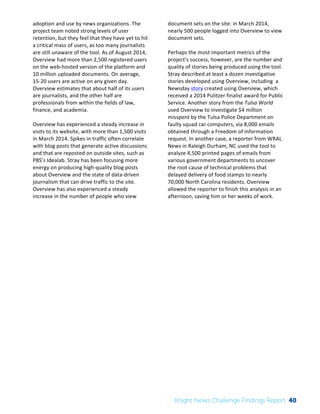
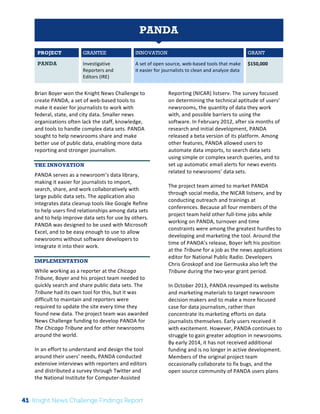
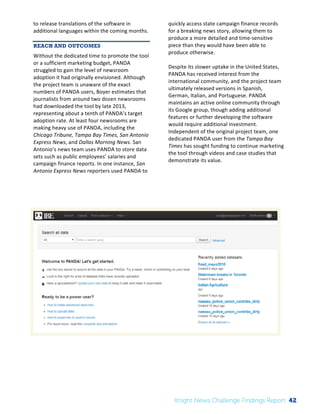
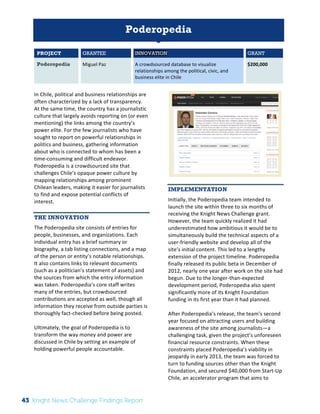
we’ve learned 
A review of the 2010 and 2011 winners 
Commissioned by The John S. and James L. Knight Foundation • Prepared by Kenneth Dautrich, The Stats Group
ABOUT THE JOHN S. AND JAMES L. KNIGHT FOUNDATION 
The John S. and James L. Knight Foundation advances journalism in the digital age 
and invests in the vitality of communities where the Knight brothers owned newspapers. 
The Knight Foundation focuses on projects that promote informed and engaged 
communities and lead to transformational change. 
This work is licensed under the Creative Commons Attribution-NonCommercial 3.0 United States License. 
To view a copy of this license, visit http://creativecommons.org/licenses/by-nc/3.0/us/ or send a letter to 
Creative Commons, 444 Castro Street, Suite 900, Mountain View, California, 94041, USA. 
1 Knight News Challenge Findings Report
Table of contents 
Executive summary 3 
2011 News Challenge Winners 6 
2010 News Challenge Winners 8 
Lessons Learned 10 
Lesson one 11 
Lesson two 13 
Lesson three 14 
Lesson four 16 
Lesson five 17 
Lesson six 18 
Lesson seven 20 
Lesson eight 22 
2010 KNC Winner Profiles 23 
2010 KNC Winner Profiles 62 
Knight News Challenge Findings Report 2
Executive Summary 
Disruption and innovation 
have become regular features 
of the news and media 
landscape. Social media feeds and 
newsreaders are replacing printed 
words and pages. Ordinary citizens 
with smartphones and Twitter or 
Instagram accounts increasingly 
stand in for trained reporters. Hacker 
journalists—wearing the hats of 
both journalist and coder—crunch 
massive data sets to find the insights 
buried within, as major news media 
organizations struggle simply to keep 
up with the crowdsourced pace of 
social media. 
That’s where the Knight News Challenge comes in. Launched in September 2006 by the John 
S. and James L. Knight Foundation, the News Challenge invests in people who are testing 
new ideas for engaging citizens with news and information. It is an open contest designed to 
accelerate innovation in the ways that we create, consume, and share news and information 
by developing new ideas to reach more people more effectively. In each round of the News 
Challenge, Knight Foundation trustees approve the winners as recommended by Knight 
staff, with the advice of outside advisers. Since its inception, the Knight News Challenge has 
provided more than $37 million to fund 111 projects in the United States and around the world. 
3 Knight News Challenge Findings Report
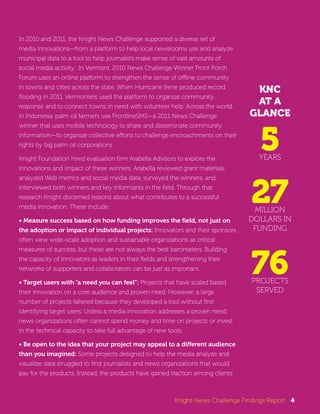
KNC 
AT A 
GLANCE 
5YEARS 
27 MILLION 
DOLLARS IN 
FUNDING 
76 PROJECTS 
SERVED 
In 2010 and 2011, the Knight News Challenge supported a diverse set of 
media innovations—from a platform to help local newsrooms use and analyze 
municipal data to a tool to help journalists make sense of vast amounts of 
social media activity. In Vermont, 2010 News Challenge Winner Front Porch 
Forum uses an online platform to strengthen the sense of offline community 
in towns and cities across the state. When Hurricane Irene produced record 
flooding in 2011, Vermonters used the platform to organize community 
response and to connect towns in need with volunteer help. Across the world, 
in Indonesia, palm oil farmers use FrontlineSMS—a 2011 News Challenge 
winner that uses mobile technology to share and disseminate community 
information—to organize collective efforts to challenge encroachments on their 
rights by big palm oil corporations. 
Knight Foundation hired evaluation firm Arabella Advisors to explore the 
innovations and impact of these winners. Arabella reviewed grant materials, 
analyzed Web metrics and social media data, surveyed the winners, and 
interviewed both winners and key informants in the field. Through that 
research Knight discerned lessons about what contributes to a successful 
media innovation. These include: 
• Measure success based on how funding improves the field, not just on 
the adoption or impact of individual projects: Innovators and their sponsors 
often view wide-scale adoption and sustainable organizations as critical 
measures of success, but these are not always the best barometers. Building 
the capacity of innovators as leaders in their fields and strengthening their 
networks of supporters and collaborators can be just as important. 
• Target users with “a need you can feel”: Projects that have scaled based 
their innovation on a core audience and proven need. However, a large 
number of projects faltered because they developed a tool without first 
identifying target users. Unless a media innovation addresses a proven need, 
news organizations often cannot spend money and time on projects or invest 
in the technical capacity to take full advantage of new tools. 
• Be open to the idea that your project may appeal to a different audience 
than you imagined: Some projects designed to help the media analyze and 
visualize data struggled to find journalists and news organizations that would 
pay for the products. Instead, the products have gained traction among clients 
Knight News Challenge Findings Report 4
in other industries. Small budgets in journalism and a lack of technical understanding 
among journalists can inhibit adoption. 
• Spend the time to get the user interface right: An intuitive user interface is vital for 
attracting and retaining users. But a simple interface can mask a high degree of planning 
and technical complexity. Innovators should not underestimate the time and expense 
behind developing such deceptively simple interfaces. 
• Provide substantial support to grantees beyond money, such as creating a cohort 
of peers and providing access to influential networks: News Challenge winners 
expressed a desire for support that comes from access to advisers who operate within 
the foundation’s network and a desire to share their experiences with other winners 
through in-person convenings that encourage the development of new connections. 
• Anticipate resistance to innovation and the disruption it will cause, and plan 
around it: Innovations frequently shake up their fields and meet with entrenched 
institutional resistance. Successful innovators anticipate such resistance and plan 
accordingly. 
• Identify the elements of a project that require full-time staff and those that 
can be entrusted to volunteers—and invest resources accordingly: An active 
community of users and evangelists can perform certain functions that are critical for 
the development of a media innovation. Other functions can only be performed by 
dedicated, compensated, full-time staff. Innovators should identify who can accomplish 
which elements early in their project, and invest accordingly. 
• Recognize the benefits and challenges of open source code: The News Challenge 
requires winners to use open source code and to publicly release it. This approach 
encourages iteration and improvement, but the benefits may be to the wider community 
instead of the challenge winner, who may bear the cost of development. 
The Knight News Challenge has evolved significantly since its inception. Knight 
continues to review the challenge and learn from the winners to help news and 
information industries navigate the disruption in traditional strategies and uncover new 
models of sustainability. 
In the pages that follow we provide additional detail on these lessons, ideas and 
insights—as well as on the progress of each of the winners of the Knight News Challenge 
from 2010 and 2011. 
5 Knight News Challenge Findings Report
2011 Knight News Challenge winners 
Project Grantee Innovation Current 
Status 
Grant 
Knight News Challenge Findings Report 6 
Awesome 
Foundation News 
Taskforce 
The Institute on 
Higher Awesome 
Studies Inc. 
A vehicle for issuing micro-grants 
to support innovative 
local journalism and civic 
media projects 
Active $244,000 
DocumentCloud 
Reader Annotations 
Investigative 
Reporters and 
Editors (IRE) 
A new DocumentCloud 
feature designed to engage 
readers by allowing them to 
add notes and comments to 
original source documents 
Active $320,000 
FrontlineSMS Social Impact 
Lab Foundation 
(formerly The 
Kiwanja Foundation) 
A platform that enables 
journalists to more effectively 
use text messaging to inform 
and engage rural communities 
Active $250,000 
iWitness Adaptive Path A Web-based tool for 
aggregating and cross-referencing 
news events with 
user-generated content 
Closed $360,000 
NextDrop NextDrop An interactive voice response 
and text message-based 
service that notifies residents 
of Hubli-Dharwad, India, when 
their water is available 
Active $375,000 
OpenBlock Rural University of North 
Carolina, Chapel Hill 
A standard process and 
structure for scraping public 
records that allows rural 
newspapers to gather, format 
and publish municipal data 
through the OpenBlock 
platform 
Closed $275,000 
Overview The Associated 
Press 
An open source tool that can 
make patterns within large 
document sets visible, helping 
journalists find stories in large 
amounts of data 
Active $475,000
Project Grantee Innovation Current 
7 Knight News Challenge Findings Report 
Status 
Grant 
PANDA Investigative 
Reporters and 
Editors (IRE) 
A set of open source, Web-based 
tools that make it easier 
for journalists to clean and 
analyze data 
Active $150,000 
Poderopedia Miguel Paz A crowdsourced database that 
visualizes relationships among 
the political, civic and business 
elite in Chile 
Active $200,000 
The Public 
Laboratory 
The Public 
Laboratory for Open 
Technology and 
Science 
An online community and set 
of toolkits that enables citizens 
to gather environmental data 
about their communities 
Active $500,000 
ScraperWiki ScraperWiki New journalist-specific 
features within an existing tool 
to collect, store and publish 
data from across the Web 
Active $280,000 
Spending Stories Open Knowledge 
Foundation 
A tool for contextualizing 
government spending data 
and improving fiscal literacy 
among journalists and the 
public 
Active $250,000 
The State Decoded The Miller Center 
Foundation 
A digital platform for parsing 
and displaying state codes, 
making laws readable and 
accessible to the average 
citizen 
Active $165,000 
StoriesFrom The Tiziano Project A storytelling platform for 
combining user-generated 
content with professional 
sources 
Closed $200,000 
SwiftRiver Ushahidi An open source platform 
that helps identify trends and 
verify user-generated content 
emerging from mobile phones 
and social media 
Active $250,000 
Zeega Media and Place 
Productions 
A platform to empower 
citizens and local news 
organizations to create 
multimedia stories about their 
communities 
Active $420,000 
Total $4,714,000
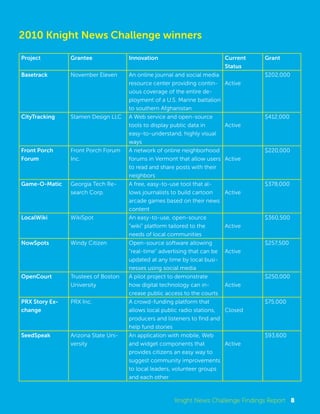
2010 Knight News Challenge winners 
Project Grantee Innovation Current 
Status 
Grant 
Basetrack November Eleven An online journal and social media 
resource center providing contin-uous 
coverage of the entire de-ployment 
of a U.S. Marine battalion 
to southern Afghanistan 
Active 
$202,000 
CityTracking Stamen Design LLC A Web service and open-source 
tools to display public data in 
easy-to-understand, highly visual 
ways 
Active 
$412,000 
Front Porch 
Forum 
Front Porch Forum 
Inc. 
A network of online neighborhood 
forums in Vermont that allow users 
to read and share posts with their 
neighbors 
Active 
$220,000 
Game-O-Matic Georgia Tech Re-search 
Corp. 
A free, easy-to-use tool that al-lows 
journalists to build cartoon 
arcade games based on their news 
content 
Active 
$378,000 
LocalWiki WikiSpot An easy-to-use, open-source 
“wiki” platform tailored to the 
needs of local communities 
Active 
$360,500 
NowSpots Windy Citizen Open-source software allowing 
“real-time” advertising that can be 
updated at any time by local busi-nesses 
using social media 
Active 
$257,500 
OpenCourt Trustees of Boston 
University 
A pilot project to demonstrate 
how digital technology can in-crease 
public access to the courts 
Active 
$250,000 
PRX Story Ex-change 
PRX Inc. A crowd-funding platform that 
allows local public radio stations, 
producers and listeners to find and 
help fund stories 
Closed 
$75,000 
SeedSpeak Arizona State Uni-versity 
An application with mobile, Web 
and widget components that 
provides citizens an easy way to 
suggest community improvements 
to local leaders, volunteer groups 
and each other 
Active 
$93,600 
Knight News Challenge Findings Report 8
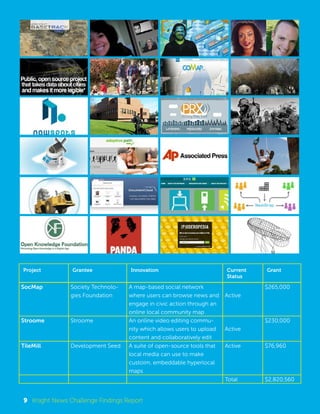
Project Grantee Innovation Current 
SocMap Society Technolo-gies 
Foundation 
A map-based social network 
where users can browse news and 
engage in civic action through an 
online local community map 
Status 
Active 
Grant 
$265,000 
Stroome Stroome An online video editing commu-nity 
which allows users to upload 
content and collaboratively edit 
Active 
$230,000 
TileMill Development Seed A suite of open-source tools that 
local media can use to make 
custoim, embeddable hyperlocal 
maps 
Active $76,960 
Total $2,820,560 
9 Knight News Challenge Findings Report
Lessons Learned 
The winners of the 2010 and 2011 Knight News Challenges 
encompass a diverse range of approaches, audiences, 
geographies, goals and technologies. However, the 
progress and challenges the winners faced illustrate common 
lessons which may apply to other innovators who seek to 
improve the ways communities produce, disseminate and 
consume news and information. 
10
Measure success based on how funding 
improves the field, not just on the 
adoption or impact of individual projects. 
The best barometer of success isn’t the outcome of 
individual projects but the effects projects may have 
on their sectors or industries. Funders should focus on 
building the capacity of innovators as leaders in their 
fields or strengthening their network of supporters and 
collaborators for long-term impact—regardless of the 
sustainability of particular projects. 
For example, in developing The State Decoded, a 2011 
winner, Waldo Jaquith hoped to build upon work in 
Virginia to make state laws more readable and accessible 
to citizens. The goal was to create a platform that could 
be adapted to state codes across the country. In doing so, 
Jaquith became a leader in the open government field. 
His success is attributable to several factors. An active 
community of users supports The State Decoded, and the 
platform has been adapted for use in a number of states 
and municipalities across the country. But Jaquith also 
set very clear goals for the project, and most importantly, 
he stuck with his original timeline. He outlined a clear 
beginning, middle and end for his involvement in The 
State Decoded, and eventually handed off its development 
to the community of open government activists and 
hackers. This has contributed to Jaquith’s leadership within 
that community. He continues to use his prominence 
to advocate for greater governmental transparency. As 
his involvement in The State Decoded was concluding, 
Jaquith launched—with Knight Foundation support—the 
Funders should 
focus on building 
the capacity 
of innovators 
as leaders in 
their fields or 
strengthening 
their network of 
supporters and 
collaborators 
for long-term 
impact— 
regardless of the 
sustainability 
of particular 
projects. 
11 Knight News Challenge Findings Report
U.S. Open Data Institute, which replicates a British effort 
to encourage governments and businesses to adopt open 
data standards as a way to promote economic growth, 
innovation and social change, demonstrating his ongoing 
leadership in the open government field. 
Investments in leadership sometimes pay off significantly 
even when products are not particularly successful or 
widely adopted. Brian Boyer developed PANDA as a set 
of Web-based tools that could serve as a newsroom’s 
data library. As conceived, PANDA would help journalists 
import, search, share and work collaboratively with 
large public data sets. Although PANDA has received 
praise for its technical sophistication and its usability, 
newsrooms have not adopted it as widely as hoped. 
The underwhelming adoption rate is partly attributable 
to the fact that Boyer and his project team were not 
able to dedicate themselves full time to developing and 
marketing PANDA. However, as he developed PANDA, 
Boyer’s stature in data journalism rose. Based on his work 
at The Chicago Tribune—and, presently, in his role as 
news applications editor at NPR—Boyer became a leader 
in the field, someone who could help bridge traditional 
journalism with the more technically sophisticated 
aspects of data analysis and visualization. Today, PANDA 
is no longer in active development, and by conventional 
measures, it failed the test of sustainability. But the project 
strengthened Boyer’s position as a leader and advocate in 
the field of data journalism—an outcome with potentially 
farther-reaching implications than that of a single tool, 
even if the tool had been widely adopted. 
Although 
PANDA has 
received praise 
for its technical 
sophistication 
and its usability, 
newsrooms 
have not 
adopted it 
as widely as 
hoped. The 
underwhelming 
adoption 
rate is partly 
attributable to 
the fact that 
Boyer and his 
project team 
were not able 
to dedicate 
themselves 
full time to 
developing 
and marketing 
PANDA. 
Knight News Challenge Findings Report 12
Target users with “a need you can feel.” 
Many News Challenge winners develop innovative tools or approaches that 
target journalists, their employers and other media organizations, but selling 
innovations to news organizations is extremely difficult because they may 
lack the money and time to spend on innovative projects or the technical 
capacity to take full advantage of new tools. The innovation may also be 
entering a market guarded by institutions that may be resistant to change. 
Fundamentally, unless an innovation addresses a pressing need, journalists 
and news organizations will not adopt it. In fact, innovators need to anticipate 
resistance, and create development and marketing plans that address it. 
Innovators may need to diversify their user bases beyond journalists and news 
organizations to promote wider adoption and project sustainability. 
In many cases, media organizations—especially in small or medium markets— 
lack not just the need for innovative tools, but also the resources and capacity 
to support ambitious technology development. One of the 2011 News 
Challenge winners, Zeega, aimed to build a platform that enabled local news 
organizations to create multimedia stories about their own communities. By 
developing an easy way to combine video clips, audio clips and images from 
a variety of sources, Zeega would make it easier for news organizations to tell 
stories in different and compelling ways. Initially, the project team provided 
consulting services to local media organizations to help them produce 
customized multimedia experiences with the Zeega tool. But they quickly 
13
found that providing custom consulting drained limited 
staff time and resources and detracted from their ability to 
develop Zeega as a product that could have appeal to a 
general audience. The local news organizations that Zeega 
had identified as its target users were not willing to pay for 
the tool. Zeega ultimately changed both its product and 
its business model. Zeega’s leaders now view the target 
audience as the wider tech-savvy population equipped 
with smartphones and tablets. 
In other cases, a real need for a new tool might exist, but 
the barriers to its adoption might simply outweigh that 
need. This is especially true in data-driven journalism. 
ScraperWiki, for example, a 2011 News Challenge winner, 
received funding to adapt its tool to help journalists collect, 
store and publish data from across the Internet. But the 
project team found that news organizations were either 
unwilling to pay for the tool or that the learning curve 
was too steep. ScraperWiki has since developed a more 
user-friendly version of its tool, but adoption rates among 
journalists remain below expectations, and ScraperWiki is 
still dependent upon non-media corporate customers to 
support development costs. 
Be open to the idea that your project 
may appeal to a different audience than 
you imagined. 
In some cases, a project’s ultimate audience or user base 
can differ dramatically from that for which it was originally 
conceived or designed. Several 2010 News Challenge 
winners made significant changes to help their projects 
In other cases, 
a real need for a 
new tool might 
exist, but the 
barriers to its 
adoption might 
simply outweigh 
that need. This 
is especially true 
in data-driven 
journalism. 
Knight News Challenge Findings Report 14
gain traction. While developing their respective tools, the 
project teams behind Stroome and Game-O-Matic tried to 
broaden their original audiences from journalists and editors 
to include citizen journalists and casual users. CityTracking 
moved in an opposite direction: Finding that journalists 
were too broad of an audience, it now focuses on serving 
the need of more technically proficient developers. 
Overview, a tool to help journalists visualize patterns 
within large sets of documents, also faced a choice about 
whether to continue serving its intended audience or to 
shift to a new model. However, the project leaders also 
had to weigh their own values about what they hoped to 
achieve within their own innovation, even if those values 
might steer them away from models that made more 
financial sense. From the outset, Overview’s target audience 
was journalists, and its mission was to empower them to 
tell stories that might otherwise remain hidden in large, 
inaccessible or disorganized document sets. As the tool 
was being developed, Overview received an increasing 
amount of interest from potential customers in finance, 
business consulting and the legal profession. Pursuing these 
clients, however, would have required a shift of emphasis, 
a shift of resources, and a shift in organizational structure. 
The project team considered reincorporating Overview 
as a for-profit venture, but they kept coming back to the 
same conclusion: Although they might be able to develop 
a for-profit venture to attract funding to finance additional 
development costs, this would necessitate a shift away from 
their original target users—journalists. The Overview team 
determined that they didn’t want to become “just another 
startup.” They wanted to focus on their original social-driven 
mission and their original users. 
As the tool was 
being developed, 
Overview 
received an 
increasing 
amount of 
interest from 
potential 
customers in 
finance, business 
consulting 
and the legal 
profession. 
Pursuing these 
clients, however, 
would have 
required a shift of 
emphasis, a shift 
of resources, 
15 Knight News Challenge Findings Report
Spend the time to get the user interface right. 
User interface can play a major role in determining whether a media 
innovation is actually adopted by its audience—an interface that’s fun 
to use or saves the user’s time can make the difference between a tool 
that’s used and one that gathers dust. Among the innovations developed 
by News Challenge winners, the most effective interfaces frequently 
have been those that appear simple or straightforward. But such user-facing 
simplicity is hard to build. The user interface of Front Porch Forum, 
for example, was deliberately designed to be clean and straightforward, 
unadorned with extraneous features. Although it is an online tool, Front 
Porch Forum’s end goal is to strengthen the sense of offline community 
in Vermont towns and cities. The project team has designed the site’s 
features and functionality around this social formula by keeping the 
interface deliberately sparse. This allows users to get what they need from 
the site and build their offline community, while discouraging them from 
spending “all day in front of a computer.” 
If media innovators aspire for wide adoption of their tools, they cannot 
overlook the development of an effective user interface; it’s often more 
important than the features or functionality of the tool itself. Indeed, 
according to Ian Bogost of Game-O-Matic, developing features and 
functionality may represent 80 to 90 percent of the effort in developing 
an innovative media tool. But that last 10 to 20 percent entails developing 
usability and polish, and that’s often the hardest part of bringing a tool to 
market. Given the fast pace of innovation in the media marketplace, News 
Challenge winners may only have one opportunity to release their tool for 
wide use. 
Knight News Challenge Findings Report 16
Provide substantial support to grantees beyond 
money, such as creating a cohort of peers and 
providing access to influential networks. 
Many 2011 News Challenge winners expressed a desire for a greater 
degree of support in building strong and resilient project teams with the 
skills necessary to develop and scale their innovations; in developing 
effective marketing strategies to find new users; and in planning for 
sustainability beyond the period of the News Challenge grant. While 
Knight may be capable of providing some of this support, access to its 
networks of thought leaders and advisers can be invaluable for grantees 
negotiating these issues. 
Just as important to the News Challenge winners, however, was 
the expertise of other winners. The 2011 winners reported that the 
opportunities to interact directly with fellow News Challenge winners— 
such as events held in Cambridge, Mass., Palo Alto, Calif., and Miami— 
proved to be extremely valuable, especially sharing information 
with projects that were either in different stages or had experienced 
similar challenges. Several winners expressed the desire for additional 
opportunities to interact with, and learn from, their fellow News 
Challenge winners. The opportunities that were most valuable were 
the in-person events in which winners could build connections with 
one another, and discover new connections with winners working in 
seemingly different arenas. 
The value of these in-person convenings of News Challenge winners 
extends beyond individual cohorts. The 2011 winners valued their 
interactions with News Challenge winners from other years, and would 
have welcomed greater opportunities to nurture those relationships. 
Winners said they were more likely to seek support and advice from 
17 Knight News Challenge Findings Report
other winners via e-mail and other means if they first met 
in person and developed some degree of familiarity. 
Anticipate resistance to innovation and 
the disruption it will cause; plan around 
it. 
Whether it takes the form of a new product or tool to 
empower citizen journalists or a new process to engage 
consumers of news and information, a media innovation 
often enters a space that is already occupied by time-tested 
methods and approaches, and one that often is 
guarded by institutions that may be resistant to change. 
These institutions may not react kindly to new innovations 
invading their space, because the innovation disrupts their 
normal course of operations. Innovators need to anticipate 
this resistance, and create development and marketing 
plans that reckon with it. 
The 2010 News Challenge winners were no strangers to 
resistance. OpenCourt, for example, sought to change the 
way that citizens of Massachusetts were connected to 
their judicial system by live-streaming court proceedings 
These institutions 
may not react 
kindly to new 
innovations 
invading their 
space, because 
the innovation 
disrupts their 
normal course 
of operations. 
Innovators need 
to anticipate 
this resistance, 
and create 
development and 
marketing plans 
that reckon with 
it. 
Knight News Challenge Findings Report 18
and trials in Quincy. But this represented a fairly radical 
change in how the court system in Quincy interacted 
with the media and with citizens at large, and OpenCourt 
faced numerous lawsuits that attempted to prevent it from 
streaming trial footage. Ultimately, OpenCourt prevailed 
on appeal to the Massachusetts Supreme Court, setting 
the precedent that OpenCourt—or other innovators in 
Massachusetts—could install cameras in courtrooms and 
broadcast their proceedings on the Internet. It succeeded 
in part because John Davidow, the project director, 
anticipated the strong institutional resistance he would 
face, prepared for it and had the support to persevere in 
the face of litigation and delays. Perhaps most importantly, 
the project had the benefit of an established home— 
Boston University—which paid for OpenCourt’s legal 
expenses as it fended off resistance. 
Basetrack represents another example of a News 
Challenge project that sought to shake up institutional 
norms. In its effort to create an online, social media 
reporting network, it embedded a team of reporters 
and photojournalists with the 1st Battalion, 8th Marine 
Regiment during its deployment to Afghanistan. The 
military has strict rules governing how journalists can 
embed with deployed units in combat zones, and it was 
no small achievement that the project was able to embed 
with the Marine unit in the first place. Only a few months 
after deployment, however, the Marines asked Basetrack 
to cease its project, due principally to concerns that the 
project’s location-based reporting was revealing sensitive 
information about the position of U.S. forces. If the Marines 
were uncomfortable with the location data that Basetrack 
was providing, however, they could have worked with the 
project to remove the potentially dangerous information. 
But fundamentally, the military was extremely wary about 
Certain important 
elements of a 
project—such 
as product 
promotion 
and content 
creation—can 
be outsourced 
in some cases 
to users, 
evangelists, and 
the open source 
community. But 
other critical 
elements—such 
as core software 
development, 
business 
development, 
and fundraising— 
should generally 
be entrusted to 
dedicated, paid 
project staff. 
19 Knight News Challenge Findings Report
unconventional efforts to report news from the battlefields and there was a 
limit to how far Basetrack could push the military’s standard practices regarding 
journalists. 
Identify the elements of a project that require full-time 
staff and those that can be entrusted to volunteers— 
and invest resources accordingly. 
Many projects plan at the outset to rely upon a dedicated user community to 
refine and promote an innovation, and upon vocal evangelists to drive wider 
adoption of their tools. In many cases, user communities and evangelists can 
become indispensable (and inexpensive) cornerstones of a project, especially 
when a project is dependent upon open source development. But without a 
core group of paid staff with the skills, the time, and the incentive to devote 
themselves full time to a project, development of a tool can suffer. Certain 
important elements of a project—such as product promotion and content 
creation—can be outsourced in some cases to users, evangelists and the 
open source community. But other critical elements—such as core software 
development, business development and fundraising—should generally be 
entrusted to dedicated, paid project staff. 
Knight News Challenge Findings Report 20
When it comes to staff, passion alone is not sufficient— 
full-time commitment is often necessary, along with 
the money to make that a reality. The Tiziano Project, 
for example, won 2011 News Challenge funding to 
develop and refine its proprietary storytelling platform 
into StoriesFrom, which would combine user-generated 
content with content from professional journalists to 
tell news stories in more compelling ways. Relying 
on the strong reputation of its existing platform and 
on the enthusiasm of the founders, the project team 
experienced initial success in terms of developing 
partnerships and launched its platform ahead of 
schedule. But it quickly faced challenges related to its 
staffing model. Prior to winning the News Challenge, 
the Tiziano Project team consisted of highly motivated 
volunteers. The team dedicated a portion of its News 
Challenge award to paying for a full-time project 
manager and to providing part-time compensation 
for other team members. But this ultimately proved 
to be a significant underinvestment. The part-time 
team members lost the sense of commitment and 
excitement they had possessed as pure volunteers, 
while not being compensated to a degree sufficient to 
capture their full attention and energy. In addition, the 
team did not invest in staff dedicated to fundraising or 
business development. They had assumed that once 
the initial partnerships were forged, users would find 
StoriesFrom, use the platform and organically raise the 
visibility of the platform. As it happened, without a full-time 
staff member dedicated to business development 
and partnership management, momentum behind the 
project quickly slowed. The initial enthusiasm that users 
and partners expressed for the project faded as well, 
and without the investment in full-time staff to carry the 
work forward, the project faltered. 
It is entirely 
conceivable that 
the winner might 
bear the cost of 
developing open 
source code, 
without receiving 
an equivalent 
or offsetting 
benefit, which 
might accrue to 
someone else 
entirely. 
21 Knight News Challenge Findings Report
Recognize the benefits and challenges of 
open source code. 
The requirement that News Challenge winners use open source 
code and publicly release any code they create has definite 
advantages. It encourages iteration and improvement, and it can 
magnify the impact of the winners’ work. DocumentCloud— 
which first won the News Challenge in 2009—produced 
Backbone.js, an open source JavaScript library that has since 
become a fundamental and widely used component for building 
Web-based applications, and in the words of one key observer, 
has proven “sufficient to justify the entire cost of the News 
Challenge.” But the open source requirement is not an absolute 
good, especially for News Challenge projects that include the 
scaling of an existing product or tool and that already have an 
established method for code development and dissemination. 
Front Porch Forum, a 2010 winner, represented such a case, with 
the project team reporting that the open source requirement 
was a drain on valuable time and resources, and that it provided 
little—if any—value to the project. 
It is also important to consider where the benefits of open source 
accrue. In some cases, the News Challenge winners themselves 
benefit from using and sharing open source code. In other cases, 
it is the wider community of developers that benefits most. It 
is entirely conceivable that the winner might bear the cost of 
developing open source code, without receiving an equivalent or 
offsetting benefit, which might accrue to someone else entirely. 
It is important to consider such implications on a winner-by-winner 
basis, and to be flexible with grant terms and conditions 
to create an arrangement that will be most supportive of 
innovators’ efforts. The open source requirement could also be 
improved and implemented in a way that grants more flexibility 
in the types of open source licenses that winners can use. 
Knight News Challenge Findings Report 22
2011 KNC Winner Profiles 
Awesome Foundation 24 
DocumentCloud 25 
Frontline SMS 28 
iWitness 31 
NextDrop 33 
Open Block Rural 36 
Overview 38 
Panda 41 
Poderopedia 43 
The Public Laboratory 46 
ScraperWiki 49 
Spending Stories 52 
StoriesFrom 55 
Swift River 58 
The State Decoded 60 
23 Knight News Challenge Findings Report
The 
Knight 
News 
Challenge: 
A 
Review 
of 
the 
2011 
Winners 
1 
Awesome Foundation News Taskforce 
PROJECT GRANTEE INNOVATION GRANT 
Awesome 
The 
Institute 
on 
A 
vehicle 
for 
issuing 
micro-­‐grants 
to 
support 
Foundation 
Higher 
Awesome 
innovative 
local 
journalism 
and 
civic 
media 
News 
Studies, 
Inc. 
projects 
Taskforce 
$244,000 
The 
Awesome 
Foundation 
establishes 
autonomous 
chapters 
of 
trustees 
in 
cities 
around 
the 
world 
that 
distribute 
monthly 
micro-­‐ 
grants 
to 
compelling 
projects 
in 
their 
communities. 
The 
foundation 
received 
Knight 
News 
Challenge 
funding 
to 
apply 
its 
model 
for 
community-­‐based 
financing 
to 
the 
field 
of 
journalism 
and 
to 
open 
chapters 
with 
an 
exclusive 
focus 
on 
local 
news 
projects. 
THE INNOVATION 
Each 
chapter 
of 
the 
Awesome 
Foundation 
awards 
one 
$1,000 
micro-­‐grant 
per 
month 
to 
an 
exciting 
local 
project 
or 
organization. 
Chapter 
trustees 
are 
given 
full 
autonomy 
over 
grant-­‐ 
making 
decisions, 
a 
structure 
which 
empowers 
them 
to 
use 
their 
local 
expertise 
to 
determine 
which 
projects 
would 
be 
most 
useful 
for 
their 
communities. 
The 
small 
scale 
of 
each 
grant 
also 
encourages 
effective 
and 
efficient 
projects 
that 
might 
be 
otherwise 
overlooked 
by 
larger 
foundations 
that 
typically 
give 
out 
larger 
grants. 
The 
Awesome 
Foundation 
has 
started 
two 
chapters 
dedicated 
to 
journalism 
innovation 
so 
far, 
in 
Detroit 
and 
New 
Orleans. 
Early 
micro-­‐ 
grants 
have 
been 
awarded 
to 
a 
wide 
range 
of 
media 
projects, 
including 
photo 
documentaries, 
print 
shops, 
and 
city 
guides. 
Ultimately, 
the 
Awesome 
Foundation 
aims 
to 
foster 
local 
news 
communities 
by 
scaling 
its 
News 
Taskforce 
model 
to 
more 
cities 
around 
the 
United 
States. 
IMPLEMENTATION 
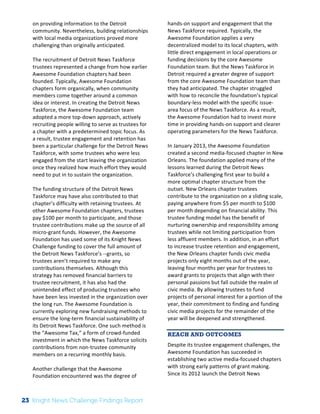
The 
first 
News 
Taskforce 
chapter 
was 
established 
in 
Detroit 
in 
January 
2012 
and 
awarded 
its 
first 
grant 
in 
March 
2012 
to 
the 
Detroit 
Journal, 
for 
a 
short 
film 
series 
featuring 
everyday 
Detroit 
citizens. 
Because 
the 
Awesome 
Foundation 
is 
headquartered 
in 
Massachusetts, 
a 
Detroit-­‐based 
staffer 
(referred 
to 
as 
“the 
Dean 
of 
Awesome”) 
was 
hired 
to 
oversee 
trustee 
recruitment 
and 
manage 
the 
logistical 
aspects 
of 
building 
a 
chapter 
from 
scratch. 
With 
only 
one 
journalist 
on 
the 
inaugural 
trustee 
team, 
the 
Detroit 
News 
Taskforce 
spent 
much 
of 
its 
first 
six 
months 
consulting 
with 
area 
journalists 
to 
set 
parameters 
around 
what 
would 
qualify 
as 
a 
journalism-­‐related 
project 
for 
the 
purposes 
of 
their 
grant 
making. 
Ultimately, 
the 
trustees 
opted 
to 
broaden 
the 
scope 
of 
grant-­‐eligible 
projects 
beyond 
newspaper-­‐ 
and 
magazine-­‐ 
centric 
proposals 
to 
include 
any 
project 
focused 
Knight News Challenge Findings Report 24
The 
Knight 
News 
Challenge: 
A 
Review 
of 
the 
2011 
Winners 
2 
on 
providing 
information 
to 
the 
Detroit 
community. 
Nevertheless, 
building 
relationships 
with 
local 
media 
organizations 
proved 
more 
challenging 
than 
originally 
anticipated. 
The 
recruitment 
of 
Detroit 
News 
Taskforce 
trustees 
represented 
a 
change 
from 
how 
earlier 
Awesome 
Foundation 
chapters 
had 
been 
founded. 
Typically, 
Awesome 
Foundation 
chapters 
form 
organically, 
when 
community 
members 
come 
together 
around 
a 
common 
idea 
or 
interest. 
In 
creating 
the 
Detroit 
News 
Taskforce, 
the 
Awesome 
Foundation 
team 
adopted 
a 
more 
top-­‐down 
approach, 
actively 
recruiting 
people 
willing 
to 
serve 
as 
trustees 
for 
a 
chapter 
with 
a 
predetermined 
topic 
focus. 
As 
a 
result, 
trustee 
engagement 
and 
retention 
has 
been 
a 
particular 
challenge 
for 
the 
Detroit 
News 
Taskforce, 
with 
some 
trustees 
who 
were 
less 
engaged 
from 
the 
start 
leaving 
the 
organization 
once 
they 
realized 
how 
much 
effort 
they 
would 
need 
to 
put 
in 
to 
sustain 
the 
organization. 
The 
funding 
structure 
of 
the 
Detroit 
News 
Taskforce 
may 
have 
also 
contributed 
to 
that 
chapter’s 
difficulty 
with 
retaining 
trustees. 
At 
other 
Awesome 
Foundation 
chapters, 
trustees 
pay 
$100 
per 
month 
to 
participate, 
and 
those 
trustee 
contributions 
make 
up 
the 
source 
of 
all 
micro-­‐grant 
funds. 
However, 
the 
Awesome 
Foundation 
has 
used 
some 
of 
its 
Knight 
News 
Challenge 
funding 
to 
cover 
the 
full 
amount 
of 
the 
Detroit 
News 
Taskforce’s 
-­‐-­‐grants, 
so 
trustees 
aren’t 
required 
to 
make 
any 
contributions 
themselves. 
Although 
this 
strategy 
has 
removed 
financial 
barriers 
to 
trustee 
recruitment, 
it 
has 
also 
had 
the 
unintended 
effect 
of 
producing 
trustees 
who 
have 
been 
less 
invested 
in 
the 
organization 
over 
the 
long 
run. 
The 
Awesome 
Foundation 
is 
currently 
exploring 
new 
fundraising 
methods 
to 
ensure 
the 
long-­‐term 
financial 
sustainability 
of 
its 
Detroit 
News 
Taskforce. 
One 
such 
method 
is 
the 
“Awesome 
Tax,” 
a 
form 
of 
crowd-­‐funded 
investment 
in 
which 
the 
News 
Taskforce 
solicits 
contributions 
from 
non-­‐trustee 
community 
members 
on 
a 
recurring 
monthly 
basis. 
Another 
challenge 
that 
the 
Awesome 
Foundation 
encountered 
was 
the 
degree 
of 
hands-­‐on 
support 
and 
engagement 
that 
the 
News 
Taskforce 
required. 
Typically, 
the 
Awesome 
Foundation 
applies 
a 
very 
decentralized 
model 
to 
its 
local 
chapters, 
with 
little 
direct 
engagement 
in 
local 
operations 
or 
funding 
decisions 
by 
the 
core 
Awesome 
Foundation 
team. 
But 
the 
News 
Taskforce 
in 
Detroit 
required 
a 
greater 
degree 
of 
support 
from 
the 
core 
Awesome 
Foundation 
team 
than 
they 
had 
anticipated. 
The 
chapter 
struggled 
with 
how 
to 
reconcile 
the 
foundation’s 
typical 
boundary-­‐less 
model 
with 
the 
specific 
issue-­‐ 
area 
focus 
of 
the 
News 
Taskforce. 
As 
a 
result, 
the 
Awesome 
Foundation 
had 
to 
invest 
more 
time 
in 
providing 
hands-­‐on 
support 
and 
clearer 
operating 
parameters 
for 
the 
News 
Taskforce. 
In 
January 
2013, 
the 
Awesome 
Foundation 
created 
a 
second 
media-­‐focused 
chapter 
in 
New 
Orleans. 
The 
foundation 
applied 
many 
of 
the 
lessons 
learned 
during 
the 
Detroit 
News 
Taskforce’s 
challenging 
first 
year 
to 
build 
a 
more 
optimal 
chapter 
structure 
from 
the 
outset. 
New 
Orleans 
chapter 
trustees 
contribute 
to 
the 
organization 
on 
a 
sliding 
scale, 
paying 
anywhere 
from 
$5 
per 
month 
to 
$100 
per 
month 
depending 
on 
financial 
ability. 
This 
trustee 
funding 
model 
has 
the 
benefit 
of 
nurturing 
ownership 
and 
responsibility 
among 
trustees 
while 
not 
limiting 
participation 
from 
less 
affluent 
members. 
In 
addition, 
in 
an 
effort 
to 
increase 
trustee 
retention 
and 
engagement, 
the 
New 
Orleans 
chapter 
funds 
civic 
media 
projects 
only 
eight 
months 
out 
of 
the 
year, 
leaving 
four 
months 
per 
year 
for 
trustees 
to 
award 
grants 
to 
projects 
that 
align 
with 
their 
personal 
passions 
but 
fall 
outside 
the 
realm 
of 
civic 
media. 
By 
allowing 
trustees 
to 
fund 
projects 
of 
personal 
interest 
for 
a 
portion 
of 
the 
year, 
their 
commitment 
to 
finding 
and 
funding 
civic 
media 
projects 
for 
the 
remainder 
of 
the 
year 
will 
be 
deepened 
and 
strengthened. 
REACH AND OUTCOMES 
Despite 
its 
trustee 
engagement 
challenges, 
the 
Awesome 
Foundation 
has 
succeeded 
in 
establishing 
two 
active 
media-­‐focused 
chapters 
with 
strong 
early 
patterns 
of 
grant 
making. 
Since 
its 
2012 
launch 
the 
Detroit 
News 
23 Knight News Challenge Findings Report
The 
Knight 
News 
Challenge: 
A 
Review 
of 
the 
2011 
Winners 
3 
Taskforce 
has 
awarded 
$24,000 
in 
funding 
to 
24 
Detroit-­‐area 
media 
projects. 
The 
Awesome 
New 
Orleans 
chapter 
has 
awarded 
$9,000 
to 
nine 
projects 
since 
its 
first 
grant 
in 
April 
2013, 
six 
of 
which 
have 
had 
a 
significant 
media 
element. 
Examples 
of 
funded 
projects 
include 
an 
initiative 
to 
raise 
awareness 
about 
the 
importance 
of 
voting 
in 
local 
elections, 
a 
newspaper 
supplement 
written 
by 
children 
and 
young 
adults, 
and 
a 
literacy 
and 
arts 
festival. 
The 
Detroit 
and 
New 
Orleans 
grant 
recipients 
have 
thus 
far 
met 
with 
mixed 
success. 
Some 
have 
won 
funding 
from 
other, 
larger 
foundations. 
Other 
project 
creators 
have 
had 
compelling 
ideas, 
but 
have 
ultimately 
lacked 
the 
necessary 
resources 
to 
scale 
their 
projects 
beyond 
the 
local 
level. 
Finding 
projects 
to 
support 
that 
are 
both 
relevant 
to 
a 
local 
community 
and 
have 
the 
business 
capacity 
to 
expand 
regionally 
or 
nationally 
has 
proved 
more 
difficult 
than 
the 
Awesome 
Foundation 
team 
initially 
anticipated. 
The 
Awesome 
Foundation 
team, 
however, 
has 
discovered 
that 
$1,000 
awards 
have 
benefitted 
winners 
beyond 
the 
value 
of 
modest 
grant 
amount 
itself. 
The 
Awesome 
Foundation 
model 
has 
shown 
promise 
as 
a 
method 
of 
identifying 
innovators 
who 
are 
likely 
to 
do 
good 
work 
in 
the 
future, 
regardless 
of 
whether 
their 
winning 
project 
succeeds 
or 
fails. 
As 
its 
winner 
list 
grows, 
the 
foundation 
has 
also 
made 
a 
greater 
effort 
to 
connect 
winners 
with 
one 
another, 
and 
in 
some 
cases, 
this 
has 
resulted 
in 
winners 
sharing 
resources 
and 
offering 
mutual 
support. 
In 
2014, 
the 
Awesome 
Foundation’s 
main 
goal 
for 
the 
News 
Taskforces 
is 
to 
sustain 
the 
Detroit 
and 
New 
Orleans 
chapters 
without 
grant 
funding 
with 
a 
combination 
of 
trustee 
contributions 
and 
local 
business 
sponsorship. 
The 
Awesome 
Foundation 
team 
also 
intends 
to 
be 
more 
deliberate 
about 
facilitating 
relationships 
between 
particularly 
promising 
winners 
and 
larger 
funders 
like 
the 
Knight 
Foundation. 
Knight News Challenge Findings Report 24
The 
Knight 
News 
Challenge: 
A 
Review 
of 
the 
2011 
Winners 
1 
DocumentCloud Reader Annotations 
PROJECT GRANTEE INNOVATION GRANT 
Document 
Cloud 
Investigative 
Reporters 
and 
Editors 
(IRE) 
A 
new 
DocumentCloud 
feature 
designed 
to 
engage 
readers 
by 
allowing 
them 
to 
add 
notes 
and 
comments 
to 
original 
source 
documents 
$320,000 
DocumentCloud 
won 
a 
Knight 
News 
Challenge 
grant 
in 
2009 
to 
build 
a 
tool 
that 
helps 
journalists 
analyze, 
annotate, 
and 
publish 
original 
source 
documents. 
The 
project 
has 
experienced 
a 
great 
deal 
of 
success: 
it 
continues 
to 
gain 
adoption 
in 
newsrooms 
and 
grow. 
DocumentCloud 
was 
also 
instrumental 
in 
the 
development 
of 
Backbone.js, 
which 
is 
one 
of 
the 
most 
important 
Javascript 
libraries 
used 
in 
web 
development 
today. 
In 
2011, 
DocumentCloud 
again 
won 
the 
News 
Challenge, 
this 
time 
to 
incorporate 
the 
ability 
to 
add 
reader 
annotations 
to 
source 
documents—a 
new 
feature 
that 
would 
allow 
newsrooms 
to 
invite 
the 
public 
to 
annotate 
and 
comment 
on 
source 
documents. 
THE INNOVATION 
DocumentCloud 
is 
an 
open 
source, 
web-­‐based 
platform 
that 
helps 
journalists 
analyze, 
annotate, 
and 
publish 
original 
source 
documents. 
To 
date, 
almost 
1,100 
organizations 
use 
DocumentCloud 
to 
store 
and 
share 
source 
documents 
with 
readers. 
Journalists 
can 
already 
annotate 
documents 
using 
the 
tool, 
and 
many 
users 
have 
requested 
a 
similar 
feature 
that 
would 
allow 
them 
to 
add 
notes 
and 
comments 
to 
documents 
as 
well. 
Adding 
a 
reader 
annotations 
feature 
would 
allow 
DocumentCloud 
to 
be 
used 
not 
only 
to 
link 
stories 
to 
raw 
documents, 
but 
also 
to 
crowdsource 
document 
annotation, 
allowing 
journalists 
to 
review 
massive 
amounts 
of 
documents 
faster 
with 
help 
from 
the 
public. 
The 
feature 
will 
help 
journalists 
involve 
their 
readers 
in 
the 
process 
of 
reporting 
and 
analyzing 
news 
events 
and 
will 
improve 
DocumentCloud 
as 
a 
tool 
and 
resource 
for 
investigative 
reporting. 
IMPLEMENTATION 
DocumentCloud 
began 
through 
collaboration 
between 
journalists 
at 
The 
New 
York 
Times 
and 
ProPublica. 
Following 
the 
announcement 
of 
their 
second 
News 
Challenge 
award, 
the 
project 
changed 
hands 
when 
DocumentCloud 
was 
acquired 
by 
Investigative 
Reporters 
and 
Editors 
(IRE), 
a 
nonprofit 
membership 
organization 
based 
at 
the 
University 
of 
Missouri. 
As 
of 
early 
2014, 
DocumentCloud 
has 
yet 
to 
deploy 
its 
public-­‐facing 
reader 
annotations 
feature. 
It 
is 
still 
in 
the 
process 
of 
developing 
and 
beta 
testing 
the 
feature 
with 
several 
newsrooms. 
Several 
factors 
delayed 
its 
release, 
the 
most 
notable 
of 
which 
was 
the 
challenge 
of 
trying 
to 
accomplish 
three 
discrete 
tasks 
at 
the 
same 
time: 
maintaining 
the 
platform 
at 
its 
current 
level 
of 
functionality, 
managing 
growth 
of 
the 
user 
base, 
and 
adding 
new 
features 
and 
functionality. 
DocumentCloud 
struggled 
with 
whether 
to 
allow 
readers 
to 
comment 
anonymously 
and 
with 
determining 
the 
best 
way 
to 
integrate 
reader 
comments 
into 
news 
organizations’ 
content 
management 
systems. 
Like 
many 
commenting 
features, 
it 
decided 
to 
link 
readers’ 
comments 
to 
their 
social 
media 
accounts 
(Facebook 
and 
Twitter) 
so 
they 
could 
not 
remain 
anonymous. 
The 
project 
team 
created 
a 
test 
version 
of 
the 
annotations 
tool 
early 
in 
its 
two-­‐year 
grant 
period 
and 
used 
journalists’ 
feedback 
to 
help 
shape 
further 
development. 
User 
feedback 
pointed 
out 
additional 
improvements 
and 
modifications 
needed 
to 
improve 
the 
functionality 
of 
both 
the 
public 
annotation 
tool 
and 
other 
elements 
of 
DocumentCloud. 
Feedback 
indicated 
that 
the 
team 
needed 
to 
rebuild 
its 
document 
viewer 
so 
that 
public 
annotations 
could 
be 
stacked 
in 
a 
25 Knight News Challenge Findings Report
The 
Knight 
News 
Challenge: 
A 
Review 
of 
the 
2011 
Winners 
2 
legible 
and 
uncluttered 
way, 
and 
that 
the 
project 
team 
needed 
to 
improve 
DocumentCloud’s 
mobile 
version 
to 
allow 
for 
easier 
viewing 
of 
reader 
comments. 
Meanwhile, 
DocumentCloud’s 
rapid 
growth 
placed 
additional 
demands 
on 
its 
technical 
system 
and 
on 
the 
capacity 
of 
its 
project 
team 
at 
IRE. 
With 
more 
users 
came 
technical 
challenges 
of 
needing 
to 
improve 
the 
platform’s 
speed 
and 
its 
capacity 
to 
hold 
larger, 
more 
complex 
document 
sets. 
DocumentCloud 
will 
be 
working 
on 
its 
sustainability 
planning 
with 
help 
from 
outside 
consultants 
throughout 
2014 
and 
is 
considering 
various 
models 
for 
generating 
revenue 
into 
the 
future. 
As 
of 
March 
2014, 
it 
was 
still 
in 
the 
process 
of 
beta 
testing 
the 
reader 
annotations 
with 
partnering 
journalists 
and 
planned 
to 
release 
the 
feature 
later 
in 
2014. 
Once 
released, 
IRE’s 
executive 
director, 
Mark 
Horvit, 
believes 
reader 
comments 
ideally 
will 
be 
project 
specific, 
and 
used 
in 
cases 
where 
news 
organizations 
would 
gather 
facts/analysis 
from 
readers 
or 
the 
readers’ 
opinions. 
For 
example, 
a 
newsroom 
may 
use 
the 
tool 
to 
allow 
readers 
to 
comment 
on 
the 
collection 
of 
Sarah 
Palin’s 
leaked 
emails, 
or 
to 
allow 
readers 
to 
flag 
items 
within 
public 
expenditure 
data. 
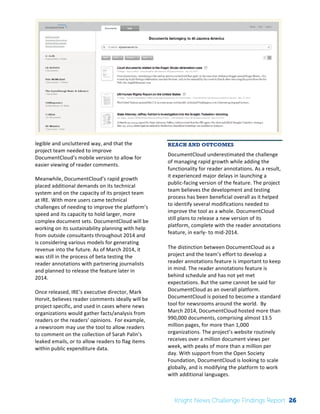
REACH AND OUTCOMES 
DocumentCloud 
underestimated 
the 
challenge 
of 
managing 
rapid 
growth 
while 
adding 
the 
functionality 
for 
reader 
annotations. 
As 
a 
result, 
it 
experienced 
major 
delays 
in 
launching 
a 
public-­‐facing 
version 
of 
the 
feature. 
The 
project 
team 
believes 
the 
development 
and 
testing 
process 
has 
been 
beneficial 
overall 
as 
it 
helped 
to 
identify 
several 
modifications 
needed 
to 
improve 
the 
tool 
as 
a 
whole. 
DocumentCloud 
still 
plans 
to 
release 
a 
new 
version 
of 
its 
platform, 
complete 
with 
the 
reader 
annotations 
feature, 
in 
early-­‐ 
to 
mid-­‐2014. 
The 
distinction 
between 
DocumentCloud 
as 
a 
project 
and 
the 
team’s 
effort 
to 
develop 
a 
reader 
annotations 
feature 
is 
important 
to 
keep 
in 
mind. 
The 
reader 
annotations 
feature 
is 
behind 
schedule 
and 
has 
not 
yet 
met 
expectations. 
But 
the 
same 
cannot 
be 
said 
for 
DocumentCloud 
as 
an 
overall 
platform. 
DocumentCloud 
is 
poised 
to 
become 
a 
standard 
tool 
for 
newsrooms 
around 
the 
world. 
By 
March 
2014, 
DocumentCloud 
hosted 
more 
than 
990,000 
documents, 
comprising 
almost 
13.5 
million 
pages, 
for 
more 
than 
1,000 
organizations. 
The 
project’s 
website 
routinely 
receives 
over 
a 
million 
document 
views 
per 
week, 
with 
peaks 
of 
more 
than 
a 
million 
per 
day. 
With 
support 
from 
the 
Open 
Society 
Foundation, 
DocumentCloud 
is 
looking 
to 
scale 
globally, 
and 
is 
modifying 
the 
platform 
to 
work 
with 
additional 
languages. 
Knight News Challenge Findings Report 26
The 
Knight 
News 
Challenge: 
A 
Review 
of 
the 
2011 
Winners 
3 
Even 
with 
its 
success, 
planning 
for 
long-­‐term 
sustainability 
is 
a 
key 
challenge 
for 
DocumentCloud. 
The 
project 
received 
a 
separate 
grant 
to 
fund 
its 
strategic 
planning 
work 
with 
a 
group 
of 
outside 
consultants. 
Planning 
is 
still 
underway, 
and 
the 
team 
is 
considering 
options 
for 
generating 
revenue 
which 
might 
include 
the 
creation 
of 
paid 
add-­‐on 
features 
or 
the 
creation 
of 
a 
paid 
platform 
targeted 
toward 
other 
industries. 
27 Knight News Challenge Findings Report
FrontlineSMS 
PROJECT GRANTEE INNOVATION GRANT 
FrontlineSMS Social 
Impact 
Lab 
(formerly 
The 
Kiwanja 
Foundation) 
A 
platform 
that 
enables 
journalists 
to 
more 
effectively 
use 
text 
messaging 
to 
inform 
and 
engage 
rural 
communities 
$250,000 
Mobile 
phones 
are 
increasingly 
common 
even 
in 
developing 
countries 
with 
low 
literacy 
rates 
and 
large 
rural 
populations. 
SMS 
and 
MMS 
messaging 
(text 
messaging) 
are 
similarly 
popular 
and 
are 
among 
the 
most 
effective 
ways 
to 
quickly 
reach 
large 
numbers 
of 
people 
in 
many 
communities. 
Although 
many 
tools 
for 
communicating 
with 
people 
via 
mobile 
phones 
exist, 
few 
SMS 
management 
systems 
are 
designed 
specifically 
for 
journalists 
and 
news 
organizations. 
FrontlineSMS 
was 
awarded 
News 
Challenge 
funding 
in 
2011 
to 
expand 
and 
improve 
its 
existing 
platform, 
which 
enables 
users 
in 
developing 
and 
rural 
areas 
to 
organize 
interactions 
with 
large 
numbers 
of 
people 
via 
SMS, 
and 
to 
tailor 
this 
platform 
to 
the 
needs 
of 
journalists 
and 
news 
organizations 
around 
the 
world. 
THE INNOVATION 
Introduced 
in 
2005, 
FrontlineSMS 
is 
an 
open 
source 
platform 
that 
enables 
users 
in 
areas 
with 
poor 
communications 
infrastructures 
to 
disseminate 
and 
exchange 
information 
with 
large 
numbers 
of 
people 
over 
cell 
phone 
networks 
without 
the 
need 
for 
the 
internet. 
The 
first 
version 
of 
FrontlineSMS 
was 
a 
free 
desktop 
application 
that 
allowed 
users 
to 
reach 
large 
groups 
via 
text 
messages, 
using 
just 
a 
laptop 
and 
a 
mobile 
phone. 
FrontlineSMS 
was 
awarded 
News 
Challenge 
funding 
to 
further 
develop 
its 
software 
for 
use 
by 
journalists 
and 
to 
work 
with 
community 
news 
organizations 
and 
radio 
stations 
to 
more 
effectively 
use 
text 
messaging 
to 
inform 
and 
engage 
rural 
communities. 
The 
project 
later 
developed 
FrontlineCloud, 
a 
similar, 
web-­‐hosted 
platform 
that 
allows 
users 
to 
log 
in 
wherever 
they 
have 
internet 
access 
and 
to 
run 
projects 
remotely. 
IMPLEMENTATION 
At 
the 
outset 
of 
its 
News 
Challenge 
grant, 
the 
FrontlineSMS 
team 
intended 
to 
expand 
its 
original 
application 
and 
release 
a 
specific 
plug-­‐ 
in 
for 
use 
by 
journalists 
and 
community 
news 
organizations. 
The 
team 
hired 
Trevor 
Knoblich 
as 
its 
media 
project 
director 
and 
revised 
its 
original 
plans 
to 
include 
a 
research 
and 
consultation 
phase 
to 
gather 
feedback 
on 
the 
needs 
of 
rural 
media 
outlets 
and 
organizations 
already 
familiar 
with 
FrontlineSMS. 
After 
surveys 
and 
extensive 
interviews 
with 
members 
of 
media 
outlets 
from 
around 
the 
world, 
FrontlineSMS 
found 
that 
news 
organizations 
hoped 
to 
use 
the 
tool 
in 
three 
ways: 
• To 
disseminate 
news 
headlines, 
tips, 
or 
follow-­‐ups 
to 
long-­‐form 
pieces 
to 
large 
subscription 
lists 
• To 
coordinate 
staff, 
freelancers, 
photographers, 
and 
citizen 
journalists 
• To 
solicit 
requests 
for 
information 
via 
a 
dedicated 
phone 
line 
(“Text 
us 
if 
you 
see 
harassment 
in 
your 
neighborhood,” 
for 
example) 
FrontlineSMS 
released 
the 
second 
version 
of 
its 
original 
modem-­‐based 
platform 
in 
June 
2012 
using 
its 
News 
Challenge 
funding. 
Within 
the 
first 
fourteen 
months 
of 
its 
release, 
version 
two 
of 
FrontlineSMS 
was 
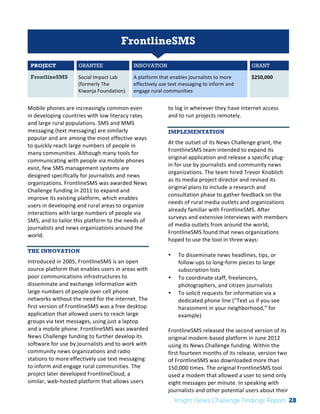
downloaded 
more 
than 
150,000 
times. 
The 
original 
FrontlineSMS 
tool 
used 
a 
modem 
that 
allowed 
a 
user 
to 
send 
only 
eight 
messages 
per 
minute. 
In 
speaking 
with 
journalists 
and 
other 
potential 
users 
about 
their 
Knight News Challenge Findings Report 28
FrontlineSMS Users 
15000 
12000 
9000 
6000 
3000 
The 
Knight 
News 
Challenge: 
A 
Review 
of 
the 
2011 
Winners 
1 
needs, 
however, 
the 
FrontlineSMS 
team 
realized 
that 
media 
outlets 
preferred 
an 
online 
mechanism 
for 
managing 
their 
mobile 
communications. 
News 
organizations 
also 
needed 
a 
tool 
that 
would 
allow 
them 
to 
send 
urgent 
news 
alerts 
to 
a 
larger 
audience 
more 
quickly. 
In 
response, 
the 
team 
began 
developing 
FrontlineCloud, 
the 
web-­‐based 
version 
of 
FrontlineSMS. 
Unlike 
FrontlineSMS, 
FrontlineCloud 
requires 
internet 
access. 
But 
it 
provides 
news 
organizations 
and 
journalists 
with 
a 
more 
flexible 
option 
for 
disseminating 
news 
headlines 
and 
information. 
In 
early 
2014, 
FrontlineCloud 
was 
still 
in 
the 
beta 
testing 
phase. 
The 
team 
was 
also 
working 
to 
build 
an 
interoperable 
product 
set 
that 
would 
allow 
users 
to 
smoothly 
transition 
between 
online 
use 
with 
FrontlineCloud 
and 
offline 
use 
with 
FrontlineSMS. 
FrontlineSMS 
continues 
to 
offer 
a 
range 
of 
premium 
user 
support 
and 
paid-­‐for 
consulting 
services 
to 
provide 
an 
additional 
revenue 
stream 
to 
support 
its 
work. 
These 
services 
include 
mobile 
integration 
and 
program 
design 
assistance, 
staff 
training, 
software 
customization, 
dedicated 
technical 
support, 
and 
evaluation 
support. 
REACH AND OUTCOMES 
As 
of 
January 
2014, 
the 
second 
version 
of 
FrontlineSMS 
had 
been 
downloaded 
more 
than 
177,850 
times—more 
than 
seven 
times 
the 
number 
of 
downloads 
of 
version 
one. 
FrontlineSMS’s 
downloads 
continue 
to 
grow 
at 
a 
steady 
pace, 
with 
an 
average 
of 
about 
730 
monthly 
downloads 
by 
journalists 
and 
others 
in 
the 
media. 
An 
estimated 
14,500 
journalists 
are 
using 
FrontlineSMS 
in 
76 
countries 
across 
the 
world, 
including 
Eastern, 
Central, 
and 
sub-­‐ 
Saharan 
Africa; 
Southeast 
Asia; 
Pakistan; 
Indonesia; 
the 
United 
States; 
and 
the 
Philippines. 
News 
organizations 
using 
the 
tool 
include 
rural 
radio 
stations 
in 
Uganda 
and 
Kenya; 
larger 
media 
outlets 
like 
the 
Kenya 
Star; 
and 
multinational 
news 
outlets 
such 
as 
the 
BBC, 
The 
Guardian, 
and 
Al 
Jazeera. 
In 
Indonesia, 
rural 
farmers, 
journalists 
from 
Internews, 
and 
environmental 
advocates 
are 
using 
FrontlineSMS 
to 
report, 
connect, 
and 
raise 
awareness 
of 
palm 
oil 
corporations’ 
destructive 
environmental 
practices. 
After 
one 
story 
by 
Ruai 
TV, 
the 
local 
palm 
oil 
company 
agreed 
to 
repair 
a 
road 
that 
had 
long 
been 
a 
source 
of 
contention 
with 
the 
community. 
Although 
the 
focus 
of 
FrontlineSMS’s 
News 
Challenge 
grant 
was 
to 
release 
a 
plug-­‐in 
specifically 
tailored 
for 
journalists 
and 
community 
news 
organizations, 
the 
tool 
is 
actually 
used 
by 
both 
news 
organizations 
and 
the 
nonprofit 
community. 
Organizations 
working 
to 
combat 
malaria 
have 
used 
FrontlineSMS 
to 
connect 
people 
to 
health 
services 
in 
the 
Democratic 
Republic 
of 
the 
Congo. 
In 
December 
2013, 
the 
project 
received 
a 
$1.5 
million 
Google 
Impact 
Award 
for 
a 
three-­‐ 
year 
partnership 
with 
the 
nonprofit 
Landesa 
to 
help 
secure 
land 
rights 
for 
over 
80,000 
families 
0 
Esgmated 
Increase 
Media 
Users 
(Aggregate) 
Linear 
(Esgmated 
Increase 
Media 
Users 
(Aggregate)) 
Trend 
line 
(Aggregate 
Media 
Users) 
Aggregate 
Number 
of 
Media 
Users 
29 Knight News Challenge Findings Report
The 
Knight 
News 
Challenge: 
A 
Review 
of 
the 
2011 
Winners 
2 
in 
Odisha, 
India. 
FrontlineSMS 
also 
received 
awards 
from 
the 
Hewlett 
Foundation 
and 
the 
United 
Nations 
Democracy 
Fund 
to 
train 
civil 
society 
groups 
and 
governments 
in 
ways 
to 
use 
SMS 
to 
create 
more 
efficient 
service 
delivery 
mechanisms 
around 
the 
world. 
Looking 
ahead, 
the 
project 
team 
plans 
to 
add 
a 
missed-­‐calls 
feature 
that 
provides 
users 
with 
a 
free 
and 
easy 
way 
to 
call 
organizations 
through 
their 
FrontlineCloud 
and 
FrontlineSMS 
accounts. The 
team 
continues 
to 
work 
on 
building 
an 
interoperable 
product 
set 
to 
allow 
for 
smooth 
transitions 
between 
FrontlineCloud 
and 
FrontlineSMS. 
And 
through 
the 
course 
of 
2015, 
Social 
Impact 
Lab 
plans 
to 
support 
Frontline 
SMS 
in 
the 
process 
of 
forming 
its 
own 
independent 
organization, 
in 
the 
hope 
of 
attracting 
even 
greater 
investment 
in 
the 
platform. 
Knight News Challenge Findings Report 30
The 
Knight 
News 
Challenge: 
A 
Review 
of 
the 
2011 
Winners 
1 
iWitness 
PROJECT GRANTEE INNOVATION GRANT 
iWitness Adaptive 
Path 
A 
web-­‐based 
tool 
for 
aggregating 
and 
cross-­‐ 
referencing 
news 
events 
with 
user-­‐generated 
content 
$360,000 
For 
media 
outlets 
looking 
to 
supplement 
professional 
news 
coverage 
with 
citizen-­‐ 
generated 
content, 
finding 
relevant 
content 
can 
be 
a 
challenging 
task. 
Keyword 
searches 
and 
hashtags 
fail 
to 
differentiate 
between 
first-­‐ 
person 
accounts 
of 
a 
news 
event 
and 
secondhand 
observations. 
Some 
news 
organizations 
have 
built 
custom 
systems 
to 
collect 
crowdsourced 
media, 
but 
these 
tend 
to 
be 
cumbersome 
and 
resource 
intensive, 
resulting 
in 
little 
actual 
use. 
User 
experience 
firm 
Adaptive 
Path 
won 
News 
Challenge 
funding 
in 
2011 
to 
bridge 
the 
gap 
between 
traditional 
and 
citizen 
media 
through 
iWitness, 
a 
web-­‐ 
based 
tool 
that 
aggregates 
user-­‐generated 
content 
from 
social 
media 
during 
big 
news 
events. 
THE INNOVATION 
iWitness 
combined 
time 
indexing 
and 
geolocation 
technologies 
to 
allow 
users 
to 
search 
for 
citizen-­‐generated 
content 
by 
both 
time 
and 
place. 
A 
date-­‐time 
selector 
let 
the 
user 
search 
for 
events 
by 
hour 
and 
minute, 
and 
a 
map 
location 
box 
let 
users 
enter 
either 
a 
general 
city 
or 
a 
specific 
street 
address. 
When 
a 
major 
news 
event 
occurred 
(such 
as 
Hurricane 
Sandy 
hitting 
the 
East 
Coast 
in 
October 
2012), 
iWitness 
could 
show 
users 
Flickr 
photos 
and 
Twitter 
messages 
posted 
from 
people 
at 
the 
scene, 
all 
aggregated 
into 
a 
single, 
easy-­‐to-­‐ 
browse 
interface. 
Although 
an 
increasing 
number 
of 
services 
allow 
their 
content 
to 
be 
geotagged 
in 
this 
way, 
iWitness 
was 
unique 
in 
focusing 
on 
organizing 
data 
about 
news 
events. 
By 
showing 
the 
same 
scene 
from 
multiple 
social 
media 
vantage 
points, 
iWitness 
aimed 
to 
provide 
a 
new 
way 
for 
people 
to 
explore 
and 
experience 
the 
news. 
Its 
ultimate 
goal 
was 
to 
make 
it 
easier 
for 
journalists 
to 
find 
and 
analyze 
meaningful 
citizen 
content 
about 
world 
events. 
IMPLEMENTATION 
Adaptive 
Path 
is 
primarily 
a 
design 
consultancy. 
Identifying 
a 
need 
for 
a 
different 
kind 
of 
expertise 
to 
develop 
iWitness, 
it 
partnered 
with 
New 
Context, 
a 
software 
development 
company, 
to 
carry 
out 
the 
technical 
work 
of 
building 
the 
iWitness 
tool. 
New 
Context 
developers 
recognized 
that 
in 
order 
for 
iWitness 
to 
be 
used 
by 
newsrooms, 
it 
needed 
to 
be 
something 
that 
non-­‐tech-­‐savvy 
journalists 
could 
easily 
manage. 
Additionally, 
staffing 
and 
funding 
constraints 
meant 
that 
once 
iWitness 
was 
released, 
opportunities 
to 
perform 
ongoing 
maintenance 
of 
a 
server-­‐based 
tool 
would 
be 
limited. 
For 
these 
reasons, 
iWitness 
was 
built 
as 
an 
entirely 
browser-­‐based 
application. 
The 
initial 
development 
process 
for 
iWitness 
was 
fairly 
smooth. 
The 
project 
timeline 
was 
extended 
four 
weeks 
beyond 
what 
had 
originally 
been 
planned—two 
weeks 
were 
dedicated 
to 
final 
technical 
iterations 
refining 
the 
finished 
product, 
and 
two 
more 
weeks 
were 
spent 
on 
marketing 
and 
promotion 
activities. 
The 
team 
worked 
with 
newsrooms 
at 
The 
31 Knight News Challenge Findings Report
The 
Knight 
News 
Challenge: 
A 
Review 
of 
the 
2011 
Winners 
2 
Washington 
Post, 
The 
Wall 
Street 
Journal, 
The 
Seattle 
Times, 
The 
Palm 
Beach 
Post, 
and 
the 
Sacramento 
Press 
to 
beta 
test 
the 
application. 
iWitness 
was 
released 
to 
the 
general 
public 
on 
June 
12, 
2012. 
A 
promotional 
video 
about 
the 
tool 
posted 
on 
Adaptive 
Path’s 
blog 
at 
that 
time 
received 
around 
5,000 
views. 
The 
visual 
design 
of 
the 
application 
didn’t 
lend 
itself 
to 
a 
mobile 
display, 
but 
it 
was 
supported 
on 
Google 
Chrome 
and 
Safari, 
and 
it 
was 
viewable 
on 
mobile 
devices 
such 
as 
the 
iPad. 
Unfortunately, 
iWitness 
hit 
a 
critical 
roadblock 
when 
Twitter 
changed 
its 
API 
in 
June 
2013. 
The 
new 
version 
permitted 
only 
authenticated 
Twitter 
users 
to 
take 
advantage 
of 
the 
Twitter 
API; 
prior 
to 
that, 
using 
the 
Twitter 
API 
wasn’t 
dependent 
on 
a 
user 
signing 
in. 
As 
a 
result, 
the 
mechanism 
by 
which 
iWitness 
retrieved 
information 
from 
Twitter 
was 
essentially 
blocked. 
In 
its 
News 
Challenge 
application, 
the 
iWitness 
team 
acknowledged 
the 
risks 
that 
potential 
changes 
to 
the 
Twitter 
or 
Flickr 
APIs 
might 
represent, 
as 
well 
as 
the 
tool’s 
vulnerability 
to 
such 
changes. 
Unfortunately, 
when 
Twitter 
changed 
its 
API, 
the 
iWitness 
team 
lacked 
the 
funding 
to 
execute 
the 
extensive 
technical 
retooling 
of 
the 
application 
needed 
to 
restore 
full 
functionality. 
Such 
retooling 
would 
have 
involved 
reengineering 
the 
product 
to 
support 
a 
server-­‐based 
solution 
with 
ongoing 
maintenance 
and 
production 
demands. 
Consequently, 
the 
team 
decided 
not 
to 
overhaul 
its 
software 
to 
account 
for 
Twitter’s 
new 
API. 
As 
of 
March 
2014, 
the 
iWitness 
tool 
has 
been 
fully 
disabled, 
and 
iwitness.adaptivepath.com 
returns 
a 
user 
to 
Adaptive 
Path’s 
website. 
REACH AND OUTCOMES 
Before 
the 
change 
in 
the 
Twitter 
API 
undermined 
the 
tool’s 
technical 
underpinnings, 
iWitness 
was 
gaining 
notable 
traction. 
Within 
the 
first 
11 
months 
after 
its 
launch, 
the 
site 
received 
approximately 
18,000 
visits 
from 
13,000 
unique 
users. 
The 
professional 
organization 
Investigative 
Reporters 
and 
Editors 
reported 
that 
several 
of 
their 
members 
used 
iWitness 
to 
support 
their 
coverage 
of 
events 
such 
as 
the 
2012 
Newtown 
shootings 
and 
the 
2013 
Boston 
Marathon 
bombings. 
Currently, 
iWitness 
is 
non-­‐operational, 
and 
team 
members 
have 
no 
plans 
to 
return 
to 
update 
the 
project. 
Knight News Challenge Findings Report 32
The 
Knight 
News 
Challenge: 
A 
Review 
of 
the 
2011 
Winners 
1 
NextDrop 
PROJECT GRANTEE INNOVATION GRANT 
NextDrop NextDrop 
An 
interactive 
voice 
response-­‐ 
and 
text 
message-­‐ 
based 
service 
that 
notifies 
residents 
of 
Hubli-­‐ 
Dharwad, 
India 
when 
their 
water 
is 
available 
$375,000 
One 
million 
residents 
of 
Hubli-­‐Dharwad, 
India, 
have 
water 
piped 
to 
their 
homes. 
Water 
is 
only 
available 
through 
those 
pipes 
for 
a 
few 
hours 
each 
week, 
however, 
and 
some 
residents 
must 
wait 
up 
to 
eight 
days 
between 
water 
deliveries. 
Each 
of 
India’s 
major 
cities 
faces 
similar 
water 
scarcity, 
affecting 
more 
than 
100 
million 
people. 
Project 
lead 
Anu 
Sridharan 
and 
her 
team 
created 
NextDrop 
to 
provide 
an 
immediate, 
accurate 
way 
for 
residents 
to 
know 
when 
water 
will 
be 
available. 
Leveraging 
the 
widespread 
adoption 
of 
mobile 
phones 
in 
India, 
NextDrop 
notifies 
residents 
when 
water 
will 
be 
available 
in 
their 
communities. 
THE INNOVATION 
NextDrop 
is 
a 
platform 
that 
uses 
SMS 
messaging 
and 
interactive 
voice 
response 
(IVR) 
technology 
to 
notify 
residents 
of 
Hubli-­‐ 
Dharward, 
India 
just 
before 
their 
water 
becomes 
available. 
Prior 
to 
this 
service, 
residents 
were 
forced 
to 
waste 
hours 
each 
day 
waiting 
for 
water 
as 
printed 
newspaper 
notifications 
about 
water 
deliveries 
were 
often 
too 
outdated 
and 
inaccurate 
to 
be 
useful. 
NextDrop 
partners 
with 
the 
valve 
men 
who 
control 
a 
community’s 
infrequent 
flow 
of 
water 
and 
trains 
them 
to 
use 
the 
mobile-­‐based 
platform 
to 
notify 
neighborhood 
residents 
via 
SMS 
when 
the 
water 
is 
turned 
on. 
NextDrop 
asks 
residents 
to 
respond, 
confirming 
that 
the 
water 
has 
arrived. 
The 
project 
received 
News 
Challenge 
funding 
to 
launch 
NextDrop’s 
work 
in 
Hubli 
and 
to 
develop 
the 
platform 
so 
that 
it 
might 
be 
customized 
and 
implemented 
elsewhere 
as 
a 
way 
of 
distributing 
other 
types 
of 
real-­‐time 
community 
information. 
IMPLEMENTATION 
NextDrop 
launched 
in 
September 
2011. 
It 
faced 
its 
first 
significant 
challenge 
when 
the 
Indian 
government 
passed 
regulations 
that 
same 
month 
restricting 
companies 
from 
sending 
bulk 
messages 
for 
commercial 
purposes 
between 
the 
hours 
of 
9:00 
p.m. 
and 
9:00 
a.m. 
The 
project 
team 
faced 
a 
decision: 
either 
stop 
sending 
SMS 
messages 
between 
9:00 
p.m. 
and 
9:00 
a.m., 
or 
gain 
an 
exemption 
from 
government 
authorities 
that 
would 
categorize 
NextDrop’s 
messages 
as 
“transactional,” 
rather 
than 
“commercial.” 
Typically, 
navigating 
the 
necessary 
bureaucratic 
hurdles 
to 
accomplish 
this 
would 
have 
taken 
months. 
NextDrop, 
however, 
had 
developed 
close 
partnerships 
with 
its 
SMS 
provider 
Netcore 
and 
the 
Hubli-­‐ 
Dharwad 
water 
utility. 
Together 
with 
these 
partners, 
NextDrop 
discovered 
that 
the 
new 
regulations 
did 
not 
apply 
to 
SMS 
messages 
sent 
by 
government 
agencies. 
And 
because 
the 
actual 
senders 
of 
NextDrop 
SMS 
messages 
were 
valve 
men 
employed 
by 
the 
Central 
Water 
Commission, 
this 
exemption 
could 
apply 
to 
NextDrop. 
Working 
with 
Netcore 
and 
its 
partners 
at 
the 
water 
authority, 
the 
team 
gained 
this 
exemption 
and 
returned 
to 
service 
after 
being 
shut 
down 
for 
only 
12 
days. 
The 
project’s 
success 
was 
similarly 
threatened 
by 
a 
sharp 
increase 
in 
SMS 
prices. 
The 
cost 
of 
sending 
a 
single 
text 
message 
increased 
five 
times 
in 
NextDrop’s 
first 
few 
years 
of 
operation, 
forcing 
the 
team 
to 
rethink 
its 
business 
model 
and 
find 
ways 
of 
cutting 
extra 
costs. 
NextDrop 
decided 
to 
halve 
its 
text 
messaging 
by 
sending 
only 
one 
message 
to 
users 
an 
hour 
before 
their 
water 
became 
available. 
33 Knight News Challenge Findings Report
The 
Knight 
News 
Challenge: 
A 
Review 
of 
the 
2011 
Winners 
2 
Despite 
these 
challenges, 
NextDrop 
was 
able 
to 
continue 
building 
upon 
its 
work 
in 
Hubli. 
One 
of 
the 
team’s 
key 
discoveries 
was 
that 
many 
customers 
preferred 
to 
use 
IVR 
technology 
as 
opposed 
to 
SMS 
messages. 
Although 
many 
of 
NextDrop’s 
customers 
could 
read 
SMS 
messages, 
many 
lacked 
the 
literacy 
skills 
to 
write 
an 
SMS 
to 
confirm 
the 
arrival 
of 
their 
water. 
More 
users 
were 
willing 
to 
pay 
for 
NextDrop’s 
IVR 
notifications 
than 
expected, 
and 
the 
project’s 
response 
rate 
among 
residents 
rose 
from 
10 
percent 
to 
30 
percent 
after 
introducing 
a 
“missed 
call” 
option. 
Through 
an 
external 
impact 
analysis, 
the 
project 
team 
also 
found 
that 
it 
was 
having 
the 
greatest 
impact 
on 
those 
who 
could 
not 
afford 
to 
pay 
others 
to 
collect 
their 
water 
while 
they 
themselves 
were 
away 
at 
work. 
As 
a 
result, 
NextDrop 
pivoted 
toward 
marketing 
to 
the 
working 
poor 
(and 
expanding 
its 
services 
to 
Bangalore, 
to 
better 
target 
this 
group) 
and 
moved 
to 
a 
freemium 
model, 
no 
longer 
charging 
customers 
for 
its 
most 
basic 
SMS 
water 
notification 
services. 
By 
early 
2014, 
NextDrop 
has 
proven 
the 
value 
of 
its 
service, 
and 
it 
is 
in 
the 
process 
of 
strengthening 
its 
team’s 
capacity 
to 
build 
relationships 
with 
government 
officials 
and 
to 
brand 
and 
market 
the 
platform 
more 
widely. 
It 
is 
also 
in 
the 
process 
of 
becoming 
a 
paid, 
two-­‐ 
way 
platform 
for 
citizen-­‐government 
communications. 
The 
project 
is 
working 
with 
Karnataka 
Water 
Supply 
and 
Sewage 
Board 
and 
the 
Bangalore 
Water 
Supply 
and 
Sewage 
Board 
to 
pilot 
the 
use 
of 
NextDrop 
in 
collecting 
feedback 
and 
reports 
of 
pipe 
damage 
and 
outages 
from 
NextDrop’s 
users. 
Although 
the 
project 
team 
is 
still 
early 
in 
the 
process 
of 
developing 
these 
services 
for 
utility 
companies, 
NextDrop 
believes 
its 
platform 
will 
prove 
replicable 
for 
other 
government 
services, 
and 
it 
is 
pursuing 
long-­‐term 
contracts 
with 
water 
utilities 
as 
an 
ongoing 
source 
of 
revenue. 
The 
project 
team 
is 
also 
early 
in 
the 
process 
of 
exploring 
the 
possibility 
of 
marketing 
the 
NextDrop 
platform 
for 
politicians, 
who 
could 
use 
it 
to 
communicate 
with, 
and 
gain 
feedback 
from, 
their 
constituents. 
REACH AND OUTCOMES 
NextDrop 
aimed 
to 
be 
in 
use 
by 
at 
least 
half 
of 
Hubli’s 
households—around 
33,000—by 
the 
end 
of 
its 
two-­‐year 
New 
Challenge 
award. 
It 
did 
not 
meet 
that 
target, 
but 
it 
has 
nonetheless 
shown 
strong 
signs 
of 
growth. 
By 
March 
2014, 
about 
17,300 
households 
in 
Hubli 
had 
registered 
with 
the 
service. 
Since 
transitioning 
to 
a 
“freemium” 
model, 
the 
project 
expects 
to 
reach 
its 
target 
within 
in 
the 
near 
future. 
The 
Karnataka 
Water 
Supply 
and 
Sewage 
Board 
and 
Bangalore 
Water 
Supply 
and 
Sewage 
Board 
have 
both 
purchased 
the 
platform’s 
utility 
services, 
and 
NextDrop 
is 
in 
talks 
with 
the 
Hubli-­‐ 
Dharwad 
Municipal 
Corporation 
about 
eventually 
scaling 
water 
alerts 
service 
to 
every 
Hubli 
household. 
Other 
cities’ 
commissioners 
have 
also 
approached 
the 
project 
team, 
expressing 
an 
interest 
in 
replicating 
the 
NextDrop 
model 
for 
other 
government 
services 
such 
as 
power 
and 
sanitation. 
Despite 
encountering 
various 
technical 
difficulties 
which 
resulted 
in 
instances 
of 
late 
and 
intermittent 
water 
notifications, 
NextDrop 
has 
largely 
been 
successful 
in 
providing 
reliable 
notifications 
for 
water 
delivery. 
Its 
external 
impact 
assessment 
showed 
that 
when 
used 
correctly, 
NextDrop 
allowed 
users 
to 
avoid 
contaminated 
groundwater, 
assisted 
them 
with 
rationing 
and 
water 
planning, 
and 
provided 
them 
with 
additional 
free 
time 
and 
relatively 
greater 
water 
security. 
In 
addition 
to 
providing 
water 
notifications, 
NextDrop’s 
utility 
services 
stand 
poised 
to 
improve 
communication 
between 
citizens 
and 
the 
Indian 
government, 
and 
ultimately 
improve 
Hubli’s 
infrastructure 
for 
water 
access 
and 
distribution. 
Knight News Challenge Findings Report 34
The 
Knight 
News 
Challenge: 
A 
Review 
of 
the 
2011 
Winners 
3 
The 
project 
intends 
to 
sustain 
itself 
by 
engaging 
in 
long-­‐term 
contracts 
with 
water 
utilities, 
using 
its 
platform 
to 
collect 
feedback 
and 
reports 
of 
pipe 
damage 
and 
outages 
from 
NextDrop’s 
users. 
NextDrop 
also 
received 
funding 
from 
its 
partnerships 
with 
the 
Social 
Capital 
Partnership, 
Unilever’s 
Young 
Entrepreneurs 
Awards, 
and 
the 
Global 
System 
for 
Mobile 
Association, 
an 
association 
of 
mobile 
operators 
and 
related 
companies. 
Ultimately, 
NextDrop 
expects 
to 
eventually 
serve 
all 
1.2 
million 
citizens 
in 
Hubli-­‐ 
Dharwad 
and 
to 
scale 
to 
the 
entirety 
of 
Bangalore. 
Project 
lead 
Anu 
Sridharan 
hopes 
to 
scale 
to 
the 
entire 
state 
of 
Karnataka, 
India 
by 
2015, 
and 
to 
scale 
globally, 
to 
other 
regions 
without 
continuous 
access 
to 
water, 
by 
2018. 
35 Knight News Challenge Findings Report
The 
Knight 
News 
Challenge: 
A 
Review 
of 
the 
2011 
Winners 
1 
OpenBlock Rural 
PROJECT GRANTEE INNOVATION GRANT 
OpenBlock 
Rural 
University 
of 
North 
Carolina, 
Chapel 
Hill 
A 
standard 
process 
and 
structure 
for 
scraping 
public 
records 
that 
allows 
rural 
newspapers 
to 
gather, 
format, 
and 
publish 
municipal 
data 
through 
the 
OpenBlock 
platform 
$275,000 
OpenBlock 
is 
the 
open 
source 
software 
of 
EveryBlock, 
which 
won 
the 
2007 
Knight 
News 
Challenge. 
EveryBlock 
was 
an 
online 
platform 
that 
provided 
citizens 
access 
to 
hyper-­‐local 
news 
and 
public 
data. 
As 
rural 
news 
organizations 
often 
lack 
the 
staff 
to 
make 
public 
data 
available 
and 
digestible, 
Ryan 
Thornburg 
of 
UNC 
Chapel 
Hill 
received 
2011 
News 
Challenge 
funding 
to 
tailor 
OpenBlock 
to 
the 
specific 
needs 
of 
rural 
communities 
and 
to 
develop 
a 
blueprint 
for 
deploying 
OpenBlock 
in 
rural 
newspapers 
across 
the 
country. 
THE INNOVATION 
Prior 
to 
OpenBlock 
Rural, 
few 
tools 
or 
services 
existed 
to 
help 
smaller, 
rural 
news 
organizations 
efficiently 
gather, 
format, 
and 
publish 
public 
records 
on 
their 
sites. 
OpenBlock 
Rural 
aimed 
to 
increase 
rural 
communities’ 
access 
to 
local 
information 
and 
to 
strengthen 
their 
newspapers’ 
technical 
expertise 
by 
providing 
a 
tool 
that 
would 
allow 
them 
to 
collect, 
aggregate, 
and 
publish 
public 
data 
such 
as 
crime 
and 
real 
estate 
reports, 
restaurant 
inspections, 
and 
school 
ratings. 
The 
project 
also 
aimed 
to 
provide 
rural 
newspapers 
with 
a 
new 
way 
to 
generate 
revenue 
by 
allowing 
local 
businesses 
to 
sponsor 
data 
categories 
within 
the 
OpenBlock 
platform. 
IMPLEMENTATION 
OpenBlock 
Rural 
set 
out 
to 
standardize 
the 
process 
and 
structure 
of 
scraping 
public 
records 
in 
rural 
communities, 
allowing 
these 
communities 
to 
then 
publish 
this 
data 
through 
the 
OpenBlock 
platform. 
The 
project 
team 
intentionally 
focused 
on 
a 
single, 
smaller 
partner—The 
News 
Reporter 
in 
Whiteville, 
North 
Carolina—as 
it 
built 
and 
deployed 
its 
prototype. 
The 
project’s 
launch 
was 
delayed 
by 
several 
factors, 
the 
greatest 
of 
which 
was 
the 
difficulty 
it 
faced 
in 
acquiring 
digital 
public 
records. 
Rural 
communities 
often 
lack 
digital 
public 
records 
that 
are 
online, 
complete, 
and 
in 
a 
standardized 
format. 
Even 
when 
available, 
municipal 
data 
often 
suffered 
from 
misspellings 
and 
factual 
errors, 
and 
changes 
to 
the 
location 
or 
format 
of 
records 
caused 
OpenBlock’s 
scrapers 
(online 
tools 
used 
to 
extract 
information 
from 
websites) 
to 
break. 
In 
response, 
they 
launched 
open-­‐nc.org, 
an 
online 
catalog 
of 
digital 
public 
data 
generated 
from 
state 
and 
local 
governments, 
in 
November 
2013. 
Open 
NC 
was 
released 
as 
a 
free 
and 
open 
source 
Django 
web 
app 
in 
effort 
to 
assist 
other 
communities 
in 
making 
their 
data 
sets 
accessible 
to 
the 
public. 
In 
addition, 
the 
project 
faced 
concerns 
from 
both 
public 
officials 
and 
newspaper 
staff 
that 
citizens’ 
privacy 
outweighed 
their 
interest 
in 
government 
transparency. 
Other 
challenges 
included 
technical 
difficulties 
with 
geocoding 
news 
in 
rural 
areas 
(often 
due 
to 
incomplete 
data 
from 
the 
US 
Census 
Bureau) 
and 
higher-­‐ 
than-­‐expected 
costs 
for 
local 
newspapers 
to 
host 
the 
application. 
OpenBlock 
Rural’s 
first 
year 
focused 
on 
overcoming 
technical 
challenges, 
most 
of 
which 
it 
did 
successfully. 
Its 
second 
year 
focused 
on 
the 
challenge 
of 
finding 
ways 
to 
use 
the 
platform 
to 
build 
a 
sustainable 
revenue 
stream 
for 
The 
News 
Reporter 
and 
other 
rural 
newspapers. 
Due 
to 
the 
continuing 
lack 
of 
available 
public 
records, 
however, 
OpenBlock 
Rural 
has 
no 
immediate 
plans 
to 
launch. 
Knight News Challenge Findings Report 36
The 
Knight 
News 
Challenge: 
A 
Review 
of 
the 
2011 
Winners 
2 
REACH AND OUTCOMES 
OpenBlock 
Rural 
has 
yet 
to 
launch 
with 
The 
News 
Reporter 
or 
any 
other 
rural 
newspapers 
as 
of 
early 
2014. 
Facing 
the 
challenge 
of 
insufficient 
digital 
public 
data, 
the 
project 
team 
instead 
turned 
to 
the 
mission 
of 
making 
it 
easier 
to 
find, 
request, 
and 
share 
digital 
public 
data 
within 
the 
state 
of 
North 
Carolina 
by 
launching 
open-­‐nc.org. 
By 
March 
2014, 
open-­‐nc.org 
featured 
about 
125 
open 
data 
sets, 
including 
local 
arrest 
reports, 
property 
data, 
GIS 
files, 
and 
restaurant 
inspections, 
and 
was 
visited 
by 
1,065 
unique 
visitors 
both 
inside 
North 
Carolina 
and 
around 
the 
world. 
By 
providing 
easy 
access 
to 
the 
state’s 
public 
data, 
Open 
NC 
aims 
to 
support 
the 
transparency 
of 
its 
state 
and 
local 
governments, 
to 
lower 
the 
cost 
of 
watchdog 
reporting, 
and 
to 
increase 
innovation 
and 
economic 
development. 
As 
noted 
above, 
until 
more 
of 
the 
state’s 
digital 
public 
records 
are 
available 
online, 
OpenBlock 
Rural 
has 
no 
immediate 
plans 
to 
launch. 
37 Knight News Challenge Findings Report
The 
Knight 
News 
Challenge: 
A 
Review 
of 
the 
2011 
Winners 
1 
Overview 
PROJECT GRANTEE INNOVATION GRANT 
Overview The 
Associated 
Press 
An 
open 
source 
tool 
that 
can 
make 
patterns 
within 
large 
document 
sets 
visible, 
helping 
journalists 
find 
stories 
in 
large 
amounts 
of 
data 
$475,000 
As 
demand 
for 
government 
data 
and 
transparency 
increases, 
the 
release 
of 
large 
document 
sets 
is 
becoming 
more 
common. 
Whether 
from 
government 
transparency 
initiatives, 
leaks, 
or 
freedom 
of 
information 
requests, 
journalists 
have 
an 
increasing 
need 
to 
discern 
information 
from 
large 
data 
sets. 
Jonathan 
Stray, 
project 
lead 
at 
the 
Associated 
Press, 
conceived 
of 
Overview 
as 
a 
tool 
to 
help 
journalists 
explore 
and 
find 
stories 
within 
large 
data 
and 
document 
sets. 
THE INNOVATION 
Several 
existing 
tools 
allow 
users 
to 
search 
large 
document 
sets 
for 
names 
and 
key 
words. 
But 
Overview 
aimed 
to 
be 
the 
first 
such 
tool 
specifically 
tailored 
to 
journalists’ 
needs, 
allowing 
them 
to 
discover 
new 
stories 
that 
might 
not 
even 
have 
been 
the 
basis 
for 
their 
initial 
search. 
Overview 
helps 
journalists 
discover 
stories 
hidden 
within 
massive 
document 
sets 
by 
using 
natural 
language 
processing 
to 
produce 
semantic 
maps 
that 
display 
the 
relationships 
among 
people, 
places, 
dates, 
and 
concepts. 
For 
example, 
a 
reporter 
analyzing 
large 
sets 
of 
emails 
can 
use 
Overview 
to 
sort 
the 
documents 
by 
topic, 
automatically 
grouping 
messages 
into 
threads 
and 
threads 
into 
subjects. 
Starting 
from 
a 
huge 
collection 
of 
unorganized 
files, 
Overview 
can 
automatically 
group 
documents 
by 
type 
and 
remove 
duplicates. 
Overview’s 
interactive 
system 
allows 
the 
user 
to 
explore 
these 
visualizations 
in 
order 
to 
detect 
patterns 
and 
reveal 
stories 
that 
might 
not 
have 
emerged 
through 
human 
sifting 
alone. 
The 
tool 
provides 
a 
way 
for 
newsrooms 
to 
gain 
a 
detailed 
understanding 
of 
the 
content 
within 
a 
large, 
unstructured 
database, 
allowing 
journalists 
to 
surface 
more 
original 
stories 
in 
less 
time. 
IMPLEMENTATION 
Overview 
set 
out 
to 
become 
a 
go-­‐to 
tool 
for 
newsrooms 
seeking 
to 
explore 
and 
find 
stories 
within 
large 
sets 
of 
documents. 
After 
the 
debut 
of 
its 
first 
prototype 
with 
journalists 
at 
the 
National 
Institute 
for 
Computer-­‐Assisted 
Reporting 
(NICAR) 
conference 
in 
2012, 
it 
became 
clear 
that 
most 
users 
were 
unable 
to 
install 
the 
software 
or 
were 
unable 
to 
upload 
document 
files 
into 
the 
system. 
The 
project 
team 
hired 
a 
designer 
and 
spent 
months 
creating 
a 
web-­‐hosted 
version 
of 
the 
tool, 
overhauling 
the 
user 
interface, 
changing 
its 
clustering 
algorithm, 
and 
completely 
rebuilding 
its 
document 
list 
based 
on 
feedback 
from 
early 
users. 
By 
the 
summer 
of 
2013, 
Overview 
had 
addressed 
many 
of 
its 
largest 
usability 
problems 
and 
turned 
its 
attention 
toward 
marketing. 
The 
project 
team 
presented 
Overview 
to 
journalists 
through 
webinars, 
conferences, 
and 
blogs, 
as 
well 
as 
through 
the 
NICAR 
mailing 
list. 
It 
also 
implemented 
new 
CRM 
software 
for 
providing 
customer 
support. 
Throughout 
the 
two 
years 
of 
its 
News 
Challenge 
grant, 
Overview 
received 
interest 
from 
professionals 
within 
the 
fields 
of 
finance, 
business 
consulting, 
and 
government 
IT. 
The 
team 
considered 
two 
main 
options 
for 
developing 
Overview 
into 
a 
for-­‐profit 
venture: 
selling 
the 
tool 
for 
use 
in 
monitoring 
brand 
conversations 
over 
social 
media, 
or 
selling 
it 
for 
law 
firms’ 
use 
in 
document 
review. 
Though 
these 
options 
increased 
the 
likelihood 
of 
sustaining 
the 
project, 
Overview 
ultimately 
decided 
against 
them, 
reasoning 
that 
this 
would 
divert 
resources 
away 
from 
developing 
the 
tool 
for 
their 
core 
audience 
of 
journalists. 
Knight News Challenge Findings Report 38
Overview Page Visits 
1500 
1000 
500 
Page 
Visits 
Overview Viewed Document Sets 
500 
400 
300 
200 
100 
Page 
Visits 
The 
Knight 
News 
Challenge: 
A 
Review 
of 
the 
2011 
Winners 
2 
After 
choosing 
to 
stick 
with 
journalists 
as 
its 
target 
market, 
the 
Overview 
team 
continued 
to 
customize 
its 
platform 
to 
fit 
journalists’ 
specific 
needs. 
The 
project 
originally 
anticipated 
that 
journalists 
would 
use 
Overview 
to 
summarize 
massive 
document 
sets. 
Journalists 
used 
the 
tool 
for 
a 
host 
of 
other 
scenarios, 
however, 
including 
when 
they 
needed 
to 
look 
for 
something 
specific 
within 
the 
data 
set, 
needed 
to 
classify 
and 
tag 
every 
document, 
or 
needed 
to 
filter 
out 
irrelevant 
material. 
Overview 
eventually 
implemented 
features 
that 
allowed 
users 
to 
complete 
these 
tasks. 
Today, 
the 
project 
is 
exploring 
several 
possible 
avenues 
for 
sustainability, 
including 
consulting 
to 
news 
organizations 
(training 
and 
providing 
support 
as 
they 
use 
the 
tool), 
selling 
the 
software 
as 
a 
service, 
and 
source 
licensing. 
The 
team 
is 
current 
transitioning 
to 
a 
paid 
model, 
which 
will 
charge 
a 
monthly 
subscription 
after 
a 
30 
day 
free 
trial. 
Overview 
expects 
this 
to 
cover 
its 
server 
operating 
costs, 
but 
will 
continue 
to 
pursue 
grant 
funding 
opportunities 
to 
cover 
developers’ 
salaries 
and 
the 
work 
of 
extending 
Overview’s 
API. 
REACH AND OUTCOMES 
Overview 
encountered 
a 
tension 
between 
continuing 
to 
develop 
its 
tool 
for 
journalists 
and 
pursuing 
other 
markets 
to 
increase 
the 
likelihood 
of 
sustainability. 
It 
chose 
to 
focus 
on 
developing 
its 
tool 
for 
its 
core 
users: 
journalists. 
But 
Overview 
has 
struggled 
with 
user 
acquisition 
and 
creating 
a 
sustainable 
business 
model. 
From 
a 
technical 
standpoint, 
the 
project 
has 
been 
successful 
in 
creating 
a 
web-­‐based 
tool 
that 
helps 
journalists 
successfully 
map 
the 
relationships 
between 
names, 
topics, 
and 
concepts 
in 
large 
data 
sets. 
Overview 
has 
been 
less 
successful, 
however, 
in 
gaining 
wider 
0 
Trend 
line 
(Site 
Visits) 
Page 
Visits 
Linear 
(Page 
Visits) 
0 
Feb-­‐13 
Mar-­‐13 
Apr-­‐13 
May-­‐13 
Jun-­‐13 
Jul-­‐13 
Aug-­‐13 
Sep-­‐13 
Oct-­‐13 
Nov-­‐13 
Dec-­‐13 
Jan-­‐14 
Feb-­‐14 
Mar-­‐14 
Trend 
line 
(Viewed 
Document 
Sets) 
Viewed 
document 
sets 
Linear 
(Viewed 
document 
sets) 
39 Knight News Challenge Findings Report
The 
Knight 
News 
Challenge: 
A 
Review 
of 
the 
2011 
Winners 
3 
adoption 
and 
use 
by 
news 
organizations. 
The 
project 
team 
noted 
strong 
levels 
of 
user 
retention, 
but 
they 
feel 
that 
they 
have 
yet 
to 
hit 
a 
critical 
mass 
of 
users, 
as 
too 
many 
journalists 
are 
still 
unaware 
of 
the 
tool. 
As 
of 
August 
2014, 
Overview 
had 
more 
than 
2,500 
registered 
users 
on 
the 
web-­‐hosted 
version 
of 
the 
platform 
and 
10 
million 
uploaded 
documents. 
On 
average, 
15-­‐20 
users 
are 
active 
on 
any 
given 
day. 
Overview 
estimates 
that 
about 
half 
of 
its 
users 
are 
journalists, 
and 
the 
other 
half 
are 
professionals 
from 
within 
the 
fields 
of 
law, 
finance, 
and 
academia. 
Overview 
has 
experienced 
a 
steady 
increase 
in 
visits 
to 
its 
website, 
with 
more 
than 
1,500 
visits 
in 
March 
2014. 
Spikes 
in 
traffic 
often 
correlate 
with 
blog 
posts 
that 
generate 
active 
discussions 
and 
that 
are 
reposted 
on 
outside 
sites, 
such 
as 
PBS’s 
Idealab. 
Stray 
has 
been 
focusing 
more 
energy 
on 
producing 
high-­‐quality 
blog 
posts 
about 
Overview 
and 
the 
state 
of 
data-­‐driven 
journalism 
that 
can 
drive 
traffic 
to 
the 
site. 
Overview 
has 
also 
experienced 
a 
steady 
increase 
in 
the 
number 
of 
people 
who 
view 
document 
sets 
on 
the 
site: 
in 
March 
2014, 
nearly 
500 
people 
logged 
into 
Overview 
to 
view 
document 
sets. 
Perhaps 
the 
most 
important 
metrics 
of 
the 
project’s 
success, 
however, 
are 
the 
number 
and 
quality 
of 
stories 
being 
produced 
using 
the 
tool. 
Stray 
described 
at 
least 
a 
dozen 
investigative 
stories 
developed 
using 
Overview, 
including 
a 
Newsday 
story 
created 
using 
Overview, 
which 
received 
a 
2014 
Pulitzer 
finalist 
award 
for 
Public 
Service. 
Another 
story 
from 
the 
Tulsa 
World 
used 
Overview 
to 
investigate 
$4 
million 
misspent 
by 
the 
Tulsa 
Police 
Department 
on 
faulty 
squad 
car 
computers, 
via 
8,000 
emails 
obtained 
through 
a 
Freedom 
of 
Information 
request. 
In 
another 
case, 
a 
reporter 
from 
WRAL 
News 
in 
Raleigh 
Durham, 
NC 
used 
the 
tool 
to 
analyze 
4,500 
printed 
pages 
of 
emails 
from 
various 
government 
departments 
to 
uncover 
the 
root 
cause 
of 
technical 
problems 
that 
delayed 
delivery 
of 
food 
stamps 
to 
nearly 
70,000 
North 
Carolina 
residents. 
Overview 
allowed 
the 
reporter 
to 
finish 
this 
analysis 
in 
an 
afternoon, 
saving 
him 
or 
her 
weeks 
of 
work. 
Knight News Challenge Findings Report 40
The 
Knight 
News 
Challenge: 
A 
Review 
of 
the 
2011 
Winners 
1 
PANDA 
PROJECT GRANTEE INNOVATION GRANT 
PANDA Investigative 
Reporters 
and 
Editors 
(IRE) 
A 
set 
of 
open 
source, 
web-­‐based 
tools 
that 
make 
it 
easier 
for 
journalists 
to 
clean 
and 
analyze 
data 
$150,000 
Brian 
Boyer 
won 
the 
Knight 
News 
Challenge 
to 
create 
PANDA, 
a 
set 
of 
web-­‐based 
tools 
to 
make 
it 
easier 
for 
journalists 
to 
work 
with 
federal, 
state, 
and 
city 
data. 
Smaller 
news 
organizations 
often 
lack 
the 
staff, 
knowledge, 
and 
tools 
to 
handle 
complex 
data 
sets. 
PANDA 
sought 
to 
help 
newsrooms 
share 
and 
make 
better 
use 
of 
public 
data, 
enabling 
more 
data 
reporting 
and 
stronger 
journalism. 
THE INNOVATION 
PANDA 
serves 
as 
a 
newsroom’s 
data 
library, 
making 
it 
easier 
for 
journalists 
to 
import, 
search, 
share, 
and 
work 
collaboratively 
with 
large 
public 
data 
sets. 
The 
application 
also 
integrates 
data 
cleanup 
tools 
like 
Google 
Refine 
to 
help 
users 
find 
relationships 
among 
data 
sets 
and 
to 
help 
improve 
data 
sets 
for 
use 
by 
others. 
PANDA 
was 
designed 
to 
be 
used 
with 
Microsoft 
Excel, 
and 
to 
be 
easy 
enough 
to 
use 
to 
allow 
newsrooms 
without 
software 
developers 
to 
integrate 
it 
into 
their 
work. 
IMPLEMENTATION 
While 
working 
as 
a 
reporter 
at 
the 
Chicago 
Tribune, 
Boyer 
and 
his 
project 
team 
needed 
to 
quickly 
search 
and 
share 
public 
data 
sets. 
The 
Tribune 
had 
its 
own 
tool 
for 
this, 
but 
it 
was 
difficult 
to 
maintain 
and 
reporters 
were 
required 
to 
update 
the 
site 
every 
time 
they 
found 
new 
data. 
The 
project 
team 
was 
awarded 
News 
Challenge 
funding 
to 
develop 
PANDA 
for 
The 
Chicago 
Tribune 
and 
for 
other 
newsrooms 
around 
the 
world. 
In 
an 
effort 
to 
understand 
and 
design 
the 
tool 
around 
their 
users’ 
needs, 
PANDA 
conducted 
extensive 
interviews 
with 
reporters 
and 
editors 
and 
distributed 
a 
survey 
through 
Twitter 
and 
the 
National 
Institute 
for 
Computer-­‐Assisted 
Reporting 
(NICAR) 
listserv. 
The 
survey 
focused 
on 
determining 
the 
technical 
aptitude 
of 
users’ 
newsrooms, 
the 
quantity 
of 
data 
they 
work 
with, 
and 
possible 
barriers 
to 
using 
the 
software. 
In 
February 
2012, 
after 
six 
months 
of 
research 
and 
initial 
development, 
PANDA 
released 
a 
beta 
version 
of 
its 
platform. 
Among 
other 
features, 
PANDA 
allowed 
users 
to 
automate 
data 
imports, 
to 
search 
data 
sets 
using 
simple 
or 
complex 
search 
queries, 
and 
to 
set 
up 
automatic 
email 
alerts 
for 
news 
events 
related 
to 
newsrooms’ 
data 
sets. 
The 
project 
team 
aimed 
to 
market 
PANDA 
through 
social 
media, 
the 
NICAR 
listserv, 
and 
by 
conducting 
outreach 
and 
trainings 
at 
conferences. 
Because 
all 
four 
members 
of 
the 
project 
team 
held 
other 
full-­‐time 
jobs 
while 
working 
on 
PANDA, 
turnover 
and 
time 
constraints 
were 
among 
the 
greatest 
hurdles 
to 
developing 
and 
marketing 
the 
tool. 
Around 
the 
time 
of 
PANDA’s 
release, 
Boyer 
left 
his 
position 
at 
the 
Tribune 
for 
a 
job 
as 
the 
news 
applications 
editor 
for 
National 
Public 
Radio. 
Developers 
Chris 
Groskopf 
and 
Joe 
Germuska 
also 
left 
the 
Tribune 
during 
the 
two-­‐year 
grant 
period. 
In 
October 
2013, 
PANDA 
revamped 
its 
website 
and 
marketing 
materials 
to 
target 
newsroom 
decision 
makers 
and 
to 
make 
a 
more 
focused 
case 
for 
data 
journalism, 
rather 
than 
concentrate 
its 
marketing 
efforts 
on 
data 
journalists 
themselves. 
Early 
users 
received 
it 
with 
excitement. 
However, 
PANDA 
continues 
to 
struggle 
to 
gain 
greater 
adoption 
in 
newsrooms. 
By 
early 
2014, 
it 
has 
not 
received 
additional 
funding 
and 
is 
no 
longer 
in 
active 
development. 
Members 
of 
the 
original 
project 
team 
occasionally 
collaborate 
to 
fix 
bugs, 
and 
the 
open 
source 
community 
of 
PANDA 
users 
plans 
41 Knight News Challenge Findings Report
The 
Knight 
News 
Challenge: 
A 
Review 
of 
the 
2011 
Winners 
2 
to 
release 
translations 
of 
the 
software 
in 
additional 
languages 
within 
the 
coming 
months. 
REACH AND OUTCOMES 
Without 
the 
dedicated 
time 
to 
promote 
the 
tool 
or 
a 
sufficient 
marketing 
budget, 
PANDA 
struggled 
to 
gain 
the 
level 
of 
newsroom 
adoption 
it 
had 
originally 
envisioned. 
Although 
the 
project 
team 
is 
unaware 
of 
the 
exact 
numbers 
of 
PANDA 
users, 
Boyer 
estimates 
that 
journalists 
from 
around 
two 
dozen 
newsrooms 
had 
downloaded 
the 
tool 
by 
late 
2013, 
representing 
about 
a 
tenth 
of 
PANDA’s 
target 
adoption 
rate. 
At 
least 
four 
newsrooms 
are 
making 
heavy 
use 
of 
PANDA, 
including 
the 
Chicago 
Tribune, 
Tampa 
Bay 
Times, 
San 
Antonio 
Express 
News, 
and 
Dallas 
Morning 
News. 
San 
Antonio’s 
news 
team 
uses 
PANDA 
to 
store 
data 
sets 
such 
as 
public 
employees’ 
salaries 
and 
campaign 
finance 
reports. 
In 
one 
instance, 
San 
Antonio 
Express 
News 
reporters 
used 
PANDA 
to 
quickly 
access 
state 
campaign 
finance 
records 
for 
a 
breaking 
news 
story, 
allowing 
them 
to 
produce 
a 
more 
detailed 
and 
time-­‐sensitive 
piece 
than 
they 
would 
have 
been 
able 
to 
produce 
otherwise. 
Despite 
its 
slower 
uptake 
in 
the 
United 
States, 
PANDA 
has 
received 
interest 
from 
the 
international 
community, 
and 
the 
project 
team 
ultimately 
released 
versions 
in 
Spanish, 
German, 
Italian, 
and 
Portuguese. 
PANDA 
maintains 
an 
active 
online 
community 
through 
its 
Google 
group, 
though 
adding 
additional 
features 
or 
further 
developing 
the 
software 
would 
require 
additional 
investment. 
Independent 
of 
the 
original 
project 
team, 
one 
dedicated 
PANDA 
user 
from 
the 
Tampa 
Bay 
Times 
has 
sought 
funding 
to 
continue 
marketing 
the 
tool 
through 
videos 
and 
case 
studies 
that 
demonstrate 
its 
value. 
Knight News Challenge Findings Report 42
The 
Knight 
News 
Challenge: 
A 
Review 
of 
the 
2011 
Winners 
1 
Poderopedia 
PROJECT GRANTEE INNOVATION GRANT 
Poderopedia Miguel 
Paz 
A 
crowdsourced 
database 
to 
visualize 
relationships 
among 
the 
political, 
civic, 
and 
business 
elite 
in 
Chile 
$200,000 
In 
Chile, 
political 
and 
business 
relationships 
are 
often 
characterized 
by 
a 
lack 
of 
transparency. 
At 
the 
same 
time, 
the 
country 
has 
a 
journalistic 
culture 
that 
largely 
avoids 
reporting 
on 
(or 
even 
mentioning) 
the 
links 
among 
the 
country’s 
power 
elite. 
For 
the 
few 
journalists 
who 
have 
sought 
to 
report 
on 
powerful 
relationships 
in 
politics 
and 
business, 
gathering 
information 
about 
who 
is 
connected 
to 
whom 
has 
been 
a 
time-­‐consuming 
and 
difficult 
endeavor. 
Poderopedia 
is 
a 
crowdsourced 
site 
that 
challenges 
Chile’s 
opaque 
power 
culture 
by 
mapping 
relationships 
among 
prominent 
Chilean 
leaders, 
making 
it 
easier 
for 
journalists 
to 
find 
and 
expose 
potential 
conflicts 
of 
interest. 
THE INNOVATION 
The 
Poderopedia 
site 
consists 
of 
entries 
for 
people, 
businesses, 
and 
organizations. 
Each 
individual 
entry 
has 
a 
brief 
summary 
or 
biography, 
a 
tab 
listing 
connections, 
and 
a 
map 
of 
the 
person 
or 
entity’s 
notable 
relationships. 
It 
also 
contains 
links 
to 
relevant 
documents 
(such 
as 
a 
politician’s 
statement 
of 
assets) 
and 
the 
sources 
from 
which 
the 
entry 
information 
was 
taken. 
Poderopedia’s 
core 
staff 
writes 
many 
of 
the 
entries, 
but 
crowdsourced 
contributions 
are 
accepted 
as 
well, 
though 
all 
information 
they 
receive 
from 
outside 
parties 
is 
thoroughly 
fact-­‐checked 
before 
being 
posted. 
Ultimately, 
the 
goal 
of 
Poderopedia 
is 
to 
transform 
the 
way 
money 
and 
power 
are 
discussed 
in 
Chile 
by 
setting 
an 
example 
of 
holding 
powerful 
people 
accountable. 
IMPLEMENTATION 
Initially, 
the 
Poderopedia 
team 
intended 
to 
launch 
the 
site 
within 
three 
to 
six 
months 
of 
receiving 
the 
Knight 
News 
Challenge 
grant. 
However, 
the 
team 
quickly 
realized 
it 
had 
underestimated 
how 
ambitious 
it 
would 
be 
to 
simultaneously 
build 
the 
technical 
aspects 
of 
a 
user-­‐friendly 
website 
and 
develop 
all 
of 
the 
site’s 
initial 
content. 
This 
led 
to 
a 
lengthy 
extension 
of 
the 
project 
timeline. 
Poderopedia 
finally 
released 
its 
public 
beta 
in 
December 
of 
2012, 
nearly 
one 
year 
after 
work 
on 
the 
site 
had 
begun. 
Due 
to 
the 
longer-­‐than-­‐expected 
development 
period, 
Poderopedia 
also 
spent 
significantly 
more 
of 
its 
Knight 
Foundation 
funding 
in 
its 
first 
year 
than 
it 
had 
planned. 
After 
Poderopedia’s 
release, 
the 
team’s 
second 
year 
focused 
on 
attracting 
users 
and 
building 
awareness 
of 
the 
site 
among 
journalists—a 
challenging 
task, 
given 
the 
project’s 
unforeseen 
financial 
resource 
constraints. 
When 
these 
constraints 
placed 
Poderopedia’s 
viability 
in 
jeopardy 
in 
early 
2013, 
the 
team 
was 
forced 
to 
turn 
to 
funding 
sources 
other 
than 
the 
Knight 
Foundation, 
and 
secured 
$40,000 
from 
Start-­‐Up 
Chile, 
an 
accelerator 
program 
that 
aims 
to 
43 Knight News Challenge Findings Report
attract 
innovative, 
high-­‐potential 
entrepreneurs 
to 
the 
country. 
Miguel 
Paz, 
Poderopedia’s 
founder, 
also 
began 
a 
fellowship 
with 
the 
International 
Center 
for 
Journalists 
and 
applied 
some 
of 
the 
stipend 
money 
to 
support 
the 
project. 
Although 
these 
strategies 
kept 
the 
project 
afloat, 
they 
also 
came 
at 
a 
cost, 
diverting 
some 
of 
the 
team’s 
energy 
from 
working 
on 
Poderopedia 
itself 
to 
grant 
reporting 
and 
fellowship 
project 
work. 
Poderopedia 
also 
faced 
a 
challenge 
specific 
to 
the 
media 
culture 
in 
Chile, 
where 
proper 
citation 
is 
not 
a 
central 
tenet 
of 
journalism 
and 
powerful 
media 
organizations 
often 
make 
efforts 
to 
block 
news 
stories 
that 
they 
don’t 
want 
reported. 
While 
several 
mainstream 
media 
organizations 
have 
picked 
up 
Poderopedia 
stories, 
they 
have 
rarely 
credited 
Poderopedia 
as 
a 
source. 
This 
has 
made 
it 
difficult 
for 
the 
Poderopedia 
brand 
to 
extend 
beyond 
in-­‐the-­‐know 
journalists 
to 
a 
general 
audience, 
even 
as 
Poderopedia’s 
founder 
has 
invested 
substantial 
time 
in 
marketing 
the 
site 
and 
it 
has 
done 
ultimately 
impactful 
work 
4000 
3000 
2000 
1000 
50 
40 
30 
20 
10 
Poderopedia Site Visits 
Poderopedia Social Media Mentions 
The 
Knight 
News 
Challenge: 
A 
Review 
of 
the 
2011 
Winners 
2 
0 
Sep-­‐13 
Oct-­‐13 
Nov-­‐13 
Dec-­‐13 
Jan-­‐14 
Feb-­‐14 
Mar-­‐14 
Other 
Facebook 
Twier 
0 
Dec-­‐12 
Feb-­‐13 
Apr-­‐13 
Jun-­‐13 
Aug-­‐13 
Oct-­‐13 
Dec-­‐13 
Feb-­‐14 
Site 
Visits 
Linear 
(Site 
Visits) 
driving 
transparency 
in 
Chile. 
As 
Poderopedia 
moved 
into 
its 
third 
year 
of 
operation, 
the 
project 
team 
had 
two 
primary 
goals. 
The 
first 
was 
to 
update 
the 
site’s 
open 
source 
code 
to 
make 
it 
easier 
for 
Poderopedia 
users 
to 
upload 
data 
in 
bulk 
and 
to 
model 
power 
relationships 
in 
other 
contexts 
outside 
of 
Chilean 
politics 
(such 
as 
other 
countries 
or 
industries). 
Updating 
the 
code 
would 
also 
make 
it 
easier 
for 
developers 
to 
modify 
and 
adapt 
the 
site 
for 
use 
in 
other 
countries, 
which 
had 
proven 
difficult 
thus 
far. 
The 
Poderopedia 
team 
had 
been 
aware 
of 
the 
need 
to 
update 
the 
site’s 
underlying 
code 
for 
some 
time, 
but 
lacked 
the 
funds 
to 
improve 
it. 
The 
team’s 
second 
goal 
was 
to 
reduce 
its 
financial 
dependence 
on 
grants, 
as 
applying 
for 
grant 
funding 
and 
approaching 
donors 
has 
continued 
to 
be 
a 
time-­‐consuming 
challenge. 
Paz 
aimed 
to 
have 
no 
more 
than 
50 
percent 
of 
project 
income 
come 
from 
grants 
by 
the 
end 
of 
2014 
and 
was 
seeking 
funding 
through 
other 
revenue 
sources 
such 
as 
consulting 
to 
other 
organizations 
and 
by 
leading 
classes 
and 
trainings. 
Trend 
line 
(Site 
Visits) 
Knight News Challenge Findings Report 44
The 
Knight 
News 
Challenge: 
A 
Review 
of 
the 
2011 
Winners 
3 
REACH AND OUTCOMES 
Poderopedia’s 
site 
averaged 
about 
570 
visitors 
per 
day 
by 
March 
2014. 
Notable 
traffic 
spikes 
tended 
to 
occur 
during 
major 
political 
events, 
such 
as 
a 
presidential 
election 
or 
a 
cabinet 
change, 
indicating 
that 
its 
mission 
to 
provide 
quickly 
accessible 
contextual 
information 
to 
reporters 
is 
being 
fulfilled 
on 
some 
level. 
Despite 
its 
readership, 
Poderopedia 
has 
struggled 
to 
attract 
contributors 
and 
is 
working 
to 
make 
changes 
to 
foster 
larger 
amounts 
of 
crowdsourcing. 
Poderopedia 
has 
received 
over 
450 
crowdsourced 
contributions 
from 
users, 
but 
the 
project 
team 
estimates 
that 
about 
85 
percent 
of 
its 
content 
was 
developed 
by 
the 
project’s 
team 
of 
editors. 
Beyond 
helping 
journalists 
cover 
large 
news 
events, 
Poderopedia 
has 
managed 
to 
break 
its 
own 
news 
stories. 
In 
one 
instance, 
Poderopedia 
first 
reported 
on 
a 
senator’s 
conflict 
of 
interest 
between 
his 
role 
leading 
a 
senate 
committee 
overseeing 
the 
logging 
industry 
and 
logging 
land 
he 
privately 
owned. 
Once 
Poderopedia 
published 
the 
story, 
another 
news 
outlet 
picked 
it 
up, 
which 
eventually 
led 
to 
a 
senate 
investigation. 
In 
a 
similar 
example, 
a 
congressman 
failed 
to 
disclose 
his 
shares 
in 
energy 
companies 
that 
would 
be 
affected 
by 
his 
energy 
committee, 
and 
Poderopedia 
exposed 
that 
link 
as 
well, 
which 
led 
to 
public 
outcry. 
This 
suggests 
that, 
little 
by 
little, 
Chilean 
political 
culture 
and 
the 
media 
that 
reports 
on 
it 
are 
becoming 
more 
transparent. 
Anecdotally, 
Poderopedia 
is 
a 
major 
though 
often 
silent 
contributor 
to 
that 
shift. 
Poderopedia 
has 
also 
done 
notable 
work 
expanding 
its 
mission 
to 
encourage 
media 
transparency, 
and 
not 
just 
in 
Chile. 
Paz 
established 
Poderopedia-­‐branded 
workshops 
for 
teaching 
journalism 
throughout 
Latin 
America, 
in 
the 
process 
creating 
a 
community 
around 
the 
importance 
of 
transparency 
and 
using 
technology 
to 
tell 
stories. 
Paz 
also 
gained 
individual 
prominence 
as 
a 
champion 
of 
government 
and 
media 
transparency, 
with 
over 
44,000 
Twitter 
followers 
who 
receive 
his 
updates 
on 
Poderopedia 
and 
the 
broader 
aims 
it 
supports. 
International 
interest 
in 
Poderopedia 
has 
grown, 
as 
well: 
a 
Venezuelan 
Poderopedia 
was 
scheduled 
to 
launch 
in 
April 
2014, 
and 
groups 
in 
Spain, 
Colombia, 
Bolivia, 
and 
Puerto 
Rico 
were 
weighing 
the 
possibility 
of 
launching 
their 
own 
versions 
of 
the 
site. 
45 Knight News Challenge Findings Report
The 
Knight 
News 
Challenge: 
A 
Review 
of 
the 
2011 
Winners 
1 
The Public Laboratory 
PROJECT GRANTEE INNOVATION GRANT 
The Public 
Laboratory 
The 
Public 
Laboratory 
for 
Open 
Technology 
and 
Science 
An 
online 
community 
and 
set 
of 
toolkits 
that 
enables 
citizens 
to 
gather 
environmental 
data 
about 
their 
own 
communities 
$500,000 
The 
Public 
Laboratory 
(“Public 
Lab”) 
is 
a 
collaborative 
network 
that 
develops 
inexpensive 
and 
accessible 
do-­‐it-­‐yourself 
(DIY) 
scientific 
tools 
to 
engage 
citizens 
in 
solving 
local 
community 
challenges. 
Based 
on 
the 
success 
of 
its 
Grassroots 
Mapping 
project—in 
which 
volunteers 
mapped 
the 
Gulf 
Coast 
oil 
spill 
using 
helium-­‐filled 
balloons 
and 
digital 
cameras— 
Public 
Lab 
won 
the 
Knight 
News 
Challenge 
to 
nurture 
and 
develop 
a 
community 
dedicated 
to 
expanding 
its 
set 
of 
DIY 
tools 
and 
promoting 
grassroots 
data 
gathering 
and 
research. 
THE INNOVATION 
Public 
Lab 
designs 
and 
distributes 
kits 
of 
DIY 
tools 
with 
the 
goal 
of 
empowering 
citizens 
to 
investigate 
environmental 
issues 
in 
their 
local 
communities. 
Citizens 
without 
science 
backgrounds 
have 
previously 
lacked 
the 
money, 
skills, 
and 
technology 
to 
assess 
the 
environment 
around 
them, 
relying 
on 
government, 
corporate, 
and 
academic 
researchers 
to 
study 
and 
publicize 
matters 
of 
public 
and 
environmental 
health. 
Public 
Lab 
publishes 
instructions 
for 
building 
low-­‐cost 
scientific 
instruments 
out 
of 
basic 
materials, 
enabling 
laypeople 
to 
collect 
crucial 
community 
data 
on 
their 
own. 
For 
a 
few 
hundred 
dollars 
or 
less, 
interested 
citizens 
can 
construct 
their 
own 
spectrometers 
for 
identifying 
oil 
contamination 
in 
water 
and 
soil, 
or 
near-­‐infrared 
cameras 
for 
analyzing 
plant 
health. 
To 
reduce 
assembly 
time, 
they 
can 
also 
purchase 
kits 
for 
each 
tool 
from 
the 
Public 
Lab’s 
web 
store 
that 
include 
all 
the 
necessary 
materials. 
Public 
Lab 
provides 
detailed 
information 
on 
analyzing 
data 
from 
tools 
on 
its 
website, 
along 
with 
forums 
where 
community 
members 
can 
comment 
on 
tool 
design 
and 
collaborate 
on 
potential 
improvements. 
IMPLEMENTATION 
Public 
Lab 
launched 
with 
the 
goal 
of 
creating 
a 
community 
around 
DIY 
environmental 
exploration. 
Prior 
to 
receiving 
Knight 
News 
Challenge 
funding, 
the 
Public 
Lab 
team 
launched 
publiclab.org 
in 
January 
2011 
as 
the 
community’s 
online 
home. 
After 
winning 
the 
News 
Challenge, 
they 
planned 
to 
develop 
and 
post 
a 
new 
tool 
to 
the 
site 
every 
three 
months. 
Thanks 
in 
large 
part 
to 
development 
work 
that 
predated 
the 
News 
Challenge 
grant, 
by 
the 
end 
of 
2011, 
the 
site 
already 
hosted 
instructions 
for 
assembling 
nine 
different 
scientific 
tools, 
including 
near-­‐infrared 
cameras, 
balloon 
mapping 
kits, 
and 
hydrogen 
sulfide 
sensors. 
While 
tool 
development 
proceeded 
on 
schedule 
during 
the 
early 
months 
of 
the 
grant, 
the 
seven 
founders’ 
geographical 
separation 
led 
to 
human 
resources 
complications—for 
instance, 
health 
Knight News Challenge Findings Report 46
Public Lab Site Visits 
9000 
8000 
7000 
6000 
5000 
4000 
3000 
2000 
1000 
The 
Knight 
News 
Challenge: 
A 
Review 
of 
the 
2011 
Winners 
2 
care 
and 
workers’ 
compensation 
were 
more 
costly 
given 
the 
distributed 
staffing 
model—and 
exacerbated 
the 
already 
steep 
challenge 
of 
aligning 
all 
of 
the 
founders’ 
visions 
for 
Public 
Lab. 
To 
address 
this, 
the 
Knight 
Foundation 
funded 
a 
facilitator 
for 
the 
team’s 
May 
2012 
in-­‐ 
person 
staff 
meeting, 
who 
helped 
the 
founders 
establish 
more 
effective 
strategies 
for 
collaborating 
at 
a 
distance. 
Funding 
became 
a 
larger 
challenge 
for 
Public 
Lab 
in 
its 
second 
year. 
The 
founders 
had 
assumed 
that 
Public 
Lab 
would 
attract 
additional 
support 
beyond 
the 
News 
Challenge 
grant, 
but 
that 
support 
failed 
to 
materialize. 
The 
fundraising 
difficulties 
were 
largely 
due 
to 
a 
lack 
of 
staff 
capacity—the 
Public 
Lab 
team 
spent 
more 
time 
than 
they 
had 
anticipated 
in 
their 
first 
year 
building 
organizational 
infrastructure 
instead 
of 
nurturing 
long-­‐term 
funding 
relationships. 
Recognizing 
the 
need 
for 
greater 
attention 
to 
funding, 
Public 
Lab 
hired 
a 
director 
of 
development, 
and 
initiated 
Kickstarter 
campaigns 
to 
sell 
and 
distribute 
retail 
kits 
of 
its 
scientific 
tools. 
The 
Kickstarter 
campaigns 
proved 
effective 
for 
introducing 
the 
project 
to 
technologically 
interested 
experimenters 
and 
early 
adopters, 
and 
succeeded 
far 
beyond 
staff 
expectations, 
with 
the 
balloon 
mapping 
kit 
and 
spectrometer 
kit 
combined 
generating 
over 
$150,000 
in 
sales 
in 
2012. 
REACH AND OUTCOMES 
Public 
Lab 
has 
built 
a 
substantial 
community 
around 
grassroots 
scientific 
tool-­‐building 
and 
data 
collection. 
As 
of 
February 
2014, 
publiclab.org 
had 
received 
over 
540,000 
unique 
visitors 
since 
the 
start 
of 
the 
Knight 
Foundation 
grant 
on 
September 
1, 
2011, 
and 
is 
averaging 
over 
1,800 
unique 
visitors 
a 
day 
in 
2014. 
The 
more 
than 
1,200 
registered 
users 
of 
the 
site 
are 
notably 
active, 
having 
posted 
over 
1,500 
research 
notes 
and 
created 
over 
600 
wiki 
pages 
since 
the 
site’s 
launch. 
Public 
Lab 
has 
also 
garnered 
significant 
media 
attention, 
with 
mentions 
in 
The 
New 
York 
Times, 
The 
Boston 
Globe, 
Popular 
Mechanics, 
Wired.com, 
TechCrunch, 
Fast 
Company, 
and 
many 
other 
outlets. 
The 
most 
deeply 
engaged 
community 
members 
are 
the 
Public 
Lab 
organizers, 
a 
group 
of 
45 
leaders 
who 
coordinate 
Public 
Lab 
activities 
in 
their 
local 
communities 
and 
tend 
to 
be 
the 
most 
frequent 
contributors 
to 
the 
site. 
Organizers 
have 
played 
an 
invaluable 
role 
in 
expanding 
the 
visibility 
of 
Public 
Lab 
in 
locations 
with 
no 
staff 
presence 
and 
in 
generating 
sign-­‐ups 
for 
the 
organization’s 
11 
region-­‐specific 
mailing 
lists. 
Public 
Lab’s 
team 
credited 
the 
geographic 
spread 
of 
its 
founders 
for 
this 
presence, 
and 
believed 
it 
allowed 
various 
regional 
groups 
to 
arise 
that 
would 
not 
have, 
otherwise. 
0 
Sep-­‐11 
Dec-­‐11 
Mar-­‐12 
Jun-­‐12 
Sep-­‐12 
Dec-­‐12 
Mar-­‐13 
Jun-­‐13 
Sep-­‐13 
Dec-­‐13 
Mar-­‐14 
Site 
Visits 
Linear 
(Site 
Visits) 
Web 
links 
to 
Spectrometer 
Kickstarter 
German 
website 
reprint 
of 
Technology 
Review 
article 
Google 
announces 
map 
publication 
Site 
Visits 
Trend 
line 
(Site 
Visits) 
47 Knight News Challenge Findings Report
The 
Knight 
News 
Challenge: 
A 
Review 
of 
the 
2011 
Winners 
3 
Enthusiasm 
within 
the 
Public 
Lab 
community 
has 
assisted 
staff 
in 
forming 
partnerships 
with 
organizations 
from 
the 
Gulf 
Restoration 
Network 
to 
the 
National 
Affordable 
Housing 
Network 
to 
the 
University 
of 
Massachusetts 
Amherst. 
In 
accordance 
with 
its 
mission, 
Public 
Lab 
has 
strived 
to 
make 
its 
community 
as 
accessible 
as 
possible. 
Its 
site 
has 
a 
reputation 
as 
one 
of 
the 
friendliest 
open 
source 
communities 
on 
the 
web, 
and 
includes 
tool-­‐building 
instructions 
in 
eight 
languages 
and 
counting. 
Offline, 
staff 
lead 
workshops 
to 
introduce 
the 
group’s 
data-­‐ 
collection 
methodologies 
to 
community 
members 
who 
don’t 
have 
internet 
access. 
Public 
Lab 
has 
also 
hosted 
three 
annual 
“Barnraisings”—conferences 
where 
participants 
gather 
to 
collaborate 
on 
new 
tools, 
research 
directions, 
and 
projects. 
Fifty 
members 
attended 
the 
most 
recent 
November 
2013 
barn 
raising 
in 
New 
Orleans. 
Public 
Lab 
was 
successful 
at 
fostering 
an 
engaged 
and 
involved 
community, 
but 
struggled 
with 
internal 
capacity 
issues 
early 
on 
in 
the 
grant, 
causing 
a 
backlog 
of 
new 
tools 
that 
the 
team 
was 
unable 
to 
launch. 
Despite 
this, 
Public 
Lab’s 
Kickstarter 
retail 
sales 
and 
Kits 
Initiative 
have 
helped 
to 
increase 
the 
size 
of 
their 
community, 
providing 
both 
a 
way 
to 
incubate 
projects 
and 
an 
additional 
source 
of 
funding 
for 
Public 
Lab’s 
newly 
approved 
501(c)(3) 
nonprofit. 
The 
project 
has 
continued 
its 
growth 
well 
into 
2014, 
hiring 
two 
new 
fulltime 
staff 
members 
and 
securing 
over 
$800,000 
in 
funding, 
including 
another 
Knight 
News 
Challenge 
award 
in 
2014 
and 
federal 
funding 
from 
the 
Environmental 
Protection 
Agency 
(EPA). 
Knight News Challenge Findings Report 48
The 
Knight 
News 
Challenge: 
A 
Review 
of 
the 
2011 
Winners 
1 
ScraperWiki 
PROJECT GRANTEE INNOVATION GRANT 
ScraperWiki ScraperWiki 
New, 
journalist-­‐specific 
features 
within 
an 
existing 
tool 
to 
collect, 
store, 
and 
publish 
data 
from 
across 
the 
web 
$280,000 
As 
more 
institutions 
make 
data 
available 
online, 
the 
potential 
to 
increase 
data-­‐driven 
journalism 
grows 
immensely. 
Unfortunately, 
accessing 
and 
processing 
data 
is 
often 
tremendously 
difficult, 
particularly 
for 
journalists 
and 
citizens 
with 
limited 
programming 
skills. 
Few 
tools 
exist 
to 
help 
journalists 
find, 
access, 
and 
process 
obscure 
or 
complex 
data. 
ScraperWiki, 
a 
start-­‐ 
up 
in 
Liverpool, 
England, 
sought 
to 
develop 
journalist-­‐specific 
features 
to 
facilitate 
the 
collection 
of 
information 
from 
across 
the 
web. 
THE INNOVATION 
ScraperWiki 
allows 
users 
to 
collect, 
store, 
and 
publish 
public 
data, 
with 
a 
tool 
called 
a 
scraper. 
The 
data 
they 
scrape 
is 
then 
made 
available 
for 
others’ 
use. 
ScraperWiki 
was 
awarded 
News 
Challenge 
funding 
to 
add 
a 
data 
on 
demand 
feature 
that 
is 
specifically 
tailored 
for 
journalists, 
and 
to 
accelerate 
adoption 
of 
the 
platform 
in 
the 
United 
States 
by 
hosting 
journalism 
data 
camps. 
The 
new 
feature 
would 
allow 
journalists 
to 
request 
data 
sets 
and 
be 
notified 
of 
changes 
in 
data 
that 
might 
be 
newsworthy, 
and 
it 
would 
allow 
them 
to 
place 
data 
embargos 
that 
keep 
information 
private 
until 
after 
their 
stories 
break. 
ScraperWiki 
ultimately 
aims 
to 
allow 
journalists 
to 
produce 
richer 
stories 
and 
data 
visualizations 
by 
providing 
them 
with 
the 
means 
for 
accessing 
updated, 
aggregated 
public 
data. 
IMPLEMENTATION 
The 
first 
goal 
of 
ScraperWiki’s 
News 
Challenge 
award 
was 
to 
add 
new, 
journalist-­‐specific 
features 
to 
its 
existing 
platform. 
These 
features 
included 
a 
tool 
for 
on-­‐demand, 
rapid-­‐response 
data 
scraping; 
custom, 
private 
scrapers 
for 
a 
fee; 
assistance 
in 
developing 
public 
data 
sets; 
and 
a 
data 
alert 
service 
that 
notifies 
journalists 
about 
changes 
in 
relevant 
data 
sets. 
ScraperWiki 
released 
its 
first 
iterations 
of 
these 
features 
in 
late 
2011, 
and 
it 
used 
customer 
feedback 
and 
A/B 
testing 
to 
drive 
ongoing 
development. 
The 
second 
goal 
of 
ScraperWiki’s 
News 
Challenge 
grant 
was 
to 
accelerate 
the 
adoption 
and 
use 
of 
ScraperWiki 
throughout 
the 
United 
States 
by 
hosting 
journalism 
data 
camps 
in 
New 
York, 
NY; 
St. 
Louis, 
MO; 
Washington, 
DC; 
San 
Mateo, 
TX; 
and 
San 
Francisco, 
CA. 
ScraperWiki 
kicked 
off 
its 
program 
of 
events 
in 
January 
2012. 
To 
conduct 
these 
data 
camps, 
ScraperWiki 
partnered 
with 
newspapers 
and 
organizations 
such 
as 
The 
New 
York 
Times, 
the 
Chicago 
Herald 
Tribune, 
the 
Sunlight 
Foundation, 
ProPublica, 
Investigative 
Reporters 
and 
Editors, 
Spot.Us, 
the 
Centre 
for 
Investigative 
Journalism, 
Code 
for 
America, 
and 
the 
Online 
News 
Association. 
It 
also 
received 
support 
from 
journalism 
schools 
in 
its 
targeted 
states. 
During 
these 
events, 
journalists 
learned 
more 
about 
ScraperWiki 
and 
coding, 
and 
programmers 
learned 
more 
about 
ScraperWiki 
and 
data 
scraping. 
A 
number 
of 
challenges 
impeded 
ScraperWiki’s 
ability 
to 
gain 
newsroom 
adoption. 
First, 
the 
project 
team 
found 
that 
newsrooms 
often 
had 
very 
little 
money 
and 
were 
unwilling 
to 
pay 
for 
data 
services. 
The 
team 
also 
encountered 
confusion 
about 
the 
platform’s 
free 
versus 
paid 
services. 
In 
addition, 
ScraperWiki 
found 
that 
its 
levels 
of 
newsroom 
adoption 
were 
low 
because 
its 
platform 
required 
a 
level 
of 
programming 
expertise 
and 
technical 
skill 
that 
few 
journalists 
and 
media 
professionals 
held. 
Often, 
journalists 
with 
coding 
experience 
also 
had 
their 
own 
internal 
tools 
for 
data 
mining 
and 
scraping. 
In 
response, 
the 
team 
decided 
to 
develop 
a 
new, 
more 
user-­‐friendly 
platform 
that 
would 
address 
49 Knight News Challenge Findings Report
The 
Knight 
News 
Challenge: 
A 
Review 
of 
the 
2011 
Winners 
2 
these 
challenges 
and 
also 
allow 
more 
technical 
users 
to 
code 
within 
the 
browser 
application. 
It 
also 
introduced 
a 
community 
plan 
option, 
which 
allows 
users 
to 
get, 
clean, 
visualize, 
and 
analyze 
up 
to 
three 
data 
sets 
for 
free 
and 
to 
upgrade 
to 
a 
premium 
account 
if 
they 
agree 
to 
publish 
their 
data 
to 
Datahub.io, 
the 
Open 
Knowledge 
Foundation’s 
CKAN 
government 
catalogue. 
ScraperWiki 
released 
the 
beta 
version 
of 
its 
new 
platform 
in 
July 
2013 
and 
closed 
its 
original 
system. 
For 
journalists, 
the 
new 
ScraperWiki 
provides 
built-­‐in 
data 
tools 
for 
specific 
tasks, 
such 
as 
scraping 
and 
searching 
for 
tweets, 
uploading 
spreadsheets, 
and 
summarizing 
large 
volumes 
of 
data 
through 
data 
visualizations. 
The 
new 
platform 
also 
allows 
more 
technical 
users 
to 
write 
their 
own 
code 
using 
GitHub, 
SSH, 
or 
the 
programming 
language 
of 
their 
choice. 
ScraperWiki 
continues 
to 
experience 
challenges 
in 
selling 
its 
platform 
and 
services 
to 
news 
organizations, 
where 
data 
would 
be 
used 
to 
support 
development 
of 
editorial 
content 
to 
create 
deeper, 
more 
compelling 
experiences 
for 
news 
consumers. 
It 
has 
experienced 
more 
success, 
however, 
in 
selling 
the 
tool 
to 
government 
agencies 
and 
corporate 
media 
clients. 
In 
this 
context, 
The 
Guardian, 
Channel 
4 
News, 
the 
UK 
Cabinet 
office, 
the 
United 
Nations 
Office 
for 
the 
Coordination 
of 
Humanitarian 
Affairs, 
Informa 
Agra, 
TraderMedia, 
and 
others 
have 
purchased 
subscriptions 
to 
the 
ScraperWiki 
platform. 
REACH AND OUTCOMES 
ScraperWiki 
succeeded 
in 
building 
versions 
of 
its 
software 
for 
use 
by 
journalists 
and 
news 
organizations. 
However, 
it 
has 
struggled 
to 
gain 
traction 
with 
journalists 
because 
few 
newsrooms 
are 
willing 
to 
pay 
for 
data 
services 
and 
because 
use 
of 
the 
platform 
previously 
required 
significant 
technical 
ability. 
The 
release 
of 
the 
new, 
more 
user-­‐friendly 
system 
in 
July 
2013 
and 
the 
introduction 
of 
a 
free 
community 
plan 
subscription 
model 
were 
attempts 
to 
address 
this 
challenge 
and 
to 
make 
ScraperWiki 
more 
useful 
for 
investigative 
journalists. 
As 
of 
February 
2014, 
only 
about 
200 
data 
journalists 
have 
registered 
for 
the 
tool. 
ScraperWiki 
as 
a 
whole, 
however, 
averages 
around 
3,000 
new 
registered 
users 
a 
month, 
many 
of 
whom 
are 
corporate 
media 
clients 
and 
government 
agencies. 
By 
March 
2014, 
journalists 
from 
The 
Guardian, 
the 
Chicago 
Tribune, 
and 
the 
Texas 
Tribune 
had 
used 
ScraperWiki 
to 
produce 
stories. 
The 
Guardian 
used 
ScraperWiki 
in 
a 
front-­‐page 
story 
revealing 
corporations 
and 
interest 
groups 
that 
channeled 
money 
to 
buy 
influence 
among 
UK’s 
parliament. 
Reporters 
used 
ScraperWiki 
to 
collect 
data 
located 
on 
different 
services 
from 
registers 
across 
parliament, 
and 
to 
aggregate 
it 
into 
one 
source 
table 
which 
could 
be 
viewed 
in 
an 
automatically 
updated 
spreadsheet 
or 
document. 
ScraperWiki 
has 
yet 
to 
achieve 
similar 
levels 
of 
traction 
within 
the 
United 
States, 
but 
it 
has 
succeeded 
in 
sparking 
connections 
and 
collaboration 
between 
over 
500 
journalists 
and 
developers 
through 
its 
data 
journalism 
camps. 
As 
the 
result 
of 
a 
connection 
made 
during 
ScraperWiki’s 
data 
journalism 
camp, 
two 
attendees 
Brian 
Ableson 
and 
Michael 
Keller 
have 
gone 
on 
to 
collaborate 
on 
various 
open 
news 
projects. 
The 
pair 
produced 
an 
interactive 
news 
app 
published 
in 
the 
Daily 
Knight News Challenge Findings Report 50
The 
Knight 
News 
Challenge: 
A 
Review 
of 
the 
2011 
Winners 
3 
Beast 
displaying 
the 
size 
and 
locations 
of 
mass-­‐ 
shootings 
within 
the 
United 
States. 
Today, 
ScraperWiki 
continues 
to 
promote 
its 
platform 
to 
both 
journalists 
and 
corporate 
communications 
clients, 
relying 
on 
its 
consulting 
work 
and 
managed 
services 
in 
other 
industries 
to 
help 
sustain 
the 
development 
of 
its 
tools 
for 
investigative 
journalism. 
ScraperWiki 
continues 
to 
market 
the 
services 
of 
its 
media 
tool 
pack 
to 
journalists, 
and 
it 
plans 
to 
conduct 
additional 
market 
testing 
throughout 
2014. 
51 Knight News Challenge Findings Report
The 
Knight 
News 
Challenge: 
A 
Review 
of 
the 
2011 
Winners 
1 
Spending Stories 
PROJECT GRANTEE INNOVATION GRANT 
Spending 
Stories 
Open 
Knowledge 
Foundation 
A 
tool 
for 
contextualizing 
government 
spending 
data 
and 
improving 
fiscal 
literacy 
among 
journalists 
and 
the 
public 
$250,000 
News 
stories 
about 
government 
spending 
are 
commonplace, 
but 
without 
the 
appropriate 
context, 
it’s 
often 
difficult 
for 
readers 
to 
understand 
what 
the 
spending 
data 
means. 
The 
UK-­‐based 
Open 
Knowledge 
Foundation, 
an 
international 
leader 
in 
organizing 
and 
interpreting 
open 
data, 
won 
Knight 
News 
Challenge 
funding 
to 
create 
the 
Spending 
Stories 
project. 
The 
goal 
of 
the 
project 
was 
to 
develop 
software 
applications 
to 
connect 
news 
stories 
to 
government 
spending 
information 
to 
provide 
quick 
access 
to 
much-­‐needed 
context 
on 
public 
finance 
figures, 
thereby 
improving 
fiscal 
literacy 
for 
citizens 
and 
journalists 
alike. 
SpendingStories.org 
was 
to 
be 
the 
key 
application 
that 
resulted 
from 
this 
effort. 
THE INNOVATION 
The 
ultimate 
objectives 
of 
Spending 
Stories 
were 
threefold: 
to 
give 
additional 
context 
to 
government 
spending 
numbers 
in 
the 
news; 
to 
make 
available 
more 
and 
higher-­‐quality 
data 
about 
public 
spending; 
and 
to 
help 
people 
use 
that 
data 
once 
it 
becomes 
public. 
To 
achieve 
these 
objectives, 
the 
Open 
Knowledge 
Foundation 
introduced 
upgrades 
to 
its 
existing 
OpenSpending.org 
site, 
as 
requested 
by 
community 
users, 
and 
developed 
a 
free-­‐ 
standing 
Spending 
Stories 
application. 
In 
practice, 
Spending 
Stories 
puts 
public 
finance 
numbers 
in 
perspective 
by 
allowing 
users 
to 
compare 
spending 
figures 
cited 
in 
one 
news 
report 
with 
amounts 
reported 
elsewhere. 
For 
example, 
entering 
“1.0 
million 
British 
pounds” 
into 
the 
search 
function 
in 
Spending 
Stories 
informs 
the 
user 
that 
that 
is 
the 
amount 
David 
Cameron 
has 
spent 
renovating 
Downing 
Street 
since 
his 
election. 
It 
is 
also 
five 
percent 
of 
the 
cost 
of 
the 
2012 
wedding 
of 
Prince 
William 
and 
Kate 
Middleton. 
Users 
can 
visualize 
relationships 
between 
public 
spending 
figures 
on 
a 
scale 
or 
laid 
out 
in 
a 
card 
format 
with 
the 
most 
relevant 
stories 
appearing 
first. 
Users 
can 
also 
filter 
stories 
for 
those 
relevant 
to 
their 
interests, 
click 
to 
the 
original 
news 
story 
behind 
any 
number 
listed, 
and 
contribute 
stories 
to 
the 
database. 
IMPLEMENTATION 
Although 
the 
goals 
for 
Spending 
Stories 
have 
remained 
constant, 
the 
format 
of 
the 
project 
has 
changed 
significantly 
over 
the 
course 
of 
the 
Knight 
Foundation 
grant. 
For 
the 
first 
year 
and 
a 
half 
of 
their 
grant, 
the 
Open 
Knowledge 
Foundation 
primarily 
focused 
on 
upgrading 
OpenSpending.org, 
the 
site 
which 
would 
serve 
as 
the 
hub 
for 
Spending 
Stories’ 
source 
data. 
Originally, 
the 
team 
planned 
to 
create 
a 
browser 
plug-­‐in 
for 
journalists 
to 
embed 
in 
media 
sites 
that 
would 
systematically 
link 
spending 
figures 
to 
their 
source 
data. 
Doing 
so 
would 
have 
made 
Spending 
Stories 
one 
of 
the 
few 
media 
outlets 
linking 
public 
spending 
numbers 
back 
to 
their 
primary 
sources, 
rather 
than 
to 
other 
websites. 
For 
both 
technical 
and 
practical 
reasons, 
a 
browser 
plug-­‐in 
to 
gather 
and 
source 
public 
spending 
data 
would 
not 
Knight News Challenge Findings Report 52
Spending Stories Site Visits 
400 
300 
200 
100 
The 
Knight 
News 
Challenge: 
A 
Review 
of 
the 
2011 
Winners 
2 
have 
worked 
as 
well 
outside 
the 
United 
Kingdom, 
where 
such 
data 
is 
more 
readily 
available 
than 
it 
is 
in 
other 
nations. 
As 
a 
result, 
the 
project 
team 
decided 
to 
shift 
the 
site 
design 
to 
a 
human-­‐generated 
matching 
system, 
in 
which 
users 
find 
news 
stories 
that 
mention 
spending 
figures 
and 
submit 
them 
for 
inclusion 
in 
the 
website. 
The 
revised 
design 
makes 
the 
site 
functional 
internationally 
while 
also 
creating 
a 
personalized 
filter 
so 
users 
aren’t 
overwhelmed 
by 
the 
number 
of 
stories 
on 
the 
site. 
The 
intended 
audience 
for 
Spending 
Stories 
has 
shifted 
as 
well. 
When 
it 
was 
conceived, 
Spending 
Stories 
was 
meant 
to 
be 
a 
resource 
for 
journalists. 
The 
project 
team 
expected 
that 
reporters 
would 
regularly 
visit 
the 
site 
to 
add 
context 
to 
their 
stories 
and 
conduct 
investigative 
work. 
With 
this 
in 
mind, 
the 
Spending 
Stories 
team 
budgeted 
to 
pay 
for 
a 
rotating 
team 
of 
journalists 
to 
contribute 
to 
a 
blog 
that 
would 
contain 
short 
videos 
and 
detailed 
commentary 
on 
spending 
in 
key 
issue 
areas. 
For 
several 
reasons, 
this 
model 
proved 
more 
difficult 
to 
execute 
than 
the 
team 
had 
anticipated. 
Most 
journalists 
had 
only 
minimal 
time 
to 
contribute 
to 
the 
project, 
and 
few 
were 
willing 
to 
invest 
the 
substantial 
training 
and 
effort 
required 
to 
work 
with 
Spending 
Stories’ 
complex 
datasets. 
Journalists 
also 
expressed 
greater 
interest 
in 
the 
browser 
plug-­‐in 
idea. 
As 
such, 
the 
Spending 
Stories 
creators 
decided 
to 
focus 
on 
advocacy 
and 
non-­‐governmental 
organizations 
whose 
interest 
in 
Spending 
Stories 
stemmed 
from 
the 
fact 
that 
the 
app 
could 
be 
used 
to 
help 
with 
budgeting 
decisions 
in 
the 
developing 
world. 
Unlike 
journalists, 
these 
groups 
were 
also 
much 
more 
willing 
and 
able 
to 
partner 
with 
Spending 
Stories 
to 
explore 
and 
manage 
the 
project’s 
datasets. 
The 
changes 
to 
the 
project 
resulted 
in 
a 
significant 
alteration 
of 
the 
project 
timeline. 
After 
several 
internal 
reboots, 
including 
staff 
changes 
at 
the 
beginning 
of 
2013, 
the 
Spending 
Stories 
application 
launched 
on 
November 
21, 
2013. 
Since 
then, 
efforts 
to 
attract 
users 
have 
involved 
promotion 
at 
in-­‐person 
events 
and 
paying 
an 
outside 
contributor 
to 
populate 
spendingstories.org 
with 
an 
initial 
set 
of 
stories 
to 
generate 
interest. 
As 
of 
March 
2014, 
the 
Spending 
Stories 
team 
was 
exploring 
other, 
less 
labor-­‐intensive 
methods 
for 
adding 
stories, 
such 
as 
enabling 
any 
story 
tagged 
with 
#spendingstories 
on 
Twitter 
to 
be 
placed 
in 
a 
queue 
to 
be 
posted 
on 
the 
site, 
potentially 
by 
volunteer 
moderators. 
The 
team 
was 
also 
applying 
for 
additional 
funding 
outside 
of 
the 
Knight 
Foundation 
to 
support 
a 
set 
of 
targeted 
workshops 
on 
using 
Spending 
Stories 
and 
to 
evaluate 
the 
possibility 
of 
adding 
a 
leaderboard 
to 
the 
site 
to 
further 
incentivize 
user 
contributions. 
REACH AND OUTCOMES 
In 
the 
first 
two 
weeks 
after 
spendingstories.org 
launched, 
the 
site 
averaged 
69 
visits 
a 
day. 
From 
December 
2013 
to 
March 
2014, 
visitors 
0 
Nov-­‐13 
Dec-­‐13 
Jan-­‐14 
Feb-­‐14 
Mar-­‐14 
Visits 
TLrineenadr 
l 
i(nVeis 
(itVsi)s 
its) 
53 Knight News Challenge Findings Report
The 
Knight 
News 
Challenge: 
A 
Review 
of 
the 
2011 
Winners 
3 
dropped 
to 
about 
eight 
per 
day. 
Beyond 
basic 
tracking 
of 
site 
traffic 
and 
bug 
reports 
submitted 
by 
users, 
the 
Spending 
Stories 
team 
has 
had 
difficulty 
collecting 
information 
about 
its 
users, 
and 
team 
members 
acknowledge 
that 
this 
is 
an 
area 
where 
the 
project 
has 
room 
for 
improvement. 
As 
of 
March 
2014—only 
four 
months 
after 
launch—it 
was 
too 
early 
to 
judge 
the 
ultimate 
success 
of 
the 
Spending 
Stories 
site. 
Traffic 
to 
spendingstories.org 
has 
so 
been 
light. 
But 
visualizations 
created 
through 
OpenSpending.org—the 
hub 
for 
Spending 
Stories’ 
source 
data—have 
been 
embedded 
in 
prominent 
outlets 
including 
the 
Guardian, 
Le 
Monde, 
and 
Liberation, 
among 
others. 
Knight News Challenge Findings Report 54
The 
Knight 
News 
Challenge: 
A 
Review 
of 
the 
2011 
Winners 
1 
StoriesFrom 
PROJECT GRANTEE INNOVATION GRANT 
StoriesFrom The 
Tiziano 
Project 
A 
storytelling 
platform 
for 
combining 
user-­‐ 
generated 
content 
with 
professional 
sources 
$200,000 
Among 
the 
dozens 
of 
organizations 
conducting 
community 
journalism 
projects 
around 
the 
world, 
many 
are 
poorly 
funded 
or 
lack 
the 
leadership 
necessary 
to 
sustain 
a 
beneficial 
program. 
Based 
on 
the 
success 
of 
the 
Tiziano 
Project’s 
360° 
Kurdistan, 
an 
immersive 
multimedia 
web 
platform 
for 
exploring 
the 
cultures 
of 
Iraqi 
Kurdistan, 
the 
group 
won 
the 
2011 
Knight 
News 
Challenge 
funding 
to 
redesign 
its 
proprietary 
360° 
platform 
into 
StoriesFrom, 
a 
tool 
that 
community 
journalism 
programs 
in 
any 
local 
community 
could 
replicate. 
StoriesFrom 
was 
intended 
to 
give 
these 
programs 
a 
high-­‐quality 
and 
convenient 
way 
to 
display 
compelling 
content 
while 
pairing 
the 
work 
of 
community 
and 
professional 
journalists. 
THE INNOVATION 
For 
360° 
Kurdistan, 
the 
Tiziano 
Project 
team 
conducted 
a 
three-­‐month 
citizen 
journalism 
training 
program 
in 
Iraq, 
matching 
trainees 
with 
professional 
journalist 
mentors 
and 
presenting 
their 
work 
on 
a 
single, 
interactive 
site. 
Their 
efforts 
on 
the 
project 
were 
recognized 
with 
numerous 
honors, 
including 
the 
Gracie 
Award 
for 
Outstanding 
News 
Website, 
the 
SXSW 
Interactive 
Award 
for 
Best 
Activism 
Website, 
the 
Community 
Collaboration 
Award 
from 
the 
Online 
News 
Association, 
and 
a 
Webby 
Awards 
honor 
for 
the 
Charitable 
Organizations/ 
Nonprofit 
category. 
StoriesFrom 
(initially 
titled 
the 
Tiziano 
Project 
360°) 
proposed 
to 
build 
on 
the 
Tiziano 
Project’s 
prior 
work 
in 
several 
ways: 
it 
would 
redevelop 
the 
platform 
to 
make 
it 
replicable 
by 
organizations 
conducting 
similar 
workshops 
around 
the 
world, 
expand 
the 
platform 
to 
incorporate 
mobile 
technology, 
and 
create 
an 
interactive 
world 
map 
to 
serve 
as 
a 
hub 
for 
projects 
developing 
StoriesFrom 
sites 
in 
their 
communities. 
The 
ultimate 
goal 
of 
the 
project 
was 
to 
enable 
local 
journalists 
to 
tell 
the 
stroies 
of 
their 
communities 
by 
improving 
the 
ways 
they 
could 
deliver 
news 
and 
information 
to 
larger 
audiences. 
In 
the 
process, 
they 
hoped 
the 
project 
would 
help 
shape 
public 
perceptions 
of 
regions 
that 
often 
receive 
one-­‐sided 
coverage 
from 
Western 
media 
outlets. 
IMPLEMENTATION 
The 
StoriesFrom 
team 
established 
relationships 
to 
pilot 
the 
project 
with 
several 
important 
organizations 
early 
in 
the 
grant 
period, 
among 
them 
the 
National 
Constitution 
Center, 
the 
National 
History 
Museum 
of 
Latvia, 
the 
Afghan 
Film 
Project, 
Machschava 
Tova, 
Media 
Art 
Xchanges, 
and 
the 
Fernando 
Pullum 
Community 
Arts 
Center. 
Pilot 
projects 
involved 
training 
students 
on 
reporting 
and 
media 
creation 
techniques, 
with 
the 
goal 
of 
empowering 
them 
to 
communicate 
stories 
of 
their 
communities 
online. 
In 
Latvia, 
21 
students 
learned 
how 
to 
report 
on 
local 
civic 
engagement. 
In 
Afghanistan, 
students 
were 
taught 
how 
to 
report 
on 
key 
community 
themes. 
On 
the 
San 
Carlos 
Indian 
Reservation 
in 
Arizona, 
five 
Tiziano 
Project 
mentors 
instructed 
25 
students 
in 
photography 
and 
multimedia 
creation 
skills. 
At 
the 
same 
time, 
StoriesFrom 
developers 
were 
constructing 
the 
web 
platform 
that 
formed 
the 
cornerstone 
of 
their 
proposal. 
The 
StoriesFrom 
beta 
site 
(www.storiesfrom.us) 
launched 
on 
July 
7, 
2012, 
two 
months 
ahead 
of 
the 
team’s 
original 
schedule. 
The 
timeline 
was 
accelerated 
after 
the 
team 
received 
an 
invitation 
to 
present 
StoriesFrom 
at 
the 
Dokufest 
International 
Film 
Festival 
in 
mid-­‐July 
2012. 
The 
new 
site 
was 
fully 
redesigned 
for 
HTML5 
and 
optimized 
for 
the 
55 Knight News Challenge Findings Report
StoresFrom Site Visits 
250 
200 
150 
100 
50 
Trend 
line 
(Visits) 
The 
Knight 
News 
Challenge: 
A 
Review 
of 
the 
2011 
Winners 
2 
iPad. 
Initial 
content 
consisted 
mainly 
of 
student 
work 
from 
the 
six 
pilot 
projects, 
along 
with 
the 
planned 
interactive 
map 
populated 
by 
the 
projects 
and 
curated 
tweets 
from 
around 
the 
world. 
Despite 
its 
early 
successes 
forming 
partnerships 
and 
meeting 
its 
launch 
goals, 
the 
StoriesFrom 
team 
faced 
challenges 
throughout 
the 
development 
process 
that 
only 
grew 
in 
magnitude 
after 
the 
site 
was 
launched. 
One 
large 
problem 
was 
with 
the 
structure 
of 
the 
team 
itself. 
Prior 
to 
winning 
the 
Knight 
News 
Challenge, 
Tiziano 
Project 
team 
members 
were 
all 
motivated 
volunteers. 
When 
the 
Knight 
Foundation 
funding 
came 
through, 
it 
was 
used 
to 
budget 
for 
one 
full-­‐time 
project 
manager 
and 
part-­‐time 
compensation 
for 
other 
team 
members, 
which 
had 
the 
unintended 
effect 
of 
demotivating 
formerly 
enthusiastic 
contributors 
while 
not 
providing 
enough 
of 
a 
financial 
incentive 
for 
them 
to 
fully 
commit 
to 
the 
project. 
Additionally, 
the 
part-­‐time 
team 
model 
meant 
that 
crucial 
project 
roles, 
such 
as 
business 
development, 
were 
only 
being 
carried 
out 
half 
the 
time. 
The 
absence 
of 
a 
full-­‐time 
business 
development 
employee 
took 
a 
significant 
toll 
on 
the 
long-­‐term 
viability 
of 
StoriesFrom. 
The 
pilot 
partnerships 
the 
project 
had 
secured, 
while 
encouraging, 
were 
not 
designed 
to 
be 
maintained 
over 
a 
long 
period. 
The 
team 
had 
taken 
a 
“if 
you 
build 
it, 
they 
will 
come” 
philosophy 
toward 
their 
platform, 
assuming 
that 
the 
site 
needed 
to 
be 
launched 
before 
promoting 
the 
site 
and 
reaching 
out 
to 
more 
potential 
partners. 
Instead, 
as 
the 
StoriesFrom 
team 
found 
itself 
in 
need 
of 
new 
partners, 
it 
became 
apparent 
that 
attracting 
interest 
in 
the 
site 
and 
additional 
funding 
would 
require 
significant 
work 
beyond 
release 
of 
the 
site 
itself—and 
that 
they 
lacked 
the 
necessary 
resources 
for 
outreach. 
As 
a 
result, 
work 
on 
StoriesFrom 
has 
stopped, 
with 
no 
current 
plans 
to 
revive 
the 
project. 
REACH AND OUTCOMES 
The 
StoriesFrom 
site 
saw 
modest 
web 
traffic 
at 
the 
outset—1,600 
unique 
visitors 
came 
to 
the 
site 
in 
July 
2012, 
the 
month 
of 
its 
launch. 
Since 
that 
time, 
however, 
interest 
in 
the 
site 
has 
largely 
dropped 
off, 
with 
only 
a 
few 
traffic 
spikes 
around 
a 
few 
key 
events—for 
example, 
recognition 
for 
its 
Webby 
Award 
and 
a 
related 
Twitter 
mention 
brought 
2,100 
new 
visitors 
in 
March 
and 
April 
of 
2013. 
Perhaps 
the 
biggest 
positive 
impact 
of 
StoriesFrom 
has 
come 
from 
the 
students 
it 
trained 
during 
the 
pilot 
phase. 
In 
follow-­‐up 
surveys, 
pilot 
participants 
reported 
that 
they 
still 
use 
the 
skills 
they 
acquired 
during 
their 
StoriesFrom 
workshops, 
and 
that 
the 
skills 
have 
given 
them 
access 
to 
new 
job 
opportunities 
they 
wouldn’t 
have 
been 
qualified 
for 
otherwise. 
Their 
responses 
suggest 
that 
the 
training 
models 
employed 
by 
StoriesFrom 
staff 
were 
highly 
effective, 
even 
if 
the 
team 
was 
unable 
to 
sustain 
those 
trainings. 
0 
Jul-­‐12 
Sep-­‐12 
Nov-­‐12 
Jan-­‐13 
Mar-­‐13 
May-­‐13 
Jul-­‐13 
Sep-­‐13 
Nov-­‐13 
Jan-­‐14 
Mar-­‐14 
Visits 
Linear 
(Visits) 
Webby 
Awards 
recognition 
and 
Twitter 
mention 
Visits 
Knight News Challenge Findings Report 56
The 
Knight 
News 
Challenge: 
A 
Review 
of 
the 
2011 
Winners 
3 
Instead 
of 
searching 
for 
a 
new 
sustainability 
model 
for 
StoriesFrom, 
which 
would 
likely 
require 
a 
$300,000 
to 
$400,000 
annual 
budget 
to 
reactivate, 
StoriesFrom 
creator 
Jon 
Vidar 
is 
applying 
his 
experiences 
by 
founding 
Uncharted 
Digital, 
a 
creative 
agency 
for 
storytelling 
ventures. 
Uncharted 
Digital’s 
development 
team 
is 
based 
in 
Ukraine 
for 
cost 
effectiveness, 
and 
its 
American 
staff 
members 
are 
all 
full-­‐time 
employees. 
The 
company 
is 
currently 
working 
on 
projects 
with 
the 
Tribeca 
Film 
Festival, 
the 
Sundance 
Film 
Festival, 
the 
Ford 
Foundation, 
and 
the 
Open 
Society 
Foundations. 
57 Knight News Challenge Findings Report
The 
Knight 
News 
Challenge: 
A 
Review 
of 
the 
2011 
Winners 
1 
SwiftRiver 
PROJECT GRANTEE INNOVATION GRANT 
SwiftRiver Ushahidi 
An 
open 
source 
platform 
that 
helps 
identify 
trends 
and 
verify 
user-­‐generated 
content 
emerging 
from 
mobile 
phones 
and 
social 
media 
$250,000 
Ushahidi—a 
Knight 
News 
Challenge 
Winner 
in 
2009—won 
the 
News 
Challenge 
again 
in 
2011 
to 
build 
on 
its 
past 
efforts 
to 
collect 
citizen-­‐ 
generated 
information 
originating 
from 
global 
crisis 
situations, 
such 
as 
the 
Kenyan 
election 
crisis 
in 
2008 
and 
the 
earthquakes 
in 
Haiti 
and 
Japan. 
As 
news 
events 
unfold, 
users 
of 
mobile 
phones 
flood 
the 
internet 
with 
firsthand 
accounts 
of 
these 
events. 
SwiftRiver 
aimed 
to 
help 
curate 
and 
verify 
this 
information 
by 
parsing 
it 
and 
evaluating 
its 
sources. 
THE INNOVATION 
As 
the 
number 
of 
people 
who 
contribute 
newsworthy 
content 
grows 
exponentially 
with 
the 
growing 
use 
of 
mobile 
technology, 
the 
challenges 
facing 
journalists 
have 
shifted 
increasingly 
from 
problems 
of 
distribution 
to 
problems 
of 
discoverability 
and 
trust. 
Mobile 
phones 
and 
the 
social 
web 
allow 
citizens 
to 
report 
on 
major 
events 
and 
crisis 
situations 
around 
the 
world, 
but 
few 
tools 
exist 
to 
help 
journalists 
filter 
and 
differentiate 
this 
information 
based 
on 
accurate 
and 
trustworthy 
sources. 
Working 
across 
email, 
Twitter, 
web 
feeds, 
and 
text 
messages, 
SwiftRiver 
aimed 
to 
allow 
journalists, 
NGOs, 
government 
agencies, 
bloggers, 
and 
other 
organizations 
to 
identify 
trends 
and 
to 
evaluate 
information 
based 
on 
its 
creator’s 
reputation. 
IMPLEMENTATION 
Ushahidi 
encountered 
a 
number 
of 
challenges 
in 
the 
development 
of 
SwiftRiver. 
Among 
the 
largest 
of 
these 
was 
building 
the 
technical 
infrastructure 
needed 
to 
store 
and 
sort 
massive 
amounts 
of 
data. 
Hiring 
engineers 
with 
the 
technical 
expertise 
to 
build 
systems 
of 
this 
scale 
required 
more 
funding 
than 
Ushahidi 
had 
anticipated. 
At 
the 
outset, 
Ushahidi 
hired 
a 
small 
team 
of 
US-­‐based 
engineers 
in 
Silicon 
Valley 
to 
develop 
the 
SwiftRiver 
platform, 
but 
it 
was 
unable 
to 
afford 
them 
as 
time 
went 
on. 
SwiftRiver’s 
next 
developers 
were 
based 
in 
Kenya 
and 
worked 
remotely, 
causing 
challenges 
as 
the 
teams 
worked 
across 
time 
zones. 
The 
project 
team 
also 
realized 
that 
the 
technology 
needed 
to 
create 
a 
simple 
tool 
to 
validate 
sources 
within 
massive 
streams 
of 
social 
media 
data 
may 
not 
be 
available 
or 
easily 
developed, 
given 
the 
team’s 
financial 
constraints. 
As 
such, 
the 
team’s 
conception 
of 
SwiftRiver 
evolved. 
Instead 
of 
focusing 
on 
creating 
a 
stand-­‐alone 
platform 
that 
relied 
upon 
an 
automated 
system 
for 
verifying 
citizen-­‐ 
generated 
information, 
the 
SwiftRiver 
team 
focused 
on 
creating 
a 
set 
of 
tools 
to 
crowd-­‐ 
source 
the 
task 
of 
filtering 
citizen-­‐generated 
information. 
These 
tools 
would 
exist 
within 
Ushahidi’s 
existing 
suite 
of 
services. 
The 
most 
popular 
of 
the 
six 
tools 
that 
ultimately 
comprised 
the 
SwiftRiver 
platform 
included 
its 
semantic 
tagging 
and 
geolocation 
tagging 
APIs. 
SwiftRiver’s 
semantic 
tagging 
application, 
Chambua, 
allows 
users 
to 
analyze 
text 
and 
extract 
words 
and 
terms 
that 
can 
be 
classified 
as 
people, 
places, 
and 
organizations. 
It 
can 
also 
recognize 
nationalities, 
religions, 
expressions 
of 
time, 
and 
monetary 
values. 
Chambua 
cannot 
fully 
and 
completely 
verify 
sources 
in 
a 
data 
stream, 
but 
it 
provides 
users 
with 
a 
tool 
that 
helps 
to 
sort 
and 
organize 
the 
data—which 
is 
a 
first 
step 
toward 
making 
sense 
of 
it. 
Ushahidi 
released 
SwiftRiver 
publically 
as 
an 
open 
source 
product 
available 
as 
part 
of 
its 
existing 
suite 
of 
tools 
in 
June 
2013. 
Interest 
and 
demand 
for 
the 
tools 
remains 
high, 
and 
Ushahidi 
anticipates 
paying 
customers 
or 
the 
larger 
developer 
community 
will 
support 
and 
Knight News Challenge Findings Report 58
The 
Knight 
News 
Challenge: 
A 
Review 
of 
the 
2011 
Winners 
2 
further 
develop 
the 
platform. 
The 
code 
generated 
and 
lessons 
learned 
through 
its 
development 
will 
help 
inform 
version 
three 
of 
the 
Ushahidi 
platform, 
scheduled 
to 
be 
built 
in 
2014. 
REACH AND OUTCOMES 
SwiftRiver 
aimed 
to 
create 
an 
open 
source 
platform 
that 
filters 
information 
about 
major 
events 
and 
crisis 
situations, 
and 
identifies 
and 
verifies 
the 
most 
authoritative 
and 
accurate 
of 
these 
accounts. 
By 
doing 
so, 
it 
aimed 
to 
increase 
the 
viability 
of 
crowdsourced 
data 
collection 
as 
a 
methodology 
and 
practice 
for 
journalists. 
The 
project 
succeeded 
in 
building 
tools 
that 
help 
crowdsource 
the 
task 
of 
filtering 
large 
data 
sets, 
but 
it 
fell 
short 
of 
developing 
a 
tool 
that 
can 
filter 
and 
verify 
accurate 
sources 
within 
massive, 
real-­‐time 
streams 
of 
data 
on 
its 
own. 
Through 
the 
development 
process, 
the 
SwiftRiver 
team 
realized 
found 
that 
it 
underestimated 
the 
technical 
challenges 
in 
creating 
a 
simple, 
mechanical 
tool 
for 
validating 
sources 
and 
making 
sense 
of 
massive 
data 
sets. 
These 
challenges 
proved 
to 
be 
insurmountable 
for 
Ushahidi, 
given 
its 
financial 
constraints. 
The 
team 
initially 
focused 
on 
marketing 
SwiftRiver 
to 
larger 
organizations, 
but 
soon 
scaled 
back 
to 
targeting 
smaller 
municipalities. 
The 
largest 
deployment 
of 
SwiftRiver 
to 
date 
is 
in 
Pierce 
County, 
Washington. 
In 
November 
2012—even 
prior 
to 
the 
public 
release 
of 
SwiftRiver 
as 
part 
of 
Ushahidi’s 
existing 
suite 
of 
tools—Ushahidi 
began 
collaborating 
with 
Pierce 
County 
to 
develop 
FirstToSee, 
an 
application 
that 
uses 
the 
SwiftRiver 
platform 
to 
provide 
emergency 
managers 
in 
the 
Puget 
Sound 
area 
with 
an 
efficient 
and 
effective 
way 
of 
responding 
to 
citizen-­‐reported 
incidents 
on 
social 
media. 
FirstToSee 
will 
eventually 
be 
made 
available 
to 
other 
regions 
outside 
of 
Puget 
Sound. 
Pierce 
County 
also 
uses 
SwiftRiver 
to 
keep 
tabs 
on 
other 
relevant 
social 
and 
cultural 
events 
and 
conversations, 
positioning 
the 
county 
to 
better 
engage 
and 
respond 
to 
citizen 
voices 
in 
a 
transparent, 
proactive, 
and 
interactive 
manner. 
Although 
the 
demand 
for 
and 
interest 
in 
a 
more 
advanced 
tool 
that 
validates 
sources 
on 
its 
own 
remains 
high, 
Ushahidi 
lacks 
the 
funding 
and 
staff 
needed 
to 
further 
build, 
extend, 
and 
manage 
the 
project. 
SwiftRiver 
is 
currently 
part 
of 
Ushahidi’s 
business 
products 
toolkit, 
available 
for 
deployment 
by 
paying 
clients. 
Using 
revenue 
generated 
by 
SwiftRiver, 
Ushahidi 
plans 
to 
eventually 
develop 
the 
existing 
tool 
into 
a 
cloud-­‐hosted 
platform. 
59 Knight News Challenge Findings Report
The 
Knight 
News 
Challenge: 
A 
Review 
of 
the 
2011 
Winners 
1 
The State Decoded 
PROJECT GRANTEE INNOVATION GRANT 
The State 
The 
Miller 
Center 
A 
digital 
platform 
for 
parsing 
and 
displaying 
state 
Decoded 
codes, 
making 
laws 
readable 
and 
accessible 
to 
the 
average 
citizen 
$165,000 
Many 
state 
codes—the 
laws 
that 
govern 
every 
state—have 
been 
online 
for 
several 
years. 
But 
in 
most 
cases, 
they 
only 
exist 
in 
inaccessible 
formats. 
Many 
are 
only 
available 
as 
PDFs, 
making 
them 
difficult 
to 
search 
and 
interpret 
for 
even 
experienced 
legal 
professionals 
and 
journalists. 
The 
State 
Decoded 
aimed 
to 
create 
a 
standard 
platform, 
deployable 
in 
every 
state, 
to 
parse 
the 
text 
of 
a 
state’s 
code 
and 
build 
a 
website 
where 
ordinary 
citizens 
could 
quickly 
access 
contextualized 
information 
about 
the 
laws 
that 
govern 
them. 
The 
project 
was 
led 
by 
Waldo 
Jaquith, 
a 
programmer 
and 
open 
government 
advocate 
who 
had 
developed 
an 
early 
version 
of 
The 
State 
Decoded 
for 
Virginia. 
THE INNOVATION 
The 
State 
Decoded 
makes 
laws 
digitally 
accessible 
by 
providing 
a 
set 
of 
tools 
to 
create 
individual 
websites 
for 
each 
state’s 
code. 
Prior 
to 
The 
State 
Decoded 
receiving 
Knight 
News 
Challenge 
funding, 
much 
of 
the 
work 
of 
the 
open 
government 
movement 
had 
been 
focused 
on 
clarifying 
the 
political 
process 
of 
lawmaking, 
as 
opposed 
to 
making 
existing 
laws 
more 
readable. 
By 
prototyping 
the 
creation 
of 
state 
code 
websites 
with 
basic 
search 
functionality, 
embedded 
legal 
definitions, 
and 
a 
rich 
API, 
The 
State 
Decoded 
represented 
one 
of 
the 
first 
major 
attempts 
to 
improve 
the 
user 
experience 
of 
citizens 
who 
are 
interested 
in 
accessing 
and 
understanding 
current 
laws. 
The 
ultimate 
goal 
of 
The 
State 
Decoded 
was 
to 
change 
people’s 
relationships 
with 
the 
laws 
that 
govern 
them 
by 
equipping 
average 
citizens 
with 
information 
about 
how 
their 
state 
works, 
how 
their 
government 
functions, 
and 
the 
laws 
that 
impact 
their 
daily 
lives. 
Achieving 
that 
objective 
would 
also 
carry 
significant 
benefits 
for 
journalists, 
giving 
them 
a 
reliable 
source 
of 
information 
on 
current 
laws 
when 
researching 
articles 
and 
enhancing 
the 
quality 
of 
the 
information 
media 
outlets 
provide 
about 
the 
state 
code. 
IMPLEMENTATION 
Development 
of 
The 
State 
Decoded 
has 
largely 
proceeded 
as 
its 
founder 
initially 
envisioned. 
Building 
off 
of 
pre-­‐Knight 
News 
Challenge 
work, 
Jaquith 
and 
his 
team 
launched 
Virginia 
Decoded 
in 
March 
2012. 
The 
next 
step 
was 
to 
rework 
the 
Virginia-­‐specific 
code 
so 
it 
could 
be 
applied 
to 
other 
states. 
That 
work 
began 
with 
the 
GitHub 
release 
of 
Version 
0.1 
of 
The 
State 
Decoded’s 
source 
code 
in 
May 
2012. 
Subsequent 
updates 
to 
the 
code 
were 
released 
every 
one 
to 
two 
months 
through 
the 
end 
of 
2012. 
To 
Jaquith’s 
surprise, 
interest 
in 
the 
pre-­‐release 
software 
was 
much 
higher 
than 
he 
had 
anticipated. 
Early 
contributors 
to 
the 
code 
on 
GitHub 
proved 
to 
be 
valuable 
development 
partners, 
providing 
a 
number 
of 
suggestions 
for 
improvement 
that 
were 
incorporated 
into 
later 
versions 
by 
the 
core 
team. 
To 
accommodate 
the 
volume 
of 
community 
feedback, 
the 
time 
between 
releases 
increased 
in 
2013 
as 
each 
code 
release 
grew 
more 
ambitious. 
Version 
0.6, 
released 
in 
February 
2013, 
established 
a 
public 
API 
for 
State 
Decoded 
sites 
and 
created 
a 
standard 
XTML 
format 
for 
importing 
laws. 
Changes 
in 
version 
0.7 
were 
more 
substantive 
than 
in 
all 
previous 
versions 
combined, 
and 
consisted 
of 
optimizations 
for 
speed, 
efficiency, 
and 
navigability. 
The 
State 
Decoded 
released 
Version 
0.8 
in 
November 
2013. 
Jaquith 
intends 
for 
this 
to 
be 
the 
final 
release 
before 
it 
releases 
version 
1.0. 
Knight News Challenge Findings Report 60
The 
Knight 
News 
Challenge: 
A 
Review 
of 
the 
2011 
Winners 
2 
Although 
the 
project 
has 
largely 
stuck 
with 
its 
original 
plan, 
a 
few 
factors 
have 
led 
to 
slight 
modifications. 
Several 
groups 
expressed 
an 
interest 
in 
seeing 
municipal 
codes 
given 
the 
same 
digital 
treatment 
as 
that 
of 
states, 
and 
later 
software 
releases 
supported 
that 
interest. 
Additionally, 
an 
intention 
to 
hire 
a 
domain 
expert 
in 
the 
typography 
of 
legal 
texts 
was 
scrapped 
when 
it 
became 
clear 
that 
only 
a 
few 
such 
experts 
exist, 
and 
that 
their 
time 
would 
have 
been 
prohibitively 
expensive. 
Instead, 
the 
team 
worked 
with 
a 
designer 
with 
experience 
in 
typography 
and 
absorbed 
the 
additional 
cost 
of 
that 
person 
learning 
more 
about 
legal 
texts. 
Of 
The 
State 
Decoded’s 
numerous 
successful 
partnerships, 
the 
strongest 
is 
likely 
its 
partnership 
with 
the 
OpenGov 
Foundation, 
which 
has 
led 
efforts 
to 
implement 
The 
State 
Decoded 
in 
Maryland, 
San 
Francisco, 
and 
Baltimore. 
Other 
notable 
partners 
of 
The 
State 
Decoded 
include 
the 
ReInvent 
Law 
Laboratory 
at 
the 
Michigan 
State 
University 
College 
of 
Law, 
which 
has 
committed 
to 
implementing 
the 
State 
Decoded 
in 
Michigan, 
and 
the 
Free 
Law 
Project’s 
CourtListener, 
which 
gathers 
court 
decisions 
online 
to 
support 
The 
State 
Decoded 
for 
CourtListener’s 
API. 
The 
project 
has 
met 
its 
key 
development 
goals, 
and 
as 
planned 
from 
the 
start, 
Jaquith 
has 
moved 
on 
from 
the 
project. 
But 
the 
open 
source 
community 
continues 
to 
refine 
and 
develop 
The 
State 
Decoded’s 
codebase, 
and 
the 
task 
of 
deploying 
the 
platform 
in 
additional 
states 
and 
municipalities 
around 
the 
country 
will 
be 
left 
in 
the 
hands 
of 
motivated 
and 
engaged 
citizens 
in 
each 
community. 
REACH AND OUTCOMES 
By 
March 
2014, 
The 
State 
Decoded 
had 
launched 
in 
Virginia, 
Florida, 
Maryland, 
Chicago, 
San 
Francisco, 
Baltimore, 
Washington 
DC, 
and 
Philadelphia. 
Stakeholders 
in 
Delaware, 
Louisiana, 
Michigan, 
and 
Washington 
have 
also 
expressed 
interest 
in 
implementing 
it. 
Accessing 
copies 
of 
laws 
for 
other 
states 
has 
proved 
more 
difficult 
than 
the 
team 
anticipated, 
as 
most 
states 
do 
not 
provide 
bulk 
downloads 
of 
their 
laws. 
Jaquith’s 
goal 
was 
to 
create 
a 
platform 
that 
could 
be 
applied 
to 
all 
50 
states, 
spearhead 
implementation 
in 
a 
select 
few 
states, 
and 
trust 
the 
remainder 
of 
the 
work 
to 
volunteer 
open 
government 
groups 
and 
citizen 
activists, 
with 
Jaquith 
serving 
in 
a 
largely 
advisory 
capacity. 
That 
scenario 
is 
exactly 
what 
has 
happened: 
Jaquith’s 
team 
has 
overseen 
creation 
of 
the 
Virginia 
and 
Florida 
State 
Decoded 
sites, 
with 
the 
OpenGov 
Foundation 
and 
other 
groups 
managing 
sites 
in 
other 
areas. 
In 
March 
2014, 
the 
OpenGov 
Foundation 
launched 
americadecoded.org 
as 
a 
central 
directory 
for 
all 
Decoded 
sites 
in 
the 
United 
States. 
The 
team 
does 
not 
track 
visitors 
to 
www.statedecoded.com 
or 
any 
of 
the 
individual 
Decoded 
sites, 
as 
it 
has 
prioritized 
having 
an 
API 
and 
machine-­‐readable 
data. 
Nonetheless, 
there 
is 
evidence 
that 
the 
project 
has 
had 
a 
profound 
impact 
on 
attitudes 
about 
open 
government. 
Jaquith 
has 
become 
one 
of 
the 
most 
recognized 
players 
in 
the 
open 
government 
movement, 
regularly 
receiving 
speaking 
invitations 
from 
think 
tanks 
and 
conferences 
related 
to 
freedom 
of 
information. 
He 
was 
named 
a 
2011 
White 
House 
Champion 
of 
Change. 
In 
2013, 
with 
further 
support 
from 
the 
Knight 
Foundation, 
he 
spearheaded 
the 
foundation 
of 
the 
US 
Open 
Data 
Institute 
to 
encourage 
collaboration 
among 
people, 
organizations, 
and 
businesses 
working 
on 
open 
data. 
Additionally, 
in 
contrast 
to 
three 
years 
ago, 
the 
open 
data 
community 
widely 
sees 
state 
codes 
as 
primary 
datasets 
that 
need 
to 
be 
online, 
and 
there 
is 
widespread 
interest 
in 
making 
legal 
codes 
machine-­‐ 
readable, 
understandable 
to 
non-­‐attorneys, 
and 
automatically 
integrated 
with 
other 
forms 
of 
related 
legal 
data. 
According 
to 
members 
of 
the 
open 
government 
community, 
Jaquith 
and 
The 
State 
Decoded 
are 
nearly 
single-­‐handedly 
responsible 
for 
initiating 
this 
culture 
shift. 
61 Knight News Challenge Findings Report
2010 KNC Winner Profiles 
Basetrack 63 
City Tracking 66 
Front Porch Forum 69 
Game-O-Matic 72 
LocalWiki 74 
Now Spots 77 
OpenCourt 79 
PRX Story Exchange 82 
SeedSpeak 84 
SocMap 86 
Stroome 88 
Tilemill 90 
Knight News Challenge Findings Report 62
Interim 
Review: 
2010 
Knight 
News 
Challenge 
Winners 
1 
Basetrack (One-Eight) 
PROJECT GRANTEE INNOVATION GRANT 
Basetrack November 
Eleven 
An 
online 
journal 
and 
social 
media 
resource 
center 
providing 
continuous 
coverage 
of 
the 
entire 
deployment 
of 
a 
US 
Marine 
battalion 
to 
southern 
Afghanistan 
$202,000 
Basetrack 
created 
an 
independent, 
civilian 
online 
journal 
and 
social 
media 
resource 
center 
that 
provides 
continuous 
coverage 
of 
the 
deployment 
of 
the 
First 
Battalion, 
Eighth 
Marines 
(1/8), 
to 
southern 
Afghanistan. 
Military 
media 
units 
provide 
some 
reporting 
for 
the 
Marines, 
but 
their 
reporting 
is 
not 
independent 
and 
the 
reporters 
often 
lack 
knowledge 
about 
the 
areas 
in 
which 
they 
are 
based. 
This 
means 
that 
the 
families 
and 
friends 
of 
military 
members 
can 
only 
expect 
passing 
and 
superficial 
reports 
about 
those 
deployed 
to 
Afghanistan. 
Basetrack 
aimed 
to 
provide 
a 
platform 
for 
reporting 
to 
and 
drawing 
reporting 
from 
the 
Marines 
and 
their 
families, 
in 
order 
to 
broaden 
the 
perspectives 
that 
surround 
US 
military 
operations 
and 
to 
better 
inform 
the 
Marines, 
their 
families, 
and 
the 
public. 
THE INNOVATION 
Basetrack’s 
site 
combined 
original 
reporting 
from 
a 
network 
of 
embedded 
reporters 
in 
Afghanistan 
with 
aggregated 
news 
and 
analysis 
about 
wider 
regional 
issues 
and 
user-­‐generated 
content 
(photos, 
video, 
and 
commentary) 
from 
the 
Marines 
themselves. 
Its 
WordPress-­‐based 
platform 
integrates 
existing 
popular 
social 
media 
products 
(such 
as 
Flickr, 
Vimeo, 
Twitter, 
and 
Facebook) 
to 
host 
and 
broadcast 
content 
created 
by 
Marines 
and 
by 
the 
project’s 
embedded 
reporters. 
Basetrack 
allowed 
the 
troops 
and 
their 
families 
to 
be 
interactive 
audiences: 
they 
steered, 
challenged 
and 
augmented 
coverage 
of 
the 
1/8 
Marines’ 
deployment 
in 
Afghanistan, 
and 
distributed 
content 
through 
their 
own 
social 
media 
channels. 
IMPLEMENTATION 
The 
project 
aimed 
to 
chronicle 
new 
uses 
of 
social 
media 
by 
the 
military. 
Basetrack 
originally 
intended 
to 
employ 
existing 
social 
media 
frameworks 
such 
as 
Twitter, 
Facebook, 
Vimeo, 
and 
Flickr 
through 
a 
relatively 
simple 
platform 
which 
would 
require 
very 
little 
software 
development. 
Ultimately, 
however, 
Basetrack 
decided 
to 
create 
a 
more 
complex 
platform 
where 
content 
was 
organized 
by, 
and 
posted 
in 
relation 
to, 
its 
location 
on 
a 
web-­‐based 
map. 
Basetrack 
struggled 
to 
find 
reliable, 
effective 
programmers 
to 
develop 
its 
WordPress-­‐based 
publishing 
platform, 
and 
the 
platform 
ultimately 
suffered 
from 
various 
technical 
glitches 
that 
made 
it 
difficult 
to 
load 
pages, 
navigate, 
and 
view 
posts. 
As 
a 
result, 
activity 
on 
Basetrack’s 
primary 
website 
subsided 
and 
much 
of 
the 
activity 
took 
place 
on 
its 
Facebook 
page. 
To 
gain 
an 
audience 
among 
1/8 
Marines 
and 
their 
family 
members, 
the 
project 
relied 
entirely 
on 
word-­‐of-­‐mouth 
and 
viral 
peer-­‐to-­‐peer 
marketing 
through 
social 
media 
channels. 
Basetrack’s 
first 
team 
of 
embedded 
photo 
journalists 
traveled 
to 
Afghanistan 
in 
September 
2010. 
The 
project 
had 
originally 
planned 
to 
host 
three 
to 
four 
full-­‐time 
contributors, 
but 
because 
of 
the 
danger 
inherent 
to 
being 
embedded, 
it 
instead 
ended 
up 
using 
one 
full-­‐time 
staff 
member 
and 
more 
than 
a 
dozen 
part 
time-­‐time 
contributors. 
Basetrack’s 
embedded 
photo 
journalists 
documented 
the 
Marines’ 
daily 
operations 
through 
essays 
and 
photographs 
taken 
with 
the 
iPhone’s 
Hipstamatic 
Application. 
63 Knight News Challenge Findings Report
In 
addition 
to 
the 
difficulties 
the 
project 
faced 
in 
working 
with 
outside 
developers, 
Basetrack 
encountered 
a 
number 
of 
other 
significant 
technical 
and 
operational 
challenges. 
Gaining 
internet 
access 
in 
remote 
areas 
of 
southern 
Afghanistan 
was 
a 
challenge 
and 
required 
the 
team 
to 
use 
expensive 
and 
often 
ineffective 
satellite 
data 
modems. 
The 
project 
also 
encountered 
resistance 
and 
an 
unusual 
level 
of 
restrictions 
placed 
upon 
its 
embedded 
contributors 
by 
the 
battalion’s 
commanding 
officers. 
In 
response, 
Basetrack 
created 
redaction 
software 
designed 
to 
foster 
radical 
transparency 
of 
the 
military’s 
censorship 
policies. 
The 
software 
allows 
commanders 
to 
black 
out 
any 
text 
or 
images, 
but 
requires 
that 
they 
indicate 
that 
the 
item 
was 
censored, 
provide 
an 
explanation, 
and 
assign 
an 
officer 
to 
be 
held 
responsible 
for 
the 
censorship. 
The 
software 
made 
it 
easier 
for 
the 
military 
to 
Number of Social Media Mentions 
500 
400 
300 
200 
100 
Number of Facebook Users Reached 
45,000 
40,000 
35,000 
30,000 
25,000 
20,000 
15,000 
10,000 
5,000 
Interim 
Review: 
2010 
Knight 
News 
Challenge 
Winners 
2 
0 
Jan-­‐11 
Mar-­‐11 
May-­‐11 
Jul-­‐11 
Sep-­‐11 
Nov-­‐11 
Jan-­‐12 
Mar-­‐12 
May-­‐12 
Jul-­‐12 
blogsearch 
facebook 
twier 
censor 
Basetrack’s 
content, 
but 
helped 
the 
project 
avoid 
unnecessary 
censorship 
when 
commanding 
officers 
found 
explaining 
their 
redactions 
too 
awkward. 
Basetrack’s 
embedded 
contributors 
were 
asked 
to 
leave 
six 
weeks 
ahead 
of 
schedule 
on 
February 
5, 
2011 
amid 
concerns 
about 
the 
mapping 
tool’s 
“perceived 
Operational 
Security 
violations.” 
Follow-­‐up 
e-­‐mails 
from 
the 
military 
concluded 
that 
“media 
ground 
rules 
were 
not 
violated” 
and 
a 
definitive 
explanation 
for 
the 
reasons 
for 
terminating 
Basetrack’s 
access 
was 
never 
given. 
The 
cancellation 
notice 
was 
issued 
shortly 
after 
Basetrack 
was 
given 
an 
ultimatum 
to 
shut 
down 
its 
Facebook 
page. 
Following 
the 
ejection 
from 
their 
embed 
in 
Afghanistan, 
Basetrack’s 
project 
team 
went 
on 
to 
present 
on 
the 
project 
at 
conferences 
around 
the 
world 
and 
to 
build 
wireframes 
for 
a 
future 
0 
Aug-­‐11 
Sep-­‐11 
Oct-­‐11 
Nov-­‐11 
Dec-­‐11 
Jan-­‐12 
Feb-­‐12 
Mar-­‐12 
Apr-­‐12 
May-­‐12 
Jun-­‐12 
Jul-­‐12 
Daily 
Engaged 
Users 
Daily 
Total 
Reach 
Knight News Challenge Findings Report 64
Interim 
Review: 
2010 
Knight 
News 
Challenge 
Winners 
3 
redesign 
of 
its 
website. 
Basetrack 
produced 
a 
book 
of 
the 
images 
and 
the 
Julliard 
School 
in 
New 
York 
City 
adapted 
Basetrack’s 
photos, 
videos, 
essays, 
Facebook 
transcripts, 
and 
tweets 
into 
a 
multi-­‐media 
live 
performance. 
REACH AND OUTCOMES 
Though 
it 
was 
asked 
to 
leave 
its 
post 
in 
Afghanistan 
prematurely, 
Basetrack 
was 
successful 
in 
building 
an 
audience 
of 
the 
US 
First 
Battalion, 
Eighth 
Marine 
Corps 
members, 
their 
families, 
and 
other 
members 
of 
the 
public. 
Analytics 
on 
the 
project’s 
Facebook 
page 
(which 
hosted 
the 
majority 
of 
the 
project’s 
activity 
after 
the 
1/8 
Battalion 
returned 
home 
from 
its 
deployment 
in 
Afghanistan) 
suggest 
that 
its 
daily 
total 
reach 
averaged 
nearly 
27,000 
individuals 
per 
month 
from 
August 
2011 
until 
July 
2012. 
During 
the 
time 
when 
the 
1/8 
marines 
were 
deployed 
in 
Afghanistan, 
Basetrack’s 
website 
was 
updated 
with 
238 
posts, 
1460 
images, 
and 
100 
embedded 
videos. 
Seven 
embedded 
reporters 
contributed 
to 
the 
primary 
content 
of 
the 
site, 
in 
addition 
to 
the 
Marine 
officers 
who 
were 
in 
charge 
of 
redaction. 
Basetrack 
provided 
an 
invaluable 
benefit 
to 
military 
family 
members, 
connecting 
them 
to 
information 
on 
their 
loved 
ones, 
to 
other 
military 
families, 
and 
to 
background 
information 
on 
Afghanistan. 
Evidence 
of 
Basetrack’s 
impact 
can 
be 
found 
in 
the 
direct 
communication 
from 
family 
members 
of 
1/8 
Marines 
via 
postings 
to 
Basetrack’s 
website 
and 
Facebook 
wall. 
Although 
independent-­‐minded, 
vocal, 
and 
engaged, 
the 
parents 
and 
friends 
of 
the 
1/8 
service 
members 
were 
also 
respectful 
and 
civil, 
expressing 
very 
little 
hostility 
in 
their 
Facebook 
postings. 
Users 
shared 
articles 
of 
interest 
and 
generally 
engaged 
in 
intelligent 
debate. 
Essays 
and 
photographs 
from 
the 
project 
have 
been 
used 
in 
a 
number 
of 
well-­‐known 
outlets 
including 
the 
New 
York 
Times, 
Foreign 
Policy 
magazine, 
Newsweek, 
BBC/PRI’s 
The 
World, 
Wired, 
and 
Gizmodo. 
Basetrack 
was 
the 
recipient 
of 
a 
number 
of 
awards, 
received 
widespread 
media 
attention 
from 
the 
traditional 
press 
and 
blogs, 
and 
generated 
significant 
conversation 
in 
online 
forums 
and 
social 
networks 
(both 
positive 
and 
negative). 
Project 
leader 
Teru 
Kuwayama 
has 
also 
been 
invited 
to 
speak 
to 
Afghanistan-­‐bound 
US 
military 
forces 
and 
provide 
advice 
on 
information 
operations 
strategy. 
The 
project 
team 
aimed 
to 
use 
Basetrack 
as 
a 
replicable 
model 
that 
could 
be 
imitated 
in 
other 
military 
units 
to 
provide 
an 
in-­‐depth, 
wide-­‐spectrum 
view 
of 
US 
military 
operations. 
Other 
military 
units 
have 
expressed 
interest 
in 
potentially 
hosting 
a 
similar 
project, 
but 
it 
looks 
unlikely 
that 
Basetrack 
will 
return 
to 
Afghanistan. 
Its 
project 
team 
is 
developing 
and 
upgrading 
its 
WordPress 
software 
piece 
with 
the 
intention 
of 
making 
it 
usable 
for 
any 
kind 
of 
blog 
or 
media 
project. 
65 Knight News Challenge Findings Report
Interim 
Review: 
2010 
Knight 
News 
Challenge 
Winners 
1 
CityTracking 
PROJECT GRANTEE INNOVATION GRANT 
CityTracking Stamen 
Design, 
LLC 
A 
web 
service 
and 
open 
source 
tools 
to 
display 
public 
data 
in 
easy-­‐to-­‐understand, 
highly 
visual 
ways 
$412,000 
Federal, 
state, 
and 
municipal 
governments 
are 
publicly 
releasing 
previously 
unavailable 
datasets. 
There 
has 
not 
been 
a 
corresponding 
increase, 
however, 
in 
the 
tools 
that 
make 
that 
data 
legible 
to 
the 
public. 
CityTracking 
is 
a 
project 
of 
Stamen 
Design, 
a 
San 
Francisco-­‐based 
design 
and 
technology 
studio, 
which 
aimed 
to 
create 
open-­‐source 
toolsets 
to 
present 
and 
host 
urban 
information 
in 
a 
manner 
that 
was 
easy 
for 
technically 
adept 
journalists, 
cities, 
and 
the 
public 
to 
use. 
The 
project 
created 
web-­‐based 
tools 
which 
would 
allow 
users 
to 
create 
highly 
polished, 
easily 
sharable 
maps 
from 
public 
data. 
Ultimately, 
the 
project 
wants 
data 
visualization 
to 
become 
part 
of 
the 
core 
of 
local 
information 
offered 
by 
cities, 
civic 
groups, 
and 
local 
businesses. 
THE INNOVATION 
CityTracking 
is 
a 
public 
project 
comprised 
of 
open-­‐source 
toolsets 
for 
presenting 
digital 
data 
about 
cities 
that 
journalists 
and 
the 
public 
can 
easily 
access 
and 
use 
to 
create 
highly 
polished 
maps. 
Although 
there 
are 
a 
number 
of 
other 
web-­‐based 
platforms 
for 
creating 
maps 
(such 
as 
Google 
Maps, 
OpenLayers, 
Polymaps, 
and 
Tableau), 
the 
project’s 
main 
innovation 
was 
to 
raise 
the 
bar 
on 
the 
visual 
appeal 
of 
easily 
creatable 
maps, 
turning 
map 
making 
into 
an 
aesthetic 
and 
cultural 
exercise. 
Through 
CityTracking, 
Stamen 
designed 
unique 
and 
aesthetically 
pleasing 
cartographic 
styles 
based 
on 
data 
from 
Open 
Street 
Map. 
CityTracking’s 
cartographic 
styles 
include: 
• Toner: 
A 
high 
contrast, 
minimalist 
mapping 
style 
which 
uses 
only 
black 
and 
white 
to 
create 
a 
basemap. 
• Terrain: 
A 
mapping 
style 
which 
includes 
shaded 
hills, 
larger 
text, 
and 
green 
for 
park 
areas 
as 
an 
open-­‐source 
alternative 
to 
the 
terrain 
style 
of 
Google 
Maps. 
• Watercolor: 
This 
style 
which 
incorporates 
colorful 
textures 
that 
appear 
to 
be 
hand-­‐ 
painted. 
• Burning 
Map: 
The 
burning 
map 
style 
uses 
fiery 
animations 
to 
represent 
streets. 
• Trees, 
Cabs, 
and 
Crime: 
A 
mapping 
style 
only 
available 
within 
San 
Francisco 
that 
represents 
the 
datasets 
for 
tree 
locations, 
taxi 
cab 
GPS 
positions, 
and 
crime 
reports 
in 
colorful 
halftones. 
IMPLEMENTATION 
Stamen 
Design 
won 
Knight 
News 
Challenge 
funding 
to 
create 
tools 
to 
help 
make 
data 
visualization 
part 
of 
the 
core 
of 
local 
information 
offered 
by 
cities, 
civic 
groups, 
and 
local 
businesses. 
The 
goal 
was 
to 
change 
the 
way 
people 
view, 
talk 
about, 
and 
use 
digital 
city 
services. 
At 
the 
outset, 
CityTracking 
planned 
to 
market 
its 
tools 
to 
cities, 
journalists, 
and 
the 
public 
in 
San 
Francisco, 
Oakland, 
and 
Berkeley, 
and 
then 
expand 
to 
other 
cities. 
As 
part 
of 
the 
project, 
CityTracking 
also 
planned 
to 
host 
an 
annual 
Data 
Visualization 
for 
Cities 
Conference 
which 
would 
build 
interest 
in 
CityTracking’s 
tools 
and 
explore 
the 
current 
state 
of 
the 
field. 
The 
project 
also 
planned 
to 
regularly 
add 
code 
to 
CityTracking’s 
open 
source 
code 
base 
through 
GitHub 
to 
allow 
other 
groups 
and 
developers 
to 
use 
its 
code 
to 
build 
server-­‐side 
data 
visualization 
programs. 
The 
project 
released 
the 
following 
open 
source 
toolsets, 
among 
others, 
through 
City 
Tracking: 
• Dotspotting: 
Dotspotting 
is 
a 
hosted 
web 
service 
that 
allows 
cities 
and 
citizens 
to 
Knight News Challenge Findings Report 66
Pageviews of Maps.Stamen.com 
70,000 
60,000 
50,000 
40,000 
30,000 
20,000 
10,000 
Interim 
Review: 
2010 
Knight 
News 
Challenge 
Winners 
2 
upload 
geographic 
information, 
host 
it, 
and 
embed 
and 
export 
it 
in 
various 
ways. 
The 
project 
was 
made 
available 
to 
the 
public 
on 
December 
7, 
2010 
and 
formally 
launched 
on 
June 
17. 
Cities 
including 
San 
Francisco, 
New 
Haven, 
and 
Los 
Angeles 
used 
Dotspotting 
to 
map 
a 
variety 
of 
their 
urban 
datasets 
on 
crime, 
vehicle 
crashes, 
and 
the 
locations 
of 
prisons. 
The 
tool 
allows 
users 
to 
place 
a 
variety 
of 
different 
types 
and 
colors 
of 
dots 
on 
a 
map. 
• Toner: 
CityTracking 
released 
a 
second 
open-­‐ 
source 
tool, 
Toner, 
to 
the 
public 
on 
June 
29, 
2011. 
Toner 
is 
the 
underlying 
code 
component 
of 
the 
distinctive 
black-­‐and-­‐white 
mapping 
style 
used 
in 
Dotspotting. 
• Flamework: 
Flamework 
is 
an 
open 
source 
framework 
for 
web 
applications 
that 
CityTracking 
created 
for 
Dotspotting. 
Flamework 
continues 
to 
be 
actively 
developed 
as 
a 
part 
of 
the 
Dotspotting 
project, 
and 
has 
been 
used 
in 
a 
number 
of 
Stamen 
Design’s 
commercial 
projects 
including 
work 
for 
MapQuest. 
• Tile 
Farm: 
CityTracking 
spent 
the 
majority 
of 
its 
effort 
on 
Tile 
Farm, 
available 
at 
http://maps.stamen.com. 
Tile 
Farm 
is 
an 
open 
source 
tile 
generating 
engine 
which 
provides 
users 
with 
a 
browsable, 
embeddable, 
and 
otherwise 
immediately 
usable 
map 
of 
the 
whole 
world 
which 
can 
be 
used 
in 
Google 
Maps, 
Modest 
Maps, 
and 
other 
mapping 
APIs 
without 
having 
to 
download 
OpenStreetMap 
or 
needing 
to 
work 
with 
servers 
and 
technical 
code. 
After 
publically 
releasing 
Dotspotting, 
CityTracking 
realized 
that 
users 
expressed 
more 
interest 
in 
the 
tool’s 
background 
maps 
than 
in 
its 
ability 
to 
put 
dots 
on 
a 
map. 
CityTracking 
responded 
by 
making 
the 
code 
for 
its 
Toner 
style 
available 
for 
download 
and 
by 
creating 
Tile 
Farm, 
the 
open-­‐source 
map 
of 
the 
world 
which 
can 
be 
used 
to 
style 
and 
download 
highly 
polished 
street-­‐level 
map 
tiles. 
CityTracking 
hosted 
its 
inaugural 
Data 
Visualization 
for 
Cities 
conference 
at 
Stamen’s 
headquarters 
in 
San 
Francisco's 
Mission 
District. 
The 
conference 
gathered 
over 
40 
city 
officials, 
data 
visualization 
experts, 
and 
people 
working 
in 
tech. 
It 
featured 
a 
mix 
of 
talks 
by 
Stamen 
personnel 
demonstrating 
their 
work 
and 
panel 
discussions 
and 
workshops 
in 
which 
city 
employees 
and 
data 
visualization 
practitioners 
shared 
their 
experiences. 
Despite 
the 
interest 
the 
conference 
generated 
in 
CityTracking’s 
tools, 
marketing 
proved 
to 
be 
the 
largest 
challenge 
for 
the 
project 
and 
CityTracking 
struggled 
to 
find 
the 
capacity 
on 
its 
12-­‐person 
team 
to 
provide 
effective 
outreach 
and 
training 
to 
potential 
users. 
Without 
a 
team 
member 
in 
charge 
of 
marketing 
and 
publicity, 
the 
project 
heavily 
relied 
on 
industry 
speaking 
engagements 
and 
Stamen’s 
blog 
posts 
and 
tweets 
to 
build 
awareness 
and 
adoption 
of 
its 
tools. 
CityTracking 
also 
found 
that 
while 
it 
primarily 
aimed 
to 
reach 
journalists 
and 
the 
0 
Jun-­‐12 
Jul-­‐12 
Aug-­‐12 
Sep-­‐12 
Oct-­‐12 
Pageviews 
Linear 
(Pageviews) 
67 Knight News Challenge Findings Report
Interim 
Review: 
2010 
Knight 
News 
Challenge 
Winners 
3 
public, 
the 
majority 
of 
its 
users 
were 
the 
developers 
and 
designers 
working 
for 
journalists 
and 
cities. 
REACH AND OUTCOMES 
CityTracking 
experienced 
less 
adoption 
during 
its 
grant 
period 
than 
the 
project 
team 
had 
hoped 
but 
has 
nonetheless 
made 
an 
impact, 
providing 
tools 
to 
help 
people 
gather 
cities’ 
data 
and 
make 
that 
data 
legible 
through 
mapping 
and 
visualization. 
The 
number 
of 
embedded 
maps 
created 
using 
the 
project’s 
first 
mapping 
application, 
Dotspotting, 
is 
unavailable, 
but 
the 
average 
monthly 
traffic 
for 
unique 
visitors 
to 
Dotspotting’s 
website 
shows 
an 
average 
of 
810 
unique 
visitors 
a 
month 
for 
2011, 
and 
749 
unique 
visitors 
a 
month 
for 
2012. 
The 
use 
of 
at 
maps.stamen.com 
is 
significantly 
higher, 
with 
a 
total 
of 
116,579 
embeds 
between 
its 
creation 
and 
November 
2012. 
As 
noted 
above, 
CityTracking 
found 
that 
the 
majority 
of 
its 
users 
were 
developers 
and 
designers 
working 
for 
journalists 
and 
cities. 
A 
number 
of 
cities 
across 
the 
United 
States 
have 
used 
CityTracking, 
including 
San 
Francisco, 
Oakland, 
Berkeley, 
Los 
Angeles, 
and 
New 
Haven. 
The 
state 
government 
of 
California 
and 
the 
national 
government 
of 
Bosnia 
have 
used 
CityTracking 
as 
well. 
The 
project’s 
blog 
provides 
several 
examples 
of 
how 
individuals 
are 
adapting 
and 
using 
their 
maps 
in 
creative 
ways: 
using 
watercolor 
maps 
as 
art, 
depicting 
maps 
on 
sneakers, 
mapping 
health 
inspections 
in 
Atlanta 
and 
wildfires 
in 
Colorado. 
CityTracking 
also 
noted 
the 
positive, 
enthusiastic 
response 
it 
received 
from 
cities 
such 
as 
San 
Francisco 
and 
its 
mayor’s 
Office 
of 
Economic 
Development. 
An 
important 
goal 
of 
CityTracking 
was 
to 
build 
an 
open 
source 
code 
base 
which 
would 
allow 
other 
groups 
and 
developers 
to 
use 
its 
code 
to 
build 
server-­‐side 
data 
visualization 
programs. 
From 
July 
to 
September 
2011, 
there 
were 
a 
total 
of 
11 
public 
data 
repositories 
and 
6 
unique 
contributors 
to 
CityTracking’s 
code 
on 
GitHub. 
From 
September 
2011 
to 
July 
2012, 
these 
numbers 
increased 
only 
slightly 
with 
15 
public 
data 
repositories 
and 
10 
unique 
contributors. 
By 
August 
2012, 
CityTracking’s 
code 
was 
forked 
341 
times, 
558 
people 
had 
identified 
bugs, 
and 
837 
people 
had 
contributed 
changes 
that 
were 
incorporated 
into 
CityTracking’s 
code. 
Both 
CityTracking 
and 
Dotspotting 
are 
being 
closely 
watched 
by 
influential 
members 
of 
the 
open 
source 
community 
on 
GitHub. 
CityTracking 
has 
experienced 
considerable 
growth 
in 
the 
two 
years 
following 
its 
Knight 
News 
Challenge 
grant 
period, 
gaining 
hundreds 
of 
thousands 
of 
users 
and 
averaging 
over 
5,000 
embeds 
per 
month. 
The 
project 
team 
attributed 
this 
growth 
to 
their 
sustained 
promotion 
efforts 
and 
their 
tools’ 
ease 
of 
use. 
Embeds from Maps.stamen.com 
Cartographic 
Style 
Number 
of 
Embeds 
Watercolor 
63,686 
Toner 
42,620 
Toner-­‐labels 
8,262 
Terrain 
1,409 
Toner-­‐lines 
373 
Toner 
Lite 
229 
Total 
embeds 
116,579 
Knight News Challenge Findings Report 68
Interim 
Review: 
2010 
Knight 
News 
Challenge 
Winners 
1 
Front Porch Forum 
PROJECT GRANTEE INNOVATION INVESTMENT 
Front Porch 
Forum 
Front 
Porch 
Forum, 
Inc. 
A 
network 
of 
online 
neighborhood 
forums 
in 
Vermont 
that 
allow 
users 
to 
read 
and 
share 
posts 
with 
their 
neighbors 
$220,000 
This 
project 
involved 
the 
scaling 
of 
Front 
Porch 
Forum, 
a 
mission-­‐driven, 
for-­‐profit 
business 
that 
hosts 
networks 
of 
local 
online 
forums. 
Front 
Porch 
Forum 
(FPF) 
offers 
an 
easy-­‐to-­‐use 
online 
platform 
for 
communicating 
with 
neighbors 
and 
keeping 
up 
with 
neighborhood 
news. 
The 
project 
received 
convertible 
debt 
financing 
from 
the 
Knight 
News 
Challenge 
to: 
1) 
further 
scale 
the 
work 
of 
its 
25 
pilot 
towns 
by 
rebuilding 
and 
enhancing 
Front 
Porch 
Forum’s 
proof-­‐of-­‐concept 
software, 
and 
2) 
expand 
to 
cover 
each 
of 
Vermont’s 
251 
towns. 
THE INNOVATION 
Front 
Porch 
Forum 
was 
created 
to 
help 
users 
meet 
and 
get 
to 
know 
their 
neighbors. 
By 
circulating 
daily 
neighborhood 
postings 
on 
topics 
ranging 
from 
block 
parties 
and 
lost 
pets 
to 
local 
politics, 
Front 
Porch 
Forum 
aims 
to 
better 
inform 
users 
about 
nearby 
goings-­‐on, 
strengthen 
a 
sense 
of 
offline 
community, 
and 
spur 
civic 
engagement. 
Front 
Porch 
Forum 
was 
the 
first 
project 
to 
enter 
the 
online 
space 
of 
“helping 
neighbors 
connect,” 
and 
since 
its 
launch, 
over 
20 
groups 
have 
started 
similar 
projects. 
Many 
of 
these 
projects, 
such 
as 
NextDoor.com, 
appear 
to 
have 
been 
significantly 
influenced 
by 
Front 
Porch 
Forum’s 
code 
and 
success. 
IMPLEMENTATION 
Front 
Porch 
Forum’s 
pilot 
had 
been 
operating 
for 
three 
years, 
and 
was 
already 
running 
in 
25 
northwest 
Vermont 
towns, 
before 
the 
Knight 
News 
Challenge 
award. 
After 
the 
award, 
FPF 
used 
an 
outsourced 
tech 
team 
to 
rebuild 
its 
web 
application 
via 
Ruby 
on 
Rails—an 
open-­‐ 
source, 
agile 
web 
application 
development 
framework. 
It 
then 
launched 
the 
new 
web 
application 
as 
the 
open-­‐source 
OpenPorch 
on 
GitHub. 
In 
July 
2011, 
FPF 
also 
launched 
a 
redesigned 
website. 
The 
platform 
is 
free 
of 
charge 
to 
users 
and 
allows 
them 
to 
submit 
postings 
over 
email 
or 
through 
FPF’s 
website. 
FPF 
employs 
online 
community 
managers 
who 
organize 
and 
moderate 
these 
postings, 
stopping 
negative 
and 
recursive 
threads 
and 
ensuring 
a 
reasonable 
balance 
of 
content 
from 
neighbors/residents 
and 
local 
public 
officials. 
To 
help 
foster 
a 
greater 
sense 
of 
offline 
community, 
each 
posting 
includes 
the 
member’s 
full 
name 
and 
street 
name. 
Registered 
members 
receive 
these 
postings 
through 
daily 
e-­‐newsletters 
and 
can 
access 
past 
newsletters 
through 
the 
archives 
on 
FPF’s 
website. 
Eager 
to 
expand 
throughout 
Vermont 
and 
beyond, 
the 
project 
developed 
a 
marketing 
plan 
that 
project 
director 
Michael 
Wood-­‐Lewis 
described 
as 
“complex, 
authentically 
local, 
and 
relentless.” 
FPF 
focused 
its 
marketing 
efforts 
on 
partnering 
with 
local 
groups, 
including 
municipal 
governments, 
nonprofit 
organizations, 
chambers 
of 
commerce, 
school 
districts, 
and 
other 
institutions 
that 
would 
market 
the 
project 
to 
their 
employees 
and 
constituents 
in 
exchange 
for 
FPF 
access 
and 
ad 
space. 
The 
project 
also 
worked 
to 
earn 
media 
coverage 
on 
its 
expansion 
and 
to 
place 
subscriber 
success 
stories 
through 
local 
newspapers, 
radio, 
TV, 
websites, 
and 
newsletters. 
FPF 
has 
spread 
around 
the 
periphery 
of 
its 
existing 
communities 
largely 
through 
word 
of 
mouth. 
To 
keep 
up 
with 
this 
growth, 
its 
platform 
is 
currently 
undergoing 
another 
round 
of 
development 
aimed 
at 
building 
out 
69 Knight News Challenge Findings Report
Interim 
Review: 
2010 
Knight 
News 
Challenge 
Winners 
2 
components 
of 
the 
software 
that 
will 
further 
facilitate 
scaling. 
A 
number 
of 
towns 
have 
approached 
Front 
Porch 
Forum, 
requesting 
to 
launch 
the 
platform 
in 
their 
communities. 
In 
response, 
FPF 
has 
since 
changed 
its 
business 
model 
to 
require 
a 
start-­‐up 
fee 
for 
launching 
into 
new 
areas. 
Communities 
have 
paid 
this 
start-­‐up 
fee 
through 
their 
chambers 
of 
commerce, 
citizen 
fundraising, 
or 
municipal 
budgets. 
REACH AND OUTCOMES 
Since 
receiving 
funding 
through 
the 
Knight 
News 
Challenge, 
Front 
Porch 
Forum 
has 
spread 
from 
25 
to 
84 
towns, 
including 
82 
towns 
in 
Vermont 
and 
one 
town 
each 
in 
New 
Hampshire 
and 
New 
York. 
By 
reaching 
82 
towns 
in 
Vermont, 
FPF 
has 
achieved 
about 
33 
percent 
of 
its 
long-­‐term 
goal 
for 
scaling. 
The 
project 
has 
also 
spread 
to 
the 
neighboring 
communities 
of 
Stewartstown, 
New 
Hampshire 
and 
Argyle, 
New 
York. 
One 
of 
the 
key 
metrics 
used 
to 
measure 
Front 
Porch 
Forum’s 
adoption 
is 
its 
“take 
rate”—the 
percentage 
of 
registered 
users 
within 
a 
given 
FPF 
neighborhood. 
As 
of 
October 
2012, 
Front 
Porch 
Forum’s 
take 
rate 
was 
38 
percent, 
with 
43,000 
total 
members 
out 
of 
a 
coverage 
area 
that 
encompasses 
112,000 
households. 
The 
project’s 
take 
rates 
within 
individual 
communities 
vary 
between 
15 
percent 
and 
over 
90 
percent, 
in 
communities 
where 
multiple 
registered 
FPF 
users 
exist 
within 
the 
same 
household. 
The 
project 
also 
shows 
strong 
signs 
of 
user 
engagement. 
In 
communities 
such 
as 
Burlington, 
more 
than 
half 
of 
FPF’s 
users 
actively 
post 
to 
their 
neighborhood 
forum. 
From 
July 
2011 
to 
July 
2012, 
time 
spent 
on 
Front 
Porch 
Forum’s 
site 
averaged 
nearly 
five 
minutes 
(4:50) 
across 
1.5 
million 
page 
views, 
with 
users 
accessing 
an 
average 
of 
5.7 
pages 
of 
content 
per 
visit 
(even 
though 
most 
users 
interact 
with 
their 
local 
FPF 
via 
email 
rather 
than 
the 
website). 
Most 
notably, 
Front 
Porch 
Forum’s 
number 
of 
returning 
visitors 
over 
the 
12-­‐month 
period 
was 
57.4 
percent, 
which 
substantially 
exceeds 
the 
industry 
average. 
The 
project’s 
mentions 
through 
Blogger, 
Facebook, 
and 
Twitter 
have 
been 
growing 
steadily 
since 
November 
2011. 
Front 
Porch 
Forum’s 
ultimate 
goals 
were 
to 
help 
inform 
users 
about 
local 
news, 
strengthen 
a 
sense 
of 
offline 
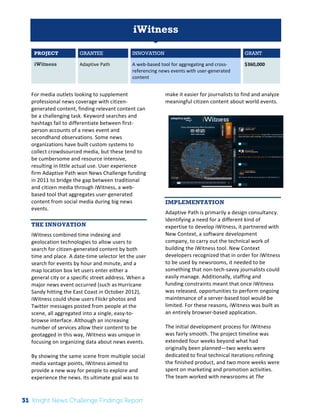
community, 
and 
spur 
greater 
levels 
of 
civic 
engagement. 
Evidence 
of 
these 
impacts 
exists 
on 
FPF’s 
blog 
(which 
has 
been 
maintained 
for 
over 
five 
years 
and 
includes 
over 
1,500 
posts), 
through 
the 
thousands 
of 
posts 
made 
weekly 
to 
the 
project’s 
forums, 
and 
through 
the 
outpouring 
of 
praise 
and 
thanks 
from 
users 
who 
feel 
more 
connected, 
informed, 
and 
involved. 
Front 
Porch 
Forum 
has 
proven 
to 
be 
a 
powerful 
tool 
for 
community 
development 
and 
building 
social 
capital. 
In 
the 
aftermath 
of 
Hurricane 
Irene 
in 
late 
August 
2011, 
FPF 
was 
invaluable 
in 
broadcasting 
messages 
from 
public 
officials 
and 
in 
helping 
devastated 
Vermont 
communities 
coordinate 
relief 
efforts. 
Smaller 
towns 
used 
Front 
Porch 
Forum 
to 
post 
ads 
seeking 
emergency 
housing 
and 
volunteers 
with 
trucks 
and 
chains 
who 
were 
willing 
to 
help 
pull 
cars 
from 
flooded 
areas. 
The 
example 
of 
Moretown 
provides 
a 
useful 
case-­‐in-­‐point. 
After 
the 
Knight News Challenge Findings Report 70
hurricane 
hit, 
a 
group 
of 
students 
decided 
to 
offer 
their 
volunteer 
services 
to 
ravaged 
communities. 
The 
students 
traveled 
from 
town 
to 
town, 
offering 
their 
services. 
Towns 
that 
had 
not 
been 
using 
Front 
Porch 
Forum 
often 
were 
unable 
to 
put 
the 
volunteers 
to 
good 
use. 
The 
volunteers 
would 
arrive, 
ready 
to 
help, 
but 
residents 
were 
insufficiently 
organized 
to 
provide 
them 
with 
meaningful 
work 
to 
do. 
But 
residents 
of 
Moretown— 
who 
had 
been 
using 
Front 
Porch 
Forum 
for 
a 
year—knew 
exactly 
how 
they 
could 
use 
the 
volunteer 
assistance 
and 
had 
the 
community 
networks 
in 
place 
to 
put 
them 
to 
immediate 
use. 
New vs Returning Visitors 
25,000 
20,000 
15,000 
10,000 
5,000 
5000 
4000 
3000 
2000 
1000 
Interim 
Review: 
2010 
Knight 
News 
Challenge 
Winners 
3 
0 
Q1 
2010 
Q2 
2010 
Q3 
2010 
Q4 
2010 
Q1 
2011 
Q2 
2011 
Q3 
2011 
Q4 
2011 
Q1 
2012 
Q2 
2012 
Q3 
2012 
Registered New Users 
Registered 
New 
Users 
Linear 
(Registered 
New 
Users) 
0 
Returning 
Visitors 
New 
Visitors 
Linear 
(Returning 
Visitors) 
Linear 
(New 
Visitors) 
71 Knight News Challenge Findings Report
Interim 
Review: 
2010 
Knight 
News 
Challenge 
Winners 
1 
Game-O-Matic (The Cartoonist) 
PROJECT GRANTEE INNOVATION GRANT 
Game-O-Matic Georgia 
Tech 
Research 
Corp. 
A 
free, 
easy-­‐to-­‐use 
tool 
that 
allows 
journalists 
to 
build 
cartoon 
arcade 
games 
based 
on 
their 
news 
content 
$378,000 
In 
partnership 
with 
the 
University 
of 
California 
Santa 
Cruz, 
the 
Georgia 
Institute 
of 
Technology 
received 
News 
Challenge 
funding 
to 
create 
a 
free 
tool 
that 
allows 
anyone 
to 
create 
cartoon-­‐ 
like 
current 
event 
games 
that 
can 
be 
easily 
integrated 
into 
the 
websites 
of 
local 
newspapers 
and 
media 
outlets. 
The 
aim 
of 
Game-­‐O-­‐Matic 
(formally 
called 
The 
Cartoonist) 
was 
to 
increase 
the 
use 
of 
news 
games 
to 
convey 
editorial 
opinion, 
helping 
journalists 
and 
editors 
draw 
communities 
to 
their 
local 
newspapers, 
and 
further 
inspire 
citizens 
to 
explore 
the 
news. 
THE INNOVATION 
The 
developers 
conceived 
Game-­‐O-­‐Matic 
as 
a 
free 
tool 
for 
those 
without 
a 
background 
in 
game 
development 
to 
use 
in 
generating 
simple, 
cartoon-­‐like 
current 
event 
games 
that 
are 
the 
equivalent 
of 
editorial 
cartoons. 
Several 
other 
projects 
exist 
to 
develop 
digital 
games 
to 
build 
citizen 
engagement 
in 
important 
issues.1 
The 
expense, 
time, 
and 
expertise 
required 
to 
craft 
regular 
video-­‐game 
content, 
however, 
has 
prevented 
the 
widespread 
adoption 
of 
news 
games 
by 
traditional 
media 
sources. 
Game-­‐O-­‐ 
Matic 
was 
created 
to 
relieve 
the 
burden 
of 
programming 
and 
design 
while 
encouraging 
journalists 
to 
think 
of 
news 
events 
not 
just 
as 
stories, 
but 
as 
systems 
that 
can 
be 
modeled 
and 
explored. 
The 
tool 
serves 
as 
an 
intelligent 
operating 
system 
for 
creating 
arcade-­‐style 
games 
through 
the 
process 
of 
concept 
mapping 
relevant 
actors 
and 
their 
relationships. 
By 
answering 
a 
series 
of 
questions 
about 
the 
major 
1 
Other 
new 
games-­‐focused 
projects 
include 
2007 
Knight 
News 
Challenge 
Winners 
New 
York 
News 
Games, 
Oakland 
Jazz 
& 
Blues 
Clubs 
Video 
Game, 
and 
Playing 
the 
News. 
actors 
in 
a 
news 
event 
and 
making 
value 
judgments 
about 
their 
actions, 
Game-­‐O-­‐Matic 
automatically 
proposes 
game 
rules 
and 
images. 
Once 
created, 
users 
can 
publish 
their 
games 
to 
Game-­‐O-­‐Matic’s 
site 
or 
to 
their 
own 
website 
or 
Facebook 
profile. 
IMPLEMENTATION 
Because 
Game-­‐O-­‐Matic 
set 
out 
to 
create 
a 
technology 
from 
scratch, 
the 
project 
spent 
its 
early 
months 
conducting 
research 
into 
game 
design 
platforms 
and 
working 
to 
find 
ways 
in 
which 
the 
platform 
could 
interpret 
user 
input 
to 
generate 
games. 
After 
a 
conducting 
survey 
of 
available 
game 
design 
platforms, 
Game-­‐O-­‐Matic 
chose 
to 
use 
PushButton 
Engine, 
an 
open 
source 
framework 
for 
building 
Flash 
games. 
The 
project 
spent 
a 
significant 
amount 
of 
time 
developing 
a 
theory 
of 
meaning 
and 
rhetoric 
for 
two-­‐dimensional, 
arcade-­‐style 
games. 
No 
one 
had 
undertaken 
this 
research 
before, 
and 
the 
development 
of 
Game-­‐O-­‐Matic 
took 
longer 
than 
the 
project 
team 
anticipated 
since 
they 
had 
to 
conceptualize 
the 
types 
of 
stories 
the 
tool 
could 
process, 
the 
basic 
structures 
of 
the 
news, 
how 
the 
tool 
could 
combine 
video-­‐game 
elements 
to 
create 
meaning, 
and 
how 
to 
make 
the 
software 
usable. 
Game-­‐O-­‐Matic’s 
project 
team 
programmed 
an 
early 
version 
of 
the 
tool 
after 
they 
determined 
the 
video-­‐game 
elements 
that 
one 
would 
need 
to 
portray 
events, 
coded 
ways 
these 
pieces 
could 
be 
combined, 
selected 
a 
method 
by 
which 
events 
are 
broken 
down 
into 
actors 
and 
relationships, 
created 
interpretations 
of 
relationships 
that 
can 
suggest 
nuance 
in 
a 
story, 
and 
coded 
an 
interface 
that 
allows 
journalists 
to 
input 
stories. 
As 
the 
project 
rolled 
out 
an 
early 
Knight News Challenge Findings Report 72
Interim 
Review: 
2010 
Knight 
News 
Challenge 
Winners 
2 
version 
of 
Game-­‐O-­‐Matic, 
called 
the 
The 
Cartoonist, 
it 
received 
a 
number 
of 
angry 
messages 
and 
comments 
from 
editorial 
cartoonists 
who 
viewed 
the 
tool 
as 
way 
for 
newspapers 
to 
replace 
them. 
As 
a 
result, 
the 
project 
was 
forced 
to 
reconsider 
its 
branding 
and 
to 
spend 
time 
explaining 
that 
it 
intended 
the 
tool 
to 
reference 
editorial 
cartoons’ 
ability 
to 
convey 
bite-­‐sized 
commentary 
on 
current 
events 
rather 
than 
replace 
cartoons 
entirely. 
The 
project 
ultimately 
chose 
the 
name 
“Game-­‐ 
O-­‐Matic” 
to 
convey 
its 
automated 
process 
for 
creating 
games 
and 
the 
complex, 
generative 
nature 
of 
the 
tool. 
The 
project 
intended 
to 
market 
Game-­‐O-­‐Matic 
to 
the 
editors, 
reporters, 
and 
designers 
of 
local 
newspapers 
and 
media 
groups. 
However, 
later 
on 
it 
expanded 
its 
target 
audience 
to 
include 
the 
general 
public 
in 
order 
to 
create 
greater 
adoption 
and 
awareness. 
Game-­‐O-­‐Matic 
reached 
out 
to 
local 
news 
organizations 
in 
Atlanta, 
GA 
and 
Santa 
Cruz, 
CA 
to 
test 
the 
tool 
and 
inform 
its 
development. 
It 
also 
approached 
individuals 
from 
other 
local 
news 
organizations 
and 
presented 
on 
the 
project 
at 
various 
game 
developer 
conferences 
and 
to 
the 
World 
Newspaper 
Congress 
and 
World 
Editors 
Forum 
in 
Vienna, 
Austria. 
Many 
of 
these 
target 
groups 
were 
initially 
receptive, 
but 
Game-­‐O-­‐Matic 
found 
it 
difficult 
to 
promote 
a 
novelty 
product, 
and 
the 
project 
struggled 
to 
find 
highly-­‐visible 
partners 
who 
would 
create 
a 
game 
to 
serve 
as 
an 
example 
for 
other 
potential 
users. 
The 
project 
developed 
a 
beta 
site, 
http://game-­‐o-­‐ 
matic.com/, 
but 
is 
waiting 
to 
publicly 
launch 
until 
the 
tool 
is 
more 
polished 
and 
easier 
to 
use. 
REACH AND OUTCOMES 
Game-­‐O-­‐Matic 
has 
yet 
to 
launch 
publicly 
and 
is 
still 
in 
the 
very 
early 
stages 
of 
its 
lifecycle. 
By 
the 
end 
of 
the 
grant 
period, 
adoption 
of 
the 
tool 
had 
been 
low: 
by 
August 
2012, 
450 
games 
had 
been 
produced 
and 
news 
media 
groups 
were 
experimenting 
with 
the 
tool. 
Anecdotally, 
user 
reception 
of 
the 
tool 
was 
largely 
positive, 
but 
Game-­‐O-­‐Matic 
found 
it 
difficult 
to 
motivate 
these 
partners 
to 
actually 
use 
the 
tool 
to 
create 
games 
that 
they 
posted 
on 
their 
websites. 
As 
of 
mid-­‐October 
2012, 
Game-­‐O-­‐Matic 
was 
still 
struggling 
to 
find 
a 
user-­‐created 
game 
to 
serve 
as 
an 
example 
of 
the 
tool’s 
use 
to 
promote 
to 
local 
newsgroups. 
Overall 
awareness 
of 
the 
tool 
is 
also 
low. 
Social 
media 
monitoring 
captured 
about 
50 
mentions 
of 
“Game-­‐O-­‐Matic” 
between 
March 
2012 
and 
November 
2012, 
with 
mentions 
spiking 
around 
times 
when 
the 
project 
gave 
presentations 
during 
conferences 
and 
events, 
including 
the 
Game 
Developer’s 
Conference, 
Games 
for 
Change, 
and 
the 
workshop 
on 
Procedural 
Content 
Generation 
in 
Games. 
The 
project’s 
ultimate 
aim 
was 
to 
create 
a 
tool 
which 
would 
increase 
the 
use 
of 
news 
games, 
resulting 
in 
readers’ 
increased 
interest 
in 
the 
news. 
To 
date, 
there 
is 
no 
evidence 
to 
suggest 
that 
Game-­‐O-­‐Matic 
has 
significantly 
helped 
to 
increase 
the 
use 
of 
news 
games 
in 
local 
news 
or 
raised 
reader 
interest 
in 
the 
news. 
Perhaps 
the 
project’s 
greatest 
achievement, 
however, 
was 
the 
successful 
completion 
of 
a 
beta 
version 
of 
its 
platform. 
Game-­‐O-­‐Matic 
proved 
itself 
to 
be 
a 
versatile 
way 
of 
thinking 
about 
meaning 
and 
games 
and 
even 
produced 
a 
white 
paper 
on 
the 
theory 
of 
meaning 
and 
rhetoric 
for 
two-­‐ 
dimensional, 
arcade-­‐style 
games.2 
Its 
model 
established 
a 
flexible 
framework 
which 
can 
be 
updated 
with 
new 
templates, 
variables, 
assets, 
and 
logics, 
and 
could 
inspire 
the 
design 
and 
creation 
of 
other 
news 
game 
authoring 
systems 
in 
the 
future. 
Game-­‐O-­‐Matic’s 
future 
plans 
include 
pursuing 
bridge 
funding 
of 
$50,000 
for 
the 
next 
year 
in 
order 
to 
revise 
the 
tool 
according 
to 
initial 
users’ 
feedback, 
to 
eventually 
launch 
the 
platform 
to 
the 
public, 
and 
to 
continue 
pursuing 
partners 
who 
could 
market 
games 
made 
with 
the 
tool 
to 
other 
potential 
users. 
2 
Game-­‐O-­‐Matic’s 
white 
paper 
is 
available 
here: 
http://mtreanor.com/research/micro-­‐rhetorics.pdf 
73 Knight News Challenge Findings Report
Interim 
Review: 
2010 
Knight 
News 
Challenge 
Winners 
1 
LocalWiki 
PROJECT GRANTEE INNOVATION GRANT 
LocalWiki WikiSpot 
An 
easy-­‐to-­‐use, 
open-­‐source 
“wiki” 
platform 
tailored 
to 
the 
needs 
of 
local 
communities 
$360,500 
Wikis 
are 
websites 
developed 
collaboratively 
by 
a 
community 
of 
users, 
allowing 
any 
user 
to 
add 
and 
edit 
content. 
Based 
on 
the 
success 
of 
its 
first 
locally 
based 
wiki 
in 
Davis, 
California, 
LocalWiki 
received 
Knight 
News 
Challenge 
funding 
to 
create 
specialized, 
open-­‐source 
wiki 
software 
and 
to 
help 
other 
geographic 
communities 
develop, 
launch, 
and 
sustain 
wiki 
projects 
using 
this 
software. 
THE INNOVATION 
LocalWiki 
pioneered 
locally 
focused 
wiki 
software 
with 
the 
goal 
of 
making 
it 
easy 
for 
people 
to 
share 
knowledge 
of 
their 
own 
communities. 
The 
platform 
enables 
users 
to 
create 
pages 
and 
articles, 
upload 
photos 
and 
files, 
and 
edit 
others’ 
pages. 
Community 
wiki 
pages 
can 
feature 
articles 
on 
anything 
from 
the 
news 
and 
history 
of 
the 
area 
to 
updates 
on 
local 
public 
transportation, 
nearby 
attractions, 
lost 
pets, 
or 
local 
social 
services. 
Specific 
innovations 
within 
LocalWiki’s 
software 
include 
its 
accessibility 
and 
ease 
of 
use, 
tagging 
features 
for 
pages, 
and 
mapping 
capabilities 
that 
allow 
users 
to 
link 
pages 
to 
points 
and 
areas 
on 
a 
map. 
Users 
can 
easily 
view 
and 
reverse 
edits 
to 
pages 
and 
maps 
and 
track 
their 
wiki’s 
number 
of 
pages 
and 
contributors 
through 
a 
dashboard 
feature. 
IMPLEMENTATION 
LocalWiki 
set 
out 
to 
develop 
an 
enhanced, 
open-­‐source 
wiki 
platform 
with 
documentation 
designed 
to 
meet 
the 
needs 
of 
local 
communities. 
Because 
the 
project’s 
Knight 
News 
Challenge 
funding 
focused 
more 
heavily 
on 
software 
development, 
LocalWiki 
was 
limited 
to 
launching 
and 
testing 
its 
software 
in 
just 
one 
pilot 
community. 
LocalWiki 
turned 
to 
the 
crowd-­‐funding 
platform 
Kickstarter 
to 
help 
fund 
outreach 
and 
education 
efforts 
and 
eventually 
raised 
over 
$26,000 
with 
the 
help 
of 
427 
individual 
donors. 
Delays 
in 
the 
initial 
disbursement 
of 
Knight 
grant 
funds 
pushed 
back 
the 
start 
of 
the 
project 
by 
about 
three 
months, 
but 
progress 
picked 
up 
when 
the 
project 
received 
its 
funding. 
LocalWiki 
publicly 
released 
its 
first 
version 
of 
the 
software 
on 
November 
30, 
2011. 
The 
platform 
was 
designed 
to 
be 
easier 
for 
non-­‐developers 
to 
install 
and 
to 
create 
a 
more 
accessible 
editing 
process. 
LocalWiki 
marketed 
this 
software 
to 
the 
open-­‐ 
source 
community 
through 
the 
project’s 
own 
development 
mailing 
list, 
through 
interaction 
with 
other 
projects 
on 
GitHub, 
and 
through 
a 
series 
of 
hackathons 
on 
LocalWiki’s 
code. 
LocalWiki 
selected 
Denton, 
Texas 
to 
serve 
as 
its 
first 
pilot 
community 
because 
Denton’s 
project 
leads 
seemed 
the 
most 
able 
and 
motivated 
to 
work 
under 
limited 
initial 
guidance. 
By 
piloting 
DentonWiki, 
LocalWiki 
aimed 
to 
gain 
essential 
feedback 
on 
the 
new 
software 
as 
it 
was 
being 
developed, 
and 
to 
gain 
experience 
helping 
other 
communities 
create 
and 
launch 
local 
wiki 
projects. 
Prior 
to 
the 
launch 
of 
DentonWiki, 
LocalWiki 
worked 
with 
the 
team 
in 
Denton 
to 
Knight News Challenge Findings Report 74
Independent Installs 
1000 
900 
800 
700 
600 
500 
400 
300 
200 
100 
Content Growth (in pages) 
45,000,000 
40,000,000 
35,000,000 
30,000,000 
25,000,000 
20,000,000 
15,000,000 
10,000,000 
5,000,000 
Interim 
Review: 
2010 
Knight 
News 
Challenge 
Winners 
2 
help 
build 
a 
core, 
dedicated 
group 
of 
editors 
who 
would 
drive 
the 
project. 
Denton’s 
wiki 
featured 
over 
800 
pages 
when 
it 
launched, 
on 
the 
same 
day 
as 
the 
public 
release 
of 
LocalWiki’s 
new 
software. 
After 
supporting 
the 
first 
pilot 
community 
in 
Denton, 
Texas, 
LocalWiki 
selected 
Santa 
Cruz, 
California 
and 
Raleigh-­‐Durham, 
North 
Carolina 
as 
additional 
communities 
in 
which 
to 
test 
the 
platform. 
LocalWiki 
left 
the 
local 
outreach 
work 
up 
to 
these 
focus 
communities 
but 
offered 
them 
coaching 
along 
the 
way 
through 
visits, 
phone 
calls, 
and 
emails. 
By 
providing 
direct 
support 
to 
a 
few 
successful 
communities 
and 
then 
building 
a 
network 
of 
communities 
implementing 
the 
software, 
LocalWiki 
hoped 
to 
create 
a 
model 
in 
which 
communities 
would 
reach 
out 
to 
each 
other 
for 
best 
practices 
and 
further 
spread 
the 
platform. 
REACH AND OUTCOMES 
LocalWiki 
is 
well 
positioned 
to 
achieve 
its 
ultimate 
aim 
of 
demonstrating 
that 
local 
wikis 
are 
a 
viable 
way 
for 
communities 
to 
manage 
and 
share 
information. 
LocalWiki’s 
open 
source 
code 
has 
been 
adopted 
and 
used 
around 
the 
world. 
Between 
late 
August 
2011 
and 
the 
software’s 
first 
major 
release 
in 
late 
November 
2011, 
LocalWiki’s 
platform 
was 
installed 
nearly 
700 
times. 
LocalWiki 
is 
now 
the 
second-­‐most 
installed 
of 
the 
Knight 
News 
Challenge’s 
server-­‐ 
focused 
projects.1 
By 
late 
August 
2012, 
there 
were 
at 
least 
58 
independent 
LocalWiki 
projects 
(of 
which 
37 
were 
considered 
“major”), 
spread 
across 
nine 
countries 
and 
published 
in 
seven 
languages. 
LocalWiki 
only 
hosts 
a 
minority 
of 
its 
community 
projects, 
but 
it 
received 
about 
26.7 
million 
page 
views 
for 
these 
projects 
over 
the 
1 
LocalWiki’s 
downloads 
are 
second 
only 
to 
the 
Ushahidi 
platform, 
a 
server-­‐focused 
project 
which 
provides 
an 
open 
source 
software 
for 
collecting, 
visualizing, 
and 
mapping 
citizen 
reports 
from 
large 
news 
events. 
0 
0 
75 Knight News Challenge Findings Report
Interim 
Review: 
2010 
Knight 
News 
Challenge 
Winners 
3 
course 
of 
2011. 
By 
late 
August 
2012, 
LocalWiki’s 
code 
had 
been 
downloaded 
over 
690 
times 
and 
forked 
40 
times. 
It 
had 
also 
attracted 
164 
individuals 
who 
signed 
up 
to 
be 
notified 
of 
changes 
to 
the 
code. 
Additionally, 
73 
people 
have 
contributed 
by 
identifying 
bugs 
in 
LocalWiki’s 
code, 
and 
LocalWiki 
has 
incorporated 
others’ 
changes 
in 
about 
80 
cases. 
Users 
have 
downloaded 
the 
code 
to 
develop 
mobile 
web 
applications, 
a 
LocalWiki-­‐like 
project 
for 
Burning 
Man, 
and 
new 
functionalities 
such 
as 
editable 
comments. 
Two 
users 
in 
Portugal 
used 
the 
code 
to 
internationalize 
LocalWiki, 
so 
that 
the 
platform’s 
user 
interface 
could 
be 
translated 
into 
any 
language. 
To 
date, 
LocalWiki 
is 
available 
in 
seven 
languages. 
Although 
the 
platform 
has 
exerperienced 
impressive 
adoption, 
most 
of 
LocalWiki’s 
community 
wikis 
are 
still 
working 
to 
reach 
a 
critical 
mass 
of 
users 
and 
become 
entirely 
community 
maintained. 
LocalWiki 
has 
already 
reached 
this 
tipping 
point 
with 
its 
longstanding 
DavisWiki 
project. 
Nearly 
one 
in 
seven 
Davis 
residents 
contributes 
to 
the 
wiki 
at 
some 
point 
within 
the 
course 
of 
a 
year, 
and 
about 
half 
of 
Davis’s 
residents 
use 
DavisWiki 
each 
month. 
LocalWiki’s 
other 
communties 
have 
yet 
to 
achieve 
this 
same 
level 
of 
engagement 
but 
have 
demonstrated 
a 
number 
of 
initial 
successes. 
Santa 
Cruz, 
California 
is 
LocalWiki’s 
largest 
focus 
community, 
with 
over 
5,400 
pages, 
4,300 
photos, 
and 
2,700 
maps. 
TriangleWiki 
in 
Raleigh-­‐Durham, 
North 
Carolina 
has 
seen 
widespread 
adoption 
and 
use 
from 
Raleigh’s 
city 
council, 
which 
has 
used 
the 
wiki 
to 
post 
city 
government 
content. 
Two 
locally 
based 
mobile 
projects 
have 
also 
used 
TriangleWiki, 
incorporating 
the 
wiki’s 
content 
streams 
in 
their 
applications. 
Knight News Challenge Findings Report 76
Interim 
Review: 
2010 
Knight 
News 
Challenge 
Winners 
1 
NowSpots 
PROJECT GRANTEE INNOVATION GRANT 
NowSpots Windy 
Citizen 
Open-­‐source 
software 
allowing 
“real-­‐time 
advertising” 
that 
can 
be 
updated 
at 
any 
time 
by 
local 
businesses 
using 
social 
media 
$257,500 
NowSpots 
was 
created 
to 
provide 
local 
publishers 
with 
“real-­‐time 
advertising” 
through 
widgets 
that 
show 
the 
latest 
updates 
from 
an 
advertiser’s 
social 
media 
accounts. 
The 
project 
aimed 
to 
turn 
sponsored 
social 
media 
streams 
into 
a 
viable 
source 
of 
income 
for 
news 
sites. 
THE INNOVATION 
Traditional 
web 
advertising 
relies 
heavily 
on 
banner 
ads—static 
or 
animated 
images 
that 
display 
an 
advertiser’s 
messaging 
each 
time 
the 
page 
is 
refreshed. 
If 
done 
well, 
banner 
ads 
can 
build 
brand 
awareness 
and 
help 
drive 
traffic 
to 
the 
advertiser’s 
site. 
For 
smaller 
organizations 
without 
a 
strong 
web 
presence, 
however, 
these 
ads 
often 
fail 
to 
build 
a 
relationship 
between 
viewers 
and 
the 
organization 
being 
advertised. 
NowSpots 
created 
open-­‐source 
software 
allowing 
“real-­‐time 
advertising” 
through 
a 
widget 
that 
shows 
the 
latest 
message 
or 
post 
from 
the 
organization’s 
social 
media 
accounts 
including 
blogs, 
Facebook, 
Twitter, 
and 
YouTube. 
The 
platform 
enables 
users 
(local 
businesses 
and 
publishers 
of 
all 
sizes) 
to 
update 
their 
advertisements 
automatically 
with 
real-­‐ 
time 
information, 
allowing 
them 
to 
connect 
more 
directly 
with 
potential 
customers. 
It 
also 
provides 
them 
with 
back-­‐end 
analytics 
on 
how 
many 
times 
potential 
customers 
view 
the 
ads, 
click 
on 
them, 
or 
repost 
content 
from 
them. 
IMPLEMENTATION 
The 
Knight 
News 
Challenge 
awarded 
funding 
to 
NowSpots 
to 
release 
and 
promote 
open-­‐source 
code 
that 
lets 
local 
publishers 
sell, 
manage, 
and 
serve 
“real-­‐time 
advertising” 
on 
their 
own 
sites. 
The 
original 
concept 
for 
the 
project 
was 
to 
market 
the 
tool 
to 
local 
news 
outlets 
that 
could 
use 
the 
tool 
to 
add 
a 
viable 
source 
of 
income 
by 
selling 
these 
advertising 
spots 
to 
businesses. 
To 
help 
streamline 
newspapers’ 
sales 
process, 
NowSpots 
also 
developed 
a 
search 
tool 
that 
scours 
local 
businesses, 
identifies 
which 
are 
the 
most 
active 
in 
social 
media, 
and 
rates 
them 
on 
how 
likely 
they 
are 
to 
be 
interested 
in 
purchasing 
“real-­‐time 
advertising.” 
The 
project 
worked 
to 
build 
awareness 
through 
an 
internal 
sales 
force 
that 
targeted 
about 
400 
local 
newspapers 
around 
the 
country, 
relying 
on 
conversations 
and 
word 
of 
mouth. 
NowSpots 
partnered 
with 
its 
first 
client, 
the 
Chicago 
Tribune 
to 
test 
the 
tool, 
working 
with 
the 
Tribune’s 
sales 
team 
to 
market 
the 
real-­‐time 
advertising 
spots 
to 
outside 
businesses. 
Despite 
some 
initial 
successes 
with 
the 
Chicago 
Tribune, 
NowSpots’ 
momentum 
eventually 
waivered 
and 
the 
paper’s 
sales 
team 
stopped 
selling 
the 
advertising 
spots. 
NowSpots 
estimated 
that 
the 
Tribune’s 
real-­‐time 
ads 
were 
performing 
well, 
with 
click-­‐through 
rates 
nearly 
300 
percent 
higher 
than 
traditional 
ads, 
but 
it 
proved 
to 
be 
difficult 
for 
the 
Tribune’s 
sales 
team 
to 
sell 
to 
outside 
businesses. 
NowSpots 
also 
partnered 
with 
a 
number 
of 
other 
newspapers 
and 
media 
groups 
and 
encountered 
similar 
challenges 
in 
educating 
the 
papers’ 
sales 
staff 
about 
the 
product 
and 
how 
to 
effectively 
sell 
the 
advertisements. 
NowSpots 
found 
it 
difficult 
to 
motivate 
news 
organizations’ 
sales 
teams, 
as 
these 
teams 
typically 
had 
30–50 
other 
products 
to 
sell. 
As 
a 
result 
of 
these 
challenges, 
NowSpots 
pivoted 
from 
targeting 
news 
organizations 
to 
selling 
the 
tool 
to 
small 
businesses 
and 
start-­‐ 
77 Knight News Challenge Findings Report
Interim 
Review: 
2010 
Knight 
News 
Challenge 
Winners 
2 
ups. 
In 
early 
October 
2012, 
NowSpots 
founder 
launched 
Perfect 
Audience, 
a 
Facebook 
and 
web 
retargeting 
platform 
that 
companies 
can 
use 
to 
target 
Facebook 
ad 
campaigns 
to 
people 
who 
visit 
the 
company’s 
website, 
with 
the 
aim 
of 
helping 
them 
reach 
their 
ideal 
customer 
at 
scale. 
REACH AND OUTCOMES 
By 
November 
2012, 
the 
information 
needed 
to 
determine 
the 
extent 
of 
NowSpots’s 
adoption 
and 
ultimate 
impact 
was 
unavailable. 
Measuring 
adoption 
of 
NowSpots 
ads 
was 
difficult, 
since 
the 
ads 
ran 
on 
publishers’ 
websites. 
However, 
by 
fall 
2011, 
NowSpots 
had 
tested 
its 
system 
in 
447 
news 
media 
outlets, 
including 
the 
Chicago 
Tribune, 
Hearst 
Digital 
media, 
Gatehouse 
Media, 
and 
Digital 
First 
Media, 
and 
in 
a 
number 
of 
ad 
agencies 
and 
small 
businesses. 
Despite 
the 
challenges 
it 
encountered 
in 
working 
to 
train 
news 
organizations’ 
sales 
team 
to 
sell 
NowSpots 
ads, 
early 
users 
such 
as 
the 
Chicago 
Tribune 
believed 
the 
project 
met 
a 
need 
and 
customers 
such 
as 
Mastercard, 
Northwestern 
University, 
Hard 
Rock 
Café, 
and 
the 
Art 
Institute 
of 
Chicago 
each 
bought 
advertising 
spots 
from 
the 
project. 
Some 
of 
NowSpots 
most 
successful 
advertising 
campaigns 
with 
these 
customers 
have 
lasted 
longer 
than 
eight 
months. 
NowSpots’ 
six-­‐month 
relationship 
with 
the 
Chicago 
Tribune 
alone 
produced 
25 
advertising 
campaigns 
with 
over 
seven 
million 
ad 
impressions. 
Results 
from 
the 
project’s 
test 
markets 
indicate 
that 
NowSpots 
ads’ 
click-­‐through 
rates 
were 
at 
.361 
percent— 
about 
300 
percent 
higher 
than 
the 
average 
click-­‐through 
rate 
of 
traditional 
online 
banner 
ads. 
Perfect 
Audience—the 
Facebook 
and 
web-­‐ 
retargeting 
platform 
launched 
by 
NowSpots 
founder 
Brad 
Flora—has 
achieved 
considerable 
success 
since 
its 
founding 
in 
October 
2012. 
In 
June 
2014, 
Perfect 
Audience 
was 
bought 
for 
$25.5 
million 
by 
Marin 
Software. 
Knight News Challenge Findings Report 78
Interim 
Review: 
2010 
Knight 
News 
Challenge 
Winners 
1 
OpenCourt (Order in the Court 2.0) 
PROJECT GRANTEE INNOVATION GRANT 
OpenCourt Trustees 
of 
Boston 
University 
A 
pilot 
project 
to 
demonstrate 
how 
digital 
technology 
can 
increase 
public 
access 
to 
the 
courts 
$250,000 
Mainstream 
news 
outlets 
often 
lack 
the 
resources 
to 
adequately 
cover 
local 
courts. 
At 
the 
same 
time, 
court 
policies 
regarding 
digital 
journalism 
have 
not 
changed 
since 
standards 
for 
video 
and 
audio 
recording 
were 
established 
in 
the 
1970s, 
and 
the 
judicial 
branch 
has 
failed 
to 
adapt 
to 
new 
technologies 
such 
as 
web 
streaming 
and 
social 
media 
tools 
like 
Twitter 
and 
Facebook. 
OpenCourt 
is 
a 
pilot 
project 
designed 
to 
test 
new 
media 
initiatives 
within 
a 
working 
court 
system 
and 
to 
establish 
best 
practices 
that 
can 
be 
replicated 
and 
adopted 
throughout 
the 
nation’s 
court 
system. 
THE INNOVATION 
OpenCourt 
grants 
citizens 
and 
professional 
journalists 
digital, 
web-­‐based 
access 
to 
Quincy 
District 
Court 
in 
the 
greater 
Boston 
area. 
The 
project 
provides 
the 
court 
with 
a 
WiFi 
network 
for 
use 
by 
journalists 
and 
bloggers 
and 
features 
a 
live-­‐streaming 
video 
of 
the 
proceedings 
from 
the 
court’s 
First 
Session 
courtroom 
and 
daily 
archives 
of 
courtroom 
footage. 
OpenCourt 
aims 
to 
serve 
as 
a 
model 
for 
similar 
efforts 
to 
integrate 
new 
technology 
into 
the 
courts 
as 
a 
means 
of 
improving 
the 
public’s 
access 
to 
and 
understanding 
of 
the 
judicial 
system. 
IMPLEMENTATION 
OpenCourt 
evolved 
from 
work 
done 
by 
the 
Media 
Committee 
of 
the 
Massachusetts 
Supreme 
Judicial 
Court, 
and 
it 
began 
with 
a 
series 
of 
meetings 
in 
December 
2010 
to 
introduce 
the 
project 
and 
invite 
feedback 
from 
court 
staff, 
attorneys, 
local 
journalists, 
and 
advocacy 
groups. 
Even 
before 
its 
launch, 
OpenCourt 
anticipated 
a 
number 
of 
challenges 
related 
to 
the 
fear 
that 
cameras 
could 
influence 
courtroom 
behavior 
and 
the 
outcomes 
of 
cases. 
The 
project 
faced 
resistance 
from 
a 
number 
of 
stakeholders, 
including 
defense 
attorneys, 
the 
District 
Attorney’s 
office, 
and 
advocates 
against 
domestic 
violence. 
Concerns 
included 
the 
difficulty 
of 
ensuring 
that 
the 
project 
would 
strike 
the 
balance 
between 
public 
access 
and 
an 
individual’s 
right 
to 
a 
fair 
trial 
and 
due 
process, 
and 
issues 
of 
safety 
in 
protecting 
the 
privacy 
of 
domestic 
abuse 
victims. 
Despite 
these 
groups’ 
opposition 
to 
the 
project, 
each 
participated 
in 
its 
development, 
serving 
on 
the 
working 
group 
that 
met 
regularly 
to 
establish 
guidelines 
and 
policies 
for 
OpenCourt’s 
live-­‐streaming 
courtroom 
coverage. 
OpenCourt 
also 
dealt 
with 
a 
number 
of 
unexpected 
technical 
challenges 
and 
trademark 
issues 
prior 
to 
its 
site 
launch. 
Gaining 
sufficient 
bandwidth 
into 
Quincy 
District 
Court 
proved 
to 
be 
difficult 
and 
delayed 
the 
project’s 
original 
timeline. 
After 
rebranding 
from 
its 
original 
project 
name 
“Order 
in 
the 
Court”, 
OpenCourt 
also 
learned 
that 
TruTV 
(formerly 
CourtTV) 
owned 
this 
“mark” 
and 
a 
similar 
domain 
name. 
The 
project’s 
website, 
http://opencourt.us, 
went 
live 
in 
May 
2011. 
The 
site 
allows 
users 
to 
view 
live-­‐streaming 
court 
cases, 
daily 
archives 
of 
cases, 
and 
electronic 
versions 
of 
daily 
court 
schedules. 
On 
its 
first 
day 
of 
operation, 
the 
local 
District 
Attorney’s 
office 
filed 
a 
motion 
to 
close 
access 
to 
OpenCourt’s 
online 
archives. 
The 
motion 
was 
denied, 
but 
by 
July 
2011, 
the 
District 
Attorney’s 
office 
had 
filed 
a 
pair 
of 
motions 
aimed 
at 
shutting 
off 
the 
site’s 
archives 
79 Knight News Challenge Findings Report
and 
live-­‐streaming 
footage. 
The 
Massachusetts 
Supreme 
Judicial 
Court 
ruled 
in 
favor 
of 
OpenCourt 
in 
March 
2012 
and 
established 
that 
the 
state 
cannot 
suppress 
publication 
or 
redact 
footage 
of 
public 
proceedings. 
Not 
long 
after 
this 
decision, 
the 
District 
Attorney’s 
office 
again 
sued 
OpenCourt 
to 
stop 
its 
plans 
to 
begin 
streaming 
jury 
trials. 
The 
court 
ruled 
in 
OpenCourt’s 
favor 
again 
in 
mid-­‐August 
2012 
and 
allowed 
OpenCourt 
to 
move 
forward 
with 
live-­‐streaming 
jury 
trials 
under 
the 
preliminary 
guidelines 
set 
forth 
by 
its 
decision 
in 
the 
earlier 
case. 
On 
September 
11, 
2012, 
OpenCourt 
live 
streamed 
a 
jury 
trial 
from 
Quincy 
District 
Courthouse 
for 
the 
first 
time. 
REACH AND OUTCOMES 
OpenCourt 
has 
received 
significant 
attention 
in 
the 
legal 
field 
and 
in 
the 
media. 
Trend 
data 
on 
visits 
to 
OpenCourt’s 
website 
are 
unavailable, 
but 
Google 
Analytics 
data 
shows 
that 
the 
project 
received 
a 
total 
of 
122,038 
visitors 
including 
70,788 
returning 
visitors 
between 
October 
2011 
and 
late 
November 
2012. 
Spikes 
in 
the 
number 
of 
OpenCourt’s 
social 
media 
mentions 
are 
due 
in 
part 
to 
the 
increased 
media 
attention 
during 
its 
legal 
challenges. 
The 
project 
received 
positive 
coverage 
in 
local 
new 
outlets 
such 
as 
the 
Boston 
Globe, 
the 
Boston 
Number 
of 
Social 
Media 
Men=ons 
250 
200 
150 
100 
50 
Interim 
Review: 
2010 
Knight 
News 
Challenge 
Winners 
2 
0 
Jan-­‐11 
Mar-­‐11 
May-­‐11 
Jul-­‐11 
Sep-­‐11 
Nov-­‐11 
Jan-­‐12 
Mar-­‐12 
May-­‐12 
Jul-­‐12 
Other 
facebook 
twi`er 
Herald, 
Quincy 
Patriot 
Ledger, 
WBUR, 
and 
Massachusetts 
Lawyer’s 
Weekly. 
Links 
from 
Boston.com, 
the 
Associated 
Press, 
WBUR, 
and 
the 
Quincy 
Patriot 
Ledger 
websites 
each 
helped 
to 
drive 
traffic 
to 
OpenCourt’s 
website. 
OpenCourt 
also 
received 
attention 
in 
national 
sources 
such 
as 
the 
Legal 
Law 
Network 
and 
Current, 
a 
periodical 
that 
covers 
issues 
in 
public 
media. 
The 
ultimate 
goal 
of 
OpenCourt 
was 
to 
create 
a 
set 
of 
benchmarks 
and 
best 
practices 
for 
digital 
communications 
that 
could 
be 
published 
and 
shared 
widely 
among 
industry 
groups, 
even 
beyond 
judicial 
systems. 
This 
broader 
vision 
has 
gradually 
come 
to 
fruition. 
In 
addition 
to 
the 
project’s 
web 
traffic 
and 
media 
attention, 
OpenCourt’s 
team 
was 
asked 
to 
present 
at 
a 
number 
of 
speaking 
engagements 
nationally 
and 
received 
numerous 
requests 
from 
legal 
journals 
that 
are 
interested 
in 
publishing 
the 
project’s 
findings. 
OpenCourt 
is 
in 
the 
process 
of 
authoring 
these 
articles. 
Perhaps 
OpenCourt’s 
greatest 
achievement 
is 
the 
precedent 
that 
it 
has 
set 
on 
the 
issue 
of 
citizen 
access 
to 
courtrooms—a 
precedent 
that 
could 
encourage 
and 
strengthen 
similar 
efforts 
in 
Massachusetts 
and 
across 
the 
United 
States. 
OpenCourt’s 
legal 
victories 
have 
also 
had 
a 
significant 
impact 
on 
Massachusetts’s 
revised 
guidelines 
for 
cameras 
in 
courtrooms. 
At 
the 
time 
of 
this 
report, 
OpenCourt 
had 
just 
launched 
its 
coverage 
from 
a 
second 
courtroom, 
using 
a 
multi-­‐camera 
setup 
to 
document 
new 
types 
of 
hearings, 
such 
as 
jury 
trials. 
OpenCourt’s 
broadcast 
on 
September 
11, 
2012 
marked 
the 
first 
criminal 
trial 
ever 
to 
be 
live 
streamed 
in 
Massachusetts. 
According 
to 
Google 
Analytics, 
the 
trial’s 
live 
stream 
received 
Knight News Challenge Findings Report 80
Interim 
Review: 
2010 
Knight 
News 
Challenge 
Winners 
3 
a 
total 
of 
481 
views. 
OpenCourt’s 
legal 
battles, 
however, 
did 
slow 
its 
expansion 
and 
limited 
the 
amount 
of 
time 
the 
team 
could 
devote 
to 
developing 
contextual 
reporting, 
training 
citizen 
journalists, 
and 
developing 
technical 
solutions 
to 
handle 
the 
large 
amount 
of 
video 
data 
captured 
in 
court. 
In 
spite 
of 
this, 
the 
court 
cases 
helped 
to 
generate 
more 
awareness 
and 
interest 
in 
the 
project. 
Despite 
the 
project’s 
momentum, 
OpenCourt 
is 
struggling 
to 
find 
a 
funding 
model 
to 
sustain 
itself. 
OpenCourt’s 
team 
has 
funding 
and 
institutional 
support 
from 
WBUR 
and 
Boston 
University 
to 
keep 
the 
project 
running 
through 
December 
2012 
and 
is 
currently 
exploring 
a 
number 
of 
potential 
options 
for 
sustaining 
the 
project. 
81 Knight News Challenge Findings Report
Interim 
Review: 
2010 
Knight 
News 
Challenge 
Winners 
1 
PRX Story Exchange (StoryMarket) 
PROJECT GRANTEE INNOVATION GRANT 
PRX Story 
PRX, 
Inc. 
A 
crowd-­‐funding 
platform 
that 
allows 
local 
Exchange 
public 
radio 
stations, 
producers, 
and 
listeners 
to 
find 
and 
help 
fund 
stories 
$75,000 
Faced 
with 
capacity 
constraints 
and 
the 
high 
cost 
of 
producing 
local 
stories, 
many 
of 
today’s 
public 
radio 
stations 
fail 
to 
cover 
local 
news. 
Story 
Exchange, 
run 
by 
PRX, 
a 
nonprofit 
public 
media 
company 
in 
Cambridge, 
Massachusetts, 
was 
created 
to 
offer 
an 
open-­‐source 
crowd-­‐ 
funding 
platform 
for 
finding, 
supporting, 
and 
distributing 
local 
public 
radio 
stories. 
PRX 
partnered 
with 
an 
existing 
crowd-­‐funding 
project, 
2008 
Knight 
News 
Challenge 
Winner 
Spot.us, 
to 
serve 
as 
Story 
Exchange’s 
technical 
platform. 
The 
project 
was 
funded 
through 
the 
Knight 
News 
Challenge 
to 
develop 
a 
pilot 
with 
Louisville 
Public 
Media 
(LPM) 
in 
Louisville, 
KY 
and 
to 
eventually 
expand 
to 
at 
least 
three 
other 
test 
markets. 
Ultimately, 
Story 
Exchange 
failed 
to 
gain 
widespread 
adoption. 
THE INNOVATION 
Story 
Exchange 
aimed 
to 
help 
crowd 
funding 
become 
an 
effective 
revenue 
option 
for 
professional 
journalism. 
Using 
Story 
Exchange, 
public 
radio 
stations 
and 
independent 
producers 
could 
issue 
requests 
for 
story 
ideas 
along 
with 
their 
respective 
fundraising 
goals, 
hosted 
on 
the 
station’s 
own 
website, 
PRX’s 
website, 
and 
Spot.us’s 
website. 
The 
platform 
offered 
listeners 
the 
ability 
to 
vote 
on 
story 
ideas, 
to 
pledge 
financial 
support 
to 
the 
stories 
and 
pitches 
of 
their 
choosing, 
and 
to 
post 
suggestions 
of 
other 
stories 
they 
wanted 
to 
hear 
in 
the 
future. 
Several 
other 
web-­‐based 
crowd-­‐funding 
efforts 
existed, 
such 
as 
Kickstarter 
and 
Spot.us, 
but 
Story 
Exchange 
was 
the 
first 
to 
focus 
on 
funding 
public 
radio 
stories 
and 
the 
first 
to 
promote 
these 
stories 
using 
on-­‐ 
air 
pitches. 
IMPLEMENTATION 
PRX 
set 
out 
to 
test 
Story 
Exchange’s 
model 
with 
LPM 
in 
Louisville, 
KY 
and 
to 
eventually 
scale 
to 
other 
communities 
already 
connected 
through 
PRX.org. 
Rather 
than 
building 
its 
own 
technical 
platform 
from 
scratch, 
Story 
Exchange 
partnered 
with 
2008 
Knight 
News 
Challenge 
Winner 
Spot.us. 
Story 
Exchange 
originally 
planned 
to 
use 
Spot.us’s 
code 
in 
order 
to 
develop 
a 
separate 
project. 
After 
lengthy 
consideration, 
PRX 
chose 
instead 
to 
integrate 
Story 
Exchange 
into 
Spot.us. 
Coordinating 
with 
Spot.us 
on 
the 
scope, 
specifications, 
and 
interface 
of 
the 
platform 
took 
Story 
Exchange 
longer 
than 
expected 
and 
delayed 
the 
project’s 
development. 
Story 
Exchange’s 
launch 
met 
with 
resistance 
from 
public 
radio 
journalists. 
The 
day 
Story 
Exchange 
began 
on-­‐air 
announcements 
for 
the 
project’s 
pitches 
in 
Louisville, 
a 
number 
of 
public 
radio 
producers, 
editors, 
and 
consultants 
posted 
accusations 
about 
the 
potential 
for 
conflict 
of 
interest 
and 
concerns 
about 
the 
project’s 
lack 
of 
editorial 
control 
to 
the 
Facebook 
page 
of 
the 
American 
Public 
Media 
Group 
(APM). 
PRX 
had 
anticipated 
this 
reaction 
at 
the 
outset 
of 
the 
project 
and 
had 
put 
rules 
in 
place 
that 
capped 
the 
amount 
an 
individual 
listener 
could 
contribute 
to 
a 
story, 
created 
a 
policy 
for 
returning 
the 
donations 
of 
listeners 
too 
close 
to 
an 
issue, 
and 
granted 
partner 
stations 
decision-­‐making 
authority 
over 
which 
stories 
to 
air 
and 
the 
content 
of 
these 
pieces. 
Story 
Exchange 
confronted 
stations’ 
concerns 
and 
misperceptions 
head-­‐on 
in 
in-­‐person 
meetings 
and 
in 
written 
explanations, 
but 
the 
Knight News Challenge Findings Report 82
Interim 
Review: 
2010 
Knight 
News 
Challenge 
Winners 
2 
negative 
attention 
ultimately 
hampered 
the 
project’s 
ability 
to 
attract 
partner 
stations. 
While 
it 
lasted, 
Story 
Exchange’s 
partnership 
with 
Spot.us 
benefited 
both 
groups 
and 
contributed 
to 
improvements 
within 
each 
project. 
However, 
the 
dynamic 
changed 
significantly 
in 
fall 
2011, 
when 
APM 
acquired 
Spot.us. 
PRX 
continued 
partnering 
with 
APM 
on 
Story 
Exchange, 
but 
the 
members 
of 
the 
Spot.us 
team 
who 
PRX 
had 
worked 
with 
were 
placed 
on 
other 
projects 
or 
left 
the 
company. 
As 
a 
result, 
Story 
Exchange 
lost 
its 
developer 
team 
and 
its 
platform 
lacked 
sufficient 
technical 
support 
and 
attention. 
Similarly, 
Story 
Exchange’s 
relationship 
with 
LPM 
was 
largely 
positive 
until 
the 
project’s 
key 
point 
of 
contact 
left 
the 
station. 
While 
LPM’s 
staff 
was 
enthusiastic 
and 
engaged 
with 
the 
project, 
the 
loss 
of 
its 
champion 
within 
the 
station 
left 
Story 
Exchange 
without 
a 
key 
leader 
who 
had 
helped 
ensure 
the 
continuity 
and 
direction 
of 
the 
work. 
REACH AND OUTCOMES 
PRX 
Story 
Exchange 
struggled 
to 
gain 
adoption 
among 
public 
radio 
stations. 
It 
even 
had 
trouble 
finding 
three 
other 
public 
radio 
stations 
to 
serve 
as 
the 
project’s 
test 
markets. 
PRX 
made 
pitches 
to 
a 
number 
of 
potential 
partners, 
but 
each 
was 
unwilling 
to 
adopt 
the 
platform. 
St. 
Louis 
Public 
Radio 
worried 
the 
platform 
might 
dilute 
and 
distract 
from 
the 
radio 
station’s 
general 
fundraising 
appeals. 
North 
Country 
Public 
Radio 
in 
the 
Adirondack 
area 
of 
New 
York 
State 
didn’t 
have 
the 
technical 
capacity 
to 
integrate 
Story 
Exchange 
into 
its 
website 
quickly 
enough. 
Other 
stations, 
such 
as 
KALW 
in 
San 
Francisco, 
had 
begun 
using 
Kickstarter 
as 
a 
means 
for 
funding 
news 
pieces. 
Despite 
this, 
Story 
Exchange’s 
partnership 
with 
Louisville 
Public 
Media 
accomplished 
the 
goal 
of 
helping 
fund 
original 
local 
news 
pieces. 
Four 
of 
the 
five 
story 
ideas 
posted 
to 
Story 
Exchange 
were 
fully 
funded 
by 
listeners: 
92 
individuals 
contributed 
a 
total 
of 
just 
over 
$900 
to 
these 
stories, 
and 
the 
four 
stories 
that 
received 
funding 
were 
aired 
on 
eight 
different 
public 
radio 
stations. 
“Is 
it 
Time 
to 
Get 
Serious 
about 
Coal 
Ash?” 
was 
Story 
Exchange’s 
most 
successful 
story. 
The 
piece 
aired 
over 
each 
of 
Kentucky’s 
seven 
public 
radio 
stations, 
inspired 
a 
local 
producer 
to 
create 
a 
12-­‐minute 
documentary, 
and 
won 
the 
award 
for 
Best 
News 
Series 
from 
the 
Indiana 
Associated 
Press 
Broadcasters. 
One 
user 
of 
Story 
Exchange 
felt 
that 
the 
value 
it 
added 
was 
less 
about 
filling 
the 
financial 
needs 
of 
a 
specific 
story 
(often, 
the 
station 
may 
have 
done 
the 
piece 
anyway), 
but 
providing 
supplemental 
funding 
and 
motivation 
to 
follow 
through, 
as 
the 
station 
was 
then 
beholden 
to 
the 
story’s 
donors. 
Story 
Exchange 
may 
have 
failed 
to 
gain 
adoption 
among 
public 
radio 
stations, 
but 
PRX 
learned 
a 
number 
of 
valuable 
lessons 
about 
the 
techniques, 
guidelines, 
and 
knowledge 
needed 
to 
ensure 
a 
successful 
crowd-­‐funding 
campaign. 
PRX 
chose 
to 
discontinue 
Story 
Exchange 
beyond 
the 
two 
years 
of 
its 
News 
Challenge 
grant, 
but 
it 
began 
using 
Kickstarter 
in 
its 
crowd-­‐funding 
efforts 
for 
independent 
public 
media. 
83 Knight News Challenge Findings Report
Interim 
Review: 
2010 
Knight 
News 
Challenge 
Winners 
1 
SeedSpeak (CitySeed) 
PROJECT GRANTEE INNOVATION GRANT 
SeedSpeak Arizona 
State 
University 
An 
application 
with 
mobile, 
web, 
and 
widget 
components 
that 
provides 
citizens 
in 
local 
communities 
an 
easy 
way 
to 
suggest 
community 
improvements 
to 
local 
leaders, 
volunteer 
groups, 
and 
each 
other 
$93,600 
SeedSpeak, 
formerly 
CitySeed, 
is 
a 
project 
led 
by 
Retha 
Hill 
of 
the 
Walter 
Cronkite 
School 
of 
Journalism 
and 
Mass 
Communication 
at 
Arizona 
State 
University 
(ASU). 
SeedSpeak 
is 
an 
application 
with 
mobile, 
web, 
and 
widget 
components. 
It 
allows 
users 
to 
plant 
suggestions 
(seeds) 
in 
local 
communities 
in 
order 
to 
empower 
other 
community 
members, 
leaders, 
and 
volunteer 
groups 
to 
discover 
their 
ideas, 
add 
to 
them, 
and 
help 
bring 
them 
to 
fruition. 
The 
project 
was 
created 
to 
give 
citizens 
a 
simple 
way 
to 
suggest 
community 
improvements 
and 
to 
increase 
the 
number 
of 
people 
who 
are 
informed 
about 
and 
engaged 
in 
their 
communities. 
THE INNOVATION 
A 
number 
of 
similar 
applications—such 
as 
EveryBlock, 
City 
Works, 
City 
Ideas, 
and 
SeeClickFix— 
exist 
for 
suggesting 
community 
improvements 
and 
increasing 
community 
engagement.1,2 
SeedSpeak 
is 
the 
first 
of 
these 
to 
offer 
a 
low-­‐cost 
or 
free 
open 
source 
solution 
specially 
targeting 
smaller 
cities. 
The 
project 
allows 
citizens 
to 
suggest 
community 
improvements 
at 
the 
exact 
location 
where 
they 
see 
an 
unmet 
need 
or 
have 
an 
idea 
for 
a 
project. 
SeedSpeak 
includes 
web 
and 
mobile 
applications 
as 
well 
as 
a 
white-­‐label 
widget 
to 
be 
incorporated 
into 
local 
news 
sites 
or 
1 
City 
Works 
and 
City 
Ideas 
are 
map-­‐based 
applications 
created 
as 
a 
part 
of 
SocMap 
(formerly 
known 
as 
GoMap 
Riga), 
a 
fellow 
2010 
winner 
of 
the 
Knight 
News 
Challenge. 
2 
EveryBlock 
is 
a 
winner 
of 
the 
2007 
Knight 
News 
Challenge. 
EveryBlock.com 
was 
acquired 
by 
MSNBC 
in 
2009 
and 
now 
operates 
in 
19 
US 
cities. 
municipality’s 
websites 
can 
embed 
so 
community 
members 
can 
collaborate 
to 
improve 
their 
community 
or 
to 
report 
problems. 
Problems 
and 
suggestions 
can 
focus 
on 
any 
number 
of 
community-­‐related 
issues, 
such 
as 
traffic, 
recreation, 
or 
the 
use 
of 
public 
space. 
In 
a 
typical 
case, 
a 
user 
might 
come 
across 
a 
potential 
location 
for 
a 
community 
garden. 
The 
person 
can 
use 
SeedSpeak’s 
mobile 
application 
to 
geo-­‐tag 
his 
or 
her 
idea, 
linking 
it 
to 
the 
exact 
location 
of 
the 
potential 
garden. 
Other 
users 
view 
this 
and 
other 
place-­‐based 
suggestions, 
debate, 
and 
take 
action 
on 
their 
favorite 
ideas. 
IMPLEMENTATION 
SeedSpeak 
experienced 
several 
challenges 
which 
pushed 
its 
timeline 
back 
by 
over 
a 
year. 
It 
hired 
a 
local, 
Phoenix-­‐based 
interactive 
agency 
to 
design, 
develop, 
and 
build 
its 
applications. 
The 
project 
team 
focused 
its 
initial 
energy 
on 
user-­‐centered 
design, 
researching 
the 
desires 
of 
the 
Phoenix, 
AZ 
community 
for 
features 
in 
a 
mobile, 
idea-­‐sharing 
social 
network. 
SeedSpeak 
conducted 
interviews 
with 
avid 
social 
networkers, 
mobile 
experts, 
city 
officials, 
leaders 
of 
community 
organizations, 
and 
news 
gatherers, 
in 
an 
effort 
to 
understand 
the 
needs 
and 
goals 
of 
potential 
users 
and 
other 
relevant 
stakeholders. 
The 
research 
helped 
inform 
SeedSpeak's 
feature 
set, 
layout, 
and 
design 
and 
allowed 
the 
outside 
developers 
to 
hammer 
out 
a 
prototype 
website 
design. 
Early 
user 
feedback 
also 
helped 
SeedSpeak 
revise 
its 
design 
plans, 
de-­‐emphasizing 
the 
gardening 
metaphor 
of 
planting 
and 
growing 
ideas 
after 
testers 
Knight News Challenge Findings Report 84
Interim 
Review: 
2010 
Knight 
News 
Challenge 
Winners 
2 
confused 
the 
goals 
of 
the 
project 
with 
actual 
gardening. 
The 
third-­‐party 
developers 
produced 
an 
alpha 
version 
of 
SeedSpeak’s 
website 
in 
March 
2011, 
but 
the 
site 
required 
more 
funding 
and 
months 
of 
additional 
work 
to 
address 
design 
and 
functionality 
flaws. 
Delays 
in 
funding 
due 
to 
ASU’s 
reporting 
requirements 
also 
stalled 
the 
project, 
causing 
the 
developers 
to 
suspend 
their 
work 
for 
nearly 
two 
months. 
After 
changes 
in 
similar 
applications 
such 
as 
EveryBlock 
and 
SeeClickFix, 
SeedSpeak 
spent 
more 
time 
than 
anticipated 
distinguishing 
itself 
from 
other 
applications. 
SeedSpeak 
eventually 
created 
a 
beta 
version 
of 
its 
site, 
http://beta.seedspeak.com/, 
by 
fall 
2011 
and 
the 
iTunes 
App 
Store 
accepted 
SeedSpeak’s 
iPhone 
application 
in 
early 
August 
2012. 
SeedSpeak 
contracted 
with 
a 
new 
developer 
to 
work 
on 
the 
Android 
application 
the 
next 
month. 
When 
its 
project 
team 
initially 
conceived 
SeedSpeak, 
it 
planned 
to 
host 
the 
widget 
version 
of 
its 
application 
on 
local 
newspapers 
and 
news 
websites 
to 
allow 
for 
more 
interaction 
between 
users 
and 
local 
reporters. 
SeedSpeak 
shifted 
this 
focus 
shortly 
after 
receiving 
Knight 
funding 
when 
it 
found 
that 
media 
organizations 
were 
too 
distracted 
by 
budget 
constraints 
and 
other 
competing 
projects. 
The 
project 
pivoted 
instead 
to 
city 
and 
municipal 
government 
sites, 
promoting 
itself 
through 
direct 
outreach 
to 
local 
governments, 
local 
political 
leaders, 
and 
community 
groups. 
SeedSpeak 
also 
planned 
to 
market 
the 
tool 
through 
coverage 
in 
local 
news 
outlets 
and 
in 
the 
marketing 
literature, 
websites, 
and 
outreach 
collateral 
of 
supporting 
foundations, 
civic 
groups, 
public 
officials, 
ASU, 
and 
local 
Chambers 
of 
Commerce. 
REACH AND OUTCOMES 
As 
a 
result 
of 
major 
delays 
in 
developing 
the 
beta 
version 
of 
the 
website, 
applications, 
and 
widget, 
SeedSpeak 
only 
began 
promoting 
its 
tool 
in 
fall 
2012. 
By 
late 
October 
2012, 
SeedSpeak 
was 
working 
to 
identify 
the 
first 
community 
that 
would 
test 
the 
platform 
by 
reaching 
out 
to 
numerous 
local 
governments, 
political 
leaders, 
and 
community 
groups. 
It 
remains 
relatively 
early 
in 
the 
project’s 
lifecycle 
to 
assess 
the 
platform’s 
ability 
to 
reach 
some 
of 
its 
more 
ambitious 
goals 
to 
increase 
the 
number 
of 
people 
informed 
about 
and 
engaged 
in 
their 
communities. 
However, 
several 
communities 
have 
expressed 
an 
initial 
interest 
in 
using 
the 
tool. 
Among 
these 
areas 
are 
Chandler, 
AZ; 
Jerome, 
AZ; 
Yavapai 
County, 
AZ; 
and 
Benton 
Harbor, 
MI. 
To 
sustain 
the 
project 
into 
the 
future, 
SeedSpeak 
has 
applied 
for 
bridge 
funding 
through 
a 
partnership 
between 
the 
Knight 
Foundation 
and 
the 
Association 
for 
Education 
in 
Journalism 
and 
Mass 
Communication, 
and 
through 
ASU. 
Despite 
the 
challenges 
and 
delays 
faced 
throughout 
its 
development, 
the 
project 
leader 
is 
optimistic 
about 
SeedSpeak’s 
ability 
to 
land 
contracts 
with 
smaller 
cities. 
The 
project 
continues 
to 
evolve, 
exploring 
other 
possible 
uses, 
geographies, 
and 
partners. 
SeedSpeak 
is 
also 
exploring 
the 
idea 
of 
testing 
its 
widget 
in 
countries 
with 
markets 
that 
are 
less 
crowded 
with 
community 
engagement 
applications, 
such 
as 
Mexico. 
85 Knight News Challenge Findings Report
Interim 
Review: 
2010 
Knight 
News 
Challenge 
Winners 
1 
SocMap (GoMap Riga) 
PROJECT GRANTEE INNOVATION GRANT 
SocMap Society 
Technologies 
Foundation 
A 
map-­‐based 
social 
network 
where 
users 
can 
browse 
news 
and 
engage 
in 
civic 
action 
through 
an 
online 
local 
community 
map 
$265,000 
The 
Society 
Technologies 
Foundation 
received 
funding 
through 
the 
Knight 
News 
Challenge 
to 
create 
SocMap, 
a 
social 
platform 
where 
users 
can 
browse 
news 
and 
engage 
in 
civic 
action 
through 
a 
live, 
interactive 
online 
map 
of 
their 
community. 
SocMap 
(originally 
named 
GoMap 
Riga) 
is 
a 
portal 
application 
that 
connects 
users 
for 
interaction, 
self 
organization, 
and 
the 
spread 
of 
local 
news. 
SocMap 
was 
tested 
in 
Riga, 
Latvia 
with 
hopes 
of 
eventually 
expanding 
to 
other 
cities. 
THE INNOVATION 
The 
original 
innovation 
behind 
SocMap 
was 
a 
social 
network 
where 
news 
would 
be 
presented 
in 
relation 
to 
its 
location 
on 
a 
live, 
interactive, 
web-­‐based 
map. 
SocMap 
would 
pull 
and 
aggregate 
community 
news 
found 
on 
the 
web, 
place 
these 
stories 
on 
its 
map, 
and 
allow 
users 
to 
browse 
local 
news 
and 
to 
search 
and 
post 
local 
events, 
pictures, 
and 
videos. 
By 
being 
integrated 
with 
the 
major 
existing 
social 
networks, 
users 
could 
interact 
with 
local 
news 
stories, 
and 
have 
their 
tweets 
placed 
on 
the 
map. 
The 
application 
also 
aimed 
to 
provide 
a 
platform 
for 
civic 
engagement 
where 
users 
could 
post 
initiatives 
to 
the 
map 
(such 
as 
suggestions 
for 
a 
community 
mural, 
or 
complaints 
of 
a 
broken 
fountain), 
gather 
signatures 
from 
fellow 
citizens, 
and 
bring 
the 
initiative 
to 
the 
attention 
of 
the 
local 
municipality, 
media, 
or 
police. 
IMPLEMENTATION 
The 
project 
did 
not 
unfold 
as 
planned. 
Although 
the 
project 
team 
built 
SocMap 
and 
experimented 
for 
a 
full 
year 
with 
various 
ways 
of 
attracting 
users 
and 
motivating 
them 
to 
post 
content 
to 
the 
site, 
SocMap 
struggled 
to 
reach 
1,000 
users, 
the 
platform 
ultimately 
stagnated, 
and 
the 
project 
team 
decided 
to 
adapt. 
Using 
the 
advanced 
mapping 
API 
that 
it 
had 
created, 
the 
project 
team 
began 
creating 
smaller, 
more 
targeted 
applications 
that 
let 
users 
interact 
with 
municipalities 
and 
city 
governments 
rather 
than 
with 
other 
members. 
SocMap 
had 
hired 
a 
team 
of 
creative 
developers 
under 
the 
original 
concept 
for 
the 
platform, 
but 
the 
shift 
in 
focus 
required 
a 
new 
team, 
one 
that 
had 
business 
expertise. 
The 
core 
members 
of 
the 
project 
team, 
who 
had 
been 
engaged 
on 
multiple 
projects 
unrelated 
to 
SocMap, 
decided 
to 
dedicate 
themselves 
full 
time 
to 
the 
project, 
and 
SocMap 
hired 
individual 
directors 
in 
business, 
marketing, 
products, 
networking, 
sales, 
and 
technology. 
SocMap 
marketed 
the 
applications 
that 
came 
out 
of 
its 
original 
platform 
to 
municipalities 
through 
the 
website 
and 
Facebook 
page 
of 
the 
new 
brand 
“Stakeholde.rs.” 
As 
of 
November 
2012, 
Stakeholde.rs 
offered 
four, 
white-­‐label 
map-­‐ 
based 
applications: 
• City 
Works 
allows 
cities 
to 
post 
completed 
municipal 
maintenance 
projects 
and 
enables 
users 
to 
suggest 
improvements. 
• City 
Ideas 
allows 
cities 
to 
post 
questions 
and 
ideas 
on 
a 
map 
and 
solicit 
citizens’ 
input. 
Users 
can 
vote 
on 
the 
most 
popular 
ideas 
or 
make 
their 
own 
suggestions. 
• City 
Growth 
presents 
completed 
and 
planned 
city 
development 
projects 
to 
citizens 
and 
investors. 
Residents 
can 
view 
these 
projects, 
comment 
on 
them, 
and 
share 
them 
over 
existing 
social 
networks. 
Knight News Challenge Findings Report 86
Interim 
Review: 
2010 
Knight 
News 
Challenge 
Winners 
2 
• Map 
Survey 
can 
be 
used 
by 
journalists 
and 
municipal 
governments 
to 
create 
surveys 
that 
visualize 
users’ 
responses 
on 
a 
map-­‐ 
based 
infographic. 
Map 
Survey 
was 
used 
to 
create 
HotBills, 
a 
citizen-­‐populated 
data 
map 
that 
visualized 
the 
differing 
costs 
of 
heating 
per 
square 
meter 
across 
Latvia, 
and 
SchoolMoney, 
another 
citizen-­‐populated 
map 
that 
presented 
the 
costs 
associated 
with 
Latvian 
public 
education. 
The 
project 
team 
found 
that 
creating 
smaller, 
more 
targeted 
applications 
was 
cheaper 
and 
easier 
to 
experiment 
with 
than 
creating 
and 
managing 
a 
large 
website. 
Stakeholde.rs 
is 
now 
translating 
Map 
Survey 
into 
English 
and 
designing 
other 
map-­‐based 
applications 
to 
market 
to 
municipalities 
across 
Latvia 
and 
the 
European 
Union. 
The 
project’s 
partnerships 
with 
external 
groups 
were 
crucial 
in 
helping 
promote 
these 
applications. 
SocMap 
partnered 
with 
the 
Municipality 
Union 
of 
Latvia, 
an 
association 
of 
local 
and 
regional 
Latvian 
governments, 
to 
help 
attract 
the 
municipalities 
to 
use 
Stakeholde.rs’ 
tools. 
SocMap 
also 
partnered 
with 
the 
Baltic 
Center 
for 
Investigative 
Journalism 
to 
attract 
publicity 
and 
content 
for 
the 
map-­‐based 
infographics 
created 
with 
Map 
Survey. 
REACH AND OUTCOMES 
As 
noted 
above, 
SocMap’s 
original 
platform 
failed 
to 
gain 
significant 
levels 
of 
adoption 
and 
engagement, 
struggling 
to 
reach 
even 
1,000 
registered 
users 
and 
to 
expand 
beyond 
users 
the 
project 
team 
had 
attracted 
through 
their 
own 
personal 
networks. 
Although 
its 
first 
platform 
failed, 
the 
project 
used 
SocMap’s 
mapping 
API 
to 
create 
four 
more-­‐successful 
applications 
marketed 
through 
Stakeholde.rs. 
By 
October 
2012, 
one-­‐sixth 
of 
Latvia’s 
municipalities 
(about 
20 
out 
of 
120 
cities) 
are 
using 
Stakeholde.rs’ 
applications 
to 
engage 
their 
citizens. 
Stakeholde.rs 
will 
begin 
to 
turn 
a 
profit 
once 
approximately 
40 
more 
cities 
purchase 
its 
tools. 
In 
early 
October 
2012, 
13 
other 
European 
cities 
signed 
up 
for 
free 
trials 
of 
various 
Stakeholde.rs 
tools. 
Among 
these 
cities 
were 
Amsterdam 
and 
The 
Hague, 
Netherlands; 
Munich, 
Germany; 
Warsaw, 
Poland; 
Terrassa, 
Spain; 
and 
Dresden, 
Germany. 
Map 
Survey 
has 
emerged 
as 
Stakeholde.rs’s 
most 
successful 
application 
to 
date. 
HotBills 
took 
only 
a 
few 
weeks 
to 
develop, 
but 
within 
a 
month 
of 
its 
launch 
in 
February 
2012, 
the 
application 
was 
used 
by 
two 
percent 
of 
Latvia's 
population 
(40,000 
people) 
and 
over 
2,500 
users 
had 
scanned 
and 
submitted 
their 
heating 
bills. 
Between 
January 
1, 
2011 
and 
July 
31, 
2012, 
HotBills 
had 
262,593 
unique 
visitors 
and 
over 
1.1 
million 
page 
views 
(90 
percent 
of 
which 
came 
from 
Latvia), 
making 
it 
the 
largest 
crowdsourced 
journalism 
project 
in 
Latvian 
history. 
The 
tool 
aggregated 
this 
data 
into 
a 
visual 
map 
which 
revealed 
that 
the 
cost 
of 
heating 
per 
square 
meter 
differs 
by 
up 
to 
several 
times, 
that 
neighboring 
houses 
could 
have 
vastly 
different 
costs, 
and 
that 
Latvians 
do 
not 
know 
how 
their 
bills 
are 
calculated. 
HotBills 
ultimately 
helped 
to 
provide 
users 
with 
an 
incentive 
to 
talk 
to 
their 
landlords 
about 
heating 
prices, 
to 
ask 
for 
explanations, 
and 
to 
demand 
adequate 
answers. 
Stakeholde.rs 
is 
primarily 
focused 
on 
marketing 
MapSurvey 
to 
neighboring 
countries 
in 
the 
Baltic 
region, 
but 
is 
also 
in 
the 
process 
of 
translating 
the 
application 
into 
English, 
as 
a 
number 
of 
local 
governments 
in 
other 
countries 
have 
expressed 
interest 
in 
the 
tool. 
The 
BBC, 
the 
Guardian, 
and 
various 
Baltic 
media 
organizations 
have 
signed 
up 
for 
Map 
Survey’s 
free 
trial. 
By 
May 
2013, 
Stakeholde.rs 
apps 
reached 
30 
subscription 
contracts 
in 
Latvia 
and 
two 
in 
Estonia. 
The 
company 
was 
acquired 
in 
May 
2013 
by 
investors 
with 
experience 
in 
SAAS 
for 
government 
institutions. 
87 Knight News Challenge Findings Report
Interim 
Review: 
2010 
Knight 
News 
Challenge 
Winners 
1 
Stroome 
PROJECT GRANTEE INNOVATION GRANT 
Stroome Stroome 
An 
online 
video 
editing 
community 
which 
allows 
users 
to 
upload 
content 
and 
collaboratively 
edit 
$230,000 
Eyewitness 
video 
captured 
by 
mobile 
phones 
or 
webcams 
has 
rapidly 
become 
a 
key 
component 
of 
news 
coverage. 
Stroome’s 
platform 
was 
designed 
to 
allow 
multiple 
journalists 
or 
aspiring 
journalists 
to 
cover 
the 
same 
story 
and 
stream 
their 
footage 
to 
the 
web, 
replacing 
satellite 
truck 
technology 
with 
an 
inexpensive 
online 
solution. 
Stroome 
aimed 
to 
provide 
users 
with 
a 
robust 
online 
editing 
community 
where 
they 
can 
collaborate, 
share 
ideas 
and 
tips, 
and 
publish 
accurate, 
contextual 
news 
in 
real 
time. 
Despite 
challenges 
in 
working 
with 
developers 
and 
in 
finding 
supplemental 
funding, 
the 
platform 
earned 
praise 
and 
has 
seen 
growing 
adoption 
among 
users. 
THE INNOVATION 
Stroome 
is 
the 
first 
online 
video 
editing 
platform 
to 
allow 
multiple 
users 
to 
collaborate 
on 
a 
project. 
Other 
online 
editing 
sites 
exist, 
but 
each 
requires 
users 
to 
exchange 
and 
transfer 
video 
files 
through 
other 
means 
(such 
as 
email) 
in 
order 
to 
work 
together 
to 
edit 
a 
piece. 
Stroome 
aimed 
to 
transform 
collaborative 
video 
editing 
into 
a 
more 
efficient 
process 
by 
allowing 
users 
to 
edit 
content 
together 
within 
their 
web 
browsers, 
add 
and 
view 
uploads 
with 
real-­‐time 
streaming, 
exchange 
comments 
through 
remix 
or 
text, 
and 
publish 
finished 
pieces 
through 
their 
own 
blogs, 
websites, 
and 
social 
media 
channels. 
IMPLEMENTATION 
Prototyped 
at 
USC 
Annenberg’s 
Program 
on 
Online 
Communities 
in 
the 
fall 
of 
2008, 
Stroome 
started 
small 
and 
aimed 
to 
iterate, 
scale 
up, 
and 
eventually 
roll 
out 
to 
a 
larger 
audience 
of 
journalists 
and 
journalism 
students. 
The 
project 
was 
on 
its 
second 
iteration 
when 
it 
received 
its 
Knight 
News 
Challenge 
award 
in 
2010. 
It 
used 
this 
funding 
to 
launch 
a 
third 
iteration 
of 
its 
platform, 
which 
would 
remedy 
the 
broken 
flow 
and 
functionality 
of 
its 
previous 
versions. 
Stroome 
hired 
a 
top 
Los 
Angeles 
design 
and 
user 
experience 
firm 
to 
partner 
with 
the 
project, 
held 
focus 
groups 
to 
gain 
user 
feedback 
for 
future 
iterations, 
decided 
on 
a 
new 
logo, 
and 
worked 
to 
find 
ways 
to 
make 
the 
platform’s 
functions 
for 
sharing 
and 
collaborating 
on 
projects 
more 
intuitive. 
One 
of 
Stroome’s 
largest 
challenges 
was 
finding 
the 
appropriate 
third-­‐party 
developer 
for 
the 
project. 
The 
project 
team 
identified 
only 
one 
company 
that 
had 
the 
technical 
skills 
and 
technology 
to 
create 
the 
necessary 
video 
elements 
for 
the 
project. 
Stroome 
ultimately 
created 
a 
partnership 
with 
this 
company, 
but 
experienced 
a 
number 
of 
challenges 
in 
the 
process 
of 
rebuilding 
its 
older 
Drupal 
platform 
from 
scratch 
using 
Ruby 
on 
Rails, 
which 
ultimately 
delayed 
its 
release. 
Stroome 
eventually 
launched 
its 
third 
iteration 
at 
TEDxUSC, 
in 
April 
2011. 
With 
this 
launch, 
Stroome 
aimed 
to 
become 
an 
essential 
tool 
in 
the 
classroom 
and 
for 
journalists 
in 
the 
field, 
and 
focused 
its 
initial 
marketing 
strategy 
on 
targeting 
students 
who 
are 
enrolled 
at 
journalism 
schools. 
The 
project 
used 
a 
strong 
social 
media 
campaign 
over 
Facebook 
and 
Twitter 
to 
build 
anticipation 
for 
its 
launch 
and 
to 
create 
an 
initial 
user 
base 
to 
help 
populate 
the 
site 
with 
content. 
Stroome 
integrated 
the 
tool 
in 
the 
journalism 
program 
in 
the 
USC 
Annenberg 
School 
for 
Communication 
and 
Journalism 
and 
marketed 
the 
tool 
to 
a 
number 
of 
other 
journalism 
and 
digital 
media 
Knight News Challenge Findings Report 88
Social Media Mentions of Stroome 
500 
400 
300 
200 
100 
Interim 
Review: 
2010 
Knight 
News 
Challenge 
Winners 
2 
programs 
nationally 
through 
email, 
RSS 
feeds, 
word 
of 
mouth, 
and 
presentations 
at 
relevant 
conferences 
and 
trade 
shows. 
REACH AND OUTCOMES 
Early 
signs 
of 
Stroome’s 
impact 
are 
evident 
in 
the 
number 
of 
users 
and 
number 
of 
videos 
edited 
within 
the 
site. 
By 
late 
fall 
2012, 
Stroome 
had 
been 
used 
by 
nearly 
1,300 
users 
in 
146 
counties, 
who 
had 
created 
around 
105,000 
pieces 
of 
content. 
Stroome 
also 
garnered 
attention 
from 
a 
number 
of 
notable 
sources 
early 
on 
in 
the 
project, 
including 
blogger 
Keith 
Shaw, 
writer 
of 
the 
influential 
“Cool 
Tools 
Happy 
Blog,” 
BBC 
news 
web 
reviewer 
Kate 
Russell, 
and 
the 
Guardian, 
which 
endorsed 
it 
as 
one 
of 
the 
“top 
five 
social 
networks 
worth 
a 
browse.” 
To 
date, 
the 
project 
and 
its 
team 
have 
been 
featured 
in 
over 
150 
media 
outlets 
and 
recognized 
by 
major 
media 
organizations. 
Since 
its 
creation, 
Stroome 
has 
been 
used 
by 
USC’s 
Annenberg 
School 
of 
Journalism 
and 
Communication, 
regional 
journalism 
programs 
including 
Columbia 
College 
in 
Chicago, 
and 
grassroots 
citizen 
journalism 
sites 
such 
as 
FreeSpeech 
TV 
and 
the 
Bay 
Area 
Video 
Coalition. 
Stroome 
was 
also 
used 
in 
February 
2011 
by 
Egyptian 
protesters 
during 
the 
Egyptian 
Revolution 
when 
the 
government 
shut 
down 
social 
media 
channels 
such 
as 
Facebook 
and 
Twitter. 
The 
project 
initially 
targeted 
journalism 
classrooms 
and 
citizen 
journalism 
sites 
as 
its 
early 
adopters, 
but 
its 
user 
base 
shifted 
over 
time 
to 
include 
more 
high-­‐school 
educators 
and 
students, 
rather 
than 
universities 
and 
professional 
journalists. 
By 
fall 
2012, 
Stroome 
was 
working 
to 
raise 
the 
money 
to 
sustain 
the 
project 
and 
to 
fix 
old 
functions 
and 
add 
new 
ones 
to 
the 
platform. 
In 
an 
effort 
to 
address 
the 
project’s 
reliance 
on 
third-­‐party 
vendors 
which 
had 
hampered 
its 
ability 
to 
fix 
bugs 
and 
build 
new 
feature 
sets 
for 
the 
tool, 
Stroome 
eventually 
brought 
on 
a 
chief 
technology 
officer 
with 
a 
focus 
on 
rebuilding 
the 
platform’s 
video 
editing 
feature. 
Going 
forward, 
Stroome 
hopes 
to 
create 
a 
mobile 
version 
of 
the 
platform, 
to 
develop 
a 
white-­‐ 
label 
version 
of 
the 
product 
to 
be 
marketed 
to 
the 
corporate 
community, 
and 
eventually 
to 
begin 
charging 
fees 
for 
use. 
0 
Jan-­‐11 
Mar-­‐11 
May-­‐11 
Jul-­‐11 
Sep-­‐11 
Nov-­‐11 
Jan-­‐12 
Mar-­‐12 
May-­‐12 
Jul-­‐12 
blogs 
news 
twiber 
89 Knight News Challenge Findings Report
Interim 
Review: 
2010 
Knight 
News 
Challenge 
Winners 
1 
TileMill (Tilemapping) 
PROJECT GRANTEE INNOVATION GRANT 
TileMill Development 
Seed 
A 
suite 
of 
open-­‐source 
tools 
that 
local 
media 
can 
use 
to 
make 
custom, 
embeddable, 
hyper-­‐ 
local 
maps 
$76,960 
TileMill 
is 
a 
project 
of 
Development 
Seed, 
a 
data 
visualization 
and 
mapping 
firm 
based 
in 
Washington, 
DC. 
TileMill 
significantly 
lowers 
the 
barrier 
to 
entry 
for 
creating 
highly 
customized 
maps, 
with 
the 
aim 
of 
allowing 
journalists 
and 
bloggers 
to 
tell 
richer 
stories 
and 
provide 
unique 
analysis 
on 
local 
issues 
through 
hyper-­‐ 
local, 
data-­‐filled 
maps. 
THE INNOVATION 
TileMill 
is 
a 
free, 
open-­‐source 
mapping 
tool 
for 
creating 
highly 
customized 
maps, 
viewable 
on 
any 
web 
browser 
and 
on 
various 
mobile 
devices. 
Although 
other 
basic 
mapping 
tools 
such 
as 
Google 
Maps, 
OpenLayers, 
and 
Polymaps 
have 
already 
made 
it 
easier 
to 
load 
a 
map 
into 
a 
website 
and 
plot 
certain 
points 
on 
it, 
TileMill 
offers 
the 
ability 
to 
change 
the 
appearance 
of 
base 
maps 
(both 
in 
design 
and 
the 
data 
they 
show) 
and 
to 
easily 
customize 
data 
points. 
TileMill 
requires 
less 
technical 
experience 
than 
traditional 
GIS 
mapping 
and 
turns 
mapmaking 
into 
a 
task 
that 
those 
who 
are 
comfortable 
with 
common 
web 
design 
languages 
(HTML 
and 
CSS) 
can 
quickly 
grasp. 
Users 
customize 
their 
maps 
with 
the 
platform’s 
web-­‐based 
interface 
and 
CSS 
style 
sheets. 
TileMill 
can 
import 
maps 
and 
layer 
data 
from 
several 
popular 
file 
formats. 
Maps 
made 
in 
TileMill 
can 
be 
exported 
and 
edited 
through 
popular 
software 
such 
as 
Adobe 
Illustrator. 
IMPLEMENTATION 
Rather 
than 
start 
from 
scratch, 
Development 
Seed 
built 
TileMill 
from 
a 
suite 
of 
open 
source 
libraries 
including 
Mapnik, 
node.js, 
backbone.js, 
express, 
and 
CodeMirror.1 
Development 
Seed 
received 
funding 
through 
the 
Knight 
News 
Challenge 
to 
develop 
TileMill 
into 
TileMill 
2.0, 
with 
a 
new 
focus 
on 
ease 
of 
use. 
Initial 
contract 
negotiations 
with 
Knight 
and 
discussions 
on 
the 
type 
of 
open-­‐source 
license 
that 
would 
be 
used 
delayed 
the 
project’s 
launch 
by 
a 
month. 
TileMill 
2.0 
was 
launched 
on 
February 
16, 
2011 
with 
extensive 
built-­‐in 
help 
text 
and 
thorough 
documentation 
available 
at 
http://mapbox.com/tilemill/. 
Development 
Seed 
announced 
this 
launch 
through 
its 
blog 
and 
other 
social 
media 
channels 
such 
as 
Twitter 
and 
Delicious. 
Within 
the 
first 
day 
of 
TileMill 
2.0’s 
launch, 
more 
than 
10,000 
people 
read 
the 
announcement 
on 
Development 
Seed’s 
blog 
and 
1,750 
visited 
TileMill’s 
website. 
Throughout 
TileMill’s 
development 
process, 
Development 
Seed 
regularly 
asked 
both 
the 
developer 
community 
and 
regular 
users 
for 
their 
feedback 
on 
the 
tool. 
Development 
Seed 
has 
released 
eight 
updates 
of 
the 
tool 
since 
the 
release 
of 
TileMill 
2.0, 
adding 
a 
number 
of 
key 
features 
including 
a 
one-­‐click 
installer 
and 
a 
Microsoft 
Windows 
compatible 
version 
of 
the 
software. 
Version 
0.10.0, 
TileMill’s 
most 
recent 
version, 
was 
released 
in 
late 
September 
2012. 
TileMill 
0.10.0 
offers 
even 
more 
functions 
for 
compositing 
layers 
and 
allows 
for 
Photoshop-­‐ 
like 
clipping, 
masking, 
blurring, 
and 
highlighting. 
At 
the 
start 
of 
the 
project, 
Development 
Seed 
planned 
to 
focus 
its 
marketing 
efforts 
on 
targeted 
outreach 
to 
journalists 
and 
bloggers 
in 
the 
Washington, 
DC 
area. 
TileMill 
would 
work 
closely 
with 
the 
Washington 
Examiner 
as 
a 
beta 
1 
Backbone.js 
is 
also 
a 
component 
of 
DocumentCloud, 
a 
2009 
Knight 
News 
Challenge 
winner. 
Knight News Challenge Findings Report 90
Pageviews 
16,000 
14,000 
12,000 
10,000 
8,000 
6,000 
4,000 
2,000 
Social Media Mentions 
1000 
800 
600 
400 
200 
Interim 
Review: 
2010 
Knight 
News 
Challenge 
Winners 
2 
partner, 
to 
test 
the 
software 
and 
provide 
training 
on 
how 
to 
use 
the 
tool 
to 
create 
custom 
maps 
for 
the 
Examiner’s 
local 
stories. 
TileMill’s 
point 
of 
contact 
left 
the 
Examiner 
just 
before 
TileMill 
2.0 
was 
launched, 
and 
the 
project 
was 
left 
to 
find 
another 
beta 
partner. 
Despite 
this 
initial 
setback, 
the 
tool 
received 
interest 
from 
a 
number 
of 
mainstream 
news 
organizations 
outside 
the 
DC 
area. 
TileMill’s 
team 
spent 
more 
time 
training 
these 
groups 
in 
an 
effort 
to 
gain 
a 
number 
of 
strong 
samples 
that 
could 
be 
used 
to 
show 
TileMill’s 
work 
and 
help 
spread 
usage 
to 
more 
local 
bloggers 
and 
news 
organizations. 
Development 
Seed 
also 
continued 
promoting 
TileMill 
through 
its 
blog, 
social 
media 
channels, 
presentations 
and 
trainings 
at 
local 
meet 
ups 
and 
conferences, 
and 
through 
its 
involvement 
in 
the 
developer 
community. 
REACH AND OUTCOMES 
Early 
signs 
of 
impact 
such 
as 
TileMill’s 
number 
of 
downloads, 
high-­‐end 
clients, 
and 
the 
buzz 
surrounding 
the 
project 
suggest 
that 
TileMill 
may 
be 
well 
on 
the 
way 
to 
becoming 
an 
essential 
newsroom 
tool. 
It 
experienced 
a 
significant 
and 
steady 
growth 
of 
visitors 
who 
came 
to 
its 
website 
for 
information 
on 
the 
project 
and/or 
who 
downloaded 
the 
application 
to 
create 
and 
modify 
their 
own 
maps. 
As 
of 
early 
October 
2012, 
TileMill 
had 
been 
downloaded 
nearly 
65,900 
times. 
Among 
the 
organizations 
to 
download 
the 
application 
are: 
well-­‐known 
news 
organizations 
such 
as 
the 
Chicago 
Tribune, 
the 
Boston 
Globe, 
NPR, 
USA 
Today, 
the 
New 
York 
Times, 
and 
the 
Guardian; 
universities 
including 
Cornell; 
international 
agencies 
like 
Amnesty 
International; 
and 
0 
Jan-­‐11 
Mar-­‐11 
May-­‐11 
Jul-­‐11 
Sep-­‐11 
Nov-­‐11 
Jan-­‐12 
Mar-­‐12 
May-­‐12 
Jul-­‐12 
blogs 
delicious 
hackernews 
twicer 
0 
Oct-­‐11 
Nov-­‐11 
Dec-­‐11 
Jan-­‐12 
Feb-­‐12 
Mar-­‐12 
Apr-­‐12 
May-­‐12 
Jun-­‐12 
Jul-­‐12 
Aug-­‐12 
Sep-­‐12 
Pageviews 
Linear 
(Pageviews) 
91 Knight News Challenge Findings Report
Interim 
Review: 
2010 
Knight 
News 
Challenge 
Winners 
3 
government 
agencies 
including 
the 
White 
House 
and 
the 
Department 
of 
Energy. 
While 
TileMill 
originally 
planned 
to 
target 
its 
outreach 
efforts 
to 
the 
Washington, 
DC 
area, 
the 
evidence 
suggests 
that 
it 
has 
gained 
considerable 
awareness 
and 
spread 
to 
a 
much 
broader 
audience. 
From 
January 
2011 
to 
October 
2012, 
TileMill 
was 
mentioned 
a 
total 
of 
10,600 
times 
over 
social 
media 
channels, 
with 
38 
percent 
of 
those 
mentions 
coming 
from 
outside 
the 
United 
States. 
The 
majority 
(85 
percent) 
of 
these 
mentions 
were 
over 
Twitter. 
Peaks 
in 
TileMill’s 
mentions 
in 
January 
2011, 
September 
2011, 
and 
January 
2012 
coincide 
with 
release 
of 
new 
versions 
of 
the 
software. 
TileMill 
achieved 
its 
broader 
goal 
of 
helping 
journalists 
and 
bloggers 
tell 
richer, 
more 
complex 
stories 
through 
hyper-­‐local, 
data-­‐filled 
maps. 
MapBox—which 
began 
as 
Development 
Seed’s 
fee-­‐based 
platform 
for 
hosting 
TileMill 
maps 
and 
now 
exists 
as 
a 
fully 
separate 
company 
that 
operates 
TileMill—features 
a 
wealth 
of 
visually 
stunning 
maps 
that 
succeed 
in 
this 
goal 
through 
the 
use 
of 
the 
tool.2 
TileMill 
has 
received 
a 
largely 
positive 
response 
from 
many 
users, 
including 
excitement 
from 
Brian 
Boyer, 
one 
of 
the 
Chicago 
Tribune’s 
main 
developers 
of 
news 
applications. 
In 
addition 
to 
the 
tool’s 
actual 
use, 
project 
team 
members 
are 
frequently 
asked 
to 
present 
and 
give 
trainings 
on 
TileMill 
at 
conferences 
and 
events 
around 
the 
country. 
The 
project 
has 
also 
attracted 
significant 
attention 
in 
the 
area 
of 
open-­‐source 
code 
and 
cultivated 
a 
strong 
developer 
community. 
By 
late 
July 
2012 
TileMill’s 
code 
had 
been 
downloaded 
more 
than 
56,000 
times, 
forked 
114 
times, 
and 
attracted 
nearly 
1,000 
individuals 
who 
signed 
up 
to 
be 
notified 
of 
code 
changes. 
TileMill 
was 
featured 
in 
Linux 
Magazine 
as 
a 
project 
to 
watch, 
and 
Development 
Seed 
was 
asked 
to 
present 
on 
TileMill 
at 
a 
number 
of 
open 
source 
2 
MapBox’s 
gallery 
of 
web 
maps 
built 
using 
TileMill 
is 
available 
at 
http://mapbox.com/tilemill/gallery/. 
conferences, 
including 
WhereCampPDX, 
WhereCampDC, 
POSS4G, 
and 
State 
of 
the 
Map. 
Knight News Challenge Findings Report 92
KNC report

KNC report

  • 1.
    KNIGHT NEWS CHALLENGE A look at what we’ve learned A review of the 2010 and 2011 winners Commissioned by The John S. and James L. Knight Foundation • Prepared by Kenneth Dautrich, The Stats Group
  • 2.
    ABOUT THE JOHNS. AND JAMES L. KNIGHT FOUNDATION The John S. and James L. Knight Foundation advances journalism in the digital age and invests in the vitality of communities where the Knight brothers owned newspapers. The Knight Foundation focuses on projects that promote informed and engaged communities and lead to transformational change. This work is licensed under the Creative Commons Attribution-NonCommercial 3.0 United States License. To view a copy of this license, visit http://creativecommons.org/licenses/by-nc/3.0/us/ or send a letter to Creative Commons, 444 Castro Street, Suite 900, Mountain View, California, 94041, USA. 1 Knight News Challenge Findings Report
  • 3.
    Table of contents Executive summary 3 2011 News Challenge Winners 6 2010 News Challenge Winners 8 Lessons Learned 10 Lesson one 11 Lesson two 13 Lesson three 14 Lesson four 16 Lesson five 17 Lesson six 18 Lesson seven 20 Lesson eight 22 2010 KNC Winner Profiles 23 2010 KNC Winner Profiles 62 Knight News Challenge Findings Report 2
  • 4.
    Executive Summary Disruptionand innovation have become regular features of the news and media landscape. Social media feeds and newsreaders are replacing printed words and pages. Ordinary citizens with smartphones and Twitter or Instagram accounts increasingly stand in for trained reporters. Hacker journalists—wearing the hats of both journalist and coder—crunch massive data sets to find the insights buried within, as major news media organizations struggle simply to keep up with the crowdsourced pace of social media. That’s where the Knight News Challenge comes in. Launched in September 2006 by the John S. and James L. Knight Foundation, the News Challenge invests in people who are testing new ideas for engaging citizens with news and information. It is an open contest designed to accelerate innovation in the ways that we create, consume, and share news and information by developing new ideas to reach more people more effectively. In each round of the News Challenge, Knight Foundation trustees approve the winners as recommended by Knight staff, with the advice of outside advisers. Since its inception, the Knight News Challenge has provided more than $37 million to fund 111 projects in the United States and around the world. 3 Knight News Challenge Findings Report
  • 5.
    KNC AT A GLANCE 5YEARS 27 MILLION DOLLARS IN FUNDING 76 PROJECTS SERVED In 2010 and 2011, the Knight News Challenge supported a diverse set of media innovations—from a platform to help local newsrooms use and analyze municipal data to a tool to help journalists make sense of vast amounts of social media activity. In Vermont, 2010 News Challenge Winner Front Porch Forum uses an online platform to strengthen the sense of offline community in towns and cities across the state. When Hurricane Irene produced record flooding in 2011, Vermonters used the platform to organize community response and to connect towns in need with volunteer help. Across the world, in Indonesia, palm oil farmers use FrontlineSMS—a 2011 News Challenge winner that uses mobile technology to share and disseminate community information—to organize collective efforts to challenge encroachments on their rights by big palm oil corporations. Knight Foundation hired evaluation firm Arabella Advisors to explore the innovations and impact of these winners. Arabella reviewed grant materials, analyzed Web metrics and social media data, surveyed the winners, and interviewed both winners and key informants in the field. Through that research Knight discerned lessons about what contributes to a successful media innovation. These include: • Measure success based on how funding improves the field, not just on the adoption or impact of individual projects: Innovators and their sponsors often view wide-scale adoption and sustainable organizations as critical measures of success, but these are not always the best barometers. Building the capacity of innovators as leaders in their fields and strengthening their networks of supporters and collaborators can be just as important. • Target users with “a need you can feel”: Projects that have scaled based their innovation on a core audience and proven need. However, a large number of projects faltered because they developed a tool without first identifying target users. Unless a media innovation addresses a proven need, news organizations often cannot spend money and time on projects or invest in the technical capacity to take full advantage of new tools. • Be open to the idea that your project may appeal to a different audience than you imagined: Some projects designed to help the media analyze and visualize data struggled to find journalists and news organizations that would pay for the products. Instead, the products have gained traction among clients Knight News Challenge Findings Report 4
  • 6.
    in other industries.Small budgets in journalism and a lack of technical understanding among journalists can inhibit adoption. • Spend the time to get the user interface right: An intuitive user interface is vital for attracting and retaining users. But a simple interface can mask a high degree of planning and technical complexity. Innovators should not underestimate the time and expense behind developing such deceptively simple interfaces. • Provide substantial support to grantees beyond money, such as creating a cohort of peers and providing access to influential networks: News Challenge winners expressed a desire for support that comes from access to advisers who operate within the foundation’s network and a desire to share their experiences with other winners through in-person convenings that encourage the development of new connections. • Anticipate resistance to innovation and the disruption it will cause, and plan around it: Innovations frequently shake up their fields and meet with entrenched institutional resistance. Successful innovators anticipate such resistance and plan accordingly. • Identify the elements of a project that require full-time staff and those that can be entrusted to volunteers—and invest resources accordingly: An active community of users and evangelists can perform certain functions that are critical for the development of a media innovation. Other functions can only be performed by dedicated, compensated, full-time staff. Innovators should identify who can accomplish which elements early in their project, and invest accordingly. • Recognize the benefits and challenges of open source code: The News Challenge requires winners to use open source code and to publicly release it. This approach encourages iteration and improvement, but the benefits may be to the wider community instead of the challenge winner, who may bear the cost of development. The Knight News Challenge has evolved significantly since its inception. Knight continues to review the challenge and learn from the winners to help news and information industries navigate the disruption in traditional strategies and uncover new models of sustainability. In the pages that follow we provide additional detail on these lessons, ideas and insights—as well as on the progress of each of the winners of the Knight News Challenge from 2010 and 2011. 5 Knight News Challenge Findings Report
  • 7.
    2011 Knight NewsChallenge winners Project Grantee Innovation Current Status Grant Knight News Challenge Findings Report 6 Awesome Foundation News Taskforce The Institute on Higher Awesome Studies Inc. A vehicle for issuing micro-grants to support innovative local journalism and civic media projects Active $244,000 DocumentCloud Reader Annotations Investigative Reporters and Editors (IRE) A new DocumentCloud feature designed to engage readers by allowing them to add notes and comments to original source documents Active $320,000 FrontlineSMS Social Impact Lab Foundation (formerly The Kiwanja Foundation) A platform that enables journalists to more effectively use text messaging to inform and engage rural communities Active $250,000 iWitness Adaptive Path A Web-based tool for aggregating and cross-referencing news events with user-generated content Closed $360,000 NextDrop NextDrop An interactive voice response and text message-based service that notifies residents of Hubli-Dharwad, India, when their water is available Active $375,000 OpenBlock Rural University of North Carolina, Chapel Hill A standard process and structure for scraping public records that allows rural newspapers to gather, format and publish municipal data through the OpenBlock platform Closed $275,000 Overview The Associated Press An open source tool that can make patterns within large document sets visible, helping journalists find stories in large amounts of data Active $475,000
  • 8.
    Project Grantee InnovationCurrent 7 Knight News Challenge Findings Report Status Grant PANDA Investigative Reporters and Editors (IRE) A set of open source, Web-based tools that make it easier for journalists to clean and analyze data Active $150,000 Poderopedia Miguel Paz A crowdsourced database that visualizes relationships among the political, civic and business elite in Chile Active $200,000 The Public Laboratory The Public Laboratory for Open Technology and Science An online community and set of toolkits that enables citizens to gather environmental data about their communities Active $500,000 ScraperWiki ScraperWiki New journalist-specific features within an existing tool to collect, store and publish data from across the Web Active $280,000 Spending Stories Open Knowledge Foundation A tool for contextualizing government spending data and improving fiscal literacy among journalists and the public Active $250,000 The State Decoded The Miller Center Foundation A digital platform for parsing and displaying state codes, making laws readable and accessible to the average citizen Active $165,000 StoriesFrom The Tiziano Project A storytelling platform for combining user-generated content with professional sources Closed $200,000 SwiftRiver Ushahidi An open source platform that helps identify trends and verify user-generated content emerging from mobile phones and social media Active $250,000 Zeega Media and Place Productions A platform to empower citizens and local news organizations to create multimedia stories about their communities Active $420,000 Total $4,714,000
  • 9.
    2010 Knight NewsChallenge winners Project Grantee Innovation Current Status Grant Basetrack November Eleven An online journal and social media resource center providing contin-uous coverage of the entire de-ployment of a U.S. Marine battalion to southern Afghanistan Active $202,000 CityTracking Stamen Design LLC A Web service and open-source tools to display public data in easy-to-understand, highly visual ways Active $412,000 Front Porch Forum Front Porch Forum Inc. A network of online neighborhood forums in Vermont that allow users to read and share posts with their neighbors Active $220,000 Game-O-Matic Georgia Tech Re-search Corp. A free, easy-to-use tool that al-lows journalists to build cartoon arcade games based on their news content Active $378,000 LocalWiki WikiSpot An easy-to-use, open-source “wiki” platform tailored to the needs of local communities Active $360,500 NowSpots Windy Citizen Open-source software allowing “real-time” advertising that can be updated at any time by local busi-nesses using social media Active $257,500 OpenCourt Trustees of Boston University A pilot project to demonstrate how digital technology can in-crease public access to the courts Active $250,000 PRX Story Ex-change PRX Inc. A crowd-funding platform that allows local public radio stations, producers and listeners to find and help fund stories Closed $75,000 SeedSpeak Arizona State Uni-versity An application with mobile, Web and widget components that provides citizens an easy way to suggest community improvements to local leaders, volunteer groups and each other Active $93,600 Knight News Challenge Findings Report 8
  • 10.
    Project Grantee InnovationCurrent SocMap Society Technolo-gies Foundation A map-based social network where users can browse news and engage in civic action through an online local community map Status Active Grant $265,000 Stroome Stroome An online video editing commu-nity which allows users to upload content and collaboratively edit Active $230,000 TileMill Development Seed A suite of open-source tools that local media can use to make custoim, embeddable hyperlocal maps Active $76,960 Total $2,820,560 9 Knight News Challenge Findings Report
  • 11.
    Lessons Learned Thewinners of the 2010 and 2011 Knight News Challenges encompass a diverse range of approaches, audiences, geographies, goals and technologies. However, the progress and challenges the winners faced illustrate common lessons which may apply to other innovators who seek to improve the ways communities produce, disseminate and consume news and information. 10
  • 12.
    Measure success basedon how funding improves the field, not just on the adoption or impact of individual projects. The best barometer of success isn’t the outcome of individual projects but the effects projects may have on their sectors or industries. Funders should focus on building the capacity of innovators as leaders in their fields or strengthening their network of supporters and collaborators for long-term impact—regardless of the sustainability of particular projects. For example, in developing The State Decoded, a 2011 winner, Waldo Jaquith hoped to build upon work in Virginia to make state laws more readable and accessible to citizens. The goal was to create a platform that could be adapted to state codes across the country. In doing so, Jaquith became a leader in the open government field. His success is attributable to several factors. An active community of users supports The State Decoded, and the platform has been adapted for use in a number of states and municipalities across the country. But Jaquith also set very clear goals for the project, and most importantly, he stuck with his original timeline. He outlined a clear beginning, middle and end for his involvement in The State Decoded, and eventually handed off its development to the community of open government activists and hackers. This has contributed to Jaquith’s leadership within that community. He continues to use his prominence to advocate for greater governmental transparency. As his involvement in The State Decoded was concluding, Jaquith launched—with Knight Foundation support—the Funders should focus on building the capacity of innovators as leaders in their fields or strengthening their network of supporters and collaborators for long-term impact— regardless of the sustainability of particular projects. 11 Knight News Challenge Findings Report
  • 13.
    U.S. Open DataInstitute, which replicates a British effort to encourage governments and businesses to adopt open data standards as a way to promote economic growth, innovation and social change, demonstrating his ongoing leadership in the open government field. Investments in leadership sometimes pay off significantly even when products are not particularly successful or widely adopted. Brian Boyer developed PANDA as a set of Web-based tools that could serve as a newsroom’s data library. As conceived, PANDA would help journalists import, search, share and work collaboratively with large public data sets. Although PANDA has received praise for its technical sophistication and its usability, newsrooms have not adopted it as widely as hoped. The underwhelming adoption rate is partly attributable to the fact that Boyer and his project team were not able to dedicate themselves full time to developing and marketing PANDA. However, as he developed PANDA, Boyer’s stature in data journalism rose. Based on his work at The Chicago Tribune—and, presently, in his role as news applications editor at NPR—Boyer became a leader in the field, someone who could help bridge traditional journalism with the more technically sophisticated aspects of data analysis and visualization. Today, PANDA is no longer in active development, and by conventional measures, it failed the test of sustainability. But the project strengthened Boyer’s position as a leader and advocate in the field of data journalism—an outcome with potentially farther-reaching implications than that of a single tool, even if the tool had been widely adopted. Although PANDA has received praise for its technical sophistication and its usability, newsrooms have not adopted it as widely as hoped. The underwhelming adoption rate is partly attributable to the fact that Boyer and his project team were not able to dedicate themselves full time to developing and marketing PANDA. Knight News Challenge Findings Report 12
  • 14.
    Target users with“a need you can feel.” Many News Challenge winners develop innovative tools or approaches that target journalists, their employers and other media organizations, but selling innovations to news organizations is extremely difficult because they may lack the money and time to spend on innovative projects or the technical capacity to take full advantage of new tools. The innovation may also be entering a market guarded by institutions that may be resistant to change. Fundamentally, unless an innovation addresses a pressing need, journalists and news organizations will not adopt it. In fact, innovators need to anticipate resistance, and create development and marketing plans that address it. Innovators may need to diversify their user bases beyond journalists and news organizations to promote wider adoption and project sustainability. In many cases, media organizations—especially in small or medium markets— lack not just the need for innovative tools, but also the resources and capacity to support ambitious technology development. One of the 2011 News Challenge winners, Zeega, aimed to build a platform that enabled local news organizations to create multimedia stories about their own communities. By developing an easy way to combine video clips, audio clips and images from a variety of sources, Zeega would make it easier for news organizations to tell stories in different and compelling ways. Initially, the project team provided consulting services to local media organizations to help them produce customized multimedia experiences with the Zeega tool. But they quickly 13
  • 15.
    found that providingcustom consulting drained limited staff time and resources and detracted from their ability to develop Zeega as a product that could have appeal to a general audience. The local news organizations that Zeega had identified as its target users were not willing to pay for the tool. Zeega ultimately changed both its product and its business model. Zeega’s leaders now view the target audience as the wider tech-savvy population equipped with smartphones and tablets. In other cases, a real need for a new tool might exist, but the barriers to its adoption might simply outweigh that need. This is especially true in data-driven journalism. ScraperWiki, for example, a 2011 News Challenge winner, received funding to adapt its tool to help journalists collect, store and publish data from across the Internet. But the project team found that news organizations were either unwilling to pay for the tool or that the learning curve was too steep. ScraperWiki has since developed a more user-friendly version of its tool, but adoption rates among journalists remain below expectations, and ScraperWiki is still dependent upon non-media corporate customers to support development costs. Be open to the idea that your project may appeal to a different audience than you imagined. In some cases, a project’s ultimate audience or user base can differ dramatically from that for which it was originally conceived or designed. Several 2010 News Challenge winners made significant changes to help their projects In other cases, a real need for a new tool might exist, but the barriers to its adoption might simply outweigh that need. This is especially true in data-driven journalism. Knight News Challenge Findings Report 14
  • 16.
    gain traction. Whiledeveloping their respective tools, the project teams behind Stroome and Game-O-Matic tried to broaden their original audiences from journalists and editors to include citizen journalists and casual users. CityTracking moved in an opposite direction: Finding that journalists were too broad of an audience, it now focuses on serving the need of more technically proficient developers. Overview, a tool to help journalists visualize patterns within large sets of documents, also faced a choice about whether to continue serving its intended audience or to shift to a new model. However, the project leaders also had to weigh their own values about what they hoped to achieve within their own innovation, even if those values might steer them away from models that made more financial sense. From the outset, Overview’s target audience was journalists, and its mission was to empower them to tell stories that might otherwise remain hidden in large, inaccessible or disorganized document sets. As the tool was being developed, Overview received an increasing amount of interest from potential customers in finance, business consulting and the legal profession. Pursuing these clients, however, would have required a shift of emphasis, a shift of resources, and a shift in organizational structure. The project team considered reincorporating Overview as a for-profit venture, but they kept coming back to the same conclusion: Although they might be able to develop a for-profit venture to attract funding to finance additional development costs, this would necessitate a shift away from their original target users—journalists. The Overview team determined that they didn’t want to become “just another startup.” They wanted to focus on their original social-driven mission and their original users. As the tool was being developed, Overview received an increasing amount of interest from potential customers in finance, business consulting and the legal profession. Pursuing these clients, however, would have required a shift of emphasis, a shift of resources, 15 Knight News Challenge Findings Report
  • 17.
    Spend the timeto get the user interface right. User interface can play a major role in determining whether a media innovation is actually adopted by its audience—an interface that’s fun to use or saves the user’s time can make the difference between a tool that’s used and one that gathers dust. Among the innovations developed by News Challenge winners, the most effective interfaces frequently have been those that appear simple or straightforward. But such user-facing simplicity is hard to build. The user interface of Front Porch Forum, for example, was deliberately designed to be clean and straightforward, unadorned with extraneous features. Although it is an online tool, Front Porch Forum’s end goal is to strengthen the sense of offline community in Vermont towns and cities. The project team has designed the site’s features and functionality around this social formula by keeping the interface deliberately sparse. This allows users to get what they need from the site and build their offline community, while discouraging them from spending “all day in front of a computer.” If media innovators aspire for wide adoption of their tools, they cannot overlook the development of an effective user interface; it’s often more important than the features or functionality of the tool itself. Indeed, according to Ian Bogost of Game-O-Matic, developing features and functionality may represent 80 to 90 percent of the effort in developing an innovative media tool. But that last 10 to 20 percent entails developing usability and polish, and that’s often the hardest part of bringing a tool to market. Given the fast pace of innovation in the media marketplace, News Challenge winners may only have one opportunity to release their tool for wide use. Knight News Challenge Findings Report 16
  • 18.
    Provide substantial supportto grantees beyond money, such as creating a cohort of peers and providing access to influential networks. Many 2011 News Challenge winners expressed a desire for a greater degree of support in building strong and resilient project teams with the skills necessary to develop and scale their innovations; in developing effective marketing strategies to find new users; and in planning for sustainability beyond the period of the News Challenge grant. While Knight may be capable of providing some of this support, access to its networks of thought leaders and advisers can be invaluable for grantees negotiating these issues. Just as important to the News Challenge winners, however, was the expertise of other winners. The 2011 winners reported that the opportunities to interact directly with fellow News Challenge winners— such as events held in Cambridge, Mass., Palo Alto, Calif., and Miami— proved to be extremely valuable, especially sharing information with projects that were either in different stages or had experienced similar challenges. Several winners expressed the desire for additional opportunities to interact with, and learn from, their fellow News Challenge winners. The opportunities that were most valuable were the in-person events in which winners could build connections with one another, and discover new connections with winners working in seemingly different arenas. The value of these in-person convenings of News Challenge winners extends beyond individual cohorts. The 2011 winners valued their interactions with News Challenge winners from other years, and would have welcomed greater opportunities to nurture those relationships. Winners said they were more likely to seek support and advice from 17 Knight News Challenge Findings Report
  • 19.
    other winners viae-mail and other means if they first met in person and developed some degree of familiarity. Anticipate resistance to innovation and the disruption it will cause; plan around it. Whether it takes the form of a new product or tool to empower citizen journalists or a new process to engage consumers of news and information, a media innovation often enters a space that is already occupied by time-tested methods and approaches, and one that often is guarded by institutions that may be resistant to change. These institutions may not react kindly to new innovations invading their space, because the innovation disrupts their normal course of operations. Innovators need to anticipate this resistance, and create development and marketing plans that reckon with it. The 2010 News Challenge winners were no strangers to resistance. OpenCourt, for example, sought to change the way that citizens of Massachusetts were connected to their judicial system by live-streaming court proceedings These institutions may not react kindly to new innovations invading their space, because the innovation disrupts their normal course of operations. Innovators need to anticipate this resistance, and create development and marketing plans that reckon with it. Knight News Challenge Findings Report 18
  • 20.
    and trials inQuincy. But this represented a fairly radical change in how the court system in Quincy interacted with the media and with citizens at large, and OpenCourt faced numerous lawsuits that attempted to prevent it from streaming trial footage. Ultimately, OpenCourt prevailed on appeal to the Massachusetts Supreme Court, setting the precedent that OpenCourt—or other innovators in Massachusetts—could install cameras in courtrooms and broadcast their proceedings on the Internet. It succeeded in part because John Davidow, the project director, anticipated the strong institutional resistance he would face, prepared for it and had the support to persevere in the face of litigation and delays. Perhaps most importantly, the project had the benefit of an established home— Boston University—which paid for OpenCourt’s legal expenses as it fended off resistance. Basetrack represents another example of a News Challenge project that sought to shake up institutional norms. In its effort to create an online, social media reporting network, it embedded a team of reporters and photojournalists with the 1st Battalion, 8th Marine Regiment during its deployment to Afghanistan. The military has strict rules governing how journalists can embed with deployed units in combat zones, and it was no small achievement that the project was able to embed with the Marine unit in the first place. Only a few months after deployment, however, the Marines asked Basetrack to cease its project, due principally to concerns that the project’s location-based reporting was revealing sensitive information about the position of U.S. forces. If the Marines were uncomfortable with the location data that Basetrack was providing, however, they could have worked with the project to remove the potentially dangerous information. But fundamentally, the military was extremely wary about Certain important elements of a project—such as product promotion and content creation—can be outsourced in some cases to users, evangelists, and the open source community. But other critical elements—such as core software development, business development, and fundraising— should generally be entrusted to dedicated, paid project staff. 19 Knight News Challenge Findings Report
  • 21.
    unconventional efforts toreport news from the battlefields and there was a limit to how far Basetrack could push the military’s standard practices regarding journalists. Identify the elements of a project that require full-time staff and those that can be entrusted to volunteers— and invest resources accordingly. Many projects plan at the outset to rely upon a dedicated user community to refine and promote an innovation, and upon vocal evangelists to drive wider adoption of their tools. In many cases, user communities and evangelists can become indispensable (and inexpensive) cornerstones of a project, especially when a project is dependent upon open source development. But without a core group of paid staff with the skills, the time, and the incentive to devote themselves full time to a project, development of a tool can suffer. Certain important elements of a project—such as product promotion and content creation—can be outsourced in some cases to users, evangelists and the open source community. But other critical elements—such as core software development, business development and fundraising—should generally be entrusted to dedicated, paid project staff. Knight News Challenge Findings Report 20
  • 22.
    When it comesto staff, passion alone is not sufficient— full-time commitment is often necessary, along with the money to make that a reality. The Tiziano Project, for example, won 2011 News Challenge funding to develop and refine its proprietary storytelling platform into StoriesFrom, which would combine user-generated content with content from professional journalists to tell news stories in more compelling ways. Relying on the strong reputation of its existing platform and on the enthusiasm of the founders, the project team experienced initial success in terms of developing partnerships and launched its platform ahead of schedule. But it quickly faced challenges related to its staffing model. Prior to winning the News Challenge, the Tiziano Project team consisted of highly motivated volunteers. The team dedicated a portion of its News Challenge award to paying for a full-time project manager and to providing part-time compensation for other team members. But this ultimately proved to be a significant underinvestment. The part-time team members lost the sense of commitment and excitement they had possessed as pure volunteers, while not being compensated to a degree sufficient to capture their full attention and energy. In addition, the team did not invest in staff dedicated to fundraising or business development. They had assumed that once the initial partnerships were forged, users would find StoriesFrom, use the platform and organically raise the visibility of the platform. As it happened, without a full-time staff member dedicated to business development and partnership management, momentum behind the project quickly slowed. The initial enthusiasm that users and partners expressed for the project faded as well, and without the investment in full-time staff to carry the work forward, the project faltered. It is entirely conceivable that the winner might bear the cost of developing open source code, without receiving an equivalent or offsetting benefit, which might accrue to someone else entirely. 21 Knight News Challenge Findings Report
  • 23.
    Recognize the benefitsand challenges of open source code. The requirement that News Challenge winners use open source code and publicly release any code they create has definite advantages. It encourages iteration and improvement, and it can magnify the impact of the winners’ work. DocumentCloud— which first won the News Challenge in 2009—produced Backbone.js, an open source JavaScript library that has since become a fundamental and widely used component for building Web-based applications, and in the words of one key observer, has proven “sufficient to justify the entire cost of the News Challenge.” But the open source requirement is not an absolute good, especially for News Challenge projects that include the scaling of an existing product or tool and that already have an established method for code development and dissemination. Front Porch Forum, a 2010 winner, represented such a case, with the project team reporting that the open source requirement was a drain on valuable time and resources, and that it provided little—if any—value to the project. It is also important to consider where the benefits of open source accrue. In some cases, the News Challenge winners themselves benefit from using and sharing open source code. In other cases, it is the wider community of developers that benefits most. It is entirely conceivable that the winner might bear the cost of developing open source code, without receiving an equivalent or offsetting benefit, which might accrue to someone else entirely. It is important to consider such implications on a winner-by-winner basis, and to be flexible with grant terms and conditions to create an arrangement that will be most supportive of innovators’ efforts. The open source requirement could also be improved and implemented in a way that grants more flexibility in the types of open source licenses that winners can use. Knight News Challenge Findings Report 22
  • 24.
    2011 KNC WinnerProfiles Awesome Foundation 24 DocumentCloud 25 Frontline SMS 28 iWitness 31 NextDrop 33 Open Block Rural 36 Overview 38 Panda 41 Poderopedia 43 The Public Laboratory 46 ScraperWiki 49 Spending Stories 52 StoriesFrom 55 Swift River 58 The State Decoded 60 23 Knight News Challenge Findings Report
  • 25.
    The Knight News Challenge: A Review of the 2011 Winners 1 Awesome Foundation News Taskforce PROJECT GRANTEE INNOVATION GRANT Awesome The Institute on A vehicle for issuing micro-­‐grants to support Foundation Higher Awesome innovative local journalism and civic media News Studies, Inc. projects Taskforce $244,000 The Awesome Foundation establishes autonomous chapters of trustees in cities around the world that distribute monthly micro-­‐ grants to compelling projects in their communities. The foundation received Knight News Challenge funding to apply its model for community-­‐based financing to the field of journalism and to open chapters with an exclusive focus on local news projects. THE INNOVATION Each chapter of the Awesome Foundation awards one $1,000 micro-­‐grant per month to an exciting local project or organization. Chapter trustees are given full autonomy over grant-­‐ making decisions, a structure which empowers them to use their local expertise to determine which projects would be most useful for their communities. The small scale of each grant also encourages effective and efficient projects that might be otherwise overlooked by larger foundations that typically give out larger grants. The Awesome Foundation has started two chapters dedicated to journalism innovation so far, in Detroit and New Orleans. Early micro-­‐ grants have been awarded to a wide range of media projects, including photo documentaries, print shops, and city guides. Ultimately, the Awesome Foundation aims to foster local news communities by scaling its News Taskforce model to more cities around the United States. IMPLEMENTATION The first News Taskforce chapter was established in Detroit in January 2012 and awarded its first grant in March 2012 to the Detroit Journal, for a short film series featuring everyday Detroit citizens. Because the Awesome Foundation is headquartered in Massachusetts, a Detroit-­‐based staffer (referred to as “the Dean of Awesome”) was hired to oversee trustee recruitment and manage the logistical aspects of building a chapter from scratch. With only one journalist on the inaugural trustee team, the Detroit News Taskforce spent much of its first six months consulting with area journalists to set parameters around what would qualify as a journalism-­‐related project for the purposes of their grant making. Ultimately, the trustees opted to broaden the scope of grant-­‐eligible projects beyond newspaper-­‐ and magazine-­‐ centric proposals to include any project focused Knight News Challenge Findings Report 24
  • 26.
    The Knight News Challenge: A Review of the 2011 Winners 2 on providing information to the Detroit community. Nevertheless, building relationships with local media organizations proved more challenging than originally anticipated. The recruitment of Detroit News Taskforce trustees represented a change from how earlier Awesome Foundation chapters had been founded. Typically, Awesome Foundation chapters form organically, when community members come together around a common idea or interest. In creating the Detroit News Taskforce, the Awesome Foundation team adopted a more top-­‐down approach, actively recruiting people willing to serve as trustees for a chapter with a predetermined topic focus. As a result, trustee engagement and retention has been a particular challenge for the Detroit News Taskforce, with some trustees who were less engaged from the start leaving the organization once they realized how much effort they would need to put in to sustain the organization. The funding structure of the Detroit News Taskforce may have also contributed to that chapter’s difficulty with retaining trustees. At other Awesome Foundation chapters, trustees pay $100 per month to participate, and those trustee contributions make up the source of all micro-­‐grant funds. However, the Awesome Foundation has used some of its Knight News Challenge funding to cover the full amount of the Detroit News Taskforce’s -­‐-­‐grants, so trustees aren’t required to make any contributions themselves. Although this strategy has removed financial barriers to trustee recruitment, it has also had the unintended effect of producing trustees who have been less invested in the organization over the long run. The Awesome Foundation is currently exploring new fundraising methods to ensure the long-­‐term financial sustainability of its Detroit News Taskforce. One such method is the “Awesome Tax,” a form of crowd-­‐funded investment in which the News Taskforce solicits contributions from non-­‐trustee community members on a recurring monthly basis. Another challenge that the Awesome Foundation encountered was the degree of hands-­‐on support and engagement that the News Taskforce required. Typically, the Awesome Foundation applies a very decentralized model to its local chapters, with little direct engagement in local operations or funding decisions by the core Awesome Foundation team. But the News Taskforce in Detroit required a greater degree of support from the core Awesome Foundation team than they had anticipated. The chapter struggled with how to reconcile the foundation’s typical boundary-­‐less model with the specific issue-­‐ area focus of the News Taskforce. As a result, the Awesome Foundation had to invest more time in providing hands-­‐on support and clearer operating parameters for the News Taskforce. In January 2013, the Awesome Foundation created a second media-­‐focused chapter in New Orleans. The foundation applied many of the lessons learned during the Detroit News Taskforce’s challenging first year to build a more optimal chapter structure from the outset. New Orleans chapter trustees contribute to the organization on a sliding scale, paying anywhere from $5 per month to $100 per month depending on financial ability. This trustee funding model has the benefit of nurturing ownership and responsibility among trustees while not limiting participation from less affluent members. In addition, in an effort to increase trustee retention and engagement, the New Orleans chapter funds civic media projects only eight months out of the year, leaving four months per year for trustees to award grants to projects that align with their personal passions but fall outside the realm of civic media. By allowing trustees to fund projects of personal interest for a portion of the year, their commitment to finding and funding civic media projects for the remainder of the year will be deepened and strengthened. REACH AND OUTCOMES Despite its trustee engagement challenges, the Awesome Foundation has succeeded in establishing two active media-­‐focused chapters with strong early patterns of grant making. Since its 2012 launch the Detroit News 23 Knight News Challenge Findings Report
  • 27.
    The Knight News Challenge: A Review of the 2011 Winners 3 Taskforce has awarded $24,000 in funding to 24 Detroit-­‐area media projects. The Awesome New Orleans chapter has awarded $9,000 to nine projects since its first grant in April 2013, six of which have had a significant media element. Examples of funded projects include an initiative to raise awareness about the importance of voting in local elections, a newspaper supplement written by children and young adults, and a literacy and arts festival. The Detroit and New Orleans grant recipients have thus far met with mixed success. Some have won funding from other, larger foundations. Other project creators have had compelling ideas, but have ultimately lacked the necessary resources to scale their projects beyond the local level. Finding projects to support that are both relevant to a local community and have the business capacity to expand regionally or nationally has proved more difficult than the Awesome Foundation team initially anticipated. The Awesome Foundation team, however, has discovered that $1,000 awards have benefitted winners beyond the value of modest grant amount itself. The Awesome Foundation model has shown promise as a method of identifying innovators who are likely to do good work in the future, regardless of whether their winning project succeeds or fails. As its winner list grows, the foundation has also made a greater effort to connect winners with one another, and in some cases, this has resulted in winners sharing resources and offering mutual support. In 2014, the Awesome Foundation’s main goal for the News Taskforces is to sustain the Detroit and New Orleans chapters without grant funding with a combination of trustee contributions and local business sponsorship. The Awesome Foundation team also intends to be more deliberate about facilitating relationships between particularly promising winners and larger funders like the Knight Foundation. Knight News Challenge Findings Report 24
  • 28.
    The Knight News Challenge: A Review of the 2011 Winners 1 DocumentCloud Reader Annotations PROJECT GRANTEE INNOVATION GRANT Document Cloud Investigative Reporters and Editors (IRE) A new DocumentCloud feature designed to engage readers by allowing them to add notes and comments to original source documents $320,000 DocumentCloud won a Knight News Challenge grant in 2009 to build a tool that helps journalists analyze, annotate, and publish original source documents. The project has experienced a great deal of success: it continues to gain adoption in newsrooms and grow. DocumentCloud was also instrumental in the development of Backbone.js, which is one of the most important Javascript libraries used in web development today. In 2011, DocumentCloud again won the News Challenge, this time to incorporate the ability to add reader annotations to source documents—a new feature that would allow newsrooms to invite the public to annotate and comment on source documents. THE INNOVATION DocumentCloud is an open source, web-­‐based platform that helps journalists analyze, annotate, and publish original source documents. To date, almost 1,100 organizations use DocumentCloud to store and share source documents with readers. Journalists can already annotate documents using the tool, and many users have requested a similar feature that would allow them to add notes and comments to documents as well. Adding a reader annotations feature would allow DocumentCloud to be used not only to link stories to raw documents, but also to crowdsource document annotation, allowing journalists to review massive amounts of documents faster with help from the public. The feature will help journalists involve their readers in the process of reporting and analyzing news events and will improve DocumentCloud as a tool and resource for investigative reporting. IMPLEMENTATION DocumentCloud began through collaboration between journalists at The New York Times and ProPublica. Following the announcement of their second News Challenge award, the project changed hands when DocumentCloud was acquired by Investigative Reporters and Editors (IRE), a nonprofit membership organization based at the University of Missouri. As of early 2014, DocumentCloud has yet to deploy its public-­‐facing reader annotations feature. It is still in the process of developing and beta testing the feature with several newsrooms. Several factors delayed its release, the most notable of which was the challenge of trying to accomplish three discrete tasks at the same time: maintaining the platform at its current level of functionality, managing growth of the user base, and adding new features and functionality. DocumentCloud struggled with whether to allow readers to comment anonymously and with determining the best way to integrate reader comments into news organizations’ content management systems. Like many commenting features, it decided to link readers’ comments to their social media accounts (Facebook and Twitter) so they could not remain anonymous. The project team created a test version of the annotations tool early in its two-­‐year grant period and used journalists’ feedback to help shape further development. User feedback pointed out additional improvements and modifications needed to improve the functionality of both the public annotation tool and other elements of DocumentCloud. Feedback indicated that the team needed to rebuild its document viewer so that public annotations could be stacked in a 25 Knight News Challenge Findings Report
  • 29.
    The Knight News Challenge: A Review of the 2011 Winners 2 legible and uncluttered way, and that the project team needed to improve DocumentCloud’s mobile version to allow for easier viewing of reader comments. Meanwhile, DocumentCloud’s rapid growth placed additional demands on its technical system and on the capacity of its project team at IRE. With more users came technical challenges of needing to improve the platform’s speed and its capacity to hold larger, more complex document sets. DocumentCloud will be working on its sustainability planning with help from outside consultants throughout 2014 and is considering various models for generating revenue into the future. As of March 2014, it was still in the process of beta testing the reader annotations with partnering journalists and planned to release the feature later in 2014. Once released, IRE’s executive director, Mark Horvit, believes reader comments ideally will be project specific, and used in cases where news organizations would gather facts/analysis from readers or the readers’ opinions. For example, a newsroom may use the tool to allow readers to comment on the collection of Sarah Palin’s leaked emails, or to allow readers to flag items within public expenditure data. REACH AND OUTCOMES DocumentCloud underestimated the challenge of managing rapid growth while adding the functionality for reader annotations. As a result, it experienced major delays in launching a public-­‐facing version of the feature. The project team believes the development and testing process has been beneficial overall as it helped to identify several modifications needed to improve the tool as a whole. DocumentCloud still plans to release a new version of its platform, complete with the reader annotations feature, in early-­‐ to mid-­‐2014. The distinction between DocumentCloud as a project and the team’s effort to develop a reader annotations feature is important to keep in mind. The reader annotations feature is behind schedule and has not yet met expectations. But the same cannot be said for DocumentCloud as an overall platform. DocumentCloud is poised to become a standard tool for newsrooms around the world. By March 2014, DocumentCloud hosted more than 990,000 documents, comprising almost 13.5 million pages, for more than 1,000 organizations. The project’s website routinely receives over a million document views per week, with peaks of more than a million per day. With support from the Open Society Foundation, DocumentCloud is looking to scale globally, and is modifying the platform to work with additional languages. Knight News Challenge Findings Report 26
  • 30.
    The Knight News Challenge: A Review of the 2011 Winners 3 Even with its success, planning for long-­‐term sustainability is a key challenge for DocumentCloud. The project received a separate grant to fund its strategic planning work with a group of outside consultants. Planning is still underway, and the team is considering options for generating revenue which might include the creation of paid add-­‐on features or the creation of a paid platform targeted toward other industries. 27 Knight News Challenge Findings Report
  • 31.
    FrontlineSMS PROJECT GRANTEEINNOVATION GRANT FrontlineSMS Social Impact Lab (formerly The Kiwanja Foundation) A platform that enables journalists to more effectively use text messaging to inform and engage rural communities $250,000 Mobile phones are increasingly common even in developing countries with low literacy rates and large rural populations. SMS and MMS messaging (text messaging) are similarly popular and are among the most effective ways to quickly reach large numbers of people in many communities. Although many tools for communicating with people via mobile phones exist, few SMS management systems are designed specifically for journalists and news organizations. FrontlineSMS was awarded News Challenge funding in 2011 to expand and improve its existing platform, which enables users in developing and rural areas to organize interactions with large numbers of people via SMS, and to tailor this platform to the needs of journalists and news organizations around the world. THE INNOVATION Introduced in 2005, FrontlineSMS is an open source platform that enables users in areas with poor communications infrastructures to disseminate and exchange information with large numbers of people over cell phone networks without the need for the internet. The first version of FrontlineSMS was a free desktop application that allowed users to reach large groups via text messages, using just a laptop and a mobile phone. FrontlineSMS was awarded News Challenge funding to further develop its software for use by journalists and to work with community news organizations and radio stations to more effectively use text messaging to inform and engage rural communities. The project later developed FrontlineCloud, a similar, web-­‐hosted platform that allows users to log in wherever they have internet access and to run projects remotely. IMPLEMENTATION At the outset of its News Challenge grant, the FrontlineSMS team intended to expand its original application and release a specific plug-­‐ in for use by journalists and community news organizations. The team hired Trevor Knoblich as its media project director and revised its original plans to include a research and consultation phase to gather feedback on the needs of rural media outlets and organizations already familiar with FrontlineSMS. After surveys and extensive interviews with members of media outlets from around the world, FrontlineSMS found that news organizations hoped to use the tool in three ways: • To disseminate news headlines, tips, or follow-­‐ups to long-­‐form pieces to large subscription lists • To coordinate staff, freelancers, photographers, and citizen journalists • To solicit requests for information via a dedicated phone line (“Text us if you see harassment in your neighborhood,” for example) FrontlineSMS released the second version of its original modem-­‐based platform in June 2012 using its News Challenge funding. Within the first fourteen months of its release, version two of FrontlineSMS was downloaded more than 150,000 times. The original FrontlineSMS tool used a modem that allowed a user to send only eight messages per minute. In speaking with journalists and other potential users about their Knight News Challenge Findings Report 28
  • 32.
    FrontlineSMS Users 15000 12000 9000 6000 3000 The Knight News Challenge: A Review of the 2011 Winners 1 needs, however, the FrontlineSMS team realized that media outlets preferred an online mechanism for managing their mobile communications. News organizations also needed a tool that would allow them to send urgent news alerts to a larger audience more quickly. In response, the team began developing FrontlineCloud, the web-­‐based version of FrontlineSMS. Unlike FrontlineSMS, FrontlineCloud requires internet access. But it provides news organizations and journalists with a more flexible option for disseminating news headlines and information. In early 2014, FrontlineCloud was still in the beta testing phase. The team was also working to build an interoperable product set that would allow users to smoothly transition between online use with FrontlineCloud and offline use with FrontlineSMS. FrontlineSMS continues to offer a range of premium user support and paid-­‐for consulting services to provide an additional revenue stream to support its work. These services include mobile integration and program design assistance, staff training, software customization, dedicated technical support, and evaluation support. REACH AND OUTCOMES As of January 2014, the second version of FrontlineSMS had been downloaded more than 177,850 times—more than seven times the number of downloads of version one. FrontlineSMS’s downloads continue to grow at a steady pace, with an average of about 730 monthly downloads by journalists and others in the media. An estimated 14,500 journalists are using FrontlineSMS in 76 countries across the world, including Eastern, Central, and sub-­‐ Saharan Africa; Southeast Asia; Pakistan; Indonesia; the United States; and the Philippines. News organizations using the tool include rural radio stations in Uganda and Kenya; larger media outlets like the Kenya Star; and multinational news outlets such as the BBC, The Guardian, and Al Jazeera. In Indonesia, rural farmers, journalists from Internews, and environmental advocates are using FrontlineSMS to report, connect, and raise awareness of palm oil corporations’ destructive environmental practices. After one story by Ruai TV, the local palm oil company agreed to repair a road that had long been a source of contention with the community. Although the focus of FrontlineSMS’s News Challenge grant was to release a plug-­‐in specifically tailored for journalists and community news organizations, the tool is actually used by both news organizations and the nonprofit community. Organizations working to combat malaria have used FrontlineSMS to connect people to health services in the Democratic Republic of the Congo. In December 2013, the project received a $1.5 million Google Impact Award for a three-­‐ year partnership with the nonprofit Landesa to help secure land rights for over 80,000 families 0 Esgmated Increase Media Users (Aggregate) Linear (Esgmated Increase Media Users (Aggregate)) Trend line (Aggregate Media Users) Aggregate Number of Media Users 29 Knight News Challenge Findings Report
  • 33.
    The Knight News Challenge: A Review of the 2011 Winners 2 in Odisha, India. FrontlineSMS also received awards from the Hewlett Foundation and the United Nations Democracy Fund to train civil society groups and governments in ways to use SMS to create more efficient service delivery mechanisms around the world. Looking ahead, the project team plans to add a missed-­‐calls feature that provides users with a free and easy way to call organizations through their FrontlineCloud and FrontlineSMS accounts. The team continues to work on building an interoperable product set to allow for smooth transitions between FrontlineCloud and FrontlineSMS. And through the course of 2015, Social Impact Lab plans to support Frontline SMS in the process of forming its own independent organization, in the hope of attracting even greater investment in the platform. Knight News Challenge Findings Report 30
  • 34.
    The Knight News Challenge: A Review of the 2011 Winners 1 iWitness PROJECT GRANTEE INNOVATION GRANT iWitness Adaptive Path A web-­‐based tool for aggregating and cross-­‐ referencing news events with user-­‐generated content $360,000 For media outlets looking to supplement professional news coverage with citizen-­‐ generated content, finding relevant content can be a challenging task. Keyword searches and hashtags fail to differentiate between first-­‐ person accounts of a news event and secondhand observations. Some news organizations have built custom systems to collect crowdsourced media, but these tend to be cumbersome and resource intensive, resulting in little actual use. User experience firm Adaptive Path won News Challenge funding in 2011 to bridge the gap between traditional and citizen media through iWitness, a web-­‐ based tool that aggregates user-­‐generated content from social media during big news events. THE INNOVATION iWitness combined time indexing and geolocation technologies to allow users to search for citizen-­‐generated content by both time and place. A date-­‐time selector let the user search for events by hour and minute, and a map location box let users enter either a general city or a specific street address. When a major news event occurred (such as Hurricane Sandy hitting the East Coast in October 2012), iWitness could show users Flickr photos and Twitter messages posted from people at the scene, all aggregated into a single, easy-­‐to-­‐ browse interface. Although an increasing number of services allow their content to be geotagged in this way, iWitness was unique in focusing on organizing data about news events. By showing the same scene from multiple social media vantage points, iWitness aimed to provide a new way for people to explore and experience the news. Its ultimate goal was to make it easier for journalists to find and analyze meaningful citizen content about world events. IMPLEMENTATION Adaptive Path is primarily a design consultancy. Identifying a need for a different kind of expertise to develop iWitness, it partnered with New Context, a software development company, to carry out the technical work of building the iWitness tool. New Context developers recognized that in order for iWitness to be used by newsrooms, it needed to be something that non-­‐tech-­‐savvy journalists could easily manage. Additionally, staffing and funding constraints meant that once iWitness was released, opportunities to perform ongoing maintenance of a server-­‐based tool would be limited. For these reasons, iWitness was built as an entirely browser-­‐based application. The initial development process for iWitness was fairly smooth. The project timeline was extended four weeks beyond what had originally been planned—two weeks were dedicated to final technical iterations refining the finished product, and two more weeks were spent on marketing and promotion activities. The team worked with newsrooms at The 31 Knight News Challenge Findings Report
  • 35.
    The Knight News Challenge: A Review of the 2011 Winners 2 Washington Post, The Wall Street Journal, The Seattle Times, The Palm Beach Post, and the Sacramento Press to beta test the application. iWitness was released to the general public on June 12, 2012. A promotional video about the tool posted on Adaptive Path’s blog at that time received around 5,000 views. The visual design of the application didn’t lend itself to a mobile display, but it was supported on Google Chrome and Safari, and it was viewable on mobile devices such as the iPad. Unfortunately, iWitness hit a critical roadblock when Twitter changed its API in June 2013. The new version permitted only authenticated Twitter users to take advantage of the Twitter API; prior to that, using the Twitter API wasn’t dependent on a user signing in. As a result, the mechanism by which iWitness retrieved information from Twitter was essentially blocked. In its News Challenge application, the iWitness team acknowledged the risks that potential changes to the Twitter or Flickr APIs might represent, as well as the tool’s vulnerability to such changes. Unfortunately, when Twitter changed its API, the iWitness team lacked the funding to execute the extensive technical retooling of the application needed to restore full functionality. Such retooling would have involved reengineering the product to support a server-­‐based solution with ongoing maintenance and production demands. Consequently, the team decided not to overhaul its software to account for Twitter’s new API. As of March 2014, the iWitness tool has been fully disabled, and iwitness.adaptivepath.com returns a user to Adaptive Path’s website. REACH AND OUTCOMES Before the change in the Twitter API undermined the tool’s technical underpinnings, iWitness was gaining notable traction. Within the first 11 months after its launch, the site received approximately 18,000 visits from 13,000 unique users. The professional organization Investigative Reporters and Editors reported that several of their members used iWitness to support their coverage of events such as the 2012 Newtown shootings and the 2013 Boston Marathon bombings. Currently, iWitness is non-­‐operational, and team members have no plans to return to update the project. Knight News Challenge Findings Report 32
  • 36.
    The Knight News Challenge: A Review of the 2011 Winners 1 NextDrop PROJECT GRANTEE INNOVATION GRANT NextDrop NextDrop An interactive voice response-­‐ and text message-­‐ based service that notifies residents of Hubli-­‐ Dharwad, India when their water is available $375,000 One million residents of Hubli-­‐Dharwad, India, have water piped to their homes. Water is only available through those pipes for a few hours each week, however, and some residents must wait up to eight days between water deliveries. Each of India’s major cities faces similar water scarcity, affecting more than 100 million people. Project lead Anu Sridharan and her team created NextDrop to provide an immediate, accurate way for residents to know when water will be available. Leveraging the widespread adoption of mobile phones in India, NextDrop notifies residents when water will be available in their communities. THE INNOVATION NextDrop is a platform that uses SMS messaging and interactive voice response (IVR) technology to notify residents of Hubli-­‐ Dharward, India just before their water becomes available. Prior to this service, residents were forced to waste hours each day waiting for water as printed newspaper notifications about water deliveries were often too outdated and inaccurate to be useful. NextDrop partners with the valve men who control a community’s infrequent flow of water and trains them to use the mobile-­‐based platform to notify neighborhood residents via SMS when the water is turned on. NextDrop asks residents to respond, confirming that the water has arrived. The project received News Challenge funding to launch NextDrop’s work in Hubli and to develop the platform so that it might be customized and implemented elsewhere as a way of distributing other types of real-­‐time community information. IMPLEMENTATION NextDrop launched in September 2011. It faced its first significant challenge when the Indian government passed regulations that same month restricting companies from sending bulk messages for commercial purposes between the hours of 9:00 p.m. and 9:00 a.m. The project team faced a decision: either stop sending SMS messages between 9:00 p.m. and 9:00 a.m., or gain an exemption from government authorities that would categorize NextDrop’s messages as “transactional,” rather than “commercial.” Typically, navigating the necessary bureaucratic hurdles to accomplish this would have taken months. NextDrop, however, had developed close partnerships with its SMS provider Netcore and the Hubli-­‐ Dharwad water utility. Together with these partners, NextDrop discovered that the new regulations did not apply to SMS messages sent by government agencies. And because the actual senders of NextDrop SMS messages were valve men employed by the Central Water Commission, this exemption could apply to NextDrop. Working with Netcore and its partners at the water authority, the team gained this exemption and returned to service after being shut down for only 12 days. The project’s success was similarly threatened by a sharp increase in SMS prices. The cost of sending a single text message increased five times in NextDrop’s first few years of operation, forcing the team to rethink its business model and find ways of cutting extra costs. NextDrop decided to halve its text messaging by sending only one message to users an hour before their water became available. 33 Knight News Challenge Findings Report
  • 37.
    The Knight News Challenge: A Review of the 2011 Winners 2 Despite these challenges, NextDrop was able to continue building upon its work in Hubli. One of the team’s key discoveries was that many customers preferred to use IVR technology as opposed to SMS messages. Although many of NextDrop’s customers could read SMS messages, many lacked the literacy skills to write an SMS to confirm the arrival of their water. More users were willing to pay for NextDrop’s IVR notifications than expected, and the project’s response rate among residents rose from 10 percent to 30 percent after introducing a “missed call” option. Through an external impact analysis, the project team also found that it was having the greatest impact on those who could not afford to pay others to collect their water while they themselves were away at work. As a result, NextDrop pivoted toward marketing to the working poor (and expanding its services to Bangalore, to better target this group) and moved to a freemium model, no longer charging customers for its most basic SMS water notification services. By early 2014, NextDrop has proven the value of its service, and it is in the process of strengthening its team’s capacity to build relationships with government officials and to brand and market the platform more widely. It is also in the process of becoming a paid, two-­‐ way platform for citizen-­‐government communications. The project is working with Karnataka Water Supply and Sewage Board and the Bangalore Water Supply and Sewage Board to pilot the use of NextDrop in collecting feedback and reports of pipe damage and outages from NextDrop’s users. Although the project team is still early in the process of developing these services for utility companies, NextDrop believes its platform will prove replicable for other government services, and it is pursuing long-­‐term contracts with water utilities as an ongoing source of revenue. The project team is also early in the process of exploring the possibility of marketing the NextDrop platform for politicians, who could use it to communicate with, and gain feedback from, their constituents. REACH AND OUTCOMES NextDrop aimed to be in use by at least half of Hubli’s households—around 33,000—by the end of its two-­‐year New Challenge award. It did not meet that target, but it has nonetheless shown strong signs of growth. By March 2014, about 17,300 households in Hubli had registered with the service. Since transitioning to a “freemium” model, the project expects to reach its target within in the near future. The Karnataka Water Supply and Sewage Board and Bangalore Water Supply and Sewage Board have both purchased the platform’s utility services, and NextDrop is in talks with the Hubli-­‐ Dharwad Municipal Corporation about eventually scaling water alerts service to every Hubli household. Other cities’ commissioners have also approached the project team, expressing an interest in replicating the NextDrop model for other government services such as power and sanitation. Despite encountering various technical difficulties which resulted in instances of late and intermittent water notifications, NextDrop has largely been successful in providing reliable notifications for water delivery. Its external impact assessment showed that when used correctly, NextDrop allowed users to avoid contaminated groundwater, assisted them with rationing and water planning, and provided them with additional free time and relatively greater water security. In addition to providing water notifications, NextDrop’s utility services stand poised to improve communication between citizens and the Indian government, and ultimately improve Hubli’s infrastructure for water access and distribution. Knight News Challenge Findings Report 34
  • 38.
    The Knight News Challenge: A Review of the 2011 Winners 3 The project intends to sustain itself by engaging in long-­‐term contracts with water utilities, using its platform to collect feedback and reports of pipe damage and outages from NextDrop’s users. NextDrop also received funding from its partnerships with the Social Capital Partnership, Unilever’s Young Entrepreneurs Awards, and the Global System for Mobile Association, an association of mobile operators and related companies. Ultimately, NextDrop expects to eventually serve all 1.2 million citizens in Hubli-­‐ Dharwad and to scale to the entirety of Bangalore. Project lead Anu Sridharan hopes to scale to the entire state of Karnataka, India by 2015, and to scale globally, to other regions without continuous access to water, by 2018. 35 Knight News Challenge Findings Report
  • 39.
    The Knight News Challenge: A Review of the 2011 Winners 1 OpenBlock Rural PROJECT GRANTEE INNOVATION GRANT OpenBlock Rural University of North Carolina, Chapel Hill A standard process and structure for scraping public records that allows rural newspapers to gather, format, and publish municipal data through the OpenBlock platform $275,000 OpenBlock is the open source software of EveryBlock, which won the 2007 Knight News Challenge. EveryBlock was an online platform that provided citizens access to hyper-­‐local news and public data. As rural news organizations often lack the staff to make public data available and digestible, Ryan Thornburg of UNC Chapel Hill received 2011 News Challenge funding to tailor OpenBlock to the specific needs of rural communities and to develop a blueprint for deploying OpenBlock in rural newspapers across the country. THE INNOVATION Prior to OpenBlock Rural, few tools or services existed to help smaller, rural news organizations efficiently gather, format, and publish public records on their sites. OpenBlock Rural aimed to increase rural communities’ access to local information and to strengthen their newspapers’ technical expertise by providing a tool that would allow them to collect, aggregate, and publish public data such as crime and real estate reports, restaurant inspections, and school ratings. The project also aimed to provide rural newspapers with a new way to generate revenue by allowing local businesses to sponsor data categories within the OpenBlock platform. IMPLEMENTATION OpenBlock Rural set out to standardize the process and structure of scraping public records in rural communities, allowing these communities to then publish this data through the OpenBlock platform. The project team intentionally focused on a single, smaller partner—The News Reporter in Whiteville, North Carolina—as it built and deployed its prototype. The project’s launch was delayed by several factors, the greatest of which was the difficulty it faced in acquiring digital public records. Rural communities often lack digital public records that are online, complete, and in a standardized format. Even when available, municipal data often suffered from misspellings and factual errors, and changes to the location or format of records caused OpenBlock’s scrapers (online tools used to extract information from websites) to break. In response, they launched open-­‐nc.org, an online catalog of digital public data generated from state and local governments, in November 2013. Open NC was released as a free and open source Django web app in effort to assist other communities in making their data sets accessible to the public. In addition, the project faced concerns from both public officials and newspaper staff that citizens’ privacy outweighed their interest in government transparency. Other challenges included technical difficulties with geocoding news in rural areas (often due to incomplete data from the US Census Bureau) and higher-­‐ than-­‐expected costs for local newspapers to host the application. OpenBlock Rural’s first year focused on overcoming technical challenges, most of which it did successfully. Its second year focused on the challenge of finding ways to use the platform to build a sustainable revenue stream for The News Reporter and other rural newspapers. Due to the continuing lack of available public records, however, OpenBlock Rural has no immediate plans to launch. Knight News Challenge Findings Report 36
  • 40.
    The Knight News Challenge: A Review of the 2011 Winners 2 REACH AND OUTCOMES OpenBlock Rural has yet to launch with The News Reporter or any other rural newspapers as of early 2014. Facing the challenge of insufficient digital public data, the project team instead turned to the mission of making it easier to find, request, and share digital public data within the state of North Carolina by launching open-­‐nc.org. By March 2014, open-­‐nc.org featured about 125 open data sets, including local arrest reports, property data, GIS files, and restaurant inspections, and was visited by 1,065 unique visitors both inside North Carolina and around the world. By providing easy access to the state’s public data, Open NC aims to support the transparency of its state and local governments, to lower the cost of watchdog reporting, and to increase innovation and economic development. As noted above, until more of the state’s digital public records are available online, OpenBlock Rural has no immediate plans to launch. 37 Knight News Challenge Findings Report
  • 41.
    The Knight News Challenge: A Review of the 2011 Winners 1 Overview PROJECT GRANTEE INNOVATION GRANT Overview The Associated Press An open source tool that can make patterns within large document sets visible, helping journalists find stories in large amounts of data $475,000 As demand for government data and transparency increases, the release of large document sets is becoming more common. Whether from government transparency initiatives, leaks, or freedom of information requests, journalists have an increasing need to discern information from large data sets. Jonathan Stray, project lead at the Associated Press, conceived of Overview as a tool to help journalists explore and find stories within large data and document sets. THE INNOVATION Several existing tools allow users to search large document sets for names and key words. But Overview aimed to be the first such tool specifically tailored to journalists’ needs, allowing them to discover new stories that might not even have been the basis for their initial search. Overview helps journalists discover stories hidden within massive document sets by using natural language processing to produce semantic maps that display the relationships among people, places, dates, and concepts. For example, a reporter analyzing large sets of emails can use Overview to sort the documents by topic, automatically grouping messages into threads and threads into subjects. Starting from a huge collection of unorganized files, Overview can automatically group documents by type and remove duplicates. Overview’s interactive system allows the user to explore these visualizations in order to detect patterns and reveal stories that might not have emerged through human sifting alone. The tool provides a way for newsrooms to gain a detailed understanding of the content within a large, unstructured database, allowing journalists to surface more original stories in less time. IMPLEMENTATION Overview set out to become a go-­‐to tool for newsrooms seeking to explore and find stories within large sets of documents. After the debut of its first prototype with journalists at the National Institute for Computer-­‐Assisted Reporting (NICAR) conference in 2012, it became clear that most users were unable to install the software or were unable to upload document files into the system. The project team hired a designer and spent months creating a web-­‐hosted version of the tool, overhauling the user interface, changing its clustering algorithm, and completely rebuilding its document list based on feedback from early users. By the summer of 2013, Overview had addressed many of its largest usability problems and turned its attention toward marketing. The project team presented Overview to journalists through webinars, conferences, and blogs, as well as through the NICAR mailing list. It also implemented new CRM software for providing customer support. Throughout the two years of its News Challenge grant, Overview received interest from professionals within the fields of finance, business consulting, and government IT. The team considered two main options for developing Overview into a for-­‐profit venture: selling the tool for use in monitoring brand conversations over social media, or selling it for law firms’ use in document review. Though these options increased the likelihood of sustaining the project, Overview ultimately decided against them, reasoning that this would divert resources away from developing the tool for their core audience of journalists. Knight News Challenge Findings Report 38
  • 42.
    Overview Page Visits 1500 1000 500 Page Visits Overview Viewed Document Sets 500 400 300 200 100 Page Visits The Knight News Challenge: A Review of the 2011 Winners 2 After choosing to stick with journalists as its target market, the Overview team continued to customize its platform to fit journalists’ specific needs. The project originally anticipated that journalists would use Overview to summarize massive document sets. Journalists used the tool for a host of other scenarios, however, including when they needed to look for something specific within the data set, needed to classify and tag every document, or needed to filter out irrelevant material. Overview eventually implemented features that allowed users to complete these tasks. Today, the project is exploring several possible avenues for sustainability, including consulting to news organizations (training and providing support as they use the tool), selling the software as a service, and source licensing. The team is current transitioning to a paid model, which will charge a monthly subscription after a 30 day free trial. Overview expects this to cover its server operating costs, but will continue to pursue grant funding opportunities to cover developers’ salaries and the work of extending Overview’s API. REACH AND OUTCOMES Overview encountered a tension between continuing to develop its tool for journalists and pursuing other markets to increase the likelihood of sustainability. It chose to focus on developing its tool for its core users: journalists. But Overview has struggled with user acquisition and creating a sustainable business model. From a technical standpoint, the project has been successful in creating a web-­‐based tool that helps journalists successfully map the relationships between names, topics, and concepts in large data sets. Overview has been less successful, however, in gaining wider 0 Trend line (Site Visits) Page Visits Linear (Page Visits) 0 Feb-­‐13 Mar-­‐13 Apr-­‐13 May-­‐13 Jun-­‐13 Jul-­‐13 Aug-­‐13 Sep-­‐13 Oct-­‐13 Nov-­‐13 Dec-­‐13 Jan-­‐14 Feb-­‐14 Mar-­‐14 Trend line (Viewed Document Sets) Viewed document sets Linear (Viewed document sets) 39 Knight News Challenge Findings Report
  • 43.
    The Knight News Challenge: A Review of the 2011 Winners 3 adoption and use by news organizations. The project team noted strong levels of user retention, but they feel that they have yet to hit a critical mass of users, as too many journalists are still unaware of the tool. As of August 2014, Overview had more than 2,500 registered users on the web-­‐hosted version of the platform and 10 million uploaded documents. On average, 15-­‐20 users are active on any given day. Overview estimates that about half of its users are journalists, and the other half are professionals from within the fields of law, finance, and academia. Overview has experienced a steady increase in visits to its website, with more than 1,500 visits in March 2014. Spikes in traffic often correlate with blog posts that generate active discussions and that are reposted on outside sites, such as PBS’s Idealab. Stray has been focusing more energy on producing high-­‐quality blog posts about Overview and the state of data-­‐driven journalism that can drive traffic to the site. Overview has also experienced a steady increase in the number of people who view document sets on the site: in March 2014, nearly 500 people logged into Overview to view document sets. Perhaps the most important metrics of the project’s success, however, are the number and quality of stories being produced using the tool. Stray described at least a dozen investigative stories developed using Overview, including a Newsday story created using Overview, which received a 2014 Pulitzer finalist award for Public Service. Another story from the Tulsa World used Overview to investigate $4 million misspent by the Tulsa Police Department on faulty squad car computers, via 8,000 emails obtained through a Freedom of Information request. In another case, a reporter from WRAL News in Raleigh Durham, NC used the tool to analyze 4,500 printed pages of emails from various government departments to uncover the root cause of technical problems that delayed delivery of food stamps to nearly 70,000 North Carolina residents. Overview allowed the reporter to finish this analysis in an afternoon, saving him or her weeks of work. Knight News Challenge Findings Report 40
  • 44.
    The Knight News Challenge: A Review of the 2011 Winners 1 PANDA PROJECT GRANTEE INNOVATION GRANT PANDA Investigative Reporters and Editors (IRE) A set of open source, web-­‐based tools that make it easier for journalists to clean and analyze data $150,000 Brian Boyer won the Knight News Challenge to create PANDA, a set of web-­‐based tools to make it easier for journalists to work with federal, state, and city data. Smaller news organizations often lack the staff, knowledge, and tools to handle complex data sets. PANDA sought to help newsrooms share and make better use of public data, enabling more data reporting and stronger journalism. THE INNOVATION PANDA serves as a newsroom’s data library, making it easier for journalists to import, search, share, and work collaboratively with large public data sets. The application also integrates data cleanup tools like Google Refine to help users find relationships among data sets and to help improve data sets for use by others. PANDA was designed to be used with Microsoft Excel, and to be easy enough to use to allow newsrooms without software developers to integrate it into their work. IMPLEMENTATION While working as a reporter at the Chicago Tribune, Boyer and his project team needed to quickly search and share public data sets. The Tribune had its own tool for this, but it was difficult to maintain and reporters were required to update the site every time they found new data. The project team was awarded News Challenge funding to develop PANDA for The Chicago Tribune and for other newsrooms around the world. In an effort to understand and design the tool around their users’ needs, PANDA conducted extensive interviews with reporters and editors and distributed a survey through Twitter and the National Institute for Computer-­‐Assisted Reporting (NICAR) listserv. The survey focused on determining the technical aptitude of users’ newsrooms, the quantity of data they work with, and possible barriers to using the software. In February 2012, after six months of research and initial development, PANDA released a beta version of its platform. Among other features, PANDA allowed users to automate data imports, to search data sets using simple or complex search queries, and to set up automatic email alerts for news events related to newsrooms’ data sets. The project team aimed to market PANDA through social media, the NICAR listserv, and by conducting outreach and trainings at conferences. Because all four members of the project team held other full-­‐time jobs while working on PANDA, turnover and time constraints were among the greatest hurdles to developing and marketing the tool. Around the time of PANDA’s release, Boyer left his position at the Tribune for a job as the news applications editor for National Public Radio. Developers Chris Groskopf and Joe Germuska also left the Tribune during the two-­‐year grant period. In October 2013, PANDA revamped its website and marketing materials to target newsroom decision makers and to make a more focused case for data journalism, rather than concentrate its marketing efforts on data journalists themselves. Early users received it with excitement. However, PANDA continues to struggle to gain greater adoption in newsrooms. By early 2014, it has not received additional funding and is no longer in active development. Members of the original project team occasionally collaborate to fix bugs, and the open source community of PANDA users plans 41 Knight News Challenge Findings Report
  • 45.
    The Knight News Challenge: A Review of the 2011 Winners 2 to release translations of the software in additional languages within the coming months. REACH AND OUTCOMES Without the dedicated time to promote the tool or a sufficient marketing budget, PANDA struggled to gain the level of newsroom adoption it had originally envisioned. Although the project team is unaware of the exact numbers of PANDA users, Boyer estimates that journalists from around two dozen newsrooms had downloaded the tool by late 2013, representing about a tenth of PANDA’s target adoption rate. At least four newsrooms are making heavy use of PANDA, including the Chicago Tribune, Tampa Bay Times, San Antonio Express News, and Dallas Morning News. San Antonio’s news team uses PANDA to store data sets such as public employees’ salaries and campaign finance reports. In one instance, San Antonio Express News reporters used PANDA to quickly access state campaign finance records for a breaking news story, allowing them to produce a more detailed and time-­‐sensitive piece than they would have been able to produce otherwise. Despite its slower uptake in the United States, PANDA has received interest from the international community, and the project team ultimately released versions in Spanish, German, Italian, and Portuguese. PANDA maintains an active online community through its Google group, though adding additional features or further developing the software would require additional investment. Independent of the original project team, one dedicated PANDA user from the Tampa Bay Times has sought funding to continue marketing the tool through videos and case studies that demonstrate its value. Knight News Challenge Findings Report 42
  • 46.
    The Knight News Challenge: A Review of the 2011 Winners 1 Poderopedia PROJECT GRANTEE INNOVATION GRANT Poderopedia Miguel Paz A crowdsourced database to visualize relationships among the political, civic, and business elite in Chile $200,000 In Chile, political and business relationships are often characterized by a lack of transparency. At the same time, the country has a journalistic culture that largely avoids reporting on (or even mentioning) the links among the country’s power elite. For the few journalists who have sought to report on powerful relationships in politics and business, gathering information about who is connected to whom has been a time-­‐consuming and difficult endeavor. Poderopedia is a crowdsourced site that challenges Chile’s opaque power culture by mapping relationships among prominent Chilean leaders, making it easier for journalists to find and expose potential conflicts of interest. THE INNOVATION The Poderopedia site consists of entries for people, businesses, and organizations. Each individual entry has a brief summary or biography, a tab listing connections, and a map of the person or entity’s notable relationships. It also contains links to relevant documents (such as a politician’s statement of assets) and the sources from which the entry information was taken. Poderopedia’s core staff writes many of the entries, but crowdsourced contributions are accepted as well, though all information they receive from outside parties is thoroughly fact-­‐checked before being posted. Ultimately, the goal of Poderopedia is to transform the way money and power are discussed in Chile by setting an example of holding powerful people accountable. IMPLEMENTATION Initially, the Poderopedia team intended to launch the site within three to six months of receiving the Knight News Challenge grant. However, the team quickly realized it had underestimated how ambitious it would be to simultaneously build the technical aspects of a user-­‐friendly website and develop all of the site’s initial content. This led to a lengthy extension of the project timeline. Poderopedia finally released its public beta in December of 2012, nearly one year after work on the site had begun. Due to the longer-­‐than-­‐expected development period, Poderopedia also spent significantly more of its Knight Foundation funding in its first year than it had planned. After Poderopedia’s release, the team’s second year focused on attracting users and building awareness of the site among journalists—a challenging task, given the project’s unforeseen financial resource constraints. When these constraints placed Poderopedia’s viability in jeopardy in early 2013, the team was forced to turn to funding sources other than the Knight Foundation, and secured $40,000 from Start-­‐Up Chile, an accelerator program that aims to 43 Knight News Challenge Findings Report
  • 47.
    attract innovative, high-­‐potential entrepreneurs to the country. Miguel Paz, Poderopedia’s founder, also began a fellowship with the International Center for Journalists and applied some of the stipend money to support the project. Although these strategies kept the project afloat, they also came at a cost, diverting some of the team’s energy from working on Poderopedia itself to grant reporting and fellowship project work. Poderopedia also faced a challenge specific to the media culture in Chile, where proper citation is not a central tenet of journalism and powerful media organizations often make efforts to block news stories that they don’t want reported. While several mainstream media organizations have picked up Poderopedia stories, they have rarely credited Poderopedia as a source. This has made it difficult for the Poderopedia brand to extend beyond in-­‐the-­‐know journalists to a general audience, even as Poderopedia’s founder has invested substantial time in marketing the site and it has done ultimately impactful work 4000 3000 2000 1000 50 40 30 20 10 Poderopedia Site Visits Poderopedia Social Media Mentions The Knight News Challenge: A Review of the 2011 Winners 2 0 Sep-­‐13 Oct-­‐13 Nov-­‐13 Dec-­‐13 Jan-­‐14 Feb-­‐14 Mar-­‐14 Other Facebook Twier 0 Dec-­‐12 Feb-­‐13 Apr-­‐13 Jun-­‐13 Aug-­‐13 Oct-­‐13 Dec-­‐13 Feb-­‐14 Site Visits Linear (Site Visits) driving transparency in Chile. As Poderopedia moved into its third year of operation, the project team had two primary goals. The first was to update the site’s open source code to make it easier for Poderopedia users to upload data in bulk and to model power relationships in other contexts outside of Chilean politics (such as other countries or industries). Updating the code would also make it easier for developers to modify and adapt the site for use in other countries, which had proven difficult thus far. The Poderopedia team had been aware of the need to update the site’s underlying code for some time, but lacked the funds to improve it. The team’s second goal was to reduce its financial dependence on grants, as applying for grant funding and approaching donors has continued to be a time-­‐consuming challenge. Paz aimed to have no more than 50 percent of project income come from grants by the end of 2014 and was seeking funding through other revenue sources such as consulting to other organizations and by leading classes and trainings. Trend line (Site Visits) Knight News Challenge Findings Report 44
  • 48.
    The Knight News Challenge: A Review of the 2011 Winners 3 REACH AND OUTCOMES Poderopedia’s site averaged about 570 visitors per day by March 2014. Notable traffic spikes tended to occur during major political events, such as a presidential election or a cabinet change, indicating that its mission to provide quickly accessible contextual information to reporters is being fulfilled on some level. Despite its readership, Poderopedia has struggled to attract contributors and is working to make changes to foster larger amounts of crowdsourcing. Poderopedia has received over 450 crowdsourced contributions from users, but the project team estimates that about 85 percent of its content was developed by the project’s team of editors. Beyond helping journalists cover large news events, Poderopedia has managed to break its own news stories. In one instance, Poderopedia first reported on a senator’s conflict of interest between his role leading a senate committee overseeing the logging industry and logging land he privately owned. Once Poderopedia published the story, another news outlet picked it up, which eventually led to a senate investigation. In a similar example, a congressman failed to disclose his shares in energy companies that would be affected by his energy committee, and Poderopedia exposed that link as well, which led to public outcry. This suggests that, little by little, Chilean political culture and the media that reports on it are becoming more transparent. Anecdotally, Poderopedia is a major though often silent contributor to that shift. Poderopedia has also done notable work expanding its mission to encourage media transparency, and not just in Chile. Paz established Poderopedia-­‐branded workshops for teaching journalism throughout Latin America, in the process creating a community around the importance of transparency and using technology to tell stories. Paz also gained individual prominence as a champion of government and media transparency, with over 44,000 Twitter followers who receive his updates on Poderopedia and the broader aims it supports. International interest in Poderopedia has grown, as well: a Venezuelan Poderopedia was scheduled to launch in April 2014, and groups in Spain, Colombia, Bolivia, and Puerto Rico were weighing the possibility of launching their own versions of the site. 45 Knight News Challenge Findings Report
  • 49.
    The Knight News Challenge: A Review of the 2011 Winners 1 The Public Laboratory PROJECT GRANTEE INNOVATION GRANT The Public Laboratory The Public Laboratory for Open Technology and Science An online community and set of toolkits that enables citizens to gather environmental data about their own communities $500,000 The Public Laboratory (“Public Lab”) is a collaborative network that develops inexpensive and accessible do-­‐it-­‐yourself (DIY) scientific tools to engage citizens in solving local community challenges. Based on the success of its Grassroots Mapping project—in which volunteers mapped the Gulf Coast oil spill using helium-­‐filled balloons and digital cameras— Public Lab won the Knight News Challenge to nurture and develop a community dedicated to expanding its set of DIY tools and promoting grassroots data gathering and research. THE INNOVATION Public Lab designs and distributes kits of DIY tools with the goal of empowering citizens to investigate environmental issues in their local communities. Citizens without science backgrounds have previously lacked the money, skills, and technology to assess the environment around them, relying on government, corporate, and academic researchers to study and publicize matters of public and environmental health. Public Lab publishes instructions for building low-­‐cost scientific instruments out of basic materials, enabling laypeople to collect crucial community data on their own. For a few hundred dollars or less, interested citizens can construct their own spectrometers for identifying oil contamination in water and soil, or near-­‐infrared cameras for analyzing plant health. To reduce assembly time, they can also purchase kits for each tool from the Public Lab’s web store that include all the necessary materials. Public Lab provides detailed information on analyzing data from tools on its website, along with forums where community members can comment on tool design and collaborate on potential improvements. IMPLEMENTATION Public Lab launched with the goal of creating a community around DIY environmental exploration. Prior to receiving Knight News Challenge funding, the Public Lab team launched publiclab.org in January 2011 as the community’s online home. After winning the News Challenge, they planned to develop and post a new tool to the site every three months. Thanks in large part to development work that predated the News Challenge grant, by the end of 2011, the site already hosted instructions for assembling nine different scientific tools, including near-­‐infrared cameras, balloon mapping kits, and hydrogen sulfide sensors. While tool development proceeded on schedule during the early months of the grant, the seven founders’ geographical separation led to human resources complications—for instance, health Knight News Challenge Findings Report 46
  • 50.
    Public Lab SiteVisits 9000 8000 7000 6000 5000 4000 3000 2000 1000 The Knight News Challenge: A Review of the 2011 Winners 2 care and workers’ compensation were more costly given the distributed staffing model—and exacerbated the already steep challenge of aligning all of the founders’ visions for Public Lab. To address this, the Knight Foundation funded a facilitator for the team’s May 2012 in-­‐ person staff meeting, who helped the founders establish more effective strategies for collaborating at a distance. Funding became a larger challenge for Public Lab in its second year. The founders had assumed that Public Lab would attract additional support beyond the News Challenge grant, but that support failed to materialize. The fundraising difficulties were largely due to a lack of staff capacity—the Public Lab team spent more time than they had anticipated in their first year building organizational infrastructure instead of nurturing long-­‐term funding relationships. Recognizing the need for greater attention to funding, Public Lab hired a director of development, and initiated Kickstarter campaigns to sell and distribute retail kits of its scientific tools. The Kickstarter campaigns proved effective for introducing the project to technologically interested experimenters and early adopters, and succeeded far beyond staff expectations, with the balloon mapping kit and spectrometer kit combined generating over $150,000 in sales in 2012. REACH AND OUTCOMES Public Lab has built a substantial community around grassroots scientific tool-­‐building and data collection. As of February 2014, publiclab.org had received over 540,000 unique visitors since the start of the Knight Foundation grant on September 1, 2011, and is averaging over 1,800 unique visitors a day in 2014. The more than 1,200 registered users of the site are notably active, having posted over 1,500 research notes and created over 600 wiki pages since the site’s launch. Public Lab has also garnered significant media attention, with mentions in The New York Times, The Boston Globe, Popular Mechanics, Wired.com, TechCrunch, Fast Company, and many other outlets. The most deeply engaged community members are the Public Lab organizers, a group of 45 leaders who coordinate Public Lab activities in their local communities and tend to be the most frequent contributors to the site. Organizers have played an invaluable role in expanding the visibility of Public Lab in locations with no staff presence and in generating sign-­‐ups for the organization’s 11 region-­‐specific mailing lists. Public Lab’s team credited the geographic spread of its founders for this presence, and believed it allowed various regional groups to arise that would not have, otherwise. 0 Sep-­‐11 Dec-­‐11 Mar-­‐12 Jun-­‐12 Sep-­‐12 Dec-­‐12 Mar-­‐13 Jun-­‐13 Sep-­‐13 Dec-­‐13 Mar-­‐14 Site Visits Linear (Site Visits) Web links to Spectrometer Kickstarter German website reprint of Technology Review article Google announces map publication Site Visits Trend line (Site Visits) 47 Knight News Challenge Findings Report
  • 51.
    The Knight News Challenge: A Review of the 2011 Winners 3 Enthusiasm within the Public Lab community has assisted staff in forming partnerships with organizations from the Gulf Restoration Network to the National Affordable Housing Network to the University of Massachusetts Amherst. In accordance with its mission, Public Lab has strived to make its community as accessible as possible. Its site has a reputation as one of the friendliest open source communities on the web, and includes tool-­‐building instructions in eight languages and counting. Offline, staff lead workshops to introduce the group’s data-­‐ collection methodologies to community members who don’t have internet access. Public Lab has also hosted three annual “Barnraisings”—conferences where participants gather to collaborate on new tools, research directions, and projects. Fifty members attended the most recent November 2013 barn raising in New Orleans. Public Lab was successful at fostering an engaged and involved community, but struggled with internal capacity issues early on in the grant, causing a backlog of new tools that the team was unable to launch. Despite this, Public Lab’s Kickstarter retail sales and Kits Initiative have helped to increase the size of their community, providing both a way to incubate projects and an additional source of funding for Public Lab’s newly approved 501(c)(3) nonprofit. The project has continued its growth well into 2014, hiring two new fulltime staff members and securing over $800,000 in funding, including another Knight News Challenge award in 2014 and federal funding from the Environmental Protection Agency (EPA). Knight News Challenge Findings Report 48
  • 52.
    The Knight News Challenge: A Review of the 2011 Winners 1 ScraperWiki PROJECT GRANTEE INNOVATION GRANT ScraperWiki ScraperWiki New, journalist-­‐specific features within an existing tool to collect, store, and publish data from across the web $280,000 As more institutions make data available online, the potential to increase data-­‐driven journalism grows immensely. Unfortunately, accessing and processing data is often tremendously difficult, particularly for journalists and citizens with limited programming skills. Few tools exist to help journalists find, access, and process obscure or complex data. ScraperWiki, a start-­‐ up in Liverpool, England, sought to develop journalist-­‐specific features to facilitate the collection of information from across the web. THE INNOVATION ScraperWiki allows users to collect, store, and publish public data, with a tool called a scraper. The data they scrape is then made available for others’ use. ScraperWiki was awarded News Challenge funding to add a data on demand feature that is specifically tailored for journalists, and to accelerate adoption of the platform in the United States by hosting journalism data camps. The new feature would allow journalists to request data sets and be notified of changes in data that might be newsworthy, and it would allow them to place data embargos that keep information private until after their stories break. ScraperWiki ultimately aims to allow journalists to produce richer stories and data visualizations by providing them with the means for accessing updated, aggregated public data. IMPLEMENTATION The first goal of ScraperWiki’s News Challenge award was to add new, journalist-­‐specific features to its existing platform. These features included a tool for on-­‐demand, rapid-­‐response data scraping; custom, private scrapers for a fee; assistance in developing public data sets; and a data alert service that notifies journalists about changes in relevant data sets. ScraperWiki released its first iterations of these features in late 2011, and it used customer feedback and A/B testing to drive ongoing development. The second goal of ScraperWiki’s News Challenge grant was to accelerate the adoption and use of ScraperWiki throughout the United States by hosting journalism data camps in New York, NY; St. Louis, MO; Washington, DC; San Mateo, TX; and San Francisco, CA. ScraperWiki kicked off its program of events in January 2012. To conduct these data camps, ScraperWiki partnered with newspapers and organizations such as The New York Times, the Chicago Herald Tribune, the Sunlight Foundation, ProPublica, Investigative Reporters and Editors, Spot.Us, the Centre for Investigative Journalism, Code for America, and the Online News Association. It also received support from journalism schools in its targeted states. During these events, journalists learned more about ScraperWiki and coding, and programmers learned more about ScraperWiki and data scraping. A number of challenges impeded ScraperWiki’s ability to gain newsroom adoption. First, the project team found that newsrooms often had very little money and were unwilling to pay for data services. The team also encountered confusion about the platform’s free versus paid services. In addition, ScraperWiki found that its levels of newsroom adoption were low because its platform required a level of programming expertise and technical skill that few journalists and media professionals held. Often, journalists with coding experience also had their own internal tools for data mining and scraping. In response, the team decided to develop a new, more user-­‐friendly platform that would address 49 Knight News Challenge Findings Report
  • 53.
    The Knight News Challenge: A Review of the 2011 Winners 2 these challenges and also allow more technical users to code within the browser application. It also introduced a community plan option, which allows users to get, clean, visualize, and analyze up to three data sets for free and to upgrade to a premium account if they agree to publish their data to Datahub.io, the Open Knowledge Foundation’s CKAN government catalogue. ScraperWiki released the beta version of its new platform in July 2013 and closed its original system. For journalists, the new ScraperWiki provides built-­‐in data tools for specific tasks, such as scraping and searching for tweets, uploading spreadsheets, and summarizing large volumes of data through data visualizations. The new platform also allows more technical users to write their own code using GitHub, SSH, or the programming language of their choice. ScraperWiki continues to experience challenges in selling its platform and services to news organizations, where data would be used to support development of editorial content to create deeper, more compelling experiences for news consumers. It has experienced more success, however, in selling the tool to government agencies and corporate media clients. In this context, The Guardian, Channel 4 News, the UK Cabinet office, the United Nations Office for the Coordination of Humanitarian Affairs, Informa Agra, TraderMedia, and others have purchased subscriptions to the ScraperWiki platform. REACH AND OUTCOMES ScraperWiki succeeded in building versions of its software for use by journalists and news organizations. However, it has struggled to gain traction with journalists because few newsrooms are willing to pay for data services and because use of the platform previously required significant technical ability. The release of the new, more user-­‐friendly system in July 2013 and the introduction of a free community plan subscription model were attempts to address this challenge and to make ScraperWiki more useful for investigative journalists. As of February 2014, only about 200 data journalists have registered for the tool. ScraperWiki as a whole, however, averages around 3,000 new registered users a month, many of whom are corporate media clients and government agencies. By March 2014, journalists from The Guardian, the Chicago Tribune, and the Texas Tribune had used ScraperWiki to produce stories. The Guardian used ScraperWiki in a front-­‐page story revealing corporations and interest groups that channeled money to buy influence among UK’s parliament. Reporters used ScraperWiki to collect data located on different services from registers across parliament, and to aggregate it into one source table which could be viewed in an automatically updated spreadsheet or document. ScraperWiki has yet to achieve similar levels of traction within the United States, but it has succeeded in sparking connections and collaboration between over 500 journalists and developers through its data journalism camps. As the result of a connection made during ScraperWiki’s data journalism camp, two attendees Brian Ableson and Michael Keller have gone on to collaborate on various open news projects. The pair produced an interactive news app published in the Daily Knight News Challenge Findings Report 50
  • 54.
    The Knight News Challenge: A Review of the 2011 Winners 3 Beast displaying the size and locations of mass-­‐ shootings within the United States. Today, ScraperWiki continues to promote its platform to both journalists and corporate communications clients, relying on its consulting work and managed services in other industries to help sustain the development of its tools for investigative journalism. ScraperWiki continues to market the services of its media tool pack to journalists, and it plans to conduct additional market testing throughout 2014. 51 Knight News Challenge Findings Report
  • 55.
    The Knight News Challenge: A Review of the 2011 Winners 1 Spending Stories PROJECT GRANTEE INNOVATION GRANT Spending Stories Open Knowledge Foundation A tool for contextualizing government spending data and improving fiscal literacy among journalists and the public $250,000 News stories about government spending are commonplace, but without the appropriate context, it’s often difficult for readers to understand what the spending data means. The UK-­‐based Open Knowledge Foundation, an international leader in organizing and interpreting open data, won Knight News Challenge funding to create the Spending Stories project. The goal of the project was to develop software applications to connect news stories to government spending information to provide quick access to much-­‐needed context on public finance figures, thereby improving fiscal literacy for citizens and journalists alike. SpendingStories.org was to be the key application that resulted from this effort. THE INNOVATION The ultimate objectives of Spending Stories were threefold: to give additional context to government spending numbers in the news; to make available more and higher-­‐quality data about public spending; and to help people use that data once it becomes public. To achieve these objectives, the Open Knowledge Foundation introduced upgrades to its existing OpenSpending.org site, as requested by community users, and developed a free-­‐ standing Spending Stories application. In practice, Spending Stories puts public finance numbers in perspective by allowing users to compare spending figures cited in one news report with amounts reported elsewhere. For example, entering “1.0 million British pounds” into the search function in Spending Stories informs the user that that is the amount David Cameron has spent renovating Downing Street since his election. It is also five percent of the cost of the 2012 wedding of Prince William and Kate Middleton. Users can visualize relationships between public spending figures on a scale or laid out in a card format with the most relevant stories appearing first. Users can also filter stories for those relevant to their interests, click to the original news story behind any number listed, and contribute stories to the database. IMPLEMENTATION Although the goals for Spending Stories have remained constant, the format of the project has changed significantly over the course of the Knight Foundation grant. For the first year and a half of their grant, the Open Knowledge Foundation primarily focused on upgrading OpenSpending.org, the site which would serve as the hub for Spending Stories’ source data. Originally, the team planned to create a browser plug-­‐in for journalists to embed in media sites that would systematically link spending figures to their source data. Doing so would have made Spending Stories one of the few media outlets linking public spending numbers back to their primary sources, rather than to other websites. For both technical and practical reasons, a browser plug-­‐in to gather and source public spending data would not Knight News Challenge Findings Report 52
  • 56.
    Spending Stories SiteVisits 400 300 200 100 The Knight News Challenge: A Review of the 2011 Winners 2 have worked as well outside the United Kingdom, where such data is more readily available than it is in other nations. As a result, the project team decided to shift the site design to a human-­‐generated matching system, in which users find news stories that mention spending figures and submit them for inclusion in the website. The revised design makes the site functional internationally while also creating a personalized filter so users aren’t overwhelmed by the number of stories on the site. The intended audience for Spending Stories has shifted as well. When it was conceived, Spending Stories was meant to be a resource for journalists. The project team expected that reporters would regularly visit the site to add context to their stories and conduct investigative work. With this in mind, the Spending Stories team budgeted to pay for a rotating team of journalists to contribute to a blog that would contain short videos and detailed commentary on spending in key issue areas. For several reasons, this model proved more difficult to execute than the team had anticipated. Most journalists had only minimal time to contribute to the project, and few were willing to invest the substantial training and effort required to work with Spending Stories’ complex datasets. Journalists also expressed greater interest in the browser plug-­‐in idea. As such, the Spending Stories creators decided to focus on advocacy and non-­‐governmental organizations whose interest in Spending Stories stemmed from the fact that the app could be used to help with budgeting decisions in the developing world. Unlike journalists, these groups were also much more willing and able to partner with Spending Stories to explore and manage the project’s datasets. The changes to the project resulted in a significant alteration of the project timeline. After several internal reboots, including staff changes at the beginning of 2013, the Spending Stories application launched on November 21, 2013. Since then, efforts to attract users have involved promotion at in-­‐person events and paying an outside contributor to populate spendingstories.org with an initial set of stories to generate interest. As of March 2014, the Spending Stories team was exploring other, less labor-­‐intensive methods for adding stories, such as enabling any story tagged with #spendingstories on Twitter to be placed in a queue to be posted on the site, potentially by volunteer moderators. The team was also applying for additional funding outside of the Knight Foundation to support a set of targeted workshops on using Spending Stories and to evaluate the possibility of adding a leaderboard to the site to further incentivize user contributions. REACH AND OUTCOMES In the first two weeks after spendingstories.org launched, the site averaged 69 visits a day. From December 2013 to March 2014, visitors 0 Nov-­‐13 Dec-­‐13 Jan-­‐14 Feb-­‐14 Mar-­‐14 Visits TLrineenadr l i(nVeis (itVsi)s its) 53 Knight News Challenge Findings Report
  • 57.
    The Knight News Challenge: A Review of the 2011 Winners 3 dropped to about eight per day. Beyond basic tracking of site traffic and bug reports submitted by users, the Spending Stories team has had difficulty collecting information about its users, and team members acknowledge that this is an area where the project has room for improvement. As of March 2014—only four months after launch—it was too early to judge the ultimate success of the Spending Stories site. Traffic to spendingstories.org has so been light. But visualizations created through OpenSpending.org—the hub for Spending Stories’ source data—have been embedded in prominent outlets including the Guardian, Le Monde, and Liberation, among others. Knight News Challenge Findings Report 54
  • 58.
    The Knight News Challenge: A Review of the 2011 Winners 1 StoriesFrom PROJECT GRANTEE INNOVATION GRANT StoriesFrom The Tiziano Project A storytelling platform for combining user-­‐ generated content with professional sources $200,000 Among the dozens of organizations conducting community journalism projects around the world, many are poorly funded or lack the leadership necessary to sustain a beneficial program. Based on the success of the Tiziano Project’s 360° Kurdistan, an immersive multimedia web platform for exploring the cultures of Iraqi Kurdistan, the group won the 2011 Knight News Challenge funding to redesign its proprietary 360° platform into StoriesFrom, a tool that community journalism programs in any local community could replicate. StoriesFrom was intended to give these programs a high-­‐quality and convenient way to display compelling content while pairing the work of community and professional journalists. THE INNOVATION For 360° Kurdistan, the Tiziano Project team conducted a three-­‐month citizen journalism training program in Iraq, matching trainees with professional journalist mentors and presenting their work on a single, interactive site. Their efforts on the project were recognized with numerous honors, including the Gracie Award for Outstanding News Website, the SXSW Interactive Award for Best Activism Website, the Community Collaboration Award from the Online News Association, and a Webby Awards honor for the Charitable Organizations/ Nonprofit category. StoriesFrom (initially titled the Tiziano Project 360°) proposed to build on the Tiziano Project’s prior work in several ways: it would redevelop the platform to make it replicable by organizations conducting similar workshops around the world, expand the platform to incorporate mobile technology, and create an interactive world map to serve as a hub for projects developing StoriesFrom sites in their communities. The ultimate goal of the project was to enable local journalists to tell the stroies of their communities by improving the ways they could deliver news and information to larger audiences. In the process, they hoped the project would help shape public perceptions of regions that often receive one-­‐sided coverage from Western media outlets. IMPLEMENTATION The StoriesFrom team established relationships to pilot the project with several important organizations early in the grant period, among them the National Constitution Center, the National History Museum of Latvia, the Afghan Film Project, Machschava Tova, Media Art Xchanges, and the Fernando Pullum Community Arts Center. Pilot projects involved training students on reporting and media creation techniques, with the goal of empowering them to communicate stories of their communities online. In Latvia, 21 students learned how to report on local civic engagement. In Afghanistan, students were taught how to report on key community themes. On the San Carlos Indian Reservation in Arizona, five Tiziano Project mentors instructed 25 students in photography and multimedia creation skills. At the same time, StoriesFrom developers were constructing the web platform that formed the cornerstone of their proposal. The StoriesFrom beta site (www.storiesfrom.us) launched on July 7, 2012, two months ahead of the team’s original schedule. The timeline was accelerated after the team received an invitation to present StoriesFrom at the Dokufest International Film Festival in mid-­‐July 2012. The new site was fully redesigned for HTML5 and optimized for the 55 Knight News Challenge Findings Report
  • 59.
    StoresFrom Site Visits 250 200 150 100 50 Trend line (Visits) The Knight News Challenge: A Review of the 2011 Winners 2 iPad. Initial content consisted mainly of student work from the six pilot projects, along with the planned interactive map populated by the projects and curated tweets from around the world. Despite its early successes forming partnerships and meeting its launch goals, the StoriesFrom team faced challenges throughout the development process that only grew in magnitude after the site was launched. One large problem was with the structure of the team itself. Prior to winning the Knight News Challenge, Tiziano Project team members were all motivated volunteers. When the Knight Foundation funding came through, it was used to budget for one full-­‐time project manager and part-­‐time compensation for other team members, which had the unintended effect of demotivating formerly enthusiastic contributors while not providing enough of a financial incentive for them to fully commit to the project. Additionally, the part-­‐time team model meant that crucial project roles, such as business development, were only being carried out half the time. The absence of a full-­‐time business development employee took a significant toll on the long-­‐term viability of StoriesFrom. The pilot partnerships the project had secured, while encouraging, were not designed to be maintained over a long period. The team had taken a “if you build it, they will come” philosophy toward their platform, assuming that the site needed to be launched before promoting the site and reaching out to more potential partners. Instead, as the StoriesFrom team found itself in need of new partners, it became apparent that attracting interest in the site and additional funding would require significant work beyond release of the site itself—and that they lacked the necessary resources for outreach. As a result, work on StoriesFrom has stopped, with no current plans to revive the project. REACH AND OUTCOMES The StoriesFrom site saw modest web traffic at the outset—1,600 unique visitors came to the site in July 2012, the month of its launch. Since that time, however, interest in the site has largely dropped off, with only a few traffic spikes around a few key events—for example, recognition for its Webby Award and a related Twitter mention brought 2,100 new visitors in March and April of 2013. Perhaps the biggest positive impact of StoriesFrom has come from the students it trained during the pilot phase. In follow-­‐up surveys, pilot participants reported that they still use the skills they acquired during their StoriesFrom workshops, and that the skills have given them access to new job opportunities they wouldn’t have been qualified for otherwise. Their responses suggest that the training models employed by StoriesFrom staff were highly effective, even if the team was unable to sustain those trainings. 0 Jul-­‐12 Sep-­‐12 Nov-­‐12 Jan-­‐13 Mar-­‐13 May-­‐13 Jul-­‐13 Sep-­‐13 Nov-­‐13 Jan-­‐14 Mar-­‐14 Visits Linear (Visits) Webby Awards recognition and Twitter mention Visits Knight News Challenge Findings Report 56
  • 60.
    The Knight News Challenge: A Review of the 2011 Winners 3 Instead of searching for a new sustainability model for StoriesFrom, which would likely require a $300,000 to $400,000 annual budget to reactivate, StoriesFrom creator Jon Vidar is applying his experiences by founding Uncharted Digital, a creative agency for storytelling ventures. Uncharted Digital’s development team is based in Ukraine for cost effectiveness, and its American staff members are all full-­‐time employees. The company is currently working on projects with the Tribeca Film Festival, the Sundance Film Festival, the Ford Foundation, and the Open Society Foundations. 57 Knight News Challenge Findings Report
  • 61.
    The Knight News Challenge: A Review of the 2011 Winners 1 SwiftRiver PROJECT GRANTEE INNOVATION GRANT SwiftRiver Ushahidi An open source platform that helps identify trends and verify user-­‐generated content emerging from mobile phones and social media $250,000 Ushahidi—a Knight News Challenge Winner in 2009—won the News Challenge again in 2011 to build on its past efforts to collect citizen-­‐ generated information originating from global crisis situations, such as the Kenyan election crisis in 2008 and the earthquakes in Haiti and Japan. As news events unfold, users of mobile phones flood the internet with firsthand accounts of these events. SwiftRiver aimed to help curate and verify this information by parsing it and evaluating its sources. THE INNOVATION As the number of people who contribute newsworthy content grows exponentially with the growing use of mobile technology, the challenges facing journalists have shifted increasingly from problems of distribution to problems of discoverability and trust. Mobile phones and the social web allow citizens to report on major events and crisis situations around the world, but few tools exist to help journalists filter and differentiate this information based on accurate and trustworthy sources. Working across email, Twitter, web feeds, and text messages, SwiftRiver aimed to allow journalists, NGOs, government agencies, bloggers, and other organizations to identify trends and to evaluate information based on its creator’s reputation. IMPLEMENTATION Ushahidi encountered a number of challenges in the development of SwiftRiver. Among the largest of these was building the technical infrastructure needed to store and sort massive amounts of data. Hiring engineers with the technical expertise to build systems of this scale required more funding than Ushahidi had anticipated. At the outset, Ushahidi hired a small team of US-­‐based engineers in Silicon Valley to develop the SwiftRiver platform, but it was unable to afford them as time went on. SwiftRiver’s next developers were based in Kenya and worked remotely, causing challenges as the teams worked across time zones. The project team also realized that the technology needed to create a simple tool to validate sources within massive streams of social media data may not be available or easily developed, given the team’s financial constraints. As such, the team’s conception of SwiftRiver evolved. Instead of focusing on creating a stand-­‐alone platform that relied upon an automated system for verifying citizen-­‐ generated information, the SwiftRiver team focused on creating a set of tools to crowd-­‐ source the task of filtering citizen-­‐generated information. These tools would exist within Ushahidi’s existing suite of services. The most popular of the six tools that ultimately comprised the SwiftRiver platform included its semantic tagging and geolocation tagging APIs. SwiftRiver’s semantic tagging application, Chambua, allows users to analyze text and extract words and terms that can be classified as people, places, and organizations. It can also recognize nationalities, religions, expressions of time, and monetary values. Chambua cannot fully and completely verify sources in a data stream, but it provides users with a tool that helps to sort and organize the data—which is a first step toward making sense of it. Ushahidi released SwiftRiver publically as an open source product available as part of its existing suite of tools in June 2013. Interest and demand for the tools remains high, and Ushahidi anticipates paying customers or the larger developer community will support and Knight News Challenge Findings Report 58
  • 62.
    The Knight News Challenge: A Review of the 2011 Winners 2 further develop the platform. The code generated and lessons learned through its development will help inform version three of the Ushahidi platform, scheduled to be built in 2014. REACH AND OUTCOMES SwiftRiver aimed to create an open source platform that filters information about major events and crisis situations, and identifies and verifies the most authoritative and accurate of these accounts. By doing so, it aimed to increase the viability of crowdsourced data collection as a methodology and practice for journalists. The project succeeded in building tools that help crowdsource the task of filtering large data sets, but it fell short of developing a tool that can filter and verify accurate sources within massive, real-­‐time streams of data on its own. Through the development process, the SwiftRiver team realized found that it underestimated the technical challenges in creating a simple, mechanical tool for validating sources and making sense of massive data sets. These challenges proved to be insurmountable for Ushahidi, given its financial constraints. The team initially focused on marketing SwiftRiver to larger organizations, but soon scaled back to targeting smaller municipalities. The largest deployment of SwiftRiver to date is in Pierce County, Washington. In November 2012—even prior to the public release of SwiftRiver as part of Ushahidi’s existing suite of tools—Ushahidi began collaborating with Pierce County to develop FirstToSee, an application that uses the SwiftRiver platform to provide emergency managers in the Puget Sound area with an efficient and effective way of responding to citizen-­‐reported incidents on social media. FirstToSee will eventually be made available to other regions outside of Puget Sound. Pierce County also uses SwiftRiver to keep tabs on other relevant social and cultural events and conversations, positioning the county to better engage and respond to citizen voices in a transparent, proactive, and interactive manner. Although the demand for and interest in a more advanced tool that validates sources on its own remains high, Ushahidi lacks the funding and staff needed to further build, extend, and manage the project. SwiftRiver is currently part of Ushahidi’s business products toolkit, available for deployment by paying clients. Using revenue generated by SwiftRiver, Ushahidi plans to eventually develop the existing tool into a cloud-­‐hosted platform. 59 Knight News Challenge Findings Report
  • 63.
    The Knight News Challenge: A Review of the 2011 Winners 1 The State Decoded PROJECT GRANTEE INNOVATION GRANT The State The Miller Center A digital platform for parsing and displaying state Decoded codes, making laws readable and accessible to the average citizen $165,000 Many state codes—the laws that govern every state—have been online for several years. But in most cases, they only exist in inaccessible formats. Many are only available as PDFs, making them difficult to search and interpret for even experienced legal professionals and journalists. The State Decoded aimed to create a standard platform, deployable in every state, to parse the text of a state’s code and build a website where ordinary citizens could quickly access contextualized information about the laws that govern them. The project was led by Waldo Jaquith, a programmer and open government advocate who had developed an early version of The State Decoded for Virginia. THE INNOVATION The State Decoded makes laws digitally accessible by providing a set of tools to create individual websites for each state’s code. Prior to The State Decoded receiving Knight News Challenge funding, much of the work of the open government movement had been focused on clarifying the political process of lawmaking, as opposed to making existing laws more readable. By prototyping the creation of state code websites with basic search functionality, embedded legal definitions, and a rich API, The State Decoded represented one of the first major attempts to improve the user experience of citizens who are interested in accessing and understanding current laws. The ultimate goal of The State Decoded was to change people’s relationships with the laws that govern them by equipping average citizens with information about how their state works, how their government functions, and the laws that impact their daily lives. Achieving that objective would also carry significant benefits for journalists, giving them a reliable source of information on current laws when researching articles and enhancing the quality of the information media outlets provide about the state code. IMPLEMENTATION Development of The State Decoded has largely proceeded as its founder initially envisioned. Building off of pre-­‐Knight News Challenge work, Jaquith and his team launched Virginia Decoded in March 2012. The next step was to rework the Virginia-­‐specific code so it could be applied to other states. That work began with the GitHub release of Version 0.1 of The State Decoded’s source code in May 2012. Subsequent updates to the code were released every one to two months through the end of 2012. To Jaquith’s surprise, interest in the pre-­‐release software was much higher than he had anticipated. Early contributors to the code on GitHub proved to be valuable development partners, providing a number of suggestions for improvement that were incorporated into later versions by the core team. To accommodate the volume of community feedback, the time between releases increased in 2013 as each code release grew more ambitious. Version 0.6, released in February 2013, established a public API for State Decoded sites and created a standard XTML format for importing laws. Changes in version 0.7 were more substantive than in all previous versions combined, and consisted of optimizations for speed, efficiency, and navigability. The State Decoded released Version 0.8 in November 2013. Jaquith intends for this to be the final release before it releases version 1.0. Knight News Challenge Findings Report 60
  • 64.
    The Knight News Challenge: A Review of the 2011 Winners 2 Although the project has largely stuck with its original plan, a few factors have led to slight modifications. Several groups expressed an interest in seeing municipal codes given the same digital treatment as that of states, and later software releases supported that interest. Additionally, an intention to hire a domain expert in the typography of legal texts was scrapped when it became clear that only a few such experts exist, and that their time would have been prohibitively expensive. Instead, the team worked with a designer with experience in typography and absorbed the additional cost of that person learning more about legal texts. Of The State Decoded’s numerous successful partnerships, the strongest is likely its partnership with the OpenGov Foundation, which has led efforts to implement The State Decoded in Maryland, San Francisco, and Baltimore. Other notable partners of The State Decoded include the ReInvent Law Laboratory at the Michigan State University College of Law, which has committed to implementing the State Decoded in Michigan, and the Free Law Project’s CourtListener, which gathers court decisions online to support The State Decoded for CourtListener’s API. The project has met its key development goals, and as planned from the start, Jaquith has moved on from the project. But the open source community continues to refine and develop The State Decoded’s codebase, and the task of deploying the platform in additional states and municipalities around the country will be left in the hands of motivated and engaged citizens in each community. REACH AND OUTCOMES By March 2014, The State Decoded had launched in Virginia, Florida, Maryland, Chicago, San Francisco, Baltimore, Washington DC, and Philadelphia. Stakeholders in Delaware, Louisiana, Michigan, and Washington have also expressed interest in implementing it. Accessing copies of laws for other states has proved more difficult than the team anticipated, as most states do not provide bulk downloads of their laws. Jaquith’s goal was to create a platform that could be applied to all 50 states, spearhead implementation in a select few states, and trust the remainder of the work to volunteer open government groups and citizen activists, with Jaquith serving in a largely advisory capacity. That scenario is exactly what has happened: Jaquith’s team has overseen creation of the Virginia and Florida State Decoded sites, with the OpenGov Foundation and other groups managing sites in other areas. In March 2014, the OpenGov Foundation launched americadecoded.org as a central directory for all Decoded sites in the United States. The team does not track visitors to www.statedecoded.com or any of the individual Decoded sites, as it has prioritized having an API and machine-­‐readable data. Nonetheless, there is evidence that the project has had a profound impact on attitudes about open government. Jaquith has become one of the most recognized players in the open government movement, regularly receiving speaking invitations from think tanks and conferences related to freedom of information. He was named a 2011 White House Champion of Change. In 2013, with further support from the Knight Foundation, he spearheaded the foundation of the US Open Data Institute to encourage collaboration among people, organizations, and businesses working on open data. Additionally, in contrast to three years ago, the open data community widely sees state codes as primary datasets that need to be online, and there is widespread interest in making legal codes machine-­‐ readable, understandable to non-­‐attorneys, and automatically integrated with other forms of related legal data. According to members of the open government community, Jaquith and The State Decoded are nearly single-­‐handedly responsible for initiating this culture shift. 61 Knight News Challenge Findings Report
  • 65.
    2010 KNC WinnerProfiles Basetrack 63 City Tracking 66 Front Porch Forum 69 Game-O-Matic 72 LocalWiki 74 Now Spots 77 OpenCourt 79 PRX Story Exchange 82 SeedSpeak 84 SocMap 86 Stroome 88 Tilemill 90 Knight News Challenge Findings Report 62
  • 66.
    Interim Review: 2010 Knight News Challenge Winners 1 Basetrack (One-Eight) PROJECT GRANTEE INNOVATION GRANT Basetrack November Eleven An online journal and social media resource center providing continuous coverage of the entire deployment of a US Marine battalion to southern Afghanistan $202,000 Basetrack created an independent, civilian online journal and social media resource center that provides continuous coverage of the deployment of the First Battalion, Eighth Marines (1/8), to southern Afghanistan. Military media units provide some reporting for the Marines, but their reporting is not independent and the reporters often lack knowledge about the areas in which they are based. This means that the families and friends of military members can only expect passing and superficial reports about those deployed to Afghanistan. Basetrack aimed to provide a platform for reporting to and drawing reporting from the Marines and their families, in order to broaden the perspectives that surround US military operations and to better inform the Marines, their families, and the public. THE INNOVATION Basetrack’s site combined original reporting from a network of embedded reporters in Afghanistan with aggregated news and analysis about wider regional issues and user-­‐generated content (photos, video, and commentary) from the Marines themselves. Its WordPress-­‐based platform integrates existing popular social media products (such as Flickr, Vimeo, Twitter, and Facebook) to host and broadcast content created by Marines and by the project’s embedded reporters. Basetrack allowed the troops and their families to be interactive audiences: they steered, challenged and augmented coverage of the 1/8 Marines’ deployment in Afghanistan, and distributed content through their own social media channels. IMPLEMENTATION The project aimed to chronicle new uses of social media by the military. Basetrack originally intended to employ existing social media frameworks such as Twitter, Facebook, Vimeo, and Flickr through a relatively simple platform which would require very little software development. Ultimately, however, Basetrack decided to create a more complex platform where content was organized by, and posted in relation to, its location on a web-­‐based map. Basetrack struggled to find reliable, effective programmers to develop its WordPress-­‐based publishing platform, and the platform ultimately suffered from various technical glitches that made it difficult to load pages, navigate, and view posts. As a result, activity on Basetrack’s primary website subsided and much of the activity took place on its Facebook page. To gain an audience among 1/8 Marines and their family members, the project relied entirely on word-­‐of-­‐mouth and viral peer-­‐to-­‐peer marketing through social media channels. Basetrack’s first team of embedded photo journalists traveled to Afghanistan in September 2010. The project had originally planned to host three to four full-­‐time contributors, but because of the danger inherent to being embedded, it instead ended up using one full-­‐time staff member and more than a dozen part time-­‐time contributors. Basetrack’s embedded photo journalists documented the Marines’ daily operations through essays and photographs taken with the iPhone’s Hipstamatic Application. 63 Knight News Challenge Findings Report
  • 67.
    In addition to the difficulties the project faced in working with outside developers, Basetrack encountered a number of other significant technical and operational challenges. Gaining internet access in remote areas of southern Afghanistan was a challenge and required the team to use expensive and often ineffective satellite data modems. The project also encountered resistance and an unusual level of restrictions placed upon its embedded contributors by the battalion’s commanding officers. In response, Basetrack created redaction software designed to foster radical transparency of the military’s censorship policies. The software allows commanders to black out any text or images, but requires that they indicate that the item was censored, provide an explanation, and assign an officer to be held responsible for the censorship. The software made it easier for the military to Number of Social Media Mentions 500 400 300 200 100 Number of Facebook Users Reached 45,000 40,000 35,000 30,000 25,000 20,000 15,000 10,000 5,000 Interim Review: 2010 Knight News Challenge Winners 2 0 Jan-­‐11 Mar-­‐11 May-­‐11 Jul-­‐11 Sep-­‐11 Nov-­‐11 Jan-­‐12 Mar-­‐12 May-­‐12 Jul-­‐12 blogsearch facebook twier censor Basetrack’s content, but helped the project avoid unnecessary censorship when commanding officers found explaining their redactions too awkward. Basetrack’s embedded contributors were asked to leave six weeks ahead of schedule on February 5, 2011 amid concerns about the mapping tool’s “perceived Operational Security violations.” Follow-­‐up e-­‐mails from the military concluded that “media ground rules were not violated” and a definitive explanation for the reasons for terminating Basetrack’s access was never given. The cancellation notice was issued shortly after Basetrack was given an ultimatum to shut down its Facebook page. Following the ejection from their embed in Afghanistan, Basetrack’s project team went on to present on the project at conferences around the world and to build wireframes for a future 0 Aug-­‐11 Sep-­‐11 Oct-­‐11 Nov-­‐11 Dec-­‐11 Jan-­‐12 Feb-­‐12 Mar-­‐12 Apr-­‐12 May-­‐12 Jun-­‐12 Jul-­‐12 Daily Engaged Users Daily Total Reach Knight News Challenge Findings Report 64
  • 68.
    Interim Review: 2010 Knight News Challenge Winners 3 redesign of its website. Basetrack produced a book of the images and the Julliard School in New York City adapted Basetrack’s photos, videos, essays, Facebook transcripts, and tweets into a multi-­‐media live performance. REACH AND OUTCOMES Though it was asked to leave its post in Afghanistan prematurely, Basetrack was successful in building an audience of the US First Battalion, Eighth Marine Corps members, their families, and other members of the public. Analytics on the project’s Facebook page (which hosted the majority of the project’s activity after the 1/8 Battalion returned home from its deployment in Afghanistan) suggest that its daily total reach averaged nearly 27,000 individuals per month from August 2011 until July 2012. During the time when the 1/8 marines were deployed in Afghanistan, Basetrack’s website was updated with 238 posts, 1460 images, and 100 embedded videos. Seven embedded reporters contributed to the primary content of the site, in addition to the Marine officers who were in charge of redaction. Basetrack provided an invaluable benefit to military family members, connecting them to information on their loved ones, to other military families, and to background information on Afghanistan. Evidence of Basetrack’s impact can be found in the direct communication from family members of 1/8 Marines via postings to Basetrack’s website and Facebook wall. Although independent-­‐minded, vocal, and engaged, the parents and friends of the 1/8 service members were also respectful and civil, expressing very little hostility in their Facebook postings. Users shared articles of interest and generally engaged in intelligent debate. Essays and photographs from the project have been used in a number of well-­‐known outlets including the New York Times, Foreign Policy magazine, Newsweek, BBC/PRI’s The World, Wired, and Gizmodo. Basetrack was the recipient of a number of awards, received widespread media attention from the traditional press and blogs, and generated significant conversation in online forums and social networks (both positive and negative). Project leader Teru Kuwayama has also been invited to speak to Afghanistan-­‐bound US military forces and provide advice on information operations strategy. The project team aimed to use Basetrack as a replicable model that could be imitated in other military units to provide an in-­‐depth, wide-­‐spectrum view of US military operations. Other military units have expressed interest in potentially hosting a similar project, but it looks unlikely that Basetrack will return to Afghanistan. Its project team is developing and upgrading its WordPress software piece with the intention of making it usable for any kind of blog or media project. 65 Knight News Challenge Findings Report
  • 69.
    Interim Review: 2010 Knight News Challenge Winners 1 CityTracking PROJECT GRANTEE INNOVATION GRANT CityTracking Stamen Design, LLC A web service and open source tools to display public data in easy-­‐to-­‐understand, highly visual ways $412,000 Federal, state, and municipal governments are publicly releasing previously unavailable datasets. There has not been a corresponding increase, however, in the tools that make that data legible to the public. CityTracking is a project of Stamen Design, a San Francisco-­‐based design and technology studio, which aimed to create open-­‐source toolsets to present and host urban information in a manner that was easy for technically adept journalists, cities, and the public to use. The project created web-­‐based tools which would allow users to create highly polished, easily sharable maps from public data. Ultimately, the project wants data visualization to become part of the core of local information offered by cities, civic groups, and local businesses. THE INNOVATION CityTracking is a public project comprised of open-­‐source toolsets for presenting digital data about cities that journalists and the public can easily access and use to create highly polished maps. Although there are a number of other web-­‐based platforms for creating maps (such as Google Maps, OpenLayers, Polymaps, and Tableau), the project’s main innovation was to raise the bar on the visual appeal of easily creatable maps, turning map making into an aesthetic and cultural exercise. Through CityTracking, Stamen designed unique and aesthetically pleasing cartographic styles based on data from Open Street Map. CityTracking’s cartographic styles include: • Toner: A high contrast, minimalist mapping style which uses only black and white to create a basemap. • Terrain: A mapping style which includes shaded hills, larger text, and green for park areas as an open-­‐source alternative to the terrain style of Google Maps. • Watercolor: This style which incorporates colorful textures that appear to be hand-­‐ painted. • Burning Map: The burning map style uses fiery animations to represent streets. • Trees, Cabs, and Crime: A mapping style only available within San Francisco that represents the datasets for tree locations, taxi cab GPS positions, and crime reports in colorful halftones. IMPLEMENTATION Stamen Design won Knight News Challenge funding to create tools to help make data visualization part of the core of local information offered by cities, civic groups, and local businesses. The goal was to change the way people view, talk about, and use digital city services. At the outset, CityTracking planned to market its tools to cities, journalists, and the public in San Francisco, Oakland, and Berkeley, and then expand to other cities. As part of the project, CityTracking also planned to host an annual Data Visualization for Cities Conference which would build interest in CityTracking’s tools and explore the current state of the field. The project also planned to regularly add code to CityTracking’s open source code base through GitHub to allow other groups and developers to use its code to build server-­‐side data visualization programs. The project released the following open source toolsets, among others, through City Tracking: • Dotspotting: Dotspotting is a hosted web service that allows cities and citizens to Knight News Challenge Findings Report 66
  • 70.
    Pageviews of Maps.Stamen.com 70,000 60,000 50,000 40,000 30,000 20,000 10,000 Interim Review: 2010 Knight News Challenge Winners 2 upload geographic information, host it, and embed and export it in various ways. The project was made available to the public on December 7, 2010 and formally launched on June 17. Cities including San Francisco, New Haven, and Los Angeles used Dotspotting to map a variety of their urban datasets on crime, vehicle crashes, and the locations of prisons. The tool allows users to place a variety of different types and colors of dots on a map. • Toner: CityTracking released a second open-­‐ source tool, Toner, to the public on June 29, 2011. Toner is the underlying code component of the distinctive black-­‐and-­‐white mapping style used in Dotspotting. • Flamework: Flamework is an open source framework for web applications that CityTracking created for Dotspotting. Flamework continues to be actively developed as a part of the Dotspotting project, and has been used in a number of Stamen Design’s commercial projects including work for MapQuest. • Tile Farm: CityTracking spent the majority of its effort on Tile Farm, available at http://maps.stamen.com. Tile Farm is an open source tile generating engine which provides users with a browsable, embeddable, and otherwise immediately usable map of the whole world which can be used in Google Maps, Modest Maps, and other mapping APIs without having to download OpenStreetMap or needing to work with servers and technical code. After publically releasing Dotspotting, CityTracking realized that users expressed more interest in the tool’s background maps than in its ability to put dots on a map. CityTracking responded by making the code for its Toner style available for download and by creating Tile Farm, the open-­‐source map of the world which can be used to style and download highly polished street-­‐level map tiles. CityTracking hosted its inaugural Data Visualization for Cities conference at Stamen’s headquarters in San Francisco's Mission District. The conference gathered over 40 city officials, data visualization experts, and people working in tech. It featured a mix of talks by Stamen personnel demonstrating their work and panel discussions and workshops in which city employees and data visualization practitioners shared their experiences. Despite the interest the conference generated in CityTracking’s tools, marketing proved to be the largest challenge for the project and CityTracking struggled to find the capacity on its 12-­‐person team to provide effective outreach and training to potential users. Without a team member in charge of marketing and publicity, the project heavily relied on industry speaking engagements and Stamen’s blog posts and tweets to build awareness and adoption of its tools. CityTracking also found that while it primarily aimed to reach journalists and the 0 Jun-­‐12 Jul-­‐12 Aug-­‐12 Sep-­‐12 Oct-­‐12 Pageviews Linear (Pageviews) 67 Knight News Challenge Findings Report
  • 71.
    Interim Review: 2010 Knight News Challenge Winners 3 public, the majority of its users were the developers and designers working for journalists and cities. REACH AND OUTCOMES CityTracking experienced less adoption during its grant period than the project team had hoped but has nonetheless made an impact, providing tools to help people gather cities’ data and make that data legible through mapping and visualization. The number of embedded maps created using the project’s first mapping application, Dotspotting, is unavailable, but the average monthly traffic for unique visitors to Dotspotting’s website shows an average of 810 unique visitors a month for 2011, and 749 unique visitors a month for 2012. The use of at maps.stamen.com is significantly higher, with a total of 116,579 embeds between its creation and November 2012. As noted above, CityTracking found that the majority of its users were developers and designers working for journalists and cities. A number of cities across the United States have used CityTracking, including San Francisco, Oakland, Berkeley, Los Angeles, and New Haven. The state government of California and the national government of Bosnia have used CityTracking as well. The project’s blog provides several examples of how individuals are adapting and using their maps in creative ways: using watercolor maps as art, depicting maps on sneakers, mapping health inspections in Atlanta and wildfires in Colorado. CityTracking also noted the positive, enthusiastic response it received from cities such as San Francisco and its mayor’s Office of Economic Development. An important goal of CityTracking was to build an open source code base which would allow other groups and developers to use its code to build server-­‐side data visualization programs. From July to September 2011, there were a total of 11 public data repositories and 6 unique contributors to CityTracking’s code on GitHub. From September 2011 to July 2012, these numbers increased only slightly with 15 public data repositories and 10 unique contributors. By August 2012, CityTracking’s code was forked 341 times, 558 people had identified bugs, and 837 people had contributed changes that were incorporated into CityTracking’s code. Both CityTracking and Dotspotting are being closely watched by influential members of the open source community on GitHub. CityTracking has experienced considerable growth in the two years following its Knight News Challenge grant period, gaining hundreds of thousands of users and averaging over 5,000 embeds per month. The project team attributed this growth to their sustained promotion efforts and their tools’ ease of use. Embeds from Maps.stamen.com Cartographic Style Number of Embeds Watercolor 63,686 Toner 42,620 Toner-­‐labels 8,262 Terrain 1,409 Toner-­‐lines 373 Toner Lite 229 Total embeds 116,579 Knight News Challenge Findings Report 68
  • 72.
    Interim Review: 2010 Knight News Challenge Winners 1 Front Porch Forum PROJECT GRANTEE INNOVATION INVESTMENT Front Porch Forum Front Porch Forum, Inc. A network of online neighborhood forums in Vermont that allow users to read and share posts with their neighbors $220,000 This project involved the scaling of Front Porch Forum, a mission-­‐driven, for-­‐profit business that hosts networks of local online forums. Front Porch Forum (FPF) offers an easy-­‐to-­‐use online platform for communicating with neighbors and keeping up with neighborhood news. The project received convertible debt financing from the Knight News Challenge to: 1) further scale the work of its 25 pilot towns by rebuilding and enhancing Front Porch Forum’s proof-­‐of-­‐concept software, and 2) expand to cover each of Vermont’s 251 towns. THE INNOVATION Front Porch Forum was created to help users meet and get to know their neighbors. By circulating daily neighborhood postings on topics ranging from block parties and lost pets to local politics, Front Porch Forum aims to better inform users about nearby goings-­‐on, strengthen a sense of offline community, and spur civic engagement. Front Porch Forum was the first project to enter the online space of “helping neighbors connect,” and since its launch, over 20 groups have started similar projects. Many of these projects, such as NextDoor.com, appear to have been significantly influenced by Front Porch Forum’s code and success. IMPLEMENTATION Front Porch Forum’s pilot had been operating for three years, and was already running in 25 northwest Vermont towns, before the Knight News Challenge award. After the award, FPF used an outsourced tech team to rebuild its web application via Ruby on Rails—an open-­‐ source, agile web application development framework. It then launched the new web application as the open-­‐source OpenPorch on GitHub. In July 2011, FPF also launched a redesigned website. The platform is free of charge to users and allows them to submit postings over email or through FPF’s website. FPF employs online community managers who organize and moderate these postings, stopping negative and recursive threads and ensuring a reasonable balance of content from neighbors/residents and local public officials. To help foster a greater sense of offline community, each posting includes the member’s full name and street name. Registered members receive these postings through daily e-­‐newsletters and can access past newsletters through the archives on FPF’s website. Eager to expand throughout Vermont and beyond, the project developed a marketing plan that project director Michael Wood-­‐Lewis described as “complex, authentically local, and relentless.” FPF focused its marketing efforts on partnering with local groups, including municipal governments, nonprofit organizations, chambers of commerce, school districts, and other institutions that would market the project to their employees and constituents in exchange for FPF access and ad space. The project also worked to earn media coverage on its expansion and to place subscriber success stories through local newspapers, radio, TV, websites, and newsletters. FPF has spread around the periphery of its existing communities largely through word of mouth. To keep up with this growth, its platform is currently undergoing another round of development aimed at building out 69 Knight News Challenge Findings Report
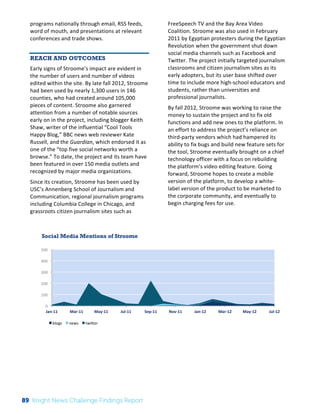
  • 73.
    Interim Review: 2010 Knight News Challenge Winners 2 components of the software that will further facilitate scaling. A number of towns have approached Front Porch Forum, requesting to launch the platform in their communities. In response, FPF has since changed its business model to require a start-­‐up fee for launching into new areas. Communities have paid this start-­‐up fee through their chambers of commerce, citizen fundraising, or municipal budgets. REACH AND OUTCOMES Since receiving funding through the Knight News Challenge, Front Porch Forum has spread from 25 to 84 towns, including 82 towns in Vermont and one town each in New Hampshire and New York. By reaching 82 towns in Vermont, FPF has achieved about 33 percent of its long-­‐term goal for scaling. The project has also spread to the neighboring communities of Stewartstown, New Hampshire and Argyle, New York. One of the key metrics used to measure Front Porch Forum’s adoption is its “take rate”—the percentage of registered users within a given FPF neighborhood. As of October 2012, Front Porch Forum’s take rate was 38 percent, with 43,000 total members out of a coverage area that encompasses 112,000 households. The project’s take rates within individual communities vary between 15 percent and over 90 percent, in communities where multiple registered FPF users exist within the same household. The project also shows strong signs of user engagement. In communities such as Burlington, more than half of FPF’s users actively post to their neighborhood forum. From July 2011 to July 2012, time spent on Front Porch Forum’s site averaged nearly five minutes (4:50) across 1.5 million page views, with users accessing an average of 5.7 pages of content per visit (even though most users interact with their local FPF via email rather than the website). Most notably, Front Porch Forum’s number of returning visitors over the 12-­‐month period was 57.4 percent, which substantially exceeds the industry average. The project’s mentions through Blogger, Facebook, and Twitter have been growing steadily since November 2011. Front Porch Forum’s ultimate goals were to help inform users about local news, strengthen a sense of offline community, and spur greater levels of civic engagement. Evidence of these impacts exists on FPF’s blog (which has been maintained for over five years and includes over 1,500 posts), through the thousands of posts made weekly to the project’s forums, and through the outpouring of praise and thanks from users who feel more connected, informed, and involved. Front Porch Forum has proven to be a powerful tool for community development and building social capital. In the aftermath of Hurricane Irene in late August 2011, FPF was invaluable in broadcasting messages from public officials and in helping devastated Vermont communities coordinate relief efforts. Smaller towns used Front Porch Forum to post ads seeking emergency housing and volunteers with trucks and chains who were willing to help pull cars from flooded areas. The example of Moretown provides a useful case-­‐in-­‐point. After the Knight News Challenge Findings Report 70
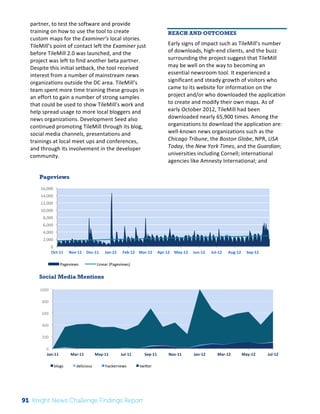
  • 74.
    hurricane hit, a group of students decided to offer their volunteer services to ravaged communities. The students traveled from town to town, offering their services. Towns that had not been using Front Porch Forum often were unable to put the volunteers to good use. The volunteers would arrive, ready to help, but residents were insufficiently organized to provide them with meaningful work to do. But residents of Moretown— who had been using Front Porch Forum for a year—knew exactly how they could use the volunteer assistance and had the community networks in place to put them to immediate use. New vs Returning Visitors 25,000 20,000 15,000 10,000 5,000 5000 4000 3000 2000 1000 Interim Review: 2010 Knight News Challenge Winners 3 0 Q1 2010 Q2 2010 Q3 2010 Q4 2010 Q1 2011 Q2 2011 Q3 2011 Q4 2011 Q1 2012 Q2 2012 Q3 2012 Registered New Users Registered New Users Linear (Registered New Users) 0 Returning Visitors New Visitors Linear (Returning Visitors) Linear (New Visitors) 71 Knight News Challenge Findings Report
  • 75.
    Interim Review: 2010 Knight News Challenge Winners 1 Game-O-Matic (The Cartoonist) PROJECT GRANTEE INNOVATION GRANT Game-O-Matic Georgia Tech Research Corp. A free, easy-­‐to-­‐use tool that allows journalists to build cartoon arcade games based on their news content $378,000 In partnership with the University of California Santa Cruz, the Georgia Institute of Technology received News Challenge funding to create a free tool that allows anyone to create cartoon-­‐ like current event games that can be easily integrated into the websites of local newspapers and media outlets. The aim of Game-­‐O-­‐Matic (formally called The Cartoonist) was to increase the use of news games to convey editorial opinion, helping journalists and editors draw communities to their local newspapers, and further inspire citizens to explore the news. THE INNOVATION The developers conceived Game-­‐O-­‐Matic as a free tool for those without a background in game development to use in generating simple, cartoon-­‐like current event games that are the equivalent of editorial cartoons. Several other projects exist to develop digital games to build citizen engagement in important issues.1 The expense, time, and expertise required to craft regular video-­‐game content, however, has prevented the widespread adoption of news games by traditional media sources. Game-­‐O-­‐ Matic was created to relieve the burden of programming and design while encouraging journalists to think of news events not just as stories, but as systems that can be modeled and explored. The tool serves as an intelligent operating system for creating arcade-­‐style games through the process of concept mapping relevant actors and their relationships. By answering a series of questions about the major 1 Other new games-­‐focused projects include 2007 Knight News Challenge Winners New York News Games, Oakland Jazz & Blues Clubs Video Game, and Playing the News. actors in a news event and making value judgments about their actions, Game-­‐O-­‐Matic automatically proposes game rules and images. Once created, users can publish their games to Game-­‐O-­‐Matic’s site or to their own website or Facebook profile. IMPLEMENTATION Because Game-­‐O-­‐Matic set out to create a technology from scratch, the project spent its early months conducting research into game design platforms and working to find ways in which the platform could interpret user input to generate games. After a conducting survey of available game design platforms, Game-­‐O-­‐Matic chose to use PushButton Engine, an open source framework for building Flash games. The project spent a significant amount of time developing a theory of meaning and rhetoric for two-­‐dimensional, arcade-­‐style games. No one had undertaken this research before, and the development of Game-­‐O-­‐Matic took longer than the project team anticipated since they had to conceptualize the types of stories the tool could process, the basic structures of the news, how the tool could combine video-­‐game elements to create meaning, and how to make the software usable. Game-­‐O-­‐Matic’s project team programmed an early version of the tool after they determined the video-­‐game elements that one would need to portray events, coded ways these pieces could be combined, selected a method by which events are broken down into actors and relationships, created interpretations of relationships that can suggest nuance in a story, and coded an interface that allows journalists to input stories. As the project rolled out an early Knight News Challenge Findings Report 72
  • 76.
    Interim Review: 2010 Knight News Challenge Winners 2 version of Game-­‐O-­‐Matic, called the The Cartoonist, it received a number of angry messages and comments from editorial cartoonists who viewed the tool as way for newspapers to replace them. As a result, the project was forced to reconsider its branding and to spend time explaining that it intended the tool to reference editorial cartoons’ ability to convey bite-­‐sized commentary on current events rather than replace cartoons entirely. The project ultimately chose the name “Game-­‐ O-­‐Matic” to convey its automated process for creating games and the complex, generative nature of the tool. The project intended to market Game-­‐O-­‐Matic to the editors, reporters, and designers of local newspapers and media groups. However, later on it expanded its target audience to include the general public in order to create greater adoption and awareness. Game-­‐O-­‐Matic reached out to local news organizations in Atlanta, GA and Santa Cruz, CA to test the tool and inform its development. It also approached individuals from other local news organizations and presented on the project at various game developer conferences and to the World Newspaper Congress and World Editors Forum in Vienna, Austria. Many of these target groups were initially receptive, but Game-­‐O-­‐Matic found it difficult to promote a novelty product, and the project struggled to find highly-­‐visible partners who would create a game to serve as an example for other potential users. The project developed a beta site, http://game-­‐o-­‐ matic.com/, but is waiting to publicly launch until the tool is more polished and easier to use. REACH AND OUTCOMES Game-­‐O-­‐Matic has yet to launch publicly and is still in the very early stages of its lifecycle. By the end of the grant period, adoption of the tool had been low: by August 2012, 450 games had been produced and news media groups were experimenting with the tool. Anecdotally, user reception of the tool was largely positive, but Game-­‐O-­‐Matic found it difficult to motivate these partners to actually use the tool to create games that they posted on their websites. As of mid-­‐October 2012, Game-­‐O-­‐Matic was still struggling to find a user-­‐created game to serve as an example of the tool’s use to promote to local newsgroups. Overall awareness of the tool is also low. Social media monitoring captured about 50 mentions of “Game-­‐O-­‐Matic” between March 2012 and November 2012, with mentions spiking around times when the project gave presentations during conferences and events, including the Game Developer’s Conference, Games for Change, and the workshop on Procedural Content Generation in Games. The project’s ultimate aim was to create a tool which would increase the use of news games, resulting in readers’ increased interest in the news. To date, there is no evidence to suggest that Game-­‐O-­‐Matic has significantly helped to increase the use of news games in local news or raised reader interest in the news. Perhaps the project’s greatest achievement, however, was the successful completion of a beta version of its platform. Game-­‐O-­‐Matic proved itself to be a versatile way of thinking about meaning and games and even produced a white paper on the theory of meaning and rhetoric for two-­‐ dimensional, arcade-­‐style games.2 Its model established a flexible framework which can be updated with new templates, variables, assets, and logics, and could inspire the design and creation of other news game authoring systems in the future. Game-­‐O-­‐Matic’s future plans include pursuing bridge funding of $50,000 for the next year in order to revise the tool according to initial users’ feedback, to eventually launch the platform to the public, and to continue pursuing partners who could market games made with the tool to other potential users. 2 Game-­‐O-­‐Matic’s white paper is available here: http://mtreanor.com/research/micro-­‐rhetorics.pdf 73 Knight News Challenge Findings Report
  • 77.
    Interim Review: 2010 Knight News Challenge Winners 1 LocalWiki PROJECT GRANTEE INNOVATION GRANT LocalWiki WikiSpot An easy-­‐to-­‐use, open-­‐source “wiki” platform tailored to the needs of local communities $360,500 Wikis are websites developed collaboratively by a community of users, allowing any user to add and edit content. Based on the success of its first locally based wiki in Davis, California, LocalWiki received Knight News Challenge funding to create specialized, open-­‐source wiki software and to help other geographic communities develop, launch, and sustain wiki projects using this software. THE INNOVATION LocalWiki pioneered locally focused wiki software with the goal of making it easy for people to share knowledge of their own communities. The platform enables users to create pages and articles, upload photos and files, and edit others’ pages. Community wiki pages can feature articles on anything from the news and history of the area to updates on local public transportation, nearby attractions, lost pets, or local social services. Specific innovations within LocalWiki’s software include its accessibility and ease of use, tagging features for pages, and mapping capabilities that allow users to link pages to points and areas on a map. Users can easily view and reverse edits to pages and maps and track their wiki’s number of pages and contributors through a dashboard feature. IMPLEMENTATION LocalWiki set out to develop an enhanced, open-­‐source wiki platform with documentation designed to meet the needs of local communities. Because the project’s Knight News Challenge funding focused more heavily on software development, LocalWiki was limited to launching and testing its software in just one pilot community. LocalWiki turned to the crowd-­‐funding platform Kickstarter to help fund outreach and education efforts and eventually raised over $26,000 with the help of 427 individual donors. Delays in the initial disbursement of Knight grant funds pushed back the start of the project by about three months, but progress picked up when the project received its funding. LocalWiki publicly released its first version of the software on November 30, 2011. The platform was designed to be easier for non-­‐developers to install and to create a more accessible editing process. LocalWiki marketed this software to the open-­‐ source community through the project’s own development mailing list, through interaction with other projects on GitHub, and through a series of hackathons on LocalWiki’s code. LocalWiki selected Denton, Texas to serve as its first pilot community because Denton’s project leads seemed the most able and motivated to work under limited initial guidance. By piloting DentonWiki, LocalWiki aimed to gain essential feedback on the new software as it was being developed, and to gain experience helping other communities create and launch local wiki projects. Prior to the launch of DentonWiki, LocalWiki worked with the team in Denton to Knight News Challenge Findings Report 74
  • 78.
    Independent Installs 1000 900 800 700 600 500 400 300 200 100 Content Growth (in pages) 45,000,000 40,000,000 35,000,000 30,000,000 25,000,000 20,000,000 15,000,000 10,000,000 5,000,000 Interim Review: 2010 Knight News Challenge Winners 2 help build a core, dedicated group of editors who would drive the project. Denton’s wiki featured over 800 pages when it launched, on the same day as the public release of LocalWiki’s new software. After supporting the first pilot community in Denton, Texas, LocalWiki selected Santa Cruz, California and Raleigh-­‐Durham, North Carolina as additional communities in which to test the platform. LocalWiki left the local outreach work up to these focus communities but offered them coaching along the way through visits, phone calls, and emails. By providing direct support to a few successful communities and then building a network of communities implementing the software, LocalWiki hoped to create a model in which communities would reach out to each other for best practices and further spread the platform. REACH AND OUTCOMES LocalWiki is well positioned to achieve its ultimate aim of demonstrating that local wikis are a viable way for communities to manage and share information. LocalWiki’s open source code has been adopted and used around the world. Between late August 2011 and the software’s first major release in late November 2011, LocalWiki’s platform was installed nearly 700 times. LocalWiki is now the second-­‐most installed of the Knight News Challenge’s server-­‐ focused projects.1 By late August 2012, there were at least 58 independent LocalWiki projects (of which 37 were considered “major”), spread across nine countries and published in seven languages. LocalWiki only hosts a minority of its community projects, but it received about 26.7 million page views for these projects over the 1 LocalWiki’s downloads are second only to the Ushahidi platform, a server-­‐focused project which provides an open source software for collecting, visualizing, and mapping citizen reports from large news events. 0 0 75 Knight News Challenge Findings Report
  • 79.
    Interim Review: 2010 Knight News Challenge Winners 3 course of 2011. By late August 2012, LocalWiki’s code had been downloaded over 690 times and forked 40 times. It had also attracted 164 individuals who signed up to be notified of changes to the code. Additionally, 73 people have contributed by identifying bugs in LocalWiki’s code, and LocalWiki has incorporated others’ changes in about 80 cases. Users have downloaded the code to develop mobile web applications, a LocalWiki-­‐like project for Burning Man, and new functionalities such as editable comments. Two users in Portugal used the code to internationalize LocalWiki, so that the platform’s user interface could be translated into any language. To date, LocalWiki is available in seven languages. Although the platform has exerperienced impressive adoption, most of LocalWiki’s community wikis are still working to reach a critical mass of users and become entirely community maintained. LocalWiki has already reached this tipping point with its longstanding DavisWiki project. Nearly one in seven Davis residents contributes to the wiki at some point within the course of a year, and about half of Davis’s residents use DavisWiki each month. LocalWiki’s other communties have yet to achieve this same level of engagement but have demonstrated a number of initial successes. Santa Cruz, California is LocalWiki’s largest focus community, with over 5,400 pages, 4,300 photos, and 2,700 maps. TriangleWiki in Raleigh-­‐Durham, North Carolina has seen widespread adoption and use from Raleigh’s city council, which has used the wiki to post city government content. Two locally based mobile projects have also used TriangleWiki, incorporating the wiki’s content streams in their applications. Knight News Challenge Findings Report 76
  • 80.
    Interim Review: 2010 Knight News Challenge Winners 1 NowSpots PROJECT GRANTEE INNOVATION GRANT NowSpots Windy Citizen Open-­‐source software allowing “real-­‐time advertising” that can be updated at any time by local businesses using social media $257,500 NowSpots was created to provide local publishers with “real-­‐time advertising” through widgets that show the latest updates from an advertiser’s social media accounts. The project aimed to turn sponsored social media streams into a viable source of income for news sites. THE INNOVATION Traditional web advertising relies heavily on banner ads—static or animated images that display an advertiser’s messaging each time the page is refreshed. If done well, banner ads can build brand awareness and help drive traffic to the advertiser’s site. For smaller organizations without a strong web presence, however, these ads often fail to build a relationship between viewers and the organization being advertised. NowSpots created open-­‐source software allowing “real-­‐time advertising” through a widget that shows the latest message or post from the organization’s social media accounts including blogs, Facebook, Twitter, and YouTube. The platform enables users (local businesses and publishers of all sizes) to update their advertisements automatically with real-­‐ time information, allowing them to connect more directly with potential customers. It also provides them with back-­‐end analytics on how many times potential customers view the ads, click on them, or repost content from them. IMPLEMENTATION The Knight News Challenge awarded funding to NowSpots to release and promote open-­‐source code that lets local publishers sell, manage, and serve “real-­‐time advertising” on their own sites. The original concept for the project was to market the tool to local news outlets that could use the tool to add a viable source of income by selling these advertising spots to businesses. To help streamline newspapers’ sales process, NowSpots also developed a search tool that scours local businesses, identifies which are the most active in social media, and rates them on how likely they are to be interested in purchasing “real-­‐time advertising.” The project worked to build awareness through an internal sales force that targeted about 400 local newspapers around the country, relying on conversations and word of mouth. NowSpots partnered with its first client, the Chicago Tribune to test the tool, working with the Tribune’s sales team to market the real-­‐time advertising spots to outside businesses. Despite some initial successes with the Chicago Tribune, NowSpots’ momentum eventually waivered and the paper’s sales team stopped selling the advertising spots. NowSpots estimated that the Tribune’s real-­‐time ads were performing well, with click-­‐through rates nearly 300 percent higher than traditional ads, but it proved to be difficult for the Tribune’s sales team to sell to outside businesses. NowSpots also partnered with a number of other newspapers and media groups and encountered similar challenges in educating the papers’ sales staff about the product and how to effectively sell the advertisements. NowSpots found it difficult to motivate news organizations’ sales teams, as these teams typically had 30–50 other products to sell. As a result of these challenges, NowSpots pivoted from targeting news organizations to selling the tool to small businesses and start-­‐ 77 Knight News Challenge Findings Report

  • 81.
    Interim Review: 2010 Knight News Challenge Winners 2 ups. In early October 2012, NowSpots founder launched Perfect Audience, a Facebook and web retargeting platform that companies can use to target Facebook ad campaigns to people who visit the company’s website, with the aim of helping them reach their ideal customer at scale. REACH AND OUTCOMES By November 2012, the information needed to determine the extent of NowSpots’s adoption and ultimate impact was unavailable. Measuring adoption of NowSpots ads was difficult, since the ads ran on publishers’ websites. However, by fall 2011, NowSpots had tested its system in 447 news media outlets, including the Chicago Tribune, Hearst Digital media, Gatehouse Media, and Digital First Media, and in a number of ad agencies and small businesses. Despite the challenges it encountered in working to train news organizations’ sales team to sell NowSpots ads, early users such as the Chicago Tribune believed the project met a need and customers such as Mastercard, Northwestern University, Hard Rock Café, and the Art Institute of Chicago each bought advertising spots from the project. Some of NowSpots most successful advertising campaigns with these customers have lasted longer than eight months. NowSpots’ six-­‐month relationship with the Chicago Tribune alone produced 25 advertising campaigns with over seven million ad impressions. Results from the project’s test markets indicate that NowSpots ads’ click-­‐through rates were at .361 percent— about 300 percent higher than the average click-­‐through rate of traditional online banner ads. Perfect Audience—the Facebook and web-­‐ retargeting platform launched by NowSpots founder Brad Flora—has achieved considerable success since its founding in October 2012. In June 2014, Perfect Audience was bought for $25.5 million by Marin Software. Knight News Challenge Findings Report 78
  • 82.
    Interim Review: 2010 Knight News Challenge Winners 1 OpenCourt (Order in the Court 2.0) PROJECT GRANTEE INNOVATION GRANT OpenCourt Trustees of Boston University A pilot project to demonstrate how digital technology can increase public access to the courts $250,000 Mainstream news outlets often lack the resources to adequately cover local courts. At the same time, court policies regarding digital journalism have not changed since standards for video and audio recording were established in the 1970s, and the judicial branch has failed to adapt to new technologies such as web streaming and social media tools like Twitter and Facebook. OpenCourt is a pilot project designed to test new media initiatives within a working court system and to establish best practices that can be replicated and adopted throughout the nation’s court system. THE INNOVATION OpenCourt grants citizens and professional journalists digital, web-­‐based access to Quincy District Court in the greater Boston area. The project provides the court with a WiFi network for use by journalists and bloggers and features a live-­‐streaming video of the proceedings from the court’s First Session courtroom and daily archives of courtroom footage. OpenCourt aims to serve as a model for similar efforts to integrate new technology into the courts as a means of improving the public’s access to and understanding of the judicial system. IMPLEMENTATION OpenCourt evolved from work done by the Media Committee of the Massachusetts Supreme Judicial Court, and it began with a series of meetings in December 2010 to introduce the project and invite feedback from court staff, attorneys, local journalists, and advocacy groups. Even before its launch, OpenCourt anticipated a number of challenges related to the fear that cameras could influence courtroom behavior and the outcomes of cases. The project faced resistance from a number of stakeholders, including defense attorneys, the District Attorney’s office, and advocates against domestic violence. Concerns included the difficulty of ensuring that the project would strike the balance between public access and an individual’s right to a fair trial and due process, and issues of safety in protecting the privacy of domestic abuse victims. Despite these groups’ opposition to the project, each participated in its development, serving on the working group that met regularly to establish guidelines and policies for OpenCourt’s live-­‐streaming courtroom coverage. OpenCourt also dealt with a number of unexpected technical challenges and trademark issues prior to its site launch. Gaining sufficient bandwidth into Quincy District Court proved to be difficult and delayed the project’s original timeline. After rebranding from its original project name “Order in the Court”, OpenCourt also learned that TruTV (formerly CourtTV) owned this “mark” and a similar domain name. The project’s website, http://opencourt.us, went live in May 2011. The site allows users to view live-­‐streaming court cases, daily archives of cases, and electronic versions of daily court schedules. On its first day of operation, the local District Attorney’s office filed a motion to close access to OpenCourt’s online archives. The motion was denied, but by July 2011, the District Attorney’s office had filed a pair of motions aimed at shutting off the site’s archives 79 Knight News Challenge Findings Report
  • 83.
    and live-­‐streaming footage. The Massachusetts Supreme Judicial Court ruled in favor of OpenCourt in March 2012 and established that the state cannot suppress publication or redact footage of public proceedings. Not long after this decision, the District Attorney’s office again sued OpenCourt to stop its plans to begin streaming jury trials. The court ruled in OpenCourt’s favor again in mid-­‐August 2012 and allowed OpenCourt to move forward with live-­‐streaming jury trials under the preliminary guidelines set forth by its decision in the earlier case. On September 11, 2012, OpenCourt live streamed a jury trial from Quincy District Courthouse for the first time. REACH AND OUTCOMES OpenCourt has received significant attention in the legal field and in the media. Trend data on visits to OpenCourt’s website are unavailable, but Google Analytics data shows that the project received a total of 122,038 visitors including 70,788 returning visitors between October 2011 and late November 2012. Spikes in the number of OpenCourt’s social media mentions are due in part to the increased media attention during its legal challenges. The project received positive coverage in local new outlets such as the Boston Globe, the Boston Number of Social Media Men=ons 250 200 150 100 50 Interim Review: 2010 Knight News Challenge Winners 2 0 Jan-­‐11 Mar-­‐11 May-­‐11 Jul-­‐11 Sep-­‐11 Nov-­‐11 Jan-­‐12 Mar-­‐12 May-­‐12 Jul-­‐12 Other facebook twi`er Herald, Quincy Patriot Ledger, WBUR, and Massachusetts Lawyer’s Weekly. Links from Boston.com, the Associated Press, WBUR, and the Quincy Patriot Ledger websites each helped to drive traffic to OpenCourt’s website. OpenCourt also received attention in national sources such as the Legal Law Network and Current, a periodical that covers issues in public media. The ultimate goal of OpenCourt was to create a set of benchmarks and best practices for digital communications that could be published and shared widely among industry groups, even beyond judicial systems. This broader vision has gradually come to fruition. In addition to the project’s web traffic and media attention, OpenCourt’s team was asked to present at a number of speaking engagements nationally and received numerous requests from legal journals that are interested in publishing the project’s findings. OpenCourt is in the process of authoring these articles. Perhaps OpenCourt’s greatest achievement is the precedent that it has set on the issue of citizen access to courtrooms—a precedent that could encourage and strengthen similar efforts in Massachusetts and across the United States. OpenCourt’s legal victories have also had a significant impact on Massachusetts’s revised guidelines for cameras in courtrooms. At the time of this report, OpenCourt had just launched its coverage from a second courtroom, using a multi-­‐camera setup to document new types of hearings, such as jury trials. OpenCourt’s broadcast on September 11, 2012 marked the first criminal trial ever to be live streamed in Massachusetts. According to Google Analytics, the trial’s live stream received Knight News Challenge Findings Report 80
  • 84.
    Interim Review: 2010 Knight News Challenge Winners 3 a total of 481 views. OpenCourt’s legal battles, however, did slow its expansion and limited the amount of time the team could devote to developing contextual reporting, training citizen journalists, and developing technical solutions to handle the large amount of video data captured in court. In spite of this, the court cases helped to generate more awareness and interest in the project. Despite the project’s momentum, OpenCourt is struggling to find a funding model to sustain itself. OpenCourt’s team has funding and institutional support from WBUR and Boston University to keep the project running through December 2012 and is currently exploring a number of potential options for sustaining the project. 81 Knight News Challenge Findings Report
  • 85.
    Interim Review: 2010 Knight News Challenge Winners 1 PRX Story Exchange (StoryMarket) PROJECT GRANTEE INNOVATION GRANT PRX Story PRX, Inc. A crowd-­‐funding platform that allows local Exchange public radio stations, producers, and listeners to find and help fund stories $75,000 Faced with capacity constraints and the high cost of producing local stories, many of today’s public radio stations fail to cover local news. Story Exchange, run by PRX, a nonprofit public media company in Cambridge, Massachusetts, was created to offer an open-­‐source crowd-­‐ funding platform for finding, supporting, and distributing local public radio stories. PRX partnered with an existing crowd-­‐funding project, 2008 Knight News Challenge Winner Spot.us, to serve as Story Exchange’s technical platform. The project was funded through the Knight News Challenge to develop a pilot with Louisville Public Media (LPM) in Louisville, KY and to eventually expand to at least three other test markets. Ultimately, Story Exchange failed to gain widespread adoption. THE INNOVATION Story Exchange aimed to help crowd funding become an effective revenue option for professional journalism. Using Story Exchange, public radio stations and independent producers could issue requests for story ideas along with their respective fundraising goals, hosted on the station’s own website, PRX’s website, and Spot.us’s website. The platform offered listeners the ability to vote on story ideas, to pledge financial support to the stories and pitches of their choosing, and to post suggestions of other stories they wanted to hear in the future. Several other web-­‐based crowd-­‐funding efforts existed, such as Kickstarter and Spot.us, but Story Exchange was the first to focus on funding public radio stories and the first to promote these stories using on-­‐ air pitches. IMPLEMENTATION PRX set out to test Story Exchange’s model with LPM in Louisville, KY and to eventually scale to other communities already connected through PRX.org. Rather than building its own technical platform from scratch, Story Exchange partnered with 2008 Knight News Challenge Winner Spot.us. Story Exchange originally planned to use Spot.us’s code in order to develop a separate project. After lengthy consideration, PRX chose instead to integrate Story Exchange into Spot.us. Coordinating with Spot.us on the scope, specifications, and interface of the platform took Story Exchange longer than expected and delayed the project’s development. Story Exchange’s launch met with resistance from public radio journalists. The day Story Exchange began on-­‐air announcements for the project’s pitches in Louisville, a number of public radio producers, editors, and consultants posted accusations about the potential for conflict of interest and concerns about the project’s lack of editorial control to the Facebook page of the American Public Media Group (APM). PRX had anticipated this reaction at the outset of the project and had put rules in place that capped the amount an individual listener could contribute to a story, created a policy for returning the donations of listeners too close to an issue, and granted partner stations decision-­‐making authority over which stories to air and the content of these pieces. Story Exchange confronted stations’ concerns and misperceptions head-­‐on in in-­‐person meetings and in written explanations, but the Knight News Challenge Findings Report 82
  • 86.
    Interim Review: 2010 Knight News Challenge Winners 2 negative attention ultimately hampered the project’s ability to attract partner stations. While it lasted, Story Exchange’s partnership with Spot.us benefited both groups and contributed to improvements within each project. However, the dynamic changed significantly in fall 2011, when APM acquired Spot.us. PRX continued partnering with APM on Story Exchange, but the members of the Spot.us team who PRX had worked with were placed on other projects or left the company. As a result, Story Exchange lost its developer team and its platform lacked sufficient technical support and attention. Similarly, Story Exchange’s relationship with LPM was largely positive until the project’s key point of contact left the station. While LPM’s staff was enthusiastic and engaged with the project, the loss of its champion within the station left Story Exchange without a key leader who had helped ensure the continuity and direction of the work. REACH AND OUTCOMES PRX Story Exchange struggled to gain adoption among public radio stations. It even had trouble finding three other public radio stations to serve as the project’s test markets. PRX made pitches to a number of potential partners, but each was unwilling to adopt the platform. St. Louis Public Radio worried the platform might dilute and distract from the radio station’s general fundraising appeals. North Country Public Radio in the Adirondack area of New York State didn’t have the technical capacity to integrate Story Exchange into its website quickly enough. Other stations, such as KALW in San Francisco, had begun using Kickstarter as a means for funding news pieces. Despite this, Story Exchange’s partnership with Louisville Public Media accomplished the goal of helping fund original local news pieces. Four of the five story ideas posted to Story Exchange were fully funded by listeners: 92 individuals contributed a total of just over $900 to these stories, and the four stories that received funding were aired on eight different public radio stations. “Is it Time to Get Serious about Coal Ash?” was Story Exchange’s most successful story. The piece aired over each of Kentucky’s seven public radio stations, inspired a local producer to create a 12-­‐minute documentary, and won the award for Best News Series from the Indiana Associated Press Broadcasters. One user of Story Exchange felt that the value it added was less about filling the financial needs of a specific story (often, the station may have done the piece anyway), but providing supplemental funding and motivation to follow through, as the station was then beholden to the story’s donors. Story Exchange may have failed to gain adoption among public radio stations, but PRX learned a number of valuable lessons about the techniques, guidelines, and knowledge needed to ensure a successful crowd-­‐funding campaign. PRX chose to discontinue Story Exchange beyond the two years of its News Challenge grant, but it began using Kickstarter in its crowd-­‐funding efforts for independent public media. 83 Knight News Challenge Findings Report
  • 87.
    Interim Review: 2010 Knight News Challenge Winners 1 SeedSpeak (CitySeed) PROJECT GRANTEE INNOVATION GRANT SeedSpeak Arizona State University An application with mobile, web, and widget components that provides citizens in local communities an easy way to suggest community improvements to local leaders, volunteer groups, and each other $93,600 SeedSpeak, formerly CitySeed, is a project led by Retha Hill of the Walter Cronkite School of Journalism and Mass Communication at Arizona State University (ASU). SeedSpeak is an application with mobile, web, and widget components. It allows users to plant suggestions (seeds) in local communities in order to empower other community members, leaders, and volunteer groups to discover their ideas, add to them, and help bring them to fruition. The project was created to give citizens a simple way to suggest community improvements and to increase the number of people who are informed about and engaged in their communities. THE INNOVATION A number of similar applications—such as EveryBlock, City Works, City Ideas, and SeeClickFix— exist for suggesting community improvements and increasing community engagement.1,2 SeedSpeak is the first of these to offer a low-­‐cost or free open source solution specially targeting smaller cities. The project allows citizens to suggest community improvements at the exact location where they see an unmet need or have an idea for a project. SeedSpeak includes web and mobile applications as well as a white-­‐label widget to be incorporated into local news sites or 1 City Works and City Ideas are map-­‐based applications created as a part of SocMap (formerly known as GoMap Riga), a fellow 2010 winner of the Knight News Challenge. 2 EveryBlock is a winner of the 2007 Knight News Challenge. EveryBlock.com was acquired by MSNBC in 2009 and now operates in 19 US cities. municipality’s websites can embed so community members can collaborate to improve their community or to report problems. Problems and suggestions can focus on any number of community-­‐related issues, such as traffic, recreation, or the use of public space. In a typical case, a user might come across a potential location for a community garden. The person can use SeedSpeak’s mobile application to geo-­‐tag his or her idea, linking it to the exact location of the potential garden. Other users view this and other place-­‐based suggestions, debate, and take action on their favorite ideas. IMPLEMENTATION SeedSpeak experienced several challenges which pushed its timeline back by over a year. It hired a local, Phoenix-­‐based interactive agency to design, develop, and build its applications. The project team focused its initial energy on user-­‐centered design, researching the desires of the Phoenix, AZ community for features in a mobile, idea-­‐sharing social network. SeedSpeak conducted interviews with avid social networkers, mobile experts, city officials, leaders of community organizations, and news gatherers, in an effort to understand the needs and goals of potential users and other relevant stakeholders. The research helped inform SeedSpeak's feature set, layout, and design and allowed the outside developers to hammer out a prototype website design. Early user feedback also helped SeedSpeak revise its design plans, de-­‐emphasizing the gardening metaphor of planting and growing ideas after testers Knight News Challenge Findings Report 84
  • 88.
    Interim Review: 2010 Knight News Challenge Winners 2 confused the goals of the project with actual gardening. The third-­‐party developers produced an alpha version of SeedSpeak’s website in March 2011, but the site required more funding and months of additional work to address design and functionality flaws. Delays in funding due to ASU’s reporting requirements also stalled the project, causing the developers to suspend their work for nearly two months. After changes in similar applications such as EveryBlock and SeeClickFix, SeedSpeak spent more time than anticipated distinguishing itself from other applications. SeedSpeak eventually created a beta version of its site, http://beta.seedspeak.com/, by fall 2011 and the iTunes App Store accepted SeedSpeak’s iPhone application in early August 2012. SeedSpeak contracted with a new developer to work on the Android application the next month. When its project team initially conceived SeedSpeak, it planned to host the widget version of its application on local newspapers and news websites to allow for more interaction between users and local reporters. SeedSpeak shifted this focus shortly after receiving Knight funding when it found that media organizations were too distracted by budget constraints and other competing projects. The project pivoted instead to city and municipal government sites, promoting itself through direct outreach to local governments, local political leaders, and community groups. SeedSpeak also planned to market the tool through coverage in local news outlets and in the marketing literature, websites, and outreach collateral of supporting foundations, civic groups, public officials, ASU, and local Chambers of Commerce. REACH AND OUTCOMES As a result of major delays in developing the beta version of the website, applications, and widget, SeedSpeak only began promoting its tool in fall 2012. By late October 2012, SeedSpeak was working to identify the first community that would test the platform by reaching out to numerous local governments, political leaders, and community groups. It remains relatively early in the project’s lifecycle to assess the platform’s ability to reach some of its more ambitious goals to increase the number of people informed about and engaged in their communities. However, several communities have expressed an initial interest in using the tool. Among these areas are Chandler, AZ; Jerome, AZ; Yavapai County, AZ; and Benton Harbor, MI. To sustain the project into the future, SeedSpeak has applied for bridge funding through a partnership between the Knight Foundation and the Association for Education in Journalism and Mass Communication, and through ASU. Despite the challenges and delays faced throughout its development, the project leader is optimistic about SeedSpeak’s ability to land contracts with smaller cities. The project continues to evolve, exploring other possible uses, geographies, and partners. SeedSpeak is also exploring the idea of testing its widget in countries with markets that are less crowded with community engagement applications, such as Mexico. 85 Knight News Challenge Findings Report
  • 89.
    Interim Review: 2010 Knight News Challenge Winners 1 SocMap (GoMap Riga) PROJECT GRANTEE INNOVATION GRANT SocMap Society Technologies Foundation A map-­‐based social network where users can browse news and engage in civic action through an online local community map $265,000 The Society Technologies Foundation received funding through the Knight News Challenge to create SocMap, a social platform where users can browse news and engage in civic action through a live, interactive online map of their community. SocMap (originally named GoMap Riga) is a portal application that connects users for interaction, self organization, and the spread of local news. SocMap was tested in Riga, Latvia with hopes of eventually expanding to other cities. THE INNOVATION The original innovation behind SocMap was a social network where news would be presented in relation to its location on a live, interactive, web-­‐based map. SocMap would pull and aggregate community news found on the web, place these stories on its map, and allow users to browse local news and to search and post local events, pictures, and videos. By being integrated with the major existing social networks, users could interact with local news stories, and have their tweets placed on the map. The application also aimed to provide a platform for civic engagement where users could post initiatives to the map (such as suggestions for a community mural, or complaints of a broken fountain), gather signatures from fellow citizens, and bring the initiative to the attention of the local municipality, media, or police. IMPLEMENTATION The project did not unfold as planned. Although the project team built SocMap and experimented for a full year with various ways of attracting users and motivating them to post content to the site, SocMap struggled to reach 1,000 users, the platform ultimately stagnated, and the project team decided to adapt. Using the advanced mapping API that it had created, the project team began creating smaller, more targeted applications that let users interact with municipalities and city governments rather than with other members. SocMap had hired a team of creative developers under the original concept for the platform, but the shift in focus required a new team, one that had business expertise. The core members of the project team, who had been engaged on multiple projects unrelated to SocMap, decided to dedicate themselves full time to the project, and SocMap hired individual directors in business, marketing, products, networking, sales, and technology. SocMap marketed the applications that came out of its original platform to municipalities through the website and Facebook page of the new brand “Stakeholde.rs.” As of November 2012, Stakeholde.rs offered four, white-­‐label map-­‐ based applications: • City Works allows cities to post completed municipal maintenance projects and enables users to suggest improvements. • City Ideas allows cities to post questions and ideas on a map and solicit citizens’ input. Users can vote on the most popular ideas or make their own suggestions. • City Growth presents completed and planned city development projects to citizens and investors. Residents can view these projects, comment on them, and share them over existing social networks. Knight News Challenge Findings Report 86
  • 90.
    Interim Review: 2010 Knight News Challenge Winners 2 • Map Survey can be used by journalists and municipal governments to create surveys that visualize users’ responses on a map-­‐ based infographic. Map Survey was used to create HotBills, a citizen-­‐populated data map that visualized the differing costs of heating per square meter across Latvia, and SchoolMoney, another citizen-­‐populated map that presented the costs associated with Latvian public education. The project team found that creating smaller, more targeted applications was cheaper and easier to experiment with than creating and managing a large website. Stakeholde.rs is now translating Map Survey into English and designing other map-­‐based applications to market to municipalities across Latvia and the European Union. The project’s partnerships with external groups were crucial in helping promote these applications. SocMap partnered with the Municipality Union of Latvia, an association of local and regional Latvian governments, to help attract the municipalities to use Stakeholde.rs’ tools. SocMap also partnered with the Baltic Center for Investigative Journalism to attract publicity and content for the map-­‐based infographics created with Map Survey. REACH AND OUTCOMES As noted above, SocMap’s original platform failed to gain significant levels of adoption and engagement, struggling to reach even 1,000 registered users and to expand beyond users the project team had attracted through their own personal networks. Although its first platform failed, the project used SocMap’s mapping API to create four more-­‐successful applications marketed through Stakeholde.rs. By October 2012, one-­‐sixth of Latvia’s municipalities (about 20 out of 120 cities) are using Stakeholde.rs’ applications to engage their citizens. Stakeholde.rs will begin to turn a profit once approximately 40 more cities purchase its tools. In early October 2012, 13 other European cities signed up for free trials of various Stakeholde.rs tools. Among these cities were Amsterdam and The Hague, Netherlands; Munich, Germany; Warsaw, Poland; Terrassa, Spain; and Dresden, Germany. Map Survey has emerged as Stakeholde.rs’s most successful application to date. HotBills took only a few weeks to develop, but within a month of its launch in February 2012, the application was used by two percent of Latvia's population (40,000 people) and over 2,500 users had scanned and submitted their heating bills. Between January 1, 2011 and July 31, 2012, HotBills had 262,593 unique visitors and over 1.1 million page views (90 percent of which came from Latvia), making it the largest crowdsourced journalism project in Latvian history. The tool aggregated this data into a visual map which revealed that the cost of heating per square meter differs by up to several times, that neighboring houses could have vastly different costs, and that Latvians do not know how their bills are calculated. HotBills ultimately helped to provide users with an incentive to talk to their landlords about heating prices, to ask for explanations, and to demand adequate answers. Stakeholde.rs is primarily focused on marketing MapSurvey to neighboring countries in the Baltic region, but is also in the process of translating the application into English, as a number of local governments in other countries have expressed interest in the tool. The BBC, the Guardian, and various Baltic media organizations have signed up for Map Survey’s free trial. By May 2013, Stakeholde.rs apps reached 30 subscription contracts in Latvia and two in Estonia. The company was acquired in May 2013 by investors with experience in SAAS for government institutions. 87 Knight News Challenge Findings Report
  • 91.
    Interim Review: 2010 Knight News Challenge Winners 1 Stroome PROJECT GRANTEE INNOVATION GRANT Stroome Stroome An online video editing community which allows users to upload content and collaboratively edit $230,000 Eyewitness video captured by mobile phones or webcams has rapidly become a key component of news coverage. Stroome’s platform was designed to allow multiple journalists or aspiring journalists to cover the same story and stream their footage to the web, replacing satellite truck technology with an inexpensive online solution. Stroome aimed to provide users with a robust online editing community where they can collaborate, share ideas and tips, and publish accurate, contextual news in real time. Despite challenges in working with developers and in finding supplemental funding, the platform earned praise and has seen growing adoption among users. THE INNOVATION Stroome is the first online video editing platform to allow multiple users to collaborate on a project. Other online editing sites exist, but each requires users to exchange and transfer video files through other means (such as email) in order to work together to edit a piece. Stroome aimed to transform collaborative video editing into a more efficient process by allowing users to edit content together within their web browsers, add and view uploads with real-­‐time streaming, exchange comments through remix or text, and publish finished pieces through their own blogs, websites, and social media channels. IMPLEMENTATION Prototyped at USC Annenberg’s Program on Online Communities in the fall of 2008, Stroome started small and aimed to iterate, scale up, and eventually roll out to a larger audience of journalists and journalism students. The project was on its second iteration when it received its Knight News Challenge award in 2010. It used this funding to launch a third iteration of its platform, which would remedy the broken flow and functionality of its previous versions. Stroome hired a top Los Angeles design and user experience firm to partner with the project, held focus groups to gain user feedback for future iterations, decided on a new logo, and worked to find ways to make the platform’s functions for sharing and collaborating on projects more intuitive. One of Stroome’s largest challenges was finding the appropriate third-­‐party developer for the project. The project team identified only one company that had the technical skills and technology to create the necessary video elements for the project. Stroome ultimately created a partnership with this company, but experienced a number of challenges in the process of rebuilding its older Drupal platform from scratch using Ruby on Rails, which ultimately delayed its release. Stroome eventually launched its third iteration at TEDxUSC, in April 2011. With this launch, Stroome aimed to become an essential tool in the classroom and for journalists in the field, and focused its initial marketing strategy on targeting students who are enrolled at journalism schools. The project used a strong social media campaign over Facebook and Twitter to build anticipation for its launch and to create an initial user base to help populate the site with content. Stroome integrated the tool in the journalism program in the USC Annenberg School for Communication and Journalism and marketed the tool to a number of other journalism and digital media Knight News Challenge Findings Report 88
  • 92.
    Social Media Mentionsof Stroome 500 400 300 200 100 Interim Review: 2010 Knight News Challenge Winners 2 programs nationally through email, RSS feeds, word of mouth, and presentations at relevant conferences and trade shows. REACH AND OUTCOMES Early signs of Stroome’s impact are evident in the number of users and number of videos edited within the site. By late fall 2012, Stroome had been used by nearly 1,300 users in 146 counties, who had created around 105,000 pieces of content. Stroome also garnered attention from a number of notable sources early on in the project, including blogger Keith Shaw, writer of the influential “Cool Tools Happy Blog,” BBC news web reviewer Kate Russell, and the Guardian, which endorsed it as one of the “top five social networks worth a browse.” To date, the project and its team have been featured in over 150 media outlets and recognized by major media organizations. Since its creation, Stroome has been used by USC’s Annenberg School of Journalism and Communication, regional journalism programs including Columbia College in Chicago, and grassroots citizen journalism sites such as FreeSpeech TV and the Bay Area Video Coalition. Stroome was also used in February 2011 by Egyptian protesters during the Egyptian Revolution when the government shut down social media channels such as Facebook and Twitter. The project initially targeted journalism classrooms and citizen journalism sites as its early adopters, but its user base shifted over time to include more high-­‐school educators and students, rather than universities and professional journalists. By fall 2012, Stroome was working to raise the money to sustain the project and to fix old functions and add new ones to the platform. In an effort to address the project’s reliance on third-­‐party vendors which had hampered its ability to fix bugs and build new feature sets for the tool, Stroome eventually brought on a chief technology officer with a focus on rebuilding the platform’s video editing feature. Going forward, Stroome hopes to create a mobile version of the platform, to develop a white-­‐ label version of the product to be marketed to the corporate community, and eventually to begin charging fees for use. 0 Jan-­‐11 Mar-­‐11 May-­‐11 Jul-­‐11 Sep-­‐11 Nov-­‐11 Jan-­‐12 Mar-­‐12 May-­‐12 Jul-­‐12 blogs news twiber 89 Knight News Challenge Findings Report
  • 93.
    Interim Review: 2010 Knight News Challenge Winners 1 TileMill (Tilemapping) PROJECT GRANTEE INNOVATION GRANT TileMill Development Seed A suite of open-­‐source tools that local media can use to make custom, embeddable, hyper-­‐ local maps $76,960 TileMill is a project of Development Seed, a data visualization and mapping firm based in Washington, DC. TileMill significantly lowers the barrier to entry for creating highly customized maps, with the aim of allowing journalists and bloggers to tell richer stories and provide unique analysis on local issues through hyper-­‐ local, data-­‐filled maps. THE INNOVATION TileMill is a free, open-­‐source mapping tool for creating highly customized maps, viewable on any web browser and on various mobile devices. Although other basic mapping tools such as Google Maps, OpenLayers, and Polymaps have already made it easier to load a map into a website and plot certain points on it, TileMill offers the ability to change the appearance of base maps (both in design and the data they show) and to easily customize data points. TileMill requires less technical experience than traditional GIS mapping and turns mapmaking into a task that those who are comfortable with common web design languages (HTML and CSS) can quickly grasp. Users customize their maps with the platform’s web-­‐based interface and CSS style sheets. TileMill can import maps and layer data from several popular file formats. Maps made in TileMill can be exported and edited through popular software such as Adobe Illustrator. IMPLEMENTATION Rather than start from scratch, Development Seed built TileMill from a suite of open source libraries including Mapnik, node.js, backbone.js, express, and CodeMirror.1 Development Seed received funding through the Knight News Challenge to develop TileMill into TileMill 2.0, with a new focus on ease of use. Initial contract negotiations with Knight and discussions on the type of open-­‐source license that would be used delayed the project’s launch by a month. TileMill 2.0 was launched on February 16, 2011 with extensive built-­‐in help text and thorough documentation available at http://mapbox.com/tilemill/. Development Seed announced this launch through its blog and other social media channels such as Twitter and Delicious. Within the first day of TileMill 2.0’s launch, more than 10,000 people read the announcement on Development Seed’s blog and 1,750 visited TileMill’s website. Throughout TileMill’s development process, Development Seed regularly asked both the developer community and regular users for their feedback on the tool. Development Seed has released eight updates of the tool since the release of TileMill 2.0, adding a number of key features including a one-­‐click installer and a Microsoft Windows compatible version of the software. Version 0.10.0, TileMill’s most recent version, was released in late September 2012. TileMill 0.10.0 offers even more functions for compositing layers and allows for Photoshop-­‐ like clipping, masking, blurring, and highlighting. At the start of the project, Development Seed planned to focus its marketing efforts on targeted outreach to journalists and bloggers in the Washington, DC area. TileMill would work closely with the Washington Examiner as a beta 1 Backbone.js is also a component of DocumentCloud, a 2009 Knight News Challenge winner. Knight News Challenge Findings Report 90
  • 94.
    Pageviews 16,000 14,000 12,000 10,000 8,000 6,000 4,000 2,000 Social Media Mentions 1000 800 600 400 200 Interim Review: 2010 Knight News Challenge Winners 2 partner, to test the software and provide training on how to use the tool to create custom maps for the Examiner’s local stories. TileMill’s point of contact left the Examiner just before TileMill 2.0 was launched, and the project was left to find another beta partner. Despite this initial setback, the tool received interest from a number of mainstream news organizations outside the DC area. TileMill’s team spent more time training these groups in an effort to gain a number of strong samples that could be used to show TileMill’s work and help spread usage to more local bloggers and news organizations. Development Seed also continued promoting TileMill through its blog, social media channels, presentations and trainings at local meet ups and conferences, and through its involvement in the developer community. REACH AND OUTCOMES Early signs of impact such as TileMill’s number of downloads, high-­‐end clients, and the buzz surrounding the project suggest that TileMill may be well on the way to becoming an essential newsroom tool. It experienced a significant and steady growth of visitors who came to its website for information on the project and/or who downloaded the application to create and modify their own maps. As of early October 2012, TileMill had been downloaded nearly 65,900 times. Among the organizations to download the application are: well-­‐known news organizations such as the Chicago Tribune, the Boston Globe, NPR, USA Today, the New York Times, and the Guardian; universities including Cornell; international agencies like Amnesty International; and 0 Jan-­‐11 Mar-­‐11 May-­‐11 Jul-­‐11 Sep-­‐11 Nov-­‐11 Jan-­‐12 Mar-­‐12 May-­‐12 Jul-­‐12 blogs delicious hackernews twicer 0 Oct-­‐11 Nov-­‐11 Dec-­‐11 Jan-­‐12 Feb-­‐12 Mar-­‐12 Apr-­‐12 May-­‐12 Jun-­‐12 Jul-­‐12 Aug-­‐12 Sep-­‐12 Pageviews Linear (Pageviews) 91 Knight News Challenge Findings Report
  • 95.
    Interim Review: 2010 Knight News Challenge Winners 3 government agencies including the White House and the Department of Energy. While TileMill originally planned to target its outreach efforts to the Washington, DC area, the evidence suggests that it has gained considerable awareness and spread to a much broader audience. From January 2011 to October 2012, TileMill was mentioned a total of 10,600 times over social media channels, with 38 percent of those mentions coming from outside the United States. The majority (85 percent) of these mentions were over Twitter. Peaks in TileMill’s mentions in January 2011, September 2011, and January 2012 coincide with release of new versions of the software. TileMill achieved its broader goal of helping journalists and bloggers tell richer, more complex stories through hyper-­‐local, data-­‐filled maps. MapBox—which began as Development Seed’s fee-­‐based platform for hosting TileMill maps and now exists as a fully separate company that operates TileMill—features a wealth of visually stunning maps that succeed in this goal through the use of the tool.2 TileMill has received a largely positive response from many users, including excitement from Brian Boyer, one of the Chicago Tribune’s main developers of news applications. In addition to the tool’s actual use, project team members are frequently asked to present and give trainings on TileMill at conferences and events around the country. The project has also attracted significant attention in the area of open-­‐source code and cultivated a strong developer community. By late July 2012 TileMill’s code had been downloaded more than 56,000 times, forked 114 times, and attracted nearly 1,000 individuals who signed up to be notified of code changes. TileMill was featured in Linux Magazine as a project to watch, and Development Seed was asked to present on TileMill at a number of open source 2 MapBox’s gallery of web maps built using TileMill is available at http://mapbox.com/tilemill/gallery/. conferences, including WhereCampPDX, WhereCampDC, POSS4G, and State of the Map. Knight News Challenge Findings Report 92