
EHI Live Birmingham NEC
6th Nov 2013

From Patient Assessment to
European Registry
European Cystic Fibrosis Experience
Mel McIntyre

EHI Live 6th Nov 2013
About OpenApp
•Software development and support focused on
healthcare, patient assessments, quality assurance,
spatial analysis and planning.
•Deliver solutions on Open Source technologies, Python,
Postgresql, Linux, Django, Zope.
•Cloud delivered Patient Assessment Platform for Clinical
Programs
•Teaming with IBM and DSS Inc Florida USA to bring VistA
to Europe
EHI Live 6th Nov 2013
European Cystic Fibrosis Patient Registry - ECFSPR

The ECFS Patient Registry’s aim is to measure,
survey and compare aspects of cystic fibrosis and its
treatment in the participating countries,
•encouraging new standards of dealing with the
disease,
•providing data for epidemiological research
•identifying special patient groups suitable for
multi-centre trials.

EHI Live 6th Nov 2013
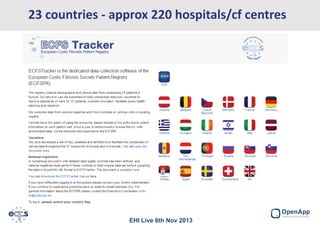
23 countries - approx 220 hospitals/cf centres

EHI Live 6th Nov 2013
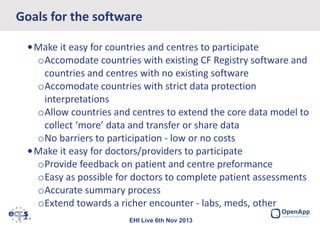
Goals for the software
•Make it easy for countries and centres to participate
oAccomodate countries with existing CF Registry software and
countries and centres with no existing software
oAccomodate countries with strict data protection
interpretations
oAllow countries and centres to extend the core data model to
collect ‘more’ data and transfer or share data
oNo barriers to participation - low or no costs
•Make it easy for doctors/providers to participate
oProvide feedback on patient and centre preformance
oEasy as possible for doctors to complete patient assessments
oAccurate summary process
oExtend towards a richer encounter - labs, meds, other
1.
EHI Live 6th Nov 2013
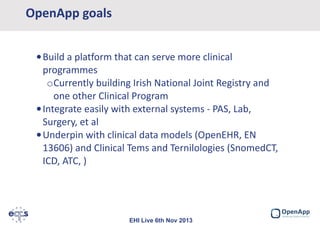
OpenApp goals
•Build a platform that can serve more clinical
programmes
oCurrently building Irish National Joint Registry and
one other Clinical Program
•Integrate easily with external systems - PAS, Lab,
Surgery, et al
•Underpin with clinical data models (OpenEHR, EN
13606) and Clinical Tems and Ternilologies (SnomedCT,
ICD, ATC, )

EHI Live 6th Nov 2013
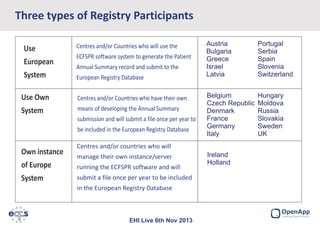
Three types of Registry Participants
Use
European
System

Centres and/or Countries who will use the
ECFSPR software system to generate the Patient
Annual Summary record and submit to the
European Registry Database

Use Own

Centres and/or Countries who have their own

System

means of developing the Annual Summary
submission and will submit a file once per year to
be included in the European Registry Database

Own instance

Austria
Bulgaria
Greece
Israel
Latvia

Portugal
Serbia
Spain
Slovenia
Switzerland

Belgium
Czech Republic
Denmark
France
Germany
Italy

Hungary
Moldova
Russia
Slovakia
Sweden
UK

Centres and/or countries who will
manage their own instance/server

of Europe

running the ECFSPR software and will

System

submit a file once per year to be included
in the European Registry Database

EHI Live 6th Nov 2013

Ireland
Holland
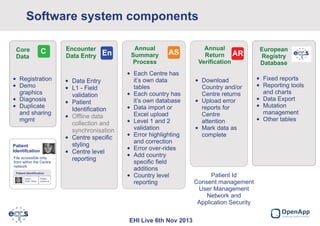
Software system components
Core
Data

C

• Registration
• Demo
graphics
• Diagnosis
• Duplicate
and sharing
mgmt

Patient
Identifcation
File accessible only
from within the Centre
network
Patient Identification
Name,
DOB, Other

Patient
Centre Id

Encounter
Data Entry

En

• Data Entry
• L1 - Field
validation
• Patient
Identification
• Offline data
collection and
synchronisation
• Centre specific
styling
• Centre level
reporting

Annual
Summary
Process

AS

• Each Centre has
it’s own data
tables
• Each country has
it’s own database
• Data import or
Excel upload
• Level 1 and 2
validation
• Error highlighting
and correction
• Error over-rides
• Add country
specific field
additions
• Country level
reporting

EHI Live 6th Nov 2013

Annual
Return AR
Verification
• Download
Country and/or
Centre returns
• Upload error
reports for
Centre
attention
• Mark data as
complete

Patient Id
Consent management
User Management
Network and
Application Security

European
Registry
Database
• Fixed reports
• Reporting tools
and charts
• Data Export
• Mutation
management
• Other tables
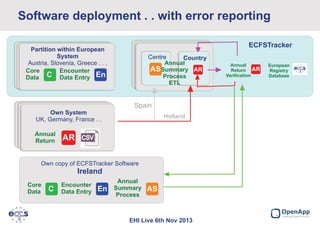
Software deployment . . with error reporting
ECFSTracker

Partition within European
System
Austria, Slovenia, Greece . . .
Core
Encounter
C Data Entry En
Data

Own System
UK, Germany, France . .
Annual
Return

Centre
Country
Annual
ASSummary AR
Process
ETL

Spain

UK
Holland

AR

Own copy of ECFSTracker Software

Ireland
Core
Data

C

Encounter
Data Entry

En

Annual
Summary
Process

AS

EHI Live 6th Nov 2013

Annual
Return AR
Verification

European
Registry
Database
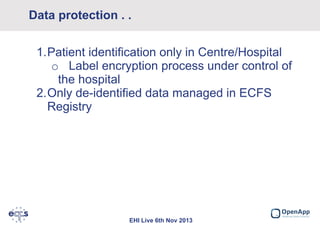
Data protection . .
1.Patient identification only in Centre/Hospital
o Label encryption process under control of
the hospital
2.Only de-identified data managed in ECFS
Registry

EHI Live 6th Nov 2013
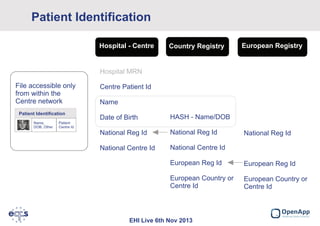
Patient Identification
Hospital - Centre

Country Registry

European Registry

Hospital MRN

File accessible only
from within the
Centre network
Patient Identification
Name,
DOB, Other

Patient
Centre Id

Centre Patient Id
Name
Date of Birth

HASH - Name/DOB

National Reg Id

National Reg Id

National Centre Id

National Centre Id

National Reg Id

European Reg Id

European Reg Id

European Country or
Centre Id

European Country or
Centre Id

EHI Live 6th Nov 2013
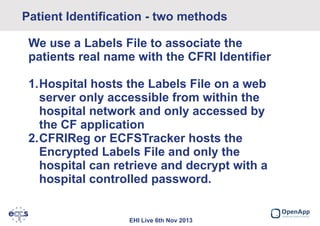
Patient Identification - two methods
We use a Labels File to associate the
patients real name with the CFRI Identifier
1.Hospital hosts the Labels File on a web
server only accessible from within the
hospital network and only accessed by
the CF application
2.CFRIReg or ECFSTracker hosts the
Encrypted Labels File and only the
hospital can retrieve and decrypt with a
hospital controlled password.

EHI Live 6th Nov 2013
Extending the Data Collected
- Adding fields at Country level . . .
•Locally defined fields can be added to the
Annual Summary at Country level and reflected
in the Centre’s Encounter Data Collection Form
•Fields are not mandatory at Centre level - you
don’t have to use them
•Visibility of fields and form layout can be
customised at Centre level

EHI Live 6th Nov 2013
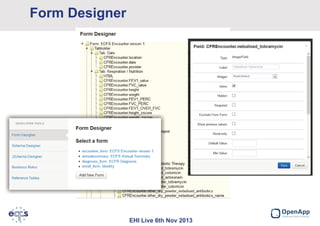
Form Designer

EHI Live 6th Nov 2013
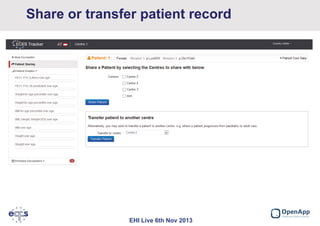
Share or transfer patient record

EHI Live 6th Nov 2013
Data Quality Control - Spec
Level 1: data control through input masks and validation rules at input level.
This is to prevent a user to put in really faulty data e.g. FEV 15 litre; validation rules,
e.g. FEV1 <= FVC or e.g. a user fills in: sterile or normal flora in sputum, then the
pseudomonas and other should become grey and impossible to choose;
Level 2: automatic data control of the whole set before saving.
A user should have the possibility to input partial data, after leaving the internet it
should be possible to continue the same patient later. Once a patient is complete, the
user clicks the button ¡§make this registration complete¡¨. From that moment on, there
should be a control of missing values, incompatible combinations of data, data
coherence etc. to give the user the possibility to correct the errors.

Summarising:
•
•
•
•
•

Automatic data-coding control;
Automatic control of miscalculations;
Automatic control of missing values or values outside the allowed range;
Automatic control double entries, e.g. records that are doubled by mistake;
Automatic data-coherence controls (according to a list that will be provided).
Level 3: once everything is in order, data are admitted to the general working
database where level 3 validation is done (many of these items will be done manually
by statisticians).

EHI Live 6th Nov 2013
Error reporting from Level 3 Validation (Statistician) . . .
•Set of tools for use by CF Registry Statistician
•Based on Annual Return of Annual Summaries on
a Centre or Country basis
•All Centre or Country data available to download
•Upload of Error Reports by Statistician
•Errors are posted back to appropriate Centre and
specific fields highlighted for correction
•Error over-ride available

EHI Live 6th Nov 2013
Error Reporting Module - Spec
• Prevents the user from entering/modifying the data when the procedure
is started;
• The user should receive notification of the errors present in their
database;
• Each error should be accompanied by a short explanation of the nature
of the error;
• The user should be automatically directed to the page where the errors
are present;
• The wrong values should be clearly evident (either by highlighting the
field or by writing it in a different colour;
• All the fields that do not need correction should be blocked (i.e. the user
should not be allowed to modify them);
• After the errors have been corrected, the software should re-carry out all
the usual and agreed data-quality controls;
• If the correction of one error generates another error in the database,
then the software should notify the user and the user should be directed
to the page where the new error is found, the user should be allowed to
modify the relevant fields

EHI Live 6th Nov 2013
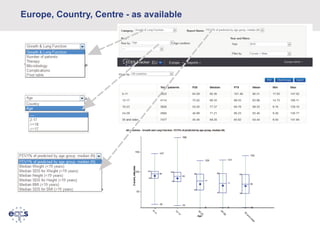
Reporting

• Europe, Country, Centre
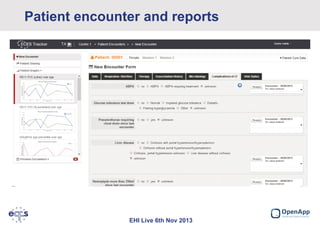
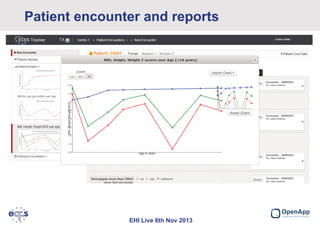
• Patient level reports

EHI Live 6th Nov 2013
Reporting . .
Data protection
• Same reporting facilities available at Centre, Country,
Europe
• Reporting permissions
o USER and Centre Administrator at Centre only
o Country Coordinator ALL CENTRES in that Country
o European Coordinator can see all Centres and Countries
• PIVOT Table for Ad-Hoc reports
o What variables to expose - still under discussion
o Counts and Proportions (Yes/Total Records) as report
type
• Fixed Reports for Centre
• Fixed Reports for Patient

EHI Live 6th Nov 2013
Europe, Country, Centre - as available

EHI Live 6th Nov 2013
Patient encounter and reports

EHI Live 6th Nov 2013
Patient encounter and reports

EHI Live 6th Nov 2013
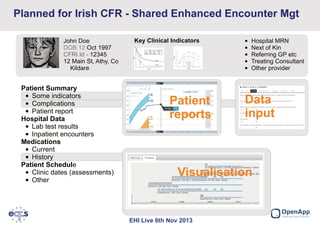
Planned for Irish CFR - Shared Enhanced Encounter Mgt
John Doe
DOB 12 Oct 1997
CFRI Id - 12345
12 Main St, Athy, Co
Kildare

Patient Summary
• Some indicators
• Complications
• Patient report
Hospital Data
• Lab test results
• Inpatient encounters
Medications
• Current
• History
Patient Schedule
• Clinic dates (assessments)
• Other

Key Clinical Indicators

Patient
reports

•
•
•
•
•

Hospital MRN
Next of Kin
Referring GP etc
Treating Consultant
Other provider

Data
input

Visualisation

EHI Live 6th Nov 2013
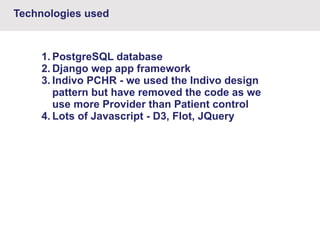
Technologies used

1. PostgreSQL database
2. Django wep app framework
3. Indivo PCHR - we used the Indivo design
pattern but have removed the code as we
use more Provider than Patient control
4. Lots of Javascript - D3, Flot, JQuery
Thanks
mel.mcintyre@openapp.ie

From Patient Encounter to European Registry

  • 1.
    EHI Live BirminghamNEC 6th Nov 2013 From Patient Assessment to European Registry European Cystic Fibrosis Experience Mel McIntyre EHI Live 6th Nov 2013
  • 2.
    About OpenApp •Software developmentand support focused on healthcare, patient assessments, quality assurance, spatial analysis and planning. •Deliver solutions on Open Source technologies, Python, Postgresql, Linux, Django, Zope. •Cloud delivered Patient Assessment Platform for Clinical Programs •Teaming with IBM and DSS Inc Florida USA to bring VistA to Europe EHI Live 6th Nov 2013
  • 3.
    European Cystic FibrosisPatient Registry - ECFSPR The ECFS Patient Registry’s aim is to measure, survey and compare aspects of cystic fibrosis and its treatment in the participating countries, •encouraging new standards of dealing with the disease, •providing data for epidemiological research •identifying special patient groups suitable for multi-centre trials. EHI Live 6th Nov 2013
  • 4.
    23 countries -approx 220 hospitals/cf centres EHI Live 6th Nov 2013
  • 5.
    Goals for thesoftware •Make it easy for countries and centres to participate oAccomodate countries with existing CF Registry software and countries and centres with no existing software oAccomodate countries with strict data protection interpretations oAllow countries and centres to extend the core data model to collect ‘more’ data and transfer or share data oNo barriers to participation - low or no costs •Make it easy for doctors/providers to participate oProvide feedback on patient and centre preformance oEasy as possible for doctors to complete patient assessments oAccurate summary process oExtend towards a richer encounter - labs, meds, other 1. EHI Live 6th Nov 2013
  • 6.
    OpenApp goals •Build aplatform that can serve more clinical programmes oCurrently building Irish National Joint Registry and one other Clinical Program •Integrate easily with external systems - PAS, Lab, Surgery, et al •Underpin with clinical data models (OpenEHR, EN 13606) and Clinical Tems and Ternilologies (SnomedCT, ICD, ATC, ) EHI Live 6th Nov 2013
  • 7.
    Three types ofRegistry Participants Use European System Centres and/or Countries who will use the ECFSPR software system to generate the Patient Annual Summary record and submit to the European Registry Database Use Own Centres and/or Countries who have their own System means of developing the Annual Summary submission and will submit a file once per year to be included in the European Registry Database Own instance Austria Bulgaria Greece Israel Latvia Portugal Serbia Spain Slovenia Switzerland Belgium Czech Republic Denmark France Germany Italy Hungary Moldova Russia Slovakia Sweden UK Centres and/or countries who will manage their own instance/server of Europe running the ECFSPR software and will System submit a file once per year to be included in the European Registry Database EHI Live 6th Nov 2013 Ireland Holland
  • 8.
    Software system components Core Data C •Registration • Demo graphics • Diagnosis • Duplicate and sharing mgmt Patient Identifcation File accessible only from within the Centre network Patient Identification Name, DOB, Other Patient Centre Id Encounter Data Entry En • Data Entry • L1 - Field validation • Patient Identification • Offline data collection and synchronisation • Centre specific styling • Centre level reporting Annual Summary Process AS • Each Centre has it’s own data tables • Each country has it’s own database • Data import or Excel upload • Level 1 and 2 validation • Error highlighting and correction • Error over-rides • Add country specific field additions • Country level reporting EHI Live 6th Nov 2013 Annual Return AR Verification • Download Country and/or Centre returns • Upload error reports for Centre attention • Mark data as complete Patient Id Consent management User Management Network and Application Security European Registry Database • Fixed reports • Reporting tools and charts • Data Export • Mutation management • Other tables
  • 9.
    Software deployment .. with error reporting ECFSTracker Partition within European System Austria, Slovenia, Greece . . . Core Encounter C Data Entry En Data Own System UK, Germany, France . . Annual Return Centre Country Annual ASSummary AR Process ETL Spain UK Holland AR Own copy of ECFSTracker Software Ireland Core Data C Encounter Data Entry En Annual Summary Process AS EHI Live 6th Nov 2013 Annual Return AR Verification European Registry Database
  • 10.
    Data protection .. 1.Patient identification only in Centre/Hospital o Label encryption process under control of the hospital 2.Only de-identified data managed in ECFS Registry EHI Live 6th Nov 2013
  • 11.
    Patient Identification Hospital -Centre Country Registry European Registry Hospital MRN File accessible only from within the Centre network Patient Identification Name, DOB, Other Patient Centre Id Centre Patient Id Name Date of Birth HASH - Name/DOB National Reg Id National Reg Id National Centre Id National Centre Id National Reg Id European Reg Id European Reg Id European Country or Centre Id European Country or Centre Id EHI Live 6th Nov 2013
  • 12.
    Patient Identification -two methods We use a Labels File to associate the patients real name with the CFRI Identifier 1.Hospital hosts the Labels File on a web server only accessible from within the hospital network and only accessed by the CF application 2.CFRIReg or ECFSTracker hosts the Encrypted Labels File and only the hospital can retrieve and decrypt with a hospital controlled password. EHI Live 6th Nov 2013
  • 13.
    Extending the DataCollected - Adding fields at Country level . . . •Locally defined fields can be added to the Annual Summary at Country level and reflected in the Centre’s Encounter Data Collection Form •Fields are not mandatory at Centre level - you don’t have to use them •Visibility of fields and form layout can be customised at Centre level EHI Live 6th Nov 2013
  • 14.
  • 15.
    Share or transferpatient record EHI Live 6th Nov 2013
  • 16.
    Data Quality Control- Spec Level 1: data control through input masks and validation rules at input level. This is to prevent a user to put in really faulty data e.g. FEV 15 litre; validation rules, e.g. FEV1 <= FVC or e.g. a user fills in: sterile or normal flora in sputum, then the pseudomonas and other should become grey and impossible to choose; Level 2: automatic data control of the whole set before saving. A user should have the possibility to input partial data, after leaving the internet it should be possible to continue the same patient later. Once a patient is complete, the user clicks the button ¡§make this registration complete¡¨. From that moment on, there should be a control of missing values, incompatible combinations of data, data coherence etc. to give the user the possibility to correct the errors. Summarising: • • • • • Automatic data-coding control; Automatic control of miscalculations; Automatic control of missing values or values outside the allowed range; Automatic control double entries, e.g. records that are doubled by mistake; Automatic data-coherence controls (according to a list that will be provided). Level 3: once everything is in order, data are admitted to the general working database where level 3 validation is done (many of these items will be done manually by statisticians). EHI Live 6th Nov 2013
  • 17.
    Error reporting fromLevel 3 Validation (Statistician) . . . •Set of tools for use by CF Registry Statistician •Based on Annual Return of Annual Summaries on a Centre or Country basis •All Centre or Country data available to download •Upload of Error Reports by Statistician •Errors are posted back to appropriate Centre and specific fields highlighted for correction •Error over-ride available EHI Live 6th Nov 2013
  • 18.
    Error Reporting Module- Spec • Prevents the user from entering/modifying the data when the procedure is started; • The user should receive notification of the errors present in their database; • Each error should be accompanied by a short explanation of the nature of the error; • The user should be automatically directed to the page where the errors are present; • The wrong values should be clearly evident (either by highlighting the field or by writing it in a different colour; • All the fields that do not need correction should be blocked (i.e. the user should not be allowed to modify them); • After the errors have been corrected, the software should re-carry out all the usual and agreed data-quality controls; • If the correction of one error generates another error in the database, then the software should notify the user and the user should be directed to the page where the new error is found, the user should be allowed to modify the relevant fields EHI Live 6th Nov 2013
  • 19.
    Reporting • Europe, Country,Centre • Patient level reports EHI Live 6th Nov 2013
  • 20.
    Reporting . . Dataprotection • Same reporting facilities available at Centre, Country, Europe • Reporting permissions o USER and Centre Administrator at Centre only o Country Coordinator ALL CENTRES in that Country o European Coordinator can see all Centres and Countries • PIVOT Table for Ad-Hoc reports o What variables to expose - still under discussion o Counts and Proportions (Yes/Total Records) as report type • Fixed Reports for Centre • Fixed Reports for Patient EHI Live 6th Nov 2013
  • 21.
    Europe, Country, Centre- as available EHI Live 6th Nov 2013
  • 22.
    Patient encounter andreports EHI Live 6th Nov 2013
  • 23.
    Patient encounter andreports EHI Live 6th Nov 2013
  • 24.
    Planned for IrishCFR - Shared Enhanced Encounter Mgt John Doe DOB 12 Oct 1997 CFRI Id - 12345 12 Main St, Athy, Co Kildare Patient Summary • Some indicators • Complications • Patient report Hospital Data • Lab test results • Inpatient encounters Medications • Current • History Patient Schedule • Clinic dates (assessments) • Other Key Clinical Indicators Patient reports • • • • • Hospital MRN Next of Kin Referring GP etc Treating Consultant Other provider Data input Visualisation EHI Live 6th Nov 2013
  • 25.
    Technologies used 1. PostgreSQLdatabase 2. Django wep app framework 3. Indivo PCHR - we used the Indivo design pattern but have removed the code as we use more Provider than Patient control 4. Lots of Javascript - D3, Flot, JQuery
  • 26.