The Due Diligence Process: A Financial Perspective Troy Knauss , Fund Executive Piedmont Angel Network Adjunct Professor, Wake Forest Univeristy [email_address] Presentation                                                 
Define the  risk  of a new investment verify the plan and ask the right questions Due Diligence : A Financial Perspective
Each deal is  unique Is it an industry that you understand? Is it a seed, early stage or later stage deal? How much money is required to hit major milestones and inflection points? What is your individual risk profile? Who are your syndication partners? Due Diligence : A Financial Perspective
When do you start? Do not start due diligence unless you like the  industry , the  plan , the  team , the  deal , and believe you can  add value Due diligence is expensive and takes a lot of time Due Diligence : A Financial Perspective
Never sign a  Non-Disclosure Agreement Early in the process, the entrepreneur may ask you to sign an NDA Many investors will not sign See a lot of similar deals Not interested in stealing ideas Long-term interest in reputation Due Diligence : A Financial Perspective
Always go into a deal expecting to find  reasons not to invest Issues with  management teams ,  market size ,  competition ,  intellectual property  (IP),  stage of development , and  revenue assumptions  (financials) Due Diligence : A Financial Perspective
Risk:  Management Team Are they  coachable ? Have they done it before? What is their experience? Do they have knowledge in a specific industry? Due Diligence : A Financial Perspective
Risk:  Market Size What are the barriers to entry? Who are the competitors? What is the growth rate? What are the assumptions of the revenue model? What do customers say? Is this a must-have? Due Diligence : A Financial Perspective
Risk:  Model Does the company have a defined value proposition that customers understand? What is the long-term growth strategy and how does it influence the revenue model? Is there differentiation? Due Diligence : A Financial Perspective
Risk:  Financial How much money is needed? What is the structure of the deal? Can the deal be negotiated? What is the valuation? Do you have comparables to review? What is the exit strategy? Due Diligence : A Financial Perspective
Risk:  Numbers Can you hit revenue sooner rather than later? How much will it cost to generate? How much salary is the team taking as a percentage of the fund raise? Is the company allocating enough money for marketing dollars? Due Diligence : A Financial Perspective
Risk:  Numbers Did the company develop a cash flow statement? What does the capitalization table look like? Does the company have any debts, liabilities, issues with uncollected A/R? Due Diligence : A Financial Perspective
Due Diligence Process Full Business Plan Review Presentation from Management (Maximum 15 minutes) Site Visit(s) Receive Due Diligence Checklist Review References Conduct Competitive and Financial Analysis Finalize the Deal Terms Due Diligence : A Financial Perspective
Process:  Site Visit(s) Meet with management team and employees to determine culture Review the organizational chart Determine if this group is coachable Is the company spending money on areas/people not needed at this stage? Due Diligence : A Financial Perspective
Due Diligence
Process:  References Contact former employees, employers, and industry experts Conduct background checks on all key employees Be prepared to ask for key man insurance on certain employees Interview Advisors and Directors Talk to current investors, lawyers and accountants Due Diligence : A Financial Perspective
Process:  Competitive Analysis What market share is required to hit the plan? Use game theory to predict competitive response to business plan. Can you compete if the response is to lower prices? Why would a customer buy from you? Differentiation? Price? Due Diligence : A Financial Perspective
Process:  Financials What is the sales pipeline? How leveraged is the company? Can the company get non-dilutive funding from banks? How has the company performed against previous plans? Due Diligence : A Financial Perspective
Process:  Valuation Do not use book value, market value or income value to determine early-stage valuations? Early-stage companies: No track record Low or negative profitability and cash flow Significant risk Due Diligence : A Financial Perspective
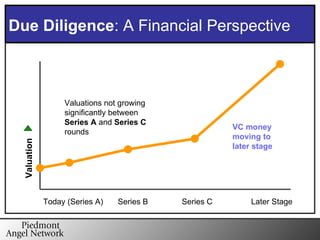
Due Diligence : A Financial Perspective Today (Series A) Series B Series C Later Stage Valuation Valuations not growing significantly between  Series A  and  Series C  rounds VC money moving to later stage
Typical Valuation Expectations Series A: $500,000 to $1.5MM Pre-money valuation: Under $3MM Equity: 10% - 40% Expected Returns: 10X – 30X No specific calculation (gut feel) Due Diligence : A Financial Perspective
Due Diligence : A Financial Perspective Investment Sought Valuation At Exit Multiple $1,000,000 Pre-money  Valuation $14 million $6 million $45 million 2X 3X $1,000,000 $2 million $30 million 10X $1,000,000 $2 million
Due Diligence : A Financial Perspective 2X 15% 4X 30% 5X 40% 8X 50% 10X 60% 5-Year Returns (Multiple) Internal Rate of Return (IRR)
Distribution of Returns by Venture Investment Average Returns
High = 1 or 2 times per  month Low = 1 or 2 times per  year   High 3.7X (4.0 years) Low 1.3X (3.6 years) Impact of Participation Mentoring, Board, Financial Monitoring Returns with Monitoring
What can help increase valuations Experienced management team ( first time entrepreneurs will exit company with 8%,  second time, 20%) Strong technology, large opportunity, and size of round to hit milestones Due Diligence : A Financial Perspective
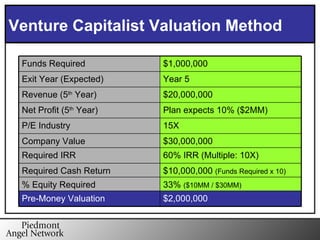
Venture Capitalist Valuation Method $2,000,000 Pre-Money Valuation 33%  ($10MM / $30MM) % Equity Required $10,000,000  (Funds Required x 10) Required Cash Return 60% IRR (Multiple: 10X) Required IRR $30,000,000 Company Value 15X P/E Industry Plan expects 10% ($2MM) Net Profit (5 th  Year) $20,000,000 Revenue (5 th  Year) Year 5 Exit Year (Expected) $1,000,000 Funds Required
Process:  Valuation In today’s financial environment, investors can dictate valuation Historical valuations are no longer applicable Important to negotiate valuation in good-faith…  do not want to invest in a negative entrepreneur Due Diligence : A Financial Perspective
Term Sheet Ask for a Board position Ask entrepreneur to pay your legal fees and to prepare documents in accordance to your term sheet Do not overpay … think about future rounds (2/3 rd  rule) Due Diligence : A Financial Perspective
Typical Deal Terms Convertible Notes vs. Preferred Stock Purchase Status of Company (C-Corp preferred) | Issues with LLCs (K1s) Dividends: Not Mandatory; Prefer no dividends Liquidation Preference: Minimum 1x Protective Provisions: Majority of Preferred Stock Holders must approve  changes to ByLaws, issuance of new shares, changes to  the number of Board members, redemption of shares,  creation of debt, etc. Reporting Requirements: Monitoring reports that include performance to budget, new milestones, new projections, and cap. tables Repurchasing Rights: Not in all cases but more and more deals are requiring  the founder to vest his/her shares
Other Information How long does a typical due diligence take? What are the odds of making an investment? Due Diligence : A Financial Perspective
Contact Information : Troy Knauss Piedmont Angel Network [email_address] (336) 235-0941

Knauss Financial Dd

  • 1.
    The Due DiligenceProcess: A Financial Perspective Troy Knauss , Fund Executive Piedmont Angel Network Adjunct Professor, Wake Forest Univeristy [email_address] Presentation                                                 
  • 2.
    Define the risk of a new investment verify the plan and ask the right questions Due Diligence : A Financial Perspective
  • 3.
    Each deal is unique Is it an industry that you understand? Is it a seed, early stage or later stage deal? How much money is required to hit major milestones and inflection points? What is your individual risk profile? Who are your syndication partners? Due Diligence : A Financial Perspective
  • 4.
    When do youstart? Do not start due diligence unless you like the industry , the plan , the team , the deal , and believe you can add value Due diligence is expensive and takes a lot of time Due Diligence : A Financial Perspective
  • 5.
    Never sign a Non-Disclosure Agreement Early in the process, the entrepreneur may ask you to sign an NDA Many investors will not sign See a lot of similar deals Not interested in stealing ideas Long-term interest in reputation Due Diligence : A Financial Perspective
  • 6.
    Always go intoa deal expecting to find reasons not to invest Issues with management teams , market size , competition , intellectual property (IP), stage of development , and revenue assumptions (financials) Due Diligence : A Financial Perspective
  • 7.
    Risk: ManagementTeam Are they coachable ? Have they done it before? What is their experience? Do they have knowledge in a specific industry? Due Diligence : A Financial Perspective
  • 8.
    Risk: MarketSize What are the barriers to entry? Who are the competitors? What is the growth rate? What are the assumptions of the revenue model? What do customers say? Is this a must-have? Due Diligence : A Financial Perspective
  • 9.
    Risk: ModelDoes the company have a defined value proposition that customers understand? What is the long-term growth strategy and how does it influence the revenue model? Is there differentiation? Due Diligence : A Financial Perspective
  • 10.
    Risk: FinancialHow much money is needed? What is the structure of the deal? Can the deal be negotiated? What is the valuation? Do you have comparables to review? What is the exit strategy? Due Diligence : A Financial Perspective
  • 11.
    Risk: NumbersCan you hit revenue sooner rather than later? How much will it cost to generate? How much salary is the team taking as a percentage of the fund raise? Is the company allocating enough money for marketing dollars? Due Diligence : A Financial Perspective
  • 12.
    Risk: NumbersDid the company develop a cash flow statement? What does the capitalization table look like? Does the company have any debts, liabilities, issues with uncollected A/R? Due Diligence : A Financial Perspective
  • 13.
    Due Diligence ProcessFull Business Plan Review Presentation from Management (Maximum 15 minutes) Site Visit(s) Receive Due Diligence Checklist Review References Conduct Competitive and Financial Analysis Finalize the Deal Terms Due Diligence : A Financial Perspective
  • 14.
    Process: SiteVisit(s) Meet with management team and employees to determine culture Review the organizational chart Determine if this group is coachable Is the company spending money on areas/people not needed at this stage? Due Diligence : A Financial Perspective
  • 15.
  • 16.
    Process: ReferencesContact former employees, employers, and industry experts Conduct background checks on all key employees Be prepared to ask for key man insurance on certain employees Interview Advisors and Directors Talk to current investors, lawyers and accountants Due Diligence : A Financial Perspective
  • 17.
    Process: CompetitiveAnalysis What market share is required to hit the plan? Use game theory to predict competitive response to business plan. Can you compete if the response is to lower prices? Why would a customer buy from you? Differentiation? Price? Due Diligence : A Financial Perspective
  • 18.
    Process: FinancialsWhat is the sales pipeline? How leveraged is the company? Can the company get non-dilutive funding from banks? How has the company performed against previous plans? Due Diligence : A Financial Perspective
  • 19.
    Process: ValuationDo not use book value, market value or income value to determine early-stage valuations? Early-stage companies: No track record Low or negative profitability and cash flow Significant risk Due Diligence : A Financial Perspective
  • 20.
    Due Diligence :A Financial Perspective Today (Series A) Series B Series C Later Stage Valuation Valuations not growing significantly between Series A and Series C rounds VC money moving to later stage
  • 21.
    Typical Valuation ExpectationsSeries A: $500,000 to $1.5MM Pre-money valuation: Under $3MM Equity: 10% - 40% Expected Returns: 10X – 30X No specific calculation (gut feel) Due Diligence : A Financial Perspective
  • 22.
    Due Diligence :A Financial Perspective Investment Sought Valuation At Exit Multiple $1,000,000 Pre-money Valuation $14 million $6 million $45 million 2X 3X $1,000,000 $2 million $30 million 10X $1,000,000 $2 million
  • 23.
    Due Diligence :A Financial Perspective 2X 15% 4X 30% 5X 40% 8X 50% 10X 60% 5-Year Returns (Multiple) Internal Rate of Return (IRR)
  • 24.
    Distribution of Returnsby Venture Investment Average Returns
  • 25.
    High = 1or 2 times per month Low = 1 or 2 times per year High 3.7X (4.0 years) Low 1.3X (3.6 years) Impact of Participation Mentoring, Board, Financial Monitoring Returns with Monitoring
  • 26.
    What can helpincrease valuations Experienced management team ( first time entrepreneurs will exit company with 8%, second time, 20%) Strong technology, large opportunity, and size of round to hit milestones Due Diligence : A Financial Perspective
  • 27.
    Venture Capitalist ValuationMethod $2,000,000 Pre-Money Valuation 33% ($10MM / $30MM) % Equity Required $10,000,000 (Funds Required x 10) Required Cash Return 60% IRR (Multiple: 10X) Required IRR $30,000,000 Company Value 15X P/E Industry Plan expects 10% ($2MM) Net Profit (5 th Year) $20,000,000 Revenue (5 th Year) Year 5 Exit Year (Expected) $1,000,000 Funds Required
  • 28.
    Process: ValuationIn today’s financial environment, investors can dictate valuation Historical valuations are no longer applicable Important to negotiate valuation in good-faith… do not want to invest in a negative entrepreneur Due Diligence : A Financial Perspective
  • 29.
    Term Sheet Askfor a Board position Ask entrepreneur to pay your legal fees and to prepare documents in accordance to your term sheet Do not overpay … think about future rounds (2/3 rd rule) Due Diligence : A Financial Perspective
  • 30.
    Typical Deal TermsConvertible Notes vs. Preferred Stock Purchase Status of Company (C-Corp preferred) | Issues with LLCs (K1s) Dividends: Not Mandatory; Prefer no dividends Liquidation Preference: Minimum 1x Protective Provisions: Majority of Preferred Stock Holders must approve changes to ByLaws, issuance of new shares, changes to the number of Board members, redemption of shares, creation of debt, etc. Reporting Requirements: Monitoring reports that include performance to budget, new milestones, new projections, and cap. tables Repurchasing Rights: Not in all cases but more and more deals are requiring the founder to vest his/her shares
  • 31.
    Other Information Howlong does a typical due diligence take? What are the odds of making an investment? Due Diligence : A Financial Perspective
  • 32.
    Contact Information :Troy Knauss Piedmont Angel Network [email_address] (336) 235-0941