Knative
on OpenShift
Presenter: Veer Muchandi
Title: Principal Architect - Container Solutions
Social Handle: @VeerMuchandi
Blogs: https://blog.openshift.com/author/veermuchandi/
Serverless Model
Serverless computing is a cloud-computing execution model in which the cloud
provider acts as the server, dynamically managing the allocation of machine
resources. Pricing is based on the actual amount of resources consumed by an
application, rather than on pre-purchased units of capacity.[1]
It is a form of utility
computing.
Knative
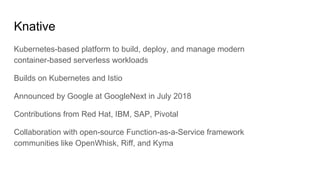
Kubernetes-based platform to build, deploy, and manage modern
container-based serverless workloads
Builds on Kubernetes and Istio
Announced by Google at GoogleNext in July 2018
Contributions from Red Hat, IBM, SAP, Pivotal
Collaboration with open-source Function-as-a-Service framework
communities like OpenWhisk, Riff, and Kyma
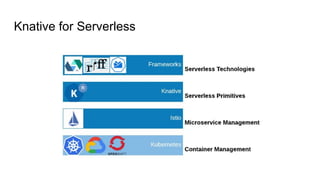
Knative for Serverless
Knative
Uses K8S CRDs to define a new set of APIs
Provides a set of building blocks that enable modern, source-centric and
container-based development workloads on Kubernetes:
● Build — Source-to-container build orchestration
● Serving — Request-driven compute model, scale to zero, autoscaling, routing
and managing traffic
● Eventing — Universal subscription, binding services to event ecosystems,
delivery and management of events
KNative
Knative components focus on solving many mundane tasks such as:
● Deploying a container
● Orchestrating source-to-URL workflows on Kubernetes
● Routing and managing traffic with blue/green deployment
● Automatic scaling and sizing workloads based on demand
● Binding running services to eventing ecosystems
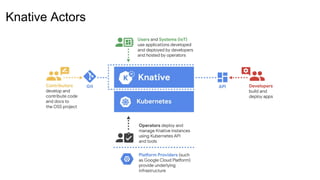
Knative Actors
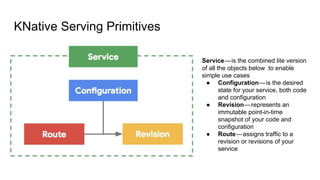
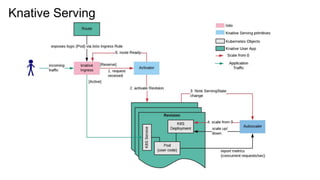
KNative Serving Primitives
Service — is the combined lite version
of all the objects below to enable
simple use cases
● Configuration — is the desired
state for your service, both code
and configuration
● Revision — represents an
immutable point-in-time
snapshot of your code and
configuration
● Route — assigns traffic to a
revision or revisions of your
service
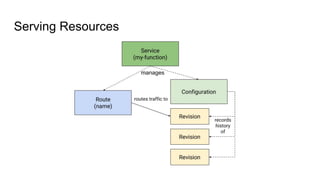
Serving Resources
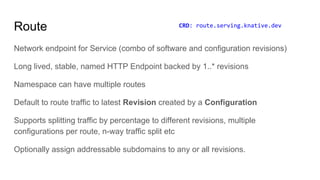
Route
Network endpoint for Service (combo of software and configuration revisions)
Long lived, stable, named HTTP Endpoint backed by 1..* revisions
Namespace can have multiple routes
Default to route traffic to latest Revision created by a Configuration
Supports splitting traffic by percentage to different revisions, multiple
configurations per route, n-way traffic split etc
Optionally assign addressable subdomains to any or all revisions.
CRD: route.serving.knative.dev
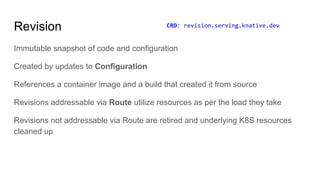
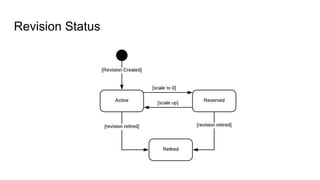
Revision
Immutable snapshot of code and configuration
Created by updates to Configuration
References a container image and a build that created it from source
Revisions addressable via Route utilize resources as per the load they take
Revisions not addressable via Route are retired and underlying K8S resources
cleaned up
CRD: revision.serving.knative.dev
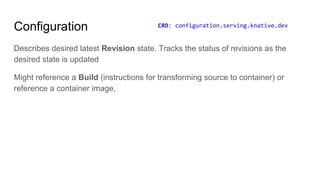
Configuration
Describes desired latest Revision state. Tracks the status of revisions as the
desired state is updated
Might reference a Build (instructions for transforming source to container) or
reference a container image,
CRD: configuration.serving.knative.dev
Revision Status
Knative Serving
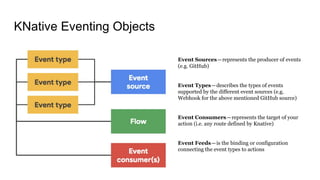
KNative Eventing Objects
Event Sources — represents the producer of events
(e.g. GitHub)
Event Types — describes the types of events
supported by the different event sources (e.g.
Webhook for the above mentioned GitHub source)
Event Consumers — represents the target of your
action (i.e. any route defined by Knative)
Event Feeds — is the binding or configuration
connecting the event types to actions

Knative Meetup

  • 1.
    Knative on OpenShift Presenter: VeerMuchandi Title: Principal Architect - Container Solutions Social Handle: @VeerMuchandi Blogs: https://blog.openshift.com/author/veermuchandi/
  • 2.
    Serverless Model Serverless computingis a cloud-computing execution model in which the cloud provider acts as the server, dynamically managing the allocation of machine resources. Pricing is based on the actual amount of resources consumed by an application, rather than on pre-purchased units of capacity.[1] It is a form of utility computing.
  • 3.
    Knative Kubernetes-based platform tobuild, deploy, and manage modern container-based serverless workloads Builds on Kubernetes and Istio Announced by Google at GoogleNext in July 2018 Contributions from Red Hat, IBM, SAP, Pivotal Collaboration with open-source Function-as-a-Service framework communities like OpenWhisk, Riff, and Kyma
  • 4.
  • 5.
    Knative Uses K8S CRDsto define a new set of APIs Provides a set of building blocks that enable modern, source-centric and container-based development workloads on Kubernetes: ● Build — Source-to-container build orchestration ● Serving — Request-driven compute model, scale to zero, autoscaling, routing and managing traffic ● Eventing — Universal subscription, binding services to event ecosystems, delivery and management of events
  • 6.
    KNative Knative components focuson solving many mundane tasks such as: ● Deploying a container ● Orchestrating source-to-URL workflows on Kubernetes ● Routing and managing traffic with blue/green deployment ● Automatic scaling and sizing workloads based on demand ● Binding running services to eventing ecosystems
  • 7.
  • 8.
    KNative Serving Primitives Service — isthe combined lite version of all the objects below to enable simple use cases ● Configuration — is the desired state for your service, both code and configuration ● Revision — represents an immutable point-in-time snapshot of your code and configuration ● Route — assigns traffic to a revision or revisions of your service
  • 9.
  • 10.
    Route Network endpoint forService (combo of software and configuration revisions) Long lived, stable, named HTTP Endpoint backed by 1..* revisions Namespace can have multiple routes Default to route traffic to latest Revision created by a Configuration Supports splitting traffic by percentage to different revisions, multiple configurations per route, n-way traffic split etc Optionally assign addressable subdomains to any or all revisions. CRD: route.serving.knative.dev
  • 11.
    Revision Immutable snapshot ofcode and configuration Created by updates to Configuration References a container image and a build that created it from source Revisions addressable via Route utilize resources as per the load they take Revisions not addressable via Route are retired and underlying K8S resources cleaned up CRD: revision.serving.knative.dev
  • 12.
    Configuration Describes desired latestRevision state. Tracks the status of revisions as the desired state is updated Might reference a Build (instructions for transforming source to container) or reference a container image, CRD: configuration.serving.knative.dev
  • 13.
  • 14.
  • 15.
    KNative Eventing Objects EventSources — represents the producer of events (e.g. GitHub) Event Types — describes the types of events supported by the different event sources (e.g. Webhook for the above mentioned GitHub source) Event Consumers — represents the target of your action (i.e. any route defined by Knative) Event Feeds — is the binding or configuration connecting the event types to actions