Productive Training and Education Consultants To develop skills/motivation/teamwork among employees
Productive Training and Education Consultants
Company Background Indian Training Company Management and staff training through effective use of information management and information technology tools 40 Trainers and administrators Head Office New Delhi, 1996 Franchisees in Mumbai, Bangalore, Pune, Chennai and Hyderabad Director of Training, Mr Nikhil Kumar
Problems, Challenges, Issues Fast growing through franchising knowledge and skills Deterioration of the high standards of knowledge  and  delivery Increasing client complaints Motivation of trainers,  especially franchisees Low morale & enthusiasm, ‘What’s in it for me?’ Increasing loss of trainers to competitors and self startups Decreasing quality and high staff turnover!
What they did First trainers retreat for 3 days in Goa Change environment, reflect and think differently Explore issues of quality, personal motivation and high staff turnover Try to build a cooperative team vs competitive teams
The Managing Director Mr Varsheydeva supportive Concern about his strong opinion and of ‘telling what to do’ rather than listen to ideas and feedback Concern trainers would be reluctant to frankly share their views
The terms of the retreat MD to open the retreat to express support A neutral facilitator for the retreat MD to attend the final two hours of day 3 Facilitator to summarize and report group results
Trainers retreat Day 1 Very good start, people felt consulted, informed, excited, relaxed, less stress People able to network Perceptions of the organization changed People acknowledged MD’s core programmes but agreed that new updated course content was now needed, and faster
Trainers retreat Day 2 A complete surprise! Franchisees complaints, inferior, not recognised by HO as in-company trainers Best sales leads kept internally Open facilitation Noticeable division between in-company and franchise trainers
Urgent review meeting Explosion of pent-up feelings Deeper communications Turning point for PTEC? Mr Kumar ‘What can we do?’ Consultant:  Root cause is lack of open communications need to build trust, collaborate and share knowledge Develop better products and services Reward and recognise people How can this happen?
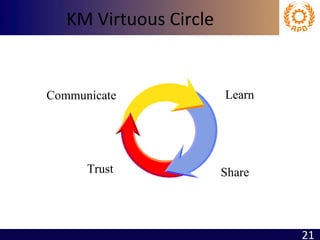
Trainer retreat day 3 System to develop your knowledge and ideas faster than your competitors Based on 4 key elements/terms Trust Communicate Learn and share knowledge Apply knowledge Based on a ‘Virtuous Circle’
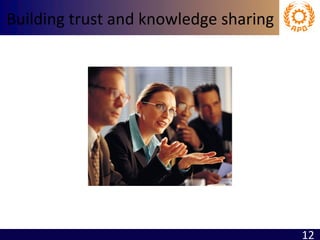
Building trust and knowledge sharing
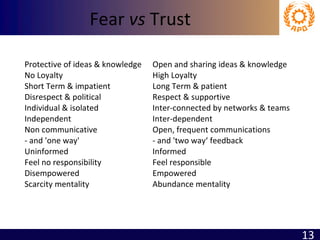
Fear  vs  Trust Protective of ideas & knowledge Open and sharing ideas & knowledge  No Loyalty High Loyalty Short Term & impatient Long Term & patient Disrespect & political Respect & supportive  Individual & isolated Inter-connected by networks & teams Independent Inter-dependent Non communicative Open, frequent communications - and 'one way' - and 'two way‘ feedback Uninformed Informed Feel no responsibility Feel responsible Disempowered Empowered Scarcity mentality  Abundance mentality
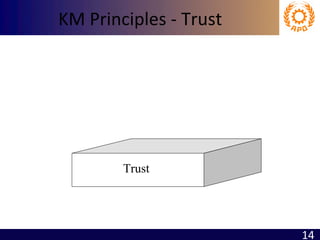
KM Principles - Trust Trust
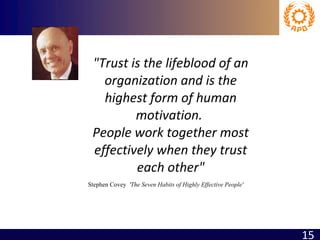
"Trust is the lifeblood of an organization and is the highest form of human motivation.  People work together most effectively when they trust each other" Stephen Covey  'The Seven Habits of Highly Effective People'
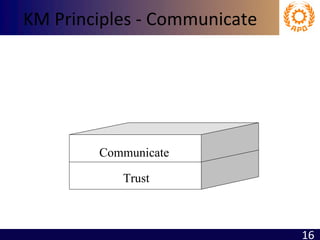
KM Principles - Communicate Trust Communicate
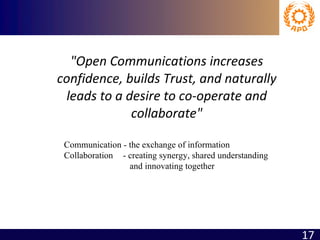
"Open Communications increases confidence, builds Trust, and naturally leads to a desire to co-operate and collaborate" Communication - the exchange of information Collaboration    - creating synergy, shared understanding    and innovating together
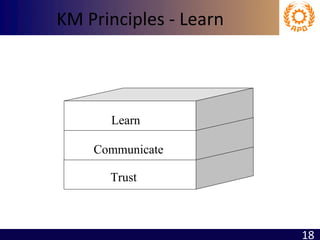
KM Principles - Learn Trust Communicate Learn
"Rapid Learning increases competence, builds greater Trust, and  naturally  leads to a desire to share"
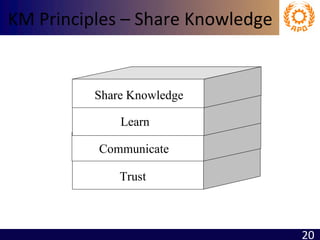
KM Principles – Share Knowledge Communicate Learn Share Knowledge   Trust
KM Virtuous Circle Communicate Learn Share   Trust
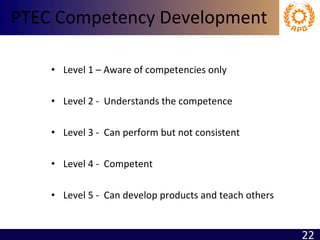
PTEC Competency Development Level 1 – Aware of competencies only Level 2 -  Understands the competence Level 3 -  Can perform but not consistent Level 4 -  Competent Level 5 -  Can develop products and teach others
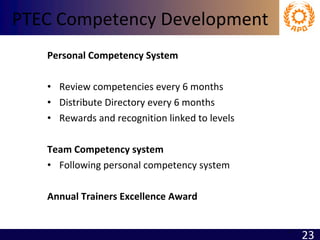
PTEC Competency Development Personal Competency System Review competencies every 6 months Distribute Directory every 6 months Rewards and recognition linked to levels Team Competency system Following personal competency system Annual Trainers Excellence Award
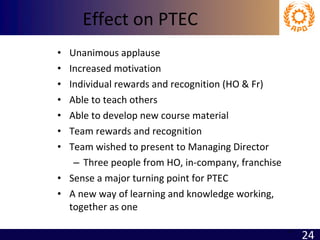
Effect on PTEC Unanimous applause Increased motivation  Individual rewards and recognition (HO & Fr) Able to teach others Able to develop new course material Team rewards and recognition Team wished to present to Managing Director Three people from HO, in-company, franchise Sense a major turning point for PTEC A new way of learning and knowledge working, together as one
Epilogue – One Year Later Second three day Trainer retreat Nominations for ‘Excellence Award’ No longer tense competition, or difference in-company trainer or franchise Less politics, focus on competence development Fair, objective MD and Director of Training respected mentors and coaches From autocracy to meritocracy People rejoining   PTEC
Why it worked (KSF’s) External consultant could be more objective External consultant knew the problem and knew a proven successful solution The new system directly rewards and recognises people for learning and better managing their knowledge better So much for my personal development & growth Low financial investment and risk, high benefits
Risk Factors The periodic assessment of competencies  must be based on ‘objective’ measurement criteria that everyone understands, and not subjective People need to appreciate ‘lifelong learning’
“  Our success depends on how well we exploit our most valuable assets: our knowledge, skills and creativity.  These are key to designing high-value goods and services and advanced business practices.  They are at the heart of a modern, knowledge driven economy.”
KM is for everyone

Km for sm es ptec case study ron young

  • 1.
    Productive Training andEducation Consultants To develop skills/motivation/teamwork among employees
  • 2.
    Productive Training andEducation Consultants
  • 3.
    Company Background IndianTraining Company Management and staff training through effective use of information management and information technology tools 40 Trainers and administrators Head Office New Delhi, 1996 Franchisees in Mumbai, Bangalore, Pune, Chennai and Hyderabad Director of Training, Mr Nikhil Kumar
  • 4.
    Problems, Challenges, IssuesFast growing through franchising knowledge and skills Deterioration of the high standards of knowledge and delivery Increasing client complaints Motivation of trainers, especially franchisees Low morale & enthusiasm, ‘What’s in it for me?’ Increasing loss of trainers to competitors and self startups Decreasing quality and high staff turnover!
  • 5.
    What they didFirst trainers retreat for 3 days in Goa Change environment, reflect and think differently Explore issues of quality, personal motivation and high staff turnover Try to build a cooperative team vs competitive teams
  • 6.
    The Managing DirectorMr Varsheydeva supportive Concern about his strong opinion and of ‘telling what to do’ rather than listen to ideas and feedback Concern trainers would be reluctant to frankly share their views
  • 7.
    The terms ofthe retreat MD to open the retreat to express support A neutral facilitator for the retreat MD to attend the final two hours of day 3 Facilitator to summarize and report group results
  • 8.
    Trainers retreat Day1 Very good start, people felt consulted, informed, excited, relaxed, less stress People able to network Perceptions of the organization changed People acknowledged MD’s core programmes but agreed that new updated course content was now needed, and faster
  • 9.
    Trainers retreat Day2 A complete surprise! Franchisees complaints, inferior, not recognised by HO as in-company trainers Best sales leads kept internally Open facilitation Noticeable division between in-company and franchise trainers
  • 10.
    Urgent review meetingExplosion of pent-up feelings Deeper communications Turning point for PTEC? Mr Kumar ‘What can we do?’ Consultant: Root cause is lack of open communications need to build trust, collaborate and share knowledge Develop better products and services Reward and recognise people How can this happen?
  • 11.
    Trainer retreat day3 System to develop your knowledge and ideas faster than your competitors Based on 4 key elements/terms Trust Communicate Learn and share knowledge Apply knowledge Based on a ‘Virtuous Circle’
  • 12.
    Building trust andknowledge sharing
  • 13.
    Fear vs Trust Protective of ideas & knowledge Open and sharing ideas & knowledge No Loyalty High Loyalty Short Term & impatient Long Term & patient Disrespect & political Respect & supportive Individual & isolated Inter-connected by networks & teams Independent Inter-dependent Non communicative Open, frequent communications - and 'one way' - and 'two way‘ feedback Uninformed Informed Feel no responsibility Feel responsible Disempowered Empowered Scarcity mentality Abundance mentality
  • 14.
    KM Principles -Trust Trust
  • 15.
    "Trust is thelifeblood of an organization and is the highest form of human motivation. People work together most effectively when they trust each other" Stephen Covey 'The Seven Habits of Highly Effective People'
  • 16.
    KM Principles -Communicate Trust Communicate
  • 17.
    "Open Communications increasesconfidence, builds Trust, and naturally leads to a desire to co-operate and collaborate" Communication - the exchange of information Collaboration - creating synergy, shared understanding and innovating together
  • 18.
    KM Principles -Learn Trust Communicate Learn
  • 19.
    "Rapid Learning increasescompetence, builds greater Trust, and naturally leads to a desire to share"
  • 20.
    KM Principles –Share Knowledge Communicate Learn Share Knowledge Trust
  • 21.
    KM Virtuous CircleCommunicate Learn Share Trust
  • 22.
    PTEC Competency DevelopmentLevel 1 – Aware of competencies only Level 2 - Understands the competence Level 3 - Can perform but not consistent Level 4 - Competent Level 5 - Can develop products and teach others
  • 23.
    PTEC Competency DevelopmentPersonal Competency System Review competencies every 6 months Distribute Directory every 6 months Rewards and recognition linked to levels Team Competency system Following personal competency system Annual Trainers Excellence Award
  • 24.
    Effect on PTECUnanimous applause Increased motivation Individual rewards and recognition (HO & Fr) Able to teach others Able to develop new course material Team rewards and recognition Team wished to present to Managing Director Three people from HO, in-company, franchise Sense a major turning point for PTEC A new way of learning and knowledge working, together as one
  • 25.
    Epilogue – OneYear Later Second three day Trainer retreat Nominations for ‘Excellence Award’ No longer tense competition, or difference in-company trainer or franchise Less politics, focus on competence development Fair, objective MD and Director of Training respected mentors and coaches From autocracy to meritocracy People rejoining PTEC
  • 26.
    Why it worked(KSF’s) External consultant could be more objective External consultant knew the problem and knew a proven successful solution The new system directly rewards and recognises people for learning and better managing their knowledge better So much for my personal development & growth Low financial investment and risk, high benefits
  • 27.
    Risk Factors Theperiodic assessment of competencies must be based on ‘objective’ measurement criteria that everyone understands, and not subjective People need to appreciate ‘lifelong learning’
  • 28.
    “ Oursuccess depends on how well we exploit our most valuable assets: our knowledge, skills and creativity. These are key to designing high-value goods and services and advanced business practices. They are at the heart of a modern, knowledge driven economy.”
  • 29.
    KM is foreveryone

Editor's Notes

  • #3 Key Messages: Transition:
  • #13 Key Messages The process of renewing knowledge is at least as important as the content. One of the best ways of renewing is by sharing   Transition
  • #14 Key Messages A predominantly trust based culture is a fundamental prerequisite to building an atmosphere where people will feel confident in sharing their knowledge.   Transition That brings us to the first of our underlying principles of KM.
  • #15 Key Messages First principle is trust   Transition Here is what the writer Stephen Covey (who wrote the book the “Seven Habits of Highly Effective People”) had to say about trust   Further Reading The Seven Habits of Highly Effective People - Stephen Covey, Simon & Schuster, ISBN: 0-671-70863-5
  • #16 Key Messages Build trust both within the organisation and with your key outside stakeholders.   Transition Based on a trusting work environment, the next most important principle of KM is Communication
  • #17 Key Messages Use technology to support, encourage and enhance frequent and wide exchange of views. Feedback is a crucial part of the process.     Transition As far as communications are concerned we can say that. ...
  • #18 Key Messages Emphasise difference between communication and collaboration.     Transition Once we have good trust and communication the next KM principle is to learn as fast as possible.
  • #19 Key Messages Learning as fast as possible allows us to use the knowledge gained to substantially improve our behaviour and performance.         Transition
  • #20 Key Messages Rapid learning increases competence and trust.     Transition And so we come to our final principle for KM companies
  • #21 Key Messages Share as widely and as quickly as is appropriate     Transition We now have the building blocks of the principles for KM Organisations. A better way of showing these blocks is as a virtuous circle.
  • #22 Key Messages Virtuous Circle. The key point in all of the principles is education.     Transition We have now looked at our links to the business objectives.
  • #30 Key Messages: KM is a new holistic discipline There are many approaches to KM KM is for everyone Transition: Having gained a better understanding of the different perspectives of knowledge and KM we can see that knowledge is becoming a very important part of organisations that requires to be managed.