Proceeding - Kuala Lumpur International Business, Economics and Law Conference Vol. 1. 
November 29 - 30, 2014. Hotel Putra, Kuala Lumpur, Malaysia. ISBN 978-967-11350-4-4 
120 
THE EFFECT OF FIRM SIZE AND ORGANIZATIONAL CULTURE ON THE QUALITY OF FINANCIAL REPORTING IN SHARIA MICROFINANCING INSTITUTION 
(BAITUL MAAL WA TAMWIL) 
(THE CASE OF EX BANYUMAS RESIDENCY-INDONESIA) 
Puji Lestari 
Faculty of Economics And Business, Accounting Department, 
Jenderal Soedirman University, Purwokerto, Indonesia 
Email: pujiunsoed@yahoo.co.id 
Winwin Yadiati 
Faculty of Economics And Business, Accounting Department, 
Padjajaran University, Bandung, Indonesia 
ABSTRACT 
This study aims to determine the effect of firm size and organizational culture on the quality of financial reporting on Islamic microfinance institutions (Baitul Maal wa tamwil / BMT) in Ex Banyumas residency, which includes Banyumas, Cilacap, Banjarnegara and Purbalingga. The study was conducted by questionnaire survey using research instruments to be filled by the leaders of Islamic microfinance institutions in the former residency of Banyumas. By using snowball sampling, the sample size was selected as 35 BMT. Data were analyzed by using Partial Least Square (PLS). The analysis showed that company size does not affect the quality of financial reporting, and organizational culture affects the quality of financial reporting 
Keywords: Company Size, Organizational Culture, Quality of Financial Reporting 
1. INTRODUCTION 
The quality of financial reporting depends on the quality of each part of the financial reporting process (Jonas and Blanchet, 2000). Azhar Susanto (2004: 40) says that the quality of information that has the characteristics: accurate, timely, relevant, and complete. Miller and Bahnson (1999) suggests the quality of financial firms, proxies by the disclosure of complete information, timely and understandable. Jonas and Blanchet (2000: 360) states reporting quality seen from the achievement of a conceptual framework. Hilton, et al (2000: 551) explains that the quality of accounting information must satisfy the following three characteristics: relevance, accuracy, and timeless. 
Quality of financial reporting is influenced by many factors. Strasser (2011: 13) states that the quality of information is positively related to several other factors, including the size of the company. Belkaoui (2002: 102) states that the stakeholder (audience) companies appreciate better the quality of information companies large and give them a better reputation. Cohen's research (2003) which proved that the company with diverse ownership and leverage are significantly higher provide high financial information. The bigger the company, the quality of financial reporting will be higher. 
Furthermore, the quality of financial reporting from perspective of senior management. Senior management gives an example of the attitude and integrity. They must continue to convey the message that it is a must to make high quality financial reporting (Leinicke, et. Al, 2000). Young (2012: 150) states that first and foremost, Sarbanes Oxley explained that the company's senior management is responsible for the culture they create and must adhere to the same rules that apply to other employees. One purpose of this rule is that that the CEO should ultimately responsible for the quality control of corporate disclosure and financial reporting and to ensure 'tone of the top 'has true meaning. Furthermore, Rezaee (2009: 80-81) states that the integrity of financial reporting is essential in rebuilding investor confidence, financial reporting and capital markets. 
PROBLEM FORMULATION 
Based on the above, the formulation of the problem in the research plan is as follows: 1). How big is the influence of firm size on the quality of financial reporting? 2). How big is the influence of organizational culture on the quality of financial reporting?
Proceeding - Kuala Lumpur International Business, Economics and Law Conference Vol. 1. 
November 29 - 30, 2014. Hotel Putra, Kuala Lumpur, Malaysia. ISBN 978-967-11350-4-4 
121 
2. LITERATURE REVIEW AND HYPOTHESIS DEVELOPMENT FRAMEWORK 
2.1. Size and Quality of Financial Reporting 
Strasser (2011: 13) states that the quality of information is positively related to several factors, including the size of the company and the company's experience in reporting. Belkaoui ((2002: 102) states that the audiences appreciates the quality of information companies over larger companies, and provide a better reputation for him. Study Cohen (2003) which proved that the company with diverse holdings and higher leverage, it will significantly provide more financial information. Companies with less competition, less likely to report high-quality information. capital-intensive company will provide more accurate financial information to predict future cash flows. coefficient growth has no significant effect on the level of future cash flow predictions. huge company believed financial reporting quality better. Another research by Cohen (2006) also mentioned that companies with high operating cycles will have a low quality of financial reporting. Watts and Zimmerman (1986) stated that the company size is used as a guide to political costs and political costs will increase with the size and risk of the company. 
The size of the company reflects the characteristics of the company. The literature indicates that the relationship between firm size and discretionary accruals no conclusive findings regarding the direction of the relationship (Lehner and Losbichler, 2012). Atiase (1985) found that the amount of information 'unexpected' is up to the market by the actual profit is inversely related to the capitalization of the company, where other things fixed. It shows that the larger the company, the less information available in the financial statements (Lehner and Losbichler, 2012). 
Transparency may be viewed as an indicator of the quality of financial reporting (Ewen, 2009: 3). When a single definition of financial reporting quality is not there, then the market using constructs such as earnings quality. The higher the quality of the earnings will be more persistent. Others say that the quality of earnings (earnings) is defined to shareholders who rely on financial statements to buy future earnings. Meanwhile Miettinen (2008: 41) states that earnings management is an indicator of the quality of financial reporting. Reezae and Riley (2010: 8) states that fraudulent financial reporting is dangerous because it damages the quality and integrity of the financial reporting process. 
Mark Lang and Russell Lundholm (1993) stated that the results are generally consistent with the existence of empirical research on voluntary disclosure. Disclosure scores were higher in companies with good performance, the agency, the larger, the company with a weaker relationship between annual stock returns and earnings, and the company that issued the securities. Belkaoui (2001) found that the level of disclosure increases with increasing firm size. Rezaei and Roshani (2012) find evidence that firm size affects the type of earnings management and earnings smoothing. 
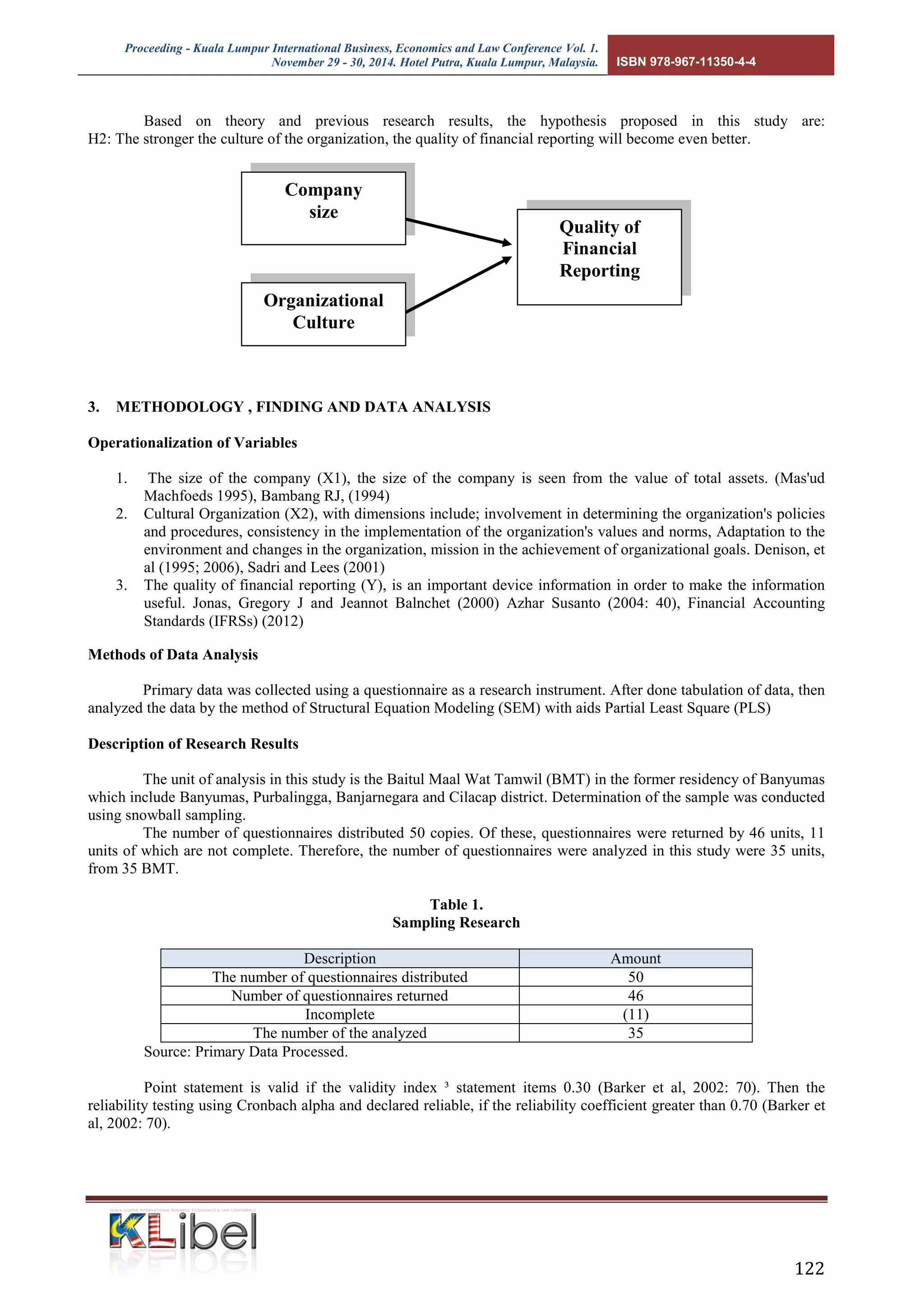
Based on theory and previous research results, the hypothesis proposed in this study are: H1: The larger the company, the better the quality of financial reporting 
2.2 Organizational Culture and Quality of Financial Reporting 
Brenkert (2004: 90-91) states that individuals must comply with the spirit and rules of competence and moral commitment. Moral commitment is understood in simple terms-that is to live in accordance with the ethical principles of honesty in providing adequate financial statements as well supported by the organizational culture. Furthermore, Young (2012: 150) states that first and foremost, Sarbanes Oxley explained that the company's senior management is responsible for the culture they create and must adhere to the same rules that apply to other employees. One purpose of this rule is that that the CEO should ultimately responsible for the quality control of corporate disclosure and financial reporting and to ensure that the 'tone of the top' has true meaning. Furthermore, Rezaee (2009: 80-81) states that the integrity of financial reporting is essential in rebuilding investor confidence, financial reporting and capital markets. 
Research Hashim (2012) revealed a positive and significant influence of the board of directors is dominated by ethnic Malays on the quality of financial reporting. Positive and significant results between ethnic and financial reporting quality as measured by discretionary component of accruals quality models in this study support the political cost theory, which indicates that the company is controlled by the ethnic minorities are more likely to face political costs of reporting high profits. While research Mir et.al (2009) revealed that the average Indian company has provided more information in the directors report in almost all categories than their counterparts in New Zealand.
Proceeding - Kuala Lumpur International Business, Economics and Law Conference Vol. 1. 
November 29 - 30, 2014. Hotel Putra, Kuala Lumpur, Malaysia. ISBN 978-967-11350-4-4 
122 
Based on theory and previous research results, the hypothesis proposed in this study are: H2: The stronger the culture of the organization, the quality of financial reporting will become even better. 
3. METHODOLOGY , FINDING AND DATA ANALYSIS 
Operationalization of Variables 
1. The size of the company (X1), the size of the company is seen from the value of total assets. (Mas'ud Machfoeds 1995), Bambang RJ, (1994) 
2. Cultural Organization (X2), with dimensions include; involvement in determining the organization's policies and procedures, consistency in the implementation of the organization's values and norms, Adaptation to the environment and changes in the organization, mission in the achievement of organizational goals. Denison, et al (1995; 2006), Sadri and Lees (2001) 
3. The quality of financial reporting (Y), is an important device information in order to make the information useful. Jonas, Gregory J and Jeannot Balnchet (2000) Azhar Susanto (2004: 40), Financial Accounting Standards (IFRSs) (2012) 
Methods of Data Analysis 
Primary data was collected using a questionnaire as a research instrument. After done tabulation of data, then analyzed the data by the method of Structural Equation Modeling (SEM) with aids Partial Least Square (PLS) 
Description of Research Results 
The unit of analysis in this study is the Baitul Maal Wat Tamwil (BMT) in the former residency of Banyumas which include Banyumas, Purbalingga, Banjarnegara and Cilacap district. Determination of the sample was conducted using snowball sampling. 
The number of questionnaires distributed 50 copies. Of these, questionnaires were returned by 46 units, 11 units of which are not complete. Therefore, the number of questionnaires were analyzed in this study were 35 units, from 35 BMT. 
Table 1. Sampling Research Description Amount 
The number of questionnaires distributed 
50 
Number of questionnaires returned 
46 
Incomplete 
(11) 
The number of the analyzed 
35 
Source: Primary Data Processed. 
Point statement is valid if the validity index ³ statement items 0.30 (Barker et al, 2002: 70). Then the reliability testing using Cronbach alpha and declared reliable, if the reliability coefficient greater than 0.70 (Barker et al, 2002: 70). 
Company 
size 
Organizational Culture 
Quality of Financial Reporting
Proceeding - Kuala Lumpur International Business, Economics and Law Conference Vol. 1. 
November 29 - 30, 2014. Hotel Putra, Kuala Lumpur, Malaysia. ISBN 978-967-11350-4-4 
123 
Data analysis 
Testing Effect Size and Cultural Organization Against Corporate Financial Reporting Quality 
Testing the effect of firm size and organizational culture on the quality of financial reporting is done by using structural equation modeling (SEM). In structural equation modeling, there are two types of models are formed, the measurement model and the structural model. Measurement model describes the proportion of variance of each manifest variables (indicators) that can be explained in the latent variable. Through the measurement model will be known which indicators are more dominant in the formation of the latent variables. After each measurement model latent variables will be elaborated further elaborated structural model that will assess the effect of each independent latent variables (latent exogenous variables) to the latent dependent variable (endogenous latent variable). 
Model Measurement (Outer) Model 
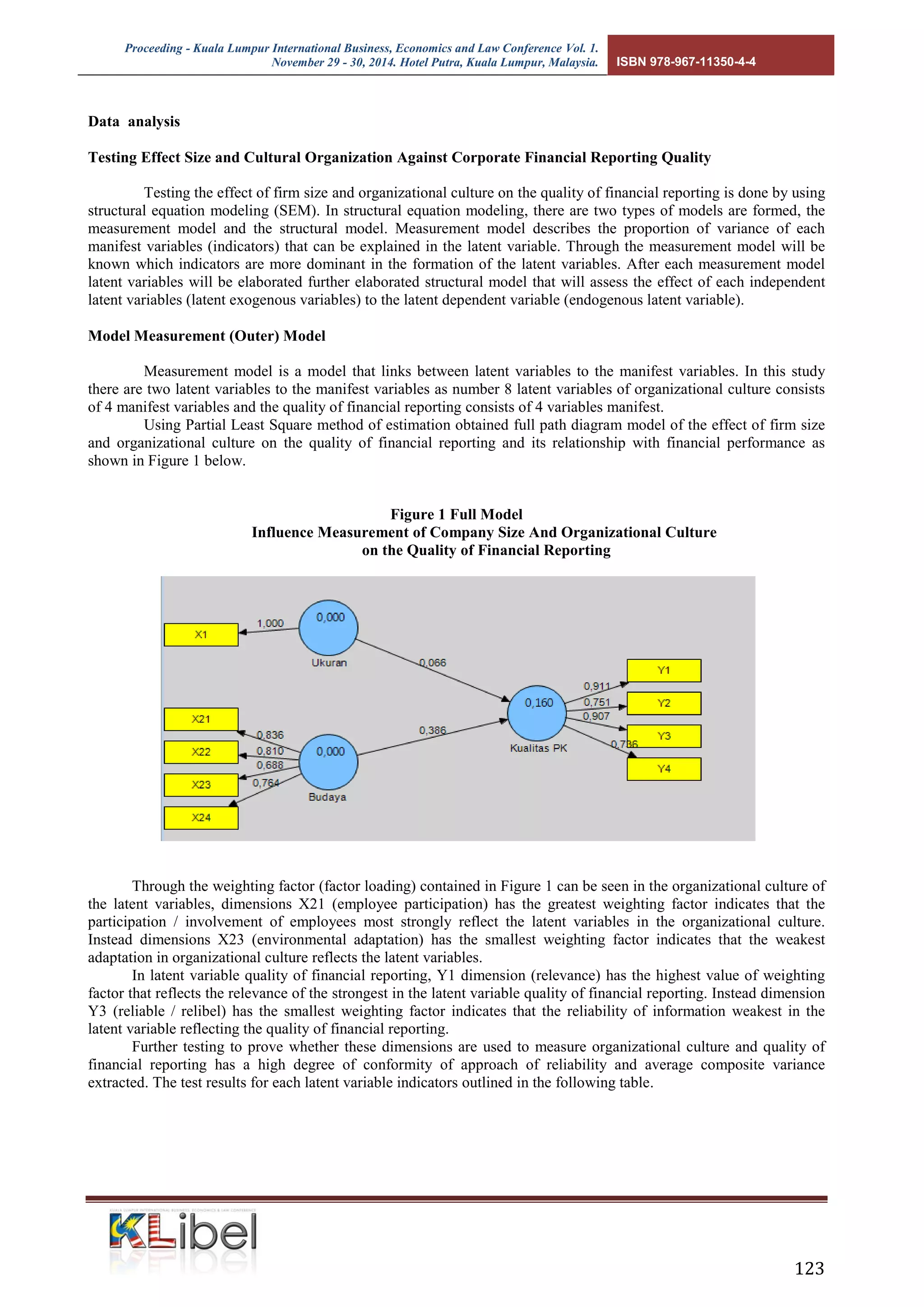
Measurement model is a model that links between latent variables to the manifest variables. In this study there are two latent variables to the manifest variables as number 8 latent variables of organizational culture consists of 4 manifest variables and the quality of financial reporting consists of 4 variables manifest. 
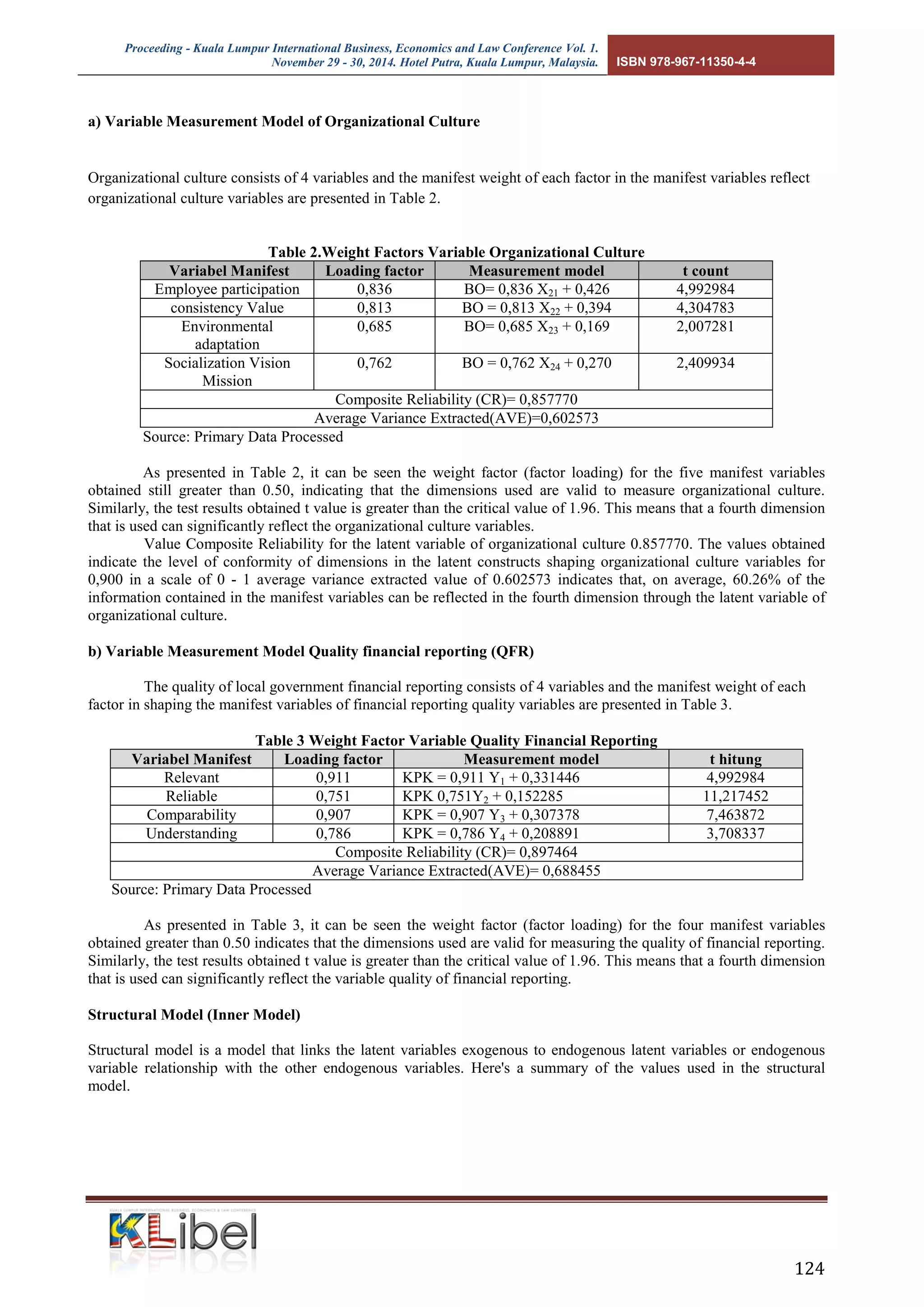
Using Partial Least Square method of estimation obtained full path diagram model of the effect of firm size and organizational culture on the quality of financial reporting and its relationship with financial performance as shown in Figure 1 below. 
Figure 1 Full Model 
Influence Measurement of Company Size And Organizational Culture 
on the Quality of Financial Reporting 
Through the weighting factor (factor loading) contained in Figure 1 can be seen in the organizational culture of the latent variables, dimensions X21 (employee participation) has the greatest weighting factor indicates that the participation / involvement of employees most strongly reflect the latent variables in the organizational culture. Instead dimensions X23 (environmental adaptation) has the smallest weighting factor indicates that the weakest adaptation in organizational culture reflects the latent variables. 
In latent variable quality of financial reporting, Y1 dimension (relevance) has the highest value of weighting factor that reflects the relevance of the strongest in the latent variable quality of financial reporting. Instead dimension Y3 (reliable / relibel) has the smallest weighting factor indicates that the reliability of information weakest in the latent variable reflecting the quality of financial reporting. 
Further testing to prove whether these dimensions are used to measure organizational culture and quality of financial reporting has a high degree of conformity of approach of reliability and average composite variance extracted. The test results for each latent variable indicators outlined in the following table.
Proceeding - Kuala Lumpur International Business, Economics and Law Conference Vol. 1. 
November 29 - 30, 2014. Hotel Putra, Kuala Lumpur, Malaysia. ISBN 978-967-11350-4-4 
124 
a) Variable Measurement Model of Organizational Culture 
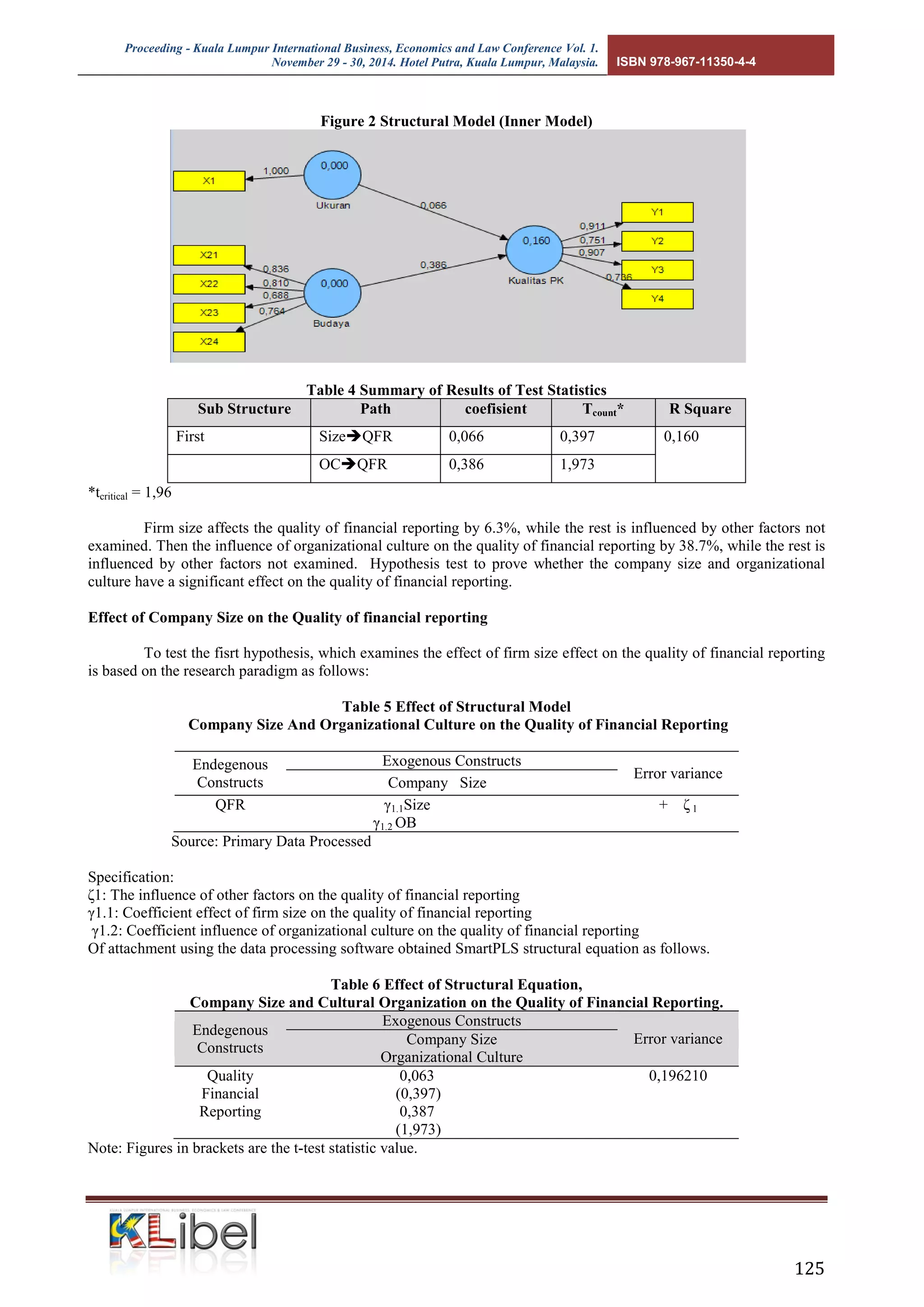
Organizational culture consists of 4 variables and the manifest weight of each factor in the manifest variables reflect organizational culture variables are presented in Table 2. 
Table 2.Weight Factors Variable Organizational Culture Variabel Manifest Loading factor Measurement model t count 
Employee participation 
0,836 
BO= 0,836 X21 + 0,426 
4,992984 
consistency Value 
0,813 
BO = 0,813 X22 + 0,394 
4,304783 
Environmental adaptation 
0,685 
BO= 0,685 X23 + 0,169 
2,007281 
Socialization Vision Mission 
0,762 
BO = 0,762 X24 + 0,270 
2,409934 
Composite Reliability (CR)= 0,857770 
Average Variance Extracted(AVE)=0,602573 
Source: Primary Data Processed 
As presented in Table 2, it can be seen the weight factor (factor loading) for the five manifest variables obtained still greater than 0.50, indicating that the dimensions used are valid to measure organizational culture. Similarly, the test results obtained t value is greater than the critical value of 1.96. This means that a fourth dimension that is used can significantly reflect the organizational culture variables. 
Value Composite Reliability for the latent variable of organizational culture 0.857770. The values obtained indicate the level of conformity of dimensions in the latent constructs shaping organizational culture variables for 0,900 in a scale of 0 - 1 average variance extracted value of 0.602573 indicates that, on average, 60.26% of the information contained in the manifest variables can be reflected in the fourth dimension through the latent variable of organizational culture. 
b) Variable Measurement Model Quality financial reporting (QFR) 
The quality of local government financial reporting consists of 4 variables and the manifest weight of each factor in shaping the manifest variables of financial reporting quality variables are presented in Table 3. 
Table 3 Weight Factor Variable Quality Financial Reporting Variabel Manifest Loading factor Measurement model t hitung 
Relevant 
0,911 
KPK = 0,911 Y1 + 0,331446 
4,992984 
Reliable 
0,751 
KPK 0,751Y2 + 0,152285 
11,217452 
Comparability 
0,907 
KPK = 0,907 Y3 + 0,307378 
7,463872 
Understanding 
0,786 
KPK = 0,786 Y4 + 0,208891 
3,708337 
Composite Reliability (CR)= 0,897464 
Average Variance Extracted(AVE)= 0,688455 
Source: Primary Data Processed 
As presented in Table 3, it can be seen the weight factor (factor loading) for the four manifest variables obtained greater than 0.50 indicates that the dimensions used are valid for measuring the quality of financial reporting. Similarly, the test results obtained t value is greater than the critical value of 1.96. This means that a fourth dimension that is used can significantly reflect the variable quality of financial reporting. 
Structural Model (Inner Model) 
Structural model is a model that links the latent variables exogenous to endogenous latent variables or endogenous variable relationship with the other endogenous variables. Here's a summary of the values used in the structural model.
Proceeding - Kuala Lumpur International Business, Economics and Law Conference Vol. 1. 
November 29 - 30, 2014. Hotel Putra, Kuala Lumpur, Malaysia. ISBN 978-967-11350-4-4 
125 
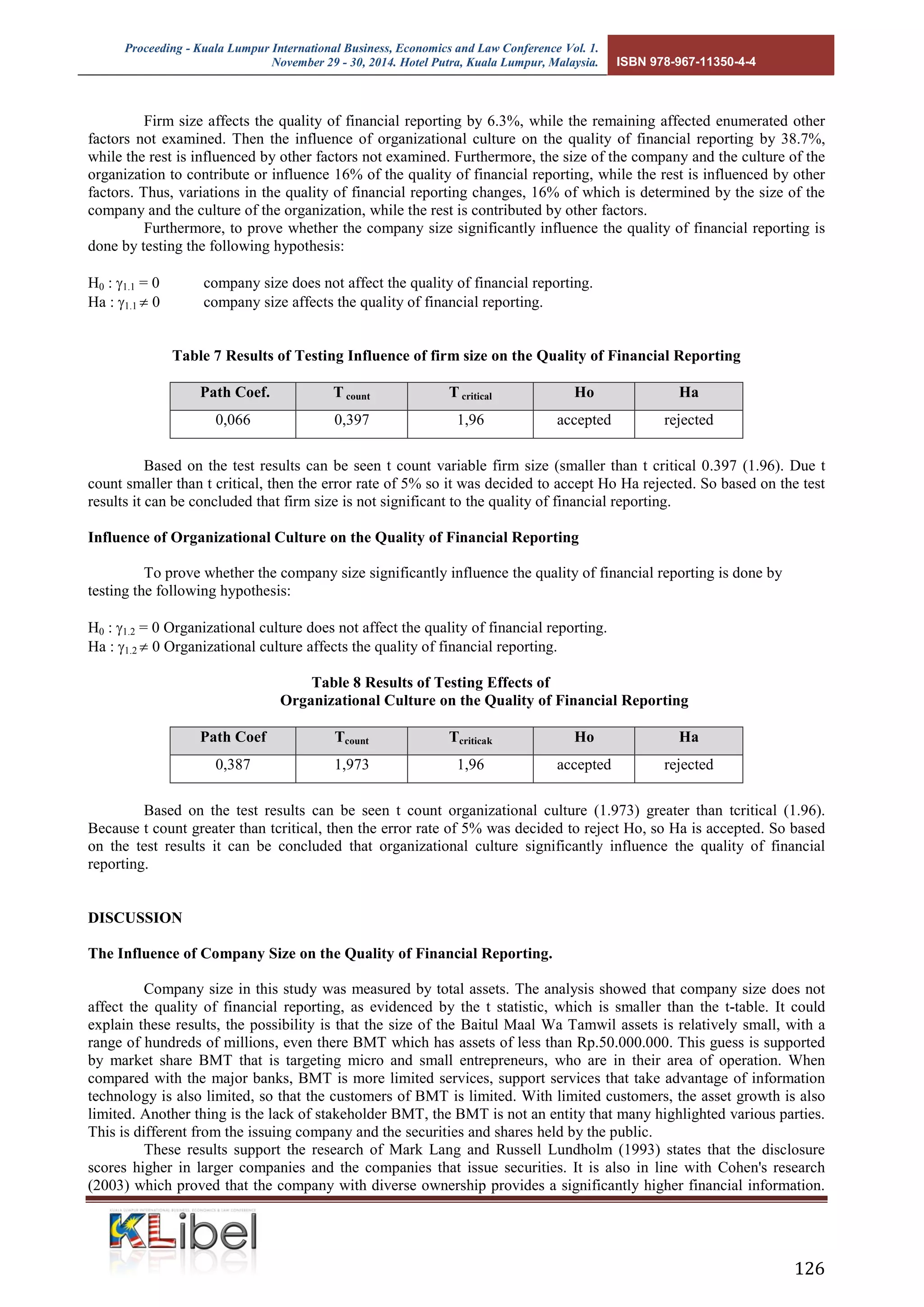
Figure 2 Structural Model (Inner Model) 
Table 4 Summary of Results of Test Statistics Sub Structure Path coefisient Tcount* R Square 
First 
SizeQFR 
0,066 
0,397 
0,160 
OCQFR 
0,386 
1,973 
*tcritical = 1,96 
Firm size affects the quality of financial reporting by 6.3%, while the rest is influenced by other factors not examined. Then the influence of organizational culture on the quality of financial reporting by 38.7%, while the rest is influenced by other factors not examined. Hypothesis test to prove whether the company size and organizational culture have a significant effect on the quality of financial reporting. 
Effect of Company Size on the Quality of financial reporting 
To test the fisrt hypothesis, which examines the effect of firm size effect on the quality of financial reporting is based on the research paradigm as follows: 
Table 5 Effect of Structural Model 
Company Size And Organizational Culture on the Quality of Financial Reporting 
Endegenous 
Constructs 
Exogenous Constructs 
Error variance 
Company Size 
QFR 
γ1.1Size 
γ1.2 OB 
+ ζ 1 
Source: Primary Data Processed 
Specification: ζ1: The influence of other factors on the quality of financial reporting γ1.1: Coefficient effect of firm size on the quality of financial reporting γ1.2: Coefficient influence of organizational culture on the quality of financial reporting Of attachment using the data processing software obtained SmartPLS structural equation as follows. 
Table 6 Effect of Structural Equation, 
Company Size and Cultural Organization on the Quality of Financial Reporting. Endegenous Constructs Exogenous Constructs Error variance Company Size Organizational Culture 
Quality 
Financial 
Reporting 
0,063 
(0,397) 
0,387 
(1,973) 
0,196210 
Note: Figures in brackets are the t-test statistic value.
Proceeding - Kuala Lumpur International Business, Economics and Law Conference Vol. 1. 
November 29 - 30, 2014. Hotel Putra, Kuala Lumpur, Malaysia. ISBN 978-967-11350-4-4 
126 
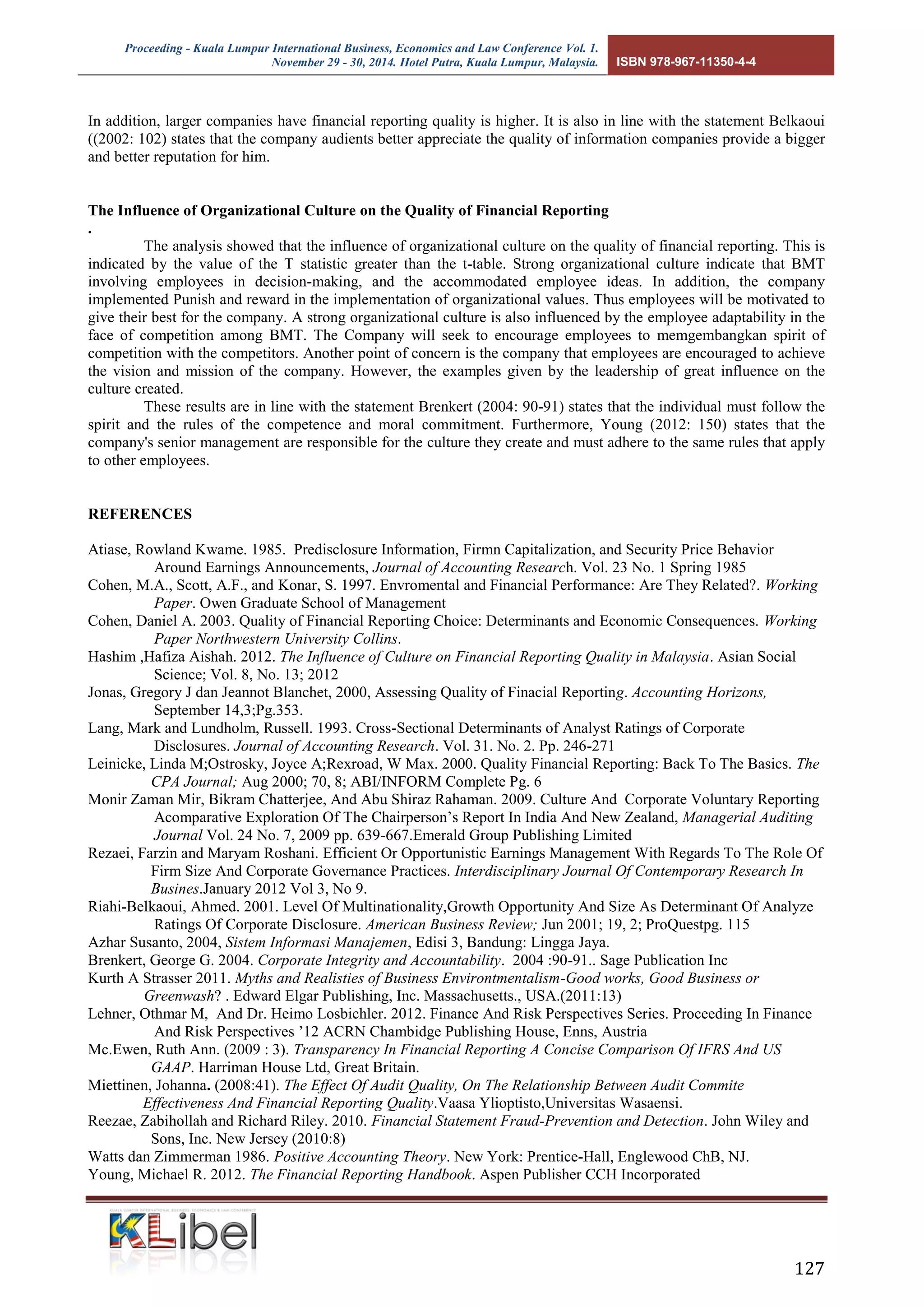
Firm size affects the quality of financial reporting by 6.3%, while the remaining affected enumerated other factors not examined. Then the influence of organizational culture on the quality of financial reporting by 38.7%, while the rest is influenced by other factors not examined. Furthermore, the size of the company and the culture of the organization to contribute or influence 16% of the quality of financial reporting, while the rest is influenced by other factors. Thus, variations in the quality of financial reporting changes, 16% of which is determined by the size of the company and the culture of the organization, while the rest is contributed by other factors. 
Furthermore, to prove whether the company size significantly influence the quality of financial reporting is done by testing the following hypothesis: 
H0 : 1.1 = 0 company size does not affect the quality of financial reporting. Ha : 1.1  0 company size affects the quality of financial reporting. 
Table 7 Results of Testing Influence of firm size on the Quality of Financial Reporting 
Path Coef. T count T critical Ho Ha 
0,066 
0,397 
1,96 
accepted 
rejected 
Based on the test results can be seen t count variable firm size (smaller than t critical 0.397 (1.96). Due t count smaller than t critical, then the error rate of 5% so it was decided to accept Ho Ha rejected. So based on the test results it can be concluded that firm size is not significant to the quality of financial reporting. 
Influence of Organizational Culture on the Quality of Financial Reporting 
To prove whether the company size significantly influence the quality of financial reporting is done by testing the following hypothesis: 
H0 : 1.2 = 0 Organizational culture does not affect the quality of financial reporting. Ha : 1.2  0 Organizational culture affects the quality of financial reporting. 
Table 8 Results of Testing Effects of 
Organizational Culture on the Quality of Financial Reporting 
Path Coef Tcount Tcriticak Ho Ha 
0,387 
1,973 
1,96 
accepted 
rejected 
Based on the test results can be seen t count organizational culture (1.973) greater than tcritical (1.96). Because t count greater than tcritical, then the error rate of 5% was decided to reject Ho, so Ha is accepted. So based on the test results it can be concluded that organizational culture significantly influence the quality of financial reporting. 
DISCUSSION 
The Influence of Company Size on the Quality of Financial Reporting. 
Company size in this study was measured by total assets. The analysis showed that company size does not affect the quality of financial reporting, as evidenced by the t statistic, which is smaller than the t-table. It could explain these results, the possibility is that the size of the Baitul Maal Wa Tamwil assets is relatively small, with a range of hundreds of millions, even there BMT which has assets of less than Rp.50.000.000. This guess is supported by market share BMT that is targeting micro and small entrepreneurs, who are in their area of operation. When compared with the major banks, BMT is more limited services, support services that take advantage of information technology is also limited, so that the customers of BMT is limited. With limited customers, the asset growth is also limited. Another thing is the lack of stakeholder BMT, the BMT is not an entity that many highlighted various parties. This is different from the issuing company and the securities and shares held by the public. 
These results support the research of Mark Lang and Russell Lundholm (1993) states that the disclosure scores higher in larger companies and the companies that issue securities. It is also in line with Cohen's research (2003) which proved that the company with diverse ownership provides a significantly higher financial information.
Proceeding - Kuala Lumpur International Business, Economics and Law Conference Vol. 1. 
November 29 - 30, 2014. Hotel Putra, Kuala Lumpur, Malaysia. ISBN 978-967-11350-4-4 
127 
In addition, larger companies have financial reporting quality is higher. It is also in line with the statement Belkaoui ((2002: 102) states that the company audients better appreciate the quality of information companies provide a bigger and better reputation for him. 
The Influence of Organizational Culture on the Quality of Financial Reporting 
. 
The analysis showed that the influence of organizational culture on the quality of financial reporting. This is indicated by the value of the T statistic greater than the t-table. Strong organizational culture indicate that BMT involving employees in decision-making, and the accommodated employee ideas. In addition, the company implemented Punish and reward in the implementation of organizational values. Thus employees will be motivated to give their best for the company. A strong organizational culture is also influenced by the employee adaptability in the face of competition among BMT. The Company will seek to encourage employees to memgembangkan spirit of competition with the competitors. Another point of concern is the company that employees are encouraged to achieve the vision and mission of the company. However, the examples given by the leadership of great influence on the culture created. 
These results are in line with the statement Brenkert (2004: 90-91) states that the individual must follow the spirit and the rules of the competence and moral commitment. Furthermore, Young (2012: 150) states that the company's senior management are responsible for the culture they create and must adhere to the same rules that apply to other employees. 
REFERENCES 
Atiase, Rowland Kwame. 1985. Predisclosure Information, Firmn Capitalization, and Security Price Behavior Around Earnings Announcements, Journal of Accounting Research. Vol. 23 No. 1 Spring 1985 
Cohen, M.A., Scott, A.F., and Konar, S. 1997. Envromental and Financial Performance: Are They Related?. Working Paper. Owen Graduate School of Management 
Cohen, Daniel A. 2003. Quality of Financial Reporting Choice: Determinants and Economic Consequences. Working Paper Northwestern University Collins. 
Hashim ,Hafiza Aishah. 2012. The Influence of Culture on Financial Reporting Quality in Malaysia. Asian Social Science; Vol. 8, No. 13; 2012 
Jonas, Gregory J dan Jeannot Blanchet, 2000, Assessing Quality of Finacial Reporting. Accounting Horizons, September 14,3;Pg.353. 
Lang, Mark and Lundholm, Russell. 1993. Cross-Sectional Determinants of Analyst Ratings of Corporate Disclosures. Journal of Accounting Research. Vol. 31. No. 2. Pp. 246-271 
Leinicke, Linda M;Ostrosky, Joyce A;Rexroad, W Max. 2000. Quality Financial Reporting: Back To The Basics. The CPA Journal; Aug 2000; 70, 8; ABI/INFORM Complete Pg. 6 
Monir Zaman Mir, Bikram Chatterjee, And Abu Shiraz Rahaman. 2009. Culture And Corporate Voluntary Reporting Acomparative Exploration Of The Chairperson’s Report In India And New Zealand, Managerial Auditing Journal Vol. 24 No. 7, 2009 pp. 639-667.Emerald Group Publishing Limited 
Rezaei, Farzin and Maryam Roshani. Efficient Or Opportunistic Earnings Management With Regards To The Role Of Firm Size And Corporate Governance Practices. Interdisciplinary Journal Of Contemporary Research In Busines.January 2012 Vol 3, No 9. 
Riahi-Belkaoui, Ahmed. 2001. Level Of Multinationality,Growth Opportunity And Size As Determinant Of Analyze Ratings Of Corporate Disclosure. American Business Review; Jun 2001; 19, 2; ProQuestpg. 115 
Azhar Susanto, 2004, Sistem Informasi Manajemen, Edisi 3, Bandung: Lingga Jaya. 
Brenkert, George G. 2004. Corporate Integrity and Accountability. 2004 :90-91.. Sage Publication Inc 
Kurth A Strasser 2011. Myths and Realisties of Business Environtmentalism-Good works, Good Business or Greenwash? . Edward Elgar Publishing, Inc. Massachusetts., USA.(2011:13) 
Lehner, Othmar M, And Dr. Heimo Losbichler. 2012. Finance And Risk Perspectives Series. Proceeding In Finance And Risk Perspectives ’12 ACRN Chambidge Publishing House, Enns, Austria 
Mc.Ewen, Ruth Ann. (2009 : 3). Transparency In Financial Reporting A Concise Comparison Of IFRS And US GAAP. Harriman House Ltd, Great Britain. 
Miettinen, Johanna. (2008:41). The Effect Of Audit Quality, On The Relationship Between Audit Commite Effectiveness And Financial Reporting Quality.Vaasa Ylioptisto,Universitas Wasaensi. 
Reezae, Zabihollah and Richard Riley. 2010. Financial Statement Fraud-Prevention and Detection. John Wiley and Sons, Inc. New Jersey (2010:8) 
Watts dan Zimmerman 1986. Positive Accounting Theory. New York: Prentice-Hall, Englewood ChB, NJ. 
Young, Michael R. 2012. The Financial Reporting Handbook. Aspen Publisher CCH Incorporated

Klibel5 acc 36_

  • 1.
    Proceeding - KualaLumpur International Business, Economics and Law Conference Vol. 1. November 29 - 30, 2014. Hotel Putra, Kuala Lumpur, Malaysia. ISBN 978-967-11350-4-4 120 THE EFFECT OF FIRM SIZE AND ORGANIZATIONAL CULTURE ON THE QUALITY OF FINANCIAL REPORTING IN SHARIA MICROFINANCING INSTITUTION (BAITUL MAAL WA TAMWIL) (THE CASE OF EX BANYUMAS RESIDENCY-INDONESIA) Puji Lestari Faculty of Economics And Business, Accounting Department, Jenderal Soedirman University, Purwokerto, Indonesia Email: pujiunsoed@yahoo.co.id Winwin Yadiati Faculty of Economics And Business, Accounting Department, Padjajaran University, Bandung, Indonesia ABSTRACT This study aims to determine the effect of firm size and organizational culture on the quality of financial reporting on Islamic microfinance institutions (Baitul Maal wa tamwil / BMT) in Ex Banyumas residency, which includes Banyumas, Cilacap, Banjarnegara and Purbalingga. The study was conducted by questionnaire survey using research instruments to be filled by the leaders of Islamic microfinance institutions in the former residency of Banyumas. By using snowball sampling, the sample size was selected as 35 BMT. Data were analyzed by using Partial Least Square (PLS). The analysis showed that company size does not affect the quality of financial reporting, and organizational culture affects the quality of financial reporting Keywords: Company Size, Organizational Culture, Quality of Financial Reporting 1. INTRODUCTION The quality of financial reporting depends on the quality of each part of the financial reporting process (Jonas and Blanchet, 2000). Azhar Susanto (2004: 40) says that the quality of information that has the characteristics: accurate, timely, relevant, and complete. Miller and Bahnson (1999) suggests the quality of financial firms, proxies by the disclosure of complete information, timely and understandable. Jonas and Blanchet (2000: 360) states reporting quality seen from the achievement of a conceptual framework. Hilton, et al (2000: 551) explains that the quality of accounting information must satisfy the following three characteristics: relevance, accuracy, and timeless. Quality of financial reporting is influenced by many factors. Strasser (2011: 13) states that the quality of information is positively related to several other factors, including the size of the company. Belkaoui (2002: 102) states that the stakeholder (audience) companies appreciate better the quality of information companies large and give them a better reputation. Cohen's research (2003) which proved that the company with diverse ownership and leverage are significantly higher provide high financial information. The bigger the company, the quality of financial reporting will be higher. Furthermore, the quality of financial reporting from perspective of senior management. Senior management gives an example of the attitude and integrity. They must continue to convey the message that it is a must to make high quality financial reporting (Leinicke, et. Al, 2000). Young (2012: 150) states that first and foremost, Sarbanes Oxley explained that the company's senior management is responsible for the culture they create and must adhere to the same rules that apply to other employees. One purpose of this rule is that that the CEO should ultimately responsible for the quality control of corporate disclosure and financial reporting and to ensure 'tone of the top 'has true meaning. Furthermore, Rezaee (2009: 80-81) states that the integrity of financial reporting is essential in rebuilding investor confidence, financial reporting and capital markets. PROBLEM FORMULATION Based on the above, the formulation of the problem in the research plan is as follows: 1). How big is the influence of firm size on the quality of financial reporting? 2). How big is the influence of organizational culture on the quality of financial reporting?
  • 2.
    Proceeding - KualaLumpur International Business, Economics and Law Conference Vol. 1. November 29 - 30, 2014. Hotel Putra, Kuala Lumpur, Malaysia. ISBN 978-967-11350-4-4 121 2. LITERATURE REVIEW AND HYPOTHESIS DEVELOPMENT FRAMEWORK 2.1. Size and Quality of Financial Reporting Strasser (2011: 13) states that the quality of information is positively related to several factors, including the size of the company and the company's experience in reporting. Belkaoui ((2002: 102) states that the audiences appreciates the quality of information companies over larger companies, and provide a better reputation for him. Study Cohen (2003) which proved that the company with diverse holdings and higher leverage, it will significantly provide more financial information. Companies with less competition, less likely to report high-quality information. capital-intensive company will provide more accurate financial information to predict future cash flows. coefficient growth has no significant effect on the level of future cash flow predictions. huge company believed financial reporting quality better. Another research by Cohen (2006) also mentioned that companies with high operating cycles will have a low quality of financial reporting. Watts and Zimmerman (1986) stated that the company size is used as a guide to political costs and political costs will increase with the size and risk of the company. The size of the company reflects the characteristics of the company. The literature indicates that the relationship between firm size and discretionary accruals no conclusive findings regarding the direction of the relationship (Lehner and Losbichler, 2012). Atiase (1985) found that the amount of information 'unexpected' is up to the market by the actual profit is inversely related to the capitalization of the company, where other things fixed. It shows that the larger the company, the less information available in the financial statements (Lehner and Losbichler, 2012). Transparency may be viewed as an indicator of the quality of financial reporting (Ewen, 2009: 3). When a single definition of financial reporting quality is not there, then the market using constructs such as earnings quality. The higher the quality of the earnings will be more persistent. Others say that the quality of earnings (earnings) is defined to shareholders who rely on financial statements to buy future earnings. Meanwhile Miettinen (2008: 41) states that earnings management is an indicator of the quality of financial reporting. Reezae and Riley (2010: 8) states that fraudulent financial reporting is dangerous because it damages the quality and integrity of the financial reporting process. Mark Lang and Russell Lundholm (1993) stated that the results are generally consistent with the existence of empirical research on voluntary disclosure. Disclosure scores were higher in companies with good performance, the agency, the larger, the company with a weaker relationship between annual stock returns and earnings, and the company that issued the securities. Belkaoui (2001) found that the level of disclosure increases with increasing firm size. Rezaei and Roshani (2012) find evidence that firm size affects the type of earnings management and earnings smoothing. Based on theory and previous research results, the hypothesis proposed in this study are: H1: The larger the company, the better the quality of financial reporting 2.2 Organizational Culture and Quality of Financial Reporting Brenkert (2004: 90-91) states that individuals must comply with the spirit and rules of competence and moral commitment. Moral commitment is understood in simple terms-that is to live in accordance with the ethical principles of honesty in providing adequate financial statements as well supported by the organizational culture. Furthermore, Young (2012: 150) states that first and foremost, Sarbanes Oxley explained that the company's senior management is responsible for the culture they create and must adhere to the same rules that apply to other employees. One purpose of this rule is that that the CEO should ultimately responsible for the quality control of corporate disclosure and financial reporting and to ensure that the 'tone of the top' has true meaning. Furthermore, Rezaee (2009: 80-81) states that the integrity of financial reporting is essential in rebuilding investor confidence, financial reporting and capital markets. Research Hashim (2012) revealed a positive and significant influence of the board of directors is dominated by ethnic Malays on the quality of financial reporting. Positive and significant results between ethnic and financial reporting quality as measured by discretionary component of accruals quality models in this study support the political cost theory, which indicates that the company is controlled by the ethnic minorities are more likely to face political costs of reporting high profits. While research Mir et.al (2009) revealed that the average Indian company has provided more information in the directors report in almost all categories than their counterparts in New Zealand.
  • 3.
    Proceeding - KualaLumpur International Business, Economics and Law Conference Vol. 1. November 29 - 30, 2014. Hotel Putra, Kuala Lumpur, Malaysia. ISBN 978-967-11350-4-4 122 Based on theory and previous research results, the hypothesis proposed in this study are: H2: The stronger the culture of the organization, the quality of financial reporting will become even better. 3. METHODOLOGY , FINDING AND DATA ANALYSIS Operationalization of Variables 1. The size of the company (X1), the size of the company is seen from the value of total assets. (Mas'ud Machfoeds 1995), Bambang RJ, (1994) 2. Cultural Organization (X2), with dimensions include; involvement in determining the organization's policies and procedures, consistency in the implementation of the organization's values and norms, Adaptation to the environment and changes in the organization, mission in the achievement of organizational goals. Denison, et al (1995; 2006), Sadri and Lees (2001) 3. The quality of financial reporting (Y), is an important device information in order to make the information useful. Jonas, Gregory J and Jeannot Balnchet (2000) Azhar Susanto (2004: 40), Financial Accounting Standards (IFRSs) (2012) Methods of Data Analysis Primary data was collected using a questionnaire as a research instrument. After done tabulation of data, then analyzed the data by the method of Structural Equation Modeling (SEM) with aids Partial Least Square (PLS) Description of Research Results The unit of analysis in this study is the Baitul Maal Wat Tamwil (BMT) in the former residency of Banyumas which include Banyumas, Purbalingga, Banjarnegara and Cilacap district. Determination of the sample was conducted using snowball sampling. The number of questionnaires distributed 50 copies. Of these, questionnaires were returned by 46 units, 11 units of which are not complete. Therefore, the number of questionnaires were analyzed in this study were 35 units, from 35 BMT. Table 1. Sampling Research Description Amount The number of questionnaires distributed 50 Number of questionnaires returned 46 Incomplete (11) The number of the analyzed 35 Source: Primary Data Processed. Point statement is valid if the validity index ³ statement items 0.30 (Barker et al, 2002: 70). Then the reliability testing using Cronbach alpha and declared reliable, if the reliability coefficient greater than 0.70 (Barker et al, 2002: 70). Company size Organizational Culture Quality of Financial Reporting
  • 4.
    Proceeding - KualaLumpur International Business, Economics and Law Conference Vol. 1. November 29 - 30, 2014. Hotel Putra, Kuala Lumpur, Malaysia. ISBN 978-967-11350-4-4 123 Data analysis Testing Effect Size and Cultural Organization Against Corporate Financial Reporting Quality Testing the effect of firm size and organizational culture on the quality of financial reporting is done by using structural equation modeling (SEM). In structural equation modeling, there are two types of models are formed, the measurement model and the structural model. Measurement model describes the proportion of variance of each manifest variables (indicators) that can be explained in the latent variable. Through the measurement model will be known which indicators are more dominant in the formation of the latent variables. After each measurement model latent variables will be elaborated further elaborated structural model that will assess the effect of each independent latent variables (latent exogenous variables) to the latent dependent variable (endogenous latent variable). Model Measurement (Outer) Model Measurement model is a model that links between latent variables to the manifest variables. In this study there are two latent variables to the manifest variables as number 8 latent variables of organizational culture consists of 4 manifest variables and the quality of financial reporting consists of 4 variables manifest. Using Partial Least Square method of estimation obtained full path diagram model of the effect of firm size and organizational culture on the quality of financial reporting and its relationship with financial performance as shown in Figure 1 below. Figure 1 Full Model Influence Measurement of Company Size And Organizational Culture on the Quality of Financial Reporting Through the weighting factor (factor loading) contained in Figure 1 can be seen in the organizational culture of the latent variables, dimensions X21 (employee participation) has the greatest weighting factor indicates that the participation / involvement of employees most strongly reflect the latent variables in the organizational culture. Instead dimensions X23 (environmental adaptation) has the smallest weighting factor indicates that the weakest adaptation in organizational culture reflects the latent variables. In latent variable quality of financial reporting, Y1 dimension (relevance) has the highest value of weighting factor that reflects the relevance of the strongest in the latent variable quality of financial reporting. Instead dimension Y3 (reliable / relibel) has the smallest weighting factor indicates that the reliability of information weakest in the latent variable reflecting the quality of financial reporting. Further testing to prove whether these dimensions are used to measure organizational culture and quality of financial reporting has a high degree of conformity of approach of reliability and average composite variance extracted. The test results for each latent variable indicators outlined in the following table.
  • 5.
    Proceeding - KualaLumpur International Business, Economics and Law Conference Vol. 1. November 29 - 30, 2014. Hotel Putra, Kuala Lumpur, Malaysia. ISBN 978-967-11350-4-4 124 a) Variable Measurement Model of Organizational Culture Organizational culture consists of 4 variables and the manifest weight of each factor in the manifest variables reflect organizational culture variables are presented in Table 2. Table 2.Weight Factors Variable Organizational Culture Variabel Manifest Loading factor Measurement model t count Employee participation 0,836 BO= 0,836 X21 + 0,426 4,992984 consistency Value 0,813 BO = 0,813 X22 + 0,394 4,304783 Environmental adaptation 0,685 BO= 0,685 X23 + 0,169 2,007281 Socialization Vision Mission 0,762 BO = 0,762 X24 + 0,270 2,409934 Composite Reliability (CR)= 0,857770 Average Variance Extracted(AVE)=0,602573 Source: Primary Data Processed As presented in Table 2, it can be seen the weight factor (factor loading) for the five manifest variables obtained still greater than 0.50, indicating that the dimensions used are valid to measure organizational culture. Similarly, the test results obtained t value is greater than the critical value of 1.96. This means that a fourth dimension that is used can significantly reflect the organizational culture variables. Value Composite Reliability for the latent variable of organizational culture 0.857770. The values obtained indicate the level of conformity of dimensions in the latent constructs shaping organizational culture variables for 0,900 in a scale of 0 - 1 average variance extracted value of 0.602573 indicates that, on average, 60.26% of the information contained in the manifest variables can be reflected in the fourth dimension through the latent variable of organizational culture. b) Variable Measurement Model Quality financial reporting (QFR) The quality of local government financial reporting consists of 4 variables and the manifest weight of each factor in shaping the manifest variables of financial reporting quality variables are presented in Table 3. Table 3 Weight Factor Variable Quality Financial Reporting Variabel Manifest Loading factor Measurement model t hitung Relevant 0,911 KPK = 0,911 Y1 + 0,331446 4,992984 Reliable 0,751 KPK 0,751Y2 + 0,152285 11,217452 Comparability 0,907 KPK = 0,907 Y3 + 0,307378 7,463872 Understanding 0,786 KPK = 0,786 Y4 + 0,208891 3,708337 Composite Reliability (CR)= 0,897464 Average Variance Extracted(AVE)= 0,688455 Source: Primary Data Processed As presented in Table 3, it can be seen the weight factor (factor loading) for the four manifest variables obtained greater than 0.50 indicates that the dimensions used are valid for measuring the quality of financial reporting. Similarly, the test results obtained t value is greater than the critical value of 1.96. This means that a fourth dimension that is used can significantly reflect the variable quality of financial reporting. Structural Model (Inner Model) Structural model is a model that links the latent variables exogenous to endogenous latent variables or endogenous variable relationship with the other endogenous variables. Here's a summary of the values used in the structural model.
  • 6.
    Proceeding - KualaLumpur International Business, Economics and Law Conference Vol. 1. November 29 - 30, 2014. Hotel Putra, Kuala Lumpur, Malaysia. ISBN 978-967-11350-4-4 125 Figure 2 Structural Model (Inner Model) Table 4 Summary of Results of Test Statistics Sub Structure Path coefisient Tcount* R Square First SizeQFR 0,066 0,397 0,160 OCQFR 0,386 1,973 *tcritical = 1,96 Firm size affects the quality of financial reporting by 6.3%, while the rest is influenced by other factors not examined. Then the influence of organizational culture on the quality of financial reporting by 38.7%, while the rest is influenced by other factors not examined. Hypothesis test to prove whether the company size and organizational culture have a significant effect on the quality of financial reporting. Effect of Company Size on the Quality of financial reporting To test the fisrt hypothesis, which examines the effect of firm size effect on the quality of financial reporting is based on the research paradigm as follows: Table 5 Effect of Structural Model Company Size And Organizational Culture on the Quality of Financial Reporting Endegenous Constructs Exogenous Constructs Error variance Company Size QFR γ1.1Size γ1.2 OB + ζ 1 Source: Primary Data Processed Specification: ζ1: The influence of other factors on the quality of financial reporting γ1.1: Coefficient effect of firm size on the quality of financial reporting γ1.2: Coefficient influence of organizational culture on the quality of financial reporting Of attachment using the data processing software obtained SmartPLS structural equation as follows. Table 6 Effect of Structural Equation, Company Size and Cultural Organization on the Quality of Financial Reporting. Endegenous Constructs Exogenous Constructs Error variance Company Size Organizational Culture Quality Financial Reporting 0,063 (0,397) 0,387 (1,973) 0,196210 Note: Figures in brackets are the t-test statistic value.
  • 7.
    Proceeding - KualaLumpur International Business, Economics and Law Conference Vol. 1. November 29 - 30, 2014. Hotel Putra, Kuala Lumpur, Malaysia. ISBN 978-967-11350-4-4 126 Firm size affects the quality of financial reporting by 6.3%, while the remaining affected enumerated other factors not examined. Then the influence of organizational culture on the quality of financial reporting by 38.7%, while the rest is influenced by other factors not examined. Furthermore, the size of the company and the culture of the organization to contribute or influence 16% of the quality of financial reporting, while the rest is influenced by other factors. Thus, variations in the quality of financial reporting changes, 16% of which is determined by the size of the company and the culture of the organization, while the rest is contributed by other factors. Furthermore, to prove whether the company size significantly influence the quality of financial reporting is done by testing the following hypothesis: H0 : 1.1 = 0 company size does not affect the quality of financial reporting. Ha : 1.1  0 company size affects the quality of financial reporting. Table 7 Results of Testing Influence of firm size on the Quality of Financial Reporting Path Coef. T count T critical Ho Ha 0,066 0,397 1,96 accepted rejected Based on the test results can be seen t count variable firm size (smaller than t critical 0.397 (1.96). Due t count smaller than t critical, then the error rate of 5% so it was decided to accept Ho Ha rejected. So based on the test results it can be concluded that firm size is not significant to the quality of financial reporting. Influence of Organizational Culture on the Quality of Financial Reporting To prove whether the company size significantly influence the quality of financial reporting is done by testing the following hypothesis: H0 : 1.2 = 0 Organizational culture does not affect the quality of financial reporting. Ha : 1.2  0 Organizational culture affects the quality of financial reporting. Table 8 Results of Testing Effects of Organizational Culture on the Quality of Financial Reporting Path Coef Tcount Tcriticak Ho Ha 0,387 1,973 1,96 accepted rejected Based on the test results can be seen t count organizational culture (1.973) greater than tcritical (1.96). Because t count greater than tcritical, then the error rate of 5% was decided to reject Ho, so Ha is accepted. So based on the test results it can be concluded that organizational culture significantly influence the quality of financial reporting. DISCUSSION The Influence of Company Size on the Quality of Financial Reporting. Company size in this study was measured by total assets. The analysis showed that company size does not affect the quality of financial reporting, as evidenced by the t statistic, which is smaller than the t-table. It could explain these results, the possibility is that the size of the Baitul Maal Wa Tamwil assets is relatively small, with a range of hundreds of millions, even there BMT which has assets of less than Rp.50.000.000. This guess is supported by market share BMT that is targeting micro and small entrepreneurs, who are in their area of operation. When compared with the major banks, BMT is more limited services, support services that take advantage of information technology is also limited, so that the customers of BMT is limited. With limited customers, the asset growth is also limited. Another thing is the lack of stakeholder BMT, the BMT is not an entity that many highlighted various parties. This is different from the issuing company and the securities and shares held by the public. These results support the research of Mark Lang and Russell Lundholm (1993) states that the disclosure scores higher in larger companies and the companies that issue securities. It is also in line with Cohen's research (2003) which proved that the company with diverse ownership provides a significantly higher financial information.
  • 8.
    Proceeding - KualaLumpur International Business, Economics and Law Conference Vol. 1. November 29 - 30, 2014. Hotel Putra, Kuala Lumpur, Malaysia. ISBN 978-967-11350-4-4 127 In addition, larger companies have financial reporting quality is higher. It is also in line with the statement Belkaoui ((2002: 102) states that the company audients better appreciate the quality of information companies provide a bigger and better reputation for him. The Influence of Organizational Culture on the Quality of Financial Reporting . The analysis showed that the influence of organizational culture on the quality of financial reporting. This is indicated by the value of the T statistic greater than the t-table. Strong organizational culture indicate that BMT involving employees in decision-making, and the accommodated employee ideas. In addition, the company implemented Punish and reward in the implementation of organizational values. Thus employees will be motivated to give their best for the company. A strong organizational culture is also influenced by the employee adaptability in the face of competition among BMT. The Company will seek to encourage employees to memgembangkan spirit of competition with the competitors. Another point of concern is the company that employees are encouraged to achieve the vision and mission of the company. However, the examples given by the leadership of great influence on the culture created. These results are in line with the statement Brenkert (2004: 90-91) states that the individual must follow the spirit and the rules of the competence and moral commitment. Furthermore, Young (2012: 150) states that the company's senior management are responsible for the culture they create and must adhere to the same rules that apply to other employees. REFERENCES Atiase, Rowland Kwame. 1985. Predisclosure Information, Firmn Capitalization, and Security Price Behavior Around Earnings Announcements, Journal of Accounting Research. Vol. 23 No. 1 Spring 1985 Cohen, M.A., Scott, A.F., and Konar, S. 1997. Envromental and Financial Performance: Are They Related?. Working Paper. Owen Graduate School of Management Cohen, Daniel A. 2003. Quality of Financial Reporting Choice: Determinants and Economic Consequences. Working Paper Northwestern University Collins. Hashim ,Hafiza Aishah. 2012. The Influence of Culture on Financial Reporting Quality in Malaysia. Asian Social Science; Vol. 8, No. 13; 2012 Jonas, Gregory J dan Jeannot Blanchet, 2000, Assessing Quality of Finacial Reporting. Accounting Horizons, September 14,3;Pg.353. Lang, Mark and Lundholm, Russell. 1993. Cross-Sectional Determinants of Analyst Ratings of Corporate Disclosures. Journal of Accounting Research. Vol. 31. No. 2. Pp. 246-271 Leinicke, Linda M;Ostrosky, Joyce A;Rexroad, W Max. 2000. Quality Financial Reporting: Back To The Basics. The CPA Journal; Aug 2000; 70, 8; ABI/INFORM Complete Pg. 6 Monir Zaman Mir, Bikram Chatterjee, And Abu Shiraz Rahaman. 2009. Culture And Corporate Voluntary Reporting Acomparative Exploration Of The Chairperson’s Report In India And New Zealand, Managerial Auditing Journal Vol. 24 No. 7, 2009 pp. 639-667.Emerald Group Publishing Limited Rezaei, Farzin and Maryam Roshani. Efficient Or Opportunistic Earnings Management With Regards To The Role Of Firm Size And Corporate Governance Practices. Interdisciplinary Journal Of Contemporary Research In Busines.January 2012 Vol 3, No 9. Riahi-Belkaoui, Ahmed. 2001. Level Of Multinationality,Growth Opportunity And Size As Determinant Of Analyze Ratings Of Corporate Disclosure. American Business Review; Jun 2001; 19, 2; ProQuestpg. 115 Azhar Susanto, 2004, Sistem Informasi Manajemen, Edisi 3, Bandung: Lingga Jaya. Brenkert, George G. 2004. Corporate Integrity and Accountability. 2004 :90-91.. Sage Publication Inc Kurth A Strasser 2011. Myths and Realisties of Business Environtmentalism-Good works, Good Business or Greenwash? . Edward Elgar Publishing, Inc. Massachusetts., USA.(2011:13) Lehner, Othmar M, And Dr. Heimo Losbichler. 2012. Finance And Risk Perspectives Series. Proceeding In Finance And Risk Perspectives ’12 ACRN Chambidge Publishing House, Enns, Austria Mc.Ewen, Ruth Ann. (2009 : 3). Transparency In Financial Reporting A Concise Comparison Of IFRS And US GAAP. Harriman House Ltd, Great Britain. Miettinen, Johanna. (2008:41). The Effect Of Audit Quality, On The Relationship Between Audit Commite Effectiveness And Financial Reporting Quality.Vaasa Ylioptisto,Universitas Wasaensi. Reezae, Zabihollah and Richard Riley. 2010. Financial Statement Fraud-Prevention and Detection. John Wiley and Sons, Inc. New Jersey (2010:8) Watts dan Zimmerman 1986. Positive Accounting Theory. New York: Prentice-Hall, Englewood ChB, NJ. Young, Michael R. 2012. The Financial Reporting Handbook. Aspen Publisher CCH Incorporated