Proceeding - Kuala Lumpur International Business, Economics and Law Conference Vol. 1. 
November 29 - 30, 2014. Hotel Putra, Kuala Lumpur, Malaysia. ISBN 978-967-11350-4-4 
154 
DEVELOPMENT DESIGN OF INTERNAL CONTROL FOR COOPERATIVE ENTITY 
Drs.Kusmuriyanto, M.Si 
Economic Faculty 
Semarang State University, Semarang, Indonesia 
Email: kusmuriyanto@yahoo.com 
Lyna Latifah, S.Pd, M.Si 
Economic Faculty 
Semarang State University, Semarang, Indonesia 
Email: lyna.unnes@gmail.com 
Indah Anisykurlillah, S.E, M.Si, Ak 
Economic Faculty 
Semarang State University, Semarang, Indonesia 
Email: indah.anis@gmail.com 
Nurdian Susilowati, S.Pd, M.Pd 
Economic Faculty 
Semarang State University, Semarang, Indonesia 
Email: nurdianakt@gmail.com 
ABSTRACT 
Cooperatives entity play important role in Indonesian sector of economy. As a foundation of national economic, cooperatives entity should attaining continuous quality improvement into strong, healthy, independent and competitive to face global economic development that very dynamic and challenging. Internal control that fit with cooperative entity is needed. The study objectives is to design quality improvement specially Internal Control for Cooperatives entity . Research and Development method employed in this research. The study provides case studies of the organizational financial management practices of 10 cooperative entities reform. The observed practices are analyzed and interpreted within internal control activities. Accordingly, we recommended (a) the pattern of new member acceptance by a selective orientation of potential candidates for productive enterprises, (b) transparency rules and operational procedures both savings and loans as well as ongoing reporting with effective monitoring,(c) standard operational procedures and standard operational management. 
Keyword: design, internal control, cooperatives 
INTRODUCTION 
Cooperative by ICA statement is an autonomous association of people united voluntarily to fulfill their common economic, social, and cultural needs and aspirations through jointly-owned and democratically-controlled enterprises (Berhane:2013). Cooperative plays an extremely important role in the economic and social development in Indonesia. The major benefit of cooperatives for a region or a country is at economic part since it provides the job opportunity to support the small and medium enterprises. Moreover, cooperatives can give a significant contribution to economic growth of a region and it is a potential instrument for eliminating poverty and ending unemployment. For these reasons, cooperatives must be strong, healthy and give excellent services to the society. There are many types of cooperative such as housing, retailer, utility, worker, credit union, consumer and others. 
The focuses of this research are credit union cooperatives. They were owned and controlled by their members without any shareholder. The members save their money regularly and then lend the money to other members. The credit union cooperative tends to be high risk than other types of cooperative. 
However, cooperatives often face obstacles in their businesses. The different types of cooperatives tackle different kinds of problems. For a certain reason, cooperative can be failed. Some cases of nonperforming loans at credit unions become a big problem for the cooperatives. Fraud is the most common case in the credit union cooperatives. It indicates the lack of risk management by the credit union cooperatives. The failure to implement the effective
Proceeding - Kuala Lumpur International Business, Economics and Law Conference Vol. 1. 
November 29 - 30, 2014. Hotel Putra, Kuala Lumpur, Malaysia. ISBN 978-967-11350-4-4 
155 
processes and procedures can increase the risks of fraud, the violations of laws and the mismanagement of funds. The system and procedure availability to control and manage risk are a fundamental requirement for the cooperatives to avoid the material and non-material losses. 
According to Miller (2003), the poor internal control leads to asset misappropriations, corruption, organizational fraud and fraudulent financial statements. Whatever the case is, every organisation, not only the cooperative (Tunji:2013), must install the efficient and effective internal control system to protect its assets from the possibility of losses caused by the funds misapplication, the fund misuse and the vandalisation of company’s property, expropriation and errors made by inefficient and inexperienced personnel. Actually, internal control system cannot eliminate all errors and irregularities, but at least, it is expected to alert the management about the potential problems which can be controlled before they become the bigger problems. Nevertheless, the established internal controls system must be evaluated from time to time to provide management the assurance effectiveness. The internal control system can be effective if its components are present and function effectively for operations, financial reporting and compliance. 
According to the results of Cooperative Development Seminar in Central Java Province, there are some weaknesses in the cooperatives. The internal control cooperative organization is still weak because there are the absence of a written job description, double duties, the lack of provisions, and the lack of application of sanctions. In order to maintain the company's assets in a preventive, detective and corrective, an internal control system within the framework of cooperative management is necessary. 
The quality of the internal control system will affect the performance of the organization. It also applies to the cooperative (Muraleetharan, 2009). The research of Suna Pius M (2008) found that managers influence the implementation of the control system. The taken actions are monitoring and supervising of each activity within an organization. The cooperative managers must ensure that the activities carried out by the managers and the employees run as it should, so the goals can be achieved effectively and efficiently. The managers need to supervise or control the activities of his subordinates. Controlling is very important to tackle the errors and irregularities so that the goal can still be achieved. Hence, the controlling function cannot be separated from the other functions of management (planning, organizing, and directing). Therefore, managers have to design and create the adequate control system, such as the internal control. 
It is a very important study because many cooperatives got losses due to the fund misappropriation done by the managers and employees. The various efforts can be made to prevent the fraud by providing the adequate system of internal control. Cooperatives have many different businesses such as business cooperatives, consumer cooperatives, cooperative production, service cooperatives and credit unions. Since the characteristics of cooperatives are different, so it takes the different internal control system. 
Based on the background above, the research problems are: 
1 What are the activities required in an internal control? 
2 How is the model development of internal control system in the credit union cooperatives? 
THE LITERATURE REVIEW 
Cooperative 
Cooperative is cooperation. Based on Enriquez (1986), cooperative is helping each other or hand in hand. 
Cooperative, based on ILO is an association of persons who join voluntarily to achieve the common economic end, controlled by business organization, making equitable contribution to the required capital and accepting the fair share of the risk and benefits. 
Internal Control 
According to IFAC, Internal Control is one of the best defenses against business failure, the important driver of business performance which manages the risk and enables the creation and preservation of value. The successful organizations know how to take the advantage of opportunities and counter the threats through the effective application of controls and therefore it can improve the performance. Auditing Practices Committee defined internal control system as the whole system of controls, financial and others, established by the management in an orderly and efficient manner to ensure the adherence of management policies, to save the assets and to secure as far as possible the
Proceeding - Kuala Lumpur International Business, Economics and Law Conference Vol. 1. 
November 29 - 30, 2014. Hotel Putra, Kuala Lumpur, Malaysia. ISBN 978-967-11350-4-4 
156 
completeness and accuracy of the records. COSO’s definition of “internal control is the process effected by an entity’s board of directors, management and other personnel, designed to provide reasonable assurance regarding to the achievement of the following categories: 
1) effectiveness and efficiency of operations; 
2) reliability of financial reporting and, 
3) compliance with applicable laws and regulations 
Internal control is an integral part of an organization’s governance system ability to manage the risk, which is understood, effected, and actively monitored by the governing body/ management and other personnel to take advantage of the opportunities and to counter the threats to achieve the organization’s objectives. 
SAS 78/ COSO stated five internal Control Components: 
1.Control environment 
1) Integrity and ethics of management, 
2) Organizational structure, 
3) Role of the board of directors and the audit committee, 
4) Management’s policies and philosophy, 
5) Delegation of responsibility and authority, 
6) Performance evaluation measurement, 
7) External influences—regulatory agencies, 
8) Policies and practices managing human resources. 
2. Risk assessment 
Is to identify, analyze and manage the risks which are relevant to the financial report, such as: 
1) changes in external environment, 
2) risky foreign markets, 
3) significant and rapid growth that strain the internal controls, 
4) new product lines, 
5) restructuring, downsizing, 
6) changes in accounting policies. 
7) 
3. Information and Communication 
The AIS should produce high quality information by : 
1) identifying and recording all valid transactions, 
2) providing timely information in appropriate detail to permit proper classification and financial reporting, 
3) accurately measuring the financial value of transactions, 
4) accurately recording transactions in the time period in which they occurred. 
5) 
Auditors must have sufficient knowledge of the IS to understand: 
a. the classes of transactions ; 
i. how these transactions are initiated [input] 
ii. the associated accounting records and accounts used in processing [input] 
b. the transaction processing steps from the initiation of a transaction to its inclusion in the financial statements [process] 
c. the financial reporting process to compile financial statements, disclosures, and estimates [output] 
4. Monitoring 
The process for assessing the quality of internal control design and operation by; 
1) procedures Separating 
a. test of controls by internal auditors 
2) Ongoing monitoring: 
a. computer modules integrated into routine operations 
b. management reports which highlight the trends and exceptions from normal performance
Proceeding - Kuala Lumpur International Business, Economics and Law Conference Vol. 1. 
November 29 - 30, 2014. Hotel Putra, Kuala Lumpur, Malaysia. ISBN 978-967-11350-4-4 
157 
5. Control activities 
1) Policies and procedures to ensure that the appropriate actions are taken to respond the identified risks 
2) Divided into two distinct categories: 
a. IT controls— specifically related to the computer environment 
b. Physical controls—primarily pertain to human activities 
METHODOLOGY 
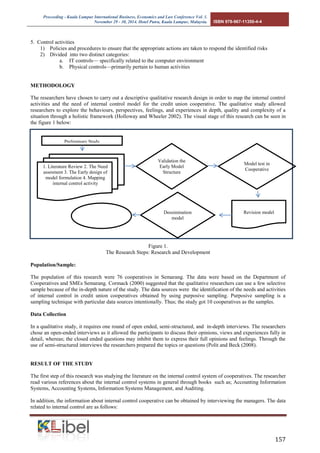
The researchers have chosen to carry out a descriptive qualitative research design in order to map the internal control activities and the need of internal control model for the credit union cooperative. The qualitative study allowed researchers to explore the behaviours, perspectives, feelings, and experiences in depth, quality and complexity of a situation through a holistic framework (Holloway and Wheeler 2002). The visual stage of this research can be seen in the figure 1 below: 
Figure 1. 
The Research Steps: Research and Development 
Population/Sample: 
The population of this research were 76 cooperatives in Semarang. The data were based on the Department of Cooperatives and SMEs Semarang. Cormack (2000) suggested that the qualitative researchers can use a few selective sample because of the in-depth nature of the study. The data sources were the identification of the needs and activities of internal control in credit union cooperatives obtained by using purposive sampling. Purposive sampling is a sampling technique with particular data sources intentionally. Thus; the study got 10 cooperatives as the samples. 
Data Collection 
In a qualitative study, it requires one round of open ended, semi-structured, and in-depth interviews. The researchers chose an open-ended interviews as it allowed the participants to discuss their opinions, views and experiences fully in detail, whereas; the closed ended questions may inhibit them to express their full opinions and feelings. Through the use of semi-structured interviews the researchers prepared the topics or questions (Polit and Beck (2008). 
RESULT OF THE STUDY 
The first step of this research was studying the literature on the internal control system of cooperatives. The researcher read various references about the internal control systems in general through books such as; Accounting Information Systems, Accounting Systems, Information Systems Management, and Auditing. 
In addition, the information about internal control cooperative can be obtained by interviewing the managers. The data related to internal control are as follows: 
Preliminary Study 
1. Literature Review 2. The Need assesment 3. The Early design of model formulation 4. Mapping internal control activity 
Validation the Early Model Structure 
Model test in Cooperative 
Revision model 
Dessimination model
Proceeding - Kuala Lumpur International Business, Economics and Law Conference Vol. 1. 
November 29 - 30, 2014. Hotel Putra, Kuala Lumpur, Malaysia. ISBN 978-967-11350-4-4 
158 
1. Generally, the cooperatives had the computerized accounting system to obtain the daily financial statement to 
control. However, there were difficulties to find errors in the data entry. 
2. Bad loans at credit unions ranged from 5% -10%. Bad loans were addressed by providing advance warning letter, 
but when it was not be paid three times, it will be executed the guarantee. 
3. There were several cooperatives that already had SOP and SOM, but mostly they found difficulty in preparing the 
grounds. Therefore; Internal control as the part or job description is required. 
4. Cooperative found difficulty to supervise the collectors since the collectors usually received the payment from the 
customers. 
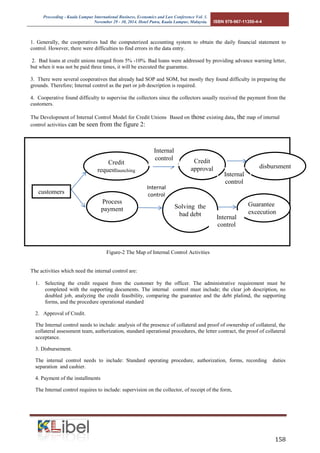
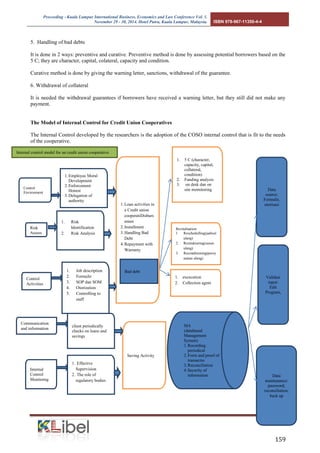
The Development of Internal Control Model for Credit Unions Based on those existing data, the map of internal 
control activities can be seen from the figure 2: 
Figure-2 The Map of Internal Control Activities 
The activities which need the internal control are: 
1. Selecting the credit request from the customer by the officer. The administrative requirement must be 
completed with the supporting documents. The internal control must include; the clear job description, no 
doubled job, analyzing the credit feasibility, comparing the guarantee and the debt plafond, the supporting 
forms, and the procedure operational standard 
2. Approval of Credit. 
The Internal control needs to include: analysis of the presence of collateral and proof of ownership of collateral, the 
collateral assessment team, authorization, standard operational procedures, the letter contract, the proof of collateral 
acceptance. 
3. Disbursement. 
The internal control needs to include: Standard operating procedure, authorization, forms, recording duties 
separation and cashier. 
4. Payment of the installments 
The Internal control requires to include: supervision on the collector, of receipt of the form, 
` 
Internal 
customers control 
Credit 
requestlaunching 
Guarantee 
excecution 
Credit 
approval disbursment 
Solving the 
bad debt 
Process 
payment 
Internal 
control 
Internal 
control 
Internal 
control
Proceeding - Kuala Lumpur International Business, Economics and Law Conference Vol. 1. 
November 29 - 30, 2014. Hotel Putra, Kuala Lumpur, Malaysia. ISBN 978-967-11350-4-4 
159 
5. Handling of bad debts 
It is done in 2 ways: preventive and curative. Preventive method is done by assessing potential borrowers based on the 5 C; they are character, capital, colateral, capacity and condition. 
Curative method is done by giving the warning letter, sanctions, withdrawal of the guarantee. 
6. Withdrawal of collateral 
It is needed the withdrawal guarantees if borrowers have received a warning letter, but they still did not make any payment. 
The Model of Internal Control for Credit Union Cooperatives 
The Internal Control developed by the researchers is the adoption of the COSO internal control that is fit to the needs of the cooperative. 
1. Employee Moral Development 
2. Enforcement Honest 
3. Delegation of authority 
1. Risk Identification 
2. Risk Analysis 
1. Job description 
2. Formulir 
3. SOP dan SOM 
4. Otorization 
5. Controlling to staff 
client periodically checks on loans and savings 
1. Effective Supervision 
2. The role of regulatory bodies 
1. 5 C (character, capacity, capital, collateral, condition) 
2. Funding analysis 
3. on desk dan on site momitoring 
Revitalitation: 
1. Reschedulling(jadwal ulang) 
2. Restrukturing(susun ulang) 
3. Reconditioning(persyaratan ulang) 
1. excecution 
2. Collection agent 
1. Loan activities in a Credit union cooperatiDisbursemen 
2. Installment 
3. Handling Bad Debt 
4. Repayment with Warranty 
Saving Activity 
Bad debt 
Control Environment 
Risk Assessment 
Control Activities 
Communication and information 
Internal Control Monitorng 
Internal control model for an credit union cooperative 
SIA 
(databased Management System) 
1. Recording periodical 
2. Form and proof of transactio 
3. Reconciliation 
4. Security of information 
Data source: 
Formulir, otorisasi 
Validasi input: 
Edit Program, 
Data maintanance: password, reconsiliation, back up
Proceeding - Kuala Lumpur International Business, Economics and Law Conference Vol. 1. 
November 29 - 30, 2014. Hotel Putra, Kuala Lumpur, Malaysia. ISBN 978-967-11350-4-4 
160 
Development of COSO Internal Control especially for credit unions: 
Based on activity of unions, cooperative control system can be formulated as follows: 
1. Control environment. It required employee moral development, policies that uphold honesty, clear delegation of authority on cooperative applications. For instance: treasurer and the cashier are responsible for the authenticity of the securities that are stored in metal cabinets. In the other hands, each member of the loan ceiling should be adjusted to the subject, mandatory savings and special mandatory savings. 
2. Risk. It identify risks and analyze risk. Besides that, it preferred loan service to sequences loan and responsibility, acceptance of loans should be done by the members themselves. 
3. Control activities. It not allowed to hold concurrent position. Cash holder should be completely separate from the books and the cashier should not be concurrently working on a bookkeeping accounts or vice versa. Implementation of making the bank reconciliation should not be the account holder. It should be created a Standard Operating Procedures and Standard Operating Management. For authorization of competent officials, cashiers must affix a stamp "paid" in cash evidence supporting documents if the payment is complete. The cashier had to put a stamp "Receipt" on the cash evidence supporting documents if the money is received. All checks should be serial numbered and each number must be accounted for, whether used or not. All petty cash expenditures must be approved by the manager (certain cooperatives), and moreover should be approved by the treasurer or chairman. Lastly, a loan application letter must be signed by the group. 
4. Communication. It can be done periodically by checking savings loan balance and the balance of the customer, and then communicate with customers. 
5. Monitoring of internal control. Cash receipts are recorded on the similiar day with the maximum cash balance per day and must be counted into the bank. Petty cash fund is filled by using the imprest system. 
Conclusion: 
The credit union cooperative is risker than the other types of cooperatives. A lot of bad debt made big problem for those credit union cooperatives. The availability of a system and procedures to control and manage risk is the fundamental requirement for the cooperatives to avoid the material and non-material losses. 
REFERENCE 
Berhane, Ghebremichael (2013). The Role of Cooperative in Empowering Woman. Journal of Business Management & Social Sciences Research (JBM&SSR), Volume 2, No.5. 
Cormack D. (2000). The Research Process in Nursing. 4th edn. Blackwell Science 
Ltd., Oxford, Great Britain.Miller, J. (2003), Internal Control measures in Corporations. 
Miller, J. (2003), Internal Control measures in Corporations 
Muraleetharan, P. (2009). Internal control and impact to financial performance of the organization (Special reference public and private organization in Jaffna District). Dept of Accounting, UniOf Jaffna. 
Polit D.F. & Beck C.T. (2008). Nursing research: Generating and Assessing Evidence for Nursing Practice. 8th edn. Lipponcott, Williams & Wilkins. Great Britain. 
Tunji, Siyanbola Trimisiu(2013). Effective Internal Controls System As Antidote For Distress In The Banking Industry In Nigeria. Journal Of Economics And International Business Research (JEIBR), Vol. 1(5), pp. 106- 121

Klibel5 acc 40_

  • 1.
    Proceeding - KualaLumpur International Business, Economics and Law Conference Vol. 1. November 29 - 30, 2014. Hotel Putra, Kuala Lumpur, Malaysia. ISBN 978-967-11350-4-4 154 DEVELOPMENT DESIGN OF INTERNAL CONTROL FOR COOPERATIVE ENTITY Drs.Kusmuriyanto, M.Si Economic Faculty Semarang State University, Semarang, Indonesia Email: kusmuriyanto@yahoo.com Lyna Latifah, S.Pd, M.Si Economic Faculty Semarang State University, Semarang, Indonesia Email: lyna.unnes@gmail.com Indah Anisykurlillah, S.E, M.Si, Ak Economic Faculty Semarang State University, Semarang, Indonesia Email: indah.anis@gmail.com Nurdian Susilowati, S.Pd, M.Pd Economic Faculty Semarang State University, Semarang, Indonesia Email: nurdianakt@gmail.com ABSTRACT Cooperatives entity play important role in Indonesian sector of economy. As a foundation of national economic, cooperatives entity should attaining continuous quality improvement into strong, healthy, independent and competitive to face global economic development that very dynamic and challenging. Internal control that fit with cooperative entity is needed. The study objectives is to design quality improvement specially Internal Control for Cooperatives entity . Research and Development method employed in this research. The study provides case studies of the organizational financial management practices of 10 cooperative entities reform. The observed practices are analyzed and interpreted within internal control activities. Accordingly, we recommended (a) the pattern of new member acceptance by a selective orientation of potential candidates for productive enterprises, (b) transparency rules and operational procedures both savings and loans as well as ongoing reporting with effective monitoring,(c) standard operational procedures and standard operational management. Keyword: design, internal control, cooperatives INTRODUCTION Cooperative by ICA statement is an autonomous association of people united voluntarily to fulfill their common economic, social, and cultural needs and aspirations through jointly-owned and democratically-controlled enterprises (Berhane:2013). Cooperative plays an extremely important role in the economic and social development in Indonesia. The major benefit of cooperatives for a region or a country is at economic part since it provides the job opportunity to support the small and medium enterprises. Moreover, cooperatives can give a significant contribution to economic growth of a region and it is a potential instrument for eliminating poverty and ending unemployment. For these reasons, cooperatives must be strong, healthy and give excellent services to the society. There are many types of cooperative such as housing, retailer, utility, worker, credit union, consumer and others. The focuses of this research are credit union cooperatives. They were owned and controlled by their members without any shareholder. The members save their money regularly and then lend the money to other members. The credit union cooperative tends to be high risk than other types of cooperative. However, cooperatives often face obstacles in their businesses. The different types of cooperatives tackle different kinds of problems. For a certain reason, cooperative can be failed. Some cases of nonperforming loans at credit unions become a big problem for the cooperatives. Fraud is the most common case in the credit union cooperatives. It indicates the lack of risk management by the credit union cooperatives. The failure to implement the effective
  • 2.
    Proceeding - KualaLumpur International Business, Economics and Law Conference Vol. 1. November 29 - 30, 2014. Hotel Putra, Kuala Lumpur, Malaysia. ISBN 978-967-11350-4-4 155 processes and procedures can increase the risks of fraud, the violations of laws and the mismanagement of funds. The system and procedure availability to control and manage risk are a fundamental requirement for the cooperatives to avoid the material and non-material losses. According to Miller (2003), the poor internal control leads to asset misappropriations, corruption, organizational fraud and fraudulent financial statements. Whatever the case is, every organisation, not only the cooperative (Tunji:2013), must install the efficient and effective internal control system to protect its assets from the possibility of losses caused by the funds misapplication, the fund misuse and the vandalisation of company’s property, expropriation and errors made by inefficient and inexperienced personnel. Actually, internal control system cannot eliminate all errors and irregularities, but at least, it is expected to alert the management about the potential problems which can be controlled before they become the bigger problems. Nevertheless, the established internal controls system must be evaluated from time to time to provide management the assurance effectiveness. The internal control system can be effective if its components are present and function effectively for operations, financial reporting and compliance. According to the results of Cooperative Development Seminar in Central Java Province, there are some weaknesses in the cooperatives. The internal control cooperative organization is still weak because there are the absence of a written job description, double duties, the lack of provisions, and the lack of application of sanctions. In order to maintain the company's assets in a preventive, detective and corrective, an internal control system within the framework of cooperative management is necessary. The quality of the internal control system will affect the performance of the organization. It also applies to the cooperative (Muraleetharan, 2009). The research of Suna Pius M (2008) found that managers influence the implementation of the control system. The taken actions are monitoring and supervising of each activity within an organization. The cooperative managers must ensure that the activities carried out by the managers and the employees run as it should, so the goals can be achieved effectively and efficiently. The managers need to supervise or control the activities of his subordinates. Controlling is very important to tackle the errors and irregularities so that the goal can still be achieved. Hence, the controlling function cannot be separated from the other functions of management (planning, organizing, and directing). Therefore, managers have to design and create the adequate control system, such as the internal control. It is a very important study because many cooperatives got losses due to the fund misappropriation done by the managers and employees. The various efforts can be made to prevent the fraud by providing the adequate system of internal control. Cooperatives have many different businesses such as business cooperatives, consumer cooperatives, cooperative production, service cooperatives and credit unions. Since the characteristics of cooperatives are different, so it takes the different internal control system. Based on the background above, the research problems are: 1 What are the activities required in an internal control? 2 How is the model development of internal control system in the credit union cooperatives? THE LITERATURE REVIEW Cooperative Cooperative is cooperation. Based on Enriquez (1986), cooperative is helping each other or hand in hand. Cooperative, based on ILO is an association of persons who join voluntarily to achieve the common economic end, controlled by business organization, making equitable contribution to the required capital and accepting the fair share of the risk and benefits. Internal Control According to IFAC, Internal Control is one of the best defenses against business failure, the important driver of business performance which manages the risk and enables the creation and preservation of value. The successful organizations know how to take the advantage of opportunities and counter the threats through the effective application of controls and therefore it can improve the performance. Auditing Practices Committee defined internal control system as the whole system of controls, financial and others, established by the management in an orderly and efficient manner to ensure the adherence of management policies, to save the assets and to secure as far as possible the
  • 3.
    Proceeding - KualaLumpur International Business, Economics and Law Conference Vol. 1. November 29 - 30, 2014. Hotel Putra, Kuala Lumpur, Malaysia. ISBN 978-967-11350-4-4 156 completeness and accuracy of the records. COSO’s definition of “internal control is the process effected by an entity’s board of directors, management and other personnel, designed to provide reasonable assurance regarding to the achievement of the following categories: 1) effectiveness and efficiency of operations; 2) reliability of financial reporting and, 3) compliance with applicable laws and regulations Internal control is an integral part of an organization’s governance system ability to manage the risk, which is understood, effected, and actively monitored by the governing body/ management and other personnel to take advantage of the opportunities and to counter the threats to achieve the organization’s objectives. SAS 78/ COSO stated five internal Control Components: 1.Control environment 1) Integrity and ethics of management, 2) Organizational structure, 3) Role of the board of directors and the audit committee, 4) Management’s policies and philosophy, 5) Delegation of responsibility and authority, 6) Performance evaluation measurement, 7) External influences—regulatory agencies, 8) Policies and practices managing human resources. 2. Risk assessment Is to identify, analyze and manage the risks which are relevant to the financial report, such as: 1) changes in external environment, 2) risky foreign markets, 3) significant and rapid growth that strain the internal controls, 4) new product lines, 5) restructuring, downsizing, 6) changes in accounting policies. 7) 3. Information and Communication The AIS should produce high quality information by : 1) identifying and recording all valid transactions, 2) providing timely information in appropriate detail to permit proper classification and financial reporting, 3) accurately measuring the financial value of transactions, 4) accurately recording transactions in the time period in which they occurred. 5) Auditors must have sufficient knowledge of the IS to understand: a. the classes of transactions ; i. how these transactions are initiated [input] ii. the associated accounting records and accounts used in processing [input] b. the transaction processing steps from the initiation of a transaction to its inclusion in the financial statements [process] c. the financial reporting process to compile financial statements, disclosures, and estimates [output] 4. Monitoring The process for assessing the quality of internal control design and operation by; 1) procedures Separating a. test of controls by internal auditors 2) Ongoing monitoring: a. computer modules integrated into routine operations b. management reports which highlight the trends and exceptions from normal performance
  • 4.
    Proceeding - KualaLumpur International Business, Economics and Law Conference Vol. 1. November 29 - 30, 2014. Hotel Putra, Kuala Lumpur, Malaysia. ISBN 978-967-11350-4-4 157 5. Control activities 1) Policies and procedures to ensure that the appropriate actions are taken to respond the identified risks 2) Divided into two distinct categories: a. IT controls— specifically related to the computer environment b. Physical controls—primarily pertain to human activities METHODOLOGY The researchers have chosen to carry out a descriptive qualitative research design in order to map the internal control activities and the need of internal control model for the credit union cooperative. The qualitative study allowed researchers to explore the behaviours, perspectives, feelings, and experiences in depth, quality and complexity of a situation through a holistic framework (Holloway and Wheeler 2002). The visual stage of this research can be seen in the figure 1 below: Figure 1. The Research Steps: Research and Development Population/Sample: The population of this research were 76 cooperatives in Semarang. The data were based on the Department of Cooperatives and SMEs Semarang. Cormack (2000) suggested that the qualitative researchers can use a few selective sample because of the in-depth nature of the study. The data sources were the identification of the needs and activities of internal control in credit union cooperatives obtained by using purposive sampling. Purposive sampling is a sampling technique with particular data sources intentionally. Thus; the study got 10 cooperatives as the samples. Data Collection In a qualitative study, it requires one round of open ended, semi-structured, and in-depth interviews. The researchers chose an open-ended interviews as it allowed the participants to discuss their opinions, views and experiences fully in detail, whereas; the closed ended questions may inhibit them to express their full opinions and feelings. Through the use of semi-structured interviews the researchers prepared the topics or questions (Polit and Beck (2008). RESULT OF THE STUDY The first step of this research was studying the literature on the internal control system of cooperatives. The researcher read various references about the internal control systems in general through books such as; Accounting Information Systems, Accounting Systems, Information Systems Management, and Auditing. In addition, the information about internal control cooperative can be obtained by interviewing the managers. The data related to internal control are as follows: Preliminary Study 1. Literature Review 2. The Need assesment 3. The Early design of model formulation 4. Mapping internal control activity Validation the Early Model Structure Model test in Cooperative Revision model Dessimination model
  • 5.
    Proceeding - KualaLumpur International Business, Economics and Law Conference Vol. 1. November 29 - 30, 2014. Hotel Putra, Kuala Lumpur, Malaysia. ISBN 978-967-11350-4-4 158 1. Generally, the cooperatives had the computerized accounting system to obtain the daily financial statement to control. However, there were difficulties to find errors in the data entry. 2. Bad loans at credit unions ranged from 5% -10%. Bad loans were addressed by providing advance warning letter, but when it was not be paid three times, it will be executed the guarantee. 3. There were several cooperatives that already had SOP and SOM, but mostly they found difficulty in preparing the grounds. Therefore; Internal control as the part or job description is required. 4. Cooperative found difficulty to supervise the collectors since the collectors usually received the payment from the customers. The Development of Internal Control Model for Credit Unions Based on those existing data, the map of internal control activities can be seen from the figure 2: Figure-2 The Map of Internal Control Activities The activities which need the internal control are: 1. Selecting the credit request from the customer by the officer. The administrative requirement must be completed with the supporting documents. The internal control must include; the clear job description, no doubled job, analyzing the credit feasibility, comparing the guarantee and the debt plafond, the supporting forms, and the procedure operational standard 2. Approval of Credit. The Internal control needs to include: analysis of the presence of collateral and proof of ownership of collateral, the collateral assessment team, authorization, standard operational procedures, the letter contract, the proof of collateral acceptance. 3. Disbursement. The internal control needs to include: Standard operating procedure, authorization, forms, recording duties separation and cashier. 4. Payment of the installments The Internal control requires to include: supervision on the collector, of receipt of the form, ` Internal customers control Credit requestlaunching Guarantee excecution Credit approval disbursment Solving the bad debt Process payment Internal control Internal control Internal control
  • 6.
    Proceeding - KualaLumpur International Business, Economics and Law Conference Vol. 1. November 29 - 30, 2014. Hotel Putra, Kuala Lumpur, Malaysia. ISBN 978-967-11350-4-4 159 5. Handling of bad debts It is done in 2 ways: preventive and curative. Preventive method is done by assessing potential borrowers based on the 5 C; they are character, capital, colateral, capacity and condition. Curative method is done by giving the warning letter, sanctions, withdrawal of the guarantee. 6. Withdrawal of collateral It is needed the withdrawal guarantees if borrowers have received a warning letter, but they still did not make any payment. The Model of Internal Control for Credit Union Cooperatives The Internal Control developed by the researchers is the adoption of the COSO internal control that is fit to the needs of the cooperative. 1. Employee Moral Development 2. Enforcement Honest 3. Delegation of authority 1. Risk Identification 2. Risk Analysis 1. Job description 2. Formulir 3. SOP dan SOM 4. Otorization 5. Controlling to staff client periodically checks on loans and savings 1. Effective Supervision 2. The role of regulatory bodies 1. 5 C (character, capacity, capital, collateral, condition) 2. Funding analysis 3. on desk dan on site momitoring Revitalitation: 1. Reschedulling(jadwal ulang) 2. Restrukturing(susun ulang) 3. Reconditioning(persyaratan ulang) 1. excecution 2. Collection agent 1. Loan activities in a Credit union cooperatiDisbursemen 2. Installment 3. Handling Bad Debt 4. Repayment with Warranty Saving Activity Bad debt Control Environment Risk Assessment Control Activities Communication and information Internal Control Monitorng Internal control model for an credit union cooperative SIA (databased Management System) 1. Recording periodical 2. Form and proof of transactio 3. Reconciliation 4. Security of information Data source: Formulir, otorisasi Validasi input: Edit Program, Data maintanance: password, reconsiliation, back up
  • 7.
    Proceeding - KualaLumpur International Business, Economics and Law Conference Vol. 1. November 29 - 30, 2014. Hotel Putra, Kuala Lumpur, Malaysia. ISBN 978-967-11350-4-4 160 Development of COSO Internal Control especially for credit unions: Based on activity of unions, cooperative control system can be formulated as follows: 1. Control environment. It required employee moral development, policies that uphold honesty, clear delegation of authority on cooperative applications. For instance: treasurer and the cashier are responsible for the authenticity of the securities that are stored in metal cabinets. In the other hands, each member of the loan ceiling should be adjusted to the subject, mandatory savings and special mandatory savings. 2. Risk. It identify risks and analyze risk. Besides that, it preferred loan service to sequences loan and responsibility, acceptance of loans should be done by the members themselves. 3. Control activities. It not allowed to hold concurrent position. Cash holder should be completely separate from the books and the cashier should not be concurrently working on a bookkeeping accounts or vice versa. Implementation of making the bank reconciliation should not be the account holder. It should be created a Standard Operating Procedures and Standard Operating Management. For authorization of competent officials, cashiers must affix a stamp "paid" in cash evidence supporting documents if the payment is complete. The cashier had to put a stamp "Receipt" on the cash evidence supporting documents if the money is received. All checks should be serial numbered and each number must be accounted for, whether used or not. All petty cash expenditures must be approved by the manager (certain cooperatives), and moreover should be approved by the treasurer or chairman. Lastly, a loan application letter must be signed by the group. 4. Communication. It can be done periodically by checking savings loan balance and the balance of the customer, and then communicate with customers. 5. Monitoring of internal control. Cash receipts are recorded on the similiar day with the maximum cash balance per day and must be counted into the bank. Petty cash fund is filled by using the imprest system. Conclusion: The credit union cooperative is risker than the other types of cooperatives. A lot of bad debt made big problem for those credit union cooperatives. The availability of a system and procedures to control and manage risk is the fundamental requirement for the cooperatives to avoid the material and non-material losses. REFERENCE Berhane, Ghebremichael (2013). The Role of Cooperative in Empowering Woman. Journal of Business Management & Social Sciences Research (JBM&SSR), Volume 2, No.5. Cormack D. (2000). The Research Process in Nursing. 4th edn. Blackwell Science Ltd., Oxford, Great Britain.Miller, J. (2003), Internal Control measures in Corporations. Miller, J. (2003), Internal Control measures in Corporations Muraleetharan, P. (2009). Internal control and impact to financial performance of the organization (Special reference public and private organization in Jaffna District). Dept of Accounting, UniOf Jaffna. Polit D.F. & Beck C.T. (2008). Nursing research: Generating and Assessing Evidence for Nursing Practice. 8th edn. Lipponcott, Williams & Wilkins. Great Britain. Tunji, Siyanbola Trimisiu(2013). Effective Internal Controls System As Antidote For Distress In The Banking Industry In Nigeria. Journal Of Economics And International Business Research (JEIBR), Vol. 1(5), pp. 106- 121