European Journal of Business and Management                                                                        www.iiste.org
ISSN 2222-1905 (Paper) ISSN 2222-2839 (Online)
Vol 4, No.13, 2012


          “Soft” Governance and Firm Performance: A Study of Ghanaian
                                                 Insurance Firms
                                         Kingsley Tornyeva1* Theophilus Wereko2
     1.    Open University of Malaysia, Accra Institute of Technology Campus PO box AN 19782, Accra-North, Ghana
     2.    Open University of Malaysia, Accra Institute of Technology Campus PO box AN 19782, Accra-North, Ghana
                                *E-mail of the corresponding author: tornyeva@yahoo.com
Abstract
The purpose of this research is to investigate the relationship between “soft” governance factors and the performance of
insurance companies in Ghana. The study employed panel data methodology for the regression analysis of “soft”
governance factors and the performance of the companies for the period 2005 – 2009. The results show that “soft”
governance factors of recruitment policy, staff training and development, communication policy and performance evaluation
have statistically significant positive relationship with the performance of the companies. It is recommended that
management should treat “soft” governance as a strategic issue and formulate strategic policies on these factors. Again they
should ensure the full implementation of these policies to ensure that the companies derive the maximum benefit of an
improved performance.
Keywords: “Soft” governance, Insurance industry, Firm performance
1. Introduction
Efforts in ensuring that companies comply with good corporate governance practices have always been concentrated on
‘hard attributes’ of good governance. This ‘conventional’ good governance has become the key principles enshrined in many
codes of corporate governance. These ‘hard attributes’ of board independence, board size, CEO tenure, separation of CEO
position and the chair of the board, CEO’s remuneration and the establishment of various oversight committees among
others have not been able to save companies from failure and their eventual collapse, though there was evidence of the
existence of these attributes in the affected companies. A case in point was the collapse of Enron Corporation, WorldCom
and Tyco International Ltd. These companies have boards that met the most challenging independence criteria by all
standards, have high caliber of experienced professionals and accomplished academicians on their boards, instituted annual
performance evaluation of individual board members and directors run for election every year (Kocourek et al., 2003). Their
failure gave credence to the believe that ‘hard attributes’ alone are not sufficient to guarantee good corporate governance, at
best they form minimal standards of good governance. In addition to those factors there is the need for ‘soft’ attributes to
ensure good governance (Meredith & Robyn, 2005). The objective of the study is to determine the contribution of “soft”
governance factors to firm performance. To achieve that objective, we first review literature on ‘soft’ governance, followed
by the methodology adopted for the study, this is followed by analysis of regression results and the conclusion and
recommendations.
2. Literature Review
Previous studies have identified some internal factors which could lead to poor relationships or inadequate information flow.
Some of these factors include, a dominant chairman or CEO, hurried decisions based on inadequate data, serial restructuring
and mass resignation of key executives, interfering with the flow of information, defensive communications and shifting of
responsibility (Meredith & Robyn, 2005). In their study of ‘soft behaviors’, Kocourek et al., (2003) identified the following
seven ‘soft attributes’ of good governance which they termed as the ‘seven principles’ of ‘soft’ governance; select the right
people, train them continuously, inform and communicate, balance the CEO’s power, establish new behaviors, devote the
time, evaluate and improve. It is hoped that with the combination of both the ‘Hard’ and ‘soft’ attributes, companies should
be able to pick the warning signals early enough to avoid the collapse of the companies.
In addition to the above factors, David Nadler (2004) in his article on “Building Better Boards” identified seven keys to
building high performing boards as; the right mind-set, the right role, the right work, the right people, the right agenda ,the
right information and the right culture. According to David Nadler (2004), board building is an ongoing activity, a process
of continuous improvement which means the board must keep asking the questions about purpose, resources and
effectiveness. The vision of the board must clearly indicate the extent to which the board wants to get involved in
influencing management decisions and the direction of the company. This would also outline the role of directors relative to
that of management. These are normally documented in the board charter which helps to avoid unnecessary interferences.
The board must also be composed of people who are not only independent but competent and have the capabilities and the
relevant attributes to deliver. Setting agenda for board meetings are very crucial because it determines what would be
                                                              86
European Journal of Business and Management                                                                        www.iiste.org
ISSN 2222-1905 (Paper) ISSN 2222-2839 (Online)
Vol 4, No.13, 2012

discussed and the extent to which it would be discussed. The problem, however, has been that this important activity is
mostly done by the management, a situation which gives them the opportunity to dictate the discussion and would be
capable to hide important matters from the board. It is suggested that this all important activity is done by the board in
collaboration with the CEO. It is important that the right information is given to the board for effective decision making and
not to be kept in the dark and also the corporate culture must be right for the company to achieve its objectives.
Sonnenfeld (2002) posits that the failure of companies despite their compliance with rigid regulatory requirement could
mean that the problems facing companies are not that of structure but social. The factors of trust, culture of open dissent,
portfolio of roles, individual accountability and evaluation of performance have been identified as factors making boards
effective (Sonnenfeld, 2002, p.110). It is important that directors of board exercise great deal of mutual respect, utmost good
faith and trust in each other. The opinions and views expressed by directors must be appreciated and given consideration by
the board irrespective of the director’s status or stake in the company. However, the level of trust and respect accorded a
board member would to a large extent depend on the individual characteristics of the director concern. If the opinions
expressed by a director and his/her line of argument is not logical and well constructed, it is likely to be disregarded by the
others on the board. Therefore to achieve mutual trust and respect the directors must take their commitment to the
company’s business seriously and always update their business knowledge.
Sonnenfeld (2002) also argue that a successful board must have the culture of open dissent. The directors should be able to
challenge openly the views of others without fear or intimidation. The board should exercise a high level of tolerance that
encourages directors to express a contrary opinion to that of others and also be in the position to justify their dissent. This
would ensure that the board does not become a rubber stamp which approves everything from management but must be able
to check the behaviour of management, particularly powerful CEOs. The issue of dissent must be done appropriately in
order not to create enmity and division on the board because the consequences of such happenings would cause the down
fall of the company. Dissent must be based on sound judgment, good reasoning and not to offend the sensibility of the
others. Also dissent does not mean one should always oppose a decision one deems not in his/her interest but the larger
interest of the business and all stakeholders must be the outmost consideration. When this is done, it would improve the
performance of the company.
Again, Sonnenfeld (2002) suggested that directors should be able to perform several functions on the board and not to be
constrained to only one particular function all the time. Businesses operate in a dynamic environment and therefore the
directors must also have the necessary skills to meet new challenges. They should be able to serve on different board
committees from time to time. This would ensure the infusion of new ideas to these committees and make their deliberations
effective and hence good decisions that would turn the fortunes of the company around. This would depend on the
competencies of the directors to be able to perform these various roles. However, boards are expected to be composed of
people from diverse backgrounds hence every member is an expert in a particular field and would therefore be difficult to
perform different roles. It is necessary that in assigning roles to directors their background is considered so that it does not
become an exercise in futility.
Additionally, Sonnenfeld (2002) suggested that there must be individual accountability by the board. The directors should
be responsible for their actions. The board should assign individual directors roles that they should perform and report to the
board. The directors should also perform other functions that are not directly assigned by the board but which in their day to
day activities they come across as valuable information or material which they consider relevant for the sustainability of the
company. This is because directors’ functions are not restricted to only what they do on the board during meetings but also
outside the boardroom. However, since the directors are not permanent employees of the company they would need the
support of the company in doing this, particularly issues concerning reimbursement of costs genuinely incurred in
performing legitimate functions.
Finally, the performance of the board must be periodically evaluated (Sonnenfeld, 2002) to determine how well they are
doing and also identify weaknesses for improvement to ensure that they make meaningful contribution to the performance
of the company. The assessment should be based on factors that are relevant to the company. It is important that the process
of the assessment is transparent and issues discussed with the directors so that everyone would feel satisfied with the
process. Though the evaluation of the performance is for an improvement and not to get people out of the board, it must also
be made clear that directors who consistently perform below the acceptable level of director’s performance must be replaced
with more competent people.
In their study of corporate governance and performance, Meredith and Robyn (2005) identified certain factors they
considered important as determinants of “soft” governance which if exist in the company would help improve the
performance of the company. The first factor they identified is clarity in roles, responsibility and relationship among the
various stakeholders. The stakeholders include the shareholders, directors, chairman of the board, management and the CEO.
These stakeholders play different roles in the company and therefore it is important that their roles are well defined to avoid
                                                              87
European Journal of Business and Management                                                                      www.iiste.org
ISSN 2222-1905 (Paper) ISSN 2222-2839 (Online)
Vol 4, No.13, 2012

the overlapping of roles leading to conflict. The two most important positions in the company are that of the chairman and
the CEO. Depending on whether these positions are occupied by one person or two different persons, the relationship
between them is very crucial for the performance of the company. Any power struggle between them would affect the
performance of the company. It is also important that the relationship between the directors and management is that of
support and complementarily. The directors should not behave as if they are there just to check management but rather to
complement their efforts and provide them with all the necessary support. The company should have code of conduct and
ethics which should detail these relationships and made available to all the stakeholders.
Meredith and Robyn (2005) also underlined the importance of skills, competencies and business knowledge. The study
supports their view that board and management must possess the relevant skills and competencies necessary for the
company. That is the only way they can be relevant to the company and contribute to its success. However, this is not
limited to only skills and competencies acquired at the time of entry but must be continuously improved to be relevant to the
company always. Without continuous training to improve skills and competencies, directors and staff would become
obsolete and less relevant to the company. In that regard the company must have a training policy and programs to ensure
the directors and staff acquire the right skills needed for the job to improve the performance of the company.
Information flow in the company is also considered important for the proper discharge of duties by Meredith and Robyn,
(lbid). There should be clear guidelines on communication so that people know where to get the required information and
this would ensure the timely performance of function and hence improve performance. Interestingly, all the above studies
have focused more on the board of directors to the neglect of management and the employees. Our study concludes that
these categories of stakeholders play a very significant role in the performance of the company. They implement all the
strategic decisions of the board and therefore the success of the company greatly depends on them. If they fail in the
successful implementation of board policies, the company as a whole would fail. They are a strategic resource of the
company and therefore their contribution to the company must be evaluated. The foregoing are among the reasons why the
study focused on factors that affect the quality of employees and how they influence their contribution to the company’s
performance.
3. Hypotheses Development
This section outlines the four key elements or independent variables of ‘soft’ governance that were used to formulate our
hypotheses for the study, mainly recruitment policy, staff training and development, communication policy and performance
evaluation.
3.1 Recruitment Policy
Employees play an important role in the performance of the company. The quality of the employees determines the
performance of the company. It is therefore important for the company to put in measures to attract the right caliber of
employees who can make meaningful contributions to the performance of the company. The recruitment policy would
outline the procedure for recruiting employees. This would ensure that only those candidates who meet the needs of the
company at a particular time are recruited. This would also avoid the situation of recruiting people based on other
considerations other than competence. Therefore recruiting the right people and supporting them with the right resources
would lead to an improved company performance. This lead to our first hypothesis:
H : There is positive relationship between recruitment policy and firm performance.
  1
3.2 Staff Training and Development
The training and development of staff enhances their ability and knowledge which ensures that they perform their duties
very well to improve the performance of the company. The business environment is dynamic and to remain competitive
means the company must be up to date with modern skills require for an efficient performance. The acquisition of these
skills would be possible through training and development. The company must therefore have a consistent program of
training its staff on current trends and challenges in the industry so that they can withstand the competition through an
improve performance. Hence training and development of staff would lead to improve firm performance. This leads to the
second hypothesis:
H : There is positive relationship between staff training and development and firm performance
  2
3.3 Communication Policy
Communication policy would ensure the availability and free flow of information within the company. The policy would
facilitate the setting up of the right management information systems that would produce the information that is needed at
every level of the company for the smooth operational processes. An important aspect of communication policy is
employees’ grievance handling procedures. Employees’ grievances when not handle very well to the satisfaction of the
employees can greatly affect their output and this would have a negative impact on the performance of the company.
However, if the company makes good use of these procedures it would help address employees concern and prevent labour
unrest bringing about the needed industrial peace. The policy would also give guidelines on handling issues concerning
                                                             88
European Journal of Business and Management                                                                        www.iiste.org
ISSN 2222-1905 (Paper) ISSN 2222-2839 (Online)
Vol 4, No.13, 2012

other stakeholders especially customers. The company can gain the maximum benefit from this policy if it has a clear
organisational structure which shows the line of authority, responsibility and control. This would support the free flow of
information and delegation. Hence a good communication policy would improve the performance of the company. This
leads to the third hypothesis:
H : There is positive relationship between communication policy and firm performance.
  3
3.4 Performance Evaluation
Periodic evaluation of employees’ performance ensures that weaknesses identified are addressed to enhance the efficiency
and effectiveness of the employees and thereby improving the performance of the company. This process should not be
limited to only employees but also all processes and procedures must be assessed to provide the vital support to the works of
the employees. Usually overlook in the evaluation process is the performance of the board of directors. It is important that
as the head of the company they are in control of whatever is going on in the company. By evaluating their performance
would help the shareholders to know those who are performing poorly and therefore institute measures to improve their
performance or remove them from the board when necessary. An objective evaluation of the performance at all levels would
improve the performance of the company. Hence our final hypothesis:
H : There is positive relationship between performance evaluation and firm performance.
  4
  4. Methodology
The methodology of study employed a combination of primary and secondary data. The primary data was collected on the
independent variables of recruitment policy, staff training and development, communication policy and performance
evaluation through questionnaires administered by members of the management team of the companies. These are dummy
variables which equal to one if the company has such policies and programs in place and zero otherwise. The performance
of the companies was measured by return on assets (ROA), return on equity (ROE) and corporate social responsibility
(CSR). ROA is defined as net profit before interest and tax as a percentage of total assets, ROE defined as net profit after tax
as a percentage of shareholders equity and CSR as percentage of company’s profit spent on CSR activities. The ratios were
computed from the financial statements of the companies over the period of 2006-2010. Only 19 companies which have
complete financial statements for these periods were included in the analysis. The study used only accounting ratios because
only two of the nineteen companies included in the study are listed on the stock exchange and therefore market ratios could
not be used in order to avoid distortion.
The study used panel data framework which follows the one used by Abor and Biekpe, (2007). This involves the pooling of
observations on cross-section of units over several time periods and provides results that are simply not detectable in pure
cross-sections or pure time-series studies. Panel data could be described as data containing time series observations of a
number of variables. An observation in panel data involves at least two dimensions; a cross-sectional dimension, indicated
by subscript and a time series dimension, indicated by subscript (Hsiao and Yanan, 2006).

Attached to the variables in the model are double subscripts in order to differentiate them from regular time-series or cross
section regression. The general panel data is of the form
                                                                    (1)
Where:
         Perf it = performance of firm i in time t;
         S it     = a vector of “soft” governance factors of firm i in time t;
         C it     = a set of control variables of firm i in time t;
          µit = the error term
To ensure the robustness of the model and to reduce specification bias, the model also includes control variables of size, age
and asset tangibility. Since performance is a function of “soft” governance variables, the model is restated as;
                                                                                (2)
5. Empirical Results
5.1 Descriptive summary statistics
“Soft” governance factors are very crucial for the human resource development and effective communication in the
company. This is because the human resource is the most important asset of the company and the success or failure of the
company to a large extent depends on how effectively the management is able to harness this resource to ensure the total
commitment of the employee to the cause of the company. An average of 84% of the companies have declared recruitment
policy which outlines the necessary procedures to go through in recruiting new staff. This means the rest 16% of the
companies do not have declared recruitment policy. This is a cause for worry since the companies may end up recruiting
people who are not qualified or recruiting people on conditions that have nothing to do with competence. A mean value of
89% of the companies have systematic staff training and development programme and 11% of them do not have. These
                                                              89
European Journal of Business and Management                                                                       www.iiste.org
ISSN 2222-1905 (Paper) ISSN 2222-2839 (Online)
Vol 4, No.13, 2012

programmes ensure the continues development of staff and help improve the performance of the company. An average of
63% of the companies have guidelines on clear communication and information flow but the remaining 37% do not have.
Communication is the life blood of every organisation because it facilitates the decision making process and ensure the flow
of information horizontally and vertically within the organisation. The lack of a clear guideline may lead to confusion,
breakdown in authority and control, and have a negative effect on the performance of the company. The performance of
employees has to be assessed periodically to identify their strength and weaknesses so that measures can be taken to
maximize the strength and minimize the weaknesses. All the companies carried on employee performance evaluation at
least once in the last quarter of the year even though some of the companies do it monthly and semi-annually. Most of the
companies use the process to design new training programs for staff and for promotion of deserving staff to higher grades as
well as demotion of staff that performed poorly.
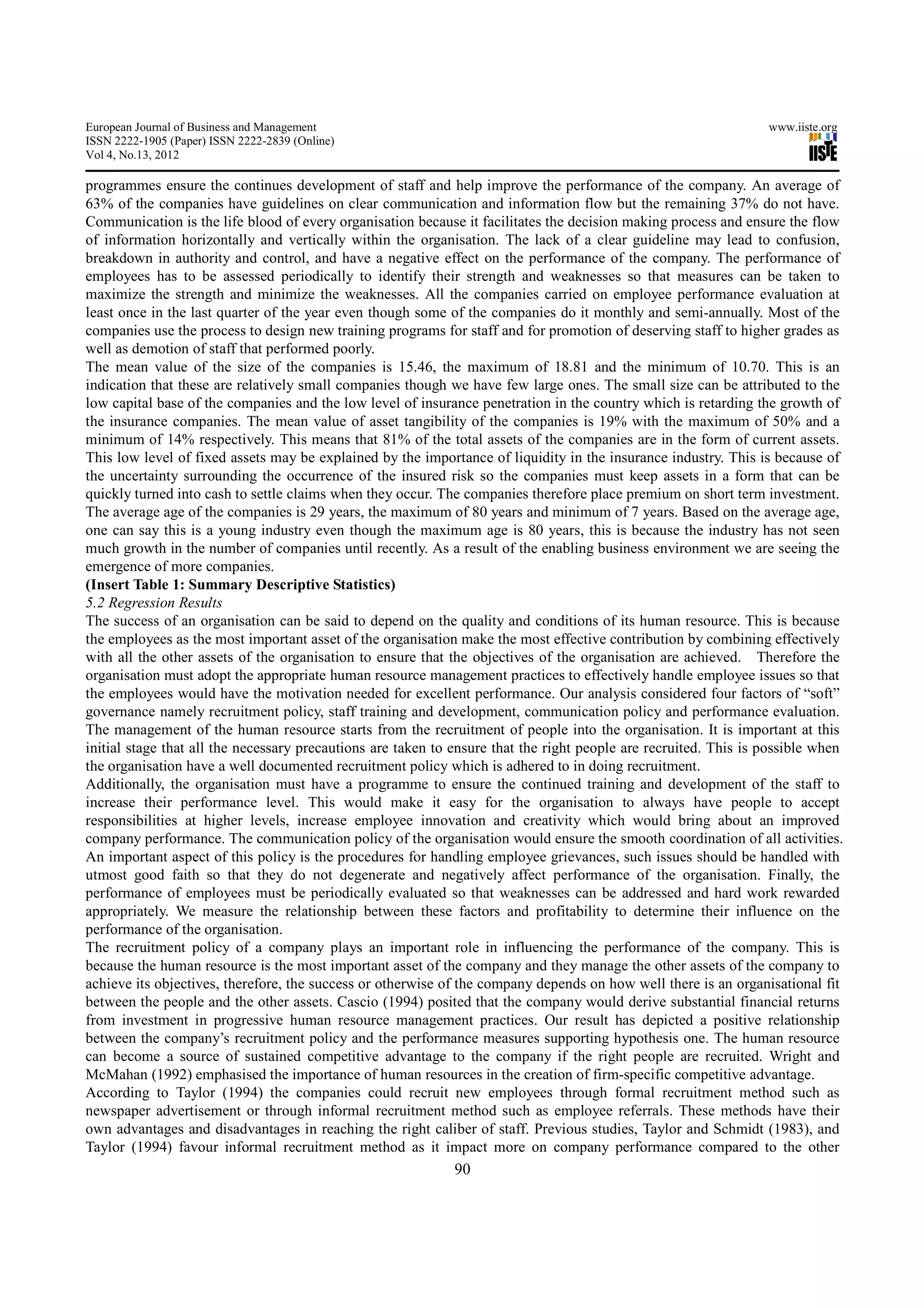
The mean value of the size of the companies is 15.46, the maximum of 18.81 and the minimum of 10.70. This is an
indication that these are relatively small companies though we have few large ones. The small size can be attributed to the
low capital base of the companies and the low level of insurance penetration in the country which is retarding the growth of
the insurance companies. The mean value of asset tangibility of the companies is 19% with the maximum of 50% and a
minimum of 14% respectively. This means that 81% of the total assets of the companies are in the form of current assets.
This low level of fixed assets may be explained by the importance of liquidity in the insurance industry. This is because of
the uncertainty surrounding the occurrence of the insured risk so the companies must keep assets in a form that can be
quickly turned into cash to settle claims when they occur. The companies therefore place premium on short term investment.
The average age of the companies is 29 years, the maximum of 80 years and minimum of 7 years. Based on the average age,
one can say this is a young industry even though the maximum age is 80 years, this is because the industry has not seen
much growth in the number of companies until recently. As a result of the enabling business environment we are seeing the
emergence of more companies.
(Insert Table 1: Summary Descriptive Statistics)
5.2 Regression Results
The success of an organisation can be said to depend on the quality and conditions of its human resource. This is because
the employees as the most important asset of the organisation make the most effective contribution by combining effectively
with all the other assets of the organisation to ensure that the objectives of the organisation are achieved. Therefore the
organisation must adopt the appropriate human resource management practices to effectively handle employee issues so that
the employees would have the motivation needed for excellent performance. Our analysis considered four factors of “soft”
governance namely recruitment policy, staff training and development, communication policy and performance evaluation.
The management of the human resource starts from the recruitment of people into the organisation. It is important at this
initial stage that all the necessary precautions are taken to ensure that the right people are recruited. This is possible when
the organisation have a well documented recruitment policy which is adhered to in doing recruitment.
Additionally, the organisation must have a programme to ensure the continued training and development of the staff to
increase their performance level. This would make it easy for the organisation to always have people to accept
responsibilities at higher levels, increase employee innovation and creativity which would bring about an improved
company performance. The communication policy of the organisation would ensure the smooth coordination of all activities.
An important aspect of this policy is the procedures for handling employee grievances, such issues should be handled with
utmost good faith so that they do not degenerate and negatively affect performance of the organisation. Finally, the
performance of employees must be periodically evaluated so that weaknesses can be addressed and hard work rewarded
appropriately. We measure the relationship between these factors and profitability to determine their influence on the
performance of the organisation.
The recruitment policy of a company plays an important role in influencing the performance of the company. This is
because the human resource is the most important asset of the company and they manage the other assets of the company to
achieve its objectives, therefore, the success or otherwise of the company depends on how well there is an organisational fit
between the people and the other assets. Cascio (1994) posited that the company would derive substantial financial returns
from investment in progressive human resource management practices. Our result has depicted a positive relationship
between the company’s recruitment policy and the performance measures supporting hypothesis one. The human resource
can become a source of sustained competitive advantage to the company if the right people are recruited. Wright and
McMahan (1992) emphasised the importance of human resources in the creation of firm-specific competitive advantage.
According to Taylor (1994) the companies could recruit new employees through formal recruitment method such as
newspaper advertisement or through informal recruitment method such as employee referrals. These methods have their
own advantages and disadvantages in reaching the right caliber of staff. Previous studies, Taylor and Schmidt (1983), and
Taylor (1994) favour informal recruitment method as it impact more on company performance compared to the other
                                                             90
European Journal of Business and Management                                                                           www.iiste.org
ISSN 2222-1905 (Paper) ISSN 2222-2839 (Online)
Vol 4, No.13, 2012

methods. This is because such employees turn to know much about the company through their referral and therefore would
only apply for the job if they have the competence and the ability to perform the job. Also they are motivated to work hard
to justify the confidence and the trust of the referral. The major disadvantage of this method is that it restricts the size of the
population that the company can recruit so the company may not recruit the best candidate. Pfeffer (1995) suggested that
employees who are recruited through stringent recruitment and selection process have a sense of elitism which imparts high
expectations of performance.
It is worthy to note that irrespective of how excellent a company’s recruitment policy is it may not be able to impact
positively on the company performance if the right structures and systems are not in place to support the employees.
Huselid (1995) argues that if the company does not have the right incentive compensation systems that align the interest of
the employees with those of shareholders, the effectiveness of even highly skilled employees would be limited. In addition,
Bailey (1993) suggested that despite the necessary motivation, the contribution of the employees to the company’s
performance may be limited if the jobs are structured or programmed. The job description should be flexible to allow for
creativity and innovation by the employees. This would ensure that the employees can use their skills and abilities to design
new and better ways of performing their job (Huselid, 1995).
Continuous training and development of employees is essential for sustained improved performance. The result of the study
shows a positive relationship between staff training and development and performance. The relationship with return on
assets is statistically significant. This support the position of hypothesis two that there is positive relationship between staff
training and development and firm performance. Companies are faced with many challenges from both internal and the
external environment on daily basis so to remain competitive means the company must be up to date with current trends.
There must be well designed programme for staff training and development to equip staff with the necessary skills and
competencies to cope with the modern technology and also to ensure the progression of staff through the ranks. This would
also ensure that, the companies have readily available skills to replace those lost through attrition (retirement, resignation,
death). The importance of training was vividly captured by Tanova and Nadiri (2005, pp.699) and confirmed in our study as
having “a strategic impact on organisations because it serves many organisational goals, apart from equipping employees
with the necessary skills for the present and future tasks, training also provides opportunities for employees to share their
experience and help better understanding of each others attitude which in turns leads to organisational cohesiveness and
employee commitment”.
Evidence from previous studies (Smith and Hayton, 1999; Bartel and Lichtenberg, 1987; Becker, 1964; Heyes and Stuart,
1996) suggested that companies train their employees to ensure increase in productivity, increase commitment,
improvement in their performance, adaptability and flexibility, adoption of new work practice, change in business strategy
or as a result of investment in new technology. Training produce human resource outcome of commitment, competence,
congruence and cost effectiveness. The safety of employees in any work environment is as important as the increase
performance that the company is seeking. With training, employees would be able to handle all work tools and equipment
and follow all safety instructions. This would reduce injuries to staff and reduction in error rates leading to an improved
company performance. The employees also derive job satisfaction as a result of training and this motivates them to make
significant contribution to productivity and profitability of the company.
However, training and development of employees is an expensive exercise in terms of financial commitment by the
company, therefore the company should not only be interested in training employees but develop systems and structures to
ensure that knowledge and skills acquired are applied for the benefit of the company. These measures should also ensure
that employees are retained in the company for long so that the knowledge can be passed on to other employees and also to
save the company cost of replacement if such employees should resign or incapacitated that they can no longer work for the
company. These systems should also ensure that the training and development is a continue process so that the employees
do not become obsolete with the passage of time. The conditions of service of engagement should have favourable
provisions that encourage employees to take the initiative to train and develop themselves.
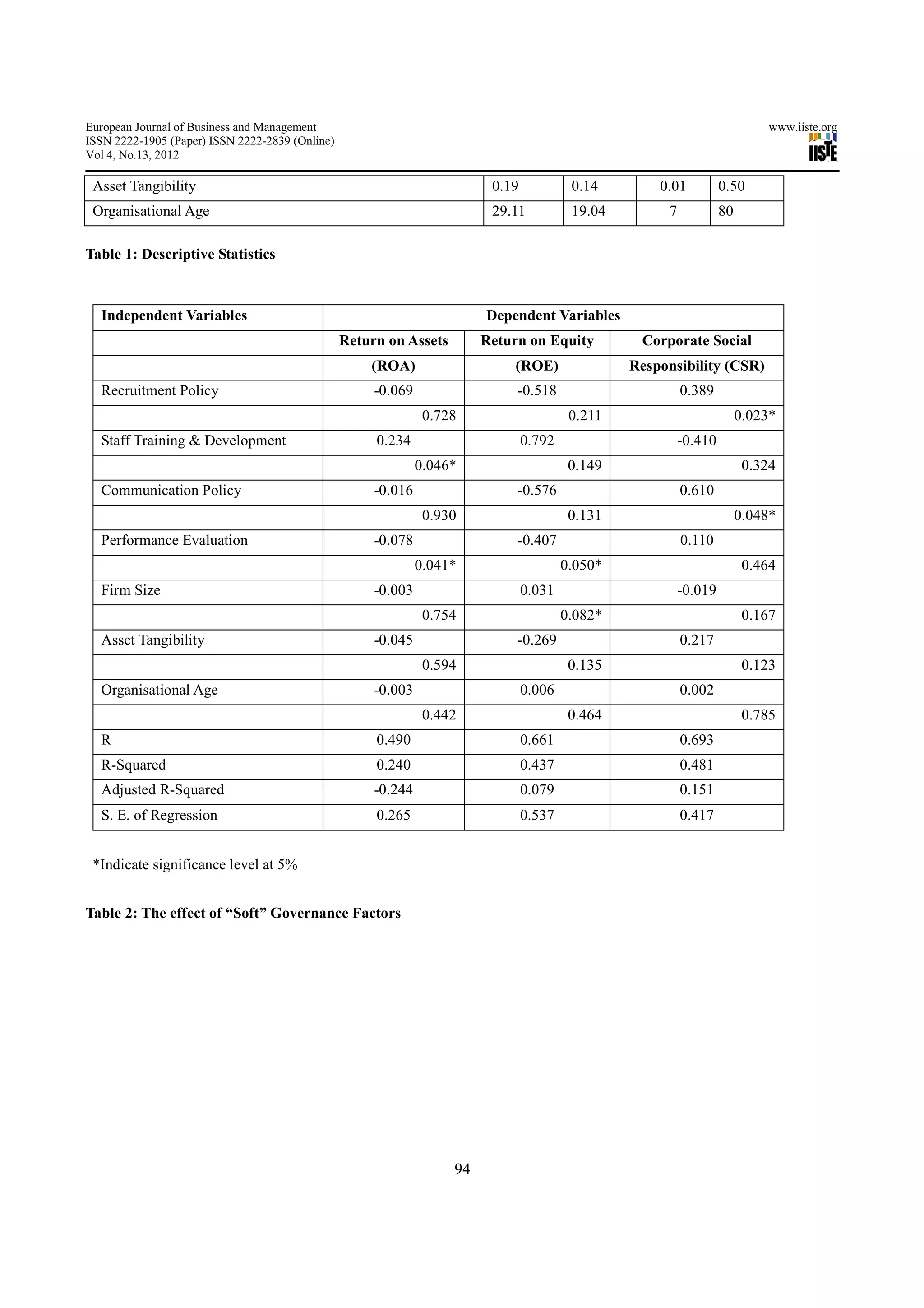
The result of our study shows a positive relationship between communication policy and firm performance. The relationship
is statistically significant with corporate social responsibility. We therefore accept hypothesis three. This is an indication
that, the company must take issues of communication with seriousness in order to improve performance of the company.
The company must have a policy on communication which gives a clear guideline on communication channels showing
lines of authority. This would ensure that employees know where to seek information for the performance of their work. The
methods of communication in an organisation could either be formal or informal. All these methods are very important and
play different roles in the organisation and therefore the procedures should be clear on which method to use to seek
particular information. In selecting channels of communication, consideration must be given to its effectiveness and the
challenges to ensure the timely delivery of the information and in the appropriate format.
Information sharing within the company helps to coordinate the activities of the various departments and hence promoting
                                                                91
European Journal of Business and Management                                                                       www.iiste.org
ISSN 2222-1905 (Paper) ISSN 2222-2839 (Online)
Vol 4, No.13, 2012

teamwork (Dewett and Jones, 2001). Each department depends on the other to achieve the objectives of the company
because of the different roles that they play and no one department can stand on its own without the contribution of the
others. This means there is the need for effective teamwork among the various departments and this can only be achieved if
there is effective communication among them. Bhatt (2000) support the position of information sharing within the company
because it is necessary in helping organisational members identify critical issues. Problem solving is an issue that confronts
every company on daily basis and the ability of the company to handle them well would depend on the effectiveness of
communication within the organisation. All these communication efforts would improve the performance of the company
and its ability to satisfy the needs of their customers.
The results also show a positive relationship between employee performance evaluation and firm performance. This lends
support to hypothesis four. The relationship is statistically significant with both return on assets and return on equity.
Performance evaluation enables management to appraise the performance of employees over a period to identify their
strengths and weaknesses. The result of such an exercise is to take measures to maximize the strengths and minimize the
weaknesses for the benefit of the company. Performance evaluation also serves as a motivational tool (Beer and Ruh, 1976)
that rewards employees for their performance. These rewards in the form of promotion and increase in remuneration
motivate employees to work harder to improve the performance of the company. Performance evaluation also helps
management to exercise control and improve communication within the company. It also provides employees with the
opportunity to seek clarification about expectations and responsibilities of their jobs.
The issue of performance evaluation is a strategic and sensitive one which must be handled with all the necessary caution to
ensure that all parties feel satisfied with the outcome. This is important because the result could also de-motivate the
employees if they are dissatisfied by the process and this can have a negative effect on the company’s performance. The
“characteristics of an effective employee performance appraisal systems should reflect formalization, job relatedness,
standards and measurements, validity, reliability, open communication, trained appraisers, ease of use, employee
accessibility to result, review procedures, and appeal procedures” (Caruth and Humphreys, 2008, p.25). It is therefore
important that the company takes these factors into account in designing its performance evaluation system so that the
objectives of the exercise can be achieved for an improved performance.
(Insert Table 2: The effect of “Soft” Governance Factors)
6. Conclusion
The study set out to investigate how “soft” governance factors influence corporate performance. This become necessary
because of corporate failures despite strict adherence to “hard” attributes of governance. The study determined how “soft”
governance factors of recruitment policy, staff training and development, communication policy and performance evaluation
impact on corporate performance measured by return on assets, return on equity and corporate social responsibility. The
regression results for the 19 Ghanaian non-life insurance companies for a period over 2006- 2010 indicates that all these
factors have positive impact on performance. It is important for companies to institute measures to ensure these policies and
programs are in place and working. The measures must also allow for control and evaluation to ensure the company is
deriving the maximum benefits. However, companies should not treat these factors as substitute for “hard” attributes of
governance but rather they should complement each other for better corporate performance.
The factors of “soft” governance are many and impossible to cover all of them in one study. Therefore our study could not
include factors such as attitude, skills and competencies, CEO/chairman relationship, motivation and management style
among others. Again the study used only financial statement ratios which could be subjected to management manipulation
for various reasons. The study covers only insurance companies mainly because of their peculiar characteristics and hence
the results may not be applied to companies in different sectors. Future research should include some of these factors and
also cover other sectors of the economy. It is hoped that in the near future more insurance companies would be listed on the
stock exchange so their performance can be measured from the market perspective.
REFERENCE
Abor, J., & Biekpe, N. (2007). Corporate governance, ownership structure and performance of SMEs in Ghana: Implications
          for financial opportunities. Corporate Governance, 7(3), 288-300
Bailey, T. (1993). Discretionary effort and the organisation of work: Employee participation and work reform since
          Hawthorne. Working paper, Columbia University, New York
Bartel, A. P., & Lichtenberg, F. (1987). The comparative advantage of educated workers in implementing new technology of
          educated workers in implementing new technology. Review of Economics and Statistics. 66(1), 1-11
Becker, G. S. (1964). Human Capital: A theoretical analysis with special reference to education. Columbia University Press,
          New York, NY.
Beer, M., & Ruh, R. A. (1976). Employee growth through performance management. In Vroom, V. H. (ed), Manage
          people, not personnel: Motivation and performance appraisal. Harvard Business School and Publishing, Boston,
                                                             92
European Journal of Business and Management                                                                    www.iiste.org
ISSN 2222-1905 (Paper) ISSN 2222-2839 (Online)
Vol 4, No.13, 2012

          MA.
Bhatt, G. D. (2000). An empirical examination of the effects of information systems integrating on business process
          improvement. International Journal of Operations and Production Management, 20(11), 1331-1359
Caruth, D. L., & Humphreys, J. H. (2008). Performance appraisal: Essential characteristics for statistic control. Measuring
          Business Excellence, 12(3), 24-32
Cascio, W. F. (1991). Costing human resources: The financial impact of behaviour in organizations. (3rd ed), Boston:
          PWS-Kent.
Dewett, T., & Jones, G. R. (2001). The role of information technology in the organisation of review, model and assessment.
          Journal of Management, 27, 313-346
Heyes, J., & Stuart, M. (1996). Does training matter? Employee experiences and attitude. Human Resource Management
          Journal, 6(3), 7-21
Hsiao, C., & Yanan, W. (2006). Panel data analysis-advantages and challenges. Wise Working Paper Series, Xiamen
          University, China.
Huselid, M. A. (1995). The impact of human resource management practices in turnover productivity and corporate
          financial performance. Academy of management Journal, 38(3), 635-672
Kocourek, P. F., Burger, C., & Birchard, B. (2003). Corporate governance: Hard facts about soft behaviors. Strategy and
          Business, Spring, 9
Meredith, E., & Robyn, C. (2005). Corporate governance and performance: An exploration of the connection in a public
          sector context”, issue series, paper 1
Nadler, D. A. (2004). Building better boards. Harvard Business Review, May, 102-111
Pfeffer, J. (1995). Producing sustainable competitive advantage through the effective management of people. Academy of
          Management Executive, 9, 55-72
Smith, A., & Hayton, G. (1999). What drives enterprise training? Evidence from Australia. The International Journal of
          Human Resource management, 10(2), 251-272
Sonnenfeld, J. A. (2002). What makes great boards great. Harvard Business Review, September, 106-113
Tanova, C., & Nadiri, H. (2005). Recruitment and training policies and practices: The case of Turkey as an EU candidate.
          Journal of European Industrial Training, 29(9), 694-711
Taylor, M. S., & Schmidth, D. W. (1983). A process oriented investigation of recruitment source effectiveness. Personnel
          Psychology, 36, 343-354
Taylor, M. S. (1994). The relationship between sources of new employees and attitudes toward the job. The Journal of
          Social Psychology. 134(1), 99-111
Wright, P. M., & McMahan, G. C. (1992). Theoretical perspectives for strategic human resource management. Journal of
          Management, 18(2), 295-320

APPENDIX
 Table 1: Summary Statistics (observations = 19)
 Variables                                                        Mean         Std. Dev.   Min.        Max.
 Performance Measures
 Return on Assets                                                 0.08         0.04        0.01        0.19
 Return on Equity                                                 0.18         0.09        0.04        0.33
 Corporate Social Responsibility                                  0.26         0.45        0           1
 "Soft" Governance Factors
 Recruitment Policy                                               0.84         0.37             0      1
 Staff Training & Development                                     0.89         0.32             0      1
 Communication Policy                                             0.63         0.50             0      1
 Performance Evaluation                                           3.63         0.76             1      4
 Control Factors
 Firm Size                                                        15.46        1.96            10.70   18.81


                                                            93
European Journal of Business and Management                                                                                  www.iiste.org
ISSN 2222-1905 (Paper) ISSN 2222-2839 (Online)
Vol 4, No.13, 2012

 Asset Tangibility                                                        0.19            0.14        0.01          0.50
 Organisational Age                                                       29.11           19.04        7            80

Table 1: Descriptive Statistics


  Independent Variables                                                  Dependent Variables
                                                 Return on Assets        Return on Equity          Corporate Social
                                                     (ROA)                   (ROE)                Responsibility (CSR)
  Recruitment Policy                                  -0.069                  -0.518                       0.389
                                                                0.728                     0.211                          0.023*
  Staff Training & Development                        0.234                      0.792                     -0.410
                                                               0.046*                     0.149                           0.324
  Communication Policy                                -0.016                  -0.576                       0.610
                                                                0.930                     0.131                          0.048*
  Performance Evaluation                              -0.078                  -0.407                       0.110
                                                               0.041*                    0.050*                           0.464
  Firm Size                                           -0.003                     0.031                     -0.019
                                                                0.754                    0.082*                           0.167
  Asset Tangibility                                   -0.045                  -0.269                       0.217
                                                                0.594                     0.135                           0.123
  Organisational Age                                  -0.003                     0.006                     0.002
                                                                0.442                     0.464                           0.785
  R                                                   0.490                      0.661                     0.693
  R-Squared                                           0.240                      0.437                     0.481
  Adjusted R-Squared                                  -0.244                     0.079                     0.151
  S. E. of Regression                                 0.265                      0.537                     0.417


 *Indicate significance level at 5%


Table 2: The effect of “Soft” Governance Factors


                                                                    94
This academic article was published by The International Institute for Science,
Technology and Education (IISTE). The IISTE is a pioneer in the Open Access
Publishing service based in the U.S. and Europe. The aim of the institute is
Accelerating Global Knowledge Sharing.

More information about the publisher can be found in the IISTE’s homepage:
http://www.iiste.org


The IISTE is currently hosting more than 30 peer-reviewed academic journals and
collaborating with academic institutions around the world. Prospective authors of
IISTE journals can find the submission instruction on the following page:
http://www.iiste.org/Journals/

The IISTE editorial team promises to the review and publish all the qualified
submissions in a fast manner. All the journals articles are available online to the
readers all over the world without financial, legal, or technical barriers other than
those inseparable from gaining access to the internet itself. Printed version of the
journals is also available upon request of readers and authors.

IISTE Knowledge Sharing Partners

EBSCO, Index Copernicus, Ulrich's Periodicals Directory, JournalTOCS, PKP Open
Archives Harvester, Bielefeld Academic Search Engine, Elektronische
Zeitschriftenbibliothek EZB, Open J-Gate, OCLC WorldCat, Universe Digtial
Library , NewJour, Google Scholar

Soft” governance and firm performance

  • 1.
    European Journal ofBusiness and Management www.iiste.org ISSN 2222-1905 (Paper) ISSN 2222-2839 (Online) Vol 4, No.13, 2012 “Soft” Governance and Firm Performance: A Study of Ghanaian Insurance Firms Kingsley Tornyeva1* Theophilus Wereko2 1. Open University of Malaysia, Accra Institute of Technology Campus PO box AN 19782, Accra-North, Ghana 2. Open University of Malaysia, Accra Institute of Technology Campus PO box AN 19782, Accra-North, Ghana *E-mail of the corresponding author: tornyeva@yahoo.com Abstract The purpose of this research is to investigate the relationship between “soft” governance factors and the performance of insurance companies in Ghana. The study employed panel data methodology for the regression analysis of “soft” governance factors and the performance of the companies for the period 2005 – 2009. The results show that “soft” governance factors of recruitment policy, staff training and development, communication policy and performance evaluation have statistically significant positive relationship with the performance of the companies. It is recommended that management should treat “soft” governance as a strategic issue and formulate strategic policies on these factors. Again they should ensure the full implementation of these policies to ensure that the companies derive the maximum benefit of an improved performance. Keywords: “Soft” governance, Insurance industry, Firm performance 1. Introduction Efforts in ensuring that companies comply with good corporate governance practices have always been concentrated on ‘hard attributes’ of good governance. This ‘conventional’ good governance has become the key principles enshrined in many codes of corporate governance. These ‘hard attributes’ of board independence, board size, CEO tenure, separation of CEO position and the chair of the board, CEO’s remuneration and the establishment of various oversight committees among others have not been able to save companies from failure and their eventual collapse, though there was evidence of the existence of these attributes in the affected companies. A case in point was the collapse of Enron Corporation, WorldCom and Tyco International Ltd. These companies have boards that met the most challenging independence criteria by all standards, have high caliber of experienced professionals and accomplished academicians on their boards, instituted annual performance evaluation of individual board members and directors run for election every year (Kocourek et al., 2003). Their failure gave credence to the believe that ‘hard attributes’ alone are not sufficient to guarantee good corporate governance, at best they form minimal standards of good governance. In addition to those factors there is the need for ‘soft’ attributes to ensure good governance (Meredith & Robyn, 2005). The objective of the study is to determine the contribution of “soft” governance factors to firm performance. To achieve that objective, we first review literature on ‘soft’ governance, followed by the methodology adopted for the study, this is followed by analysis of regression results and the conclusion and recommendations. 2. Literature Review Previous studies have identified some internal factors which could lead to poor relationships or inadequate information flow. Some of these factors include, a dominant chairman or CEO, hurried decisions based on inadequate data, serial restructuring and mass resignation of key executives, interfering with the flow of information, defensive communications and shifting of responsibility (Meredith & Robyn, 2005). In their study of ‘soft behaviors’, Kocourek et al., (2003) identified the following seven ‘soft attributes’ of good governance which they termed as the ‘seven principles’ of ‘soft’ governance; select the right people, train them continuously, inform and communicate, balance the CEO’s power, establish new behaviors, devote the time, evaluate and improve. It is hoped that with the combination of both the ‘Hard’ and ‘soft’ attributes, companies should be able to pick the warning signals early enough to avoid the collapse of the companies. In addition to the above factors, David Nadler (2004) in his article on “Building Better Boards” identified seven keys to building high performing boards as; the right mind-set, the right role, the right work, the right people, the right agenda ,the right information and the right culture. According to David Nadler (2004), board building is an ongoing activity, a process of continuous improvement which means the board must keep asking the questions about purpose, resources and effectiveness. The vision of the board must clearly indicate the extent to which the board wants to get involved in influencing management decisions and the direction of the company. This would also outline the role of directors relative to that of management. These are normally documented in the board charter which helps to avoid unnecessary interferences. The board must also be composed of people who are not only independent but competent and have the capabilities and the relevant attributes to deliver. Setting agenda for board meetings are very crucial because it determines what would be 86
  • 2.
    European Journal ofBusiness and Management www.iiste.org ISSN 2222-1905 (Paper) ISSN 2222-2839 (Online) Vol 4, No.13, 2012 discussed and the extent to which it would be discussed. The problem, however, has been that this important activity is mostly done by the management, a situation which gives them the opportunity to dictate the discussion and would be capable to hide important matters from the board. It is suggested that this all important activity is done by the board in collaboration with the CEO. It is important that the right information is given to the board for effective decision making and not to be kept in the dark and also the corporate culture must be right for the company to achieve its objectives. Sonnenfeld (2002) posits that the failure of companies despite their compliance with rigid regulatory requirement could mean that the problems facing companies are not that of structure but social. The factors of trust, culture of open dissent, portfolio of roles, individual accountability and evaluation of performance have been identified as factors making boards effective (Sonnenfeld, 2002, p.110). It is important that directors of board exercise great deal of mutual respect, utmost good faith and trust in each other. The opinions and views expressed by directors must be appreciated and given consideration by the board irrespective of the director’s status or stake in the company. However, the level of trust and respect accorded a board member would to a large extent depend on the individual characteristics of the director concern. If the opinions expressed by a director and his/her line of argument is not logical and well constructed, it is likely to be disregarded by the others on the board. Therefore to achieve mutual trust and respect the directors must take their commitment to the company’s business seriously and always update their business knowledge. Sonnenfeld (2002) also argue that a successful board must have the culture of open dissent. The directors should be able to challenge openly the views of others without fear or intimidation. The board should exercise a high level of tolerance that encourages directors to express a contrary opinion to that of others and also be in the position to justify their dissent. This would ensure that the board does not become a rubber stamp which approves everything from management but must be able to check the behaviour of management, particularly powerful CEOs. The issue of dissent must be done appropriately in order not to create enmity and division on the board because the consequences of such happenings would cause the down fall of the company. Dissent must be based on sound judgment, good reasoning and not to offend the sensibility of the others. Also dissent does not mean one should always oppose a decision one deems not in his/her interest but the larger interest of the business and all stakeholders must be the outmost consideration. When this is done, it would improve the performance of the company. Again, Sonnenfeld (2002) suggested that directors should be able to perform several functions on the board and not to be constrained to only one particular function all the time. Businesses operate in a dynamic environment and therefore the directors must also have the necessary skills to meet new challenges. They should be able to serve on different board committees from time to time. This would ensure the infusion of new ideas to these committees and make their deliberations effective and hence good decisions that would turn the fortunes of the company around. This would depend on the competencies of the directors to be able to perform these various roles. However, boards are expected to be composed of people from diverse backgrounds hence every member is an expert in a particular field and would therefore be difficult to perform different roles. It is necessary that in assigning roles to directors their background is considered so that it does not become an exercise in futility. Additionally, Sonnenfeld (2002) suggested that there must be individual accountability by the board. The directors should be responsible for their actions. The board should assign individual directors roles that they should perform and report to the board. The directors should also perform other functions that are not directly assigned by the board but which in their day to day activities they come across as valuable information or material which they consider relevant for the sustainability of the company. This is because directors’ functions are not restricted to only what they do on the board during meetings but also outside the boardroom. However, since the directors are not permanent employees of the company they would need the support of the company in doing this, particularly issues concerning reimbursement of costs genuinely incurred in performing legitimate functions. Finally, the performance of the board must be periodically evaluated (Sonnenfeld, 2002) to determine how well they are doing and also identify weaknesses for improvement to ensure that they make meaningful contribution to the performance of the company. The assessment should be based on factors that are relevant to the company. It is important that the process of the assessment is transparent and issues discussed with the directors so that everyone would feel satisfied with the process. Though the evaluation of the performance is for an improvement and not to get people out of the board, it must also be made clear that directors who consistently perform below the acceptable level of director’s performance must be replaced with more competent people. In their study of corporate governance and performance, Meredith and Robyn (2005) identified certain factors they considered important as determinants of “soft” governance which if exist in the company would help improve the performance of the company. The first factor they identified is clarity in roles, responsibility and relationship among the various stakeholders. The stakeholders include the shareholders, directors, chairman of the board, management and the CEO. These stakeholders play different roles in the company and therefore it is important that their roles are well defined to avoid 87
  • 3.
    European Journal ofBusiness and Management www.iiste.org ISSN 2222-1905 (Paper) ISSN 2222-2839 (Online) Vol 4, No.13, 2012 the overlapping of roles leading to conflict. The two most important positions in the company are that of the chairman and the CEO. Depending on whether these positions are occupied by one person or two different persons, the relationship between them is very crucial for the performance of the company. Any power struggle between them would affect the performance of the company. It is also important that the relationship between the directors and management is that of support and complementarily. The directors should not behave as if they are there just to check management but rather to complement their efforts and provide them with all the necessary support. The company should have code of conduct and ethics which should detail these relationships and made available to all the stakeholders. Meredith and Robyn (2005) also underlined the importance of skills, competencies and business knowledge. The study supports their view that board and management must possess the relevant skills and competencies necessary for the company. That is the only way they can be relevant to the company and contribute to its success. However, this is not limited to only skills and competencies acquired at the time of entry but must be continuously improved to be relevant to the company always. Without continuous training to improve skills and competencies, directors and staff would become obsolete and less relevant to the company. In that regard the company must have a training policy and programs to ensure the directors and staff acquire the right skills needed for the job to improve the performance of the company. Information flow in the company is also considered important for the proper discharge of duties by Meredith and Robyn, (lbid). There should be clear guidelines on communication so that people know where to get the required information and this would ensure the timely performance of function and hence improve performance. Interestingly, all the above studies have focused more on the board of directors to the neglect of management and the employees. Our study concludes that these categories of stakeholders play a very significant role in the performance of the company. They implement all the strategic decisions of the board and therefore the success of the company greatly depends on them. If they fail in the successful implementation of board policies, the company as a whole would fail. They are a strategic resource of the company and therefore their contribution to the company must be evaluated. The foregoing are among the reasons why the study focused on factors that affect the quality of employees and how they influence their contribution to the company’s performance. 3. Hypotheses Development This section outlines the four key elements or independent variables of ‘soft’ governance that were used to formulate our hypotheses for the study, mainly recruitment policy, staff training and development, communication policy and performance evaluation. 3.1 Recruitment Policy Employees play an important role in the performance of the company. The quality of the employees determines the performance of the company. It is therefore important for the company to put in measures to attract the right caliber of employees who can make meaningful contributions to the performance of the company. The recruitment policy would outline the procedure for recruiting employees. This would ensure that only those candidates who meet the needs of the company at a particular time are recruited. This would also avoid the situation of recruiting people based on other considerations other than competence. Therefore recruiting the right people and supporting them with the right resources would lead to an improved company performance. This lead to our first hypothesis: H : There is positive relationship between recruitment policy and firm performance. 1 3.2 Staff Training and Development The training and development of staff enhances their ability and knowledge which ensures that they perform their duties very well to improve the performance of the company. The business environment is dynamic and to remain competitive means the company must be up to date with modern skills require for an efficient performance. The acquisition of these skills would be possible through training and development. The company must therefore have a consistent program of training its staff on current trends and challenges in the industry so that they can withstand the competition through an improve performance. Hence training and development of staff would lead to improve firm performance. This leads to the second hypothesis: H : There is positive relationship between staff training and development and firm performance 2 3.3 Communication Policy Communication policy would ensure the availability and free flow of information within the company. The policy would facilitate the setting up of the right management information systems that would produce the information that is needed at every level of the company for the smooth operational processes. An important aspect of communication policy is employees’ grievance handling procedures. Employees’ grievances when not handle very well to the satisfaction of the employees can greatly affect their output and this would have a negative impact on the performance of the company. However, if the company makes good use of these procedures it would help address employees concern and prevent labour unrest bringing about the needed industrial peace. The policy would also give guidelines on handling issues concerning 88
  • 4.
    European Journal ofBusiness and Management www.iiste.org ISSN 2222-1905 (Paper) ISSN 2222-2839 (Online) Vol 4, No.13, 2012 other stakeholders especially customers. The company can gain the maximum benefit from this policy if it has a clear organisational structure which shows the line of authority, responsibility and control. This would support the free flow of information and delegation. Hence a good communication policy would improve the performance of the company. This leads to the third hypothesis: H : There is positive relationship between communication policy and firm performance. 3 3.4 Performance Evaluation Periodic evaluation of employees’ performance ensures that weaknesses identified are addressed to enhance the efficiency and effectiveness of the employees and thereby improving the performance of the company. This process should not be limited to only employees but also all processes and procedures must be assessed to provide the vital support to the works of the employees. Usually overlook in the evaluation process is the performance of the board of directors. It is important that as the head of the company they are in control of whatever is going on in the company. By evaluating their performance would help the shareholders to know those who are performing poorly and therefore institute measures to improve their performance or remove them from the board when necessary. An objective evaluation of the performance at all levels would improve the performance of the company. Hence our final hypothesis: H : There is positive relationship between performance evaluation and firm performance. 4 4. Methodology The methodology of study employed a combination of primary and secondary data. The primary data was collected on the independent variables of recruitment policy, staff training and development, communication policy and performance evaluation through questionnaires administered by members of the management team of the companies. These are dummy variables which equal to one if the company has such policies and programs in place and zero otherwise. The performance of the companies was measured by return on assets (ROA), return on equity (ROE) and corporate social responsibility (CSR). ROA is defined as net profit before interest and tax as a percentage of total assets, ROE defined as net profit after tax as a percentage of shareholders equity and CSR as percentage of company’s profit spent on CSR activities. The ratios were computed from the financial statements of the companies over the period of 2006-2010. Only 19 companies which have complete financial statements for these periods were included in the analysis. The study used only accounting ratios because only two of the nineteen companies included in the study are listed on the stock exchange and therefore market ratios could not be used in order to avoid distortion. The study used panel data framework which follows the one used by Abor and Biekpe, (2007). This involves the pooling of observations on cross-section of units over several time periods and provides results that are simply not detectable in pure cross-sections or pure time-series studies. Panel data could be described as data containing time series observations of a number of variables. An observation in panel data involves at least two dimensions; a cross-sectional dimension, indicated by subscript and a time series dimension, indicated by subscript (Hsiao and Yanan, 2006). Attached to the variables in the model are double subscripts in order to differentiate them from regular time-series or cross section regression. The general panel data is of the form (1) Where: Perf it = performance of firm i in time t; S it = a vector of “soft” governance factors of firm i in time t; C it = a set of control variables of firm i in time t; µit = the error term To ensure the robustness of the model and to reduce specification bias, the model also includes control variables of size, age and asset tangibility. Since performance is a function of “soft” governance variables, the model is restated as; (2) 5. Empirical Results 5.1 Descriptive summary statistics “Soft” governance factors are very crucial for the human resource development and effective communication in the company. This is because the human resource is the most important asset of the company and the success or failure of the company to a large extent depends on how effectively the management is able to harness this resource to ensure the total commitment of the employee to the cause of the company. An average of 84% of the companies have declared recruitment policy which outlines the necessary procedures to go through in recruiting new staff. This means the rest 16% of the companies do not have declared recruitment policy. This is a cause for worry since the companies may end up recruiting people who are not qualified or recruiting people on conditions that have nothing to do with competence. A mean value of 89% of the companies have systematic staff training and development programme and 11% of them do not have. These 89
  • 5.
    European Journal ofBusiness and Management www.iiste.org ISSN 2222-1905 (Paper) ISSN 2222-2839 (Online) Vol 4, No.13, 2012 programmes ensure the continues development of staff and help improve the performance of the company. An average of 63% of the companies have guidelines on clear communication and information flow but the remaining 37% do not have. Communication is the life blood of every organisation because it facilitates the decision making process and ensure the flow of information horizontally and vertically within the organisation. The lack of a clear guideline may lead to confusion, breakdown in authority and control, and have a negative effect on the performance of the company. The performance of employees has to be assessed periodically to identify their strength and weaknesses so that measures can be taken to maximize the strength and minimize the weaknesses. All the companies carried on employee performance evaluation at least once in the last quarter of the year even though some of the companies do it monthly and semi-annually. Most of the companies use the process to design new training programs for staff and for promotion of deserving staff to higher grades as well as demotion of staff that performed poorly. The mean value of the size of the companies is 15.46, the maximum of 18.81 and the minimum of 10.70. This is an indication that these are relatively small companies though we have few large ones. The small size can be attributed to the low capital base of the companies and the low level of insurance penetration in the country which is retarding the growth of the insurance companies. The mean value of asset tangibility of the companies is 19% with the maximum of 50% and a minimum of 14% respectively. This means that 81% of the total assets of the companies are in the form of current assets. This low level of fixed assets may be explained by the importance of liquidity in the insurance industry. This is because of the uncertainty surrounding the occurrence of the insured risk so the companies must keep assets in a form that can be quickly turned into cash to settle claims when they occur. The companies therefore place premium on short term investment. The average age of the companies is 29 years, the maximum of 80 years and minimum of 7 years. Based on the average age, one can say this is a young industry even though the maximum age is 80 years, this is because the industry has not seen much growth in the number of companies until recently. As a result of the enabling business environment we are seeing the emergence of more companies. (Insert Table 1: Summary Descriptive Statistics) 5.2 Regression Results The success of an organisation can be said to depend on the quality and conditions of its human resource. This is because the employees as the most important asset of the organisation make the most effective contribution by combining effectively with all the other assets of the organisation to ensure that the objectives of the organisation are achieved. Therefore the organisation must adopt the appropriate human resource management practices to effectively handle employee issues so that the employees would have the motivation needed for excellent performance. Our analysis considered four factors of “soft” governance namely recruitment policy, staff training and development, communication policy and performance evaluation. The management of the human resource starts from the recruitment of people into the organisation. It is important at this initial stage that all the necessary precautions are taken to ensure that the right people are recruited. This is possible when the organisation have a well documented recruitment policy which is adhered to in doing recruitment. Additionally, the organisation must have a programme to ensure the continued training and development of the staff to increase their performance level. This would make it easy for the organisation to always have people to accept responsibilities at higher levels, increase employee innovation and creativity which would bring about an improved company performance. The communication policy of the organisation would ensure the smooth coordination of all activities. An important aspect of this policy is the procedures for handling employee grievances, such issues should be handled with utmost good faith so that they do not degenerate and negatively affect performance of the organisation. Finally, the performance of employees must be periodically evaluated so that weaknesses can be addressed and hard work rewarded appropriately. We measure the relationship between these factors and profitability to determine their influence on the performance of the organisation. The recruitment policy of a company plays an important role in influencing the performance of the company. This is because the human resource is the most important asset of the company and they manage the other assets of the company to achieve its objectives, therefore, the success or otherwise of the company depends on how well there is an organisational fit between the people and the other assets. Cascio (1994) posited that the company would derive substantial financial returns from investment in progressive human resource management practices. Our result has depicted a positive relationship between the company’s recruitment policy and the performance measures supporting hypothesis one. The human resource can become a source of sustained competitive advantage to the company if the right people are recruited. Wright and McMahan (1992) emphasised the importance of human resources in the creation of firm-specific competitive advantage. According to Taylor (1994) the companies could recruit new employees through formal recruitment method such as newspaper advertisement or through informal recruitment method such as employee referrals. These methods have their own advantages and disadvantages in reaching the right caliber of staff. Previous studies, Taylor and Schmidt (1983), and Taylor (1994) favour informal recruitment method as it impact more on company performance compared to the other 90
  • 6.
    European Journal ofBusiness and Management www.iiste.org ISSN 2222-1905 (Paper) ISSN 2222-2839 (Online) Vol 4, No.13, 2012 methods. This is because such employees turn to know much about the company through their referral and therefore would only apply for the job if they have the competence and the ability to perform the job. Also they are motivated to work hard to justify the confidence and the trust of the referral. The major disadvantage of this method is that it restricts the size of the population that the company can recruit so the company may not recruit the best candidate. Pfeffer (1995) suggested that employees who are recruited through stringent recruitment and selection process have a sense of elitism which imparts high expectations of performance. It is worthy to note that irrespective of how excellent a company’s recruitment policy is it may not be able to impact positively on the company performance if the right structures and systems are not in place to support the employees. Huselid (1995) argues that if the company does not have the right incentive compensation systems that align the interest of the employees with those of shareholders, the effectiveness of even highly skilled employees would be limited. In addition, Bailey (1993) suggested that despite the necessary motivation, the contribution of the employees to the company’s performance may be limited if the jobs are structured or programmed. The job description should be flexible to allow for creativity and innovation by the employees. This would ensure that the employees can use their skills and abilities to design new and better ways of performing their job (Huselid, 1995). Continuous training and development of employees is essential for sustained improved performance. The result of the study shows a positive relationship between staff training and development and performance. The relationship with return on assets is statistically significant. This support the position of hypothesis two that there is positive relationship between staff training and development and firm performance. Companies are faced with many challenges from both internal and the external environment on daily basis so to remain competitive means the company must be up to date with current trends. There must be well designed programme for staff training and development to equip staff with the necessary skills and competencies to cope with the modern technology and also to ensure the progression of staff through the ranks. This would also ensure that, the companies have readily available skills to replace those lost through attrition (retirement, resignation, death). The importance of training was vividly captured by Tanova and Nadiri (2005, pp.699) and confirmed in our study as having “a strategic impact on organisations because it serves many organisational goals, apart from equipping employees with the necessary skills for the present and future tasks, training also provides opportunities for employees to share their experience and help better understanding of each others attitude which in turns leads to organisational cohesiveness and employee commitment”. Evidence from previous studies (Smith and Hayton, 1999; Bartel and Lichtenberg, 1987; Becker, 1964; Heyes and Stuart, 1996) suggested that companies train their employees to ensure increase in productivity, increase commitment, improvement in their performance, adaptability and flexibility, adoption of new work practice, change in business strategy or as a result of investment in new technology. Training produce human resource outcome of commitment, competence, congruence and cost effectiveness. The safety of employees in any work environment is as important as the increase performance that the company is seeking. With training, employees would be able to handle all work tools and equipment and follow all safety instructions. This would reduce injuries to staff and reduction in error rates leading to an improved company performance. The employees also derive job satisfaction as a result of training and this motivates them to make significant contribution to productivity and profitability of the company. However, training and development of employees is an expensive exercise in terms of financial commitment by the company, therefore the company should not only be interested in training employees but develop systems and structures to ensure that knowledge and skills acquired are applied for the benefit of the company. These measures should also ensure that employees are retained in the company for long so that the knowledge can be passed on to other employees and also to save the company cost of replacement if such employees should resign or incapacitated that they can no longer work for the company. These systems should also ensure that the training and development is a continue process so that the employees do not become obsolete with the passage of time. The conditions of service of engagement should have favourable provisions that encourage employees to take the initiative to train and develop themselves. The result of our study shows a positive relationship between communication policy and firm performance. The relationship is statistically significant with corporate social responsibility. We therefore accept hypothesis three. This is an indication that, the company must take issues of communication with seriousness in order to improve performance of the company. The company must have a policy on communication which gives a clear guideline on communication channels showing lines of authority. This would ensure that employees know where to seek information for the performance of their work. The methods of communication in an organisation could either be formal or informal. All these methods are very important and play different roles in the organisation and therefore the procedures should be clear on which method to use to seek particular information. In selecting channels of communication, consideration must be given to its effectiveness and the challenges to ensure the timely delivery of the information and in the appropriate format. Information sharing within the company helps to coordinate the activities of the various departments and hence promoting 91
  • 7.
    European Journal ofBusiness and Management www.iiste.org ISSN 2222-1905 (Paper) ISSN 2222-2839 (Online) Vol 4, No.13, 2012 teamwork (Dewett and Jones, 2001). Each department depends on the other to achieve the objectives of the company because of the different roles that they play and no one department can stand on its own without the contribution of the others. This means there is the need for effective teamwork among the various departments and this can only be achieved if there is effective communication among them. Bhatt (2000) support the position of information sharing within the company because it is necessary in helping organisational members identify critical issues. Problem solving is an issue that confronts every company on daily basis and the ability of the company to handle them well would depend on the effectiveness of communication within the organisation. All these communication efforts would improve the performance of the company and its ability to satisfy the needs of their customers. The results also show a positive relationship between employee performance evaluation and firm performance. This lends support to hypothesis four. The relationship is statistically significant with both return on assets and return on equity. Performance evaluation enables management to appraise the performance of employees over a period to identify their strengths and weaknesses. The result of such an exercise is to take measures to maximize the strengths and minimize the weaknesses for the benefit of the company. Performance evaluation also serves as a motivational tool (Beer and Ruh, 1976) that rewards employees for their performance. These rewards in the form of promotion and increase in remuneration motivate employees to work harder to improve the performance of the company. Performance evaluation also helps management to exercise control and improve communication within the company. It also provides employees with the opportunity to seek clarification about expectations and responsibilities of their jobs. The issue of performance evaluation is a strategic and sensitive one which must be handled with all the necessary caution to ensure that all parties feel satisfied with the outcome. This is important because the result could also de-motivate the employees if they are dissatisfied by the process and this can have a negative effect on the company’s performance. The “characteristics of an effective employee performance appraisal systems should reflect formalization, job relatedness, standards and measurements, validity, reliability, open communication, trained appraisers, ease of use, employee accessibility to result, review procedures, and appeal procedures” (Caruth and Humphreys, 2008, p.25). It is therefore important that the company takes these factors into account in designing its performance evaluation system so that the objectives of the exercise can be achieved for an improved performance. (Insert Table 2: The effect of “Soft” Governance Factors) 6. Conclusion The study set out to investigate how “soft” governance factors influence corporate performance. This become necessary because of corporate failures despite strict adherence to “hard” attributes of governance. The study determined how “soft” governance factors of recruitment policy, staff training and development, communication policy and performance evaluation impact on corporate performance measured by return on assets, return on equity and corporate social responsibility. The regression results for the 19 Ghanaian non-life insurance companies for a period over 2006- 2010 indicates that all these factors have positive impact on performance. It is important for companies to institute measures to ensure these policies and programs are in place and working. The measures must also allow for control and evaluation to ensure the company is deriving the maximum benefits. However, companies should not treat these factors as substitute for “hard” attributes of governance but rather they should complement each other for better corporate performance. The factors of “soft” governance are many and impossible to cover all of them in one study. Therefore our study could not include factors such as attitude, skills and competencies, CEO/chairman relationship, motivation and management style among others. Again the study used only financial statement ratios which could be subjected to management manipulation for various reasons. The study covers only insurance companies mainly because of their peculiar characteristics and hence the results may not be applied to companies in different sectors. Future research should include some of these factors and also cover other sectors of the economy. It is hoped that in the near future more insurance companies would be listed on the stock exchange so their performance can be measured from the market perspective. REFERENCE Abor, J., & Biekpe, N. (2007). Corporate governance, ownership structure and performance of SMEs in Ghana: Implications for financial opportunities. Corporate Governance, 7(3), 288-300 Bailey, T. (1993). Discretionary effort and the organisation of work: Employee participation and work reform since Hawthorne. Working paper, Columbia University, New York Bartel, A. P., & Lichtenberg, F. (1987). The comparative advantage of educated workers in implementing new technology of educated workers in implementing new technology. Review of Economics and Statistics. 66(1), 1-11 Becker, G. S. (1964). Human Capital: A theoretical analysis with special reference to education. Columbia University Press, New York, NY. Beer, M., & Ruh, R. A. (1976). Employee growth through performance management. In Vroom, V. H. (ed), Manage people, not personnel: Motivation and performance appraisal. Harvard Business School and Publishing, Boston, 92
  • 8.
    European Journal ofBusiness and Management www.iiste.org ISSN 2222-1905 (Paper) ISSN 2222-2839 (Online) Vol 4, No.13, 2012 MA. Bhatt, G. D. (2000). An empirical examination of the effects of information systems integrating on business process improvement. International Journal of Operations and Production Management, 20(11), 1331-1359 Caruth, D. L., & Humphreys, J. H. (2008). Performance appraisal: Essential characteristics for statistic control. Measuring Business Excellence, 12(3), 24-32 Cascio, W. F. (1991). Costing human resources: The financial impact of behaviour in organizations. (3rd ed), Boston: PWS-Kent. Dewett, T., & Jones, G. R. (2001). The role of information technology in the organisation of review, model and assessment. Journal of Management, 27, 313-346 Heyes, J., & Stuart, M. (1996). Does training matter? Employee experiences and attitude. Human Resource Management Journal, 6(3), 7-21 Hsiao, C., & Yanan, W. (2006). Panel data analysis-advantages and challenges. Wise Working Paper Series, Xiamen University, China. Huselid, M. A. (1995). The impact of human resource management practices in turnover productivity and corporate financial performance. Academy of management Journal, 38(3), 635-672 Kocourek, P. F., Burger, C., & Birchard, B. (2003). Corporate governance: Hard facts about soft behaviors. Strategy and Business, Spring, 9 Meredith, E., & Robyn, C. (2005). Corporate governance and performance: An exploration of the connection in a public sector context”, issue series, paper 1 Nadler, D. A. (2004). Building better boards. Harvard Business Review, May, 102-111 Pfeffer, J. (1995). Producing sustainable competitive advantage through the effective management of people. Academy of Management Executive, 9, 55-72 Smith, A., & Hayton, G. (1999). What drives enterprise training? Evidence from Australia. The International Journal of Human Resource management, 10(2), 251-272 Sonnenfeld, J. A. (2002). What makes great boards great. Harvard Business Review, September, 106-113 Tanova, C., & Nadiri, H. (2005). Recruitment and training policies and practices: The case of Turkey as an EU candidate. Journal of European Industrial Training, 29(9), 694-711 Taylor, M. S., & Schmidth, D. W. (1983). A process oriented investigation of recruitment source effectiveness. Personnel Psychology, 36, 343-354 Taylor, M. S. (1994). The relationship between sources of new employees and attitudes toward the job. The Journal of Social Psychology. 134(1), 99-111 Wright, P. M., & McMahan, G. C. (1992). Theoretical perspectives for strategic human resource management. Journal of Management, 18(2), 295-320 APPENDIX Table 1: Summary Statistics (observations = 19) Variables Mean Std. Dev. Min. Max. Performance Measures Return on Assets 0.08 0.04 0.01 0.19 Return on Equity 0.18 0.09 0.04 0.33 Corporate Social Responsibility 0.26 0.45 0 1 "Soft" Governance Factors Recruitment Policy 0.84 0.37 0 1 Staff Training & Development 0.89 0.32 0 1 Communication Policy 0.63 0.50 0 1 Performance Evaluation 3.63 0.76 1 4 Control Factors Firm Size 15.46 1.96 10.70 18.81 93
  • 9.
    European Journal ofBusiness and Management www.iiste.org ISSN 2222-1905 (Paper) ISSN 2222-2839 (Online) Vol 4, No.13, 2012 Asset Tangibility 0.19 0.14 0.01 0.50 Organisational Age 29.11 19.04 7 80 Table 1: Descriptive Statistics Independent Variables Dependent Variables Return on Assets Return on Equity Corporate Social (ROA) (ROE) Responsibility (CSR) Recruitment Policy -0.069 -0.518 0.389 0.728 0.211 0.023* Staff Training & Development 0.234 0.792 -0.410 0.046* 0.149 0.324 Communication Policy -0.016 -0.576 0.610 0.930 0.131 0.048* Performance Evaluation -0.078 -0.407 0.110 0.041* 0.050* 0.464 Firm Size -0.003 0.031 -0.019 0.754 0.082* 0.167 Asset Tangibility -0.045 -0.269 0.217 0.594 0.135 0.123 Organisational Age -0.003 0.006 0.002 0.442 0.464 0.785 R 0.490 0.661 0.693 R-Squared 0.240 0.437 0.481 Adjusted R-Squared -0.244 0.079 0.151 S. E. of Regression 0.265 0.537 0.417 *Indicate significance level at 5% Table 2: The effect of “Soft” Governance Factors 94
  • 10.
    This academic articlewas published by The International Institute for Science, Technology and Education (IISTE). The IISTE is a pioneer in the Open Access Publishing service based in the U.S. and Europe. The aim of the institute is Accelerating Global Knowledge Sharing. More information about the publisher can be found in the IISTE’s homepage: http://www.iiste.org The IISTE is currently hosting more than 30 peer-reviewed academic journals and collaborating with academic institutions around the world. Prospective authors of IISTE journals can find the submission instruction on the following page: http://www.iiste.org/Journals/ The IISTE editorial team promises to the review and publish all the qualified submissions in a fast manner. All the journals articles are available online to the readers all over the world without financial, legal, or technical barriers other than those inseparable from gaining access to the internet itself. Printed version of the journals is also available upon request of readers and authors. IISTE Knowledge Sharing Partners EBSCO, Index Copernicus, Ulrich's Periodicals Directory, JournalTOCS, PKP Open Archives Harvester, Bielefeld Academic Search Engine, Elektronische Zeitschriftenbibliothek EZB, Open J-Gate, OCLC WorldCat, Universe Digtial Library , NewJour, Google Scholar