1
Kisan Credit Card
Akshay Makwana
2
Introduction
Reserve Bank of India (RBI), along with National Bank for Agriculture and
Rural Development (NABARD) initiated the conception of Kisan Credit Cards
(KCC) in 1998-99, in order to assist agriculturists to have easily accessible
cash credit facilities.
it provides flexibility in terms of repayment, which can be rescheduled in
the event of unforeseen incidents like a bad crop season, with term
extensions for a period of up to four years, and so on. Kisan credit card is
valid for up to five years and is dependent on the annual renewals.
3
History
KCC was first proposed in the Budget 1998-99 by then Finance Minister
Yashwant Sinha. Consequent to this, NABARD had prepared a Model Kisan
Credit Card Scheme in consultation with the Major Banks on the basis of R V
Gupta Committee.
the farmers may use KCC to readily purchase agricultural inputs such as
seeds, fertilizers, pesticides, etc.
Accordingly, NABARD formulated a Model Kisan Credit Card Scheme in
consultation with major banks.
4
Reason behind the KCC Scheme
There are several hurdles faced by farmers in the process of acquiring
adequate finance from banks. such as:
long drawn-out documentation and processing, complicated practices
followed by banks, delay in processing and also lack of awareness among
farmers regarding banking process.
Most farmers depend on non-institutional means of credit for their
immediate needs such as:
purchase of seeds, fertilizers, pesticides and this in turn affects them
negatively since non-institutional credit is costly and counter-productive.
5
Objectives of KCC
 Post-harvest expenses
 Produce Marketing loan
 Consumption requirements of farmer household
 To meet the short term credit requirements for cultivation of crops
 Working capital for maintenance of farm assets and activities allied to
agriculture, like dairy animals
 Investment credit requirement for agriculture and allied activities like
pump sets, sprayers, dairy animals
6
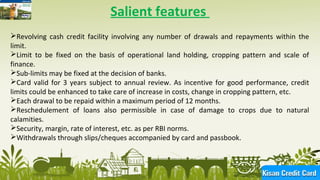
Salient features
Revolving cash credit facility involving any number of drawals and repayments within the
limit.
Limit to be fixed on the basis of operational land holding, cropping pattern and scale of
finance.
Sub-limits may be fixed at the decision of banks.
Card valid for 3 years subject to annual review. As incentive for good performance, credit
limits could be enhanced to take care of increase in costs, change in cropping pattern, etc.
Each drawal to be repaid within a maximum period of 12 months.
Reschedulement of loans also permissible in case of damage to crops due to natural
calamities.
Security, margin, rate of interest, etc. as per RBI norms.
Withdrawals through slips/cheques accompanied by card and passbook.
7
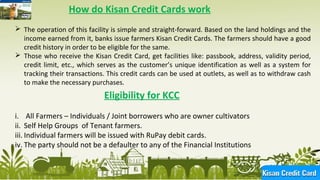
How do Kisan Credit Cards work
 The operation of this facility is simple and straight-forward. Based on the land holdings and the
income earned from it, banks issue farmers Kisan Credit Cards. The farmers should have a good
credit history in order to be eligible for the same.
 Those who receive the Kisan Credit Card, get facilities like: passbook, address, validity period,
credit limit, etc., which serves as the customer’s unique identification as well as a system for
tracking their transactions. This credit cards can be used at outlets, as well as to withdraw cash
to make the necessary purchases.
Eligibility for KCC
i. All Farmers – Individuals / Joint borrowers who are owner cultivators
ii. Self Help Groups of Tenant farmers.
iii. Individual farmers will be issued with RuPay debit cards.
iv. The party should not be a defaulter to any of the Financial Institutions
8
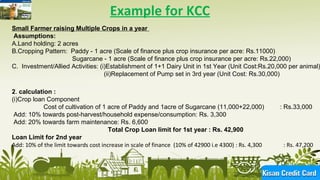
Example for KCC
Small Farmer raising Multiple Crops in a year
 Assumptions:
A.Land holding: 2 acres 
B.Cropping Pattern:  Paddy - 1 acre (Scale of finance plus crop insurance per acre: Rs.11000)
       Sugarcane - 1 acre (Scale of finance plus crop insurance per acre: Rs.22,000)
C.  Investment/Allied Activities: (i)Establishment of 1+1 Dairy Unit in 1st Year (Unit Cost:Rs.20,000 per animal)
                         (ii)Replacement of Pump set in 3rd year (Unit Cost: Rs.30,000)  
2. calculation :
(i)Crop loan Component  
                  Cost of cultivation of 1 acre of Paddy and 1acre of Sugarcane (11,000+22,000)         : Rs.33,000 
 Add: 10% towards post-harvest/household expense/consumption: Rs. 3,300 
 Add: 20% towards farm maintenance: Rs. 6,600 
  Total Crop Loan limit for 1st year : Rs. 42,900
Loan Limit for 2nd year
Add: 10% of the limit towards cost increase in scale of finance (10% of 42900 i.e 4300) : Rs. 4,300 : Rs. 47,200
9
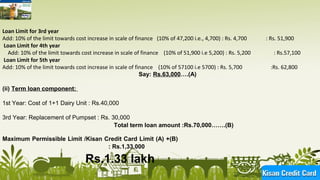
Loan Limit for 3rd year
Add: 10% of the limit towards cost increase in scale of finance (10% of 47,200 i.e., 4,700) : Rs. 4,700 : Rs. 51,900
Loan Limit for 4th year
Add: 10% of the limit towards cost increase in scale of finance (10% of 51,900 i.e 5,200) : Rs. 5,200 : Rs.57,100
Loan Limit for 5th year
Add: 10% of the limit towards cost increase in scale of finance (10% of 57100 i.e 5700) : Rs. 5,700 :Rs. 62,800
Say: Rs.63,000….(A)
(ii) Term loan component:
 
1st Year: Cost of 1+1 Dairy Unit : Rs.40,000 
 
3rd Year: Replacement of Pumpset : Rs. 30,000   
Total term loan amount :Rs.70,000…….(B)
Maximum Permissible Limit /Kisan Credit Card Limit (A) +(B)
: Rs.1,33,000
Rs.1.33 lakh
10
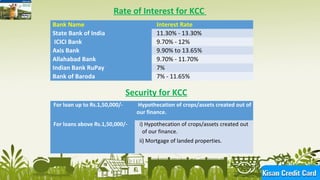
Rate of Interest for KCC
Bank Name Interest Rate
State Bank of India 11.30% - 13.30%
ICICI Bank 9.70% - 12%
Axis Bank 9.90% to 13.65%
Allahabad Bank 9.70% - 11.70%
Indian Bank RuPay 7%
Bank of Baroda 7% - 11.65%
Security for KCC
For loan up to Rs.1,50,000/- Hypothecation of crops/assets created out of
our finance.
For loans above Rs.1,50,000/- i) Hypothecation of crops/assets created out
of our finance.
ii) Mortgage of landed properties.
11
Benefits to Banks
 This scheme is beneficial to banks since it is time and cost-efficient.
 There is no need for an elaborate documentation process or continuous
appraisals under the Kisan Credit Card Scheme.
 Withdrawal of cash using the credit card requires very little paperwork and
is simple and hassle-free for not just the card holder but for the Bank as
well.
 Some other highlights include: no transaction costs, lesser risks in loan
recovery, etc.
12
Insurance under KCC Scheme
Insurance Under Kisan Credit Card holders are covered by a personal
accident insurance. This cover is available when the person enters the
scheme.
The cover is as follows:
 Death: 50,000
 Disability: 25,000
 Maximum Age to enter: 70 years
13
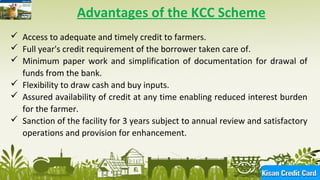
Advantages of the KCC Scheme
 Access to adequate and timely credit to farmers.
 Full year's credit requirement of the borrower taken care of.
 Minimum paper work and simplification of documentation for drawal of
funds from the bank.
 Flexibility to draw cash and buy inputs.
 Assured availability of credit at any time enabling reduced interest burden
for the farmer.
 Sanction of the facility for 3 years subject to annual review and satisfactory
operations and provision for enhancement.
14
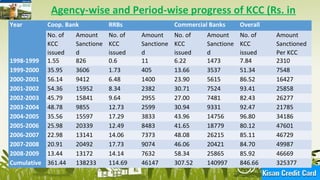
Agency-wise and Period-wise progress of KCC (Rs. in
crore)Year Coop. Bank RRBs Commercial Banks Overall
No. of
KCC
issued
Amount
Sanctione
d
No. of
KCC
issued
Amount
Sanctione
d
No. of
KCC
issued
Amount
Sanctione
d
No. of
KCC
issued
Amount
Sanctioned
Per KCC
1998-1999 1.55 826 0.6 11 6.22 1473 7.84 2310
1999-2000 35.95 3606 1.73 405 13.66 3537 51.34 7548
2000-2001 56.14 9412 6.48 1400 23.90 5615 86.52 16427
2001-2002 54.36 15952 8.34 2382 30.71 7524 93.41 25858
2002-2003 45.79 15841 9.64 2955 27.00 7481 82.43 26277
2003-2004 48.78 9855 12.73 2599 30.94 9331 92.47 21785
2004-2005 35.56 15597 17.29 3833 43.96 14756 96.80 34186
2005-2006 25.98 20339 12.49 8483 41.65 18779 80.12 47601
2006-2007 22.98 13141 14.06 7373 48.08 26215 85.11 46729
2007-2008 20.91 20492 17.73 9074 46.06 20421 84.70 49987
2008-2009 13.44 13172 14.14 7632 58.34 25865 85.92 46669
Cumulative 361.44 138233 114.69 46147 307.52 140997 846.66 325377
15
Coverage of KCC - State-wise (in lakhs)
States No. of operational
Holdings
(in lakhs)
No. of card
Issued
(in lakhs)
(% age) Estimated
KCC
(in lakhs)
(% age)
Orissa 40.67 49.34 121.32 24.87 61.15
West Bangal 67.90 31.08 45.77 27.09 39.90
Maharashtra 121.04 78.12 64.54 70.34 58.11
Gujarat 42.39 28.01 66.08 20.54 48.45
Rajasthan 58.19 47.57 81.75 37.77 64.91
Madhya Pradesh 73.58 50.68 68.90 42.57 57.87
Punjab 9.97 22.30 223.67 7.73 77.53
Haryana 15.28 23.48 153.66 11.34 74.21
UP 216.68 154.23 71.18 76.89 35.49
HP 9.14 3.25 35.56 2.64 28.88
AP 115.32 144.32 125.15 74.26 64.39
Karnataka 70.65 49.78 70.46 44.56 63.07
Kerala 65.75 30.54 46.45 28.44 43.25
Assam 27.12 4.81 17.74 3.64 13.42
Total 933.66 717.51 76.85 472.68 50.63
16
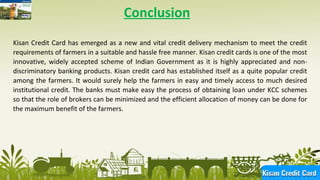
Conclusion
Kisan Credit Card has emerged as a new and vital credit delivery mechanism to meet the credit
requirements of farmers in a suitable and hassle free manner. Kisan credit cards is one of the most
innovative, widely accepted scheme of Indian Government as it is highly appreciated and non-
discriminatory banking products. Kisan credit card has established itself as a quite popular credit
among the farmers. It would surely help the farmers in easy and timely access to much desired
institutional credit. The banks must make easy the process of obtaining loan under KCC schemes
so that the role of brokers can be minimized and the efficient allocation of money can be done for
the maximum benefit of the farmers.
17
akshaym.makwana@gmail.com

Kisan Credit Card

  • 1.
  • 2.
    2 Introduction Reserve Bank ofIndia (RBI), along with National Bank for Agriculture and Rural Development (NABARD) initiated the conception of Kisan Credit Cards (KCC) in 1998-99, in order to assist agriculturists to have easily accessible cash credit facilities. it provides flexibility in terms of repayment, which can be rescheduled in the event of unforeseen incidents like a bad crop season, with term extensions for a period of up to four years, and so on. Kisan credit card is valid for up to five years and is dependent on the annual renewals.
  • 3.
    3 History KCC was firstproposed in the Budget 1998-99 by then Finance Minister Yashwant Sinha. Consequent to this, NABARD had prepared a Model Kisan Credit Card Scheme in consultation with the Major Banks on the basis of R V Gupta Committee. the farmers may use KCC to readily purchase agricultural inputs such as seeds, fertilizers, pesticides, etc. Accordingly, NABARD formulated a Model Kisan Credit Card Scheme in consultation with major banks.
  • 4.
    4 Reason behind theKCC Scheme There are several hurdles faced by farmers in the process of acquiring adequate finance from banks. such as: long drawn-out documentation and processing, complicated practices followed by banks, delay in processing and also lack of awareness among farmers regarding banking process. Most farmers depend on non-institutional means of credit for their immediate needs such as: purchase of seeds, fertilizers, pesticides and this in turn affects them negatively since non-institutional credit is costly and counter-productive.
  • 5.
    5 Objectives of KCC Post-harvest expenses  Produce Marketing loan  Consumption requirements of farmer household  To meet the short term credit requirements for cultivation of crops  Working capital for maintenance of farm assets and activities allied to agriculture, like dairy animals  Investment credit requirement for agriculture and allied activities like pump sets, sprayers, dairy animals
  • 6.
    6 Salient features Revolving cashcredit facility involving any number of drawals and repayments within the limit. Limit to be fixed on the basis of operational land holding, cropping pattern and scale of finance. Sub-limits may be fixed at the decision of banks. Card valid for 3 years subject to annual review. As incentive for good performance, credit limits could be enhanced to take care of increase in costs, change in cropping pattern, etc. Each drawal to be repaid within a maximum period of 12 months. Reschedulement of loans also permissible in case of damage to crops due to natural calamities. Security, margin, rate of interest, etc. as per RBI norms. Withdrawals through slips/cheques accompanied by card and passbook.
  • 7.
    7 How do KisanCredit Cards work  The operation of this facility is simple and straight-forward. Based on the land holdings and the income earned from it, banks issue farmers Kisan Credit Cards. The farmers should have a good credit history in order to be eligible for the same.  Those who receive the Kisan Credit Card, get facilities like: passbook, address, validity period, credit limit, etc., which serves as the customer’s unique identification as well as a system for tracking their transactions. This credit cards can be used at outlets, as well as to withdraw cash to make the necessary purchases. Eligibility for KCC i. All Farmers – Individuals / Joint borrowers who are owner cultivators ii. Self Help Groups of Tenant farmers. iii. Individual farmers will be issued with RuPay debit cards. iv. The party should not be a defaulter to any of the Financial Institutions
  • 8.
    8 Example for KCC SmallFarmer raising Multiple Crops in a year  Assumptions: A.Land holding: 2 acres  B.Cropping Pattern:  Paddy - 1 acre (Scale of finance plus crop insurance per acre: Rs.11000)        Sugarcane - 1 acre (Scale of finance plus crop insurance per acre: Rs.22,000) C.  Investment/Allied Activities: (i)Establishment of 1+1 Dairy Unit in 1st Year (Unit Cost:Rs.20,000 per animal)                          (ii)Replacement of Pump set in 3rd year (Unit Cost: Rs.30,000)   2. calculation : (i)Crop loan Component                     Cost of cultivation of 1 acre of Paddy and 1acre of Sugarcane (11,000+22,000)         : Rs.33,000   Add: 10% towards post-harvest/household expense/consumption: Rs. 3,300   Add: 20% towards farm maintenance: Rs. 6,600    Total Crop Loan limit for 1st year : Rs. 42,900 Loan Limit for 2nd year Add: 10% of the limit towards cost increase in scale of finance (10% of 42900 i.e 4300) : Rs. 4,300 : Rs. 47,200
  • 9.
    9 Loan Limit for3rd year Add: 10% of the limit towards cost increase in scale of finance (10% of 47,200 i.e., 4,700) : Rs. 4,700 : Rs. 51,900 Loan Limit for 4th year Add: 10% of the limit towards cost increase in scale of finance (10% of 51,900 i.e 5,200) : Rs. 5,200 : Rs.57,100 Loan Limit for 5th year Add: 10% of the limit towards cost increase in scale of finance (10% of 57100 i.e 5700) : Rs. 5,700 :Rs. 62,800 Say: Rs.63,000….(A) (ii) Term loan component:   1st Year: Cost of 1+1 Dairy Unit : Rs.40,000    3rd Year: Replacement of Pumpset : Rs. 30,000    Total term loan amount :Rs.70,000…….(B) Maximum Permissible Limit /Kisan Credit Card Limit (A) +(B) : Rs.1,33,000 Rs.1.33 lakh
  • 10.
    10 Rate of Interestfor KCC Bank Name Interest Rate State Bank of India 11.30% - 13.30% ICICI Bank 9.70% - 12% Axis Bank 9.90% to 13.65% Allahabad Bank 9.70% - 11.70% Indian Bank RuPay 7% Bank of Baroda 7% - 11.65% Security for KCC For loan up to Rs.1,50,000/- Hypothecation of crops/assets created out of our finance. For loans above Rs.1,50,000/- i) Hypothecation of crops/assets created out of our finance. ii) Mortgage of landed properties.
  • 11.
    11 Benefits to Banks This scheme is beneficial to banks since it is time and cost-efficient.  There is no need for an elaborate documentation process or continuous appraisals under the Kisan Credit Card Scheme.  Withdrawal of cash using the credit card requires very little paperwork and is simple and hassle-free for not just the card holder but for the Bank as well.  Some other highlights include: no transaction costs, lesser risks in loan recovery, etc.
  • 12.
    12 Insurance under KCCScheme Insurance Under Kisan Credit Card holders are covered by a personal accident insurance. This cover is available when the person enters the scheme. The cover is as follows:  Death: 50,000  Disability: 25,000  Maximum Age to enter: 70 years
  • 13.
    13 Advantages of theKCC Scheme  Access to adequate and timely credit to farmers.  Full year's credit requirement of the borrower taken care of.  Minimum paper work and simplification of documentation for drawal of funds from the bank.  Flexibility to draw cash and buy inputs.  Assured availability of credit at any time enabling reduced interest burden for the farmer.  Sanction of the facility for 3 years subject to annual review and satisfactory operations and provision for enhancement.
  • 14.
    14 Agency-wise and Period-wiseprogress of KCC (Rs. in crore)Year Coop. Bank RRBs Commercial Banks Overall No. of KCC issued Amount Sanctione d No. of KCC issued Amount Sanctione d No. of KCC issued Amount Sanctione d No. of KCC issued Amount Sanctioned Per KCC 1998-1999 1.55 826 0.6 11 6.22 1473 7.84 2310 1999-2000 35.95 3606 1.73 405 13.66 3537 51.34 7548 2000-2001 56.14 9412 6.48 1400 23.90 5615 86.52 16427 2001-2002 54.36 15952 8.34 2382 30.71 7524 93.41 25858 2002-2003 45.79 15841 9.64 2955 27.00 7481 82.43 26277 2003-2004 48.78 9855 12.73 2599 30.94 9331 92.47 21785 2004-2005 35.56 15597 17.29 3833 43.96 14756 96.80 34186 2005-2006 25.98 20339 12.49 8483 41.65 18779 80.12 47601 2006-2007 22.98 13141 14.06 7373 48.08 26215 85.11 46729 2007-2008 20.91 20492 17.73 9074 46.06 20421 84.70 49987 2008-2009 13.44 13172 14.14 7632 58.34 25865 85.92 46669 Cumulative 361.44 138233 114.69 46147 307.52 140997 846.66 325377
  • 15.
    15 Coverage of KCC- State-wise (in lakhs) States No. of operational Holdings (in lakhs) No. of card Issued (in lakhs) (% age) Estimated KCC (in lakhs) (% age) Orissa 40.67 49.34 121.32 24.87 61.15 West Bangal 67.90 31.08 45.77 27.09 39.90 Maharashtra 121.04 78.12 64.54 70.34 58.11 Gujarat 42.39 28.01 66.08 20.54 48.45 Rajasthan 58.19 47.57 81.75 37.77 64.91 Madhya Pradesh 73.58 50.68 68.90 42.57 57.87 Punjab 9.97 22.30 223.67 7.73 77.53 Haryana 15.28 23.48 153.66 11.34 74.21 UP 216.68 154.23 71.18 76.89 35.49 HP 9.14 3.25 35.56 2.64 28.88 AP 115.32 144.32 125.15 74.26 64.39 Karnataka 70.65 49.78 70.46 44.56 63.07 Kerala 65.75 30.54 46.45 28.44 43.25 Assam 27.12 4.81 17.74 3.64 13.42 Total 933.66 717.51 76.85 472.68 50.63
  • 16.
    16 Conclusion Kisan Credit Cardhas emerged as a new and vital credit delivery mechanism to meet the credit requirements of farmers in a suitable and hassle free manner. Kisan credit cards is one of the most innovative, widely accepted scheme of Indian Government as it is highly appreciated and non- discriminatory banking products. Kisan credit card has established itself as a quite popular credit among the farmers. It would surely help the farmers in easy and timely access to much desired institutional credit. The banks must make easy the process of obtaining loan under KCC schemes so that the role of brokers can be minimized and the efficient allocation of money can be done for the maximum benefit of the farmers.
  • 17.