Children are growing up in a digital
world, surrounded bymobile devices,
TV& computers.
Follow these recommendations to find
a safe balance for your child’s developing
mind in a world full of screens.
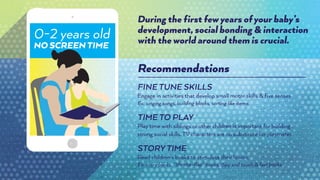
FINE TUNE SKILLS
Engage in activities that develop small motor skills & five senses
Ex: singing songs, building blocks, sorting like items.
TIME TO PLAY
Play time with siblings or other children is important for building
strong social skills. TV characters are no substitute for playmates.
STORYTIME
Read children’s books to stimulate their brains.
Ex: story books, “lift-the-flap” books, iSpy and touch & feel books.
0-18 months old
NO SCREENTIME
(Exceptvideo chatwith loved ones)
Recommendations
During the first fewyears ofyourbaby’s
development, social bonding & interaction
with theworld around them is crucial.
LIVE VIDEO CHAT EXCEPTION
The benefit of a virtual visit "conversations" with a favorite relative
outweighs the cost of exposing your child to the screen.
15 months - 2 years old
LIMITED SCREEN
TIMEW/ PARENT
VIEW TOGETHER
If you choose to introduce your child to digital media,
it's always best to consume it together.
REINFORCE THE LESSON
Repeat what the video says and/or draw attention to what is on
the screen to ensure they are learning along with the content.
GUIDE THEIR EXPERIENCE
Treat a video or app like you would a picture book. Make screen
time an interactive learning activity you can share together.
Recommendations
Baby's development is still important.
Ifusing a screen use it togetheras a
learning tool.
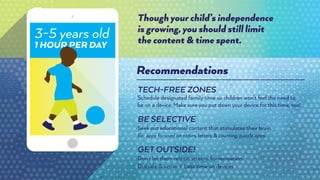
TECH-FREE ZONES
Schedule designated family time so children won’t feel the need to be on
a device. Make sure you put down your device for this time, too!
BE SELECTIVE
Focus on finding evidence-based children's educational media like
Sesame Workshop or PBS published apps/videos.
CO-VIEW CONTENT
Still co-view with your kids so you know what they are seeing
& help them apply it to the world around them.
GET OUTSIDE!
Don’t rely on screens for recreation. Outside & active = Less time on devices
Thoughyourchild’s independence
is growing,you should still limit
the content & time spent.2-5 years old
1 HOUR PER DAY
Recommendations
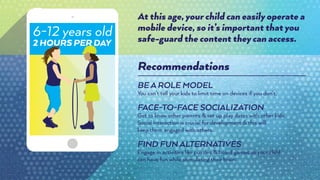
6-12 years old
2 HOURS PER DAY
BE A ROLE MODEL
You can’t tell your kids to limit time on devices if you don’t.
FACE-TO-FACE SOCIALIZATION
Get to know other parents & set up play dates with other kids.
Social interaction is crucial for development & this will
keep them engaged with others.
FIND FUN ALTERNATIVES
Engage in activities like puzzles & board games so your child
can have fun while stimulating their brain.
Recommendations
At this age,yourchild can easilyoperate a
mobile device, so it’s important thatyou
safe-guard the content theycan access.
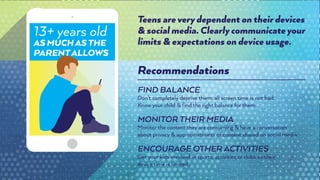
13+ years old
AS MUCHASTHE
PARENTALLOWS
FIND BALANCE
Don’t completely deprive them: all screen time is not bad.
Know your child & find the right balance for them.
MONITOR THEIR MEDIA
Monitor the content they are consuming & have a conversation
about privacy & appropriateness of content shared on social media.
ENCOURAGE OTHER ACTIVITIES
Get your kids involved in sports, activities or clubs so their
device time is limited.
Recommendations
Teens areverydependent on theirdevices
& social media. Clearlycommunicateyour
limits & expectations on device usage.
TOO MUCH SCREEN TIME CAN LEAD TO...
Obesity
Weight issues may occur at a younger age
Lack of exercise will reduce the development of social, sensory,
intellectual, auditory and perceptual-motor skills
Overeating while watching TV is commonly a bad habit that develops
Irregularsleep
Behavioral problems
Poor academic performance
Violence
Less time for real play
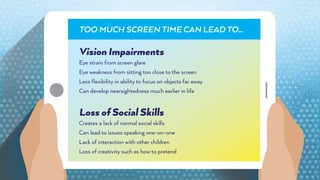
TOO MUCH SCREEN TIME CAN LEAD TO...
Vision Impairments
Eye strain from screen glare
Eye weakness from sitting too close to the screen
Less flexibility in ability to focus on objects far away
Can develop nearsightedness much earlier in life
Loss ofSocial Skills
Creates a lack of normal social skills
Can lead to issues speaking one-on-one
Lack of interaction with other children
Loss of creativity such as how to pretend

Kids & Screen Time

  • 2.
    Children are growingup in a digital world, surrounded bymobile devices, TV& computers. Follow these recommendations to find a safe balance for your child’s developing mind in a world full of screens.
  • 3.
    FINE TUNE SKILLS Engagein activities that develop small motor skills & five senses Ex: singing songs, building blocks, sorting like items. TIME TO PLAY Play time with siblings or other children is important for building strong social skills. TV characters are no substitute for playmates. STORYTIME Read children’s books to stimulate their brains. Ex: story books, “lift-the-flap” books, iSpy and touch & feel books. 0-18 months old NO SCREENTIME (Exceptvideo chatwith loved ones) Recommendations During the first fewyears ofyourbaby’s development, social bonding & interaction with theworld around them is crucial. LIVE VIDEO CHAT EXCEPTION The benefit of a virtual visit "conversations" with a favorite relative outweighs the cost of exposing your child to the screen.
  • 4.
    15 months -2 years old LIMITED SCREEN TIMEW/ PARENT VIEW TOGETHER If you choose to introduce your child to digital media, it's always best to consume it together. REINFORCE THE LESSON Repeat what the video says and/or draw attention to what is on the screen to ensure they are learning along with the content. GUIDE THEIR EXPERIENCE Treat a video or app like you would a picture book. Make screen time an interactive learning activity you can share together. Recommendations Baby's development is still important. Ifusing a screen use it togetheras a learning tool.
  • 5.
    TECH-FREE ZONES Schedule designatedfamily time so children won’t feel the need to be on a device. Make sure you put down your device for this time, too! BE SELECTIVE Focus on finding evidence-based children's educational media like Sesame Workshop or PBS published apps/videos. CO-VIEW CONTENT Still co-view with your kids so you know what they are seeing & help them apply it to the world around them. GET OUTSIDE! Don’t rely on screens for recreation. Outside & active = Less time on devices Thoughyourchild’s independence is growing,you should still limit the content & time spent.2-5 years old 1 HOUR PER DAY Recommendations
  • 6.
    6-12 years old 2HOURS PER DAY BE A ROLE MODEL You can’t tell your kids to limit time on devices if you don’t. FACE-TO-FACE SOCIALIZATION Get to know other parents & set up play dates with other kids. Social interaction is crucial for development & this will keep them engaged with others. FIND FUN ALTERNATIVES Engage in activities like puzzles & board games so your child can have fun while stimulating their brain. Recommendations At this age,yourchild can easilyoperate a mobile device, so it’s important thatyou safe-guard the content theycan access.
  • 7.
    13+ years old ASMUCHASTHE PARENTALLOWS FIND BALANCE Don’t completely deprive them: all screen time is not bad. Know your child & find the right balance for them. MONITOR THEIR MEDIA Monitor the content they are consuming & have a conversation about privacy & appropriateness of content shared on social media. ENCOURAGE OTHER ACTIVITIES Get your kids involved in sports, activities or clubs so their device time is limited. Recommendations Teens areverydependent on theirdevices & social media. Clearlycommunicateyour limits & expectations on device usage.
  • 8.
    TOO MUCH SCREENTIME CAN LEAD TO... Obesity Weight issues may occur at a younger age Lack of exercise will reduce the development of social, sensory, intellectual, auditory and perceptual-motor skills Overeating while watching TV is commonly a bad habit that develops Irregularsleep Behavioral problems Poor academic performance Violence Less time for real play
  • 9.
    TOO MUCH SCREENTIME CAN LEAD TO... Vision Impairments Eye strain from screen glare Eye weakness from sitting too close to the screen Less flexibility in ability to focus on objects far away Can develop nearsightedness much earlier in life Loss ofSocial Skills Creates a lack of normal social skills Can lead to issues speaking one-on-one Lack of interaction with other children Loss of creativity such as how to pretend