The Brain
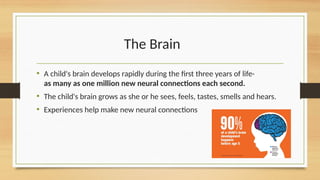
• Achild's brain develops rapidly during the first three years of life-
as many as one million new neural connections each second.
• The child's brain grows as she or he sees, feels, tastes, smells and hears.
• Experiences help make new neural connections
3.
Advantages of Technology
•Enhances children’s interest in and interaction with content
• Compliments children’s visual and auditory learning styles
• Helps develop curiosity and problem-solving skills
• Allows for more modes of communication (i.e. video chat, texting, e-mail)
• Improves access to information
4.
Disadvantages of Technology
•Access to inappropriate content
• Can take time away from exploring, playing, and social interaction.
May correlate with delays in learning and social skills
• Distraction
• Health and weight issues
• Behavior problems
5.
TV vs. Computers
•TV tends to be more passive
• Computers can be more interactive and activities can
be repeated if desired
• Both pose a concern regarding controlling access to
content
Myth
Make sure that:
-Content is age-appropriate
- Viewing time is limited
- Parents/Caregivers are involved
Fact or Myth- All Screen Time is Damaging to
Early Learning
8.
Fact or Myth-Children are Impacted by TV that
Plays in the Background
Fact
Background noises and lights effect children’s language
development, cognitive development, and executive
functioning.
9.
Fact or Myth-TV at Bedtime Can Help Put
Children to Sleep
Myth
Viewing TV within 2 hours of bedtime can make it
harder for children to fall asleep.
10.
Fact or Myth-The More Interactive a Screen
Experience is, the Better for Kids
Myth
Too many interactive features interferes with
children’s ability to focus on the storyline. It’s
important for parents to help children focus on
the story and not allow the technology to drive
the experience.
11.
Fact or Myth-Television Plays a Limited Role
in Learning
Fact
Although children may learn some concepts from
watching educational programming, they learn
best from hands-on, relational experiences.
12.
Recommended Screen Time
TheAmerican Academy of Pediatrics recommends no television (or screen media such as
computer games, videos, or DVDs) for children under 2.
• Birth through 18 months
Avoid all screen media—phones, tablets, TVs and computers. (It’s OK to video chat with
grandparents and far-away friends.)
• 18 months to 2 years
It is OK to introduce young children to high-quality children’s media if you watch it with them
and help them understand what they’re seeing.
• 2 to 5 years
Limit screen use to one hour a day of high-quality programs designed for children. Watch with
your children; explain what they’re seeing and how it applies to the world around them.
13.
Ways to LimitScreen Time
• Keep the TV/computer out of sight
• Put TV/computer in rooms not used by children
• Replace screen time with fun, interactive activities
• Play outside
• Turn on music and dance
• Bring kids into the kitchen and let them help you set the table, cook, and
clean up
14.
Choosing Age-Appropriate TVor Youtube
Shows
• Age-appropriate programs in which:
• Characters occasionally speak directly to children.
• Characters ask children to participate in the show
in some way (e.g., repeating a word).
• There's a strong storyline and storybook structure
(beginning, middle, end) are also good.
15.
Tips on UsingMedia to Support Early Learning
• Watch the program together
• Ask questions and talk about what you’re watching
• Answer children’s questions
• Point out and name things they see on the screen
(“The bear is so hungry. He is eating everything up!”)
16.
Tips on UsingMedia to Support Early
Learning
• Connect what children see on TV to their real lives
• Point out and name objects in real life that
he/she’s seen on the TV, phone, or tablet
• “Do you remember we watched a show about a
mail carrier this morning? Here comes our mail
carrier!”
17.
Tips on UsingMedia to Support Early
Learning
• Be active while you watch (dance to the music,
hop around like bunnies, etc.)
• Act out the story
• Use puppets or make up your own story to act
out together
#1 Talk about how Technology is a new field and we are still learning.
Talk about Mo and is discussion with me on creativity.
#2 We know that an immense amount of brain development is happening for children from birth to 3. It’s actually the most influential time of a child’s life when the neural pathways are forming and strengthening through the mylenation process.
Each time the child uses one of the senses, a neural connection is made in the child's brain. New experiences repeated many times help make new connections, which shape the way the child thinks, feels, behaves and learns now and in the future.
Phrase: Neurons that fire together, wire together
#3 Talk about the senses: 5 plus proprioceptive and vestibular
Meets needs of preference for visually presented information
Facetime and connection to family not close by
Accessibility for children who are nonverbal or who may experience anxiety around others
#4 Delays in learning and social skills: Children who watch too much TV in infancy and preschool years can show delays in attention, thinking, language, and social skills. Reason- interact less with parents and family
Distraction: increase in stimuli actually is shifting how long we can attend to one thing. Example, the average attention span is two minutes.
Health/weight issues: food advertising and snacking while watching TV can promote obesity. Children who oversuse media are less apt to be active with health, physical play.
Behavior problems: Violent content on TV can contribute to behavior problems because they're either scared/confused by what they see, or they try to mimic on-screen characters
#5 These have to be done in supervision of an adult because there are pitfalls such as exposure to extreme violence and destructive concepts such as racism, misogyny or age-inappropriate sexuality.
#7 Although children learn best through hands-on exploration, the reality is that most young children are exposed to screen media at a very young age and can learn from these experiences. What is most important is that...
Well-designed television programs, such as Sesame Street, can improve cognitive, literacy, and social outcomes for children 3 to 5 years of age- http://pediatrics.aappublications.org/content/138/5/e20162591
Watching educational TV before a child was 3 years old was not related to later attentional problems, but watching violent or nonviolent entertainment programming (e.g., cartoons, children’s movies, situation comedies) was related (Zimmerman &Christakis, 2007).
#8 TVs offer loud voices, flashing lights and noise! Young children already have to sort out and make sense of so much information. Focusing is easier without the TV. Try to limit TV in the background when young children are playing and make sure to turn off the TV when no one is watching.
Just having the TV on in the background, even if "no one is watching it," is enough to delay language development. Normally a parent speaks about 940 words per hour when a toddler is around. With the television on, that number falls by 770! Fewer words means less learning.
#9 Overstimulates and arouses their brain, making it harder to relax and fall asleep.
Researchers also indicated that the backlighting from TV and gaming system screens can affect children’s circadian rhythms. Remember, our circadian rhythms are responsible for telling us when it’s time to fall asleep and time to wake up, so anything that throws off our circadian rhythms throws off sleep, too.
#10
Digital books (also called “eBooks,” books that can be read on a screen) often come with interactive enhancements that, research suggests, may decrease child comprehension of content or parent dialogic reading interactions when visual effects are distracting.17 Parents should, therefore, be instructed to interact with children during eBook reading, as they would a print book.
#11 touching, feeling, shaking, stacking, problem solving—with people they care about. Consider the different ways we learn: auditory, tactile, kinesthetic, visual, etc.
#12 It takes around 18 months for a baby's brain to develop to the point where the symbols on a screen represent something for them in the real world.
Children learn best through interactions with other people
A toddler learns a lot more from banging pans on the floor while you cook dinner than he does from watching a screen for the same amount of time, because every now and then the two of you look at each other.
#15 Your child learns most from his interactions with you. The conversations you have with your child are far more educational than mobile apps—even those designed for learning. Your child points to something that interests him, and you talk about it. Learning is connected to the feeling of being loved and supported as you discover the world together.
Talk about the program. Ask 2- and 3-year-olds what they thought the show was about, which characters they liked and disliked, how it made them feel. Watch TV or use media with your child. In the same way that reading picture books has traditionally been a shared parent–child activity in middle-class Western culture, watching video together can be an opportunity for interaction. In addition, video that incorporates a dialogic questioner holds promise to promote very young children’s talking, thinking, and learning.
Answer children’s questions. Children are still figuring out new ideas and concepts. Sometimes they need your help to make sense of what they’re seeing on the screen.
https://www.zerotothree.org/resources/318-making-good-decisions-about-television-and-screen-time-for-young-children
Another wrinkle in the story was that
toddlers who watched episodes of Sesame
Street over and over (on DVDs or videotapes)
had better language outcomes than those who
watched the TV broadcast of the program
(i.e., saw each episode only once; linebarger
& Vaala, 2010). This study highlighted
one way to promote very young children’s
learning from video—giving repeated
experience with the same challenging
content. Similar good results of repetition
have been found with lab-developed teaching
videos (Barr, Muentener, garcia, Fujimoto,
& Chávez, 2007; Strouse & Troseth, 2008).
Repeated exposure to the same content gives
children multiple opportunities to learn
the new information, notice and store more
details, and make connections to what they
already know (Strouse, O’Doherty, & Troseth,
in press).
Research has indicated that young children’s learning from video is not very efficient but that watching the same video more than once is helpful (fortunately, something children like to do).
#16 Your child learns most from her experiences in the real world. She learns by exploring, using her whole body and all her senses. A bird hopping along the sidewalk, a crackly leaf or a juicy red apple are easier for her to understand and remember than the objects she sees on a screen. Help your child connect what she sees on-screen with what she sees in the real world. Point out and name objects in real life that she’s seen on the TV, phone or tablet.
#17 When the show is over, turn off the TV and act out the story. Use puppets to tell the story, or make up your own story to act out together.