
Glucose-6-phosphate
Dehydrogenase deficiency
( G6PD Deficiency)
Khan Arbaz Ali
Outline
• Introduction
• Definition
• History
• Principle
• Genetics
• Physiology & Pathophysiolgy
• Causes
• Sign and symptoms
• Diagnostic test (DX)
• Treatment (RX)
Introduction
• Most common human enzyme defect
• Present in more than 400 million people
world wide
• Distribution similar to malaria
• X-linked, hereditary genetic defect due to
mutations in the G6PD gene
• More than 140 mutations of the G6PD gene
have been identified.
Definition
• It is an inherited disease characterized by
hemolytic anemia caused by inability to
detoxify oxidized agents.
• ‘‘G6PD deficiency is an inherited condition in
which the enzyme doesn’t have enough
activity to detoxify (ROS) Reactive oxygen
species especially in RBCs.
History
• In 1931 German Biochemist Warburg and
Christian discovered G6PD
• They isolated G6PD enzyme from brewers
yeast
• His deficiency was first reported in 1956 by
Alving at al.
Principle
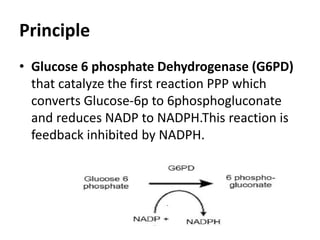
• Glucose 6 phosphate Dehydrogenase (G6PD)
that catalyze the first reaction PPP which
converts Glucose-6p to 6phosphogluconate
and reduces NADP to NADPH.This reaction is
feedback inhibited by NADPH.
Genetics:
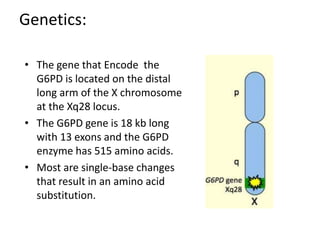
• The gene that Encode the
G6PD is located on the distal
long arm of the X chromosome
at the Xq28 locus.
• The G6PD gene is 18 kb long
with 13 exons and the G6PD
enzyme has 515 amino acids.
• Most are single-base changes
that result in an amino acid
substitution.
Gene variants
• G6PD variants are caused by point mutation in
the G6PD gene.
• Some of their point mutation do not disturb
active site of the enzyme but may or may not
reduce the active site activity of enzyme
• Three possible result of mutation
• Altered catalytic activity
• Decrease stability
• Or alteration in binding affinity for NADP+
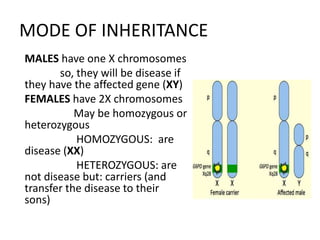
MODE OF INHERITANCE
MALES have one X chromosomes
so, they will be disease if
they have the affected gene (XY)
FEMALES have 2X chromosomes
May be homozygous or
heterozygous
HOMOZYGOUS: are
disease (XX)
HETEROZYGOUS: are
not disease but: carriers (and
transfer the disease to their
sons)
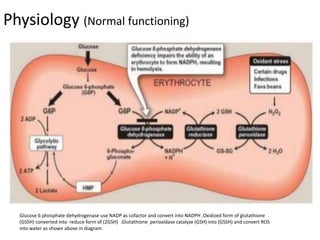
Physiology (Normal functioning)
Glucose 6 phosphate dehydrogenase use NADP as cofactor and convert into NADPH .Oxidized form of glutathione
(GSSH) converted into reduce form of (2GSH) .Glutathione perioxidase catalyze (GSH) into (GSSH) and convert ROS
into water as shown above in diagram.
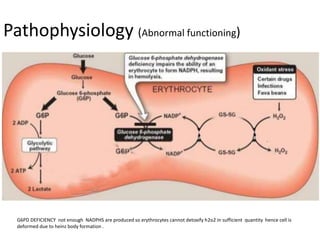
Pathophysiology (Abnormal functioning)
G6PD DEFICIENCY not enough NADPHS are produced so erythrocytes cannot detoxify h2o2 in sufficient quantity hence cell is
deformed due to heinz body formation .
Hemolytic anemia
• Anemia develops when
the spleen traps and
destroys red blood cells.
• An anemic response can
occur when G6PD
deficient individual
takes oxidative drugs or
fava beans.
• How it happen look
right side of this slide
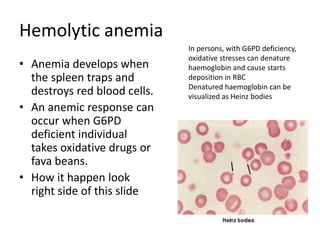
In persons, with G6PD deficiency,
oxidative stresses can denature
haemoglobin and cause starts
deposition in RBC
Denatured haemoglobin can be
visualized as Heinz bodies
Favism
• Favism usually result of
ingestion of fresh uncooked
fava beans although it can
occur with dried cooked
canned or frozen beans.
• Acute intravassuclar
hemolysis develop within 5-
24 hours after ingestion.
• Fall in hemoglobin is fatal in
severe and acute condition
if blood transfusion is not
performed.
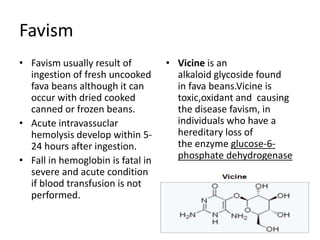
• Vicine is an
alkaloid glycoside found
in fava beans.Vicine is
toxic,oxidant and causing
the disease favism, in
individuals who have a
hereditary loss of
the enzyme glucose-6-
phosphate dehydrogenase
Why Erthyrocytes are only affected
• Other cells are also G6PD Deficient
• Malate Dehydrogenase (NADP+) (EC 1.1.1.82)
they have another source of NADPH production
• Superoxide Dismutase (SOD, EC 1.15.1.1)
superoxide (O2
−) radical into either ordinary
molecular oxygen (O2) or Hydrogen peroxide (H2O2)
• Catalase (EC 1.11.1.6) It catalyzes the
Decomposition of hydrogen peroxide
to water and oxygen 2 H2O2 → 2 H2O + O2
Causes
• RBCs destruction can be triggered by infections,
certain foods(such as fava beans) and certain
drugs, including:
• Genetic abnormality
• Antimalarial drugs
• Aspirin
• Nitrofuranton
• NSAIDs
• Quinine
• Sulfa drugs
Diagnostic tests
• A blood test can be done to check the level of
G6PD
• Others tests maybe done include:
• Bilirubin level
• Complete blood count, including RBCs count
• Haemoglobin – blood
• Haemoglobin – urine
• LDH test
Sign and symptoms
• People with this condition do not display any sign of
the disease until their RBCs are exposed to certain
chemicals in food or medicine or stress.
symptoms are more common in men and may include:
• Dark urine
• Enlarged spleen
• Fatigue
• Rapid heart rate
• Shortness of breath
• Palpitations
Treatment
• Blood transfusion
• Uses of antioxidant
• Vitamin E and selenium used as antioxidant drugs
• Splenectomy
• Prevention of haemolysis by prompt treatment
infection.
• Avoidance of oxidant drugs and toxin:
• Sulfonamide (drugs)
• Naphthalene (toxin)
• Genetic modified fava beans can be used .
Khan arbaz ali

Khan arbaz ali

  • 1.
  • 2.
    Outline • Introduction • Definition •History • Principle • Genetics • Physiology & Pathophysiolgy • Causes • Sign and symptoms • Diagnostic test (DX) • Treatment (RX)
  • 3.
    Introduction • Most commonhuman enzyme defect • Present in more than 400 million people world wide • Distribution similar to malaria • X-linked, hereditary genetic defect due to mutations in the G6PD gene • More than 140 mutations of the G6PD gene have been identified.
  • 4.
    Definition • It isan inherited disease characterized by hemolytic anemia caused by inability to detoxify oxidized agents. • ‘‘G6PD deficiency is an inherited condition in which the enzyme doesn’t have enough activity to detoxify (ROS) Reactive oxygen species especially in RBCs.
  • 5.
    History • In 1931German Biochemist Warburg and Christian discovered G6PD • They isolated G6PD enzyme from brewers yeast • His deficiency was first reported in 1956 by Alving at al.
  • 6.
    Principle • Glucose 6phosphate Dehydrogenase (G6PD) that catalyze the first reaction PPP which converts Glucose-6p to 6phosphogluconate and reduces NADP to NADPH.This reaction is feedback inhibited by NADPH.
  • 7.
    Genetics: • The genethat Encode the G6PD is located on the distal long arm of the X chromosome at the Xq28 locus. • The G6PD gene is 18 kb long with 13 exons and the G6PD enzyme has 515 amino acids. • Most are single-base changes that result in an amino acid substitution.
  • 8.
    Gene variants • G6PDvariants are caused by point mutation in the G6PD gene. • Some of their point mutation do not disturb active site of the enzyme but may or may not reduce the active site activity of enzyme • Three possible result of mutation • Altered catalytic activity • Decrease stability • Or alteration in binding affinity for NADP+
  • 9.
    MODE OF INHERITANCE MALEShave one X chromosomes so, they will be disease if they have the affected gene (XY) FEMALES have 2X chromosomes May be homozygous or heterozygous HOMOZYGOUS: are disease (XX) HETEROZYGOUS: are not disease but: carriers (and transfer the disease to their sons)
  • 10.
    Physiology (Normal functioning) Glucose6 phosphate dehydrogenase use NADP as cofactor and convert into NADPH .Oxidized form of glutathione (GSSH) converted into reduce form of (2GSH) .Glutathione perioxidase catalyze (GSH) into (GSSH) and convert ROS into water as shown above in diagram.
  • 11.
    Pathophysiology (Abnormal functioning) G6PDDEFICIENCY not enough NADPHS are produced so erythrocytes cannot detoxify h2o2 in sufficient quantity hence cell is deformed due to heinz body formation .
  • 12.
    Hemolytic anemia • Anemiadevelops when the spleen traps and destroys red blood cells. • An anemic response can occur when G6PD deficient individual takes oxidative drugs or fava beans. • How it happen look right side of this slide In persons, with G6PD deficiency, oxidative stresses can denature haemoglobin and cause starts deposition in RBC Denatured haemoglobin can be visualized as Heinz bodies
  • 13.
    Favism • Favism usuallyresult of ingestion of fresh uncooked fava beans although it can occur with dried cooked canned or frozen beans. • Acute intravassuclar hemolysis develop within 5- 24 hours after ingestion. • Fall in hemoglobin is fatal in severe and acute condition if blood transfusion is not performed. • Vicine is an alkaloid glycoside found in fava beans.Vicine is toxic,oxidant and causing the disease favism, in individuals who have a hereditary loss of the enzyme glucose-6- phosphate dehydrogenase
  • 14.
    Why Erthyrocytes areonly affected • Other cells are also G6PD Deficient • Malate Dehydrogenase (NADP+) (EC 1.1.1.82) they have another source of NADPH production • Superoxide Dismutase (SOD, EC 1.15.1.1) superoxide (O2 −) radical into either ordinary molecular oxygen (O2) or Hydrogen peroxide (H2O2) • Catalase (EC 1.11.1.6) It catalyzes the Decomposition of hydrogen peroxide to water and oxygen 2 H2O2 → 2 H2O + O2
  • 15.
    Causes • RBCs destructioncan be triggered by infections, certain foods(such as fava beans) and certain drugs, including: • Genetic abnormality • Antimalarial drugs • Aspirin • Nitrofuranton • NSAIDs • Quinine • Sulfa drugs
  • 16.
    Diagnostic tests • Ablood test can be done to check the level of G6PD • Others tests maybe done include: • Bilirubin level • Complete blood count, including RBCs count • Haemoglobin – blood • Haemoglobin – urine • LDH test
  • 17.
    Sign and symptoms •People with this condition do not display any sign of the disease until their RBCs are exposed to certain chemicals in food or medicine or stress. symptoms are more common in men and may include: • Dark urine • Enlarged spleen • Fatigue • Rapid heart rate • Shortness of breath • Palpitations
  • 18.
    Treatment • Blood transfusion •Uses of antioxidant • Vitamin E and selenium used as antioxidant drugs • Splenectomy • Prevention of haemolysis by prompt treatment infection. • Avoidance of oxidant drugs and toxin: • Sulfonamide (drugs) • Naphthalene (toxin) • Genetic modified fava beans can be used .