THE RELATIONAL MODEL AND KEYS
WHY STUDY THE RELATIONAL MODEL?
 Most widely used model.
 Vendors: IBM, Informix, Microsoft, Oracle,
Sybase, etc.
 “Legacy systems” in older models
 E.G., IBM’s IMS (hierarchical model)
 Recent competitor: object-oriented model
 ObjectStore, Versant, Ontos, O2
 A synthesis emerging: object-relational model
 Informix UDS, UniSQL, Oracle, DB2
RELATIONAL DATABASE: DEFINITIONS
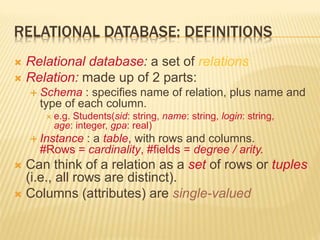
 Relational database: a set of relations
 Relation: made up of 2 parts:
 Schema : specifies name of relation, plus name and
type of each column.
 e.g. Students(sid: string, name: string, login: string,
age: integer, gpa: real)
 Instance : a table, with rows and columns.
#Rows = cardinality, #fields = degree / arity.
 Can think of a relation as a set of rows or tuples
(i.e., all rows are distinct).
 Columns (attributes) are single-valued
EXAMPLE INSTANCE OF STUDENTS
RELATION
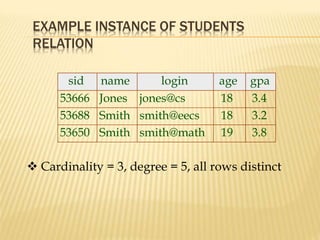
sid name login age gpa
53666 Jones jones@cs 18 3.4
53688 Smith smith@eecs 18 3.2
53650 Smith smith@math 19 3.8
 Cardinality = 3, degree = 5, all rows distinct
CREATING RELATIONS IN SQL
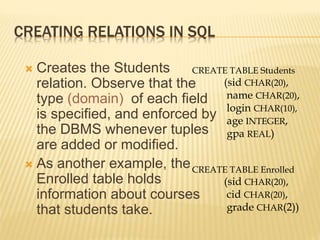
 Creates the Students
relation. Observe that the
type (domain) of each field
is specified, and enforced by
the DBMS whenever tuples
are added or modified.
 As another example, the
Enrolled table holds
information about courses
that students take.
CREATE TABLE Students
(sid CHAR(20),
name CHAR(20),
login CHAR(10),
age INTEGER,
gpa REAL)
CREATE TABLE Enrolled
(sid CHAR(20),
cid CHAR(20),
grade CHAR(2))
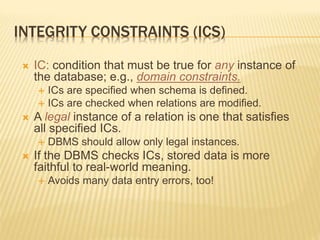
INTEGRITY CONSTRAINTS (ICS)
 IC: condition that must be true for any instance of
the database; e.g., domain constraints.
 ICs are specified when schema is defined.
 ICs are checked when relations are modified.
 A legal instance of a relation is one that satisfies
all specified ICs.
 DBMS should allow only legal instances.
 If the DBMS checks ICs, stored data is more
faithful to real-world meaning.
 Avoids many data entry errors, too!
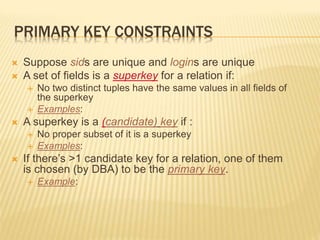
PRIMARY KEY CONSTRAINTS
 Suppose sids are unique and logins are unique
 A set of fields is a superkey for a relation if:
 No two distinct tuples have the same values in all fields of
the superkey
 Examples:
 A superkey is a (candidate) key if :
 No proper subset of it is a superkey
 Examples:
 If there’s >1 candidate key for a relation, one of them
is chosen (by DBA) to be the primary key.
 Example:
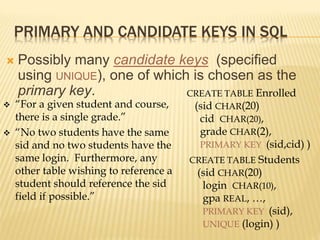
PRIMARY AND CANDIDATE KEYS IN SQL
 Possibly many candidate keys (specified
using UNIQUE), one of which is chosen as the
primary key. CREATE TABLE Enrolled
(sid CHAR(20)
cid CHAR(20),
grade CHAR(2),
PRIMARY KEY (sid,cid) )
 “For a given student and course,
there is a single grade.”
 “No two students have the same
sid and no two students have the
same login. Furthermore, any
other table wishing to reference a
student should reference the sid
field if possible.”
CREATE TABLE Students
(sid CHAR(20)
login CHAR(10),
gpa REAL, …,
PRIMARY KEY (sid),
UNIQUE (login) )
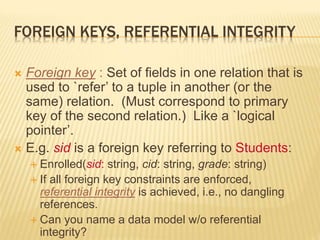
FOREIGN KEYS, REFERENTIAL INTEGRITY
 Foreign key : Set of fields in one relation that is
used to `refer’ to a tuple in another (or the
same) relation. (Must correspond to primary
key of the second relation.) Like a `logical
pointer’.
 E.g. sid is a foreign key referring to Students:
 Enrolled(sid: string, cid: string, grade: string)
 If all foreign key constraints are enforced,
referential integrity is achieved, i.e., no dangling
references.
 Can you name a data model w/o referential
integrity?
FOREIGN KEYS IN SQL
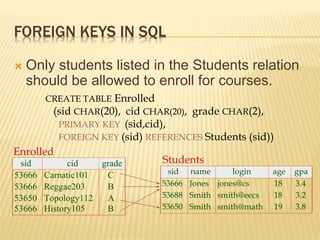
 Only students listed in the Students relation
should be allowed to enroll for courses.
CREATE TABLE Enrolled
(sid CHAR(20), cid CHAR(20), grade CHAR(2),
PRIMARY KEY (sid,cid),
FOREIGN KEY (sid) REFERENCES Students (sid))
sid name login age gpa
53666 Jones jones@cs 18 3.4
53688 Smith smith@eecs 18 3.2
53650 Smith smith@math 19 3.8
sid cid grade
53666 Carnatic101 C
53666 Reggae203 B
53650 Topology112 A
53666 History105 B
Enrolled
Students
ENFORCING REFERENTIAL INTEGRITY
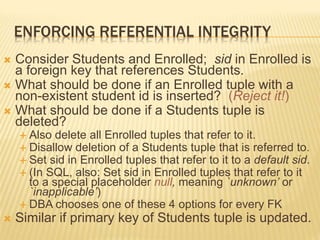
 Consider Students and Enrolled; sid in Enrolled is
a foreign key that references Students.
 What should be done if an Enrolled tuple with a
non-existent student id is inserted? (Reject it!)
 What should be done if a Students tuple is
deleted?
 Also delete all Enrolled tuples that refer to it.
 Disallow deletion of a Students tuple that is referred to.
 Set sid in Enrolled tuples that refer to it to a default sid.
 (In SQL, also: Set sid in Enrolled tuples that refer to it
to a special placeholder null, meaning `unknown’ or
`inapplicable’)
 DBA chooses one of these 4 options for every FK
 Similar if primary key of Students tuple is updated.
REFERENTIAL INTEGRITY IN SQL/92
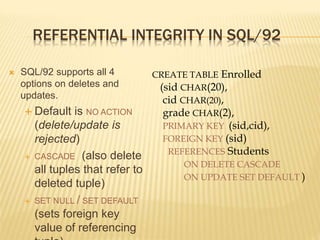
 SQL/92 supports all 4
options on deletes and
updates.
 Default is NO ACTION
(delete/update is
rejected)
 CASCADE (also delete
all tuples that refer to
deleted tuple)
 SET NULL / SET DEFAULT
(sets foreign key
value of referencing
CREATE TABLE Enrolled
(sid CHAR(20),
cid CHAR(20),
grade CHAR(2),
PRIMARY KEY (sid,cid),
FOREIGN KEY (sid)
REFERENCES Students
ON DELETE CASCADE
ON UPDATE SET DEFAULT )

Keys.ppt

  • 1.
  • 2.
    WHY STUDY THERELATIONAL MODEL?  Most widely used model.  Vendors: IBM, Informix, Microsoft, Oracle, Sybase, etc.  “Legacy systems” in older models  E.G., IBM’s IMS (hierarchical model)  Recent competitor: object-oriented model  ObjectStore, Versant, Ontos, O2  A synthesis emerging: object-relational model  Informix UDS, UniSQL, Oracle, DB2
  • 3.
    RELATIONAL DATABASE: DEFINITIONS Relational database: a set of relations  Relation: made up of 2 parts:  Schema : specifies name of relation, plus name and type of each column.  e.g. Students(sid: string, name: string, login: string, age: integer, gpa: real)  Instance : a table, with rows and columns. #Rows = cardinality, #fields = degree / arity.  Can think of a relation as a set of rows or tuples (i.e., all rows are distinct).  Columns (attributes) are single-valued
  • 4.
    EXAMPLE INSTANCE OFSTUDENTS RELATION sid name login age gpa 53666 Jones jones@cs 18 3.4 53688 Smith smith@eecs 18 3.2 53650 Smith smith@math 19 3.8  Cardinality = 3, degree = 5, all rows distinct
  • 5.
    CREATING RELATIONS INSQL  Creates the Students relation. Observe that the type (domain) of each field is specified, and enforced by the DBMS whenever tuples are added or modified.  As another example, the Enrolled table holds information about courses that students take. CREATE TABLE Students (sid CHAR(20), name CHAR(20), login CHAR(10), age INTEGER, gpa REAL) CREATE TABLE Enrolled (sid CHAR(20), cid CHAR(20), grade CHAR(2))
  • 6.
    INTEGRITY CONSTRAINTS (ICS) IC: condition that must be true for any instance of the database; e.g., domain constraints.  ICs are specified when schema is defined.  ICs are checked when relations are modified.  A legal instance of a relation is one that satisfies all specified ICs.  DBMS should allow only legal instances.  If the DBMS checks ICs, stored data is more faithful to real-world meaning.  Avoids many data entry errors, too!
  • 7.
    PRIMARY KEY CONSTRAINTS Suppose sids are unique and logins are unique  A set of fields is a superkey for a relation if:  No two distinct tuples have the same values in all fields of the superkey  Examples:  A superkey is a (candidate) key if :  No proper subset of it is a superkey  Examples:  If there’s >1 candidate key for a relation, one of them is chosen (by DBA) to be the primary key.  Example:
  • 8.
    PRIMARY AND CANDIDATEKEYS IN SQL  Possibly many candidate keys (specified using UNIQUE), one of which is chosen as the primary key. CREATE TABLE Enrolled (sid CHAR(20) cid CHAR(20), grade CHAR(2), PRIMARY KEY (sid,cid) )  “For a given student and course, there is a single grade.”  “No two students have the same sid and no two students have the same login. Furthermore, any other table wishing to reference a student should reference the sid field if possible.” CREATE TABLE Students (sid CHAR(20) login CHAR(10), gpa REAL, …, PRIMARY KEY (sid), UNIQUE (login) )
  • 9.
    FOREIGN KEYS, REFERENTIALINTEGRITY  Foreign key : Set of fields in one relation that is used to `refer’ to a tuple in another (or the same) relation. (Must correspond to primary key of the second relation.) Like a `logical pointer’.  E.g. sid is a foreign key referring to Students:  Enrolled(sid: string, cid: string, grade: string)  If all foreign key constraints are enforced, referential integrity is achieved, i.e., no dangling references.  Can you name a data model w/o referential integrity?
  • 10.
    FOREIGN KEYS INSQL  Only students listed in the Students relation should be allowed to enroll for courses. CREATE TABLE Enrolled (sid CHAR(20), cid CHAR(20), grade CHAR(2), PRIMARY KEY (sid,cid), FOREIGN KEY (sid) REFERENCES Students (sid)) sid name login age gpa 53666 Jones jones@cs 18 3.4 53688 Smith smith@eecs 18 3.2 53650 Smith smith@math 19 3.8 sid cid grade 53666 Carnatic101 C 53666 Reggae203 B 53650 Topology112 A 53666 History105 B Enrolled Students
  • 11.
    ENFORCING REFERENTIAL INTEGRITY Consider Students and Enrolled; sid in Enrolled is a foreign key that references Students.  What should be done if an Enrolled tuple with a non-existent student id is inserted? (Reject it!)  What should be done if a Students tuple is deleted?  Also delete all Enrolled tuples that refer to it.  Disallow deletion of a Students tuple that is referred to.  Set sid in Enrolled tuples that refer to it to a default sid.  (In SQL, also: Set sid in Enrolled tuples that refer to it to a special placeholder null, meaning `unknown’ or `inapplicable’)  DBA chooses one of these 4 options for every FK  Similar if primary key of Students tuple is updated.
  • 12.
    REFERENTIAL INTEGRITY INSQL/92  SQL/92 supports all 4 options on deletes and updates.  Default is NO ACTION (delete/update is rejected)  CASCADE (also delete all tuples that refer to deleted tuple)  SET NULL / SET DEFAULT (sets foreign key value of referencing CREATE TABLE Enrolled (sid CHAR(20), cid CHAR(20), grade CHAR(2), PRIMARY KEY (sid,cid), FOREIGN KEY (sid) REFERENCES Students ON DELETE CASCADE ON UPDATE SET DEFAULT )