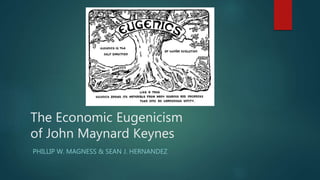
The Economic Eugenicism
of John Maynard Keynes
PHILLIP W. MAGNESS & SEAN J. HERNANDEZ
“[It is] the most important, significant and, I
would add, genuine branch of sociology
which exists, namely eugenics”
- J.M. Keynes, Feb. 14, 1946
Literature on Keynes & Eugenics
 Skidelsky
 Youthful interest, then abandoned
 <2 pages in 3 volumes
 Toye (2000)
 Meticulous historical research
 Discovers/reprints 2 unknown Keynes eugenics essays
 “Recantation” theory ca. 1930 exonerates Keynes
 Others:
 Eugenics was just an inheritance from Marshall
 Political interest with little connection to his economics
Economics & Eugenics
 Thomas Leonard (2009, 2015)
 Documents eugenics among American progressive economists
 Feature of scientific planning mindset
 Notes a reluctance “to look too closely” at eugenics dirty laundry
 Lawrence A. White (2012)
 Eugenics & scientific planning
 Part of progressive assault on laissez-faire
 Adds Keynes to the list of economic eugenicists
Our Approach:
1. Document role of eugenics in Keynes’ works (parallel to Leonard)
2. Show eugenics is indeed a feature of Keynes’ economics
 Malthusian in origin
 Feature of “scientific” planning & esp. his theory of unemployment
 Modifies focus in General Theory, but still neo-Malthusian post-1937
3. Challenge the “recantation” thesis (Toye)
4. Reconcile Keynes’ 1946 endorsement with 1920s literature
5. Explore implications of eugenics link to economic planning
Keynes & Eugenics Timeline
 1908-1912 – Cambridge Eugenics Society, delivers population lecture
 1919 – Economic Consequences of the Peace
 1922 – Neo-Malthusian Birth Control Conference
 1923 – Population debate w/ Beveridge
 1925 – Russia Lecture
 1926 – Berlin Lecture
 1930 – “Economic Possibilities for our Grandchildren”
 1931 – “End of Laissez-Faire” reprinted
 1933-35 – Malthus biography period
 1935 – General Theory
 1937 – Delivers Galton Lecture on contracting population
 1946 – Eugenics endorsement at Galton Medal Dinner
Population Lecture (1912)
"My own sympathies are with the cosmopolitans, but it is
necessary for a cosmopolitan never to forget the struggle for the
survival of races and classes which the progress of civilization has
done very little to weaken."
Population Lecture (1912)
"My own sympathies are with the cosmopolitans, but it is
necessary for a cosmopolitan never to forget the struggle for the
survival of races and classes which the progress of civilization has
done very little to weaken."
Economic Consequences (1919)
“If only the cake were not cut, but was allowed to grow in the geometrical
proportion predicted by Malthus of population, but not less true of
compound interest, perhaps a day might come when there would at last be
enough to go around, and when prosperity could enter into the enjoyment
of our labor. In that day, overwork, over-crowding and under-feeding would
come to an end and men, secure of the comforts and necessities of the body,
could proceed to the nobler exercises of their faculties. One geometrical ratio
might cancel another and the nineteenth century was able to forget the
fertility of the species in contemplation of the dizzy virtues of compound
interest.”
Economic Consequences (1919)
“If only the cake were not cut, but was allowed to grow in the
geometrical proportion predicted by Malthus of population, but not less
true of compound interest, perhaps a day might come when there would
at last be enough to go around, and when prosperity could enter into the
enjoyment of our labor. In that day, overwork, over-crowding and under-
feeding would come to an end and men, secure of the comforts and
necessities of the body, could proceed to the nobler exercises of their
faculties. One geometrical ratio might cancel another and
the nineteenth century was able to forget the fertility of the species in
contemplation of the dizzy virtues of compound interest.”
New Republic (1923)
New Republic (1923)
Neo-Malthusian Birth Control Conference
Marie Stopes & Keynes
Russia lecture (1925)
"I believe that the poverty of Russia before the War was due to
the great increase in population more than to any other cause.
The War and the Revolution reduced the population. But I am
told that now again there is a large excess of births over deaths.
There is no greater danger than this to the economic future of
Russia. There is no more important object of deliberate state
policy than to secure a balanced budget of population."
Russia lecture (1925)
"I believe that the poverty of Russia before the War was due to
the great increase in population more than to any other cause.
The War and the Revolution reduced the population. But I am
told that now again there is a large excess of births over deaths.
There is no greater danger than this to the economic future of
Russia. There is no more important object of deliberate state
policy than to secure a balanced budget of population."
Berlin Lecture (June 1926)
 Lecture is origin of “The End of Laissez-Faire”
 Lecture contained an overt endorsement of negative eugenics
 German press focused heavily on the eugenic/Malthusian character of the
lecture
 English-language press all but ignored
 Ludwig von Mises was in attendance, wrote German-language critique in
1927
 Keynes penned a notorious anti-Semitic essay reflecting on the visit
 “End of Laissez-Faire” republished in Essays in Persuasion (1931)
End of Laissez-Faire (1926, 1931)
“The time has already come when each country needs a
considered national policy about what size of population,
whether larger or smaller than at the present or the same, is
most expedient. And having settled this policy, we must take
steps to carry it into operation. The time may arrive a little
later when the community as a whole must pay attention to
the innate quality as well as to the mere numbers of its future
members”
End of Laissez-Faire (1926, 1931)
“The time has already come when each country needs a
considered national policy about what size of population,
whether larger or smaller than at the present or the same, is
most expedient. And having settled this policy, we must take
steps to carry it into operation. The time may arrive a little
later when the community as a whole must pay attention
to the innate quality as well as to the mere numbers of its
future members”
Mises’ Response (1927):
“Certainly there were found among his listeners some, who in the
last few years were driven out of the land in which they had worked
and lived; and many, who wish to emigrate from an overpopulated
Middle Europe and cannot, because the workers of more thinly
settled lands defend themselves against the addition of
competitors…
…He who rejoices that peoples are turning away from liberalism,
should not forget that war and revolution, misery and
unemployment for the masses, tyranny and dictatorship are not
accidental companions, but are necessary results of the
antiliberalism that now rules the world.”
Mises’ Response (1927):
“Certainly there were found among his listeners some, who in the
last few years were driven out of the land in which they had worked
and lived; and many, who wish to emigrate from an overpopulated
Middle Europe and cannot, because the workers of more thinly
settled lands defend themselves against the addition of
competitors…
…He who rejoices that peoples are turning away from liberalism,
should not forget that war and revolution, misery and
unemployment for the masses, tyranny and dictatorship are not
accidental companions, but are necessary results of the
antiliberalism that now rules the world.”
Keynes’ notes on Berlin visit (1926)
“Yet if I lived there, I felt I might turn anti-Semite. For the poor
Prussian is too slow and heavy on his legs for the other kind of
Jews, the ones who are not imps but serving devils, with small
horns, pitch forks, and oily tails. It is not agreeable to see
civilization so under the ugly thumbs of its impure Jews who
have all the money and the power and brains. I vote rather for
the plump hausfraus and thick fingered Wandering Birds. But I
am not sure that I wouldn’t even rather be mixed up with Lloyd
George than with the German political Jews."
Keynes’ notes on Berlin visit (1926)
“Yet if I lived there, I felt I might turn anti-Semite. For the poor
Prussian is too slow and heavy on his legs for the other kind of
Jews, the ones who are not imps but serving devils, with small
horns, pitch forks, and oily tails. It is not agreeable to see
civilization so under the ugly thumbs of its impure Jews who
have all the money and the power and brains. I vote rather for
the plump hausfraus and thick fingered Wandering Birds. But I
am not sure that I wouldn’t even rather be mixed up with Lloyd
George than with the German political Jews."
“Economic Possibilities” (1930)
 Toye interprets as a recantation of neo-Malthusianism
 Requires a deeply esoteric reading
 Strangely goes unnoticed by anybody for ~70 years
 Contradicted by textual evidence
 Keynes clearly still sees the “population devil” as a threat, e.g.
"The pace at which we can reach our destination of economic bliss will be
governed by four things- our power to control population, our
determination to avoid wars and civil dissensions…”
Population in the General Theory
 Japanese translation includes foreword by Keynes describing book as a
descendant of Malthus rather than Ricardo
 Brief, but affirms Keynes still sees population ‘equilibrium’ in play:
"But if nations can learn to provide themselves with full
employment by their domestic policy (and, we must add, if
they can also attain equilibrium in the trend of their
population), there need be no important economic forces
calculated to set the interest of one country against that of its
neighbours.“
Population in the General Theory
 Japanese translation includes foreword by Keynes describing book as a
descendant of Malthus rather than Ricardo
 Brief, but affirms Keynes still sees population ‘equilibrium’ in play:
"But if nations can learn to provide themselves with full
employment by their domestic policy (and, we must add, if
they can also attain equilibrium in the trend of their
population), there need be no important economic forces
calculated to set the interest of one country against that of its
neighbours.“
Galton Lecture (1937)
 Projects population of Britain will stabilize/decline
 NOT a recantation of Malthusian population bomb
 Stabilize = we’ve got it under control
 New unemployment challenge – effective demand problem
 Unites “old” population devil with “new” effective demand/unemployment
devil, both credited to Malthus
Keynes himself rejects “recantation”
thesis:
"In the final summing up, therefore, I do not depart from the
old Malthusian conclusion. I only wish to warn you that the
chaining up of the one devil may, if we are careless, only serve
to loose another still fiercer and more intractable.” (1937
Galton Lecture)
Keynes himself rejects “recantation”
thesis:
"In the final summing up, therefore, I do not depart from the
old Malthusian conclusion. I only wish to warn you that the
chaining up of the one devil may, if we are careless, only serve
to loose another still fiercer and more intractable.” (1937
Galton Lecture)
Implications
 Keynes’ Eugenics were deeply integrated into his macro & political theory
 Neo-Malthus runs deep
 Broad belief in scientism & social engineering
 Evidence of “recantation” is weak & esoterically derived
 Keynes himself said otherwise in 1937
 Honorary VP of Eugenics Society from 1937-44, plus 1946 Galton dinner
 If Keynes “recanted” his eugenicist contemporaries didn’t notice
 Explore implications for Keynesian thought today
 Mises’ critique in 1927 still holds
 Many descendants of Keynesian eugencicism
Comments
#FriendsOfCarlyle

Keynes-EugenicsPresentation-APEE-Final-Highlights

  • 1.
    The Economic Eugenicism ofJohn Maynard Keynes PHILLIP W. MAGNESS & SEAN J. HERNANDEZ
  • 2.
    “[It is] themost important, significant and, I would add, genuine branch of sociology which exists, namely eugenics” - J.M. Keynes, Feb. 14, 1946
  • 3.
    Literature on Keynes& Eugenics  Skidelsky  Youthful interest, then abandoned  <2 pages in 3 volumes  Toye (2000)  Meticulous historical research  Discovers/reprints 2 unknown Keynes eugenics essays  “Recantation” theory ca. 1930 exonerates Keynes  Others:  Eugenics was just an inheritance from Marshall  Political interest with little connection to his economics
  • 4.
    Economics & Eugenics Thomas Leonard (2009, 2015)  Documents eugenics among American progressive economists  Feature of scientific planning mindset  Notes a reluctance “to look too closely” at eugenics dirty laundry  Lawrence A. White (2012)  Eugenics & scientific planning  Part of progressive assault on laissez-faire  Adds Keynes to the list of economic eugenicists
  • 5.
    Our Approach: 1. Documentrole of eugenics in Keynes’ works (parallel to Leonard) 2. Show eugenics is indeed a feature of Keynes’ economics  Malthusian in origin  Feature of “scientific” planning & esp. his theory of unemployment  Modifies focus in General Theory, but still neo-Malthusian post-1937 3. Challenge the “recantation” thesis (Toye) 4. Reconcile Keynes’ 1946 endorsement with 1920s literature 5. Explore implications of eugenics link to economic planning
  • 6.
    Keynes & EugenicsTimeline  1908-1912 – Cambridge Eugenics Society, delivers population lecture  1919 – Economic Consequences of the Peace  1922 – Neo-Malthusian Birth Control Conference  1923 – Population debate w/ Beveridge  1925 – Russia Lecture  1926 – Berlin Lecture  1930 – “Economic Possibilities for our Grandchildren”  1931 – “End of Laissez-Faire” reprinted  1933-35 – Malthus biography period  1935 – General Theory  1937 – Delivers Galton Lecture on contracting population  1946 – Eugenics endorsement at Galton Medal Dinner
  • 7.
    Population Lecture (1912) "Myown sympathies are with the cosmopolitans, but it is necessary for a cosmopolitan never to forget the struggle for the survival of races and classes which the progress of civilization has done very little to weaken."
  • 8.
    Population Lecture (1912) "Myown sympathies are with the cosmopolitans, but it is necessary for a cosmopolitan never to forget the struggle for the survival of races and classes which the progress of civilization has done very little to weaken."
  • 9.
    Economic Consequences (1919) “Ifonly the cake were not cut, but was allowed to grow in the geometrical proportion predicted by Malthus of population, but not less true of compound interest, perhaps a day might come when there would at last be enough to go around, and when prosperity could enter into the enjoyment of our labor. In that day, overwork, over-crowding and under-feeding would come to an end and men, secure of the comforts and necessities of the body, could proceed to the nobler exercises of their faculties. One geometrical ratio might cancel another and the nineteenth century was able to forget the fertility of the species in contemplation of the dizzy virtues of compound interest.”
  • 10.
    Economic Consequences (1919) “Ifonly the cake were not cut, but was allowed to grow in the geometrical proportion predicted by Malthus of population, but not less true of compound interest, perhaps a day might come when there would at last be enough to go around, and when prosperity could enter into the enjoyment of our labor. In that day, overwork, over-crowding and under- feeding would come to an end and men, secure of the comforts and necessities of the body, could proceed to the nobler exercises of their faculties. One geometrical ratio might cancel another and the nineteenth century was able to forget the fertility of the species in contemplation of the dizzy virtues of compound interest.”
  • 11.
  • 12.
  • 13.
  • 14.
  • 15.
  • 16.
  • 17.
    Russia lecture (1925) "Ibelieve that the poverty of Russia before the War was due to the great increase in population more than to any other cause. The War and the Revolution reduced the population. But I am told that now again there is a large excess of births over deaths. There is no greater danger than this to the economic future of Russia. There is no more important object of deliberate state policy than to secure a balanced budget of population."
  • 18.
    Russia lecture (1925) "Ibelieve that the poverty of Russia before the War was due to the great increase in population more than to any other cause. The War and the Revolution reduced the population. But I am told that now again there is a large excess of births over deaths. There is no greater danger than this to the economic future of Russia. There is no more important object of deliberate state policy than to secure a balanced budget of population."
  • 19.
    Berlin Lecture (June1926)  Lecture is origin of “The End of Laissez-Faire”  Lecture contained an overt endorsement of negative eugenics  German press focused heavily on the eugenic/Malthusian character of the lecture  English-language press all but ignored  Ludwig von Mises was in attendance, wrote German-language critique in 1927  Keynes penned a notorious anti-Semitic essay reflecting on the visit  “End of Laissez-Faire” republished in Essays in Persuasion (1931)
  • 20.
    End of Laissez-Faire(1926, 1931) “The time has already come when each country needs a considered national policy about what size of population, whether larger or smaller than at the present or the same, is most expedient. And having settled this policy, we must take steps to carry it into operation. The time may arrive a little later when the community as a whole must pay attention to the innate quality as well as to the mere numbers of its future members”
  • 21.
    End of Laissez-Faire(1926, 1931) “The time has already come when each country needs a considered national policy about what size of population, whether larger or smaller than at the present or the same, is most expedient. And having settled this policy, we must take steps to carry it into operation. The time may arrive a little later when the community as a whole must pay attention to the innate quality as well as to the mere numbers of its future members”
  • 22.
    Mises’ Response (1927): “Certainlythere were found among his listeners some, who in the last few years were driven out of the land in which they had worked and lived; and many, who wish to emigrate from an overpopulated Middle Europe and cannot, because the workers of more thinly settled lands defend themselves against the addition of competitors… …He who rejoices that peoples are turning away from liberalism, should not forget that war and revolution, misery and unemployment for the masses, tyranny and dictatorship are not accidental companions, but are necessary results of the antiliberalism that now rules the world.”
  • 23.
    Mises’ Response (1927): “Certainlythere were found among his listeners some, who in the last few years were driven out of the land in which they had worked and lived; and many, who wish to emigrate from an overpopulated Middle Europe and cannot, because the workers of more thinly settled lands defend themselves against the addition of competitors… …He who rejoices that peoples are turning away from liberalism, should not forget that war and revolution, misery and unemployment for the masses, tyranny and dictatorship are not accidental companions, but are necessary results of the antiliberalism that now rules the world.”
  • 24.
    Keynes’ notes onBerlin visit (1926) “Yet if I lived there, I felt I might turn anti-Semite. For the poor Prussian is too slow and heavy on his legs for the other kind of Jews, the ones who are not imps but serving devils, with small horns, pitch forks, and oily tails. It is not agreeable to see civilization so under the ugly thumbs of its impure Jews who have all the money and the power and brains. I vote rather for the plump hausfraus and thick fingered Wandering Birds. But I am not sure that I wouldn’t even rather be mixed up with Lloyd George than with the German political Jews."
  • 25.
    Keynes’ notes onBerlin visit (1926) “Yet if I lived there, I felt I might turn anti-Semite. For the poor Prussian is too slow and heavy on his legs for the other kind of Jews, the ones who are not imps but serving devils, with small horns, pitch forks, and oily tails. It is not agreeable to see civilization so under the ugly thumbs of its impure Jews who have all the money and the power and brains. I vote rather for the plump hausfraus and thick fingered Wandering Birds. But I am not sure that I wouldn’t even rather be mixed up with Lloyd George than with the German political Jews."
  • 26.
    “Economic Possibilities” (1930) Toye interprets as a recantation of neo-Malthusianism  Requires a deeply esoteric reading  Strangely goes unnoticed by anybody for ~70 years  Contradicted by textual evidence  Keynes clearly still sees the “population devil” as a threat, e.g. "The pace at which we can reach our destination of economic bliss will be governed by four things- our power to control population, our determination to avoid wars and civil dissensions…”
  • 27.
    Population in theGeneral Theory  Japanese translation includes foreword by Keynes describing book as a descendant of Malthus rather than Ricardo  Brief, but affirms Keynes still sees population ‘equilibrium’ in play: "But if nations can learn to provide themselves with full employment by their domestic policy (and, we must add, if they can also attain equilibrium in the trend of their population), there need be no important economic forces calculated to set the interest of one country against that of its neighbours.“
  • 28.
    Population in theGeneral Theory  Japanese translation includes foreword by Keynes describing book as a descendant of Malthus rather than Ricardo  Brief, but affirms Keynes still sees population ‘equilibrium’ in play: "But if nations can learn to provide themselves with full employment by their domestic policy (and, we must add, if they can also attain equilibrium in the trend of their population), there need be no important economic forces calculated to set the interest of one country against that of its neighbours.“
  • 29.
    Galton Lecture (1937) Projects population of Britain will stabilize/decline  NOT a recantation of Malthusian population bomb  Stabilize = we’ve got it under control  New unemployment challenge – effective demand problem  Unites “old” population devil with “new” effective demand/unemployment devil, both credited to Malthus
  • 30.
    Keynes himself rejects“recantation” thesis: "In the final summing up, therefore, I do not depart from the old Malthusian conclusion. I only wish to warn you that the chaining up of the one devil may, if we are careless, only serve to loose another still fiercer and more intractable.” (1937 Galton Lecture)
  • 31.
    Keynes himself rejects“recantation” thesis: "In the final summing up, therefore, I do not depart from the old Malthusian conclusion. I only wish to warn you that the chaining up of the one devil may, if we are careless, only serve to loose another still fiercer and more intractable.” (1937 Galton Lecture)
  • 32.
    Implications  Keynes’ Eugenicswere deeply integrated into his macro & political theory  Neo-Malthus runs deep  Broad belief in scientism & social engineering  Evidence of “recantation” is weak & esoterically derived  Keynes himself said otherwise in 1937  Honorary VP of Eugenics Society from 1937-44, plus 1946 Galton dinner  If Keynes “recanted” his eugenicist contemporaries didn’t notice  Explore implications for Keynesian thought today  Mises’ critique in 1927 still holds  Many descendants of Keynesian eugencicism
  • 33.