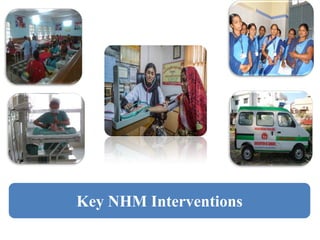
Key elements of NHM,
Important learnings,
Challenges
Desired Interventions
April 2017
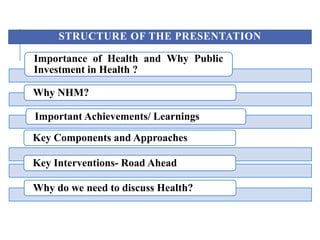
STRUCTURE OF THE PRESENTATION
Importance of Health and Why Public
Investment in Health ?
Why NHM?
Key Components and Approaches
Important Achievements/ Learnings
Key Interventions- Road Ahead
Why do we need to discuss Health?
WHY IS HEALTH SO IMPORTANT ????
“Sarve bhavantu sukhinah, sarve santu niramaya”
But Health – not only a Goal in itself, but also vital for improved
developmental outcomes
•Better Health Improves productivity
•Reduces Losses due to premature death, prolonged disability &
early retirement
•Out of Pocket Expenditure (OOPE) and catstrophic expenditure
on healthcare reduced
•Health and nutrition directly impact the scholastic
achievements- bearing on productivity and income.
•Huge employment generator- 5th in India
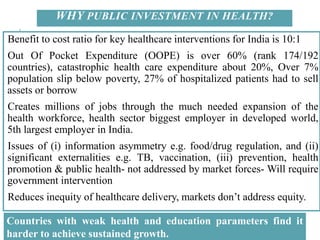
WHY PUBLIC INVESTMENT IN HEALTH?
Benefit to cost ratio for key healthcare interventions for India is 10:1
Out Of Pocket Expenditure (OOPE) is over 60% (rank 174/192
countries), catastrophic health care expenditure about 20%, Over 7%
population slip below poverty, 27% of hospitalized patients had to sell
assets or borrow
Creates millions of jobs through the much needed expansion of the
health workforce, health sector biggest employer in developed world,
5th largest employer in India.
Issues of (i) information asymmetry e.g. food/drug regulation, and (ii)
significant externalities e.g. TB, vaccination, (iii) prevention, health
promotion & public health- not addressed by market forces- Will require
government intervention
Reduces inequity of healthcare delivery, markets don’t address equity.
Countries with weak health and education parameters find it
harder to achieve sustained growth.
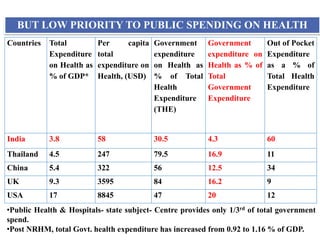
BUT LOW PRIORITY TO PUBLIC SPENDING ON HEALTH
Countries Total
Expenditure
on Health as
% of GDP*
Per capita
total
expenditure on
Health, (USD)
Government
expenditure
on Health as
% of Total
Health
Expenditure
(THE)
Government
expenditure on
Health as % of
Total
Government
Expenditure
Out of Pocket
Expenditure
as a % of
Total Health
Expenditure
India 3.8 58 30.5 4.3 60
Thailand 4.5 247 79.5 16.9 11
China 5.4 322 56 12.5 34
UK 9.3 3595 84 16.2 9
USA 17 8845 47 20 12
•Public Health & Hospitals- state subject- Centre provides only 1/3rd of total government
spend.
•Post NRHM, total Govt. health expenditure has increased from 0.92 to 1.16 % of GDP.
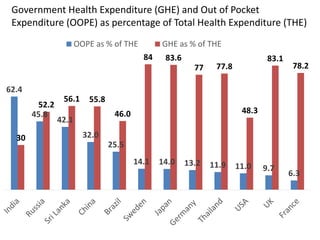
Government Health Expenditure (GHE) and Out of Pocket
Expenditure (OOPE) as percentage of Total Health Expenditure (THE)
62.4
45.8
42.1
32.0
25.5
14.1 14.0 13.2 11.9 11.0 9.7
6.3
30
52.2
56.1 55.8
46.0
84 83.6
77 77.8
48.3
83.1
78.2
OOPE as % of THE GHE as % of THE
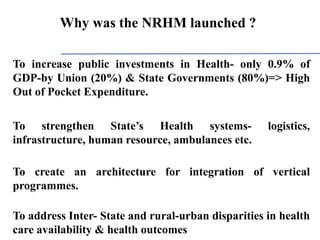
To increase public investments in Health- only 0.9% of
GDP-by Union (20%) & State Governments (80%)=> High
Out of Pocket Expenditure.
To strengthen State’s Health systems- logistics,
infrastructure, human resource, ambulances etc.
To create an architecture for integration of vertical
programmes.
To address Inter- State and rural-urban disparities in health
care availability & health outcomes
Why was the NRHM launched ?
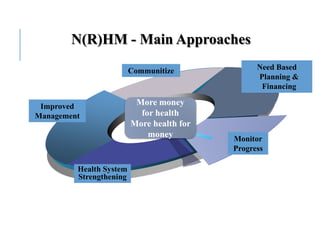
Communitize Need Based
Planning &
Financing
N(R)HM - Main Approaches
Monitor
Progress
Health System
Strengthening
Improved
Management
More money
for health
More health for
money
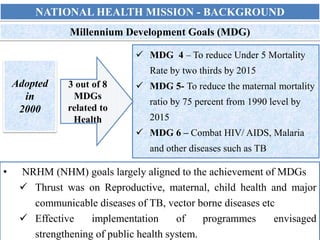
NATIONAL HEALTH MISSION - BACKGROUND
• NRHM (NHM) goals largely aligned to the achievement of MDGs
 Thrust was on Reproductive, maternal, child health and major
communicable diseases of TB, vector borne diseases etc
 Effective implementation of programmes envisaged
strengthening of public health system.
 MDG 4 – To reduce Under 5 Mortality
Rate by two thirds by 2015
 MDG 5- To reduce the maternal mortality
ratio by 75 percent from 1990 level by
2015
 MDG 6 – Combat HIV/ AIDS, Malaria
and other diseases such as TB
Millennium Development Goals (MDG)
Adopted
in
2000
3 out of 8
MDGs
related to
Health
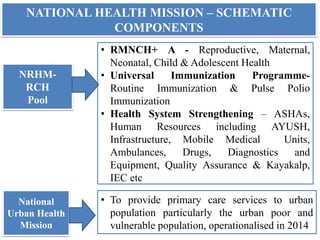
NATIONAL HEALTH MISSION – SCHEMATIC
COMPONENTS
NRHM-
RCH
Pool
National
Urban Health
Mission
• RMNCH+ A - Reproductive, Maternal,
Neonatal, Child & Adolescent Health
• Universal Immunization Programme-
Routine Immunization & Pulse Polio
Immunization
• Health System Strengthening – ASHAs,
Human Resources including AYUSH,
Infrastructure, Mobile Medical Units,
Ambulances, Drugs, Diagnostics and
Equipment, Quality Assurance & Kayakalp,
IEC etc
• To provide primary care services to urban
population particularly the urban poor and
vulnerable population, operationalised in 2014
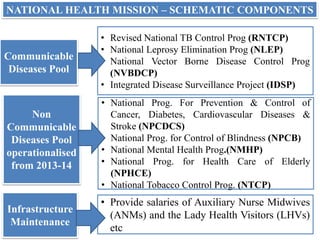
NATIONAL HEALTH MISSION – SCHEMATIC COMPONENTS
Communicable
Diseases Pool
Infrastructure
Maintenance
• Revised National TB Control Prog (RNTCP)
• National Leprosy Elimination Prog (NLEP)
• National Vector Borne Disease Control Prog
(NVBDCP)
• Integrated Disease Surveillance Project (IDSP)
• Provide salaries of Auxiliary Nurse Midwives
(ANMs) and the Lady Health Visitors (LHVs)
etc
Non
Communicable
Diseases Pool
operationalised
from 2013-14
• National Prog. For Prevention & Control of
Cancer, Diabetes, Cardiovascular Diseases &
Stroke (NPCDCS)
• National Prog. for Control of Blindness (NPCB)
• National Mental Health Prog.(NMHP)
• National Prog. for Health Care of Elderly
(NPHCE)
• National Tobacco Control Prog. (NTCP)
Key NHM Interventions
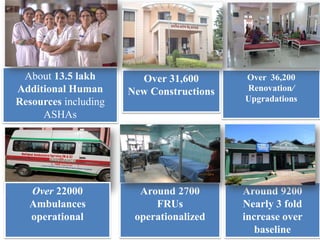
About 13.5 lakh
Additional Human
Resources including
ASHAs
Over 31,600
New Constructions
Over 36,200
Renovation/
Upgradations
Over 22000
Ambulances
operational
Around 2700
FRUs
operationalized
Around 9200
Nearly 3 fold
increase over
baseline
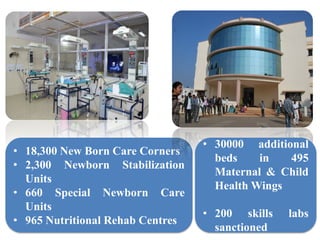
• 18,300 New Born Care Corners
• 2,300 Newborn Stabilization
Units
• 660 Special Newborn Care
Units
• 965 Nutritional Rehab Centres
• 30000 additional
beds in 495
Maternal & Child
Health Wings
• 200 skills labs
sanctioned
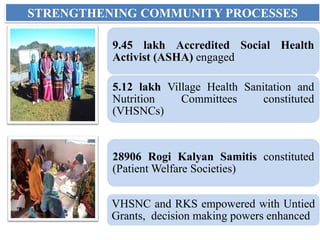
9.45 lakh Accredited Social Health
Activist (ASHA) engaged
5.12 lakh Village Health Sanitation and
Nutrition Committees constituted
(VHSNCs)
28906 Rogi Kalyan Samitis constituted
(Patient Welfare Societies)
VHSNC and RKS empowered with Untied
Grants, decision making powers enhanced
STRENGTHENING COMMUNITY PROCESSES
NHM Process of Approvals
• Bottom Up planning- Integrated District Health
Action Plans (DHAPs) through DHS & DPC/ZP
• States prepare their PIPs in light of their
healthcare needs, context and national priorities-
One of the most flexible programmes e.g
specialists salaries vary from Rs 60,000 to
200,000
• The GB and State Health Missions have
representation of all relevant departments/ sectors
IMPACT OF NHM
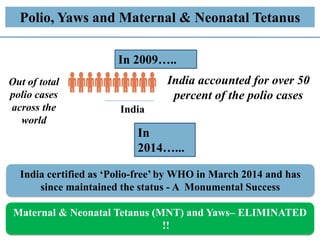
Out of total
polio cases
across the
world
India
India accounted for over 50
percent of the polio cases
In 2009…..
In
2014…...
India certified as ‘Polio-free’ by WHO in March 2014 and has
since maintained the status - A Monumental Success
Maternal & Neonatal Tetanus (MNT) and Yaws– ELIMINATED
!!
Polio, Yaws and Maternal & Neonatal Tetanus
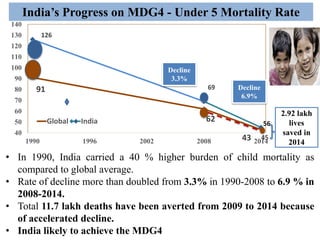
91
62
43
126
69
45
40
50
60
70
80
90
100
110
120
130
140
1990 1996 2002 2008 2014
Global India
• In 1990, India carried a 40 % higher burden of child mortality as
compared to global average.
• Rate of decline more than doubled from 3.3% in 1990-2008 to 6.9 % in
2008-2014.
• Total 11.7 lakh deaths have been averted from 2009 to 2014 because
of accelerated decline.
• India likely to achieve the MDG4
India’s Progress on MDG4 - Under 5 Mortality Rate
56
2.92 lakh
lives
saved in
2014
Decline
3.3%
Decline
6.9%
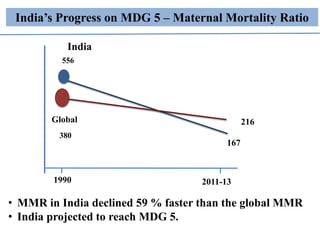
• MMR in India declined 59 % faster than the global MMR
• India projected to reach MDG 5.
India’s Progress on MDG 5 – Maternal Mortality Ratio
556
380
1990 2011-13
India
Global
167
216
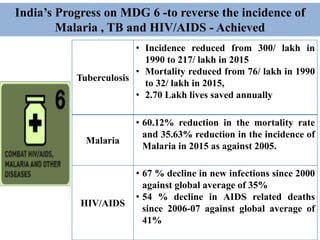
India’s Progress on MDG 6 -to reverse the incidence of
Malaria , TB and HIV/AIDS - Achieved
Tuberculosis
• Incidence reduced from 300/ lakh in
1990 to 217/ lakh in 2015
• Mortality reduced from 76/ lakh in 1990
to 32/ lakh in 2015,
• 2.70 Lakh lives saved annually
Malaria
• 60.12% reduction in the mortality rate
and 35.63% reduction in the incidence of
Malaria in 2015 as against 2005.
HIV/AIDS
• 67 % decline in new infections since 2000
against global average of 35%
• 54 % decline in AIDS related deaths
since 2006-07 against global average of
41%
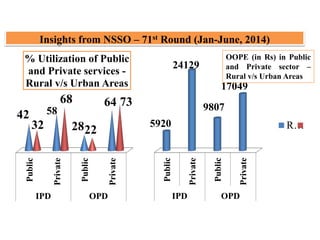
Insights from NSSO – 71st Round (Jan-June, 2014)
Public
Private
Public
Private
IPD OPD
42 58
28
64
32
68
22
73
% Utilization of Public
and Private services -
Rural v/s Urban Areas
Public
Private
Public
Private
IPD OPD
5920
24129
9807
17049
R…
OOPE (in Rs) in Public
and Private sector –
Rural v/s Urban Areas
2004-05 2014
1162 872
4137
8128
Public Private
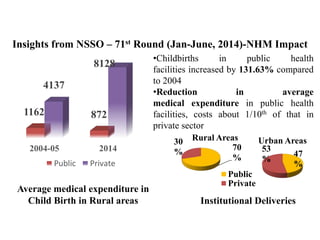
•Childbirths in public health
facilities increased by 131.63% compared
to 2004
•Reduction in average
medical expenditure in public health
facilities, costs about 1/10th of that in
private sector
Insights from NSSO – 71st Round (Jan-June, 2014)-NHM Impact
Average medical expenditure in
Child Birth in Rural areas
70
%
30
%
Rural Areas
Public
Private
47
%
53
%
Urban Areas
Institutional Deliveries
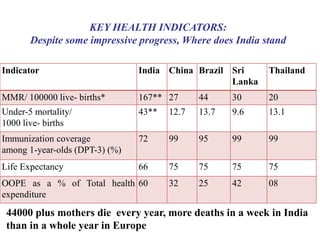
KEY HEALTH INDICATORS:
Despite some impressive progress, Where does India stand
Indicator India China Brazil Sri
Lanka
Thailand
MMR/ 100000 live- births* 167** 27 44 30 20
Under-5 mortality/
1000 live- births
43** 12.7 13.7 9.6 13.1
Immunization coverage
among 1-year-olds (DPT-3) (%)
72 99 95 99 99
Life Expectancy 66 75 75 75 75
OOPE as a % of Total health
expenditure
60 32 25 42 08
44000 plus mothers die every year, more deaths in a week in India
than in a whole year in Europe
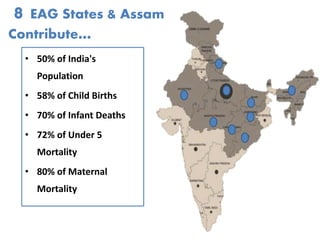
8 EAG States & Assam
Contribute…
• 50% of India's
Population
• 58% of Child Births
• 70% of Infant Deaths
• 72% of Under 5
Mortality
• 80% of Maternal
Mortality
Moving From MDGs to SDGs
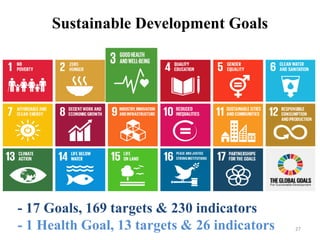
Sustainable Development Goals
- 17 Goals, 169 targets & 230 indicators
- 1 Health Goal, 13 targets & 26 indicators 27
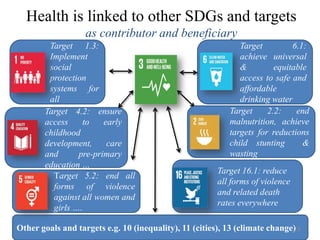
Target 1.3:
Implement
social
protection
systems for
all
Target 6.1:
achieve universal
& equitable
access to safe and
affordable
drinking water
Target 5.2: end all
forms of violence
against all women and
girls ….
Target 4.2: ensure
access to early
childhood
development, care
and pre-primary
education …
Target 16.1: reduce
all forms of violence
and related death
rates everywhere
Other goals and targets e.g. 10 (inequality), 11 (cities), 13 (climate change)
Health is linked to other SDGs and targets
as contributor and beneficiary
Target 2.2: end
malnutrition, achieve
targets for reductions
child stunting &
wasting
28
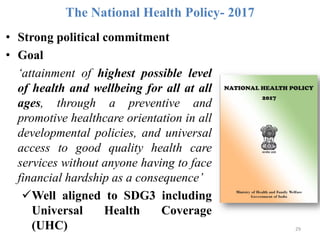
The National Health Policy- 2017
29
• Strong political commitment
• Goal
‘attainment of highest possible level
of health and wellbeing for all at all
ages, through a preventive and
promotive healthcare orientation in all
developmental policies, and universal
access to good quality health care
services without anyone having to face
financial hardship as a consequence’
Well aligned to SDG3 including
Universal Health Coverage
(UHC)
Key Effective Interventions
Neonatal Care (First 28 days) (high institutional deliveries –
major opportunity) - NMR/ U5MR is 25/43.
Labour Room Practices -Quality of Intra partum and Immediate
Post partumcare
Breast feeding (1st vaccine)
Improve access to FRUs i.e. Comprehensive Emergency
Obstetric & Neonatal Care including access to safe blood eg: 80%
shortfall in UP despite NHM flexibility
RMNCH+ A –Continuum of care approach
Improved implementation of Rashtriya Bal Swasthya
Karyakram- Early Screening, referrals to DEIC & intervention
Anemia Management (oral and injectable Iron, diet)
Robust monitoring, active case finding and compliance, ensuring
private sector participation for TB- major threat
Key Interventions
Comprehensive Primary Health Care - 12 essential services, universal
health check-up & Screening for NCDs and management, improve usage
of public health facilities
Transform Sub- Health Centres as Health & Wellness Centres with mid-
level providers (Nurses & Ayurveda doctors trained in public health &
primary care through Bridge Course)
Special attention to NPCDCS and Mental Health Programmes
Strengthening DHs as Multi-specialty care and site for trainings
Focus on High Priority Districts/ Blocks-
Strengthen monitoring-Use Data (HMIS/MCTS)-evidence based action
Implement Public Health Interventions across sectors
Partnership with NGOs and Private sector
Use of technology for health transformation, health promotion
Key Interventions
Essential Drugs & Diagnostics (Often through PPP) -free of cost
in public health facilities
Patient centric care- safety and with dignity- mera aspatal,
Quality Assurance and Kayakalp
Health Systems integrated approach for human resource
Use NHM flexibility- Align incentives (financial and non-
financial) to service providers to get desired behavior including
quality of care, design good contracts and monitor
Pay maximum importance to quality recruitment
YOUR ROLE IN HEALTH?
All of us have very important roles to play in achievement of
SDG targets-mutually interdependent and contributory
Impact of Social determinants- Convergence & coordination
extremely important to improve health outcomes- only 40%
contribution of health sector
Collector/ DM – Chairperson of the District Health Society and
Rogi Kalyan Samities of the District Hospitals- improve service
quality including patient satisfaction- Mera aspatal
Implementation
Huge flexibility under the NHM- DMs oversee the design and
implementation of District Health Action Plans under the NHM,
DPC and Zila Panchayat oversee health care delivery, monitor the
progress under the NHM, RSBY etc
Public investment in Health is decided by people amongst us.
LEADERSHIP MATTERS THE MOST - QUICK RESULTS AND
BIPARTISAN SUPPORT FOR HEALTH IMPROVEMENTS
A small body of determined
spirits fired by an
unquenchable faith in their
mission can alter the course
of history. ….
-Mahatma Gandhi
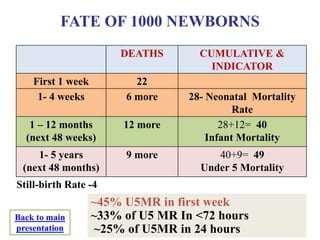
FATE OF 1000 NEWBORNS
DEATHS CUMULATIVE &
INDICATOR
First 1 week 22
1- 4 weeks 6 more 28- Neonatal Mortality
Rate
1 – 12 months
(next 48 weeks)
12 more 28+12= 40
Infant Mortality
1- 5 years
(next 48 months)
9 more 40+9= 49
Under 5 Mortality
Still-birth Rate -4
~45% U5MR in first week
~33% of U5 MR In <72 hours
~25% of U5MR in 24 hours
Back to main
presentation
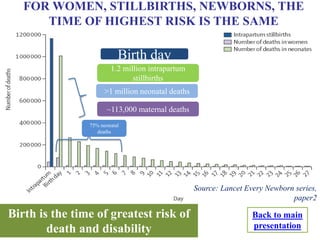
FOR WOMEN, STILLBIRTHS, NEWBORNS, THE
TIME OF HIGHEST RISK IS THE SAME
1.2 million intrapartum
stillbirths
>1 million neonatal deaths
~113,000 maternal deaths
75% neonatal
deaths
Birth day
Birth is the time of greatest risk of
death and disability
Source: Lancet Every Newborn series,
paper2
Back to main
presentation
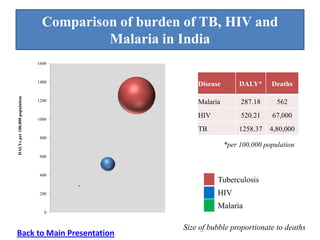
Comparison of burden of TB, HIV and
Malaria in India
Size of bubble proportionate to deaths
Tuberculosis
HIV
Malaria
Disease DALY* Deaths
Malaria 287.18 562
HIV 520.21 67,000
TB 1258.37 4,80,000
*per 100,000 population
0
200
400
600
800
1000
1200
1400
1600
DALYsper100,000population
Back to Main Presentation
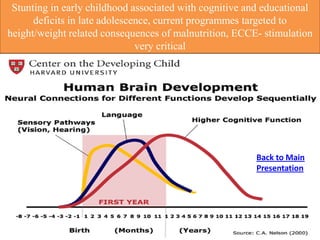
Stunting in early childhood associated with cognitive and educational
deficits in late adolescence, current programmes targeted to
height/weight related consequences of malnutrition, ECCE- stimulation
very critical
Back to Main
Presentation
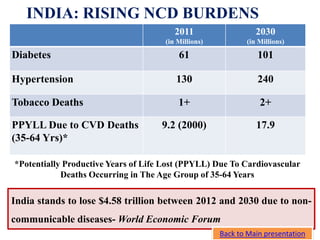
INDIA: RISING NCD BURDENS
2011
(in Millions)
2030
(in Millions)
Diabetes 61 101
Hypertension 130 240
Tobacco Deaths 1+ 2+
PPYLL Due to CVD Deaths
(35-64 Yrs)*
9.2 (2000) 17.9
*Potentially Productive Years of Life Lost (PPYLL) Due To Cardiovascular
Deaths Occurring in The Age Group of 35-64 Years
India stands to lose $4.58 trillion between 2012 and 2030 due to non-
communicable diseases- World Economic Forum
Back to Main presentation
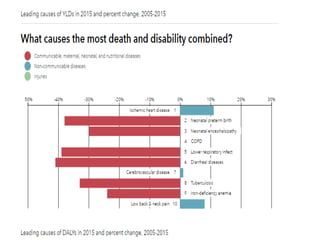
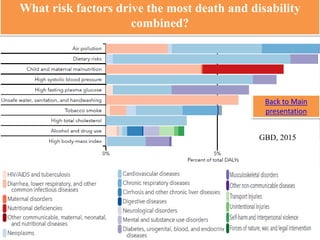
What risk factors drive the most death and disability
combined?
GBD, 2015
Back to Main
presentation
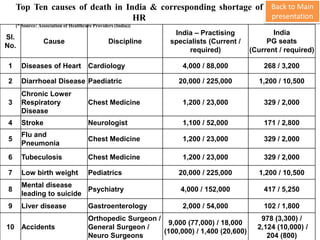
Top Ten causes of death in India & corresponding shortage of
HR
(* Source: Association of Healthcare Providers (India))
Sl.
No.
Cause Discipline
India – Practising
specialists (Current /
required)
India
PG seats
(Current / required)
1 Diseases of Heart Cardiology 4,000 / 88,000 268 / 3,200
2 Diarrhoeal Disease Paediatric 20,000 / 225,000 1,200 / 10,500
3
Chronic Lower
Respiratory
Disease
Chest Medicine 1,200 / 23,000 329 / 2,000
4 Stroke Neurologist 1,100 / 52,000 171 / 2,800
5
Flu and
Pneumonia
Chest Medicine 1,200 / 23,000 329 / 2,000
6 Tubeculosis Chest Medicine 1,200 / 23,000 329 / 2,000
7 Low birth weight Pediatrics 20,000 / 225,000 1,200 / 10,500
8
Mental disease
leading to suicide
Psychiatry 4,000 / 152,000 417 / 5,250
9 Liver disease Gastroenterology 2,000 / 54,000 102 / 1,800
10 Accidents
Orthopedic Surgeon /
General Surgeon /
Neuro Surgeons
9,000 (77,000) / 18,000
(100,000) / 1,400 (20,600)
978 (3,300) /
2,124 (10,000) /
204 (800)
Back to Main
presentation
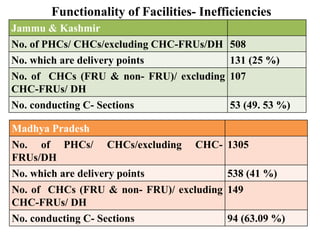
Functionality of Facilities- Inefficiencies
Jammu & Kashmir
No. of PHCs/ CHCs/excluding CHC-FRUs/DH 508
No. which are delivery points 131 (25 %)
No. of CHCs (FRU & non- FRU)/ excluding
CHC-FRUs/ DH
107
No. conducting C- Sections 53 (49. 53 %)
Madhya Pradesh
No. of PHCs/ CHCs/excluding CHC-
FRUs/DH
1305
No. which are delivery points 538 (41 %)
No. of CHCs (FRU & non- FRU)/ excluding
CHC-FRUs/ DH
149
No. conducting C- Sections 94 (63.09 %)
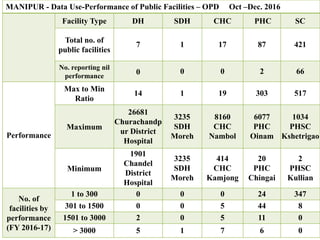
MANIPUR - Data Use-Performance of Public Facilities – OPD Oct –Dec. 2016
Facility Type DH SDH CHC PHC SC
Total no. of
public facilities
7 1 17 87 421
No. reporting nil
performance
0 0 0 2 66
Performance
Max to Min
Ratio
14 1 19 303 517
Maximum
26681
Churachandp
ur District
Hospital
3235
SDH
Moreh
8160
CHC
Nambol
6077
PHC
Oinam
1034
PHSC
Kshetrigao
Minimum
1901
Chandel
District
Hospital
3235
SDH
Moreh
414
CHC
Kamjong
20
PHC
Chingai
2
PHSC
Kullian
No. of
facilities by
performance
(FY 2016-17)
1 to 300 0 0 0 24 347
301 to 1500 0 0 5 44 8
1501 to 3000 2 0 5 11 0
> 3000 5 1 7 6 0
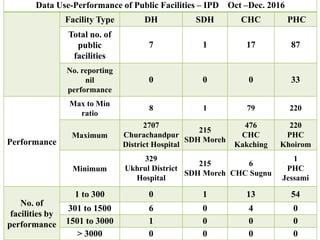
Data Use-Performance of Public Facilities – IPD Oct –Dec. 2016
Facility Type DH SDH CHC PHC
Total no. of
public
facilities
7 1 17 87
No. reporting
nil
performance
0 0 0 33
Performance
Max to Min
ratio
8 1 79 220
Maximum
2707
Churachandpur
District Hospital
215
SDH Moreh
476
CHC
Kakching
220
PHC
Khoirom
Minimum
329
Ukhrul District
Hospital
215
SDH Moreh
6
CHC Sugnu
1
PHC
Jessami
No. of
facilities by
performance
1 to 300 0 1 13 54
301 to 1500 6 0 4 0
1501 to 3000 1 0 0 0
> 3000 0 0 0 0
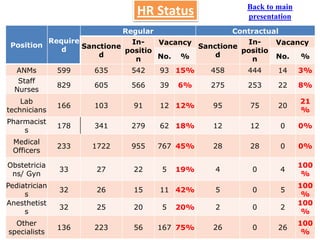
HR Status
Position
Require
d
Regular Contractual
Sanctione
d
In-
positio
n
Vacancy
Sanctione
d
In-
positio
n
Vacancy
No. % No. %
ANMs 599 635 542 93 15% 458 444 14 3%
Staff
Nurses
829 605 566 39 6% 275 253 22 8%
Lab
technicians
166 103 91 12 12% 95 75 20
21
%
Pharmacist
s
178 341 279 62 18% 12 12 0 0%
Medical
Officers
233 1722 955 767 45% 28 28 0 0%
Obstetricia
ns/ Gyn
33 27 22 5 19% 4 0 4
100
%
Pediatrician
s
32 26 15 11 42% 5 0 5
100
%
Anesthetist
s
32 25 20 5 20% 2 0 2
100
%
Other
specialists
136 223 56 167 75% 26 0 26
100
%
Back to main
presentation
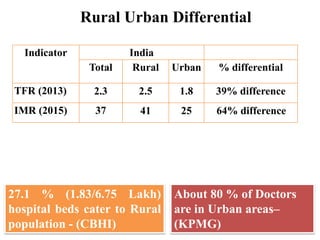
Indicator India
Total Rural Urban % differential
TFR (2013) 2.3 2.5 1.8 39% difference
IMR (2015) 37 41 25 64% difference
Rural Urban Differential
27.1 % (1.83/6.75 Lakh)
hospital beds cater to Rural
population - (CBHI)
About 80 % of Doctors
are in Urban areas–
(KPMG)
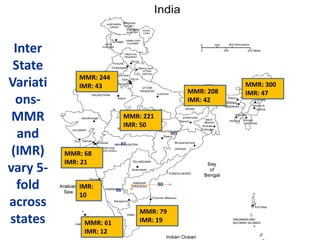
235
MMR: 244
IMR: 43
230
66
90
87
Inter
State
Variati
ons-
MMR
and
(IMR)
vary 5-
fold
across
states
IMR:
10
MMR: 221
IMR: 50
MMR: 300
IMR: 47
MMR: 68
IMR: 21
MMR: 208
IMR: 42
MMR: 79
IMR: 19MMR: 61
IMR: 12
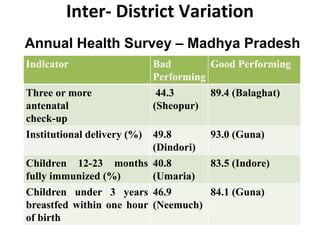
Inter- District Variation
Indicator Bad
Performing
Good Performing
Three or more
antenatal
check-up
44.3
(Sheopur)
89.4 (Balaghat)
Institutional delivery (%) 49.8
(Dindori)
93.0 (Guna)
Children 12-23 months
fully immunized (%)
40.8
(Umaria)
83.5 (Indore)
Children under 3 years
breastfed within one hour
of birth
46.9
(Neemuch)
84.1 (Guna)
Annual Health Survey – Madhya Pradesh
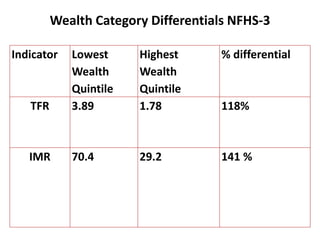
Wealth Category Differentials NFHS-3
Indicator Lowest
Wealth
Quintile
Highest
Wealth
Quintile
% differential
TFR 3.89 1.78 118%
IMR 70.4 29.2 141 %
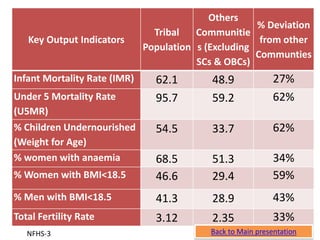
Key Output Indicators
Tribal
Population
Others
Communitie
s (Excluding
SCs & OBCs)
% Deviation
from other
Communties
Infant Mortality Rate (IMR) 62.1 48.9 27%
Under 5 Mortality Rate
(U5MR)
95.7 59.2 62%
% Children Undernourished
(Weight for Age)
54.5 33.7 62%
% women with anaemia 68.5 51.3 34%
% Women with BMI<18.5 46.6 29.4 59%
% Men with BMI<18.5 41.3 28.9 43%
Total Fertility Rate 3.12 2.35 33%
Source: NFHS 3 Back to Main presentationNFHS-3
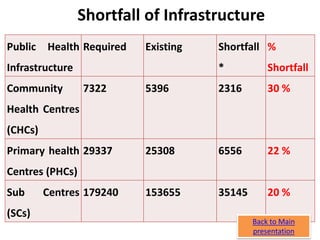
Shortfall of Infrastructure
Public Health
Infrastructure
Required Existing Shortfall
*
%
Shortfall
Community
Health Centres
(CHCs)
7322 5396 2316 30 %
Primary health
Centres (PHCs)
29337 25308 6556 22 %
Sub Centres
(SCs)
179240 153655 35145 20 %
Back to Main
presentation
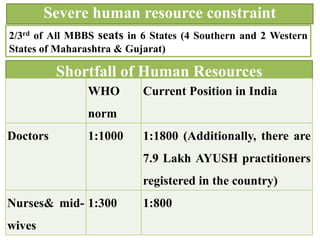
Shortfall of Human Resources
WHO
norm
Current Position in India
Doctors 1:1000 1:1800 (Additionally, there are
7.9 Lakh AYUSH practitioners
registered in the country)
Nurses& mid-
wives
1:300 1:800
Severe human resource constraint
2/3rd of All MBBS seats in 6 States (4 Southern and 2 Western
States of Maharashtra & Gujarat)
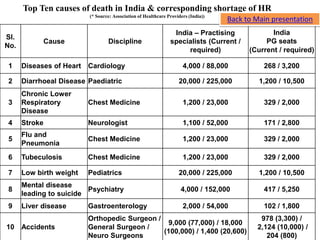
Top Ten causes of death in India & corresponding shortage of HR
(* Source: Association of Healthcare Providers (India))
Sl.
No.
Cause Discipline
India – Practising
specialists (Current /
required)
India
PG seats
(Current / required)
1 Diseases of Heart Cardiology 4,000 / 88,000 268 / 3,200
2 Diarrhoeal Disease Paediatric 20,000 / 225,000 1,200 / 10,500
3
Chronic Lower
Respiratory
Disease
Chest Medicine 1,200 / 23,000 329 / 2,000
4 Stroke Neurologist 1,100 / 52,000 171 / 2,800
5
Flu and
Pneumonia
Chest Medicine 1,200 / 23,000 329 / 2,000
6 Tubeculosis Chest Medicine 1,200 / 23,000 329 / 2,000
7 Low birth weight Pediatrics 20,000 / 225,000 1,200 / 10,500
8
Mental disease
leading to suicide
Psychiatry 4,000 / 152,000 417 / 5,250
9 Liver disease Gastroenterology 2,000 / 54,000 102 / 1,800
10 Accidents
Orthopedic Surgeon /
General Surgeon /
Neuro Surgeons
9,000 (77,000) / 18,000
(100,000) / 1,400 (20,600)
978 (3,300) /
2,124 (10,000) /
204 (800)
Back to Main presentation
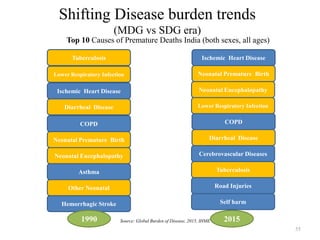
Shifting Disease burden trends
(MDG vs SDG era)
Tuberculosis
Lower Respiratory Infection
Ischemic Heart Disease
Diarrheal Disease
COPD
Neonatal Encephalopathy
Neonatal Premature Birth
Asthma
Hemorrhagic Stroke
Other Neonatal
2015Source: Global Burden of Disease, 2015, IHME
55
1990
Top 10 Causes of Premature Deaths India (both sexes, all ages)
Tuberculosis
Lower Respiratory Infection
Ischemic Heart Disease
Diarrheal Disease
COPD
Neonatal Encephalopathy
Neonatal Premature Birth
Cerebrovascular Diseases
Self harm
Road Injuries
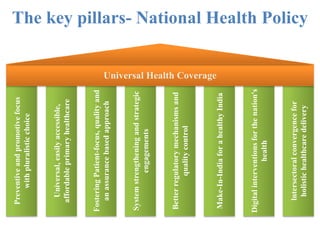
The key pillars- National Health Policy
Make-In-IndiaforahealthyIndia
Digitalinterventionsforthenation's
health
Betterregulatorymechanismsand
qualitycontrol
lntersectoralconvergencefor
holistichealthcaredelivery
Preventiveandpromotivefocus
withpluralisticchoice
Universal,easilyaccessible,
affordableprimaryhealthcare
FosteringPatient-focus,qualityand
anassurancebasedapproach
Systemstrengtheningandstrategic
engagements
Universal Health Coverage
Key Challenges
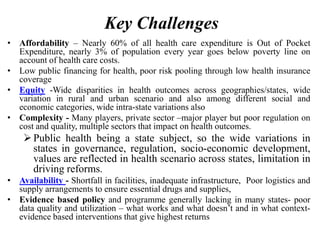
• Affordability – Nearly 60% of all health care expenditure is Out of Pocket
Expenditure, nearly 3% of population every year goes below poverty line on
account of health care costs.
• Low public financing for health, poor risk pooling through low health insurance
coverage
• Equity -Wide disparities in health outcomes across geographies/states, wide
variation in rural and urban scenario and also among different social and
economic categories, wide intra-state variations also
• Complexity - Many players, private sector –major player but poor regulation on
cost and quality, multiple sectors that impact on health outcomes.
Public health being a state subject, so the wide variations in
states in governance, regulation, socio-economic development,
values are reflected in health scenario across states, limitation in
driving reforms.
• Availability - Shortfall in facilities, inadequate infrastructure, Poor logistics and
supply arrangements to ensure essential drugs and supplies,
• Evidence based policy and programme generally lacking in many states- poor
data quality and utilization – what works and what doesn’t and in what context-
evidence based interventions that give highest returns
Key Challenges
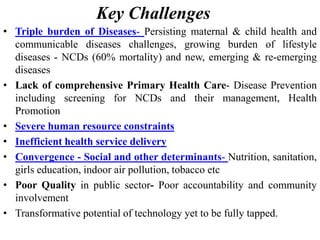
• Triple burden of Diseases- Persisting maternal & child health and
communicable diseases challenges, growing burden of lifestyle
diseases - NCDs (60% mortality) and new, emerging & re-emerging
diseases
• Lack of comprehensive Primary Health Care- Disease Prevention
including screening for NCDs and their management, Health
Promotion
• Severe human resource constraints
• Inefficient health service delivery
• Convergence - Social and other determinants- Nutrition, sanitation,
girls education, indoor air pollution, tobacco etc
• Poor Quality in public sector- Poor accountability and community
involvement
• Transformative potential of technology yet to be fully tapped.
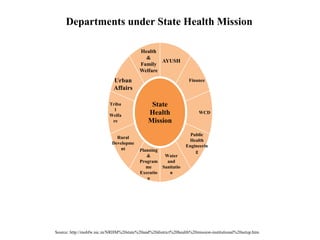
AYUSH
Finance
WCD
Public
Health
Engineerin
g
Water
and
Sanitatio
n
Planning
&
Program
me
Executio
n
Rural
Developme
nt
Triba
l
Welfa
re
Urban
Affairs
Health
&
Family
Welfare
State
Health
Mission
Source: http://mohfw.nic.in/NRHM%20state%20and%20district%20health%20mission-institutional%20setup.htm
Departments under State Health Mission
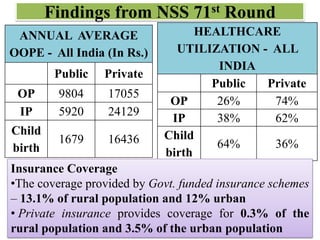
Findings from NSS 71st Round
ANNUAL AVERAGE
OOPE - All India (In Rs.)
Public Private
OP 9804 17055
IP 5920 24129
Child
birth
1679 16436
HEALTHCARE
UTILIZATION - ALL
INDIA
Public Private
OP 26% 74%
IP 38% 62%
Child
birth
64% 36%
Insurance Coverage
•The coverage provided by Govt. funded insurance schemes
– 13.1% of rural population and 12% urban
• Private insurance provides coverage for 0.3% of the
rural population and 3.5% of the urban population
Key elements of NHM, Important learnings, Challenges Desired Interventions

Key elements of NHM, Important learnings, Challenges Desired Interventions

  • 1.
    Key elements ofNHM, Important learnings, Challenges Desired Interventions April 2017
  • 2.
    STRUCTURE OF THEPRESENTATION Importance of Health and Why Public Investment in Health ? Why NHM? Key Components and Approaches Important Achievements/ Learnings Key Interventions- Road Ahead Why do we need to discuss Health?
  • 3.
    WHY IS HEALTHSO IMPORTANT ???? “Sarve bhavantu sukhinah, sarve santu niramaya” But Health – not only a Goal in itself, but also vital for improved developmental outcomes •Better Health Improves productivity •Reduces Losses due to premature death, prolonged disability & early retirement •Out of Pocket Expenditure (OOPE) and catstrophic expenditure on healthcare reduced •Health and nutrition directly impact the scholastic achievements- bearing on productivity and income. •Huge employment generator- 5th in India
  • 4.
    WHY PUBLIC INVESTMENTIN HEALTH? Benefit to cost ratio for key healthcare interventions for India is 10:1 Out Of Pocket Expenditure (OOPE) is over 60% (rank 174/192 countries), catastrophic health care expenditure about 20%, Over 7% population slip below poverty, 27% of hospitalized patients had to sell assets or borrow Creates millions of jobs through the much needed expansion of the health workforce, health sector biggest employer in developed world, 5th largest employer in India. Issues of (i) information asymmetry e.g. food/drug regulation, and (ii) significant externalities e.g. TB, vaccination, (iii) prevention, health promotion & public health- not addressed by market forces- Will require government intervention Reduces inequity of healthcare delivery, markets don’t address equity. Countries with weak health and education parameters find it harder to achieve sustained growth.
  • 5.
    BUT LOW PRIORITYTO PUBLIC SPENDING ON HEALTH Countries Total Expenditure on Health as % of GDP* Per capita total expenditure on Health, (USD) Government expenditure on Health as % of Total Health Expenditure (THE) Government expenditure on Health as % of Total Government Expenditure Out of Pocket Expenditure as a % of Total Health Expenditure India 3.8 58 30.5 4.3 60 Thailand 4.5 247 79.5 16.9 11 China 5.4 322 56 12.5 34 UK 9.3 3595 84 16.2 9 USA 17 8845 47 20 12 •Public Health & Hospitals- state subject- Centre provides only 1/3rd of total government spend. •Post NRHM, total Govt. health expenditure has increased from 0.92 to 1.16 % of GDP.
  • 6.
    Government Health Expenditure(GHE) and Out of Pocket Expenditure (OOPE) as percentage of Total Health Expenditure (THE) 62.4 45.8 42.1 32.0 25.5 14.1 14.0 13.2 11.9 11.0 9.7 6.3 30 52.2 56.1 55.8 46.0 84 83.6 77 77.8 48.3 83.1 78.2 OOPE as % of THE GHE as % of THE
  • 7.
    To increase publicinvestments in Health- only 0.9% of GDP-by Union (20%) & State Governments (80%)=> High Out of Pocket Expenditure. To strengthen State’s Health systems- logistics, infrastructure, human resource, ambulances etc. To create an architecture for integration of vertical programmes. To address Inter- State and rural-urban disparities in health care availability & health outcomes Why was the NRHM launched ?
  • 8.
    Communitize Need Based Planning& Financing N(R)HM - Main Approaches Monitor Progress Health System Strengthening Improved Management More money for health More health for money
  • 9.
    NATIONAL HEALTH MISSION- BACKGROUND • NRHM (NHM) goals largely aligned to the achievement of MDGs  Thrust was on Reproductive, maternal, child health and major communicable diseases of TB, vector borne diseases etc  Effective implementation of programmes envisaged strengthening of public health system.  MDG 4 – To reduce Under 5 Mortality Rate by two thirds by 2015  MDG 5- To reduce the maternal mortality ratio by 75 percent from 1990 level by 2015  MDG 6 – Combat HIV/ AIDS, Malaria and other diseases such as TB Millennium Development Goals (MDG) Adopted in 2000 3 out of 8 MDGs related to Health
  • 10.
    NATIONAL HEALTH MISSION– SCHEMATIC COMPONENTS NRHM- RCH Pool National Urban Health Mission • RMNCH+ A - Reproductive, Maternal, Neonatal, Child & Adolescent Health • Universal Immunization Programme- Routine Immunization & Pulse Polio Immunization • Health System Strengthening – ASHAs, Human Resources including AYUSH, Infrastructure, Mobile Medical Units, Ambulances, Drugs, Diagnostics and Equipment, Quality Assurance & Kayakalp, IEC etc • To provide primary care services to urban population particularly the urban poor and vulnerable population, operationalised in 2014
  • 11.
    NATIONAL HEALTH MISSION– SCHEMATIC COMPONENTS Communicable Diseases Pool Infrastructure Maintenance • Revised National TB Control Prog (RNTCP) • National Leprosy Elimination Prog (NLEP) • National Vector Borne Disease Control Prog (NVBDCP) • Integrated Disease Surveillance Project (IDSP) • Provide salaries of Auxiliary Nurse Midwives (ANMs) and the Lady Health Visitors (LHVs) etc Non Communicable Diseases Pool operationalised from 2013-14 • National Prog. For Prevention & Control of Cancer, Diabetes, Cardiovascular Diseases & Stroke (NPCDCS) • National Prog. for Control of Blindness (NPCB) • National Mental Health Prog.(NMHP) • National Prog. for Health Care of Elderly (NPHCE) • National Tobacco Control Prog. (NTCP)
  • 12.
  • 13.
    About 13.5 lakh AdditionalHuman Resources including ASHAs Over 31,600 New Constructions Over 36,200 Renovation/ Upgradations Over 22000 Ambulances operational Around 2700 FRUs operationalized Around 9200 Nearly 3 fold increase over baseline
  • 14.
    • 18,300 NewBorn Care Corners • 2,300 Newborn Stabilization Units • 660 Special Newborn Care Units • 965 Nutritional Rehab Centres • 30000 additional beds in 495 Maternal & Child Health Wings • 200 skills labs sanctioned
  • 15.
    9.45 lakh AccreditedSocial Health Activist (ASHA) engaged 5.12 lakh Village Health Sanitation and Nutrition Committees constituted (VHSNCs) 28906 Rogi Kalyan Samitis constituted (Patient Welfare Societies) VHSNC and RKS empowered with Untied Grants, decision making powers enhanced STRENGTHENING COMMUNITY PROCESSES
  • 16.
    NHM Process ofApprovals • Bottom Up planning- Integrated District Health Action Plans (DHAPs) through DHS & DPC/ZP • States prepare their PIPs in light of their healthcare needs, context and national priorities- One of the most flexible programmes e.g specialists salaries vary from Rs 60,000 to 200,000 • The GB and State Health Missions have representation of all relevant departments/ sectors
  • 17.
  • 18.
    Out of total poliocases across the world India India accounted for over 50 percent of the polio cases In 2009….. In 2014…... India certified as ‘Polio-free’ by WHO in March 2014 and has since maintained the status - A Monumental Success Maternal & Neonatal Tetanus (MNT) and Yaws– ELIMINATED !! Polio, Yaws and Maternal & Neonatal Tetanus
  • 19.
    91 62 43 126 69 45 40 50 60 70 80 90 100 110 120 130 140 1990 1996 20022008 2014 Global India • In 1990, India carried a 40 % higher burden of child mortality as compared to global average. • Rate of decline more than doubled from 3.3% in 1990-2008 to 6.9 % in 2008-2014. • Total 11.7 lakh deaths have been averted from 2009 to 2014 because of accelerated decline. • India likely to achieve the MDG4 India’s Progress on MDG4 - Under 5 Mortality Rate 56 2.92 lakh lives saved in 2014 Decline 3.3% Decline 6.9%
  • 20.
    • MMR inIndia declined 59 % faster than the global MMR • India projected to reach MDG 5. India’s Progress on MDG 5 – Maternal Mortality Ratio 556 380 1990 2011-13 India Global 167 216
  • 21.
    India’s Progress onMDG 6 -to reverse the incidence of Malaria , TB and HIV/AIDS - Achieved Tuberculosis • Incidence reduced from 300/ lakh in 1990 to 217/ lakh in 2015 • Mortality reduced from 76/ lakh in 1990 to 32/ lakh in 2015, • 2.70 Lakh lives saved annually Malaria • 60.12% reduction in the mortality rate and 35.63% reduction in the incidence of Malaria in 2015 as against 2005. HIV/AIDS • 67 % decline in new infections since 2000 against global average of 35% • 54 % decline in AIDS related deaths since 2006-07 against global average of 41%
  • 22.
    Insights from NSSO– 71st Round (Jan-June, 2014) Public Private Public Private IPD OPD 42 58 28 64 32 68 22 73 % Utilization of Public and Private services - Rural v/s Urban Areas Public Private Public Private IPD OPD 5920 24129 9807 17049 R… OOPE (in Rs) in Public and Private sector – Rural v/s Urban Areas
  • 23.
    2004-05 2014 1162 872 4137 8128 PublicPrivate •Childbirths in public health facilities increased by 131.63% compared to 2004 •Reduction in average medical expenditure in public health facilities, costs about 1/10th of that in private sector Insights from NSSO – 71st Round (Jan-June, 2014)-NHM Impact Average medical expenditure in Child Birth in Rural areas 70 % 30 % Rural Areas Public Private 47 % 53 % Urban Areas Institutional Deliveries
  • 24.
    KEY HEALTH INDICATORS: Despitesome impressive progress, Where does India stand Indicator India China Brazil Sri Lanka Thailand MMR/ 100000 live- births* 167** 27 44 30 20 Under-5 mortality/ 1000 live- births 43** 12.7 13.7 9.6 13.1 Immunization coverage among 1-year-olds (DPT-3) (%) 72 99 95 99 99 Life Expectancy 66 75 75 75 75 OOPE as a % of Total health expenditure 60 32 25 42 08 44000 plus mothers die every year, more deaths in a week in India than in a whole year in Europe
  • 25.
    8 EAG States& Assam Contribute… • 50% of India's Population • 58% of Child Births • 70% of Infant Deaths • 72% of Under 5 Mortality • 80% of Maternal Mortality
  • 26.
  • 27.
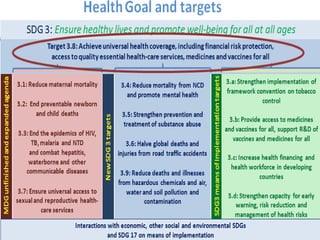
    Sustainable Development Goals -17 Goals, 169 targets & 230 indicators - 1 Health Goal, 13 targets & 26 indicators 27
  • 28.
    Target 1.3: Implement social protection systems for all Target6.1: achieve universal & equitable access to safe and affordable drinking water Target 5.2: end all forms of violence against all women and girls …. Target 4.2: ensure access to early childhood development, care and pre-primary education … Target 16.1: reduce all forms of violence and related death rates everywhere Other goals and targets e.g. 10 (inequality), 11 (cities), 13 (climate change) Health is linked to other SDGs and targets as contributor and beneficiary Target 2.2: end malnutrition, achieve targets for reductions child stunting & wasting 28
  • 29.
    The National HealthPolicy- 2017 29 • Strong political commitment • Goal ‘attainment of highest possible level of health and wellbeing for all at all ages, through a preventive and promotive healthcare orientation in all developmental policies, and universal access to good quality health care services without anyone having to face financial hardship as a consequence’ Well aligned to SDG3 including Universal Health Coverage (UHC)
  • 30.
    Key Effective Interventions NeonatalCare (First 28 days) (high institutional deliveries – major opportunity) - NMR/ U5MR is 25/43. Labour Room Practices -Quality of Intra partum and Immediate Post partumcare Breast feeding (1st vaccine) Improve access to FRUs i.e. Comprehensive Emergency Obstetric & Neonatal Care including access to safe blood eg: 80% shortfall in UP despite NHM flexibility RMNCH+ A –Continuum of care approach Improved implementation of Rashtriya Bal Swasthya Karyakram- Early Screening, referrals to DEIC & intervention Anemia Management (oral and injectable Iron, diet) Robust monitoring, active case finding and compliance, ensuring private sector participation for TB- major threat
  • 31.
    Key Interventions Comprehensive PrimaryHealth Care - 12 essential services, universal health check-up & Screening for NCDs and management, improve usage of public health facilities Transform Sub- Health Centres as Health & Wellness Centres with mid- level providers (Nurses & Ayurveda doctors trained in public health & primary care through Bridge Course) Special attention to NPCDCS and Mental Health Programmes Strengthening DHs as Multi-specialty care and site for trainings Focus on High Priority Districts/ Blocks- Strengthen monitoring-Use Data (HMIS/MCTS)-evidence based action Implement Public Health Interventions across sectors Partnership with NGOs and Private sector Use of technology for health transformation, health promotion
  • 32.
    Key Interventions Essential Drugs& Diagnostics (Often through PPP) -free of cost in public health facilities Patient centric care- safety and with dignity- mera aspatal, Quality Assurance and Kayakalp Health Systems integrated approach for human resource Use NHM flexibility- Align incentives (financial and non- financial) to service providers to get desired behavior including quality of care, design good contracts and monitor Pay maximum importance to quality recruitment
  • 33.
    YOUR ROLE INHEALTH? All of us have very important roles to play in achievement of SDG targets-mutually interdependent and contributory Impact of Social determinants- Convergence & coordination extremely important to improve health outcomes- only 40% contribution of health sector Collector/ DM – Chairperson of the District Health Society and Rogi Kalyan Samities of the District Hospitals- improve service quality including patient satisfaction- Mera aspatal Implementation Huge flexibility under the NHM- DMs oversee the design and implementation of District Health Action Plans under the NHM, DPC and Zila Panchayat oversee health care delivery, monitor the progress under the NHM, RSBY etc Public investment in Health is decided by people amongst us. LEADERSHIP MATTERS THE MOST - QUICK RESULTS AND BIPARTISAN SUPPORT FOR HEALTH IMPROVEMENTS
  • 34.
    A small bodyof determined spirits fired by an unquenchable faith in their mission can alter the course of history. …. -Mahatma Gandhi
  • 35.
    FATE OF 1000NEWBORNS DEATHS CUMULATIVE & INDICATOR First 1 week 22 1- 4 weeks 6 more 28- Neonatal Mortality Rate 1 – 12 months (next 48 weeks) 12 more 28+12= 40 Infant Mortality 1- 5 years (next 48 months) 9 more 40+9= 49 Under 5 Mortality Still-birth Rate -4 ~45% U5MR in first week ~33% of U5 MR In <72 hours ~25% of U5MR in 24 hours Back to main presentation
  • 36.
    FOR WOMEN, STILLBIRTHS,NEWBORNS, THE TIME OF HIGHEST RISK IS THE SAME 1.2 million intrapartum stillbirths >1 million neonatal deaths ~113,000 maternal deaths 75% neonatal deaths Birth day Birth is the time of greatest risk of death and disability Source: Lancet Every Newborn series, paper2 Back to main presentation
  • 37.
    Comparison of burdenof TB, HIV and Malaria in India Size of bubble proportionate to deaths Tuberculosis HIV Malaria Disease DALY* Deaths Malaria 287.18 562 HIV 520.21 67,000 TB 1258.37 4,80,000 *per 100,000 population 0 200 400 600 800 1000 1200 1400 1600 DALYsper100,000population Back to Main Presentation
  • 38.
    Stunting in earlychildhood associated with cognitive and educational deficits in late adolescence, current programmes targeted to height/weight related consequences of malnutrition, ECCE- stimulation very critical Back to Main Presentation
  • 40.
    INDIA: RISING NCDBURDENS 2011 (in Millions) 2030 (in Millions) Diabetes 61 101 Hypertension 130 240 Tobacco Deaths 1+ 2+ PPYLL Due to CVD Deaths (35-64 Yrs)* 9.2 (2000) 17.9 *Potentially Productive Years of Life Lost (PPYLL) Due To Cardiovascular Deaths Occurring in The Age Group of 35-64 Years India stands to lose $4.58 trillion between 2012 and 2030 due to non- communicable diseases- World Economic Forum Back to Main presentation
  • 41.
    What risk factorsdrive the most death and disability combined? GBD, 2015 Back to Main presentation
  • 42.
    Top Ten causesof death in India & corresponding shortage of HR (* Source: Association of Healthcare Providers (India)) Sl. No. Cause Discipline India – Practising specialists (Current / required) India PG seats (Current / required) 1 Diseases of Heart Cardiology 4,000 / 88,000 268 / 3,200 2 Diarrhoeal Disease Paediatric 20,000 / 225,000 1,200 / 10,500 3 Chronic Lower Respiratory Disease Chest Medicine 1,200 / 23,000 329 / 2,000 4 Stroke Neurologist 1,100 / 52,000 171 / 2,800 5 Flu and Pneumonia Chest Medicine 1,200 / 23,000 329 / 2,000 6 Tubeculosis Chest Medicine 1,200 / 23,000 329 / 2,000 7 Low birth weight Pediatrics 20,000 / 225,000 1,200 / 10,500 8 Mental disease leading to suicide Psychiatry 4,000 / 152,000 417 / 5,250 9 Liver disease Gastroenterology 2,000 / 54,000 102 / 1,800 10 Accidents Orthopedic Surgeon / General Surgeon / Neuro Surgeons 9,000 (77,000) / 18,000 (100,000) / 1,400 (20,600) 978 (3,300) / 2,124 (10,000) / 204 (800) Back to Main presentation
  • 43.
    Functionality of Facilities-Inefficiencies Jammu & Kashmir No. of PHCs/ CHCs/excluding CHC-FRUs/DH 508 No. which are delivery points 131 (25 %) No. of CHCs (FRU & non- FRU)/ excluding CHC-FRUs/ DH 107 No. conducting C- Sections 53 (49. 53 %) Madhya Pradesh No. of PHCs/ CHCs/excluding CHC- FRUs/DH 1305 No. which are delivery points 538 (41 %) No. of CHCs (FRU & non- FRU)/ excluding CHC-FRUs/ DH 149 No. conducting C- Sections 94 (63.09 %)
  • 44.
    MANIPUR - DataUse-Performance of Public Facilities – OPD Oct –Dec. 2016 Facility Type DH SDH CHC PHC SC Total no. of public facilities 7 1 17 87 421 No. reporting nil performance 0 0 0 2 66 Performance Max to Min Ratio 14 1 19 303 517 Maximum 26681 Churachandp ur District Hospital 3235 SDH Moreh 8160 CHC Nambol 6077 PHC Oinam 1034 PHSC Kshetrigao Minimum 1901 Chandel District Hospital 3235 SDH Moreh 414 CHC Kamjong 20 PHC Chingai 2 PHSC Kullian No. of facilities by performance (FY 2016-17) 1 to 300 0 0 0 24 347 301 to 1500 0 0 5 44 8 1501 to 3000 2 0 5 11 0 > 3000 5 1 7 6 0
  • 45.
    Data Use-Performance ofPublic Facilities – IPD Oct –Dec. 2016 Facility Type DH SDH CHC PHC Total no. of public facilities 7 1 17 87 No. reporting nil performance 0 0 0 33 Performance Max to Min ratio 8 1 79 220 Maximum 2707 Churachandpur District Hospital 215 SDH Moreh 476 CHC Kakching 220 PHC Khoirom Minimum 329 Ukhrul District Hospital 215 SDH Moreh 6 CHC Sugnu 1 PHC Jessami No. of facilities by performance 1 to 300 0 1 13 54 301 to 1500 6 0 4 0 1501 to 3000 1 0 0 0 > 3000 0 0 0 0
  • 46.
    HR Status Position Require d Regular Contractual Sanctione d In- positio n Vacancy Sanctione d In- positio n Vacancy No.% No. % ANMs 599 635 542 93 15% 458 444 14 3% Staff Nurses 829 605 566 39 6% 275 253 22 8% Lab technicians 166 103 91 12 12% 95 75 20 21 % Pharmacist s 178 341 279 62 18% 12 12 0 0% Medical Officers 233 1722 955 767 45% 28 28 0 0% Obstetricia ns/ Gyn 33 27 22 5 19% 4 0 4 100 % Pediatrician s 32 26 15 11 42% 5 0 5 100 % Anesthetist s 32 25 20 5 20% 2 0 2 100 % Other specialists 136 223 56 167 75% 26 0 26 100 % Back to main presentation
  • 47.
    Indicator India Total RuralUrban % differential TFR (2013) 2.3 2.5 1.8 39% difference IMR (2015) 37 41 25 64% difference Rural Urban Differential 27.1 % (1.83/6.75 Lakh) hospital beds cater to Rural population - (CBHI) About 80 % of Doctors are in Urban areas– (KPMG)
  • 48.
    235 MMR: 244 IMR: 43 230 66 90 87 Inter State Variati ons- MMR and (IMR) vary5- fold across states IMR: 10 MMR: 221 IMR: 50 MMR: 300 IMR: 47 MMR: 68 IMR: 21 MMR: 208 IMR: 42 MMR: 79 IMR: 19MMR: 61 IMR: 12
  • 49.
    Inter- District Variation IndicatorBad Performing Good Performing Three or more antenatal check-up 44.3 (Sheopur) 89.4 (Balaghat) Institutional delivery (%) 49.8 (Dindori) 93.0 (Guna) Children 12-23 months fully immunized (%) 40.8 (Umaria) 83.5 (Indore) Children under 3 years breastfed within one hour of birth 46.9 (Neemuch) 84.1 (Guna) Annual Health Survey – Madhya Pradesh
  • 50.
    Wealth Category DifferentialsNFHS-3 Indicator Lowest Wealth Quintile Highest Wealth Quintile % differential TFR 3.89 1.78 118% IMR 70.4 29.2 141 %
  • 51.
    Key Output Indicators Tribal Population Others Communitie s(Excluding SCs & OBCs) % Deviation from other Communties Infant Mortality Rate (IMR) 62.1 48.9 27% Under 5 Mortality Rate (U5MR) 95.7 59.2 62% % Children Undernourished (Weight for Age) 54.5 33.7 62% % women with anaemia 68.5 51.3 34% % Women with BMI<18.5 46.6 29.4 59% % Men with BMI<18.5 41.3 28.9 43% Total Fertility Rate 3.12 2.35 33% Source: NFHS 3 Back to Main presentationNFHS-3
  • 52.
    Shortfall of Infrastructure PublicHealth Infrastructure Required Existing Shortfall * % Shortfall Community Health Centres (CHCs) 7322 5396 2316 30 % Primary health Centres (PHCs) 29337 25308 6556 22 % Sub Centres (SCs) 179240 153655 35145 20 % Back to Main presentation
  • 53.
    Shortfall of HumanResources WHO norm Current Position in India Doctors 1:1000 1:1800 (Additionally, there are 7.9 Lakh AYUSH practitioners registered in the country) Nurses& mid- wives 1:300 1:800 Severe human resource constraint 2/3rd of All MBBS seats in 6 States (4 Southern and 2 Western States of Maharashtra & Gujarat)
  • 54.
    Top Ten causesof death in India & corresponding shortage of HR (* Source: Association of Healthcare Providers (India)) Sl. No. Cause Discipline India – Practising specialists (Current / required) India PG seats (Current / required) 1 Diseases of Heart Cardiology 4,000 / 88,000 268 / 3,200 2 Diarrhoeal Disease Paediatric 20,000 / 225,000 1,200 / 10,500 3 Chronic Lower Respiratory Disease Chest Medicine 1,200 / 23,000 329 / 2,000 4 Stroke Neurologist 1,100 / 52,000 171 / 2,800 5 Flu and Pneumonia Chest Medicine 1,200 / 23,000 329 / 2,000 6 Tubeculosis Chest Medicine 1,200 / 23,000 329 / 2,000 7 Low birth weight Pediatrics 20,000 / 225,000 1,200 / 10,500 8 Mental disease leading to suicide Psychiatry 4,000 / 152,000 417 / 5,250 9 Liver disease Gastroenterology 2,000 / 54,000 102 / 1,800 10 Accidents Orthopedic Surgeon / General Surgeon / Neuro Surgeons 9,000 (77,000) / 18,000 (100,000) / 1,400 (20,600) 978 (3,300) / 2,124 (10,000) / 204 (800) Back to Main presentation
  • 55.
    Shifting Disease burdentrends (MDG vs SDG era) Tuberculosis Lower Respiratory Infection Ischemic Heart Disease Diarrheal Disease COPD Neonatal Encephalopathy Neonatal Premature Birth Asthma Hemorrhagic Stroke Other Neonatal 2015Source: Global Burden of Disease, 2015, IHME 55 1990 Top 10 Causes of Premature Deaths India (both sexes, all ages) Tuberculosis Lower Respiratory Infection Ischemic Heart Disease Diarrheal Disease COPD Neonatal Encephalopathy Neonatal Premature Birth Cerebrovascular Diseases Self harm Road Injuries
  • 56.
    The key pillars-National Health Policy Make-In-IndiaforahealthyIndia Digitalinterventionsforthenation's health Betterregulatorymechanismsand qualitycontrol lntersectoralconvergencefor holistichealthcaredelivery Preventiveandpromotivefocus withpluralisticchoice Universal,easilyaccessible, affordableprimaryhealthcare FosteringPatient-focus,qualityand anassurancebasedapproach Systemstrengtheningandstrategic engagements Universal Health Coverage
  • 57.
    Key Challenges • Affordability– Nearly 60% of all health care expenditure is Out of Pocket Expenditure, nearly 3% of population every year goes below poverty line on account of health care costs. • Low public financing for health, poor risk pooling through low health insurance coverage • Equity -Wide disparities in health outcomes across geographies/states, wide variation in rural and urban scenario and also among different social and economic categories, wide intra-state variations also • Complexity - Many players, private sector –major player but poor regulation on cost and quality, multiple sectors that impact on health outcomes. Public health being a state subject, so the wide variations in states in governance, regulation, socio-economic development, values are reflected in health scenario across states, limitation in driving reforms. • Availability - Shortfall in facilities, inadequate infrastructure, Poor logistics and supply arrangements to ensure essential drugs and supplies, • Evidence based policy and programme generally lacking in many states- poor data quality and utilization – what works and what doesn’t and in what context- evidence based interventions that give highest returns
  • 58.
    Key Challenges • Tripleburden of Diseases- Persisting maternal & child health and communicable diseases challenges, growing burden of lifestyle diseases - NCDs (60% mortality) and new, emerging & re-emerging diseases • Lack of comprehensive Primary Health Care- Disease Prevention including screening for NCDs and their management, Health Promotion • Severe human resource constraints • Inefficient health service delivery • Convergence - Social and other determinants- Nutrition, sanitation, girls education, indoor air pollution, tobacco etc • Poor Quality in public sector- Poor accountability and community involvement • Transformative potential of technology yet to be fully tapped.
  • 59.
  • 60.
    Findings from NSS71st Round ANNUAL AVERAGE OOPE - All India (In Rs.) Public Private OP 9804 17055 IP 5920 24129 Child birth 1679 16436 HEALTHCARE UTILIZATION - ALL INDIA Public Private OP 26% 74% IP 38% 62% Child birth 64% 36% Insurance Coverage •The coverage provided by Govt. funded insurance schemes – 13.1% of rural population and 12% urban • Private insurance provides coverage for 0.3% of the rural population and 3.5% of the urban population