‘Doing digital’ in Brighton
The digital evolution of the Royal
Pavilion and Museums
Kevin Bacon
Digital Development Officer
I will not…
• Be an expert
• Show off
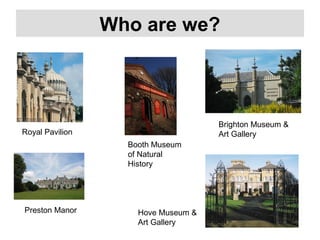
Who are we?
Royal Pavilion
Preston Manor
Booth Museum
of Natural
History
Hove Museum &
Art Gallery
Brighton Museum &
Art Gallery
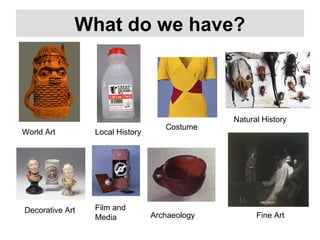
What do we have?
World Art
Decorative Art
Local History
Fine Art
Natural History
Film and
Media
Costume
Archaeology
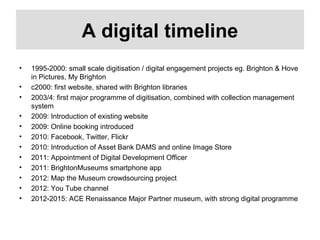
A digital timeline
• 1995-2000: small scale digitisation / digital engagement projects eg. Brighton & Hove
in Pictures, My Brighton
• c2000: first website, shared with Brighton libraries
• 2003/4: first major programme of digitisation, combined with collection management
system
• 2009: Introduction of existing website
• 2009: Online booking introduced
• 2010: Facebook, Twitter, Flickr
• 2010: Introduction of Asset Bank DAMS and online Image Store
• 2011: Appointment of Digital Development Officer
• 2011: BrightonMuseums smartphone app
• 2012: Map the Museum crowdsourcing project
• 2012: You Tube channel
• 2012-2015: ACE Renaissance Major Partner museum, with strong digital programme
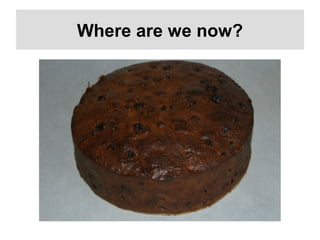
Where are we now?
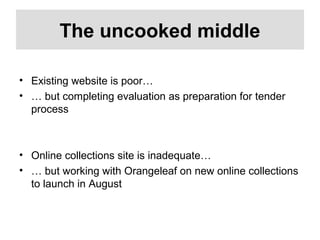
The uncooked middle
• Existing website is poor…
• … but completing evaluation as preparation for tender
process
• Online collections site is inadequate…
• … but working with Orangeleaf on new online collections
to launch in August
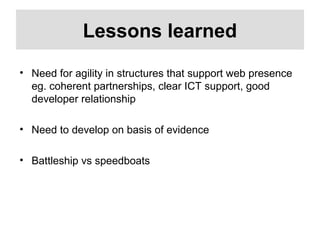
Lessons learned
• Need for agility in structures that support web presence
eg. coherent partnerships, clear ICT support, good
developer relationship
• Need to develop on basis of evidence
• Battleship vs speedboats
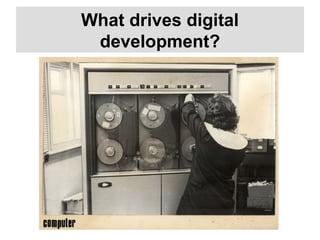
What drives digital
development?
Digital Strategy
• No standalone explicit digital strategy
• Embedded in Forward Plan: Culture Connects
• Working on formal digital strategy this autumn
Towards 2020: Culture Connects
‘The Royal Pavilion & Museums, Brighton & Hove aims to inspire,
illuminate and challenge its visitors and virtual users. It does this by
caring for and interpreting its outstanding collections and historic
sites to support discovery, enjoyment and learning….
… It operates in a digital world making collections and knowledge
available on line and providing a platform for user generated content
and debate.’
Strategic Aims
• Connecting people with museums and changing lives
• Developing and caring for cultural, scientific and natural
resources (collections & buildings)
• Building a sustainable and resilient organisation
• Exercising leadership
Connecting people with
museums
• Roll-out of wifi across sites
• Digital engagement projects with focus on young people
and communities
• Promotion of open data and re-use of digital assets
• Evolving social media use
Developing collections and
buildings
• Digitisation, particularly material stored at The Keep
• Collection of user generated knowledge
• Digital systems for archiving and record keeping
Building a sustainable
organisation
• Staff training eg. DAMS, social media
• Marketing
• Online fundraising
• Heritage Learning Consortium
Leadership
• Work with Museum Development Service to support
digital work in region
• Digital Development Assistant can offer onsite advice
• Sharing information, informal advice
http://bit.ly/18Ioqo1
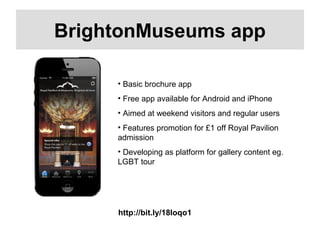
BrightonMuseums app
• Basic brochure app
• Free app available for Android and iPhone
• Aimed at weekend visitors and regular users
• Features promotion for £1 off Royal Pavilion
admission
• Developing as platform for gallery content eg.
LGBT tour
http://bit.ly/18Ioqo1
BrightonMuseums app
What works?
• Over 5000 downloads in 2012-13
• 30% conversion rate into paying customers
• Good user feedback
What doesn’t work?
• Android development a struggle
• No data on how people use the app
• Encouraging use as a gallery aid is difficult
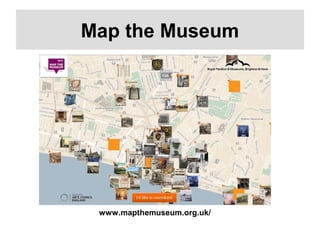
www.mapthemuseum.org.uk/
Map the Museum
http://bit.ly/18Ioqo1
Map the Museum
What works?
• Kickstarted internal conversation about open data and crowdsourcing
• Some professional interest eg Museum ID article, conference piece
• Demonstrated that fast, hacky, iterative development can work for us
What doesn’t work?
• … disappointing level of engagement
• 90% of users from outside Brighton & Hove!
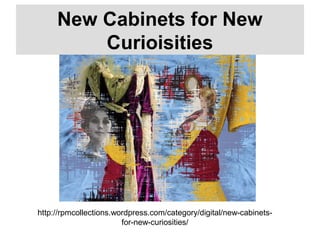
http://rpmcollections.wordpress.com/category/digital/new-cabinets-
for-new-curiosities/
New Cabinets for New
Curioisities
http://rpmcollections.wordpress.com/category/digital/new-cabinets-
for-new-curiosities/
New Cabinets for New
Curiosities
What worked?
• Pushed through first release of Airfix model open data and image sets
• Developed professional links supporting Brighton Digital Festival
• First piece of data driven digital art from collections
What didn’t work?
• Only one submission!
• Highlighted language and conceptual issues around museums and digital
assets eg.’what are digitised collections?’
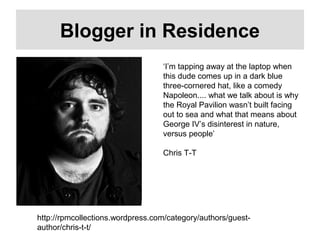
Blogger in Residence
‘I’m tapping away at the laptop when
this dude comes up in a dark blue
three-cornered hat, like a comedy
Napoleon.... what we talk about is why
the Royal Pavilion wasn’t built facing
out to sea and what that means about
George IV’s disinterest in nature,
versus people’
Chris T-T
http://rpmcollections.wordpress.com/category/authors/guest-
author/chris-t-t/
http://rpmcollections.wordpress.com/category/authors/guest-
author/chris-t-t/
Blogger in Residence
What works?
• Reach to non-traditional audiences through non-curatorial voice
• 4/5 top blog posts written by Chris
• Produced our first podcasts
• Huge interest in opportunity when offered
What doesn’t work?
• Some complaints about content
• Internal divisions over approach
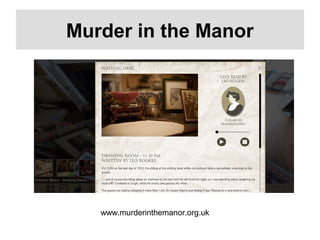
www.murderinthemanor.org.uk
Murder in the Manor
www.murderinthemanor.org.uk
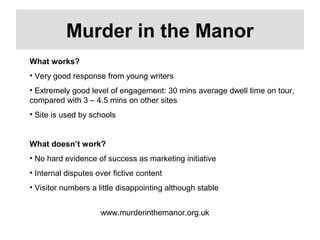
Murder in the Manor
What works?
• Very good response from young writers
• Extremely good level of engagement: 30 mins average dwell time on tour,
compared with 3 – 4.5 mins on other sites
• Site is used by schools
What doesn’t work?
• No hard evidence of success as marketing initiative
• Internal disputes over fictive content
• Visitor numbers a little disappointing although stable
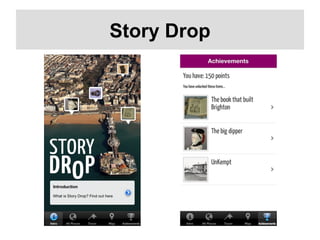
Story Drop
How have we changed?
1. More data driven
• Increasing use of Google Analytics data in
development decisions
• Moving away from focus on systems (eg. Mimsy XG)
to thinking about more fluid use of data
• New online collections will have an API for data re-use.
Encouraging use with Game Jam in September.
How have we changed?
2. More mobile friendly
• All websites now built on ‘mobile first’ basis
• Roll out of wifi to support mobile based social media
use in gallery
• Mobile enhanced content in galleries
How have we changed?
3. More open to other voices
• Ongoing blogger in residence programme
• Developing model of young people creating rich, fun experiences
to promote to schools
• Collection of user generated content through online collections
• Use of web media as a space for dialogue
How have we changed?
4. More playful
• Use of digital media to converge artistic practices
around our collections and buildings
• Use of fictive approach in creating new content
• We consider the counter-curatorial!
Thank you
Kevin Bacon
kevin.bacon@brighton-hove.gov.uk
@fauxtoegrafik

'Doing Digital' in Brighton

  • 1.
    ‘Doing digital’ inBrighton The digital evolution of the Royal Pavilion and Museums Kevin Bacon Digital Development Officer
  • 2.
    I will not… •Be an expert • Show off
  • 3.
    Who are we? RoyalPavilion Preston Manor Booth Museum of Natural History Hove Museum & Art Gallery Brighton Museum & Art Gallery
  • 4.
    What do wehave? World Art Decorative Art Local History Fine Art Natural History Film and Media Costume Archaeology
  • 5.
    A digital timeline •1995-2000: small scale digitisation / digital engagement projects eg. Brighton & Hove in Pictures, My Brighton • c2000: first website, shared with Brighton libraries • 2003/4: first major programme of digitisation, combined with collection management system • 2009: Introduction of existing website • 2009: Online booking introduced • 2010: Facebook, Twitter, Flickr • 2010: Introduction of Asset Bank DAMS and online Image Store • 2011: Appointment of Digital Development Officer • 2011: BrightonMuseums smartphone app • 2012: Map the Museum crowdsourcing project • 2012: You Tube channel • 2012-2015: ACE Renaissance Major Partner museum, with strong digital programme
  • 6.
  • 7.
    The uncooked middle •Existing website is poor… • … but completing evaluation as preparation for tender process • Online collections site is inadequate… • … but working with Orangeleaf on new online collections to launch in August
  • 8.
    Lessons learned • Needfor agility in structures that support web presence eg. coherent partnerships, clear ICT support, good developer relationship • Need to develop on basis of evidence • Battleship vs speedboats
  • 9.
  • 10.
    Digital Strategy • Nostandalone explicit digital strategy • Embedded in Forward Plan: Culture Connects • Working on formal digital strategy this autumn
  • 11.
    Towards 2020: CultureConnects ‘The Royal Pavilion & Museums, Brighton & Hove aims to inspire, illuminate and challenge its visitors and virtual users. It does this by caring for and interpreting its outstanding collections and historic sites to support discovery, enjoyment and learning…. … It operates in a digital world making collections and knowledge available on line and providing a platform for user generated content and debate.’
  • 12.
    Strategic Aims • Connectingpeople with museums and changing lives • Developing and caring for cultural, scientific and natural resources (collections & buildings) • Building a sustainable and resilient organisation • Exercising leadership
  • 13.
    Connecting people with museums •Roll-out of wifi across sites • Digital engagement projects with focus on young people and communities • Promotion of open data and re-use of digital assets • Evolving social media use
  • 14.
    Developing collections and buildings •Digitisation, particularly material stored at The Keep • Collection of user generated knowledge • Digital systems for archiving and record keeping
  • 15.
    Building a sustainable organisation •Staff training eg. DAMS, social media • Marketing • Online fundraising • Heritage Learning Consortium
  • 16.
    Leadership • Work withMuseum Development Service to support digital work in region • Digital Development Assistant can offer onsite advice • Sharing information, informal advice
  • 17.
    http://bit.ly/18Ioqo1 BrightonMuseums app • Basicbrochure app • Free app available for Android and iPhone • Aimed at weekend visitors and regular users • Features promotion for £1 off Royal Pavilion admission • Developing as platform for gallery content eg. LGBT tour
  • 18.
    http://bit.ly/18Ioqo1 BrightonMuseums app What works? •Over 5000 downloads in 2012-13 • 30% conversion rate into paying customers • Good user feedback What doesn’t work? • Android development a struggle • No data on how people use the app • Encouraging use as a gallery aid is difficult
  • 19.
  • 20.
    http://bit.ly/18Ioqo1 Map the Museum Whatworks? • Kickstarted internal conversation about open data and crowdsourcing • Some professional interest eg Museum ID article, conference piece • Demonstrated that fast, hacky, iterative development can work for us What doesn’t work? • … disappointing level of engagement • 90% of users from outside Brighton & Hove!
  • 21.
  • 22.
    http://rpmcollections.wordpress.com/category/digital/new-cabinets- for-new-curiosities/ New Cabinets forNew Curiosities What worked? • Pushed through first release of Airfix model open data and image sets • Developed professional links supporting Brighton Digital Festival • First piece of data driven digital art from collections What didn’t work? • Only one submission! • Highlighted language and conceptual issues around museums and digital assets eg.’what are digitised collections?’
  • 23.
    Blogger in Residence ‘I’mtapping away at the laptop when this dude comes up in a dark blue three-cornered hat, like a comedy Napoleon.... what we talk about is why the Royal Pavilion wasn’t built facing out to sea and what that means about George IV’s disinterest in nature, versus people’ Chris T-T http://rpmcollections.wordpress.com/category/authors/guest- author/chris-t-t/
  • 24.
    http://rpmcollections.wordpress.com/category/authors/guest- author/chris-t-t/ Blogger in Residence Whatworks? • Reach to non-traditional audiences through non-curatorial voice • 4/5 top blog posts written by Chris • Produced our first podcasts • Huge interest in opportunity when offered What doesn’t work? • Some complaints about content • Internal divisions over approach
  • 25.
  • 26.
    www.murderinthemanor.org.uk Murder in theManor What works? • Very good response from young writers • Extremely good level of engagement: 30 mins average dwell time on tour, compared with 3 – 4.5 mins on other sites • Site is used by schools What doesn’t work? • No hard evidence of success as marketing initiative • Internal disputes over fictive content • Visitor numbers a little disappointing although stable
  • 27.
  • 28.
    How have wechanged? 1. More data driven • Increasing use of Google Analytics data in development decisions • Moving away from focus on systems (eg. Mimsy XG) to thinking about more fluid use of data • New online collections will have an API for data re-use. Encouraging use with Game Jam in September.
  • 29.
    How have wechanged? 2. More mobile friendly • All websites now built on ‘mobile first’ basis • Roll out of wifi to support mobile based social media use in gallery • Mobile enhanced content in galleries
  • 30.
    How have wechanged? 3. More open to other voices • Ongoing blogger in residence programme • Developing model of young people creating rich, fun experiences to promote to schools • Collection of user generated content through online collections • Use of web media as a space for dialogue
  • 31.
    How have wechanged? 4. More playful • Use of digital media to converge artistic practices around our collections and buildings • Use of fictive approach in creating new content • We consider the counter-curatorial!
  • 32.