Department of Air Transport, Cranfield UniversityMSc in Air Transport Management 2009-2010MSc Thesis PresentationRationalising Airline’s Multi-hub Strategy:A Study of Network Performance and Competitive ImpactWenkan (Ken) LI7 Sep 2010Supervisor: Dr. Chikage Miyoshi
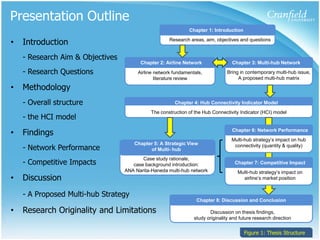
Presentation OutlineChapter 1: IntroductionIntroduction	- Research Aim & Objectives	- Research QuestionsMethodology	- Overall structure	- the HCI modelFindings	- Network Performance	- Competitive ImpactsDiscussion- A Proposed Multi-hub StrategyResearch Originality and LimitationsResearch areas, aim, objectives and questionsChapter 2: Airline NetworkChapter 3: Multi-hub NetworkBring in contemporary multi-hub issue,A proposed multi-hub matrixAirline network fundamentals, literature reviewChapter 4: Hub Connectivity Indicator ModelThe construction of the Hub Connectivity Indicator (HCI) modelChapter 6: Network PerformanceMulti-hub strategy’s impact on hub connectivity (quantity & quality)Chapter 5: A Strategic View of Multi- hubCase study rationale, case background introduction:ANA Narita-Haneda multi-hub networkChapter 7: Competitive ImpactMulti-hub strategy’s impact on airline’s market positionChapter 8: Discussion and ConclusionDiscussion on thesis findings, study originality and future research directionFigure 1: Thesis Structure
Introduction | research aim, objectives and questionsResearch AimUnderstand airline’s multi-hub network from a strategic perspective, with emphasis on real case application analysing network performance and competitive impactResearch ObjectivesUnderstand multi-hub network in terms of network characteristics and major issues Develop an analytical tool that could be employed by this study to analyse the multi-hub network performance and competitive impactResearch QuestionsWhat are theoretical arguments about multi-hub configuration in airline network literature? How those studies function in application of real industry case analysis?
What the major drivers or factors contributing to the emergence of multi-hub?
What are the characteristics and structure of multi-hub?
What is the network performance of multi-hub in close proximity, particularly hub connectivity?
What is the competitive impact of multi-hub?Methodology | framework and structureMethodology Framework- Case study of All Nippon Airways (ANA) Narita (NRT) and Haneda (HND) multi-hub networkMethodology StructureFigure 2: Methodology Structure2008: Historical separation of HND and NRT for domestic and international serviceThe Hub Connectivity Indicator (HCI) modelquality and quantity of connectivity2008NRT - InternationalHND - DomesticComparative analysis:Network performance of multi-hubIndustry benchmark: competitive impact of multi-hub2010NRT-HNDMulti-hub2010: HND resumes for scheduled international service, which allows multi-hub operation of ANASource: author 2010
Methodology | the HCI modelFigure 3: The Hub Connectivity Indicator (HCI) ModelNon-stop flight timePerceived travel timeNo. of hub involved in transferAvailability of direct serviceDirect distanceIndirect distanceRouting FactorTime FactorMinimum Connecting TimeMaximum Acceptable Connecting TimeViable Connections ThresholdFlight scheduleQuantity of Viable Connections (QVC)Quality of Connectivity Index (QCI)Hub Connectivity Indicator(HCI)Source: author 2010
Findings | network performance of multi-hubFigure 4: Comparative Analysis of Network Performance including a Scenario AnalysisLarge amount of domestic and inter-hub connections of low QCI index
The positive effect of HND international services has been immaterial at the time being, but with great potentials (see scenario)
Alliance and code-shares partner contribute to the improvement as wellRemark: data includes flights operated by ANA and its partners to and from NRT-HND; scenario is based on 2010 schedule with additional ten weekly U.S. bound international flights at HND.Source: author based on the HCI model
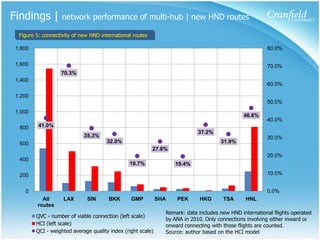
Findings | network performance of multi-hub | new HND routesFigure 5: connectivity of new HND international routesRemark: data includes new HND international flights operated by ANA in 2010. Only connections involving either inward or onward connecting with those flights are counted.Source: author based on the HCI model
Findings | network performance of multi-hub | partner’s analysisFigure 6: alliance & code-shares partner’s contribution to ANA’s network performance (2010)Remark: * = Star Alliance partner. Data includes flights operated by ANA and its partners to and from NRT-HND. Only connections involving one segment operated by partners are counted.Source: author based on the HCI model
Findings | competitive impact of multi-hubIndustry benchmark was performed to compare ANA’s network performance with selected competitors: JAL, KAL and Asiana
Competitive positioning maps in Asian inter-continental transfer marketsFigure 7: Asia – North America & Pacific transfer marketFigure 8: Asia – Europe transfer marketSource: author based on the HCI model
Discussion | a proposed future ANA multi-hub strategyFigure 9: a proposed future ANA multi-hub strategyNRT-HND Multi-hub StrategyNRTAsian gatewayInter-continental servicesAsian non-hub routesAsian hub to hub routesHNDHub for JapanInter-continental servicesJapan domestic routesSource: author 2010

Ken MSc Thesis Presentation

  • 1.
    Department of AirTransport, Cranfield UniversityMSc in Air Transport Management 2009-2010MSc Thesis PresentationRationalising Airline’s Multi-hub Strategy:A Study of Network Performance and Competitive ImpactWenkan (Ken) LI7 Sep 2010Supervisor: Dr. Chikage Miyoshi
  • 2.
    Presentation OutlineChapter 1:IntroductionIntroduction - Research Aim & Objectives - Research QuestionsMethodology - Overall structure - the HCI modelFindings - Network Performance - Competitive ImpactsDiscussion- A Proposed Multi-hub StrategyResearch Originality and LimitationsResearch areas, aim, objectives and questionsChapter 2: Airline NetworkChapter 3: Multi-hub NetworkBring in contemporary multi-hub issue,A proposed multi-hub matrixAirline network fundamentals, literature reviewChapter 4: Hub Connectivity Indicator ModelThe construction of the Hub Connectivity Indicator (HCI) modelChapter 6: Network PerformanceMulti-hub strategy’s impact on hub connectivity (quantity & quality)Chapter 5: A Strategic View of Multi- hubCase study rationale, case background introduction:ANA Narita-Haneda multi-hub networkChapter 7: Competitive ImpactMulti-hub strategy’s impact on airline’s market positionChapter 8: Discussion and ConclusionDiscussion on thesis findings, study originality and future research directionFigure 1: Thesis Structure
  • 3.
    Introduction | researchaim, objectives and questionsResearch AimUnderstand airline’s multi-hub network from a strategic perspective, with emphasis on real case application analysing network performance and competitive impactResearch ObjectivesUnderstand multi-hub network in terms of network characteristics and major issues Develop an analytical tool that could be employed by this study to analyse the multi-hub network performance and competitive impactResearch QuestionsWhat are theoretical arguments about multi-hub configuration in airline network literature? How those studies function in application of real industry case analysis?
  • 4.
    What the majordrivers or factors contributing to the emergence of multi-hub?
  • 5.
    What are thecharacteristics and structure of multi-hub?
  • 6.
    What is thenetwork performance of multi-hub in close proximity, particularly hub connectivity?
  • 7.
    What is thecompetitive impact of multi-hub?Methodology | framework and structureMethodology Framework- Case study of All Nippon Airways (ANA) Narita (NRT) and Haneda (HND) multi-hub networkMethodology StructureFigure 2: Methodology Structure2008: Historical separation of HND and NRT for domestic and international serviceThe Hub Connectivity Indicator (HCI) modelquality and quantity of connectivity2008NRT - InternationalHND - DomesticComparative analysis:Network performance of multi-hubIndustry benchmark: competitive impact of multi-hub2010NRT-HNDMulti-hub2010: HND resumes for scheduled international service, which allows multi-hub operation of ANASource: author 2010
  • 8.
    Methodology | theHCI modelFigure 3: The Hub Connectivity Indicator (HCI) ModelNon-stop flight timePerceived travel timeNo. of hub involved in transferAvailability of direct serviceDirect distanceIndirect distanceRouting FactorTime FactorMinimum Connecting TimeMaximum Acceptable Connecting TimeViable Connections ThresholdFlight scheduleQuantity of Viable Connections (QVC)Quality of Connectivity Index (QCI)Hub Connectivity Indicator(HCI)Source: author 2010
  • 9.
    Findings | networkperformance of multi-hubFigure 4: Comparative Analysis of Network Performance including a Scenario AnalysisLarge amount of domestic and inter-hub connections of low QCI index
  • 10.
    The positive effectof HND international services has been immaterial at the time being, but with great potentials (see scenario)
  • 11.
    Alliance and code-sharespartner contribute to the improvement as wellRemark: data includes flights operated by ANA and its partners to and from NRT-HND; scenario is based on 2010 schedule with additional ten weekly U.S. bound international flights at HND.Source: author based on the HCI model
  • 12.
    Findings | networkperformance of multi-hub | new HND routesFigure 5: connectivity of new HND international routesRemark: data includes new HND international flights operated by ANA in 2010. Only connections involving either inward or onward connecting with those flights are counted.Source: author based on the HCI model
  • 13.
    Findings | networkperformance of multi-hub | partner’s analysisFigure 6: alliance & code-shares partner’s contribution to ANA’s network performance (2010)Remark: * = Star Alliance partner. Data includes flights operated by ANA and its partners to and from NRT-HND. Only connections involving one segment operated by partners are counted.Source: author based on the HCI model
  • 14.
    Findings | competitiveimpact of multi-hubIndustry benchmark was performed to compare ANA’s network performance with selected competitors: JAL, KAL and Asiana
  • 15.
    Competitive positioning mapsin Asian inter-continental transfer marketsFigure 7: Asia – North America & Pacific transfer marketFigure 8: Asia – Europe transfer marketSource: author based on the HCI model
  • 16.
    Discussion | aproposed future ANA multi-hub strategyFigure 9: a proposed future ANA multi-hub strategyNRT-HND Multi-hub StrategyNRTAsian gatewayInter-continental servicesAsian non-hub routesAsian hub to hub routesHNDHub for JapanInter-continental servicesJapan domestic routesSource: author 2010