Nex Gen
Business Plan
Prepared [ Jan 2023 ]
[Kamran Khan, Business Planner]
kamran@digitalimc.com
[www.digitalimc.com]
[7011836797]
[B 1, 1st Floor,
Mohan Estate, Delhi]
Table of Contents
Executive Summary 4
Overview 4
Executive Summary Detail 5
Company Description 8
Company Overview 9
Company Mission Statement 9
Products and Services 10
Marketing Plan 11
Market Research 11
Target Customer 13
Barriers to Entry 14
Threats and Opportunities 14
Competitive Analysis 15
Positioning/Niche 15
Method of Marketing Your Product and/or Service 16
Marketing Budget 17
Distribution Channels 17
Operational Plan 18
Staffing 18
Production 18
Quality Control 18
Location 18
Legal Environment 19
Inventory 19
Suppliers and Vendors 20
Payment Terms and Credit Lines 20
Management and Organization 20
Resume Summaries 21
Management Gaps 21
Advisors 21
Organizational Chart 22
Budgets and Expenses 22
Startup Expenses 22
Develop Budgets 23
Plan for Capital 23
Personal Financial Statement 23
Financial Plan 24
Cash Flow Projections or Statements 24
Profit and Loss Projection 25
Projected Balance Sheet 26
Sales Plan 26
Appendices 26
Executive Summary
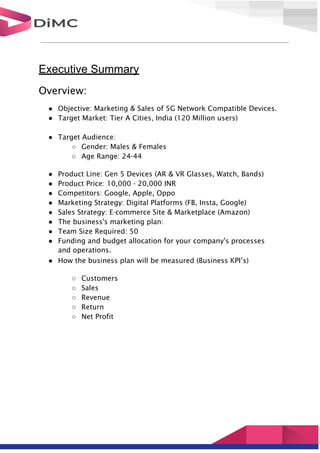
Overview:
● Objective: Marketing & Sales of 5G Network Compatible Devices.
● Target Market: Tier A Cities, India (120 Million users)
● Target Audience:
○ Gender: Males & Females
○ Age Range: 24-44
● Product Line: Gen 5 Devices (AR & VR Glasses, Watch, Bands)
● Product Price: 10,000 - 20,000 INR
● Competitors: Google, Apple, Oppo
● Marketing Strategy: Digital Platforms (FB, Insta, Google)
● Sales Strategy: E-commerce Site & Marketplace (Amazon)
● The business's marketing plan:
● Team Size Required: 50
● Funding and budget allocation for your company's processes
and operations.
● How the business plan will be measured (Business KPI’s)
○ Customers
○ Sales
○ Revenue
○ Return
○ Net Profit
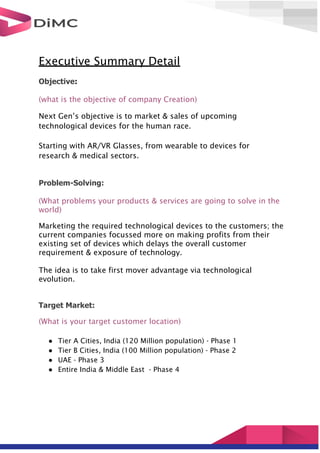
Executive Summary Detail
Objective:
(what is the objective of company Creation)
Next Gen’s objective is to market & sales of upcoming
technological devices for the human race.
Starting with AR/VR Glasses, from wearable to devices for
research & medical sectors.
Problem-Solving:
(What problems your products & services are going to solve in the
world)
Marketing the required technological devices to the customers; the
current companies focussed more on making profits from their
existing set of devices which delays the overall customer
requirement & exposure of technology.
The idea is to take first mover advantage via technological
evolution.
Target Market:
(What is your target customer location)
● Tier A Cities, India (120 Million population) - Phase 1
● Tier B Cities, India (100 Million population) - Phase 2
● UAE - Phase 3
● Entire India & Middle East - Phase 4
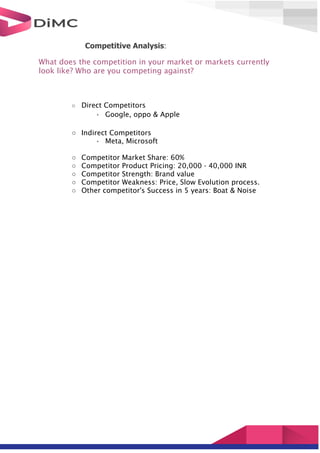
Competitive Analysis:
What does the competition in your market or markets currently
look like? Who are you competing against?
○ Direct Competitors
• Google, oppo & Apple
○ Indirect Competitors
• Meta, Microsoft
○ Competitor Market Share: 60%
○ Competitor Product Pricing: 20,000 - 40,000 INR
○ Competitor Strength: Brand value
○ Competitor Weakness: Price, Slow Evolution process.
○ Other competitor's Success in 5 years: Boat & Noise
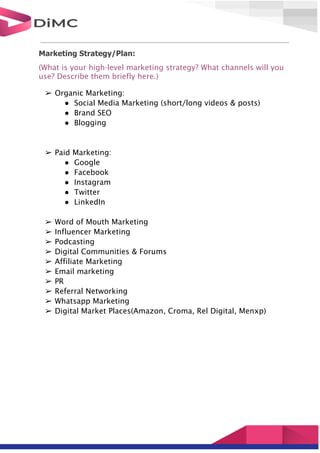
Marketing Strategy/Plan:
(What is your high-level marketing strategy? What channels will you
use? Describe them briefly here.)
➢ Organic Marketing:
● Social Media Marketing (short/long videos & posts)
● Brand SEO
● Blogging
➢ Paid Marketing:
● Google
● Facebook
● Instagram
● Twitter
● LinkedIn
➢ Word of Mouth Marketing
➢ Influencer Marketing
➢ Podcasting
➢ Digital Communities & Forums
➢ Affiliate Marketing
➢ Email marketing
➢ PR
➢ Referral Networking
➢ Whatsapp Marketing
➢ Digital Market Places(Amazon, Croma, Rel Digital, Menxp)
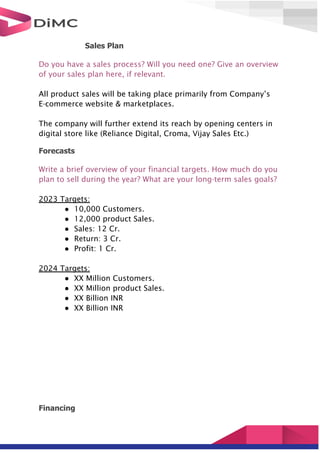
Sales Plan
Do you have a sales process? Will you need one? Give an overview
of your sales plan here, if relevant.
All product sales will be taking place primarily from Company’s
E-commerce website & marketplaces.
The company will further extend its reach by opening centers in
digital store like (Reliance Digital, Croma, Vijay Sales Etc.)
Forecasts
Write a brief overview of your financial targets. How much do you
plan to sell during the year? What are your long-term sales goals?
2023 Targets:
● 10,000 Customers.
● 12,000 product Sales.
● Sales: 12 Cr.
● Return: 3 Cr.
● Profit: 1 Cr.
2024 Targets:
● XX Million Customers.
● XX Million product Sales.
● XX Billion INR
● XX Billion INR
Financing
Include a brief summary of how much you are
seeking and what type of financing you are considering.
● Venture Catalysts
● AngelList India
● Let’s Venture
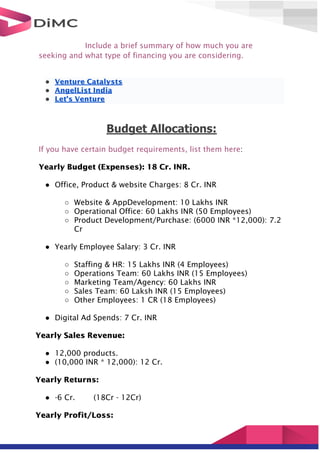
Budget Allocations:
If you have certain budget requirements, list them here:
Yearly Budget (Expenses): 18 Cr. INR.
● Office, Product & website Charges: 8 Cr. INR
○ Website & AppDevelopment: 10 Lakhs INR
○ Operational Office: 60 Lakhs INR (50 Employees)
○ Product Development/Purchase: (6000 INR *12,000): 7.2
Cr
● Yearly Employee Salary: 3 Cr. INR
○ Staffing & HR: 15 Lakhs INR (4 Employees)
○ Operations Team: 60 Lakhs INR (15 Employees)
○ Marketing Team/Agency: 60 Lakhs INR
○ Sales Team: 60 Laksh INR (15 Employees)
○ Other Employees: 1 CR (18 Employees)
● Digital Ad Spends: 7 Cr. INR
Yearly Sales Revenue:
● 12,000 products.
● (10,000 INR * 12,000): 12 Cr.
Yearly Returns:
● -6 Cr. (18Cr - 12Cr)
Yearly Profit/Loss:
Returns left after tax, equity & Interest Deductions
● Loss of 6 Cr.
Break-Even Stage:
After how much time company is targeting to start making profits:
● 18 Months
Staffing and Hiring
(Do you need to hire employees? If you have current staff, how
will they be involved?)
3-4 Hr team members will be required to manage team of 50
people.
Hiring Platforms:
● LinkedIn
● Naukri
● Monster
Locations/Warehouse
(Give an overview of your company's physical location and facility
needs. What types of locations or facilities do you plan to
acquire? If you currently have a location, how does it meet your
company's needs? Do you have plans to add or eliminate
facilities?
● South Delhi.
● Metro connectivity.
● Business Center/Coworking space for 50 employees.
Technology and Equipment
(List and describe any important technology or equipment you
may need. This can include software such as customer
relationship management (CRM) and email marketing tools,
construction equipment, and anything else you need in this
area.)
● CRM (Asana)
● Email Marketing Tool (Get Response)
● SMS Software (www.textmagic.com)
● Digital Product Inventory (Shopify/AWS)
● Website
● App
Key Performance Indicators
(What key metrics will you use to measure success and your
business's performance?)
● Website Traffic
● customers
● Engagement
● Add to Cart
● Sales
● ROAS (Return on Ad Spend)
● Revenue
● Profit
Company Description
Next Gen in a technology company focusses on developing 5th
Generation Devices in the affordable cost for Indian & Middle East
Market:
● AR Glasses
● VR Glasses
● Watches
● Ring
● Body Scanner
● Wearable smart phone
● Leg Band
● Hand Band
This section is an overview of your entire business. Include
brief information, such as when your company was founded,
the type of business entity it is (LLC, C corporation, or S
corporation), which state(s) it is registered in, etc. A summary
of your company's history gives the readers a thorough
understanding of who you are and what your business is.
Company Overview
Start the company section by providing an overview of the
company's history, its legal structure (LLC, S or C corporation,
partnership, etc.) and its current location. It should also include
information about the owners of the business and say whether
there are any business partners.
● Private Limited Company
● Registered to Delhi Address
● 2 Primary Partners
Company Mission Statement
A mission statement is a quick explanation of your company's
reason for existence. It can be as short as a tagline. The best
practice is to limit your mission statement to one or two
sentences.
Example: “Next Gen” statement is "Tapping into the future of
Human race – Feel Powered,
respected, and appreciated for who you are, no matter where
you might be."
[Check out more details on how to write a mission statement.]
Company Philosophy and Vision Statement
What values does your business stand for? Honesty,
responsibility, fun, innovation and community are some values
that might make up your business philosophy.
The company vision is the long-term outlook for your business.
What is your ultimate goal for your business?
Example: Prezi's vision statement is “To reinvent how people
share knowledge, tell stories, and inspire their audiences to
act.”
Products and Services
In this section, describe the products and/or services your
business provides. Focus on your customers' perspective (and
needs) by demonstrating the problem you solve. The goal of
this section is to prove that your business fills a market need
and will remain viable for the foreseeable future.
Explain Your Company's Products and/or Services
What do you sell, and how is it manufactured or provided? List
any business partnerships or manufacturers that play important
roles in developing your product or service.
The Problem Your Product or Service Solves
Explain what problems your products and solutions solve.
How, specifically, does your business accomplish this? What
competitive edge does your company have that others lack?
Pricing
Explain your pricing model for your products and services here. Is
it a subscription? Package? Retainer? How competitive is the
pricing compared to other companies on the market?
Marketing Plan
In the marketing plan section clearly define who your target
audience is, where you will find them, how you will reach them
and, most importantly, how you will deliver your product or
service to them. Provide a deep analysis of your ideal customer
and how your business provides a solution for them.
Also include your competitors in this section and illustrate how
your business is different. What are their strengths and
weaknesses, and how will you differentiate yourself from the
pack?
Market Research
Market research is an important element of a business plan. It
further engages your target audience about the products,
features, and services they want or need through polls, surveys,
focus groups, social media monitoring, and other methods that
help convince them of the need for your business and the
solution(s) it offers.
Primary vs. Secondary Market Research
Primary research is generally conducted directly by your business,
while secondary research is generally outsourced or found in
existing online databases.
Since primary research is conducted by your company, you own
the data. Secondary research, by contrast, is done by someone
else to support your primary research, but you don't own the
data.
It's important to do both types of market research, because they
have different purposes: Primary research yields direct results
about your audience, while secondary research backs up the
insights gleaned from your primary research.
Follow these steps to conduct market research:
1. Define your buyer persona.
2. Develop research requisitions.
3. Engage market research participants.
4. Conduct the research.
5. Summarize your research findings.
Target Customer
As mentioned earlier, you need to identify your target customer
or buyer persona. You may have multiple target customer
segments, such as both businesses and consumers.
Once you identify your target customers, create a full
demographic profile for them. Below are some suggestions
to include in your consumer and business buyer personas.
Consumer profile:
● Age: 24 - 44 Years
● Gender: Male & Female
● Location: Tier A Cities
● Income: 30,000+
● Occupation: Students, Private & Government Employees
● Education level: Senior Secondary
● Interests: Technology, Social Media, Shopping, Trends.
● habits Business profile:
● Industry
●
● Size
● Stage in business (startup, growing, mature)
● Annual sales
● Challenges
Barriers to Entry
What are the barriers to entry for your business, and how do
you plan to overcome them? These are some examples of
barriers to entry, startup costs that you may encounter:
● High capital requirements
● High marketing costs
● Lack of access to distribution channels
● Brand awareness challenges
● Market saturation by current competitors
● Steep learning curve
● Trademark consolidation in the market
● Onerous government policies
Threats and Opportunities
Once your company overcomes the barriers to entry you have
listed above, what additional threats might still exist? Explain
how the following could affect your startup:
● Supply chain issues
● Shifts in market requirements or trends
● Economic changes
● Relationships with suppliers and partners
Conduct a SWOT analysis that outlines your business's strengths,
weaknesses, opportunities and threats.
Competitive Analysis
An analysis of your competitors identifies businesses in your
industry or market that offer similar products or services to
yours and evaluates them based on specific business criteria.
A good competitive analysis helps you perceive your business
(and the competition) through customers' eyes, and it can help
you pinpoint where you could improve.
A competitor analysis should include the following elements:
● A list of key competitors
● A feature matrix
● The market share percentage of each competitor
● Pricing
● Marketing strategies
● Differentiators
● Strengths
● Weaknesses
● Competitor geographic areas
● Company culture
● Customer reviews
Positioning/Niche
After going through the steps above, you will want to
summarize your niche in this section. What gives your
company a distinct competitive advantage in the market?
Method of Marketing Your Product and/or
Service
Explain the marketing channels and advertising strategies you
plan to use. For example, which of these marketing channels
do you plan to use?
● A website
● Social media marketing:
○ Instgram Profile
○ Twitter Account
○ Facebook Page
● Email marketing
● Mobile marketing
● Youtube Channel
● SEO (search engine optimization)
● Paid Digital Advertising:
○ Google Ads
○ Facebook Ads
○ Instagram Ads
● Content marketing
● Podcasts
● Print marketing materials (billboards, brochures, flyers)
● Public relations
● Trade shows
● Events
● Networking
● Word of mouth
● Referrals
● Radio
● TV
Logo and Branding
It's important to define your company brand. Your company
logo, colors, fonts, etc. should be included here. What is your
company's look, style and message that makes it unique? How
will you incorporate this into your marketing efforts?
Marketing Budget
How much do you plan to spend on your marketing initiatives?
Develop a preliminary marketing budget of what you believe
you need to start your marketing processes and a projection of
what you anticipate spending on an ongoing or recurring basis.
Distribution Channels
What methods of distribution will you use to sell your
products and/or services? Here are some examples:
● Retail
● Market Place (Amazon)
● E-commerce (Own Site)
● Wholesale
● Inside sales team (i.e., reps typically located remotely in
an office)
● Outside sales representatives (i.e., traveling reps, usually
for face-to-face sales)
Operational Plan
This section outlines the ongoing operations of your business.
Staffing
What type of employees will your business need? In this section,
provide details such as the number of employees and positions
your business requires, the salary you plan to pay these
individuals, and any specific certifications or job training they
will need. How do you plan on hiring them?
● CEO
● CTO
● VP
○ Ops Director
○ Sales Director
○ HR Director
○ Quality Control Director
Production
What does your production process look like? Explain the
production methods, any equipment you will need, and
the estimated production costs.
Quality Control
Explain how you will ensure your products (or services) are safe
and consistent from batch to batch and product to product (or
job to job). How will you measure quality?
Location
If you have or need physical locations, explain them in more
detail in this section. Include details such as the size of the
locations, rent costs, maintenance, utilities, insurance, and any
remodeling expenses. Explain the type of building and any
zoning restrictions or requirements.
Legal Environment
In what type of legal environment will your company operate?
How are you prepared to handle legal requirements? What is the
status of those legal requirements? These are some common
examples:
● Licenses and/or permits
● Trademarks, copyrights, etc.
● Insurance coverage your business requires (and how much)
● Environmental, health or workplace regulations
● Additional special regulations in your industry
Inventory
If your business operates with inventory, you will need to detail
the following:
● What type of inventory do you have (e.g., raw
materials, supplies, finished products)?
● What is your investment in this inventory? What is the value
of it?
● What is your projected inventory turnover rate?
● Do you have seasonal peaks for inventory? How will this
affect your annual business operations?
● What is your lead time for ordering inventory?
● Do you store your inventory somewhere? Explain where
it's located and how it's stored.
Suppliers and Vendors
List your key suppliers and the following information for each:
● Names, address and website
● Type and amount of inventory furnished
● Credit and delivery policies
● History and reliability
● Backup suppliers for emergencies
● Payment terms
Payment Terms and Credit Lines
How will you accept payments from customers? Will you provide
a credit line? What will be your credit policy?
Management and Organization
Before anyone will invest in your business, they want a
complete understanding of whom they are investing in. This
section should illustrate how your business is organized. List
key members of the management team, the founders/owners,
board members, advisors, etc.
As you list each individual, provide a summary of their experience
and their role within your company. Treat this section as a series
of mini resumes, and consider appending full-length resumes or
curricula vitae to your business plan.
Resume Summaries
Include a brief description of the resumes of the owner(s) and
key managers or employees. These summaries should discuss
the experiences these individuals have that pertain to the
business and any history they have running or managing a
business.
Management Gaps
If there are gaps in your management team, explain how you
plan to fill them. For instance, if you don't have marketing
experience, will you hire a chief marketing officer?
Advisors
● Mr. XXXXX (Chief of 5G technology)
● Ms. XXXXX
List the members of your professional/advisory support team.
Include a brief biography of each member and an explanation
of how they will support the business.
Organizational Chart/Tree:
Develop and include an organizational chart with your existing
team and any new roles you plan to fill.
[Learn more about creating an organizational chart.]
Budgets and Expenses
This section discusses all initial expenses your business will
incur and any capital that exists.
Startup Expenses
List all of the business expenses you will incur and how you
came up with the amounts.
These are some common business startup costs:
● Research: 3 Lakhs
● Insurance: 5 Lakhs
● Licensing: 6 Lakhs
● Technology and equipment: 40 Lakhs
● Legal fees: 15 Lakhs
● Marketing: 50 Lakhs
[Read more on startup business costs.]
Develop Budgets
Once you have an idea of your total business expenses, you can
develop a budget. Keep in mind that new businesses often
require more capital than what owners initially expect. You
should add a contingency plan in case you need additional funds.
Plan for Capital
Do you have current investors? How much capital are they
investing? How do you plan to raise capital? If you plan to apply
for a business loan, you should provide information on the lender
and the amount you are trying to finance.
Personal Financial Statement
If the goal of the business plan is to acquire financing,
include personal financial statements for each owner and
any key stockholder.
You should include details of each owner's assets and liabilities
outside of the business and their personal net worth in this
section.
Financial Plan
Provide a detailed overview of your finances. Include any
historical data, if relevant; otherwise, you will need to develop
and list projections here.
Here are some examples of what to include in a financial plan:
● Cash flow projections or statements
● Profit and loss projection
● Balance sheets
● Sales plan
Make sure this section is precise and accurate. It's often
best practice to create this section with help from a
professional accountant.
Finally, if you're seeking outside funding for your business,
highlight why you're seeking financing, where that money will go,
and when investors can expect a return on their investment.
Cash Flow Projections or Statements
The cash flow statement tracks how much cash your business
has coming in and out of it at any given time. If you currently
don't have any cash flow statements to show, you need to
provide a cash flow projection. A cash flow projection helps you
budget for upcoming expenses so you don't run out of money.
Develop a cash flow projection for the following items:
● Inventory
● Rent
● Payroll
● Marketing expenses
● Customer payments
Profit and Loss Projection
A profit and loss (P&L) statement compares the total revenue for
a business against its debt and expenses. Essentially, all of the
company's expenses are subtracted from the income. Other
names for a P&L statement are "income statement," "earnings
statement," "revenue statement," "operating statement,"
"statement of operations" and "statement of
financial performance.”
There are three parts of a P&L statement:
● First, subtract the cost of goods sold from revenue –
this represents gross profit.
● Next, deduct operating expenses from the gross
profit, leaving the operating profit. (These are
earnings before interest and taxes.)
● Then, subtract nonoperating revenues and expenses from
the total, leaving the total profit or loss.
If you are creating a P&L projection, explain how you
determined your numbers.
Projected Balance Sheet
A balance sheet offers a way to scrutinize your business and
outline its worth. A balance sheet is different from a measure of
profit and loss. It's a list of assets and liabilities. Any good
balance sheet includes these basics:
● What the business owns or expects to own (real
estate, vehicles, office equipment, etc.)
● Revenue you expect to take in (accounts receivable)
● Expenses you expect to pay out (accounts payable)
Sales Plan
Lastly, you need to create a sales forecast. This section
details the projected total sales volume and where it will
come from.
[Find out how to create a full sales plan in more detail.]
Appendices
Attach any supporting documents that are relevant to each
section of your business plan.
These are some items business owners include in their
appendices:
● Agreements
● Intellectual property (trademarks, licenses, patents, etc.)
● Resumes of owners and key employees
● Insurance policies
● Advertising/marketing materials
● Blueprints/plans
● List of equipment
● Market research studies
● Supporting financial documents
● List of assets that can be used as collateral

Ken Khan Business Plan - Google Docs.pdf

  • 1.
    Nex Gen Business Plan Prepared[ Jan 2023 ] [Kamran Khan, Business Planner] kamran@digitalimc.com [www.digitalimc.com] [7011836797] [B 1, 1st Floor, Mohan Estate, Delhi]
  • 2.
    Table of Contents ExecutiveSummary 4 Overview 4 Executive Summary Detail 5 Company Description 8 Company Overview 9 Company Mission Statement 9 Products and Services 10 Marketing Plan 11 Market Research 11 Target Customer 13 Barriers to Entry 14 Threats and Opportunities 14 Competitive Analysis 15 Positioning/Niche 15 Method of Marketing Your Product and/or Service 16 Marketing Budget 17 Distribution Channels 17 Operational Plan 18 Staffing 18 Production 18 Quality Control 18 Location 18 Legal Environment 19 Inventory 19 Suppliers and Vendors 20 Payment Terms and Credit Lines 20
  • 3.
    Management and Organization20 Resume Summaries 21 Management Gaps 21 Advisors 21 Organizational Chart 22 Budgets and Expenses 22 Startup Expenses 22 Develop Budgets 23 Plan for Capital 23 Personal Financial Statement 23 Financial Plan 24 Cash Flow Projections or Statements 24 Profit and Loss Projection 25 Projected Balance Sheet 26 Sales Plan 26 Appendices 26
  • 4.
    Executive Summary Overview: ● Objective:Marketing & Sales of 5G Network Compatible Devices. ● Target Market: Tier A Cities, India (120 Million users) ● Target Audience: ○ Gender: Males & Females ○ Age Range: 24-44 ● Product Line: Gen 5 Devices (AR & VR Glasses, Watch, Bands) ● Product Price: 10,000 - 20,000 INR ● Competitors: Google, Apple, Oppo ● Marketing Strategy: Digital Platforms (FB, Insta, Google) ● Sales Strategy: E-commerce Site & Marketplace (Amazon) ● The business's marketing plan: ● Team Size Required: 50 ● Funding and budget allocation for your company's processes and operations. ● How the business plan will be measured (Business KPI’s) ○ Customers ○ Sales ○ Revenue ○ Return ○ Net Profit
  • 5.
    Executive Summary Detail Objective: (whatis the objective of company Creation) Next Gen’s objective is to market & sales of upcoming technological devices for the human race. Starting with AR/VR Glasses, from wearable to devices for research & medical sectors. Problem-Solving: (What problems your products & services are going to solve in the world) Marketing the required technological devices to the customers; the current companies focussed more on making profits from their existing set of devices which delays the overall customer requirement & exposure of technology. The idea is to take first mover advantage via technological evolution. Target Market: (What is your target customer location) ● Tier A Cities, India (120 Million population) - Phase 1 ● Tier B Cities, India (100 Million population) - Phase 2 ● UAE - Phase 3 ● Entire India & Middle East - Phase 4
  • 6.
    Competitive Analysis: What doesthe competition in your market or markets currently look like? Who are you competing against? ○ Direct Competitors • Google, oppo & Apple ○ Indirect Competitors • Meta, Microsoft ○ Competitor Market Share: 60% ○ Competitor Product Pricing: 20,000 - 40,000 INR ○ Competitor Strength: Brand value ○ Competitor Weakness: Price, Slow Evolution process. ○ Other competitor's Success in 5 years: Boat & Noise
  • 7.
    Marketing Strategy/Plan: (What isyour high-level marketing strategy? What channels will you use? Describe them briefly here.) ➢ Organic Marketing: ● Social Media Marketing (short/long videos & posts) ● Brand SEO ● Blogging ➢ Paid Marketing: ● Google ● Facebook ● Instagram ● Twitter ● LinkedIn ➢ Word of Mouth Marketing ➢ Influencer Marketing ➢ Podcasting ➢ Digital Communities & Forums ➢ Affiliate Marketing ➢ Email marketing ➢ PR ➢ Referral Networking ➢ Whatsapp Marketing ➢ Digital Market Places(Amazon, Croma, Rel Digital, Menxp)
  • 8.
    Sales Plan Do youhave a sales process? Will you need one? Give an overview of your sales plan here, if relevant. All product sales will be taking place primarily from Company’s E-commerce website & marketplaces. The company will further extend its reach by opening centers in digital store like (Reliance Digital, Croma, Vijay Sales Etc.) Forecasts Write a brief overview of your financial targets. How much do you plan to sell during the year? What are your long-term sales goals? 2023 Targets: ● 10,000 Customers. ● 12,000 product Sales. ● Sales: 12 Cr. ● Return: 3 Cr. ● Profit: 1 Cr. 2024 Targets: ● XX Million Customers. ● XX Million product Sales. ● XX Billion INR ● XX Billion INR Financing
  • 9.
    Include a briefsummary of how much you are seeking and what type of financing you are considering. ● Venture Catalysts ● AngelList India ● Let’s Venture Budget Allocations: If you have certain budget requirements, list them here: Yearly Budget (Expenses): 18 Cr. INR. ● Office, Product & website Charges: 8 Cr. INR ○ Website & AppDevelopment: 10 Lakhs INR ○ Operational Office: 60 Lakhs INR (50 Employees) ○ Product Development/Purchase: (6000 INR *12,000): 7.2 Cr ● Yearly Employee Salary: 3 Cr. INR ○ Staffing & HR: 15 Lakhs INR (4 Employees) ○ Operations Team: 60 Lakhs INR (15 Employees) ○ Marketing Team/Agency: 60 Lakhs INR ○ Sales Team: 60 Laksh INR (15 Employees) ○ Other Employees: 1 CR (18 Employees) ● Digital Ad Spends: 7 Cr. INR Yearly Sales Revenue: ● 12,000 products. ● (10,000 INR * 12,000): 12 Cr. Yearly Returns: ● -6 Cr. (18Cr - 12Cr) Yearly Profit/Loss:
  • 10.
    Returns left aftertax, equity & Interest Deductions ● Loss of 6 Cr. Break-Even Stage: After how much time company is targeting to start making profits: ● 18 Months Staffing and Hiring (Do you need to hire employees? If you have current staff, how will they be involved?) 3-4 Hr team members will be required to manage team of 50 people. Hiring Platforms: ● LinkedIn ● Naukri ● Monster Locations/Warehouse
  • 11.
    (Give an overviewof your company's physical location and facility needs. What types of locations or facilities do you plan to acquire? If you currently have a location, how does it meet your company's needs? Do you have plans to add or eliminate facilities? ● South Delhi. ● Metro connectivity. ● Business Center/Coworking space for 50 employees. Technology and Equipment (List and describe any important technology or equipment you may need. This can include software such as customer relationship management (CRM) and email marketing tools, construction equipment, and anything else you need in this area.) ● CRM (Asana) ● Email Marketing Tool (Get Response) ● SMS Software (www.textmagic.com) ● Digital Product Inventory (Shopify/AWS) ● Website ● App Key Performance Indicators (What key metrics will you use to measure success and your business's performance?) ● Website Traffic ● customers ● Engagement ● Add to Cart
  • 12.
    ● Sales ● ROAS(Return on Ad Spend) ● Revenue ● Profit
  • 13.
    Company Description Next Genin a technology company focusses on developing 5th Generation Devices in the affordable cost for Indian & Middle East Market: ● AR Glasses ● VR Glasses ● Watches ● Ring ● Body Scanner ● Wearable smart phone ● Leg Band ● Hand Band This section is an overview of your entire business. Include brief information, such as when your company was founded, the type of business entity it is (LLC, C corporation, or S corporation), which state(s) it is registered in, etc. A summary of your company's history gives the readers a thorough understanding of who you are and what your business is.
  • 14.
    Company Overview Start thecompany section by providing an overview of the company's history, its legal structure (LLC, S or C corporation, partnership, etc.) and its current location. It should also include information about the owners of the business and say whether there are any business partners. ● Private Limited Company ● Registered to Delhi Address ● 2 Primary Partners Company Mission Statement A mission statement is a quick explanation of your company's reason for existence. It can be as short as a tagline. The best practice is to limit your mission statement to one or two sentences. Example: “Next Gen” statement is "Tapping into the future of Human race – Feel Powered,
  • 15.
    respected, and appreciatedfor who you are, no matter where you might be." [Check out more details on how to write a mission statement.] Company Philosophy and Vision Statement What values does your business stand for? Honesty, responsibility, fun, innovation and community are some values that might make up your business philosophy. The company vision is the long-term outlook for your business. What is your ultimate goal for your business? Example: Prezi's vision statement is “To reinvent how people share knowledge, tell stories, and inspire their audiences to act.” Products and Services In this section, describe the products and/or services your business provides. Focus on your customers' perspective (and needs) by demonstrating the problem you solve. The goal of this section is to prove that your business fills a market need and will remain viable for the foreseeable future.
  • 16.
    Explain Your Company'sProducts and/or Services What do you sell, and how is it manufactured or provided? List any business partnerships or manufacturers that play important roles in developing your product or service. The Problem Your Product or Service Solves Explain what problems your products and solutions solve. How, specifically, does your business accomplish this? What competitive edge does your company have that others lack? Pricing Explain your pricing model for your products and services here. Is it a subscription? Package? Retainer? How competitive is the pricing compared to other companies on the market?
  • 17.
    Marketing Plan In themarketing plan section clearly define who your target audience is, where you will find them, how you will reach them and, most importantly, how you will deliver your product or service to them. Provide a deep analysis of your ideal customer and how your business provides a solution for them.
  • 18.
    Also include yourcompetitors in this section and illustrate how your business is different. What are their strengths and weaknesses, and how will you differentiate yourself from the pack? Market Research Market research is an important element of a business plan. It further engages your target audience about the products, features, and services they want or need through polls, surveys, focus groups, social media monitoring, and other methods that help convince them of the need for your business and the solution(s) it offers. Primary vs. Secondary Market Research Primary research is generally conducted directly by your business, while secondary research is generally outsourced or found in existing online databases. Since primary research is conducted by your company, you own the data. Secondary research, by contrast, is done by someone else to support your primary research, but you don't own the data. It's important to do both types of market research, because they have different purposes: Primary research yields direct results about your audience, while secondary research backs up the insights gleaned from your primary research. Follow these steps to conduct market research:
  • 19.
    1. Define yourbuyer persona. 2. Develop research requisitions. 3. Engage market research participants. 4. Conduct the research. 5. Summarize your research findings. Target Customer As mentioned earlier, you need to identify your target customer or buyer persona. You may have multiple target customer segments, such as both businesses and consumers. Once you identify your target customers, create a full demographic profile for them. Below are some suggestions to include in your consumer and business buyer personas. Consumer profile: ● Age: 24 - 44 Years ● Gender: Male & Female ● Location: Tier A Cities ● Income: 30,000+ ● Occupation: Students, Private & Government Employees ● Education level: Senior Secondary ● Interests: Technology, Social Media, Shopping, Trends. ● habits Business profile:
  • 20.
    ● Industry ● ● Size ●Stage in business (startup, growing, mature) ● Annual sales ● Challenges Barriers to Entry What are the barriers to entry for your business, and how do you plan to overcome them? These are some examples of barriers to entry, startup costs that you may encounter: ● High capital requirements ● High marketing costs ● Lack of access to distribution channels ● Brand awareness challenges ● Market saturation by current competitors ● Steep learning curve ● Trademark consolidation in the market ● Onerous government policies
  • 21.
    Threats and Opportunities Onceyour company overcomes the barriers to entry you have listed above, what additional threats might still exist? Explain how the following could affect your startup:
  • 22.
    ● Supply chainissues ● Shifts in market requirements or trends ● Economic changes ● Relationships with suppliers and partners Conduct a SWOT analysis that outlines your business's strengths, weaknesses, opportunities and threats. Competitive Analysis An analysis of your competitors identifies businesses in your industry or market that offer similar products or services to yours and evaluates them based on specific business criteria. A good competitive analysis helps you perceive your business (and the competition) through customers' eyes, and it can help you pinpoint where you could improve. A competitor analysis should include the following elements: ● A list of key competitors ● A feature matrix ● The market share percentage of each competitor ● Pricing ● Marketing strategies ● Differentiators ● Strengths ● Weaknesses ● Competitor geographic areas
  • 23.
    ● Company culture ●Customer reviews Positioning/Niche After going through the steps above, you will want to summarize your niche in this section. What gives your company a distinct competitive advantage in the market? Method of Marketing Your Product and/or Service Explain the marketing channels and advertising strategies you plan to use. For example, which of these marketing channels do you plan to use? ● A website ● Social media marketing: ○ Instgram Profile ○ Twitter Account ○ Facebook Page ● Email marketing ● Mobile marketing ● Youtube Channel ● SEO (search engine optimization) ● Paid Digital Advertising: ○ Google Ads ○ Facebook Ads ○ Instagram Ads ● Content marketing ● Podcasts ● Print marketing materials (billboards, brochures, flyers) ● Public relations ● Trade shows
  • 24.
    ● Events ● Networking ●Word of mouth ● Referrals ● Radio ● TV Logo and Branding It's important to define your company brand. Your company logo, colors, fonts, etc. should be included here. What is your company's look, style and message that makes it unique? How will you incorporate this into your marketing efforts? Marketing Budget How much do you plan to spend on your marketing initiatives? Develop a preliminary marketing budget of what you believe you need to start your marketing processes and a projection of what you anticipate spending on an ongoing or recurring basis. Distribution Channels What methods of distribution will you use to sell your products and/or services? Here are some examples: ● Retail ● Market Place (Amazon) ● E-commerce (Own Site)
  • 25.
    ● Wholesale ● Insidesales team (i.e., reps typically located remotely in an office) ● Outside sales representatives (i.e., traveling reps, usually for face-to-face sales) Operational Plan This section outlines the ongoing operations of your business. Staffing What type of employees will your business need? In this section, provide details such as the number of employees and positions your business requires, the salary you plan to pay these individuals, and any specific certifications or job training they will need. How do you plan on hiring them? ● CEO ● CTO ● VP ○ Ops Director ○ Sales Director ○ HR Director ○ Quality Control Director
  • 26.
    Production What does yourproduction process look like? Explain the production methods, any equipment you will need, and the estimated production costs.
  • 27.
    Quality Control Explain howyou will ensure your products (or services) are safe and consistent from batch to batch and product to product (or job to job). How will you measure quality? Location If you have or need physical locations, explain them in more detail in this section. Include details such as the size of the locations, rent costs, maintenance, utilities, insurance, and any remodeling expenses. Explain the type of building and any zoning restrictions or requirements. Legal Environment In what type of legal environment will your company operate? How are you prepared to handle legal requirements? What is the status of those legal requirements? These are some common examples: ● Licenses and/or permits ● Trademarks, copyrights, etc. ● Insurance coverage your business requires (and how much) ● Environmental, health or workplace regulations ● Additional special regulations in your industry
  • 28.
    Inventory If your businessoperates with inventory, you will need to detail the following: ● What type of inventory do you have (e.g., raw materials, supplies, finished products)? ● What is your investment in this inventory? What is the value of it? ● What is your projected inventory turnover rate? ● Do you have seasonal peaks for inventory? How will this affect your annual business operations? ● What is your lead time for ordering inventory? ● Do you store your inventory somewhere? Explain where it's located and how it's stored. Suppliers and Vendors List your key suppliers and the following information for each: ● Names, address and website ● Type and amount of inventory furnished ● Credit and delivery policies ● History and reliability ● Backup suppliers for emergencies ● Payment terms
  • 29.
    Payment Terms andCredit Lines How will you accept payments from customers? Will you provide a credit line? What will be your credit policy? Management and Organization Before anyone will invest in your business, they want a complete understanding of whom they are investing in. This section should illustrate how your business is organized. List key members of the management team, the founders/owners, board members, advisors, etc. As you list each individual, provide a summary of their experience and their role within your company. Treat this section as a series of mini resumes, and consider appending full-length resumes or curricula vitae to your business plan. Resume Summaries Include a brief description of the resumes of the owner(s) and key managers or employees. These summaries should discuss the experiences these individuals have that pertain to the business and any history they have running or managing a business.
  • 30.
    Management Gaps If thereare gaps in your management team, explain how you plan to fill them. For instance, if you don't have marketing experience, will you hire a chief marketing officer? Advisors ● Mr. XXXXX (Chief of 5G technology) ● Ms. XXXXX List the members of your professional/advisory support team. Include a brief biography of each member and an explanation of how they will support the business. Organizational Chart/Tree: Develop and include an organizational chart with your existing team and any new roles you plan to fill. [Learn more about creating an organizational chart.]
  • 31.
    Budgets and Expenses Thissection discusses all initial expenses your business will incur and any capital that exists.
  • 32.
    Startup Expenses List allof the business expenses you will incur and how you came up with the amounts. These are some common business startup costs: ● Research: 3 Lakhs ● Insurance: 5 Lakhs ● Licensing: 6 Lakhs ● Technology and equipment: 40 Lakhs ● Legal fees: 15 Lakhs ● Marketing: 50 Lakhs [Read more on startup business costs.] Develop Budgets Once you have an idea of your total business expenses, you can develop a budget. Keep in mind that new businesses often require more capital than what owners initially expect. You should add a contingency plan in case you need additional funds. Plan for Capital Do you have current investors? How much capital are they investing? How do you plan to raise capital? If you plan to apply for a business loan, you should provide information on the lender and the amount you are trying to finance.
  • 33.
    Personal Financial Statement Ifthe goal of the business plan is to acquire financing, include personal financial statements for each owner and any key stockholder. You should include details of each owner's assets and liabilities outside of the business and their personal net worth in this section. Financial Plan Provide a detailed overview of your finances. Include any historical data, if relevant; otherwise, you will need to develop and list projections here. Here are some examples of what to include in a financial plan: ● Cash flow projections or statements ● Profit and loss projection ● Balance sheets ● Sales plan Make sure this section is precise and accurate. It's often best practice to create this section with help from a professional accountant.
  • 34.
    Finally, if you'reseeking outside funding for your business, highlight why you're seeking financing, where that money will go, and when investors can expect a return on their investment. Cash Flow Projections or Statements The cash flow statement tracks how much cash your business has coming in and out of it at any given time. If you currently don't have any cash flow statements to show, you need to provide a cash flow projection. A cash flow projection helps you budget for upcoming expenses so you don't run out of money. Develop a cash flow projection for the following items: ● Inventory ● Rent ● Payroll ● Marketing expenses ● Customer payments Profit and Loss Projection A profit and loss (P&L) statement compares the total revenue for a business against its debt and expenses. Essentially, all of the company's expenses are subtracted from the income. Other names for a P&L statement are "income statement," "earnings statement," "revenue statement," "operating statement,"
  • 35.
    "statement of operations"and "statement of financial performance.” There are three parts of a P&L statement: ● First, subtract the cost of goods sold from revenue – this represents gross profit. ● Next, deduct operating expenses from the gross profit, leaving the operating profit. (These are earnings before interest and taxes.) ● Then, subtract nonoperating revenues and expenses from the total, leaving the total profit or loss. If you are creating a P&L projection, explain how you determined your numbers. Projected Balance Sheet A balance sheet offers a way to scrutinize your business and outline its worth. A balance sheet is different from a measure of profit and loss. It's a list of assets and liabilities. Any good balance sheet includes these basics: ● What the business owns or expects to own (real estate, vehicles, office equipment, etc.) ● Revenue you expect to take in (accounts receivable) ● Expenses you expect to pay out (accounts payable)
  • 36.
    Sales Plan Lastly, youneed to create a sales forecast. This section details the projected total sales volume and where it will come from. [Find out how to create a full sales plan in more detail.] Appendices Attach any supporting documents that are relevant to each section of your business plan. These are some items business owners include in their appendices: ● Agreements ● Intellectual property (trademarks, licenses, patents, etc.) ● Resumes of owners and key employees ● Insurance policies ● Advertising/marketing materials ● Blueprints/plans ● List of equipment ● Market research studies ● Supporting financial documents ● List of assets that can be used as collateral