SLIPPED CAPITAL FEMORAL EPIPHYSIS (SCFE)KurniaAyu N K
Around the hipThe hip joint is the largest joint of the human body. The hip is a ball and socket joint. The thigh bone (femur) ends with a rounded projection or ball (femoral head), which fits into the socket (acetabulum) of the pelvic girdle. Hip disorders are characteristically seen in certain well-defined age groups. Whilst there are exceptions to this role, it is sufficiently true to allow the age at onset to serve as a guide to the probable diagnosis.Slipped capital femoral epiphysis (SCFE) is the most common hip abnormality presenting in adolescence and is a primary cause of early osteoarthritis. Unfortunately, SCFE frequently is misdiagnosed, and it has symptoms that can be misleading.1Early treatment leads to better outcome but is confounded by frequent delays in diagnosis.
The DEFINITONSlipped capital femoral epiphysis (SCFE) is one of the most important pediatric and adolescent hip disorders in medical practice.Despite the fact that the underlying defect may be multifactorial (eg, mechanical and constitutional factors), SCFE represents a unique type of instability of the proximal femoral growth plate.
Clinically, the patient may report hip pain, medial thigh pain, and/or knee pain; an acute or insidious onset of a limp; and decreased range of motion of the hip.
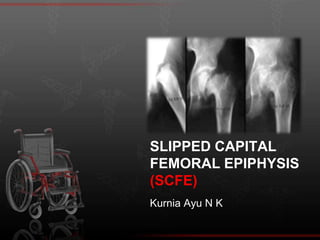
On plain radiographs, the femoral head is seen displaced, posteriorly and inferiorly in relation to the femoral neck and within the confines of the acetabulum.The ETIOLOGYMultiple theories have been proposed and it is likely a result of bothbiomechanical and biochemical factors. The combination ofthese factors results in a weakened physis with subsequent failure.Mechanical factors associated are obesity, increasedfemoral retroversion, and increased physeal obliquity. Biochemical factors are also likely involved. The effects of the gonadotropins on the physis may explain the malepredominance of slipped capital femoral epiphysis; estrogen reducesphyseal width and increases physeal strength, whereas testosteronereduces physeal strength. Slipped capital femoral epiphysis does not appear to be a heritable disorder.Routine histological evaluation and electron microscopy studies demonstrate a deficiency and abnormalityin the supporting collagenous and proteoglycan framework ofthe physis. Whether these abnormalities represent the cause or theeffect is not known.
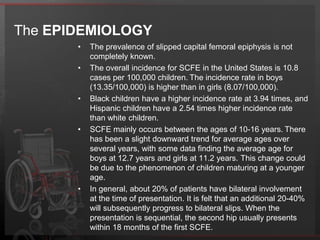
The EPIDEMIOLOGYThe prevalence of slipped capital femoral epiphysis is not completely known.The overall incidence for SCFE in the United States is 10.8 cases per 100,000 children.The incidence rate in boys (13.35/100,000) is higher than in girls (8.07/100,000). Black children have a higher incidence rate at 3.94 times, and Hispanic children have a 2.54 times higher incidence rate than white children. SCFE mainly occurs between the ages of 10-16 years.There has been a slight downward trend for average ages over several years, with some data finding the average age for boys at 12.7 years and girls at 11.2 years. This change could be due to the phenomenon of children maturing at a younger age.In general, about 20% of patients have bilateral involvement at the time of presentation. It is felt that an additional 20-40% will subsequently progress to bilateral slips. When the presentation is sequential, the second hip usually presents within 18 months of the first SCFE.
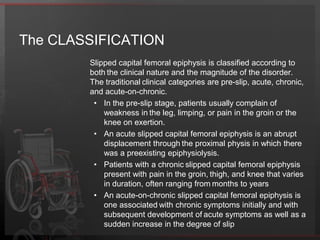
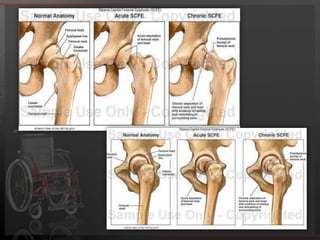
The CLASSIFICATIONSlipped capital femoral epiphysis is classified according to boththe clinical nature and the magnitude of the disorder. The traditionalclinical categories are pre-slip, acute, chronic, and acute-on-chronic.In the pre-slip stage, patients usually complain of weakness inthe leg, limping, or pain in the groin or the knee on exertion. An acute slipped capital femoral epiphysis is an abrupt displacement throughthe proximal physis in which there was a preexisting epiphysiolysis.Patients with a chronicslipped capital femoral epiphysis present with pain in the groin,thigh, and knee that varies in duration, often ranging frommonths to yearsAn acute-on-chronic slipped capital femoral epiphysis is one associatedwith chronic symptoms initially and with subsequent development ofacute symptoms as well as a sudden increase in the degree of slip
The CLASSIFICATIONThe traditional classification depends on the memory of thechild or parent, or both, and may be inaccurate; it also doesnot give a prognosis with regard to the potential for avascularnecrosis.
The clinical classification depends on the ability of the childto walk. Consideredstable when the child is able to walk with or without crutches,and it is considered unstable when the child cannot walk withor without crutches.
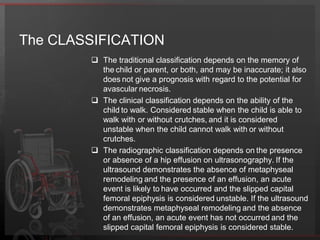
The radiographic classification depends onthe presence or absence of a hip effusion on ultrasonography.If the ultrasound demonstrates the absence of metaphyseal remodelingand the presence of an effusion, an acute event is likely tohave occurred and the slipped capital femoral epiphysis is consideredunstable. If the ultrasound demonstrates metaphyseal remodelingand the absence of an effusion, an acute event has not occurredand the slipped capital femoral epiphysis is considered stable.CLINICAL - historyMost common in the adolescent period. Males have 2.4 times the risk compared with females.The left hip is affected more commonly than the right.Obesity is a risk factor because it places more shear forces around the proximal growth plate in the hip.The duration, location, and radiation of pain are important, as is the ability to bear weight.Genetics may play a role in SCFE because the rate of familial involvement is 5-7%, with a large variability in penetrance.In patients younger than 10 years, SCFE is associated with metabolic endocrine.Bilaterality is more common in these younger patients.The chronicity of the condition should be determined.Prodromal symptoms for less than 3 weeks are deemed acute. for longer than 3 weeks are deemed chronic.If a patient reports symptoms of greater than 3 weeks' duration but presents with an acute exacerbation of pain, limp, inability to bear weight, or decreased range of motion with or without an associated traumatic episode, the SCFE is categorized as acute on chronic.Determine if a traumatic episode occurred.It is important to determine if the lesion is stable or unstable."Stable" SCFEs allow the patient to ambulate with or without crutches."Unstable" SCFEs do not allow the patient to ambulate at all.
CLINICAL – physicalIf a patient reports knee pain, always examine the hip, because knee pain may be referred pain from the hip via the obturator nerve.Obesity increases a clinician's index of suspicion for SCFE.Patients often hold their affected hip in passive external rotation.Determine the patient's ability to bear weight (stable vs unstable).If the patient is ambulatory, determine the his or her gait pattern:Antalgic – Shortened stance phase on the affected sideOut-toeingAlways examine both hips.Assess the active and passive range of motion in both hips. In patients with unilateral complaints, this comparison allows the clinician to compare the affected and unaffected sides for differences. Internal and external rotation are best tested with the patient in the prone position with the knees flexed to 90 º.If SCFE is present, the lower extremity may externally rotate and abduct with gentle passive hip flexion.Internal rotation is decreased in nearly all hips with SCFE. Internal rotation is often painful.
The EXAMINATION – Imaging StudiesDiagnosis is made using anteroposterior (AP) pelvis and lateral frog-leg radiographs. AP radiograph: The Klein line is drawn straight up the superior aspect of the femoral neck. This should intersect the epiphysis. If not, then it is likely an SCFE (see the image).Frog leg radiograph: A straight line through the center of the femoral neck proximally should be at the center of the epiphysis. If not, and the line is anterior in the epiphysis, it is likely an SCFE.Magnetic resonance imaging (MRI) depicts the slippage earliest, and MRI can demonstrate early marrow edema and slippage. MRI may be helpful in follow-up studies of the contralateral hip.The EXAMINATION – Lab. StudiesRoutine hormonal screening is not indicated. Endocrinopathies and medical disorders should be appropriately worked up in patients with an atypical presentation or other findings on history and physical examination that are consistent with endocrinologic disorders. A typical presentation is considered for children who present with SCFE who are younger than age 10 years or older than 16 years, as well as children who present with SCFE and short stature. It is also worth considering endocrinology laboratory work for a patient that is not obese but who falls within the 10 to 16 year age range.
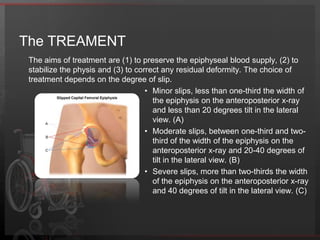
The TREAMENT	The aims of treatment are (1) to preserve the epiphysealblood supply, (2) to stabilize the physis and (3) to correct any residual deformity. The choice of treatment depends on the degree of slip.Minor slips, less than one-third the width of the epiphysis on the anteroposterior x-ray and less than 20 degrees tilt in the lateral view. (A)Moderate slips, between one-third and two-third of the width of the epiphysis on the anteroposterior x-ray and 20-40 degrees of tilt in the lateral view. (B)Severe slips, more than two-thirds the width of the epiphysis on the anteroposterior x-ray and 40 degrees of tilt in the lateral view. (C)
The COMPLICATIONSSlipping at the opposite hip, in at least 20% of cases slipping occurs at the other hip. Forewarned is forearmed: the asymptomatic hip should be checked by x-ray and at the least sign of abnormality the epiphysis should be pinned.Avascular necrosis, deathe of the epiphysis used to be common. It is now recognized that it hardly ever occurs in the absence of treatment. This iatrogenic complication is minimized by avoiding forceful manipulation and operations which might damage the posterior retinacular vessels.Articularchondrolysis, cartilage necrosis probably results from vascular damage (often iatrogenic), but bone changes are minimal. There is progressive narrowing of the joint space and hip becomes stiff.Coxavara, a slipped apiphysis that goes unnoticed – or is inadequately treated – may result in coxavara. The head slips backwards rather than downwards and the deformity is essentially one of femoral neck retroversion. Secondary effects are external rotation deformity of the hip, possibly shortening of the femur and secondary osteoarthritis.
Kangen Kamu Jelek

Kangen Kamu Jelek

  • 1.
    SLIPPED CAPITAL FEMORALEPIPHYSIS (SCFE)KurniaAyu N K
  • 2.
    Around the hipThehip joint is the largest joint of the human body. The hip is a ball and socket joint. The thigh bone (femur) ends with a rounded projection or ball (femoral head), which fits into the socket (acetabulum) of the pelvic girdle. Hip disorders are characteristically seen in certain well-defined age groups. Whilst there are exceptions to this role, it is sufficiently true to allow the age at onset to serve as a guide to the probable diagnosis.Slipped capital femoral epiphysis (SCFE) is the most common hip abnormality presenting in adolescence and is a primary cause of early osteoarthritis. Unfortunately, SCFE frequently is misdiagnosed, and it has symptoms that can be misleading.1Early treatment leads to better outcome but is confounded by frequent delays in diagnosis.
  • 3.
    The DEFINITONSlipped capitalfemoral epiphysis (SCFE) is one of the most important pediatric and adolescent hip disorders in medical practice.Despite the fact that the underlying defect may be multifactorial (eg, mechanical and constitutional factors), SCFE represents a unique type of instability of the proximal femoral growth plate.
  • 4.
    Clinically, the patientmay report hip pain, medial thigh pain, and/or knee pain; an acute or insidious onset of a limp; and decreased range of motion of the hip.
  • 5.
    On plain radiographs,the femoral head is seen displaced, posteriorly and inferiorly in relation to the femoral neck and within the confines of the acetabulum.The ETIOLOGYMultiple theories have been proposed and it is likely a result of bothbiomechanical and biochemical factors. The combination ofthese factors results in a weakened physis with subsequent failure.Mechanical factors associated are obesity, increasedfemoral retroversion, and increased physeal obliquity. Biochemical factors are also likely involved. The effects of the gonadotropins on the physis may explain the malepredominance of slipped capital femoral epiphysis; estrogen reducesphyseal width and increases physeal strength, whereas testosteronereduces physeal strength. Slipped capital femoral epiphysis does not appear to be a heritable disorder.Routine histological evaluation and electron microscopy studies demonstrate a deficiency and abnormalityin the supporting collagenous and proteoglycan framework ofthe physis. Whether these abnormalities represent the cause or theeffect is not known.
  • 6.
    The EPIDEMIOLOGYThe prevalenceof slipped capital femoral epiphysis is not completely known.The overall incidence for SCFE in the United States is 10.8 cases per 100,000 children.The incidence rate in boys (13.35/100,000) is higher than in girls (8.07/100,000). Black children have a higher incidence rate at 3.94 times, and Hispanic children have a 2.54 times higher incidence rate than white children. SCFE mainly occurs between the ages of 10-16 years.There has been a slight downward trend for average ages over several years, with some data finding the average age for boys at 12.7 years and girls at 11.2 years. This change could be due to the phenomenon of children maturing at a younger age.In general, about 20% of patients have bilateral involvement at the time of presentation. It is felt that an additional 20-40% will subsequently progress to bilateral slips. When the presentation is sequential, the second hip usually presents within 18 months of the first SCFE.
  • 7.
    The CLASSIFICATIONSlipped capitalfemoral epiphysis is classified according to boththe clinical nature and the magnitude of the disorder. The traditionalclinical categories are pre-slip, acute, chronic, and acute-on-chronic.In the pre-slip stage, patients usually complain of weakness inthe leg, limping, or pain in the groin or the knee on exertion. An acute slipped capital femoral epiphysis is an abrupt displacement throughthe proximal physis in which there was a preexisting epiphysiolysis.Patients with a chronicslipped capital femoral epiphysis present with pain in the groin,thigh, and knee that varies in duration, often ranging frommonths to yearsAn acute-on-chronic slipped capital femoral epiphysis is one associatedwith chronic symptoms initially and with subsequent development ofacute symptoms as well as a sudden increase in the degree of slip
  • 9.
    The CLASSIFICATIONThe traditionalclassification depends on the memory of thechild or parent, or both, and may be inaccurate; it also doesnot give a prognosis with regard to the potential for avascularnecrosis.
  • 10.
    The clinical classificationdepends on the ability of the childto walk. Consideredstable when the child is able to walk with or without crutches,and it is considered unstable when the child cannot walk withor without crutches.
  • 11.
    The radiographic classificationdepends onthe presence or absence of a hip effusion on ultrasonography.If the ultrasound demonstrates the absence of metaphyseal remodelingand the presence of an effusion, an acute event is likely tohave occurred and the slipped capital femoral epiphysis is consideredunstable. If the ultrasound demonstrates metaphyseal remodelingand the absence of an effusion, an acute event has not occurredand the slipped capital femoral epiphysis is considered stable.CLINICAL - historyMost common in the adolescent period. Males have 2.4 times the risk compared with females.The left hip is affected more commonly than the right.Obesity is a risk factor because it places more shear forces around the proximal growth plate in the hip.The duration, location, and radiation of pain are important, as is the ability to bear weight.Genetics may play a role in SCFE because the rate of familial involvement is 5-7%, with a large variability in penetrance.In patients younger than 10 years, SCFE is associated with metabolic endocrine.Bilaterality is more common in these younger patients.The chronicity of the condition should be determined.Prodromal symptoms for less than 3 weeks are deemed acute. for longer than 3 weeks are deemed chronic.If a patient reports symptoms of greater than 3 weeks' duration but presents with an acute exacerbation of pain, limp, inability to bear weight, or decreased range of motion with or without an associated traumatic episode, the SCFE is categorized as acute on chronic.Determine if a traumatic episode occurred.It is important to determine if the lesion is stable or unstable."Stable" SCFEs allow the patient to ambulate with or without crutches."Unstable" SCFEs do not allow the patient to ambulate at all.
  • 12.
    CLINICAL – physicalIfa patient reports knee pain, always examine the hip, because knee pain may be referred pain from the hip via the obturator nerve.Obesity increases a clinician's index of suspicion for SCFE.Patients often hold their affected hip in passive external rotation.Determine the patient's ability to bear weight (stable vs unstable).If the patient is ambulatory, determine the his or her gait pattern:Antalgic – Shortened stance phase on the affected sideOut-toeingAlways examine both hips.Assess the active and passive range of motion in both hips. In patients with unilateral complaints, this comparison allows the clinician to compare the affected and unaffected sides for differences. Internal and external rotation are best tested with the patient in the prone position with the knees flexed to 90 º.If SCFE is present, the lower extremity may externally rotate and abduct with gentle passive hip flexion.Internal rotation is decreased in nearly all hips with SCFE. Internal rotation is often painful.
  • 13.
    The EXAMINATION –Imaging StudiesDiagnosis is made using anteroposterior (AP) pelvis and lateral frog-leg radiographs. AP radiograph: The Klein line is drawn straight up the superior aspect of the femoral neck. This should intersect the epiphysis. If not, then it is likely an SCFE (see the image).Frog leg radiograph: A straight line through the center of the femoral neck proximally should be at the center of the epiphysis. If not, and the line is anterior in the epiphysis, it is likely an SCFE.Magnetic resonance imaging (MRI) depicts the slippage earliest, and MRI can demonstrate early marrow edema and slippage. MRI may be helpful in follow-up studies of the contralateral hip.The EXAMINATION – Lab. StudiesRoutine hormonal screening is not indicated. Endocrinopathies and medical disorders should be appropriately worked up in patients with an atypical presentation or other findings on history and physical examination that are consistent with endocrinologic disorders. A typical presentation is considered for children who present with SCFE who are younger than age 10 years or older than 16 years, as well as children who present with SCFE and short stature. It is also worth considering endocrinology laboratory work for a patient that is not obese but who falls within the 10 to 16 year age range.
  • 14.
    The TREAMENT The aimsof treatment are (1) to preserve the epiphysealblood supply, (2) to stabilize the physis and (3) to correct any residual deformity. The choice of treatment depends on the degree of slip.Minor slips, less than one-third the width of the epiphysis on the anteroposterior x-ray and less than 20 degrees tilt in the lateral view. (A)Moderate slips, between one-third and two-third of the width of the epiphysis on the anteroposterior x-ray and 20-40 degrees of tilt in the lateral view. (B)Severe slips, more than two-thirds the width of the epiphysis on the anteroposterior x-ray and 40 degrees of tilt in the lateral view. (C)
  • 15.
    The COMPLICATIONSSlipping atthe opposite hip, in at least 20% of cases slipping occurs at the other hip. Forewarned is forearmed: the asymptomatic hip should be checked by x-ray and at the least sign of abnormality the epiphysis should be pinned.Avascular necrosis, deathe of the epiphysis used to be common. It is now recognized that it hardly ever occurs in the absence of treatment. This iatrogenic complication is minimized by avoiding forceful manipulation and operations which might damage the posterior retinacular vessels.Articularchondrolysis, cartilage necrosis probably results from vascular damage (often iatrogenic), but bone changes are minimal. There is progressive narrowing of the joint space and hip becomes stiff.Coxavara, a slipped apiphysis that goes unnoticed – or is inadequately treated – may result in coxavara. The head slips backwards rather than downwards and the deformity is essentially one of femoral neck retroversion. Secondary effects are external rotation deformity of the hip, possibly shortening of the femur and secondary osteoarthritis.