Uniting Performance and Sustainability
in the Power Network of the Future
Blueprint for a
Smart Energy Enterprise Development Zone
in Silicon Valley
2 Uniting Performance and Sustainability in the Power Network of the Future
BOARD OF DIRECTORS	 November 2012
OFFICERS
Chris DiGiorgio, Co-Chair, Accenture, Inc.
Hon. Chuck Reed, Co-Chair, City of San José
Russell Hancock, President & CEO, Joint Venture Silicon Valley
DIRECTORS
Larry Alder, Google
Hon. Elaine Alquist, California State Senate
Mark Bauhaus, Juniper Networks
George Blumenthal, University of California at Santa Cruz
Steven Bochner, Wilson Sonsini Goodrich & Rosati
Dave Boesch, San Mateo County
Ed Cannizzaro, KPMG LLP
Emmett D. Carson, Silicon Valley Community Foundation
John Ciacchella, Deloitte & Touche LLP
Mary Dent, SVB Financial Group
Fred Diaz, City of Fremont
Ben Foster, Optony
Judith Maxwell Greig, Notre Dame De Namur University
Paul Gustafson, TDA Group
Steve Hemminger, Alston & Bird LLP
Joe Hogan, Ernst & Young
Eric Houser, Wells Fargo
Jim Keene, City of Palo Alto
W. Keith Kennedy Jr., Con-way
Tom Klein, Greenberg Traurig LLP
Hon. Liz Kniss, County of Santa Clara Board of Supervisors
Stacy McAfee, University of Phoenix
Tom McCalmont, McCalmont Engineering
Jim McCaughey, Lucile Packard Children’s Hospital
Jean McCown, Stanford University
Curtis Mo, Wilmer Cutler Pickering Hale and Dorr LLP
Mairtini Ni Dhomhnaill, Accretive Solutions
Joseph Parisi, Therma Inc.
Mo Qayoumi, San José State University
Bobby Ram, SunPower
Paul Roche, McKinsey & Company
Bill Sherry, Norman Y. Mineta San José International
Airport/Team San José
Harry Sim, Cypress Envirosystems
Susan Smarr, Kaiser Permanente
John Sobrato Sr., Sobrato Development Companies
Gautam Srivastava, LSI Corporation
Neil Struthers, Santa Clara County Building &
Construction Trades Council
Linda Thor, Foothill De-Anza Community College District
Mark Walker, Applied Materials
Linda Williams, Planned Parenthood Mar Monte
Patricia Williams, Merrill Lynch
Daniel Yost, Orrick, Herrington & Sutcliffe, LLP
SENIOR ADVISORY COUNCIL
John C. Adams, Wells Fargo
Frank Benest, City of Palo Alto (Ret.)
Eric Benhamou, Benhamou Global Ventures
Harry Kellogg Jr., SVB Financial Group
William F. Miller, Stanford University
Uniting Performance and Sustainability in the Power Network of the Future 3
Uniting Performance
and Sustainability
in the Power Network
of the Future
Blueprint for a Smart Energy
Enterprise Development Zone
in Silicon Valley
November 2012
4 Uniting Performance and Sustainability in the Power Network of the Future
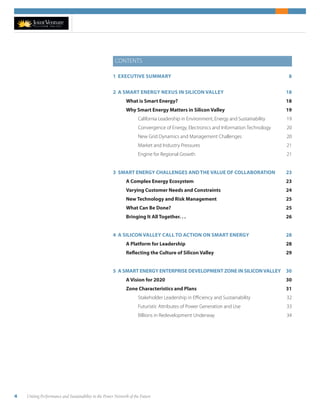
CONTENTS
1 EXECUTIVE SUMMARY				 8
2 A SMART ENERGY NEXUS IN SILICON VALLEY				 18
	 What is Smart Energy?			 18
	 Why Smart Energy Matters in Silicon Valley			 19
			California Leadership in Environment, Energy and Sustainability	 19
			 Convergence of Energy, Electronics and Information Technology	 20
			 New Grid Dynamics and Management Challenges	 20
			 Market and Industry Pressures	 21
			 Engine for Regional Growth		 21
3 SMART ENERGY CHALLENGES AND THE VALUE OF COLLABORATION	 23
	 A Complex Energy Ecosystem		 23
	 Varying Customer Needs and Constraints		 24
	 New Technology and Risk Management		 25
	 What Can Be Done?		 25
	 Bringing It All Together. . .		 26
4 A SILICON VALLEY CALL TO ACTION ON SMART ENERGY		 28
	 A Platform for Leadership					 28
	 Reflecting the Culture of Silicon Valley		 29
5 A SMART ENERGY ENTERPRISE DEVELOPMENT ZONE IN SILICONVALLEY	 30
	 A Vision for 2020		 30
	 Zone Characteristics and Plans		 31
			 Stakeholder Leadership in Efficiency and Sustainability	 32
			 Futuristic Attributes of Power Generation and Use	 33
			Billions in Redevelopment Underway	 34
Uniting Performance and Sustainability in the Power Network of the Future 5
	 Smart Energy Portfolio Elements		 35
			 Integrated Building Systems		 36
			 Distributed Generation		 36
			 Demand Programs		 36
			 Electric Transport		 37
			 Grid Infrastructure		 37
			 Advanced Storage and Backup		 38
			 Standards and Interoperability		 38
			 Incentives and Financing		 38
	 Conceptual Design and Measures		 39
			Power Reliability	 39
	 		 Power Quality	 40
			 Demand Profile	 40
			 Demand Flexibility		 40
	 		 Financial Savings		 40
			 Emissions and Energy Intensity		 40
			 Distributed Generation Penetration		 40
			 EV and Charging Infrastructure Penetration		 40
			 Market Engagement		 40
			 Directed Funding		 40
			 Future Goals		 40
	 Stakeholder Roles and Benefits		 40
6 GETTING STARTED		 43
	 Overall Approach and Road Map		 43
	 Organization and Engagement	 44
	 Practice Advancement Initiatives	 44
			Power Quality Information Sharing		 44
			 Leading Smart Energy Practice Inventory		 45
			 Model Zone Specification for Integrated Building Systems	 45
	 The Capstone: Strategic Development Programs	 45
	 The Climate Prosperity Journey 		 46
7 APPENDICES AND ENDNOTES			 47
6 Uniting Performance and Sustainability in the Power Network of the Future
BACKGROUND
In 2008, the Rockefeller Brothers Fund and Global Urban Development selected
Joint Venture Silicon Valley to head a new national initiative, the Climate Prosperity
Project, and designated Silicon Valley as one of seven pilot regions.
Climate Prosperity promotes the view that the climate crisis is an opportunity to
build new industry clusters, create whole new classes of jobs and grow the economy,
while at the same time enhancing our quality of life and solving one of the world’s
most pressing problems, climate change.
Joint Venture formed the Silicon Valley Climate Prosperity Council, chaired by
San José Mayor Chuck Reed and Chris DiGiorgio, California Managing Director of
Accenture. The strategy for this initiative—The Greenprint for Silicon Valley—was
published in 2009 and provided a framework and plan of action focused on four
areas: renewable energy, building efficiency, clean, convenient transportation and
green infrastructure.
Under the direction of the Council, the Climate Prosperity team has since led the
development and implementation of such influential programs as the Silicon Valley
Energy Storage Symposium series and the largest multiagency procurement of
renewable energy in the country to date.
The Climate Prosperity Council also identified growing the “smart energy” industry and
creating a large-scale demonstration program in Silicon Valley as a priority. Smart energy
refers to a range of new technologies, solutions, standards and practices that are enabling
cleaner and more efficient production, distribution and consumption of energy.
Over the past several months, Joint Venture has worked closely with key member
organizations and AltaTerra Research to define a Silicon Valley-based “Smart Energy
Enterprise Development Zone.” Essential in this effort has been collaboration among
a broad group of stakeholders, including leading corporate customers, developers,
municipalities, and utility and solution providers.
The goal of this initiative is to build the country’s highest-performance two-way
power network, one that supports and rewards active energy management and clean
distributed generation on a sustainable economic scale.
This report provides a vision and a road map for the development of a Smart Energy
Enterprise Development Zone in an area spanning north Sunnyvale, north Mountain
View and Moffett Field. This zone will serve as a replicable example for development
and implementation of “smart energy” solutions in other regions, and incorporates
Silicon Valley’s latest developments in efficiency, clean energy, grid performance and
business model integration.
Uniting Performance and Sustainability in the Power Network of the Future 7
We would like to thank the following organizations for providing input and insight
as we developed this blueprint:
•	 Accenture
•	 Applied Materials
•	 City of Mountain View
•	 City of Sunnyvale
•	 Cypress Envirosystems
•	 Electric Power Research Institute
•	 Google
•	 Intuit
•	 Juniper Networks
•	 Lawrence Berkeley National Laboratory
•	 Moffett Park Business Group
•	 NASA Ames Research Park
•	 NetApp
•	 McCalmont Engineering
•	 Optony
•	 Pacific Gas & Electric Company
•	 SunPower
•	 Sustainable Silicon Valley
•	 University Associates
•	 Yahoo! Inc.
8 Uniting Performance and Sustainability in the Power Network of the Future
1. EXECUTIVE SUMMARY
AN EMERGING SMART ENERGY REVOLUTION
Around the world, concerns for sustainability have placed a premium on energy
efficiency and the use of clean, renewable sources of energy. Related goals and
standards are advancing rapidly and national-scale investments are now being made
in efficiency and clean energy programs.
At the same time, innovation in electronics and information technology are reshaping
customer interaction with the traditional electric grid—in such forms as electric
vehicles (EVs), networked energy management and solar photovoltaic systems.
The convergence of these developments signals a transformation in how energy will
be sourced and utilized in the future. “Smart energy” describes a portfolio of new
practices, standards and technologies for maximizing performance and sustainability
in the production, distribution and use of electric power.
In contrast to traditional energy systems, smart energy is characterized by:
•	 A bidirectional flow of energy and real-time information
•	 Dynamic incentives for responsive, affordable matching of supply and demand
•	 Clean energy sources that may be distributed and/or variable
•	 More efficient energy uses, and electrification of transportation
•	 Integration and interoperability across sources, distribution and use
•	 A high degree of availability, reliability and quality
•	 Evolving energy- and sustainability-related metrics
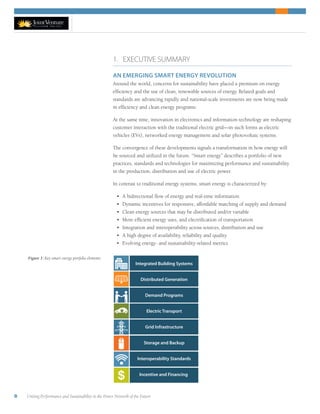
Figure 1: Key smart energy portfolio elements.
+
Integrated Building Systems
Distributed Generation
Demand Programs
Electric Transport
Grid Infrastructure
Storage and Backup
Interoperability Standards
Incentive and Financing
Uniting Performance and Sustainability in the Power Network of the Future 9
Spanning utilities and customers, a smart energy portfolio encompasses eight key
elements (see Figure 1). For example, integrated building systems help manage and
optimize building energy use at a detailed level. Distributed generation provides a
source of clean energy at customer locations, and new demand management and
pricing programs encourage optimal matching of power supply and demand between
customers and the power providers.
Characteristically, smart energy elements are often interdependent. Distributed
generation systems, for example, are usually tied to specific utility-provided rate
structures and incentives. And broad-scale deployment of electric vehicles is gated by
establishment of suitable charging infrastructure, related policies and standards.
In the end, effective collaboration and integration are essential in building a smart
energy future.
A NEXUS FOR SMART ENERGY IN SILICON VALLEY
The effects and opportunities associated with smart energy converge uniquely
on Silicon Valley. An advanced policy and regulatory environment, sophisticated
energy customers, an uncoupled utility, and economic leadership in electronics
and information technology represent the essential ingredients for a future of smart
energy leadership—as solution providers, as customers and as a region.
This matters to Silicon Valley for several reasons:
•	 California, its regional agencies and its municipalities have taken a leading role
in energy efficiency, renewable energy and greenhouse gas (GHG) reduction
policies and programs.
•	 New grid dynamics and management challenges are emerging from the addition
of renewable energy, distributed generation and electric vehicles to the grid.
•	 Market and industry pressures are forcing the information and communication
technology (ICT)i
industry to improve efficiency, reliability and sustainability in
the face of growing power needs.
•	 New electronics and IT applications converging with traditional energy and
transportation solutions are an engine of future growth for Silicon Valley.
•	 Smart energy markets are highly competitive around the world, and Silicon
Valley must continue to advance its credentials in this lucrative market.
COLLABORATION NEEDED TO ADDRESS KEY CHALLENGES
Smart energy promises essential long-term economic and environmental benefits.
Yet, as is often the case, the challenge lies in the details. The energy ecosystem is
especially complicated with many moving parts and a diverse set of stakeholders.
Customer requirements vary widely and new solutions carry cost and risk.
10 Uniting Performance and Sustainability in the Power Network of the Future
In addressing these challenges, collaboration serves as a “force multiplier.” Bringing
stakeholders together is critical for defining common opportunities, developing
integrated standards and solutions, leveraging time and investment, and realizing
more rapid propagation of best practices.
In this spirit, a host of prominent smart energy collaborations have emerged
around the United States, supported by large-scale public and private investment.
Surprisingly, there is no such broad-scale collaboration in Silicon Valley.
A SILICON VALLEY“CALL TO ACTION”
As the world’s leading region for high-technology research and development, Silicon
Valley has a long history of enabling business innovation. And now, thanks to new
developments in electronics and information technology, our region is in a position to
transform how energy is sourced, distributed and utilized around the world.
Silicon Valley is already home to many isolated examples of what the smart energy
future holds. Utility Pacific Gas & Electric (PG&E) is underwriting millions of dollars
in customer-side energy efficiency upgrades at local companies. Google has piloted
a two-way vehicle-to-grid EV charging system. And local solution providers, such as
Bloom Energy and SunPower, are industry leaders in distributed generation and have
a number of local installations. Yet despite a wealth of point examples, there is no
integrated, programmatic view of smart energy applied broadly in Silicon Valley.
Improve reliability,
affordability
Pilot and implement new capabilities, models and processes
for efficient utilization of grid energy assets, improved
reliability and affordability
Advance sustainability Reduce local GHG emissions through the expanded use of
grid-effective clean and distributed sources of energy, and
increased electrification of transportation
Expand market
opportunity
Provide global market expansion and brand enhancement
for Silicon Valley companies deploying advanced energy,
information and transportation solutions
Attract investment Attract additional energy-related technology companies,
investment and research funding as a hub for development
and deployment of advanced solutions
Accelerate climate
prosperity
Accelerate sustainable deployment of smart energy,
return tangible benefits to participants, and provide both
leadership and a replicable model for other regions
Figure 2: Collaboration objectives.
Uniting Performance and Sustainability in the Power Network of the Future 11
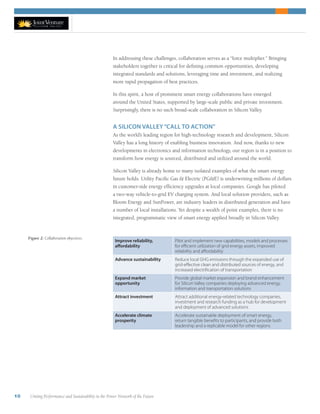
Under the direction of Joint Venture’s Climate Prosperity Council, a working group of
stakeholders was engaged in a visioning and strategy effort to outline a smart energy
collaboration based in Silicon Valley (see Figure 2). In doing so, the group identified
a handful of critical objectives—improving reliability and affordability of local power,
advancing sustainability, expanding market opportunity, attracting investment and
accelerating climate prosperity.
Silicon Valley brings a special combination of assets and capabilities from which
to establish a new and unique brand of smart energy collaboration, a real-world
platform for leadership in integrated smart energy development and deployment.
In establishing this collaboration, the working group stressed a number of guiding
principles consistent with how Silicon Valley operates, and making this effort
customer-focused, commercially sustainable, rapid and results-oriented.
Also, they envisioned this collaboration in the context of a physical and organizational
platform serving smart energy and sustainability needs over time. As new approaches and
solutions are tested, deployed and/or scaled, this platform will facilitate the measurement
of results and information sharing through traditional and online channels.
BUILDING A SILICON VALLEY-BASED SMART ENERGY
ENTERPRISE DEVELOPMENT ZONE
Central to this vision is the establishment of an enterprise development zone
(see Figure 3). This area will serve as a focal point for building:
•	 The country’s highest-performance two-way power network, supporting and
rewarding active energy management and clean distributed generation on a
sustainable economic scale
•	 A replicable example that demonstrates Silicon Valley’s latest developments in
efficiency, clean energy, grid performance and business model integration
Figure 3: Smart Energy Enterprise
Development Zone (SEEDZ). Smart Energy Enterprise Development Zone
Supply-Side
High reliability
Affordable
Dynamically priced
Load-matched/Ordered
Distributed
Clean
Demand-Side
Energy-efficient
Cost-effective
Responsive
Callable
High-value
Clean
12 Uniting Performance and Sustainability in the Power Network of the Future
Through collaborative efforts of local and industry stakeholders, the Smart Energy
Enterprise Development Zone (SEEDZ) will be home to a range of tactical practice
advancement initiatives and strategic development programs.
The 8.25-square-mile zone encompasses the Moffett Federal Airfield, the City of
Mountain View north of Highway 101 and the City of Sunnyvale north of Highway
237. The zone comprises 300 energy customers in 31 million square feet of building
space, mostly for high-tech office, lab and data center uses. In addition, billions of
dollars of investment are planned for development of more than 8.5 million square
feet of new office and lab space.
The zone has a unique and progressive energy profile, featuring high concentrations
of distributed generation and electric vehicle charging infrastructure. Current
peak power demand is estimated at 175-200 MW, with approximately 13 MW of
distributed generation across 18 installations. Hundreds of EV charging stations are
currently in place or planned.
In the zone, high-tech industry customers have growing demands for high-
quality power. Quality and reliability are extremely important here as momentary
interruptions bring down expensive development equipment and processes.
Leading customers in the zone—such as Google, Juniper Networks, NetApp,
Yahoo and Intuit—are currently ranked as leaders in corporate sustainability by
organizations such as the Carbon Disclosure Project and Newsweek magazine. PG&E
is a recognized leader in solar installations and has plans to spend $1 billion on
smart grid improvements by the year 2020.
Why a“Zone”?
For many reasons, a geographic focus is helpful for enabling smart energy solutions:
• Customers are in close proximity, enabling shared approaches and leverage
• Common utility and programs, grid infrastructure and jurisdictions
• High degree of commonality in needs and objectives among stakeholder groups
• Sets an appropriate project scale that is measurable, quantifiable and replicable
• Helps isolate test bed inputs, outputs and results
• Builds personal and neighborhood relationships that foster collaboration
Uniting Performance and Sustainability in the Power Network of the Future 13
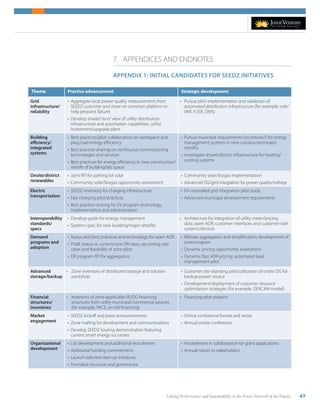
Collaborations within SEEDZ will be built around key smart energy elements.
The working group has identified a broad range of candidate initiatives associated
with one or more of these elements (see Figure 4). In the process, some specific
initiatives have been identified as high-priority “quick wins,” and other areas as likely
candidates for strategic development programs and additional third-party funding.
MEASURES OF SUCCESS—A BALANCED SCORECARD
Over time, monitoring and performance metrics will be embedded into SEEDZ.
Evaluating and judging success will be measured on the basis of complementary
operational performance, sustainability and economic growth factors (see Figure 5).
Integrated building systems
Advanced HVAC/lighting,
energy management systems,
automated load shifting,
continuous commissioning
Demand
programs
Scaled adoption
of DR and ADR,
advancement of
new dynamic
pricing models
Grid
infrastructure
Power quality monitoring,
advanced distribution
automation, self-healing
Distributed generation
Onsite (potentially shared) solar PV,
fuel cells, biogas, SWH, DG/grid
integration, district heat/cooling
Electric
transport
EV charging
infrastructure,
smart charging
programs, EV grid
impacts/integration
Storage and backup
Thermal and electric storage,
backup, DG/islanding
integration, rate arbitrage
Incentives and financing
Development incentives and
standards, availability and
piloting of PACE, on-bill financing,
other commercial structures
Interoperability standards
Building energy management
and utility integration standards,
DG and storage integration,
NIST smart grid standards
Smart Energy
Enterprise Development Zone
Practice advancement
Development of tools and model practices
Best-practice sharing
Collaborative RFIs/RFPs
Market engagement
Market education and outreach“engine”
Videos/touring demonstrations
Strategic development
Shared solution schematics
Strategic infrastructure and programs
Funding and grants
+
Figure 4: Smart energy elements and candidate
initiatives.
14 Uniting Performance and Sustainability in the Power Network of the Future
GETTING STARTED
Like any venture, launching a smart energy development zone in Silicon Valley will
take organization, resources and time. Key stakeholders will include major energy
customers, technology solution providers, the public utility, and municipal and
institutional players (see Figure 6).
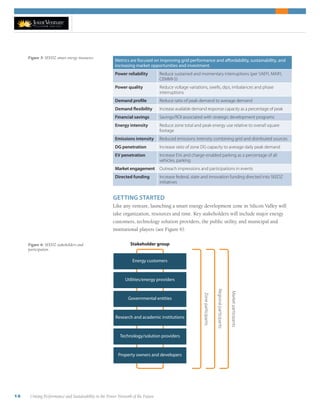
Metrics are focused on improving grid performance and affordability, sustainability, and
increasing market opportunities and investment.
Power reliability Reduce sustained and momentary interruptions (per SAEFI, MAIFI,
CEMMI-5)
Power quality Reduce voltage variations, swells, dips, imbalances and phase
interruptions
Demand profile Reduce ratio of peak demand to average demand
Demand flexibility Increase available demand response capacity as a percentage of peak
Financial savings Savings/ROI associated with strategic development programs
Energy intensity Reduce zone total and peak energy use relative to overall square
footage
Emissions intensity Reduced emissions intensity combining grid and distributed sources
DG penetration Increase ratio of zone DG capacity to average daily peak demand
EV penetration Increase EVs and charge-enabled parking as a percentage of all
vehicles, parking
Market engagement Outreach impressions and participations in events
Directed funding Increase federal, state and innovation funding directed into SEEDZ
initiatives
Figure 5: SEEDZ smart energy measures.
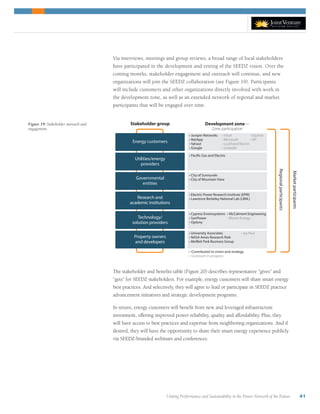
Figure 6: SEEDZ stakeholders and
participation.
Zoneparticipants
Regionalparticipants
Marketparticipants
Stakeholder group
Energy customers
Utilities/energy providers
Governmental entities
Research and academic institutions
Technology/solution providers
Property owners and developers
Uniting Performance and Sustainability in the Power Network of the Future 15
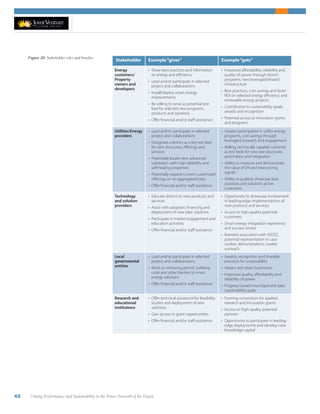
Stakeholders will be actively engaged and contribute in a variety of ways, including
staffing and financial resources, expertise, leading or participating in specific
programs, or serving as a test bed for new innovations. In return, stakeholders will
see tangible benefits in the form of solving shared problems, improving performance
and, ultimately, enhancing climate prosperity.
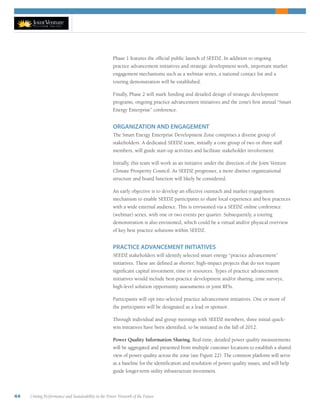
The road map for SEEDZ formation outlines three general phases (see Figure 7):
1.	Building a framework for collaboration
2.	Launching the operation
3.	Sustaining programs
To build momentum and involvement, work on tactical initiatives begins early, in
the collaboration development phase—as do market outreach, engagement and
strategic program activities. Concurrently, the collaboration will begin to establish a
mechanism to address strategic needs facing the scaled deployment of smart energy.
Figure 7: SEEDZ phasing and road map. Phase 0 Phase 1 Phase 2
SEEDZ
Vision and
strategy
Organization Public launch Market engagement and education
Ongoing practice advancement initiativesStart-up ”QuickWin”initiatives
Strategic needs assessment Strategic funding and detailed design/build
of development projects
Organization
and engagement
Practice
advancement
Strategic
development
Collaboration development Operational startup Sustaining programs
Market engagement. SEEDZ will provide brand and market development benefits
for stakeholders. This will be done through market outreach and by sharing
solutions. Early on, SEEDZ will develop market engagement mechanisms such as a
webinar series, a national contact list, and tours and demonstration to help establish
the zone’s profile and share current best practices.
16 Uniting Performance and Sustainability in the Power Network of the Future
Practice advancement initiatives. In the near term, stakeholders have identified
three quick-win practice advancement initiatives as foundational projects, ones that
will build knowledge and momentum. These initiatives include:
•	 Power quality information sharing: Sharing of power quality measurements from
customers to identify distribution problems and guide investment.
•	 Inventory of smart energy practices: Developing and sharing smart energy practices
to accelerate the adoption of smart energy solutions.
•	 Integrated Building Energy Management System Specification: Developing a model
specification with smart energy-enabling capabilities.
Capstone strategic development programs. Uniting leading Silicon Valley
customers, industry, government and utility players in strategic development
programs is the capstone opportunity for SEEDZ. Building out the SEEDZ vision
over the next 5-10 years will take a shared understanding of smart energy design,
associated programmatic and technology elements, and funding. Defining common
strategic development needs will help to attract resources and outside investment to
scale programs, infrastructure and demonstration projects.
As the SEEDZ coalition comes together, a smart energy schematic-level design and
evaluation effort will further outline potential strategic development programs.
This process will establish shared definitions of key customer and utility-side
capabilities needed to support the SEEDZ vision, key gaps, and shared research
and development opportunities.
Such shared opportunities will likely involve advanced power distribution and
management infrastructure, district generation, new dynamic pricing processes, zone
policies and adoption measures, and advanced technologies for two-way integration
of buildings, electric vehicles, distributed generation and storage.
With SEEDZ, it is expected that smart energy investments will be made by
both customers and the utility, and will be business-case driven. In addition, by
establishing itself as a high-profile smart energy collaboration, SEEDZ will have the
opportunity to attract significant incremental infrastructure and research funding
from utility, state, federal and other third-party sources.
Uniting Performance and Sustainability in the Power Network of the Future 17
THE JOURNEY FORWARD
Building out the SEEDZ vision will not be easy. New technologies and solutions must
be tested, deployed and scaled. Policies will have to be reworked. New standards
and measures must be adopted. Utilities must adapt business models, operations and
incentives to changing source and use profiles. And customers need to prepare for a
future of energy optimization and real-time integration.
Yet Silicon Valley is home to many of the world’s most innovative companies and
energy customers, progressive municipalities, leading research institutions and
forward-looking utilities. If Silicon Valley can’t succeed, then who can?
Acting now in a coordinated way will enhance and project Silicon Valley’s role at the
forefront of smart energy innovation. It will further protect our local environment,
and enhance regional competitive positioning in this new, rapidly growing market
segment. The SEEDZ collaboration will operate with a laser-focus on developing
both near-term and long-term results—accelerating climate prosperity benefits for
stakeholders, the Silicon Valley region and the global smart energy marketplace.
18 Uniting Performance and Sustainability in the Power Network of the Future
2. A SMART ENERGY NEXUS IN SILICON VALLEY
Around the world, societal concerns for sustainability are placing a premium on the
use of clean, renewable sources of energy and improved energy efficiency.
Aggressive renewable portfolio standards, advancing automobile and building
efficiency standards and regulatory and voluntary GHG reduction programs are
evidence of this trend. Further, governments around the world are expanding
investment in smart energy research, industry support and customer incentives.
The scale and trajectory of these developments signal a major transformation in how
energy will be sourced, distributed and utilized in the future. New smart energy
practices, standards and technologies will be at the forefront of this transformation.
The effects and opportunities associated with this transformation converge uniquely
on Silicon Valley. An advanced policy and regulatory environment, sophisticated
energy customers, uncoupled utilities and economic leadership in electronics and
information technology represent the essential seeds for a future of smart energy
leadership in Silicon Valley—as providers and as customers.
WHAT IS SMART ENERGY?
As studied by the Joint Venture working group, smart energy describes an emerging
portfolio of new practices, standards and technologies for maximizing performance
and sustainability in production, distribution and use of electric power. Versus
traditional energy systems, smart energy is characterized by:
•	 A bidirectional flow of energy and real-time information
•	 Dynamic incentives for responsive, affordable matching of supply and demand
•	 Clean energy sources that may be distributed and/or variable
•	 More efficient energy uses and electrification of transportation
•	 Integration and interoperability across sources, distribution and use
•	 A high degree of availability, reliability and quality
•	 Evolving energy and sustainability-related metrics
Terms such as “smart grid” or “smart microgrid” have similar definitions, yet to
some they connote a focus on power transmission and distribution management
technologies. The term “smart energy” is meant to imply an expanded view, including
such components as customer-side efficiency, electrification, supply-and-demand
incentive structures and sustainability-related measures.
The working group identified eight elements essential to realizing a smart energy
vision (see Figure 8). Importantly, individual elements are often interrelated and must
be considered in combination to achieve the greatest benefit.
Uniting Performance and Sustainability in the Power Network of the Future 19
As an example, EVs generally offer improved efficiency and reduced emissions versus
fossil-fueled vehicles. Yet EVs represent a new demand on the grid. Maximizing
the potential cost and environmental savings associated with expanded penetration
of EVs will take an integrated approach to new grid infrastructure, grid/vehicle
interoperability standards, demand management structures and local policies
and incentives.
WHY SMART ENERGY MATTERS IN SILICON VALLEY
California Leadership in Environment, Energy and Sustainability. California has
long been a leader in addressing energy efficiency and environmental sustainability,
and has established some of the most far-reaching goals and policies in the country.
California’s regulatory leadership, combined with local technology expertise, has
resulted in a burgeoning clean technology industry in Silicon Valley.
In 1978 concerns over air quality and oil prices led to the passage of Title 24,
which established the nation’s strictest energy-efficiency standards for buildings
and appliances. And in 1982 the California Public Utilities Commission (CPUC)
adopted decoupling policies to remove disincentives for utilities to promote energy
conservation and efficiency among customers. The California Energy Commission
estimates these standards and policies have saved customers $56 billion through
2003, and will save another $23 billion by 2013.ii
Figure 8: Key smart energy elements.
Integrated Building
Systems
Distributed
Generation
Demand
Programs
Electric
Transport
Grid
Infrastructure
Storage
and Backup
Interoperability
Standards
Incentive
and Financing
Building energy efficiency solutions and integrated systems will help reduce
energy consumption and enable customers to automatically respond to dynamic
pricing signals and participate in demand response events
Distributed and district renewable solutions, such as solar photovoltaic, will
provide customers with dynamic and cleaner sources of energy
Demand response programs will help create a more stable and reliable grid
by shifting customer energy use to nonpeak periods and smoothing the
electric load
Electric vehicles and infrastructure will enable a transition away from fossil
fuel–powered cars to cleaner, more efficient transportation
Advanced energy storage and backup will allow fast response to variations in
energy load/supply, help to integrate renewable resources and increase the
grid’s demand response resources
Interoperability standards and specifications will speed adoption and
integration of new solutions and technologies into building systems and the
utility electric grid
Financing structures and incentives are key to increasing the penetration and
adoption of new solutions, improving the payback of new solutions and
reducing up-front financing barriers
Grid infrastructure improvements and automation solutions will improve the
efficiency of the grid, while helping to improve power quality, reliability and
affordability
+
20 Uniting Performance and Sustainability in the Power Network of the Future
More recently, Assembly Bill 32, the Global Warming Solutions Act of 2006,
committed California to reducing GHGs to 1990 levels by the year 2020. AB 32 is the
most aggressive state-level GHG emissions act in the country, and mandates a range
of policy and standards-based mechanisms to meet reduction goals.
In the San Francisco Bay Area, many regional agencies and municipalities are
developing detailed climate action plans. These plans include identification of
municipal and community-wide GHG reduction initiatives focused on energy, the
built environment and transportation.
California has also been a leader in the deployment of renewable energy resources. Under
the “Million Solar Roofs” vision, the California Solar Initiative (CSI) is more than a third
of the way toward reaching its goal of building 3,000 MW of new solar capacity by
2016.iii
And in 2011, California increased its Renewable Portfolio Standard (RPS), now
requiring investor-owned utilities, electric service providers and community choice
aggregators to obtain 33 percent of their power from renewable sources by 2020.iv
Convergence of Energy, Electronics and Information Technology. Recently, solar
photovoltaic systems, fuel cells, electric vehicles and storage technologies have
reached commercial scale and are being connected to the grid in increasing numbers.
At the same time, new power electronics and software-based control applications are
changing how energy distribution and utilization are monitored and managed.
Successful integration of new electronics and information technology applications
with the traditional power grid will take strong technology and integration skills.
And it’s important to have willing “early adopter” customers to serve as pilot sites for
research and deployment of new integrated solutions. Silicon Valley is well suited to
this task, with highly technology-savvy energy customers and strong integration and
technology expertise.
New Grid Dynamics and Management Challenges. According to the Massachusetts
Institute of Technology report The Future of the Electric Grid,v
renewable generation,
distributed generation, electric vehicles and greater demand variability all pose
challenges to the grid if not addressed. This is an excellent example of a real-world
integration problem that will occur sooner rather than later in Silicon Valley and can
be solved by applying strong local expertise.
California is increasing its renewable energy mix from around 20 percent today to
33 percent in 2020. Much of this new capacity will come from utility-scale renewable
generation, such as wind and solar farms. Output from these variable resources is
challenging to predict accurately. As the MIT study notes, “efficiently increasing the
penetration of grid-scale renewable generation while maintaining reliability will
require modifications to the power system design and operation.”
Uniting Performance and Sustainability in the Power Network of the Future 21
Further complicating this picture is a steady increase in distributed renewable
generation at customer sites. High penetration rates in a given location can cause
unusual distribution flow patterns of power and stress electrical equipment. As
such, integrating high levels of distributed generation will require new monitoring
equipment and interconnection standards that protect the grid.vi
And from a demand standpoint, growing adoption of EVs will significantly increase
peak electricity usage, if the proper infrastructure and incentives are not provided to
encourage off-peak charging. Taken further, smart EV charging could help to improve
capacity use during low-use periods, and at some point in the future, offer capacity
back to the grid during peaks.
Market and Industry Pressures. In business operations, ICT firms require extremely
high-quality power. Excessive voltage fluctuation or momentary power interruptions
shuts down expensive development and production equipment and interrupts
the processes running on the equipment. Area customers described an 8-10 hour
recovery cycle from a power interruption, which is extremely expensive in terms of
direct and indirect costs.
Nationally, power interruptions, primarily from short interruptions less than five
minutes, cost commercial and industrial businesses nearly $80 billion annually.vii
And at a higher level, the ICT industry, in Silicon Valley and elsewhere, has growing
data center power needs to serve a market shift toward cloud computing, web services
and mobile computing. Many major companies in the industry are under direct
pressure from non-governmental organizations (NGOs) and other stakeholders to
improve energy efficiency, reliability and sustainability, while keeping energy costs low.
Engine for Regional Growth. Silicon Valley is at the epicenter of an emerging smart
energy economy. Global investment in clean energy alone reached $269 billion in
2011 and has grown more than 600 percent since 2004.viii
And the smart energy market is becoming increasingly competitive, with nations
like China, Germany and India investing heavily. China has also become the most
attractive market for investing in clean energy, according to a quarterly survey by
Ernst & Young.ix
Established Silicon Valley leaders and start-ups are aggressively engaged in new,
highly competitive smart energy markets around the world and/or are deploying
these same solutions in their own operations.
22 Uniting Performance and Sustainability in the Power Network of the Future
Figure 9: Clean technology and total venture
capital investment in California.
Source: Next 10 California Green Innovation Index
Venture Capital Investment in Clean Technology
VC and Total VC Investment/California
MillionsofdollarsinvestedinVentureCapital
(Inflationadjusted)
CleantechnologyaspercentoftotalVentureCapital
Total VC
Clean technology VC
Clean technology
as % of total VC
$70
$60
$50
$40
$30
$20
$10
$0
$70
$60
$50
$40
$30
$20
$10
$0
1999 2000 2001 2002 2003 2004 2005 2006 2007 2008 2009 2010 2011
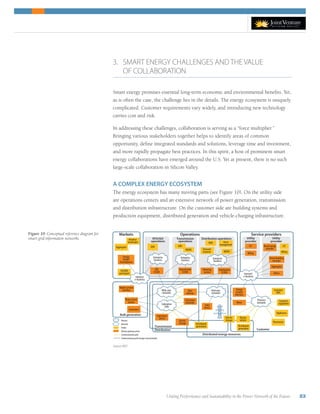
California and Silicon Valley lead the nation in clean technology investment and
innovation (see Figure 9). Totaling $1.76 billion in 2011, clean tech investment
in Silicon Valley represented 12.5 percent of total venture capital funding in the
country.x
The solar industry is particularly strong in the state, attracting $1.2 billion
of venture capital funding and accounting for 41 percent (182 patents) of all clean
tech patents filed nationwide.xi
Silicon Valley is home to numerous young and rapidly growing companies
developing smart energy technologies, such as Bloom Energy, Coulomb Technologies,
Bridgelux, eMeter, Silver Spring Networks and Tesla. SunPower, a major solar
manufacturer based in Richmond, now has annual revenues of $2.3 billion.
At the same time, leading information technology firms in the area, such as Google,
Juniper Networks, Yahoo! and NetApp continue to make visible investments in energy
efficiency, clean energy and other smart energy elements in their business operations.
In total, the market opportunity for energy efficiency via new applications of
information technology, communications and electronics is vast. As highlighted in
a 2008 Global eSustainability Initiative (GeSI) study, new ICT-based solutions in
buildings and electric grids, logistics and transportation, and industrial motor systems
represent an estimated aggregate energy savings worth $946.5 billion globally, and
emissions savings of 7.8 GtCO2e by the year 2020. Clearly, there is a large market
opportunity for Silicon Valley companies focused on smart energy technologies.xii
Uniting Performance and Sustainability in the Power Network of the Future 23
3. SMART ENERGY CHALLENGES AND THE VALUE
OF COLLABORATION
Smart energy promises essential long-term economic and environmental benefits. Yet,
as is often the case, the challenge lies in the details. The energy ecosystem is uniquely
complicated. Customer requirements vary widely, and introducing new technology
carries cost and risk.
In addressing these challenges, collaboration is serving as a “force multiplier.”
Bringing various stakeholders together helps to identify areas of common
opportunity, define integrated standards and solutions, leverage time and investment,
and more rapidly propagate best practices. In this spirit, a host of prominent smart
energy collaborations have emerged around the U.S. Yet at present, there is no such
large-scale collaboration in Silicon Valley.
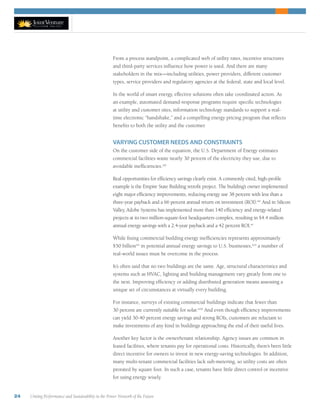
A COMPLEX ENERGY ECOSYSTEM
The energy ecosystem has many moving parts (see Figure 10). On the utility side
are operations centers and an extensive network of power generation, transmission
and distribution infrastructure. On the customer side are building systems and
production equipment, distributed generation and vehicle-charging infrastructure.
Source: NIST
Figure 10: Conceptual reference diagram for
smart grid information networks.
Markets Operations Service providers
Retailer/
wholesaler
Aggregator
Energy
market
clearinghouse
Internet/
e-business
ISO/RTO
participant
Enterprise
business
Enterprise
business
Enterprise
business
RTO/ISO
operations
Transmission
operations
Distribution operations
EMS EMS
RTO
SCADA
Transmission
SCADA
WAMS Demand
response
DMS Asset
management
MDMS
Metering
system
Distribution
SCADA
Billing
CIS
Utility
provider
Utility
provider
Billing
CISRetail energy
provider
Home/building
manager
Aggregator
OthersInternet/
e-business
Energy
services
interface
Premises
networks
Customer
DMS
Customer
equipmentMeter
Appliances
Thermostat
Electric
storage
Electric
vehicle
Distributed
generation Customer
Distributed energy resources
Wide area
networks
Substation
LANs
Data
collector
Substation
controller
Substation
device
Electric
storage
Transmission
Distribution
Plant control
system
Marketservices
interface
Generators
Bulk generation
Field area
networks
Field
device
Distributed
generation
Domain
Network
Action
Domain gateway action
Communications path
Communications path changes owner/domain
24 Uniting Performance and Sustainability in the Power Network of the Future
From a process standpoint, a complicated web of utility rates, incentive structures
and third-party services influence how power is used. And there are many
stakeholders in the mix—including utilities, power providers, different customer
types, service providers and regulatory agencies at the federal, state and local level.
In the world of smart energy, effective solutions often take coordinated action. As
an example, automated demand-response programs require specific technologies
at utility and customer sites, information technology standards to support a real-
time electronic “handshake,” and a compelling energy pricing program that reflects
benefits to both the utility and the customer.
VARYING CUSTOMER NEEDS AND CONSTRAINTS
On the customer side of the equation, the U.S. Department of Energy estimates
commercial facilities waste nearly 30 percent of the electricity they use, due to
avoidable inefficiencies.xiii
Real opportunities for efficiency savings clearly exist. A commonly cited, high-profile
example is the Empire State Building retrofit project. The building’s owner implemented
eight major efficiency improvements, reducing energy use 38 percent with less than a
three-year payback and a 66 percent annual return on investment (ROI).xiv
And in Silicon
Valley, Adobe Systems has implemented more than 140 efficiency and energy-related
projects at its two million-square-foot headquarters complex, resulting in $4.4 million
annual energy savings with a 2.4-year payback and a 42 percent ROI.xv
While fixing commercial building energy inefficiencies represents approximately
$50 billionxvi
in potential annual energy savings to U.S. businesses,xvii
a number of
real-world issues must be overcome in the process.
It’s often said that no two buildings are the same. Age, structural characteristics and
systems such as HVAC, lighting and building management vary greatly from one to
the next. Improving efficiency or adding distributed generation means assessing a
unique set of circumstances at virtually every building.
For instance, surveys of existing commercial buildings indicate that fewer than
30 percent are currently suitable for solar.xviii
And even though efficiency improvements
can yield 30-40 percent energy savings and strong ROIs, customers are reluctant to
make investments of any kind in buildings approaching the end of their useful lives.
Another key factor is the owner/tenant relationship. Agency issues are common in
leased facilities, where tenants pay for operational costs. Historically, there’s been little
direct incentive for owners to invest in new energy-saving technologies. In addition,
many multi-tenant commercial facilities lack sub-metering, so utility costs are often
prorated by square foot. In such a case, tenants have little direct control or incentive
for using energy wisely.
Uniting Performance and Sustainability in the Power Network of the Future 25
Return on investment calculations and availability of financing are perpetual
challenges for smart energy projects. Customers are often hesitant to invest in
projects that have longer than a two-year ROI. While efficiency projects often pencil
out within that timeframe, payback periods for distributed generation systems such
as solar are typically longer. And whether or not the ROI is compelling, customers
may have limited access to necessary upfront financing or viable financing terms.
Finally, as it relates to smart energy projects, organizational bandwidth is invariably
in short supply. Within most organizations, facilities and energy management budgets
are lean, and available time and expertise is limited. This makes effective market
education, engagement and leverage essential for scaling smart energy solutions.
NEW TECHNOLOGY AND RISK MANAGEMENT
Deploying new smart energy solutions involves technology integration risks, both for
utilities and customers. Similarly, new energy pricing and demand management practices
represent a business risk—for customers and utilities. Will new solutions work as
specified? To what extent will they be adopted? Will there be positive or adverse impacts
to power quality or service levels? Will costs be recovered and ROIs met?
These questions are growing in importance and scale. Recent years have seen a
dramatic increase in new technologies being introduced to the grid. New questions
are emerging around how best to manage and optimize this rapidly changing system
of energy inputs and outputs.
Standards are critical for ensuring the integration and interoperability of new
technologies. Yet the many touch points that exist between different industry players
and the complexity of the energy ecosystem make this challenging.
WHAT CAN BE DONE?
So this is complicated. Fortunately, new practices, standards and business models are
tackling the smart energy challenge head-on. And major investments are being made
in smart energy demonstration projects around the country to implement and assess
new energy technologies and market-based approaches.
At a tactical level, for example, “green leasing” practices are expanding between
building owners and tenants. These practices address agency issues and encourage
owner/tenant collaboration, aligning incentives for effective investment in efficiency
and sustainability-related improvements. Real estate services provider Jones Lang
LaSalle, for instance, has developed a Green Office Toolkitxix
providing tenants with a
range of tools on green leases and implementing sustainability improvements.
26 Uniting Performance and Sustainability in the Power Network of the Future
Also, building certifications such as Leadership in Energy and Environmental Design
(LEED) and ENERGY STAR are now having a major impact in terms of improving
energy efficiency in buildings. Critically, they provide standards by which owners,
tenants and municipalities can measure and value building energy and environmental
performance. Participation in ENERGY STAR has increased from approximately
30,000 buildings in 2006 to nearly 210,000 buildings in 2011.xx
New business models have emerged to address the issue of upfront financial cost
and availability of expertise. Power Purchase Agreements (PPA) and Energy Service
Agreements (ESA) are eliminating upfront costs by providing customers with
distributed renewable generation and energy efficiency as a service. Innovative new
policy tools, such as Property Assessed Clean Energy (PACE) programs, on-bill
financing and community solar are also helping to reduce upfront costs.
From a technology standpoint, open standards bodies such as The National Institute
of Standards and Technology (NIST), the Institute of Electrical and Electronics
Engineers (IEEE) and the International Elecrotechnical Commission (IEC) are
working on the collaborative development of detailed standards for interoperability
in smart energy systems, spanning generation, transmission, distribution and use.
Along a related vein, the Perfect Power Institute is working on an extensive set of power
system design and performance metrics spanning reliability, quality, cost and operational
efficiency, environment and energy efficiency, safety, and customer engagement.
BRINGING IT ALL TOGETHER . . .
At both a customer and utility level, proving out new technologies and programs
is critical to adoption and scaling. Pilot projects and best-practice sharing are
time-honored ways of addressing new technology risk. Pilots need to be carefully
constructed to isolate key inputs and outputs, and then measured and verified to
demonstrate achieved benefits.
Just as important is sharing results. This helps utilities and customers assess likely
risks, understand the benefits and tailor their approaches. And it accelerates adoption
of promising solutions by reducing the “fear of the unknown.”
Major smart energy collaborations are currently underway in various cities and
regions across the country. These collaborations serve as test beds for piloting
advanced energy technologies, business models and energy management systems,
and understanding associated customer behaviors.
Millions of dollars of investment are being deployed in these collaborations, from
federal, state, utility, institutional and private-sector sources. Selected projects are listed
in Figure 11. Surprisingly, there is no such large-scale collaboration in Silicon Valley.
Uniting Performance and Sustainability in the Power Network of the Future 27
Current collaborations vary in their objectives, scope and funding, but each is
pursuing elements vital to smart energy. As an example, Envision Charlotte is
helping building owners monitor and manage their energy use in real time. With
nearly $5.5 million in funding from Duke Energy and Cisco, building owners are
not charged for participating.
Other collaborations are significantly larger in scope, involving hundreds of millions
in investment. The Sacramento Municipal Utility District (SMUD) has developed the
SmartSacramento demonstration project to encourage customers to be part of energy
solutions. With more than 20 individual projects, SmartSacramento has received a
$127.5 million grant from the DOE, which SMUD is applying to its $308 million
smart grid investment in the program.
Figure 11: Selected smart energy collaborations.
Project name Partners Description
Albuquerque
Business District
Smart Grid
Project
Shimizu Corp.,
Mitsubishi, Fujji
Electric, Sandia
Labs, UNM
Two-year study at commercial facility integrating
50 kW PV, 240 kW gas generator, 80 kW fuel cell and
90 kW battery to develop a microgrid.
Envision
Charlotte
Cisco, Duke
Energy,Verizon,
Bank of America,
Wells Fargo
Pilot installation of real-time energy monitoring at
-65 office buildings with goal of reducing energy use in
buildings by 20 percent by 2016. Funded by Duke Energy
($4 million) and Cisco ($1 million). No fee to participate.
Illinois Smart
Building
Initiative
Draper  Kramer,
MJWilkow,
Argonne Lab,
seven Korean
firms
Multi-property project to combine DR, ancillary
services and EE projects to find new revenue streams
and develop new business models. Funded with
$2.7 million from the Korean government and
$1 million from the state of Illinois.
Irvine Smart Grid
Project
EPRI, Southern
California
Edison
$80 million project deploying smart grid technologies
to improve operating performance of the local
distribution system and encourage customers to
participate in the control of electric demand.
Pecan St. Project Austin, Austin
Energy, UT, Dell,
Oracle, Cisco,
Microsoft
• Organization developing advanced technologies,
business models and customer behavior
surrounding advanced energy management
systems.
• Piloting 100 homes to participate in energy audit
and installation of monitoring systems.
Philadelphia
Navy Yard
PIDC,
11 academic
institutions,
UTC, IBM, two
national labs
Developing Energy Innovation Hub with $120 million
Department of Energy grant serving as a test bed
for RE integration, microgrids and the development
of smart grid technologies. Site has an independent
electric grid.
SmartSacramento
Smart Grid
Demonstration
EPRI,
Sacramento
Municipal Utility
District
More than 20 individual projects combining existing,
proven technologies with the pilot testing of several
new technologies. Project includes consumer behavior
study, energy storage and solar feasibility study.
UC San Diego
Microgrid
Chevron Energy
Solutions, UCSD
Microgrid with the ability to manage 42 MW of
generating capacity, including cogen plant, solar
array and fuel cells. The campus can isolate itself
from the larger electric grid to maintain power in
an emergency.
28 Uniting Performance and Sustainability in the Power Network of the Future
4. A SILICON VALLEY CALL TO ACTION ON SMART ENERGY
As the world’s leading region for high-technology research and development, Silicon
Valley has a long history of enabling new business innovation. And now, recent
developments in electronics and information technology stand to transform how
energy is sourced, distributed and utilized around the world.
Under the direction of Joint Venture’s Climate Prosperity Council, a working group of
stakeholders was engaged in a visioning and strategy effort to define the outlines of a
smart energy collaboration based in Silicon Valley.
A PLATFORM FOR LEADERSHIP
Indeed, Silicon Valley is already home to many individual examples of what the smart
energy future holds.
For example, as an energy customer, Google has piloted the first vehicle-to-grid
system, along with PGE. Also, PGE has helped underwrite millions of dollars in
customer-side energy efficiency upgrades at local companies such as NetApp, Juniper
Networks and Yahoo. And as a provider of solutions, Silicon Valley-based companies
such as SunPower and Bloom Energy are industry leaders in distributed energy
generation, and a wide range of local companies are at work in energy efficiency,
management and control systems.
Despite a wealth of point examples, there is no integrated, programmatic view
of smart energy applied broadly in Silicon Valley. Further, many critical “how-to”
questions are emerging around ways to integrate and utilize smart energy solutions as
they propagate in the market—for example:
•	 How can power quality and reliability be maintained and improved as new
variable generation and vehicle-charging infrastructure are added to the grid?
•	 How is distributed generation best deployed and integrated by large customers?   
•	 How can new, more dynamic sources of supply and demand be best matched
within a grid distribution network?
•	 Will customers respond to more dynamic pricing as efficiency improves?
•	 How can building systems dynamically optimize efficiency and cost?
•	 How can emissions savings and environmental benefits be aggregated?
Answering such questions will take time, resources and interaction between
early-adopter customers, utilities, solution providers, research institutions and
governmental entities. Interactions will include identification and sharing of best
practices, technology pilots, new supply and demand management processes
and integration approaches, and testing and deployment of new distribution
infrastructure and capabilities.
Uniting Performance and Sustainability in the Power Network of the Future 29
Silicon Valley brings a special combination of assets and capabilities from which
to establish a new and unique brand of smart energy collaboration, a real-world
platform for leadership in integrated smart energy development and deployment.
Collaboration objectives, as defined by this group, are built around high-priority
opportunities for improving power quality and affordability, environmental
sustainability and economic growth (see Figure 12):
Improve grid reliability,
affordability
Pilot and implement new capabilities, models and
processes for efficient utilization of grid energy assets,
improved reliability and affordability
Advance sustainability Reduce local GHG emissions through the expanded use
of grid-effective clean and distributed sources of energy,
and increased electrification of transportation
Expand market opportunity Provide global market expansion and brand enhancement
for Silicon Valley companies deploying advanced energy,
information and transportation solutions
Attract investment Attract additional energy-related technology companies,
investment and research funding as a hub for
development and deployment of advanced solutions
Accelerate climate prosperity Accelerate sustainable deployment of smart energy,
return tangible benefits to participants, and provide both
leadership and a replicable model for other regions
Figure 12: Smart energy stakeholder
collaboration objectives.
REFLECTING THE CULTURE OF SILICON VALLEY
The stakeholder group stressed a number of guiding principles consistent with how
Silicon Valley operates. Taken together, they define a smart energy collaboration
distinct from the rest of the country:
Customer-driven:	Customer needs and preferences will drive
collaborations
Commercially sustainable:	 Successful solutions will be leveraged and scaled
Portfolio vs. monolithic approach: 	Multiple initiatives will run concurrently and will
utilize both bottoms-up and top-down approaches
Rapid and results oriented:	 Centered on delivering rapid, tangible results
Lead/opt-in:	 Participants in a given initiative must lead or “opt-in”
Information sharing:	Participants will share best practices and
lessons learned
Measurement platform:	Early priority will be given to baselining
initiatives and processes for tracking energy and
sustainability metrics in the zone
30 Uniting Performance and Sustainability in the Power Network of the Future
5. A SMART ENERGY ENTERPRISE DEVELOPMENT ZONE
IN SILICON VALLEY
The Joint Venture stakeholder working group has outlined a comprehensive smart
energy vision and collaboration, to be based in Silicon Valley.
This vision includes high-level goals, establishment of a geographic zone, definition
of a smart energy scope and key elements, measures and mechanisms to make Silicon
Valley a foremost example of smart energy excellence.
A VISION FOR 2020
Central to the vision is establishing an “enterprise development zone,” a focal area for
commercial integration and demonstration of smart energy practices, standards and
technologies. Over the next decade, the goal is to build:
•	 The country’s highest-performance two-way power network, supporting and
rewarding active energy management and clean distributed generation on a
sustainable economic scale
•	 A replicable example that demonstrates Silicon Valley’s latest developments in
efficiency, clean energy, grid performance and business-model integration
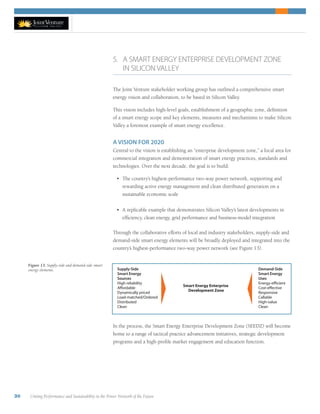
Through the collaborative efforts of local and industry stakeholders, supply-side and
demand-side smart energy elements will be broadly deployed and integrated into the
country’s highest-performance two-way power network (see Figure 13).
Figure 13: Supply-side and demand-side smart
energy elements.
In the process, the Smart Energy Enterprise Development Zone (SEEDZ) will become
home to a range of tactical practice advancement initiatives, strategic development
programs and a high-profile market engagement and education function.
Smart Energy Enterprise
Development Zone
Supply-Side
Smart Energy
Sources
High reliability
Affordable
Dynamically priced
Load-matched/Ordered
Distributed
Clean
Demand-Side
Smart Energy
Uses
Energy-efficient
Cost-effective
Responsive
Callable
High-value
Clean
Uniting Performance and Sustainability in the Power Network of the Future 31
Figure 14: Proposed Smart Energy Enterprise
Development Zone.
ZONE CHARACTERISTICS AND PLANS
The Smart Energy Enterprise Development Zone encompasses the Moffett Federal
Airfield, the City of Mountain View north of Highway 101 and the City of Sunnyvale
north of Highway 237 (see Figure 14). An exceptional group of local stakeholders, a
unique energy use profile and geographic characteristics, and extensive growth plans
make this an ideal area for development of the world’s most advanced power network.
Why a“Zone”?
For many reasons, a geographic focus is helpful for enabling smart energy solutions:
• Customers are in close proximity, enabling shared approaches and leverage
• Common utility and programs, grid infrastructure and jurisdictions
• High degree of commonality in needs and objectives among stakeholder groups
• Sets an appropriate project scale that is measurable, quantifiable and replicable
• Helps isolate test bed inputs, outputs and results
• Builds personal and neighborhood relationships that foster collaboration
The zone is primarily commercial and industrial, consisting of more than 5,300
contiguous acres (approximately 8.25 square miles). Currently there are 470 buildings
comprising more than 30.9 million square feet. Some multi-tenant residential building
is planned for the future. Most of the present space is utilized for general office,
laboratory, light industrial and data center functions. The zone is home to more than
300 businesses, including many leading technology companies.
32 Uniting Performance and Sustainability in the Power Network of the Future
Stakeholder Leadership in Efficiency and Sustainabillity. The zone supports
corporate headquarters for several of the world’s leading information technology
companies, including Google, NetApp, Juniper Networks, Yahoo!, Intuit and LinkedIn.
In addition, a number of prominent technology companies such as Microsoft, HP and
Amazon have major research facilities in the zone.
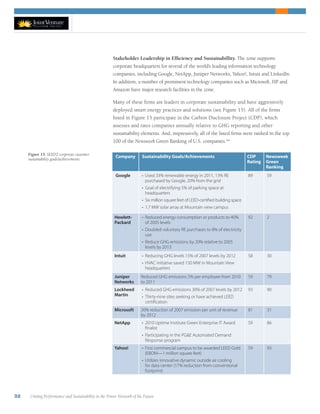
Many of these firms are leaders in corporate sustainability and have aggressively
deployed smart energy practices and solutions (see Figure 15). All of the firms
listed in Figure 15 participate in the Carbon Disclosure Project (CDP), which
assesses and rates companies annually relative to GHG reporting and other
sustainability elements. And, impressively, all of the listed firms were ranked in the top
100 of the Newsweek Green Ranking of U.S. companies.xxi
Figure 15: SEEDZ corporate customer
sustainability goals/achievements.
Company Sustainability Goals/Achievements CDP
Rating
Newsweek
Green
Ranking
Google •	 Used 33% renewable energy in 2011, 13% RE
purchased by Google, 20% from the grid
•	 Goal of electrifying 5% of parking space at
headquarters
•	 Six million square feet of LEED-certified building space
•	 1.7 MW solar array at Mountain view campus
89 59
Hewlett-
Packard
•	 Reduced energy consumption or products to 40%
of 2005 levels
•	 Doubled voluntary RE purchases to 8% of electricity
use
•	 Reduce GHG emissions by 20% relative to 2005
levels by 2013
92 2
Intuit •	 Reducing GHG levels 15% of 2007 levels by 2012
•	 HVAC initiative saved 150 MW in Mountain View
headquarters
58 30
Juniper
Networks
Reduced GHG emissions 5% per employee from 2010
to 2011
59 79
Lockheed
Martin
•	 Reduced GHG emissions 30% of 2007 levels by 2012
•	 Thirty-nine sites seeking or have achieved LEED
certification
93 90
Microsoft 30% reduction of 2007 emission per unit of revenue
by 2012
81 31
NetApp •	 2010 Uptime Institute Green Enterprise IT Award
finalist
•	 Participating in the PGE Automated Demand
Response program
59 86
Yahoo! •	 First commercial campus to be awarded LEED Gold
(EBOM—1 million square feet)
•	 Utilizes innovative dynamic outside air cooling
for data center (17% reduction from conventional
footprint)
59 93
Uniting Performance and Sustainability in the Power Network of the Future 33
PGE, the utility provider for the zone, is a leader in renewable energy with more
installed solar than any other utility.xxii
PGE is promoting the adoption of smart
metering, plug-in electric vehicles and the smart grid. The company plans to spend
between $800 million and $1.2 billion on smart grid projects over the next 20 years.xxiii
The company was also ranked 38th on Corporate Responsibility Magazine’s 2012 list of
100 Best Corporate Citizens.xxiv
The cities of Sunnyvale and Mountain View are also promoting and supporting
businesses’ energy efficiency and smart energy-related efforts. As an example, Sunnyvale
was an early pioneer in establishing green building incentives for new construction,
additions and remodels of commercial buildings. Buildings that achieve LEED Gold
certification are eligible for a 10 percent increase in the floor-area ratio or an additional
10 feet in height.xxv
These incentives have been highly effective in improving energy
efficiency and sustainability in commercial buildings.
Silicon Valley is also home to some of the world’s leading energy technology firms
and start-ups. These include Bloom Energy, which is developing fuel cells to power
businesses and homes; SunPower, which manufactures and installs high-efficiency
solar panels; and Cypress Envirosystems, a subsidiary of Cypress Semiconductor,
which is creating digital control technologies to help older plants and buildings save
energy and improve productivity.
Futuristic Attributes of Power Generation and Use. Many of the zone’s energy
customers are engaged in advanced product research and development activities, and
rely on high-quality power. These functions are central to Silicon Valley’s economic
performance and growth. Momentary power outages or irregularities in power quality
are very expensive, shutting off equipment and interrupting development processes.
At the same time, the energy profile in this zone is becoming increasingly distributed
and dynamic—highly representative of the new smart energy future. The zone now
hosts approximately 13 MW in distributed generation from 18 solar PV, fuel cell,
landfill biogas and cogeneration units, and several additional installations are planned.
Several hundred electric vehicle charging stations have been already been deployed,
mostly on corporate RD campuses, with hundreds more planned.
34 Uniting Performance and Sustainability in the Power Network of the Future
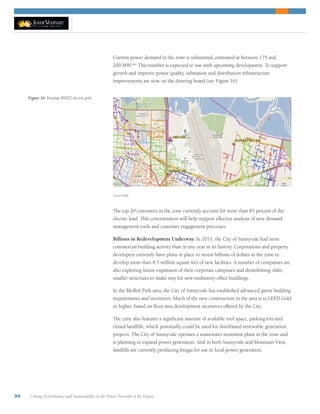
Current power demand in the zone is substantial, estimated at between 175 and
200 MW.xxvi
This number is expected to rise with upcoming development. To support
growth and improve power quality, substation and distribution infrastructure
improvements are now on the drawing board (see Figure 16).
The top 20 customers in the zone currently account for more than 85 percent of the
electric load. This concentration will help support effective analysis of new demand
management tools and customer engagement processes.
Billions in Redevelopment Underway. In 2011, the City of Sunnyvale had more
commercial building activity than in any year in its history. Corporations and property
developers currently have plans in place to invest billions of dollars in the zone to
develop more than 8.5 million square feet of new facilities. A number of companies are
also exploring future expansion of their corporate campuses and demolishing older,
smaller structures to make way for new multistory office buildings.
In the Moffett Park area, the City of Sunnyvale has established advanced green building
requirements and incentives. Much of the new construction in the area is to LEED Gold
or higher, based on floor area development incentives offered by the City.
The zone also features a significant amount of available roof space, parking lots and
closed landfills, which potentially could be used for distributed renewable generation
projects. The City of Sunnyvale operates a wastewater treatment plant in the zone and
is planning to expand power generation. And in both Sunnyvale and Mountain View,
landfills are currently producing biogas for use in local power generation.
Figure 16: Existing SEEDZ electric grid.
Source: PGE
Uniting Performance and Sustainability in the Power Network of the Future 35
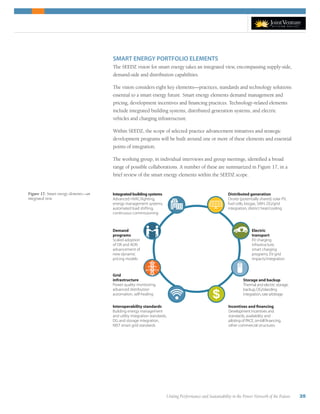
Figure 17: Smart energy elements—an
integrated view.
SMART ENERGY PORTFOLIO ELEMENTS
The SEEDZ vision for smart energy takes an integrated view, encompassing supply-side,
demand-side and distribution capabilities.
The vision considers eight key elements—practices, standards and technology solutions
essential to a smart energy future. Smart energy elements demand management and
pricing, development incentives and financing practices. Technology-related elements
include integrated building systems, distributed generation systems, and electric
vehicles and charging infrastructure.
Within SEEDZ, the scope of selected practice advancement initiatives and strategic
development programs will be built around one or more of these elements and essential
points of integration.
The working group, in individual interviews and group meetings, identified a broad
range of possible collaborations. A number of these are summarized in Figure 17, in a
brief review of the smart energy elements within the SEEDZ scope.
Integrated building systems
Advanced HVAC/lighting,
energy management systems,
automated load shifting,
continuous commissioning
Demand
programs
Scaled adoption
of DR and ADR,
advancement of
new dynamic
pricing models
Grid
infrastructure
Power quality monitoring,
advanced distribution
automation, self-healing
Distributed generation
Onsite (potentially shared) solar PV,
fuel cells, biogas, SWH, DG/grid
integration, district heat/cooling
Electric
transport
EV charging
infrastructure,
smart charging
programs, EV grid
impacts/integration
Storage and backup
Thermal and electric storage,
backup, DG/islanding
integration, rate arbitrage
Incentives and financing
Development incentives and
standards, availability and
piloting of PACE, on-bill financing,
other commercial structures
Interoperability standards
Building energy management
and utility integration standards,
DG and storage integration,
NIST smart grid standards
+
36 Uniting Performance and Sustainability in the Power Network of the Future
Integrated Building Systems. These play a crucial role in monitoring, managing and
controlling building systems and energy use, as well as enabling customers to respond
effectively and dynamically to demand response events. Advanced energy management
functionality can track energy use at a very detailed level, and enable “continuous
commissioning” of building performance relative to historical trends.
In practice, building systems and energy management capabilities vary widely
depending on a building’s age, size, use and other factors. Many zone customers,
especially larger customers with newer facilities, have sophisticated capabilities in place
and best practices to share.
Potential SEEDZ collaborations include identification of best practices associated with
systems for automated demand response, detailed energy monitoring and continuous
commissioning, and a wide range of approaches and solutions for optimizing building
systems and plug-load efficiency.
Also, there’s an opportunity to identify and promote a “zone standard” for integrated
building system capabilities. And at a strategic level, SEEDZ will explore with zone
members the establishment of municipal requirements for integrating smart energy-
enabled building systems standards in new construction or major retrofits.
Distributed Generation. SEEDZ customers have implemented a number of
distributed renewable energy-generation solutions. Currently, six sites in the zone
have installed or plan to install solar, including Google, Microsoft and Lockheed
Martin, and four sites have installed or have plans to install fuel cells. In addition,
the Sunnyvale Waste Treatment facility provides and consumes biogas, while NetApp
operates a cogeneration facility.
By leveraging purchasing power, SEEDZ stakeholders could establish joint RFIs or group
purchasing programs to lower the cost of new distributed generation, such as solar PV
systems for parking lots. In addition, SEEDZ customers and municipalities can explore
collaboration opportunities around distributed renewable energy at a district level.
The integration of significant distributed renewable capacity, which can be intermittent
and variable, presents new challenges and opportunities for a local distribution grid.
SEEDZ represents an important platform for development of advanced standards for
the integration of distributed generation with the grid, to maintain and improve overall
power reliability and quality.
Demand Programs. Demand response programs and dynamic pricing structures are
cost-effective ways to smooth demand for electricity and reduce expensive standby
capacity. Time-of-use (TOU) electricity rate structures, a basic form of variable pricing,
are used by customers representing more than 95 percent of the energy load in
SEEDZ. More dynamic pricing structures are offered through various demand response
programs, but customer participation in these programs to date has been limited.
Uniting Performance and Sustainability in the Power Network of the Future 37
An important area of collaboration for SEEDZ will be identifying best practices and
programs for demand response, automated demand response and scaling adoption
of these approaches. Also, the collaboration can explore and potentially serve as a
customer test bed for new pricing structures and the development of “fast” automated
demand response programs.
Electric Transport. To date, hundreds of level 1 and 2 electric vehicle chargers have
been deployed on corporate campuses in the zone, and there are plans to install many
more as the number of employees driving EVs continues to grow.
Google is a recognized corporate leader in deploying EV infrastructure, with more
than 240 level 2 and 160 level 1 charging stations at its Bay Area offices. Google also
has a fleet of more than 50 electric vehicles for its employee car-sharing service. Zone
customers Juniper Networks, NetApp and others have also built charging infrastructure
for their employees.
The SEEDZ collaboration will encourage adoption of EVs by facilitating the sharing of
local best practices for EV program technologies, implementation and administration.
Practices and pilot programs for the development and deployment of level 3 and DC fast-
charging infrastructure will be piloted in the zone. Finally, SEEDZ represents an excellent
potential platform for conducting controlled, commercial-scale EV grid integration pilot
studies, and the advancement of utility and municipal development requirements.
Grid Infrastructure. SEEDZ customers, particularly ICT companies and data centers,
require reliable, high-quality power. Over the past several years, a number of major
customers in the zone have faced serious power reliability and quality issues. The
reliability situation is reported as improving, yet even momentary lapses in power
quality can be very expensive for customers. Power quality issues, such as short-term
voltage dips, swells and imbalances, can shut down computing and lab equipment and
require time-consuming restoration processes.
SEEDZ will place a priority on improving the power quality and reliability in the zone
to meet the demands of customers. Several major customers currently have equipment
to measure power quality at a very detailed, localized level. Aggregating detailed power
quality from different customers and facilities in the zone represents a good “quick-
win” opportunity. It will help to better identify and pinpoint power quality issues, and
provide the basis for a power quality “analysis platform” in the zone.
From a strategic standpoint, SEEDZ customers will work with the utility on advanced
grid infrastructure development and expansion in the zone. This could involve pilot
implementations and deployment of emerging automated distribution infrastructure
such as volt/VAR optimization, FLISR (fault location, isolation and service restoration)
technologies and distribution management systems (DMS).
38 Uniting Performance and Sustainability in the Power Network of the Future
Advanced Storage and Backup. SEEDZ energy customers have become increasingly
interested in deploying advanced energy storage solutions to help with the integration
of onsite renewables, and to provide backup power. Storage and backup solutions can
enable customer sites to “island” from the electric grid and continue operating during
power outages. Despite the interest in advanced storage, new standards and best
practices are required for integrating advanced storage solutions with the electric grid
and customer-distributed generation resources.
SEEDZ will establish a zone inventory of distributed storage solutions and develop a
workshop to share best practices and storage solutions. The zone can also serve as a
pilot for islanding use of onsite distributed generation such as fuel cells and solar arrays
as a source of backup power.
Standards and Interoperability. Refinement of standards and interoperability
will speed adoption of smart energy solutions. And there are many different types
of standards, all of which are important—procedural, physical and electronic, for
instance. Examples include rules and procedures for interconnecting a solar array with
the grid, the physical shape and characteristics of an EV charging plug, or the exact
electronic data formats supporting automated demand response.
Standards are essential for enabling an “end-to-end” smart energy vision, integrating
key supply, distribution and demand processes. They serve to enable value, reduce cost,
improve usability and uptake, and reduce the need for custom integration.
SEEDZ stakeholders will share smart energy-related standards information as
appropriate. And as a group, in communication with industry-standards bodies such
as NIST, IEEE and IEC, SEEDZ will actively promote development of new or more
detailed standards where most needed.
Incentives and Financing. Customer-side smart energy projects may face challenges
meeting desired return on investment rates, or accessing sufficient upfront financing.
As such, the use of incentives and financing structures are important practices for
scaling adoption of smart energy solutions.
SEEDZ will collaborate on developing an inventory of zone-applicable energy efficiency
and distributed generation financing structures from the utility, municipal and
commercial sources. SEEDZ may also explore developing zone financing relationships/
programs to increase investment in energy efficiency and distributed generation solutions.
Uniting Performance and Sustainability in the Power Network of the Future 39
CONCEPTUAL DESIGN AND MEASURES
By the year 2020, SEEDZ aims to build a high-performance, integrated smart energy
network, encompassing sources, distribution and use. This smart energy network will
be characterized by the elements shown in Figure 18:
Figure 18: 2020 “To Be” SEEDZ scenario.
Integrated Building
Systems
Distributed
Generation
Demand
Programs
Electric
Transport
Grid
Infrastructure
Storage
and Backup
Interoperability
Standards
Incentive
and Financing
Advanced, integrated building energy solutions have helped reduce energy consump-
tion and enabled customers to automatically respond to dynamic pricing signals,
participate in DR events and manage energy in real time vs. modeled performance
Expanded deployment of distributed renewable generation in the zone,
including shared community/district renewable resources, and advanced
integration of distributed generation with the grid
High level of zone participation in DR/ADR programs, dynamic pricing structures,
bill/rate aggregation and simplification programs are saving customers
money—resulting in reduced peaks and a more stable and reliable grid
Vehicle-to-grid integration advanced standards for fast charging, grid integration
and automatic EV response to pricing signals have enabled a shift away from
less-efficient fossil fuel–powered cars
Advanced energy storage solutions in place, allowing fast response and grid stabi-
lization during rapid variations in energy load/supply, local backup, improved demand
response capacity and enhanced grid integration of distributed generation sources
Improved interoperability standards and specifications have simplified supply and
demand–side integration of smart energy solutions, accelerating adoption and
improving ROI
Effective financing structures and incentives are facilitating wide-scale adoption of
new smart energy solutions by shortening payback periods and removing upfront
financing barriers
Advanced automated distribution management in place—for example,detailed
monitoring,self-healing,advancedinterconnection and islanding capabilities—
enabling enhanced grid performance, power quality and reliability
+
An important principle for SEEDZ is to maintain objective, stakeholder-relevant
measures that describe desired “smart energy” results. Measures help guide priorities
and provide a basis for monitoring progress. Also, they help to define SEEDZ to the
outside world, and serve as a replicable example.
A set of proposed metrics are outlined below, and will be developed further as SEEDZ
progresses. These measures are intended to be consistent with the operational,
sustainability and economic growth objectives of SEEDZ.
Power Reliability. Reliability will be defined by the number of sustained and momentary
power interruptions. Momentary interruptions, which consist of any event when voltage
goes to zero for less than five minutes, will be a primary focus. SAEFI, MAIFI and
CEMMI-5 are potential metrics for measuring power interruptions in the zone.
40 Uniting Performance and Sustainability in the Power Network of the Future
Power Quality. Power quality will measure voltage variations, swells, dips, imbalances
and phase interruptions within the zone. The zone will seek to utilize a detailed power-
quality metric, potentially based on a European power-quality metric EN 50160, which
sets specific standards and limits for voltage variations, dips, swells and events.
Demand Profile. The ratio of peak demand to average demand over a year, or
“peakedness”; this is a measure relevant to efficient utilization of grid assets.
Demand Flexibility. The availability of demand response capacity as a percentage of
the total peak load in the zone.
Financial Savings. Estimated savings associated with major SEEDZ programs; savings
should consider reduced energy costs, additional value from increased power quality
and reliability, etc.
Emissions and Energy Intensity. SEEDZ will seek to track the reduction in total and
peak energy use relative to building square footage in the zone. Emissions intensity
will be measured based on a weighted blend of power provided by the utility and local
distributed generation sources.
Distributed Generation Penetration. The ratio of distributed generation within the
zone relative to the average daily peak demand.
EV and Charging Infrastructure Penetration. SEEDZ will develop a baseline
inventory of electric vehicles and charging infrastructure, and establish a metric for EVs
and charge-enabled parking as a percentage of all vehicles and parking.
Market Engagement. Market engagement will be measured by the amount of outreach
impressions and participation in events and SEEDZ programs.
Directed Funding. SEEDZ will track the increase in federal, state and innovation
funding directed toward SEEDZ initiatives.
Future Goals. Individual initiatives and collaborations will work on developing
additional metrics and measures to evaluate the success of different projects.
STAKEHOLDER ROLES AND BENEFITS
Stakeholders will contribute in a variety of ways, including taking leadership roles in
selected initiatives, and providing expertise, staff resources and financial resources. In
return, SEEDZ will work to provide results that benefit individual stakeholders, and
contribute to the success and momentum of the effort as a whole.
Uniting Performance and Sustainability in the Power Network of the Future 41
Via interviews, meetings and group reviews, a broad range of local stakeholders
have participated in the development and vetting of the SEEDZ vision. Over the
coming months, stakeholder engagement and outreach will continue, and new
organizations will join the SEEDZ collaboration (see Figure 19). Participants
will include customers and other organizations directly involved with work in
the development zone, as well as an extended network of regional and market
participants that will be engaged over time.
Figure 19: Stakeholder outreach and
engagement.
Regionalparticipants
Marketparticipants
Stakeholder group
Energy customers
Utilities/energy
providers
Governmental
entities
Research and
academic institutions
Technology/
solution providers
Property owners
and developers
Development zone—
Zone participation
• Equinix
• HP
• Pacific Gas and Electric
• City of Sunnyvale
• City of Mountain View
• Electric Power Research Institute (EPRI)
• Lawrence Berkeley National Lab (LBNL)
• Intuit
• Microsoft
• Lockheed Martin
• LinkedIn
• Juniper Networks
• NetApp
• Yahoo!
• Google
• Cypress Envirosystems
• SunPower
• Optony
• McCalmont Engineering
• Bloom Energy
—Contributed to vision and strategy
—Outreach in progress
• University Associates
• NASA Ames Research Park
• Moffett Park Business Group
• Jay Paul
The stakeholder and benefits table (Figure 20) describes representative “gives” and
“gets” for SEEDZ stakeholders. For example, energy customers will share smart energy
best practices. And selectively, they will agree to lead or participate in SEEDZ practice
advancement initiatives and strategic development programs.
In return, energy customers will benefit from new and leveraged infrastructure
investment, offering improved power reliability, quality and affordability. Plus, they
will have access to best practices and expertise from neighboring organizations. And if
desired, they will have the opportunity to share their smart energy experience publicly
via SEEDZ-branded webinars and conferences.
42 Uniting Performance and Sustainability in the Power Network of the Future
Figure 20: Stakeholder roles and benefits.
Stakeholder Example“gives” Example“gets”
Energy
customers/
Property
owners and
developers
•	 Share best practices and information
re: energy and efficiency
•	 Lead and/or participate in selected
project and collaborations
•	 Install/deploy smart energy
improvements
•	 Be willing to serve as potential test
bed for selected new programs,
products and solutions
•	 Offer financial and/or staff assistance
•	 Improved affordability, reliability and
quality of power through district
programs, new leveraged/shared
infrastructure
•	 Best practices, cost savings and faster
ROI on selected energy efficiency and
renewable energy projects
•	 Contribution to sustainability goals,
awards and recognition
•	 Potential access to innovation grants
and programs
Utilities/Energy
providers
•	 Lead and/or participate in selected
project and collaborations
•	 Designate a district as a key test bed
for new structures, offerings and
services
•	 Potentially locate new, advanced
substation with high reliability and
self-healing properties
•	 Potentially expand current customized
offerings on an aggregated basis
•	 Offer financial and/or staff assistance
•	 Greater participation in utility energy
programs, cost savings through
leveraged outreach and engagement
•	 Willing, technically capable customer
as test beds for new rate structures,
automation and integration
•	 Ability to measure and demonstrate
the value of DR and new pricing
signals
•	 Ability to publicly showcase best
practices and solutions at live
customers
Technology
and solution
providers
•	 Educate district on new products and
services
•	 Assist with adoption, financing and
deployment of new pilot solutions
•	 Participate in market engagement and
education activities
•	 Offer financial and/or staff assistance
•	 Opportunity to showcase involvement
in leading-edge implementations of
new products and services
•	 Access to high-quality potential
customers
•	 Smart energy integration experience
and success stories
•	 Branded association with SEEDZ,
potential representation in case
studies, demonstrations, market
outreach
Local
governmental
entities
•	 Lead and/or participate in selected
project and collaborations
•	 Work on removing permit, building
code and other barriers to smart
energy solutions
•	 Offer financial and/or staff assistance
•	 Awards, recognition and sharable
practices for sustainability
•	 Attract and retain businesses
•	 Improved quality, affordability and
reliability of power
•	 Progress toward municipal and state
sustainability goals
Research and
educational
institutions
•	 Offer technical assistance for feasibility
studies and deployment of new
solutions
•	 Gain access to grant opportunities
•	 Offer financial and/or staff assistance
•	 Forming consortium for applied
research and innovation grants
•	 Access to high-quality potential
partners
•	 Opportunity to participate in leading-
edge deployments and develop new
knowledge capital
Uniting Performance and Sustainability in the Power Network of the Future 43
Figure 21: SEEDZ phasing and road map.
6. GETTING STARTED
Like any venture, launching a smart energy development zone in Silicon Valley will
take organization, resources and time.
In this spirit, the road map for SEEDZ formation outlines three general phases—
collaboration development, operational startup and sustaining programs. To build
momentum and involvement, work on tactical initiatives begins early, in the
collaboration development phase—as do market outreach, engagement and strategic
program activities.
Active stakeholder involvement and support are essential for success. To motivate this
support, stakeholders must see benefits from collaboration. These will come in the
form of solving shared problems, improving performance, and ultimately, enhancing
climate prosperity.
OVERALL APPROACH AND ROAD MAP
As shown in Figure 21, the approach for building SEEDZ identifies three critical sets
of activity, organized in three sequential phases.
Collaboration development in Phase 0 includes the vision and strategy effort
described in this document. Building off the strategy are “quick-win” practice
advancement initiatives, stakeholder engagement and organization activities, and
initialization of strategic program development efforts.
Phase 0 Phase 1 Phase 2
SEEDZ
Vision and
strategy
Public launch
• Formal PR
• Pilot webinar
• Outreach
Market engagement and education
• Webinar series
• Touring demonstration
• Annual“Smart Energy Enterprise”conference
Ongoing practice advancement initiatives
(to be determined, for example)
• Customer bill/rate aggregation
• Shared parking log solar RFI
Start-up ”QuickWin”initiatives
• Leading Smart Energy
Practices survey
• Power quality data sharing
• Building energy systems spec
Strategic needs assessment
• Schematic visioning and design
• Asset evaluation and
capability gaps
• Strategic project definitions
Strategic funding and detailed design/build
of development projects
• For infrastructure projects, program
deployments, research and demonstrations
Organization
and engagement
Practice
advancement
Strategic
development
Collaboration development Operational startup Sustaining programs
Organization
• Operational
funding
• Additional
recruitment
• Organizational
structure
44 Uniting Performance and Sustainability in the Power Network of the Future
Phase 1 features the official public launch of SEEDZ. In addition to ongoing
practice advancement initiatives and strategic development work, important market
engagement mechanisms such as a webinar series, a national contact list and a
touring demonstration will be established.
Finally, Phase 2 will mark funding and detailed design of strategic development
programs, ongoing practice advancement initiatives and the zone’s first annual “Smart
Energy Enterprise” conference.
ORGANIZATION AND ENGAGEMENT
The Smart Energy Enterprise Development Zone comprises a diverse group of
stakeholders. A dedicated SEEDZ team, initially a core group of two or three staff
members, will guide start-up activities and facilitate stakeholder involvement.
Initially, this team will work as an initiative under the direction of the Joint Venture
Climate Prosperity Council. As SEEDZ progresses, a more distinct organizational
structure and board function will likely be considered.
An early objective is to develop an effective outreach and market engagement
mechanism to enable SEEDZ participants to share local experience and best practices
with a wide external audience. This is envisioned via a SEEDZ online conference
(webinar) series, with one or two events per quarter. Subsequently, a touring
demonstration is also envisioned, which could be a virtual and/or physical overview
of key best practice solutions within SEEDZ.
PRACTICE ADVANCEMENT INITIATIVES
SEEDZ stakeholders will identify selected smart energy “practice advancement”
initiatives. These are defined as shorter, high-impact projects that do not require
significant capital investment, time or resources. Types of practice advancement
initiatives would include best-practice development and/or sharing, zone surveys,
high-level solution opportunity assessments or joint RFIs.
Participants will opt into selected practice advancement initiatives. One or more of
the participants will be designated as a lead or sponsor.
Through individual and group meetings with SEEDZ members, three initial quick-
win initiatives have been identified, to be initiated in the fall of 2012.
Power Quality Information Sharing. Real-time, detailed power quality measurements
will be aggregated and presented from multiple customer locations to establish a shared
view of power quality across the zone (see Figure 22). The common platform will serve
as a baseline for the identification and resolution of power quality issues, and will help
guide longer-term utility infrastructure investment.
Uniting Performance and Sustainability in the Power Network of the Future 45
Figure 22: Customers increasingly have
detailed power quality measurement
capabilities, as shown in this metering reading
from a zone customer.
Leading Smart Energy Practice Inventory. SEEDZ stakeholders will be surveyed
regarding their smart energy practices to assess the current state of smart energy in
the zone and help to establish best practices. The resulting best practices will be
shared with members via online resources and in-person meetings to accelerate the
adoption of smart energy solutions and practices. The survey will also help to identify
high-value areas for ongoing practice advancement and collaboration.
Model Zone Specification for Integrated Building Systems. SEEDZ stakeholders
will develop a model spec for an integrated building system. These systems serve to
monitor, manage and control building systems and energy use. In addition, they can
enable customers to effectively and dynamically respond to demand response events.
Advanced energy management functionality can track energy use at a very detailed
level, and enable continuous commissioning of building performance relative to
historical trends. Zone participants will be encouraged to adopt such a specification
for all new construction and major renovations.
THE CAPSTONE: STRATEGIC DEVELOPMENT PROGRAMS
As we’ve noted, large-scale smart energy demonstrations and infrastructure projects
are underway around the country. Uniting leading Silicon Valley customers, industry,
government and utility players in strategic program collaboration represents the
capstone opportunity for SEEDZ.
SEEDZ envisions the nation’s highest-performance two-way power network that
supports and rewards active energy management and clean distributed generation
on a sustainable economic scale. Building out this vision over the next 5-10 years
will take a shared understanding of smart energy design, as well as associated
programmatic and technology elements and funding.
46 Uniting Performance and Sustainability in the Power Network of the Future
With SEEDZ, it is expected that smart energy investments will be made by
both customers and the utility, and will be business-case driven. In addition, by
establishing itself as a high-profile smart energy collaboration, SEEDZ will have the
opportunity to attract significant incremental infrastructure and research funding
from utility, state, federal and other third-party sources.
To launch this activity in the fall of 2012, a smart energy schematic design and
evaluation effort will be important for defining potential strategic development
programs. This process will establish shared definitions of key customer and utility-
side capabilities needed to support the SEEDZ vision, key gaps, and shared research
and development opportunities. Examples could include advanced distribution and
distribution management infrastructure, district generation, new dynamic pricing
processes and advanced technologies for two-way integration of buildings, electric
vehicles, distributed generation and storage.
This process will take into account current utility infrastructure and capabilities as
well as planned utility development and investment. It will involve a focused group
of key customers, the utility, municipal representation and, importantly, participating
research institutions such the Electric Power Research Institute (EPRI) and Lawrence
Berkeley National Laboratory (LBNL).   
Candidate strategic development programs may then be matched with potential
sources of funding. In turn, high-priority smart energy development programs
at the utility, state or federal level can be pursued for placement with the SEEDZ
collaboration in the context of an exceptional group of stakeholders and a well-
articulated smart energy vision.
THE CLIMATE PROSPERITY JOURNEY
Building out the SEEDZ vision will take time, focus and resources. SEEDZ
participants are essential to realizing this vision. They will guide and implement the
changes necessary to achieve new levels of performance and sustainability in the
integrated power system of the future.
SEEDZ participants in Silicon Valley are from organizations ranking among the
world’s most innovative companies and energy customers, progressive municipalities,
leading research institutions and forward-looking utilities.
Acting now in a coordinated way will enhance and project Silicon Valley’s role at the
forefront of smart energy innovation. It will further protect our local environment,
and enhance regional competitive positioning in this new, rapidly growing market
segment. The SEEDZ collaboration will accelerate climate prosperity benefits for
direct stakeholders, the Silicon Valley region and ultimately, those pursuing smart
energy solutions around the world.
Uniting Performance and Sustainability in the Power Network of the Future 47
7. APPENDICES AND ENDNOTES
APPENDIX 1: INITIAL CANDIDATES FOR SEEDZ INITIATIVES
Theme Practice advancement Strategic development
Grid
infrastructure/
reliability
•	 Aggregate local power quality measurements from
SEEDZ customer and share on common platform to
help pinpoint failures
•	 Develop shared“as-is”view of utility distribution
infrastructure and automation capabilities, utility
investment/upgrade plans
•	Pursue pilot implementation and validation of
automated distribution infrastructure (for example, volt/
VAR, FLISR, DMS)
Building
efficiency/
integrated
systems
•	 Best practices/pilot collaboration on workspace and
plug load energy efficiency
•	 Best practice-sharing on continuous commissioning
technologies and services
•	 Best practices for energy efficiency in new construction/
retrofit of building/lab space
•	 Pursue municipal requirements (incentives?) for energy
management systems in new construction/major
retrofits
•	 Investigate shared district infrastructure for heating/
cooling systems
Onsite/district
renewables
•	 Joint RFI for parking lot solar
•	 Community solar/biogas opportunity assessment
•	 Community solar/biogas implementation
•	 Advanced DG/grid integration for power quality/voltage
Electric
transportation
•	 SEEDZ inventory for charging infrastructure
•	 Fast charging pilot/practices
•	 Best practice-sharing for EV program technology,
implementation and administration
•	 EV-controlled grid integration pilot study
•	 Advanced municipal development requirements
Interoperability
standards/
specs
•	 Develop guide for energy management
•	 Systems spec for new building/major retrofits
•	Architecture for integration of utility meter/pricing
data, open ADR, customer interfaces and customer-side
systems/devices
Demand
programs and
adoption
•	 Status and best practices and technology for open ADR
•	 PGE status re: current/new DR rates, upcoming rate
cases and feasibility of zone pilot
•	 DR program RFI for aggregators
•	 Bill/rate aggregation and simplification; development of
zone program
•	 Dynamic pricing opportunity assessment
•	 Dynamic/fast ADR pricing; automated load
management pilot
Advanced
storage/backup
•	Zone inventory of distributed storage and solution
workshop
•	 Customer site islanding pilot/utilization of onsite DG for
backup power source
•	 Development/deployment of customer resource
optimization strategies (for example, DERCAM model)
Financial
structures/
incentives
•	Inventory of zone-applicable EE/DG financing
structures from utility municipal commercial sources
(for example, PACE, on-bill financing)
•	Financing pilot projects
Market
engagement
•	 SEEDZ kickoff and press announcements
•	 Zone mailing list development and communications
•	 Develop SEEDZ touring demonstration featuring
current smart energy successes
•	 Online conference format and series
•	 Annual onsite conference
Organizational
development
•	 List development and additional recruitment
•	 Additional funding commitments
•	 Launch selected start-up initiatives
•	 Formalize structure and governance
•	 Involvement in collaboration for grant applications
•	 Annual report to stakeholders
48 Uniting Performance and Sustainability in the Power Network of the Future
APPENDIX 2: ACRONYMS
ADR Automated demand response
CDP Carbon Disclosure Project
CEC California Energy Commission
CPUC California Public Utilities Commission
CSI California Solar Initiative
DG Distributed generation
DMS Distribution management systems
DR Demand response
EE Energy efficiency
EPRI Electric Power Research Institute
ESA Energy service agreement
EV/PHEV Electric vehicles and plug-in electric vehicles
GeSI Global eSustainability Initiative
GHG Greenhouse gas emissions
ICT Information and communication technologies
IEC International Elecrotechnical Commission
IEEE Institute of Electrical and Electronics Engineers
LBNL Lawrence Berkeley National Laboratory
LEED Leadership in Energy and Environmental Design
NIST National Institute of Standards and Technology
PACE Property Assessed Clean Energy Bonds
PGE Pacific Gas and Electric Company
PPA Power Purchase Agreement
RPS Renewable portfolio standard
SEEDZ Smart Energy Enterprise Development Zone
TOU Time-of-use electric rate
Uniting Performance and Sustainability in the Power Network of the Future 49
APPENDIX 3: ENDNOTES
i
Information and Communication Technologies (ICT) refers to any communication technology or
application from cell phones, to computer chips, to software programs, and the internet.
ii
Susan Brown, Global Climate Change. In support of the 2005 Integrated Energy Policy Report. Staff
paper, California Energy Commission, 2005.
iii
   “History of Go Solar, California!” http://www.gosolarcalifornia.org/about/gosolar/history.php
iv
California Renewable Portfolio Standard (RPS), California Public Utilities Commission.
v
The Future of the Electric Grid, MIT, December 2011. http://web.mit.edu/mitei/research/studies/the-
electric-grid-2011.shtml
vi
Ibid, pg. 17.
vii
  Kristina Hamachi LaCommare and Joseph H. Eto, Understanding the Cost of Power Interruptions to U.S.
Electricity Consumers, LBNL, September 2004. http://certs.lbl.gov/certs-rtinakey-cpi.html
viii
Who’s Winning the Clean Energy Race? 2011 Edition. The Pew Charitable Trust. http://
www.pewenvironment.org/uploadedFiles/PEG/Publications/Report/FINAL_forweb_
WhoIsWinningTheCleanEnergyRace-REPORT-2012.pdf
ix
Renewable Energy Country Attractiveness Indices. August 2012, Issue 34. Ernst  Young.
http://www.ey.com/Publication/vwLUAssets/Renewable_energy_country_attractiveness_indices_-_
August_2012/$FILE/Renewable_energy_country_attractiveness_indices_Aug_2012.pdf
x
Index of Silicon Valley 2012, Joint Venture Silicon Valley and Silicon Valley Community Foundation, Feb.
2012. http://www.jointventure.org/2012index
xi
2012 California Green Innovation Index, Next 10, 2012.
xii
Smart 2020: Enabling the low carbon economy in the information age, GESI and the Climate Group, 2008.
xiii
  U.S. Environmental Protection Agency, ENERGY STAR program. “Useful Facts and Figures.” No date
referenced. 1 June 2007 http://www.energystar.gov/ia/business/challenge/learn_more/FastFacts.pdf
xiv
A Landmark Sustainability Program for the Empire State Building, Jones Lang LaSalle, Clinton Climate
Initiatives, Anthony Malkin, et. al., White Paper. http://www.esbnyc.com/documents/sustainability/
ESB_White_Paper_061809.pdf
xv
https://altaterra.site-ym.com/store/view_product.asp?id=1076028
xvi
The DOE Building Energy Data Book estimates total commercial energy expenditures of $174.5B in
2012. http://buildingsdatabook.eren.doe.gov/TableView.aspx?table=3.3.3
xvii
Ibid.
xviii 
Bryan, Harvey, Hema Rallapalli, and Jin Ho Jo. “Designing a Solar Ready Roof: Establishing the
Conditions for a High-performing Solar Installation”. American Solar Energy Society Solar 2010
Conference Proceedings. 2010. Available online at: http://www.ases.org/papers/046.pdf
xix
Green Office Toolkit, Jones Lang LaSalle. http://www.joneslanglasalle.com/microsites/GreenOfficeToolkit/
xx
  George Denise presentation on Leading Practices for Building Energy Efficiency: Metrics, Monitoring 
Incentive Structures webinar. https://altaterra.site-ym.com/store/view_product.asp?id=1076028
xxi
Newsweek U.S. Companies Green Rankings. http://www.thedailybeast.com/newsweek/features/green-
rankings/2011/us.html
xxii
SEPA Utility Solar Rankings, Solar Electric Power Association, May 2012. http://www.solarelectricpower.
org/media/257424/2011%20top%2010%20slide%20deck.pdf
xxiii
PGE Smart Grid Deployment Plan 2011-2020, Pacific Gas  Electric, June 2011. http://www.pge.com/
includes/docs/pdfs/shared/edusafety/electric/SmartGridDeploymentPlan2011_06-30-11.pdf
xxiv
100 Best Corporate Citizens 2012, Corporate Responsibility Magazine, http://www.thecro.com/
files/100BestF.pdf
xxv 
http://sunnyvale.ca.gov/Portals/0/Sunnyvale/CDD/Non-Residential/Green%20Building%20Program-
Oct%202011.pdf
xxvi 
Momentary average interruption frequency (MAIF) tracks the systemwide average of momentary power
interruptions per year divided by total customers served. The customer experience multiple momentary
interruptions index (CEMMI-5) is the percentage of all customers that experience more than a certain
number of interruptions over a certain time period.
50 Uniting Performance and Sustainability in the Power Network of the Future
JOINT VENTURE SILICON VALLEY		 2012 Investors Council
Private Sector
Accenture Greenstein Rogoff Olsen San José State University Research
Foundation
Accretive Solutions Half Moon Bay Brewing Company SanDisk
ACE Train (Altamont) Hewlett-Packard Santa Clara Building  Construction
Trades Council
Adobe Systems Intero Real Estate Santa Clara County Office of Education
Adura Technologies JETRO Santa Clara University
Agilent Johnson Controls Santa Clara Valley Water District
Alston  Bird LLP Jones Lang LaSalle Sensiba San Filippo
American Leadership Foundation Juniper Networks Silicon Valley Community Foundation
Applied Materials Kaiser Permanente Silicon Valley Power
ATT KPMG Skoll Foundation
Bank of America Koret Foundation Sobrato Development Companies
Bay Area SMACNA LAM Research Solaria
Berliner Cohen, LLP Lucile Packard Children’s Hospital at Stanford SolutionSet
Better Place Leo M. Shortino Family Foundation South Bay Piping
Bingham McCutchen, LLP M+NLB Stanford University
Bloom Energy Marvell Technologies Studley
Burr, Pilger, Mayer McKinsey  Company Summerhill Land
Cargill Menlo College Sun Microsystems
Cisco Systems Morgan Family Foundation SunPower Corporation
Chevron Mozes SVB Financial Group
Clearwire Microsoft Synopsys
Cogswell Polytechnical College Mitsubishi International Corporation TDA Group
Comcast Netherlands Consulate Tech CU
Comerica Bank New Spectrum Foundation Therma
Cooley Godward, LLP NextG Networks T-Mobile
Cypress Envirosystems Notre Dame de Namur University UPS
Deloitte  Touche O’Connor Hospital University of California, Santa Cruz
DLA Piper, LLP Oakland Athletics University of Phoenix
EPRI Optony Varian Medical Systems
Ennovationz Oracle VMware
Ernst  Young Orrick, Herrington  Sutcliffe LLP Volkswagen Group of America
Extenet Systems Pacific Gas  Electric Company Volterra
Fairmont Hotel Packard Foundation Weil Gotshal  Manges
Frieda C. Fox Family Foundation Pipe Trades Training Center of Santa
Clara County
Wells Fargo Bank
Foothill-De Anza Community
College District Foundation
SamTrans Wilmer Hale, LLP
Google San Francisco 49ers Wilson Sonsini Goodrich  Rosati, LLP
Grant Thornton LLP San José/Silicon Valley Business Journal
Greenberg Traurig, LLP San José/Silicon Valley Chamber of Commerce
Uniting Performance and Sustainability in the Power Network of the Future 51
Chuck Reed, City of San José – Co-Chair
Chris DiGiorgio, Accenture – Co-Chair
Mark Bauhaus, Juniper Networks
Doug Davenport, Lawrence Berkeley National Laboratory
Ben Foster, Optony
Charlie Gay, Applied Materials Inc.
Todd Glass, Wilson Sonsini Goodrich Rosati
Carl Guardino, Silicon Valley Leadership Group
Arash Guity, BLUE Climate Change Consulting
Don Hall, Pacific Gas  Electric
Russell Hancock, Joint Venture Silicon Valley
Bryan Hannegan, Electric Power Research Institute
Scott Jacobs, McKinsey  Company
David MacMillan, MegaWatt Storage Farms
Michael Marlaire, NASA Ames Research Park
Tom McCalmont, McCalmont Engineering
Rick Needham, Google
Bobby Ram, SunPower Corporation
Harry Sim, Cypress Envirosystems
Tim Walsh, Silicon Valley Bank
Public Sector
City of Belmont City of Half Moon Bay City of San Bruno City of Watsonville
City of Brisbane City of Los Altos City of San Carlos County of Alameda
City of Burlingame City of Menlo Park City of San José County of San Mateo
City of Campbell City of Milpitas City of San Mateo County of Santa Clara
City of Colma City of Monte Sereno City of Santa Clara County of Santa Cruz
City of Cupertino City of Morgan Hill City of Santa Cruz Town of Atherton
City of Daly City City of Mountain View City of Saratoga Town of Los Altos Hills
City of East Palo Alto City of Newark City of South San Francisco Town of Los Gatos
City of Foster City City of Pacifica City of Sunnyvale Town of Portola Valley
City of Fremont City of Palo Alto City of Union City Town of Woodside
City of Gilroy City of Redwood City
CLIMATE PROSPERITY COUNCIL MEMBERS
Established in 1993, Joint Venture Silicon Valley provides analysis and action on issues affecting our
region’s economy and quality of life. The organization brings together established and emerging leaders—
from business, government, academia, labor, and the broader community—to spotlight issues, launch
projects, and work toward innovative solutions.
100 WEST SAN FERNANDO STREET • SUITE 310 • SAN JOSÉ, CALIFORNIA 95113 • PHONE: 408.298.9330 • www.jointventure.org
Acknowledgements:
This Smart Energy Enterprise Development Zone white paper was made possible by:
Don Bray, Co-founder and President, AltaTerra Research
Eric Paul, Senior Analyst, AltaTerra Research
Rachel Massaro, Acting Director, Climate Initiatives, Joint Venture Silicon Valley
Duffy Jennings, Editor, Joint Venture Silicon Valley
Produced by TDA Group www.tdagroup.com
Accenture
Applied Materials
City of Mountain View
City of Sunnyvale
Cypress Envirosystems
Electric Power Research Institute
Google
Intuit
Juniper Networks
Lawrence Berkeley National Laboratory
Moffett Park Business Group
NASA Ames Research Park
NetApp
McCalmont Engineering
Optony
Pacific Gas  Electric Company
SunPower
Sustainable Silicon Valley
University Associates
Yahoo! Inc.
We would like to thank the following organizations for providing input and insight as we developed this blueprint:
Cover image courtesy of Warren Gretz/NREL

JVSV - SEEDZ - whitepaper

  • 1.
    Uniting Performance andSustainability in the Power Network of the Future Blueprint for a Smart Energy Enterprise Development Zone in Silicon Valley
  • 2.
    2 Uniting Performanceand Sustainability in the Power Network of the Future BOARD OF DIRECTORS November 2012 OFFICERS Chris DiGiorgio, Co-Chair, Accenture, Inc. Hon. Chuck Reed, Co-Chair, City of San José Russell Hancock, President & CEO, Joint Venture Silicon Valley DIRECTORS Larry Alder, Google Hon. Elaine Alquist, California State Senate Mark Bauhaus, Juniper Networks George Blumenthal, University of California at Santa Cruz Steven Bochner, Wilson Sonsini Goodrich & Rosati Dave Boesch, San Mateo County Ed Cannizzaro, KPMG LLP Emmett D. Carson, Silicon Valley Community Foundation John Ciacchella, Deloitte & Touche LLP Mary Dent, SVB Financial Group Fred Diaz, City of Fremont Ben Foster, Optony Judith Maxwell Greig, Notre Dame De Namur University Paul Gustafson, TDA Group Steve Hemminger, Alston & Bird LLP Joe Hogan, Ernst & Young Eric Houser, Wells Fargo Jim Keene, City of Palo Alto W. Keith Kennedy Jr., Con-way Tom Klein, Greenberg Traurig LLP Hon. Liz Kniss, County of Santa Clara Board of Supervisors Stacy McAfee, University of Phoenix Tom McCalmont, McCalmont Engineering Jim McCaughey, Lucile Packard Children’s Hospital Jean McCown, Stanford University Curtis Mo, Wilmer Cutler Pickering Hale and Dorr LLP Mairtini Ni Dhomhnaill, Accretive Solutions Joseph Parisi, Therma Inc. Mo Qayoumi, San José State University Bobby Ram, SunPower Paul Roche, McKinsey & Company Bill Sherry, Norman Y. Mineta San José International Airport/Team San José Harry Sim, Cypress Envirosystems Susan Smarr, Kaiser Permanente John Sobrato Sr., Sobrato Development Companies Gautam Srivastava, LSI Corporation Neil Struthers, Santa Clara County Building & Construction Trades Council Linda Thor, Foothill De-Anza Community College District Mark Walker, Applied Materials Linda Williams, Planned Parenthood Mar Monte Patricia Williams, Merrill Lynch Daniel Yost, Orrick, Herrington & Sutcliffe, LLP SENIOR ADVISORY COUNCIL John C. Adams, Wells Fargo Frank Benest, City of Palo Alto (Ret.) Eric Benhamou, Benhamou Global Ventures Harry Kellogg Jr., SVB Financial Group William F. Miller, Stanford University
  • 3.
    Uniting Performance andSustainability in the Power Network of the Future 3 Uniting Performance and Sustainability in the Power Network of the Future Blueprint for a Smart Energy Enterprise Development Zone in Silicon Valley November 2012
  • 4.
    4 Uniting Performanceand Sustainability in the Power Network of the Future CONTENTS 1 EXECUTIVE SUMMARY 8 2 A SMART ENERGY NEXUS IN SILICON VALLEY 18 What is Smart Energy? 18 Why Smart Energy Matters in Silicon Valley 19 California Leadership in Environment, Energy and Sustainability 19 Convergence of Energy, Electronics and Information Technology 20 New Grid Dynamics and Management Challenges 20 Market and Industry Pressures 21 Engine for Regional Growth 21 3 SMART ENERGY CHALLENGES AND THE VALUE OF COLLABORATION 23 A Complex Energy Ecosystem 23 Varying Customer Needs and Constraints 24 New Technology and Risk Management 25 What Can Be Done? 25 Bringing It All Together. . . 26 4 A SILICON VALLEY CALL TO ACTION ON SMART ENERGY 28 A Platform for Leadership 28 Reflecting the Culture of Silicon Valley 29 5 A SMART ENERGY ENTERPRISE DEVELOPMENT ZONE IN SILICONVALLEY 30 A Vision for 2020 30 Zone Characteristics and Plans 31 Stakeholder Leadership in Efficiency and Sustainability 32 Futuristic Attributes of Power Generation and Use 33 Billions in Redevelopment Underway 34
  • 5.
    Uniting Performance andSustainability in the Power Network of the Future 5 Smart Energy Portfolio Elements 35 Integrated Building Systems 36 Distributed Generation 36 Demand Programs 36 Electric Transport 37 Grid Infrastructure 37 Advanced Storage and Backup 38 Standards and Interoperability 38 Incentives and Financing 38 Conceptual Design and Measures 39 Power Reliability 39 Power Quality 40 Demand Profile 40 Demand Flexibility 40 Financial Savings 40 Emissions and Energy Intensity 40 Distributed Generation Penetration 40 EV and Charging Infrastructure Penetration 40 Market Engagement 40 Directed Funding 40 Future Goals 40 Stakeholder Roles and Benefits 40 6 GETTING STARTED 43 Overall Approach and Road Map 43 Organization and Engagement 44 Practice Advancement Initiatives 44 Power Quality Information Sharing 44 Leading Smart Energy Practice Inventory 45 Model Zone Specification for Integrated Building Systems 45 The Capstone: Strategic Development Programs 45 The Climate Prosperity Journey 46 7 APPENDICES AND ENDNOTES 47
  • 6.
    6 Uniting Performanceand Sustainability in the Power Network of the Future BACKGROUND In 2008, the Rockefeller Brothers Fund and Global Urban Development selected Joint Venture Silicon Valley to head a new national initiative, the Climate Prosperity Project, and designated Silicon Valley as one of seven pilot regions. Climate Prosperity promotes the view that the climate crisis is an opportunity to build new industry clusters, create whole new classes of jobs and grow the economy, while at the same time enhancing our quality of life and solving one of the world’s most pressing problems, climate change. Joint Venture formed the Silicon Valley Climate Prosperity Council, chaired by San José Mayor Chuck Reed and Chris DiGiorgio, California Managing Director of Accenture. The strategy for this initiative—The Greenprint for Silicon Valley—was published in 2009 and provided a framework and plan of action focused on four areas: renewable energy, building efficiency, clean, convenient transportation and green infrastructure. Under the direction of the Council, the Climate Prosperity team has since led the development and implementation of such influential programs as the Silicon Valley Energy Storage Symposium series and the largest multiagency procurement of renewable energy in the country to date. The Climate Prosperity Council also identified growing the “smart energy” industry and creating a large-scale demonstration program in Silicon Valley as a priority. Smart energy refers to a range of new technologies, solutions, standards and practices that are enabling cleaner and more efficient production, distribution and consumption of energy. Over the past several months, Joint Venture has worked closely with key member organizations and AltaTerra Research to define a Silicon Valley-based “Smart Energy Enterprise Development Zone.” Essential in this effort has been collaboration among a broad group of stakeholders, including leading corporate customers, developers, municipalities, and utility and solution providers. The goal of this initiative is to build the country’s highest-performance two-way power network, one that supports and rewards active energy management and clean distributed generation on a sustainable economic scale. This report provides a vision and a road map for the development of a Smart Energy Enterprise Development Zone in an area spanning north Sunnyvale, north Mountain View and Moffett Field. This zone will serve as a replicable example for development and implementation of “smart energy” solutions in other regions, and incorporates Silicon Valley’s latest developments in efficiency, clean energy, grid performance and business model integration.
  • 7.
    Uniting Performance andSustainability in the Power Network of the Future 7 We would like to thank the following organizations for providing input and insight as we developed this blueprint: • Accenture • Applied Materials • City of Mountain View • City of Sunnyvale • Cypress Envirosystems • Electric Power Research Institute • Google • Intuit • Juniper Networks • Lawrence Berkeley National Laboratory • Moffett Park Business Group • NASA Ames Research Park • NetApp • McCalmont Engineering • Optony • Pacific Gas & Electric Company • SunPower • Sustainable Silicon Valley • University Associates • Yahoo! Inc.
  • 8.
    8 Uniting Performanceand Sustainability in the Power Network of the Future 1. EXECUTIVE SUMMARY AN EMERGING SMART ENERGY REVOLUTION Around the world, concerns for sustainability have placed a premium on energy efficiency and the use of clean, renewable sources of energy. Related goals and standards are advancing rapidly and national-scale investments are now being made in efficiency and clean energy programs. At the same time, innovation in electronics and information technology are reshaping customer interaction with the traditional electric grid—in such forms as electric vehicles (EVs), networked energy management and solar photovoltaic systems. The convergence of these developments signals a transformation in how energy will be sourced and utilized in the future. “Smart energy” describes a portfolio of new practices, standards and technologies for maximizing performance and sustainability in the production, distribution and use of electric power. In contrast to traditional energy systems, smart energy is characterized by: • A bidirectional flow of energy and real-time information • Dynamic incentives for responsive, affordable matching of supply and demand • Clean energy sources that may be distributed and/or variable • More efficient energy uses, and electrification of transportation • Integration and interoperability across sources, distribution and use • A high degree of availability, reliability and quality • Evolving energy- and sustainability-related metrics Figure 1: Key smart energy portfolio elements. + Integrated Building Systems Distributed Generation Demand Programs Electric Transport Grid Infrastructure Storage and Backup Interoperability Standards Incentive and Financing
  • 9.
    Uniting Performance andSustainability in the Power Network of the Future 9 Spanning utilities and customers, a smart energy portfolio encompasses eight key elements (see Figure 1). For example, integrated building systems help manage and optimize building energy use at a detailed level. Distributed generation provides a source of clean energy at customer locations, and new demand management and pricing programs encourage optimal matching of power supply and demand between customers and the power providers. Characteristically, smart energy elements are often interdependent. Distributed generation systems, for example, are usually tied to specific utility-provided rate structures and incentives. And broad-scale deployment of electric vehicles is gated by establishment of suitable charging infrastructure, related policies and standards. In the end, effective collaboration and integration are essential in building a smart energy future. A NEXUS FOR SMART ENERGY IN SILICON VALLEY The effects and opportunities associated with smart energy converge uniquely on Silicon Valley. An advanced policy and regulatory environment, sophisticated energy customers, an uncoupled utility, and economic leadership in electronics and information technology represent the essential ingredients for a future of smart energy leadership—as solution providers, as customers and as a region. This matters to Silicon Valley for several reasons: • California, its regional agencies and its municipalities have taken a leading role in energy efficiency, renewable energy and greenhouse gas (GHG) reduction policies and programs. • New grid dynamics and management challenges are emerging from the addition of renewable energy, distributed generation and electric vehicles to the grid. • Market and industry pressures are forcing the information and communication technology (ICT)i industry to improve efficiency, reliability and sustainability in the face of growing power needs. • New electronics and IT applications converging with traditional energy and transportation solutions are an engine of future growth for Silicon Valley. • Smart energy markets are highly competitive around the world, and Silicon Valley must continue to advance its credentials in this lucrative market. COLLABORATION NEEDED TO ADDRESS KEY CHALLENGES Smart energy promises essential long-term economic and environmental benefits. Yet, as is often the case, the challenge lies in the details. The energy ecosystem is especially complicated with many moving parts and a diverse set of stakeholders. Customer requirements vary widely and new solutions carry cost and risk.
  • 10.
    10 Uniting Performanceand Sustainability in the Power Network of the Future In addressing these challenges, collaboration serves as a “force multiplier.” Bringing stakeholders together is critical for defining common opportunities, developing integrated standards and solutions, leveraging time and investment, and realizing more rapid propagation of best practices. In this spirit, a host of prominent smart energy collaborations have emerged around the United States, supported by large-scale public and private investment. Surprisingly, there is no such broad-scale collaboration in Silicon Valley. A SILICON VALLEY“CALL TO ACTION” As the world’s leading region for high-technology research and development, Silicon Valley has a long history of enabling business innovation. And now, thanks to new developments in electronics and information technology, our region is in a position to transform how energy is sourced, distributed and utilized around the world. Silicon Valley is already home to many isolated examples of what the smart energy future holds. Utility Pacific Gas & Electric (PG&E) is underwriting millions of dollars in customer-side energy efficiency upgrades at local companies. Google has piloted a two-way vehicle-to-grid EV charging system. And local solution providers, such as Bloom Energy and SunPower, are industry leaders in distributed generation and have a number of local installations. Yet despite a wealth of point examples, there is no integrated, programmatic view of smart energy applied broadly in Silicon Valley. Improve reliability, affordability Pilot and implement new capabilities, models and processes for efficient utilization of grid energy assets, improved reliability and affordability Advance sustainability Reduce local GHG emissions through the expanded use of grid-effective clean and distributed sources of energy, and increased electrification of transportation Expand market opportunity Provide global market expansion and brand enhancement for Silicon Valley companies deploying advanced energy, information and transportation solutions Attract investment Attract additional energy-related technology companies, investment and research funding as a hub for development and deployment of advanced solutions Accelerate climate prosperity Accelerate sustainable deployment of smart energy, return tangible benefits to participants, and provide both leadership and a replicable model for other regions Figure 2: Collaboration objectives.
  • 11.
    Uniting Performance andSustainability in the Power Network of the Future 11 Under the direction of Joint Venture’s Climate Prosperity Council, a working group of stakeholders was engaged in a visioning and strategy effort to outline a smart energy collaboration based in Silicon Valley (see Figure 2). In doing so, the group identified a handful of critical objectives—improving reliability and affordability of local power, advancing sustainability, expanding market opportunity, attracting investment and accelerating climate prosperity. Silicon Valley brings a special combination of assets and capabilities from which to establish a new and unique brand of smart energy collaboration, a real-world platform for leadership in integrated smart energy development and deployment. In establishing this collaboration, the working group stressed a number of guiding principles consistent with how Silicon Valley operates, and making this effort customer-focused, commercially sustainable, rapid and results-oriented. Also, they envisioned this collaboration in the context of a physical and organizational platform serving smart energy and sustainability needs over time. As new approaches and solutions are tested, deployed and/or scaled, this platform will facilitate the measurement of results and information sharing through traditional and online channels. BUILDING A SILICON VALLEY-BASED SMART ENERGY ENTERPRISE DEVELOPMENT ZONE Central to this vision is the establishment of an enterprise development zone (see Figure 3). This area will serve as a focal point for building: • The country’s highest-performance two-way power network, supporting and rewarding active energy management and clean distributed generation on a sustainable economic scale • A replicable example that demonstrates Silicon Valley’s latest developments in efficiency, clean energy, grid performance and business model integration Figure 3: Smart Energy Enterprise Development Zone (SEEDZ). Smart Energy Enterprise Development Zone Supply-Side High reliability Affordable Dynamically priced Load-matched/Ordered Distributed Clean Demand-Side Energy-efficient Cost-effective Responsive Callable High-value Clean
  • 12.
    12 Uniting Performanceand Sustainability in the Power Network of the Future Through collaborative efforts of local and industry stakeholders, the Smart Energy Enterprise Development Zone (SEEDZ) will be home to a range of tactical practice advancement initiatives and strategic development programs. The 8.25-square-mile zone encompasses the Moffett Federal Airfield, the City of Mountain View north of Highway 101 and the City of Sunnyvale north of Highway 237. The zone comprises 300 energy customers in 31 million square feet of building space, mostly for high-tech office, lab and data center uses. In addition, billions of dollars of investment are planned for development of more than 8.5 million square feet of new office and lab space. The zone has a unique and progressive energy profile, featuring high concentrations of distributed generation and electric vehicle charging infrastructure. Current peak power demand is estimated at 175-200 MW, with approximately 13 MW of distributed generation across 18 installations. Hundreds of EV charging stations are currently in place or planned. In the zone, high-tech industry customers have growing demands for high- quality power. Quality and reliability are extremely important here as momentary interruptions bring down expensive development equipment and processes. Leading customers in the zone—such as Google, Juniper Networks, NetApp, Yahoo and Intuit—are currently ranked as leaders in corporate sustainability by organizations such as the Carbon Disclosure Project and Newsweek magazine. PG&E is a recognized leader in solar installations and has plans to spend $1 billion on smart grid improvements by the year 2020. Why a“Zone”? For many reasons, a geographic focus is helpful for enabling smart energy solutions: • Customers are in close proximity, enabling shared approaches and leverage • Common utility and programs, grid infrastructure and jurisdictions • High degree of commonality in needs and objectives among stakeholder groups • Sets an appropriate project scale that is measurable, quantifiable and replicable • Helps isolate test bed inputs, outputs and results • Builds personal and neighborhood relationships that foster collaboration
  • 13.
    Uniting Performance andSustainability in the Power Network of the Future 13 Collaborations within SEEDZ will be built around key smart energy elements. The working group has identified a broad range of candidate initiatives associated with one or more of these elements (see Figure 4). In the process, some specific initiatives have been identified as high-priority “quick wins,” and other areas as likely candidates for strategic development programs and additional third-party funding. MEASURES OF SUCCESS—A BALANCED SCORECARD Over time, monitoring and performance metrics will be embedded into SEEDZ. Evaluating and judging success will be measured on the basis of complementary operational performance, sustainability and economic growth factors (see Figure 5). Integrated building systems Advanced HVAC/lighting, energy management systems, automated load shifting, continuous commissioning Demand programs Scaled adoption of DR and ADR, advancement of new dynamic pricing models Grid infrastructure Power quality monitoring, advanced distribution automation, self-healing Distributed generation Onsite (potentially shared) solar PV, fuel cells, biogas, SWH, DG/grid integration, district heat/cooling Electric transport EV charging infrastructure, smart charging programs, EV grid impacts/integration Storage and backup Thermal and electric storage, backup, DG/islanding integration, rate arbitrage Incentives and financing Development incentives and standards, availability and piloting of PACE, on-bill financing, other commercial structures Interoperability standards Building energy management and utility integration standards, DG and storage integration, NIST smart grid standards Smart Energy Enterprise Development Zone Practice advancement Development of tools and model practices Best-practice sharing Collaborative RFIs/RFPs Market engagement Market education and outreach“engine” Videos/touring demonstrations Strategic development Shared solution schematics Strategic infrastructure and programs Funding and grants + Figure 4: Smart energy elements and candidate initiatives.
  • 14.
    14 Uniting Performanceand Sustainability in the Power Network of the Future GETTING STARTED Like any venture, launching a smart energy development zone in Silicon Valley will take organization, resources and time. Key stakeholders will include major energy customers, technology solution providers, the public utility, and municipal and institutional players (see Figure 6). Metrics are focused on improving grid performance and affordability, sustainability, and increasing market opportunities and investment. Power reliability Reduce sustained and momentary interruptions (per SAEFI, MAIFI, CEMMI-5) Power quality Reduce voltage variations, swells, dips, imbalances and phase interruptions Demand profile Reduce ratio of peak demand to average demand Demand flexibility Increase available demand response capacity as a percentage of peak Financial savings Savings/ROI associated with strategic development programs Energy intensity Reduce zone total and peak energy use relative to overall square footage Emissions intensity Reduced emissions intensity combining grid and distributed sources DG penetration Increase ratio of zone DG capacity to average daily peak demand EV penetration Increase EVs and charge-enabled parking as a percentage of all vehicles, parking Market engagement Outreach impressions and participations in events Directed funding Increase federal, state and innovation funding directed into SEEDZ initiatives Figure 5: SEEDZ smart energy measures. Figure 6: SEEDZ stakeholders and participation. Zoneparticipants Regionalparticipants Marketparticipants Stakeholder group Energy customers Utilities/energy providers Governmental entities Research and academic institutions Technology/solution providers Property owners and developers
  • 15.
    Uniting Performance andSustainability in the Power Network of the Future 15 Stakeholders will be actively engaged and contribute in a variety of ways, including staffing and financial resources, expertise, leading or participating in specific programs, or serving as a test bed for new innovations. In return, stakeholders will see tangible benefits in the form of solving shared problems, improving performance and, ultimately, enhancing climate prosperity. The road map for SEEDZ formation outlines three general phases (see Figure 7): 1. Building a framework for collaboration 2. Launching the operation 3. Sustaining programs To build momentum and involvement, work on tactical initiatives begins early, in the collaboration development phase—as do market outreach, engagement and strategic program activities. Concurrently, the collaboration will begin to establish a mechanism to address strategic needs facing the scaled deployment of smart energy. Figure 7: SEEDZ phasing and road map. Phase 0 Phase 1 Phase 2 SEEDZ Vision and strategy Organization Public launch Market engagement and education Ongoing practice advancement initiativesStart-up ”QuickWin”initiatives Strategic needs assessment Strategic funding and detailed design/build of development projects Organization and engagement Practice advancement Strategic development Collaboration development Operational startup Sustaining programs Market engagement. SEEDZ will provide brand and market development benefits for stakeholders. This will be done through market outreach and by sharing solutions. Early on, SEEDZ will develop market engagement mechanisms such as a webinar series, a national contact list, and tours and demonstration to help establish the zone’s profile and share current best practices.
  • 16.
    16 Uniting Performanceand Sustainability in the Power Network of the Future Practice advancement initiatives. In the near term, stakeholders have identified three quick-win practice advancement initiatives as foundational projects, ones that will build knowledge and momentum. These initiatives include: • Power quality information sharing: Sharing of power quality measurements from customers to identify distribution problems and guide investment. • Inventory of smart energy practices: Developing and sharing smart energy practices to accelerate the adoption of smart energy solutions. • Integrated Building Energy Management System Specification: Developing a model specification with smart energy-enabling capabilities. Capstone strategic development programs. Uniting leading Silicon Valley customers, industry, government and utility players in strategic development programs is the capstone opportunity for SEEDZ. Building out the SEEDZ vision over the next 5-10 years will take a shared understanding of smart energy design, associated programmatic and technology elements, and funding. Defining common strategic development needs will help to attract resources and outside investment to scale programs, infrastructure and demonstration projects. As the SEEDZ coalition comes together, a smart energy schematic-level design and evaluation effort will further outline potential strategic development programs. This process will establish shared definitions of key customer and utility-side capabilities needed to support the SEEDZ vision, key gaps, and shared research and development opportunities. Such shared opportunities will likely involve advanced power distribution and management infrastructure, district generation, new dynamic pricing processes, zone policies and adoption measures, and advanced technologies for two-way integration of buildings, electric vehicles, distributed generation and storage. With SEEDZ, it is expected that smart energy investments will be made by both customers and the utility, and will be business-case driven. In addition, by establishing itself as a high-profile smart energy collaboration, SEEDZ will have the opportunity to attract significant incremental infrastructure and research funding from utility, state, federal and other third-party sources.
  • 17.
    Uniting Performance andSustainability in the Power Network of the Future 17 THE JOURNEY FORWARD Building out the SEEDZ vision will not be easy. New technologies and solutions must be tested, deployed and scaled. Policies will have to be reworked. New standards and measures must be adopted. Utilities must adapt business models, operations and incentives to changing source and use profiles. And customers need to prepare for a future of energy optimization and real-time integration. Yet Silicon Valley is home to many of the world’s most innovative companies and energy customers, progressive municipalities, leading research institutions and forward-looking utilities. If Silicon Valley can’t succeed, then who can? Acting now in a coordinated way will enhance and project Silicon Valley’s role at the forefront of smart energy innovation. It will further protect our local environment, and enhance regional competitive positioning in this new, rapidly growing market segment. The SEEDZ collaboration will operate with a laser-focus on developing both near-term and long-term results—accelerating climate prosperity benefits for stakeholders, the Silicon Valley region and the global smart energy marketplace.
  • 18.
    18 Uniting Performanceand Sustainability in the Power Network of the Future 2. A SMART ENERGY NEXUS IN SILICON VALLEY Around the world, societal concerns for sustainability are placing a premium on the use of clean, renewable sources of energy and improved energy efficiency. Aggressive renewable portfolio standards, advancing automobile and building efficiency standards and regulatory and voluntary GHG reduction programs are evidence of this trend. Further, governments around the world are expanding investment in smart energy research, industry support and customer incentives. The scale and trajectory of these developments signal a major transformation in how energy will be sourced, distributed and utilized in the future. New smart energy practices, standards and technologies will be at the forefront of this transformation. The effects and opportunities associated with this transformation converge uniquely on Silicon Valley. An advanced policy and regulatory environment, sophisticated energy customers, uncoupled utilities and economic leadership in electronics and information technology represent the essential seeds for a future of smart energy leadership in Silicon Valley—as providers and as customers. WHAT IS SMART ENERGY? As studied by the Joint Venture working group, smart energy describes an emerging portfolio of new practices, standards and technologies for maximizing performance and sustainability in production, distribution and use of electric power. Versus traditional energy systems, smart energy is characterized by: • A bidirectional flow of energy and real-time information • Dynamic incentives for responsive, affordable matching of supply and demand • Clean energy sources that may be distributed and/or variable • More efficient energy uses and electrification of transportation • Integration and interoperability across sources, distribution and use • A high degree of availability, reliability and quality • Evolving energy and sustainability-related metrics Terms such as “smart grid” or “smart microgrid” have similar definitions, yet to some they connote a focus on power transmission and distribution management technologies. The term “smart energy” is meant to imply an expanded view, including such components as customer-side efficiency, electrification, supply-and-demand incentive structures and sustainability-related measures. The working group identified eight elements essential to realizing a smart energy vision (see Figure 8). Importantly, individual elements are often interrelated and must be considered in combination to achieve the greatest benefit.
  • 19.
    Uniting Performance andSustainability in the Power Network of the Future 19 As an example, EVs generally offer improved efficiency and reduced emissions versus fossil-fueled vehicles. Yet EVs represent a new demand on the grid. Maximizing the potential cost and environmental savings associated with expanded penetration of EVs will take an integrated approach to new grid infrastructure, grid/vehicle interoperability standards, demand management structures and local policies and incentives. WHY SMART ENERGY MATTERS IN SILICON VALLEY California Leadership in Environment, Energy and Sustainability. California has long been a leader in addressing energy efficiency and environmental sustainability, and has established some of the most far-reaching goals and policies in the country. California’s regulatory leadership, combined with local technology expertise, has resulted in a burgeoning clean technology industry in Silicon Valley. In 1978 concerns over air quality and oil prices led to the passage of Title 24, which established the nation’s strictest energy-efficiency standards for buildings and appliances. And in 1982 the California Public Utilities Commission (CPUC) adopted decoupling policies to remove disincentives for utilities to promote energy conservation and efficiency among customers. The California Energy Commission estimates these standards and policies have saved customers $56 billion through 2003, and will save another $23 billion by 2013.ii Figure 8: Key smart energy elements. Integrated Building Systems Distributed Generation Demand Programs Electric Transport Grid Infrastructure Storage and Backup Interoperability Standards Incentive and Financing Building energy efficiency solutions and integrated systems will help reduce energy consumption and enable customers to automatically respond to dynamic pricing signals and participate in demand response events Distributed and district renewable solutions, such as solar photovoltaic, will provide customers with dynamic and cleaner sources of energy Demand response programs will help create a more stable and reliable grid by shifting customer energy use to nonpeak periods and smoothing the electric load Electric vehicles and infrastructure will enable a transition away from fossil fuel–powered cars to cleaner, more efficient transportation Advanced energy storage and backup will allow fast response to variations in energy load/supply, help to integrate renewable resources and increase the grid’s demand response resources Interoperability standards and specifications will speed adoption and integration of new solutions and technologies into building systems and the utility electric grid Financing structures and incentives are key to increasing the penetration and adoption of new solutions, improving the payback of new solutions and reducing up-front financing barriers Grid infrastructure improvements and automation solutions will improve the efficiency of the grid, while helping to improve power quality, reliability and affordability +
  • 20.
    20 Uniting Performanceand Sustainability in the Power Network of the Future More recently, Assembly Bill 32, the Global Warming Solutions Act of 2006, committed California to reducing GHGs to 1990 levels by the year 2020. AB 32 is the most aggressive state-level GHG emissions act in the country, and mandates a range of policy and standards-based mechanisms to meet reduction goals. In the San Francisco Bay Area, many regional agencies and municipalities are developing detailed climate action plans. These plans include identification of municipal and community-wide GHG reduction initiatives focused on energy, the built environment and transportation. California has also been a leader in the deployment of renewable energy resources. Under the “Million Solar Roofs” vision, the California Solar Initiative (CSI) is more than a third of the way toward reaching its goal of building 3,000 MW of new solar capacity by 2016.iii And in 2011, California increased its Renewable Portfolio Standard (RPS), now requiring investor-owned utilities, electric service providers and community choice aggregators to obtain 33 percent of their power from renewable sources by 2020.iv Convergence of Energy, Electronics and Information Technology. Recently, solar photovoltaic systems, fuel cells, electric vehicles and storage technologies have reached commercial scale and are being connected to the grid in increasing numbers. At the same time, new power electronics and software-based control applications are changing how energy distribution and utilization are monitored and managed. Successful integration of new electronics and information technology applications with the traditional power grid will take strong technology and integration skills. And it’s important to have willing “early adopter” customers to serve as pilot sites for research and deployment of new integrated solutions. Silicon Valley is well suited to this task, with highly technology-savvy energy customers and strong integration and technology expertise. New Grid Dynamics and Management Challenges. According to the Massachusetts Institute of Technology report The Future of the Electric Grid,v renewable generation, distributed generation, electric vehicles and greater demand variability all pose challenges to the grid if not addressed. This is an excellent example of a real-world integration problem that will occur sooner rather than later in Silicon Valley and can be solved by applying strong local expertise. California is increasing its renewable energy mix from around 20 percent today to 33 percent in 2020. Much of this new capacity will come from utility-scale renewable generation, such as wind and solar farms. Output from these variable resources is challenging to predict accurately. As the MIT study notes, “efficiently increasing the penetration of grid-scale renewable generation while maintaining reliability will require modifications to the power system design and operation.”
  • 21.
    Uniting Performance andSustainability in the Power Network of the Future 21 Further complicating this picture is a steady increase in distributed renewable generation at customer sites. High penetration rates in a given location can cause unusual distribution flow patterns of power and stress electrical equipment. As such, integrating high levels of distributed generation will require new monitoring equipment and interconnection standards that protect the grid.vi And from a demand standpoint, growing adoption of EVs will significantly increase peak electricity usage, if the proper infrastructure and incentives are not provided to encourage off-peak charging. Taken further, smart EV charging could help to improve capacity use during low-use periods, and at some point in the future, offer capacity back to the grid during peaks. Market and Industry Pressures. In business operations, ICT firms require extremely high-quality power. Excessive voltage fluctuation or momentary power interruptions shuts down expensive development and production equipment and interrupts the processes running on the equipment. Area customers described an 8-10 hour recovery cycle from a power interruption, which is extremely expensive in terms of direct and indirect costs. Nationally, power interruptions, primarily from short interruptions less than five minutes, cost commercial and industrial businesses nearly $80 billion annually.vii And at a higher level, the ICT industry, in Silicon Valley and elsewhere, has growing data center power needs to serve a market shift toward cloud computing, web services and mobile computing. Many major companies in the industry are under direct pressure from non-governmental organizations (NGOs) and other stakeholders to improve energy efficiency, reliability and sustainability, while keeping energy costs low. Engine for Regional Growth. Silicon Valley is at the epicenter of an emerging smart energy economy. Global investment in clean energy alone reached $269 billion in 2011 and has grown more than 600 percent since 2004.viii And the smart energy market is becoming increasingly competitive, with nations like China, Germany and India investing heavily. China has also become the most attractive market for investing in clean energy, according to a quarterly survey by Ernst & Young.ix Established Silicon Valley leaders and start-ups are aggressively engaged in new, highly competitive smart energy markets around the world and/or are deploying these same solutions in their own operations.
  • 22.
    22 Uniting Performanceand Sustainability in the Power Network of the Future Figure 9: Clean technology and total venture capital investment in California. Source: Next 10 California Green Innovation Index Venture Capital Investment in Clean Technology VC and Total VC Investment/California MillionsofdollarsinvestedinVentureCapital (Inflationadjusted) CleantechnologyaspercentoftotalVentureCapital Total VC Clean technology VC Clean technology as % of total VC $70 $60 $50 $40 $30 $20 $10 $0 $70 $60 $50 $40 $30 $20 $10 $0 1999 2000 2001 2002 2003 2004 2005 2006 2007 2008 2009 2010 2011 California and Silicon Valley lead the nation in clean technology investment and innovation (see Figure 9). Totaling $1.76 billion in 2011, clean tech investment in Silicon Valley represented 12.5 percent of total venture capital funding in the country.x The solar industry is particularly strong in the state, attracting $1.2 billion of venture capital funding and accounting for 41 percent (182 patents) of all clean tech patents filed nationwide.xi Silicon Valley is home to numerous young and rapidly growing companies developing smart energy technologies, such as Bloom Energy, Coulomb Technologies, Bridgelux, eMeter, Silver Spring Networks and Tesla. SunPower, a major solar manufacturer based in Richmond, now has annual revenues of $2.3 billion. At the same time, leading information technology firms in the area, such as Google, Juniper Networks, Yahoo! and NetApp continue to make visible investments in energy efficiency, clean energy and other smart energy elements in their business operations. In total, the market opportunity for energy efficiency via new applications of information technology, communications and electronics is vast. As highlighted in a 2008 Global eSustainability Initiative (GeSI) study, new ICT-based solutions in buildings and electric grids, logistics and transportation, and industrial motor systems represent an estimated aggregate energy savings worth $946.5 billion globally, and emissions savings of 7.8 GtCO2e by the year 2020. Clearly, there is a large market opportunity for Silicon Valley companies focused on smart energy technologies.xii
  • 23.
    Uniting Performance andSustainability in the Power Network of the Future 23 3. SMART ENERGY CHALLENGES AND THE VALUE OF COLLABORATION Smart energy promises essential long-term economic and environmental benefits. Yet, as is often the case, the challenge lies in the details. The energy ecosystem is uniquely complicated. Customer requirements vary widely, and introducing new technology carries cost and risk. In addressing these challenges, collaboration is serving as a “force multiplier.” Bringing various stakeholders together helps to identify areas of common opportunity, define integrated standards and solutions, leverage time and investment, and more rapidly propagate best practices. In this spirit, a host of prominent smart energy collaborations have emerged around the U.S. Yet at present, there is no such large-scale collaboration in Silicon Valley. A COMPLEX ENERGY ECOSYSTEM The energy ecosystem has many moving parts (see Figure 10). On the utility side are operations centers and an extensive network of power generation, transmission and distribution infrastructure. On the customer side are building systems and production equipment, distributed generation and vehicle-charging infrastructure. Source: NIST Figure 10: Conceptual reference diagram for smart grid information networks. Markets Operations Service providers Retailer/ wholesaler Aggregator Energy market clearinghouse Internet/ e-business ISO/RTO participant Enterprise business Enterprise business Enterprise business RTO/ISO operations Transmission operations Distribution operations EMS EMS RTO SCADA Transmission SCADA WAMS Demand response DMS Asset management MDMS Metering system Distribution SCADA Billing CIS Utility provider Utility provider Billing CISRetail energy provider Home/building manager Aggregator OthersInternet/ e-business Energy services interface Premises networks Customer DMS Customer equipmentMeter Appliances Thermostat Electric storage Electric vehicle Distributed generation Customer Distributed energy resources Wide area networks Substation LANs Data collector Substation controller Substation device Electric storage Transmission Distribution Plant control system Marketservices interface Generators Bulk generation Field area networks Field device Distributed generation Domain Network Action Domain gateway action Communications path Communications path changes owner/domain
  • 24.
    24 Uniting Performanceand Sustainability in the Power Network of the Future From a process standpoint, a complicated web of utility rates, incentive structures and third-party services influence how power is used. And there are many stakeholders in the mix—including utilities, power providers, different customer types, service providers and regulatory agencies at the federal, state and local level. In the world of smart energy, effective solutions often take coordinated action. As an example, automated demand-response programs require specific technologies at utility and customer sites, information technology standards to support a real- time electronic “handshake,” and a compelling energy pricing program that reflects benefits to both the utility and the customer. VARYING CUSTOMER NEEDS AND CONSTRAINTS On the customer side of the equation, the U.S. Department of Energy estimates commercial facilities waste nearly 30 percent of the electricity they use, due to avoidable inefficiencies.xiii Real opportunities for efficiency savings clearly exist. A commonly cited, high-profile example is the Empire State Building retrofit project. The building’s owner implemented eight major efficiency improvements, reducing energy use 38 percent with less than a three-year payback and a 66 percent annual return on investment (ROI).xiv And in Silicon Valley, Adobe Systems has implemented more than 140 efficiency and energy-related projects at its two million-square-foot headquarters complex, resulting in $4.4 million annual energy savings with a 2.4-year payback and a 42 percent ROI.xv While fixing commercial building energy inefficiencies represents approximately $50 billionxvi in potential annual energy savings to U.S. businesses,xvii a number of real-world issues must be overcome in the process. It’s often said that no two buildings are the same. Age, structural characteristics and systems such as HVAC, lighting and building management vary greatly from one to the next. Improving efficiency or adding distributed generation means assessing a unique set of circumstances at virtually every building. For instance, surveys of existing commercial buildings indicate that fewer than 30 percent are currently suitable for solar.xviii And even though efficiency improvements can yield 30-40 percent energy savings and strong ROIs, customers are reluctant to make investments of any kind in buildings approaching the end of their useful lives. Another key factor is the owner/tenant relationship. Agency issues are common in leased facilities, where tenants pay for operational costs. Historically, there’s been little direct incentive for owners to invest in new energy-saving technologies. In addition, many multi-tenant commercial facilities lack sub-metering, so utility costs are often prorated by square foot. In such a case, tenants have little direct control or incentive for using energy wisely.
  • 25.
    Uniting Performance andSustainability in the Power Network of the Future 25 Return on investment calculations and availability of financing are perpetual challenges for smart energy projects. Customers are often hesitant to invest in projects that have longer than a two-year ROI. While efficiency projects often pencil out within that timeframe, payback periods for distributed generation systems such as solar are typically longer. And whether or not the ROI is compelling, customers may have limited access to necessary upfront financing or viable financing terms. Finally, as it relates to smart energy projects, organizational bandwidth is invariably in short supply. Within most organizations, facilities and energy management budgets are lean, and available time and expertise is limited. This makes effective market education, engagement and leverage essential for scaling smart energy solutions. NEW TECHNOLOGY AND RISK MANAGEMENT Deploying new smart energy solutions involves technology integration risks, both for utilities and customers. Similarly, new energy pricing and demand management practices represent a business risk—for customers and utilities. Will new solutions work as specified? To what extent will they be adopted? Will there be positive or adverse impacts to power quality or service levels? Will costs be recovered and ROIs met? These questions are growing in importance and scale. Recent years have seen a dramatic increase in new technologies being introduced to the grid. New questions are emerging around how best to manage and optimize this rapidly changing system of energy inputs and outputs. Standards are critical for ensuring the integration and interoperability of new technologies. Yet the many touch points that exist between different industry players and the complexity of the energy ecosystem make this challenging. WHAT CAN BE DONE? So this is complicated. Fortunately, new practices, standards and business models are tackling the smart energy challenge head-on. And major investments are being made in smart energy demonstration projects around the country to implement and assess new energy technologies and market-based approaches. At a tactical level, for example, “green leasing” practices are expanding between building owners and tenants. These practices address agency issues and encourage owner/tenant collaboration, aligning incentives for effective investment in efficiency and sustainability-related improvements. Real estate services provider Jones Lang LaSalle, for instance, has developed a Green Office Toolkitxix providing tenants with a range of tools on green leases and implementing sustainability improvements.
  • 26.
    26 Uniting Performanceand Sustainability in the Power Network of the Future Also, building certifications such as Leadership in Energy and Environmental Design (LEED) and ENERGY STAR are now having a major impact in terms of improving energy efficiency in buildings. Critically, they provide standards by which owners, tenants and municipalities can measure and value building energy and environmental performance. Participation in ENERGY STAR has increased from approximately 30,000 buildings in 2006 to nearly 210,000 buildings in 2011.xx New business models have emerged to address the issue of upfront financial cost and availability of expertise. Power Purchase Agreements (PPA) and Energy Service Agreements (ESA) are eliminating upfront costs by providing customers with distributed renewable generation and energy efficiency as a service. Innovative new policy tools, such as Property Assessed Clean Energy (PACE) programs, on-bill financing and community solar are also helping to reduce upfront costs. From a technology standpoint, open standards bodies such as The National Institute of Standards and Technology (NIST), the Institute of Electrical and Electronics Engineers (IEEE) and the International Elecrotechnical Commission (IEC) are working on the collaborative development of detailed standards for interoperability in smart energy systems, spanning generation, transmission, distribution and use. Along a related vein, the Perfect Power Institute is working on an extensive set of power system design and performance metrics spanning reliability, quality, cost and operational efficiency, environment and energy efficiency, safety, and customer engagement. BRINGING IT ALL TOGETHER . . . At both a customer and utility level, proving out new technologies and programs is critical to adoption and scaling. Pilot projects and best-practice sharing are time-honored ways of addressing new technology risk. Pilots need to be carefully constructed to isolate key inputs and outputs, and then measured and verified to demonstrate achieved benefits. Just as important is sharing results. This helps utilities and customers assess likely risks, understand the benefits and tailor their approaches. And it accelerates adoption of promising solutions by reducing the “fear of the unknown.” Major smart energy collaborations are currently underway in various cities and regions across the country. These collaborations serve as test beds for piloting advanced energy technologies, business models and energy management systems, and understanding associated customer behaviors. Millions of dollars of investment are being deployed in these collaborations, from federal, state, utility, institutional and private-sector sources. Selected projects are listed in Figure 11. Surprisingly, there is no such large-scale collaboration in Silicon Valley.
  • 27.
    Uniting Performance andSustainability in the Power Network of the Future 27 Current collaborations vary in their objectives, scope and funding, but each is pursuing elements vital to smart energy. As an example, Envision Charlotte is helping building owners monitor and manage their energy use in real time. With nearly $5.5 million in funding from Duke Energy and Cisco, building owners are not charged for participating. Other collaborations are significantly larger in scope, involving hundreds of millions in investment. The Sacramento Municipal Utility District (SMUD) has developed the SmartSacramento demonstration project to encourage customers to be part of energy solutions. With more than 20 individual projects, SmartSacramento has received a $127.5 million grant from the DOE, which SMUD is applying to its $308 million smart grid investment in the program. Figure 11: Selected smart energy collaborations. Project name Partners Description Albuquerque Business District Smart Grid Project Shimizu Corp., Mitsubishi, Fujji Electric, Sandia Labs, UNM Two-year study at commercial facility integrating 50 kW PV, 240 kW gas generator, 80 kW fuel cell and 90 kW battery to develop a microgrid. Envision Charlotte Cisco, Duke Energy,Verizon, Bank of America, Wells Fargo Pilot installation of real-time energy monitoring at -65 office buildings with goal of reducing energy use in buildings by 20 percent by 2016. Funded by Duke Energy ($4 million) and Cisco ($1 million). No fee to participate. Illinois Smart Building Initiative Draper Kramer, MJWilkow, Argonne Lab, seven Korean firms Multi-property project to combine DR, ancillary services and EE projects to find new revenue streams and develop new business models. Funded with $2.7 million from the Korean government and $1 million from the state of Illinois. Irvine Smart Grid Project EPRI, Southern California Edison $80 million project deploying smart grid technologies to improve operating performance of the local distribution system and encourage customers to participate in the control of electric demand. Pecan St. Project Austin, Austin Energy, UT, Dell, Oracle, Cisco, Microsoft • Organization developing advanced technologies, business models and customer behavior surrounding advanced energy management systems. • Piloting 100 homes to participate in energy audit and installation of monitoring systems. Philadelphia Navy Yard PIDC, 11 academic institutions, UTC, IBM, two national labs Developing Energy Innovation Hub with $120 million Department of Energy grant serving as a test bed for RE integration, microgrids and the development of smart grid technologies. Site has an independent electric grid. SmartSacramento Smart Grid Demonstration EPRI, Sacramento Municipal Utility District More than 20 individual projects combining existing, proven technologies with the pilot testing of several new technologies. Project includes consumer behavior study, energy storage and solar feasibility study. UC San Diego Microgrid Chevron Energy Solutions, UCSD Microgrid with the ability to manage 42 MW of generating capacity, including cogen plant, solar array and fuel cells. The campus can isolate itself from the larger electric grid to maintain power in an emergency.
  • 28.
    28 Uniting Performanceand Sustainability in the Power Network of the Future 4. A SILICON VALLEY CALL TO ACTION ON SMART ENERGY As the world’s leading region for high-technology research and development, Silicon Valley has a long history of enabling new business innovation. And now, recent developments in electronics and information technology stand to transform how energy is sourced, distributed and utilized around the world. Under the direction of Joint Venture’s Climate Prosperity Council, a working group of stakeholders was engaged in a visioning and strategy effort to define the outlines of a smart energy collaboration based in Silicon Valley. A PLATFORM FOR LEADERSHIP Indeed, Silicon Valley is already home to many individual examples of what the smart energy future holds. For example, as an energy customer, Google has piloted the first vehicle-to-grid system, along with PGE. Also, PGE has helped underwrite millions of dollars in customer-side energy efficiency upgrades at local companies such as NetApp, Juniper Networks and Yahoo. And as a provider of solutions, Silicon Valley-based companies such as SunPower and Bloom Energy are industry leaders in distributed energy generation, and a wide range of local companies are at work in energy efficiency, management and control systems. Despite a wealth of point examples, there is no integrated, programmatic view of smart energy applied broadly in Silicon Valley. Further, many critical “how-to” questions are emerging around ways to integrate and utilize smart energy solutions as they propagate in the market—for example: • How can power quality and reliability be maintained and improved as new variable generation and vehicle-charging infrastructure are added to the grid? • How is distributed generation best deployed and integrated by large customers? • How can new, more dynamic sources of supply and demand be best matched within a grid distribution network? • Will customers respond to more dynamic pricing as efficiency improves? • How can building systems dynamically optimize efficiency and cost? • How can emissions savings and environmental benefits be aggregated? Answering such questions will take time, resources and interaction between early-adopter customers, utilities, solution providers, research institutions and governmental entities. Interactions will include identification and sharing of best practices, technology pilots, new supply and demand management processes and integration approaches, and testing and deployment of new distribution infrastructure and capabilities.
  • 29.
    Uniting Performance andSustainability in the Power Network of the Future 29 Silicon Valley brings a special combination of assets and capabilities from which to establish a new and unique brand of smart energy collaboration, a real-world platform for leadership in integrated smart energy development and deployment. Collaboration objectives, as defined by this group, are built around high-priority opportunities for improving power quality and affordability, environmental sustainability and economic growth (see Figure 12): Improve grid reliability, affordability Pilot and implement new capabilities, models and processes for efficient utilization of grid energy assets, improved reliability and affordability Advance sustainability Reduce local GHG emissions through the expanded use of grid-effective clean and distributed sources of energy, and increased electrification of transportation Expand market opportunity Provide global market expansion and brand enhancement for Silicon Valley companies deploying advanced energy, information and transportation solutions Attract investment Attract additional energy-related technology companies, investment and research funding as a hub for development and deployment of advanced solutions Accelerate climate prosperity Accelerate sustainable deployment of smart energy, return tangible benefits to participants, and provide both leadership and a replicable model for other regions Figure 12: Smart energy stakeholder collaboration objectives. REFLECTING THE CULTURE OF SILICON VALLEY The stakeholder group stressed a number of guiding principles consistent with how Silicon Valley operates. Taken together, they define a smart energy collaboration distinct from the rest of the country: Customer-driven: Customer needs and preferences will drive collaborations Commercially sustainable: Successful solutions will be leveraged and scaled Portfolio vs. monolithic approach: Multiple initiatives will run concurrently and will utilize both bottoms-up and top-down approaches Rapid and results oriented: Centered on delivering rapid, tangible results Lead/opt-in: Participants in a given initiative must lead or “opt-in” Information sharing: Participants will share best practices and lessons learned Measurement platform: Early priority will be given to baselining initiatives and processes for tracking energy and sustainability metrics in the zone
  • 30.
    30 Uniting Performanceand Sustainability in the Power Network of the Future 5. A SMART ENERGY ENTERPRISE DEVELOPMENT ZONE IN SILICON VALLEY The Joint Venture stakeholder working group has outlined a comprehensive smart energy vision and collaboration, to be based in Silicon Valley. This vision includes high-level goals, establishment of a geographic zone, definition of a smart energy scope and key elements, measures and mechanisms to make Silicon Valley a foremost example of smart energy excellence. A VISION FOR 2020 Central to the vision is establishing an “enterprise development zone,” a focal area for commercial integration and demonstration of smart energy practices, standards and technologies. Over the next decade, the goal is to build: • The country’s highest-performance two-way power network, supporting and rewarding active energy management and clean distributed generation on a sustainable economic scale • A replicable example that demonstrates Silicon Valley’s latest developments in efficiency, clean energy, grid performance and business-model integration Through the collaborative efforts of local and industry stakeholders, supply-side and demand-side smart energy elements will be broadly deployed and integrated into the country’s highest-performance two-way power network (see Figure 13). Figure 13: Supply-side and demand-side smart energy elements. In the process, the Smart Energy Enterprise Development Zone (SEEDZ) will become home to a range of tactical practice advancement initiatives, strategic development programs and a high-profile market engagement and education function. Smart Energy Enterprise Development Zone Supply-Side Smart Energy Sources High reliability Affordable Dynamically priced Load-matched/Ordered Distributed Clean Demand-Side Smart Energy Uses Energy-efficient Cost-effective Responsive Callable High-value Clean
  • 31.
    Uniting Performance andSustainability in the Power Network of the Future 31 Figure 14: Proposed Smart Energy Enterprise Development Zone. ZONE CHARACTERISTICS AND PLANS The Smart Energy Enterprise Development Zone encompasses the Moffett Federal Airfield, the City of Mountain View north of Highway 101 and the City of Sunnyvale north of Highway 237 (see Figure 14). An exceptional group of local stakeholders, a unique energy use profile and geographic characteristics, and extensive growth plans make this an ideal area for development of the world’s most advanced power network. Why a“Zone”? For many reasons, a geographic focus is helpful for enabling smart energy solutions: • Customers are in close proximity, enabling shared approaches and leverage • Common utility and programs, grid infrastructure and jurisdictions • High degree of commonality in needs and objectives among stakeholder groups • Sets an appropriate project scale that is measurable, quantifiable and replicable • Helps isolate test bed inputs, outputs and results • Builds personal and neighborhood relationships that foster collaboration The zone is primarily commercial and industrial, consisting of more than 5,300 contiguous acres (approximately 8.25 square miles). Currently there are 470 buildings comprising more than 30.9 million square feet. Some multi-tenant residential building is planned for the future. Most of the present space is utilized for general office, laboratory, light industrial and data center functions. The zone is home to more than 300 businesses, including many leading technology companies.
  • 32.
    32 Uniting Performanceand Sustainability in the Power Network of the Future Stakeholder Leadership in Efficiency and Sustainabillity. The zone supports corporate headquarters for several of the world’s leading information technology companies, including Google, NetApp, Juniper Networks, Yahoo!, Intuit and LinkedIn. In addition, a number of prominent technology companies such as Microsoft, HP and Amazon have major research facilities in the zone. Many of these firms are leaders in corporate sustainability and have aggressively deployed smart energy practices and solutions (see Figure 15). All of the firms listed in Figure 15 participate in the Carbon Disclosure Project (CDP), which assesses and rates companies annually relative to GHG reporting and other sustainability elements. And, impressively, all of the listed firms were ranked in the top 100 of the Newsweek Green Ranking of U.S. companies.xxi Figure 15: SEEDZ corporate customer sustainability goals/achievements. Company Sustainability Goals/Achievements CDP Rating Newsweek Green Ranking Google • Used 33% renewable energy in 2011, 13% RE purchased by Google, 20% from the grid • Goal of electrifying 5% of parking space at headquarters • Six million square feet of LEED-certified building space • 1.7 MW solar array at Mountain view campus 89 59 Hewlett- Packard • Reduced energy consumption or products to 40% of 2005 levels • Doubled voluntary RE purchases to 8% of electricity use • Reduce GHG emissions by 20% relative to 2005 levels by 2013 92 2 Intuit • Reducing GHG levels 15% of 2007 levels by 2012 • HVAC initiative saved 150 MW in Mountain View headquarters 58 30 Juniper Networks Reduced GHG emissions 5% per employee from 2010 to 2011 59 79 Lockheed Martin • Reduced GHG emissions 30% of 2007 levels by 2012 • Thirty-nine sites seeking or have achieved LEED certification 93 90 Microsoft 30% reduction of 2007 emission per unit of revenue by 2012 81 31 NetApp • 2010 Uptime Institute Green Enterprise IT Award finalist • Participating in the PGE Automated Demand Response program 59 86 Yahoo! • First commercial campus to be awarded LEED Gold (EBOM—1 million square feet) • Utilizes innovative dynamic outside air cooling for data center (17% reduction from conventional footprint) 59 93
  • 33.
    Uniting Performance andSustainability in the Power Network of the Future 33 PGE, the utility provider for the zone, is a leader in renewable energy with more installed solar than any other utility.xxii PGE is promoting the adoption of smart metering, plug-in electric vehicles and the smart grid. The company plans to spend between $800 million and $1.2 billion on smart grid projects over the next 20 years.xxiii The company was also ranked 38th on Corporate Responsibility Magazine’s 2012 list of 100 Best Corporate Citizens.xxiv The cities of Sunnyvale and Mountain View are also promoting and supporting businesses’ energy efficiency and smart energy-related efforts. As an example, Sunnyvale was an early pioneer in establishing green building incentives for new construction, additions and remodels of commercial buildings. Buildings that achieve LEED Gold certification are eligible for a 10 percent increase in the floor-area ratio or an additional 10 feet in height.xxv These incentives have been highly effective in improving energy efficiency and sustainability in commercial buildings. Silicon Valley is also home to some of the world’s leading energy technology firms and start-ups. These include Bloom Energy, which is developing fuel cells to power businesses and homes; SunPower, which manufactures and installs high-efficiency solar panels; and Cypress Envirosystems, a subsidiary of Cypress Semiconductor, which is creating digital control technologies to help older plants and buildings save energy and improve productivity. Futuristic Attributes of Power Generation and Use. Many of the zone’s energy customers are engaged in advanced product research and development activities, and rely on high-quality power. These functions are central to Silicon Valley’s economic performance and growth. Momentary power outages or irregularities in power quality are very expensive, shutting off equipment and interrupting development processes. At the same time, the energy profile in this zone is becoming increasingly distributed and dynamic—highly representative of the new smart energy future. The zone now hosts approximately 13 MW in distributed generation from 18 solar PV, fuel cell, landfill biogas and cogeneration units, and several additional installations are planned. Several hundred electric vehicle charging stations have been already been deployed, mostly on corporate RD campuses, with hundreds more planned.
  • 34.
    34 Uniting Performanceand Sustainability in the Power Network of the Future Current power demand in the zone is substantial, estimated at between 175 and 200 MW.xxvi This number is expected to rise with upcoming development. To support growth and improve power quality, substation and distribution infrastructure improvements are now on the drawing board (see Figure 16). The top 20 customers in the zone currently account for more than 85 percent of the electric load. This concentration will help support effective analysis of new demand management tools and customer engagement processes. Billions in Redevelopment Underway. In 2011, the City of Sunnyvale had more commercial building activity than in any year in its history. Corporations and property developers currently have plans in place to invest billions of dollars in the zone to develop more than 8.5 million square feet of new facilities. A number of companies are also exploring future expansion of their corporate campuses and demolishing older, smaller structures to make way for new multistory office buildings. In the Moffett Park area, the City of Sunnyvale has established advanced green building requirements and incentives. Much of the new construction in the area is to LEED Gold or higher, based on floor area development incentives offered by the City. The zone also features a significant amount of available roof space, parking lots and closed landfills, which potentially could be used for distributed renewable generation projects. The City of Sunnyvale operates a wastewater treatment plant in the zone and is planning to expand power generation. And in both Sunnyvale and Mountain View, landfills are currently producing biogas for use in local power generation. Figure 16: Existing SEEDZ electric grid. Source: PGE
  • 35.
    Uniting Performance andSustainability in the Power Network of the Future 35 Figure 17: Smart energy elements—an integrated view. SMART ENERGY PORTFOLIO ELEMENTS The SEEDZ vision for smart energy takes an integrated view, encompassing supply-side, demand-side and distribution capabilities. The vision considers eight key elements—practices, standards and technology solutions essential to a smart energy future. Smart energy elements demand management and pricing, development incentives and financing practices. Technology-related elements include integrated building systems, distributed generation systems, and electric vehicles and charging infrastructure. Within SEEDZ, the scope of selected practice advancement initiatives and strategic development programs will be built around one or more of these elements and essential points of integration. The working group, in individual interviews and group meetings, identified a broad range of possible collaborations. A number of these are summarized in Figure 17, in a brief review of the smart energy elements within the SEEDZ scope. Integrated building systems Advanced HVAC/lighting, energy management systems, automated load shifting, continuous commissioning Demand programs Scaled adoption of DR and ADR, advancement of new dynamic pricing models Grid infrastructure Power quality monitoring, advanced distribution automation, self-healing Distributed generation Onsite (potentially shared) solar PV, fuel cells, biogas, SWH, DG/grid integration, district heat/cooling Electric transport EV charging infrastructure, smart charging programs, EV grid impacts/integration Storage and backup Thermal and electric storage, backup, DG/islanding integration, rate arbitrage Incentives and financing Development incentives and standards, availability and piloting of PACE, on-bill financing, other commercial structures Interoperability standards Building energy management and utility integration standards, DG and storage integration, NIST smart grid standards +
  • 36.
    36 Uniting Performanceand Sustainability in the Power Network of the Future Integrated Building Systems. These play a crucial role in monitoring, managing and controlling building systems and energy use, as well as enabling customers to respond effectively and dynamically to demand response events. Advanced energy management functionality can track energy use at a very detailed level, and enable “continuous commissioning” of building performance relative to historical trends. In practice, building systems and energy management capabilities vary widely depending on a building’s age, size, use and other factors. Many zone customers, especially larger customers with newer facilities, have sophisticated capabilities in place and best practices to share. Potential SEEDZ collaborations include identification of best practices associated with systems for automated demand response, detailed energy monitoring and continuous commissioning, and a wide range of approaches and solutions for optimizing building systems and plug-load efficiency. Also, there’s an opportunity to identify and promote a “zone standard” for integrated building system capabilities. And at a strategic level, SEEDZ will explore with zone members the establishment of municipal requirements for integrating smart energy- enabled building systems standards in new construction or major retrofits. Distributed Generation. SEEDZ customers have implemented a number of distributed renewable energy-generation solutions. Currently, six sites in the zone have installed or plan to install solar, including Google, Microsoft and Lockheed Martin, and four sites have installed or have plans to install fuel cells. In addition, the Sunnyvale Waste Treatment facility provides and consumes biogas, while NetApp operates a cogeneration facility. By leveraging purchasing power, SEEDZ stakeholders could establish joint RFIs or group purchasing programs to lower the cost of new distributed generation, such as solar PV systems for parking lots. In addition, SEEDZ customers and municipalities can explore collaboration opportunities around distributed renewable energy at a district level. The integration of significant distributed renewable capacity, which can be intermittent and variable, presents new challenges and opportunities for a local distribution grid. SEEDZ represents an important platform for development of advanced standards for the integration of distributed generation with the grid, to maintain and improve overall power reliability and quality. Demand Programs. Demand response programs and dynamic pricing structures are cost-effective ways to smooth demand for electricity and reduce expensive standby capacity. Time-of-use (TOU) electricity rate structures, a basic form of variable pricing, are used by customers representing more than 95 percent of the energy load in SEEDZ. More dynamic pricing structures are offered through various demand response programs, but customer participation in these programs to date has been limited.
  • 37.
    Uniting Performance andSustainability in the Power Network of the Future 37 An important area of collaboration for SEEDZ will be identifying best practices and programs for demand response, automated demand response and scaling adoption of these approaches. Also, the collaboration can explore and potentially serve as a customer test bed for new pricing structures and the development of “fast” automated demand response programs. Electric Transport. To date, hundreds of level 1 and 2 electric vehicle chargers have been deployed on corporate campuses in the zone, and there are plans to install many more as the number of employees driving EVs continues to grow. Google is a recognized corporate leader in deploying EV infrastructure, with more than 240 level 2 and 160 level 1 charging stations at its Bay Area offices. Google also has a fleet of more than 50 electric vehicles for its employee car-sharing service. Zone customers Juniper Networks, NetApp and others have also built charging infrastructure for their employees. The SEEDZ collaboration will encourage adoption of EVs by facilitating the sharing of local best practices for EV program technologies, implementation and administration. Practices and pilot programs for the development and deployment of level 3 and DC fast- charging infrastructure will be piloted in the zone. Finally, SEEDZ represents an excellent potential platform for conducting controlled, commercial-scale EV grid integration pilot studies, and the advancement of utility and municipal development requirements. Grid Infrastructure. SEEDZ customers, particularly ICT companies and data centers, require reliable, high-quality power. Over the past several years, a number of major customers in the zone have faced serious power reliability and quality issues. The reliability situation is reported as improving, yet even momentary lapses in power quality can be very expensive for customers. Power quality issues, such as short-term voltage dips, swells and imbalances, can shut down computing and lab equipment and require time-consuming restoration processes. SEEDZ will place a priority on improving the power quality and reliability in the zone to meet the demands of customers. Several major customers currently have equipment to measure power quality at a very detailed, localized level. Aggregating detailed power quality from different customers and facilities in the zone represents a good “quick- win” opportunity. It will help to better identify and pinpoint power quality issues, and provide the basis for a power quality “analysis platform” in the zone. From a strategic standpoint, SEEDZ customers will work with the utility on advanced grid infrastructure development and expansion in the zone. This could involve pilot implementations and deployment of emerging automated distribution infrastructure such as volt/VAR optimization, FLISR (fault location, isolation and service restoration) technologies and distribution management systems (DMS).
  • 38.
    38 Uniting Performanceand Sustainability in the Power Network of the Future Advanced Storage and Backup. SEEDZ energy customers have become increasingly interested in deploying advanced energy storage solutions to help with the integration of onsite renewables, and to provide backup power. Storage and backup solutions can enable customer sites to “island” from the electric grid and continue operating during power outages. Despite the interest in advanced storage, new standards and best practices are required for integrating advanced storage solutions with the electric grid and customer-distributed generation resources. SEEDZ will establish a zone inventory of distributed storage solutions and develop a workshop to share best practices and storage solutions. The zone can also serve as a pilot for islanding use of onsite distributed generation such as fuel cells and solar arrays as a source of backup power. Standards and Interoperability. Refinement of standards and interoperability will speed adoption of smart energy solutions. And there are many different types of standards, all of which are important—procedural, physical and electronic, for instance. Examples include rules and procedures for interconnecting a solar array with the grid, the physical shape and characteristics of an EV charging plug, or the exact electronic data formats supporting automated demand response. Standards are essential for enabling an “end-to-end” smart energy vision, integrating key supply, distribution and demand processes. They serve to enable value, reduce cost, improve usability and uptake, and reduce the need for custom integration. SEEDZ stakeholders will share smart energy-related standards information as appropriate. And as a group, in communication with industry-standards bodies such as NIST, IEEE and IEC, SEEDZ will actively promote development of new or more detailed standards where most needed. Incentives and Financing. Customer-side smart energy projects may face challenges meeting desired return on investment rates, or accessing sufficient upfront financing. As such, the use of incentives and financing structures are important practices for scaling adoption of smart energy solutions. SEEDZ will collaborate on developing an inventory of zone-applicable energy efficiency and distributed generation financing structures from the utility, municipal and commercial sources. SEEDZ may also explore developing zone financing relationships/ programs to increase investment in energy efficiency and distributed generation solutions.
  • 39.
    Uniting Performance andSustainability in the Power Network of the Future 39 CONCEPTUAL DESIGN AND MEASURES By the year 2020, SEEDZ aims to build a high-performance, integrated smart energy network, encompassing sources, distribution and use. This smart energy network will be characterized by the elements shown in Figure 18: Figure 18: 2020 “To Be” SEEDZ scenario. Integrated Building Systems Distributed Generation Demand Programs Electric Transport Grid Infrastructure Storage and Backup Interoperability Standards Incentive and Financing Advanced, integrated building energy solutions have helped reduce energy consump- tion and enabled customers to automatically respond to dynamic pricing signals, participate in DR events and manage energy in real time vs. modeled performance Expanded deployment of distributed renewable generation in the zone, including shared community/district renewable resources, and advanced integration of distributed generation with the grid High level of zone participation in DR/ADR programs, dynamic pricing structures, bill/rate aggregation and simplification programs are saving customers money—resulting in reduced peaks and a more stable and reliable grid Vehicle-to-grid integration advanced standards for fast charging, grid integration and automatic EV response to pricing signals have enabled a shift away from less-efficient fossil fuel–powered cars Advanced energy storage solutions in place, allowing fast response and grid stabi- lization during rapid variations in energy load/supply, local backup, improved demand response capacity and enhanced grid integration of distributed generation sources Improved interoperability standards and specifications have simplified supply and demand–side integration of smart energy solutions, accelerating adoption and improving ROI Effective financing structures and incentives are facilitating wide-scale adoption of new smart energy solutions by shortening payback periods and removing upfront financing barriers Advanced automated distribution management in place—for example,detailed monitoring,self-healing,advancedinterconnection and islanding capabilities— enabling enhanced grid performance, power quality and reliability + An important principle for SEEDZ is to maintain objective, stakeholder-relevant measures that describe desired “smart energy” results. Measures help guide priorities and provide a basis for monitoring progress. Also, they help to define SEEDZ to the outside world, and serve as a replicable example. A set of proposed metrics are outlined below, and will be developed further as SEEDZ progresses. These measures are intended to be consistent with the operational, sustainability and economic growth objectives of SEEDZ. Power Reliability. Reliability will be defined by the number of sustained and momentary power interruptions. Momentary interruptions, which consist of any event when voltage goes to zero for less than five minutes, will be a primary focus. SAEFI, MAIFI and CEMMI-5 are potential metrics for measuring power interruptions in the zone.
  • 40.
    40 Uniting Performanceand Sustainability in the Power Network of the Future Power Quality. Power quality will measure voltage variations, swells, dips, imbalances and phase interruptions within the zone. The zone will seek to utilize a detailed power- quality metric, potentially based on a European power-quality metric EN 50160, which sets specific standards and limits for voltage variations, dips, swells and events. Demand Profile. The ratio of peak demand to average demand over a year, or “peakedness”; this is a measure relevant to efficient utilization of grid assets. Demand Flexibility. The availability of demand response capacity as a percentage of the total peak load in the zone. Financial Savings. Estimated savings associated with major SEEDZ programs; savings should consider reduced energy costs, additional value from increased power quality and reliability, etc. Emissions and Energy Intensity. SEEDZ will seek to track the reduction in total and peak energy use relative to building square footage in the zone. Emissions intensity will be measured based on a weighted blend of power provided by the utility and local distributed generation sources. Distributed Generation Penetration. The ratio of distributed generation within the zone relative to the average daily peak demand. EV and Charging Infrastructure Penetration. SEEDZ will develop a baseline inventory of electric vehicles and charging infrastructure, and establish a metric for EVs and charge-enabled parking as a percentage of all vehicles and parking. Market Engagement. Market engagement will be measured by the amount of outreach impressions and participation in events and SEEDZ programs. Directed Funding. SEEDZ will track the increase in federal, state and innovation funding directed toward SEEDZ initiatives. Future Goals. Individual initiatives and collaborations will work on developing additional metrics and measures to evaluate the success of different projects. STAKEHOLDER ROLES AND BENEFITS Stakeholders will contribute in a variety of ways, including taking leadership roles in selected initiatives, and providing expertise, staff resources and financial resources. In return, SEEDZ will work to provide results that benefit individual stakeholders, and contribute to the success and momentum of the effort as a whole.
  • 41.
    Uniting Performance andSustainability in the Power Network of the Future 41 Via interviews, meetings and group reviews, a broad range of local stakeholders have participated in the development and vetting of the SEEDZ vision. Over the coming months, stakeholder engagement and outreach will continue, and new organizations will join the SEEDZ collaboration (see Figure 19). Participants will include customers and other organizations directly involved with work in the development zone, as well as an extended network of regional and market participants that will be engaged over time. Figure 19: Stakeholder outreach and engagement. Regionalparticipants Marketparticipants Stakeholder group Energy customers Utilities/energy providers Governmental entities Research and academic institutions Technology/ solution providers Property owners and developers Development zone— Zone participation • Equinix • HP • Pacific Gas and Electric • City of Sunnyvale • City of Mountain View • Electric Power Research Institute (EPRI) • Lawrence Berkeley National Lab (LBNL) • Intuit • Microsoft • Lockheed Martin • LinkedIn • Juniper Networks • NetApp • Yahoo! • Google • Cypress Envirosystems • SunPower • Optony • McCalmont Engineering • Bloom Energy —Contributed to vision and strategy —Outreach in progress • University Associates • NASA Ames Research Park • Moffett Park Business Group • Jay Paul The stakeholder and benefits table (Figure 20) describes representative “gives” and “gets” for SEEDZ stakeholders. For example, energy customers will share smart energy best practices. And selectively, they will agree to lead or participate in SEEDZ practice advancement initiatives and strategic development programs. In return, energy customers will benefit from new and leveraged infrastructure investment, offering improved power reliability, quality and affordability. Plus, they will have access to best practices and expertise from neighboring organizations. And if desired, they will have the opportunity to share their smart energy experience publicly via SEEDZ-branded webinars and conferences.
  • 42.
    42 Uniting Performanceand Sustainability in the Power Network of the Future Figure 20: Stakeholder roles and benefits. Stakeholder Example“gives” Example“gets” Energy customers/ Property owners and developers • Share best practices and information re: energy and efficiency • Lead and/or participate in selected project and collaborations • Install/deploy smart energy improvements • Be willing to serve as potential test bed for selected new programs, products and solutions • Offer financial and/or staff assistance • Improved affordability, reliability and quality of power through district programs, new leveraged/shared infrastructure • Best practices, cost savings and faster ROI on selected energy efficiency and renewable energy projects • Contribution to sustainability goals, awards and recognition • Potential access to innovation grants and programs Utilities/Energy providers • Lead and/or participate in selected project and collaborations • Designate a district as a key test bed for new structures, offerings and services • Potentially locate new, advanced substation with high reliability and self-healing properties • Potentially expand current customized offerings on an aggregated basis • Offer financial and/or staff assistance • Greater participation in utility energy programs, cost savings through leveraged outreach and engagement • Willing, technically capable customer as test beds for new rate structures, automation and integration • Ability to measure and demonstrate the value of DR and new pricing signals • Ability to publicly showcase best practices and solutions at live customers Technology and solution providers • Educate district on new products and services • Assist with adoption, financing and deployment of new pilot solutions • Participate in market engagement and education activities • Offer financial and/or staff assistance • Opportunity to showcase involvement in leading-edge implementations of new products and services • Access to high-quality potential customers • Smart energy integration experience and success stories • Branded association with SEEDZ, potential representation in case studies, demonstrations, market outreach Local governmental entities • Lead and/or participate in selected project and collaborations • Work on removing permit, building code and other barriers to smart energy solutions • Offer financial and/or staff assistance • Awards, recognition and sharable practices for sustainability • Attract and retain businesses • Improved quality, affordability and reliability of power • Progress toward municipal and state sustainability goals Research and educational institutions • Offer technical assistance for feasibility studies and deployment of new solutions • Gain access to grant opportunities • Offer financial and/or staff assistance • Forming consortium for applied research and innovation grants • Access to high-quality potential partners • Opportunity to participate in leading- edge deployments and develop new knowledge capital
  • 43.
    Uniting Performance andSustainability in the Power Network of the Future 43 Figure 21: SEEDZ phasing and road map. 6. GETTING STARTED Like any venture, launching a smart energy development zone in Silicon Valley will take organization, resources and time. In this spirit, the road map for SEEDZ formation outlines three general phases— collaboration development, operational startup and sustaining programs. To build momentum and involvement, work on tactical initiatives begins early, in the collaboration development phase—as do market outreach, engagement and strategic program activities. Active stakeholder involvement and support are essential for success. To motivate this support, stakeholders must see benefits from collaboration. These will come in the form of solving shared problems, improving performance, and ultimately, enhancing climate prosperity. OVERALL APPROACH AND ROAD MAP As shown in Figure 21, the approach for building SEEDZ identifies three critical sets of activity, organized in three sequential phases. Collaboration development in Phase 0 includes the vision and strategy effort described in this document. Building off the strategy are “quick-win” practice advancement initiatives, stakeholder engagement and organization activities, and initialization of strategic program development efforts. Phase 0 Phase 1 Phase 2 SEEDZ Vision and strategy Public launch • Formal PR • Pilot webinar • Outreach Market engagement and education • Webinar series • Touring demonstration • Annual“Smart Energy Enterprise”conference Ongoing practice advancement initiatives (to be determined, for example) • Customer bill/rate aggregation • Shared parking log solar RFI Start-up ”QuickWin”initiatives • Leading Smart Energy Practices survey • Power quality data sharing • Building energy systems spec Strategic needs assessment • Schematic visioning and design • Asset evaluation and capability gaps • Strategic project definitions Strategic funding and detailed design/build of development projects • For infrastructure projects, program deployments, research and demonstrations Organization and engagement Practice advancement Strategic development Collaboration development Operational startup Sustaining programs Organization • Operational funding • Additional recruitment • Organizational structure
  • 44.
    44 Uniting Performanceand Sustainability in the Power Network of the Future Phase 1 features the official public launch of SEEDZ. In addition to ongoing practice advancement initiatives and strategic development work, important market engagement mechanisms such as a webinar series, a national contact list and a touring demonstration will be established. Finally, Phase 2 will mark funding and detailed design of strategic development programs, ongoing practice advancement initiatives and the zone’s first annual “Smart Energy Enterprise” conference. ORGANIZATION AND ENGAGEMENT The Smart Energy Enterprise Development Zone comprises a diverse group of stakeholders. A dedicated SEEDZ team, initially a core group of two or three staff members, will guide start-up activities and facilitate stakeholder involvement. Initially, this team will work as an initiative under the direction of the Joint Venture Climate Prosperity Council. As SEEDZ progresses, a more distinct organizational structure and board function will likely be considered. An early objective is to develop an effective outreach and market engagement mechanism to enable SEEDZ participants to share local experience and best practices with a wide external audience. This is envisioned via a SEEDZ online conference (webinar) series, with one or two events per quarter. Subsequently, a touring demonstration is also envisioned, which could be a virtual and/or physical overview of key best practice solutions within SEEDZ. PRACTICE ADVANCEMENT INITIATIVES SEEDZ stakeholders will identify selected smart energy “practice advancement” initiatives. These are defined as shorter, high-impact projects that do not require significant capital investment, time or resources. Types of practice advancement initiatives would include best-practice development and/or sharing, zone surveys, high-level solution opportunity assessments or joint RFIs. Participants will opt into selected practice advancement initiatives. One or more of the participants will be designated as a lead or sponsor. Through individual and group meetings with SEEDZ members, three initial quick- win initiatives have been identified, to be initiated in the fall of 2012. Power Quality Information Sharing. Real-time, detailed power quality measurements will be aggregated and presented from multiple customer locations to establish a shared view of power quality across the zone (see Figure 22). The common platform will serve as a baseline for the identification and resolution of power quality issues, and will help guide longer-term utility infrastructure investment.
  • 45.
    Uniting Performance andSustainability in the Power Network of the Future 45 Figure 22: Customers increasingly have detailed power quality measurement capabilities, as shown in this metering reading from a zone customer. Leading Smart Energy Practice Inventory. SEEDZ stakeholders will be surveyed regarding their smart energy practices to assess the current state of smart energy in the zone and help to establish best practices. The resulting best practices will be shared with members via online resources and in-person meetings to accelerate the adoption of smart energy solutions and practices. The survey will also help to identify high-value areas for ongoing practice advancement and collaboration. Model Zone Specification for Integrated Building Systems. SEEDZ stakeholders will develop a model spec for an integrated building system. These systems serve to monitor, manage and control building systems and energy use. In addition, they can enable customers to effectively and dynamically respond to demand response events. Advanced energy management functionality can track energy use at a very detailed level, and enable continuous commissioning of building performance relative to historical trends. Zone participants will be encouraged to adopt such a specification for all new construction and major renovations. THE CAPSTONE: STRATEGIC DEVELOPMENT PROGRAMS As we’ve noted, large-scale smart energy demonstrations and infrastructure projects are underway around the country. Uniting leading Silicon Valley customers, industry, government and utility players in strategic program collaboration represents the capstone opportunity for SEEDZ. SEEDZ envisions the nation’s highest-performance two-way power network that supports and rewards active energy management and clean distributed generation on a sustainable economic scale. Building out this vision over the next 5-10 years will take a shared understanding of smart energy design, as well as associated programmatic and technology elements and funding.
  • 46.
    46 Uniting Performanceand Sustainability in the Power Network of the Future With SEEDZ, it is expected that smart energy investments will be made by both customers and the utility, and will be business-case driven. In addition, by establishing itself as a high-profile smart energy collaboration, SEEDZ will have the opportunity to attract significant incremental infrastructure and research funding from utility, state, federal and other third-party sources. To launch this activity in the fall of 2012, a smart energy schematic design and evaluation effort will be important for defining potential strategic development programs. This process will establish shared definitions of key customer and utility- side capabilities needed to support the SEEDZ vision, key gaps, and shared research and development opportunities. Examples could include advanced distribution and distribution management infrastructure, district generation, new dynamic pricing processes and advanced technologies for two-way integration of buildings, electric vehicles, distributed generation and storage. This process will take into account current utility infrastructure and capabilities as well as planned utility development and investment. It will involve a focused group of key customers, the utility, municipal representation and, importantly, participating research institutions such the Electric Power Research Institute (EPRI) and Lawrence Berkeley National Laboratory (LBNL). Candidate strategic development programs may then be matched with potential sources of funding. In turn, high-priority smart energy development programs at the utility, state or federal level can be pursued for placement with the SEEDZ collaboration in the context of an exceptional group of stakeholders and a well- articulated smart energy vision. THE CLIMATE PROSPERITY JOURNEY Building out the SEEDZ vision will take time, focus and resources. SEEDZ participants are essential to realizing this vision. They will guide and implement the changes necessary to achieve new levels of performance and sustainability in the integrated power system of the future. SEEDZ participants in Silicon Valley are from organizations ranking among the world’s most innovative companies and energy customers, progressive municipalities, leading research institutions and forward-looking utilities. Acting now in a coordinated way will enhance and project Silicon Valley’s role at the forefront of smart energy innovation. It will further protect our local environment, and enhance regional competitive positioning in this new, rapidly growing market segment. The SEEDZ collaboration will accelerate climate prosperity benefits for direct stakeholders, the Silicon Valley region and ultimately, those pursuing smart energy solutions around the world.
  • 47.
    Uniting Performance andSustainability in the Power Network of the Future 47 7. APPENDICES AND ENDNOTES APPENDIX 1: INITIAL CANDIDATES FOR SEEDZ INITIATIVES Theme Practice advancement Strategic development Grid infrastructure/ reliability • Aggregate local power quality measurements from SEEDZ customer and share on common platform to help pinpoint failures • Develop shared“as-is”view of utility distribution infrastructure and automation capabilities, utility investment/upgrade plans • Pursue pilot implementation and validation of automated distribution infrastructure (for example, volt/ VAR, FLISR, DMS) Building efficiency/ integrated systems • Best practices/pilot collaboration on workspace and plug load energy efficiency • Best practice-sharing on continuous commissioning technologies and services • Best practices for energy efficiency in new construction/ retrofit of building/lab space • Pursue municipal requirements (incentives?) for energy management systems in new construction/major retrofits • Investigate shared district infrastructure for heating/ cooling systems Onsite/district renewables • Joint RFI for parking lot solar • Community solar/biogas opportunity assessment • Community solar/biogas implementation • Advanced DG/grid integration for power quality/voltage Electric transportation • SEEDZ inventory for charging infrastructure • Fast charging pilot/practices • Best practice-sharing for EV program technology, implementation and administration • EV-controlled grid integration pilot study • Advanced municipal development requirements Interoperability standards/ specs • Develop guide for energy management • Systems spec for new building/major retrofits • Architecture for integration of utility meter/pricing data, open ADR, customer interfaces and customer-side systems/devices Demand programs and adoption • Status and best practices and technology for open ADR • PGE status re: current/new DR rates, upcoming rate cases and feasibility of zone pilot • DR program RFI for aggregators • Bill/rate aggregation and simplification; development of zone program • Dynamic pricing opportunity assessment • Dynamic/fast ADR pricing; automated load management pilot Advanced storage/backup • Zone inventory of distributed storage and solution workshop • Customer site islanding pilot/utilization of onsite DG for backup power source • Development/deployment of customer resource optimization strategies (for example, DERCAM model) Financial structures/ incentives • Inventory of zone-applicable EE/DG financing structures from utility municipal commercial sources (for example, PACE, on-bill financing) • Financing pilot projects Market engagement • SEEDZ kickoff and press announcements • Zone mailing list development and communications • Develop SEEDZ touring demonstration featuring current smart energy successes • Online conference format and series • Annual onsite conference Organizational development • List development and additional recruitment • Additional funding commitments • Launch selected start-up initiatives • Formalize structure and governance • Involvement in collaboration for grant applications • Annual report to stakeholders
  • 48.
    48 Uniting Performanceand Sustainability in the Power Network of the Future APPENDIX 2: ACRONYMS ADR Automated demand response CDP Carbon Disclosure Project CEC California Energy Commission CPUC California Public Utilities Commission CSI California Solar Initiative DG Distributed generation DMS Distribution management systems DR Demand response EE Energy efficiency EPRI Electric Power Research Institute ESA Energy service agreement EV/PHEV Electric vehicles and plug-in electric vehicles GeSI Global eSustainability Initiative GHG Greenhouse gas emissions ICT Information and communication technologies IEC International Elecrotechnical Commission IEEE Institute of Electrical and Electronics Engineers LBNL Lawrence Berkeley National Laboratory LEED Leadership in Energy and Environmental Design NIST National Institute of Standards and Technology PACE Property Assessed Clean Energy Bonds PGE Pacific Gas and Electric Company PPA Power Purchase Agreement RPS Renewable portfolio standard SEEDZ Smart Energy Enterprise Development Zone TOU Time-of-use electric rate
  • 49.
    Uniting Performance andSustainability in the Power Network of the Future 49 APPENDIX 3: ENDNOTES i Information and Communication Technologies (ICT) refers to any communication technology or application from cell phones, to computer chips, to software programs, and the internet. ii Susan Brown, Global Climate Change. In support of the 2005 Integrated Energy Policy Report. Staff paper, California Energy Commission, 2005. iii “History of Go Solar, California!” http://www.gosolarcalifornia.org/about/gosolar/history.php iv California Renewable Portfolio Standard (RPS), California Public Utilities Commission. v The Future of the Electric Grid, MIT, December 2011. http://web.mit.edu/mitei/research/studies/the- electric-grid-2011.shtml vi Ibid, pg. 17. vii Kristina Hamachi LaCommare and Joseph H. Eto, Understanding the Cost of Power Interruptions to U.S. Electricity Consumers, LBNL, September 2004. http://certs.lbl.gov/certs-rtinakey-cpi.html viii Who’s Winning the Clean Energy Race? 2011 Edition. The Pew Charitable Trust. http:// www.pewenvironment.org/uploadedFiles/PEG/Publications/Report/FINAL_forweb_ WhoIsWinningTheCleanEnergyRace-REPORT-2012.pdf ix Renewable Energy Country Attractiveness Indices. August 2012, Issue 34. Ernst Young. http://www.ey.com/Publication/vwLUAssets/Renewable_energy_country_attractiveness_indices_-_ August_2012/$FILE/Renewable_energy_country_attractiveness_indices_Aug_2012.pdf x Index of Silicon Valley 2012, Joint Venture Silicon Valley and Silicon Valley Community Foundation, Feb. 2012. http://www.jointventure.org/2012index xi 2012 California Green Innovation Index, Next 10, 2012. xii Smart 2020: Enabling the low carbon economy in the information age, GESI and the Climate Group, 2008. xiii U.S. Environmental Protection Agency, ENERGY STAR program. “Useful Facts and Figures.” No date referenced. 1 June 2007 http://www.energystar.gov/ia/business/challenge/learn_more/FastFacts.pdf xiv A Landmark Sustainability Program for the Empire State Building, Jones Lang LaSalle, Clinton Climate Initiatives, Anthony Malkin, et. al., White Paper. http://www.esbnyc.com/documents/sustainability/ ESB_White_Paper_061809.pdf xv https://altaterra.site-ym.com/store/view_product.asp?id=1076028 xvi The DOE Building Energy Data Book estimates total commercial energy expenditures of $174.5B in 2012. http://buildingsdatabook.eren.doe.gov/TableView.aspx?table=3.3.3 xvii Ibid. xviii Bryan, Harvey, Hema Rallapalli, and Jin Ho Jo. “Designing a Solar Ready Roof: Establishing the Conditions for a High-performing Solar Installation”. American Solar Energy Society Solar 2010 Conference Proceedings. 2010. Available online at: http://www.ases.org/papers/046.pdf xix Green Office Toolkit, Jones Lang LaSalle. http://www.joneslanglasalle.com/microsites/GreenOfficeToolkit/ xx George Denise presentation on Leading Practices for Building Energy Efficiency: Metrics, Monitoring Incentive Structures webinar. https://altaterra.site-ym.com/store/view_product.asp?id=1076028 xxi Newsweek U.S. Companies Green Rankings. http://www.thedailybeast.com/newsweek/features/green- rankings/2011/us.html xxii SEPA Utility Solar Rankings, Solar Electric Power Association, May 2012. http://www.solarelectricpower. org/media/257424/2011%20top%2010%20slide%20deck.pdf xxiii PGE Smart Grid Deployment Plan 2011-2020, Pacific Gas Electric, June 2011. http://www.pge.com/ includes/docs/pdfs/shared/edusafety/electric/SmartGridDeploymentPlan2011_06-30-11.pdf xxiv 100 Best Corporate Citizens 2012, Corporate Responsibility Magazine, http://www.thecro.com/ files/100BestF.pdf xxv http://sunnyvale.ca.gov/Portals/0/Sunnyvale/CDD/Non-Residential/Green%20Building%20Program- Oct%202011.pdf xxvi Momentary average interruption frequency (MAIF) tracks the systemwide average of momentary power interruptions per year divided by total customers served. The customer experience multiple momentary interruptions index (CEMMI-5) is the percentage of all customers that experience more than a certain number of interruptions over a certain time period.
  • 50.
    50 Uniting Performanceand Sustainability in the Power Network of the Future JOINT VENTURE SILICON VALLEY 2012 Investors Council Private Sector Accenture Greenstein Rogoff Olsen San José State University Research Foundation Accretive Solutions Half Moon Bay Brewing Company SanDisk ACE Train (Altamont) Hewlett-Packard Santa Clara Building Construction Trades Council Adobe Systems Intero Real Estate Santa Clara County Office of Education Adura Technologies JETRO Santa Clara University Agilent Johnson Controls Santa Clara Valley Water District Alston Bird LLP Jones Lang LaSalle Sensiba San Filippo American Leadership Foundation Juniper Networks Silicon Valley Community Foundation Applied Materials Kaiser Permanente Silicon Valley Power ATT KPMG Skoll Foundation Bank of America Koret Foundation Sobrato Development Companies Bay Area SMACNA LAM Research Solaria Berliner Cohen, LLP Lucile Packard Children’s Hospital at Stanford SolutionSet Better Place Leo M. Shortino Family Foundation South Bay Piping Bingham McCutchen, LLP M+NLB Stanford University Bloom Energy Marvell Technologies Studley Burr, Pilger, Mayer McKinsey Company Summerhill Land Cargill Menlo College Sun Microsystems Cisco Systems Morgan Family Foundation SunPower Corporation Chevron Mozes SVB Financial Group Clearwire Microsoft Synopsys Cogswell Polytechnical College Mitsubishi International Corporation TDA Group Comcast Netherlands Consulate Tech CU Comerica Bank New Spectrum Foundation Therma Cooley Godward, LLP NextG Networks T-Mobile Cypress Envirosystems Notre Dame de Namur University UPS Deloitte Touche O’Connor Hospital University of California, Santa Cruz DLA Piper, LLP Oakland Athletics University of Phoenix EPRI Optony Varian Medical Systems Ennovationz Oracle VMware Ernst Young Orrick, Herrington Sutcliffe LLP Volkswagen Group of America Extenet Systems Pacific Gas Electric Company Volterra Fairmont Hotel Packard Foundation Weil Gotshal Manges Frieda C. Fox Family Foundation Pipe Trades Training Center of Santa Clara County Wells Fargo Bank Foothill-De Anza Community College District Foundation SamTrans Wilmer Hale, LLP Google San Francisco 49ers Wilson Sonsini Goodrich Rosati, LLP Grant Thornton LLP San José/Silicon Valley Business Journal Greenberg Traurig, LLP San José/Silicon Valley Chamber of Commerce
  • 51.
    Uniting Performance andSustainability in the Power Network of the Future 51 Chuck Reed, City of San José – Co-Chair Chris DiGiorgio, Accenture – Co-Chair Mark Bauhaus, Juniper Networks Doug Davenport, Lawrence Berkeley National Laboratory Ben Foster, Optony Charlie Gay, Applied Materials Inc. Todd Glass, Wilson Sonsini Goodrich Rosati Carl Guardino, Silicon Valley Leadership Group Arash Guity, BLUE Climate Change Consulting Don Hall, Pacific Gas Electric Russell Hancock, Joint Venture Silicon Valley Bryan Hannegan, Electric Power Research Institute Scott Jacobs, McKinsey Company David MacMillan, MegaWatt Storage Farms Michael Marlaire, NASA Ames Research Park Tom McCalmont, McCalmont Engineering Rick Needham, Google Bobby Ram, SunPower Corporation Harry Sim, Cypress Envirosystems Tim Walsh, Silicon Valley Bank Public Sector City of Belmont City of Half Moon Bay City of San Bruno City of Watsonville City of Brisbane City of Los Altos City of San Carlos County of Alameda City of Burlingame City of Menlo Park City of San José County of San Mateo City of Campbell City of Milpitas City of San Mateo County of Santa Clara City of Colma City of Monte Sereno City of Santa Clara County of Santa Cruz City of Cupertino City of Morgan Hill City of Santa Cruz Town of Atherton City of Daly City City of Mountain View City of Saratoga Town of Los Altos Hills City of East Palo Alto City of Newark City of South San Francisco Town of Los Gatos City of Foster City City of Pacifica City of Sunnyvale Town of Portola Valley City of Fremont City of Palo Alto City of Union City Town of Woodside City of Gilroy City of Redwood City CLIMATE PROSPERITY COUNCIL MEMBERS
  • 52.
    Established in 1993,Joint Venture Silicon Valley provides analysis and action on issues affecting our region’s economy and quality of life. The organization brings together established and emerging leaders— from business, government, academia, labor, and the broader community—to spotlight issues, launch projects, and work toward innovative solutions. 100 WEST SAN FERNANDO STREET • SUITE 310 • SAN JOSÉ, CALIFORNIA 95113 • PHONE: 408.298.9330 • www.jointventure.org Acknowledgements: This Smart Energy Enterprise Development Zone white paper was made possible by: Don Bray, Co-founder and President, AltaTerra Research Eric Paul, Senior Analyst, AltaTerra Research Rachel Massaro, Acting Director, Climate Initiatives, Joint Venture Silicon Valley Duffy Jennings, Editor, Joint Venture Silicon Valley Produced by TDA Group www.tdagroup.com Accenture Applied Materials City of Mountain View City of Sunnyvale Cypress Envirosystems Electric Power Research Institute Google Intuit Juniper Networks Lawrence Berkeley National Laboratory Moffett Park Business Group NASA Ames Research Park NetApp McCalmont Engineering Optony Pacific Gas Electric Company SunPower Sustainable Silicon Valley University Associates Yahoo! Inc. We would like to thank the following organizations for providing input and insight as we developed this blueprint: Cover image courtesy of Warren Gretz/NREL