Java Virtual Machine
• JVM is not a real hardware machine but a software layer which resembles
an hardware platform.
• JVM converts Java byte code into machine language and executes it.
• The byte code can be executed on any platform where there exist JVM.
• JVM‘s are available for many hardware and software platforms.
• The use of the same byte code for all JVM’s on all platforms allows Java to
be described as a "write once, run anywhere" programming language.
• Thus, the JVM is a crucial component of the Java platform.
Diagram Of JVM
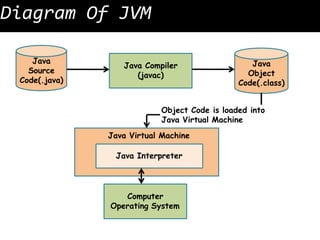
Java
Source
Code(.java)
Java
Object
Code(.class)
Java Compiler
(javac)
Computer
Operating System
Java Interpreter
Java Virtual Machine
Object Code is loaded into
Java Virtual Machine
Components Of JVM
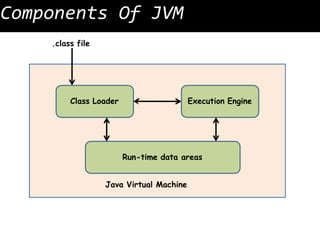
Class Loader Execution Engine
Run-time data areas
Java Virtual Machine
.class file
Components Of JVM
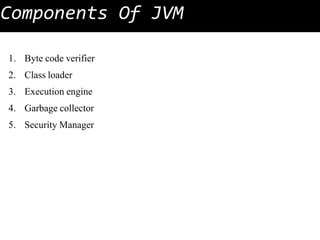
1. Byte code verifier
2. Class loader
3. Execution engine
4. Garbage collector
5. Security Manager
1. Byte code Verifier:
• Byte code verifier is used to verify the byte code.
• Also checks for unusual code.
• So it is a crucial component for security.
2. Class loader:
• Class loader loads java classes into java virtual machine and creates
the instance of java.lang.class.
• The main feature is that JVM doesn’t need to have any knowledge
about the classes that will be loaded at runtime.
• It performs three main functions of JVM, namely: loading, linking
and initialization
3. Execution Engine:
• The execution engine helps JVM to convert bytecode into machine code.
• It has two parts:
a) Interpreter
b) Just-in-time-interpreter
• Execution engine is responsible for executing the instructions contained in
the methods of loaded classes.
4. Garbage Collector:
• Garbage collection is the process of automatically freeing objects that are
no longer referenced by the program.
• It periodically check for the object on heap , whose link is broken so it can
collect garbage from heap.
• Garbage collection relieves java programmer from memory management.
5. Security Manager:
• Security manager constantly monitors the code.
• It is a special java object that is responsible for guarding security policies
for java applications.
• It is always consulted before any potentially dangerous operation is
requested by a java application.

JVM.pptx

  • 1.
    Java Virtual Machine •JVM is not a real hardware machine but a software layer which resembles an hardware platform. • JVM converts Java byte code into machine language and executes it. • The byte code can be executed on any platform where there exist JVM. • JVM‘s are available for many hardware and software platforms. • The use of the same byte code for all JVM’s on all platforms allows Java to be described as a "write once, run anywhere" programming language. • Thus, the JVM is a crucial component of the Java platform.
  • 2.
    Diagram Of JVM Java Source Code(.java) Java Object Code(.class) JavaCompiler (javac) Computer Operating System Java Interpreter Java Virtual Machine Object Code is loaded into Java Virtual Machine
  • 3.
    Components Of JVM ClassLoader Execution Engine Run-time data areas Java Virtual Machine .class file
  • 4.
    Components Of JVM 1.Byte code verifier 2. Class loader 3. Execution engine 4. Garbage collector 5. Security Manager
  • 5.
    1. Byte codeVerifier: • Byte code verifier is used to verify the byte code. • Also checks for unusual code. • So it is a crucial component for security. 2. Class loader: • Class loader loads java classes into java virtual machine and creates the instance of java.lang.class. • The main feature is that JVM doesn’t need to have any knowledge about the classes that will be loaded at runtime. • It performs three main functions of JVM, namely: loading, linking and initialization
  • 6.
    3. Execution Engine: •The execution engine helps JVM to convert bytecode into machine code. • It has two parts: a) Interpreter b) Just-in-time-interpreter • Execution engine is responsible for executing the instructions contained in the methods of loaded classes. 4. Garbage Collector: • Garbage collection is the process of automatically freeing objects that are no longer referenced by the program. • It periodically check for the object on heap , whose link is broken so it can collect garbage from heap. • Garbage collection relieves java programmer from memory management.
  • 7.
    5. Security Manager: •Security manager constantly monitors the code. • It is a special java object that is responsible for guarding security policies for java applications. • It is always consulted before any potentially dangerous operation is requested by a java application.