WELCOME
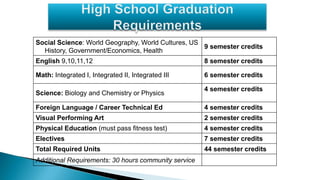
Social Science: World Geography, World Cultures, US
History, Government/Economics, Health
9 semester credits
English 9,10,11,12 8 semester credits
Math: Integrated I, Integrated II, Integrated III 6 semester credits
Science: Biology and Chemistry or Physics
4 semester credits
Foreign Language / Career Technical Ed 4 semester credits
Visual Performing Art 2 semester credits
Physical Education (must pass fitness test) 4 semester credits
Electives 7 semester credits
Total Required Units 44 semester credits
Additional Requirements: 30 hours community service
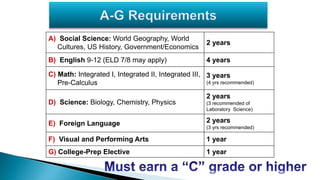
A) Social Science: World Geography, World
Cultures, US History, Government/Economics
2 years
B) English 9-12 (ELD 7/8 may apply) 4 years
C) Math: Integrated I, Integrated II, Integrated III,
Pre-Calculus
3 years
(4 yrs recommended)
D) Science: Biology, Chemistry, Physics
2 years
(3 recommended of
Laboratory Science)
E) Foreign Language 2 years
(3 yrs recommended)
F) Visual and Performing Arts 1 year
G) College-Prep Elective 1 year
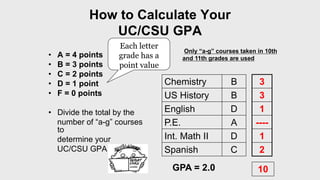
How to Calculate Your
UC/CSU GPA
• A = 4 points
• B = 3 points
• C = 2 points
• D = 1 point
• F = 0 points
• Divide the total by the
number of “a-g” courses
to
determine your
UC/CSU GPA
Chemistry B
US History B
English D
P.E. A
Int. Math II D
Spanish C
Each letter
grade has a
point value
Only “a-g” courses taken in 10th
and 11th grades are used
10
3
3
1
----
1
2
GPA = 2.0
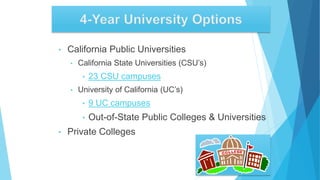
• California Public Universities
• California State Universities (CSU’s)
• 23 CSU campuses
• University of California (UC’s)
• 9 UC campuses
• Out-of-State Public Colleges & Universities
• Private Colleges
• Students should check with each college individually as
requirements vary by institution
• Admission is often determined by a “committee” type process
• Many campuses use the Common Application
• One application used by over 350 colleges and universities
• Accepted in place of the school’s own application and students
can apply to many colleges using this one application
• Colleges that use the Common Application also require:
• An essay (some schools require additional supplemental essays)
• Letters of recommendation from your counselor and teacher(s)
www.commonapp.org: Provides a list of schools that accept the
Common Application in place of their own application
Committee Selection (Private colleges & universities)
• Students are reviewed in the context of their entire application.
Extracurricular activities, leadership roles, portfolios & auditions,
recommendations, and community service can play a more significant
role.
Comprehensive or Holistic Review (UC)
• UC campuses all use the same 14 factors to evaluate applicants
(GPA in A-G courses, test scores, # of and performance in Honors/AP
courses, strength of senior schedule, special
talents/achievements/awards, etc… to name a few)
• While all UC campuses use the same 14 factors, they often apply these factors
differently. Be sure to review the selection process of each campus
Eligibility Index (CSU & UC)
• Campuses use a mathematical equation to determine eligibility,
primarily based on GPA and test scores. The index will vary by
campus.
• Letters of recommendation may also be required
for Private Universities and Out-of-state colleges
• They are not required for UC/CSU schools
• Students requiring a letter of recommendation for
college will have to complete the Letters of
Recommendation Info Sheet
•This gives teachers/counselors more insight into who you are
• Students may also require a letter of
recommendation for
• Scholarships
• Special programs or majors
As you are researching colleges, be sure to consider multiple
criteria - cost, admission rates, requirements, location, majors
available, size, student life – to help you determine a possible
good fit college.
Your college list should include a broad range of schools, mostly
“Safety” Schools – preparation well exceeds admission requirements & costs
“Match” Schools – preparation meets or exceeds admission requirements & costs
And a few…
“Reach” Schools - admission is very competitive regardless of student preparation
(historically low admission rates); student does not meet or exceed requirements or
the school’s cost exceeds your college budget
Research admission criteria and acceptance rates to compare your
qualifications with those of students who have been admitted in the past.
 A college visit is the best way to decide if a campus is a
good ‘fit’ for a student.
 Visit the colleges you are considering during spring break
and the summer break.
 Tour the residence halls, cafeteria, classroom, athletic
fields, etc.
 Call ahead or check website to schedule a tour and/or
information session.
 Ask questions of the tour guide or other students on
campus.
10
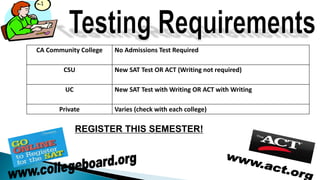
CA Community College No Admissions Test Required
CSU New SAT Test OR ACT (Writing not required)
UC New SAT Test with Writing OR ACT with Writing
Private Varies (check with each college)
REGISTER THIS SEMESTER!
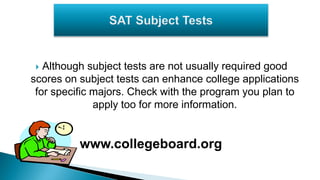
 Although subject tests are not usually required good
scores on subject tests can enhance college applications
for specific majors. Check with the program you plan to
apply too for more information.
www.collegeboard.org
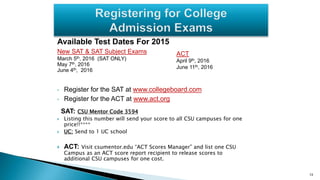
Available Test Dates For 2015
New SAT & SAT Subject Exams
March 5th, 2016 (SAT ONLY)
May 7th, 2016
June 4th, 2016
• Register for the SAT at www.collegeboard.com
• Register for the ACT at www.act.org
SAT: CSU Mentor Code 3594
 Listing this number will send your score to all CSU campuses for one
price!!****
 UC: Send to 1 UC school
 ACT: Visit csumentor.edu “ACT Scores Manager” and list one CSU
Campus as an ACT score report recipient to release scores to
additional CSU campuses for one cost.
13
ACT
April 9th, 2016
June 11th, 2016
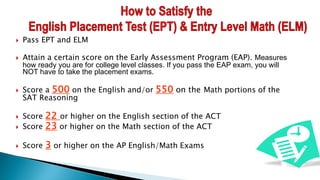
 Pass EPT and ELM
 Attain a certain score on the Early Assessment Program (EAP). Measures
how ready you are for college level classes. If you pass the EAP exam, you will
NOT have to take the placement exams.
 Score a 500 on the English and/or 550 on the Math portions of the
SAT Reasoning
 Score 22 or higher on the English section of the ACT
 Score 23 or higher on the Math section of the ACT
 Score 3 or higher on the AP English/Math Exams
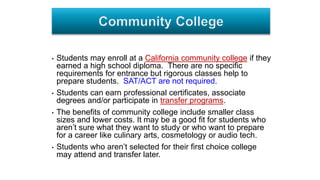
• Students may enroll at a California community college if they
earned a high school diploma. There are no specific
requirements for entrance but rigorous classes help to
prepare students. SAT/ACT are not required.
• Students can earn professional certificates, associate
degrees and/or participate in transfer programs.
• The benefits of community college include smaller class
sizes and lower costs. It may be a good fit for students who
aren’t sure what they want to study or who want to prepare
for a career like culinary arts, cosmetology or audio tech.
• Students who aren’t selected for their first choice college
may attend and transfer later.
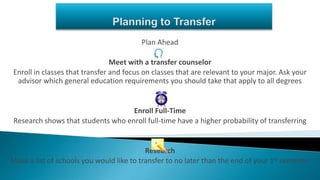
Plan Ahead
Meet with a transfer counselor
Enroll in classes that transfer and focus on classes that are relevant to your major. Ask your
advisor which general education requirements you should take that apply to all degrees
Enroll Full-Time
Research shows that students who enroll full-time have a higher probability of transferring
Research
Make a list of schools you would like to transfer to no later than the end of your 1st semester
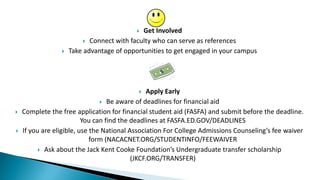
 Get Involved
 Connect with faculty who can serve as references
 Take advantage of opportunities to get engaged in your campus
 Apply Early
 Be aware of deadlines for financial aid
 Complete the free application for financial student aid (FASFA) and submit before the deadline.
You can find the deadlines at FASFA.ED.GOV/DEADLINES
 If you are eligible, use the National Association For College Admissions Counseling’s fee waiver
form (NACACNET.ORG/STUDENTINFO/FEEWAIVER
 Ask about the Jack Kent Cooke Foundation’s Undergraduate transfer scholarship
(JKCF.ORG/TRANSFER)
• Prospective student-athletes must register with the NCAA Initial-
Eligibility Clearinghouse to be eligible to play NCAA Division I or
Division II sports in college (Athletes playing in NCAA Division III do
not have to register)
• Students should register no later than the end of their 11th grade.
• The NCAA core-course requirements can be found at
www.eligibilitycenter.org
Please visit the NCAA Eligibility Center to
register. www.eligibilitycenter.org
 Scholarships do NOT have to be repaid!!!
◦ You can receive a scholarship for:
 Athletic talent
 Special Factors (ethnicity, gender, religious affiliation, etc..)
 Academic Achievements
 Personal Achievements (students who excel in such areas a writing, outstanding
community service, leadership…)
◦ Different types of scholarship
 Honorary
 Need-based
◦ FAFSA: Free Application for Federal Student Aid
 G.P.A. of 3.75 or higher (overall weighted G.P.A. over 7 semesters,
starting in 9th grade through first semester of 12th grade)
 Students must take at least 2 Advanced Placement Courses within the
4 years of high school.
 Citizenship requirement: Students can only have one D or F in seven
semesters of high school.
 Community Service requirement: At least 100 hours of community
service.
 Keep rigor in your course schedule! – at least 4
academic courses with one being math.
 Balance rigor with success – aim high, but do not take
too much risk!
 One D/F will disqualify you from a UC campus.
 One D/F will disqualify you from SDSU.
 Make sure you complete any make up work before
you apply (APEX, Summer School, Credit
Recovery…)
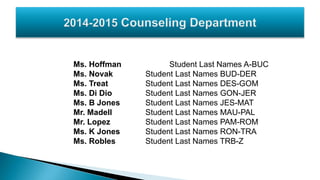
Ms. Hoffman Student Last Names A-BUC
Ms. Novak Student Last Names BUD-DER
Ms. Treat Student Last Names DES-GOM
Ms. Di Dio Student Last Names GON-JER
Ms. B Jones Student Last Names JES-MAT
Mr. Madell Student Last Names MAU-PAL
Mr. Lopez Student Last Names PAM-ROM
Ms. K Jones Student Last Names RON-TRA
Ms. Robles Student Last Names TRB-Z
 6:45-7:05
 7:10-7:30
 7:35-8:00
SDSU-HERE in the Theater
UCSD-Cafeteria
Southwestern College-Room 805
NEW SAT Test Tips- Career Center/Counseling Center
The Middle Class Scholarship & Financial Aide-Room 807
24

Junior parent night elh website ppt

  • 1.
  • 2.
    Social Science: WorldGeography, World Cultures, US History, Government/Economics, Health 9 semester credits English 9,10,11,12 8 semester credits Math: Integrated I, Integrated II, Integrated III 6 semester credits Science: Biology and Chemistry or Physics 4 semester credits Foreign Language / Career Technical Ed 4 semester credits Visual Performing Art 2 semester credits Physical Education (must pass fitness test) 4 semester credits Electives 7 semester credits Total Required Units 44 semester credits Additional Requirements: 30 hours community service
  • 3.
    A) Social Science:World Geography, World Cultures, US History, Government/Economics 2 years B) English 9-12 (ELD 7/8 may apply) 4 years C) Math: Integrated I, Integrated II, Integrated III, Pre-Calculus 3 years (4 yrs recommended) D) Science: Biology, Chemistry, Physics 2 years (3 recommended of Laboratory Science) E) Foreign Language 2 years (3 yrs recommended) F) Visual and Performing Arts 1 year G) College-Prep Elective 1 year
  • 4.
    How to CalculateYour UC/CSU GPA • A = 4 points • B = 3 points • C = 2 points • D = 1 point • F = 0 points • Divide the total by the number of “a-g” courses to determine your UC/CSU GPA Chemistry B US History B English D P.E. A Int. Math II D Spanish C Each letter grade has a point value Only “a-g” courses taken in 10th and 11th grades are used 10 3 3 1 ---- 1 2 GPA = 2.0
  • 5.
    • California PublicUniversities • California State Universities (CSU’s) • 23 CSU campuses • University of California (UC’s) • 9 UC campuses • Out-of-State Public Colleges & Universities • Private Colleges
  • 6.
    • Students shouldcheck with each college individually as requirements vary by institution • Admission is often determined by a “committee” type process • Many campuses use the Common Application • One application used by over 350 colleges and universities • Accepted in place of the school’s own application and students can apply to many colleges using this one application • Colleges that use the Common Application also require: • An essay (some schools require additional supplemental essays) • Letters of recommendation from your counselor and teacher(s) www.commonapp.org: Provides a list of schools that accept the Common Application in place of their own application
  • 7.
    Committee Selection (Privatecolleges & universities) • Students are reviewed in the context of their entire application. Extracurricular activities, leadership roles, portfolios & auditions, recommendations, and community service can play a more significant role. Comprehensive or Holistic Review (UC) • UC campuses all use the same 14 factors to evaluate applicants (GPA in A-G courses, test scores, # of and performance in Honors/AP courses, strength of senior schedule, special talents/achievements/awards, etc… to name a few) • While all UC campuses use the same 14 factors, they often apply these factors differently. Be sure to review the selection process of each campus Eligibility Index (CSU & UC) • Campuses use a mathematical equation to determine eligibility, primarily based on GPA and test scores. The index will vary by campus.
  • 8.
    • Letters ofrecommendation may also be required for Private Universities and Out-of-state colleges • They are not required for UC/CSU schools • Students requiring a letter of recommendation for college will have to complete the Letters of Recommendation Info Sheet •This gives teachers/counselors more insight into who you are • Students may also require a letter of recommendation for • Scholarships • Special programs or majors
  • 9.
    As you areresearching colleges, be sure to consider multiple criteria - cost, admission rates, requirements, location, majors available, size, student life – to help you determine a possible good fit college. Your college list should include a broad range of schools, mostly “Safety” Schools – preparation well exceeds admission requirements & costs “Match” Schools – preparation meets or exceeds admission requirements & costs And a few… “Reach” Schools - admission is very competitive regardless of student preparation (historically low admission rates); student does not meet or exceed requirements or the school’s cost exceeds your college budget Research admission criteria and acceptance rates to compare your qualifications with those of students who have been admitted in the past.
  • 10.
     A collegevisit is the best way to decide if a campus is a good ‘fit’ for a student.  Visit the colleges you are considering during spring break and the summer break.  Tour the residence halls, cafeteria, classroom, athletic fields, etc.  Call ahead or check website to schedule a tour and/or information session.  Ask questions of the tour guide or other students on campus. 10
  • 11.
    CA Community CollegeNo Admissions Test Required CSU New SAT Test OR ACT (Writing not required) UC New SAT Test with Writing OR ACT with Writing Private Varies (check with each college) REGISTER THIS SEMESTER!
  • 12.
     Although subjecttests are not usually required good scores on subject tests can enhance college applications for specific majors. Check with the program you plan to apply too for more information. www.collegeboard.org
  • 13.
    Available Test DatesFor 2015 New SAT & SAT Subject Exams March 5th, 2016 (SAT ONLY) May 7th, 2016 June 4th, 2016 • Register for the SAT at www.collegeboard.com • Register for the ACT at www.act.org SAT: CSU Mentor Code 3594  Listing this number will send your score to all CSU campuses for one price!!****  UC: Send to 1 UC school  ACT: Visit csumentor.edu “ACT Scores Manager” and list one CSU Campus as an ACT score report recipient to release scores to additional CSU campuses for one cost. 13 ACT April 9th, 2016 June 11th, 2016
  • 15.
     Pass EPTand ELM  Attain a certain score on the Early Assessment Program (EAP). Measures how ready you are for college level classes. If you pass the EAP exam, you will NOT have to take the placement exams.  Score a 500 on the English and/or 550 on the Math portions of the SAT Reasoning  Score 22 or higher on the English section of the ACT  Score 23 or higher on the Math section of the ACT  Score 3 or higher on the AP English/Math Exams
  • 16.
    • Students mayenroll at a California community college if they earned a high school diploma. There are no specific requirements for entrance but rigorous classes help to prepare students. SAT/ACT are not required. • Students can earn professional certificates, associate degrees and/or participate in transfer programs. • The benefits of community college include smaller class sizes and lower costs. It may be a good fit for students who aren’t sure what they want to study or who want to prepare for a career like culinary arts, cosmetology or audio tech. • Students who aren’t selected for their first choice college may attend and transfer later.
  • 17.
    Plan Ahead Meet witha transfer counselor Enroll in classes that transfer and focus on classes that are relevant to your major. Ask your advisor which general education requirements you should take that apply to all degrees Enroll Full-Time Research shows that students who enroll full-time have a higher probability of transferring Research Make a list of schools you would like to transfer to no later than the end of your 1st semester
  • 18.
     Get Involved Connect with faculty who can serve as references  Take advantage of opportunities to get engaged in your campus  Apply Early  Be aware of deadlines for financial aid  Complete the free application for financial student aid (FASFA) and submit before the deadline. You can find the deadlines at FASFA.ED.GOV/DEADLINES  If you are eligible, use the National Association For College Admissions Counseling’s fee waiver form (NACACNET.ORG/STUDENTINFO/FEEWAIVER  Ask about the Jack Kent Cooke Foundation’s Undergraduate transfer scholarship (JKCF.ORG/TRANSFER)
  • 19.
    • Prospective student-athletesmust register with the NCAA Initial- Eligibility Clearinghouse to be eligible to play NCAA Division I or Division II sports in college (Athletes playing in NCAA Division III do not have to register) • Students should register no later than the end of their 11th grade. • The NCAA core-course requirements can be found at www.eligibilitycenter.org Please visit the NCAA Eligibility Center to register. www.eligibilitycenter.org
  • 20.
     Scholarships doNOT have to be repaid!!! ◦ You can receive a scholarship for:  Athletic talent  Special Factors (ethnicity, gender, religious affiliation, etc..)  Academic Achievements  Personal Achievements (students who excel in such areas a writing, outstanding community service, leadership…) ◦ Different types of scholarship  Honorary  Need-based ◦ FAFSA: Free Application for Federal Student Aid
  • 21.
     G.P.A. of3.75 or higher (overall weighted G.P.A. over 7 semesters, starting in 9th grade through first semester of 12th grade)  Students must take at least 2 Advanced Placement Courses within the 4 years of high school.  Citizenship requirement: Students can only have one D or F in seven semesters of high school.  Community Service requirement: At least 100 hours of community service.
  • 22.
     Keep rigorin your course schedule! – at least 4 academic courses with one being math.  Balance rigor with success – aim high, but do not take too much risk!  One D/F will disqualify you from a UC campus.  One D/F will disqualify you from SDSU.  Make sure you complete any make up work before you apply (APEX, Summer School, Credit Recovery…)
  • 23.
    Ms. Hoffman StudentLast Names A-BUC Ms. Novak Student Last Names BUD-DER Ms. Treat Student Last Names DES-GOM Ms. Di Dio Student Last Names GON-JER Ms. B Jones Student Last Names JES-MAT Mr. Madell Student Last Names MAU-PAL Mr. Lopez Student Last Names PAM-ROM Ms. K Jones Student Last Names RON-TRA Ms. Robles Student Last Names TRB-Z
  • 24.
     6:45-7:05  7:10-7:30 7:35-8:00 SDSU-HERE in the Theater UCSD-Cafeteria Southwestern College-Room 805 NEW SAT Test Tips- Career Center/Counseling Center The Middle Class Scholarship & Financial Aide-Room 807 24