SENIOR CLASS PRESENTATION 
LIFE AFTER HIGH SCHOOL!
LEARNING TARGETS 
• Counselor breakdown 
• Discuss options for life 
• Explore college options 
• Discuss salaries related to education levels 
• Discuss general college and scholarship procedures 
• ACT VS SAT 
• What should you be doing right now
VISTA PEAK COUNSELORS 
Mrs. Lyle A-G 
Ms. Berry H-P 
Ms. Husk Q-Z
ARE YOU ON TRACK TO GRADUATE 
VP Graduation Requirements HEAR Graduation Requirements 
Subject Required Credits 
English 4.0 units of credit 
Math 4.0 units of credit 
Science 3.0 units of credit 
Social Science 1.5 units of credit 
US History 1.0 units of credit 
Civics 0.5 units of credit 
World Language 2.0 units of credit 
Electives 6.0 units of credit 
Minimum credits to 
Graduate 22.0 units of credit 
Subject Required 
Years 
English 4 Years 
Math (must include algebra 1, 
Geometry, Algebra II or 
equivalents) 
4 Years 
Natural/Physical Science (two 
units must be lab based) 
3 Years 
Social Science 1.5 Years 
US History 1 Year 
Civics 0.5 Years 
Foreign Language 1 Year 
Academic Electives 2 years
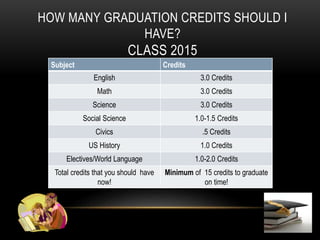
HOW MANY GRADUATION CREDITS SHOULD I 
HAVE? 
CLASS 2015 
Subject Credits 
English 3.0 Credits 
Math 3.0 Credits 
Science 3.0 Credits 
Social Science 1.0-1.5 Credits 
Civics .5 Credits 
US History 1.0 Credits 
Electives/World Language 1.0-2.0 Credits 
Total credits that you should have 
now! 
Minimum of 15 credits to graduate 
on time!
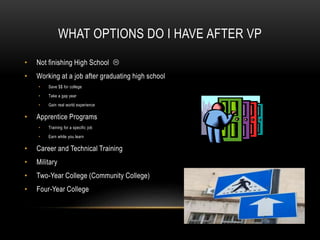
WHAT OPTIONS DO I HAVE AFTER VP 
• Not finishing High School  
• Working at a job after graduating high school 
• Save $$ for college 
• Take a gap year 
• Gain real world experience 
• Apprentice Programs 
• Training for a specific job 
• Earn while you learn 
• Career and Technical Training 
• Military 
• Two-Year College (Community College) 
• Four-Year College
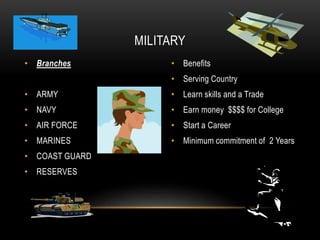
• Branches 
• ARMY 
• NAVY 
• AIR FORCE 
• MARINES 
• COAST GUARD 
• RESERVES 
MILITARY 
• Benefits 
• Serving Country 
• Learn skills and a Trade 
• Earn money $$$$ for College 
• Start a Career 
• Minimum commitment of 2 Years
• Low cost 
• May take longer than other 
Career Schools 
• Quality instructors that have 
worked in specific career field 
• Hands on career specific 
training 
• Job placement (sometimes) 
• Emily Griffith Opportunity 
School 
• Pickens Technical College 
(Aurora Public Schools) 
• Wyotec 
CAREER & TECHNICAL SCHOOLS 
Local Schools Facts
OTHER CAREER & TECHNICAL SCHOOLS 
• Promise faster completion 
• Higher tuition with more loan debt 
• Credits usually do not transfer to 
Community College or 4-year 
University 
BEAWARE!!!!!! 
Schools 
you see 
on TV
• Smaller Class size 
• Affordable tuition 
• You do not have to live on-campus 
• Guaranteed admission 
• May work with undocumented 
students 
• Community College of Aurora 
• Community College of Denver 
• Red Rocks Community 
College 
• Arapahoe Community College 
• Front Range Community 
College 
COLORADO TWO YEAR COLLEGES 
Local Community Colleges Community College Facts
COLORADO TWO YEAR COLLEGE CONT. 
Other Two-Year Colleges Two-Year College Facts 
• Low cost tuition 
• Located in Rural or Mountain 
area across Colorado 
• On-campus housing 
• looser admission 
requirements 
• May have low to no wait-list 
for programs 
• Aims Community College 
• Colorado Mountain College 
• Colorado Northwest 
Community College 
• Lamar Community College 
• Pikes Peak Community 
College
• Career and Vocational focused 
• Guaranteed admissions 
• Smaller classes than traditional 4 
year colleges 
• two –year college with on 
campus housing 
• Opportunity to participate in 
NCAA sports 
• Otero Junior College, La 
Junta 
• Trinidad Junior College, 
Trinidad 
• Blair Junior College 
• Northeastern Junior College, 
Sterling 
COLORADO JUNIOR COLLEGES 
Junior Colleges Junior College Facts
• Larger class size 
• Harder admission requirements 
• More options for Majors 
• Usually provide good Financial 
Aid options 
• Options to participate in NCAA 
sports (competitive) 
• Adams State College, Alamosa 
• Colorado School of Mines, Golden 
Colorado 
• Colorado State University, 
• - Fort Collins (Main Campus) & 
Pueblo 
• Fort Lewis College 
• Mesa University, Grand Junction 
• Metropolitan State University of 
Denver, Denver 
FOUR YEAR COLORADO 
COLLEGES/UNIVERSITIES 
Four Year Colleges/Universities Four Year College/University -Facts
• Higher tuition than Community College 
• Competitive admission requirements 
• More major options 
• Larger campuses 
• May offer good Financial Aid package 
• Opportunity to participate in NCAA sports 
(competitive) 
• University of Colorado at Boulder, Boulder 
(main campus) 
• University of Colorado at Colorado 
Springs, Colorado Springs 
• University of Colorado at Denver, Denver 
• University of Colorado Health and Science 
Center, Aurora 
• University of Northern Colorado, Greeley 
• Western State College of Colorado, 
Gunnison 
FOUR YEAR COLORADO 
COLLEGES/UNIVERSITIES CONTINUED 
Four Year Colleges/Universities Four Year College/University Facts
PRIVATE COLORADO FOUR-YEAR 
COLLEGES/UNIVERSITIES 
Colorado Private Colleges Private Institution Facts 
• Smaller college 
• Tuition is higher 
• Some give more Financial Aid 
and large scholarship 
endowments 
• No COF requirement and may 
work for undocumented students 
• Opportunity to participate in 
NCAA college sports 
• Colorado College, Colorado 
Springs 
• Colorado Christian University, 
Lakewood 
• Johnson & Wales, Denver 
• Regis University, Denver 
• Rocky Mountain College of Art 
and Design, Denver 
• University of Denver
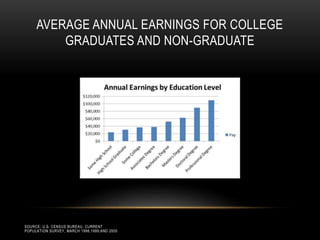
AVERAGE ANNUAL EARNINGS FOR COLLEGE 
GRADUATES AND NON-GRADUATE 
SOURCE: U.S. CENSUS BUREAU, CURRENT 
POPULATION SURVEY, MARCH 1998,1999,AND 2000
WHAT STEPS TO TAKE NEXT 
• Visit schools that you may be 
interested in attending 
• Apply to at least five schools. Make 
sure you have two safe schools 
• Talk to your family about Post- 
Secondary plans (Financial Aid, 
Colleges) 
• Check Naviance and the Counseling 
Center for upcoming Events, 
Scholarships and Post –Secondary 
information 
• Talk to Counselors to discuss options 
to make up credits. 
• Examine you ACT score, Look at 
upcoming ACT retest dates. 
• Check for Scholarship and College 
Application deadlines. (research) 
• Apply for scholarships that meet your 
qualifications 
• Talk to your counselor to see if you are 
on track 
• Talk to teachers about 
recommendation letters
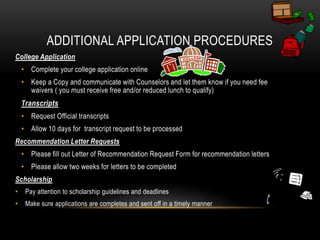
ADDITIONAL APPLICATION PROCEDURES 
College Application 
• Complete your college application online 
• Keep a Copy and communicate with Counselors and let them know if you need fee 
waivers ( you must receive free and/or reduced lunch to qualify) 
Transcripts 
• Request Official transcripts 
• Allow 10 days for transcript request to be processed 
Recommendation Letter Requests 
• Please fill out Letter of Recommendation Request Form for recommendation letters 
• Please allow two weeks for letters to be completed 
Scholarship 
• Pay attention to scholarship guidelines and deadlines 
• Make sure applications are completes and sent off in a timely manner
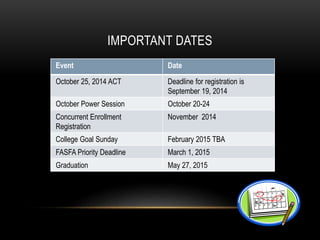
IMPORTANT DATES 
Event Date 
October 25, 2014 ACT Deadline for registration is 
September 19, 2014 
October Power Session October 20-24 
Concurrent Enrollment 
Registration 
November 2014 
College Goal Sunday February 2015 TBA 
FASFA Priority Deadline March 1, 2015 
Graduation May 27, 2015
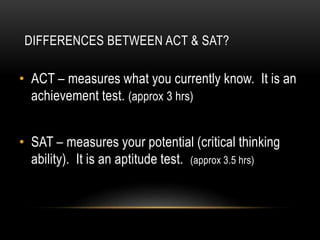
DIFFERENCES BETWEEN ACT & SAT? 
• ACT – measures what you currently know. It is an 
achievement test. (approx 3 hrs) 
• SAT – measures your potential (critical thinking 
ability). It is an aptitude test. (approx 3.5 hrs)
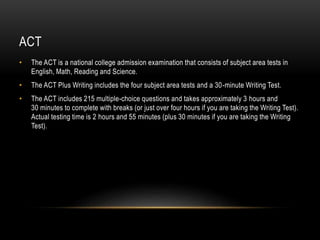
ACT 
• The ACT is a national college admission examination that consists of subject area tests in 
English, Math, Reading and Science. 
• The ACT Plus Writing includes the four subject area tests and a 30-minute Writing Test. 
• The ACT includes 215 multiple-choice questions and takes approximately 3 hours and 
30 minutes to complete with breaks (or just over four hours if you are taking the Writing Test). 
Actual testing time is 2 hours and 55 minutes (plus 30 minutes if you are taking the Writing 
Test).
SAT 
• The SAT Reasoning Test is a measure of the critical thinking skills you'll need for academic 
success in college. 
• The SAT assesses how well you analyze and solve problems—skills you learned in school 
that you'll need in college. 
• The SAT includes a Critical Reading, Mathematics, and Writing section. The 25-minute essay 
will always be the first section of the SAT, and the 10-minute multiple-choice writing section 
will always be the final section. The remaining six 25-minute sections can appear in any 
order, as can the two 20-minute sections.
GRANTS VS SCHOLARSHIPS 
Grants = Free money you don’t have to pay back 
Scholarships=Free money-academic, athletic, service 
Application, essays, interviews 
(more to come) 
Loans= must pay back once you graduate
FAFSA 
• Free Application for Federal Student Aid 
• Is FREE on fafsa.edu.gov-you should not pay for it!!! 
• Need based 
• Can start applying Jan 1, 2015 
• College Goal Sunday Feb 2015 CCA 
• Apply early 
• More on this topic to come
COLLEGE ESSAY 
• Needs to reflect who you are NOT what you did 
• Make it personal-how did you feel, what did you think,what 
did you learn 
• Be honest 
• Leave people with hope 
• What is your message to the world 
• We will explore topics
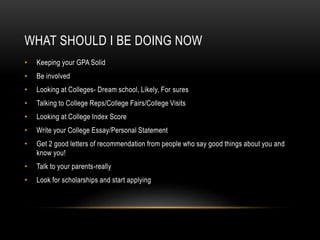
WHAT SHOULD I BE DOING NOW 
• Keeping your GPA Solid 
• Be involved 
• Looking at Colleges- Dream school, Likely, For sures 
• Talking to College Reps/College Fairs/College Visits 
• Looking at College Index Score 
• Write your College Essay/Personal Statement 
• Get 2 good letters of recommendation from people who say good things about you and 
know you! 
• Talk to your parents-really 
• Look for scholarships and start applying
QUESTIONS

Senior Class Presentations

  • 1.
    SENIOR CLASS PRESENTATION LIFE AFTER HIGH SCHOOL!
  • 2.
    LEARNING TARGETS •Counselor breakdown • Discuss options for life • Explore college options • Discuss salaries related to education levels • Discuss general college and scholarship procedures • ACT VS SAT • What should you be doing right now
  • 3.
    VISTA PEAK COUNSELORS Mrs. Lyle A-G Ms. Berry H-P Ms. Husk Q-Z
  • 4.
    ARE YOU ONTRACK TO GRADUATE VP Graduation Requirements HEAR Graduation Requirements Subject Required Credits English 4.0 units of credit Math 4.0 units of credit Science 3.0 units of credit Social Science 1.5 units of credit US History 1.0 units of credit Civics 0.5 units of credit World Language 2.0 units of credit Electives 6.0 units of credit Minimum credits to Graduate 22.0 units of credit Subject Required Years English 4 Years Math (must include algebra 1, Geometry, Algebra II or equivalents) 4 Years Natural/Physical Science (two units must be lab based) 3 Years Social Science 1.5 Years US History 1 Year Civics 0.5 Years Foreign Language 1 Year Academic Electives 2 years
  • 5.
    HOW MANY GRADUATIONCREDITS SHOULD I HAVE? CLASS 2015 Subject Credits English 3.0 Credits Math 3.0 Credits Science 3.0 Credits Social Science 1.0-1.5 Credits Civics .5 Credits US History 1.0 Credits Electives/World Language 1.0-2.0 Credits Total credits that you should have now! Minimum of 15 credits to graduate on time!
  • 6.
    WHAT OPTIONS DOI HAVE AFTER VP • Not finishing High School  • Working at a job after graduating high school • Save $$ for college • Take a gap year • Gain real world experience • Apprentice Programs • Training for a specific job • Earn while you learn • Career and Technical Training • Military • Two-Year College (Community College) • Four-Year College
  • 7.
    • Branches •ARMY • NAVY • AIR FORCE • MARINES • COAST GUARD • RESERVES MILITARY • Benefits • Serving Country • Learn skills and a Trade • Earn money $$$$ for College • Start a Career • Minimum commitment of 2 Years
  • 8.
    • Low cost • May take longer than other Career Schools • Quality instructors that have worked in specific career field • Hands on career specific training • Job placement (sometimes) • Emily Griffith Opportunity School • Pickens Technical College (Aurora Public Schools) • Wyotec CAREER & TECHNICAL SCHOOLS Local Schools Facts
  • 9.
    OTHER CAREER &TECHNICAL SCHOOLS • Promise faster completion • Higher tuition with more loan debt • Credits usually do not transfer to Community College or 4-year University BEAWARE!!!!!! Schools you see on TV
  • 10.
    • Smaller Classsize • Affordable tuition • You do not have to live on-campus • Guaranteed admission • May work with undocumented students • Community College of Aurora • Community College of Denver • Red Rocks Community College • Arapahoe Community College • Front Range Community College COLORADO TWO YEAR COLLEGES Local Community Colleges Community College Facts
  • 11.
    COLORADO TWO YEARCOLLEGE CONT. Other Two-Year Colleges Two-Year College Facts • Low cost tuition • Located in Rural or Mountain area across Colorado • On-campus housing • looser admission requirements • May have low to no wait-list for programs • Aims Community College • Colorado Mountain College • Colorado Northwest Community College • Lamar Community College • Pikes Peak Community College
  • 12.
    • Career andVocational focused • Guaranteed admissions • Smaller classes than traditional 4 year colleges • two –year college with on campus housing • Opportunity to participate in NCAA sports • Otero Junior College, La Junta • Trinidad Junior College, Trinidad • Blair Junior College • Northeastern Junior College, Sterling COLORADO JUNIOR COLLEGES Junior Colleges Junior College Facts
  • 13.
    • Larger classsize • Harder admission requirements • More options for Majors • Usually provide good Financial Aid options • Options to participate in NCAA sports (competitive) • Adams State College, Alamosa • Colorado School of Mines, Golden Colorado • Colorado State University, • - Fort Collins (Main Campus) & Pueblo • Fort Lewis College • Mesa University, Grand Junction • Metropolitan State University of Denver, Denver FOUR YEAR COLORADO COLLEGES/UNIVERSITIES Four Year Colleges/Universities Four Year College/University -Facts
  • 14.
    • Higher tuitionthan Community College • Competitive admission requirements • More major options • Larger campuses • May offer good Financial Aid package • Opportunity to participate in NCAA sports (competitive) • University of Colorado at Boulder, Boulder (main campus) • University of Colorado at Colorado Springs, Colorado Springs • University of Colorado at Denver, Denver • University of Colorado Health and Science Center, Aurora • University of Northern Colorado, Greeley • Western State College of Colorado, Gunnison FOUR YEAR COLORADO COLLEGES/UNIVERSITIES CONTINUED Four Year Colleges/Universities Four Year College/University Facts
  • 15.
    PRIVATE COLORADO FOUR-YEAR COLLEGES/UNIVERSITIES Colorado Private Colleges Private Institution Facts • Smaller college • Tuition is higher • Some give more Financial Aid and large scholarship endowments • No COF requirement and may work for undocumented students • Opportunity to participate in NCAA college sports • Colorado College, Colorado Springs • Colorado Christian University, Lakewood • Johnson & Wales, Denver • Regis University, Denver • Rocky Mountain College of Art and Design, Denver • University of Denver
  • 16.
    AVERAGE ANNUAL EARNINGSFOR COLLEGE GRADUATES AND NON-GRADUATE SOURCE: U.S. CENSUS BUREAU, CURRENT POPULATION SURVEY, MARCH 1998,1999,AND 2000
  • 17.
    WHAT STEPS TOTAKE NEXT • Visit schools that you may be interested in attending • Apply to at least five schools. Make sure you have two safe schools • Talk to your family about Post- Secondary plans (Financial Aid, Colleges) • Check Naviance and the Counseling Center for upcoming Events, Scholarships and Post –Secondary information • Talk to Counselors to discuss options to make up credits. • Examine you ACT score, Look at upcoming ACT retest dates. • Check for Scholarship and College Application deadlines. (research) • Apply for scholarships that meet your qualifications • Talk to your counselor to see if you are on track • Talk to teachers about recommendation letters
  • 18.
    ADDITIONAL APPLICATION PROCEDURES College Application • Complete your college application online • Keep a Copy and communicate with Counselors and let them know if you need fee waivers ( you must receive free and/or reduced lunch to qualify) Transcripts • Request Official transcripts • Allow 10 days for transcript request to be processed Recommendation Letter Requests • Please fill out Letter of Recommendation Request Form for recommendation letters • Please allow two weeks for letters to be completed Scholarship • Pay attention to scholarship guidelines and deadlines • Make sure applications are completes and sent off in a timely manner
  • 19.
    IMPORTANT DATES EventDate October 25, 2014 ACT Deadline for registration is September 19, 2014 October Power Session October 20-24 Concurrent Enrollment Registration November 2014 College Goal Sunday February 2015 TBA FASFA Priority Deadline March 1, 2015 Graduation May 27, 2015
  • 20.
    DIFFERENCES BETWEEN ACT& SAT? • ACT – measures what you currently know. It is an achievement test. (approx 3 hrs) • SAT – measures your potential (critical thinking ability). It is an aptitude test. (approx 3.5 hrs)
  • 21.
    ACT • TheACT is a national college admission examination that consists of subject area tests in English, Math, Reading and Science. • The ACT Plus Writing includes the four subject area tests and a 30-minute Writing Test. • The ACT includes 215 multiple-choice questions and takes approximately 3 hours and 30 minutes to complete with breaks (or just over four hours if you are taking the Writing Test). Actual testing time is 2 hours and 55 minutes (plus 30 minutes if you are taking the Writing Test).
  • 22.
    SAT • TheSAT Reasoning Test is a measure of the critical thinking skills you'll need for academic success in college. • The SAT assesses how well you analyze and solve problems—skills you learned in school that you'll need in college. • The SAT includes a Critical Reading, Mathematics, and Writing section. The 25-minute essay will always be the first section of the SAT, and the 10-minute multiple-choice writing section will always be the final section. The remaining six 25-minute sections can appear in any order, as can the two 20-minute sections.
  • 23.
    GRANTS VS SCHOLARSHIPS Grants = Free money you don’t have to pay back Scholarships=Free money-academic, athletic, service Application, essays, interviews (more to come) Loans= must pay back once you graduate
  • 24.
    FAFSA • FreeApplication for Federal Student Aid • Is FREE on fafsa.edu.gov-you should not pay for it!!! • Need based • Can start applying Jan 1, 2015 • College Goal Sunday Feb 2015 CCA • Apply early • More on this topic to come
  • 25.
    COLLEGE ESSAY •Needs to reflect who you are NOT what you did • Make it personal-how did you feel, what did you think,what did you learn • Be honest • Leave people with hope • What is your message to the world • We will explore topics
  • 26.
    WHAT SHOULD IBE DOING NOW • Keeping your GPA Solid • Be involved • Looking at Colleges- Dream school, Likely, For sures • Talking to College Reps/College Fairs/College Visits • Looking at College Index Score • Write your College Essay/Personal Statement • Get 2 good letters of recommendation from people who say good things about you and know you! • Talk to your parents-really • Look for scholarships and start applying
  • 27.