TorqueBox
Mixing Java and Ruby all willy-nilly
           Bob McWhirter
            JBoss Fellow
TorqueBox
Mixing Java and Ruby all willy-nilly
           Bob McWhirter
            JBoss Fellow
Who is Bob?
• JBoss Fellow
• Chief Architect of Middleware Cloud
  Computing
• Founder of...
  • The Codehaus
  • Drools
  • TorqueBox
Basic Premise

• You can run Ruby in the JVM
 • Compliant
 • Fast
• You can wire existing enterprise Java
  features into Ruby
Why?


• Ruby has a lot of varied point solutions.
• Traditionally web-centric frameworks.
• Performance issues.
What exactly is
 TorqueBox?
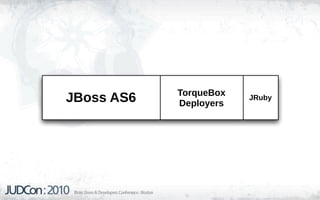
TorqueBox
JBoss AS6   Deployers
                        JRuby
JBoss AS6++


Just as good as regular JBoss AS6,
plus the goodness of a Ruby platform.
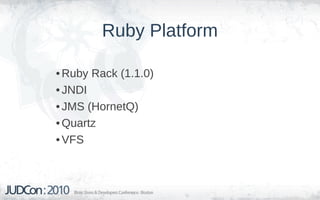
Ruby Platform

• Ruby Rack (1.1.0)
• JNDI
• JMS (HornetQ)
• Quartz
• VFS
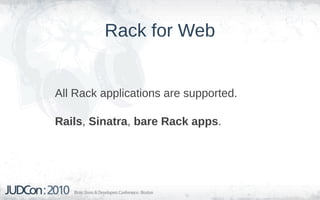
Rack for Web


All Rack applications are supported.

Rails, Sinatra, bare Rack apps.
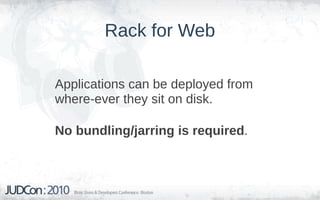
Rack for Web

Applications can be deployed from
where-ever they sit on disk.
No bundling/jarring is required.
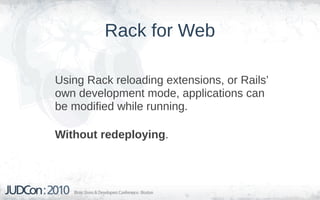
Rack for Web

Using Rack reloading extensions, or Rails’
own development mode, applications can
be modified while running.

Without redeploying.
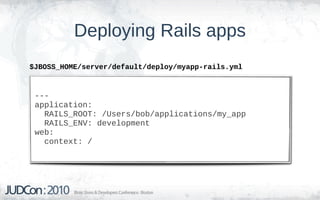
Deploying Rails apps
$JBOSS_HOME/server/default/deploy/myapp-rails.yml


 ---
 application:
   RAILS_ROOT: /Users/bob/applications/my_app
   RAILS_ENV: development
 web:
   context: /
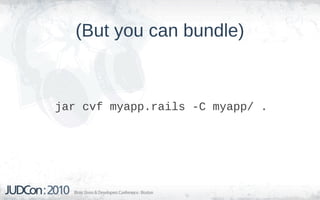
(But you can bundle)


jar cvf myapp.rails -C myapp/ .
Everything else


Due to lack of specs/standards, we’ve
invented our own APIs for bindings to
JNDI, JMS, Quartz, etc.
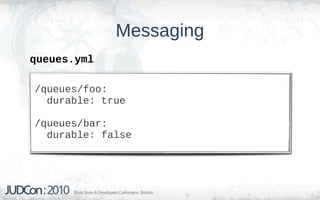
Messaging
queues.yml

/queues/foo:
  durable: true

/queues/bar:
  durable: false
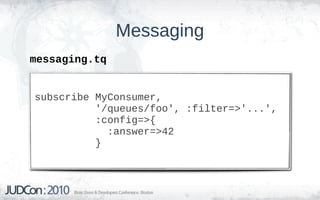
Messaging
messaging.tq


subscribe MyConsumer,
          '/queues/foo', :filter=>'...',
          :config=>{
            :answer=>42
          }
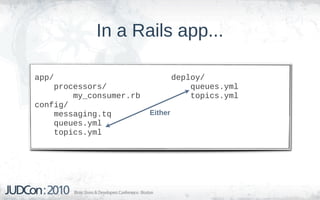
In a Rails app...

app/                              deploy/
    processors/                       queues.yml
        my_consumer.rb                topics.yml
config/
    messaging.tq         Either
    queues.yml
    topics.yml
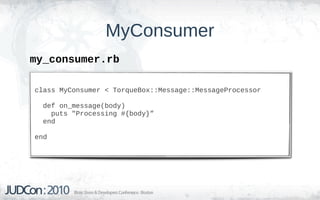
MyConsumer
my_consumer.rb

class MyConsumer < TorqueBox::Message::MessageProcessor

  def on_message(body)
    puts "Processing #{body}”
  end

end
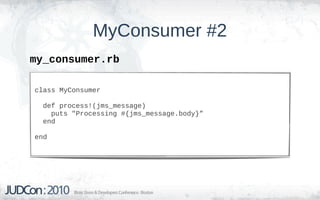
MyConsumer #2
my_consumer.rb

class MyConsumer

  def process!(jms_message)
    puts "Processing #{jms_message.body}”
  end

end
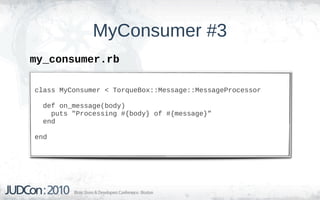
MyConsumer #3
my_consumer.rb

class MyConsumer < TorqueBox::Message::MessageProcessor

  def on_message(body)
    puts "Processing #{body} of #{message}”
  end

end
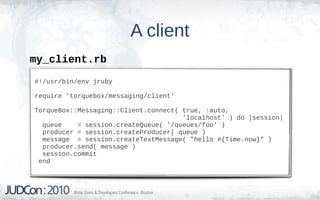
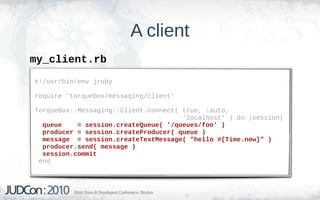
A client
my_client.rb
#!/usr/bin/env jruby

require 'torquebox/messaging/client'

TorqueBox::Messaging::Client.connect( true, :auto,
                                      'localhost' ) do |session|
  queue    = session.createQueue( '/queues/foo' )
  producer = session.createProducer( queue )
  message = session.createTextMessage( "hello #{Time.now}" )
  producer.send( message )
  session.commit
 end
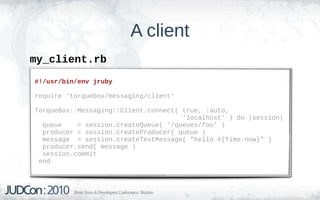
A client
my_client.rb
#!/usr/bin/env jruby

require 'torquebox/messaging/client'

TorqueBox::Messaging::Client.connect( true, :auto,
                                      'localhost' ) do |session|
  queue    = session.createQueue( '/queues/foo' )
  producer = session.createProducer( queue )
  message = session.createTextMessage( "hello #{Time.now}" )
  producer.send( message )
  session.commit
 end
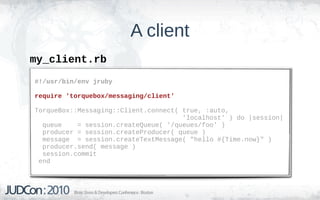
A client
my_client.rb
#!/usr/bin/env jruby

require 'torquebox/messaging/client'

TorqueBox::Messaging::Client.connect( true, :auto,
                                      'localhost' ) do |session|
  queue    = session.createQueue( '/queues/foo' )
  producer = session.createProducer( queue )
  message = session.createTextMessage( "hello #{Time.now}" )
  producer.send( message )
  session.commit
 end
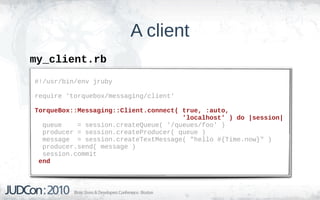
A client
my_client.rb
#!/usr/bin/env jruby

require 'torquebox/messaging/client'

TorqueBox::Messaging::Client.connect( true, :auto,
                                      'localhost' ) do |session|
  queue    = session.createQueue( '/queues/foo' )
  producer = session.createProducer( queue )
  message = session.createTextMessage( "hello #{Time.now}" )
  producer.send( message )
  session.commit
 end
A client
my_client.rb
#!/usr/bin/env jruby

require 'torquebox/messaging/client'

TorqueBox::Messaging::Client.connect( true, :auto,
                                      'localhost' ) do |session|
  queue    = session.createQueue( '/queues/foo' )
  producer = session.createProducer( queue )
  message = session.createTextMessage( "hello #{Time.now}" )
  producer.send( message )
  session.commit
 end
What if I just want a farm
of processors, not lots of
    full AS instances?
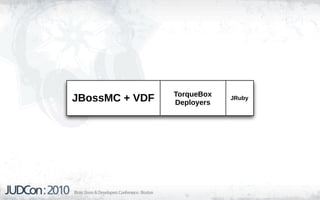
TorqueBox
JBossMC + VDF   Deployers
                            JRuby
Messaging outside of AS

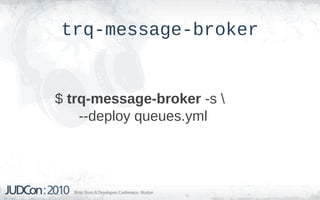
trq-message-broker
 • Ruby API for firing up HornetQ

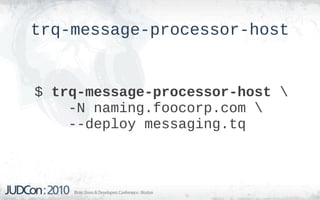
trq-message-processor-host
 • Container for processors.
trq-message-broker


$ trq-message-broker -s 
    --deploy queues.yml
trq-message-processor-host


$ trq-message-processor-host 
    -N naming.foocorp.com 
    --deploy messaging.tq
What’s going on?
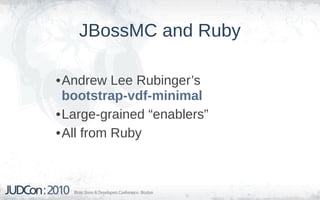
JBossMC and Ruby

•Andrew Lee Rubinger’s
 bootstrap-vdf-minimal
•Large-grained “enablers”
•All from Ruby
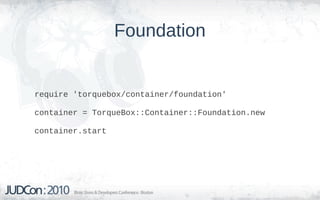
Foundation


require 'torquebox/container/foundation'

container = TorqueBox::Container::Foundation.new

container.start
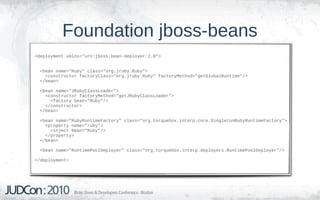
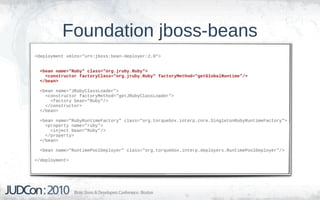
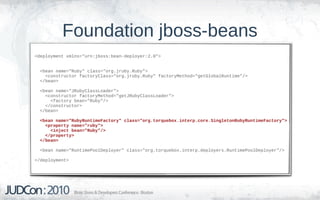
Foundation jboss-beans
<deployment xmlns="urn:jboss:bean-deployer:2.0">


  <bean name="Ruby" class="org.jruby.Ruby">
    <constructor factoryClass="org.jruby.Ruby" factoryMethod="getGlobalRuntime"/>
  </bean>

  <bean name="JRubyClassLoader">
    <constructor factoryMethod="getJRubyClassLoader">
      <factory bean="Ruby"/>
    </constructor>
  </bean>

  <bean name="RubyRuntimeFactory" class="org.torquebox.interp.core.SingletonRubyRuntimeFactory">
    <property name="ruby">
      <inject bean="Ruby"/>
    </property>
  </bean>

  <bean name="RuntimePoolDeployer" class="org.torquebox.interp.deployers.RuntimePoolDeployer"/>

</deployment>
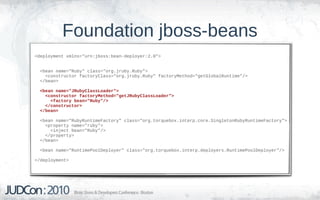
Foundation jboss-beans
<deployment xmlns="urn:jboss:bean-deployer:2.0">


  <bean name="Ruby" class="org.jruby.Ruby">
    <constructor factoryClass="org.jruby.Ruby" factoryMethod="getGlobalRuntime"/>
  </bean>

  <bean name="JRubyClassLoader">
    <constructor factoryMethod="getJRubyClassLoader">
      <factory bean="Ruby"/>
    </constructor>
  </bean>

  <bean name="RubyRuntimeFactory" class="org.torquebox.interp.core.SingletonRubyRuntimeFactory">
    <property name="ruby">
      <inject bean="Ruby"/>
    </property>
  </bean>

  <bean name="RuntimePoolDeployer" class="org.torquebox.interp.deployers.RuntimePoolDeployer"/>

</deployment>
Foundation jboss-beans
<deployment xmlns="urn:jboss:bean-deployer:2.0">


  <bean name="Ruby" class="org.jruby.Ruby">
    <constructor factoryClass="org.jruby.Ruby" factoryMethod="getGlobalRuntime"/>
  </bean>

  <bean name="JRubyClassLoader">
    <constructor factoryMethod="getJRubyClassLoader">
      <factory bean="Ruby"/>
    </constructor>
  </bean>

  <bean name="RubyRuntimeFactory" class="org.torquebox.interp.core.SingletonRubyRuntimeFactory">
    <property name="ruby">
      <inject bean="Ruby"/>
    </property>
  </bean>

  <bean name="RuntimePoolDeployer" class="org.torquebox.interp.deployers.RuntimePoolDeployer"/>

</deployment>
Foundation jboss-beans
<deployment xmlns="urn:jboss:bean-deployer:2.0">


  <bean name="Ruby" class="org.jruby.Ruby">
    <constructor factoryClass="org.jruby.Ruby" factoryMethod="getGlobalRuntime"/>
  </bean>

  <bean name="JRubyClassLoader">
    <constructor factoryMethod="getJRubyClassLoader">
      <factory bean="Ruby"/>
    </constructor>
  </bean>

  <bean name="RubyRuntimeFactory" class="org.torquebox.interp.core.SingletonRubyRuntimeFactory">
    <property name="ruby">
      <inject bean="Ruby"/>
    </property>
  </bean>

  <bean name="RuntimePoolDeployer" class="org.torquebox.interp.deployers.RuntimePoolDeployer"/>

</deployment>
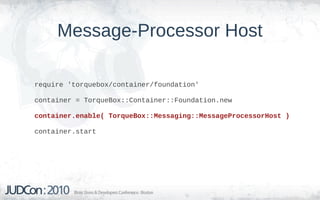
Message-Processor Host

require 'torquebox/container/foundation'

container = TorqueBox::Container::Foundation.new

container.enable( TorqueBox::Messaging::MessageProcessorHost )

container.start
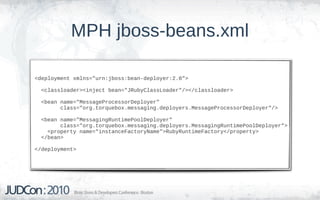
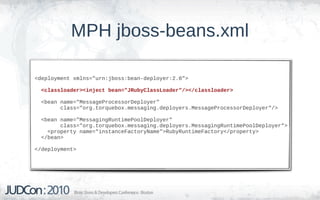
MPH jboss-beans.xml

<deployment xmlns="urn:jboss:bean-deployer:2.0">

  <classloader><inject bean="JRubyClassLoader"/></classloader>

  <bean name="MessageProcessorDeployer"
        class="org.torquebox.messaging.deployers.MessageProcessorDeployer"/>

  <bean name="MessagingRuntimePoolDeployer"
        class="org.torquebox.messaging.deployers.MessagingRuntimePoolDeployer">
    <property name="instanceFactoryName">RubyRuntimeFactory</property>
  </bean>

</deployment>
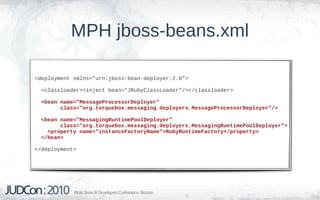
MPH jboss-beans.xml

<deployment xmlns="urn:jboss:bean-deployer:2.0">

  <classloader><inject bean="JRubyClassLoader"/></classloader>

  <bean name="MessageProcessorDeployer"
        class="org.torquebox.messaging.deployers.MessageProcessorDeployer"/>

  <bean name="MessagingRuntimePoolDeployer"
        class="org.torquebox.messaging.deployers.MessagingRuntimePoolDeployer">
    <property name="instanceFactoryName">RubyRuntimeFactory</property>
  </bean>

</deployment>
MPH jboss-beans.xml

<deployment xmlns="urn:jboss:bean-deployer:2.0">

  <classloader><inject bean="JRubyClassLoader"/></classloader>

  <bean name="MessageProcessorDeployer"
        class="org.torquebox.messaging.deployers.MessageProcessorDeployer"/>

  <bean name="MessagingRuntimePoolDeployer"
        class="org.torquebox.messaging.deployers.MessagingRuntimePoolDeployer">
    <property name="instanceFactoryName">RubyRuntimeFactory</property>
  </bean>

</deployment>
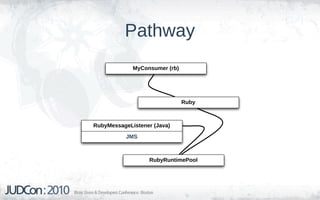
Pathway
             MyConsumer (rb)


                               Ruby


RubyMessageListener (Java)
           JMS


                  RubyRuntimePool
Naming


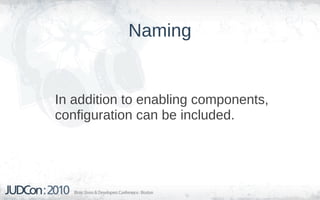
A lot of things require JNDI.
Naming


In addition to enabling components,
configuration can be included.
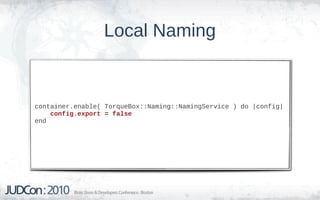
Local Naming


container.enable( TorqueBox::Naming::NamingService ) do |config|
    config.export = false
end
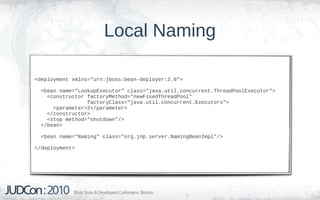
Local Naming

<deployment xmlns="urn:jboss:bean-deployer:2.0">

  <bean name="LookupExecutor" class="java.util.concurrent.ThreadPoolExecutor">
    <constructor factoryMethod="newFixedThreadPool"
                 factoryClass="java.util.concurrent.Executors">
      <parameter>2</parameter>
    </constructor>
    <stop method="shutdown"/>
  </bean>

  <bean name="Naming" class="org.jnp.server.NamingBeanImpl"/>

</deployment>
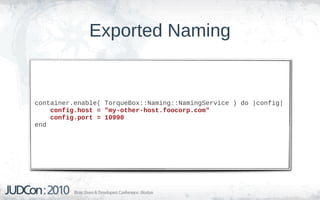
Exported Naming


container.enable( TorqueBox::Naming::NamingService ) do |config|
    config.host = "my-other-host.foocorp.com"
    config.port = 10990
end
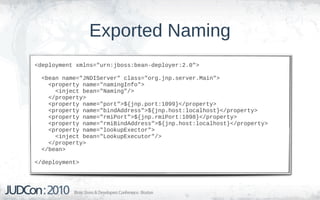
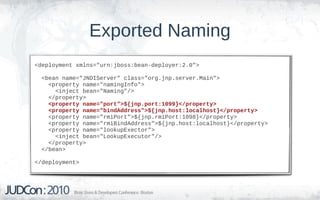
Exported Naming
<deployment xmlns="urn:jboss:bean-deployer:2.0">

  <bean name="JNDIServer" class="org.jnp.server.Main">
    <property name="namingInfo">
      <inject bean="Naming"/>
    </property>
    <property name="port">${jnp.port:1099}</property>
    <property name="bindAddress">${jnp.host:localhost}</property>
    <property name="rmiPort">${jnp.rmiPort:1098}</property>
    <property name="rmiBindAddress">${jnp.host:localhost}</property>
    <property name="lookupExector">
      <inject bean="LookupExecutor"/>
    </property>
  </bean>

</deployment>
Exported Naming
<deployment xmlns="urn:jboss:bean-deployer:2.0">

  <bean name="JNDIServer" class="org.jnp.server.Main">
    <property name="namingInfo">
      <inject bean="Naming"/>
    </property>
    <property name="port">${jnp.port:1099}</property>
    <property name="bindAddress">${jnp.host:localhost}</property>
    <property name="rmiPort">${jnp.rmiPort:1098}</property>
    <property name="rmiBindAddress">${jnp.host:localhost}</property>
    <property name="lookupExector">
      <inject bean="LookupExecutor"/>
    </property>
  </bean>

</deployment>
VDF bootstrap allows for
TorqueBox bits to be used
  in other environments.
Allows us to boot up an
absolute minimal AS,
     in 1 second.
The same code paths as AS.
JBoss VFS
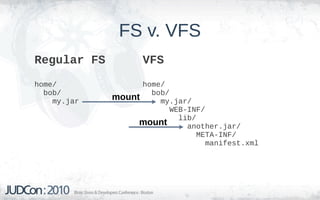
FS v. VFS
Regular FS          VFS
home/              home/
  bob/               bob/
    my.jar   mount     my.jar/
                          WEB-INF/
                            lib/
                  mount       another.jar/
                                 META-INF/
                                   manifest.xml
Why do we like VFS?
Because there’s more
than just the filesystem
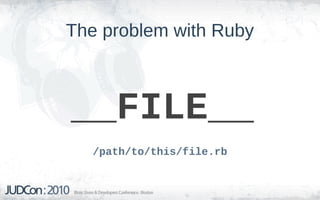
The problem with Ruby


__FILE__
   /path/to/this/file.rb
For Instance...


Dir[ "#{File.dirname(__FILE__)}/*.xml" ]
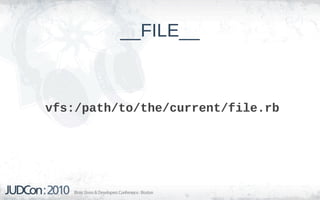
__FILE__


vfs:/path/to/the/current/file.rb
Making Ruby VFS-aware

Kernel
  open( "vfs:/path/to/some.jar/some/content.txt" )

Dir
  Dir[ "vfs:/path/to/some.jar/some/*.txt" ]

File
  File.exist?( "vfs:/path/to/some.jar/some/content.txt" )
  File.read( "vfs:/path/to/some.jar/some/content.txt" )
Now Ruby doesn’t care that
your filesystem is actually VFS.
Bundles


We want Ruby to be happy with
VFS for when you deploy bundles
and hope to farm.
But not warbling


Warbler builds a “normal” JavaEE .war.
So, why bother?
Threading


Unlike C-Ruby, supports
real threading.
Management


RHQ/JON, stuff you're used to.
Integration


HornetQ, Quartz, etc, already
available to your apps.
Gotchas
Native gems


Native gems are not supported,
except FFI.
Threading


While TorqueBox gives you
real threads, many existing
Ruby libraries suck.
Thanks!
Q&A
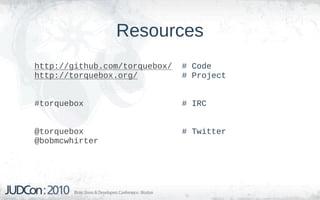
Resources
http://github.com/torquebox/   # Code
http://torquebox.org/          # Project


#torquebox                     # IRC


@torquebox                     # Twitter
@bobmcwhirter

JUDCon 2010 Boston : TorqueBox