History of Judaism
ORIGINS
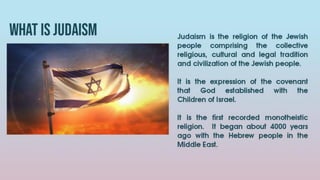
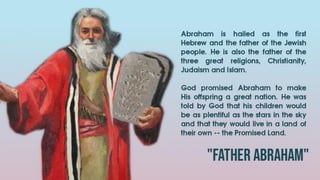
• Judaism originates nearly 4,000 years ago in the Middle East with a couple
named Abraham and Sarah, whom G-d selected to start a new people, the
chosen nation.
• G-d commanded them to relocate to a new land (which would eventually
become the Land of Israel) that He would show them
• As recorded in the Book of Genesis, G-d Himself attests that “I have known
[Abraham] because he commands his children and his household after him,
that they should keep the way of the L-rd to perform righteousness and justice,
in order that the L-rd bring upon Abraham that which He spoke concerning
him.”
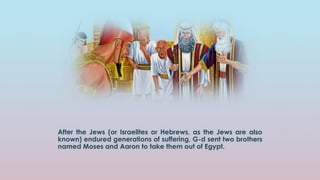
After the Jews (or Israelites or Hebrews, as the Jews are also
known) endured generations of suffering, G-d sent two brothers
named Moses and Aaron to take them out of Egypt.
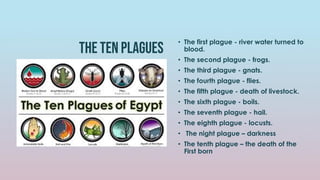
The ten plagues
• The first plague - river water turned to
blood.
• The second plague - frogs.
• The third plague - gnats.
• The fourth plague - flies.
• The fifth plague - death of livestock.
• The sixth plague - boils.
• The seventh plague - hail.
• The eighth plague - locusts.
• The night plague – darkness
• The tenth plague – the death of the
First born
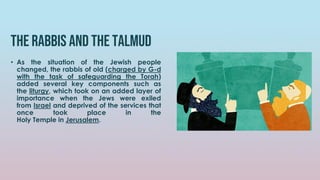
The rabbis and the talmud
• As the situation of the Jewish people
changed, the rabbis of old (charged by G-d
with the task of safeguarding the Torah)
added several key components such as
the liturgy, which took on an added layer of
importance when the Jews were exiled
from Israel and deprived of the services that
once took place in the
Holy Temple in Jerusalem.
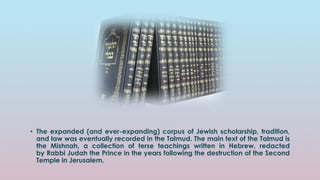
• The expanded (and ever-expanding) corpus of Jewish scholarship, tradition,
and law was eventually recorded in the Talmud. The main text of the Talmud is
the Mishnah, a collection of terse teachings written in Hebrew, redacted
by Rabbi Judah the Prince in the years following the destruction of the Second
Temple in Jerusalem.
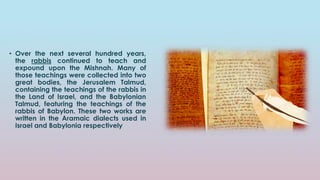
• Over the next several hundred years,
the rabbis continued to teach and
expound upon the Mishnah. Many of
those teachings were collected into two
great bodies, the Jerusalem Talmud,
containing the teachings of the rabbis in
the Land of Israel, and the Babylonian
Talmud, featuring the teachings of the
rabbis of Babylon. These two works are
written in the Aramaic dialects used in
Israel and Babylonia respectively
JEWS AND JUDAISM
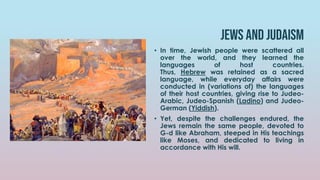
• In time, Jewish people were scattered all
over the world, and they learned the
languages of host countries.
Thus, Hebrew was retained as a sacred
language, while everyday affairs were
conducted in (variations of) the languages
of their host countries, giving rise to Judeo-
Arabic, Judeo-Spanish (Ladino) and Judeo-
German (Yiddish).
• Yet, despite the challenges endured, the
Jews remain the same people, devoted to
G-d like Abraham, steeped in His teachings
like Moses, and dedicated to living in
accordance with His will.
Jesus and the jews
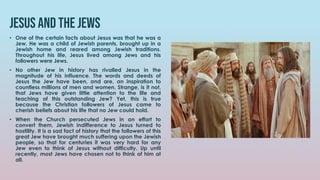
• One of the certain facts about Jesus was that he was a
Jew. He was a child of Jewish parents, brought up in a
Jewish home and reared among Jewish traditions.
Throughout his life, Jesus lived among Jews and his
followers were Jews.
• No other Jew in history has rivalled Jesus in the
magnitude of his influence. The words and deeds of
Jesus the Jew have been, and are, an inspiration to
countless millions of men and women. Strange, is it not,
that Jews have given little attention to the life and
teaching of this outstanding Jew? Yet, this is true
because the Christian followers of Jesus came to
cherish beliefs about his life that no Jew could hold.
• When the Church persecuted Jews in an effort to
convert them, Jewish indifference to Jesus turned to
hostility. It is a sad fact of history that the followers of this
great Jew have brought much suffering upon the Jewish
people, so that for centuries it was very hard for any
Jew even to think of Jesus without difficulty. Up until
recently, most Jews have chosen not to think of him at
all.
Jesus and the jews
• Now we are witnessing a significant change and although Jewish indifference to Jesus has
not by any means disappeared, the signs are encouraging.
• Jesus and his family would have been observant of Torah, paid tithes, kept the Sabbath,
circumcised their males, attended synagogue, observed purity laws in relation to childbirth
and menstruation, kept the dietary code - one could go on. While the Gospels record
disputes about Jesus' interpretation of a few of these, the notion of a Christian Jesus, who did
not live by Torah or only by its ethical values, does not fit historical reality.
• There is no official Jewish view of Jesus but in one respect Jews are agreed in their attitude
towards Jesus. Jews reject the tremendous claim, which is made for Jesus by his Christian
followers - that Jesus is the Lord Christ, God Incarnate, the very Son of God the Father. On that
belief, Jews and Christians must continue to respectfully differ. Jews believe that all share the
divine spirit and are stamped with the divine image and no person - not even the greatest of
all
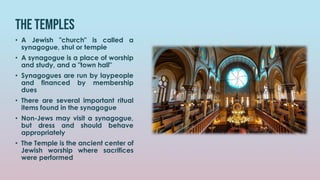
The temples
• A Jewish "church" is called a
synagogue, shul or temple
• A synagogue is a place of worship
and study, and a "town hall"
• Synagogues are run by laypeople
and financed by membership
dues
• There are several important ritual
items found in the synagogue
• Non-Jews may visit a synagogue,
but dress and should behave
appropriately
• The Temple is the ancient center of
Jewish worship where sacrifices
were performed
The temples
• Around 1000 B.C., King David ruled the Jewish people. His son Solomon built the first holy
Temple in Jerusalem, which became the central place of worship for Jews.
• The kingdom fell apart around 931 B.C., and the Jewish people split into two groups:
Israel in the North and Judah in the South.
• Sometime around 587 B.C., the Babylonians destroyed the first Temple and sent many
Jews into exile.
• A second Temple was built in about 516 B.C. but was eventually destroyed by the
Romans in 70 A.D.
• The destruction of the second Temple was significant because Jewish people no longer
had a primary place to gather, so they shifted their focus to worshipping in local
synagogues.
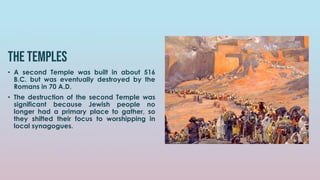
The temples
• A second Temple was built in about 516
B.C. but was eventually destroyed by the
Romans in 70 A.D.
• The destruction of the second Temple was
significant because Jewish people no
longer had a primary place to gather, so
they shifted their focus to worshipping in
local synagogues.
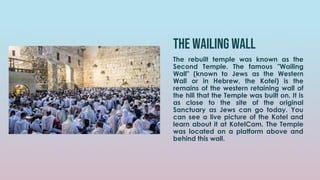
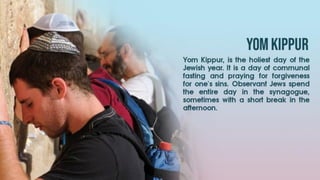
The wailing wall
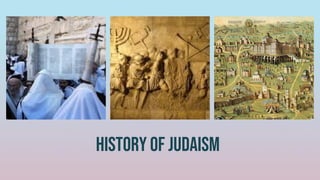
The rebuilt temple was known as the
Second Temple. The famous "Wailing
Wall" (known to Jews as the Western
Wall or in Hebrew, the Kotel) is the
remains of the western retaining wall of
the hill that the Temple was built on. It is
as close to the site of the original
Sanctuary as Jews can go today. You
can see a live picture of the Kotel and
learn about it at KotelCam. The Temple
was located on a platform above and
behind this wall.
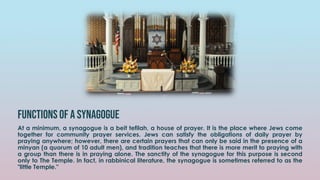
Functions of a Synagogue
At a minimum, a synagogue is a beit tefilah, a house of prayer. It is the place where Jews come
together for community prayer services. Jews can satisfy the obligations of daily prayer by
praying anywhere; however, there are certain prayers that can only be said in the presence of a
minyan (a quorum of 10 adult men), and tradition teaches that there is more merit to praying with
a group than there is in praying alone. The sanctity of the synagogue for this purpose is second
only to The Temple. In fact, in rabbinical literature, the synagogue is sometimes referred to as the
"little Temple."
Function of a synagogue
• A synagogue is usually also a beit midrash, a house of study. Contrary to popular belief,
Jewish education does not end at the age of bar mitzvah. For the observant Jew, the
study of sacred texts is a life-long task. Thus, a synagogue normally has a well-stocked
library of sacred Jewish texts for members of the community to study. It is also the place
where children receive their basic religious education.
• Most synagogues also have a social hall for religious and non-religious activities. The
synagogue often functions as a sort of town hall where matters of importance to the
community can be discussed.
• In addition, the synagogue functions as a social welfare agency, collecting and
dispensing money and other items for the aid of the poor and needy within the
community
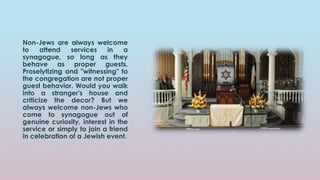
Non-Jews are always welcome
to attend services in a
synagogue, so long as they
behave as proper guests.
Proselytizing and "witnessing" to
the congregation are not proper
guest behavior. Would you walk
into a stranger's house and
criticize the decor? But we
always welcome non-Jews who
come to synagogue out of
genuine curiosity, interest in the
service or simply to join a friend
in celebration of a Jewish event.
Judaism now
• Today, there are about 14 million
Jews worldwide. Most of them live in
the United States and Israel.
Traditionally, a person is considered
Jewish if his or her mother is Jewish.
• Today the ministry of Jesus is seen
rather as a movement within
Judaism rather than as something
opposed to it. At the same time
people have begun to understand
how complex and still developing a
phenomenon first-century Judaism
was.
Judaism now
• The results of the 2013 Pew survey indicate that 39 percent of the members of
Conservative synagogues and 60 percent of Reform temple members will
next show up at services on Sept. 29, 2019, the first day of Rosh Hashanah
5780
• Jack Wertheimer, a professor of American Jewish history at the Jewish
Theological Seminary Jack Wertheimer, “The New American Judaism: How
Jews Practice Their Religion Today”which states “:
• Most Jews have little Jewish education and can read little or no Hebrew. On
a deeper level, in an age of self-help and self-actualization, most Jews don’t
believe in mitzvot as obligations or a God of “Thou Shalts and Thou Shalt
Nots.”
Judaism now
• Reform Judaism, Wertheimer shows, is now the largest of the streams, having
taken advantage of its being unbound by Jewish law. It has embraced popular
liberal trends like social action, care for the environment and the welcoming of
members of LGBT and interfaith families. But the author wonders how long the
movement can sustain itself by championing autonomy without requiring any
imperatives.
• Conservative Judaism in the last two decades has seen a precipitous decline in
its membership, number of congregations and Solomon Schechter day schools.
Seeking to balance modernity and tradition, the movement has lost some
members to Orthodoxy and more to Reform, and its organizational structure has
had financial woes. On the positive side, though, Wertheimer notes that the
remaining synagogue members are becoming more active and that there is
more creativity in services, with more joyful music and congregational
participation.
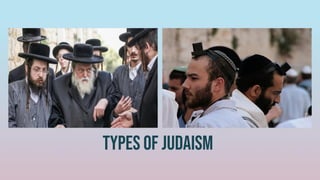
types of Judaism
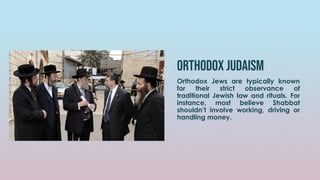
Orthodox judaism
Orthodox Jews are typically known
for their strict observance of
traditional Jewish law and rituals. For
instance, most believe Shabbat
shouldn’t involve working, driving or
handling money.
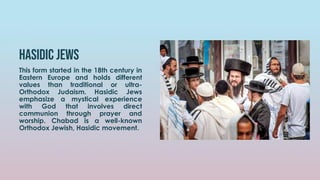
Hasidic jews
This form started in the 18th century in
Eastern Europe and holds different
values than traditional or ultra-
Orthodox Judaism. Hasidic Jews
emphasize a mystical experience
with God that involves direct
communion through prayer and
worship. Chabad is a well-known
Orthodox Jewish, Hasidic movement.
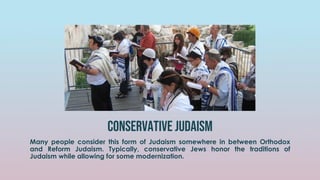
conservative judaism
Many people consider this form of Judaism somewhere in between Orthodox
and Reform Judaism. Typically, conservative Jews honor the traditions of
Judaism while allowing for some modernization.
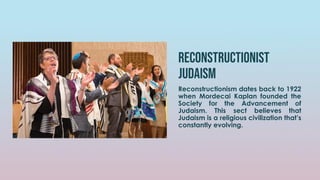
Reconstructionist
judaism
Reconstructionism dates back to 1922
when Mordecai Kaplan founded the
Society for the Advancement of
Judaism. This sect believes that
Judaism is a religious civilization that’s
constantly evolving.
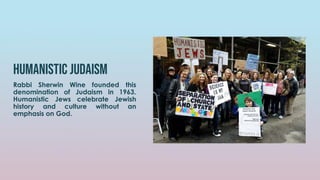
humanistic judaism
Rabbi Sherwin Wine founded this
denomination of Judaism in 1963.
Humanistic Jews celebrate Jewish
history and culture without an
emphasis on God.
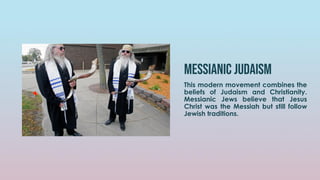
messianic judaism
This modern movement combines the
beliefs of Judaism and Christianity.
Messianic Jews believe that Jesus
Christ was the Messiah but still follow
Jewish traditions.
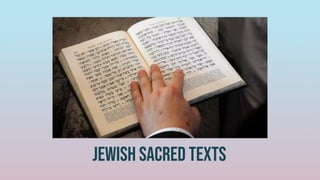
Jewish sacred texts
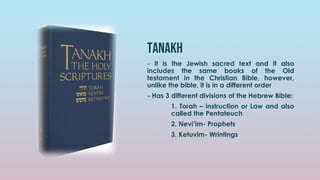
tanakh
- it is the Jewish sacred text and it also
includes the same books of the Old
testament in the Christian Bible, however,
unlike the bible, it is in a different order
- Has 3 different divisions of the Hebrew Bible:
1. Torah – instruction or Law and also
called the Pentateuch
2. Nevi’im- Prophets
3. Ketuvim- Wrintings
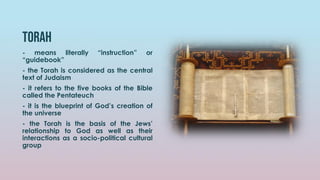
torah
- means literally “instruction” or
“guidebook”
- the Torah is considered as the central
text of Judaism
- it refers to the five books of the Bible
called the Pentateuch
- it is the blueprint of God’s creation of
the universe
- the Torah is the basis of the Jews’
relationship to God as well as their
interactions as a socio-political cultural
group
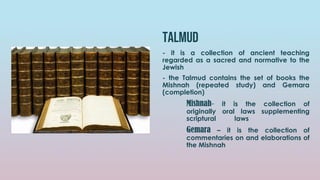
talmud
- it is a collection of ancient teaching
regarded as a sacred and normative to the
Jewish
- the Talmud contains the set of books the
Mishnah (repeated study) and Gemara
(completion)
Mishnah- it is the collection of
originally oral laws supplementing
scriptural laws
Gemara – it is the collection of
commentaries on and elaborations of
the Mishnah
1. He is the Father of Judaism
A. Jesus
B. Abraham
C. Gerard
D. Ezekiel
2. The set of dietary laws dealing with the
foods that Jews are permitted to eat
A. Kashrut
B. Halal
C. T’Challa
D. Hashir
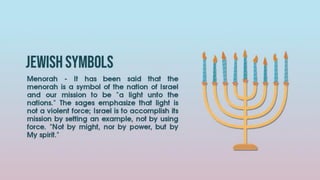
3. It symbolizes the mission of Israel to
be the light among the nations
A. Blaze
B. Phoenix
C. Star of David
D. Menorah
4. a Jewish scholar or teacher, especially
one who studies or teaches Jewish law
A. McGonagall
B. Pedagogue
C. Rabbi
D. Gemara
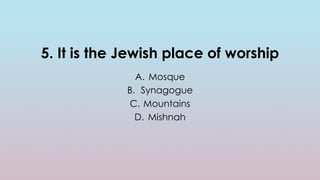
5. It is the Jewish place of worship
A. Mosque
B. Synagogue
C. Mountains
D. Mishnah
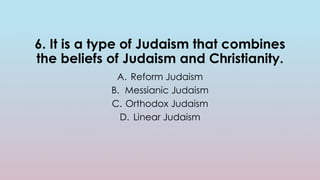
6. It is a type of Judaism that combines
the beliefs of Judaism and Christianity.
A. Reform Judaism
B. Messianic Judaism
C. Orthodox Judaism
D. Linear Judaism
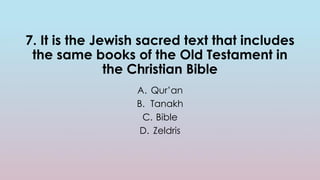
7. It is the Jewish sacred text that includes
the same books of the Old Testament in
the Christian Bible
A. Qur’an
B. Tanakh
C. Bible
D. Zeldris
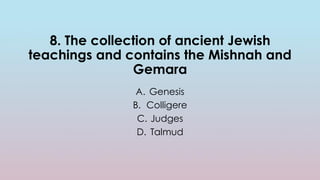
8. The collection of ancient Jewish
teachings and contains the Mishnah and
Gemara
A. Genesis
B. Colligere
C. Judges
D. Talmud
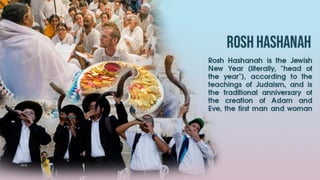
9. It is the Jewish New Year
A. Rosh Hashanah
B. Yom Kippur
C. Passover
D. Bar Mitzvah
10. It is considered as the day of
Atonement which Jews repent their sins
and ask for forgiveness
A. Rosh Hashanah
B. Yom Kippur
C. Passover
D. Bar Mitzvah
Answers
1) B
2) A
3) D
4) C
5) B
6) B
7) B
8) D
9) A
10)B

JUDAISM POWERPOINT PRESENTATION - THEOLOGY

  • 16.
  • 17.
    ORIGINS • Judaism originatesnearly 4,000 years ago in the Middle East with a couple named Abraham and Sarah, whom G-d selected to start a new people, the chosen nation. • G-d commanded them to relocate to a new land (which would eventually become the Land of Israel) that He would show them • As recorded in the Book of Genesis, G-d Himself attests that “I have known [Abraham] because he commands his children and his household after him, that they should keep the way of the L-rd to perform righteousness and justice, in order that the L-rd bring upon Abraham that which He spoke concerning him.”
  • 18.
    After the Jews(or Israelites or Hebrews, as the Jews are also known) endured generations of suffering, G-d sent two brothers named Moses and Aaron to take them out of Egypt.
  • 19.
    The ten plagues •The first plague - river water turned to blood. • The second plague - frogs. • The third plague - gnats. • The fourth plague - flies. • The fifth plague - death of livestock. • The sixth plague - boils. • The seventh plague - hail. • The eighth plague - locusts. • The night plague – darkness • The tenth plague – the death of the First born
  • 20.
    The rabbis andthe talmud • As the situation of the Jewish people changed, the rabbis of old (charged by G-d with the task of safeguarding the Torah) added several key components such as the liturgy, which took on an added layer of importance when the Jews were exiled from Israel and deprived of the services that once took place in the Holy Temple in Jerusalem.
  • 21.
    • The expanded(and ever-expanding) corpus of Jewish scholarship, tradition, and law was eventually recorded in the Talmud. The main text of the Talmud is the Mishnah, a collection of terse teachings written in Hebrew, redacted by Rabbi Judah the Prince in the years following the destruction of the Second Temple in Jerusalem.
  • 22.
    • Over thenext several hundred years, the rabbis continued to teach and expound upon the Mishnah. Many of those teachings were collected into two great bodies, the Jerusalem Talmud, containing the teachings of the rabbis in the Land of Israel, and the Babylonian Talmud, featuring the teachings of the rabbis of Babylon. These two works are written in the Aramaic dialects used in Israel and Babylonia respectively
  • 23.
    JEWS AND JUDAISM •In time, Jewish people were scattered all over the world, and they learned the languages of host countries. Thus, Hebrew was retained as a sacred language, while everyday affairs were conducted in (variations of) the languages of their host countries, giving rise to Judeo- Arabic, Judeo-Spanish (Ladino) and Judeo- German (Yiddish). • Yet, despite the challenges endured, the Jews remain the same people, devoted to G-d like Abraham, steeped in His teachings like Moses, and dedicated to living in accordance with His will.
  • 24.
    Jesus and thejews • One of the certain facts about Jesus was that he was a Jew. He was a child of Jewish parents, brought up in a Jewish home and reared among Jewish traditions. Throughout his life, Jesus lived among Jews and his followers were Jews. • No other Jew in history has rivalled Jesus in the magnitude of his influence. The words and deeds of Jesus the Jew have been, and are, an inspiration to countless millions of men and women. Strange, is it not, that Jews have given little attention to the life and teaching of this outstanding Jew? Yet, this is true because the Christian followers of Jesus came to cherish beliefs about his life that no Jew could hold. • When the Church persecuted Jews in an effort to convert them, Jewish indifference to Jesus turned to hostility. It is a sad fact of history that the followers of this great Jew have brought much suffering upon the Jewish people, so that for centuries it was very hard for any Jew even to think of Jesus without difficulty. Up until recently, most Jews have chosen not to think of him at all.
  • 25.
    Jesus and thejews • Now we are witnessing a significant change and although Jewish indifference to Jesus has not by any means disappeared, the signs are encouraging. • Jesus and his family would have been observant of Torah, paid tithes, kept the Sabbath, circumcised their males, attended synagogue, observed purity laws in relation to childbirth and menstruation, kept the dietary code - one could go on. While the Gospels record disputes about Jesus' interpretation of a few of these, the notion of a Christian Jesus, who did not live by Torah or only by its ethical values, does not fit historical reality. • There is no official Jewish view of Jesus but in one respect Jews are agreed in their attitude towards Jesus. Jews reject the tremendous claim, which is made for Jesus by his Christian followers - that Jesus is the Lord Christ, God Incarnate, the very Son of God the Father. On that belief, Jews and Christians must continue to respectfully differ. Jews believe that all share the divine spirit and are stamped with the divine image and no person - not even the greatest of all
  • 26.
    The temples • AJewish "church" is called a synagogue, shul or temple • A synagogue is a place of worship and study, and a "town hall" • Synagogues are run by laypeople and financed by membership dues • There are several important ritual items found in the synagogue • Non-Jews may visit a synagogue, but dress and should behave appropriately • The Temple is the ancient center of Jewish worship where sacrifices were performed
  • 27.
    The temples • Around1000 B.C., King David ruled the Jewish people. His son Solomon built the first holy Temple in Jerusalem, which became the central place of worship for Jews. • The kingdom fell apart around 931 B.C., and the Jewish people split into two groups: Israel in the North and Judah in the South. • Sometime around 587 B.C., the Babylonians destroyed the first Temple and sent many Jews into exile. • A second Temple was built in about 516 B.C. but was eventually destroyed by the Romans in 70 A.D. • The destruction of the second Temple was significant because Jewish people no longer had a primary place to gather, so they shifted their focus to worshipping in local synagogues.
  • 28.
    The temples • Asecond Temple was built in about 516 B.C. but was eventually destroyed by the Romans in 70 A.D. • The destruction of the second Temple was significant because Jewish people no longer had a primary place to gather, so they shifted their focus to worshipping in local synagogues.
  • 29.
    The wailing wall Therebuilt temple was known as the Second Temple. The famous "Wailing Wall" (known to Jews as the Western Wall or in Hebrew, the Kotel) is the remains of the western retaining wall of the hill that the Temple was built on. It is as close to the site of the original Sanctuary as Jews can go today. You can see a live picture of the Kotel and learn about it at KotelCam. The Temple was located on a platform above and behind this wall.
  • 30.
    Functions of aSynagogue At a minimum, a synagogue is a beit tefilah, a house of prayer. It is the place where Jews come together for community prayer services. Jews can satisfy the obligations of daily prayer by praying anywhere; however, there are certain prayers that can only be said in the presence of a minyan (a quorum of 10 adult men), and tradition teaches that there is more merit to praying with a group than there is in praying alone. The sanctity of the synagogue for this purpose is second only to The Temple. In fact, in rabbinical literature, the synagogue is sometimes referred to as the "little Temple."
  • 31.
    Function of asynagogue • A synagogue is usually also a beit midrash, a house of study. Contrary to popular belief, Jewish education does not end at the age of bar mitzvah. For the observant Jew, the study of sacred texts is a life-long task. Thus, a synagogue normally has a well-stocked library of sacred Jewish texts for members of the community to study. It is also the place where children receive their basic religious education. • Most synagogues also have a social hall for religious and non-religious activities. The synagogue often functions as a sort of town hall where matters of importance to the community can be discussed. • In addition, the synagogue functions as a social welfare agency, collecting and dispensing money and other items for the aid of the poor and needy within the community
  • 32.
    Non-Jews are alwayswelcome to attend services in a synagogue, so long as they behave as proper guests. Proselytizing and "witnessing" to the congregation are not proper guest behavior. Would you walk into a stranger's house and criticize the decor? But we always welcome non-Jews who come to synagogue out of genuine curiosity, interest in the service or simply to join a friend in celebration of a Jewish event.
  • 33.
    Judaism now • Today,there are about 14 million Jews worldwide. Most of them live in the United States and Israel. Traditionally, a person is considered Jewish if his or her mother is Jewish. • Today the ministry of Jesus is seen rather as a movement within Judaism rather than as something opposed to it. At the same time people have begun to understand how complex and still developing a phenomenon first-century Judaism was.
  • 34.
    Judaism now • Theresults of the 2013 Pew survey indicate that 39 percent of the members of Conservative synagogues and 60 percent of Reform temple members will next show up at services on Sept. 29, 2019, the first day of Rosh Hashanah 5780 • Jack Wertheimer, a professor of American Jewish history at the Jewish Theological Seminary Jack Wertheimer, “The New American Judaism: How Jews Practice Their Religion Today”which states “: • Most Jews have little Jewish education and can read little or no Hebrew. On a deeper level, in an age of self-help and self-actualization, most Jews don’t believe in mitzvot as obligations or a God of “Thou Shalts and Thou Shalt Nots.”
  • 35.
    Judaism now • ReformJudaism, Wertheimer shows, is now the largest of the streams, having taken advantage of its being unbound by Jewish law. It has embraced popular liberal trends like social action, care for the environment and the welcoming of members of LGBT and interfaith families. But the author wonders how long the movement can sustain itself by championing autonomy without requiring any imperatives. • Conservative Judaism in the last two decades has seen a precipitous decline in its membership, number of congregations and Solomon Schechter day schools. Seeking to balance modernity and tradition, the movement has lost some members to Orthodoxy and more to Reform, and its organizational structure has had financial woes. On the positive side, though, Wertheimer notes that the remaining synagogue members are becoming more active and that there is more creativity in services, with more joyful music and congregational participation.
  • 36.
  • 37.
    Orthodox judaism Orthodox Jewsare typically known for their strict observance of traditional Jewish law and rituals. For instance, most believe Shabbat shouldn’t involve working, driving or handling money.
  • 38.
    Hasidic jews This formstarted in the 18th century in Eastern Europe and holds different values than traditional or ultra- Orthodox Judaism. Hasidic Jews emphasize a mystical experience with God that involves direct communion through prayer and worship. Chabad is a well-known Orthodox Jewish, Hasidic movement.
  • 39.
    conservative judaism Many peopleconsider this form of Judaism somewhere in between Orthodox and Reform Judaism. Typically, conservative Jews honor the traditions of Judaism while allowing for some modernization.
  • 40.
    Reconstructionist judaism Reconstructionism dates backto 1922 when Mordecai Kaplan founded the Society for the Advancement of Judaism. This sect believes that Judaism is a religious civilization that’s constantly evolving.
  • 41.
    humanistic judaism Rabbi SherwinWine founded this denomination of Judaism in 1963. Humanistic Jews celebrate Jewish history and culture without an emphasis on God.
  • 42.
    messianic judaism This modernmovement combines the beliefs of Judaism and Christianity. Messianic Jews believe that Jesus Christ was the Messiah but still follow Jewish traditions.
  • 43.
  • 44.
    tanakh - it isthe Jewish sacred text and it also includes the same books of the Old testament in the Christian Bible, however, unlike the bible, it is in a different order - Has 3 different divisions of the Hebrew Bible: 1. Torah – instruction or Law and also called the Pentateuch 2. Nevi’im- Prophets 3. Ketuvim- Wrintings
  • 45.
    torah - means literally“instruction” or “guidebook” - the Torah is considered as the central text of Judaism - it refers to the five books of the Bible called the Pentateuch - it is the blueprint of God’s creation of the universe - the Torah is the basis of the Jews’ relationship to God as well as their interactions as a socio-political cultural group
  • 46.
    talmud - it isa collection of ancient teaching regarded as a sacred and normative to the Jewish - the Talmud contains the set of books the Mishnah (repeated study) and Gemara (completion) Mishnah- it is the collection of originally oral laws supplementing scriptural laws Gemara – it is the collection of commentaries on and elaborations of the Mishnah
  • 53.
    1. He isthe Father of Judaism A. Jesus B. Abraham C. Gerard D. Ezekiel
  • 54.
    2. The setof dietary laws dealing with the foods that Jews are permitted to eat A. Kashrut B. Halal C. T’Challa D. Hashir
  • 55.
    3. It symbolizesthe mission of Israel to be the light among the nations A. Blaze B. Phoenix C. Star of David D. Menorah
  • 56.
    4. a Jewishscholar or teacher, especially one who studies or teaches Jewish law A. McGonagall B. Pedagogue C. Rabbi D. Gemara
  • 57.
    5. It isthe Jewish place of worship A. Mosque B. Synagogue C. Mountains D. Mishnah
  • 58.
    6. It isa type of Judaism that combines the beliefs of Judaism and Christianity. A. Reform Judaism B. Messianic Judaism C. Orthodox Judaism D. Linear Judaism
  • 59.
    7. It isthe Jewish sacred text that includes the same books of the Old Testament in the Christian Bible A. Qur’an B. Tanakh C. Bible D. Zeldris
  • 60.
    8. The collectionof ancient Jewish teachings and contains the Mishnah and Gemara A. Genesis B. Colligere C. Judges D. Talmud
  • 61.
    9. It isthe Jewish New Year A. Rosh Hashanah B. Yom Kippur C. Passover D. Bar Mitzvah
  • 62.
    10. It isconsidered as the day of Atonement which Jews repent their sins and ask for forgiveness A. Rosh Hashanah B. Yom Kippur C. Passover D. Bar Mitzvah
  • 64.
    Answers 1) B 2) A 3)D 4) C 5) B 6) B 7) B 8) D 9) A 10)B