JavaScript 1.8.5
New Features Explored
by Milan Adamovsky
http://milan.adamovsky.com ◆ http://www.hardcorejs.com
Friday, October 4, 13
What it is
• Culmination of good-to-haves
• Most features can be shimmed
• Supported by all mobile devices
• Supported by most modern browsers
• IE8 is still in heavy use (JavaScript 1.5)
Friday, October 4, 13
Remember
• Includes many features introduced since 1.5
• 1.6
• 1.7 features mainly supported in FireFox
• Use reference material for all versions
• Some features are deprecated
Friday, October 4, 13
What to know
• Array functions
• Object properties
• Still doesn’t have block scope
• Function features
• “use strict”
Friday, October 4, 13
Quick notes
• NaN, Infinity, and undefined immutable
• No trailing commas in JSON.parse()
• Supports “strict mode”
• apply() accepts array-like object
• Data properties are big
Friday, October 4, 13
Strings
Friday, October 4, 13
“”.trim()
• Introduced in 1.8.5
• Removes leading spaces
• Removes trailing spaces
• Works on strings
Friday, October 4, 13
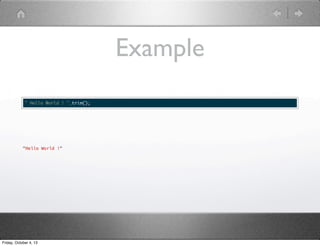
Example
" Hello World ! ".trim();
"Hello World !"
Friday, October 4, 13
Arrays
Friday, October 4, 13
[].map(fn, this)
• Introduced in 1.6
• Does not mutate array
• Works only on indexes with values
• Executes fn on each item in array
• Modify an array’s items without a loop
Friday, October 4, 13
Example
function resolve(item)
{
return $(item);
}
var selectors = ["body", "#hello"].map(resolve);
console.log(selectors);
[ e.fn.init[1], e.fn.init[0] ]
Friday, October 4, 13
[].reduce(fn, first)
• Introduced in 1.8
• Does not mutate array
• Executes fn on each item of array
• Reduce array to one value without loops
• Also available .reduceRight()
Friday, October 4, 13
Example
function callback(previousItem, currentItem, index, array)
{
console.log(previousItem, " - ", currentItem, " - ", index, " - ", array);
return previousItem + " " + currentItem;
}
var sentence = ["three", "little", "pigs", "red", "riding", "hood"].reduce(callback);
three - little - 1 - ["three", "little", "pigs", "red", "riding", "hood"]
three little - pigs - 2 - ["three", "little", "pigs", "red", "riding", "hood"]
three little pigs - red - 3 - ["three", "little", "pigs", "red", "riding", "hood"]
three little pigs red - riding - 4 - ["three", "little", "pigs", "red", "riding", "hood"]
three little pigs red riding - hood - 5 - ["three", "little", "pigs", "red", "riding", "hood"]
Friday, October 4, 13
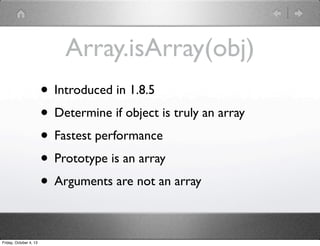
Array.isArray(obj)
• Introduced in 1.8.5
• Determine if object is truly an array
• Fastest performance
• Prototype is an array
• Arguments are not an array
Friday, October 4, 13
Example
function callback(switcher)
{
return switcher
? ["m", "t", "w", "t", "f"]
: undefined;
}
Array.isArray([]);
Array.isArray(new Array());
Array.isArray(callback(true));
Array.isArray(callback(false));
true
true
true
false
Friday, October 4, 13
[].filter(fn, this)
• Introduced in 1.6
• Filters an array via fn
• Returns all items for which fn returns true
• Doesn’t need loops
• Takes optional parameter for this
Friday, October 4, 13
Example
function callback(value, index, array)
{
return value.days === 31;
}
[
{ days : 31, month : "January" },
{ days : 28, month : "February" },
{ days : 31, month : "March" },
{ days : 30, month : "April" },
{ days : 31, month : "May" }
].filter(callback);
[ Object, Object, Object ]
Friday, October 4, 13
See also
• [].forEach(fn, this)
• [].toString()
• [].some(fn, this)
• [].every(fn, this)
• [].lastIndexOf(search, index)
Friday, October 4, 13
Objects
Friday, October 4, 13
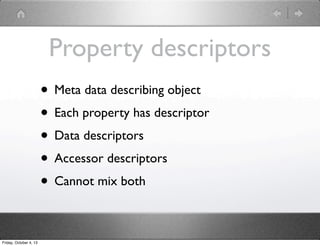
Property descriptors
• Meta data describing object
• Each property has descriptor
• Data descriptors
• Accessor descriptors
• Cannot mix both
Friday, October 4, 13
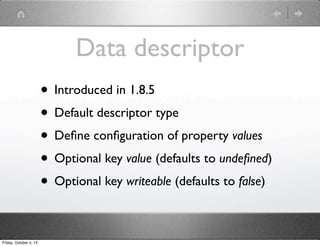
Data descriptor
• Introduced in 1.8.5
• Default descriptor type
• Define configuration of property values
• Optional key value (defaults to undefined)
• Optional key writeable (defaults to false)
Friday, October 4, 13
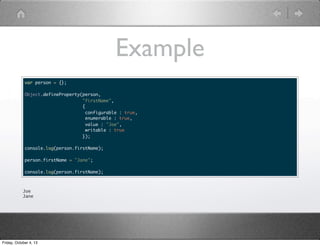
Example
var person = {};
Object.defineProperty(person,
"firstName",
{
configurable : true,
enumerable : true,
value : "Joe",
writable : true
});
console.log(person.firstName);
person.firstName = "Jane";
console.log(person.firstName);
Joe
Jane
Friday, October 4, 13
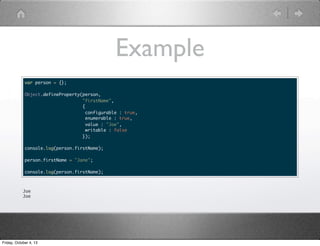
Example
var person = {};
Object.defineProperty(person,
"firstName",
{
configurable : true,
enumerable : true,
value : "Joe",
writable : false
});
console.log(person.firstName);
person.firstName = "Jane";
console.log(person.firstName);
Joe
Joe
Friday, October 4, 13
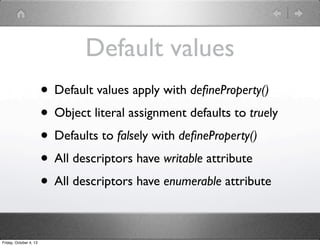
Default values
• Default values apply with defineProperty()
• Object literal assignment defaults to truely
• Defaults to falsely with defineProperty()
• All descriptors have writable attribute
• All descriptors have enumerable attribute
Friday, October 4, 13
Accessor descriptor
• Introduced in 1.8.5
• Bind functionality with property
• Define configuration of property values
• Optional key value (defaults to undefined)
• Optional key writeable (defaults to false)
Friday, October 4, 13
Example
var year = {};
(function ()
{
var month = "";
Object.defineProperty(year,
"month",
{
configurable : true,
enumerable : true,
get : function ()
{
return month;
},
set : function (value)
{
value = value.toLowerCase().substr(0, 3);
month = ([ "jan", "feb", "mar" ].filter(function (val, index, arr)
{
return value === val;
}))[0];
}
});
})();
year.month = "February";
console.log(year.month);
Friday, October 4, 13
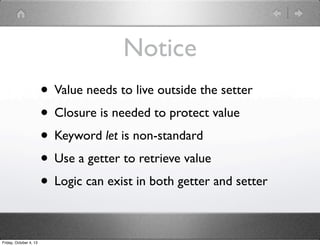
Notice
• Value needs to live outside the setter
• Closure is needed to protect value
• Keyword let is non-standard
• Use a getter to retrieve value
• Logic can exist in both getter and setter
Friday, October 4, 13
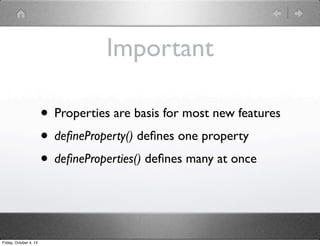
Important
• Properties are basis for most new features
• defineProperty() defines one property
• defineProperties() defines many at once
Friday, October 4, 13
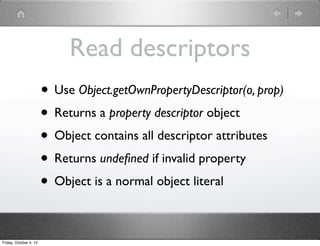
Read descriptors
• Use Object.getOwnPropertyDescriptor(o, prop)
• Returns a property descriptor object
• Object contains all descriptor attributes
• Returns undefined if invalid property
• Object is a normal object literal
Friday, October 4, 13
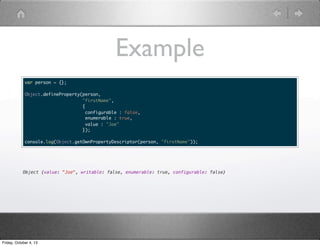
Example
var person = {};
Object.defineProperty(person,
"firstName",
{
configurable : false,
enumerable : true,
value : "Joe"
});
console.log(Object.getOwnPropertyDescriptor(person, "firstName"));
Object {value: "Joe", writable: false, enumerable: true, configurable: false}
Friday, October 4, 13
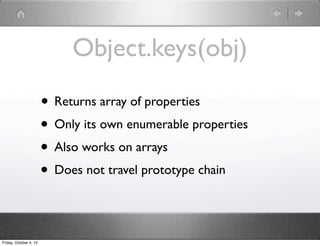
Object.keys(obj)
• Returns array of properties
• Only its own enumerable properties
• Also works on arrays
• Does not travel prototype chain
Friday, October 4, 13
Example
var person = {
"age" : 99,
"lastName" : "Shmo"
};
Object.defineProperty(person,
"firstName",
{
configurable : true,
enumerable : false,
value : "Joe",
writable : true
});
console.log(Object.keys(person));
["age", "lastName"]
Friday, October 4, 13
See also
• for...in to list all properties
• Object.getOwnPropertyNames(obj)
Friday, October 4, 13
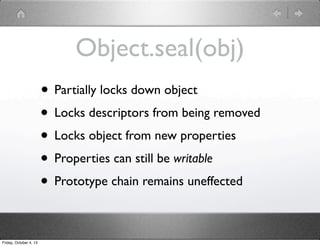
Object.seal(obj)
• Partially locks down object
• Locks descriptors from being removed
• Locks object from new properties
• Properties can still be writable
• Prototype chain remains uneffected
Friday, October 4, 13
Example
var person = {
"age" : 99,
"lastName" : "Shmo"
};
Object.defineProperty(person,
"firstName",
{
configurable : true,
enumerable : false,
value : "Joe",
writable : true
});
console.log(Object.keys(person));
["age", "lastName"]
Friday, October 4, 13
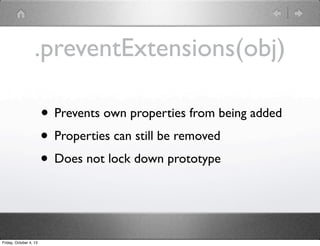
.preventExtensions(obj)
• Prevents own properties from being added
• Properties can still be removed
• Does not lock down prototype
Friday, October 4, 13
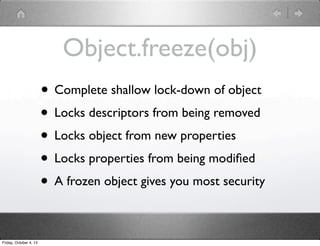
Object.freeze(obj)
• Complete shallow lock-down of object
• Locks descriptors from being removed
• Locks object from new properties
• Locks properties from being modified
• A frozen object gives you most security
Friday, October 4, 13
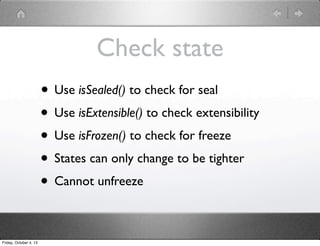
Check state
• Use isSealed() to check for seal
• Use isExtensible() to check extensibility
• Use isFrozen() to check for freeze
• States can only change to be tighter
• Cannot unfreeze
Friday, October 4, 13
Functions
Friday, October 4, 13
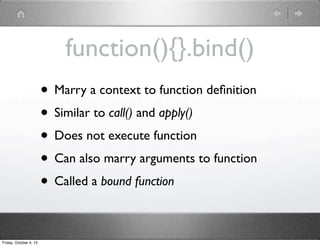
function(){}.bind()
• Marry a context to function definition
• Similar to call() and apply()
• Does not execute function
• Can also marry arguments to function
• Called a bound function
Friday, October 4, 13
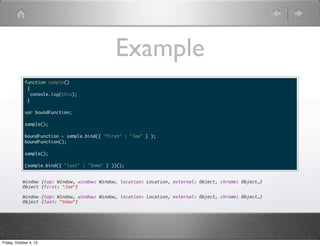
Example
function sample()
{
console.log(this);
}
var boundFunction;
sample();
boundFunction = sample.bind({ "first" : "Joe" } );
boundFunction();
sample();
(sample.bind({ "last" : "Shmo" } ))();
Window {top: Window, window: Window, location: Location, external: Object, chrome: Object…}
Object {first: "Joe"}
Window {top: Window, window: Window, location: Location, external: Object, chrome: Object…}
Object {last: "Shmo"}
Friday, October 4, 13
Connect
• Thank you for your time
• Connect with me on LinkedIn
• Join the Hardcore JavaScript community
• Read my blog
• Contact me via e-mail
Friday, October 4, 13

JavaScript 1.8.5: New Features Explored

  • 1.
    JavaScript 1.8.5 New FeaturesExplored by Milan Adamovsky http://milan.adamovsky.com ◆ http://www.hardcorejs.com Friday, October 4, 13
  • 2.
    What it is •Culmination of good-to-haves • Most features can be shimmed • Supported by all mobile devices • Supported by most modern browsers • IE8 is still in heavy use (JavaScript 1.5) Friday, October 4, 13
  • 3.
    Remember • Includes manyfeatures introduced since 1.5 • 1.6 • 1.7 features mainly supported in FireFox • Use reference material for all versions • Some features are deprecated Friday, October 4, 13
  • 4.
    What to know •Array functions • Object properties • Still doesn’t have block scope • Function features • “use strict” Friday, October 4, 13
  • 5.
    Quick notes • NaN,Infinity, and undefined immutable • No trailing commas in JSON.parse() • Supports “strict mode” • apply() accepts array-like object • Data properties are big Friday, October 4, 13
  • 6.
  • 7.
    “”.trim() • Introduced in1.8.5 • Removes leading spaces • Removes trailing spaces • Works on strings Friday, October 4, 13
  • 8.
    Example " Hello World! ".trim(); "Hello World !" Friday, October 4, 13
  • 9.
  • 10.
    [].map(fn, this) • Introducedin 1.6 • Does not mutate array • Works only on indexes with values • Executes fn on each item in array • Modify an array’s items without a loop Friday, October 4, 13
  • 11.
    Example function resolve(item) { return $(item); } varselectors = ["body", "#hello"].map(resolve); console.log(selectors); [ e.fn.init[1], e.fn.init[0] ] Friday, October 4, 13
  • 12.
    [].reduce(fn, first) • Introducedin 1.8 • Does not mutate array • Executes fn on each item of array • Reduce array to one value without loops • Also available .reduceRight() Friday, October 4, 13
  • 13.
    Example function callback(previousItem, currentItem,index, array) { console.log(previousItem, " - ", currentItem, " - ", index, " - ", array); return previousItem + " " + currentItem; } var sentence = ["three", "little", "pigs", "red", "riding", "hood"].reduce(callback); three - little - 1 - ["three", "little", "pigs", "red", "riding", "hood"] three little - pigs - 2 - ["three", "little", "pigs", "red", "riding", "hood"] three little pigs - red - 3 - ["three", "little", "pigs", "red", "riding", "hood"] three little pigs red - riding - 4 - ["three", "little", "pigs", "red", "riding", "hood"] three little pigs red riding - hood - 5 - ["three", "little", "pigs", "red", "riding", "hood"] Friday, October 4, 13
  • 14.
    Array.isArray(obj) • Introduced in1.8.5 • Determine if object is truly an array • Fastest performance • Prototype is an array • Arguments are not an array Friday, October 4, 13
  • 15.
    Example function callback(switcher) { return switcher ?["m", "t", "w", "t", "f"] : undefined; } Array.isArray([]); Array.isArray(new Array()); Array.isArray(callback(true)); Array.isArray(callback(false)); true true true false Friday, October 4, 13
  • 16.
    [].filter(fn, this) • Introducedin 1.6 • Filters an array via fn • Returns all items for which fn returns true • Doesn’t need loops • Takes optional parameter for this Friday, October 4, 13
  • 17.
    Example function callback(value, index,array) { return value.days === 31; } [ { days : 31, month : "January" }, { days : 28, month : "February" }, { days : 31, month : "March" }, { days : 30, month : "April" }, { days : 31, month : "May" } ].filter(callback); [ Object, Object, Object ] Friday, October 4, 13
  • 18.
    See also • [].forEach(fn,this) • [].toString() • [].some(fn, this) • [].every(fn, this) • [].lastIndexOf(search, index) Friday, October 4, 13
  • 19.
  • 20.
    Property descriptors • Metadata describing object • Each property has descriptor • Data descriptors • Accessor descriptors • Cannot mix both Friday, October 4, 13
  • 21.
    Data descriptor • Introducedin 1.8.5 • Default descriptor type • Define configuration of property values • Optional key value (defaults to undefined) • Optional key writeable (defaults to false) Friday, October 4, 13
  • 22.
    Example var person ={}; Object.defineProperty(person, "firstName", { configurable : true, enumerable : true, value : "Joe", writable : true }); console.log(person.firstName); person.firstName = "Jane"; console.log(person.firstName); Joe Jane Friday, October 4, 13
  • 23.
    Example var person ={}; Object.defineProperty(person, "firstName", { configurable : true, enumerable : true, value : "Joe", writable : false }); console.log(person.firstName); person.firstName = "Jane"; console.log(person.firstName); Joe Joe Friday, October 4, 13
  • 24.
    Default values • Defaultvalues apply with defineProperty() • Object literal assignment defaults to truely • Defaults to falsely with defineProperty() • All descriptors have writable attribute • All descriptors have enumerable attribute Friday, October 4, 13
  • 25.
    Accessor descriptor • Introducedin 1.8.5 • Bind functionality with property • Define configuration of property values • Optional key value (defaults to undefined) • Optional key writeable (defaults to false) Friday, October 4, 13
  • 26.
    Example var year ={}; (function () { var month = ""; Object.defineProperty(year, "month", { configurable : true, enumerable : true, get : function () { return month; }, set : function (value) { value = value.toLowerCase().substr(0, 3); month = ([ "jan", "feb", "mar" ].filter(function (val, index, arr) { return value === val; }))[0]; } }); })(); year.month = "February"; console.log(year.month); Friday, October 4, 13
  • 27.
    Notice • Value needsto live outside the setter • Closure is needed to protect value • Keyword let is non-standard • Use a getter to retrieve value • Logic can exist in both getter and setter Friday, October 4, 13
  • 28.
    Important • Properties arebasis for most new features • defineProperty() defines one property • defineProperties() defines many at once Friday, October 4, 13
  • 29.
    Read descriptors • UseObject.getOwnPropertyDescriptor(o, prop) • Returns a property descriptor object • Object contains all descriptor attributes • Returns undefined if invalid property • Object is a normal object literal Friday, October 4, 13
  • 30.
    Example var person ={}; Object.defineProperty(person, "firstName", { configurable : false, enumerable : true, value : "Joe" }); console.log(Object.getOwnPropertyDescriptor(person, "firstName")); Object {value: "Joe", writable: false, enumerable: true, configurable: false} Friday, October 4, 13
  • 31.
    Object.keys(obj) • Returns arrayof properties • Only its own enumerable properties • Also works on arrays • Does not travel prototype chain Friday, October 4, 13
  • 32.
    Example var person ={ "age" : 99, "lastName" : "Shmo" }; Object.defineProperty(person, "firstName", { configurable : true, enumerable : false, value : "Joe", writable : true }); console.log(Object.keys(person)); ["age", "lastName"] Friday, October 4, 13
  • 33.
    See also • for...into list all properties • Object.getOwnPropertyNames(obj) Friday, October 4, 13
  • 34.
    Object.seal(obj) • Partially locksdown object • Locks descriptors from being removed • Locks object from new properties • Properties can still be writable • Prototype chain remains uneffected Friday, October 4, 13
  • 35.
    Example var person ={ "age" : 99, "lastName" : "Shmo" }; Object.defineProperty(person, "firstName", { configurable : true, enumerable : false, value : "Joe", writable : true }); console.log(Object.keys(person)); ["age", "lastName"] Friday, October 4, 13
  • 36.
    .preventExtensions(obj) • Prevents ownproperties from being added • Properties can still be removed • Does not lock down prototype Friday, October 4, 13
  • 37.
    Object.freeze(obj) • Complete shallowlock-down of object • Locks descriptors from being removed • Locks object from new properties • Locks properties from being modified • A frozen object gives you most security Friday, October 4, 13
  • 38.
    Check state • UseisSealed() to check for seal • Use isExtensible() to check extensibility • Use isFrozen() to check for freeze • States can only change to be tighter • Cannot unfreeze Friday, October 4, 13
  • 39.
  • 40.
    function(){}.bind() • Marry acontext to function definition • Similar to call() and apply() • Does not execute function • Can also marry arguments to function • Called a bound function Friday, October 4, 13
  • 41.
    Example function sample() { console.log(this); } var boundFunction; sample(); boundFunction= sample.bind({ "first" : "Joe" } ); boundFunction(); sample(); (sample.bind({ "last" : "Shmo" } ))(); Window {top: Window, window: Window, location: Location, external: Object, chrome: Object…} Object {first: "Joe"} Window {top: Window, window: Window, location: Location, external: Object, chrome: Object…} Object {last: "Shmo"} Friday, October 4, 13
  • 42.
    Connect • Thank youfor your time • Connect with me on LinkedIn • Join the Hardcore JavaScript community • Read my blog • Contact me via e-mail Friday, October 4, 13