JOURNALISMBY MS. MARICON C. VIDUYA
WHY JOURNALISM Journalism is widely regarded as a glamorous and exciting profession. Disadvantages Low salaryThe pressure of beating the deadlineThe long and often irregular hours of workLife-threatening
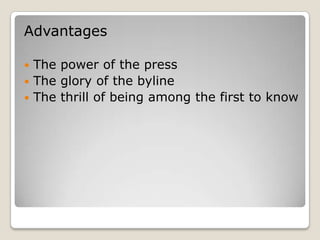
AdvantagesThe power of the pressThe glory of the bylineThe thrill of being among the first to know
The power of the pressHas long been recognized, accepted, and supportedIn most places, it is one of the few remaining forces that can effectively challenge a corrupt and secretive administration. It has proven its power to galvanize public opinion.
The power of the pressMore often used in a less earth-shaking way e.g. crusading against injustice in a small town, campaigning for worthy causes, publishing useful information on health and safety issues
The power of the press“The basis of our government being the opinion of the people, the very first object should be to keep that right; and were it left to me to decide whether we should have a government without newspapers or newspapers without government, I should not hesitate a moment to prefer the latter.”  			– Thomas Jefferson
The power of the press“ Congress watches the President; the Supreme Court watches them both; and the press exposes all their discoverable secrets.” – US ConstitutionFilipino leaders during the Spanish regime – Jose Rizal, Marcelo H. del Pilar, Graciano Lopez-Jaena—turned to press in their crusade for reforms
The Glory of the BylineByline – the author’s name appearing with the story or article 	- could be nom de plume/ pen name/ pseudonym	- full name	- may include middle name	- first initials or initials together with his full family name
BylineHas become the expression of the writer’s styleThrough the byline, the author could be recognized asa person of influence, a purveyor of wisdoma molder of opinionsa shaper of society   		- Leonard Ray Teel and Ron Taylor
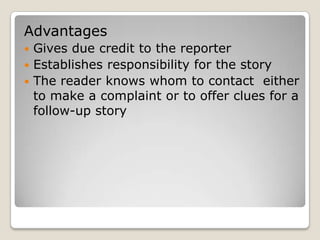
AdvantagesGives due credit to the reporterEstablishes responsibility for the storyThe reader knows whom to contact  either to make a complaint or to offer clues for a follow-up story
The First to KnowThere is excitement in being the first to knowThis could refer to the important events or to personal concerns of famous people; to the historically significant, to change in the weather, or simply a surprise party for a friend
The First to KnowThe reporter witnesses history as it is taking place.The reporter gets to meet interesting people, not necessarily celebrities, but also common folks who are personalities in their own way. The established journalist has access to the seats of power which is denied to others.
Limitations of the PressIdeally, the press should present the truth about any event or issueRealistically, it can only present some facts about every story
Limitations of the PressReporters are not the “omniscient” observers that they might seem to beAs pointed out by David Broder, “the dean of political reporters” and Pulitzer prize-winning columnist and author, press reports are flawed
2 reasons for the flaw1.Time pressure under which reporters have to submit their news storiesLack of time and resources leads to their failure to get different perspectives
2 reasons for the flaw	2. Their inability to reach all the sources they would wish to interview or researchReporters try their best; but the information that they have is always incomplete and is “just a bare sketch of what the reality is”
Border suggests that the writer truthfully add, at the end of each story“subject to revision and amplification” Although he concedes that newspapers are the “first draft of history,” Broder believes that they should not be taken as the final authority.
Readers tend to trust the printed words implicitly and newsmen pretend to have an authority which they do not possess“Media should start with a premise that they are fallible human beings dealing with very complex reality.”
Readers, therefore, should judge what they read critically. They should ask the questions that are left unanswered, in the same way the journalists do when they are digging for facts.
Another weakness of the press is its proneness to being manipulated by politicians.	“Every good politician will attempt to work the press. If you live in a country where public opinion ultimately decides public policy, any politician who’s at all serious is going to try to manage public opinion, and that means working the press. So they all do it.”
Beside public support, the press also needs intelligent criticism, both from the news organization itself and from its readers. The press is after all, “A PRIVATE BUSINESS PERFORMING A PUBLIC SERVICE WITH CONSTITUTIONAL IMMUNITY.”Source: Journalism Handbook, E. Pangilinan
Other limitations of the Press6 Major Limitations of the PressLibelAnti-obscenity lawInvasion of privacy lawsLaw on national securityContempt of courtCopyright law 

Journalism

  • 1.
  • 2.
    WHY JOURNALISM Journalismis widely regarded as a glamorous and exciting profession. Disadvantages Low salaryThe pressure of beating the deadlineThe long and often irregular hours of workLife-threatening
  • 3.
    AdvantagesThe power ofthe pressThe glory of the bylineThe thrill of being among the first to know
  • 4.
    The power ofthe pressHas long been recognized, accepted, and supportedIn most places, it is one of the few remaining forces that can effectively challenge a corrupt and secretive administration. It has proven its power to galvanize public opinion.
  • 5.
    The power ofthe pressMore often used in a less earth-shaking way e.g. crusading against injustice in a small town, campaigning for worthy causes, publishing useful information on health and safety issues
  • 6.
    The power ofthe press“The basis of our government being the opinion of the people, the very first object should be to keep that right; and were it left to me to decide whether we should have a government without newspapers or newspapers without government, I should not hesitate a moment to prefer the latter.” – Thomas Jefferson
  • 7.
    The power ofthe press“ Congress watches the President; the Supreme Court watches them both; and the press exposes all their discoverable secrets.” – US ConstitutionFilipino leaders during the Spanish regime – Jose Rizal, Marcelo H. del Pilar, Graciano Lopez-Jaena—turned to press in their crusade for reforms
  • 8.
    The Glory ofthe BylineByline – the author’s name appearing with the story or article - could be nom de plume/ pen name/ pseudonym - full name - may include middle name - first initials or initials together with his full family name
  • 9.
    BylineHas become theexpression of the writer’s styleThrough the byline, the author could be recognized asa person of influence, a purveyor of wisdoma molder of opinionsa shaper of society   - Leonard Ray Teel and Ron Taylor
  • 10.
    AdvantagesGives due creditto the reporterEstablishes responsibility for the storyThe reader knows whom to contact either to make a complaint or to offer clues for a follow-up story
  • 11.
    The First toKnowThere is excitement in being the first to knowThis could refer to the important events or to personal concerns of famous people; to the historically significant, to change in the weather, or simply a surprise party for a friend
  • 12.
    The First toKnowThe reporter witnesses history as it is taking place.The reporter gets to meet interesting people, not necessarily celebrities, but also common folks who are personalities in their own way. The established journalist has access to the seats of power which is denied to others.
  • 13.
    Limitations of thePressIdeally, the press should present the truth about any event or issueRealistically, it can only present some facts about every story
  • 14.
    Limitations of thePressReporters are not the “omniscient” observers that they might seem to beAs pointed out by David Broder, “the dean of political reporters” and Pulitzer prize-winning columnist and author, press reports are flawed
  • 15.
    2 reasons forthe flaw1.Time pressure under which reporters have to submit their news storiesLack of time and resources leads to their failure to get different perspectives
  • 16.
    2 reasons forthe flaw 2. Their inability to reach all the sources they would wish to interview or researchReporters try their best; but the information that they have is always incomplete and is “just a bare sketch of what the reality is”
  • 17.
    Border suggests thatthe writer truthfully add, at the end of each story“subject to revision and amplification” Although he concedes that newspapers are the “first draft of history,” Broder believes that they should not be taken as the final authority.
  • 18.
    Readers tend totrust the printed words implicitly and newsmen pretend to have an authority which they do not possess“Media should start with a premise that they are fallible human beings dealing with very complex reality.”
  • 19.
    Readers, therefore, shouldjudge what they read critically. They should ask the questions that are left unanswered, in the same way the journalists do when they are digging for facts.
  • 20.
    Another weakness ofthe press is its proneness to being manipulated by politicians. “Every good politician will attempt to work the press. If you live in a country where public opinion ultimately decides public policy, any politician who’s at all serious is going to try to manage public opinion, and that means working the press. So they all do it.”
  • 21.
    Beside public support,the press also needs intelligent criticism, both from the news organization itself and from its readers. The press is after all, “A PRIVATE BUSINESS PERFORMING A PUBLIC SERVICE WITH CONSTITUTIONAL IMMUNITY.”Source: Journalism Handbook, E. Pangilinan
  • 22.
    Other limitations ofthe Press6 Major Limitations of the PressLibelAnti-obscenity lawInvasion of privacy lawsLaw on national securityContempt of courtCopyright law