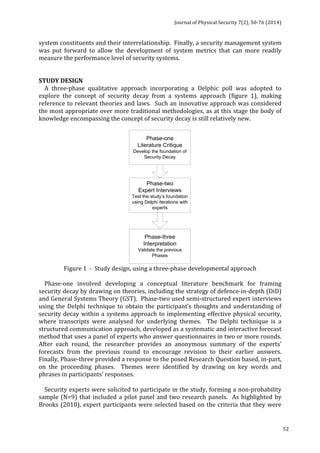

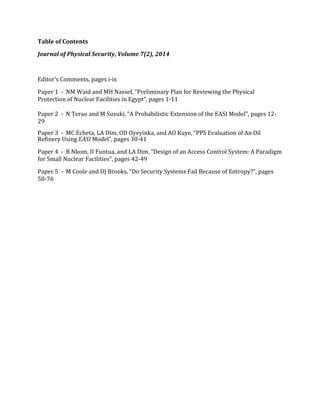


Table 
of 
Contents 
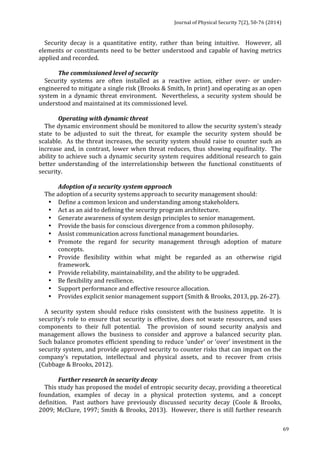
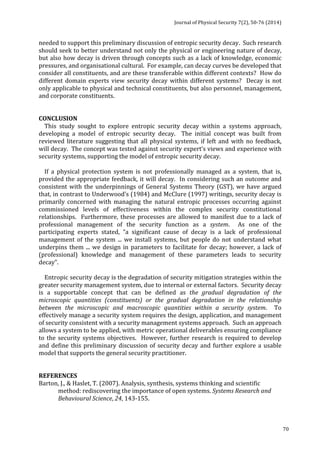
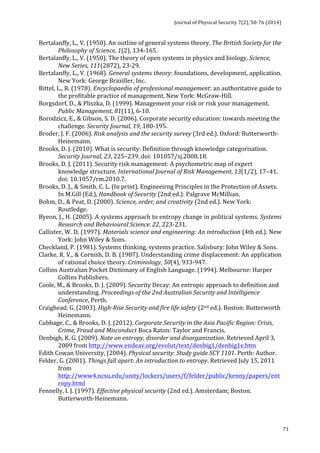
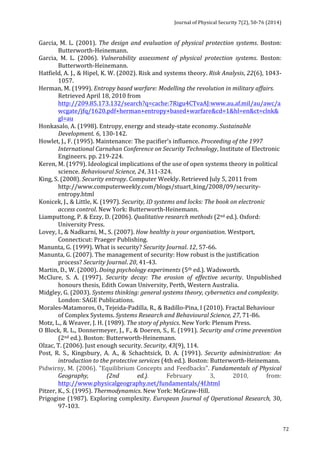
Journal 
of 
Physical 
Security, 
Volume 
7(2), 
2014 
Editor’s 
Comments, 
pages 
i-­‐ix 
Paper 
1 
-­‐ 
NM 
Waid 
and 
MH 
Nassef, 
“Preliminary 
Plan 
for 
Reviewing 
the 
Physical 
Protection 
of 
Nuclear 
Facilities 
in 
Egypt”, 
pages 
1-­‐11 
Paper 
2 
-­‐ 
N 
Terao 
and 
M 
Suzuki, 
“A 
Probabilistic 
Extension 
of 
the 
EASI 
Model”, 
pages 
12-­‐ 
29 
Paper 
3 
-­‐ 
MC 
Echeta, 
LA 
Dim, 
OD 
Oyeyinka, 
and 
AO 
Kuye, 
“PPS 
Evaluation 
of 
An 
Oil 
Refinery 
Using 
EASI 
Model”, 
pages 
30-­‐41 
Paper 
4 
-­‐ 
B 
Nkom, 
II 
Funtua, 
and 
LA 
Dim, 
“Design 
of 
an 
Access 
Control 
System: 
A 
Paradigm 
for 
Small 
Nuclear 
Facilities”, 
pages 
42-­‐49 
Paper 
5 
-­‐ 
M 
Coole 
and 
DJ 
Brooks, 
“Do 
Security 
Systems 
Fail 
Because 
of 
Entropy?”, 
pages 
50-­‐76
Journal 
of 
Physical 
Security 
7(2), 
i-­‐ix 
(2014) 
Editor’s 
Comments 
Welcome 
to 
volume 
7, 
issue 
2 
of 
the 
Journal 
of 
Physical 
Security. 
This 
issue 
has 
papers 
about 
security 
evaluations 
of 
Egyptian 
nuclear 
facilities, 
a 
probabilistic 
model 
for 
quantifying 
the 
odds 
of 
interrupting 
an 
attack, 
a 
security 
evaluation 
for 
an 
oil 
refinery 
in 
Nigeria, 
access 
control 
for 
small 
nuclear 
facilities, 
and 
entropy 
as 
a 
driver 
of 
security 
failures. 
For 
the 
last 
paper 
in 
this 
issue, 
we 
had 
the 
interesting 
situation 
where 
the 
reviewers, 
the 
editor, 
and 
the 
authors 
couldn’t 
come 
to 
an 
agreement 
on 
possible 
changes 
to 
the 
paper. 
This 
resulted 
in 
a 
discussion 
at 
the 
end 
of 
the 
paper 
that 
you 
won’t 
want 
to 
miss 
because 
of 
its 
larger 
implications. 
I 
hope 
you 
find 
it 
thought 
provoking. 
As 
usual, 
the 
views 
expressed 
by 
the 
editor 
and 
authors 
are 
their 
own 
and 
should 
not 
necessarily 
be 
ascribed 
to 
their 
home 
institutions, 
Argonne 
National 
Laboratory, 
or 
the 
United 
States 
Department 
of 
Energy. 
i 
***** 
JPS 
& 
Peer 
Review 
Research 
manuscripts 
submitted 
to 
this 
journal 
are 
usually 
reviewed 
by 
2 
anonymous 
reviewers 
knowledgeable 
in 
the 
subject 
of 
the 
paper. 
Viewpoint 
papers 
are 
reviewed 
by 
0, 
1, 
or 
2 
reviewers, 
depending 
on 
the 
topic 
and 
content. 
(Papers 
that 
receive 
no 
peer 
review 
are 
clearly 
marked 
as 
such.) 
The 
authors’ 
identities 
are 
known 
to 
the 
reviewers, 
i.e., 
this 
journal 
does 
not 
use 
a 
double 
blind 
review 
system. 
This 
is 
the 
case 
for 
most 
peer 
review 
journals 
in 
other 
fields. 
There 
are 
pros 
and 
cons 
to 
this 
single 
blind 
approach. 
We 
are 
always 
very 
grateful 
to 
reviewers 
for 
their 
(unpaid) 
time. 
Serving 
as 
a 
reviewer 
is 
a 
real 
service 
to 
your 
security 
colleagues 
and 
to 
everybody’s 
security. 
If 
you 
are 
interested 
in 
serving 
as 
an 
occasional 
reviewer, 
please 
contact 
me 
through 
Argonne 
National 
Laboratory 
or 
http://jps.anl.gov. 
Dr. 
Jon 
Warner 
of 
our 
Argonne 
Vulnerability 
Assessment 
Team 
serves 
very 
capably 
as 
Associate 
Editor. 
The 
pie 
chart 
below 
shows 
that 
almost 
¼ 
of 
manuscripts 
submitted 
to 
JPS 
do 
not 
get 
printed 
in 
the 
journal. 
The 
vast 
majority 
of 
manuscripts 
that 
are 
accepted 
undergo 
significant 
changes 
or 
additions 
suggested 
by 
the 
reviewers 
and 
the 
editor 
prior 
to 
being 
published. 
I 
often 
assist 
with 
editing 
papers 
for 
authors 
for 
whom 
English 
is 
not 
their 
first 
language, 
or 
who 
are 
from 
the 
UK.
Journal 
of 
Physical 
Security 
7(2), 
i-­‐ix 
(2014) 
The 
standard 
style 
of 
this 
journal 
is 
American 
English. 
This 
includes, 
among 
other 
things, 
putting 
a 
comma 
before 
the 
last 
item 
in 
a 
list, 
the 
so-­‐called 
“serial 
comma”, 
also 
ironically 
called 
the 
“Oxford 
comma”. 
(Not 
all 
Americans 
do 
this, 
however, 
especially 
journalists 
and 
young 
people.) 
Here 
are 
2 
examples 
of 
where 
the 
serial 
comma 
can 
be 
important: 
ii 
“My 
favorite 
sandwiches 
are 
tuna, 
ham, 
and 
cheese.” 
refers 
to 
3 
sandwiches, 
whereas 
“My 
favorite 
sandwiches 
are 
tuna, 
ham 
and 
cheese.” 
is 
focused 
on 
2. 
“I 
got 
the 
idea 
from 
talking 
to 
my 
boss, 
a 
convicted 
felon, 
and 
a 
drug 
addict.” 
has 
quite 
a 
different 
meaning 
from 
“I 
got 
the 
idea 
from 
talking 
to 
my 
boss, 
a 
convicted 
felon 
and 
a 
drug 
addict.” 
While 
there 
are 
counter-­‐arguments, 
in 
my 
mind 
there 
are 
2 
good 
reasons 
for 
use 
of 
the 
serial 
comma. 
First, 
is 
consistent 
with 
the 
general 
idea 
of 
parallelism, 
an 
important 
element 
of 
good 
writing. 
Good 
writing 
has 
rhythm 
and 
organization, 
and 
you 
don’t 
want 
to 
confuse 
the 
reader 
or 
squander 
her 
time 
by 
breaking 
them. 
One 
example 
of 
good 
parallelism 
is 
writing 
a 
list 
using 
only 
nouns 
or 
only 
verbs 
or 
only 
gerunds. 
Mixing 
them 
creates 
clumsy 
wording, 
such 
as: 
“I 
like 
to 
fish, 
pancakes, 
and 
talking 
to 
art 
experts.” 
A 
better 
sentence 
might 
use 
all 
gerunds 
for 
parallelism: 
“I 
like 
fishing, 
eating 
pancakes, 
and 
talking 
to 
art 
experts.”
Journal 
of 
Physical 
Security 
7(2), 
i-­‐ix 
(2014) 
iii 
The 
second 
reason 
the 
serial 
comma 
is 
useful 
is 
that 
it 
most 
closely 
mimics 
oral 
speech, 
which 
is 
really 
the 
underlying 
basis 
of 
the 
written 
word. 
To 
a 
considerable 
degree, 
good 
writing 
sounds 
like 
good 
talking. 
Some 
writers 
claim 
that 
commas 
clutter 
up 
writing. 
While 
commas 
can 
certainly 
be 
overused, 
I 
think 
they 
actually 
make 
reading 
easier—and 
the 
meaning 
clearer—when 
used 
to 
mimic 
the 
natural 
pauses 
in 
oral 
speech. 
Thus, 
if 
I 
really 
meant 
3 
sandwiches, 
the 
way 
I 
say 
this 
is 
“tuna..ham..and..cheese”, 
but 
if 
I 
meant 
2 
sandwiches, 
“tuna……ham 
& 
cheese. 
The 
comma 
can 
help 
the 
reader 
understand 
where 
the 
pauses 
should 
be. 
***** 
Voting 
for 
Security 
Theater 
I 
recently 
observed 
a 
nearly 
2-­‐hour 
training 
course 
for 
election 
judges. 
The 
course 
was 
taught 
by 
state 
election 
officials 
for 
a 
single 
election 
jurisdiction. 
The 
state 
and 
jurisdiction 
shall 
go 
unnamed. 
The 
course 
was 
efficient, 
practical, 
professionally 
run, 
and 
well 
tuned 
to 
the 
audience. 
A 
lot 
of 
useful 
information 
was 
provided 
to 
the 
election 
judges. 
I 
found 
it 
telling 
that 
the 
word 
“security” 
made 
an 
appearance 
only 
once 
in 
the 
2-­‐hour 
presentation, 
and 
then 
only 
in 
the 
following 
context: 
“Election 
judges 
should 
follow 
this 
procedure 
because 
it 
gives 
the 
appearance 
of 
security.” 
[Italics 
added.] 
Now 
I’m 
quite 
familiar 
with 
Security 
Theater. 
As 
a 
vulnerability 
assessor, 
I 
see 
it 
all 
the 
time 
in 
disparate 
security 
devices, 
systems, 
and 
programs. 
But 
usually 
Security 
Theater 
involves 
security 
managers 
or 
organizations 
fooling 
themselves, 
or 
it 
is 
busywork 
deliberately 
designed 
to 
make 
auditors 
or 
the 
boss 
happy, 
or 
it’s 
something 
meant 
to 
snow 
customers 
or 
the 
public. 
Sometimes, 
Security 
Theater 
is 
used 
as 
a 
form 
of 
bluffing, 
i.e., 
to 
make 
a 
target 
falsely 
look 
harder 
than 
it 
really 
is. 
(Bluffing, 
however, 
is 
usually 
effective 
only 
over 
the 
short 
term.) 
The 
procedure 
that 
was 
being 
discussed 
in 
the 
course 
as 
needing 
the 
appearance 
of 
security 
was 
not 
one 
that 
would 
be 
much 
noted 
by 
voters 
or 
the 
public, 
so 
it 
was 
probably 
not 
intended 
as 
a 
bluff. 
Rather, 
the 
apparent 
attitude 
among 
these 
election 
officials—which 
I 
and 
others 
have 
frequently 
observed 
in 
other 
contexts, 
states, 
and 
election 
jurisdictions— 
is 
that 
security 
is 
viewed 
as 
only 
being 
about 
appearances. 
One 
of 
the 
functions 
of 
election 
judges 
is 
often 
to 
compare 
voters’ 
signatures 
on 
election 
day 
with 
the 
voter 
registration 
records. 
In 
this 
particular 
state 
and 
election 
jurisdiction, 
as 
in 
most 
others, 
election 
judges 
are 
given 
zero 
useful 
instructions 
on 
how 
to 
compare 
signatures, 
not 
even 
the 
brief, 
rudimentary 
training 
often 
given 
to 
cashiers 
in 
retail 
stores 
on 
signature 
verification. 
In 
my 
view, 
the 
veracity 
of 
the 
vote 
deserves 
more 
serious 
security 
attention. 
Election 
fairness 
and 
accuracy 
are 
fundamental 
principles 
of 
democracy.
Journal 
of 
Physical 
Security 
7(2), 
i-­‐ix 
(2014) 
iv 
***** 
Faking 
it 
Artistically 
Counterfeit 
works 
of 
art 
and 
antiquities 
are 
a 
huge 
security 
problem. 
A 
new 
technique 
has 
been 
deployed, 
based 
on 
the 
anomalously 
high 
amount 
of 
radioactive 
carbon-­‐14 
found 
in 
the 
atmosphere 
since 
the 
dawn 
of 
the 
nuclear 
age. 
A 
painting 
attributed 
to 
the 
French 
cubist 
painter 
Fernand 
Léger 
was 
clearly 
proven 
to 
be 
a 
forgery. 
For 
more 
information: 
http://www.chromatographytechniques.com/news/2014/03/carbon-­‐dating-­‐shows-­‐ 
cubist-­‐painting-­‐was-­‐forged?et_cid=3815889&et_rid=396957192&type=headline 
***** 
Compliance 
vs. 
Security 
Compliance 
and 
Security, 
of 
course, 
are 
not 
the 
same 
thing. 
Sometimes 
they 
are 
at 
odds. 
In 
my 
experience, 
it 
is 
typical 
for 
at 
least 
a 
third 
of 
compliance 
rules 
to 
actually 
make 
security 
worse. 
This 
can 
occur 
when 
compliance 
wastes 
time, 
energy, 
and 
resources; 
distracts 
security 
personnel 
and 
employees 
and 
focuses 
them 
on 
the 
wrong 
issues; 
makes 
auditors 
the 
enemy, 
instead 
of 
the 
actual 
adversaries; 
encourages 
mindless 
rule 
following 
rather 
than 
careful 
proactive 
thinking 
about 
security; 
institutionalizes 
stupid, 
one-­‐size-­‐fits-­‐ 
all 
rules 
mandated 
by 
bureaucrats 
far 
removed 
from 
ground 
level; 
fossilizes 
rules 
that 
need 
to 
be 
flexible 
with 
changing 
threats, 
conditions, 
and 
technology; 
lets 
the 
good 
guys 
and 
the 
existing 
security 
infrastructure 
and 
security 
strategies 
define 
the 
problem, 
not 
the 
bad 
guys 
(which 
is 
the 
real-­‐world 
situation); 
makes 
security 
the 
enemy 
of 
productivity 
and 
of 
employees; 
and 
engenders 
cynicism 
about 
security. 
The 
best 
(and 
funniest 
and 
most 
disturbing) 
examples 
I 
know 
of 
compliance 
harming 
security 
can’t 
be 
openly 
discussed 
because 
of 
their 
sensitivity. 
Here, 
however, 
are 
a 
few 
examples 
I 
can 
share. 
• Granting 
access 
to 
numerous 
auditors, 
overseers, 
micro-­‐managers, 
testers, 
maintenance 
people 
for 
security 
hardware, 
and 
checkers 
of 
the 
checkers 
increases 
the 
insider 
threat. 
• Mandated 
State 
of 
Health 
(SOH) 
checks 
on 
security 
hardware 
increases 
complexity 
(bad 
for 
security) 
and 
hacking 
opportunities. 
• Mandated 
security 
devices 
get 
in 
each 
other’s 
way, 
or 
compromise 
each 
other’s 
security. 
• Specifically 
mandated 
security 
products 
or 
anti-­‐malware 
software 
preclude 
the 
use 
of 
better, 
more 
up 
to 
date 
products. 
• PC 
security 
rules 
applied 
mindlessly 
to 
Macs. 
• Compliance 
makes 
the 
best 
the 
enemy 
of 
the 
good. 
• Almost 
anybody 
is 
considered 
to 
have 
a 
“Need 
to 
Know” 
if 
it 
can 
help 
us 
avoid 
minor 
procedural 
and 
paperwork 
errors 
(or 
he/she 
can 
offer 
some 
vaguely 
plausible 
story
Journal 
of 
Physical 
Security 
7(2), 
i-­‐ix 
(2014) 
line), 
thus 
creating 
unnecessary 
checkers 
and 
increasing 
the 
insider 
threat 
as 
well 
as 
the 
chances 
of 
mishandling 
sensitive 
data. 
v 
• Government 
security 
clearances 
that 
require 
self-­‐reporting 
of 
professional 
counseling 
and 
mental 
health 
treatment, 
thus 
discouraging 
it. 
• Grievance, 
complaint 
resolution, 
and 
employee 
assistance 
programs 
that 
increase 
disgruntlement 
and 
target 
users 
for 
retaliation. 
• Formal 
rules 
requiring 
overly 
predictable 
guard 
patrols 
and 
shift 
changes. 
• Little 
room 
allowed 
for 
flexibility, 
individual 
initiative, 
proactiveness, 
questions/concerns, 
hunches, 
resourcefulness, 
observational 
skills, 
and 
people 
skills. 
• Security 
managers 
are 
fearful 
of 
installing 
additional 
security 
procedures 
and 
hardware 
(even 
common 
sense 
ones) 
that 
can 
improve 
security 
locally 
because 
they 
are 
not 
called 
for 
by 
auditors 
or 
the 
compliance 
documents. 
• An 
over-­‐emphasis 
on 
fences 
(4.5 
– 
15 
sec 
delay) 
and 
entry 
points 
as 
security 
measures 
leads 
to 
bad 
security. 
• The 
required 
complex 
multitude 
of 
security 
layers 
(“Defense 
in 
Depth”) 
leads 
to 
a 
situation 
where 
nobody 
takes 
any 
one 
layer 
(or 
alarm) 
seriously. 
See, 
for 
example, 
the 
Y-­‐12 
break-­‐in 
by 
an 
85-­‐year 
old 
nun: 
http://www.cbsnews.com/news/nun-­‐84-­‐ 
gets-­‐3-­‐years-­‐in-­‐prison-­‐for-­‐breaking-­‐in-­‐nuclear-­‐weapons-­‐complex/ 
This 
is 
a 
classic, 
predictable, 
and 
very 
common 
mode 
of 
failure 
for 
Defense 
in 
Depth 
(“layered 
security”). 
Unfortunately, 
multiple 
layers 
of 
lousy 
security 
rarely 
add 
up 
to 
good 
security. 
And 
Defense 
in 
Depth 
tends 
to 
engender 
acceptance 
of 
lousy 
layers. 
• The 
wrong 
mindset 
is 
created: 
Security 
= 
Busy 
Work 
& 
Mindless 
Rule-­‐Following, 
leading 
to 
the 
idea 
that 
the 
Brass 
and 
bureaucrats 
are 
responsible 
for 
thinking 
about 
security, 
not 
me. 
***** 
Criminy! 
Recent 
events 
in 
Crimea 
are 
a 
reminder 
that 
2014 
is 
the 
160th 
anniversary 
of 
the 
Crimean 
War, 
a 
conflict 
between 
Russia 
and 
an 
alliance 
of 
France, 
Britain, 
the 
Ottoman 
Empire, 
and 
Sardinia. 
It 
was 
one 
of 
the 
first 
“modern” 
wars 
in 
a 
number 
of 
ways. 
The 
Crimean 
War 
is 
probably 
best 
remembered 
for 
the 
incompetence 
and 
unnecessary 
loss 
of 
life 
on 
both 
sides. 
At 
the 
time, 
British 
citizens 
could 
buy 
a 
commission, 
i.e., 
British 
military 
leaders 
were 
not 
chosen 
by 
merit, 
intelligence, 
or 
experience 
but 
by 
who 
could 
cough 
up 
big 
bucks. 
The 
poem, 
“Charge 
of 
the 
Light 
Brigade” 
by 
Alfred, 
Lord 
Tennyson 
based 
on 
the 
Crimean 
war 
helped 
to 
focus 
attention 
on 
the 
incompetence 
of 
English 
military 
leaders, 
which 
eventually 
resulted 
in 
ending 
the 
practice 
of 
selling 
commissions. 
Now, 
160 
years 
later, 
many 
security 
professionals 
are 
all 
too 
familiar 
with 
the 
negative 
consequences 
of 
having 
leaders 
who 
are 
not 
chosen 
based 
on 
merit, 
intelligence, 
and 
experience.
Journal 
of 
Physical 
Security 
7(2), 
i-­‐ix 
(2014) 
vi 
***** 
Uncommon 
Common 
Sense 
As 
of 
this 
writing, 
there 
is 
as 
of 
yet 
no 
solution 
to 
the 
mystery 
of 
missing 
Malaysia 
Airlines 
Flight 
370. 
What 
has 
become 
clear 
from 
this 
incident, 
however, 
is 
that 
many 
nations 
and 
airlines 
do 
not 
make 
use 
of 
the 
Interpol 
database 
of 
stolen 
passports. 
This 
database 
contains 
data 
on 
40 
million 
lost 
or 
stolen 
travel 
documents. 
According 
to 
Interpol 
General 
Secretary 
Ronald 
Noble, 
“Only 
a 
handful 
of 
countries 
worldwide 
are 
taking 
care 
to 
make 
sure 
that 
persons 
possessing 
stolen 
passports 
are 
not 
boarding 
international 
flights.” 
Even 
so, 
the 
database 
gets 
60,000 
hits 
per 
year. 
The 
United 
States, 
UK, 
and 
the 
United 
Arab 
Emirates 
are 
some 
of 
the 
few 
countries 
that 
do 
use 
the 
database 
extensively. 
A 
2011 
study 
found 
that 
the 
database 
can 
be 
an 
effective 
tool 
for 
counter-­‐terrorism. 
See 
http://research.create.usc.edu/cgi/viewcontent.cgi?article=1147&context=published_papers 
This 
countermeasure 
is 
quick, 
simple, 
inexpensive, 
and 
relatively 
painless. 
Failure 
to 
use 
it 
is 
surely 
a 
breakdown 
of 
common 
sense. 
What 
is 
it 
about 
security 
that 
it 
is 
so 
often 
divorced 
from 
common 
sense? 
Or 
is 
the 
problem, 
as 
Voltaire 
thought, 
more 
generic? 
He 
maintained 
that 
the 
trouble 
with 
common 
sense 
in 
general 
is 
that 
it 
isn’t 
all 
that 
common. 
***** 
Dumber 
Than 
the 
Hardware 
A 
would-­‐be 
burglar 
in 
Chicago 
defeated 
the 
lock 
on 
the 
outside 
of 
a 
bar, 
but 
then 
couldn’t 
manage 
to 
get 
inside 
because 
he 
kept 
trying 
to 
pull 
the 
door 
open. 
The 
door 
was 
clearly 
marked, 
“PUSH”. 
See 
the 
video 
and 
story 
at: 
http://www.dnainfo.com/chicago/20140115/wicker-­‐park/video-­‐wicker-­‐park-­‐bar-­‐break-­‐ 
in-­‐thwarted-­‐when-­‐man-­‐pulls-­‐door-­‐marked-­‐push 
***** 
Mexican 
Threat 
Apparently 
packs 
of 
roaming 
feral 
Chihuahua 
dogs 
are 
harassing 
Phoenix. 
The 
Phoenix 
police 
department 
reports 
more 
than 
6,000 
complaints. 
For 
more 
information, 
see 
http://abcnews.go.com/blogs/headlines/2014/02/chihuahuas-­‐rampage-­‐in-­‐arizona/ 
Seems 
like 
an 
excellent 
opportunity 
to 
install 
$10 
billion 
of 
untested 
homeland 
security 
hardware 
to 
monitor 
the 
Chihuahua 
threat!
Journal 
of 
Physical 
Security 
7(2), 
i-­‐ix 
(2014) 
vii 
***** 
Canadian 
Threat 
Ottawa 
police 
are 
searching 
for 
a 
man 
who 
tried 
to 
rob 
a 
store 
while 
brandishing 
a 
hockey 
stick. 
The 
owner 
of 
the 
store 
grabbed 
the 
hockey 
stick 
from 
the 
suspect, 
who 
then 
fled. 
See 
http://www.cbc.ca/news/canada/ottawa/hockey-­‐stick-­‐wielded-­‐in-­‐foiled-­‐ottawa-­‐ 
store-­‐robbery-­‐1.2559383. 
Presumably 
it 
wasn’t 
a 
curling 
broom 
because 
curling 
doesn’t 
exactly 
have 
a 
fierce 
reputation 
for 
bench-­‐clearing 
brawls. 
(This 
might, 
however, 
increase 
the 
fan 
base.) 
Speaking 
of 
Olympic 
sports, 
the 
best 
suggestion 
I 
have 
ever 
heard 
is 
to 
require 
that 
every 
Olympic 
event 
include 
one 
average 
citizen 
in 
the 
competition, 
just 
for 
comparison. 
***** 
Bad 
Joke, 
Good 
Security 
Moral 
A 
young 
man 
on 
a 
bicycle 
has 
a 
bag 
of 
sand 
slung 
over 
his 
shoulder. 
He 
rides 
up 
to 
the 
border 
guard 
who 
stops 
him 
and 
asks, 
"What's 
in 
the 
bag?". 
"Sand," 
says 
the 
young 
man. 
The 
guard 
doesn't 
believe 
him, 
so 
makes 
the 
young 
man 
open 
the 
bag 
and 
the 
border 
guard 
feels 
around 
inside. 
Sure 
enough, 
sand. 
The 
guard 
lets 
the 
young 
man 
go 
on 
his 
way 
across 
the 
border. 
The 
next 
day, 
the 
same 
thing 
happens, 
only 
this 
time, 
the 
guard 
insists 
the 
young 
man 
empty 
the 
bag 
of 
sand 
on 
the 
ground 
so 
the 
guard 
can 
more 
carefully 
examine 
its 
contents. 
Again, 
nothing 
but 
sand. 
The 
young 
man 
hand 
shovels 
the 
sand 
back 
into 
the 
bag 
and 
pedals 
across 
the 
border. 
This 
happens 
3 
more 
days 
in 
a 
row. 
Growing 
more 
and 
more 
suspicious, 
the 
border 
guard 
the 
next 
day 
takes 
a 
sample 
from 
the 
young 
man's 
bag 
to 
be 
chemically 
analyzed. 
For 
another 
week, 
the 
young 
man 
shows 
up 
everyday 
on 
his 
bike 
with 
the 
bag 
of 
sand 
slung 
over 
his 
shoulder, 
and 
the 
guard 
lets 
him 
through. 
Finally, 
the 
chemical 
analysis 
results 
come 
in: 
100% 
sand. 
The 
next 
day, 
the 
guard 
stops 
the 
young 
man 
again 
and 
says, 
"Look, 
son. 
I 
know 
you 
are 
smuggling 
something 
across 
the 
border. 
I'm 
dying 
to 
know 
what 
it 
is. 
Just 
tell 
me, 
and 
I 
swear 
on 
my 
mother's 
grave 
that 
I 
won't 
turn 
you 
in. 
So 
what 
are 
you 
smuggling?" 
"Bicycles," 
says 
the 
young 
man. 
*****
Journal 
of 
Physical 
Security 
7(2), 
i-­‐ix 
(2014) 
Some 
Inconvenient 
Truths 
About 
Security 
1. 
If 
you 
can’t 
envision 
security 
failures, 
you 
can’t 
prevent 
them. 
2. 
If 
you 
are 
not 
failing 
in 
testing 
your 
security, 
you 
are 
not 
learning 
anything. 
3. 
If 
you 
automatically 
think 
of 
“cyber” 
when 
somebody 
says 
“security”, 
you 
probably 
have 
poor 
physical 
security 
viii 
and 
poor 
cyber 
security. 
4. 
Most 
security 
devices 
can 
be 
compromised 
in 
as 
little 
as 
15 
seconds. 
This 
can 
be 
done 
at 
the 
factory, 
the 
vendor, 
while 
in 
transit, 
while 
sitting 
on 
loading 
docks, 
prior 
to 
installation, 
and 
after 
installation. 
This 
is 
why 
a 
solid 
chain 
of 
custody 
is 
needed, 
starting 
right 
at 
the 
factory, 
and 
why 
security 
devices 
must 
regularly 
be 
carefully 
examined 
internally 
for 
tampering 
or 
counterfeiting. 
But 
you 
have 
to 
know 
what 
the 
device 
is 
supposed 
to 
look 
like. 
5. 
A 
chain 
of 
custody 
is 
a 
process 
for 
securing 
important 
assets 
in 
transit. 
It 
is 
not 
a 
piece 
of 
paper 
(never 
to 
be 
examined) 
that 
arbitrary 
people 
scribble 
their 
initials 
or 
signatures 
on! 
6. 
Many 
manufacturers 
and 
vendors 
of 
security 
devices 
have 
poor 
security 
and 
poor 
security 
culture 
at 
their 
facilities. 
7. 
A 
mechanical 
tamper 
switch 
or 
a 
light 
detector 
in 
a 
security 
device 
is 
about 
the 
same 
thing 
as 
having 
no 
tamper 
detection 
at 
all. 
Moreover, 
during 
the 
time 
that 
the 
device 
lacks 
power 
(such 
as 
during 
shipment), 
they 
provide 
zero 
security. 
8. 
If 
you 
aren’t 
secure 
before 
you 
deploy 
encryption, 
you 
aren’t 
secure 
after. 
9. 
Encryption 
has 
no 
meaningful 
role 
to 
play 
in 
checking 
product 
authenticity. 
It 
is 
a 
red 
herring. 
10. 
Random, 
virtual 
numeric 
tokens 
are 
not 
the 
same 
thing 
as 
serialization 
for 
detecting 
counterfeit 
products. 
The 
few 
companies 
that 
use 
random 
virtual 
numeric 
tokens 
usually 
make 
a 
number 
of 
errors 
in 
doing 
so. 
11. 
Tamper-­‐indicating 
seals 
do 
not 
magically 
detect 
or 
stop 
tampering. 
They 
take 
a 
lot 
of 
hard 
work 
to 
be 
effective. 
12. 
Most 
organizations 
ignore 
or 
substantially 
underestimate 
the 
insider 
threat. 
13. 
If 
you’re 
not 
making 
an 
intense 
effort 
to 
mitigate 
the 
disgruntlement 
of 
employees, 
contractors, 
customers, 
and 
vendors, 
then 
you 
are 
putting 
yourself 
at 
great 
risk. 
14. 
If 
the 
manufacturer 
or 
vendor 
of 
a 
security 
product 
can’t 
or 
won’t 
tell 
you 
the 
half 
dozen 
most 
likely 
ways 
the 
device 
or 
system 
can 
be 
attacked, 
you 
shouldn’t 
buy 
it.
Journal 
of 
Physical 
Security 
7(2), 
i-­‐ix 
(2014) 
15. 
Relatively 
low 
tech 
attacks 
work 
well, 
even 
on 
high-­‐tech 
security 
devices, 
systems, 
and 
programs. 
16. 
If 
you 
think 
that 
threats 
and 
vulnerabilities 
are 
the 
same 
thing, 
or 
you 
think 
that 
you 
know 
all 
your 
vulnerabilities 
(or 
don’t 
have 
any), 
or 
you 
think 
a 
vulnerability 
assessment 
is 
a 
test 
you 
can 
pass, 
then 
you 
don’t 
understand 
vulnerabilities, 
vulnerability 
assessments, 
or 
your 
security. 
17. 
Confidence 
in 
a 
security 
program 
or 
security 
product 
is 
almost 
always 
wishful 
thinking. 
Or 
as 
the 
old 
adage 
says, 
“Confidence 
is 
that 
feeling 
you 
sometimes 
have 
before 
you 
really 
understand 
the 
situation.” 
18. 
If 
you 
are 
more 
worried 
about 
compliance 
than 
security, 
you 
almost 
certainly 
have 
poor 
security. 
19. 
If 
people 
can’t 
question 
your 
security 
without 
you 
(or 
your 
organization) 
getting 
upset, 
you 
probably 
have 
poor 
security. 
20. 
“Over-­‐seriousness 
is 
a 
warning 
sign 
for 
mediocrity 
and 
bureaucratic 
thinking. 
People 
who 
are 
seriously 
committed 
to 
mastery 
and 
high 
performance 
are 
secure 
enough 
to 
lighten 
up.” 
-­‐-­‐ 
Michael 
J. 
Gelb 
ix 
***** 
Everybody 
has 
a 
price. 
If 
not, 
everybody 
has 
a 
weakness. 
-­‐-­‐ 
Michelle 
Bulleri 
***** 
-­‐-­‐Roger 
Johnston 
Argonne 
National 
Laboratory 
LinkedIn: 
http://www.linkedin.com/in/rogergjohnston 
VAT 
URL: 
http://www.ne.anl.gov/capabilities/vat 
Journal 
of 
Physical 
Security: 
http://jps.anl.gov 
March 
2014
Journal 
of 
Physical 
Security 
7(2), 
1-­‐11 
(2014) 
1 
Preliminary 
Plan 
for 
Reviewing 
the 
Physical 
Protection 
of 
Nuclear 
Facilities 
in 
Egypt 
*Nawal 
M. 
Said1,3 
and 
*M.H. 
Nassef2,3 
1El 
Taif 
University, 
Faculty 
of 
Science, 
Physics 
Department 
2King 
Abdulaziz 
University, 
Faculty 
of 
Engineering, 
P.O. 
Box.80204, 
Jeddah 
21589, 
Saudi 
Arabia, 
Phone: 
+0567102821, 
Fax: 
+26952648 
3Nuclear 
and 
Radiological 
Regulatory 
Authority, 
(NRRA) 
Cairo, 
Egypt 
*On 
leave 
from 
NRRA-­‐Egypt 
Abstract 
The 
main 
objective 
of 
a 
physical 
protection 
system 
(PPS) 
is 
to 
prevent 
radiological 
sabotage 
of 
the 
nuclear 
facility 
and 
theft 
of 
nuclear 
materials. 
This 
paper 
describes 
a 
procedure 
for 
effective 
physical 
protection 
of 
nuclear 
facilities, 
as 
will 
as 
physical 
protection 
of 
nuclear 
materials 
(NMs) 
in 
use, 
storage, 
and 
transport. 
The 
procedure 
involves 
categorizing 
the 
nuclear 
facility 
targets 
and 
how 
to 
protect 
them. 
We 
then 
propose 
a 
preliminary 
plan 
for 
a 
site 
visit 
for 
the 
purpose 
of 
evaluating 
the 
PPS, 
and 
ensuring 
that 
it 
is 
in 
compliance 
with 
the 
International 
Atomic 
Energy 
Agency 
(IAEA) 
standards, 
the 
International 
Physical 
Protection 
Advisory 
Service 
(IPPAS) 
guidelines, 
and 
also 
meets 
the 
necessary 
conditions 
set 
out 
in 
Egyptian 
regulations 
(licensing) 
of 
the 
facility. 
The 
implementation 
of 
this 
plan 
could 
strengthen 
physical 
protection 
of 
Egyptian 
nuclear 
facilities. 
Key 
words; 
Nuclear 
facility 
Physical 
protection, 
IAEA-­‐ 
IPASS 
mission, 
Inspection 
plan
Journal 
of 
Physical 
Security 
7(2), 
1-­‐11 
(2014) 
1. 
Introduction 
National 
practices 
for 
what 
is 
called 
"physical 
protection” 
of 
nuclear 
materials 
vary 
widely. 
Some 
states 
have 
obligated 
themselves 
to 
apply 
IAEA 
recommendations 
for 
such 
protection, 
but 
others 
have 
only 
agreed 
to 
give 
consideration 
to 
those 
recommendations, 
or 
have 
made 
no 
commitment 
at 
all. 
Some 
have 
adopted 
domestic 
regulations 
with 
requirements 
as 
high 
or 
higher 
than 
these 
recommendations, 
but 
others 
has 
adopted 
lower 
standards, 
including 
none 
at 
all.[1] 
According 
to 
Article 
III 
of 
the 
Non-­‐Proliferation 
Treaty 
(NPT), 
each 
non-­‐nuclear 
weapon 
state 
that 
is 
party 
to 
the 
treaty 
agrees 
to 
accept 
safeguards 
as 
set 
forth 
in 
an 
agreement 
to 
be 
negotiated 
and 
concluded 
with 
the 
International 
Atomic 
Energy 
Agency 
(IAEA) 
in 
accordance 
with 
the 
state’s 
statutes 
and 
safeguards 
system. 
The 
purpose 
of 
such 
IAEA 
safeguards 
is 
to 
verify 
the 
fulfillment 
of 
the 
state’s 
obligations 
under 
the 
NPT 
to 
prevent 
diversion 
of 
nuclear 
energy 
from 
peaceful 
uses 
to 
nuclear 
weapons 
or 
other 
nuclear 
explosive 
devices. 
As 
such, 
IAEA 
“safeguards” 
constitute 
the 
most 
important 
example 
of 
multinational 
nuclear 
treaty 
monitoring. 
By 
the 
IAEA’s 
own 
definition, 
the 
IAEA 
safeguards 
system 
comprises 
an 
extensive 
set 
of 
technical 
measures 
by 
which 
the 
IAEA 
Secretariat 
independently 
verifies 
the 
correctness 
and 
the 
completeness 
of 
the 
declarations 
made 
by 
states 
about 
their 
nuclear 
material 
and 
activities. 
While 
this 
definition 
goes 
a 
long 
way 
in 
describing 
the 
safeguards 
process 
from 
the 
point 
of 
view 
of 
the 
IAEA, 
it 
fails 
to 
describe 
concisely 
and 
substantively 
the 
intentions 
(and 
limitations) 
of 
IAEA 
safeguards. 
To 
add 
to 
the 
confusion 
over 
the 
term 
"safeguards", 
the 
United 
States 
government 
uses 
the 
word 
"safeguards" 
in 
a 
rather 
imprecise 
way, 
often 
in 
combination 
with 
"security", 
to 
cover 
a 
wide 
range 
of 
2 
domestic 
nuclear 
non-­‐proliferation 
activities, 
from 
physical 
protection 
and 
containment 
to 
accounting 
for 
nuclear 
material, 
grouped 
under 
the 
heading 
of 
“Material 
Protection, 
Control 
& 
Accounting” 
(MPC&A). 
It 
is 
not 
surprising, 
therefore, 
that 
many 
observers 
complain 
that 
a 
clear, 
concise, 
and 
consistent 
definition 
for 
safeguards 
is 
still 
missing.[2] 
As 
a 
result, 
there 
may 
be 
a 
risk 
not 
only 
of 
mixing 
the 
meaning 
of 
the 
different 
safeguards 
terms, 
but 
also 
of 
confusing 
the 
distinct 
goals 
of 
each 
nuclear 
security 
measure 
implemented. 
There 
is 
a 
long 
tradition 
of 
the 
IAEA 
using 
domestic 
(usually 
U.S.) 
safeguards 
technology 
and 
approaches 
with 
little 
or 
no 
modification 
for 
use 
in 
IAEA 
international 
safeguards. 
Domestic 
and 
international 
safeguards—despite 
both 
being 
called 
"safeguards"—are 
profoundly 
dissimilar. 
Domestic 
safeguards 
are 
primarily 
concerned 
with 
nuclear 
materials 
protection, 
control, 
and 
accounting 
(MPC&A). 
This 
includes 
protecting 
nuclear 
weapons 
or 
materials 
from 
sabotage, 
vandalism, 
terrorism, 
espionage, 
theft, 
diversion, 
or 
loss. 
International 
NPT 
safeguards, 
on 
the 
other 
hand, 
are 
concerned 
with 
obtaining 
evidence 
that 
each 
state 
that 
signed 
an 
agreement 
or 
treaty 
is 
indeed 
complying 
with 
its 
obligations, 
declarations, 
and 
promises. 
Most 
of 
the 
“safeguards” 
currently 
undertaken 
by 
the 
IAEA 
involve 
monitoring 
under 
the 
NPT.[2]
Journal 
of 
Physical 
Security 
7(2), 
1-­‐11 
(2014) 
2. 
Improvement 
of 
Nuclear 
Legislation 
in 
Egypt 
Egypt 
started 
its 
legal 
framework 
to 
control 
and 
regulate 
the 
peaceful 
uses 
of 
nuclear 
energy 
with 
Law 
No. 
59 
in 
the 
year 
1960. 
On 
30 
March 
2010, 
the 
Government 
of 
Egypt 
issued 
a 
new 
comprehensive 
law 
governing 
nuclear 
and 
radiation 
related 
activities 
(Law 
No. 
7 
of 
2010). 
This 
new 
law 
aims 
to 
establish 
a 
legislative 
framework 
for 
nuclear 
installations 
and 
activities 
in 
order 
to 
protect 
individuals, 
the 
environment 
and 
property. 
It 
regulates 
radiation 
protection, 
nuclear 
safety, 
radioactive 
waste 
management, 
transport 
of 
radioactive 
material, 
emergency 
preparedness 
and 
response, 
nuclear 
security, 
nuclear 
safeguards, 
import 
and 
export 
controls, 
and 
civil 
liability 
in 
the 
case 
of 
nuclear 
damage. 
The 
law 
also 
has 
the 
power 
to 
deal 
with 
all 
activities 
and 
financing 
mechanisms 
covering 
the 
decommissioning 
process 
for 
the 
nuclear 
reactors.[3] 
According 
to 
the 
new 
Law, 
all 
the 
radioactive 
and 
nuclear 
activities 
are 
controlled 
under 
the 
independent 
regulatory 
body, 
the 
Nuclear 
and 
Radiological 
Regulatory 
Authority 
(NRRA). 
The 
NRRA 
is 
responsible 
for 
issuing 
licenses 
and 
permits 
for 
any 
activity 
involving 
radioactive 
materials, 
and 
for 
controlling 
and 
verifying 
that 
these 
activities 
are 
performed 
within 
the 
NRRA 
regulations. 
In 
our 
view, 
the 
new 
law 
has 
helped 
Egypt 
be 
in 
compliance 
with 
international 
safety 
and 
security 
standards. 
NRRA 
Licenses 
cover 
the 
following 
nuclear 
activities 
in 
Egypt: 
3 
• 
Research 
Reactors 
(ET-­‐RR-­‐1 
& 
ET-­‐RR-­‐2) 
A: 
Reactor 
Operator 
B: 
Fuel 
Fabrication 
Plant 
for 
ET-­‐RR-­‐2 
• 
Nuclear 
Power 
Plant 
and 
Related 
Activities 
• 
Accelerators 
(Cyclotron 
& 
Linear 
Accelerator) 
A. 
Industrial 
Irradiator 
• 
Applications 
of 
Radioisotopes 
in 
Industry, 
Medicine, 
Agriculture, 
and 
Research 
• 
Radioactive 
Waste 
Disposal 
Facility 
and 
Treatment 
Plant 
• 
Transportation 
of 
Radioactive 
Materials. 
The 
Nuclear 
safeguards 
agreements 
between 
Egypt 
and 
the 
IAEA 
have 
been 
concluded 
pursuant 
to 
NPT. 
A 
state 
system 
of 
accounting 
for 
and 
controlling 
of 
nuclear 
material 
in 
Egypt 
has 
been 
established 
under 
the 
title 
of 
"A 
National 
System 
of 
Nuclear 
Material 
Accounting 
and 
Safeguards 
(NSNMAS)". 
[4] 
A 
physical 
protection 
system 
(PPS) 
for 
nuclear 
materials 
(NMs) 
in 
nuclear 
research 
reactor 
(NRR) 
facilities 
provides 
measures 
for 
external 
protection, 
administrative 
control, 
guards, 
entry 
and 
access 
control, 
safety, 
and 
protection 
for 
transport 
and 
personnel.[5] 
These 
measures 
are 
applied 
during 
the 
operation 
or 
the 
decommissioning 
of 
the 
facility. 
Since 
the 
operator 
is 
responsible 
for 
operational 
safety 
and 
the 
physical 
protection 
of 
the 
nuclear 
facility, 
the 
operator 
must 
ensure 
that 
all 
nuclear 
materials 
belonging 
to 
it, 
including 
waste, 
is 
stored 
in 
specially 
designed 
containers. 
The 
operator 
is 
obliged 
to 
establish 
and 
apply 
an 
accounting 
system 
for 
nuclear 
materials, 
and 
to 
exercise 
control 
in 
accordance 
with 
the 
requirements 
laid 
down 
in 
the 
safeguards 
agreement. 
Such 
accounting 
is 
a 
part 
of 
the 
physical 
protection 
system.[6]
Journal 
of 
Physical 
Security 
7(2), 
1-­‐11 
(2014) 
In 
this 
study, 
the 
physical 
protection 
system 
(PPS) 
for 
one 
of 
the 
two 
declared 
nuclear 
facilities 
in 
the 
Anshas 
zone 
in 
Egypt 
was 
investigated. 
The 
PPS 
under 
investigation 
belongs 
to 
the 
old 
Egyptian 
nuclear 
reactor 
(ET-­‐RR-­‐1), 
which 
was 
the 
first 
Egyptian 
nuclear 
research 
reactor 
(NRR) 
having 
a 
material 
balance 
area 
(MBA):ET-­‐A. 
The 
ET-­‐RR-­‐ 
1 
is 
a 
2 
MW 
research 
reactor, 
tank 
type, 
with 
distilled 
water 
as 
a 
moderator 
coolant, 
and 
utilizing 
a 
reflector. 
The 
nuclear 
fuel 
used 
in 
this 
reactor 
is 
type 
EK-­‐10 
of 
Russian 
fabrication. 
The 
fuel 
rods 
are 
made 
of 
uranium 
dioxide 
dispersed 
in 
magnesium 
matrix, 
enriched 
by 
10% 
235U 
in 
the 
form 
of 
rods 
cladded 
by 
an 
Al 
jacket.[7] 
3-­‐ 
Basic 
Concept 
of 
Physical 
Protection 
According 
to 
the 
IAEA 
recommendations 
and 
the 
Egyptian 
regulations 
on 
the 
physical 
protection 
of 
nuclear 
materials, 
PPS’s 
must 
deal 
with 
the 
following 
issues: 
4 
a-­‐ Categorizing 
of 
nuclear 
materials 
b-­‐ Determining 
the 
protected 
and 
controlled 
areas 
c-­‐ Controlling 
the 
access 
of 
persons 
and 
vehicles 
d-­‐ Managing 
the 
security 
of 
workers 
e-­‐ Providing 
a 
data 
information 
and 
analysis 
unit 
A 
physical 
protection 
plan 
is 
part 
of 
the 
reviewed 
documentation 
necessary 
for 
issue 
of 
the 
license 
given 
by 
NRRA. 
The 
plan 
must 
take 
in 
account 
all 
requirements 
related 
to 
the 
PPS 
according 
to 
the 
specifications 
of 
INFCIRC/225/Rev.4 
and 
also 
the 
IAEA-­‐IPPAS 
guidelines, 
which 
deal 
with 
categorization 
of 
the 
nuclear 
facilities, 
nuclear 
materials, 
and 
radioactive 
waste.[8,9] 
Because 
nuclear 
materials 
(NMs) 
can 
be 
found 
in 
different 
physical, 
morphological, 
and 
chemical 
forms, 
the 
attractiveness 
of 
these 
materials 
for 
theft 
or 
sabotage 
depends 
crucially 
on 
their 
specific 
nature 
and 
properties. 
Thus, 
the 
primary 
factors 
for 
determining 
the 
physical 
protection 
measures 
against 
unauthorized 
removal 
or 
sabotage 
of 
NMs 
must 
be 
the 
status 
and 
nature 
of 
the 
NM 
itself. 
Table 
1 
shows 
the 
type 
of 
nuclear 
material 
as 
categorized 
by 
the 
IAEA 
conventions 
on 
physical 
protection, 
specifically 
INFCIRC/274/rev.1 
and 
INFCIRC/225/rev.3.[10-­‐12] 
3.1. 
Physical 
Protection 
of 
the 
NRR 
Since 
the 
nuclear 
materials 
contained 
in 
the 
two 
Egyptian 
nuclear 
research 
reactors 
are 
classified 
as 
category 
II 
and 
III, 
both 
reactors 
are 
protected 
by 
designed 
PPSs 
involving 
barriers 
and 
inner 
areas, 
delay 
components, 
access 
control, 
and 
assessment 
systems 
to 
defeat 
theft 
or 
sabotage 
attempted 
by 
one 
or 
more 
persons 
from 
outside 
or 
inside 
the 
plants 
(MC&A). 
All 
the 
equipment 
and 
nuclear 
materials 
of 
category 
II 
are 
located 
in 
the 
controlled 
area, 
while 
the 
equipment 
and 
nuclear 
materials 
of 
category 
III 
are 
located 
in 
the 
protected 
area.
Journal 
of 
Physical 
Security 
7(2), 
1-­‐11 
(2014) 
5 
Table 
1: 
Categorization 
of 
Nuclear 
Material. 
Material Form 
Category 
І 
Category 
ІI 
Category 
ІII 
Plutonium 
Un-­‐irradiated 
≥2 
kg 
>500 
g 
<2 
kg 
>15 
g 
≤500 
g 
Uranium-­‐235 
Un-­‐irradiated 
Uranium 
enriched 
(EU) 
to 
20% 
235U 
≥5kg 
>1 
kg 
<5 
kg 
>15g 
≤1 
kg 
EU 
to 
10% 
but 
< 
20% 
235U 
≥10 
kg 
≥1 
kg 
<10 
kg 
EU 
above 
natural, 
but 
< 
10% 
235U 
≥10 
kg 
Uranium-­‐233 
Un-­‐irradiated 
≥2 
kg 
>500 
g 
< 
2 
kg 
>15 
g 
≤500 
g 
Irradiated 
Fuel* 
depleted 
or 
natural 
U, 
Th, 
or 
low 
enriched 
fuel 
> 
10% 
fissile 
_________ 
*The 
categorization 
of 
irradiated 
fuel 
in 
the 
table 
is 
based 
on 
the 
international 
transport 
considerations. 
The 
state 
may 
assign 
a 
different 
category 
for 
domestic 
use, 
storage, 
and 
transport 
taking 
all 
relevant 
factors 
into 
account. 
The 
first 
Egyptian 
Nuclear 
Research 
Reactor 
(ET-­‐RR-­‐1) 
has 
been 
in 
operation 
since 
1961. 
Provisions 
were 
made 
for 
the 
facility 
geographical 
location, 
the 
safety 
design, 
the 
access 
to 
vital 
areas, 
and 
the 
State’s 
assessment 
of 
the 
threat. 
The 
PPS 
was 
upgraded 
and 
some 
new 
technical 
components 
were 
introduced, 
such 
as 
a 
perimeter 
barrier: 
a 
peripheral 
fence 
has 
been 
built 
around 
the 
nuclear 
facility 
as 
a 
second 
barrier. 
The 
first 
barrier 
is 
the 
original 
fence 
of 
the 
Nuclear 
Research 
Center 
(NRC-­‐EAEA), 
where 
authorized 
personnel 
are 
allowed 
to 
entry 
or 
exit 
through 
the 
main 
gate. 
In 
addition 
to 
fences, 
there 
are 
intrusion 
sensors, 
alarms, 
a 
lightning 
system 
(in 
order 
to 
ensure 
functioning 
of 
the 
surveillance 
24 
hours 
a 
day), 
and 
entry 
control 
(the 
access 
of 
personnel 
to 
the 
NRR 
facility 
is 
controlled 
through 
a 
personnel 
entry/exit 
port 
located 
near 
a 
local 
security 
guard). 
Authorized 
personnel 
are 
granted 
entry 
to 
the 
NRR 
facility 
only 
after 
registering 
and 
signing 
in 
on 
an 
registration 
book. 
There 
is 
also 
video 
surveillance 
to 
monitor 
the 
inner 
areas, 
and 
an 
integrated 
alarm 
system 
with 
ultrasonic 
sensors 
to 
detect 
the 
movement 
of 
an 
intruder 
within 
the 
interior 
of 
a 
specific 
inner 
area 
inside 
the 
NRR 
facility. 
The 
NRR 
facility 
fence 
is 
provided 
with 
a 
local 
security 
control 
center, 
guards, 
communication 
equipment, 
and 
is 
in 
direct 
contact 
with 
the 
main 
guard 
and 
security 
center. 
Also, 
the 
fence 
has 
video 
cameras 
allowing 
complete 
visibility 
of 
the 
fence 
zone.[13]
Journal 
of 
Physical 
Security 
7(2), 
1-­‐11 
(2014) 
For 
ET-­‐RR-­‐2, 
the 
physical 
protection 
system 
was 
installed 
and 
operational 
in 
1997. 
As 
with 
ET-­‐RR-­‐1, 
the 
PPS 
is 
maintained 
by 
a 
technical 
group. 
The 
ET-­‐RR-­‐2 
facility 
is 
monitored 
24 
hours 
a 
day. 
Also, 
as 
part 
of 
the 
upgrades, 
the 
PPS 
responsible 
staff 
and 
regulatory 
body 
staff 
received 
training 
in 
the 
physical 
protection 
of 
nuclear 
materials 
and 
facilities. 
This 
was 
done 
via 
the 
International 
Training 
Course 
(ITC) 
on 
the 
Physical 
Protection 
of 
Nuclear 
Facilities 
and 
Materials, 
conducted 
at 
Sandia 
National 
Laboratories 
in 
the 
USA 
under 
the 
umbrella 
of 
IAEA. 
The 
course 
was 
first 
offered 
in 
1978. 
The 
course 
focuses 
on 
a 
systems 
engineering 
performance–based 
approach 
to 
requirements, 
definition, 
design, 
and 
evaluation 
of 
physical 
protection 
systems. 
In 
addition 
to 
providing 
important 
information 
and 
experience, 
the 
course 
is 
helpful 
in 
improving 
the 
cooperation 
of 
facility 
personnel. 
During 
the 
first 
21 
presentations 
of 
ITC 
(the 
years 
1987 
through 
2010), 
20 
participants 
from 
Egypt 
were 
trained.[14] 
3.2. 
Procedure 
for 
an 
Effective 
Physical 
Protection 
System 
Ensuring 
the 
physical 
protection 
of 
NMs 
during 
use, 
storage, 
and 
transportation 
is 
one 
of 
the 
obligatory 
requirements 
to 
be 
met 
in 
Egypt 
in 
order 
to 
get 
licensed 
for 
design 
and 
operation 
of 
nuclear 
facilities. 
A 
physical 
protection 
procedure 
for 
inspection 
and 
for 
reporting 
must 
be 
submitted. 
This 
procedure 
contains 
a 
listing 
of 
numerous 
elements 
that 
need 
to 
be 
evaluated 
in 
order 
to 
improve 
the 
existing 
PPS 
and 
help 
to 
devise 
new 
plans 
for 
the 
physical 
protection 
requirements. 
The 
procedure 
that 
we 
recommend, 
which 
we 
call 
our 
“check 
list”, 
deals 
mainly 
with 
the 
following: 
6 
• 
Determining 
the 
possible 
threats 
to 
the 
NRR, 
NMs, 
and 
the 
fuel 
manufacturing 
pilot 
plant 
based 
on 
Design 
Basis 
Threat 
(DBT) 
analysis. 
• 
Classifying 
the 
NRR 
and 
the 
NMs 
into 
individual 
categories. 
• 
Conducting 
safety 
and 
security 
analyses, 
taking 
into 
consideration 
the 
national 
threat 
assessment 
and 
assumed 
adversary 
model 
to 
identify 
areas 
that 
must 
be 
protected. 
• 
Identifying 
the 
protected 
areas, 
inner 
areas, 
and 
vital 
areas 
for 
the 
nuclear 
facility. 
• 
Describing 
the 
technical 
equipment 
used 
in 
the 
security 
or 
for 
the 
monitoring 
of 
the 
NRR 
and 
NMs 
within 
the 
PPS. 
• 
Checking 
the 
access 
controls 
provided 
for 
the 
identification 
and 
entry 
authorization 
of 
all 
incoming 
personal, 
materials, 
and 
vehicles 
into 
the 
individual 
categorized 
areas. 
• 
Erecting 
barriers 
to 
prevent 
the 
entry 
of 
unauthorized 
incoming 
vehicles. 
• 
Establishing 
the 
presence 
of 
a 
control 
room 
inside 
the 
protected 
area 
where 
the 
security 
personnel 
can 
monitor 
the 
condition 
and 
status 
of 
all 
PPS 
equipment. 
(It 
is 
important 
to 
mention 
that 
the 
operator 
inside 
the 
control 
room 
must 
have 
sufficient 
equipment 
to 
communicate 
with 
the 
security 
personnel 
and 
also 
communicate 
with 
external 
response 
forces.)
Journal 
of 
Physical 
Security 
7(2), 
1-­‐11 
(2014) 
7 
• 
Equipping 
the 
guard 
forces 
with 
sufficient 
equipment 
to 
carry 
out 
their 
task, 
e.g., 
communications 
equipment 
and 
weapons. 
• 
Creating 
a 
program 
for 
measuring 
the 
training 
and 
practicing 
of 
personnel 
in 
the 
implemented 
physical 
protection 
system. 
• 
Developing 
a 
program 
for 
testing 
and 
maintaining 
PPS 
equipment. 
• 
Documenting 
the 
quality 
assurance 
for 
the 
design 
and 
implementation 
of 
the 
PPS. 
• 
Analyzing 
the 
implementation 
of 
the 
physical 
protection 
functions 
during 
the 
operation 
of 
the 
nuclear 
reactor 
and 
during 
theoretical 
emergency 
situations. 
• 
Evaluating 
PPS 
test 
results. 
• 
Updating 
the 
PPS 
plan 
when 
the 
facility 
is 
modified. 
3.3. 
IAEA 
IPPAS 
Mission 
to 
Enhance 
the 
Level 
of 
PPS 
The 
objective 
of 
the 
International 
Physical 
Protection 
Advisory 
Service 
(IPPAS) 
mission 
to 
Egypt 
is 
to 
assist 
and 
help 
the 
NRR 
to 
enhance 
the 
physical 
protection 
system 
and 
regulations 
for 
the 
nuclear 
facilities 
in 
Egypt. 
The 
products 
of 
the 
mission 
include 
detailed 
technical 
notes, 
with 
recommendations, 
suggestions, 
and 
good 
practices 
for 
upgrading 
the 
PPS 
system 
through 
a 
discussion 
with 
the 
competent 
authority 
(NRRA) 
and 
the 
operator’s 
staff 
at 
the 
nuclear 
research 
reactors. 
It 
is 
important 
to 
mention 
that 
all 
documents 
generated 
before, 
during, 
and 
after 
the 
mission 
are 
treated 
as 
safeguards 
confidential 
documents 
by 
the 
IAEA 
and 
the 
team 
members 
according 
to 
the 
IAEA 
internationally 
accepted 
recommendations 
(INFCIRC/225 
Rev. 
4 
(Corr.).[15] 
3.4. 
Physical 
Protection 
During 
the 
NMs 
Transportation 
It 
is 
widely 
believed 
that 
NMs 
are 
most 
vulnerable 
to 
illegal 
acts 
and 
sabotage 
during 
transport. 
As 
a 
consequence, 
a 
plan 
for 
the 
physical 
protection 
of 
NMs 
during 
transportation 
inside 
the 
facility 
must 
be 
prepared 
by 
the 
nuclear 
facility 
operator. 
(External 
transportation 
involving 
“transportation 
outside 
the 
facility” 
is 
beyond 
the 
scope 
of 
our 
proposed 
plan). 
A 
permit 
is 
needed 
for 
any 
such 
internal 
transport, 
and 
the 
plan 
for 
each 
transportation 
stage 
requires 
the 
following: 
• 
Determining 
the 
possible 
threats 
to 
the 
NRR, 
NMs, 
and 
the 
fuel 
manufacturing 
pilot 
plant 
based 
on 
Design 
Basis 
Threat 
(DBT) 
analysis. 
• 
Classifying 
the 
NRR 
and 
the 
NMs 
into 
individual 
categories.
Journal 
of 
Physical 
Security 
7(2), 
1-­‐11 
(2014) 
8 
• 
Preparing 
a 
physical 
protection 
plan. 
• 
Establishing 
a 
communication 
and 
reporting 
system 
for 
use 
during 
transportation. 
• 
Locking 
and 
sealing 
the 
transport 
packages. 
• 
Protecting 
the 
confidentiality 
of 
the 
physical 
protection 
information. 
• 
Establishing 
an 
emergency 
response 
system.[16] 
• 
[In 
the 
case 
of 
international 
transport, 
the 
responsibility 
for 
ensuring 
PPS 
is 
regulated 
by 
an 
agreement 
between 
the 
states 
concerned.] 
4. 
Our 
Proposed 
Inspections 
Plan 
To 
evaluate 
the 
effectiveness 
of 
the 
PPS 
plans 
and 
procedures, 
an 
inspection 
plan 
organized 
by 
the 
authors 
was 
devised. 
Our 
inspection 
is 
aimed 
at 
a 
more 
detailed 
examination 
and 
determination 
of 
whether 
the 
PPS 
elements 
are 
functional 
and 
working 
according 
to 
plan. 
This 
check-­‐up 
of 
the 
system 
would 
ideally 
be 
conducted 
at 
least 
once 
a 
year 
by 
representatives 
of 
the 
NRRA, 
jointly 
with 
a 
facility 
operator. 
The 
elements 
of 
our 
proposed 
inspection 
include: 
Routine 
Inspection: 
The 
main 
aim 
of 
this 
is 
to 
assess 
and 
evaluate 
the 
conditions 
of 
the 
PPS, 
and 
also 
to 
assess 
the 
training 
and 
qualifications 
of 
the 
physical 
protection 
team 
(and 
how 
they 
may 
have 
changed 
from 
the 
previous 
inspection.)[17] 
This 
involves 
a 
routine 
check 
and 
verification 
of 
the 
PPS 
elements. 
Routine 
inspection 
activities 
are 
undertaken 
either 
at 
fixed 
time 
intervals 
or 
at 
variable 
time 
intervals 
in 
conjunction 
with 
specific 
tasks, 
e.g., 
pre-­‐operation, 
nuclear 
materials 
transport 
from 
or 
to 
the 
nuclear 
facility, 
etc.[18] 
Stimulation 
of 
an 
security 
incident: 
This 
is 
an 
in-­‐service 
inspection 
of 
the 
physical 
protection 
elements 
and 
the 
facility’s 
capability 
to 
detect, 
communicate, 
and 
respond 
to 
an 
intruder’s 
progress 
towards 
the 
target 
in 
the 
shortest 
possible 
time. 
Specific 
checklists 
for 
each 
type 
of 
practice 
inspection 
help 
facilitate 
this 
review. 
Regardless 
of 
the 
type 
of 
inspection, 
the 
following 
systems 
require 
checking: 
the 
exterior 
intrusion 
detection 
system; 
the 
entry 
control 
system 
for 
personnel 
and 
vehicles; 
the 
entry 
control 
barriers 
(fences, 
personnel 
gate, 
vehicle 
gate, 
etc.); 
the 
interior 
detection 
system; 
the 
communication 
system; 
and 
the 
manual 
response 
of 
security 
personnel. 
4.1. 
Proposed 
Inspection 
Report 
In 
our 
view, 
the 
inspection 
reports 
should 
be 
done 
and 
submitted 
by 
the 
nuclear 
facility 
operator 
directly 
to 
the 
NRRA. 
The 
proposed 
inspection 
report 
includes: 
1. Name 
and 
code 
of 
the 
nuclear 
facility. 
2. Names 
of 
inspection 
team 
members 
(personnel), 
and 
their 
responsibilities 
during 
the 
inspection. 
3. Date 
and 
type 
of 
inspection, 
including 
weather 
conditions. 
4. Classification 
of 
the 
nuclear 
material.
Journal 
of 
Physical 
Security 
7(2), 
1-­‐11 
(2014) 
5. Resources 
used 
for 
the 
inspection 
(personnel, 
time, 
materials, 
equipment, 
etc.). 
6. The 
inspection 
techniques 
used 
(running 
the 
system, 
revision, 
check 
and 
9 
measure, 
verification, 
etc.) 
7. Inspection 
findings 
and 
recommendations. 
8. Assessment 
of 
the 
physical 
facilities 
from 
the 
viewpoint 
of 
physical 
protection. 
9. Type(s) 
of 
analyses 
used 
to 
evaluate 
the 
PPS. 
10. 
A 
list 
of 
crucial 
corrective 
actions. 
11. 
A 
list 
of 
possible 
areas 
for 
improvement. 
12. 
The 
response 
times 
for 
security 
guards. 
13. 
Overall 
findings 
and 
test 
results. 
14. 
Recommendations 
specific 
to 
the 
facility 
operator. 
15. 
Recommendations 
specific 
to 
the 
regulatory 
organization. 
Conclusions 
and 
Recommendations 
The 
nuclear 
materials 
in 
Egyptian 
research 
reactors 
have 
been 
categorized 
according 
to 
their 
fuel 
amount, 
type, 
and 
enrichment. 
This 
is 
important 
information 
for 
both 
safety 
and 
security 
planning. 
We 
believe 
our 
proposed 
preliminary 
inspection 
plan, 
which 
includes 
an 
inspection 
checklist 
(Section 
3.2) 
and 
proposed 
report 
content 
(Section 
4.1), 
could 
assist 
the 
regulatory 
organization 
(NRRA) 
in 
evaluating 
the 
physical 
protection 
systems 
at 
nuclear 
facilities. 
The 
plan 
might 
also 
help 
the 
NRRA 
systematically 
follow 
up 
on 
inspection 
findings 
to 
ensure 
that 
all 
aspects 
of 
legislation, 
including 
the 
license 
conditions, 
are 
fully 
compliant 
with 
national 
and 
international 
obligations . This 
approach 
can 
also 
help 
the 
operator 
of 
the 
nuclear 
facility 
improve 
facility 
safety 
and 
security. 
When 
our 
inspection 
checklist 
was 
applied 
to 
the 
studied 
NRR, 
we 
came 
to 
the 
following 
major 
conclusions: 
1) 
The 
PPS 
in 
the 
NRR 
should 
be 
modified 
to 
incorporate 
new 
construction 
and 
repair. 
2) 
It 
is 
important 
to 
have 
a 
sufficient 
stock 
of 
spare 
parts 
of 
PPS 
components 
because 
most 
of 
these 
spare 
parts 
are 
produced 
abroad 
and 
in 
the 
majority 
of 
cases, 
cannot 
be 
substituted 
by 
local 
products 
so 
as 
to 
ensure 
uninterrupted 
operation 
of 
the 
PPS. 
3) 
The 
performance 
of 
the 
security 
response 
force 
to 
an 
emergency 
situation 
should 
be 
examined 
to 
understand 
its 
response 
time 
and 
reliability. 
Acknowledgments 
We 
are 
grateful 
to 
the 
editor 
and 
anonymous 
reviewers 
for 
useful 
suggestions, 
and 
for 
assistance 
with 
editing 
and 
reviewing 
the 
English.
Journal 
of 
Physical 
Security 
7(2), 
1-­‐11 
(2014) 
10 
Acronyms 
IAEA 
The 
International 
Atomic 
Energy 
Authority 
PPS 
Physical 
Protection 
System 
DBT 
Design 
Basis 
Threat 
IPPAS 
International 
Physical 
Protection 
Advisory 
Service 
NPT 
The 
Treaty 
on 
the 
Non-­‐Proliferation 
of 
Nuclear 
Weapons 
NRR 
Nuclear 
Research 
Reactor 
NRRA 
Nuclear 
and 
Radiological 
Regulatory 
Authority 
NRC 
Nuclear 
Research 
Center 
NM 
Nuclear 
Materials 
EU 
Enriched 
Uranium 
ET-­‐RR-­‐1 
Egyptian 
First 
Research 
Reactor 
ET-­‐RR-­‐2 
Egyptian 
second 
Research 
Reactor 
References 
1. 
George 
Bunn, 
Frtiz 
Steinhausler, 
and 
Lyudmila 
Zaitesva, 
“Strengthening 
Nuclear 
Security 
Against 
Terrorists 
and 
Thieves 
Through 
Better 
Training”, 
Nonproliferation 
Review 
(Fall/Winter 
2001), 
http://cns.miis.edu/npr/pdfs/83bunn.pdf 
2. 
Roger 
G. 
Johnston 
and 
Morten 
Bremer 
Maerli, 
“International 
vs. 
Domestic 
Nuclear 
Safeguards: 
The 
Need 
for 
Clarity 
in 
the 
Debate 
over 
Effectiveness”, 
Disarmament 
Diplomacy, 
issue 
69, 
pp 
1-­‐6 
(2003), 
http://www.acronym.org.uk/dd/dd69/69op01.htm 
3. 
OECD, 
Nuclear 
Law 
Bulletin 
No.85, 
volume 
2010/1, 
Nuclear 
Energy 
Agency, 
(2010). 
4. 
Ismail 
Badawy, 
“The 
National 
System 
of 
Nuclear 
Material 
Control, 
Developments 
and 
Challenges”, 
Sixth 
Conference 
on 
Nuclear 
Sciences 
and 
Applications, 
Cairo, 
Egypt, 
15-­‐20 
March, 
volume 
111 
(1996). 
5. 
A. 
A. 
Hamed, 
Wael 
A. 
El-­‐Gammal, 
and 
I. 
Badawy, 
“A 
Proposed 
Nuclear 
Safeguards 
System 
for 
A 
Decommissioned 
Nuclear 
Research 
Reactor”, 
International 
Eighth 
Conference 
on 
Nuclear 
Sciences 
& 
applications, 
volume 
II, 
Cairo, 
Egypt, 
7-­‐12 
February 
(2004). 
6. 
S. 
Kursels, 
“Development 
of 
a 
Legal 
and 
Organizational 
Basis 
for 
Physical 
Protection 
of 
Nuclear 
Material 
and 
Nuclear 
Facilities 
in 
Lithuania”, 
International 
Conference 
on 
Physical 
Protection 
of 
Nuclear 
Materials, 
Vienna, 
Austria, 
10-­‐14 
November 
(1997). 
7. 
E.A. 
Saad, 
E. 
M. 
El 
Sherbiny, 
M. 
Sobhy, 
and 
S. 
I. 
Mahmoud, 
“Spent 
Fuel 
Storage 
Experience 
at 
the 
ET-­‐RR-­‐1 
Reactor 
in 
Egypt”, 
International 
Atomic 
Energy 
Agency, 
IAEA-­‐TECDOC-­‐786, 
Experience 
with 
Spent 
Fuel 
Storage 
at 
Research 
and 
Test 
Reactors, 
Proceedings 
of 
an 
Advisory 
Group 
meeting 
held 
in 
Vienna, 
Austria, 
5-­‐8 
July 
(1993).
Journal 
of 
Physical 
Security 
7(2), 
1-­‐11 
(2014) 
11 
8. 
IAEA-­‐INFCIRC/225/rev.4, 
The 
Physical 
Protection 
of 
Nuclear 
Material 
and 
Nuclear 
Facilities, 
International 
Atomic 
Energy 
Agency, 
Vienna, 
Austria 
(1999). 
9. 
IAEA-­‐IPPAS 
Guidelines, 
IAEA 
International 
Physical 
Protection 
Advisory 
Service. 
IAEA 
Services 
Series 
No.3. 
Feb. 
(1999). 
10. 
IAEA-­‐INFCIRC/274/Rev.1, 
The 
Convention 
on 
the 
Physical 
Protection 
of 
Nuclear 
Material, 
IAEA, 
Vienna, 
Austria 
(1981). 
11. 
IAEA-­‐INFCIRC/225, 
The 
Physical 
Protection 
of 
Nuclear 
Material, 
International 
Atomic 
Energy 
Agency, 
Vienna 
, 
Austria 
(1975). 
12. 
IAEA-­‐INFCIRC/225/Rev.3, 
The 
Physical 
Protection 
of 
Nuclear 
Material, 
International 
Atomic 
Energy 
Agency, 
Vienna, 
Austria 
(1993). 
13. 
I. 
Badawy, 
“Upgrading 
of 
Physical 
Protection 
of 
Nuclear 
Materials 
in 
an 
Old 
Nuclear 
Research 
Reactor 
Facility”, 
IAEA-­‐CN-­‐86/9, 
Proceedings, 
International 
Conference 
held 
in 
Stockholm, 
Sweden, 
7-­‐11 
May 
(2001). 
14. 
John 
C. 
Matter, 
“The 
International 
Training 
Course 
on 
the 
Physical 
Protection 
of 
Nuclear 
Facilities 
and 
Materials”, 
Topical 
paper, 
Journal 
of 
Nuclear 
Materials 
Management, 
vol. 
XXXVIII, 
No.4, 
p 
4-­‐11, 
(2010). 
15. 
IAEA-­‐INFCIRC/225/Rev.4(Corrected), 
The 
Physical 
Protection 
of 
Nuclear 
Material 
and 
Nuclear 
Facilities, 
29 
pages, 
IAEA, 
June, 
(1999). 
16. 
H. 
Kawai, 
H. 
Kurihara, 
M. 
Kajiyoshi, 
“Physical 
Protection 
of 
Nuclear 
Material 
in 
Japan”, 
International 
Conference 
on 
Physical 
Protection 
of 
Nuclear 
Materials, 
Vienna, 
Austria, 
10-­‐14 
November 
(1997). 
17. 
A. 
Stefulova, 
“Evaluation 
of 
Effectiveness 
of 
Physical 
Protection 
System 
at 
Nuclear 
Facilities 
in 
the 
Slovak 
Republic”, 
International 
Conference 
on 
Security 
of 
Material, 
Measures 
to 
Prevent, 
Intercept 
and 
Respond 
to 
Illicit 
Uses 
of 
Nuclear 
Material 
and 
Radioactive 
Sources, 
Stockholm, 
Sweden 
7-­‐11 
May 
2001, 
IAEA-­‐Cn_86-­‐47, 
p84-­‐86, 
(2001). 
18. 
M.A. 
Shiniashin, 
Regulatory 
inspection 
of 
plane 
of 
nuclear 
facilities, 
private 
communication.
Journal 
of 
Physical 
Security 
7(2), 
12-­‐29 
(2014) 
12 
A 
Probabilistic 
Extension 
of 
the 
EASI 
Model 
Norichika 
Terao* 
and 
Mitsutoshi 
Suzuki 
Japan 
Atomic 
Energy 
Agency 
* 
terao.norichika@jaea.go.jp 
Abstract 
The 
probability 
of 
an 
adversary’s 
interruption, 
PI, 
in 
a 
specific 
scenario 
can 
be 
evaluated 
using 
a 
calculation 
code, 
EASI. 
The 
purpose 
of 
this 
study 
is 
to 
devise 
a 
quantification 
method 
for 
PI 
by 
considering 
the 
influence 
of 
uncertainty 
and 
variability. 
Specifically, 
we 
attempt 
to 
devise 
a 
new 
calculation 
method 
for 
three 
components 
of 
PI: 
the 
probability 
of 
detection, 
P(Di); 
the 
probability 
of 
successful 
communication 
to 
the 
response 
force, 
P(Ci); 
and 
the 
probability 
of 
the 
response 
force 
arriving 
prior 
to 
the 
end 
of 
the 
adversary’s 
completion 
of 
the 
attack, 
P(R|Ai). 
In 
addition, 
we 
design 
a 
hypothetical 
nuclear 
facility 
and 
an 
adversary 
attack 
scenario, 
and 
then 
assess 
the 
PI 
value 
using 
our 
new 
method. 
We 
set 
the 
performance 
parameters 
of 
the 
facility 
as 
temporary, 
hypothetical 
values 
without 
a 
real 
performance 
test. 
We 
attempt 
to 
express 
the 
uncertainty 
and 
variability 
of 
each 
element 
of 
the 
facility 
using 
the 
Monte 
Carlo 
method. 
Introduction 
The 
September 
11, 
2001 
attacks 
increased 
our 
understanding 
of 
the 
importance 
of 
considering 
adversarial 
attacks. 
After 
a 
speech 
in 
Prague 
in 
2009, 
President 
Obama 
hosted 
the 
first 
Nuclear 
Security 
Summit 
(NSS) 
in 
2010 
in 
Washington 
D.C. 
aimed 
at 
global 
nuclear 
terrorism 
prevention. 
The 
second 
NSS 
was 
held 
in 
Seoul 
in 
2012, 
and 
the 
third 
will 
be 
held 
in 
Hague 
in 
2014. 
Regarding 
the 
physical 
protection 
regime 
in 
Japan, 
a 
relevant 
ministerial 
ordinance 
was 
revised 
in 
2012 
that 
considered 
both 
INFCIRC/225/Rev.5 
and 
the 
lessons 
of 
the 
Fukushima 
Daiichi 
nuclear 
power 
plant 
accident.[1] 
Because 
of 
heightened 
interest 
in 
nuclear 
security, 
it 
is 
useful 
to 
establish 
an 
evaluation 
method 
to 
calculate 
the 
risks 
to 
a 
hypothetical 
nuclear 
facility. 
Nuclear 
security 
is 
founded 
on 
a 
number 
of 
issues, 
but 
3 
of 
the 
most 
important 
are 
physical 
protection 
(PP) 
[2], 
illegal 
trafficking 
[2], 
and 
protection 
of 
radioisotopes 
[2]. 
Other 
issues 
are 
important 
as 
well, 
such 
as 
mitigating 
the 
insider 
threat, 
conducting 
effect 
threat 
assessments, 
providing 
cyber 
security, 
instigating 
material 
control 
and
Journal 
of 
Physical 
Security 
7(2), 
12-­‐29 
(2014) 
accounting 
(MC&A), 
optimizing 
security 
resources, 
and 
providing 
countermeasures 
to 
espionage. 
In 
this 
study, 
we 
focus 
on 
a 
hypothetical 
sabotage 
event 
in 
a 
model 
nuclear 
facility. 
We 
focus 
particular 
attention 
on 
PP. 
13 
The 
risk 
(R) 
for 
PP 
can 
be 
defined 
as 
R 
=PA×(1-­‐PE) 
×C, 
where 
PA 
is 
the 
probability 
of 
an 
adversary 
attacking 
during 
a 
given 
period, 
PE 
is 
the 
probability 
of 
PP 
system 
effectiveness, 
and 
C 
is 
the 
consequence 
value 
of 
a 
security 
failure.[3] 
The 
PA 
value 
should 
be 
expressed 
as 
the 
possibility 
of 
attack 
against 
the 
target 
facility 
using 
the 
data 
of 
events 
during 
the 
scenario, 
such 
as 
sabotage 
or 
the 
theft. 
Often 
[4], 
the 
value 
of 
PA 
is 
set 
to 
1, 
though 
this 
may 
not 
be 
a 
prudent 
choice 
in 
actual 
practice. 
The 
probability 
of 
system 
effectiveness 
is 
defined 
as 
PE 
=PI×PN, 
where 
PI 
is 
the 
probability 
of 
the 
adversary 
being 
interrupted, 
and 
PN 
is 
the 
probability 
of 
neutralization. 
Now 
the 
difference 
between 
nuclear 
security 
and 
nuclear 
safety 
is 
the 
existence 
of 
adversaries 
in 
nuclear 
security. 
Many 
types 
of 
adversaries 
exist 
for 
reasons 
such 
as 
politics 
and 
religion. 
Various 
factors 
affect 
the 
adversaries’ 
probability 
of 
success, 
including 
skills, 
equipment, 
knowledge, 
and 
motivation. 
It 
is 
necessary 
to 
consider 
the 
detailed 
characteristics 
of 
adversaries 
individually 
in 
order 
to 
accurately 
express 
the 
nuclear 
security 
risk. 
Here, 
we 
include 
only 
one 
type 
of 
adversary 
in 
our 
scenarios. 
In 
general, 
risk 
is 
determined 
using 
two 
factors: 
the 
magnitude 
of 
possible 
adverse 
consequences, 
and 
the 
likelihood 
of 
occurrence 
of 
each 
consequence. 
Probabilistic 
risk 
assessment 
(PRA) 
uses 
probability 
distributions 
to 
characterize 
variability 
or 
uncertainty 
in 
risk 
estimates.[5] 
In 
the 
nuclear 
safety 
field, 
PRA 
is 
conducted 
using 
factors 
such 
as 
the 
frequency 
of 
an 
accident 
sequence, 
the 
probability 
that 
sensors 
cease 
functioning, 
and 
human 
error.[6] 
The 
frequencies 
with 
which 
an 
accident 
sequence 
or 
random 
sensor 
errors 
occur 
are 
typically 
expressed 
using 
actual 
measured 
values. 
Thus, 
sensor 
problems 
or 
human 
errors 
are 
well 
quantified 
in 
nuclear 
safety. 
By 
contrast, 
many 
of 
the 
frequencies 
and 
probabilities 
for 
nuclear 
security 
are 
unknown 
or 
cannot 
be 
revealed 
for 
security 
reasons. 
Therefore, 
PRA 
for 
nuclear 
security 
is 
a 
more 
challenging 
problem. 
In 
this 
study, 
we 
focus 
on 
quantifying 
the 
value 
of 
PI. 
The 
PI 
value 
in 
a 
specific 
scenario 
can 
be 
evaluated 
using 
an 
Estimate 
of 
Adversary 
Sequence 
Interruption 
(EASI), 
a 
calculation 
code 
developed 
by 
Sandia 
National 
Laboratory 
(SNL) 
in 
the 
United
Journal 
of 
Physical 
Security 
7(2), 
12-­‐29 
(2014) 
States.[7] 
In 
the 
EASI 
model, 
errors 
caused 
by 
uncertainty 
and 
variability 
are 
ignored 
when 
expressing 
the 
performance 
of 
sensors 
and 
communications. 
The 
purpose 
of 
this 
study 
is 
to 
devise 
a 
quantification 
method 
for 
14 
PI 
by 
considering 
the 
influence 
of 
uncertainty 
and 
variability. 
In 
addition, 
we 
seek 
to 
design 
a 
hypothetical 
nuclear 
facility 
as 
well 
as 
an 
adversary’s 
attack 
scenario, 
and 
then 
assess 
the 
PI 
value 
using 
our 
new 
method. 
Conventional 
Expression 
of 
PI 
Using 
EASI 
We 
conduct 
a 
risk 
assessment 
of 
the 
interruption 
probability 
PI 
under 
a 
specific 
scenario 
using 
EASI 
developed 
by 
SNL. 
EASI 
is 
a 
simple 
and 
easy-­‐to-­‐use 
method 
for 
evaluating 
the 
performance 
of 
a 
PP 
system 
along 
a 
specific 
adversarial 
path 
and 
with 
specific 
conditions 
of 
threat 
and 
system 
operation, 
and 
is 
a 
traditional 
tool 
used 
worldwide. 
A 
simple 
calculation 
describing 
PI 
in 
EASI 
when 
an 
adversary 
intrudes 
into 
a 
nuclear 
facility 
is 
shown 
in 
figure 
1. 
The 
left 
side 
of 
this 
figure 
indicates 
the 
simplified 
diagram 
of 
an 
event 
tree 
for 
the 
PI 
calculation 
at 
the 
n 
point 
barriers, 
and 
the 
right 
side 
indicates 
the 
calculation 
components 
of 
PI. 
The 
summation 
of 
the 
calculation 
components 
of 
PI 
becomes 
the 
PI 
value. 
The 
PI 
value 
is 
represented 
[7] 
by 
equation 
(1). 
!!! 
푃! = 푃 D! ×푃 C! ×푃 R A! + 푃(푅|퐴!)×푃(퐶!)×푃(퐷!)× 1 − 푃(퐷!) 
!!! 
! 
!!! 
, 
(1) 
where 
P(Di) 
is 
the 
probability 
of 
a 
detection 
alarm 
for 
the 
facility 
equipment, 
e.g., 
infrared 
(IR) 
sensors; 
P(Ci) 
is 
the 
probability 
that 
the 
facility 
guard 
successfully 
understands 
the 
alarm 
condition 
using 
the 
facility’s 
equipment 
and 
successfully 
communicates 
it 
to 
the 
response 
force; 
and 
P(R|Ai) 
is 
the 
conditional 
probability 
that, 
given 
a 
recognized 
alarm, 
the 
response 
force 
arrives 
prior 
to 
the 
end 
of 
the 
adversary’s 
action 
sequence. 
In 
the 
calculation 
of 
PI 
using 
the 
EASI 
method, 
both 
P(Di) 
and 
P(Ci) 
values 
are 
taken 
as 
the 
evaluated 
values 
without 
uncertainty 
and 
variability 
errors, 
and 
the 
P(R|Ai) 
value 
is 
calculated 
using 
a 
normal 
distribution.
Journal 
of 
Physical 
Security 
7(2), 
12-­‐29 
(2014) 
15 
Figure 
1 
-­‐ 
Schematic 
of 
the 
EASI 
method. 
New 
Quantification 
Method 
for 
PI 
In 
this 
study, 
we 
devise 
a 
new 
calculation 
method 
for 
the 
three 
components 
of 
PI: 
P(Di), 
P(Ci), 
and 
P(R|Ai). 
Specifically, 
we 
express 
P(Di) 
and 
P(Ci) 
as 
probability 
distributions 
that 
include 
errors 
caused 
by 
uncertainty 
and 
variability. 
Uncertainty 
means 
incompleteness 
of 
knowledge, 
such 
as 
failure 
to 
set 
conditions 
or 
wrong 
operation 
procedures, 
and 
variability 
means 
fluctuations 
in 
nature, 
such 
as 
weather 
conditions, 
environmental 
conditions, 
or 
presence 
of 
wild 
animals. 
Furthermore, 
we 
express 
a 
new 
calculation 
method 
of 
P(R|Ai) 
using 
a 
Bernoulli 
trial. 
Calculation 
of 
P(Di) 
The 
performance 
of 
sensors 
in 
a 
nuclear 
facility 
provide 
the 
value 
of 
P(Di) 
for 
the 
EASI 
computation, 
which 
is 
used 
as 
the 
evaluated 
value 
without 
any 
errors.[7] 
There 
are 
many 
types 
of 
sensors 
used 
in 
the 
facility, 
such 
as 
active 
and 
passive 
IR 
sensors, 
microwave 
sensors, 
sonic 
sensors, 
vibration 
sensors, 
and 
video 
cameras. 
In 
this 
study, 
we 
consider 
only 
IR 
and 
microwave 
sensors. 
It 
is 
possible 
to 
express 
the 
influence 
of 
a 
sensor’s 
uncertainty 
and 
variability 
as 
a 
probability 
distribution 
by 
examining 
the 
statistical 
false 
positive 
error 
rates 
(type 
I 
error, 
or 
α) 
and 
false 
negative 
error 
rates 
(type 
II 
error, 
or 
β). 
A 
graph 
of 
P(D) 
and 
Pfa 
of 
a 
hypothetical 
sensor 
against 
the 
signal 
strength 
in 
dB 
is 
shown 
in 
figure 
2. 
fs+n(R) 
indicates 
the 
probability 
density 
function 
(PDF) 
of 
a 
signal 
plus 
noise, 
and 
fn(R) 
indicates 
the 
PDF 
of 
noise, 
respectively, 
as 
a 
function 
of 
signal 
intensity, 
R. 
The 
threshold 
(VT) 
separates 
the 
sensor’s 
detectable 
region 
and 
the 
undetectable 
region 
of
Journal 
of 
Physical 
Security 
7(2), 
12-­‐29 
(2014) 
16 
fs+n(R) 
and 
fn(R). 
The 
blue 
dashed 
area, 
1-­‐β, 
indicates 
the 
P(D) 
value, 
and 
the 
orange 
dashed 
area, 
α, 
indicates 
the 
Pfa 
value. 
Determining 
a 
proper 
fs+n(R) 
can 
help 
us 
calculate 
the 
P(D) 
value. 
First, 
we 
consider 
fs+n(R) 
and 
fn(R) 
for 
the 
IR 
sensors. 
There 
are 
basically 
two 
types 
of 
IR 
sensors, 
active 
and 
passive. 
Active 
IR 
sensors 
emit 
infrared 
light 
and 
detect 
changes 
to 
the 
reflected 
or 
scattered 
infrared 
light 
indicative 
of 
intrusion. 
Passive 
IR 
sensors 
detect 
changes 
to 
the 
thermal 
infrared 
light 
emitted 
by 
warm 
bodies, 
including 
people. 
For 
simplicity, 
we 
assume 
that 
fs+n(R) 
for 
both 
kinds 
of 
IR 
sensors 
is 
the 
same 
as 
fn(R). 
Figure 
2 
-­‐ 
Probability 
distribution 
functions 
P(D) 
and 
Pfa 
for 
a 
hypothetical 
sensor. 
Generally, 
IR 
sensors 
are 
easily 
affected 
by 
noise 
and 
variability. 
We 
assume 
that 
their 
sensitivity 
to 
anomalies 
is 
proportional 
to 
their 
variability. 
Because 
the 
risk 
evaluation 
formula 
is 
a 
multiplicative 
function, 
the 
distribution 
of 
the 
risk 
that 
takes 
only 
a 
positive 
value 
generally 
uses 
a 
log-­‐normal 
distribution. 
We 
assume 
that 
fs+n(R) 
obeys 
a 
log-­‐normal 
distribution. 
If 
the 
evaluation 
values 
are 
usable, 
a 
best-­‐fit 
probability 
distribution 
is 
most 
useful. 
The 
detection 
probability 
is 
equal 
to 
the 
distribution 
function 
of 
fs+n(R). 
!!!!_!_!"! exp − !" !!!!_!_!" 
푃 퐷!_!" = 1 − 훽 = ! 
! 
!!!_!_!"! 푑푅 ! 
!T_!_!" 
, 
(2) 
where 
VT_i_IR 
is 
the 
threshold 
value 
and 
μs_i_IR 
and 
σs_i_IR 
are 
the 
mean 
and 
standard 
deviation 
of 
the 
signal-­‐plus-­‐noise 
performance 
of 
the 
IR 
sensors, 
respectively. 
Similarly, 
we 
assume 
that 
fn(R) 
obeys 
a 
log-­‐normal 
distribution. 
The 
false 
alarm 
probability 
is 
equal 
to 
the 
distribution 
function 
of 
fn(R):
Journal 
of 
Physical 
Security 
7(2), 
12-­‐29 
(2014) 
17 
!!!!_!_!"! exp − !" !!!!_!_!" 
푃!"_!_!" = 훼 = ! 
! 
!!!_!_!"! 푑푅 ! 
!T_!_!" 
, 
(3) 
where 
μn_i_IR 
and 
σn_i_IR 
is 
are 
the 
mean 
and 
standard 
deviation 
of 
the 
noise 
of 
the 
IR 
sensors, 
respectively. 
Next, 
we 
consider 
fs+n(R) 
and 
fn(R) 
for 
the 
microwave 
sensors. 
The 
microwave 
sensors 
typically 
detect 
changes 
in 
reflected 
or 
scattered 
microwaves, 
including 
amplitude 
or 
Doppler 
frequency 
shifts. 
Microwaves 
are 
electromagnetic 
waves 
with 
wavelengths 
between 
1 
cm 
and 
10 
cm. 
The 
intensity 
of 
microwaves 
can 
be 
weakened 
by 
rain 
or 
fog; 
we 
will 
assume 
that 
the 
variability 
of 
the 
microwave 
sensors 
is 
mainly 
caused 
by 
air 
conditions. 
For 
microwave 
sensors, 
some 
concrete 
statistical 
models 
of 
fs+n(R) 
and 
fn(R) 
have 
been 
proposed.[8, 
9] 
In 
this 
study, 
we 
assume 
that 
the 
main 
source 
of 
background 
noise 
is 
thermal 
noise. 
fs+n(R) 
obeys 
a 
Rice 
distribution 
[10], 
and 
the 
detection 
probability 
is 
equal 
to 
the 
distribution 
function 
of 
fs+n(R). 
!!_!_!! exp −!!!!!_!_! 
푃 퐷!_! = 1 − 훽 = ! 
! 
!!!_!_!! 퐼! 
!!_!_!! 
!!_!_!! 
! 
!T_!_! 
푑푅, 
(4) 
where 
VT_i_M 
is 
the 
threshold 
value, 
σs_i_M 
is 
the 
standard 
deviation 
of 
the 
signal 
plus 
the 
noise, 
and 
σn_i_M 
is 
the 
standard 
deviation 
of 
the 
noise 
of 
the 
microwave 
sensors. 
In 
addition, 
I0(Z) 
is 
a 
modified 
Bessel 
function 
of 
the 
first 
kind 
with 
order 
zero. 
If 
clutter 
becomes 
dominant 
in 
the 
background 
noise, 
the 
Rice 
distribution 
is 
not 
used 
due 
to 
its 
large 
error; 
fn(R) 
obeys 
a 
Rayleigh 
distribution 
in 
that 
case. 
The 
false 
alarm 
probability 
is 
equal 
to 
the 
distribution 
function 
of 
fn(R): 
!!_!_!! exp − !! 
!!_!_!! 
! 
!T_!_! 
푃!"_!_! = 훼 = ! 
푑푅. 
(5) 
If 
the 
clutter 
becomes 
dominant 
in 
the 
background 
noise, 
a 
log-­‐normal 
distribution 
[8] 
or 
Weibull 
distribution 
[9] 
is 
appropriate 
instead 
of 
a 
Rayleigh 
distribution. 
Calculation 
of 
P(Ci) 
In 
the 
EASI 
model, 
the 
value 
of 
P(Ci) 
ignores 
errors.[7] 
In 
our 
model, 
two 
human 
characters 
come 
into 
play: 
a 
facility 
guard 
and 
a 
responder 
from 
the 
response 
force. 
In 
this 
study, 
two 
communication 
processes 
are 
considered 
for 
calculating 
the 
probability. 
The 
first 
process 
occurs 
when 
the 
guard 
understands 
the 
anomalous 
signal 
from 
the 
sensors 
and 
recognizes 
the 
events 
that 
occurred 
in 
the 
facility. 
The 
second 
process 
is 
when 
thae 
guard 
correctly 
communicates 
information 
to 
the 
responder, 
who, 
in 
turn,
Journal 
of 
Physical 
Security 
7(2), 
12-­‐29 
(2014) 
comprehends 
the 
complete 
sequence 
of 
events 
from 
such 
information. 
Communication 
effectiveness 
is 
influenced 
by 
uncertainty 
and 
variability 
because 
of 
human 
errors 
such 
as 
failure 
to 
act, 
fear, 
inattention, 
memory 
lapses, 
and 
rule-­‐based 
or 
knowledge 
based 
mistakes. 
In 
contrast, 
the 
influence 
of 
insider 
threats 
such 
as 
violations 
or 
sabotage 
is 
not 
considered 
here. 
Generally, 
the 
human 
error 
probability 
(HEP) 
is 
quantified 
using 
various 
human 
reliability 
analysis 
(HRA) 
methods.[11, 
12] 
In 
our 
model, 
the 
18 
P(Ci) 
value 
is 
expressed 
using 
a 
probability 
distribution 
that 
represents 
human 
errors. 
In 
the 
first 
communication 
process, 
the 
HEP 
is 
influenced 
by 
both 
uncertainty 
(e.g., 
the 
guard’s 
condition 
and 
lack 
of 
perception) 
and 
variability 
(e.g., 
bad 
environmental 
conditions). 
We 
assume 
that 
the 
HEP 
of 
the 
first 
process 
is 
proportional 
to 
the 
degree 
of 
uncertainty 
and 
variability. 
Because 
the 
log-­‐normal 
distribution 
is 
used 
frequently 
in 
safety 
studies 
as 
the 
epistemic 
distribution 
of 
failure 
rates 
[13], 
the 
HEP 
is 
represented 
as 
a 
log-­‐normal 
distribution 
function. 
Furthermore, 
we 
suppose 
that 
the 
unit 
of 
a 
variable 
is 
expressed 
using 
its 
error 
rate, 
that 
is, 
the 
number 
of 
errors 
per 
command. 
The 
P(Ctype1_i) 
value 
indicates 
the 
communication 
probability 
of 
the 
first 
process, 
and 
it 
is 
expressed 
in 
equation 
(6) 
by 
deducting 
the 
HEP 
from 
the 
whole. 
!!!!!_!! exp − !" !!!!!_! 
푃 퐶!"#$!_! = 1 − ! 
! 
!!!!_!! 푑푅 !!!_! 
! , 
(6) 
where 
the 
VF1_i 
is 
quantity 
of 
uncertainty 
and 
variability, 
and 
μc1_i 
and 
σc1_i 
are 
the 
mean 
and 
standard 
deviation 
of 
the 
first 
communication 
process, 
respectively. 
In 
the 
second 
communication 
process, 
the 
HEP 
is 
influenced 
by 
both 
uncertainty 
(e.g., 
the 
guard’s 
or 
the 
responder’s 
condition 
and 
lack 
of 
perception) 
and 
variability 
(e.g., 
bad 
environmental 
conditions). 
We 
assume 
that 
the 
HEP 
of 
the 
second 
process 
is 
proportional 
to 
the 
quantity 
of 
uncertainty 
and 
variability. 
The 
HEP 
is 
represented 
as 
a 
distribution 
function 
of 
log-­‐normal 
type, 
as 
with 
the 
first 
communication 
process. 
The 
P(Ctype2_i) 
value 
indicates 
the 
communication 
probability 
of 
the 
second 
process 
and 
is 
expressed 
in 
equation 
(7) 
by 
deducting 
the 
HEP 
from 
the 
total 
probability. 
!!!!!_!! exp − !" !!!!!_! 
푃 퐶!"#$!_! = 1 − ! 
! 
!!!!_!! 푑푅 !!!_! 
! , 
(7) 
where 
the 
VF2_i 
is 
quantity 
of 
uncertainty 
and 
variability, 
and 
the 
μc2_i 
and 
σc2_i 
are 
the 
mean 
and 
standard 
deviation 
of 
the 
second 
communication 
process, 
respectively.
Journal 
of 
Physical 
Security 
7(2), 
12-­‐29 
(2014) 
19 
Finally, 
the 
P(Ci) 
value 
is 
calculated 
as 
the 
product 
of 
the 
P(Ctype1_i) 
value 
and 
the 
P(Ctype2_i) 
value 
for 
each 
i. 
Calculation 
of 
P(R|Ai) 
The 
value 
of 
P(R|Ai) 
for 
EASI 
is 
calculated 
using 
the 
normal 
distribution 
by 
including 
both 
the 
delay 
time 
of 
the 
barrier 
for 
the 
facility 
and 
the 
arrival 
time 
of 
the 
response 
force.[7] 
Approximately 
99.7% 
of 
phenomena 
occur 
within 
±3 
sigma 
for 
the 
normal 
distribution. 
Therefore, 
it 
is 
clear 
whether 
the 
response 
force 
can 
reach 
the 
adversary 
in 
time. 
Because 
the 
actions 
of 
the 
response 
force 
should 
have 
considerable 
flexibility, 
a 
gradually 
decreasing 
probability 
distribution, 
rather 
than 
the 
normal 
distribution, 
needs 
to 
be 
considered. 
In 
this 
section, 
P(R|Ai) 
is 
expressed 
using 
a 
different 
method 
than 
EASI. 
The 
P(R|Ai) 
value 
is 
expressed 
using 
a 
Bernoulli 
trial, 
focusing 
on 
whether 
the 
response 
force 
can 
get 
the 
situation 
under 
control 
before 
the 
adversary 
finishes 
the 
attack. 
The 
probability 
distribution 
of 
the 
Bernoulli 
trial 
is 
described 
using 
a 
binominal 
and 
a 
Poisson 
distribution. 
An 
adversary 
attack 
is 
a 
major 
problem 
for 
nuclear 
security. 
The 
binominal 
distribution 
is 
assumed 
to 
occur 
for 
the 
target 
event 
multiple 
times, 
and 
hence, 
the 
Poisson 
distribution 
is 
more 
suitable 
than 
the 
binominal 
distribution 
for 
representing 
P(R|Ai). 
A 
Poisson 
distribution 
is 
a 
discrete 
probability 
distribution 
expressed 
in 
equation 
(8). 
푃 푋 = 푘 = !!!!! 
!! , 
(8) 
where 
k 
is 
natural 
number 
and 
λ 
is 
a 
positive 
constant. 
In 
other 
words, 
a 
Poisson 
distribution 
is 
the 
probability 
that 
an 
event 
that 
arises 
λ 
times 
on 
average 
occurs 
k 
times 
during 
a 
given 
period. 
In 
this 
section, 
we 
assume 
that 
λi 
at 
the 
ith 
barrier 
is 
a 
calculated 
value 
that 
indicates 
the 
frequency 
of 
the 
response 
force 
arriving 
in 
time 
before 
the 
adversaries 
obtain 
their 
goal. 
The 
λi 
value 
is 
given 
in 
equation 
(9). 
휆! = TR! 
RFT! 
, 
(9) 
where 
TRi 
is 
the 
residual 
time 
at 
the 
ith 
barrier, 
and 
RFTi 
is 
the 
response 
force’s 
arrival 
time 
at 
the 
ith 
barrier. 
If 
λ 
is 
greater 
than 
1, 
the 
response 
force 
can 
reach 
the 
event 
on
Journal 
of 
Physical 
Security 
7(2), 
12-­‐29 
(2014) 
20 
time. 
By 
subtracting 
the 
probability 
when 
k 
is 
equal 
to 
0 
from 
the 
total 
probability, 
1, 
the 
value 
of 
P(R|Ai) 
for 
each 
barrier 
is 
given 
as: 
푃 R A! = 1 − 푒!!! . 
(10) 
Trial 
of 
Risk 
Assessment 
We 
assess 
the 
value 
for 
PI 
in 
the 
case 
of 
an 
adversary’s 
attack 
against 
a 
hypothetical 
nuclear 
facility 
using 
the 
new 
quantification 
method 
proposed 
above. 
An 
overview 
of 
the 
designed 
hypothetical 
facility 
and 
the 
adversary’s 
attempt 
are 
shown 
in 
figure 
3. 
The 
circled 
numbers 
in 
this 
figure 
indicate 
the 
barriers 
of 
the 
facility, 
and 
the 
dashed 
line 
indicates 
the 
adversary’s 
attempt 
to 
sabotage 
the 
target 
nuclear 
material. 
Sensors 
in 
this 
facility 
are 
assumed 
to 
be 
IR 
and 
microwave 
detectors. 
The 
assumed 
delay 
values 
(Delayi) 
and 
response 
force 
time 
(RFTi) 
of 
the 
barrier 
i 
are 
shown 
in 
table 
1. 
Delayi 
means 
the 
time 
that 
the 
adversaries 
need 
in 
order 
to 
pass 
through 
each 
barrier 
i, 
and 
RFTi 
indicates 
the 
time 
required 
for 
the 
response 
force 
to 
arrive 
at 
the 
facility 
in 
case 
of 
an 
attack. 
Figure 
3 
-­‐ 
Overview 
of 
the 
designed 
hypothetical 
nuclear 
facility 
and 
adversary’s 
pass.
Journal 
of 
Physical 
Security 
7(2), 
12-­‐29 
(2014) 
The 
temporary 
performance 
levels 
of 
the 
sensors, 
guards, 
the 
adversary, 
and 
the 
response 
force 
are 
given 
approximate 
numerical 
values 
in 
order 
to 
assess 
the 
21 
PI 
value, 
because 
we 
cannot 
use 
actual 
values 
for 
security 
reasons. 
It 
is 
necessary 
to 
consider 
the 
influence 
of 
uncertainty 
and 
variability 
of 
P(Di), 
P(Ci), 
and 
P(R|Ai). 
In 
this 
study, 
the 
uncertainty 
and 
variability 
of 
each 
element 
of 
the 
facility 
are 
expressed 
using 
a 
Monte 
Carlo 
method. 
Table 
1 
-­‐ 
Some 
parameters 
of 
the 
hypothetical 
nuclear 
facility. 
i 
Delayi 
[sec] 
RFTi 
[sec] 
Mean 
Standard 
deviation 
Mean 
Standard 
deviation 
1 
40.0 
4.00 
220 
22.0 
2 
30.0 
3.00 
220 
22.0 
3 
20.0 
2.00 
220 
22.0 
4 
50.0 
5.00 
220 
22.0 
5 
50.0 
5.00 
220 
22.0 
6 
40.0 
4.00 
220 
22.0 
7 
60.0 
6.00 
220 
22.0 
8 
50.0 
5.00 
220 
22.0 
9 
60.0 
6.00 
220 
22.0 
10 
120 
12.0 
220 
22.0 
Table 
2 
-­‐ 
Some 
parameters 
to 
calculate 
the 
P(Di) 
value 
and 
result. 
i 
Infrared 
sensors 
Microwave 
sensors 
P(D_i_IR) 
or 
P(D_i_M) 
Pfa_i_IR 
or 
VT_i_IR 
μs_i_IR 
σs_i_IR 
μn_i_IR 
σn_i_IR 
VT_i_M 
σs_i_M 
σn_i_M 
Pfa_i_M 
1 
5.00 
2.00 
0.400 
1.10 
0.500 
-­‐ 
-­‐ 
-­‐ 
0.84 
0.15 
2 
-­‐ 
-­‐ 
-­‐ 
-­‐ 
-­‐ 
1.50 
2.00 
0.500 
0.87 
0.12 
3 
4.50 
2.00 
0.400 
1.00 
0.400 
-­‐ 
-­‐ 
-­‐ 
0.89 
0.10 
4 
-­‐ 
-­‐ 
-­‐ 
-­‐ 
-­‐ 
1.50 
2.00 
0.500 
0.87 
0.12 
5 
4.50 
2.00 
0.400 
1.00 
0.400 
-­‐ 
-­‐ 
-­‐ 
0.89 
0.10 
6 
-­‐ 
-­‐ 
-­‐ 
-­‐ 
-­‐ 
1.50 
2.00 
0.500 
0.87 
0.12 
7 
4.00 
2.00 
0.400 
0.900 
0.300 
-­‐ 
-­‐ 
-­‐ 
0.94 
0.05 
8 
4.00 
2.00 
0.400 
0.900 
0.300 
-­‐ 
-­‐ 
-­‐ 
0.94 
0.05 
9 
4.00 
2.00 
0.400 
0.900 
0.300 
-­‐ 
-­‐ 
-­‐ 
0.94 
0.05 
10 
-­‐ 
-­‐ 
-­‐ 
-­‐ 
-­‐ 
-­‐ 
-­‐ 
-­‐ 
0.00 
0.00
Journal 
of 
Physical 
Security 
7(2), 
12-­‐29 
(2014) 
22 
First, 
P(Di) 
is 
expressed 
using 
the 
Monte 
Carlo 
method. 
The 
P(Di) 
values 
are 
expressed 
using 
equation 
(2) 
and 
equation 
(4). 
For 
the 
IR 
sensors, 
the 
P(Di) 
values 
are 
calculated 
using 
the 
VT_i_IR, 
the 
μs_i_IR, 
and 
the 
σs_i_IR 
values. 
For 
the 
microwave 
sensors, 
the 
P(Di) 
values 
are 
calculated 
using 
the 
VT_i_M, 
the 
σs_i_M, 
and 
the 
σn_i_M 
values. 
These 
values 
are 
set 
freely 
and 
shown 
in 
table 
2 
together 
with 
the 
calculated 
P(Di) 
values. 
If 
the 
operational 
performance 
of 
the 
sensors 
is 
directly 
influenced 
by 
errors 
caused 
by 
uncertainty 
and 
variability, 
a 
focus 
on 
the 
fluctuations 
of 
the 
variables 
σs_i_IR, 
σs_i_M, 
and 
σn_i_M 
is 
warranted. 
We 
assume 
that 
these 
values 
are 
randomly 
affected 
by 
uncertainty 
and 
variability, 
and 
that 
they 
are 
expressed 
using 
a 
normal 
random 
number. 
We 
generated 
a 
normal 
random 
number 
using 
the 
following 
two 
processes: 
A 
uniform 
random 
number 
sequence 
between 
0–1 
was 
generated 
using 
the 
RAND 
function 
of 
Microsoft 
Excel 
and 
was 
then 
translated 
into 
a 
normal 
random 
number, 
N(0, 
1], 
using 
the 
Box-­‐Muller 
transform.[14] 
The 
trial 
run 
was 
repeated 
5,000 
times 
using 
a 
random 
number 
sequence. 
The 
same 
random 
number 
sequence 
was 
used 
for 
all 
barriers, 
i. 
For 
the 
IR 
sensors, 
the 
variation 
of 
σs_i_IR 
was 
assumed 
to 
fluctuate 
by 
0.01 
from 
the 
value 
set 
in 
table 
2. 
Similarly, 
for 
the 
microwave 
sensors, 
we 
assumed 
that 
the 
variation 
of 
σs_i_M 
and 
σn_i_M 
fluctuate 
by 
0.005 
and 
0.01, 
respectively, 
from 
the 
values 
set 
in 
table 
2. 
The 
histograms 
of 
the 
5,000 
calculated 
P(Di) 
values 
are 
shown 
in 
figure 
4 
for 
every 
P(Di) 
value. 
The 
data 
interval 
of 
the 
P(Di) 
values 
was 
0.001. 
Figure 
4 
-­‐ 
Probability 
distribution 
of 
P(Di) 
using 
5,000 
normal 
random 
numbers. 
Next, 
P(Ci) 
was 
expressed 
using 
the 
Monte 
Carlo 
method. 
The 
P(Ci) 
values 
were 
calculated 
by 
multiplying 
equation 
(6) 
by 
equation 
(7). 
In 
the 
first 
communication
Journal 
of 
Physical 
Security 
7(2), 
12-­‐29 
(2014) 
23 
process, 
the 
P(Ctype1_i) 
values 
are 
calculated 
from 
the 
VF1_i, 
μc1_i, 
and 
σc1_i 
values. 
Similarly, 
in 
the 
second 
communication 
process, 
the 
P(Ctype2_i) 
values 
are 
calculated 
using 
the 
VF2_i, 
μc2_i, 
and 
σc2_i 
values. 
These 
values 
are 
set 
freely 
and 
shown 
in 
table 
3, 
together 
with 
the 
calculated 
P(Ctype1_i), 
P(Ctype2_i), 
and 
P(Ci) 
values. 
Table 
3 
-­‐ 
Some 
parameters 
to 
calculate 
the 
P(Ci) 
value 
and 
result. 
i 
Path 
1 
Path 
2 
P(Ci) 
VF1_i 
μC1_i 
σC1_i 
P(Ctype1_i) 
VF2_i 
μC2_i 
σC2_i 
P(Ctype2_i) 
1 
0.0500 
1.00 
3.00 
0.909 
0.0200 
1.00 
2.00 
0.993 
0.90 
2 
0.0400 
1.00 
3.00 
0.920 
0.0200 
1.00 
2.00 
0.993 
0.91 
3 
0.0300 
1.00 
3.00 
0.933 
0.0100 
1.00 
2.00 
0.997 
0.93 
4 
0.0300 
1.00 
3.00 
0.933 
0.0100 
1.00 
2.00 
0.997 
0.93 
5 
0.0100 
1.00 
3.00 
0.969 
0.0100 
1.00 
2.00 
0.997 
0.97 
6 
0.0200 
1.00 
3.00 
0.949 
0.0100 
1.00 
2.00 
0.997 
0.95 
7 
0.0100 
1.00 
3.00 
0.969 
0.0100 
1.00 
2.00 
0.997 
0.97 
8 
0.0200 
1.00 
3.00 
0.949 
0.0100 
1.00 
2.00 
0.997 
0.95 
9 
0.0100 
1.00 
3.00 
0.969 
0.0100 
1.00 
2.00 
0.997 
0.97 
10 
0.0100 
1.00 
3.00 
0.969 
0.0100 
1.00 
2.00 
0.997 
0.97 
If 
P(Ctype1_i) 
and 
P(Ctype2_i) 
are 
directly 
influenced 
by 
errors 
caused 
by 
uncertainty 
and 
variability, 
a 
focus 
on 
the 
fluctuations 
of 
the 
variables 
VF1_i 
and 
VF2_i 
is 
warranted. 
We 
thus 
assume 
that 
these 
values 
are 
randomly 
affected 
by 
both 
uncertainty 
and 
variability. 
These 
values 
were 
expressed 
using 
a 
normal 
random 
number, 
N(0, 
1]. 
The 
sequence 
of 
the 
5,000 
normal 
random 
numbers 
was 
generated 
using 
the 
same 
method 
as 
that 
of 
P(Di). 
A 
different 
random 
number 
sequence 
was 
used 
in 
the 
P(Ctype1_i) 
and 
P(Ctype2_i) 
calculation. 
The 
trial 
run 
was 
repeated 
5,000 
times 
using 
a 
different 
random 
number 
sequence. 
The 
same 
random 
number 
sequence, 
i, 
was 
used 
for 
all 
barriers. 
We 
assumed 
that 
the 
variations 
of 
both 
VF1_i, 
and 
VF2_i 
fluctuate 
by 
0.01 
from 
the 
value 
set 
in 
table 
3. 
The 
histograms 
of 
the 
5,000 
calculated 
P(Ctype1_i) 
and 
P(Ctype2_i) 
values 
are 
shown 
in 
figure 
5. 
The 
data 
interval 
of 
the 
P(Ctype1_i) 
and 
P(Ctype2_i) 
values 
are 
0.001 
and 
0.0005, 
respectively. 
The 
histograms 
of 
the 
5,000 
calculated 
P(Ci) 
values 
are 
shown 
in 
figure 
6. 
The 
data 
interval 
of 
the 
P(Ci) 
values 
was 
0.001.
Journal 
of 
Physical 
Security 
7(2), 
12-­‐29 
(2014) 
24 
Finally, 
P(R|Ai) 
was 
determined 
using 
the 
Monte 
Carlo 
method. 
The 
P(R|Ai) 
values 
come 
from 
equation 
(10) 
as 
a 
function 
of 
the 
variable 
λi. 
The 
λi 
values 
were 
calculated 
using 
the 
TRi 
and 
RFTi 
values, 
similar 
to 
what 
was 
done 
for 
equation 
(9). 
The 
TRi 
values 
can 
be 
calculated 
from 
the 
delay 
values 
shown 
in 
table 
1. 
The 
RFTi 
values 
are 
also 
shown 
in 
table 
1. 
The 
standard 
deviation 
values 
of 
TRi 
and 
λi 
can 
be 
calculated 
using 
the 
propagation 
of 
errors 
technique. 
These 
values 
are 
shown 
in 
table 
4 
along 
with 
the 
calculated 
P(R|Ai) 
values. 
If 
P(R|Ai) 
is 
influenced 
by 
errors 
caused 
by 
uncertainty 
and 
variability 
directly, 
focusing 
on 
the 
fluctuations 
of 
the 
λi 
variables 
is 
warranted. 
We 
assume 
that 
these 
values 
are 
affected 
by 
uncertainty 
and 
variability 
at 
random. 
These 
values 
were 
expressed 
using 
a 
normal 
random 
number, 
N(0, 
1]. 
The 
sequence 
of 
5,000 
normal 
random 
numbers 
is 
generated 
in 
the 
same 
manner 
in 
P(Di) 
and 
P(Ci). 
Figure 
5 
-­‐ 
(a) 
Probability 
distribution 
of 
P(Ctype1_i) 
using 
5,000 
normal 
random 
numbers. 
(b) 
Probability 
distribution 
of 
P(Ctype2_i) 
using 
5,000 
normal 
random 
numbers.
Journal 
of 
Physical 
Security 
7(2), 
12-­‐29 
(2014) 
25 
Figure 
6 
-­‐ 
Probability 
distribution 
of 
P(Ci) 
using 
5,000 
normal 
random 
numbers. 
Table 
4 
-­‐ 
Some 
parameters 
to 
calculate 
the 
P(R|Ai) 
value 
and 
result. 
i 
TRi 
[sec] 
RFTi 
[sec] 
λi 
P(R|Ai) 
Mean 
Standard 
deviation 
Mean 
Standard 
deviation 
Mean 
Standard 
deviation 
1 
520 
18.3 
220 
22.0 
2.36 
0.251 
0.91 
2 
480 
17.9 
220 
22.0 
2.18 
0.233 
0.89 
3 
450 
17.6 
220 
22.0 
2.05 
0.220 
0.87 
4 
430 
17.5 
220 
22.0 
1.95 
0.211 
0.86 
5 
380 
16.8 
220 
22.0 
1.73 
0.189 
0.82 
6 
330 
16.0 
220 
22.0 
1.50 
0.167 
0.78 
7 
290 
15.5 
220 
22.0 
1.32 
0.150 
0.73 
8 
230 
14.3 
220 
22.0 
1.05 
0.123 
0.65 
9 
180 
13.4 
220 
22.0 
0.818 
0.102 
0.56 
10 
120 
12.0 
220 
22.0 
0.545 
0.0771 
0.42 
The 
trial 
run 
was 
repeated 
5,000 
times 
using 
the 
random 
number 
sequence. 
The 
same 
random 
number 
sequence 
was 
used 
for 
all 
barriers, 
i. 
We 
assumed 
that 
the 
variations 
of 
λi 
fluctuate 
by 
the 
standard 
deviation 
values 
set 
in 
table 
4. 
The 
histograms 
of 
the 
5,000 
calculated 
P(R|Ai) 
values 
are 
shown 
in 
figure 
7. 
The 
data 
interval 
of 
the 
P(R|Ai) 
values 
is 
0.01.
Journal 
of 
Physical 
Security 
7(2), 
12-­‐29 
(2014) 
26 
Figure 
7 
-­‐ 
Probability 
distribution 
of 
P(R|Ai) 
using 
5,000 
normal 
random 
numbers. 
Finally, 
values 
of 
PI 
considering 
uncertainty 
or 
variability 
can 
be 
calculated 
using 
equation 
(1). 
The 
values 
of 
P(Di), 
P(Ci), 
and 
P(R|Ai) 
allowing 
for 
uncertainty 
or 
variability 
are 
shown 
in 
figures 
4, 
6, 
and 
7, 
respectively. 
By 
using 
the 
5,000 
temporary 
data 
points 
of 
P(Di), 
P(Ci), 
and 
P(R|Ai) 
generated 
using 
the 
Monte 
Carlo 
method, 
the 
5,000 
data 
points 
of 
the 
PI 
were 
calculated. 
The 
histogram 
of 
the 
5,000 
calculated 
PI 
values 
is 
shown 
in 
figure 
8. 
The 
data 
interval 
of 
the 
PI 
values 
was 
0.005, 
and 
the 
mean 
and 
standard 
deviation 
value 
of 
PI 
were 
0.81 
and 
0.02, 
respectively. 
Figure 
8 
-­‐ 
Probability 
distribution 
of 
PI 
calculated 
from 
a 
probability 
distribution 
of 
P(Di), 
P(Ci), 
and 
P(R|Ai). 
We 
can 
assess 
the 
probabilistic 
PI 
values 
using 
a 
temporary 
value 
set 
when 
an 
adversary 
attacks 
a 
hypothetical 
nuclear 
facility. 
Because 
the 
random 
numbers 
used 
in 
this 
paper 
are 
independent 
of 
the 
real 
performance 
of 
sensors, 
guards, 
adversary, 
and
Journal 
of 
Physical 
Security 
7(2), 
12-­‐29 
(2014) 
response 
force, 
the 
assessment 
result 
does 
not 
reveal 
the 
real 
fluctuations 
caused 
by 
uncertainty 
or 
variability. 
If 
the 
random 
numbers 
are 
represented 
by 
real 
performance 
data, 
the 
real-­‐world 
27 
PI 
values 
can 
be 
calculated. 
Conclusions 
The 
PI 
value 
in 
a 
specific 
scenario 
can 
be 
calculated 
using 
a 
method 
such 
as 
EASI 
developed 
by 
SNL 
in 
the 
United 
States. 
In 
the 
EASI 
calculation, 
errors 
caused 
by 
uncertainty 
and 
variability 
are 
not 
considered 
in 
expressing 
the 
performance 
of 
sensors 
and 
communication. 
We 
attempted 
to 
devise 
a 
new 
calculation 
method 
for 
three 
components 
of 
PI: 
P(Di), 
P(Ci), 
and 
P(R|Ai). 
Specifically, 
the 
new 
calculation 
method 
for 
P(Di) 
and 
P(Ci) 
is 
expressed 
as 
a 
probability 
distribution 
that 
includes 
errors 
caused 
by 
uncertainty 
and 
variability. 
We 
assumed 
that 
fs+n(R) 
obeys 
a 
log-­‐normal 
distribution 
in 
the 
case 
of 
IR 
sensors, 
and 
a 
Rice 
distribution 
in 
the 
case 
of 
microwave 
sensors. 
The 
P(Di) 
values 
are 
equal 
to 
the 
distribution 
function 
of 
fs+n(R). 
Moreover, 
two 
communication 
processes 
are 
considered 
to 
calculate 
the 
P(Ci) 
value. 
We 
assumed 
that 
the 
HEP 
of 
these 
processes 
is 
represented 
as 
a 
long-­‐normal 
distribution 
function. 
The 
communication 
probability 
for 
the 
first 
and 
second 
processes, 
P(Ctype1_i) 
and 
P(Ctype2_i), 
respectively, 
are 
expressed 
by 
deducting 
the 
HEP 
from 
the 
total 
probability. 
In 
contrast, 
the 
new 
calculation 
method 
of 
P(R|Ai) 
is 
expressed 
using 
a 
Bernoulli 
trial, 
specifically 
a 
Poisson 
distribution. 
We 
assumed 
that 
λi 
at 
the 
ith 
barrier 
is 
the 
frequency 
at 
which 
the 
response 
force 
can 
arrive 
in 
time 
before 
the 
adversaries 
obtain 
their 
goal. 
By 
subtracting 
the 
probability 
when 
k 
is 
equal 
to 
0 
from 
the 
total 
probability, 
1, 
the 
P(R|Ai) 
value 
for 
each 
barrier 
is 
expressed 
as 
an 
exponential 
form. 
We 
calculated 
the 
PI 
value 
using 
the 
new 
quantification 
method 
in 
the 
case 
of 
an 
adversary’s 
attack 
against 
a 
hypothetical 
nuclear 
facility. 
The 
temporary 
performance 
of 
sensors, 
guards, 
adversary, 
and 
the 
response 
force 
were 
assigned 
numerical 
values 
in 
order 
to 
assess 
the 
PI 
value, 
because 
real 
values 
cannot 
be 
used 
for 
security 
reasons. 
The 
influence 
of 
uncertainty 
and 
variability 
are 
expressed 
using 
a 
Monte 
Carlo 
method. 
If 
the 
sensor’s 
operational 
performance 
is 
directly 
influenced 
by 
errors 
caused 
by 
uncertainty 
and 
variability, 
focusing 
on 
the 
fluctuations 
of 
the 
variables 
σs_i_IR, 
σs_i_M, 
and 
σn_i_M 
in 
the 
case 
of 
P(Di), 
that 
of 
VF1_i 
and 
VF2_i 
in 
the 
case 
of 
P(Ci), 
and 
that 
of 
λi 
in 
the 
case 
of 
P(R|Ai) 
is 
warranted. 
We 
assumed 
that 
these 
values 
are 
affected 
by 
uncertainty
Journal 
of 
Physical 
Security 
7(2), 
12-­‐29 
(2014) 
and 
variability 
at 
random. 
Therefore, 
we 
expressed 
these 
values 
using 
a 
normal 
random 
number, 
N(0, 
1]. 
By 
using 
5,000 
temporary 
performance 
data 
points 
of 
P(Di), 
28 
P(Ci), 
and 
P(R|Ai) 
generated 
by 
the 
Monte 
Carlo 
method, 
the 
5,000 
performance 
data 
points 
of 
PI 
were 
calculated. 
The 
mean 
and 
standard 
deviation 
value 
of 
PI 
were 
found 
to 
be 
0.81 
and 
0.02, 
respectively. 
We 
can 
assess 
the 
probabilistic 
PI 
value 
by 
using 
a 
temporary 
value 
set 
when 
an 
adversary 
attacks 
a 
hypothetical 
nuclear 
facility. 
Because 
the 
random 
numbers 
of 
this 
study 
are 
independent 
to 
the 
real-­‐world 
performance 
of 
the 
sensors, 
guards, 
adversary, 
and 
response 
force, 
the 
assessment 
result 
does 
not 
reveal 
the 
actual 
fluctuations 
caused 
by 
uncertainty 
or 
variability. 
If 
the 
random 
numbers 
were 
represented 
by 
real 
performance 
data, 
the 
real 
PI 
value 
can 
be 
calculated. 
References 
1. 
The 
Sasakawa 
Peace 
Foundation, 
The 
Fukushima 
Nuclear 
Accident 
and 
Crisis 
Management, 
pp 
63-­‐80, 
(2012). 
2. 
Kazutomo 
Irie, 
Redefining 
Interrelationship 
between 
Nuclear 
Safety, 
Nuclear 
Security 
and 
Safeguards, 
Journal 
of 
Power 
and 
Energy 
Systems 
6(2), 
109-­‐117, 
(2012). 
3. 
Mary 
Lynn 
Garcia, 
EASI 
Model, 
The 
Design 
and 
Evaluation 
of 
PHYSICAL 
PROTECTION 
SYSTEMS 
2nd 
edition, 
Butterworth-­‐Heinemann, 
p. 
9-­‐10, 
(2007). 
4. 
Mary 
Lynn 
Garcia, 
EASI 
Model, 
The 
Design 
and 
Evaluation 
of 
PHYSICAL 
PROTECTION 
SYSTEMS 
2nd 
edition, 
Butterworth-­‐Heinemann, 
p. 
292, 
(2007). 
5. 
60 
FR 
42622, 
Use 
of 
Probabilistic 
Risk 
Assessment 
Methods 
in 
Nuclear 
Activities: 
Final 
Policy 
Statement, 
Washington, 
DC, 
(1995). 
6. 
INSAG-­‐12, 
Basic 
Safety 
Principles 
for 
Nuclear 
Power 
Plants, 
75-­‐INSAG-­‐3 
Rev. 
1, 
IAEA, 
(1999). 
7. 
Mary 
Lynn 
Garcia, 
EASI 
Model, 
The 
Design 
and 
Evaluation 
of 
PHYSICAL 
PROTECTION 
SYSTEMS 
2nd 
edition, 
Butterworth-­‐Heinemann, 
pp 
319-­‐323, 
(2007). 
8. 
G. 
R. 
Valenzuela 
and 
M. 
B. 
Laing, 
On 
the 
Statistics 
of 
Sea 
Clutter, 
NRL 
REPORT 
7349. 
9. 
D. 
A. 
Shnidman, 
Generalized 
radar 
clutter 
model, 
IEEE 
Trans., 
Aerospace 
and 
Electronic 
Systems, 
35(3), 
857-­‐865, 
(1999). 
10. 
S. 
O. 
Rice, 
Mathematical 
Analysis 
of 
Random 
Noise, 
Bell 
System 
Tech. 
J., 
23, 
282-­‐332, 
(1994), 
and 
24, 
46-­‐156, 
(1945). 
11. 
A. 
D. 
Swain, 
& 
H. 
E. 
Guttman, 
Handbook 
of 
Human 
Reliability 
Analysis 
with 
Emphasis 
on 
Nuclear 
Power 
Plant 
Applications, 
(1983).
Journal 
of 
Physical 
Security 
7(2), 
12-­‐29 
(2014) 
12. 
E. 
Hollnagel, 
Cognitive 
Reliability 
and 
Error 
Analysis 
Method 
– 
CREAM, 
Oxford: 
29 
Elsevier 
Science, 
(1998). 
13. 
Michael 
Stamatelatos, 
and 
Homayoon 
Dezfuli, 
Probabilistic 
Risk 
Assessment 
Procedures 
Guide 
for 
NASA 
Managers 
and 
Practitioners, 
2nd 
edition, 
pp. 
6-­‐8 
to 
6-­‐11, 
(2011). 
14. 
G. 
E. 
P. 
Box 
and 
Mervin 
E. 
Muller, 
A 
Note 
on 
the 
Generation 
of 
Random 
Normal 
Deviates, 
The 
Annals 
of 
Mathematical 
Statistics, 
29(2), 
610–611, 
(1958).
Journal 
of 
Physical 
Security 
7(2), 
30-­‐41 
(2014) 
30 
PPS 
Evaluation 
of 
An 
Oil 
Refinery 
Using 
EASI 
Model 
M.C. 
Echeta1, 
L.A. 
Dim2, 
O.D. 
Oyeyinka1, 
and 
A.O. 
Kuye1 
1. Centre 
for 
Nuclear 
Energy 
Studies, 
University 
of 
Port-­‐Harcourt, 
P.M.B 
5323, 
Port 
Harcourt, 
Nigeria 
2. Centre 
for 
Energy 
Research 
and 
Training, 
Ahmadu 
Bello 
University, 
Zaria, 
Nigeria 
Abstract 
This 
paper 
attempts 
to 
quantitatively 
analyze 
the 
effectiveness 
of 
a 
Physical 
Protection 
System 
(PPS) 
designed 
for 
an 
oil 
refinery 
using 
the 
Estimate 
of 
Adversary 
Sequence 
Interruption 
(EASI) 
model. 
The 
output 
from 
the 
model 
is 
the 
Probability 
of 
Interruption 
(P1) 
of 
a 
potential 
attack 
scenario 
along 
a 
specific 
path. 
The 
effectiveness 
of 
a 
security 
system 
is 
dependent 
on 
the 
value 
of 
the 
Probability 
of 
Interruption. 
Results 
obtained 
show 
that 
the 
values 
of 
the 
probability 
of 
interruption 
of 
the 
adversaries 
for 
the 
most 
likely 
adversary 
paths 
are 
very 
low. 
But 
by 
upgrading 
the 
protection 
elements, 
the 
values 
of 
probability 
of 
interruption 
increase 
from 
0 
to 
a 
range 
of 
0.66 
to 
0.89, 
strengthening 
overall 
security. 
Keywords: 
Physical 
Protection 
System; 
PPS 
Evaluation; 
Oil 
Refinery 
Security 
Introduction 
A 
Physical 
Protection 
System 
(PPS) 
integrates 
people, 
procedures, 
and/or 
equipment 
for 
the 
protection 
of 
assets 
or 
facilities 
against 
theft, 
sabotage, 
and 
other 
malevolent 
human 
acts. 
A 
PPS 
can 
be 
applied 
to 
either 
fixed 
or 
moving 
assets. 
The 
ultimate 
objective 
of 
a 
PPS 
is 
to 
prevent 
the 
accomplishment 
of 
overt 
or 
covert 
malevolent 
actions. 
A 
PPS 
accomplishes 
its 
objectives 
by 
either 
deterrence 
or 
a 
combination 
of 
detection, 
delay, 
and 
response 
(Garcia, 
2001). 
For 
these 
objectives 
to 
be 
achieved, 
the 
PPS 
must 
be 
evaluated 
or 
analyzed 
to 
determine 
its 
effectiveness. 
For 
a 
system 
to 
be 
effective, 
there 
must 
be 
awareness 
of 
an 
attack 
(detection) 
and 
the 
slowing 
of 
adversary 
progress 
to 
the 
targets 
(delay), 
thus 
allowing 
a 
response 
force 
enough 
time 
to 
interrupt 
or 
stop 
the 
adversary 
(response). 
In 
the 
design, 
evaluation, 
and 
selection 
of 
security 
systems, 
Doyon 
(1981) 
presents 
a 
probabilistic 
network 
model 
for 
a 
system 
consisting 
of 
guards, 
sensors, 
and 
barriers. 
He 
determines 
analytic 
representations 
for 
determining 
probabilities 
of 
intruder 
apprehension 
in 
different 
zones 
between 
site 
entry 
and 
a 
target 
object. 
Schneider 
and 
Grassie 
(1989) 
and 
Grassie 
et 
al. 
(1990) 
present 
a 
methodology 
in 
which 
countermeasures
Journal 
of 
Physical 
Security 
7(2), 
30-­‐41 
(2014) 
are 
developed 
in 
response 
to 
asset-­‐specific 
vulnerabilities. 
They 
discuss 
issues 
relating 
to 
cost-­‐effectiveness 
tradeoffs 
for 
individual 
countermeasures, 
but 
fail 
to 
give 
an 
overall 
security 
system 
evaluation 
scheme. 
They 
do 
allow 
for 
a 
“system 
level 
impression 
of 
overall 
cost 
and 
effectiveness” 
created 
by 
considering 
the 
interaction 
of 
the 
selected 
countermeasures. 
Garcia 
(2001) 
gives 
an 
integrated 
approach 
to 
designing 
physical 
security 
systems, 
evaluation 
and 
analysis 
of 
protective 
systems 
as 
well 
as 
risk 
assessment. 
A 
cost-­‐ 
effectiveness 
approach 
is 
presented, 
and 
the 
measure 
of 
effectiveness 
employed 
for 
a 
physical 
protection 
system 
is 
the 
probability 
of 
interruption, 
which 
is 
defined 
as 
“the 
cumulative 
probability 
of 
detection 
from 
the 
start 
of 
an 
adversary 
path 
to 
the 
point 
determined 
by 
the 
time 
available 
for 
response”. 
Whitehead 
et 
al. 
(2007) 
suggest 
that 
a 
quantitative 
analysis 
is 
required 
for 
the 
protection 
of 
assets 
with 
unacceptably 
high 
consequence 
of 
loss, 
even 
if 
the 
probability 
of 
an 
adversary 
attack 
is 
low. 
A 
PPS 
can 
be 
evaluated 
for 
its 
effectiveness 
using 
available 
software 
tools 
and 
techniques. 
A 
number 
of 
software 
tools 
are 
available 
for 
evaluating 
the 
effectiveness 
of 
a 
PPS. 
These 
include 
EASI, 
SNAP, 
SAVI, 
and 
SAFE. 
Describing 
these 
software 
tools, 
Swindle 
(1979) 
refers 
to 
Safeguard 
Network 
Analysis 
Procedure 
(SNAP) 
as 
an 
NRC-­‐sponsored 
methodology 
developed 
by 
Prisker 
and 
Associates, 
Inc., 
through 
subcontract 
to 
Sandia 
National 
Laboratories, 
for 
evaluating 
the 
effectiveness 
of 
the 
physical 
security 
measures 
of 
a 
safeguards 
31 
system. 
He 
emphasizes 
that 
SNAP 
employs 
the 
network 
modeling 
approach 
to 
problem 
solving. 
Garcia 
(2001) 
also 
states 
that 
SNAP 
employs 
the 
network 
modeling 
approach 
to 
problem-­‐solving. 
It 
requires 
the 
analyst 
to 
model 
the 
facility, 
the 
guard 
force, 
and 
the 
adversary 
force. 
SNAP 
is 
highly 
scenario-­‐ 
dependent 
and 
uses 
an 
assumed 
attribute 
method 
to 
give 
a 
measure 
of 
the 
PPS 
effectiveness 
within 
a 
certain 
scenario. 
For 
applications 
in 
which 
force-­‐on-­‐force 
battles 
are 
not 
expected, 
EASI 
is 
the 
preferred 
analysis 
tool. 
Garcia 
(2001) 
opines 
that 
the 
System 
Analysis 
of 
Vulnerability 
to 
Intrusion 
(SAVI) 
model 
provides 
a 
comprehensive 
analysis 
of 
all 
adversary 
paths 
into 
a 
facility. 
This 
was 
developed 
in 
1980 
(Sandia 
National 
Laboratories, 
1989). 
Once 
data 
on 
the 
threat, 
target, 
facility, 
site-­‐specific 
PPS 
elements, 
and 
response 
force 
time 
are 
entered, 
the 
SAVI 
code 
computes 
and 
ranks 
the 
ten 
most 
vulnerable 
paths 
for 
up 
to 
ten 
response 
force 
times. 
This 
model 
uses 
the 
EASI 
algorithm 
to 
predict 
system 
performance 
and 
also 
uses 
Adversary 
Sequence 
Diagram 
(ASD) 
Model 
for 
multi-­‐path 
analysis 
(Jang 
et 
al. 
2009). 
Engi 
and 
Harlan 
(1981) 
and 
Chapman 
et 
al. 
(1978) 
describe 
Safeguards 
Automated 
Facility 
Evaluation 
Methodology 
(SAFE) 
as 
a 
Sandia-­‐developed, 
NRC-­‐sponsored 
methodology 
for 
evaluating 
the 
effectiveness 
of 
the 
physical 
security 
aspects 
of 
a 
safeguards 
system. 
SAFE 
consists 
of 
a 
collection 
of 
functional 
modules 
for 
facility 
representation, 
component 
selection, 
adversary 
path 
analysis, 
and 
effectiveness 
evaluation. 
The 
technique 
has 
been 
implemented 
on 
an 
interactive 
computer 
time-­‐sharing 
system 
and 
makes 
use 
of 
computer 
graphics 
for 
the 
processing 
and 
presentation 
of 
information.
Journal 
of 
Physical 
Security 
7(2), 
30-­‐41 
(2014) 
For 
the 
purpose 
of 
this 
work, 
Estimate 
of 
Adversary 
Sequence 
Interruption 
(EASI) 
is 
the 
preferred 
analysis 
tool. 
This 
is 
because 
the 
model 
is 
simple 
to 
use, 
easy 
to 
change, 
and 
it 
quantitatively 
illustrates 
the 
effect 
of 
changing 
physical 
protection 
parameters. 
This 
paper 
is 
focused 
on 
using 
EASI 
for 
the 
evaluation 
of 
the 
effectiveness 
of 
the 
current 
physical 
protection 
system 
of 
an 
oil 
refinery. 
Methodology 
A-­‐ 
EASI 
Model 
EASI 
is 
a 
fairly 
simple 
calculation 
tool 
developed 
by 
Sandia 
National 
Laboratories, 
USA. 
It 
quantitatively 
illustrates 
the 
effect 
of 
changing 
physical 
protection 
parameters 
along 
a 
specific 
path. 
It 
uses 
detection, 
delay, 
response, 
and 
communication 
values 
to 
compute 
the 
probability 
of 
interruption 
P1. 
Since 
EASI 
is 
a 
path-­‐level 
model, 
it 
can 
only 
analyze 
one 
adversary 
path 
or 
scenario 
at 
a 
time. 
It 
can 
also 
perform 
sensitivity 
analyses 
and 
analyze 
physical 
protection 
system 
interactions 
and 
time 
trade-­‐offs 
along 
that 
path. 
In 
this 
model, 
input 
parameters 
representing 
the 
physical 
protection 
functions 
of 
detection, 
delay, 
and 
response 
are 
required. 
Communication 
likelihood 
of 
the 
alarm 
signal 
is 
also 
required 
for 
the 
model. 
Detection 
and 
communication 
inputs 
are 
in 
form 
of 
probabilities 
(PD 
and 
PC 
respectively) 
that 
each 
of 
these 
total 
functions 
will 
be 
performed 
successfully. 
Delay 
and 
response 
inputs 
are 
in 
form 
of 
mean 
times 
(Tdelay 
and 
RFT 
respectively) 
and 
standard 
deviation 
for 
each 
element. 
All 
inputs 
refer 
to 
a 
specific 
adversary 
path 
(Garcia, 
2001). 
The 
output 
is 
P1, 
the 
probability 
of 
interrupting 
the 
adversary 
before 
any 
theft 
or 
sabotage 
occurs. 
After 
obtaining 
the 
output, 
any 
part 
of 
the 
input 
data 
can 
be 
changed 
to 
determine 
the 
effect 
on 
the 
output. 
If 
there 
is 
one 
sensor 
on 
the 
path, 
this 
probability 
is 
calculated 
as: 
32 
P1 
= 
PC 
× 
PD 
(1) 
Where, 
PC 
is 
probability 
of 
guard 
communication, 
and 
PD 
is 
probability 
of 
sensor 
detection. 
One 
of 
the 
input 
parameters 
of 
this 
model 
was 
changed 
to 
suit 
the 
relevant 
environment. 
This 
parameter 
was 
the 
probability 
of 
guard 
communication, 
PC. 
Evaluation 
of 
many 
systems 
designed 
and 
implemented 
by 
Sandia 
National 
Laboratories 
indicates 
that 
most 
systems 
operate 
with 
a 
PC 
of 
at 
least 
0.95. 
This 
number 
can 
be 
used 
as 
a 
working 
value 
during 
the 
analysis 
of 
a 
facility, 
unless 
there 
is 
reason 
to 
believe 
that 
this 
assumption 
is 
not 
valid. 
If 
actual 
testing 
at 
a 
facility 
yields 
a 
different 
PC, 
this 
number 
should 
be 
used; 
if 
guard 
communication 
appears 
to 
be 
less 
dependable, 
a 
lower 
value 
can 
be 
substituted 
in 
the 
model. 
Factors 
that 
may 
influence 
PC 
include 
lack 
of 
training 
in 
use 
of 
communication 
equipment, 
poor 
maintenance, 
dead 
spots 
in 
radio 
communication, 
or 
the 
stress 
experienced 
during 
an 
actual 
attack. 
This 
flexibility 
allows 
the 
analyst 
to 
vary 
Pc 
as 
needed 
to 
correctly 
represent 
the 
function. 
Based 
on 
expert 
judgement, 
the 
probability 
of 
guard
Journal 
of 
Physical 
Security 
7(2), 
30-­‐41 
(2014) 
communication 
of 
0.9 
was 
used 
as 
the 
input 
value 
in 
this 
work 
to 
fit 
our 
own 
specific 
environment. 
This 
is 
because 
the 
guard 
response 
forces 
do 
not 
receive 
adequate 
training 
in 
the 
use 
of 
communication 
gadgets, 
and 
these 
gadgets 
are 
not 
properly 
maintained, 
thereby 
passing 
incomplete 
information 
or 
instituting 
delay 
in 
disseminating 
information. 
The 
values 
of 
probability 
of 
detection 
are 
based 
on 
the 
availability/non-­‐availability 
of 
sensor(s) 
on 
the 
adversary 
paths. 
Delay 
and 
response 
values, 
in 
form 
of 
mean 
times 
and 
standard 
deviation 
for 
each 
element 
are 
purely 
expert 
opinion 
based 
on 
security 
guards’ 
drills. 
To 
use 
EASI 
in 
this 
work, 
we 
followed 
the 
steps 
listed 
below. 
B-­‐ 
Critical 
Asset 
(Target) 
and 
Site 
Assessment 
The 
refinery 
complex 
consists 
of 
two 
refineries 
and 
it 
occupies 
an 
area 
of 
900 
hectares. 
It 
is 
bounded 
on 
the 
south 
by 
muddy 
vegetation 
and 
sea, 
and 
on 
the 
north, 
east, 
and 
west 
by 
dry 
ground. 
There 
are 
many 
streams, 
creeks, 
residential 
buildings, 
and 
shops 
near 
the 
complex. 
These 
two 
refineries 
have 
combined 
processing 
capacity 
of 
210,000 
barrels 
of 
crude 
oil 
per 
day. 
This 
refinery 
complex 
houses 
different 
assets 
such 
as 
the 
administrative 
and 
technical 
buildings, 
oil 
pipelines, 
refined 
petroleum 
products 
storage 
tanks, 
refining 
processing 
units, 
and 
power 
plants. 
Of 
all 
these 
assets, 
the 
most 
critical 
asset 
is 
the 
7½ 
km 
refined 
petroleum 
products 
pipelines 
that 
run 
from 
the 
inside 
of 
the 
refinery 
to 
the 
jetty 
where 
ships 
and 
fuel 
tankers 
load/offload 
products 
for 
import 
and 
export. 
Some 
parts 
of 
these 
pipelines 
run 
on 
top 
of 
the 
ground, 
on 
top 
of 
saline 
water, 
and 
underneath 
residential 
buildings. 
The 
refinery 
complex 
is 
doubled 
fenced 
in 
some 
areas 
while 
others 
are 
singled-­‐fenced. 
The 
complex 
has 
8 
entrance 
and 
exit 
gates, 
but 
only 
four 
major 
gates 
lead 
directly 
into 
the 
oil 
facilities. 
Gate 
1 
is 
an 
entrance 
gate 
for 
employees 
and 
visitors, 
gate 
2 
is 
for 
vehicles 
entering 
the 
facility 
complex, 
gate 
3 
is 
the 
exit 
for 
vehicles 
and 
persons, 
while 
gate 
5 
leads 
to 
the 
restricted 
area 
(which 
houses 
the 
crude 
oil 
refining 
facilities). 
These 
gates 
are 
constantly 
locked 
except 
when 
vehicles 
and 
human 
movements 
are 
required. 
The 
plant 
layout 
of 
the 
oil 
facility 
is 
shown 
in 
figure 
1. 
The 
heights 
of 
the 
concrete 
and 
electric 
fences 
are 
roughly 
4-­‐5 
meters 
and 
there 
are 
2 
closed-­‐circuit 
televisions 
(CCTVs) 
at 
gates 
2 
and 
3. 
The 
videos 
recorded 
by 
these 
CCTVs 
are 
sent 
to 
and 
monitored 
by 
the 
control 
room. 
There 
are 
security 
operatives’ 
posts 
at 
the 
entrance 
and 
exit 
gates 
of 
the 
refinery 
complex 
and 
at 
some 
distances 
along 
the 
7½ 
km 
refined 
petroleum 
products 
pipelines. 
There 
are 
no 
sensors 
on 
the 
fences, 
gates, 
or 
pipelines. 
The 
7½ 
km 
pipelines 
are 
partly 
exposed 
without 
any 
external 
fence 
protecting 
the 
part 
of 
the 
pipelines 
on 
land. 
There 
is 
also 
no 
fencing 
or 
other 
protective 
measures 
for 
the 
underground 
parts 
of 
the 
pipelines, 
or 
the 
parts 
in 
saline 
water. 
33
Journal 
of 
Physical 
Security 
7(2), 
30-­‐41 
(2014) 
34 
Figure 
1 
-­‐ 
The 
plant 
layout 
of 
the 
oil 
refinery 
with 
its 
most 
likely 
adversary 
paths 
and 
target. 
The 
Design 
Basis 
Threat 
for 
critical 
assets 
must 
consider 
the 
attributes, 
characteristics, 
and 
motivations 
of 
potential 
insider 
and/or 
external 
adversaries 
who 
might 
attempt 
to 
damage 
or 
seek 
unauthorized 
removal 
of 
refined 
petroleum 
products, 
against 
which 
the 
PPS 
is 
designed 
and 
evaluated. 
This 
paper 
is 
limited 
to 
attack 
from 
external 
adversaries 
because 
EASI 
model 
does 
not 
handle 
insider 
attacks. 
Past 
hostilities 
that 
have 
occurred 
on 
the 
oil 
pipelines 
were 
all 
believed 
to 
be 
from 
the 
outside. 
Presently, 
there 
is 
no 
record 
of 
internal 
attacks 
on 
the 
oil 
pipelines. 
The 
possibility 
of 
an 
insider 
attack 
is 
not 
being 
ruled 
out 
completely, 
however. 
The 
most 
likely 
adversaries 
of 
the 
oil 
facility 
are 
militants 
and 
local 
vandals. 
Other 
kinds 
of 
outside 
adversaries 
represent 
a 
lower 
probability 
of 
attack. 
In 
the 
past, 
adversaries 
have 
attacked 
the 
facility 
from 
outside 
of 
the 
refinery 
complex 
using 
equipment 
such 
as 
plasma 
cutters, 
welding 
machines, 
pliers, 
valves, 
and 
rubber 
pipes. 
From 
the 
information 
gathered, 
they 
appeared 
to 
be 
intent 
on 
oil 
pipeline 
sabotage 
and 
theft 
of 
refined 
petroleum 
products 
from 
the 
pipelines. 
The 
adversaries 
are 
motivated 
by 
the 
financial 
gain 
from 
the 
sale 
of 
refined 
petroleum 
products, 
or 
by 
their 
desire 
for 
resource 
control 
for 
their 
communities.
Journal 
of 
Physical 
Security 
7(2), 
30-­‐41 
(2014) 
C-­‐ 
Possible 
adversary 
paths 
and 
action 
sequences 
The 
most 
likely 
adversary 
paths 
to 
the 
critical 
asset 
are 
shown 
in 
figure 
1. 
Adversary 
path 
1 
is 
from 
the 
shop 
on 
top 
of 
the 
7½ 
km 
oil 
pipelines. 
Adversary 
path 
2 
runs 
from 
the 
residential 
buildings 
to 
the 
pipelines. 
Adversary 
path 
3 
runs 
through 
the 
water-­‐ways, 
creek 
and 
on 
land 
to 
the 
oil 
pipelines. 
The 
possible 
adversary 
action 
sequences 
corresponding 
to 
the 
paths 
are 
shown 
in 
Fig. 
2. 
35 
Dig 
up 
the 
ground 
Run 
to 
the 
pipelines 
Penetrate 
pipelines 
to 
insert 
valves 
Connect 
rubber 
pipes 
to 
the 
pipelines 
Theft 
of 
refined 
petroleum 
products 
Penetrate 
pipelines 
to 
insert 
valves 
Connect 
rubber 
pipes 
to 
the 
pipelines 
Theft 
of 
refined 
petroleum 
products 
Path 
1 
Path 
2 
Enter 
the 
boat(s) 
Travel 
through 
the 
water 
ways 
to 
creek(s) 
Run 
to 
the 
pipelines 
Penetrate 
pipelines 
to 
insert 
valves 
Connect 
rubber 
pipes 
to 
the 
pipelines 
Run 
back 
to 
the 
creek(s) 
Theft 
of 
refined 
petroleum 
products 
Path 
3 
Figure 
2 
-­‐ 
Possible 
adversary 
action 
sequences.
Journal 
of 
Physical 
Security 
7(2), 
30-­‐41 
(2014) 
Results 
and 
Discussion 
Baseline 
paths 
A 
computerized 
EASI 
model 
was 
used 
to 
calculate 
the 
probability 
of 
interruption 
(P1) 
of 
all 
the 
most 
likely 
adversary 
paths 
using 
the 
input 
values 
obtained 
from 
the 
experts 
at 
the 
refinery 
site. 
Figure 
3 
shows 
the 
result 
of 
the 
EASI 
analysis 
of 
adversary 
path 
3. 
The 
results 
of 
EASI 
analyses 
of 
adversary 
paths 
1 
and 
2 
produced 
the 
same 
output 
as 
path 
3. 
36 
Estimate 
of 
Adversary 
Sequence 
Interruption 
Probability 
of 
Guard 
Communication 
Mean 
Response 
Force 
Time 
(RFT) 
(secs) 
Standard 
Deviation 
of 
RFT 
(secs) 
0.9 
720 
216 
Delays 
(Seconds): 
Task 
Description 
P 
(Detection) 
Location 
Mean 
Standard 
Deviation 
1 
Enter 
Boat 
0 
B 
6 
1.8 
2 
Travel 
to 
the 
Creek 
0 
B 
480 
144 
3 
Run 
to 
Pipelines 
0 
B 
10 
3 
4 
Penetrate 
Pipelines 
0 
B 
600 
180 
5 
Connect 
Rubber 
Pipes 
0 
B 
150 
45 
6 
Run 
back 
to 
the 
Creek 
0 
B 
10 
3 
7 
Theft 
Target 
0 
B 
120 
36 
Probability 
of 
Interruption: 
0.000 
Figure 
3 
-­‐ 
Results 
of 
EASI 
analysis 
for 
adversary 
path 
3. 
The 
results 
of 
the 
EASI 
analysis 
of 
the 
entire 
common 
adversary 
paths 
show 
the 
probability 
of 
interruption 
to 
be 
0.000. 
This 
shows 
that 
the 
adversary 
cannot 
be 
interrupted 
until 
the 
refined 
petroleum 
products 
have 
been 
stolen 
from 
the 
pipelines 
or 
if 
an 
accident 
occurs 
during 
pipeline 
vandalism. 
Proposed/Improved 
PPS 
In 
re-­‐designing 
the 
security 
system 
at 
the 
oil 
facility, 
new 
security 
measures 
and 
equipment 
were 
proposed 
to 
improve 
the 
three 
key 
functions 
(detection, 
delay, 
and 
response) 
of 
PPS. 
The 
suggested 
upgrades 
have 
the 
ability 
to 
achieve 
desired 
security 
principles. 
These 
include 
detection 
early 
in 
the 
path 
and 
prior 
to 
delay; 
effectiveness 
of 
delay 
at 
the 
asset; 
the 
relationship 
among 
detection, 
delay, 
and 
response 
functions; 
timely
Journal 
of 
Physical 
Security 
7(2), 
30-­‐41 
(2014) 
detection; 
and 
the 
principles 
of 
protection-­‐in-­‐depth 
and 
balanced 
protection. 
The 
upgrades 
are 
as 
follows: 
Upgrades 
for 
adversary 
path 
1 
A. Demolition 
of 
shops 
on 
top 
of 
the 
pipelines, 
erecting 
an 
external 
fence 
with 
a 
fence 
sensor 
system, 
and 
ensuring 
that 
buildings 
are 
erected 
beyond 
a 
mandatory 
distance 
of 
25 
m 
from 
one 
side 
of 
the 
pipelines; 
37 
B. Installation 
of 
sensors 
on 
oil 
pipelines; 
C. Relocation 
of 
guards 
closer 
to 
the 
pipelines; 
D. Enclosing 
the 
pipelines 
in 
a 
more 
hardened 
case 
with 
a 
stronger 
alloy. 
Upgrades 
for 
adversary 
path 
2 
A. Erection 
of 
external 
fence 
with 
a 
fence 
sensor 
system 
and 
ensuring 
that 
buildings 
are 
erected 
beyond 
a 
mandatory 
distance 
of 
25 
m 
from 
one 
side 
of 
the 
pipelines; 
B. Installation 
of 
sensors 
on 
oil 
pipelines; 
C. Relocation 
of 
guards 
closer 
to 
the 
pipelines; 
D. Enclosing 
the 
pipelines 
in 
a 
more 
hardened 
case 
with 
a 
stronger 
alloy. 
Upgrades 
for 
adversary 
path 
3 
A. Destruction 
of 
creeks, 
and 
mounting 
of 
sea/water 
surveillance 
equipment; 
B. 
Installation 
of 
sensors 
on 
oil 
pipelines; 
C. Relocation 
of 
guards 
closer 
to 
the 
pipelines; 
D. Enclosing 
the 
pipelines 
in 
a 
more 
hardened 
case 
with 
a 
stronger 
alloy. 
We 
assigned 
values 
to 
the 
probability 
of 
detection 
of 
the 
proposed 
upgrades 
on 
each 
adversary 
path 
in 
order 
to 
see 
the 
effects 
of 
these 
upgrades 
on 
the 
output, 
i.e., 
probability 
of 
interruption. 
The 
effects 
of 
these 
upgrades 
were 
analyzed 
using 
the 
EASI 
model 
to 
show 
the 
new 
values 
of 
output, 
P1. 
The 
results 
of 
some 
selected 
EASI 
analysis 
of 
the 
upgrades 
on 
each 
of 
the 
adversary 
paths 
1, 
2 
and 
3 
are 
shown 
below. 
The 
result 
of 
EASI 
analysis 
of 
upgrade 
A 
on 
adversary 
path 
1 
is 
shown 
in 
figure 
4.
Journal 
of 
Physical 
Security 
7(2), 
30-­‐41 
(2014) 
38 
Estimate 
of 
Adversary 
Sequence 
Interruption 
Probability 
of 
Guard 
Communication 
Mean 
Response 
Force 
Time 
(RFT) 
(secs) 
Standard 
Deviation 
of 
RFT 
(secs) 
0.9 
420 
126 
Delays 
(Seconds): 
Task 
Description 
P 
(Detection) 
Location 
Mean 
Standard 
Deviation 
1 
Dig 
Up 
Ground 
0.9 
B 
240 
72 
2 
Penetrate 
Pipelines 
0 
B 
360 
108 
3 
Connect 
Rubber 
pipes 
0 
B 
60 
18 
4 
Theft 
Target 
0 
B 
120 
36 
Probability 
of 
Interruption: 
0.789 
Figure 
4 
-­‐ 
Result 
of 
EASI 
analysis 
of 
upgrade 
A 
on 
adversary 
path 
1. 
The 
result 
of 
EASI 
analysis 
of 
upgrade 
B 
on 
adversary 
path 
2 
after 
upgrade 
A 
has 
been 
executed 
is 
shown 
in 
figure 
5. 
Estimate 
of 
Adversary 
Sequence 
Interruption 
Probability 
of 
Guard 
Communication 
Mean 
Response 
Force 
Time 
(RFT) 
(secs) 
Standard 
Deviation 
of 
RFT 
(secs) 
0.9 
420 
126 
Delays 
(Seconds): 
Task 
Description 
P 
(Detection) 
Location 
Mean 
Standard 
Deviation 
1 
Run 
to 
the 
pipelines 
0.9 
B 
10 
3 
2 
Penetrate 
Pipelines 
0.9 
B 
360 
108 
3 
Connect 
Rubber 
pipes 
0 
B 
120 
36 
4 
Theft 
Target 
0 
B 
120 
36 
Probability 
of 
Interruption: 
0.768 
Figure 
5 
-­‐ 
Result 
of 
EASI 
analysis 
of 
upgrade 
B 
on 
adversary 
path 
2. 
The 
result 
of 
EASI 
analysis 
of 
upgrade 
C 
on 
adversary 
path 
3 
after 
upgrades 
A 
and 
B 
have 
been 
carried 
out 
is 
shown 
in 
figure 
6.
Journal 
of 
Physical 
Security 
7(2), 
30-­‐41 
(2014) 
39 
Estimate 
of 
Adversary 
Sequence 
Interruption 
Probability 
of 
Guard 
Communication 
Mean 
Response 
Force 
Time 
(RFT) 
(secs) 
Standard 
Deviation 
of 
RFT 
(secs) 
0.9 
600 
180 
Delays 
(Seconds): 
Task 
Description 
P 
(Detection) 
Location 
Mean 
Standard 
Deviation 
1 
Enter 
Boat 
0 
B 
6 
1.8 
2 
Travel 
to 
the 
Creek 
0.75 
B 
480 
144 
3 
Run 
to 
Pipelines 
0 
B 
10 
3 
4 
Penetrate 
Pipelines 
0.9 
B 
600 
180 
5 
Connect 
Rubber 
Pipes 
0 
B 
150 
45 
6 
Run 
back 
to 
the 
Creek 
0 
B 
10 
3 
7 
Theft 
Target 
0 
B 
120 
36 
Probability 
of 
Interruption: 
0.845 
Figure 
6 
-­‐ 
Result 
of 
EASI 
analysis 
of 
upgrade 
C 
on 
adversary 
path 
3. 
Table 
1 
shows 
the 
summary 
of 
the 
values 
of 
the 
output, 
i.e., 
the 
probability 
of 
interruption 
(P1) 
after 
the 
all 
proposed 
security 
upgrades 
have 
been 
implemented. 
Table 
1 
-­‐ 
Summary 
of 
values 
of 
Probability 
of 
interruption 
(P1) 
after 
Proposed 
upgrades. 
Paths 
Suggested 
Upgrades 
Path 
1 
Path 
2 
Path 
3 
A 
0.789 
0.699 
0.660 
B 
0.850 
0.768 
0.805 
C 
0.886 
0.874 
0.845 
D 
0.890 
0.877 
0.874
Journal 
of 
Physical 
Security 
7(2), 
30-­‐41 
(2014) 
From 
table 
1 
it 
can 
be 
seen 
that 
the 
values 
of 
the 
output 
(the 
probability 
of 
interruption) 
increased 
after 
each 
proposed 
upgrade 
was 
applied 
to 
the 
adversary 
paths. 
The 
table 
shows 
that 
the 
final 
value 
of 
P1 
at 
the 
end 
of 
the 
entire 
upgrade 
(Suggested 
Upgrade 
D) 
on 
each 
adversary 
path 
is 
approximately 
0.9. 
When 
the 
P1’s 
along 
all 
paths 
are 
approximately 
equal 
after 
the 
upgrades, 
the 
physical 
protection 
system 
is 
said 
to 
be 
“balanced”, 
i.e., 
all 
paths 
are 
equally 
difficult 
for 
the 
adversary 
to 
achieve 
their 
goal. 
Note 
that 
balance 
is 
achieved 
by 
mixing 
detection, 
delay, 
and 
response 
components, 
and 
that 
there 
are 
a 
number 
of 
possible 
combinations 
that 
will 
result 
in 
acceptable 
system 
performance. 
This 
provides 
the 
opportunity 
to 
select 
combinations 
that 
meet 
cost 
and 
operational 
requirements 
without 
compromising 
system 
effectiveness. 
Conclusions 
This 
work 
involved 
evaluating 
the 
effectiveness 
of 
the 
current 
physical 
protection 
system 
for 
an 
oil 
refinery 
using 
the 
Computerized 
EASI 
model. 
Results 
obtained 
from 
the 
analysis 
of 
the 
most 
likely 
adversary 
paths 
showed 
that 
the 
values 
of 
probability 
of 
interrupting 
the 
adversaries 
(P1) 
were 
very 
low. 
But 
by 
upgrading 
the 
physical 
security 
systems 
with 
certain 
measures 
and 
equipment, 
the 
values 
of 
P1 
increased 
significantly, 
improving 
security. 
Acknowledgments 
The 
authors 
are 
grateful 
to 
the 
Nigeria 
Atomic 
Energy 
Commission 
(NAEC) 
for 
sponsoring 
this 
research 
work. 
References 
Chapman, 
L.D., 
Grady, 
L.M., 
Bennett, 
H.A., 
Sasser, 
D.W. 
and 
Engi, 
D., 
(1978): 
"Safeguards 
Automated 
Facility 
Evaluation 
(SAFE) 
Methodology," 
Sandia 
Laboratories 
report 
SAND 
78-­‐ 
0378, 
NUREG/CR-­‐0296. 
Doyon, 
L.R., 
(1981): 
“Stochastic 
Modeling 
of 
Facility 
Security-­‐Systems 
for 
analytical 
solutions,” 
Computers 
& 
Industrial 
Engineering, 
vol. 
5, 
no. 
2, 
pp. 
127–138. 
Engi, 
D. 
and 
Harlan, 
C.P., 
(1981): 
"Brief 
Adversary 
Threat 
Loss 
Estimator 
(BATLE) 
User's 
Guide," 
Sandia 
National 
Laboratories 
report 
SAND 
78-­‐1136, 
NUREG/CR-­‐1432. 
Garcia, 
M.L., 
(2001): 
“The 
Design 
& 
Evaluation 
of 
Physical 
Protection 
Systems”, 
Butterworth-­‐Heinemann, 
pp. 
251-­‐259. 
40
Journal 
of 
Physical 
Security 
7(2), 
30-­‐41 
(2014) 
Grassie, 
R.P., 
Johnson, 
A.J. 
and 
Schneider, 
W.J., 
(1990): 
“Countermeasures 
Selection 
and 
Integration: 
A 
delicate 
balancing 
act 
for 
the 
security 
designer,” 
in 
Proceedings 
IEEE 
1990 
International 
Carnahan 
Conference 
on 
Security 
Technology: 
Crime 
Countermeasures, 
Lexington, 
Kentucky, 
pp. 
116–123. 
Schneider, 
W.J 
and 
Grassie, 
R.P., 
(1989): 
“Countermeasures 
Development 
in 
the 
Physical 
Security 
design 
process: 
An 
Anti-­‐terrorist 
perspective,” 
Proceedings 
of 
1989 
International 
Carnahan 
Conference 
of 
IEEE 
on 
Security 
Technology, 
Zurich, 
Switzerland, 
pp. 
297–302. 
Jang, 
S.S., 
Kwak, 
S., 
Yoo, 
H., 
Kim, 
J 
and 
Yoon, 
W.K., 
(2009); 
“Development 
of 
a 
Vulnerability 
Assessment 
code 
for 
a 
Physical 
Protection 
System”, 
Journal 
of 
Nuclear 
Engineering 
and 
Technology, 
Vol. 
41, 
No. 
5, 
pp. 
747-­‐752. 
SAVI, 
(1989): 
Systematic 
Analysis 
of 
Vulnerability 
to 
Intrusion, 
V1, 
SAND89-­‐0926, 
Sandia 
National 
Laboratories, 
pp. 
1-­‐8. 
Swindle, 
D.W., 
(1979): 
"The 
Use 
of 
Effectiveness 
Evaluation 
in 
the 
Design 
of 
a 
Physical 
Protection 
System 
for 
the 
Consolidated 
Fuel 
Reprocessing 
Program's 
Hot 
Experimental 
Facility," 
20th 
Annual 
Meeting 
of 
the 
Institute 
of 
Nuclear 
Materials 
Management, 
Albuqueraue, 
NM; 
Nuclear 
Materials 
Management 
VIII, 
761, 
pp. 
1-­‐20. 
Whitehead, 
D.W., 
Potter, 
C.S 
and 
O’Connor, 
S.L 
(2007): 
“Nuclear 
Power 
Plant 
Security 
Assessment 
Technical 
Manual”, 
SAND2007-­‐5591, 
Sandia 
National 
Laboratory, 
pp. 
1-­‐63. 
41
Journal 
of 
Physical 
Security 
7(2), 
42-­‐49 
(2014) 
42 
Design 
of 
an 
Access 
Control 
System: 
A 
Paradigm 
for 
Small 
Nuclear 
Facilities 
B. 
Nkom1, 
I.I. 
Funtua2, 
and 
L.A. 
Dim3 
Centre 
for 
Energy 
Research 
and 
Training 
(CERT), 
Ahmadu 
Bello 
University, 
P. 
M. 
B. 
1014, 
Zaria, 
Nigeria 
1b.nkom@ieee.org; 
2iifuntua@yahoo.com; 
3lawrenceanikwedim@yahoo.com 
Abstract 
-­‐ 
This 
paper 
describes 
the 
design 
of 
a 
Radio 
Frequency 
Identification 
(RFID) 
personnel 
access 
control/anti-­‐intruder 
system, 
using 
an 
active 
Quad 
Tag 
(RWD-­‐QT) 
Reader/Writer 
module 
in 
direct 
conjunction 
with 
a 
MicrochipTM 
PIC18F4550 
microcontroller, 
which 
provides 
control, 
non-­‐volatile 
memory, 
data 
processing, 
and 
external 
communication 
functions. 
The 
system 
obtains 
signals 
from 
an 
RFID 
module, 
motion 
detectors 
and 
vibration 
sensors 
to 
effectively 
control 
a 
dot-­‐matrix 
LED 
display, 
alarm 
sounders, 
and 
an 
electric 
door 
strike, 
thereby 
providing 
a 
low-­‐cost, 
power-­‐efficient, 
reliable 
means 
of 
supplementing 
traditional 
methods 
of 
providing 
physical 
protection 
for 
research 
reactor 
buildings. 
Relevant 
IAEA 
documents 
such 
as 
INFCIRC/225/Rev. 
4 
and 
TECDOC 
967 
(Rev. 
1) 
were 
duly 
consulted 
for 
the 
necessary 
guidance 
in 
this 
research 
and 
development 
effort. 
Keywords 
-­‐ 
Physical 
Protection, 
Low 
Cost, 
Radio 
Frequency 
Identification 
(RFID), 
Access 
Control 
System, 
Microcontroller. 
I. 
INTRODUCTION 
Since 
2011, 
lingering 
terrorist 
threats 
have 
required 
the 
global 
nuclear 
industry 
to 
constantly 
reaffirm 
its 
commitment 
to 
ensuring 
nuclear 
security.[1-­‐2] 
By 
factoring 
in 
the 
present 
globalization 
trends, 
nuclear 
security 
has 
evolved 
into 
an 
issue 
that 
positive-­‐thinking 
individuals, 
organizations, 
and 
governments 
worldwide 
now 
realize 
concerns 
and 
affects 
them, 
due 
to 
the 
potential 
for 
huge 
consequences 
for 
everyone 
if 
a 
large 
scale 
breach 
occurs 
in 
any 
part 
of 
the 
world.[3] 
Physical 
protection 
is 
an 
integral 
part 
of 
nuclear 
security. 
Guidance 
note 
G101 
of 
[4] 
states 
the 
need 
for 
a 
physical 
protection 
system 
and 
points 
out 
that 
a 
system 
based 
on 
a 
combination 
of 
personnel, 
hardware, 
procedures, 
and 
facility 
design 
should 
be 
established 
to 
achieve 
the 
desired 
protection, 
bearing 
in 
mind 
the 
overall 
safety 
of 
the 
facility. 
This 
paper 
is 
concerned 
with 
protection 
using 
hardware, 
specifically 
electronic 
hardware. 
The 
term 
“facility” 
used 
here 
may 
be 
viewed 
in 
broad 
terms 
to 
include 
fixed 
facilities 
such 
as 
reactors 
and 
spent 
fuel 
repositories, 
as 
well 
as 
in-­‐ 
transit 
facilities 
that 
refer 
to 
special 
facilities 
used 
in 
transporting 
nuclear 
material, 
(e.g., 
trucks 
or 
railcars) 
which 
are 
sometimes 
not 
properly 
secured.[2] 
The 
access 
control/anti-­‐intruder 
system 
described 
in 
this 
paper 
is 
primarily 
meant 
to 
supplement 
existing 
fixed 
facility 
protection, 
specifically 
at 
university-­‐based 
research 
reactors. 
The 
terms 
“asset” 
and 
“threat” 
used 
here 
may 
also 
be 
viewed 
in 
broad 
terms. 
An 
asset 
refers 
to 
anything 
that 
is 
being 
protected 
(personnel, 
equipment, 
nuclear 
and 
non-­‐nuclear 
material) 
that 
aids 
nuclear 
security. 
A 
threat 
refers 
to 
anything 
that 
compromises 
the 
security 
of 
a 
nuclear 
material 
or 
facility 
(natural 
disasters, 
adversaries). 
This 
paper 
is 
concerned 
with 
the 
means 
of 
protection 
against 
adversaries, 
which 
include 
protestors 
(demonstrators, 
activists, 
and 
extremists), 
terrorists, 
and 
criminals 
from 
outside; 
as 
well 
as 
internal 
employees, 
regular 
visitors, 
and 
contractors/suppliers 
with 
grudges, 
criminal 
tendencies, 
or 
psychological/drug-­‐related 
issues.[5,18] 
University-­‐based 
research 
reactors 
are 
mostly 
located 
in 
fairly 
dense 
locations, 
sometimes 
inside 
campuses, 
and 
thus 
may 
be 
perceived 
as 
easy 
targets 
by 
adversaries. 
A 
lot 
of 
reactors 
experience 
a 
large 
influx 
of 
students, 
visitors, 
and 
clients 
on 
a 
daily 
basis, 
which 
may 
cause 
laxity 
in 
security 
protocols 
when 
juxtaposed 
with 
long 
periods 
of 
absence 
of 
security-­‐ 
related 
incidences. 
Long 
shutdown 
periods 
as 
a 
result 
of 
school 
calendars 
and 
national 
holidays 
are 
also 
common. 
In 
addition, 
most 
of 
these 
reactors 
are 
used 
for 
non-­‐profit, 
non-­‐commercial 
purposes 
that 
offer 
little 
financial 
gains 
to 
justify 
elaborate 
physical 
protection 
schemes, 
giving 
rise 
to 
a 
high 
risk 
scenario.[6] 
Furthermore, 
such 
reactors 
that 
are 
located 
in 
politically 
unstable, 
technologically 
unprepared, 
and 
economically 
disadvantaged 
countries 
are 
at 
greater 
risk 
due 
to 
lean 
budgets, 
financial 
incentives 
to 
engage 
in 
criminal 
activities, 
and 
lack 
of 
understanding 
of 
physical 
protection 
technology.[7] 
This 
paper 
seeks 
to 
show 
that 
with 
the 
advancement 
of 
physical 
protection 
technology 
in 
general, 
and 
electronics 
technology 
in 
particular, 
acquiring 
electronic 
physical 
protection 
systems 
does 
not 
necessarily 
require 
big 
budgets. 
In 
addition, 
we 
will 
try 
to 
show 
that 
managers 
of 
such 
facilities 
can 
be 
actively 
involved 
in 
the 
rudimentary 
design 
process 
in 
order 
to 
tailor 
the 
electronic 
systems 
to 
suit 
their 
individual 
circumstances, 
taking 
national, 
regional, 
and
Journal 
of 
Physical 
Security 
7(2), 
42-­‐49 
(2014) 
43 
international 
regulations 
and 
advice 
into 
consideration. 
This 
is 
actually 
expected 
in 
physical 
protection 
considerations, 
as 
expressly 
indicated 
in 
guidance 
note 
G427 
of 
[4]. 
The 
rest 
of 
this 
paper 
is 
organized 
as 
follows: 
Section 
Two 
gives 
an 
overview 
of 
a 
few 
modern 
electronic 
devices 
that 
function 
in 
accordance 
with 
the 
primary 
requirements 
for 
physical 
protection 
systems, 
and 
also 
provides 
a 
brief 
description 
of 
microcontrollers. 
Section 
Three 
mentions 
a 
few 
hardware 
considerations 
necessary 
for 
successful 
electronic 
physical 
protection 
system 
design 
and 
outlines 
the 
design 
process 
for 
the 
control 
and 
data 
processing 
centre 
for 
our 
system. 
Section 
Four 
covers 
final 
system 
implementation 
and 
verification 
considerations, 
including 
a 
few 
factors 
to 
consider 
when 
actually 
carrying 
out 
security 
system 
installations. 
Concluding 
statements 
are 
given 
in 
Section 
Five. 
II. OVERVIEW 
OF 
ELECTRONIC 
PHYSICAL 
PROTECTION 
DEVICES 
An 
effective 
physical 
protection 
system 
should 
perform 
the 
following 
primary 
functions: 
Deter, 
Detect, 
Assess, 
Delay, 
and 
Respond.[4] 
G103 
states 
that 
the 
physical 
protection 
sub-­‐system 
first 
encountered 
by 
adversaries 
in 
any 
facility 
should 
serve 
as 
a 
huge 
deterrent 
by 
presenting 
a 
difficult 
obstacle 
to 
penetrate. 
These 
obstacles 
are 
usually 
non-­‐electronic 
systems 
such 
as 
steel 
gates, 
but 
in 
recent 
times 
there 
have 
been 
increased 
use 
of 
electrified 
fences 
and 
armored 
floodlights 
as 
the 
first 
line 
of 
defense.[8] 
Attempts 
to 
breach 
a 
protected 
area 
are 
to 
be 
detected 
by 
a 
physical 
protection 
system, 
and 
this 
is 
mostly 
achieved 
by 
the 
use 
of 
electronic 
sensors. 
These 
are 
typically 
devices 
that 
detect 
changes 
in 
a 
physical 
quantity 
(heat, 
motion, 
vibration) 
and 
convert 
them 
to 
electrical 
signals. 
These 
signals 
are 
then 
made 
readily 
available 
for 
indication 
and/or 
annunciation 
at 
the 
central 
alarm 
station 
via 
transmission 
sub-­‐systems. 
Providing 
a 
supplementary 
means 
of 
indication 
at 
the 
point 
of 
detection 
may 
also 
serve 
as 
a 
deterrent. 
Motion 
sensors 
are 
used 
in 
the 
system 
described 
in 
this 
paper; 
the 
type 
and 
specifications 
cannot 
be 
stated 
here 
as 
required 
by 
confidentiality 
clauses 
in 
sections 
4.3.1 
and 
4.3.2 
of 
[9], 
and 
G444 
and 
445 
of 
[4]. 
If 
a 
fixed 
nuclear 
facility 
has 
been 
well 
designed, 
its 
vital 
areas 
will 
have 
a 
small 
number 
of 
entrances/exits, 
windows, 
and 
other 
vulnerable 
access 
points 
as 
recommended 
by 
G610 
of 
[4], 
which 
will 
reduce 
the 
number 
of 
such 
devices 
to 
be 
used 
at 
each 
point, 
and 
hence 
lower 
costs. 
Best 
practice 
highly 
recommends 
that 
assessment 
should 
go 
hand 
in 
hand 
with 
detection, 
so 
that 
confirmation 
of 
an 
intrusion 
may 
be 
done 
at 
the 
central 
alarm 
station 
when 
detection 
occurs. 
This 
is 
best 
achieved 
by 
visual 
means 
via 
CCTV 
systems 
[8] 
in 
conjunction 
with 
guards, 
as 
recommended 
in 
G108 
and 
G615 
of 
[4]. 
This 
is 
already 
in 
adequate 
use 
in 
the 
facility 
where 
the 
access 
control/anti-­‐intruder 
system 
is 
to 
be 
installed. 
In 
order 
to 
delay 
an 
adversary, 
the 
entrance 
and 
perimeter 
to 
the 
vital 
or 
inner 
area 
of 
the 
facility 
should 
be 
difficult 
to 
breach, 
even 
by 
the 
use 
of 
force, 
and 
this 
is 
a 
function 
of 
the 
facility 
design. 
Good 
access 
control 
systems 
should 
also 
be 
capable 
of 
controlling 
the 
physical 
barrier 
at 
the 
entrance/exit 
point 
automatically 
by 
preventing 
access 
to 
the 
vital 
area 
until 
authorization 
is 
granted, 
thus 
contributing 
to 
the 
delay 
function. 
This 
is 
mostly 
achieved 
by 
electromechanical 
sub-­‐systems 
such 
as 
door 
strikes 
and 
rotating 
doors. 
A 
well-­‐designed 
physical 
protection 
system 
should 
always 
assume 
a 
threat 
of 
sabotage, 
as 
stated 
in 
7.1.1 
of 
[9] 
and 
G104 
and 
G110 
of 
[4], 
thus 
a 
rapid 
human 
intervention 
to 
an 
intrusion 
may 
be 
achieved 
by 
the 
access 
control/anti-­‐intruder 
system’s 
ability 
to 
respond 
quickly 
and 
effectively 
by 
promptly 
alerting 
response 
teams 
through 
communications 
sub-­‐systems, 
by 
the 
use 
of 
aural 
and 
visual 
alarm 
indicators 
such 
as 
sirens 
and 
strobes. 
Additional 
response 
measures 
such 
as 
initiating 
a 
lock-­‐down 
by 
electromechanical 
means 
may 
also 
be 
carried 
out 
by 
the 
system. 
Assuming 
category 
I 
nuclear 
material 
as 
classified 
in 
[9], 
in 
the 
case 
of 
protection 
against 
removal 
of 
nuclear 
material, 
or 
protection 
against 
sabotage 
of 
nuclear 
power 
reactors, 
access 
to 
the 
protected 
area 
will 
be 
only 
by 
positive 
identification 
through 
photo 
badge 
ID’s. 
Since 
a 
more 
stringent 
and 
reliable 
access 
control 
measure 
is 
required 
for 
the 
vital 
area, 
electronic 
access 
control 
systems 
that 
use 
one 
or 
more 
means 
of 
identification 
are 
recommended, 
as 
stated 
in 
6.2.2 
and 
7.2.3 
of 
[9], 
and 
G601 
of 
[4]. 
At 
system 
design 
stage, 
these 
means 
of 
identification 
come 
as 
electronic 
device 
modules 
that 
are 
added 
unto 
a 
control 
and 
power 
sub-­‐system 
to 
make 
them 
functional. 
A 
few 
of 
such 
identification 
modules 
are 
numeric 
keypad 
modules, 
biometric 
fingerprint 
modules, 
and 
biometric 
iris 
modules. 
RFID 
is 
the 
identification 
scheme 
for 
the 
system 
described 
in 
this 
paper. 
Due 
to 
its 
wide 
availability 
and 
susceptibility 
for 
spoofing 
and 
counterfeiting, 
infrared 
detectors 
and 
proximity 
switches 
were 
also 
incorporated 
in 
the 
implementation 
as 
extra 
breach 
detection 
barriers. 
Placing 
a 
combination 
of 
the 
devices 
described 
above 
in 
a 
physical 
protection 
system, 
based 
on 
primary 
function 
and 
principles 
of 
operation, 
is 
necessary 
to 
obtain 
an 
acceptable 
level 
of 
protection. 
Thus, 
a 
way 
to 
coordinate 
the 
functions 
of 
all 
these 
devices 
is 
needed. 
Traditionally, 
pre-­‐manufactured 
off-­‐ 
the-­‐shelf 
alarm 
control 
panels, 
typically 
costing 
between 
$80 
and 
$560, 
depending 
on 
level 
of 
sophistication, 
robustness, 
and 
communications 
technology 
employed, 
are 
used.[10] 
The 
access 
control/anti-­‐intruder 
system 
described 
in 
this 
paper 
uses 
a 
microcontroller 
chip 
to 
achieve 
the 
coordination 
function. 
These, 
together 
with 
their 
programming 
kits, 
typically 
cost 
between 
$5 
and 
$240 
[11] 
depending 
on 
manufacturer, 
number 
and 
type 
of 
on-­‐board 
modules, 
and 
semiconductor 
technology 
used. 
Choosing 
and
Journal 
of 
Physical 
Security 
7(2), 
42-­‐49 
(2014) 
44 
using 
a 
suitable 
one 
sensibly 
will 
drastically 
reduce 
the 
cost 
associated 
with 
the 
control 
function. 
The 
microcontroller 
is 
a 
handy 
device 
that 
continues 
to 
gain 
popularity 
amongst 
electronic 
systems 
developers. 
It 
is 
a 
computer 
on 
a 
chip 
that 
emphasizes 
self-­‐sufficiency 
and 
cost 
effectiveness; 
and 
as 
the 
name 
implies, 
it 
is 
optimized 
for 
controlling 
other 
devices/components 
via 
on-­‐board 
modules 
such 
as 
ADC’s, 
counters, 
CCP’s, 
analog 
comparators, 
and 
communications. 
In 
recent 
times, 
microcontrollers 
have 
become 
vital 
components 
in 
virtually 
all 
electrical/electronic 
equipment 
and 
systems, 
such 
as 
home 
entertainment 
systems 
and 
vending 
machines; 
where 
they 
are 
used 
in 
controlling 
the 
functions 
of 
these 
equipment, 
and 
in 
processing 
and 
transferring 
data 
into 
and 
out 
of 
external 
units 
connected 
to 
them.[12-­‐14] 
Electronic 
access 
control 
systems 
are 
certainly 
not 
left 
out. 
Microcontrollers 
have 
the 
advantage 
of 
being 
software 
configurable 
and 
software 
driven, 
thus 
a 
carefully 
designed 
program 
will 
reduce 
the 
need 
for 
external 
support 
chips 
such 
as 
digital 
clock/calendars, 
thereby 
offering 
a 
low 
component 
count. 
They 
offer 
a 
high 
level 
of 
versatility 
in 
design 
since 
changing 
a 
design 
parameter 
mostly 
just 
requires 
changing 
an 
aspect 
of 
the 
program. 
This 
is 
vital 
for 
physical 
protection 
systems, 
where 
conditions 
are 
highly 
dynamic. 
Also, 
a 
microcontroller 
may 
be 
directly 
interfaced 
with 
a 
suitable 
display, 
thereby 
providing 
a 
means 
of 
creating 
a 
menu-­‐based 
user 
interface 
for 
the 
system; 
which 
will 
make 
it 
more 
user-­‐friendly. 
Very 
importantly 
also, 
a 
microcontroller 
can 
be 
interfaced 
with 
a 
PC 
for 
the 
purpose 
of 
data 
transfer, 
which 
is 
vital 
for 
any 
access 
control 
system. 
No 
less 
importantly, 
a 
typical 
microcontroller 
is 
a 
small-­‐sized, 
lightweight, 
low-­‐power 
device, 
thereby 
offering 
the 
advantage 
of 
a 
small, 
energy-­‐efficient 
control 
panel. 
In 
addition, 
there 
are 
various 
opportunities 
provided 
by 
the 
development 
platforms 
of 
these 
microcontrollers 
to 
simulate, 
debug, 
emulate, 
and 
generally 
troubleshoot 
your 
application 
even 
before 
the 
microcontroller 
is 
programmed. 
This 
is 
obviously 
a 
time 
saving 
tool. 
The 
development 
platforms 
themselves 
are 
deployed 
on 
regular 
PC 
systems, 
thereby 
providing 
the 
most 
important 
advantage 
of 
executing 
projects 
completely 
in-­‐house. 
The 
choice 
of 
which 
microcontroller 
to 
use 
is 
influenced 
by 
popularity 
of 
the 
general 
family 
and 
particular 
device, 
suitability 
for 
intended 
application 
as 
regards 
number 
of 
input/output 
ports 
and 
on-­‐board 
peripherals, 
availability 
in 
locality, 
cost, 
device 
architecture, 
and 
the 
device 
manufacturer, 
which 
also 
has 
a 
bearing 
on 
its 
ease 
of 
use.[13] 
By 
taking 
these 
factors 
into 
consideration, 
we 
narrowed 
down 
to 
the 
PIC18F4550 
microcontroller 
from 
MicrochipTM. 
This 
is 
a 
40-­‐pin 
16-­‐bit 
nanoWatt 
device 
with 
32 
kilobytes 
of 
self-­‐programmable 
flash 
program 
memory, 
256 
bytes 
of 
flash 
EEPROM 
memory, 
34 
input/output 
pins 
with 
individual 
direction 
control, 
four 
16-­‐bit 
timer/counter 
peripherals, 
USB/EUSART/I2C 
communications, 
12 
interrupt 
sources 
including 
interrupt 
on 
port 
change 
for 
RB<4:7>, 
multiple 
selectable 
oscillator 
peripherals, 
four 
addressing 
modes, 
8-­‐level 
deep 
hardware 
stack, 
and 
a 
large 
general 
purpose 
register 
pool. 
It 
employs 
an 
advanced 
Harvard 
RISC 
architecture, 
featuring 
76 
single-­‐word 
instructions 
for 
writing 
assembly 
code 
for 
18xxx 
devices. 
It 
requires 
2 
to 
5 
V 
DC 
and 
consumes 
less 
than 
200 
μA 
under 
any 
condition, 
with 
core 
speeds 
of 
zero 
to 
20 
MHz 
valid 
for 
operation.[19] 
III. SYSTEM 
DESIGN 
CONSIDERATIONS 
System 
Design 
refers 
to 
the 
process 
of 
planning 
a 
system 
so 
that 
it 
functions 
in 
accordance 
with 
a 
predetermined 
concept. 
This 
concept 
will 
only 
be 
successfully 
actualized 
by 
considering 
numerous 
factors 
(page 
2, 
paragraph 
4 
of 
[15]), 
some 
of 
which 
are 
described 
below: 
1) 
Characteristics 
of 
Physical 
Protection 
Systems: 
These 
are 
outlined 
in 
G 
112 
to 
G118 
of 
[4], 
the 
ones 
that 
concern 
us 
most 
are: 
1. 
Defense 
in 
Depth: 
This 
refers 
to 
the 
practice 
of 
placing 
multiple 
levels 
of 
protection 
sub-­‐ 
systems 
in 
sequence 
along 
all 
the 
probable 
paths 
that 
adversaries 
will 
follow 
in 
the 
facility 
to 
get 
to 
the 
asset. 
As 
previously 
mentioned, 
the 
access 
control/anti-­‐intruder 
system 
described 
in 
this 
paper 
is 
to 
serve 
as 
a 
sub-­‐ 
system 
in 
an 
already 
existing 
physical 
protection 
system, 
so 
it 
helps 
the 
larger 
system 
to 
achieve 
this 
requirement. 
However, 
defense 
in 
depth 
can 
be 
incorporated 
into 
the 
sub-­‐ 
system 
itself, 
as 
will 
be 
shown 
subsequently. 
2. 
Minimum 
Consequence 
of 
Component 
Failure: 
This 
refers 
to 
the 
requirement 
that 
the 
entire 
physical 
protection 
system 
at 
the 
facility 
should 
not 
fail 
as 
a 
result 
of 
the 
failure 
of 
a 
component 
or 
sub-­‐system. 
Measures 
will 
be 
taken 
to 
ensure 
that 
the 
failure 
of 
the 
system 
described 
in 
this 
paper 
will 
not 
cripple 
the 
entire 
physical 
protection 
system 
at 
a 
facility 
by 
making 
it 
entirely 
independent 
so 
that 
it 
can 
serve 
as 
a 
redundant 
system. 
However, 
it 
will 
be 
shown 
that 
a 
good 
choice 
of 
hardware 
components 
and 
design 
concepts 
for 
the 
access 
control/anti-­‐intruder 
system 
can 
reduce 
the 
odds 
of 
total 
failure 
going 
unnoticed. 
3. 
Balance 
with 
Other 
Considerations: 
An 
overall 
balance 
must 
be 
achieved 
between 
the 
physical 
protection 
system 
and 
other 
considerations 
such 
as 
safety 
of 
personnel 
at 
the 
facility, 
cost 
of 
the 
system, 
and 
structural 
integrity 
of 
the 
facility 
itself. 
These 
three 
factors 
in 
particular 
have 
been 
positively 
addressed 
in 
the 
process 
of 
designing 
the 
system. 
2) 
Functional 
Conformity: 
A 
physical 
protection 
system 
must 
be 
designed 
with 
basic 
functional 
logic 
so 
that 
it 
is 
effective, 
efficient, 
and 
easy 
to 
use 
but 
not 
necessarily 
easy 
to
Journal 
of 
Physical 
Security 
7(2), 
42-­‐49 
(2014) 
45 
figure 
out. 
In 
the 
case 
of 
electronic 
systems, 
the 
functions 
of 
the 
user 
interfaces 
should 
be 
straightforward, 
to 
reduce 
any 
confusion 
pertaining 
to 
the 
operation 
of 
the 
system 
and 
thus 
instill 
confidence 
in 
it. 
However, 
the 
particular 
manner 
in 
which 
the 
sensors 
and 
actuators 
interact 
with 
the 
control 
system 
should 
be 
kept 
confidential. 
The 
entire 
system 
should 
be 
as 
energy-­‐efficient 
as 
possible, 
because 
it 
should 
be 
able 
to 
function 
for 
a 
reasonable 
length 
of 
time 
on 
battery 
power, 
in 
case 
the 
mains 
supply 
is 
unavailable 
for 
any 
reason. 
All 
the 
components 
that 
make 
up 
the 
system 
should 
be 
easy 
to 
troubleshoot 
and 
maintain, 
so 
as 
to 
reduce 
down 
time 
in 
case 
of 
breakdowns. 
3) 
Vulnerability 
assessments: 
All 
physical 
protection 
systems 
must 
be 
subjected 
to 
vulnerability 
tests, 
to 
judge 
how 
effective 
they 
will 
be 
in 
warding 
off 
attacks 
from 
adversaries. 
Some 
of 
the 
types 
of 
attacks 
that 
should 
be 
considered 
when 
designing 
such 
systems 
are 
as 
follows.[16] 
1. 
False 
Alarming: 
This 
refers 
to 
the 
situation 
where 
the 
adversary 
induces 
random, 
multiple 
false 
alarms 
in 
a 
system 
in 
order 
to 
undermine 
its 
usefulness 
and 
the 
confidence 
placed 
in 
it. 
2. 
Fault 
analysis: 
This 
refers 
to 
the 
situation 
where 
an 
adversary, 
mostly 
with 
technically 
savvy, 
makes 
a 
system 
function 
in 
an 
abnormal 
manner 
by 
altering 
its 
operational 
parameters, 
in 
order 
to 
obtain 
useful 
information 
that 
can 
be 
exploited. 
An 
example 
is 
changing 
the 
ambient 
temperature 
around 
a 
sensor. 
3. 
“Poke 
the 
System”: 
This 
refers 
to 
the 
situation 
where 
an 
adversary 
probes 
the 
system 
without 
tampering 
with 
it 
and 
observes 
its 
responses, 
in 
order 
to 
obtain 
useful 
information. 
An 
example 
is 
taking 
note 
of 
how 
near 
one 
can 
get 
to 
a 
motion 
sensor 
before 
it 
detects 
a 
presence. 
4) 
Forms 
of 
Adversaries: 
A 
few 
examples 
of 
adversaries 
were 
given 
in 
the 
introduction, 
but 
the 
point 
of 
interest 
here 
is 
the 
fact 
that 
adversaries 
can 
come 
from 
within 
the 
facility 
organization 
itself, 
or 
at 
least 
be 
aided 
by 
people 
within 
it. 
Thus 
a 
physical 
protection 
system 
should 
be 
designed 
with 
the 
possibility 
that 
a 
legitimate 
member 
of 
the 
facility 
may 
become 
an 
adversary 
at 
any 
time. 
[16-­‐18] 
Our 
concept 
in 
this 
case 
is 
an 
electronics 
system 
that 
will 
carry 
out 
the 
following 
general 
functions: 
1. Sense 
the 
movement 
of 
an 
animate 
object 
already 
in 
a 
protected 
area 
towards 
possible 
access 
points 
to 
a 
vital 
area 
such 
as 
entrances/exits, 
ducts, 
and 
windows, 
and 
relay 
this 
information 
to 
the 
central 
alarm 
station, 
i.e., 
Detect. 
This 
will 
be 
achieved 
by 
using 
motion 
detectors. 
2. Sense 
the 
prolonged 
presence 
of 
an 
animate 
object 
in 
close 
proximity 
to 
an 
access 
point 
to 
the 
vital 
area, 
and 
set 
off 
a 
soft 
alarm 
capable 
of 
being 
heard 
at 
that 
point, 
i.e., 
Deter. 
This 
will 
be 
achieved 
by 
enabling 
a 
false 
alarm 
time 
period 
once 
an 
animate 
object 
is 
detected, 
during 
which 
a 
mini 
piezo-­‐electric 
sounder 
is 
activated. 
3. Monitor 
all 
possible 
access 
points 
to 
the 
vital 
area, 
including 
designated 
entrances/exits, 
to 
determine 
when 
an 
intrusion 
occurs 
or 
is 
attempted, 
and 
set 
off 
a 
general 
alarm. 
This 
will 
be 
achieved 
by 
the 
use 
of 
vibration/ultrasonic 
transducers 
to 
detect 
attempted 
forced 
entry, 
non-­‐magnetic 
proximity 
switches 
to 
determine 
door 
position 
for 
likely 
intrusion, 
high-­‐intensity 
sirens 
to 
provide 
a 
general 
alarm, 
and 
Ethernet 
communications 
to 
relay 
the 
situation 
to 
the 
central 
alarm 
station. 
4. Monitor 
designated 
entrances/exits 
to 
authorize 
unhindered 
access 
to 
persons 
bearing 
valid 
RFID 
tags, 
and 
to 
keep 
records 
of 
instances 
of 
entrances 
and 
exits 
for 
reference 
and 
analysis 
purposes. 
The 
desired 
system 
functions 
stated 
above 
served 
as 
the 
main 
guidelines 
in 
creating 
a 
flowchart, 
which 
completely 
describes 
the 
functions 
of 
the 
access 
control/anti-­‐intruder 
system 
in 
relation 
to 
the 
sensors 
and 
actuators 
to 
be 
used 
in 
the 
system. 
This 
is 
shown 
in 
figure 
1. 
It 
serves 
as 
the 
basis 
of 
the 
firmware 
to 
be 
implemented 
in 
our 
microcontroller 
of 
choice, 
which 
was 
developed 
by 
translating 
the 
structure, 
instructions, 
and 
variables 
specified 
in 
the 
flowchart 
into 
a 
computer 
program 
written 
in 
Microchip 
MPLAB 
assembly 
language 
to 
influence 
designated 
outputs 
in 
response 
to 
signals 
from 
designated 
inputs, 
on-­‐board 
peripherals, 
and 
changes 
in 
internal 
registers. 
The 
predominant 
reasons 
for 
choosing 
the 
PIC 
18F4550 
microcontroller 
were 
its 
program 
memory 
space, 
on-­‐ 
board 
peripheral 
devices, 
and 
number 
of 
input/output 
pins; 
however, 
this 
was 
done 
after 
some 
preliminary 
design 
considerations. 
The 
firmware 
development 
process 
actually 
started 
with 
the 
identification 
and 
procurement 
of 
a 
motion 
detector, 
a 
vibration 
detector, 
an 
Avago 
HCMS 
2975 
serial 
input 
8-­‐character 
dot-­‐ 
matrix 
LED 
display 
[22], 
and 
an 
RFID 
module. 
The 
best 
firmware 
routines 
needed 
to 
run 
these 
devices 
had 
to 
be 
first 
established 
by 
initially 
working 
with 
each 
of 
them 
separately, 
before 
integrating 
the 
routines 
in 
the 
firmware. 
The 
Microchip 
MPLAB 
Integrated 
Development 
Environment 
version 
7.52 
was 
used 
to 
design, 
debug, 
and 
simulate 
the 
firmware, 
and 
thereafter 
insert 
it 
into 
the 
PIC 
18F4550 
microcontroller 
via 
a 
PICStart 
Plus 
Device 
programmer 
in 
order 
to 
make 
it 
a 
functional 
piece 
of 
hardware, 
which 
is 
specifically 
the 
control 
and 
data 
processing 
center 
for 
all 
the 
devices 
that 
constitute 
the 
access 
control/anti-­‐intruder 
system. 
A 
study 
of 
the 
microcontroller’s 
data 
sheet 
will 
show 
that 
its 
peripheral 
resources 
are 
more 
than 
adequate 
to 
support 
a 
fully 
conformal 
implementation 
of 
the 
system 
flowchart.[19] 
To 
ensure 
a 
low 
component 
count 
for
Journal 
of 
Physical 
Security 
7(2), 
42-­‐49 
(2014) 
46 
the 
system, 
the 
firmware 
was 
developed 
to 
also 
run 
a 
clock/calendar 
routine 
in 
concordance 
with 
the 
multiple 
functions 
desired 
of 
the 
access 
control/anti-­‐ 
intruder 
system, 
which 
placed 
large 
constraints 
on 
loop 
timing 
in 
order 
to 
ensure 
accuracy. 
This 
was 
effectively 
resolved 
by 
using 
flags 
for 
all 
desired 
actions, 
with 
the 
actions 
actually 
being 
managed 
within 
the 
main 
firmware 
loop 
containing 
the 
clock/calendar 
routine. 
Additional 
flags 
may 
in 
turn 
be 
generated 
within 
the 
main 
loop 
to 
influence 
actions 
within 
the 
interrupt 
service 
routine. 
It 
can 
be 
observed 
from 
the 
flowchart 
that 
a 
reasonable 
level 
of 
defense 
in 
depth 
has 
been 
achieved 
by 
the 
provision 
of 
routines 
for 
motion 
detectors 
and 
vibration/proximity 
sensors 
in 
the 
firmware. 
Connecting 
and 
mounting 
these 
devices 
correctly 
will 
increase 
the 
odds 
that 
adversaries 
will 
have 
to 
defeat 
the 
protection 
provided 
by 
them 
in 
sequence, 
starting 
with 
the 
detection 
of 
motion 
towards 
an 
access 
point, 
followed 
by 
the 
detection 
of 
attempted 
forced 
entry, 
and 
then 
the 
forced 
entry. 
The 
detection 
of 
motion 
itself 
triggers 
a 
soft 
alarm 
at 
the 
point 
of 
detection 
as 
well 
as 
at 
the 
central 
alarm 
station 
(CAS) 
to 
serve 
as 
a 
deterrent 
to 
the 
adversaries 
by 
indicating 
that 
their 
presence 
at 
that 
location 
has 
been 
observed. 
Since 
at 
this 
time 
the 
adversaries 
are 
not 
yet 
at 
the 
access 
point, 
a 
visual 
confirmation 
of 
the 
presence 
of 
adversaries 
will 
allow 
the 
response 
teams 
ample 
time 
to 
take 
action, 
hopefully 
before 
any 
significant 
damage 
is 
done. 
Additional 
defense 
in 
depth 
has 
been 
made 
available 
by 
the 
inclusion 
of 
a 
routine 
for 
an 
electric 
door 
strike, 
lock, 
rotating 
bar 
or 
door, 
which 
will 
normally 
prevent 
access 
to 
the 
vital 
area 
until 
authorization 
is 
granted 
via 
the 
RFID 
module. 
The 
access 
control/anti-­‐intruder 
system, 
even 
if 
used 
without 
redundancy, 
will 
have 
low 
consequence 
of 
component 
failure 
because 
provision 
has 
been 
made 
for 
regular 
transmission 
of 
the 
status 
of 
the 
system 
to 
the 
CAS 
via 
state 
of 
health 
(SOH) 
data, 
which 
will 
include 
data 
about 
the 
power 
situation 
of 
the 
system. 
In 
addition, 
all 
devices 
connected 
to 
the 
system 
provide 
a 
definite 
electrical 
signal 
when 
operational, 
thus 
the 
absence 
of 
such 
signals 
will 
be 
interpreted 
by 
the 
system 
as 
an 
alarm 
condition. 
Provisions 
for 
minimizing 
the 
impact 
of 
false 
alarms 
have 
also 
been 
provided 
in 
the 
flowchart. 
The 
CAS 
is 
alerted 
when 
motion 
detection 
occurs 
in 
order 
for 
an 
assessment 
of 
the 
situation 
to 
be 
made. 
Even 
when 
vibration 
detection 
occurs, 
the 
general 
alarm, 
which 
may 
consist 
of 
a 
number 
of 
actuators 
(strobes, 
sirens) 
is 
activated 
intermittently 
in 
accordance 
with 
the 
detector/sensor 
signal. 
A 
predetermined 
number 
of 
“false” 
alarms 
within 
a 
fixed 
time 
period 
will 
be 
interpreted 
by 
the 
system 
as 
a 
“poke” 
and 
thus 
the 
general 
alarm 
will 
be 
fully 
activated. 
This 
time 
period 
should 
be 
adequate 
for 
guards 
to 
carry 
out 
a 
thorough 
investigation 
of 
the 
situation 
to 
ascertain 
if 
adversaries 
may 
be 
responsible 
for 
it. 
Data 
pertaining 
to 
login/logout 
attempts, 
whether 
successful 
or 
not, 
are 
relayed 
to 
the 
CAS 
for 
reference 
and 
analysis 
purposes. 
This 
may 
aid 
in 
identifying 
potential 
insider 
threats 
in 
a 
timely 
manner. 
IV. SYSTEM 
IMPLEMENTATION 
CONSIDERATIONS 
System 
Implementation 
refers 
to 
actual 
construction, 
verification, 
installation, 
and 
commissioning 
of 
the 
system. 
The 
construction 
of 
the 
system 
required 
the 
consideration 
of 
a 
number 
of 
issues 
in 
general 
hardware 
design 
and 
implementation 
that 
were 
necessary 
to 
ensure 
functional 
harmony 
between 
the 
programmed 
microcontroller 
and 
all 
other 
hardware 
components 
specified 
for 
the 
data 
logger 
on 
integration; 
first 
on 
a 
breadboard 
for 
hardware 
troubleshooting 
purposes, 
and 
then 
onto 
a 
PCB. 
A 
few 
of 
these 
considerations, 
in 
turn, 
required 
the 
use 
of 
additional 
hardware 
components, 
for 
overall 
system 
effectiveness 
and 
efficiency. 
Even 
though 
we 
opted 
to 
use 
one 
of 
the 
available 
internal 
oscillator 
speeds 
for 
the 
microcontroller, 
we 
chose 
to 
also 
use 
the 
crystal 
clock 
option 
with 
a 
speed 
of 
32.768 
KHz 
for 
the 
timer 
1 
module, 
which 
was 
configured 
to 
run 
as 
a 
real-­‐time 
clock 
for 
our 
clock/calendar 
routine. 
This 
necessitated 
the 
addition 
of 
a 
crystal 
of 
like 
specification 
and 
two 
30 
picoFarad 
ceramic 
capacitors 
necessary 
to 
form 
a 
crystal 
oscillator, 
to 
our 
hardware. 
We 
also 
opted 
for 
normally 
open, 
spring-­‐loaded 
PCB 
button 
switches 
as 
our 
user 
input 
interfaces 
for 
exit 
request 
by 
regular 
users 
and 
menu-­‐based 
system 
operation 
for 
the 
administrator 
of 
the 
system. 
To 
avoid 
interference 
from 
electrical 
noise 
due 
to 
floating 
inputs 
at 
normally 
open 
switch 
contacts, 
a 
simple 
buffering 
arrangement 
using 
TTL 
inverter 
gates 
was 
used. 
This 
called 
for 
the 
addition 
of 
a 
74L04 
IC 
to 
our 
hardware.[20] 
A 
battery 
backed-­‐up 
power 
source 
was 
deemed 
an 
ideal 
choice 
for 
the 
data 
logger 
because 
the 
microcontroller’s 
volatile 
memory, 
in 
the 
form 
of 
its 
general 
purpose 
registers, 
is 
used 
for 
keeping 
all 
timing 
counts. 
In 
addition, 
the 
access 
control/anti-­‐intruder 
functions 
must 
withstand 
fault 
analysis 
attacks 
from 
adversaries, 
and 
disrupting 
power 
to 
a 
facility 
falls 
under 
this 
category; 
thus, 
the 
microcontroller 
must 
be 
kept 
powered 
when 
the 
system 
is 
in 
use. 
This 
necessitated 
the 
acquisition 
of 
a 
switch-­‐mode 
battery-­‐ 
backed 
power 
supply 
module 
costing 
$124. 
However, 
a 
transformer 
power 
supply 
with 
similar 
specifications 
may 
be 
built 
for 
far 
less. 
The 
only 
components 
vital 
to 
the 
control 
and 
data 
processing 
function 
of 
the 
access 
control/anti-­‐intruder 
system 
are 
the 
microcontroller 
and 
RFID 
module. 
This 
is 
desirable 
because 
a 
low 
component 
count 
improves 
the 
systems 
reliability 
and 
energy-­‐efficiency, 
and 
keeps 
the 
complexity 
of 
the 
system, 
and 
hence 
its 
maintenance 
costs, 
low; 
which 
in 
turn 
will 
ensure 
that 
the 
system 
stays 
in 
fairly 
regular 
service. 
The 
access 
control/anti-­‐intruder 
system 
went
Journal 
of 
Physical 
Security 
7(2), 
42-­‐49 
(2014) 
47 
through 
some 
basic 
tests 
for 
functionality, 
durability, 
power 
consumption, 
and 
safety. 
Power 
consumption 
was 
found 
to 
be 
38 
mA 
while 
running. 
Heat 
dissipation 
was 
barely 
noticeable, 
thus 
no 
heat 
sink 
and/or 
fan 
is 
required 
for 
the 
system; 
however, 
vent 
slots 
are 
necessary 
in 
any 
casing 
considered 
for 
the 
system 
if 
a 
transformer 
power 
supply 
is 
used, 
to 
ensure 
it 
is 
adequately 
cooled 
by 
air 
convection. 
At 
this 
stage, 
the 
data 
logger 
was 
considered 
to 
be 
verified.[13] 
The 
installation 
and 
commissioning 
of 
any 
physical 
protection 
system 
is 
subject 
to 
ratification 
and 
approval 
by 
the 
regulatory 
body 
of 
the 
state 
in 
question 
(4.2.4.2. 
of 
[9] 
and 
G424 
of 
[4], 
thus 
the 
access 
control/anti-­‐intruder 
system 
described 
in 
this 
paper 
has 
not 
yet 
been 
installed. 
However, 
a 
few 
factors 
to 
consider 
when 
carrying 
out 
an 
installation 
of 
this 
kind 
are 
[21]: 
1. Integration 
with 
existing 
system: 
In 
our 
case, 
the 
system 
was 
designed 
to 
be 
independent 
of 
any 
existing 
access 
control/anti-­‐intruder 
system 
and 
thus 
requires 
no 
extensive 
integration 
with 
existing 
systems 
at 
the 
facility 
where 
it 
is 
to 
be 
installed, 
save 
for 
power 
sources. 
Structurally 
the 
system’s 
control 
unit 
is 
rather 
small 
to 
constitute 
much 
of 
a 
problem. 
However, 
safety 
analysis, 
especially 
in 
relation 
to 
emergency 
procedures 
will 
be 
carried 
out 
in 
due 
course. 
2. Location 
of 
system 
devices: 
In 
our 
case, 
the 
system 
is 
meant 
to 
be 
installed 
at 
a 
pre-­‐ 
existing 
facility 
as 
a 
redundant 
electronic 
physical 
protection 
system, 
and 
thus 
the 
final 
positions 
of 
all 
devices 
that 
make 
up 
the 
system 
will 
be 
easy 
to 
locate 
since 
the 
vital 
area, 
protected 
area, 
and 
possible 
access 
points 
are 
already 
known. 
The 
unit 
housing 
the 
microcontroller 
and 
RFID 
module, 
and 
battery 
backed-­‐up 
power 
supply 
should 
naturally 
be 
installed 
in 
the 
vital 
area 
(G 
601 
of 
[4]). 
3. Security 
of 
Installation: 
Parts 
of 
the 
system 
that 
will 
be 
located 
outside 
the 
vital 
area 
such 
as 
the 
motion 
detectors, 
RFID 
antenna, 
and 
the 
transmission 
sub-­‐system 
in 
our 
case, 
need 
to 
be 
protected. 
In-­‐wall 
conduits 
or 
armored 
surface 
trunking 
are 
necessary 
for 
cables, 
with 
dummy 
cables 
added 
as 
further 
precaution 
(6.2.16 
and 
7.2.16 
of 
[9]). 
4. Inclusion 
of 
dummy 
devices: 
It 
is 
a 
good 
security 
system 
installation 
practice 
to 
install 
a 
number 
of 
dummy 
devices 
together 
with 
the 
actual 
ones, 
as 
a 
ruse 
to 
intruders. 
V. CONCLUSION 
The 
design, 
implementation, 
and 
use 
of 
any 
physical 
protection 
system 
or 
sub-­‐system 
involve 
processes 
that 
address 
the 
question 
of 
how 
to 
effectively 
protect 
assets 
from 
threats. 
This 
is 
highly 
multidimensional 
and 
thus 
makes 
physical 
protection 
a 
bit 
difficult 
because, 
while 
an 
adversary 
only 
needs 
to 
find 
and 
exploit 
one 
vulnerability 
in 
a 
physical 
protection 
system 
to 
succeed, 
designers 
of 
such 
systems 
must 
identify, 
understand, 
and 
factor-­‐in 
all 
possible 
vulnerabilities. 
Also, 
adversaries 
mostly 
need 
to 
attack 
from 
just 
one 
point, 
while 
security 
managers 
must 
protect 
entire 
facilities. 
Another 
serious 
challenge 
for 
physical 
security 
is 
the 
fact 
that 
success 
is 
equated 
with 
non-­‐incidences, 
which 
does 
not 
permit 
effective 
cost/benefit 
analysis 
and 
often 
results 
in 
inadequate 
resources 
being 
allocated. 
Thus, 
security 
budgets 
decay 
over 
time 
as 
long 
as 
there 
are 
no 
incidences, 
thereby 
affecting 
the 
security 
level, 
mostly 
due 
to 
reduced 
quality 
and 
quantity 
of 
paid 
security 
personnel 
and 
lack 
of 
upgrades 
to 
systems 
to 
keep 
up 
with 
technological 
advancements. 
Personnel 
factors 
also 
contribute 
a 
lot 
to 
general 
security, 
thus 
it 
is 
not 
advisable 
to 
rely 
solely 
on 
guards 
to 
protect 
access 
points 
that 
are 
merely 
locked.[16] 
Since 
no 
two 
facilities 
are 
the 
same, 
in 
order 
to 
properly 
design 
an 
effective 
physical 
protection 
system, 
designers 
and 
managers 
must 
work 
closely 
together, 
and 
this 
is 
easiest 
when 
the 
designers 
are 
an 
integral 
part 
of 
the 
facility, 
particularly 
its 
engineering 
wing. 
Thus, 
the 
main 
objective 
of 
this 
paper 
is 
to 
promote 
the 
method 
of 
system 
development 
suggested 
herein, 
which 
may 
be 
used 
in 
acquiring 
an 
effective 
electronic 
physical 
protection 
system 
of 
a 
reasonable 
level 
of 
sophistication 
for 
organizations 
that 
are 
hampered 
by 
low 
budgets.[15] 
The 
microcontroller, 
display, 
RFID 
module 
and 
tags, 
motion 
detector, 
vibration 
sensor, 
and 
all 
sundry 
items 
added 
subsequently, 
cost 
a 
total 
of 
$220 
(power 
supply 
excluded). 
Labor 
time 
was 
approximately 
135 
man-­‐hours. 
There 
may 
exist 
pre-­‐ 
manufactured 
access 
control/anti-­‐intruder 
systems 
that 
cost 
less, 
but 
a 
high 
level 
of 
customization 
is 
inherent 
in 
designing 
and 
implementing 
in-­‐house, 
which 
offers 
better 
control 
of 
all 
circumstances 
that 
may 
arise 
subsequently. 
This 
method 
is 
highly 
recommended, 
especially 
in 
creating 
electronic 
physical 
protection 
system 
redundancy. 
The 
two 
main 
constraints 
identified 
are 
the 
ready 
availability 
of 
embedded 
system 
hardware 
programmers 
within 
the 
facility, 
and 
the 
availability 
of 
the 
development 
kits 
to 
effect 
the 
designs; 
however, 
making 
these 
available 
where 
they 
may 
be 
lacking 
is 
an 
investment 
in 
the 
engineering 
capabilities 
and 
infrastructure 
of 
that 
facility, 
and 
is 
highly 
encouraged.
Journal 
of 
Physical 
Security 
7(2), 
42-­‐49 
(2014) 
48 
Start 
1. Initialize Device 
2. Initialize I/O ports 
3. Testrun 
4. Clear timer register 
1. Process flags 
2. Place Device in 
sleep mode with 
timer running 
1 minute 
elapsed? 
1. Clear timer register 
2. Send SOH data to CAS 
3. Increment clock/ 
calendar 
No 
Interrupt 
encountered? 
No 
No No No No 
RFID? Vibration Exit Button? 
sensors? 
Motion 
detector? 
Determine 
Zone 
1. Set flag bit for RFID 
2. Send status to CAS 
1. Set flag bit for motion 
2. Start false alarm 
timer for zone 
3. Send status to CAS 
Enable soft 
alarm for zone 
False alarm 
period up? 
Detector still 
active? 
1. Set flag bit for door/ 
window vibration 
2. Send status to CAS 
No 
RFID flag 
set? 
Enable general 
alarm intermittently 
Enable buzzer 
Increment false 
trigger counter 
False trigger 
counter=03h? 
1. Set flag bit for 
possible system fault 
2. Send status to CAS 
Poke 
counter=0? 
Poke period 
up? 
Detector/ 
sensor still 
active? 
1. Enable general alarm 
continuously for fixed period 
2. Send status to CAS 
Initialize false 
alarm timer 
Decrement 
poke counter 
No 
No 
No 
No 
No 
Entrance Exit 
Zone? 
Display time 
Invalid code? 
1. Disable Door 
Strike 
2. Enable buzzer 
3. Start door timer 1 
4. Send status to 
CAS 
Door open? 
Door timer 1 
period up? 
1. Initialize 
door timer 1 
2. Disable 
buzzer 
3. Start 
door timer 2 
1. Enable door strike 
2. Disable buzzer 
Door closed? 
Door timer 2 
period up? 
1. Send 
message 
via display 
2. Send 
status to 
CAS 
1. Send 
message 
via display 
2. Set or 
Clear login 
flag bit for 
the user 
3. Send 
status & 
data to 
CAS 
Send status 
to CAS 
Door closed? 
Enable 
door strike 
1. Disable buzzer 
2. Send status to CAS 
No 
No No 
No 
No 
No 
No 
No 
No 
Proximity 
sensors? 
No 
Set flag bit for 
door/window 
intrusion 
Poke period 
up? 
1. Start poke timer for zone 
2. Initialize poke counter 
Figure 
1 
-­‐ 
Flowchart 
for 
the 
access 
control/anti-­‐intruder 
system.
Journal 
of 
Physical 
Security 
7(2), 
42-­‐49 
(2014) 
49 
REFERENCES 
1. Nuclear 
Terrorism; 
Report 
by 
the 
Director-­‐ 
General 
to 
the 
46th 
Regular 
Session 
of 
the 
General 
Conference 
of 
the 
IAEA 
(Items 
2,3, 
21, 
28 
and 
29 
of 
the 
Activity 
Areas); 
Vienna, 
Austria, 
12th 
August 
2002. 
2. Asymmetrical 
Sabotage 
Tactics; 
Nuclear 
Facilities/Materials 
and 
Vulnerability 
analysis; 
J. 
D. 
Ballard, 
NUMAT 
Conference 
Proceedings; 
Salzburg, 
Austria, 
08 
– 
13 
September 
2002. 
3. Nuclear 
Security 
Report 
2008 
– 
Measures 
to 
Protect 
against 
Nuclear 
Terrorism; 
Report 
by 
the 
Director-­‐General 
to 
the 
52nd 
IAEA 
Board 
of 
Governors 
General 
Conference 
(Items 
1 
and 
18); 
Vienna, 
Austria, 
22nd 
August 
2008. 
4. IAEA-­‐TECDOC-­‐967 
(Rev. 
1).Guidance 
and 
Considerations 
for 
Implementation 
of 
INFCIRC/225/Rev.3, 
The 
Physical 
Protection 
of 
Nuclear 
Materials 
and 
Facilities 
5. International 
Standard 
for 
Design 
Basis 
Threat 
(DBT); 
J. 
Blankenship, 
NUMAT 
Conference 
Proceedings; 
Salzburg, 
Austria, 
08 
– 
13 
September 
2002. 
6. Nuclear 
Terrorism 
Potential: 
Research 
Reactors 
vs 
Power 
Reactors? 
(Page 
7 
Paragraph 
4); 
G. 
Bunn 
et 
al, 
NUMAT 
Conference 
Proceedings; 
Salzburg, 
Austria, 
08 
– 
13 
September 
2002. 
7. International 
Terrorists 
Threat 
to 
Nuclear 
Facilities 
(Page 
7); 
C. 
Braun 
et 
al, 
NUMAT 
Conference 
Proceedings; 
Salzburg, 
Austria, 
08 
– 
13 
September 
2002. 
8. Enhanced 
Physical 
Protection 
Measures 
and 
the 
Agency’s 
Plan 
of 
Action 
for 
Protection 
against 
Nuclear 
Terrorism; 
T. 
Rauf, 
presented 
at 
the 
2003 
NPT 
PrepCom, 
6th 
May 
2003. 
9. IAEA-­‐INFCIRC/225/Rev. 
4. 
10. Components 
Catalogue, 
RS 
components 
website. 
[Online]. 
Available: 
http://www.rs-­‐ 
components.com 
11. MicrochipTM 
Catalogue, 
MicrochipTM 
website. 
[Online]. 
Available: 
http://www.microchip.com 
12. An 
Introduction 
to 
PIC 
Microcontrollers; 
R. 
A. 
Penfold, 
Bernard 
Babani 
Ltd, 
1997. 
13. Integrating 
Hardware 
and 
Software 
for 
the 
Development 
of 
Microcontroller-­‐based 
Systems; 
A. 
H. 
G. 
Al-­‐Dhaher, 
Elsevier 
Science 
Journal, 
Microprocessor 
and 
Microsystems 
25 
(2001), 
pages 
317 
– 
328. 
14. Introduction 
to 
Embedded 
Systems; 
Wiki 
website. 
[Online]. 
Available: 
http://en.wikibooks.org/wiki/ 
15. Nuclear 
Materials 
and 
Facilities 
– 
Security 
Systems 
and 
Technology 
R 
& 
D 
Trends; 
D. 
Ellis 
et 
al, 
NUMAT 
Conference 
Proceedings; 
Salzburg, 
Austria, 
08 
– 
13 
September 
2002. 
16. Effective 
Vulnerability 
Assessments 
for 
Physical 
Security 
Devices, 
Systems, 
and 
Programs; 
R. 
G. 
Johnston 
et 
al, 
NUMAT 
Conference 
Proceedings; 
Salzburg, 
Austria, 
08 
– 
13 
September 
2002. 
17. An 
Integrated 
Approach 
to 
Adapt 
Physical 
Protection 
to 
the 
New 
International 
Terrorism 
Threats; 
F. 
Steinhausler 
et 
al, 
NUMAT 
Conference 
Proceedings; 
Salzburg, 
Austria, 
08 
– 
13 
September 
2002. 
18. Nuclear 
Security 
Series 
8 
– 
Preventive 
and 
Protective 
Measures 
against 
Insider 
Threats. 
19. MicrochipTM 
PIC18F4550 
Data 
Sheet. 
20. Practical 
Electronics 
Handbook 
(2nd 
Edition); 
I. 
Sinclair, 
Heinemann 
Newnes, 
1988. 
21. Nuclear 
Security 
Series 
4 
– 
Engineering 
Safety 
Aspects 
of 
the 
Protection 
of 
Nuclear 
Power 
Plants 
Against 
Sabotage. 
22. Avago 
HCMS-­‐29 
Series 
Dot-­‐Matrix 
LED 
Display 
Data 
Sheet.
Journal 
of 
Physical 
Security 
7(2), 
50-­‐76 
(2014) 
50 
Do 
Security 
Systems 
Fail 
Because 
of 
Entropy?* 
Michael 
Coole 
and 
David 
J. 
Brooks 
School 
of 
Computer 
and 
Security 
Science, 
Edith 
Cowan 
University 
m.coole@ecu.edu.au 
and 
d.brooks@ecu.edu.au 
ABSTRACT 
Security 
is 
implemented 
to 
mitigate 
an 
organisation’s 
identified 
risks, 
linking 
layered 
elements 
into 
a 
system 
to 
provide 
countermeasure 
by 
the 
functions 
of 
deter, 
detect, 
delay, 
response 
and 
recovery. 
For 
a 
system 
to 
maintain 
its 
effectiveness 
these 
functions 
must 
be 
efficaciously 
performed 
in 
order; 
however, 
such 
systems 
may 
be 
prone 
to 
decay 
leading 
to 
security 
failures. 
This 
study 
used 
a 
three-­‐phase 
qualitative 
methodology 
to 
develop 
an 
entropic 
theoretical 
foundation 
and 
to 
present 
a 
model 
of 
entropic 
security 
decay. 
Security 
decay 
is 
defined 
as 
degradation 
of 
the 
microscopic 
constituents 
propagating 
through 
the 
security 
system 
as 
a 
result 
of 
knowledge, 
cultural 
or 
economic 
factors. 
Security 
management 
should 
be 
primarily 
concerned 
with 
managing 
the 
entropic 
processes 
against 
commissioned 
security 
system 
levels; 
however, 
when 
decay 
occurs 
it 
is 
as 
a 
bottom-­‐up 
factor. 
This 
study 
suggests 
security 
controls 
should 
be 
measurable 
and 
be 
designed, 
applied, 
and 
managed 
to 
maintain 
security 
system 
efficacy. 
Key 
words: 
Decay, 
entropy, 
defence-­‐in-­‐depth, 
layered 
security, 
system, 
physical 
security, 
security 
management 
INTRODUCTION 
Security 
risk 
management 
may 
be 
implemented 
in 
an 
open 
system 
approach, 
using 
the 
strategy 
of 
defence-­‐in-­‐depth 
(DiD). 
Nevertheless, 
it 
is 
proposed 
that 
DiD 
strategies 
can 
be 
impeded 
by 
the 
characteristics 
of 
disorganization 
and 
decay 
underpinning 
entropy. 
For 
an 
organisation 
to 
maintain 
a 
sound 
security 
profile, 
all 
DiD 
elements 
and 
their 
constituents 
must 
be 
maintained 
at 
their 
optimum 
level 
of 
commissioning 
performance. 
This 
study 
argues 
that 
the 
scholarly 
area 
of 
Security 
Science 
should 
draw 
on 
the 
concept 
of 
entropy 
to 
establish 
the 
concept 
of 
security 
decay. 
Security 
decay 
results 
in 
a 
reduction 
in 
overall 
system 
performance, 
which 
could 
be 
avoided 
through 
effective 
risk 
identification 
at 
the 
design 
stage, 
and 
the 
active 
monitoring 
and 
reviewing 
of 
treatment 
strategies. 
Background 
of 
the 
study 
Underwood 
stated 
that 
“the 
provision 
of 
effective 
security 
is 
paradoxically 
the 
first 
step 
towards 
decay, 
as 
an 
effective 
system 
will 
not 
only 
repel 
successful 
attacks, 
but 
also 
prevent 
the 
attacks 
being 
made 
… 
an 
illusion 
is 
then 
created 
that 
the 
established 
security 
is 
unnecessary 
suggesting 
decay 
will 
follow 
until 
the 
degree 
of 
security 
falls 
to 
the 
point 
where 
an 
attack 
will 
succeed” 
(1984, 
pp. 
249-­‐250). 
________________ 
*Editor’s 
Note: 
Be 
sure 
to 
see 
the 
reviewers’ 
comments 
at 
the 
end 
of 
the 
references.
Journal 
of 
Physical 
Security 
7(2), 
50-­‐76 
(2014) 
51 
Early 
literature 
on 
the 
concept 
of 
security 
decay 
suggested 
that 
the 
cause 
was 
the 
attitude 
of 
apathy, 
which 
led 
to 
poor 
compliance 
to 
security 
procedures 
(McClure, 
1997). 
Nevertheless, 
decay 
is 
a 
far 
broader 
concept, 
and 
has 
to 
encompass 
the 
whole 
security 
system 
and 
its 
interrelated 
constituents. 
In 
addition, 
external 
factors 
such 
as 
the 
environment 
and 
dynamic 
threats 
also 
affect 
the 
security 
system. 
Each 
of 
these 
internal 
and 
external 
constituents 
is 
prone 
to 
some 
degree 
of 
decay. 
For 
example, 
if… 
• the 
operator 
receives 
many 
false 
intrusion 
alarms, 
their 
trust 
in 
the 
system 
will 
diminish 
to 
a 
point 
where 
they 
will 
be 
unlikely 
to 
assess/discriminate 
an 
actual 
true 
alarm 
event. 
• a 
detector 
fails, 
physical 
delay 
is 
significantly 
reduced 
or 
eliminated 
as 
an 
effective 
measure. 
• an 
attacker 
gains 
access 
to 
firearms, 
the 
ability 
to 
counter-­‐respond 
by 
the 
guard 
force 
will 
be 
significantly 
reduced. 
• a 
security 
incident 
occurs, 
then 
resources 
are 
likely 
to 
be 
directed 
towards 
that 
latest 
breach, 
taking 
the 
focus 
away 
from 
other 
parts 
of 
the 
security 
system 
(Smith 
& 
Brooks, 
2013, 
p. 
47) 
which 
may 
require 
greater 
attention. 
• there 
is 
a 
cultural 
view 
that 
the 
organisation 
is 
not 
exposed 
to 
a 
given 
threat, 
then 
it 
won’t 
be 
prepared 
for 
that 
threat. 
• the 
security 
manager 
does 
not 
understand 
the 
security 
system 
and 
how 
small 
changes 
may 
affect 
the 
greater 
system, 
serious 
security 
incidents 
may 
occur. 
Security 
decay 
is 
often 
misunderstood 
so 
that 
after 
an 
incident, 
the 
immediate 
reaction 
is 
often 
to 
increase 
the 
established 
security 
resources. 
However, 
this 
reaction 
is 
not 
usually 
necessary, 
as 
all 
that 
may 
be 
required 
is 
the 
re-­‐establishment 
of 
the 
designed 
or 
commissioned 
level 
of 
protection. 
Responding 
to 
decay 
in 
this 
fashion 
results 
in 
security 
becoming 
reactive, 
rather 
than 
being 
proactive. 
Thus, 
resources 
are 
used 
ineffectively 
to 
provide 
ad-­‐hock 
or 
a 
piece-­‐meal 
security 
mitigation 
strategies 
(Smith 
& 
Brooks, 
2013, 
p. 
47). 
Conceptually 
this 
view 
was 
supported 
in 
the 
works 
of 
Garcia, 
who 
wrote 
“it 
is 
unlikely 
that 
a 
complex 
system 
will 
ever 
be 
developed 
and 
operated 
that 
does 
not 
experience 
some 
component 
failure 
... 
it 
is 
important 
to 
know 
the 
cause 
of 
component 
failure 
to 
restore 
the 
system 
to 
normal 
operations” 
(2001, 
p. 
59). 
Therefore, 
understanding 
the 
security 
system 
as 
a 
system 
and 
its 
likely 
decay 
factors 
will 
lead 
to 
improved 
security. 
Study 
Objectives 
The 
objectives 
of 
this 
study 
were 
to 
present 
a 
model 
that 
develops 
the 
concept 
of 
entropic 
security 
decay, 
establishing 
where 
security 
decay 
integrates 
into 
the 
security 
risk 
management 
cycle 
and 
stimulating 
academic 
discourse 
into 
the 
concept 
of 
security 
decay. 
To 
achieve 
these 
objectives, 
a 
discrete 
Research 
Question 
was 
put 
forward, 
namely: 
Do 
security 
experts 
support 
the 
theoretical 
validity 
of 
entropic 
decay 
theory, 
which 
states 
that 
security 
decay 
is 
represented 
by 
the 
degradation 
of 
the 
microscopic 
quantities 
(constituents), 
and, 
or, 
the 
gradual 
degradation 
in 
the 
relationship 
between 
the 
microscopic 
and 
macroscopic 
quantities 
within 
a 
security 
system? 
In 
addition 
to 
the 
primary 
Research 
Question, 
a 
number 
sub-­‐questions 
were 
addressed. 
These 
sub-­‐questions 
considered 
whether 
security 
experts 
support 
the 
systems 
approach 
to 
implementing 
effective 
security 
controls, 
whether 
security 
systems 
suffer 
from 
decay, 
and 
if 
experts 
support 
the 
view 
that 
security 
decay 
lies 
within 
the
Journal 
of 
Physical 
Security 
7(2), 
50-­‐76 
(2014) 
52 
system 
constituents 
and 
their 
interrelationship. 
Finally, 
a 
security 
management 
system 
was 
put 
forward 
to 
allow 
the 
development 
of 
system 
metrics 
that 
can 
more 
readily 
measure 
the 
performance 
level 
of 
security 
systems. 
STUDY 
DESIGN 
A 
three-­‐phase 
qualitative 
approach 
incorporating 
a 
Delphic 
poll 
was 
adopted 
to 
explore 
the 
concept 
of 
security 
decay 
from 
a 
systems 
approach 
(figure 
1), 
making 
reference 
to 
relevant 
theories 
and 
laws. 
Such 
an 
innovative 
approach 
was 
considered 
the 
most 
appropriate 
over 
more 
traditional 
methodologies, 
as 
at 
this 
stage 
the 
body 
of 
knowledge 
encompassing 
the 
concept 
of 
security 
decay 
is 
still 
relatively 
new. 
Phase-one 
Literature Critique 
Develop the foundation of 
Security Decay 
Phase-two 
Expert Interviews 
Test the study’s foundation 
using Delphi iterations with 
experts 
Phase-three 
Interpretation 
Validate the previous 
Phases 
Figure 
1 
-­‐ 
Study 
design, 
using 
a 
three-­‐phase 
developmental 
approach 
Phase-­‐one 
involved 
developing 
a 
conceptual 
literature 
benchmark 
for 
framing 
security 
decay 
by 
drawing 
on 
theories, 
including 
the 
strategy 
of 
defence-­‐in-­‐depth 
(DiD) 
and 
General 
Systems 
Theory 
(GST). 
Phase-­‐two 
used 
semi-­‐structured 
expert 
interviews 
using 
the 
Delphi 
technique 
to 
obtain 
the 
participant’s 
thoughts 
and 
understanding 
of 
security 
decay 
within 
a 
systems 
approach 
to 
implementing 
effective 
physical 
security, 
where 
transcripts 
were 
analysed 
for 
underlying 
themes. 
The 
Delphi 
technique 
is 
a 
structured 
communication 
approach, 
developed 
as 
a 
systematic 
and 
interactive 
forecast 
method 
that 
uses 
a 
panel 
of 
experts 
who 
answer 
questionnaires 
in 
two 
or 
more 
rounds. 
After 
each 
round, 
the 
researcher 
provides 
an 
anonymous 
summary 
of 
the 
experts’ 
forecasts 
from 
the 
previous 
round 
to 
encourage 
revision 
to 
their 
earlier 
answers. 
Finally, 
Phase-­‐three 
provided 
a 
response 
to 
the 
posed 
Research 
Question 
based, 
in-­‐part, 
on 
the 
proceeding 
phases. 
Themes 
were 
identified 
by 
drawing 
on 
key 
words 
and 
phrases 
in 
participants’ 
responses. 
Security 
experts 
were 
solicited 
to 
participate 
in 
the 
study, 
forming 
a 
non-­‐probability 
sample 
(N=9) 
that 
included 
a 
pilot 
panel 
and 
two 
research 
panels. 
As 
highlighted 
by 
Brooks 
(2010), 
expert 
participants 
were 
selected 
based 
on 
the 
criteria 
that 
they 
were
Journal 
of 
Physical 
Security 
7(2), 
50-­‐76 
(2014) 
53 
employed 
or 
solicited 
to 
provide 
security 
knowledge 
advice 
across 
the 
varied 
security 
related 
occupations. 
In 
addition, 
selection 
was 
based 
on 
their 
extensive 
knowledge, 
experience, 
occupation, 
education, 
training, 
and 
that 
others 
peer 
revered 
their 
professional 
opinion 
within 
the 
multi-­‐disciplined 
security 
industry. 
Reliability 
and 
validity 
This 
study 
used 
a 
number 
of 
controls 
to 
ensure 
reliability 
and 
validity. 
These 
controls 
included 
the 
principle 
of 
triangulation, 
with 
data 
inputs 
from 
multiple 
participant 
sources. 
Expert 
participants 
formed 
research 
panels, 
where 
consistent 
views 
were 
reflected 
and 
consensus 
achieved 
to 
demonstrate 
a 
high 
level 
of 
confidence 
to 
infer 
support 
of 
the 
core 
themes 
and 
principles. 
Triangulation 
was 
also 
used 
to 
establish 
consensus 
support 
to 
each 
separate 
panel 
of 
experts. 
Member 
checking 
was 
incorporated 
into 
the 
panel 
design, 
where 
during 
the 
second 
round 
feedback 
process, 
each 
participant 
was 
presented 
with 
a 
transcript 
of 
their 
interview 
responses. 
Furthermore, 
each 
panel 
participant 
was 
asked 
whether 
they 
supported 
the 
interpretations 
drawn 
from 
the 
data, 
and 
were 
provided 
with 
the 
opportunity 
to 
respond 
to 
these 
interpretations. 
This 
approach 
aimed 
to 
establish 
a 
level 
of 
trust 
towards 
the 
inductive 
analysis 
prior 
to 
moving 
forward 
to 
the 
deductive 
analysis 
phase. 
A 
THEORETICAL 
FOUNDATION 
TO 
DEVELOP 
SECURITY 
DECAY 
Phase-­‐one 
explored 
the 
literature 
in 
order 
to 
develop 
a 
theoretical 
foundation 
of 
security 
decay 
from 
the 
perspectives 
of 
defence-­‐in-­‐depth 
(DiD) 
and 
General 
Systems 
Theory 
(GST) 
(Bertalanffy, 
1950). 
The 
concept 
of 
security 
decay 
is 
a 
significant 
risk 
to 
any 
security 
program 
(Underwood, 
1984); 
however, 
there 
has 
been 
restricted 
research 
conducted 
into 
this 
area 
and 
this 
provides 
limited 
insight. 
Nevertheless, 
Underwood 
(1984, 
p. 
xi) 
states 
that 
it 
is 
“important 
that 
security 
is 
seen 
as 
a 
whole, 
both 
designed 
and 
operated 
as 
a 
system”. 
As 
Garcia 
(2001, 
p. 
6) 
stated, 
DiD 
should 
be 
implemented 
in 
security 
management 
using 
a 
systems 
approach. 
Such 
views 
indicate 
that 
security 
should 
be 
designed, 
implemented, 
and 
managed 
as 
a 
system. 
The 
systems 
approach 
in 
management 
and 
a 
lesser 
degree, 
security, 
is 
a 
well 
supported 
concept. 
Therefore, 
it 
is 
reasonable 
to 
argue 
that 
any 
discussion 
in 
relation 
to 
a 
holistic 
approach 
to 
security 
decay 
must 
consider 
a 
systems 
approach. 
That 
is, 
a 
holistic 
approach 
to 
security 
decay 
must 
encompass 
both 
the 
processes 
in 
establishing 
the 
system 
and 
the 
ongoing 
management 
processes 
that 
aim 
to 
ensure 
the 
system 
reliably 
delivers, 
over 
time, 
the 
output 
for 
which 
it 
was 
commissioned. 
This 
study 
supports 
the 
concept 
of 
security 
decay; 
however, 
we 
aregue 
that 
the 
concept 
of 
security 
decay 
must 
be 
considered, 
defined, 
and 
applied 
congruous 
with 
the 
systems 
approach 
used 
to 
employ 
the 
strategy 
of 
DiD. 
DiD 
has 
been 
applied 
to 
the 
protection 
of 
assets 
for 
centuries, 
based 
on 
the 
argument 
that 
a 
protected 
asset 
should 
be 
enclosed 
by 
a 
succession 
of 
barriers 
that 
restricts 
penetration 
of 
unauthorised 
access 
to 
provide 
time 
for 
an 
appropriate 
response 
(Smith, 
2003, 
p. 
8). 
Such 
barriers 
must 
encompass 
the 
physical, 
technological, 
and 
human 
element. 
The 
preventative 
functions 
of 
DiD 
may 
be 
considered 
as 
deter, 
detect, 
delay, 
response 
(D3R) 
and 
recovery, 
implemented 
systematically 
to 
achieve 
a 
desired 
level 
of
Journal 
of 
Physical 
Security 
7(2), 
50-­‐76 
(2014) 
54 
security. 
As 
such, 
General 
Systems 
Theory 
(GST) 
provides 
a 
salient 
supporting 
strategy 
to 
DiD. 
General 
Systems 
Theory 
General 
Systems 
Theory 
(GST) 
is 
the 
interdisciplinary 
study 
of 
a 
system, 
with 
the 
formulation 
and 
deduction 
of 
principles. 
These 
principles 
“apply 
to 
systems 
in 
general, 
whatever 
the 
nature 
of 
their 
component 
elements, 
or 
of 
the 
relations 
or 
forces 
between 
them” 
(Bertalanffy, 
1950, 
p. 
139). 
In 
applying 
a 
system 
approach 
to 
DiD, 
Garcia 
(2001, 
p. 
6) 
defines 
a 
system 
as 
an 
“integrated 
collection 
of 
components 
or 
elements 
designed 
to 
achieve 
an 
objective 
according 
to 
plan”. 
However, 
there 
are 
many 
different 
types 
of 
systems 
(Midgley, 
2003, 
p. 
xix) 
with 
a 
number 
of 
dictomies, 
each 
drawing 
attention 
to 
particular 
aspects 
of 
systems 
thinking 
(Barton 
& 
Haslett, 
2007, 
p. 
151) 
The 
most 
significant 
development 
in 
scientific 
method 
towards 
systems 
thinking 
has 
arisen 
from 
the 
open 
versus 
closed 
dictomy. 
Closed 
systems 
are 
those 
considered 
isolated 
from 
their 
environment, 
meaning 
concrete 
systems 
(Midgley, 
2003, 
p. 
182). 
For 
a 
closed 
system, 
whatever 
matter-­‐energy 
happens 
to 
be 
within 
that 
system 
is 
finite 
and 
over 
time, 
that 
energy 
gradually 
becomes 
disordered. 
Closed 
systems 
theory 
therefore 
emphasises 
the 
tendency 
towards 
equilibrium 
(Keren, 
1979, 
p. 
312), 
where 
according 
to 
the 
laws 
of 
thermodynamics, 
closed 
systems 
attain 
a 
time-­‐independent 
equilibrium 
state, 
with 
maximum 
entropy 
and 
minimum 
free 
energy 
(Bertallanffy, 
1950, 
p. 
23). 
In 
contrast, 
other 
systems 
are 
not 
isolated 
from 
their 
environment. 
According 
to 
Bittel 
(1978, 
p. 
1130), 
open 
systems 
theory 
considers 
the 
system’s 
interaction 
with 
its 
environment 
as 
crucial 
to 
the 
adoption 
and 
evolution 
of 
complex 
systems. 
Keren 
(1979, 
p. 
316) 
explains 
that 
open 
systems 
depend 
on 
their 
environment 
for 
resources 
and 
are 
constrained 
by 
its 
influence. 
For 
an 
open 
system, 
the 
ability 
to 
change 
in 
response 
to 
environmental 
pressures 
ensures 
the 
system’s 
long-­‐term 
viability. 
In 
contrast 
to 
closed 
systems 
that 
eventually 
attain 
a 
time-­‐independent 
equilibrium 
state, 
an 
open 
system 
may 
attain 
(certain 
conditions 
presumed) 
a 
stationary 
state 
where 
the 
system 
remains 
constant 
as 
a 
“whole”, 
referred 
to 
as 
a 
steady 
state 
condition 
(figure 
2) 
(Bertalanffy, 
1950, 
p. 
23). 
Figure 
2 
-­‐ 
Example 
of 
a 
steady 
state 
system 
(average 
condition) 
over 
time 
(Pidwirny, 
2006). 
While 
in 
a 
closed 
system, 
the 
final 
state 
depends 
on 
the 
components 
given 
at 
the 
beginning 
of 
the 
process, 
steady 
state 
systems 
(open 
systems) 
show 
equifinality 
(figure 
3), 
where 
the 
initial 
state 
can 
change 
as 
energy 
inputs 
change. 
As 
such, 
if 
a 
steady 
state 
is 
reached 
in 
an 
open 
system, 
it 
is 
independent 
of 
the 
initial 
conditions 
and 
determined 
by 
the 
system’s 
parameters 
(Bertalanffy, 
1950, 
p. 
158). 
For 
example 
in 
figure 
3, 
path 
A 
commences 
with 
a 
high 
energy 
input 
reaching 
a 
high 
point; 
however, 
as 
the 
system’s
Journal 
of 
Physical 
Security 
7(2), 
50-­‐76 
(2014) 
55 
energy 
inputs 
are 
reduced, 
that 
is, 
constituent 
parameters 
reduced, 
its 
level 
of 
output 
is 
also 
reduced 
reaching 
a 
steady 
state 
condition 
based 
on 
the 
mean 
energy 
inputs. 
In 
contrast, 
paths 
B 
and 
C 
commence 
with 
lower 
or 
negative 
energy 
inputs. 
For 
a 
DiD 
system, 
as 
the 
individual 
constituent 
parameters 
that 
achieve 
the 
elements 
of 
detect, 
delay 
and 
response 
increase, 
the 
systems 
macro-­‐state 
output 
increase. 
As 
constituent 
levels 
decrease, 
so 
does 
the 
macro-­‐output 
of 
the 
system. 
Change, 
accordant 
with 
the 
provision 
or 
reduction 
of 
resources 
makes 
open 
systems, 
and 
specifically 
physical 
protection 
systems, 
scalable. 
Therefore 
accordant 
with 
the 
principle 
of 
equifinality, 
the 
system 
may 
be 
tuned 
to 
deliver 
a 
higher 
or 
lower 
output, 
or 
maintained 
at 
a 
predetermined 
level 
accordant 
with 
the 
perceived 
threat 
driving 
the 
system. 
Figure 
3 
-­‐ 
System 
equifinality 
(Bertalanffy, 
1968, 
p. 
143). 
There 
are 
different 
possible 
paths 
to 
the 
same 
state. 
According 
to 
Checkland 
(1981, 
p. 
83), 
the 
steady 
state 
in 
an 
open 
system 
may 
create 
and/or 
maintain 
a 
high 
degree 
of 
order. 
Steady 
states 
in 
open 
systems 
are 
not 
defined 
by 
maximum 
entropy, 
but 
by 
the 
approach 
of 
minimum 
entropy 
production. 
Entropy 
is 
a 
concept 
derived 
from 
a 
metric, 
defined 
as 
a 
measure 
of 
disorder 
in 
a 
system 
and 
a 
process 
characterised 
with 
decay, 
disintegration, 
running 
down 
and 
becoming 
disordered 
(Bohm 
& 
Peat, 
2000, 
p. 
137; 
Herman, 
1999, 
p. 
86; 
Bertalanffy, 
1968, 
p. 
42). 
In 
all 
irreversible 
processes, 
entropy 
must 
increase 
(Bertalanffy, 
1968, 
pp. 
41-­‐42). 
For 
a 
system, 
as 
entropy 
increases 
its 
(entropy 
level) 
capability 
decreases, 
based 
on 
the 
argument 
that 
systems 
rely 
on 
order 
and 
cohesion. 
The 
isomorphism 
of 
entropy 
Entropy 
as 
a 
concept 
is 
a 
state 
function 
of 
a 
system 
(Roos, 
1997, 
p. 
5), 
a 
description 
of 
the 
system 
in 
terms 
of 
its 
properties 
at 
any 
instant 
of 
time. 
When 
a 
system 
changes 
from 
one 
state 
to 
another, 
the 
difference 
in 
properties 
depend 
solely 
on 
the 
states 
and 
not 
on 
the 
manner 
or 
pathway 
by 
which 
the 
change 
occurred. 
According 
to 
Midgley 
(2003, 
p. 
39), 
traditional 
physics 
only 
deals 
with 
closed 
systems, 
and 
as 
such, 
physicists
Journal 
of 
Physical 
Security 
7(2), 
50-­‐76 
(2014) 
56 
argue 
the 
laws 
of 
thermodynamics 
only 
apply 
to 
closed 
systems, 
in 
particular, 
the 
second 
law 
(Entropy 
law) 
(Bertalanffy, 
1968, 
p. 
39). 
For 
example, 
as 
a 
closed 
system 
moves 
towards 
equilibrium, 
energy 
is 
converted 
to 
work; 
however, 
as 
it 
approaches 
equilibrium 
the 
available 
energy 
decreases, 
eventually 
removing 
the 
systems 
capability 
until 
the 
system 
is 
reenergized. 
The 
concept 
of 
entropy 
has 
been 
seen 
as 
a 
foundational 
concept 
in 
contemporary 
systems 
theory. 
Although 
the 
term 
originated 
in 
the 
field 
of 
thermodynamics, 
it 
has 
both 
theoretical 
and 
mathematical 
interpretations, 
as 
well 
as 
widespread 
applications 
in 
other 
disciplines 
(Byeon, 
2005, 
p. 
224). 
According 
to 
Byeon 
(2005, 
p. 
224), 
a 
large 
number 
of 
useful 
terms 
and 
concepts 
have 
been 
transported 
into 
other 
disciplines 
from 
their 
original 
discipline. 
Since 
its 
original 
inception 
by 
Clausius 
in 
classical 
thermodynamics, 
entropy 
has 
witnessed 
a 
series 
of 
subsequent 
incarnations. 
As 
such, 
the 
term 
“entropy” 
can 
be 
used 
as 
long 
as 
it 
is 
qualified 
by 
a 
prefix, 
as 
in 
“social 
entropy” 
(Bailey, 
1990 
cited 
in 
Byeon, 
2005, 
p. 
224). 
This 
prefix 
enables 
various 
isomorphic 
applications 
of 
entropy 
to 
be 
differentiated 
from 
Clausius’ 
entropy, 
or 
Boltzmann’s’ 
entropy, 
or 
biological 
entropy, 
or 
any 
other 
concept 
which 
lacks 
a 
certain 
prefix. 
The 
concept 
of 
entropy 
is 
becoming 
increasingly 
popular 
and 
used 
to 
discuss 
the 
state 
of 
various 
systems. 
For 
example, 
the 
second 
law 
of 
thermodynamics 
has 
been 
applied 
to 
many 
domains 
including 
information 
security 
(King, 
2008), 
organisational 
systems 
(Lovey 
& 
Nadkarni, 
2007), 
combat 
systems 
(Herman, 
1999), 
communications, 
biology, 
economics, 
sociology, 
psychology, 
political 
science 
and 
art 
(Rifkin, 
1982, 
p. 
263). 
Entropy 
is 
a 
concept 
conceived 
to 
discuss 
the 
degradation 
and 
disorder 
within 
a 
system 
relating 
to 
a 
systems 
ability 
to 
carry 
out 
work. 
Developing 
entropic 
security 
decay 
According 
to 
King 
(2008, 
p. 
1), 
“security 
system 
degradation 
is 
the 
result 
of 
such 
systems 
suffering 
from 
natural 
entropy”. 
Honkasalo 
(1998, 
p. 
136) 
explains 
that 
degradation 
measures 
the 
irreversible 
increase 
of 
entropy, 
which 
is 
the 
amount 
of 
usefulness 
lost. 
That 
is, 
a 
security 
system 
is 
only 
as 
effective 
as 
its 
parts; 
when 
a 
single 
part 
fails, 
this 
failure 
can 
cause 
degradation 
within 
the 
total 
system 
(Konicek 
& 
Little, 
1997, 
p. 
184: 
King, 
2008, 
p. 
1). 
Garcia 
(2006) 
concurs, 
suggesting 
that 
system 
effectiveness 
can 
become 
degraded 
through 
the 
reduction 
in 
effectiveness 
of 
individual 
components. 
As 
entropy 
increases, 
capability 
decreases 
as 
systems 
rely 
on 
order 
and 
cohesion 
(Smith 
& 
Brooks, 
2013, 
p. 
47), 
and 
a 
security 
system 
is 
no 
different. 
Even 
the 
most 
effective 
systems 
will 
deteriorate 
over 
time 
and 
with 
use 
(Howlet, 
1995, 
p. 
222). 
The 
isomorphic 
application 
of 
entropy 
to 
DiD 
or 
a 
Physical 
Protection 
System 
(PPS) 
is 
supported 
by 
Lovey 
and 
Manohar 
(2007, 
p. 
99), 
who 
assert 
that 
various 
systems 
suffer 
from 
entropy. 
The 
application 
of 
the 
second 
law 
of 
thermodynamics, 
specifically 
the 
concept 
of 
entropy 
to 
a 
PPS, 
reintroduces 
the 
concepts 
of 
degradation 
and 
decay 
into 
security. 
System 
degradation 
results 
from 
entropy 
production, 
which 
reduces 
the 
efficiency 
and 
effectiveness 
within 
a 
system 
that 
impedes 
its 
output 
goal 
(Bohm 
& 
Peat, 
2000, 
p. 
137). 
In 
contrast 
to 
closed 
systems, 
open 
systems 
that 
have 
the 
appropriate 
feedback 
or 
energy 
input 
will 
have 
decreasing 
entropy. 
Such 
systems, 
with 
minimum 
entropy 
production, 
are 
generally 
stable 
and 
provide 
a 
consistent 
output 
product. 
Nevertheless,
Journal 
of 
Physical 
Security 
7(2), 
50-­‐76 
(2014) 
57 
if 
one 
of 
the 
system’s 
variables 
is 
negatively 
altered, 
the 
system 
manifests 
correlating 
changes 
in 
the 
opposite 
direction 
(Bertalanffy, 
1950, 
p. 
26). 
This 
property 
of 
open 
systems 
is 
in-­‐line 
with 
Lorenz’s 
(1963) 
findings 
and 
the 
“Butterfly” 
metaphor. 
Therefore, 
it 
is 
argued 
that 
the 
macro 
state 
of 
a 
DiD 
system 
is 
recognised 
as 
an 
expression 
of 
the 
average 
of 
the 
microstate 
variables 
collectively, 
where 
changes 
in 
microstates 
(constituent 
elements) 
directly 
affect 
the 
macro 
state. 
Such 
a 
process 
is 
based 
on 
the 
definition 
of 
entropy 
offered 
by 
Bohm 
and 
Peat 
(2000, 
p. 
137), 
where 
disorder 
within 
and 
between 
elements 
increases, 
decay 
increases, 
and 
capability 
decreases, 
demonstrated 
by 
the 
systems 
effectiveness 
equation 
(1): 
System 
effectiveness 
= 
capability 
(1) 
entropy 
(Coole 
& 
Brooks, 
2009, 
p. 
22). 
For 
example 
if 
the 
degree 
of 
risk 
mitigation 
decreases, 
that 
is, 
the 
individual 
constituents 
which 
combine 
to 
achieve 
specific 
outputs 
of 
the 
protection 
system 
decay, 
then 
the 
ability 
of 
the 
physical 
protection 
or 
response 
constituents 
to 
counter 
its 
commissioned 
threat 
level 
is 
degraded. 
For 
the 
system 
to 
maintain 
its 
commissioning 
levels 
of 
effectiveness 
(counter 
the 
threats 
which 
pose 
a 
risk), 
it 
must 
be 
provided 
with 
the 
appropriate 
feedback 
(energy 
inputs) 
to 
ensure 
the 
level 
of 
output 
capability 
for 
the 
system 
is 
equal 
to 
or 
exceeds 
the 
effects 
of 
natural 
entropy 
at 
the 
constituent 
level. 
Measuring 
decay 
in 
physical 
security 
systems 
In 
applying 
a 
systems 
approach 
to 
physical 
security, 
entropy 
is 
an 
idea 
born 
from 
classical 
thermodynamics. 
As 
such, 
entropy 
is 
a 
quantitative 
entity 
rather 
than 
something 
intuitive 
and 
should 
therefore 
be 
defined 
through 
an 
equation. 
To 
apply 
a 
quantitative 
approach 
to 
physical 
security, 
this 
study 
drew 
on 
the 
works 
of 
Garcia 
(2001, 
p. 
246) 
who 
explained 
that 
the 
effectiveness 
measure 
of 
a 
Physical 
Protection 
System 
(PPS) 
is 
the 
principle 
of 
timely 
detection. 
Therefore, 
the 
macro-­‐state 
of 
a 
PPS 
can 
be 
represented 
as 
its 
probability 
of 
interruption 
(Pi), 
where 
Pi 
is 
the 
probability 
of 
interruption 
or 
the 
cumulative 
probability 
of 
detection 
when 
there 
is 
enough 
time 
remaining 
for 
the 
response 
force 
to 
interrupt 
the 
adversaries. 
Entropy 
can 
be 
quantitatively 
measured 
for 
a 
DiD 
system 
using 
the 
Estimated 
Adversary 
Sequence 
Interruption 
(EASI) 
equation 
(2) 
to 
quantitatively 
represent 
a 
systems 
commissioning 
or 
operational 
macro-­‐state 
level 
(Garcia, 
2001). 
Accordant 
with 
the 
premises 
of 
systems 
theory, 
EASI 
quantitatively 
presents 
the 
various 
relationships 
among 
the 
constituents 
and 
elements 
performance 
measures 
within 
PPS. 
P(I) 
= 
P(D1) 
× 
P(C1) 
× 
P 
(R/A1) 
+ 
푃 !! 
!! (R/Ai) 
P(Ci) 
P 
(Di) 
( !!! 
!!! 1 
– 
P(Di)) 
(2) 
EASI 
mathematically 
demonstrates 
the 
relationship 
among 
the 
performance 
measures 
of 
the 
PPS 
constituents 
(table 
1). 
For 
a 
PPS, 
the 
higher 
the 
probability 
of 
interruption 
(Pi), 
the 
lower 
the 
chances 
of 
a 
successful 
penetration; 
whereas, 
the 
lower 
the 
Pi, 
the 
higher 
the 
chances 
of 
penetration 
(Garcia, 
2001, 
p. 
246).
Journal 
of 
Physical 
Security 
7(2), 
50-­‐76 
(2014) 
58 
EASI 
measures 
are 
the 
cumulative 
sum 
of 
the 
various 
sub-­‐systems 
within 
a 
PPS, 
where 
accordant 
with 
the 
principles 
of 
system 
theory 
any 
changes 
in 
these 
inputs 
have 
an 
overall 
effect 
on 
the 
output 
of 
the 
probability 
of 
interruption. 
Therefore, 
congruous 
with 
the 
principles 
of 
General 
Systems 
Theory, 
changes 
in 
the 
various 
sub-­‐system’s 
microstates 
have 
a 
direct 
effect 
on 
the 
PPS’s 
macro-­‐state. 
Table 
1 
-­‐ 
The 
Estimated 
Adversary 
Sequence 
Interruption 
(EASI) 
components. 
Component 
Descriptor 
Ps 
Probability 
that 
individual 
detection 
constituents 
will 
sense 
abnormal 
or 
unauthorised 
activities 
Pt 
Probability 
that 
the 
alarm 
indication 
will 
be 
transmitted 
to 
an 
evaluation 
or 
assessment 
point 
Pa 
Probability 
of 
accurate 
assessment 
PD1 
Product 
of 
the 
probability 
that 
the 
detection 
constituents 
will 
sense 
abnormal 
or 
unauthorised 
activities, 
Pd 
represents 
the 
element 
of 
detection 
P(C) 
Probability 
of 
guard 
communication 
P(A) 
Probability 
of 
alarm 
Mean 
and 
standard 
deviation 
of 
delay 
time 
Mean 
and 
standard 
deviation 
of 
response 
time 
P(R 
| 
A) 
Probability 
of 
response 
force 
arrival 
prior 
to 
end 
of 
adversary’s 
action 
sequence, 
given 
alarm 
1 
To 
account 
for 
an 
adversary 
getting 
to 
the 
next 
layer 
along 
their 
path, 
EASI 
draws 
on 
the 
probability 
of 
non-­‐detection 
(PI) 
with 
a 
variation 
where 
the 
sensor 
is 
located 
relative 
to 
path 
delay 
measures, 
with 
PI 
= 
1˗PND. 
Achieving 
a 
steady 
state 
physical 
protection 
system 
The 
application 
of 
the 
Estimated 
Adversary 
Sequence 
Interruption 
(EASI) 
model 
within 
an 
open 
systems 
facilitates 
the 
measurement 
of 
a 
physical 
security 
program, 
where 
the 
combined 
elements 
of 
detect, 
delay, 
and 
response 
provide 
a 
security 
system’s 
macro-­‐state 
measure. 
That 
is, 
EASI 
provides 
the 
means 
of 
measuring 
the 
system’s 
stable 
condition 
stemming 
from 
the 
systematic 
process 
which 
combines 
people, 
equipment, 
and 
procedures. 
However, 
according 
to 
Olzak 
(2006, 
p. 
1), 
“which 
security 
layers 
to 
implement 
and 
to 
what 
extent 
is 
a 
risk 
management 
decision”. 
That 
is, 
the 
total 
cost 
of 
the 
security 
system 
is 
determined 
within 
the 
strategy 
of 
DiD. 
The 
degree 
of 
security 
control 
required 
to 
achieve 
the 
amount 
of 
time 
delay 
judged 
necessary 
after 
detection 
to 
facilitate 
an 
appropriate 
response 
in 
relation 
to 
the 
risk 
of 
the 
asset 
being 
protected 
(Post, 
Kingsbury 
& 
Schachtsiek, 
1991, 
p. 
89; 
Garcia, 
2001, 
p. 
272), 
which 
must 
be 
implemented 
in 
a 
manner 
which 
achieves 
a 
steady 
state 
(stable) 
risk 
reduction 
system. 
McClure 
(1997, 
p. 
4) 
considered 
that 
an 
effective 
security 
state 
exists 
when 
the 
level 
of 
risk 
exposure 
is 
reduced, 
through 
various 
means, 
to 
a 
level 
that 
is 
acceptable 
to 
the 
organization. 
Such 
risk 
mitigation 
can 
be 
achieved 
through 
a 
security 
risk 
management 
strategy. 
Security 
risk 
management 
can 
be 
represented 
in 
many 
ways, 
although 
one 
such 
method 
is 
with 
the 
use 
of 
threat, 
vulnerability, 
and 
criticality 
components 
(3) 
(Standards 
Australia, 
2006). 
This 
approach 
establishes 
the 
security 
risk 
management
Journal 
of 
Physical 
Security 
7(2), 
50-­‐76 
(2014) 
59 
context 
as 
a 
combination 
of 
a 
threat 
assessment, 
vulnerability 
review, 
and 
criticality 
register. 
Risk 
= 
threat 
x 
vulnerability 
x 
criticality 
(3) 
Furthermore, 
Garcia 
(2001, 
p. 
272) 
considers 
risk 
may 
be 
defined 
through 
equation 
(4). 
Likelihood 
considers 
the 
probability 
of 
an 
attack, 
the 
current 
level 
of 
vulnerability 
within 
the 
security 
system, 
the 
effectiveness 
of 
the 
response 
force 
to 
counter 
the 
attacker 
in 
a 
timely 
manner, 
and 
the 
consequence 
of 
the 
attacker 
achieving 
their 
goal. 
Risk 
= 
PA 
× 
[1-­‐(PI)] 
× 
C 
(4) 
Where: 
PA 
= 
Likelihood 
(threat) 
of 
an 
adversary 
attack 
measured 
between 
0 
and 
1. 
1 
= 
Vulnerability 
measured 
between 
0 
to1. 
PI 
= 
Probability 
of 
interruption 
measured 
between 
0 
and 
1. 
C 
= 
Consequences 
(criticality) 
value 
measured 
between 
0 
and 
1. 
This 
study 
argues 
that 
in 
a 
quantitative 
approach 
to 
security 
the 
relationship 
can 
be 
summarised 
with 
the 
sum 
(Ʃ) 
of 
deter, 
detect, 
delay 
and 
respond 
(D3R) 
over 
risk 
(3) 
to 
produce 
the 
final 
equation 
for 
security 
(5]. 
For 
an 
effective 
state 
of 
security 
to 
be 
achieved, 
a 
security 
system 
must 
demonstrate 
effectiveness 
in 
response 
to 
a 
facility’s 
analysed 
risk 
level 
accordant 
to 
its 
defined 
threat 
(Garcia, 
2006, 
p. 
30). 
푆푒푐푢푟푖푡푦 = !!" 
!"#$ !!!"#$ ×!"#$%&'()#)*+ ×!"#$#%&'#$( 
(5) 
Garcia 
(2001, 
p. 
277) 
explains 
the 
risk 
equation 
(4) 
and 
Probability 
of 
Interruption 
(Pi) 
enables 
effective 
cost-­‐benefit 
decisions 
to 
be 
made 
towards 
implementing 
security 
controls, 
which 
reduces 
an 
organisation’s 
risk 
to 
an 
acceptable 
level. 
For 
example, 
figure 
4 
presents 
an 
open 
system 
with 
the 
level 
of 
implemented 
security 
based 
on 
the 
risk 
equation 
and 
PPS 
system 
performance 
measures, 
whilst 
being 
cognizant 
of 
maintaining 
a 
deterrent 
value 
during 
daily 
system 
fluctuations. 
Congruent 
with 
the 
objectives 
of 
open 
systems 
(Honkasalo, 
1998, 
p. 
135), 
the 
overall 
aim 
of 
a 
PPS 
is 
to 
reach 
a 
steady 
state 
condition 
where 
the 
flow 
of 
energy 
is 
constant 
and 
the 
increase 
of 
entropy 
is 
minimal. 
Such 
a 
steady 
state 
condition 
implies 
an 
exchange 
of 
either 
matter 
or 
energy 
within 
the 
environment 
(Roos, 
1997, 
p. 
6), 
which 
is 
a 
balance 
of 
inputs, 
outputs 
and 
internal 
processes, 
and 
the 
system 
is 
stable 
to 
produce 
what 
it 
was 
commissioned 
to 
achieve. 
In 
contrast 
to 
an 
effectively 
maintained 
steady-­‐state 
security 
system 
(figure 
4) 
consistent 
with 
the 
principle 
of 
equifinality 
(figure 
3), 
figure 
5 
indicates 
the 
effects 
entropy 
has 
within 
the 
DiD 
system. 
Entropy 
effect 
the 
systems 
macro-­‐steady 
state 
condition 
in 
relation 
to 
its 
commissioned 
risk 
reduction 
level. 
In 
figure 
5, 
the 
level 
of 
implemented 
protection 
has 
decreased 
based 
on 
control 
constituent 
reductions 
at 
the 
micro 
level 
reducing 
total 
system 
efficacy 
as 
a 
system, 
yet 
the 
system 
still 
intuitively 
presents 
a 
steady 
state 
condition.
Journal 
of 
Physical 
Security 
7(2), 
50-­‐76 
(2014) 
60 
Figure 
4 
-­‐ 
Effective 
implemented 
security 
levels. 
(Adapted 
from 
Underwood 
1984; 
Martin, 
2000, 
p. 
210; 
Garcia, 
2001, 
2006; 
Pidwirny, 
2006; 
Standards 
Australia 
HB167 
Security 
Risk 
Management, 
2006). 
Figure 
5 
-­‐ 
The 
effects 
of 
decay 
on 
the 
systems 
commissioning 
level 
of 
effective 
security 
when 
using 
the 
Pi 
and 
Risk 
Equation. 
(Adjusted 
from 
Underwood 
1984; 
Martin, 
2000, 
p. 
210; 
Garcia, 
2001, 
2006; 
Pidwirny, 
2006; 
Standards 
Australia 
HB167 
Security 
Risk 
Management, 
2006).
Journal 
of 
Physical 
Security 
7(2), 
50-­‐76 
(2014) 
61 
We 
argue 
that 
this 
subtle 
degradation 
results 
in 
the 
system 
performing 
below 
the 
level 
of 
risk 
control 
considered 
necessary 
for 
a 
specific 
security 
risk 
context 
(figure 
5). 
In 
addition, 
as 
the 
system 
is 
perceived 
to 
be 
degraded 
by 
potential 
adversaries, 
the 
deterrence 
element 
of 
DiD 
is 
also 
degraded, 
leading 
to 
the 
perception 
by 
opportunistic 
offenders 
that 
the 
benefits 
outweigh 
the 
costs 
leading 
to 
a 
decision 
within 
the 
rational 
choice 
framework 
to 
attempt 
penetration. 
Entropic 
security 
decay 
conceptually 
defined 
The 
meaning 
of 
entropy 
is 
difficult 
to 
conceptualise 
and 
not 
well 
understood 
outside 
of 
academic 
disciplines, 
leading 
to 
ubiquitous 
usage 
and 
restricted 
understanding. 
Whilst 
various 
definitions 
and 
understandings 
are 
applied 
to 
entropy, 
a 
central 
theme 
is 
how 
various 
components 
of 
a 
system 
relate 
to 
one 
another 
towards 
producing 
a 
coherent 
whole. 
As 
such, 
this 
study 
has 
argued 
that 
the 
concept 
of 
entropy 
provides 
a 
model 
towards 
measuring 
the 
gradual 
degradation 
of 
a 
physical 
protection 
system 
after 
its 
commissioning. 
The 
adoption 
of 
security 
decay 
provides 
a 
functional 
definition 
and 
therefore, 
appeal 
to 
both 
security 
academics 
and 
practitioners 
alike. 
Study 
Phase-­‐one, 
the 
theoretical 
foundation 
of 
security 
decay, 
led 
to 
the 
proposition 
that 
security 
decay 
can 
be 
defined 
as: 
The 
gradual 
degradation 
of 
the 
microscopic 
quantities 
(constituents) 
or 
the 
relationship 
between 
the 
microscopic 
and 
macroscopic 
quantities 
within 
a 
security 
system. 
VALIDATING 
ENTROPIC 
SECURITY 
DECAY 
Phase-­‐two 
validated 
the 
theoretical 
foundation 
of 
security 
decay 
using 
the 
Delphi 
approach. 
A 
total 
of 
three 
expert 
panels 
were 
used, 
where 
experts 
were 
interviewed 
individually 
and 
the 
sum 
of 
their 
views 
provided 
to 
the 
other 
panel 
experts. 
Experts 
were 
heterogeneous 
practitioners 
from 
across 
the 
corporate 
or 
commercial 
security 
industry 
(table 
2). 
During 
the 
interviews 
themes 
were 
identified 
by 
drawing 
on 
key-­‐ 
words 
and 
phrases 
in 
the 
experts’ 
comments, 
allowing 
a 
response 
to 
the 
posed 
research 
sub-­‐questions. 
What 
is 
the 
experts’ 
view 
of 
entropic 
security 
decay? 
The 
systems 
approach 
to 
implementing 
effective 
security 
framed 
the 
study’s 
approach 
in 
understanding 
security 
decay. 
Considering 
this 
view, 
research 
sub-­‐ 
question 
one 
asked 
whether 
Security 
experts 
support 
the 
systems 
approach 
to 
implementing 
effective 
security 
controls? 
Congruous 
with 
the 
past 
authors 
(Underwood, 
1984; 
Howlet, 
1995; 
McClure, 
1997; 
King, 
2008) 
all 
the 
participants 
supported 
a 
systems 
approach 
to 
security. 
As 
one 
of 
the 
participant’s 
stated 
“a 
system 
is 
a 
combination 
of 
elemental 
inputs 
… 
very 
much 
dependant 
on 
the 
correct 
operation 
of 
the 
effectiveness 
of 
each 
of 
these 
elements 
performing 
their 
function 
and 
supporting 
functions 
of 
other 
elements. 
Therefore, 
small 
changes 
in 
the 
elements, 
particularly 
where 
this 
occurs 
across 
many/all 
elements 
can 
have 
a 
major 
impact 
on 
system 
output 
at 
the 
macro 
level”. 
Such 
a 
view 
was 
supported 
by 
another 
participant, 
who 
suggested 
that 
a 
“system 
ties 
together 
a 
group 
of 
elements 
and
Journal 
of 
Physical 
Security 
7(2), 
50-­‐76 
(2014) 
62 
constituents 
which 
maintain 
a 
role 
towards 
an 
overall 
goal, 
where 
all 
aspects 
are 
interrelated”. 
Table 
2 
-­‐ 
Expert 
participants. 
Expert 
Description 
of 
security 
expert 
1 
20 
years 
experience 
working 
with 
physical 
protection 
systems 
(PPS) 
in 
the 
correctional 
environment, 
providing 
advice 
on 
the 
operational 
effectiveness 
of 
PPS. 
Qualification: 
Bachelors 
Degree 
in 
Security. 
2 
15 
years 
correctional 
security 
experience, 
monitoring 
and 
reviewing 
operational 
effectiveness 
of 
PPS. 
Qualification: 
Bachelors 
Degree 
in 
Security. 
3 
20 
years 
experience 
in 
various 
security 
roles 
in 
customs 
and 
correctional 
environments, 
providing 
advice 
relating 
to 
daily 
management 
of 
staff 
operating 
and 
maintaining 
PPS. 
Qualification: 
Bachelors 
Degree 
in 
Business 
Management. 
4 
20 
years 
experience 
in 
security 
related 
projects 
as 
a 
client 
relations 
manager 
for 
a 
large 
security 
engineering 
organisation. 
Facilitates 
security 
risk 
management 
and 
leads 
the 
design 
of 
technical, 
physical 
and 
procedural 
security 
controls. 
Qualification: 
Diploma 
of 
Applied 
Science. 
5 
21 
years 
experience 
in 
security 
operations, 
including 
the 
Australian 
Defence 
Force, 
customs 
and 
corrections. 
Coordinates 
capital 
works 
projects 
focusing 
on 
security 
aspects. 
Qualification: 
Bachelors 
Degree 
in 
Security. 
6 
25 
years 
experience 
in 
correctional 
security 
and 
emergency 
management. 
Security 
manager 
within 
corrections, 
coordinating 
physical 
and 
procedural 
security. 
7 
20 
years 
experience 
in 
special 
forces, 
with 
five 
years 
in 
oil 
and 
gas 
security. 
Provides 
security 
compliance 
advice 
to 
Maritime 
Transport 
and 
Offshore 
Facilities 
Security 
Act 
(2003) 
and 
prepares 
security 
and 
emergency 
plans. 
Qualifications: 
Bachelors 
Degree 
in 
Security, 
Graduate 
Certificate 
in 
Operations 
Management. 
8 
20 
years 
experience 
in 
policing 
and 
security 
advisory 
roles. 
Principle 
security 
consultant, 
conducting 
security 
risk 
assessments 
and 
audits. 
Qualifications: 
Bachelors 
Degree 
in 
Security 
(Honours), 
Advanced 
Diploma 
in 
Business 
Management, 
Diploma 
in 
Criminal 
Investigations. 
9 
33 
years 
security 
industry 
experience 
as 
a 
senior 
consultant 
to 
high 
level 
security 
projects. 
Published 
over 
60 
papers 
on 
security 
issues 
and 
has 
professional 
qualifications 
in 
electrical 
engineering, 
building 
services 
engineering 
and 
holds 
Certified 
Protection 
Professional 
(CPP) 
certification. 
In 
general, 
there 
was 
participant 
acknowledgment 
that 
the 
components 
of 
a 
Physical 
Protection 
System 
(PPS) 
are 
interrelated 
and 
interdependent, 
with 
each 
sub-­‐system 
being 
a 
system 
of 
systems. 
According 
to 
participants, 
each 
aspect 
of 
a 
security 
system 
has 
a 
defined 
role, 
where 
constituents 
are 
implemented 
in 
a 
manner 
where 
their 
interrelationships 
complement 
and 
influence 
each 
other 
to 
reduce 
security 
risks. 
This 
approach 
was 
highlighted 
by 
one 
participant 
who 
stated 
that 
“we 
select 
individual
Journal 
of 
Physical 
Security 
7(2), 
50-­‐76 
(2014) 
63 
components 
from 
their 
individual 
key 
performance 
indicators, 
then, 
combine 
them 
together 
into 
a 
designed 
whole”. 
Where 
“security 
decay 
is 
the 
degradation 
in 
the 
performance 
of 
an 
element 
of 
the 
security 
solution, 
both, 
as 
a 
single 
element 
performing 
a 
specific 
function, 
and 
the 
elements 
role 
in 
supporting 
other 
elements 
in 
their 
function 
within 
the 
total 
system”. 
In 
responding 
to 
research 
sub-­‐question 
one, 
results 
indicated 
that 
all 
participants 
supported 
the 
systems 
approach 
to 
achieving 
effective 
security. 
In 
addition, 
their 
views 
relating 
to 
the 
implementation 
of 
such 
controls 
are 
accordant 
with 
the 
various 
underpinning 
principles 
of 
General 
Systems 
Theory. 
Do 
security 
systems 
suffer 
from 
decay? 
Research 
sub-­‐question 
two 
related 
to 
the 
premises 
of 
Underwood 
(1984) 
and 
McClure 
(1997), 
asking, 
Do 
security 
experts 
support 
the 
argument 
that 
security 
systems 
can 
suffer 
from 
decay? 
All 
research 
panels 
reported 
in 
the 
affirmative 
that 
they 
believed 
security 
systems 
suffer 
from 
decay. 
For 
example, 
one 
member 
stated, 
“I 
do 
believe 
that 
security 
systems 
can 
and 
do 
experience 
decay”, 
with 
another 
stating 
that, 
“yes, 
… 
I 
believe 
security 
systems 
categorically 
decay”. 
In 
response 
to 
the 
research 
sub-­‐question 
regarding 
security 
systems 
decay, 
the 
evidence 
supported 
that 
such 
decay 
relates 
to 
a 
failure 
to 
maintain 
security 
“systems” 
at 
their 
commissioned 
operating 
levels 
of 
effectiveness, 
diminishing 
their 
ability 
to 
deliver 
the 
required 
output 
goal 
(risk 
reduction). 
As 
one 
participant 
stated 
“decay 
relates 
to 
the 
decline 
in 
the 
efficacy 
and 
efficiency 
of 
the 
security 
function, 
and 
its 
correlating 
increase 
in 
risk”. 
Another 
participant 
summarised 
decay 
as 
when 
“people 
who 
have 
systems 
installed 
do 
not 
understand 
what 
underpins 
them, 
systems 
are 
designed 
with 
parameters 
to 
facilitate 
for 
decay, 
a 
lack 
in 
professional 
system 
management, 
that 
is, 
a 
lack 
of 
knowledge 
to 
manage 
these 
parameters, 
a 
lack 
in 
education, 
in 
formal 
training 
leads 
to 
decay 
within 
physical 
protection 
systems”. 
Elements 
of 
security 
decay 
Research 
sub-­‐question 
three 
focused 
on 
the 
heterogeneous 
aspects 
of 
the 
Physical 
Protection 
System 
(PPS). 
As 
such, 
this 
question 
asked 
whether 
Security 
experts 
support 
that 
security 
decay 
lies 
within 
the 
systems 
elements, 
constituents 
and 
their 
interrelationship? 
In 
response, 
one 
participant 
stated 
that 
decay 
“within 
a 
PPS 
occurs 
within 
its 
individual 
element, 
and 
propagates 
through 
the 
system. 
Decay 
occurs 
at 
the 
base 
level 
over 
time. 
This 
decay 
at 
elemental 
level 
occurs 
through 
many 
causes 
and 
the 
effect 
can 
result 
in 
major 
system 
breakdown”. 
This 
participant 
further 
stated 
that 
“a 
system 
is 
a 
combination 
of 
elemental 
inputs, 
the 
system 
is 
very 
much 
dependant 
on 
the 
correct 
operation 
of 
the 
effectiveness 
of 
each 
of 
these 
elements 
in 
performing 
their 
function 
and 
supporting 
functions 
of 
other 
elements”. 
Congruous 
with 
this 
viewpoint, 
one 
participant 
stated, 
“the 
effects 
of 
decay 
are 
directly 
proportional 
to 
the 
loss 
of 
risk 
management 
... 
Decay 
occurs 
in 
all 
aspects: 
management, 
technology 
and 
physical 
engineering”. 
This 
idea 
was 
supported 
by 
another 
who 
suggested 
that, 
“small 
changes 
can 
lead 
to 
large 
security 
implications, 
much 
like 
a 
chain. 
A 
chain 
is 
only 
as 
good 
as 
its 
weakest 
link 
or 
point. 
When 
the 
weakest 
link 
breaks 
the 
results 
can 
be 
large”.
Journal 
of 
Physical 
Security 
7(2), 
50-­‐76 
(2014) 
64 
Based 
on 
the 
participants’ 
responses, 
we 
argue 
that 
security 
decay 
lies 
within 
the 
systems 
elements, 
constituents, 
and 
their 
interrelationships. 
That 
is, 
decay 
within 
a 
security 
system 
occurs 
at 
the 
constituent 
level, 
manifests 
and 
then 
expands 
to 
incorporate 
and 
affect 
specific 
sub-­‐system 
key 
performance 
indicators. 
Such 
expansion 
then 
affects 
the 
specific 
DiD 
element 
within 
the 
defence 
in 
depth 
strategy 
for 
which 
it 
is 
located. 
ENTROPIC 
SECURITY 
DECAY 
Phase-­‐three 
allowed 
interpretation 
to 
be 
made 
in 
response 
to 
the 
posed 
Research 
Question, 
namely 
Do 
security 
experts 
support 
the 
theoretical 
validity 
of 
entropic 
decay 
theory, 
which 
argues 
that 
security 
decay 
is 
represented 
by 
the 
gradual 
degradation 
of 
the 
microscopic 
quantities 
(constituents), 
and/or 
the 
gradual 
degradation 
in 
the 
relationship 
between 
the 
microscopic 
and 
macroscopic 
quantities 
within 
a 
security 
system? 
To 
support 
the 
concept 
of 
entropic 
security 
decay, 
a 
number 
of 
factors 
are 
put 
forward. 
An 
item 
bank 
was 
developed 
from 
the 
expert 
interviews 
to 
consider 
the 
components 
of 
Physical 
Protections 
Systems 
(PPS). 
The 
isomorphic 
principles 
of 
science 
considered 
the 
use 
of 
entropy 
within 
other 
systems 
and 
how 
this 
supports 
security 
systems. 
A 
security 
management 
system 
approach 
is 
shown, 
detailing 
how 
entropic 
decay 
can 
assist 
in 
defining 
process 
metric 
system 
indicators. 
Finally, 
we 
provide 
a 
definition 
for 
entropic 
security 
decay, 
concluding 
the 
conceptual 
development 
of 
this 
concept. 
Entropic 
security 
decay 
item 
bank 
Within 
a 
systems 
approach 
to 
physical 
security, 
there 
is 
a 
complex 
interrelationship 
between 
the 
built 
environment, 
physical 
controls, 
technology, 
people, 
and 
management 
processes 
as 
they 
achieve 
the 
elements 
of 
depth-­‐in-­‐depth 
(DiD). 
For 
example, 
table 
3 
presents 
the 
study’s 
security 
expert’s 
pool 
of 
variables 
and 
factors 
(item 
bank) 
associated 
with 
the 
concept 
of 
security 
decay. 
The 
item 
bank 
is 
divided 
into 
discrete 
PPS 
components 
of 
technical, 
people 
and 
physical, 
demonstrating 
decay 
conditions, 
the 
phenomena 
and 
resulting 
consequence. 
Such 
an 
item 
bank 
is 
underpinned 
by 
the 
expert 
panel’s 
thoughts, 
feelings, 
and 
experience 
with 
degradation 
within 
PPS. 
This 
study 
found 
that 
within 
this 
interrelationship, 
decay 
occurs 
at 
the 
constituent 
level 
and 
if 
left 
undetected, 
expands 
to 
affect 
the 
local 
sub-­‐system 
and 
eventually, 
the 
DiD 
system. 
Table 
3 
-­‐ 
Security 
decay 
preliminary 
item 
bank 
for 
technical, 
people 
and 
physical 
components. 
PPS 
Component 
s 
Decay 
Categories 
Condition 
Phenomenon 
Consequence 
Technical 
Poor 
detection 
system 
maintenance 
Increased 
nuisance 
alarm 
rates 
Alarms 
ignored, 
reducing 
probability 
of 
accurate 
assessment 
KPI. 
Incorrect 
technical 
maintenance 
Causes 
high 
nuisance 
alarm 
rates. 
Blind 
acceptance 
of 
alarms, 
diminishing 
accurate 
assessment 
as 
a 
KPI.
Journal 
of 
Physical 
Security 
7(2), 
50-­‐76 
(2014) 
65 
Degradation 
of 
lighting 
system 
Light 
lamp 
failure 
affects 
the 
performance 
of 
CCTV 
systems. 
Diminished 
ability 
to 
assess 
(discriminate) 
alarm 
sources. 
People 
Lack 
of 
professional 
management 
of 
the 
security 
function, 
as 
a 
system. 
System 
decays 
across 
all 
aspects 
of 
the 
management 
triangle, 
technological, 
physical 
and 
procedural. 
Security 
events 
occur 
due 
to 
diminished 
risk 
reduction 
program. 
Poor, 
or 
lack 
of 
system 
testing, 
or, 
breaches 
of 
system 
testing 
procedures. 
Accurate 
steady 
state 
condition 
not 
known. 
Sub-­‐system 
vulnerabilities. 
Poor 
formal 
training 
for 
new 
staff, 
where 
training 
occurs 
through 
handed 
down 
processes. 
Incorrect 
procedures 
or 
bad 
habits 
passed 
on 
to 
new 
staff. 
Cultural 
decay 
within 
human 
aspect 
of 
the 
system. 
Lack 
of 
qualified 
staff 
continuation 
training. 
Decay 
in 
response 
processes 
for 
non-­‐ 
routine 
events. 
Staff 
responses 
decay. 
System 
environment 
environment 
changed 
to 
suit 
personal 
requirements. 
Changes 
parameters, 
discordant 
with 
their 
design 
specifications. 
Triggers 
small 
changes 
in 
which 
are 
not 
understood 
until 
a 
security 
event. 
Fluctuations 
in 
staff 
competencies 
Reduces 
sub-­‐system 
KPI’s 
related 
to 
competency 
reduction. 
Staff 
may 
not 
react 
accordant 
with 
system 
design 
requirements. 
Poor 
physical 
attribute 
(lighting 
and 
air 
conditioning) 
within 
CCR. 
Provide 
inappropriate 
output 
conditions. 
Staff 
concentration 
and 
focus 
degrading 
within 
CCR. 
Operating 
procedures 
modified 
without 
reference 
to 
holistic 
system 
requirements. 
Degrades 
the 
performance 
of 
the 
operating 
system 
as 
a 
“whole”. 
System 
may 
not 
perform 
accordant 
with 
design 
specifications. 
Poor 
communication 
between 
CCR, 
and 
operational 
staff. 
Degradation 
in 
efficacy 
across 
“whole” 
system. 
System 
may 
not 
perform 
efficiently 
against 
defined 
threat.
Journal 
of 
Physical 
Security 
7(2), 
50-­‐76 
(2014) 
66 
Physical 
Lack 
of 
maintenance 
of 
PPS 
environments 
(weeds 
and 
feral 
growth). 
Triggers 
increased 
nuisance 
alarm 
rates 
Alarm 
acceptance 
reducing 
probability 
of 
accurate 
assessment 
KPI. 
Deterioration 
of 
delay 
physical 
elements. 
Barrier 
time 
delay 
degrades 
against 
defined 
threat. 
Delay 
time 
along 
an 
adversary’s 
path 
is 
changed 
altering 
commissioning 
Pi. 
Physical 
components 
designed 
without 
considering 
physical 
environment 
impact. 
Leads 
to 
premature 
physical 
decay. 
Physical 
components 
may 
not 
withstand 
defined 
threat 
stress. 
(Adjusted 
from 
Gillham, 
2000, 
p. 
68) 
Isomorphic 
principles 
to 
support 
entropic 
security 
decay 
Conforming 
to 
the 
isomorphic 
principles 
of 
science 
(see 
Bertalanffy, 
1950; 
1968), 
this 
study 
considered 
the 
laws 
of 
thermodynamics 
(Entropy 
law) 
to 
explain 
the 
natural 
decay 
occurring 
in 
systems 
of 
all 
types, 
regardless 
of 
make-­‐up. 
We 
considered 
this 
necessary 
given 
the 
variety 
of 
different 
sciences 
that 
make 
a 
PPS 
possible, 
where 
the 
one 
science 
binds 
all 
various 
sciences 
to 
achieve 
the 
systems 
output 
goal 
is 
GST 
(Bertalanffy, 
1950; 
1968). 
As 
with 
any 
physical 
open 
or 
closed 
system, 
it 
will 
decay 
overtime 
if 
there 
is 
restricted 
or 
inappropriate 
input. 
Entropy 
is 
associated 
with 
a 
system’s 
inability 
to 
carry 
out 
work, 
transfer 
useful 
energy, 
or 
maintain 
orders 
of 
activity, 
and 
all 
systems 
strive 
towards 
disorder 
that 
when 
achieved 
are 
in 
a 
state 
of 
equilibrium 
or 
death. 
Therefore, 
security 
systems 
reduce 
in 
their 
efficiency 
and 
effectiveness 
when 
they, 
their 
component 
elements, 
or 
constituents 
become 
disordered, 
run-­‐down, 
degraded, 
or 
decayed. 
In 
investigating 
the 
concept 
of 
security 
decay 
from 
a 
systems 
approach, 
contrary 
to 
McClure’s 
(1997) 
work, 
this 
study 
argues 
that 
apathy 
is 
not 
the 
salient 
factor 
driving 
decay. 
Apathy 
can 
be 
a 
product 
of 
decay 
manifested 
from 
another 
constituent 
within 
the 
system 
that 
has 
been 
allowed 
to 
propagate. 
For 
example, 
one 
participant 
stated, 
“all 
technology 
decays, 
as 
technology 
decays 
it 
constantly 
false 
alarms, 
then 
staff 
ignore 
them, 
where 
ultimately 
they 
lose 
confidence 
in 
the 
system 
and 
their 
work 
decays”. 
Such 
a 
view 
was 
also 
reported 
by 
Howlet: 
Even 
the 
best 
system 
will 
deteriorate 
with 
time 
and 
use 
… 
from 
the 
time 
of 
taking 
a 
system 
into 
use 
it 
will 
start 
to 
deteriorate. 
No 
system, 
however 
well 
designed, 
can 
be 
completely 
reliable 
without 
proper 
maintenance. 
If 
left 
without 
attention 
it 
will 
become 
unserviceable. 
A 
poorly 
maintained 
security 
system 
will 
have 
many 
unexplained 
alarms, 
leading 
to 
the 
guard 
force 
losing 
confidence 
in 
the 
system 
and 
eventually 
ignoring 
a 
true 
alarm 
as 
just 
another 
false 
alarm. 
However, 
the 
operator 
may 
not 
be 
aware 
of 
it, 
but 
the 
system 
will 
not 
perform 
as 
intended 
(1995, 
p. 
220).
Journal 
of 
Physical 
Security 
7(2), 
50-­‐76 
(2014) 
67 
A 
security 
management 
systems 
approach 
As 
a 
result 
of 
the 
heterogeneous 
nature 
of 
a 
PPS, 
reduced 
functionality 
in 
one 
specific 
area 
(point 
disturbance) 
will 
result 
in 
decay 
propagating 
throughout 
the 
remainder 
of 
the 
PPS 
due 
to 
interrelationships. 
For 
example, 
a 
PPS 
is 
made 
from 
many 
components 
that 
provide 
the 
functions 
of 
detection, 
delay 
and 
response. 
If 
a 
detection 
component 
does 
not 
perform 
to 
its 
design 
parametric, 
this 
puts 
greater 
stress 
in 
the 
delay 
component 
or 
increased 
reliance 
on 
the 
following 
detection 
components 
in 
a 
layered 
system. 
Such 
propagation 
ultimately 
changes 
the 
performance 
(macro-­‐state) 
of 
the 
whole 
system. 
The 
security 
management 
system 
(figure 
6) 
commences 
with 
a 
top-­‐down 
approach, 
where, 
based 
on 
defined 
or 
perceived 
threats, 
vulnerabilities, 
and/or 
criticalities 
(system 
purpose), 
the 
systems 
objectives 
and 
parameters 
are 
established 
as 
a 
desired 
level 
of 
security. 
Operational 
deliverables 
being 
physical, 
technological, 
or 
procedural 
are 
implemented 
and 
managed 
to 
ensure 
the 
system 
maintains 
its 
commissioned 
measures 
of 
performance 
or 
key 
performance 
indicators 
over 
time. 
However 
as 
figure 
6 
highlights, 
if 
the 
system 
constituents 
are 
allowed 
to 
decay, 
the 
affect 
of 
this 
decay 
propagates 
back 
up 
the 
pyramid 
in 
a 
bottom-­‐up 
approach. 
Conceptual 
decay 
curves 
are 
represented 
within 
the 
constituents. 
Such 
propagation 
of 
decay 
constituents 
diminishes 
the 
risk 
reduction 
efforts, 
increasing 
organisational 
risk 
exposure. 
Figure 
6 
-­‐ 
A 
security 
management 
systems 
approach, 
highlighting 
the 
decay 
constitutes 
curves 
within 
the 
operational 
deliverables.
Journal 
of 
Physical 
Security 
7(2), 
50-­‐76 
(2014) 
68 
McClure 
highlighted 
the 
“complex 
interrelationship 
between 
technology, 
people, 
and 
management 
processes 
within 
a 
security 
function” 
(1997, 
p. 
1). 
Consistent 
with 
such 
a 
view, 
it 
is 
the 
interrelations 
which 
integrate 
the 
system 
towards 
achieving 
an 
output 
goal, 
rather 
than 
a 
collection 
or 
juxtaposition 
of 
controls. 
Coole 
and 
Brooks 
(2009, 
p. 
22) 
highlighted 
such 
a 
complex 
relationship 
within 
a 
PPS, 
arguing 
that 
an 
orderly 
relationship 
exists 
where 
the 
space 
and 
time 
distribution 
of 
the 
DiD 
elements 
creates 
a 
comprehensive 
state 
of 
order 
in 
relation 
to 
a 
PPS’s 
macro 
level 
of 
effectiveness. 
Defining 
entropic 
security 
decay 
In 
considering 
the 
systems 
approach 
to 
achieving 
DiD, 
the 
concept 
of 
entropic 
security 
decay 
has 
been 
presented. 
DiD 
is 
the 
sum 
of 
various 
elements, 
namely 
deterrence, 
detection, 
delay, 
response 
and 
recovery. 
The 
concept 
of 
entropy 
supported 
the 
argument 
that 
any 
change 
in 
the 
efficiency 
or 
effectiveness 
of 
any 
of 
the 
DiD 
elements 
constituents 
reduces 
the 
system’s 
effectiveness. 
The 
sum 
of 
these 
concepts 
collectively 
form 
and 
were 
referred 
to 
as 
security 
decay, 
being 
defined 
as: 
The 
gradual 
degradation 
of 
the 
microscopic 
quantities 
(constituents) 
or 
the 
gradual 
degradation 
in 
the 
relationship 
between 
the 
microscopic 
and 
macroscopic 
quantities 
within 
a 
security 
system. 
Such 
a 
definition 
provides 
rigor 
and 
genuine 
conceptual 
substance 
that 
can 
be 
integrated 
into 
a 
PPS 
performance 
measures. 
In 
addition, 
such 
an 
approach 
may 
also 
be 
applied 
to 
personnel 
and 
information 
security 
frameworks 
to 
encompass 
the 
security 
management 
functions, 
ultimately 
leading 
to 
the 
ability 
to 
develop 
and 
define 
system 
metrics 
or 
key 
performance 
indicators. 
RECOMMENDATIONS 
Security 
decay 
has 
been 
discussed 
by 
previous 
authors 
(Coole 
& 
Brooks, 
2009; 
McClure, 
1997; 
Smith 
& 
Brooks, 
2013; 
Underwood, 
1984) 
but 
has 
not 
been 
explored 
within 
systems 
theory. 
Therefore, 
there 
are 
a 
number 
of 
recommendations 
resulting 
from 
this 
study. 
These 
include 
a 
greater 
use 
of 
applied 
metrics 
to 
measure 
and 
record 
the 
security 
constituents, 
and 
enhanced 
efforts 
to 
understand 
and 
maintain 
a 
security 
system 
at 
its 
commissioned 
level. 
Other 
recommendations 
include 
recognizing 
the 
dynamic 
environment 
that 
a 
security 
system 
has 
to 
operate 
within, 
the 
benefits 
of 
a 
system 
approach 
to 
security, 
and 
the 
need 
for 
further 
research 
in 
order 
to 
understand 
the 
concept 
of 
security 
decay. 
Greater 
use 
of 
security 
metrics 
In 
applying 
a 
systems 
approach 
to 
security, 
there 
has 
to 
be 
the 
ability 
to 
measure 
constituents 
effectiveness, 
individually 
and 
as 
relationships. 
Entropy 
can 
be 
quantitatively 
measured 
for 
a 
DiD 
system, 
using 
the 
Estimated 
Adversary 
Sequence 
Interruption 
(EASI) 
to 
quantitatively 
represent 
a 
systems 
commissioning 
or 
operational 
macro-­‐state 
level 
(Garcia, 
2001). 
In 
accordance 
with 
the 
premises 
of 
systems 
theory, 
EASI 
quantitatively 
presents 
the 
various 
relationships 
among 
the 
constituents 
and 
elements 
performance 
measures 
within 
PPS.
Journal 
of 
Physical 
Security 
7(2), 
50-­‐76 
(2014) 
69 
Security 
decay 
is 
a 
quantitative 
entity, 
rather 
than 
being 
intuitive. 
However, 
all 
elements 
or 
constituents 
need 
to 
be 
better 
understood 
and 
capable 
of 
having 
metrics 
applied 
and 
recorded. 
The 
commissioned 
level 
of 
security 
Security 
systems 
are 
often 
installed 
as 
a 
reactive 
action, 
either 
over-­‐ 
or 
under-­‐ 
engineered 
to 
mitigate 
a 
single 
risk 
(Brooks 
& 
Smith, 
In 
print) 
and 
operating 
as 
an 
open 
system 
in 
a 
dynamic 
threat 
environment. 
Nevertheless, 
a 
security 
system 
should 
be 
understood 
and 
maintained 
at 
its 
commissioned 
level. 
Operating 
with 
dynamic 
threat 
The 
dynamic 
environment 
should 
be 
monitored 
to 
allow 
the 
security 
system’s 
steady 
state 
to 
be 
adjusted 
to 
suit 
the 
threat, 
for 
example 
the 
security 
system 
should 
be 
scalable. 
As 
the 
threat 
increases, 
the 
security 
system 
should 
raise 
to 
counter 
such 
an 
increase 
and, 
in 
contrast, 
lower 
when 
threat 
reduces, 
thus 
showing 
equifinality. 
The 
ability 
to 
achieve 
such 
a 
dynamic 
security 
system 
requires 
additional 
research 
to 
gain 
better 
understanding 
of 
the 
interrelationship 
between 
the 
functional 
constituents 
of 
security. 
Adoption 
of 
a 
security 
system 
approach 
The 
adoption 
of 
a 
security 
systems 
approach 
to 
security 
management 
should: 
• Define 
a 
common 
lexicon 
and 
understanding 
among 
stakeholders. 
• Act 
as 
an 
aid 
to 
defining 
the 
security 
program 
architecture. 
• Generate 
awareness 
of 
system 
design 
principles 
to 
senior 
management. 
• Provide 
the 
basis 
for 
conscious 
divergence 
from 
a 
common 
philosophy. 
• Assist 
communication 
across 
functional 
management 
boundaries. 
• Promote 
the 
regard 
for 
security 
management 
through 
adoption 
of 
mature 
concepts. 
• Provide 
flexibility 
within 
what 
might 
be 
regarded 
as 
an 
otherwise 
rigid 
framework. 
• Provide 
reliability, 
maintainability, 
and 
the 
ability 
to 
be 
upgraded. 
• Be 
flexibility 
and 
resilience. 
• Support 
performance 
and 
effective 
resource 
allocation. 
• Provides 
explicit 
senior 
management 
support 
(Smith 
& 
Brooks, 
2013, 
pp. 
26-­‐27). 
A 
security 
system 
should 
reduce 
risks 
consistent 
with 
the 
business 
appetite. 
It 
is 
security’s 
role 
to 
ensure 
that 
security 
is 
effective, 
does 
not 
waste 
resources, 
and 
uses 
components 
to 
their 
full 
potential. 
The 
provision 
of 
sound 
security 
analysis 
and 
management 
allows 
the 
business 
to 
consider 
and 
approve 
a 
balanced 
security 
plan. 
Such 
balance 
promotes 
efficient 
spending 
to 
reduce 
‘under’ 
or 
‘over’ 
investment 
in 
the 
security 
system, 
and 
provide 
approved 
security 
to 
counter 
risks 
that 
can 
impact 
on 
the 
company’s 
reputation, 
intellectual 
and 
physical 
assets, 
and 
to 
recover 
from 
crisis 
(Cubbage 
& 
Brooks, 
2012). 
Further 
research 
in 
security 
decay 
This 
study 
has 
proposed 
the 
model 
of 
entropic 
security 
decay, 
providing 
a 
theoretical 
foundation, 
examples 
of 
decay 
in 
a 
physical 
protection 
systems, 
and 
a 
concept 
definition. 
Past 
authors 
have 
previously 
discussed 
security 
decay 
(Coole 
& 
Brooks, 
2009; 
McClure, 
1997; 
Smith 
& 
Brooks, 
2013). 
However, 
there 
is 
still 
further 
research
Journal 
of 
Physical 
Security 
7(2), 
50-­‐76 
(2014) 
70 
needed 
to 
support 
this 
preliminary 
discussion 
of 
entropic 
security 
decay. 
Such 
research 
should 
seek 
to 
better 
understand 
not 
only 
the 
physical 
or 
engineering 
nature 
of 
decay, 
but 
also 
how 
decay 
is 
driven 
through 
concepts 
such 
as 
a 
lack 
of 
knowledge, 
economic 
pressures, 
and 
organisational 
cultural. 
For 
example, 
can 
decay 
curves 
be 
developed 
that 
consider 
all 
constituents, 
and 
are 
these 
transferable 
within 
different 
contexts? 
How 
do 
different 
domain 
experts 
view 
security 
decay 
within 
different 
systems? 
Decay 
is 
not 
only 
applicable 
to 
physical 
and 
technical 
constituents, 
but 
also 
personnel, 
management, 
and 
corporate 
constituents. 
CONCLUSION 
This 
study 
sought 
to 
explore 
entropic 
security 
decay 
within 
a 
systems 
approach, 
developing 
a 
model 
of 
entropic 
security 
decay. 
The 
initial 
concept 
was 
built 
from 
reviewed 
literature 
suggesting 
that 
all 
physical 
systems, 
if 
left 
and 
with 
no 
feedback, 
will 
decay. 
The 
concept 
was 
tested 
against 
security 
expert’s 
views 
and 
experience 
with 
security 
systems, 
supporting 
the 
model 
of 
entropic 
security 
decay. 
If 
a 
physical 
protection 
system 
is 
not 
professionally 
managed 
as 
a 
system, 
that 
is, 
provided 
the 
appropriate 
feedback, 
it 
will 
decay. 
In 
considering 
such 
an 
outcome 
and 
consistent 
with 
the 
underpinnings 
of 
General 
Systems 
Theory 
(GST), 
we 
have 
argued 
that, 
in 
contrast 
to 
Underwood’s 
(1984) 
and 
McClure 
(1997) 
writings, 
security 
decay 
is 
primarily 
concerned 
with 
managing 
the 
natural 
entropic 
processes 
occurring 
against 
commissioned 
levels 
of 
effectiveness 
within 
the 
complex 
security 
constitutional 
relationships. 
Furthermore, 
these 
processes 
are 
allowed 
to 
manifest 
due 
to 
a 
lack 
of 
professional 
management 
of 
the 
security 
function 
as 
a 
system. 
As 
one 
of 
the 
participating 
experts 
stated, 
“a 
significant 
cause 
of 
decay 
is 
a 
lack 
of 
professional 
management 
of 
the 
system 
... 
we 
install 
systems, 
but 
people 
do 
not 
understand 
what 
underpins 
them 
... 
we 
design 
in 
parameters 
to 
facilitate 
for 
decay; 
however, 
a 
lack 
of 
(professional) 
knowledge 
and 
management 
of 
these 
parameters 
leads 
to 
security 
decay”. 
Entropic 
security 
decay 
is 
the 
degradation 
of 
security 
mitigation 
strategies 
within 
the 
greater 
security 
management 
system, 
due 
to 
internal 
or 
external 
factors. 
Security 
decay 
is 
a 
supportable 
concept 
that 
can 
be 
defined 
as 
the 
gradual 
degradation 
of 
the 
microscopic 
quantities 
(constituents) 
or 
the 
gradual 
degradation 
in 
the 
relationship 
between 
the 
microscopic 
and 
macroscopic 
quantities 
within 
a 
security 
system. 
To 
effectively 
manage 
a 
security 
system 
requires 
the 
design, 
application, 
and 
management 
of 
security 
consistent 
with 
a 
security 
management 
systems 
approach. 
Such 
an 
approach 
allows 
a 
system 
to 
be 
applied, 
with 
metric 
operational 
deliverables 
ensuring 
compliance 
to 
the 
security 
systems 
objectives. 
However, 
further 
research 
is 
required 
to 
develop 
and 
define 
this 
preliminary 
discussion 
of 
security 
decay 
and 
further 
explore 
a 
usable 
model 
that 
supports 
the 
general 
security 
practitioner. 
REFERENCES 
Barton, 
J., 
& 
Haslet, 
T. 
(2007). 
Analysis, 
synthesis, 
systems 
thinking 
and 
scientific 
method: 
rediscovering 
the 
importance 
of 
open 
systems. 
Systems 
Research 
and 
Behavioural 
Science, 
24, 
143-­‐155.
Journal 
of 
Physical 
Security 
7(2), 
50-­‐76 
(2014) 
71 
Bertalanffy, 
L., 
V. 
(1950). 
An 
outline 
of 
general 
systems 
theory. 
The 
British 
Society 
for 
the 
Philosophy 
of 
Science, 
1(2), 
134-­‐165. 
Bertalanffy, 
L., 
V. 
(1950). 
The 
theory 
of 
open 
systems 
in 
physics 
and 
biology. 
Science, 
New 
Series, 
111(2872), 
23-­‐29. 
Bertalanffy, 
L., 
V. 
(1968). 
General 
systems 
theory: 
foundations, 
development, 
application. 
New 
York: 
George 
Braziller, 
Inc. 
Bittel, 
L., 
R. 
(1978). 
Encyclopaedia 
of 
professional 
management: 
an 
authoritative 
guide 
to 
the 
profitable 
practice 
of 
management. 
New 
York: 
McGraw-­‐Hill. 
Borgsdorf, 
D., 
& 
Pliszka, 
D. 
(1999). 
Management 
your 
risk 
or 
risk 
your 
management. 
Public 
Management, 
81(11), 
6-­‐10. 
Borodzicz, 
E., 
& 
Gibson, 
S. 
D. 
(2006). 
Corporate 
security 
education: 
towards 
meeting 
the 
challenge. 
Security 
Journal, 
19, 
180-­‐195. 
Broder, 
J. 
F. 
(2006). 
Risk 
analysis 
and 
the 
security 
survey 
(3rd 
ed.). 
Oxford: 
Butterworth-­‐ 
Heinemann. 
Brooks, 
D. 
J. 
(2010). 
What 
is 
security: 
Definition 
through 
knowledge 
categorisation. 
Security 
Journal, 
23, 
225–239. 
doi: 
101057/sj.2008.18. 
Brooks, 
D. 
J. 
(2011). 
Security 
risk 
management: 
A 
psychometric 
map 
of 
expert 
knowledge 
structure. 
International 
Journal 
of 
Risk 
Management, 
13(1/2), 
17–41. 
doi: 
10.1057/rm.2010.7. 
Brooks, 
D. 
J., 
& 
Smith, 
C. 
L. 
(In 
print). 
Engineeirng 
Principles 
in 
the 
Protection 
of 
Assets. 
In 
M.Gill 
(Ed.), 
Handbook 
of 
Security 
(2nd 
ed.): 
Palgrave 
McMillian. 
Bohm, 
D., 
& 
Peat, 
D. 
(2000). 
Science, 
order, 
and 
creativity 
(2nd 
ed.). 
New 
York: 
Routledge. 
Byeon, 
J., 
H. 
(2005). 
A 
systems 
approach 
to 
entropy 
change 
in 
political 
systems. 
Systems 
Research 
and 
Behavioural 
Science. 
22, 
223-­‐231. 
Callister, 
W. 
D. 
(1997). 
Materials 
science 
and 
engineering: 
An 
introduction 
(4th 
ed.). 
New 
York: 
John 
Wiley 
& 
Sons. 
Checkland, 
P. 
(1981). 
Systems 
thinking, 
systems 
practice. 
Salisbury: 
John 
Wiley 
& 
Sons. 
Clarke, 
R. 
V., 
& 
Cornish, 
D. 
B. 
(1987). 
Understanding 
crime 
displacement: 
An 
application 
of 
rational 
choice 
theory. 
Criminology, 
50(4), 
933-­‐947. 
Collins 
Australian 
Pocket 
Dictionary 
of 
English 
Language. 
(1994). 
Melbourne: 
Harper 
Collins 
Publishers. 
Coole, 
M., 
& 
Brooks, 
D. 
J. 
(2009). 
Security 
Decay: 
An 
entropic 
approach 
to 
definition 
and 
understanding. 
Proceedings 
of 
the 
2nd 
Australian 
Security 
and 
Intelligence 
Conference, 
Perth. 
Craighead, 
G. 
(2003). 
High-­‐Rise 
Security 
and 
fire 
life 
safety 
(2nd 
ed.). 
Boston: 
Butterworth 
Heinemann. 
Cubbage, 
C., 
& 
Brooks, 
D. 
J. 
(2012). 
Corporate 
Security 
in 
the 
Asia 
Pacific 
Region: 
Crisis, 
Crime, 
Fraud 
and 
Misconduct 
Boca 
Raton: 
Taylor 
and 
Francis. 
Denbigh, 
K. 
G. 
(2009). 
Note 
on 
entropy, 
disorder 
and 
disorganization. 
Retrieved 
April 
3, 
2009 
from 
http://www.endeav.org/evolut/text/denbig1/denbig1e.htm 
Edith 
Cowan 
University, 
(2004). 
Physical 
security: 
Study 
guide 
SCY 
1101. 
Perth: 
Author. 
Felder, 
G. 
(2001). 
Things 
fall 
apart: 
An 
introduction 
to 
entropy. 
Retrieved 
July 
15, 
2011 
from 
http://www4.ncsu.edu/unity/lockers/users/f/felder/public/kenny/papers/ent 
ropy.html 
Fennelly, 
I. 
J. 
(1997). 
Effective 
physical 
security 
(2nd 
ed.). 
Amsterdam; 
Boston. 
Butterworth-­‐Heinemann.
Journal 
of 
Physical 
Security 
7(2), 
50-­‐76 
(2014) 
72 
Garcia, 
M. 
L. 
(2001). 
The 
design 
and 
evaluation 
of 
physical 
protection 
systems. 
Boston: 
Butterworth-­‐Heinemann. 
Garcia, 
M. 
L. 
(2006). 
Vulnerability 
assessment 
of 
physical 
protection 
systems. 
Boston: 
Butterworth-­‐Heinemann. 
Hatfield, 
A. 
J., 
& 
Hipel, 
K. 
W. 
(2002). 
Risk 
and 
systems 
theory. 
Risk 
Analysis, 
22(6), 
1043-­‐ 
1057. 
Herman, 
M. 
(1999). 
Entropy 
based 
warfare: 
Modelling 
the 
revolution 
in 
military 
affairs. 
Retrieved 
April 
18, 
2010 
from 
http://209.85.173.132/search?q=cache:7Rigu4CTvaAJ:www.au.af.mil/au/awc/a 
wcgate/jfq/1620.pdf+herman+entropy+based+warfare&cd=1&hl=en&ct=clnk& 
gl=au 
Honkasalo, 
A. 
(1998). 
Entropy, 
energy 
and 
steady-­‐state 
economy. 
Sustainable 
Development. 
6, 
130-­‐142. 
Howlet, 
J., 
F. 
(1995). 
Maintenance: 
The 
pacifier’s 
influence. 
Proceeding 
of 
the 
1997 
International 
Carnahan 
Conference 
on 
Security 
Technology, 
Institute 
of 
Electronic 
Engineers. 
pp. 
219-­‐224. 
Keren, 
M. 
(1979). 
Ideological 
implications 
of 
the 
use 
of 
open 
systems 
theory 
in 
political 
science. 
Behavioural 
Science, 
24, 
311-­‐324. 
King, 
S. 
(2008). 
Security 
entropy. 
Computer 
Weekly. 
Retrieved 
July 
5, 
2011 
from 
http://www.computerweekly.com/blogs/stuart_king/2008/09/security-­‐ 
entropy.html 
Konicek, 
J., 
& 
Little, 
K. 
(1997). 
Security, 
ID 
systems 
and 
locks: 
The 
book 
on 
electronic 
access 
control. 
New 
York: 
Butterworth-­‐Heinemann. 
Liamputtong, 
P. 
& 
Ezzy, 
D. 
(2006). 
Qualitative 
research 
methods 
(2nd 
ed.). 
Oxford: 
University 
Press. 
Lovey, 
I., 
& 
Nadkarni, 
M., 
S. 
(2007). 
How 
healthy 
is 
your 
organisation. 
Westport, 
Connecticut: 
Praeger 
Publishing. 
Manunta, 
G. 
(1999). 
What 
is 
security? 
Security 
Journal. 
12, 
57-­‐66. 
Manunta, 
G. 
(2007). 
The 
management 
of 
security: 
How 
robust 
is 
the 
justification 
process? 
Security 
Journal. 
20, 
41-­‐43. 
Martin, 
D., 
W. 
(2000). 
Doing 
psychology 
experiments 
(5th 
ed.). 
Wadsworth. 
McClure, 
S. 
A. 
(1997). 
Security 
decay: 
The 
erosion 
of 
effective 
security. 
Unpublished 
honours 
thesis, 
Edith 
Cowan 
University, 
Perth, 
Western 
Australia. 
Midgley, 
G. 
(2003). 
Systems 
thinking: 
general 
systems 
theory, 
cybernetics 
and 
complexity. 
London: 
SAGE 
Publications. 
Morales-­‐Matamoros, 
O., 
Tejeida-­‐Padilla, 
R., 
& 
Badillo-­‐Pina, 
I 
(2010). 
Fractal 
Behaviour 
of 
Complex 
Systems. 
Systems 
Research 
and 
Behavioural 
Science, 
27, 
71-­‐86. 
Motz, 
L., 
& 
Weaver, 
J. 
H. 
(1989). 
The 
story 
of 
physics. 
New 
York: 
Plenum 
Press. 
O 
Block, 
R. 
L., 
Donnermeyer, 
J., 
F., 
& 
Doeren, 
S., 
E. 
(1991). 
Security 
and 
crime 
prevention 
(2nd 
ed.). 
Boston: 
Butterworth-­‐Heinemann. 
Olzac, 
T. 
(2006). 
Just 
enough 
security. 
Security, 
43(9), 
114. 
Post, 
R. 
S., 
Kingsbury, 
A. 
A., 
& 
Schachtsick, 
D. 
A. 
(1991). 
Security 
administration: 
An 
introduction 
to 
the 
protective 
services 
(4th 
ed.). 
Boston: 
Butterworth-­‐Heinemann. 
Pidwirny, 
M. 
(2006). 
"Equilibrium 
Concepts 
and 
Feedbacks". 
Fundamentals 
of 
Physical 
Geography, 
(2nd 
ed.). 
February 
3, 
2010, 
from: 
http://www.physicalgeography.net/fundamentals/4f.html 
Pitzer, 
K., 
S. 
(1995). 
Thermodynamics. 
New 
York: 
McGraw-­‐Hill. 
Prigogine 
(1987). 
Exploring 
complexity. 
European 
Journal 
of 
Operational 
Research, 
30, 
97-­‐103.
Journal 
of 
Physical 
Security 
7(2), 
50-­‐76 
(2014) 
73 
Rifkin, 
J., 
& 
Howard, 
T. 
(1982). 
Entropy: 
a 
new 
world 
view. 
New 
York: 
The 
Viking 
Press. 
Roos, 
I. 
(1997). 
The 
Debt 
of 
Systems 
Theory 
to 
Thermodynamics. 
Monash 
University 
Faculty 
of 
Business 
& 
Economics. 
Working 
paper 
series 
34/97. 
Singh, 
A. 
M. 
(2005). 
Private 
security 
and 
crime 
control. 
Theoretical 
Criminology, 
9, 
153-­‐ 
174. 
Smith, 
C. 
L. 
(2003). 
Understanding 
concepts 
in 
the 
defence 
in 
depth 
strategy, 
School 
of 
Engineering 
and 
Mathematics. 
Edith 
Cowan 
University, 
Perth, 
Western 
Australia. 
Smith, 
S. 
(1992). 
Global 
dumbing: 
the 
politics 
of 
entropy. 
Progressive 
Review. 
Retrieved 
April 
22, 
2009 
from 
http://prorev.com/dumbing.htm 
Smith, 
C. 
L., 
& 
Brooks, 
D. 
J. 
(2013). 
Security 
Science: 
The 
Theory 
and 
Practice 
of 
Security 
Waltham, 
MA: 
Elsevier. 
Somerson, 
I., 
S. 
(2009). 
The 
art 
and 
science 
of 
risk 
security 
risk 
assessment. 
Alexandria, 
VA: 
ASIS 
International. 
Standards 
Australia. 
(2004). 
AS/NZS4360:2004 
Risk 
management. 
Sydney: 
Standards 
Australia. 
Standards 
Australia. 
(2006). 
HB 
167:2006 
Security 
risk 
management. 
Sydney: 
Standards 
Australia. 
Styer, 
D. 
F. 
(2000). 
Insight 
into 
entropy. 
American 
Journal 
of 
Physics, 
68(12), 
1090-­‐1096. 
The 
New 
Oxford 
School 
Dictionary 
(1991). 
Melbourne: 
Harper 
Collins 
Publishers. 
Trusted 
Information 
Sharing 
Network 
for 
Critical 
infrastructure 
Protection, 
(2008). 
Defence 
in 
depth. 
Retrieved 
July 
15, 
2011 
from 
http://www.dbcde.gov.au/__data/assets/pdf_file/0006/88359/DiD-­‐CIO-­‐15_Oct-­‐ 
2008.pdf 
Underwood, 
G. 
(1984). 
The 
security 
of 
buildings. 
London: 
Butterworths. 
Vannini, 
A. 
(2005). 
Entropy 
and 
Syntropy: 
from 
mechanical 
to 
life 
science. 
NeuroQuantology 
(2), 
88-­‐110. 
REVIEWERS’ 
COMMENTS 
(AS 
SUMMARZIED 
BY 
THE 
EDITOR 
WITH 
THEIR 
APPROVAL) 
The 
authors 
are 
to 
be 
congratulated 
for 
provided 
us 
a 
fascinating 
and 
innovative 
model 
for 
thinking 
about 
security. 
Unfortunately, 
we 
have 
problems 
with 
the 
choice 
and 
phrasing 
of 
questions 
to 
the 
experts 
panels, 
with 
the 
degree 
to 
which 
the 
model 
was 
“validated”, 
and 
with 
the 
writing 
itself. 
Most 
importantly 
of 
all, 
we 
believe 
the 
authors 
are 
perpetuating 
a 
number 
of 
myths 
and 
oversimplifications 
about 
security. 
These 
are 
both 
unnecessary 
for 
their 
thesis, 
and 
a 
disservice 
to 
readers. 
The 
experts 
chosen 
for 
this 
study 
were 
clearly 
very 
qualified. 
While 
the 
authors 
were 
no 
doubt 
simply 
trying 
to 
be 
thorough 
and 
careful, 
many 
of 
the 
questions 
posed 
to 
the 
experts 
were 
rather 
mundane 
and 
pedantic. 
Is 
it 
really 
necessary 
to 
essentially 
check 
whether 
the 
experts 
believe 
in 
the 
2nd 
Law 
of 
Thermodynamics? 
More 
troublesome, 
the 
questions 
to 
the 
experts 
seemed 
to 
be 
framed 
in 
a 
way 
that 
did 
not 
invite 
them 
to 
find 
any 
problems 
with 
the 
model. 
They 
don’t 
seem 
to 
have 
been 
particularly 
encouraged 
to 
think 
about 
or 
raise 
any 
objections. 
In 
other 
words, 
too 
many 
softball 
questions 
resulted 
in 
a 
missed 
opportunity 
to 
critically 
examine 
the 
model.
Journal 
of 
Physical 
Security 
7(2), 
50-­‐76 
(2014) 
74 
One 
of 
us 
(but 
not 
so 
much 
the 
other) 
thinks 
that 
the 
authors’ 
claim 
that 
the 
Delphi 
exercise 
“validated” 
their 
model 
may 
be 
overreaching, 
and 
that 
perhaps 
“examining 
its 
validity” 
might 
be 
a 
better 
way 
to 
think 
about 
this 
study. 
The 
authors 
attempt—and 
we 
think 
with 
some 
success—to 
argue 
that 
decay 
can 
cause 
security 
failure. 
Unfortunately, 
they 
largely 
ignore 
other 
failure 
mechanisms 
that 
should 
be 
discussed 
as 
alternative 
or 
competing 
mechanisms, 
e.g., 
security 
may 
have 
been 
poorly 
designed 
right 
from 
the 
start, 
security 
resources 
may 
simply 
be 
inadequate, 
security 
hardware/software 
products 
deployed 
may 
not 
be 
very 
good 
or 
adversaries 
may 
have 
compromised 
them 
before 
deployment, 
the 
facility 
may 
be 
badly 
designed, 
changing 
threats 
and 
external 
technology 
development 
may 
make 
existing 
security 
moot 
or 
ineffective, 
the 
organization’s 
mission 
or 
funding 
may 
have 
been 
modified 
by 
external 
authorities, 
etc. 
Another 
problem 
with 
the 
paper, 
and 
something 
that 
impedes 
the 
reader’s 
understanding 
and 
enjoyment, 
are 
the 
prevalent 
grammatical 
errors, 
pedantic 
language, 
clumsy 
wording, 
and 
(especially) 
the 
excessive 
use 
of 
the 
passive 
voice 
in 
much 
of 
the 
writing. 
If 
writing 
isn’t 
the 
authors’ 
strong 
suit, 
perhaps 
they 
should 
seek 
the 
assistance 
of 
a 
proficient 
technical 
writer 
in 
the 
future. 
The 
biggest 
issue 
we 
have 
with 
the 
paper 
is 
that 
the 
authors 
seem 
overly 
obsessed 
with 
“Defense 
in 
Depth” 
(DiD), 
and 
the 
often 
mindless 
mantra 
“Deterrence, 
Detection, 
Delay, 
Response, 
and 
Recovery” 
(3D2R). 
The 
latter 
is 
more 
traditionally 
thought 
of 
as 
the 
5Ds: 
“Deter, 
Detect, 
Deny, 
Delay 
and 
Defend”. 
(DiD 
is 
sometimes 
also 
called 
“layered 
security”.) 
The 
authors 
do 
not 
need 
to 
invoke 
these 
concepts 
to 
discuss 
security 
decay; 
they 
would 
have 
a 
more 
general 
model 
(and 
mislead 
the 
reader 
less) 
without 
them, 
or 
if 
they 
at 
least 
used 
them 
only 
tangentially. 
It 
is 
NOT 
true, 
as 
stated 
in 
the 
abstract, 
that 
“...these 
functions 
[Deter, 
Detect, 
Delay, 
Response, 
and 
Recover] 
must 
be 
...performed 
in 
order”. 
In 
fact, 
3D2R 
and 
5Ds, 
which 
tend 
to 
be 
used 
somewhat 
interchangeably, 
aren’t 
even 
in 
agreement 
over 
the 
order! 
More 
importantly, 
it’s 
delusional 
thinking 
to 
believe 
that 
security 
managers 
can 
force 
a 
tightly 
ordered 
sequence 
(or 
a 
small 
number 
of 
pre-­‐defined 
attack 
paths) 
on 
an 
intelligent 
and 
prepared 
adversary, 
especially 
inside 
attackers. 
It 
is 
also 
worth 
noting 
that 
in 
some 
complex 
DiD 
security 
plans, 
the 
various 
functions 
(or 
at 
least 
some 
of 
them) 
are 
meant 
to 
go 
into 
action 
simultaneously. 
For 
many 
security 
applications, 
all 
of 
the 
various 
functions 
in 
3D2R 
(or 
5Ds) 
aren’t 
relevant. 
Tamper-­‐evident 
packaging 
on 
drugs, 
for 
example, 
involve 
detection, 
but 
there 
is 
little 
deter, 
delay, 
or 
recovery. 
When 
the 
President 
of 
the 
United 
States 
visits 
a 
city, 
Secret 
Service 
Agents 
sometimes 
“babysit” 
mentally 
unbalanced 
citizens 
who 
have 
made 
threats 
in 
the 
past 
as 
a 
preventive 
measure 
during 
the 
visit. 
This 
is 
pure 
prevention, 
without 
3D2R 
or 
5Ds. 
As 
another 
example, 
[Deter, 
Detect, 
Delay, 
Response, 
Recover] 
are 
often 
wholly 
or 
partially 
irrelevant 
for 
inside 
attackers. 
By 
insisting 
that 
security 
can 
only 
be 
thought 
of 
in 
terms 
of 
DiD 
and 
3D2R 
or 
5Ds, 
the 
authors 
are 
perpetuating 
common, 
but 
dangerous 
myths. 
By 
insisting 
that 
their 
model 
can 
only 
be 
about 
DiD 
and 
3D2R 
or 
5Ds, 
they 
are 
limited 
its 
generality 
and 
usefulness.
Journal 
of 
Physical 
Security 
7(2), 
50-­‐76 
(2014) 
75 
EDITOR’S 
COMMENTS 
I 
agree 
with 
the 
reviewers 
that 
this 
is 
a 
welcome 
and 
interesting 
paper, 
and 
that 
the 
authors 
should 
be 
thanked 
for 
their 
diligent 
efforts 
and 
for 
sharing 
them 
with 
us. 
I 
was 
surprised 
at 
the 
vehemence 
with 
which 
both 
reviewers 
rejected 
the 
efficacy 
and 
orthodoxy 
of 
Defense 
in 
Depth 
and 
3D2R 
(or 
5D). 
I 
thought 
that 
was 
my 
shtick. 
I 
was 
also 
surprised 
at 
the 
vehemence 
with 
which 
the 
authors 
insisted 
that 
the 
only 
way 
to 
think 
about 
security 
or 
security 
decay 
is 
via 
Defense 
in 
Depth 
and 
3D2R 
(or 
5D). 
I 
certainly 
have 
seen 
many 
examples 
of 
bad 
DiD 
security—the 
security 
failure 
at 
Y-­‐12 
with 
the 
trespassing 
85-­‐year 
old 
nun 
being 
a 
classic 
example 
of 
how 
(stupidly) 
DiD 
usually 
fails. 
(See 
the 
middle 
of 
page 
v 
at 
the 
beginning 
of 
this 
issue 
for 
more 
information 
about 
the 
Y-­‐12 
security 
breach.) 
I 
have 
also 
frequently 
seen 
examples 
of 
where 
an 
obsession 
with 
3D2R 
(or 
5D) 
leads 
to 
an 
over-­‐emphasis 
on 
unimaginative 
force-­‐on-­‐force 
attacks 
at 
the 
expense 
of 
not 
properly 
defending 
against 
more 
probable, 
subtle, 
intelligent, 
and 
effective 
attack 
scenarios. 
These 
include, 
for 
example, 
insider 
attacks, 
and 
tampering 
with 
or 
installing 
backdoors 
in 
security 
hardware, 
software, 
or 
the 
facility 
being 
defended. 
In 
my 
view, 
the 
concepts 
of 
DiD 
and 
“3D2R 
(or 
5D)—and 
in 
particular 
their 
“mindless” 
use 
(borrowing 
one 
reviewer’s 
incendiary 
term)—have 
probably 
caused 
almost 
as 
much 
harm 
to 
security 
as 
good. 
As 
a 
vulnerability 
assessor, 
I 
often 
ask 
about 
the 
strategy 
behind 
the 
security 
device, 
system, 
or 
program 
we 
are 
analyzing. 
If 
the 
first 
thing 
that 
the 
developer, 
manufacturer, 
or 
security 
manager 
says 
is 
“Defense 
in 
Depth”, 
then 
I 
know 
in 
advance 
we 
are 
going 
to 
find 
a 
lot 
of 
amateurish 
and 
egregious 
vulnerabilities 
because 
the 
security 
has 
been 
incompletely 
thought 
through. 
If, 
on 
the 
other 
hand, 
there 
actually 
is 
a 
security 
strategy, 
with 
DiD 
merely 
being 
part 
of 
that 
strategy, 
then 
we 
will 
certainly 
find 
vulnerabilities 
but 
they 
won’t 
be 
as 
numerous 
or 
embarrassing. 
I 
have 
to 
agree 
with 
the 
reviewers 
that 
neither 
DiD 
nor 
3D2R 
(or 
5D) 
are 
necessary 
in 
the 
authors’ 
model, 
and 
are 
indeed 
something 
of 
a 
red 
herring. 
On 
the 
other 
hand, 
decay 
is 
no 
doubt 
a 
bigger 
problem 
for 
complex 
systems, 
and 
DiD 
is 
almost 
always 
an 
(overly) 
complex 
system. 
Moreover, 
DiD 
and 
3D2R 
(or 
5D) 
are 
highly 
relevant 
to 
real 
world 
security 
because 
these 
are 
approaches 
and 
paradigms 
commonly 
used 
in 
security—for 
good 
or 
ill. 
To 
further 
side 
with 
the 
authors 
(at 
least 
a 
little), 
it 
is 
probably 
unfair 
for 
the 
reviewers 
and 
me 
to 
gang 
up 
on 
them 
over 
the 
issue 
of 
DiD 
and 
3D2R 
(or 
5D). 
The 
authors 
certainly 
did 
not 
invent 
these 
concepts 
nor 
are 
they 
responsible 
for 
their 
often 
“mindless”, 
knee-­‐jerk 
implement-­‐ 
tation. 
Furthermore, 
the 
second 
and 
third 
papers 
in 
this 
issue 
discuss 
applying 
and 
extending 
the 
EASI 
model, 
yet 
neither 
I 
nor 
the 
(different) 
reviewers 
of 
those 
papers 
criticized 
the 
authors 
over 
their 
use 
of 
EASI, 
DiD, 
and 
3D2R 
(or 
5D). 
Though 
the 
reviewers 
did 
not 
raise 
this 
point, 
I 
was 
disappointed 
that 
the 
authors— 
having 
invoked 
a 
lot 
of 
science—didn’t 
much 
use 
their 
model 
in 
a 
scientific 
way: 
to 
make 
predictions. 
Social 
scientists 
tend 
to 
use 
models 
to 
organize 
ideas, 
assist 
in 
interpreting 
the 
real 
world, 
and 
provide 
a 
construct 
for 
thinking 
about 
the 
relevant 
issues. 
Scientists, 
in
Journal 
of 
Physical 
Security 
7(2), 
50-­‐76 
(2014) 
76 
contrast, 
typically 
view 
the 
purpose 
of 
models 
as 
making 
predictions 
that 
can 
be 
tested. 
One 
prediction 
that 
the 
authors’ 
model 
would 
seem 
to 
make 
that 
the 
authors 
did 
not 
much 
pursue 
is 
the 
idea 
that 
when 
security 
programs 
are 
not 
closed, 
i.e., 
when 
there 
is 
a 
lot 
of 
input 
of 
fresh 
“energy” 
(e.g., 
money, 
new 
ideas, 
new 
personnel, 
improved 
hardware 
and 
software, 
fresh 
analysis 
of 
threats/vulnerabilities/consequences/strategies), 
then 
the 
system’s 
entropy 
can 
decrease. 
I 
also 
whole-­‐heartedly 
agree 
with 
the 
reviewers’ 
condemnation 
of 
the 
extensive 
use 
of 
passive 
voice 
by 
the 
authors. 
Passive 
voice 
is 
not 
rigorous 
or 
scholarly. 
Rather, 
it 
obscures 
and 
it 
disguises. 
And 
it’s 
annoying 
in 
excess. 
I 
have 
edited 
out 
a 
good 
bit 
of 
it 
in 
the 
final 
paper, 
as 
is 
standard 
practice 
for 
the 
Journal 
of 
Physical 
Security. 
For 
any 
confused 
readers, 
here 
are 
some 
examples: 
“I 
made 
mistakes” 
is 
much 
better 
than 
the 
passive 
and 
weasely 
“Mistakes 
were 
made.” 
People 
should 
write, 
“The 
data 
suggest…”, 
not 
“It 
can 
be 
inferred 
from 
the 
data…” 
For 
future 
authors: 
Here 
is 
Stephen 
King 
commenting 
on 
the 
passive 
voice 
[from 
On 
Writing: 
A 
Memoir 
of 
the 
Craft, 
Simon 
and 
Schuster, 
(2000), 
pp. 
122-­‐ 
124]: 
Verbs 
come 
in 
two 
types, 
active 
and 
passive. 
With 
an 
active 
verb, 
the 
subject 
of 
the 
sentence 
is 
doing 
something. 
With 
a 
passive 
verb, 
something 
is 
being 
done 
to 
the 
subject 
of 
the 
sentence. 
The 
subject 
is 
just 
letting 
it 
happen. 
You 
should 
avoid 
the 
passive 
voice. 
I'm 
not 
the 
only 
one 
who 
says 
so; 
you 
can 
find 
the 
same 
advice 
in 
The 
Elements 
of 
Style. 
Messrs. 
Strunk 
and 
White 
don't 
speculate 
as 
to 
why 
so 
many 
writers 
are 
attracted 
to 
passive 
verbs, 
but 
I'm 
willing 
to; 
I 
think 
timid 
writers 
like 
them 
for 
the 
same 
reason 
timid 
lovers 
like 
passive 
partners. 
The 
passive 
voice 
is 
safe. 
There 
is 
no 
troublesome 
action 
to 
contend 
with…I 
think 
unsure 
writers 
also 
feel 
the 
passive 
voice 
somehow 
lends 
their 
work 
authority, 
perhaps 
even 
a 
quality 
of 
majesty. 
If 
you 
find 
instruction 
manuals 
and 
lawyers' 
torts 
majestic, 
I 
guess 
it 
does. 
… 
I 
won't 
say 
there's 
no 
place 
for 
the 
passive 
tense. 
[But]…two 
pages 
of 
passive 
voice—just 
about 
any 
business 
document 
ever 
written, 
in 
other 
words, 
not 
to 
mention 
reams 
of 
bad 
fiction—make 
me 
want 
to 
scream. 
It's 
weak, 
it's 
circuitous, 
and 
it's 
frequently 
tortuous, 
as 
well. 
Now 
some 
might 
argue 
that 
technical 
writing 
is 
somehow 
different. 
Poppycock*, 
I 
say! 
It 
is 
still 
done 
in 
English, 
and 
the 
principles 
of 
good 
English 
and 
good 
communication 
still 
apply, 
maybe 
even 
more 
so. 
(And 
this 
includes 
the 
importance 
of 
writing 
in 
short, 
clean, 
unambiguous 
sentences.) 
Overall—the 
objections 
of 
the 
reviewers 
and 
myself 
notwithstanding—I 
think 
this 
is 
a 
remarkable 
and 
laudable 
paper. 
It 
certainly 
made 
me 
think 
about 
security 
(and 
“entropy”) 
in 
a 
different 
way, 
and 
the 
disagreements 
were 
at 
least 
exciting, 
if 
not 
illuminating. 
___________ 
*“Poppycock” 
is 
from 
the 
Dutch 
word 
“pappekak”, 
literally 
“soft 
dung”.

Journal of Physical Security 7(2)

  • 2.
    Table of Contents Journal of Physical Security, Volume 7(2), 2014 Editor’s Comments, pages i-­‐ix Paper 1 -­‐ NM Waid and MH Nassef, “Preliminary Plan for Reviewing the Physical Protection of Nuclear Facilities in Egypt”, pages 1-­‐11 Paper 2 -­‐ N Terao and M Suzuki, “A Probabilistic Extension of the EASI Model”, pages 12-­‐ 29 Paper 3 -­‐ MC Echeta, LA Dim, OD Oyeyinka, and AO Kuye, “PPS Evaluation of An Oil Refinery Using EASI Model”, pages 30-­‐41 Paper 4 -­‐ B Nkom, II Funtua, and LA Dim, “Design of an Access Control System: A Paradigm for Small Nuclear Facilities”, pages 42-­‐49 Paper 5 -­‐ M Coole and DJ Brooks, “Do Security Systems Fail Because of Entropy?”, pages 50-­‐76
  • 3.
    Journal of Physical Security 7(2), i-­‐ix (2014) Editor’s Comments Welcome to volume 7, issue 2 of the Journal of Physical Security. This issue has papers about security evaluations of Egyptian nuclear facilities, a probabilistic model for quantifying the odds of interrupting an attack, a security evaluation for an oil refinery in Nigeria, access control for small nuclear facilities, and entropy as a driver of security failures. For the last paper in this issue, we had the interesting situation where the reviewers, the editor, and the authors couldn’t come to an agreement on possible changes to the paper. This resulted in a discussion at the end of the paper that you won’t want to miss because of its larger implications. I hope you find it thought provoking. As usual, the views expressed by the editor and authors are their own and should not necessarily be ascribed to their home institutions, Argonne National Laboratory, or the United States Department of Energy. i ***** JPS & Peer Review Research manuscripts submitted to this journal are usually reviewed by 2 anonymous reviewers knowledgeable in the subject of the paper. Viewpoint papers are reviewed by 0, 1, or 2 reviewers, depending on the topic and content. (Papers that receive no peer review are clearly marked as such.) The authors’ identities are known to the reviewers, i.e., this journal does not use a double blind review system. This is the case for most peer review journals in other fields. There are pros and cons to this single blind approach. We are always very grateful to reviewers for their (unpaid) time. Serving as a reviewer is a real service to your security colleagues and to everybody’s security. If you are interested in serving as an occasional reviewer, please contact me through Argonne National Laboratory or http://jps.anl.gov. Dr. Jon Warner of our Argonne Vulnerability Assessment Team serves very capably as Associate Editor. The pie chart below shows that almost ¼ of manuscripts submitted to JPS do not get printed in the journal. The vast majority of manuscripts that are accepted undergo significant changes or additions suggested by the reviewers and the editor prior to being published. I often assist with editing papers for authors for whom English is not their first language, or who are from the UK.
  • 4.
    Journal of Physical Security 7(2), i-­‐ix (2014) The standard style of this journal is American English. This includes, among other things, putting a comma before the last item in a list, the so-­‐called “serial comma”, also ironically called the “Oxford comma”. (Not all Americans do this, however, especially journalists and young people.) Here are 2 examples of where the serial comma can be important: ii “My favorite sandwiches are tuna, ham, and cheese.” refers to 3 sandwiches, whereas “My favorite sandwiches are tuna, ham and cheese.” is focused on 2. “I got the idea from talking to my boss, a convicted felon, and a drug addict.” has quite a different meaning from “I got the idea from talking to my boss, a convicted felon and a drug addict.” While there are counter-­‐arguments, in my mind there are 2 good reasons for use of the serial comma. First, is consistent with the general idea of parallelism, an important element of good writing. Good writing has rhythm and organization, and you don’t want to confuse the reader or squander her time by breaking them. One example of good parallelism is writing a list using only nouns or only verbs or only gerunds. Mixing them creates clumsy wording, such as: “I like to fish, pancakes, and talking to art experts.” A better sentence might use all gerunds for parallelism: “I like fishing, eating pancakes, and talking to art experts.”
  • 5.
    Journal of Physical Security 7(2), i-­‐ix (2014) iii The second reason the serial comma is useful is that it most closely mimics oral speech, which is really the underlying basis of the written word. To a considerable degree, good writing sounds like good talking. Some writers claim that commas clutter up writing. While commas can certainly be overused, I think they actually make reading easier—and the meaning clearer—when used to mimic the natural pauses in oral speech. Thus, if I really meant 3 sandwiches, the way I say this is “tuna..ham..and..cheese”, but if I meant 2 sandwiches, “tuna……ham & cheese. The comma can help the reader understand where the pauses should be. ***** Voting for Security Theater I recently observed a nearly 2-­‐hour training course for election judges. The course was taught by state election officials for a single election jurisdiction. The state and jurisdiction shall go unnamed. The course was efficient, practical, professionally run, and well tuned to the audience. A lot of useful information was provided to the election judges. I found it telling that the word “security” made an appearance only once in the 2-­‐hour presentation, and then only in the following context: “Election judges should follow this procedure because it gives the appearance of security.” [Italics added.] Now I’m quite familiar with Security Theater. As a vulnerability assessor, I see it all the time in disparate security devices, systems, and programs. But usually Security Theater involves security managers or organizations fooling themselves, or it is busywork deliberately designed to make auditors or the boss happy, or it’s something meant to snow customers or the public. Sometimes, Security Theater is used as a form of bluffing, i.e., to make a target falsely look harder than it really is. (Bluffing, however, is usually effective only over the short term.) The procedure that was being discussed in the course as needing the appearance of security was not one that would be much noted by voters or the public, so it was probably not intended as a bluff. Rather, the apparent attitude among these election officials—which I and others have frequently observed in other contexts, states, and election jurisdictions— is that security is viewed as only being about appearances. One of the functions of election judges is often to compare voters’ signatures on election day with the voter registration records. In this particular state and election jurisdiction, as in most others, election judges are given zero useful instructions on how to compare signatures, not even the brief, rudimentary training often given to cashiers in retail stores on signature verification. In my view, the veracity of the vote deserves more serious security attention. Election fairness and accuracy are fundamental principles of democracy.
  • 6.
    Journal of Physical Security 7(2), i-­‐ix (2014) iv ***** Faking it Artistically Counterfeit works of art and antiquities are a huge security problem. A new technique has been deployed, based on the anomalously high amount of radioactive carbon-­‐14 found in the atmosphere since the dawn of the nuclear age. A painting attributed to the French cubist painter Fernand Léger was clearly proven to be a forgery. For more information: http://www.chromatographytechniques.com/news/2014/03/carbon-­‐dating-­‐shows-­‐ cubist-­‐painting-­‐was-­‐forged?et_cid=3815889&et_rid=396957192&type=headline ***** Compliance vs. Security Compliance and Security, of course, are not the same thing. Sometimes they are at odds. In my experience, it is typical for at least a third of compliance rules to actually make security worse. This can occur when compliance wastes time, energy, and resources; distracts security personnel and employees and focuses them on the wrong issues; makes auditors the enemy, instead of the actual adversaries; encourages mindless rule following rather than careful proactive thinking about security; institutionalizes stupid, one-­‐size-­‐fits-­‐ all rules mandated by bureaucrats far removed from ground level; fossilizes rules that need to be flexible with changing threats, conditions, and technology; lets the good guys and the existing security infrastructure and security strategies define the problem, not the bad guys (which is the real-­‐world situation); makes security the enemy of productivity and of employees; and engenders cynicism about security. The best (and funniest and most disturbing) examples I know of compliance harming security can’t be openly discussed because of their sensitivity. Here, however, are a few examples I can share. • Granting access to numerous auditors, overseers, micro-­‐managers, testers, maintenance people for security hardware, and checkers of the checkers increases the insider threat. • Mandated State of Health (SOH) checks on security hardware increases complexity (bad for security) and hacking opportunities. • Mandated security devices get in each other’s way, or compromise each other’s security. • Specifically mandated security products or anti-­‐malware software preclude the use of better, more up to date products. • PC security rules applied mindlessly to Macs. • Compliance makes the best the enemy of the good. • Almost anybody is considered to have a “Need to Know” if it can help us avoid minor procedural and paperwork errors (or he/she can offer some vaguely plausible story
  • 7.
    Journal of Physical Security 7(2), i-­‐ix (2014) line), thus creating unnecessary checkers and increasing the insider threat as well as the chances of mishandling sensitive data. v • Government security clearances that require self-­‐reporting of professional counseling and mental health treatment, thus discouraging it. • Grievance, complaint resolution, and employee assistance programs that increase disgruntlement and target users for retaliation. • Formal rules requiring overly predictable guard patrols and shift changes. • Little room allowed for flexibility, individual initiative, proactiveness, questions/concerns, hunches, resourcefulness, observational skills, and people skills. • Security managers are fearful of installing additional security procedures and hardware (even common sense ones) that can improve security locally because they are not called for by auditors or the compliance documents. • An over-­‐emphasis on fences (4.5 – 15 sec delay) and entry points as security measures leads to bad security. • The required complex multitude of security layers (“Defense in Depth”) leads to a situation where nobody takes any one layer (or alarm) seriously. See, for example, the Y-­‐12 break-­‐in by an 85-­‐year old nun: http://www.cbsnews.com/news/nun-­‐84-­‐ gets-­‐3-­‐years-­‐in-­‐prison-­‐for-­‐breaking-­‐in-­‐nuclear-­‐weapons-­‐complex/ This is a classic, predictable, and very common mode of failure for Defense in Depth (“layered security”). Unfortunately, multiple layers of lousy security rarely add up to good security. And Defense in Depth tends to engender acceptance of lousy layers. • The wrong mindset is created: Security = Busy Work & Mindless Rule-­‐Following, leading to the idea that the Brass and bureaucrats are responsible for thinking about security, not me. ***** Criminy! Recent events in Crimea are a reminder that 2014 is the 160th anniversary of the Crimean War, a conflict between Russia and an alliance of France, Britain, the Ottoman Empire, and Sardinia. It was one of the first “modern” wars in a number of ways. The Crimean War is probably best remembered for the incompetence and unnecessary loss of life on both sides. At the time, British citizens could buy a commission, i.e., British military leaders were not chosen by merit, intelligence, or experience but by who could cough up big bucks. The poem, “Charge of the Light Brigade” by Alfred, Lord Tennyson based on the Crimean war helped to focus attention on the incompetence of English military leaders, which eventually resulted in ending the practice of selling commissions. Now, 160 years later, many security professionals are all too familiar with the negative consequences of having leaders who are not chosen based on merit, intelligence, and experience.
  • 8.
    Journal of Physical Security 7(2), i-­‐ix (2014) vi ***** Uncommon Common Sense As of this writing, there is as of yet no solution to the mystery of missing Malaysia Airlines Flight 370. What has become clear from this incident, however, is that many nations and airlines do not make use of the Interpol database of stolen passports. This database contains data on 40 million lost or stolen travel documents. According to Interpol General Secretary Ronald Noble, “Only a handful of countries worldwide are taking care to make sure that persons possessing stolen passports are not boarding international flights.” Even so, the database gets 60,000 hits per year. The United States, UK, and the United Arab Emirates are some of the few countries that do use the database extensively. A 2011 study found that the database can be an effective tool for counter-­‐terrorism. See http://research.create.usc.edu/cgi/viewcontent.cgi?article=1147&context=published_papers This countermeasure is quick, simple, inexpensive, and relatively painless. Failure to use it is surely a breakdown of common sense. What is it about security that it is so often divorced from common sense? Or is the problem, as Voltaire thought, more generic? He maintained that the trouble with common sense in general is that it isn’t all that common. ***** Dumber Than the Hardware A would-­‐be burglar in Chicago defeated the lock on the outside of a bar, but then couldn’t manage to get inside because he kept trying to pull the door open. The door was clearly marked, “PUSH”. See the video and story at: http://www.dnainfo.com/chicago/20140115/wicker-­‐park/video-­‐wicker-­‐park-­‐bar-­‐break-­‐ in-­‐thwarted-­‐when-­‐man-­‐pulls-­‐door-­‐marked-­‐push ***** Mexican Threat Apparently packs of roaming feral Chihuahua dogs are harassing Phoenix. The Phoenix police department reports more than 6,000 complaints. For more information, see http://abcnews.go.com/blogs/headlines/2014/02/chihuahuas-­‐rampage-­‐in-­‐arizona/ Seems like an excellent opportunity to install $10 billion of untested homeland security hardware to monitor the Chihuahua threat!
  • 9.
    Journal of Physical Security 7(2), i-­‐ix (2014) vii ***** Canadian Threat Ottawa police are searching for a man who tried to rob a store while brandishing a hockey stick. The owner of the store grabbed the hockey stick from the suspect, who then fled. See http://www.cbc.ca/news/canada/ottawa/hockey-­‐stick-­‐wielded-­‐in-­‐foiled-­‐ottawa-­‐ store-­‐robbery-­‐1.2559383. Presumably it wasn’t a curling broom because curling doesn’t exactly have a fierce reputation for bench-­‐clearing brawls. (This might, however, increase the fan base.) Speaking of Olympic sports, the best suggestion I have ever heard is to require that every Olympic event include one average citizen in the competition, just for comparison. ***** Bad Joke, Good Security Moral A young man on a bicycle has a bag of sand slung over his shoulder. He rides up to the border guard who stops him and asks, "What's in the bag?". "Sand," says the young man. The guard doesn't believe him, so makes the young man open the bag and the border guard feels around inside. Sure enough, sand. The guard lets the young man go on his way across the border. The next day, the same thing happens, only this time, the guard insists the young man empty the bag of sand on the ground so the guard can more carefully examine its contents. Again, nothing but sand. The young man hand shovels the sand back into the bag and pedals across the border. This happens 3 more days in a row. Growing more and more suspicious, the border guard the next day takes a sample from the young man's bag to be chemically analyzed. For another week, the young man shows up everyday on his bike with the bag of sand slung over his shoulder, and the guard lets him through. Finally, the chemical analysis results come in: 100% sand. The next day, the guard stops the young man again and says, "Look, son. I know you are smuggling something across the border. I'm dying to know what it is. Just tell me, and I swear on my mother's grave that I won't turn you in. So what are you smuggling?" "Bicycles," says the young man. *****
  • 10.
    Journal of Physical Security 7(2), i-­‐ix (2014) Some Inconvenient Truths About Security 1. If you can’t envision security failures, you can’t prevent them. 2. If you are not failing in testing your security, you are not learning anything. 3. If you automatically think of “cyber” when somebody says “security”, you probably have poor physical security viii and poor cyber security. 4. Most security devices can be compromised in as little as 15 seconds. This can be done at the factory, the vendor, while in transit, while sitting on loading docks, prior to installation, and after installation. This is why a solid chain of custody is needed, starting right at the factory, and why security devices must regularly be carefully examined internally for tampering or counterfeiting. But you have to know what the device is supposed to look like. 5. A chain of custody is a process for securing important assets in transit. It is not a piece of paper (never to be examined) that arbitrary people scribble their initials or signatures on! 6. Many manufacturers and vendors of security devices have poor security and poor security culture at their facilities. 7. A mechanical tamper switch or a light detector in a security device is about the same thing as having no tamper detection at all. Moreover, during the time that the device lacks power (such as during shipment), they provide zero security. 8. If you aren’t secure before you deploy encryption, you aren’t secure after. 9. Encryption has no meaningful role to play in checking product authenticity. It is a red herring. 10. Random, virtual numeric tokens are not the same thing as serialization for detecting counterfeit products. The few companies that use random virtual numeric tokens usually make a number of errors in doing so. 11. Tamper-­‐indicating seals do not magically detect or stop tampering. They take a lot of hard work to be effective. 12. Most organizations ignore or substantially underestimate the insider threat. 13. If you’re not making an intense effort to mitigate the disgruntlement of employees, contractors, customers, and vendors, then you are putting yourself at great risk. 14. If the manufacturer or vendor of a security product can’t or won’t tell you the half dozen most likely ways the device or system can be attacked, you shouldn’t buy it.
  • 11.
    Journal of Physical Security 7(2), i-­‐ix (2014) 15. Relatively low tech attacks work well, even on high-­‐tech security devices, systems, and programs. 16. If you think that threats and vulnerabilities are the same thing, or you think that you know all your vulnerabilities (or don’t have any), or you think a vulnerability assessment is a test you can pass, then you don’t understand vulnerabilities, vulnerability assessments, or your security. 17. Confidence in a security program or security product is almost always wishful thinking. Or as the old adage says, “Confidence is that feeling you sometimes have before you really understand the situation.” 18. If you are more worried about compliance than security, you almost certainly have poor security. 19. If people can’t question your security without you (or your organization) getting upset, you probably have poor security. 20. “Over-­‐seriousness is a warning sign for mediocrity and bureaucratic thinking. People who are seriously committed to mastery and high performance are secure enough to lighten up.” -­‐-­‐ Michael J. Gelb ix ***** Everybody has a price. If not, everybody has a weakness. -­‐-­‐ Michelle Bulleri ***** -­‐-­‐Roger Johnston Argonne National Laboratory LinkedIn: http://www.linkedin.com/in/rogergjohnston VAT URL: http://www.ne.anl.gov/capabilities/vat Journal of Physical Security: http://jps.anl.gov March 2014
  • 12.
    Journal of Physical Security 7(2), 1-­‐11 (2014) 1 Preliminary Plan for Reviewing the Physical Protection of Nuclear Facilities in Egypt *Nawal M. Said1,3 and *M.H. Nassef2,3 1El Taif University, Faculty of Science, Physics Department 2King Abdulaziz University, Faculty of Engineering, P.O. Box.80204, Jeddah 21589, Saudi Arabia, Phone: +0567102821, Fax: +26952648 3Nuclear and Radiological Regulatory Authority, (NRRA) Cairo, Egypt *On leave from NRRA-­‐Egypt Abstract The main objective of a physical protection system (PPS) is to prevent radiological sabotage of the nuclear facility and theft of nuclear materials. This paper describes a procedure for effective physical protection of nuclear facilities, as will as physical protection of nuclear materials (NMs) in use, storage, and transport. The procedure involves categorizing the nuclear facility targets and how to protect them. We then propose a preliminary plan for a site visit for the purpose of evaluating the PPS, and ensuring that it is in compliance with the International Atomic Energy Agency (IAEA) standards, the International Physical Protection Advisory Service (IPPAS) guidelines, and also meets the necessary conditions set out in Egyptian regulations (licensing) of the facility. The implementation of this plan could strengthen physical protection of Egyptian nuclear facilities. Key words; Nuclear facility Physical protection, IAEA-­‐ IPASS mission, Inspection plan
  • 13.
    Journal of Physical Security 7(2), 1-­‐11 (2014) 1. Introduction National practices for what is called "physical protection” of nuclear materials vary widely. Some states have obligated themselves to apply IAEA recommendations for such protection, but others have only agreed to give consideration to those recommendations, or have made no commitment at all. Some have adopted domestic regulations with requirements as high or higher than these recommendations, but others has adopted lower standards, including none at all.[1] According to Article III of the Non-­‐Proliferation Treaty (NPT), each non-­‐nuclear weapon state that is party to the treaty agrees to accept safeguards as set forth in an agreement to be negotiated and concluded with the International Atomic Energy Agency (IAEA) in accordance with the state’s statutes and safeguards system. The purpose of such IAEA safeguards is to verify the fulfillment of the state’s obligations under the NPT to prevent diversion of nuclear energy from peaceful uses to nuclear weapons or other nuclear explosive devices. As such, IAEA “safeguards” constitute the most important example of multinational nuclear treaty monitoring. By the IAEA’s own definition, the IAEA safeguards system comprises an extensive set of technical measures by which the IAEA Secretariat independently verifies the correctness and the completeness of the declarations made by states about their nuclear material and activities. While this definition goes a long way in describing the safeguards process from the point of view of the IAEA, it fails to describe concisely and substantively the intentions (and limitations) of IAEA safeguards. To add to the confusion over the term "safeguards", the United States government uses the word "safeguards" in a rather imprecise way, often in combination with "security", to cover a wide range of 2 domestic nuclear non-­‐proliferation activities, from physical protection and containment to accounting for nuclear material, grouped under the heading of “Material Protection, Control & Accounting” (MPC&A). It is not surprising, therefore, that many observers complain that a clear, concise, and consistent definition for safeguards is still missing.[2] As a result, there may be a risk not only of mixing the meaning of the different safeguards terms, but also of confusing the distinct goals of each nuclear security measure implemented. There is a long tradition of the IAEA using domestic (usually U.S.) safeguards technology and approaches with little or no modification for use in IAEA international safeguards. Domestic and international safeguards—despite both being called "safeguards"—are profoundly dissimilar. Domestic safeguards are primarily concerned with nuclear materials protection, control, and accounting (MPC&A). This includes protecting nuclear weapons or materials from sabotage, vandalism, terrorism, espionage, theft, diversion, or loss. International NPT safeguards, on the other hand, are concerned with obtaining evidence that each state that signed an agreement or treaty is indeed complying with its obligations, declarations, and promises. Most of the “safeguards” currently undertaken by the IAEA involve monitoring under the NPT.[2]
  • 14.
    Journal of Physical Security 7(2), 1-­‐11 (2014) 2. Improvement of Nuclear Legislation in Egypt Egypt started its legal framework to control and regulate the peaceful uses of nuclear energy with Law No. 59 in the year 1960. On 30 March 2010, the Government of Egypt issued a new comprehensive law governing nuclear and radiation related activities (Law No. 7 of 2010). This new law aims to establish a legislative framework for nuclear installations and activities in order to protect individuals, the environment and property. It regulates radiation protection, nuclear safety, radioactive waste management, transport of radioactive material, emergency preparedness and response, nuclear security, nuclear safeguards, import and export controls, and civil liability in the case of nuclear damage. The law also has the power to deal with all activities and financing mechanisms covering the decommissioning process for the nuclear reactors.[3] According to the new Law, all the radioactive and nuclear activities are controlled under the independent regulatory body, the Nuclear and Radiological Regulatory Authority (NRRA). The NRRA is responsible for issuing licenses and permits for any activity involving radioactive materials, and for controlling and verifying that these activities are performed within the NRRA regulations. In our view, the new law has helped Egypt be in compliance with international safety and security standards. NRRA Licenses cover the following nuclear activities in Egypt: 3 • Research Reactors (ET-­‐RR-­‐1 & ET-­‐RR-­‐2) A: Reactor Operator B: Fuel Fabrication Plant for ET-­‐RR-­‐2 • Nuclear Power Plant and Related Activities • Accelerators (Cyclotron & Linear Accelerator) A. Industrial Irradiator • Applications of Radioisotopes in Industry, Medicine, Agriculture, and Research • Radioactive Waste Disposal Facility and Treatment Plant • Transportation of Radioactive Materials. The Nuclear safeguards agreements between Egypt and the IAEA have been concluded pursuant to NPT. A state system of accounting for and controlling of nuclear material in Egypt has been established under the title of "A National System of Nuclear Material Accounting and Safeguards (NSNMAS)". [4] A physical protection system (PPS) for nuclear materials (NMs) in nuclear research reactor (NRR) facilities provides measures for external protection, administrative control, guards, entry and access control, safety, and protection for transport and personnel.[5] These measures are applied during the operation or the decommissioning of the facility. Since the operator is responsible for operational safety and the physical protection of the nuclear facility, the operator must ensure that all nuclear materials belonging to it, including waste, is stored in specially designed containers. The operator is obliged to establish and apply an accounting system for nuclear materials, and to exercise control in accordance with the requirements laid down in the safeguards agreement. Such accounting is a part of the physical protection system.[6]
  • 15.
    Journal of Physical Security 7(2), 1-­‐11 (2014) In this study, the physical protection system (PPS) for one of the two declared nuclear facilities in the Anshas zone in Egypt was investigated. The PPS under investigation belongs to the old Egyptian nuclear reactor (ET-­‐RR-­‐1), which was the first Egyptian nuclear research reactor (NRR) having a material balance area (MBA):ET-­‐A. The ET-­‐RR-­‐ 1 is a 2 MW research reactor, tank type, with distilled water as a moderator coolant, and utilizing a reflector. The nuclear fuel used in this reactor is type EK-­‐10 of Russian fabrication. The fuel rods are made of uranium dioxide dispersed in magnesium matrix, enriched by 10% 235U in the form of rods cladded by an Al jacket.[7] 3-­‐ Basic Concept of Physical Protection According to the IAEA recommendations and the Egyptian regulations on the physical protection of nuclear materials, PPS’s must deal with the following issues: 4 a-­‐ Categorizing of nuclear materials b-­‐ Determining the protected and controlled areas c-­‐ Controlling the access of persons and vehicles d-­‐ Managing the security of workers e-­‐ Providing a data information and analysis unit A physical protection plan is part of the reviewed documentation necessary for issue of the license given by NRRA. The plan must take in account all requirements related to the PPS according to the specifications of INFCIRC/225/Rev.4 and also the IAEA-­‐IPPAS guidelines, which deal with categorization of the nuclear facilities, nuclear materials, and radioactive waste.[8,9] Because nuclear materials (NMs) can be found in different physical, morphological, and chemical forms, the attractiveness of these materials for theft or sabotage depends crucially on their specific nature and properties. Thus, the primary factors for determining the physical protection measures against unauthorized removal or sabotage of NMs must be the status and nature of the NM itself. Table 1 shows the type of nuclear material as categorized by the IAEA conventions on physical protection, specifically INFCIRC/274/rev.1 and INFCIRC/225/rev.3.[10-­‐12] 3.1. Physical Protection of the NRR Since the nuclear materials contained in the two Egyptian nuclear research reactors are classified as category II and III, both reactors are protected by designed PPSs involving barriers and inner areas, delay components, access control, and assessment systems to defeat theft or sabotage attempted by one or more persons from outside or inside the plants (MC&A). All the equipment and nuclear materials of category II are located in the controlled area, while the equipment and nuclear materials of category III are located in the protected area.
  • 16.
    Journal of Physical Security 7(2), 1-­‐11 (2014) 5 Table 1: Categorization of Nuclear Material. Material Form Category І Category ІI Category ІII Plutonium Un-­‐irradiated ≥2 kg >500 g <2 kg >15 g ≤500 g Uranium-­‐235 Un-­‐irradiated Uranium enriched (EU) to 20% 235U ≥5kg >1 kg <5 kg >15g ≤1 kg EU to 10% but < 20% 235U ≥10 kg ≥1 kg <10 kg EU above natural, but < 10% 235U ≥10 kg Uranium-­‐233 Un-­‐irradiated ≥2 kg >500 g < 2 kg >15 g ≤500 g Irradiated Fuel* depleted or natural U, Th, or low enriched fuel > 10% fissile _________ *The categorization of irradiated fuel in the table is based on the international transport considerations. The state may assign a different category for domestic use, storage, and transport taking all relevant factors into account. The first Egyptian Nuclear Research Reactor (ET-­‐RR-­‐1) has been in operation since 1961. Provisions were made for the facility geographical location, the safety design, the access to vital areas, and the State’s assessment of the threat. The PPS was upgraded and some new technical components were introduced, such as a perimeter barrier: a peripheral fence has been built around the nuclear facility as a second barrier. The first barrier is the original fence of the Nuclear Research Center (NRC-­‐EAEA), where authorized personnel are allowed to entry or exit through the main gate. In addition to fences, there are intrusion sensors, alarms, a lightning system (in order to ensure functioning of the surveillance 24 hours a day), and entry control (the access of personnel to the NRR facility is controlled through a personnel entry/exit port located near a local security guard). Authorized personnel are granted entry to the NRR facility only after registering and signing in on an registration book. There is also video surveillance to monitor the inner areas, and an integrated alarm system with ultrasonic sensors to detect the movement of an intruder within the interior of a specific inner area inside the NRR facility. The NRR facility fence is provided with a local security control center, guards, communication equipment, and is in direct contact with the main guard and security center. Also, the fence has video cameras allowing complete visibility of the fence zone.[13]
  • 17.
    Journal of Physical Security 7(2), 1-­‐11 (2014) For ET-­‐RR-­‐2, the physical protection system was installed and operational in 1997. As with ET-­‐RR-­‐1, the PPS is maintained by a technical group. The ET-­‐RR-­‐2 facility is monitored 24 hours a day. Also, as part of the upgrades, the PPS responsible staff and regulatory body staff received training in the physical protection of nuclear materials and facilities. This was done via the International Training Course (ITC) on the Physical Protection of Nuclear Facilities and Materials, conducted at Sandia National Laboratories in the USA under the umbrella of IAEA. The course was first offered in 1978. The course focuses on a systems engineering performance–based approach to requirements, definition, design, and evaluation of physical protection systems. In addition to providing important information and experience, the course is helpful in improving the cooperation of facility personnel. During the first 21 presentations of ITC (the years 1987 through 2010), 20 participants from Egypt were trained.[14] 3.2. Procedure for an Effective Physical Protection System Ensuring the physical protection of NMs during use, storage, and transportation is one of the obligatory requirements to be met in Egypt in order to get licensed for design and operation of nuclear facilities. A physical protection procedure for inspection and for reporting must be submitted. This procedure contains a listing of numerous elements that need to be evaluated in order to improve the existing PPS and help to devise new plans for the physical protection requirements. The procedure that we recommend, which we call our “check list”, deals mainly with the following: 6 • Determining the possible threats to the NRR, NMs, and the fuel manufacturing pilot plant based on Design Basis Threat (DBT) analysis. • Classifying the NRR and the NMs into individual categories. • Conducting safety and security analyses, taking into consideration the national threat assessment and assumed adversary model to identify areas that must be protected. • Identifying the protected areas, inner areas, and vital areas for the nuclear facility. • Describing the technical equipment used in the security or for the monitoring of the NRR and NMs within the PPS. • Checking the access controls provided for the identification and entry authorization of all incoming personal, materials, and vehicles into the individual categorized areas. • Erecting barriers to prevent the entry of unauthorized incoming vehicles. • Establishing the presence of a control room inside the protected area where the security personnel can monitor the condition and status of all PPS equipment. (It is important to mention that the operator inside the control room must have sufficient equipment to communicate with the security personnel and also communicate with external response forces.)
  • 18.
    Journal of Physical Security 7(2), 1-­‐11 (2014) 7 • Equipping the guard forces with sufficient equipment to carry out their task, e.g., communications equipment and weapons. • Creating a program for measuring the training and practicing of personnel in the implemented physical protection system. • Developing a program for testing and maintaining PPS equipment. • Documenting the quality assurance for the design and implementation of the PPS. • Analyzing the implementation of the physical protection functions during the operation of the nuclear reactor and during theoretical emergency situations. • Evaluating PPS test results. • Updating the PPS plan when the facility is modified. 3.3. IAEA IPPAS Mission to Enhance the Level of PPS The objective of the International Physical Protection Advisory Service (IPPAS) mission to Egypt is to assist and help the NRR to enhance the physical protection system and regulations for the nuclear facilities in Egypt. The products of the mission include detailed technical notes, with recommendations, suggestions, and good practices for upgrading the PPS system through a discussion with the competent authority (NRRA) and the operator’s staff at the nuclear research reactors. It is important to mention that all documents generated before, during, and after the mission are treated as safeguards confidential documents by the IAEA and the team members according to the IAEA internationally accepted recommendations (INFCIRC/225 Rev. 4 (Corr.).[15] 3.4. Physical Protection During the NMs Transportation It is widely believed that NMs are most vulnerable to illegal acts and sabotage during transport. As a consequence, a plan for the physical protection of NMs during transportation inside the facility must be prepared by the nuclear facility operator. (External transportation involving “transportation outside the facility” is beyond the scope of our proposed plan). A permit is needed for any such internal transport, and the plan for each transportation stage requires the following: • Determining the possible threats to the NRR, NMs, and the fuel manufacturing pilot plant based on Design Basis Threat (DBT) analysis. • Classifying the NRR and the NMs into individual categories.
  • 19.
    Journal of Physical Security 7(2), 1-­‐11 (2014) 8 • Preparing a physical protection plan. • Establishing a communication and reporting system for use during transportation. • Locking and sealing the transport packages. • Protecting the confidentiality of the physical protection information. • Establishing an emergency response system.[16] • [In the case of international transport, the responsibility for ensuring PPS is regulated by an agreement between the states concerned.] 4. Our Proposed Inspections Plan To evaluate the effectiveness of the PPS plans and procedures, an inspection plan organized by the authors was devised. Our inspection is aimed at a more detailed examination and determination of whether the PPS elements are functional and working according to plan. This check-­‐up of the system would ideally be conducted at least once a year by representatives of the NRRA, jointly with a facility operator. The elements of our proposed inspection include: Routine Inspection: The main aim of this is to assess and evaluate the conditions of the PPS, and also to assess the training and qualifications of the physical protection team (and how they may have changed from the previous inspection.)[17] This involves a routine check and verification of the PPS elements. Routine inspection activities are undertaken either at fixed time intervals or at variable time intervals in conjunction with specific tasks, e.g., pre-­‐operation, nuclear materials transport from or to the nuclear facility, etc.[18] Stimulation of an security incident: This is an in-­‐service inspection of the physical protection elements and the facility’s capability to detect, communicate, and respond to an intruder’s progress towards the target in the shortest possible time. Specific checklists for each type of practice inspection help facilitate this review. Regardless of the type of inspection, the following systems require checking: the exterior intrusion detection system; the entry control system for personnel and vehicles; the entry control barriers (fences, personnel gate, vehicle gate, etc.); the interior detection system; the communication system; and the manual response of security personnel. 4.1. Proposed Inspection Report In our view, the inspection reports should be done and submitted by the nuclear facility operator directly to the NRRA. The proposed inspection report includes: 1. Name and code of the nuclear facility. 2. Names of inspection team members (personnel), and their responsibilities during the inspection. 3. Date and type of inspection, including weather conditions. 4. Classification of the nuclear material.
  • 20.
    Journal of Physical Security 7(2), 1-­‐11 (2014) 5. Resources used for the inspection (personnel, time, materials, equipment, etc.). 6. The inspection techniques used (running the system, revision, check and 9 measure, verification, etc.) 7. Inspection findings and recommendations. 8. Assessment of the physical facilities from the viewpoint of physical protection. 9. Type(s) of analyses used to evaluate the PPS. 10. A list of crucial corrective actions. 11. A list of possible areas for improvement. 12. The response times for security guards. 13. Overall findings and test results. 14. Recommendations specific to the facility operator. 15. Recommendations specific to the regulatory organization. Conclusions and Recommendations The nuclear materials in Egyptian research reactors have been categorized according to their fuel amount, type, and enrichment. This is important information for both safety and security planning. We believe our proposed preliminary inspection plan, which includes an inspection checklist (Section 3.2) and proposed report content (Section 4.1), could assist the regulatory organization (NRRA) in evaluating the physical protection systems at nuclear facilities. The plan might also help the NRRA systematically follow up on inspection findings to ensure that all aspects of legislation, including the license conditions, are fully compliant with national and international obligations . This approach can also help the operator of the nuclear facility improve facility safety and security. When our inspection checklist was applied to the studied NRR, we came to the following major conclusions: 1) The PPS in the NRR should be modified to incorporate new construction and repair. 2) It is important to have a sufficient stock of spare parts of PPS components because most of these spare parts are produced abroad and in the majority of cases, cannot be substituted by local products so as to ensure uninterrupted operation of the PPS. 3) The performance of the security response force to an emergency situation should be examined to understand its response time and reliability. Acknowledgments We are grateful to the editor and anonymous reviewers for useful suggestions, and for assistance with editing and reviewing the English.
  • 21.
    Journal of Physical Security 7(2), 1-­‐11 (2014) 10 Acronyms IAEA The International Atomic Energy Authority PPS Physical Protection System DBT Design Basis Threat IPPAS International Physical Protection Advisory Service NPT The Treaty on the Non-­‐Proliferation of Nuclear Weapons NRR Nuclear Research Reactor NRRA Nuclear and Radiological Regulatory Authority NRC Nuclear Research Center NM Nuclear Materials EU Enriched Uranium ET-­‐RR-­‐1 Egyptian First Research Reactor ET-­‐RR-­‐2 Egyptian second Research Reactor References 1. George Bunn, Frtiz Steinhausler, and Lyudmila Zaitesva, “Strengthening Nuclear Security Against Terrorists and Thieves Through Better Training”, Nonproliferation Review (Fall/Winter 2001), http://cns.miis.edu/npr/pdfs/83bunn.pdf 2. Roger G. Johnston and Morten Bremer Maerli, “International vs. Domestic Nuclear Safeguards: The Need for Clarity in the Debate over Effectiveness”, Disarmament Diplomacy, issue 69, pp 1-­‐6 (2003), http://www.acronym.org.uk/dd/dd69/69op01.htm 3. OECD, Nuclear Law Bulletin No.85, volume 2010/1, Nuclear Energy Agency, (2010). 4. Ismail Badawy, “The National System of Nuclear Material Control, Developments and Challenges”, Sixth Conference on Nuclear Sciences and Applications, Cairo, Egypt, 15-­‐20 March, volume 111 (1996). 5. A. A. Hamed, Wael A. El-­‐Gammal, and I. Badawy, “A Proposed Nuclear Safeguards System for A Decommissioned Nuclear Research Reactor”, International Eighth Conference on Nuclear Sciences & applications, volume II, Cairo, Egypt, 7-­‐12 February (2004). 6. S. Kursels, “Development of a Legal and Organizational Basis for Physical Protection of Nuclear Material and Nuclear Facilities in Lithuania”, International Conference on Physical Protection of Nuclear Materials, Vienna, Austria, 10-­‐14 November (1997). 7. E.A. Saad, E. M. El Sherbiny, M. Sobhy, and S. I. Mahmoud, “Spent Fuel Storage Experience at the ET-­‐RR-­‐1 Reactor in Egypt”, International Atomic Energy Agency, IAEA-­‐TECDOC-­‐786, Experience with Spent Fuel Storage at Research and Test Reactors, Proceedings of an Advisory Group meeting held in Vienna, Austria, 5-­‐8 July (1993).
  • 22.
    Journal of Physical Security 7(2), 1-­‐11 (2014) 11 8. IAEA-­‐INFCIRC/225/rev.4, The Physical Protection of Nuclear Material and Nuclear Facilities, International Atomic Energy Agency, Vienna, Austria (1999). 9. IAEA-­‐IPPAS Guidelines, IAEA International Physical Protection Advisory Service. IAEA Services Series No.3. Feb. (1999). 10. IAEA-­‐INFCIRC/274/Rev.1, The Convention on the Physical Protection of Nuclear Material, IAEA, Vienna, Austria (1981). 11. IAEA-­‐INFCIRC/225, The Physical Protection of Nuclear Material, International Atomic Energy Agency, Vienna , Austria (1975). 12. IAEA-­‐INFCIRC/225/Rev.3, The Physical Protection of Nuclear Material, International Atomic Energy Agency, Vienna, Austria (1993). 13. I. Badawy, “Upgrading of Physical Protection of Nuclear Materials in an Old Nuclear Research Reactor Facility”, IAEA-­‐CN-­‐86/9, Proceedings, International Conference held in Stockholm, Sweden, 7-­‐11 May (2001). 14. John C. Matter, “The International Training Course on the Physical Protection of Nuclear Facilities and Materials”, Topical paper, Journal of Nuclear Materials Management, vol. XXXVIII, No.4, p 4-­‐11, (2010). 15. IAEA-­‐INFCIRC/225/Rev.4(Corrected), The Physical Protection of Nuclear Material and Nuclear Facilities, 29 pages, IAEA, June, (1999). 16. H. Kawai, H. Kurihara, M. Kajiyoshi, “Physical Protection of Nuclear Material in Japan”, International Conference on Physical Protection of Nuclear Materials, Vienna, Austria, 10-­‐14 November (1997). 17. A. Stefulova, “Evaluation of Effectiveness of Physical Protection System at Nuclear Facilities in the Slovak Republic”, International Conference on Security of Material, Measures to Prevent, Intercept and Respond to Illicit Uses of Nuclear Material and Radioactive Sources, Stockholm, Sweden 7-­‐11 May 2001, IAEA-­‐Cn_86-­‐47, p84-­‐86, (2001). 18. M.A. Shiniashin, Regulatory inspection of plane of nuclear facilities, private communication.
  • 23.
    Journal of Physical Security 7(2), 12-­‐29 (2014) 12 A Probabilistic Extension of the EASI Model Norichika Terao* and Mitsutoshi Suzuki Japan Atomic Energy Agency * terao.norichika@jaea.go.jp Abstract The probability of an adversary’s interruption, PI, in a specific scenario can be evaluated using a calculation code, EASI. The purpose of this study is to devise a quantification method for PI by considering the influence of uncertainty and variability. Specifically, we attempt to devise a new calculation method for three components of PI: the probability of detection, P(Di); the probability of successful communication to the response force, P(Ci); and the probability of the response force arriving prior to the end of the adversary’s completion of the attack, P(R|Ai). In addition, we design a hypothetical nuclear facility and an adversary attack scenario, and then assess the PI value using our new method. We set the performance parameters of the facility as temporary, hypothetical values without a real performance test. We attempt to express the uncertainty and variability of each element of the facility using the Monte Carlo method. Introduction The September 11, 2001 attacks increased our understanding of the importance of considering adversarial attacks. After a speech in Prague in 2009, President Obama hosted the first Nuclear Security Summit (NSS) in 2010 in Washington D.C. aimed at global nuclear terrorism prevention. The second NSS was held in Seoul in 2012, and the third will be held in Hague in 2014. Regarding the physical protection regime in Japan, a relevant ministerial ordinance was revised in 2012 that considered both INFCIRC/225/Rev.5 and the lessons of the Fukushima Daiichi nuclear power plant accident.[1] Because of heightened interest in nuclear security, it is useful to establish an evaluation method to calculate the risks to a hypothetical nuclear facility. Nuclear security is founded on a number of issues, but 3 of the most important are physical protection (PP) [2], illegal trafficking [2], and protection of radioisotopes [2]. Other issues are important as well, such as mitigating the insider threat, conducting effect threat assessments, providing cyber security, instigating material control and
  • 24.
    Journal of Physical Security 7(2), 12-­‐29 (2014) accounting (MC&A), optimizing security resources, and providing countermeasures to espionage. In this study, we focus on a hypothetical sabotage event in a model nuclear facility. We focus particular attention on PP. 13 The risk (R) for PP can be defined as R =PA×(1-­‐PE) ×C, where PA is the probability of an adversary attacking during a given period, PE is the probability of PP system effectiveness, and C is the consequence value of a security failure.[3] The PA value should be expressed as the possibility of attack against the target facility using the data of events during the scenario, such as sabotage or the theft. Often [4], the value of PA is set to 1, though this may not be a prudent choice in actual practice. The probability of system effectiveness is defined as PE =PI×PN, where PI is the probability of the adversary being interrupted, and PN is the probability of neutralization. Now the difference between nuclear security and nuclear safety is the existence of adversaries in nuclear security. Many types of adversaries exist for reasons such as politics and religion. Various factors affect the adversaries’ probability of success, including skills, equipment, knowledge, and motivation. It is necessary to consider the detailed characteristics of adversaries individually in order to accurately express the nuclear security risk. Here, we include only one type of adversary in our scenarios. In general, risk is determined using two factors: the magnitude of possible adverse consequences, and the likelihood of occurrence of each consequence. Probabilistic risk assessment (PRA) uses probability distributions to characterize variability or uncertainty in risk estimates.[5] In the nuclear safety field, PRA is conducted using factors such as the frequency of an accident sequence, the probability that sensors cease functioning, and human error.[6] The frequencies with which an accident sequence or random sensor errors occur are typically expressed using actual measured values. Thus, sensor problems or human errors are well quantified in nuclear safety. By contrast, many of the frequencies and probabilities for nuclear security are unknown or cannot be revealed for security reasons. Therefore, PRA for nuclear security is a more challenging problem. In this study, we focus on quantifying the value of PI. The PI value in a specific scenario can be evaluated using an Estimate of Adversary Sequence Interruption (EASI), a calculation code developed by Sandia National Laboratory (SNL) in the United
  • 25.
    Journal of Physical Security 7(2), 12-­‐29 (2014) States.[7] In the EASI model, errors caused by uncertainty and variability are ignored when expressing the performance of sensors and communications. The purpose of this study is to devise a quantification method for 14 PI by considering the influence of uncertainty and variability. In addition, we seek to design a hypothetical nuclear facility as well as an adversary’s attack scenario, and then assess the PI value using our new method. Conventional Expression of PI Using EASI We conduct a risk assessment of the interruption probability PI under a specific scenario using EASI developed by SNL. EASI is a simple and easy-­‐to-­‐use method for evaluating the performance of a PP system along a specific adversarial path and with specific conditions of threat and system operation, and is a traditional tool used worldwide. A simple calculation describing PI in EASI when an adversary intrudes into a nuclear facility is shown in figure 1. The left side of this figure indicates the simplified diagram of an event tree for the PI calculation at the n point barriers, and the right side indicates the calculation components of PI. The summation of the calculation components of PI becomes the PI value. The PI value is represented [7] by equation (1). !!! 푃! = 푃 D! ×푃 C! ×푃 R A! + 푃(푅|퐴!)×푃(퐶!)×푃(퐷!)× 1 − 푃(퐷!) !!! ! !!! , (1) where P(Di) is the probability of a detection alarm for the facility equipment, e.g., infrared (IR) sensors; P(Ci) is the probability that the facility guard successfully understands the alarm condition using the facility’s equipment and successfully communicates it to the response force; and P(R|Ai) is the conditional probability that, given a recognized alarm, the response force arrives prior to the end of the adversary’s action sequence. In the calculation of PI using the EASI method, both P(Di) and P(Ci) values are taken as the evaluated values without uncertainty and variability errors, and the P(R|Ai) value is calculated using a normal distribution.
  • 26.
    Journal of Physical Security 7(2), 12-­‐29 (2014) 15 Figure 1 -­‐ Schematic of the EASI method. New Quantification Method for PI In this study, we devise a new calculation method for the three components of PI: P(Di), P(Ci), and P(R|Ai). Specifically, we express P(Di) and P(Ci) as probability distributions that include errors caused by uncertainty and variability. Uncertainty means incompleteness of knowledge, such as failure to set conditions or wrong operation procedures, and variability means fluctuations in nature, such as weather conditions, environmental conditions, or presence of wild animals. Furthermore, we express a new calculation method of P(R|Ai) using a Bernoulli trial. Calculation of P(Di) The performance of sensors in a nuclear facility provide the value of P(Di) for the EASI computation, which is used as the evaluated value without any errors.[7] There are many types of sensors used in the facility, such as active and passive IR sensors, microwave sensors, sonic sensors, vibration sensors, and video cameras. In this study, we consider only IR and microwave sensors. It is possible to express the influence of a sensor’s uncertainty and variability as a probability distribution by examining the statistical false positive error rates (type I error, or α) and false negative error rates (type II error, or β). A graph of P(D) and Pfa of a hypothetical sensor against the signal strength in dB is shown in figure 2. fs+n(R) indicates the probability density function (PDF) of a signal plus noise, and fn(R) indicates the PDF of noise, respectively, as a function of signal intensity, R. The threshold (VT) separates the sensor’s detectable region and the undetectable region of
  • 27.
    Journal of Physical Security 7(2), 12-­‐29 (2014) 16 fs+n(R) and fn(R). The blue dashed area, 1-­‐β, indicates the P(D) value, and the orange dashed area, α, indicates the Pfa value. Determining a proper fs+n(R) can help us calculate the P(D) value. First, we consider fs+n(R) and fn(R) for the IR sensors. There are basically two types of IR sensors, active and passive. Active IR sensors emit infrared light and detect changes to the reflected or scattered infrared light indicative of intrusion. Passive IR sensors detect changes to the thermal infrared light emitted by warm bodies, including people. For simplicity, we assume that fs+n(R) for both kinds of IR sensors is the same as fn(R). Figure 2 -­‐ Probability distribution functions P(D) and Pfa for a hypothetical sensor. Generally, IR sensors are easily affected by noise and variability. We assume that their sensitivity to anomalies is proportional to their variability. Because the risk evaluation formula is a multiplicative function, the distribution of the risk that takes only a positive value generally uses a log-­‐normal distribution. We assume that fs+n(R) obeys a log-­‐normal distribution. If the evaluation values are usable, a best-­‐fit probability distribution is most useful. The detection probability is equal to the distribution function of fs+n(R). !!!!_!_!"! exp − !" !!!!_!_!" 푃 퐷!_!" = 1 − 훽 = ! ! !!!_!_!"! 푑푅 ! !T_!_!" , (2) where VT_i_IR is the threshold value and μs_i_IR and σs_i_IR are the mean and standard deviation of the signal-­‐plus-­‐noise performance of the IR sensors, respectively. Similarly, we assume that fn(R) obeys a log-­‐normal distribution. The false alarm probability is equal to the distribution function of fn(R):
  • 28.
    Journal of Physical Security 7(2), 12-­‐29 (2014) 17 !!!!_!_!"! exp − !" !!!!_!_!" 푃!"_!_!" = 훼 = ! ! !!!_!_!"! 푑푅 ! !T_!_!" , (3) where μn_i_IR and σn_i_IR is are the mean and standard deviation of the noise of the IR sensors, respectively. Next, we consider fs+n(R) and fn(R) for the microwave sensors. The microwave sensors typically detect changes in reflected or scattered microwaves, including amplitude or Doppler frequency shifts. Microwaves are electromagnetic waves with wavelengths between 1 cm and 10 cm. The intensity of microwaves can be weakened by rain or fog; we will assume that the variability of the microwave sensors is mainly caused by air conditions. For microwave sensors, some concrete statistical models of fs+n(R) and fn(R) have been proposed.[8, 9] In this study, we assume that the main source of background noise is thermal noise. fs+n(R) obeys a Rice distribution [10], and the detection probability is equal to the distribution function of fs+n(R). !!_!_!! exp −!!!!!_!_! 푃 퐷!_! = 1 − 훽 = ! ! !!!_!_!! 퐼! !!_!_!! !!_!_!! ! !T_!_! 푑푅, (4) where VT_i_M is the threshold value, σs_i_M is the standard deviation of the signal plus the noise, and σn_i_M is the standard deviation of the noise of the microwave sensors. In addition, I0(Z) is a modified Bessel function of the first kind with order zero. If clutter becomes dominant in the background noise, the Rice distribution is not used due to its large error; fn(R) obeys a Rayleigh distribution in that case. The false alarm probability is equal to the distribution function of fn(R): !!_!_!! exp − !! !!_!_!! ! !T_!_! 푃!"_!_! = 훼 = ! 푑푅. (5) If the clutter becomes dominant in the background noise, a log-­‐normal distribution [8] or Weibull distribution [9] is appropriate instead of a Rayleigh distribution. Calculation of P(Ci) In the EASI model, the value of P(Ci) ignores errors.[7] In our model, two human characters come into play: a facility guard and a responder from the response force. In this study, two communication processes are considered for calculating the probability. The first process occurs when the guard understands the anomalous signal from the sensors and recognizes the events that occurred in the facility. The second process is when thae guard correctly communicates information to the responder, who, in turn,
  • 29.
    Journal of Physical Security 7(2), 12-­‐29 (2014) comprehends the complete sequence of events from such information. Communication effectiveness is influenced by uncertainty and variability because of human errors such as failure to act, fear, inattention, memory lapses, and rule-­‐based or knowledge based mistakes. In contrast, the influence of insider threats such as violations or sabotage is not considered here. Generally, the human error probability (HEP) is quantified using various human reliability analysis (HRA) methods.[11, 12] In our model, the 18 P(Ci) value is expressed using a probability distribution that represents human errors. In the first communication process, the HEP is influenced by both uncertainty (e.g., the guard’s condition and lack of perception) and variability (e.g., bad environmental conditions). We assume that the HEP of the first process is proportional to the degree of uncertainty and variability. Because the log-­‐normal distribution is used frequently in safety studies as the epistemic distribution of failure rates [13], the HEP is represented as a log-­‐normal distribution function. Furthermore, we suppose that the unit of a variable is expressed using its error rate, that is, the number of errors per command. The P(Ctype1_i) value indicates the communication probability of the first process, and it is expressed in equation (6) by deducting the HEP from the whole. !!!!!_!! exp − !" !!!!!_! 푃 퐶!"#$!_! = 1 − ! ! !!!!_!! 푑푅 !!!_! ! , (6) where the VF1_i is quantity of uncertainty and variability, and μc1_i and σc1_i are the mean and standard deviation of the first communication process, respectively. In the second communication process, the HEP is influenced by both uncertainty (e.g., the guard’s or the responder’s condition and lack of perception) and variability (e.g., bad environmental conditions). We assume that the HEP of the second process is proportional to the quantity of uncertainty and variability. The HEP is represented as a distribution function of log-­‐normal type, as with the first communication process. The P(Ctype2_i) value indicates the communication probability of the second process and is expressed in equation (7) by deducting the HEP from the total probability. !!!!!_!! exp − !" !!!!!_! 푃 퐶!"#$!_! = 1 − ! ! !!!!_!! 푑푅 !!!_! ! , (7) where the VF2_i is quantity of uncertainty and variability, and the μc2_i and σc2_i are the mean and standard deviation of the second communication process, respectively.
  • 30.
    Journal of Physical Security 7(2), 12-­‐29 (2014) 19 Finally, the P(Ci) value is calculated as the product of the P(Ctype1_i) value and the P(Ctype2_i) value for each i. Calculation of P(R|Ai) The value of P(R|Ai) for EASI is calculated using the normal distribution by including both the delay time of the barrier for the facility and the arrival time of the response force.[7] Approximately 99.7% of phenomena occur within ±3 sigma for the normal distribution. Therefore, it is clear whether the response force can reach the adversary in time. Because the actions of the response force should have considerable flexibility, a gradually decreasing probability distribution, rather than the normal distribution, needs to be considered. In this section, P(R|Ai) is expressed using a different method than EASI. The P(R|Ai) value is expressed using a Bernoulli trial, focusing on whether the response force can get the situation under control before the adversary finishes the attack. The probability distribution of the Bernoulli trial is described using a binominal and a Poisson distribution. An adversary attack is a major problem for nuclear security. The binominal distribution is assumed to occur for the target event multiple times, and hence, the Poisson distribution is more suitable than the binominal distribution for representing P(R|Ai). A Poisson distribution is a discrete probability distribution expressed in equation (8). 푃 푋 = 푘 = !!!!! !! , (8) where k is natural number and λ is a positive constant. In other words, a Poisson distribution is the probability that an event that arises λ times on average occurs k times during a given period. In this section, we assume that λi at the ith barrier is a calculated value that indicates the frequency of the response force arriving in time before the adversaries obtain their goal. The λi value is given in equation (9). 휆! = TR! RFT! , (9) where TRi is the residual time at the ith barrier, and RFTi is the response force’s arrival time at the ith barrier. If λ is greater than 1, the response force can reach the event on
  • 31.
    Journal of Physical Security 7(2), 12-­‐29 (2014) 20 time. By subtracting the probability when k is equal to 0 from the total probability, 1, the value of P(R|Ai) for each barrier is given as: 푃 R A! = 1 − 푒!!! . (10) Trial of Risk Assessment We assess the value for PI in the case of an adversary’s attack against a hypothetical nuclear facility using the new quantification method proposed above. An overview of the designed hypothetical facility and the adversary’s attempt are shown in figure 3. The circled numbers in this figure indicate the barriers of the facility, and the dashed line indicates the adversary’s attempt to sabotage the target nuclear material. Sensors in this facility are assumed to be IR and microwave detectors. The assumed delay values (Delayi) and response force time (RFTi) of the barrier i are shown in table 1. Delayi means the time that the adversaries need in order to pass through each barrier i, and RFTi indicates the time required for the response force to arrive at the facility in case of an attack. Figure 3 -­‐ Overview of the designed hypothetical nuclear facility and adversary’s pass.
  • 32.
    Journal of Physical Security 7(2), 12-­‐29 (2014) The temporary performance levels of the sensors, guards, the adversary, and the response force are given approximate numerical values in order to assess the 21 PI value, because we cannot use actual values for security reasons. It is necessary to consider the influence of uncertainty and variability of P(Di), P(Ci), and P(R|Ai). In this study, the uncertainty and variability of each element of the facility are expressed using a Monte Carlo method. Table 1 -­‐ Some parameters of the hypothetical nuclear facility. i Delayi [sec] RFTi [sec] Mean Standard deviation Mean Standard deviation 1 40.0 4.00 220 22.0 2 30.0 3.00 220 22.0 3 20.0 2.00 220 22.0 4 50.0 5.00 220 22.0 5 50.0 5.00 220 22.0 6 40.0 4.00 220 22.0 7 60.0 6.00 220 22.0 8 50.0 5.00 220 22.0 9 60.0 6.00 220 22.0 10 120 12.0 220 22.0 Table 2 -­‐ Some parameters to calculate the P(Di) value and result. i Infrared sensors Microwave sensors P(D_i_IR) or P(D_i_M) Pfa_i_IR or VT_i_IR μs_i_IR σs_i_IR μn_i_IR σn_i_IR VT_i_M σs_i_M σn_i_M Pfa_i_M 1 5.00 2.00 0.400 1.10 0.500 -­‐ -­‐ -­‐ 0.84 0.15 2 -­‐ -­‐ -­‐ -­‐ -­‐ 1.50 2.00 0.500 0.87 0.12 3 4.50 2.00 0.400 1.00 0.400 -­‐ -­‐ -­‐ 0.89 0.10 4 -­‐ -­‐ -­‐ -­‐ -­‐ 1.50 2.00 0.500 0.87 0.12 5 4.50 2.00 0.400 1.00 0.400 -­‐ -­‐ -­‐ 0.89 0.10 6 -­‐ -­‐ -­‐ -­‐ -­‐ 1.50 2.00 0.500 0.87 0.12 7 4.00 2.00 0.400 0.900 0.300 -­‐ -­‐ -­‐ 0.94 0.05 8 4.00 2.00 0.400 0.900 0.300 -­‐ -­‐ -­‐ 0.94 0.05 9 4.00 2.00 0.400 0.900 0.300 -­‐ -­‐ -­‐ 0.94 0.05 10 -­‐ -­‐ -­‐ -­‐ -­‐ -­‐ -­‐ -­‐ 0.00 0.00
  • 33.
    Journal of Physical Security 7(2), 12-­‐29 (2014) 22 First, P(Di) is expressed using the Monte Carlo method. The P(Di) values are expressed using equation (2) and equation (4). For the IR sensors, the P(Di) values are calculated using the VT_i_IR, the μs_i_IR, and the σs_i_IR values. For the microwave sensors, the P(Di) values are calculated using the VT_i_M, the σs_i_M, and the σn_i_M values. These values are set freely and shown in table 2 together with the calculated P(Di) values. If the operational performance of the sensors is directly influenced by errors caused by uncertainty and variability, a focus on the fluctuations of the variables σs_i_IR, σs_i_M, and σn_i_M is warranted. We assume that these values are randomly affected by uncertainty and variability, and that they are expressed using a normal random number. We generated a normal random number using the following two processes: A uniform random number sequence between 0–1 was generated using the RAND function of Microsoft Excel and was then translated into a normal random number, N(0, 1], using the Box-­‐Muller transform.[14] The trial run was repeated 5,000 times using a random number sequence. The same random number sequence was used for all barriers, i. For the IR sensors, the variation of σs_i_IR was assumed to fluctuate by 0.01 from the value set in table 2. Similarly, for the microwave sensors, we assumed that the variation of σs_i_M and σn_i_M fluctuate by 0.005 and 0.01, respectively, from the values set in table 2. The histograms of the 5,000 calculated P(Di) values are shown in figure 4 for every P(Di) value. The data interval of the P(Di) values was 0.001. Figure 4 -­‐ Probability distribution of P(Di) using 5,000 normal random numbers. Next, P(Ci) was expressed using the Monte Carlo method. The P(Ci) values were calculated by multiplying equation (6) by equation (7). In the first communication
  • 34.
    Journal of Physical Security 7(2), 12-­‐29 (2014) 23 process, the P(Ctype1_i) values are calculated from the VF1_i, μc1_i, and σc1_i values. Similarly, in the second communication process, the P(Ctype2_i) values are calculated using the VF2_i, μc2_i, and σc2_i values. These values are set freely and shown in table 3, together with the calculated P(Ctype1_i), P(Ctype2_i), and P(Ci) values. Table 3 -­‐ Some parameters to calculate the P(Ci) value and result. i Path 1 Path 2 P(Ci) VF1_i μC1_i σC1_i P(Ctype1_i) VF2_i μC2_i σC2_i P(Ctype2_i) 1 0.0500 1.00 3.00 0.909 0.0200 1.00 2.00 0.993 0.90 2 0.0400 1.00 3.00 0.920 0.0200 1.00 2.00 0.993 0.91 3 0.0300 1.00 3.00 0.933 0.0100 1.00 2.00 0.997 0.93 4 0.0300 1.00 3.00 0.933 0.0100 1.00 2.00 0.997 0.93 5 0.0100 1.00 3.00 0.969 0.0100 1.00 2.00 0.997 0.97 6 0.0200 1.00 3.00 0.949 0.0100 1.00 2.00 0.997 0.95 7 0.0100 1.00 3.00 0.969 0.0100 1.00 2.00 0.997 0.97 8 0.0200 1.00 3.00 0.949 0.0100 1.00 2.00 0.997 0.95 9 0.0100 1.00 3.00 0.969 0.0100 1.00 2.00 0.997 0.97 10 0.0100 1.00 3.00 0.969 0.0100 1.00 2.00 0.997 0.97 If P(Ctype1_i) and P(Ctype2_i) are directly influenced by errors caused by uncertainty and variability, a focus on the fluctuations of the variables VF1_i and VF2_i is warranted. We thus assume that these values are randomly affected by both uncertainty and variability. These values were expressed using a normal random number, N(0, 1]. The sequence of the 5,000 normal random numbers was generated using the same method as that of P(Di). A different random number sequence was used in the P(Ctype1_i) and P(Ctype2_i) calculation. The trial run was repeated 5,000 times using a different random number sequence. The same random number sequence, i, was used for all barriers. We assumed that the variations of both VF1_i, and VF2_i fluctuate by 0.01 from the value set in table 3. The histograms of the 5,000 calculated P(Ctype1_i) and P(Ctype2_i) values are shown in figure 5. The data interval of the P(Ctype1_i) and P(Ctype2_i) values are 0.001 and 0.0005, respectively. The histograms of the 5,000 calculated P(Ci) values are shown in figure 6. The data interval of the P(Ci) values was 0.001.
  • 35.
    Journal of Physical Security 7(2), 12-­‐29 (2014) 24 Finally, P(R|Ai) was determined using the Monte Carlo method. The P(R|Ai) values come from equation (10) as a function of the variable λi. The λi values were calculated using the TRi and RFTi values, similar to what was done for equation (9). The TRi values can be calculated from the delay values shown in table 1. The RFTi values are also shown in table 1. The standard deviation values of TRi and λi can be calculated using the propagation of errors technique. These values are shown in table 4 along with the calculated P(R|Ai) values. If P(R|Ai) is influenced by errors caused by uncertainty and variability directly, focusing on the fluctuations of the λi variables is warranted. We assume that these values are affected by uncertainty and variability at random. These values were expressed using a normal random number, N(0, 1]. The sequence of 5,000 normal random numbers is generated in the same manner in P(Di) and P(Ci). Figure 5 -­‐ (a) Probability distribution of P(Ctype1_i) using 5,000 normal random numbers. (b) Probability distribution of P(Ctype2_i) using 5,000 normal random numbers.
  • 36.
    Journal of Physical Security 7(2), 12-­‐29 (2014) 25 Figure 6 -­‐ Probability distribution of P(Ci) using 5,000 normal random numbers. Table 4 -­‐ Some parameters to calculate the P(R|Ai) value and result. i TRi [sec] RFTi [sec] λi P(R|Ai) Mean Standard deviation Mean Standard deviation Mean Standard deviation 1 520 18.3 220 22.0 2.36 0.251 0.91 2 480 17.9 220 22.0 2.18 0.233 0.89 3 450 17.6 220 22.0 2.05 0.220 0.87 4 430 17.5 220 22.0 1.95 0.211 0.86 5 380 16.8 220 22.0 1.73 0.189 0.82 6 330 16.0 220 22.0 1.50 0.167 0.78 7 290 15.5 220 22.0 1.32 0.150 0.73 8 230 14.3 220 22.0 1.05 0.123 0.65 9 180 13.4 220 22.0 0.818 0.102 0.56 10 120 12.0 220 22.0 0.545 0.0771 0.42 The trial run was repeated 5,000 times using the random number sequence. The same random number sequence was used for all barriers, i. We assumed that the variations of λi fluctuate by the standard deviation values set in table 4. The histograms of the 5,000 calculated P(R|Ai) values are shown in figure 7. The data interval of the P(R|Ai) values is 0.01.
  • 37.
    Journal of Physical Security 7(2), 12-­‐29 (2014) 26 Figure 7 -­‐ Probability distribution of P(R|Ai) using 5,000 normal random numbers. Finally, values of PI considering uncertainty or variability can be calculated using equation (1). The values of P(Di), P(Ci), and P(R|Ai) allowing for uncertainty or variability are shown in figures 4, 6, and 7, respectively. By using the 5,000 temporary data points of P(Di), P(Ci), and P(R|Ai) generated using the Monte Carlo method, the 5,000 data points of the PI were calculated. The histogram of the 5,000 calculated PI values is shown in figure 8. The data interval of the PI values was 0.005, and the mean and standard deviation value of PI were 0.81 and 0.02, respectively. Figure 8 -­‐ Probability distribution of PI calculated from a probability distribution of P(Di), P(Ci), and P(R|Ai). We can assess the probabilistic PI values using a temporary value set when an adversary attacks a hypothetical nuclear facility. Because the random numbers used in this paper are independent of the real performance of sensors, guards, adversary, and
  • 38.
    Journal of Physical Security 7(2), 12-­‐29 (2014) response force, the assessment result does not reveal the real fluctuations caused by uncertainty or variability. If the random numbers are represented by real performance data, the real-­‐world 27 PI values can be calculated. Conclusions The PI value in a specific scenario can be calculated using a method such as EASI developed by SNL in the United States. In the EASI calculation, errors caused by uncertainty and variability are not considered in expressing the performance of sensors and communication. We attempted to devise a new calculation method for three components of PI: P(Di), P(Ci), and P(R|Ai). Specifically, the new calculation method for P(Di) and P(Ci) is expressed as a probability distribution that includes errors caused by uncertainty and variability. We assumed that fs+n(R) obeys a log-­‐normal distribution in the case of IR sensors, and a Rice distribution in the case of microwave sensors. The P(Di) values are equal to the distribution function of fs+n(R). Moreover, two communication processes are considered to calculate the P(Ci) value. We assumed that the HEP of these processes is represented as a long-­‐normal distribution function. The communication probability for the first and second processes, P(Ctype1_i) and P(Ctype2_i), respectively, are expressed by deducting the HEP from the total probability. In contrast, the new calculation method of P(R|Ai) is expressed using a Bernoulli trial, specifically a Poisson distribution. We assumed that λi at the ith barrier is the frequency at which the response force can arrive in time before the adversaries obtain their goal. By subtracting the probability when k is equal to 0 from the total probability, 1, the P(R|Ai) value for each barrier is expressed as an exponential form. We calculated the PI value using the new quantification method in the case of an adversary’s attack against a hypothetical nuclear facility. The temporary performance of sensors, guards, adversary, and the response force were assigned numerical values in order to assess the PI value, because real values cannot be used for security reasons. The influence of uncertainty and variability are expressed using a Monte Carlo method. If the sensor’s operational performance is directly influenced by errors caused by uncertainty and variability, focusing on the fluctuations of the variables σs_i_IR, σs_i_M, and σn_i_M in the case of P(Di), that of VF1_i and VF2_i in the case of P(Ci), and that of λi in the case of P(R|Ai) is warranted. We assumed that these values are affected by uncertainty
  • 39.
    Journal of Physical Security 7(2), 12-­‐29 (2014) and variability at random. Therefore, we expressed these values using a normal random number, N(0, 1]. By using 5,000 temporary performance data points of P(Di), 28 P(Ci), and P(R|Ai) generated by the Monte Carlo method, the 5,000 performance data points of PI were calculated. The mean and standard deviation value of PI were found to be 0.81 and 0.02, respectively. We can assess the probabilistic PI value by using a temporary value set when an adversary attacks a hypothetical nuclear facility. Because the random numbers of this study are independent to the real-­‐world performance of the sensors, guards, adversary, and response force, the assessment result does not reveal the actual fluctuations caused by uncertainty or variability. If the random numbers were represented by real performance data, the real PI value can be calculated. References 1. The Sasakawa Peace Foundation, The Fukushima Nuclear Accident and Crisis Management, pp 63-­‐80, (2012). 2. Kazutomo Irie, Redefining Interrelationship between Nuclear Safety, Nuclear Security and Safeguards, Journal of Power and Energy Systems 6(2), 109-­‐117, (2012). 3. Mary Lynn Garcia, EASI Model, The Design and Evaluation of PHYSICAL PROTECTION SYSTEMS 2nd edition, Butterworth-­‐Heinemann, p. 9-­‐10, (2007). 4. Mary Lynn Garcia, EASI Model, The Design and Evaluation of PHYSICAL PROTECTION SYSTEMS 2nd edition, Butterworth-­‐Heinemann, p. 292, (2007). 5. 60 FR 42622, Use of Probabilistic Risk Assessment Methods in Nuclear Activities: Final Policy Statement, Washington, DC, (1995). 6. INSAG-­‐12, Basic Safety Principles for Nuclear Power Plants, 75-­‐INSAG-­‐3 Rev. 1, IAEA, (1999). 7. Mary Lynn Garcia, EASI Model, The Design and Evaluation of PHYSICAL PROTECTION SYSTEMS 2nd edition, Butterworth-­‐Heinemann, pp 319-­‐323, (2007). 8. G. R. Valenzuela and M. B. Laing, On the Statistics of Sea Clutter, NRL REPORT 7349. 9. D. A. Shnidman, Generalized radar clutter model, IEEE Trans., Aerospace and Electronic Systems, 35(3), 857-­‐865, (1999). 10. S. O. Rice, Mathematical Analysis of Random Noise, Bell System Tech. J., 23, 282-­‐332, (1994), and 24, 46-­‐156, (1945). 11. A. D. Swain, & H. E. Guttman, Handbook of Human Reliability Analysis with Emphasis on Nuclear Power Plant Applications, (1983).
  • 40.
    Journal of Physical Security 7(2), 12-­‐29 (2014) 12. E. Hollnagel, Cognitive Reliability and Error Analysis Method – CREAM, Oxford: 29 Elsevier Science, (1998). 13. Michael Stamatelatos, and Homayoon Dezfuli, Probabilistic Risk Assessment Procedures Guide for NASA Managers and Practitioners, 2nd edition, pp. 6-­‐8 to 6-­‐11, (2011). 14. G. E. P. Box and Mervin E. Muller, A Note on the Generation of Random Normal Deviates, The Annals of Mathematical Statistics, 29(2), 610–611, (1958).
  • 41.
    Journal of Physical Security 7(2), 30-­‐41 (2014) 30 PPS Evaluation of An Oil Refinery Using EASI Model M.C. Echeta1, L.A. Dim2, O.D. Oyeyinka1, and A.O. Kuye1 1. Centre for Nuclear Energy Studies, University of Port-­‐Harcourt, P.M.B 5323, Port Harcourt, Nigeria 2. Centre for Energy Research and Training, Ahmadu Bello University, Zaria, Nigeria Abstract This paper attempts to quantitatively analyze the effectiveness of a Physical Protection System (PPS) designed for an oil refinery using the Estimate of Adversary Sequence Interruption (EASI) model. The output from the model is the Probability of Interruption (P1) of a potential attack scenario along a specific path. The effectiveness of a security system is dependent on the value of the Probability of Interruption. Results obtained show that the values of the probability of interruption of the adversaries for the most likely adversary paths are very low. But by upgrading the protection elements, the values of probability of interruption increase from 0 to a range of 0.66 to 0.89, strengthening overall security. Keywords: Physical Protection System; PPS Evaluation; Oil Refinery Security Introduction A Physical Protection System (PPS) integrates people, procedures, and/or equipment for the protection of assets or facilities against theft, sabotage, and other malevolent human acts. A PPS can be applied to either fixed or moving assets. The ultimate objective of a PPS is to prevent the accomplishment of overt or covert malevolent actions. A PPS accomplishes its objectives by either deterrence or a combination of detection, delay, and response (Garcia, 2001). For these objectives to be achieved, the PPS must be evaluated or analyzed to determine its effectiveness. For a system to be effective, there must be awareness of an attack (detection) and the slowing of adversary progress to the targets (delay), thus allowing a response force enough time to interrupt or stop the adversary (response). In the design, evaluation, and selection of security systems, Doyon (1981) presents a probabilistic network model for a system consisting of guards, sensors, and barriers. He determines analytic representations for determining probabilities of intruder apprehension in different zones between site entry and a target object. Schneider and Grassie (1989) and Grassie et al. (1990) present a methodology in which countermeasures
  • 42.
    Journal of Physical Security 7(2), 30-­‐41 (2014) are developed in response to asset-­‐specific vulnerabilities. They discuss issues relating to cost-­‐effectiveness tradeoffs for individual countermeasures, but fail to give an overall security system evaluation scheme. They do allow for a “system level impression of overall cost and effectiveness” created by considering the interaction of the selected countermeasures. Garcia (2001) gives an integrated approach to designing physical security systems, evaluation and analysis of protective systems as well as risk assessment. A cost-­‐ effectiveness approach is presented, and the measure of effectiveness employed for a physical protection system is the probability of interruption, which is defined as “the cumulative probability of detection from the start of an adversary path to the point determined by the time available for response”. Whitehead et al. (2007) suggest that a quantitative analysis is required for the protection of assets with unacceptably high consequence of loss, even if the probability of an adversary attack is low. A PPS can be evaluated for its effectiveness using available software tools and techniques. A number of software tools are available for evaluating the effectiveness of a PPS. These include EASI, SNAP, SAVI, and SAFE. Describing these software tools, Swindle (1979) refers to Safeguard Network Analysis Procedure (SNAP) as an NRC-­‐sponsored methodology developed by Prisker and Associates, Inc., through subcontract to Sandia National Laboratories, for evaluating the effectiveness of the physical security measures of a safeguards 31 system. He emphasizes that SNAP employs the network modeling approach to problem solving. Garcia (2001) also states that SNAP employs the network modeling approach to problem-­‐solving. It requires the analyst to model the facility, the guard force, and the adversary force. SNAP is highly scenario-­‐ dependent and uses an assumed attribute method to give a measure of the PPS effectiveness within a certain scenario. For applications in which force-­‐on-­‐force battles are not expected, EASI is the preferred analysis tool. Garcia (2001) opines that the System Analysis of Vulnerability to Intrusion (SAVI) model provides a comprehensive analysis of all adversary paths into a facility. This was developed in 1980 (Sandia National Laboratories, 1989). Once data on the threat, target, facility, site-­‐specific PPS elements, and response force time are entered, the SAVI code computes and ranks the ten most vulnerable paths for up to ten response force times. This model uses the EASI algorithm to predict system performance and also uses Adversary Sequence Diagram (ASD) Model for multi-­‐path analysis (Jang et al. 2009). Engi and Harlan (1981) and Chapman et al. (1978) describe Safeguards Automated Facility Evaluation Methodology (SAFE) as a Sandia-­‐developed, NRC-­‐sponsored methodology for evaluating the effectiveness of the physical security aspects of a safeguards system. SAFE consists of a collection of functional modules for facility representation, component selection, adversary path analysis, and effectiveness evaluation. The technique has been implemented on an interactive computer time-­‐sharing system and makes use of computer graphics for the processing and presentation of information.
  • 43.
    Journal of Physical Security 7(2), 30-­‐41 (2014) For the purpose of this work, Estimate of Adversary Sequence Interruption (EASI) is the preferred analysis tool. This is because the model is simple to use, easy to change, and it quantitatively illustrates the effect of changing physical protection parameters. This paper is focused on using EASI for the evaluation of the effectiveness of the current physical protection system of an oil refinery. Methodology A-­‐ EASI Model EASI is a fairly simple calculation tool developed by Sandia National Laboratories, USA. It quantitatively illustrates the effect of changing physical protection parameters along a specific path. It uses detection, delay, response, and communication values to compute the probability of interruption P1. Since EASI is a path-­‐level model, it can only analyze one adversary path or scenario at a time. It can also perform sensitivity analyses and analyze physical protection system interactions and time trade-­‐offs along that path. In this model, input parameters representing the physical protection functions of detection, delay, and response are required. Communication likelihood of the alarm signal is also required for the model. Detection and communication inputs are in form of probabilities (PD and PC respectively) that each of these total functions will be performed successfully. Delay and response inputs are in form of mean times (Tdelay and RFT respectively) and standard deviation for each element. All inputs refer to a specific adversary path (Garcia, 2001). The output is P1, the probability of interrupting the adversary before any theft or sabotage occurs. After obtaining the output, any part of the input data can be changed to determine the effect on the output. If there is one sensor on the path, this probability is calculated as: 32 P1 = PC × PD (1) Where, PC is probability of guard communication, and PD is probability of sensor detection. One of the input parameters of this model was changed to suit the relevant environment. This parameter was the probability of guard communication, PC. Evaluation of many systems designed and implemented by Sandia National Laboratories indicates that most systems operate with a PC of at least 0.95. This number can be used as a working value during the analysis of a facility, unless there is reason to believe that this assumption is not valid. If actual testing at a facility yields a different PC, this number should be used; if guard communication appears to be less dependable, a lower value can be substituted in the model. Factors that may influence PC include lack of training in use of communication equipment, poor maintenance, dead spots in radio communication, or the stress experienced during an actual attack. This flexibility allows the analyst to vary Pc as needed to correctly represent the function. Based on expert judgement, the probability of guard
  • 44.
    Journal of Physical Security 7(2), 30-­‐41 (2014) communication of 0.9 was used as the input value in this work to fit our own specific environment. This is because the guard response forces do not receive adequate training in the use of communication gadgets, and these gadgets are not properly maintained, thereby passing incomplete information or instituting delay in disseminating information. The values of probability of detection are based on the availability/non-­‐availability of sensor(s) on the adversary paths. Delay and response values, in form of mean times and standard deviation for each element are purely expert opinion based on security guards’ drills. To use EASI in this work, we followed the steps listed below. B-­‐ Critical Asset (Target) and Site Assessment The refinery complex consists of two refineries and it occupies an area of 900 hectares. It is bounded on the south by muddy vegetation and sea, and on the north, east, and west by dry ground. There are many streams, creeks, residential buildings, and shops near the complex. These two refineries have combined processing capacity of 210,000 barrels of crude oil per day. This refinery complex houses different assets such as the administrative and technical buildings, oil pipelines, refined petroleum products storage tanks, refining processing units, and power plants. Of all these assets, the most critical asset is the 7½ km refined petroleum products pipelines that run from the inside of the refinery to the jetty where ships and fuel tankers load/offload products for import and export. Some parts of these pipelines run on top of the ground, on top of saline water, and underneath residential buildings. The refinery complex is doubled fenced in some areas while others are singled-­‐fenced. The complex has 8 entrance and exit gates, but only four major gates lead directly into the oil facilities. Gate 1 is an entrance gate for employees and visitors, gate 2 is for vehicles entering the facility complex, gate 3 is the exit for vehicles and persons, while gate 5 leads to the restricted area (which houses the crude oil refining facilities). These gates are constantly locked except when vehicles and human movements are required. The plant layout of the oil facility is shown in figure 1. The heights of the concrete and electric fences are roughly 4-­‐5 meters and there are 2 closed-­‐circuit televisions (CCTVs) at gates 2 and 3. The videos recorded by these CCTVs are sent to and monitored by the control room. There are security operatives’ posts at the entrance and exit gates of the refinery complex and at some distances along the 7½ km refined petroleum products pipelines. There are no sensors on the fences, gates, or pipelines. The 7½ km pipelines are partly exposed without any external fence protecting the part of the pipelines on land. There is also no fencing or other protective measures for the underground parts of the pipelines, or the parts in saline water. 33
  • 45.
    Journal of Physical Security 7(2), 30-­‐41 (2014) 34 Figure 1 -­‐ The plant layout of the oil refinery with its most likely adversary paths and target. The Design Basis Threat for critical assets must consider the attributes, characteristics, and motivations of potential insider and/or external adversaries who might attempt to damage or seek unauthorized removal of refined petroleum products, against which the PPS is designed and evaluated. This paper is limited to attack from external adversaries because EASI model does not handle insider attacks. Past hostilities that have occurred on the oil pipelines were all believed to be from the outside. Presently, there is no record of internal attacks on the oil pipelines. The possibility of an insider attack is not being ruled out completely, however. The most likely adversaries of the oil facility are militants and local vandals. Other kinds of outside adversaries represent a lower probability of attack. In the past, adversaries have attacked the facility from outside of the refinery complex using equipment such as plasma cutters, welding machines, pliers, valves, and rubber pipes. From the information gathered, they appeared to be intent on oil pipeline sabotage and theft of refined petroleum products from the pipelines. The adversaries are motivated by the financial gain from the sale of refined petroleum products, or by their desire for resource control for their communities.
  • 46.
    Journal of Physical Security 7(2), 30-­‐41 (2014) C-­‐ Possible adversary paths and action sequences The most likely adversary paths to the critical asset are shown in figure 1. Adversary path 1 is from the shop on top of the 7½ km oil pipelines. Adversary path 2 runs from the residential buildings to the pipelines. Adversary path 3 runs through the water-­‐ways, creek and on land to the oil pipelines. The possible adversary action sequences corresponding to the paths are shown in Fig. 2. 35 Dig up the ground Run to the pipelines Penetrate pipelines to insert valves Connect rubber pipes to the pipelines Theft of refined petroleum products Penetrate pipelines to insert valves Connect rubber pipes to the pipelines Theft of refined petroleum products Path 1 Path 2 Enter the boat(s) Travel through the water ways to creek(s) Run to the pipelines Penetrate pipelines to insert valves Connect rubber pipes to the pipelines Run back to the creek(s) Theft of refined petroleum products Path 3 Figure 2 -­‐ Possible adversary action sequences.
  • 47.
    Journal of Physical Security 7(2), 30-­‐41 (2014) Results and Discussion Baseline paths A computerized EASI model was used to calculate the probability of interruption (P1) of all the most likely adversary paths using the input values obtained from the experts at the refinery site. Figure 3 shows the result of the EASI analysis of adversary path 3. The results of EASI analyses of adversary paths 1 and 2 produced the same output as path 3. 36 Estimate of Adversary Sequence Interruption Probability of Guard Communication Mean Response Force Time (RFT) (secs) Standard Deviation of RFT (secs) 0.9 720 216 Delays (Seconds): Task Description P (Detection) Location Mean Standard Deviation 1 Enter Boat 0 B 6 1.8 2 Travel to the Creek 0 B 480 144 3 Run to Pipelines 0 B 10 3 4 Penetrate Pipelines 0 B 600 180 5 Connect Rubber Pipes 0 B 150 45 6 Run back to the Creek 0 B 10 3 7 Theft Target 0 B 120 36 Probability of Interruption: 0.000 Figure 3 -­‐ Results of EASI analysis for adversary path 3. The results of the EASI analysis of the entire common adversary paths show the probability of interruption to be 0.000. This shows that the adversary cannot be interrupted until the refined petroleum products have been stolen from the pipelines or if an accident occurs during pipeline vandalism. Proposed/Improved PPS In re-­‐designing the security system at the oil facility, new security measures and equipment were proposed to improve the three key functions (detection, delay, and response) of PPS. The suggested upgrades have the ability to achieve desired security principles. These include detection early in the path and prior to delay; effectiveness of delay at the asset; the relationship among detection, delay, and response functions; timely
  • 48.
    Journal of Physical Security 7(2), 30-­‐41 (2014) detection; and the principles of protection-­‐in-­‐depth and balanced protection. The upgrades are as follows: Upgrades for adversary path 1 A. Demolition of shops on top of the pipelines, erecting an external fence with a fence sensor system, and ensuring that buildings are erected beyond a mandatory distance of 25 m from one side of the pipelines; 37 B. Installation of sensors on oil pipelines; C. Relocation of guards closer to the pipelines; D. Enclosing the pipelines in a more hardened case with a stronger alloy. Upgrades for adversary path 2 A. Erection of external fence with a fence sensor system and ensuring that buildings are erected beyond a mandatory distance of 25 m from one side of the pipelines; B. Installation of sensors on oil pipelines; C. Relocation of guards closer to the pipelines; D. Enclosing the pipelines in a more hardened case with a stronger alloy. Upgrades for adversary path 3 A. Destruction of creeks, and mounting of sea/water surveillance equipment; B. Installation of sensors on oil pipelines; C. Relocation of guards closer to the pipelines; D. Enclosing the pipelines in a more hardened case with a stronger alloy. We assigned values to the probability of detection of the proposed upgrades on each adversary path in order to see the effects of these upgrades on the output, i.e., probability of interruption. The effects of these upgrades were analyzed using the EASI model to show the new values of output, P1. The results of some selected EASI analysis of the upgrades on each of the adversary paths 1, 2 and 3 are shown below. The result of EASI analysis of upgrade A on adversary path 1 is shown in figure 4.
  • 49.
    Journal of Physical Security 7(2), 30-­‐41 (2014) 38 Estimate of Adversary Sequence Interruption Probability of Guard Communication Mean Response Force Time (RFT) (secs) Standard Deviation of RFT (secs) 0.9 420 126 Delays (Seconds): Task Description P (Detection) Location Mean Standard Deviation 1 Dig Up Ground 0.9 B 240 72 2 Penetrate Pipelines 0 B 360 108 3 Connect Rubber pipes 0 B 60 18 4 Theft Target 0 B 120 36 Probability of Interruption: 0.789 Figure 4 -­‐ Result of EASI analysis of upgrade A on adversary path 1. The result of EASI analysis of upgrade B on adversary path 2 after upgrade A has been executed is shown in figure 5. Estimate of Adversary Sequence Interruption Probability of Guard Communication Mean Response Force Time (RFT) (secs) Standard Deviation of RFT (secs) 0.9 420 126 Delays (Seconds): Task Description P (Detection) Location Mean Standard Deviation 1 Run to the pipelines 0.9 B 10 3 2 Penetrate Pipelines 0.9 B 360 108 3 Connect Rubber pipes 0 B 120 36 4 Theft Target 0 B 120 36 Probability of Interruption: 0.768 Figure 5 -­‐ Result of EASI analysis of upgrade B on adversary path 2. The result of EASI analysis of upgrade C on adversary path 3 after upgrades A and B have been carried out is shown in figure 6.
  • 50.
    Journal of Physical Security 7(2), 30-­‐41 (2014) 39 Estimate of Adversary Sequence Interruption Probability of Guard Communication Mean Response Force Time (RFT) (secs) Standard Deviation of RFT (secs) 0.9 600 180 Delays (Seconds): Task Description P (Detection) Location Mean Standard Deviation 1 Enter Boat 0 B 6 1.8 2 Travel to the Creek 0.75 B 480 144 3 Run to Pipelines 0 B 10 3 4 Penetrate Pipelines 0.9 B 600 180 5 Connect Rubber Pipes 0 B 150 45 6 Run back to the Creek 0 B 10 3 7 Theft Target 0 B 120 36 Probability of Interruption: 0.845 Figure 6 -­‐ Result of EASI analysis of upgrade C on adversary path 3. Table 1 shows the summary of the values of the output, i.e., the probability of interruption (P1) after the all proposed security upgrades have been implemented. Table 1 -­‐ Summary of values of Probability of interruption (P1) after Proposed upgrades. Paths Suggested Upgrades Path 1 Path 2 Path 3 A 0.789 0.699 0.660 B 0.850 0.768 0.805 C 0.886 0.874 0.845 D 0.890 0.877 0.874
  • 51.
    Journal of Physical Security 7(2), 30-­‐41 (2014) From table 1 it can be seen that the values of the output (the probability of interruption) increased after each proposed upgrade was applied to the adversary paths. The table shows that the final value of P1 at the end of the entire upgrade (Suggested Upgrade D) on each adversary path is approximately 0.9. When the P1’s along all paths are approximately equal after the upgrades, the physical protection system is said to be “balanced”, i.e., all paths are equally difficult for the adversary to achieve their goal. Note that balance is achieved by mixing detection, delay, and response components, and that there are a number of possible combinations that will result in acceptable system performance. This provides the opportunity to select combinations that meet cost and operational requirements without compromising system effectiveness. Conclusions This work involved evaluating the effectiveness of the current physical protection system for an oil refinery using the Computerized EASI model. Results obtained from the analysis of the most likely adversary paths showed that the values of probability of interrupting the adversaries (P1) were very low. But by upgrading the physical security systems with certain measures and equipment, the values of P1 increased significantly, improving security. Acknowledgments The authors are grateful to the Nigeria Atomic Energy Commission (NAEC) for sponsoring this research work. References Chapman, L.D., Grady, L.M., Bennett, H.A., Sasser, D.W. and Engi, D., (1978): "Safeguards Automated Facility Evaluation (SAFE) Methodology," Sandia Laboratories report SAND 78-­‐ 0378, NUREG/CR-­‐0296. Doyon, L.R., (1981): “Stochastic Modeling of Facility Security-­‐Systems for analytical solutions,” Computers & Industrial Engineering, vol. 5, no. 2, pp. 127–138. Engi, D. and Harlan, C.P., (1981): "Brief Adversary Threat Loss Estimator (BATLE) User's Guide," Sandia National Laboratories report SAND 78-­‐1136, NUREG/CR-­‐1432. Garcia, M.L., (2001): “The Design & Evaluation of Physical Protection Systems”, Butterworth-­‐Heinemann, pp. 251-­‐259. 40
  • 52.
    Journal of Physical Security 7(2), 30-­‐41 (2014) Grassie, R.P., Johnson, A.J. and Schneider, W.J., (1990): “Countermeasures Selection and Integration: A delicate balancing act for the security designer,” in Proceedings IEEE 1990 International Carnahan Conference on Security Technology: Crime Countermeasures, Lexington, Kentucky, pp. 116–123. Schneider, W.J and Grassie, R.P., (1989): “Countermeasures Development in the Physical Security design process: An Anti-­‐terrorist perspective,” Proceedings of 1989 International Carnahan Conference of IEEE on Security Technology, Zurich, Switzerland, pp. 297–302. Jang, S.S., Kwak, S., Yoo, H., Kim, J and Yoon, W.K., (2009); “Development of a Vulnerability Assessment code for a Physical Protection System”, Journal of Nuclear Engineering and Technology, Vol. 41, No. 5, pp. 747-­‐752. SAVI, (1989): Systematic Analysis of Vulnerability to Intrusion, V1, SAND89-­‐0926, Sandia National Laboratories, pp. 1-­‐8. Swindle, D.W., (1979): "The Use of Effectiveness Evaluation in the Design of a Physical Protection System for the Consolidated Fuel Reprocessing Program's Hot Experimental Facility," 20th Annual Meeting of the Institute of Nuclear Materials Management, Albuqueraue, NM; Nuclear Materials Management VIII, 761, pp. 1-­‐20. Whitehead, D.W., Potter, C.S and O’Connor, S.L (2007): “Nuclear Power Plant Security Assessment Technical Manual”, SAND2007-­‐5591, Sandia National Laboratory, pp. 1-­‐63. 41
  • 53.
    Journal of Physical Security 7(2), 42-­‐49 (2014) 42 Design of an Access Control System: A Paradigm for Small Nuclear Facilities B. Nkom1, I.I. Funtua2, and L.A. Dim3 Centre for Energy Research and Training (CERT), Ahmadu Bello University, P. M. B. 1014, Zaria, Nigeria 1b.nkom@ieee.org; 2iifuntua@yahoo.com; 3lawrenceanikwedim@yahoo.com Abstract -­‐ This paper describes the design of a Radio Frequency Identification (RFID) personnel access control/anti-­‐intruder system, using an active Quad Tag (RWD-­‐QT) Reader/Writer module in direct conjunction with a MicrochipTM PIC18F4550 microcontroller, which provides control, non-­‐volatile memory, data processing, and external communication functions. The system obtains signals from an RFID module, motion detectors and vibration sensors to effectively control a dot-­‐matrix LED display, alarm sounders, and an electric door strike, thereby providing a low-­‐cost, power-­‐efficient, reliable means of supplementing traditional methods of providing physical protection for research reactor buildings. Relevant IAEA documents such as INFCIRC/225/Rev. 4 and TECDOC 967 (Rev. 1) were duly consulted for the necessary guidance in this research and development effort. Keywords -­‐ Physical Protection, Low Cost, Radio Frequency Identification (RFID), Access Control System, Microcontroller. I. INTRODUCTION Since 2011, lingering terrorist threats have required the global nuclear industry to constantly reaffirm its commitment to ensuring nuclear security.[1-­‐2] By factoring in the present globalization trends, nuclear security has evolved into an issue that positive-­‐thinking individuals, organizations, and governments worldwide now realize concerns and affects them, due to the potential for huge consequences for everyone if a large scale breach occurs in any part of the world.[3] Physical protection is an integral part of nuclear security. Guidance note G101 of [4] states the need for a physical protection system and points out that a system based on a combination of personnel, hardware, procedures, and facility design should be established to achieve the desired protection, bearing in mind the overall safety of the facility. This paper is concerned with protection using hardware, specifically electronic hardware. The term “facility” used here may be viewed in broad terms to include fixed facilities such as reactors and spent fuel repositories, as well as in-­‐ transit facilities that refer to special facilities used in transporting nuclear material, (e.g., trucks or railcars) which are sometimes not properly secured.[2] The access control/anti-­‐intruder system described in this paper is primarily meant to supplement existing fixed facility protection, specifically at university-­‐based research reactors. The terms “asset” and “threat” used here may also be viewed in broad terms. An asset refers to anything that is being protected (personnel, equipment, nuclear and non-­‐nuclear material) that aids nuclear security. A threat refers to anything that compromises the security of a nuclear material or facility (natural disasters, adversaries). This paper is concerned with the means of protection against adversaries, which include protestors (demonstrators, activists, and extremists), terrorists, and criminals from outside; as well as internal employees, regular visitors, and contractors/suppliers with grudges, criminal tendencies, or psychological/drug-­‐related issues.[5,18] University-­‐based research reactors are mostly located in fairly dense locations, sometimes inside campuses, and thus may be perceived as easy targets by adversaries. A lot of reactors experience a large influx of students, visitors, and clients on a daily basis, which may cause laxity in security protocols when juxtaposed with long periods of absence of security-­‐ related incidences. Long shutdown periods as a result of school calendars and national holidays are also common. In addition, most of these reactors are used for non-­‐profit, non-­‐commercial purposes that offer little financial gains to justify elaborate physical protection schemes, giving rise to a high risk scenario.[6] Furthermore, such reactors that are located in politically unstable, technologically unprepared, and economically disadvantaged countries are at greater risk due to lean budgets, financial incentives to engage in criminal activities, and lack of understanding of physical protection technology.[7] This paper seeks to show that with the advancement of physical protection technology in general, and electronics technology in particular, acquiring electronic physical protection systems does not necessarily require big budgets. In addition, we will try to show that managers of such facilities can be actively involved in the rudimentary design process in order to tailor the electronic systems to suit their individual circumstances, taking national, regional, and
  • 54.
    Journal of Physical Security 7(2), 42-­‐49 (2014) 43 international regulations and advice into consideration. This is actually expected in physical protection considerations, as expressly indicated in guidance note G427 of [4]. The rest of this paper is organized as follows: Section Two gives an overview of a few modern electronic devices that function in accordance with the primary requirements for physical protection systems, and also provides a brief description of microcontrollers. Section Three mentions a few hardware considerations necessary for successful electronic physical protection system design and outlines the design process for the control and data processing centre for our system. Section Four covers final system implementation and verification considerations, including a few factors to consider when actually carrying out security system installations. Concluding statements are given in Section Five. II. OVERVIEW OF ELECTRONIC PHYSICAL PROTECTION DEVICES An effective physical protection system should perform the following primary functions: Deter, Detect, Assess, Delay, and Respond.[4] G103 states that the physical protection sub-­‐system first encountered by adversaries in any facility should serve as a huge deterrent by presenting a difficult obstacle to penetrate. These obstacles are usually non-­‐electronic systems such as steel gates, but in recent times there have been increased use of electrified fences and armored floodlights as the first line of defense.[8] Attempts to breach a protected area are to be detected by a physical protection system, and this is mostly achieved by the use of electronic sensors. These are typically devices that detect changes in a physical quantity (heat, motion, vibration) and convert them to electrical signals. These signals are then made readily available for indication and/or annunciation at the central alarm station via transmission sub-­‐systems. Providing a supplementary means of indication at the point of detection may also serve as a deterrent. Motion sensors are used in the system described in this paper; the type and specifications cannot be stated here as required by confidentiality clauses in sections 4.3.1 and 4.3.2 of [9], and G444 and 445 of [4]. If a fixed nuclear facility has been well designed, its vital areas will have a small number of entrances/exits, windows, and other vulnerable access points as recommended by G610 of [4], which will reduce the number of such devices to be used at each point, and hence lower costs. Best practice highly recommends that assessment should go hand in hand with detection, so that confirmation of an intrusion may be done at the central alarm station when detection occurs. This is best achieved by visual means via CCTV systems [8] in conjunction with guards, as recommended in G108 and G615 of [4]. This is already in adequate use in the facility where the access control/anti-­‐intruder system is to be installed. In order to delay an adversary, the entrance and perimeter to the vital or inner area of the facility should be difficult to breach, even by the use of force, and this is a function of the facility design. Good access control systems should also be capable of controlling the physical barrier at the entrance/exit point automatically by preventing access to the vital area until authorization is granted, thus contributing to the delay function. This is mostly achieved by electromechanical sub-­‐systems such as door strikes and rotating doors. A well-­‐designed physical protection system should always assume a threat of sabotage, as stated in 7.1.1 of [9] and G104 and G110 of [4], thus a rapid human intervention to an intrusion may be achieved by the access control/anti-­‐intruder system’s ability to respond quickly and effectively by promptly alerting response teams through communications sub-­‐systems, by the use of aural and visual alarm indicators such as sirens and strobes. Additional response measures such as initiating a lock-­‐down by electromechanical means may also be carried out by the system. Assuming category I nuclear material as classified in [9], in the case of protection against removal of nuclear material, or protection against sabotage of nuclear power reactors, access to the protected area will be only by positive identification through photo badge ID’s. Since a more stringent and reliable access control measure is required for the vital area, electronic access control systems that use one or more means of identification are recommended, as stated in 6.2.2 and 7.2.3 of [9], and G601 of [4]. At system design stage, these means of identification come as electronic device modules that are added unto a control and power sub-­‐system to make them functional. A few of such identification modules are numeric keypad modules, biometric fingerprint modules, and biometric iris modules. RFID is the identification scheme for the system described in this paper. Due to its wide availability and susceptibility for spoofing and counterfeiting, infrared detectors and proximity switches were also incorporated in the implementation as extra breach detection barriers. Placing a combination of the devices described above in a physical protection system, based on primary function and principles of operation, is necessary to obtain an acceptable level of protection. Thus, a way to coordinate the functions of all these devices is needed. Traditionally, pre-­‐manufactured off-­‐ the-­‐shelf alarm control panels, typically costing between $80 and $560, depending on level of sophistication, robustness, and communications technology employed, are used.[10] The access control/anti-­‐intruder system described in this paper uses a microcontroller chip to achieve the coordination function. These, together with their programming kits, typically cost between $5 and $240 [11] depending on manufacturer, number and type of on-­‐board modules, and semiconductor technology used. Choosing and
  • 55.
    Journal of Physical Security 7(2), 42-­‐49 (2014) 44 using a suitable one sensibly will drastically reduce the cost associated with the control function. The microcontroller is a handy device that continues to gain popularity amongst electronic systems developers. It is a computer on a chip that emphasizes self-­‐sufficiency and cost effectiveness; and as the name implies, it is optimized for controlling other devices/components via on-­‐board modules such as ADC’s, counters, CCP’s, analog comparators, and communications. In recent times, microcontrollers have become vital components in virtually all electrical/electronic equipment and systems, such as home entertainment systems and vending machines; where they are used in controlling the functions of these equipment, and in processing and transferring data into and out of external units connected to them.[12-­‐14] Electronic access control systems are certainly not left out. Microcontrollers have the advantage of being software configurable and software driven, thus a carefully designed program will reduce the need for external support chips such as digital clock/calendars, thereby offering a low component count. They offer a high level of versatility in design since changing a design parameter mostly just requires changing an aspect of the program. This is vital for physical protection systems, where conditions are highly dynamic. Also, a microcontroller may be directly interfaced with a suitable display, thereby providing a means of creating a menu-­‐based user interface for the system; which will make it more user-­‐friendly. Very importantly also, a microcontroller can be interfaced with a PC for the purpose of data transfer, which is vital for any access control system. No less importantly, a typical microcontroller is a small-­‐sized, lightweight, low-­‐power device, thereby offering the advantage of a small, energy-­‐efficient control panel. In addition, there are various opportunities provided by the development platforms of these microcontrollers to simulate, debug, emulate, and generally troubleshoot your application even before the microcontroller is programmed. This is obviously a time saving tool. The development platforms themselves are deployed on regular PC systems, thereby providing the most important advantage of executing projects completely in-­‐house. The choice of which microcontroller to use is influenced by popularity of the general family and particular device, suitability for intended application as regards number of input/output ports and on-­‐board peripherals, availability in locality, cost, device architecture, and the device manufacturer, which also has a bearing on its ease of use.[13] By taking these factors into consideration, we narrowed down to the PIC18F4550 microcontroller from MicrochipTM. This is a 40-­‐pin 16-­‐bit nanoWatt device with 32 kilobytes of self-­‐programmable flash program memory, 256 bytes of flash EEPROM memory, 34 input/output pins with individual direction control, four 16-­‐bit timer/counter peripherals, USB/EUSART/I2C communications, 12 interrupt sources including interrupt on port change for RB<4:7>, multiple selectable oscillator peripherals, four addressing modes, 8-­‐level deep hardware stack, and a large general purpose register pool. It employs an advanced Harvard RISC architecture, featuring 76 single-­‐word instructions for writing assembly code for 18xxx devices. It requires 2 to 5 V DC and consumes less than 200 μA under any condition, with core speeds of zero to 20 MHz valid for operation.[19] III. SYSTEM DESIGN CONSIDERATIONS System Design refers to the process of planning a system so that it functions in accordance with a predetermined concept. This concept will only be successfully actualized by considering numerous factors (page 2, paragraph 4 of [15]), some of which are described below: 1) Characteristics of Physical Protection Systems: These are outlined in G 112 to G118 of [4], the ones that concern us most are: 1. Defense in Depth: This refers to the practice of placing multiple levels of protection sub-­‐ systems in sequence along all the probable paths that adversaries will follow in the facility to get to the asset. As previously mentioned, the access control/anti-­‐intruder system described in this paper is to serve as a sub-­‐ system in an already existing physical protection system, so it helps the larger system to achieve this requirement. However, defense in depth can be incorporated into the sub-­‐ system itself, as will be shown subsequently. 2. Minimum Consequence of Component Failure: This refers to the requirement that the entire physical protection system at the facility should not fail as a result of the failure of a component or sub-­‐system. Measures will be taken to ensure that the failure of the system described in this paper will not cripple the entire physical protection system at a facility by making it entirely independent so that it can serve as a redundant system. However, it will be shown that a good choice of hardware components and design concepts for the access control/anti-­‐intruder system can reduce the odds of total failure going unnoticed. 3. Balance with Other Considerations: An overall balance must be achieved between the physical protection system and other considerations such as safety of personnel at the facility, cost of the system, and structural integrity of the facility itself. These three factors in particular have been positively addressed in the process of designing the system. 2) Functional Conformity: A physical protection system must be designed with basic functional logic so that it is effective, efficient, and easy to use but not necessarily easy to
  • 56.
    Journal of Physical Security 7(2), 42-­‐49 (2014) 45 figure out. In the case of electronic systems, the functions of the user interfaces should be straightforward, to reduce any confusion pertaining to the operation of the system and thus instill confidence in it. However, the particular manner in which the sensors and actuators interact with the control system should be kept confidential. The entire system should be as energy-­‐efficient as possible, because it should be able to function for a reasonable length of time on battery power, in case the mains supply is unavailable for any reason. All the components that make up the system should be easy to troubleshoot and maintain, so as to reduce down time in case of breakdowns. 3) Vulnerability assessments: All physical protection systems must be subjected to vulnerability tests, to judge how effective they will be in warding off attacks from adversaries. Some of the types of attacks that should be considered when designing such systems are as follows.[16] 1. False Alarming: This refers to the situation where the adversary induces random, multiple false alarms in a system in order to undermine its usefulness and the confidence placed in it. 2. Fault analysis: This refers to the situation where an adversary, mostly with technically savvy, makes a system function in an abnormal manner by altering its operational parameters, in order to obtain useful information that can be exploited. An example is changing the ambient temperature around a sensor. 3. “Poke the System”: This refers to the situation where an adversary probes the system without tampering with it and observes its responses, in order to obtain useful information. An example is taking note of how near one can get to a motion sensor before it detects a presence. 4) Forms of Adversaries: A few examples of adversaries were given in the introduction, but the point of interest here is the fact that adversaries can come from within the facility organization itself, or at least be aided by people within it. Thus a physical protection system should be designed with the possibility that a legitimate member of the facility may become an adversary at any time. [16-­‐18] Our concept in this case is an electronics system that will carry out the following general functions: 1. Sense the movement of an animate object already in a protected area towards possible access points to a vital area such as entrances/exits, ducts, and windows, and relay this information to the central alarm station, i.e., Detect. This will be achieved by using motion detectors. 2. Sense the prolonged presence of an animate object in close proximity to an access point to the vital area, and set off a soft alarm capable of being heard at that point, i.e., Deter. This will be achieved by enabling a false alarm time period once an animate object is detected, during which a mini piezo-­‐electric sounder is activated. 3. Monitor all possible access points to the vital area, including designated entrances/exits, to determine when an intrusion occurs or is attempted, and set off a general alarm. This will be achieved by the use of vibration/ultrasonic transducers to detect attempted forced entry, non-­‐magnetic proximity switches to determine door position for likely intrusion, high-­‐intensity sirens to provide a general alarm, and Ethernet communications to relay the situation to the central alarm station. 4. Monitor designated entrances/exits to authorize unhindered access to persons bearing valid RFID tags, and to keep records of instances of entrances and exits for reference and analysis purposes. The desired system functions stated above served as the main guidelines in creating a flowchart, which completely describes the functions of the access control/anti-­‐intruder system in relation to the sensors and actuators to be used in the system. This is shown in figure 1. It serves as the basis of the firmware to be implemented in our microcontroller of choice, which was developed by translating the structure, instructions, and variables specified in the flowchart into a computer program written in Microchip MPLAB assembly language to influence designated outputs in response to signals from designated inputs, on-­‐board peripherals, and changes in internal registers. The predominant reasons for choosing the PIC 18F4550 microcontroller were its program memory space, on-­‐ board peripheral devices, and number of input/output pins; however, this was done after some preliminary design considerations. The firmware development process actually started with the identification and procurement of a motion detector, a vibration detector, an Avago HCMS 2975 serial input 8-­‐character dot-­‐ matrix LED display [22], and an RFID module. The best firmware routines needed to run these devices had to be first established by initially working with each of them separately, before integrating the routines in the firmware. The Microchip MPLAB Integrated Development Environment version 7.52 was used to design, debug, and simulate the firmware, and thereafter insert it into the PIC 18F4550 microcontroller via a PICStart Plus Device programmer in order to make it a functional piece of hardware, which is specifically the control and data processing center for all the devices that constitute the access control/anti-­‐intruder system. A study of the microcontroller’s data sheet will show that its peripheral resources are more than adequate to support a fully conformal implementation of the system flowchart.[19] To ensure a low component count for
  • 57.
    Journal of Physical Security 7(2), 42-­‐49 (2014) 46 the system, the firmware was developed to also run a clock/calendar routine in concordance with the multiple functions desired of the access control/anti-­‐ intruder system, which placed large constraints on loop timing in order to ensure accuracy. This was effectively resolved by using flags for all desired actions, with the actions actually being managed within the main firmware loop containing the clock/calendar routine. Additional flags may in turn be generated within the main loop to influence actions within the interrupt service routine. It can be observed from the flowchart that a reasonable level of defense in depth has been achieved by the provision of routines for motion detectors and vibration/proximity sensors in the firmware. Connecting and mounting these devices correctly will increase the odds that adversaries will have to defeat the protection provided by them in sequence, starting with the detection of motion towards an access point, followed by the detection of attempted forced entry, and then the forced entry. The detection of motion itself triggers a soft alarm at the point of detection as well as at the central alarm station (CAS) to serve as a deterrent to the adversaries by indicating that their presence at that location has been observed. Since at this time the adversaries are not yet at the access point, a visual confirmation of the presence of adversaries will allow the response teams ample time to take action, hopefully before any significant damage is done. Additional defense in depth has been made available by the inclusion of a routine for an electric door strike, lock, rotating bar or door, which will normally prevent access to the vital area until authorization is granted via the RFID module. The access control/anti-­‐intruder system, even if used without redundancy, will have low consequence of component failure because provision has been made for regular transmission of the status of the system to the CAS via state of health (SOH) data, which will include data about the power situation of the system. In addition, all devices connected to the system provide a definite electrical signal when operational, thus the absence of such signals will be interpreted by the system as an alarm condition. Provisions for minimizing the impact of false alarms have also been provided in the flowchart. The CAS is alerted when motion detection occurs in order for an assessment of the situation to be made. Even when vibration detection occurs, the general alarm, which may consist of a number of actuators (strobes, sirens) is activated intermittently in accordance with the detector/sensor signal. A predetermined number of “false” alarms within a fixed time period will be interpreted by the system as a “poke” and thus the general alarm will be fully activated. This time period should be adequate for guards to carry out a thorough investigation of the situation to ascertain if adversaries may be responsible for it. Data pertaining to login/logout attempts, whether successful or not, are relayed to the CAS for reference and analysis purposes. This may aid in identifying potential insider threats in a timely manner. IV. SYSTEM IMPLEMENTATION CONSIDERATIONS System Implementation refers to actual construction, verification, installation, and commissioning of the system. The construction of the system required the consideration of a number of issues in general hardware design and implementation that were necessary to ensure functional harmony between the programmed microcontroller and all other hardware components specified for the data logger on integration; first on a breadboard for hardware troubleshooting purposes, and then onto a PCB. A few of these considerations, in turn, required the use of additional hardware components, for overall system effectiveness and efficiency. Even though we opted to use one of the available internal oscillator speeds for the microcontroller, we chose to also use the crystal clock option with a speed of 32.768 KHz for the timer 1 module, which was configured to run as a real-­‐time clock for our clock/calendar routine. This necessitated the addition of a crystal of like specification and two 30 picoFarad ceramic capacitors necessary to form a crystal oscillator, to our hardware. We also opted for normally open, spring-­‐loaded PCB button switches as our user input interfaces for exit request by regular users and menu-­‐based system operation for the administrator of the system. To avoid interference from electrical noise due to floating inputs at normally open switch contacts, a simple buffering arrangement using TTL inverter gates was used. This called for the addition of a 74L04 IC to our hardware.[20] A battery backed-­‐up power source was deemed an ideal choice for the data logger because the microcontroller’s volatile memory, in the form of its general purpose registers, is used for keeping all timing counts. In addition, the access control/anti-­‐intruder functions must withstand fault analysis attacks from adversaries, and disrupting power to a facility falls under this category; thus, the microcontroller must be kept powered when the system is in use. This necessitated the acquisition of a switch-­‐mode battery-­‐ backed power supply module costing $124. However, a transformer power supply with similar specifications may be built for far less. The only components vital to the control and data processing function of the access control/anti-­‐intruder system are the microcontroller and RFID module. This is desirable because a low component count improves the systems reliability and energy-­‐efficiency, and keeps the complexity of the system, and hence its maintenance costs, low; which in turn will ensure that the system stays in fairly regular service. The access control/anti-­‐intruder system went
  • 58.
    Journal of Physical Security 7(2), 42-­‐49 (2014) 47 through some basic tests for functionality, durability, power consumption, and safety. Power consumption was found to be 38 mA while running. Heat dissipation was barely noticeable, thus no heat sink and/or fan is required for the system; however, vent slots are necessary in any casing considered for the system if a transformer power supply is used, to ensure it is adequately cooled by air convection. At this stage, the data logger was considered to be verified.[13] The installation and commissioning of any physical protection system is subject to ratification and approval by the regulatory body of the state in question (4.2.4.2. of [9] and G424 of [4], thus the access control/anti-­‐intruder system described in this paper has not yet been installed. However, a few factors to consider when carrying out an installation of this kind are [21]: 1. Integration with existing system: In our case, the system was designed to be independent of any existing access control/anti-­‐intruder system and thus requires no extensive integration with existing systems at the facility where it is to be installed, save for power sources. Structurally the system’s control unit is rather small to constitute much of a problem. However, safety analysis, especially in relation to emergency procedures will be carried out in due course. 2. Location of system devices: In our case, the system is meant to be installed at a pre-­‐ existing facility as a redundant electronic physical protection system, and thus the final positions of all devices that make up the system will be easy to locate since the vital area, protected area, and possible access points are already known. The unit housing the microcontroller and RFID module, and battery backed-­‐up power supply should naturally be installed in the vital area (G 601 of [4]). 3. Security of Installation: Parts of the system that will be located outside the vital area such as the motion detectors, RFID antenna, and the transmission sub-­‐system in our case, need to be protected. In-­‐wall conduits or armored surface trunking are necessary for cables, with dummy cables added as further precaution (6.2.16 and 7.2.16 of [9]). 4. Inclusion of dummy devices: It is a good security system installation practice to install a number of dummy devices together with the actual ones, as a ruse to intruders. V. CONCLUSION The design, implementation, and use of any physical protection system or sub-­‐system involve processes that address the question of how to effectively protect assets from threats. This is highly multidimensional and thus makes physical protection a bit difficult because, while an adversary only needs to find and exploit one vulnerability in a physical protection system to succeed, designers of such systems must identify, understand, and factor-­‐in all possible vulnerabilities. Also, adversaries mostly need to attack from just one point, while security managers must protect entire facilities. Another serious challenge for physical security is the fact that success is equated with non-­‐incidences, which does not permit effective cost/benefit analysis and often results in inadequate resources being allocated. Thus, security budgets decay over time as long as there are no incidences, thereby affecting the security level, mostly due to reduced quality and quantity of paid security personnel and lack of upgrades to systems to keep up with technological advancements. Personnel factors also contribute a lot to general security, thus it is not advisable to rely solely on guards to protect access points that are merely locked.[16] Since no two facilities are the same, in order to properly design an effective physical protection system, designers and managers must work closely together, and this is easiest when the designers are an integral part of the facility, particularly its engineering wing. Thus, the main objective of this paper is to promote the method of system development suggested herein, which may be used in acquiring an effective electronic physical protection system of a reasonable level of sophistication for organizations that are hampered by low budgets.[15] The microcontroller, display, RFID module and tags, motion detector, vibration sensor, and all sundry items added subsequently, cost a total of $220 (power supply excluded). Labor time was approximately 135 man-­‐hours. There may exist pre-­‐ manufactured access control/anti-­‐intruder systems that cost less, but a high level of customization is inherent in designing and implementing in-­‐house, which offers better control of all circumstances that may arise subsequently. This method is highly recommended, especially in creating electronic physical protection system redundancy. The two main constraints identified are the ready availability of embedded system hardware programmers within the facility, and the availability of the development kits to effect the designs; however, making these available where they may be lacking is an investment in the engineering capabilities and infrastructure of that facility, and is highly encouraged.
  • 59.
    Journal of Physical Security 7(2), 42-­‐49 (2014) 48 Start 1. Initialize Device 2. Initialize I/O ports 3. Testrun 4. Clear timer register 1. Process flags 2. Place Device in sleep mode with timer running 1 minute elapsed? 1. Clear timer register 2. Send SOH data to CAS 3. Increment clock/ calendar No Interrupt encountered? No No No No No RFID? Vibration Exit Button? sensors? Motion detector? Determine Zone 1. Set flag bit for RFID 2. Send status to CAS 1. Set flag bit for motion 2. Start false alarm timer for zone 3. Send status to CAS Enable soft alarm for zone False alarm period up? Detector still active? 1. Set flag bit for door/ window vibration 2. Send status to CAS No RFID flag set? Enable general alarm intermittently Enable buzzer Increment false trigger counter False trigger counter=03h? 1. Set flag bit for possible system fault 2. Send status to CAS Poke counter=0? Poke period up? Detector/ sensor still active? 1. Enable general alarm continuously for fixed period 2. Send status to CAS Initialize false alarm timer Decrement poke counter No No No No No Entrance Exit Zone? Display time Invalid code? 1. Disable Door Strike 2. Enable buzzer 3. Start door timer 1 4. Send status to CAS Door open? Door timer 1 period up? 1. Initialize door timer 1 2. Disable buzzer 3. Start door timer 2 1. Enable door strike 2. Disable buzzer Door closed? Door timer 2 period up? 1. Send message via display 2. Send status to CAS 1. Send message via display 2. Set or Clear login flag bit for the user 3. Send status & data to CAS Send status to CAS Door closed? Enable door strike 1. Disable buzzer 2. Send status to CAS No No No No No No No No No Proximity sensors? No Set flag bit for door/window intrusion Poke period up? 1. Start poke timer for zone 2. Initialize poke counter Figure 1 -­‐ Flowchart for the access control/anti-­‐intruder system.
  • 60.
    Journal of Physical Security 7(2), 42-­‐49 (2014) 49 REFERENCES 1. Nuclear Terrorism; Report by the Director-­‐ General to the 46th Regular Session of the General Conference of the IAEA (Items 2,3, 21, 28 and 29 of the Activity Areas); Vienna, Austria, 12th August 2002. 2. Asymmetrical Sabotage Tactics; Nuclear Facilities/Materials and Vulnerability analysis; J. D. Ballard, NUMAT Conference Proceedings; Salzburg, Austria, 08 – 13 September 2002. 3. Nuclear Security Report 2008 – Measures to Protect against Nuclear Terrorism; Report by the Director-­‐General to the 52nd IAEA Board of Governors General Conference (Items 1 and 18); Vienna, Austria, 22nd August 2008. 4. IAEA-­‐TECDOC-­‐967 (Rev. 1).Guidance and Considerations for Implementation of INFCIRC/225/Rev.3, The Physical Protection of Nuclear Materials and Facilities 5. International Standard for Design Basis Threat (DBT); J. Blankenship, NUMAT Conference Proceedings; Salzburg, Austria, 08 – 13 September 2002. 6. Nuclear Terrorism Potential: Research Reactors vs Power Reactors? (Page 7 Paragraph 4); G. Bunn et al, NUMAT Conference Proceedings; Salzburg, Austria, 08 – 13 September 2002. 7. International Terrorists Threat to Nuclear Facilities (Page 7); C. Braun et al, NUMAT Conference Proceedings; Salzburg, Austria, 08 – 13 September 2002. 8. Enhanced Physical Protection Measures and the Agency’s Plan of Action for Protection against Nuclear Terrorism; T. Rauf, presented at the 2003 NPT PrepCom, 6th May 2003. 9. IAEA-­‐INFCIRC/225/Rev. 4. 10. Components Catalogue, RS components website. [Online]. Available: http://www.rs-­‐ components.com 11. MicrochipTM Catalogue, MicrochipTM website. [Online]. Available: http://www.microchip.com 12. An Introduction to PIC Microcontrollers; R. A. Penfold, Bernard Babani Ltd, 1997. 13. Integrating Hardware and Software for the Development of Microcontroller-­‐based Systems; A. H. G. Al-­‐Dhaher, Elsevier Science Journal, Microprocessor and Microsystems 25 (2001), pages 317 – 328. 14. Introduction to Embedded Systems; Wiki website. [Online]. Available: http://en.wikibooks.org/wiki/ 15. Nuclear Materials and Facilities – Security Systems and Technology R & D Trends; D. Ellis et al, NUMAT Conference Proceedings; Salzburg, Austria, 08 – 13 September 2002. 16. Effective Vulnerability Assessments for Physical Security Devices, Systems, and Programs; R. G. Johnston et al, NUMAT Conference Proceedings; Salzburg, Austria, 08 – 13 September 2002. 17. An Integrated Approach to Adapt Physical Protection to the New International Terrorism Threats; F. Steinhausler et al, NUMAT Conference Proceedings; Salzburg, Austria, 08 – 13 September 2002. 18. Nuclear Security Series 8 – Preventive and Protective Measures against Insider Threats. 19. MicrochipTM PIC18F4550 Data Sheet. 20. Practical Electronics Handbook (2nd Edition); I. Sinclair, Heinemann Newnes, 1988. 21. Nuclear Security Series 4 – Engineering Safety Aspects of the Protection of Nuclear Power Plants Against Sabotage. 22. Avago HCMS-­‐29 Series Dot-­‐Matrix LED Display Data Sheet.
  • 61.
    Journal of Physical Security 7(2), 50-­‐76 (2014) 50 Do Security Systems Fail Because of Entropy?* Michael Coole and David J. Brooks School of Computer and Security Science, Edith Cowan University m.coole@ecu.edu.au and d.brooks@ecu.edu.au ABSTRACT Security is implemented to mitigate an organisation’s identified risks, linking layered elements into a system to provide countermeasure by the functions of deter, detect, delay, response and recovery. For a system to maintain its effectiveness these functions must be efficaciously performed in order; however, such systems may be prone to decay leading to security failures. This study used a three-­‐phase qualitative methodology to develop an entropic theoretical foundation and to present a model of entropic security decay. Security decay is defined as degradation of the microscopic constituents propagating through the security system as a result of knowledge, cultural or economic factors. Security management should be primarily concerned with managing the entropic processes against commissioned security system levels; however, when decay occurs it is as a bottom-­‐up factor. This study suggests security controls should be measurable and be designed, applied, and managed to maintain security system efficacy. Key words: Decay, entropy, defence-­‐in-­‐depth, layered security, system, physical security, security management INTRODUCTION Security risk management may be implemented in an open system approach, using the strategy of defence-­‐in-­‐depth (DiD). Nevertheless, it is proposed that DiD strategies can be impeded by the characteristics of disorganization and decay underpinning entropy. For an organisation to maintain a sound security profile, all DiD elements and their constituents must be maintained at their optimum level of commissioning performance. This study argues that the scholarly area of Security Science should draw on the concept of entropy to establish the concept of security decay. Security decay results in a reduction in overall system performance, which could be avoided through effective risk identification at the design stage, and the active monitoring and reviewing of treatment strategies. Background of the study Underwood stated that “the provision of effective security is paradoxically the first step towards decay, as an effective system will not only repel successful attacks, but also prevent the attacks being made … an illusion is then created that the established security is unnecessary suggesting decay will follow until the degree of security falls to the point where an attack will succeed” (1984, pp. 249-­‐250). ________________ *Editor’s Note: Be sure to see the reviewers’ comments at the end of the references.
  • 62.
    Journal of Physical Security 7(2), 50-­‐76 (2014) 51 Early literature on the concept of security decay suggested that the cause was the attitude of apathy, which led to poor compliance to security procedures (McClure, 1997). Nevertheless, decay is a far broader concept, and has to encompass the whole security system and its interrelated constituents. In addition, external factors such as the environment and dynamic threats also affect the security system. Each of these internal and external constituents is prone to some degree of decay. For example, if… • the operator receives many false intrusion alarms, their trust in the system will diminish to a point where they will be unlikely to assess/discriminate an actual true alarm event. • a detector fails, physical delay is significantly reduced or eliminated as an effective measure. • an attacker gains access to firearms, the ability to counter-­‐respond by the guard force will be significantly reduced. • a security incident occurs, then resources are likely to be directed towards that latest breach, taking the focus away from other parts of the security system (Smith & Brooks, 2013, p. 47) which may require greater attention. • there is a cultural view that the organisation is not exposed to a given threat, then it won’t be prepared for that threat. • the security manager does not understand the security system and how small changes may affect the greater system, serious security incidents may occur. Security decay is often misunderstood so that after an incident, the immediate reaction is often to increase the established security resources. However, this reaction is not usually necessary, as all that may be required is the re-­‐establishment of the designed or commissioned level of protection. Responding to decay in this fashion results in security becoming reactive, rather than being proactive. Thus, resources are used ineffectively to provide ad-­‐hock or a piece-­‐meal security mitigation strategies (Smith & Brooks, 2013, p. 47). Conceptually this view was supported in the works of Garcia, who wrote “it is unlikely that a complex system will ever be developed and operated that does not experience some component failure ... it is important to know the cause of component failure to restore the system to normal operations” (2001, p. 59). Therefore, understanding the security system as a system and its likely decay factors will lead to improved security. Study Objectives The objectives of this study were to present a model that develops the concept of entropic security decay, establishing where security decay integrates into the security risk management cycle and stimulating academic discourse into the concept of security decay. To achieve these objectives, a discrete Research Question was put forward, namely: Do security experts support the theoretical validity of entropic decay theory, which states that security decay is represented by the degradation of the microscopic quantities (constituents), and, or, the gradual degradation in the relationship between the microscopic and macroscopic quantities within a security system? In addition to the primary Research Question, a number sub-­‐questions were addressed. These sub-­‐questions considered whether security experts support the systems approach to implementing effective security controls, whether security systems suffer from decay, and if experts support the view that security decay lies within the
  • 63.
    Journal of Physical Security 7(2), 50-­‐76 (2014) 52 system constituents and their interrelationship. Finally, a security management system was put forward to allow the development of system metrics that can more readily measure the performance level of security systems. STUDY DESIGN A three-­‐phase qualitative approach incorporating a Delphic poll was adopted to explore the concept of security decay from a systems approach (figure 1), making reference to relevant theories and laws. Such an innovative approach was considered the most appropriate over more traditional methodologies, as at this stage the body of knowledge encompassing the concept of security decay is still relatively new. Phase-one Literature Critique Develop the foundation of Security Decay Phase-two Expert Interviews Test the study’s foundation using Delphi iterations with experts Phase-three Interpretation Validate the previous Phases Figure 1 -­‐ Study design, using a three-­‐phase developmental approach Phase-­‐one involved developing a conceptual literature benchmark for framing security decay by drawing on theories, including the strategy of defence-­‐in-­‐depth (DiD) and General Systems Theory (GST). Phase-­‐two used semi-­‐structured expert interviews using the Delphi technique to obtain the participant’s thoughts and understanding of security decay within a systems approach to implementing effective physical security, where transcripts were analysed for underlying themes. The Delphi technique is a structured communication approach, developed as a systematic and interactive forecast method that uses a panel of experts who answer questionnaires in two or more rounds. After each round, the researcher provides an anonymous summary of the experts’ forecasts from the previous round to encourage revision to their earlier answers. Finally, Phase-­‐three provided a response to the posed Research Question based, in-­‐part, on the proceeding phases. Themes were identified by drawing on key words and phrases in participants’ responses. Security experts were solicited to participate in the study, forming a non-­‐probability sample (N=9) that included a pilot panel and two research panels. As highlighted by Brooks (2010), expert participants were selected based on the criteria that they were
  • 64.
    Journal of Physical Security 7(2), 50-­‐76 (2014) 53 employed or solicited to provide security knowledge advice across the varied security related occupations. In addition, selection was based on their extensive knowledge, experience, occupation, education, training, and that others peer revered their professional opinion within the multi-­‐disciplined security industry. Reliability and validity This study used a number of controls to ensure reliability and validity. These controls included the principle of triangulation, with data inputs from multiple participant sources. Expert participants formed research panels, where consistent views were reflected and consensus achieved to demonstrate a high level of confidence to infer support of the core themes and principles. Triangulation was also used to establish consensus support to each separate panel of experts. Member checking was incorporated into the panel design, where during the second round feedback process, each participant was presented with a transcript of their interview responses. Furthermore, each panel participant was asked whether they supported the interpretations drawn from the data, and were provided with the opportunity to respond to these interpretations. This approach aimed to establish a level of trust towards the inductive analysis prior to moving forward to the deductive analysis phase. A THEORETICAL FOUNDATION TO DEVELOP SECURITY DECAY Phase-­‐one explored the literature in order to develop a theoretical foundation of security decay from the perspectives of defence-­‐in-­‐depth (DiD) and General Systems Theory (GST) (Bertalanffy, 1950). The concept of security decay is a significant risk to any security program (Underwood, 1984); however, there has been restricted research conducted into this area and this provides limited insight. Nevertheless, Underwood (1984, p. xi) states that it is “important that security is seen as a whole, both designed and operated as a system”. As Garcia (2001, p. 6) stated, DiD should be implemented in security management using a systems approach. Such views indicate that security should be designed, implemented, and managed as a system. The systems approach in management and a lesser degree, security, is a well supported concept. Therefore, it is reasonable to argue that any discussion in relation to a holistic approach to security decay must consider a systems approach. That is, a holistic approach to security decay must encompass both the processes in establishing the system and the ongoing management processes that aim to ensure the system reliably delivers, over time, the output for which it was commissioned. This study supports the concept of security decay; however, we aregue that the concept of security decay must be considered, defined, and applied congruous with the systems approach used to employ the strategy of DiD. DiD has been applied to the protection of assets for centuries, based on the argument that a protected asset should be enclosed by a succession of barriers that restricts penetration of unauthorised access to provide time for an appropriate response (Smith, 2003, p. 8). Such barriers must encompass the physical, technological, and human element. The preventative functions of DiD may be considered as deter, detect, delay, response (D3R) and recovery, implemented systematically to achieve a desired level of
  • 65.
    Journal of Physical Security 7(2), 50-­‐76 (2014) 54 security. As such, General Systems Theory (GST) provides a salient supporting strategy to DiD. General Systems Theory General Systems Theory (GST) is the interdisciplinary study of a system, with the formulation and deduction of principles. These principles “apply to systems in general, whatever the nature of their component elements, or of the relations or forces between them” (Bertalanffy, 1950, p. 139). In applying a system approach to DiD, Garcia (2001, p. 6) defines a system as an “integrated collection of components or elements designed to achieve an objective according to plan”. However, there are many different types of systems (Midgley, 2003, p. xix) with a number of dictomies, each drawing attention to particular aspects of systems thinking (Barton & Haslett, 2007, p. 151) The most significant development in scientific method towards systems thinking has arisen from the open versus closed dictomy. Closed systems are those considered isolated from their environment, meaning concrete systems (Midgley, 2003, p. 182). For a closed system, whatever matter-­‐energy happens to be within that system is finite and over time, that energy gradually becomes disordered. Closed systems theory therefore emphasises the tendency towards equilibrium (Keren, 1979, p. 312), where according to the laws of thermodynamics, closed systems attain a time-­‐independent equilibrium state, with maximum entropy and minimum free energy (Bertallanffy, 1950, p. 23). In contrast, other systems are not isolated from their environment. According to Bittel (1978, p. 1130), open systems theory considers the system’s interaction with its environment as crucial to the adoption and evolution of complex systems. Keren (1979, p. 316) explains that open systems depend on their environment for resources and are constrained by its influence. For an open system, the ability to change in response to environmental pressures ensures the system’s long-­‐term viability. In contrast to closed systems that eventually attain a time-­‐independent equilibrium state, an open system may attain (certain conditions presumed) a stationary state where the system remains constant as a “whole”, referred to as a steady state condition (figure 2) (Bertalanffy, 1950, p. 23). Figure 2 -­‐ Example of a steady state system (average condition) over time (Pidwirny, 2006). While in a closed system, the final state depends on the components given at the beginning of the process, steady state systems (open systems) show equifinality (figure 3), where the initial state can change as energy inputs change. As such, if a steady state is reached in an open system, it is independent of the initial conditions and determined by the system’s parameters (Bertalanffy, 1950, p. 158). For example in figure 3, path A commences with a high energy input reaching a high point; however, as the system’s
  • 66.
    Journal of Physical Security 7(2), 50-­‐76 (2014) 55 energy inputs are reduced, that is, constituent parameters reduced, its level of output is also reduced reaching a steady state condition based on the mean energy inputs. In contrast, paths B and C commence with lower or negative energy inputs. For a DiD system, as the individual constituent parameters that achieve the elements of detect, delay and response increase, the systems macro-­‐state output increase. As constituent levels decrease, so does the macro-­‐output of the system. Change, accordant with the provision or reduction of resources makes open systems, and specifically physical protection systems, scalable. Therefore accordant with the principle of equifinality, the system may be tuned to deliver a higher or lower output, or maintained at a predetermined level accordant with the perceived threat driving the system. Figure 3 -­‐ System equifinality (Bertalanffy, 1968, p. 143). There are different possible paths to the same state. According to Checkland (1981, p. 83), the steady state in an open system may create and/or maintain a high degree of order. Steady states in open systems are not defined by maximum entropy, but by the approach of minimum entropy production. Entropy is a concept derived from a metric, defined as a measure of disorder in a system and a process characterised with decay, disintegration, running down and becoming disordered (Bohm & Peat, 2000, p. 137; Herman, 1999, p. 86; Bertalanffy, 1968, p. 42). In all irreversible processes, entropy must increase (Bertalanffy, 1968, pp. 41-­‐42). For a system, as entropy increases its (entropy level) capability decreases, based on the argument that systems rely on order and cohesion. The isomorphism of entropy Entropy as a concept is a state function of a system (Roos, 1997, p. 5), a description of the system in terms of its properties at any instant of time. When a system changes from one state to another, the difference in properties depend solely on the states and not on the manner or pathway by which the change occurred. According to Midgley (2003, p. 39), traditional physics only deals with closed systems, and as such, physicists
  • 67.
    Journal of Physical Security 7(2), 50-­‐76 (2014) 56 argue the laws of thermodynamics only apply to closed systems, in particular, the second law (Entropy law) (Bertalanffy, 1968, p. 39). For example, as a closed system moves towards equilibrium, energy is converted to work; however, as it approaches equilibrium the available energy decreases, eventually removing the systems capability until the system is reenergized. The concept of entropy has been seen as a foundational concept in contemporary systems theory. Although the term originated in the field of thermodynamics, it has both theoretical and mathematical interpretations, as well as widespread applications in other disciplines (Byeon, 2005, p. 224). According to Byeon (2005, p. 224), a large number of useful terms and concepts have been transported into other disciplines from their original discipline. Since its original inception by Clausius in classical thermodynamics, entropy has witnessed a series of subsequent incarnations. As such, the term “entropy” can be used as long as it is qualified by a prefix, as in “social entropy” (Bailey, 1990 cited in Byeon, 2005, p. 224). This prefix enables various isomorphic applications of entropy to be differentiated from Clausius’ entropy, or Boltzmann’s’ entropy, or biological entropy, or any other concept which lacks a certain prefix. The concept of entropy is becoming increasingly popular and used to discuss the state of various systems. For example, the second law of thermodynamics has been applied to many domains including information security (King, 2008), organisational systems (Lovey & Nadkarni, 2007), combat systems (Herman, 1999), communications, biology, economics, sociology, psychology, political science and art (Rifkin, 1982, p. 263). Entropy is a concept conceived to discuss the degradation and disorder within a system relating to a systems ability to carry out work. Developing entropic security decay According to King (2008, p. 1), “security system degradation is the result of such systems suffering from natural entropy”. Honkasalo (1998, p. 136) explains that degradation measures the irreversible increase of entropy, which is the amount of usefulness lost. That is, a security system is only as effective as its parts; when a single part fails, this failure can cause degradation within the total system (Konicek & Little, 1997, p. 184: King, 2008, p. 1). Garcia (2006) concurs, suggesting that system effectiveness can become degraded through the reduction in effectiveness of individual components. As entropy increases, capability decreases as systems rely on order and cohesion (Smith & Brooks, 2013, p. 47), and a security system is no different. Even the most effective systems will deteriorate over time and with use (Howlet, 1995, p. 222). The isomorphic application of entropy to DiD or a Physical Protection System (PPS) is supported by Lovey and Manohar (2007, p. 99), who assert that various systems suffer from entropy. The application of the second law of thermodynamics, specifically the concept of entropy to a PPS, reintroduces the concepts of degradation and decay into security. System degradation results from entropy production, which reduces the efficiency and effectiveness within a system that impedes its output goal (Bohm & Peat, 2000, p. 137). In contrast to closed systems, open systems that have the appropriate feedback or energy input will have decreasing entropy. Such systems, with minimum entropy production, are generally stable and provide a consistent output product. Nevertheless,
  • 68.
    Journal of Physical Security 7(2), 50-­‐76 (2014) 57 if one of the system’s variables is negatively altered, the system manifests correlating changes in the opposite direction (Bertalanffy, 1950, p. 26). This property of open systems is in-­‐line with Lorenz’s (1963) findings and the “Butterfly” metaphor. Therefore, it is argued that the macro state of a DiD system is recognised as an expression of the average of the microstate variables collectively, where changes in microstates (constituent elements) directly affect the macro state. Such a process is based on the definition of entropy offered by Bohm and Peat (2000, p. 137), where disorder within and between elements increases, decay increases, and capability decreases, demonstrated by the systems effectiveness equation (1): System effectiveness = capability (1) entropy (Coole & Brooks, 2009, p. 22). For example if the degree of risk mitigation decreases, that is, the individual constituents which combine to achieve specific outputs of the protection system decay, then the ability of the physical protection or response constituents to counter its commissioned threat level is degraded. For the system to maintain its commissioning levels of effectiveness (counter the threats which pose a risk), it must be provided with the appropriate feedback (energy inputs) to ensure the level of output capability for the system is equal to or exceeds the effects of natural entropy at the constituent level. Measuring decay in physical security systems In applying a systems approach to physical security, entropy is an idea born from classical thermodynamics. As such, entropy is a quantitative entity rather than something intuitive and should therefore be defined through an equation. To apply a quantitative approach to physical security, this study drew on the works of Garcia (2001, p. 246) who explained that the effectiveness measure of a Physical Protection System (PPS) is the principle of timely detection. Therefore, the macro-­‐state of a PPS can be represented as its probability of interruption (Pi), where Pi is the probability of interruption or the cumulative probability of detection when there is enough time remaining for the response force to interrupt the adversaries. Entropy can be quantitatively measured for a DiD system using the Estimated Adversary Sequence Interruption (EASI) equation (2) to quantitatively represent a systems commissioning or operational macro-­‐state level (Garcia, 2001). Accordant with the premises of systems theory, EASI quantitatively presents the various relationships among the constituents and elements performance measures within PPS. P(I) = P(D1) × P(C1) × P (R/A1) + 푃 !! !! (R/Ai) P(Ci) P (Di) ( !!! !!! 1 – P(Di)) (2) EASI mathematically demonstrates the relationship among the performance measures of the PPS constituents (table 1). For a PPS, the higher the probability of interruption (Pi), the lower the chances of a successful penetration; whereas, the lower the Pi, the higher the chances of penetration (Garcia, 2001, p. 246).
  • 69.
    Journal of Physical Security 7(2), 50-­‐76 (2014) 58 EASI measures are the cumulative sum of the various sub-­‐systems within a PPS, where accordant with the principles of system theory any changes in these inputs have an overall effect on the output of the probability of interruption. Therefore, congruous with the principles of General Systems Theory, changes in the various sub-­‐system’s microstates have a direct effect on the PPS’s macro-­‐state. Table 1 -­‐ The Estimated Adversary Sequence Interruption (EASI) components. Component Descriptor Ps Probability that individual detection constituents will sense abnormal or unauthorised activities Pt Probability that the alarm indication will be transmitted to an evaluation or assessment point Pa Probability of accurate assessment PD1 Product of the probability that the detection constituents will sense abnormal or unauthorised activities, Pd represents the element of detection P(C) Probability of guard communication P(A) Probability of alarm Mean and standard deviation of delay time Mean and standard deviation of response time P(R | A) Probability of response force arrival prior to end of adversary’s action sequence, given alarm 1 To account for an adversary getting to the next layer along their path, EASI draws on the probability of non-­‐detection (PI) with a variation where the sensor is located relative to path delay measures, with PI = 1˗PND. Achieving a steady state physical protection system The application of the Estimated Adversary Sequence Interruption (EASI) model within an open systems facilitates the measurement of a physical security program, where the combined elements of detect, delay, and response provide a security system’s macro-­‐state measure. That is, EASI provides the means of measuring the system’s stable condition stemming from the systematic process which combines people, equipment, and procedures. However, according to Olzak (2006, p. 1), “which security layers to implement and to what extent is a risk management decision”. That is, the total cost of the security system is determined within the strategy of DiD. The degree of security control required to achieve the amount of time delay judged necessary after detection to facilitate an appropriate response in relation to the risk of the asset being protected (Post, Kingsbury & Schachtsiek, 1991, p. 89; Garcia, 2001, p. 272), which must be implemented in a manner which achieves a steady state (stable) risk reduction system. McClure (1997, p. 4) considered that an effective security state exists when the level of risk exposure is reduced, through various means, to a level that is acceptable to the organization. Such risk mitigation can be achieved through a security risk management strategy. Security risk management can be represented in many ways, although one such method is with the use of threat, vulnerability, and criticality components (3) (Standards Australia, 2006). This approach establishes the security risk management
  • 70.
    Journal of Physical Security 7(2), 50-­‐76 (2014) 59 context as a combination of a threat assessment, vulnerability review, and criticality register. Risk = threat x vulnerability x criticality (3) Furthermore, Garcia (2001, p. 272) considers risk may be defined through equation (4). Likelihood considers the probability of an attack, the current level of vulnerability within the security system, the effectiveness of the response force to counter the attacker in a timely manner, and the consequence of the attacker achieving their goal. Risk = PA × [1-­‐(PI)] × C (4) Where: PA = Likelihood (threat) of an adversary attack measured between 0 and 1. 1 = Vulnerability measured between 0 to1. PI = Probability of interruption measured between 0 and 1. C = Consequences (criticality) value measured between 0 and 1. This study argues that in a quantitative approach to security the relationship can be summarised with the sum (Ʃ) of deter, detect, delay and respond (D3R) over risk (3) to produce the final equation for security (5]. For an effective state of security to be achieved, a security system must demonstrate effectiveness in response to a facility’s analysed risk level accordant to its defined threat (Garcia, 2006, p. 30). 푆푒푐푢푟푖푡푦 = !!" !"#$ !!!"#$ ×!"#$%&'()#)*+ ×!"#$#%&'#$( (5) Garcia (2001, p. 277) explains the risk equation (4) and Probability of Interruption (Pi) enables effective cost-­‐benefit decisions to be made towards implementing security controls, which reduces an organisation’s risk to an acceptable level. For example, figure 4 presents an open system with the level of implemented security based on the risk equation and PPS system performance measures, whilst being cognizant of maintaining a deterrent value during daily system fluctuations. Congruent with the objectives of open systems (Honkasalo, 1998, p. 135), the overall aim of a PPS is to reach a steady state condition where the flow of energy is constant and the increase of entropy is minimal. Such a steady state condition implies an exchange of either matter or energy within the environment (Roos, 1997, p. 6), which is a balance of inputs, outputs and internal processes, and the system is stable to produce what it was commissioned to achieve. In contrast to an effectively maintained steady-­‐state security system (figure 4) consistent with the principle of equifinality (figure 3), figure 5 indicates the effects entropy has within the DiD system. Entropy effect the systems macro-­‐steady state condition in relation to its commissioned risk reduction level. In figure 5, the level of implemented protection has decreased based on control constituent reductions at the micro level reducing total system efficacy as a system, yet the system still intuitively presents a steady state condition.
  • 71.
    Journal of Physical Security 7(2), 50-­‐76 (2014) 60 Figure 4 -­‐ Effective implemented security levels. (Adapted from Underwood 1984; Martin, 2000, p. 210; Garcia, 2001, 2006; Pidwirny, 2006; Standards Australia HB167 Security Risk Management, 2006). Figure 5 -­‐ The effects of decay on the systems commissioning level of effective security when using the Pi and Risk Equation. (Adjusted from Underwood 1984; Martin, 2000, p. 210; Garcia, 2001, 2006; Pidwirny, 2006; Standards Australia HB167 Security Risk Management, 2006).
  • 72.
    Journal of Physical Security 7(2), 50-­‐76 (2014) 61 We argue that this subtle degradation results in the system performing below the level of risk control considered necessary for a specific security risk context (figure 5). In addition, as the system is perceived to be degraded by potential adversaries, the deterrence element of DiD is also degraded, leading to the perception by opportunistic offenders that the benefits outweigh the costs leading to a decision within the rational choice framework to attempt penetration. Entropic security decay conceptually defined The meaning of entropy is difficult to conceptualise and not well understood outside of academic disciplines, leading to ubiquitous usage and restricted understanding. Whilst various definitions and understandings are applied to entropy, a central theme is how various components of a system relate to one another towards producing a coherent whole. As such, this study has argued that the concept of entropy provides a model towards measuring the gradual degradation of a physical protection system after its commissioning. The adoption of security decay provides a functional definition and therefore, appeal to both security academics and practitioners alike. Study Phase-­‐one, the theoretical foundation of security decay, led to the proposition that security decay can be defined as: The gradual degradation of the microscopic quantities (constituents) or the relationship between the microscopic and macroscopic quantities within a security system. VALIDATING ENTROPIC SECURITY DECAY Phase-­‐two validated the theoretical foundation of security decay using the Delphi approach. A total of three expert panels were used, where experts were interviewed individually and the sum of their views provided to the other panel experts. Experts were heterogeneous practitioners from across the corporate or commercial security industry (table 2). During the interviews themes were identified by drawing on key-­‐ words and phrases in the experts’ comments, allowing a response to the posed research sub-­‐questions. What is the experts’ view of entropic security decay? The systems approach to implementing effective security framed the study’s approach in understanding security decay. Considering this view, research sub-­‐ question one asked whether Security experts support the systems approach to implementing effective security controls? Congruous with the past authors (Underwood, 1984; Howlet, 1995; McClure, 1997; King, 2008) all the participants supported a systems approach to security. As one of the participant’s stated “a system is a combination of elemental inputs … very much dependant on the correct operation of the effectiveness of each of these elements performing their function and supporting functions of other elements. Therefore, small changes in the elements, particularly where this occurs across many/all elements can have a major impact on system output at the macro level”. Such a view was supported by another participant, who suggested that a “system ties together a group of elements and
  • 73.
    Journal of Physical Security 7(2), 50-­‐76 (2014) 62 constituents which maintain a role towards an overall goal, where all aspects are interrelated”. Table 2 -­‐ Expert participants. Expert Description of security expert 1 20 years experience working with physical protection systems (PPS) in the correctional environment, providing advice on the operational effectiveness of PPS. Qualification: Bachelors Degree in Security. 2 15 years correctional security experience, monitoring and reviewing operational effectiveness of PPS. Qualification: Bachelors Degree in Security. 3 20 years experience in various security roles in customs and correctional environments, providing advice relating to daily management of staff operating and maintaining PPS. Qualification: Bachelors Degree in Business Management. 4 20 years experience in security related projects as a client relations manager for a large security engineering organisation. Facilitates security risk management and leads the design of technical, physical and procedural security controls. Qualification: Diploma of Applied Science. 5 21 years experience in security operations, including the Australian Defence Force, customs and corrections. Coordinates capital works projects focusing on security aspects. Qualification: Bachelors Degree in Security. 6 25 years experience in correctional security and emergency management. Security manager within corrections, coordinating physical and procedural security. 7 20 years experience in special forces, with five years in oil and gas security. Provides security compliance advice to Maritime Transport and Offshore Facilities Security Act (2003) and prepares security and emergency plans. Qualifications: Bachelors Degree in Security, Graduate Certificate in Operations Management. 8 20 years experience in policing and security advisory roles. Principle security consultant, conducting security risk assessments and audits. Qualifications: Bachelors Degree in Security (Honours), Advanced Diploma in Business Management, Diploma in Criminal Investigations. 9 33 years security industry experience as a senior consultant to high level security projects. Published over 60 papers on security issues and has professional qualifications in electrical engineering, building services engineering and holds Certified Protection Professional (CPP) certification. In general, there was participant acknowledgment that the components of a Physical Protection System (PPS) are interrelated and interdependent, with each sub-­‐system being a system of systems. According to participants, each aspect of a security system has a defined role, where constituents are implemented in a manner where their interrelationships complement and influence each other to reduce security risks. This approach was highlighted by one participant who stated that “we select individual
  • 74.
    Journal of Physical Security 7(2), 50-­‐76 (2014) 63 components from their individual key performance indicators, then, combine them together into a designed whole”. Where “security decay is the degradation in the performance of an element of the security solution, both, as a single element performing a specific function, and the elements role in supporting other elements in their function within the total system”. In responding to research sub-­‐question one, results indicated that all participants supported the systems approach to achieving effective security. In addition, their views relating to the implementation of such controls are accordant with the various underpinning principles of General Systems Theory. Do security systems suffer from decay? Research sub-­‐question two related to the premises of Underwood (1984) and McClure (1997), asking, Do security experts support the argument that security systems can suffer from decay? All research panels reported in the affirmative that they believed security systems suffer from decay. For example, one member stated, “I do believe that security systems can and do experience decay”, with another stating that, “yes, … I believe security systems categorically decay”. In response to the research sub-­‐question regarding security systems decay, the evidence supported that such decay relates to a failure to maintain security “systems” at their commissioned operating levels of effectiveness, diminishing their ability to deliver the required output goal (risk reduction). As one participant stated “decay relates to the decline in the efficacy and efficiency of the security function, and its correlating increase in risk”. Another participant summarised decay as when “people who have systems installed do not understand what underpins them, systems are designed with parameters to facilitate for decay, a lack in professional system management, that is, a lack of knowledge to manage these parameters, a lack in education, in formal training leads to decay within physical protection systems”. Elements of security decay Research sub-­‐question three focused on the heterogeneous aspects of the Physical Protection System (PPS). As such, this question asked whether Security experts support that security decay lies within the systems elements, constituents and their interrelationship? In response, one participant stated that decay “within a PPS occurs within its individual element, and propagates through the system. Decay occurs at the base level over time. This decay at elemental level occurs through many causes and the effect can result in major system breakdown”. This participant further stated that “a system is a combination of elemental inputs, the system is very much dependant on the correct operation of the effectiveness of each of these elements in performing their function and supporting functions of other elements”. Congruous with this viewpoint, one participant stated, “the effects of decay are directly proportional to the loss of risk management ... Decay occurs in all aspects: management, technology and physical engineering”. This idea was supported by another who suggested that, “small changes can lead to large security implications, much like a chain. A chain is only as good as its weakest link or point. When the weakest link breaks the results can be large”.
  • 75.
    Journal of Physical Security 7(2), 50-­‐76 (2014) 64 Based on the participants’ responses, we argue that security decay lies within the systems elements, constituents, and their interrelationships. That is, decay within a security system occurs at the constituent level, manifests and then expands to incorporate and affect specific sub-­‐system key performance indicators. Such expansion then affects the specific DiD element within the defence in depth strategy for which it is located. ENTROPIC SECURITY DECAY Phase-­‐three allowed interpretation to be made in response to the posed Research Question, namely Do security experts support the theoretical validity of entropic decay theory, which argues that security decay is represented by the gradual degradation of the microscopic quantities (constituents), and/or the gradual degradation in the relationship between the microscopic and macroscopic quantities within a security system? To support the concept of entropic security decay, a number of factors are put forward. An item bank was developed from the expert interviews to consider the components of Physical Protections Systems (PPS). The isomorphic principles of science considered the use of entropy within other systems and how this supports security systems. A security management system approach is shown, detailing how entropic decay can assist in defining process metric system indicators. Finally, we provide a definition for entropic security decay, concluding the conceptual development of this concept. Entropic security decay item bank Within a systems approach to physical security, there is a complex interrelationship between the built environment, physical controls, technology, people, and management processes as they achieve the elements of depth-­‐in-­‐depth (DiD). For example, table 3 presents the study’s security expert’s pool of variables and factors (item bank) associated with the concept of security decay. The item bank is divided into discrete PPS components of technical, people and physical, demonstrating decay conditions, the phenomena and resulting consequence. Such an item bank is underpinned by the expert panel’s thoughts, feelings, and experience with degradation within PPS. This study found that within this interrelationship, decay occurs at the constituent level and if left undetected, expands to affect the local sub-­‐system and eventually, the DiD system. Table 3 -­‐ Security decay preliminary item bank for technical, people and physical components. PPS Component s Decay Categories Condition Phenomenon Consequence Technical Poor detection system maintenance Increased nuisance alarm rates Alarms ignored, reducing probability of accurate assessment KPI. Incorrect technical maintenance Causes high nuisance alarm rates. Blind acceptance of alarms, diminishing accurate assessment as a KPI.
  • 76.
    Journal of Physical Security 7(2), 50-­‐76 (2014) 65 Degradation of lighting system Light lamp failure affects the performance of CCTV systems. Diminished ability to assess (discriminate) alarm sources. People Lack of professional management of the security function, as a system. System decays across all aspects of the management triangle, technological, physical and procedural. Security events occur due to diminished risk reduction program. Poor, or lack of system testing, or, breaches of system testing procedures. Accurate steady state condition not known. Sub-­‐system vulnerabilities. Poor formal training for new staff, where training occurs through handed down processes. Incorrect procedures or bad habits passed on to new staff. Cultural decay within human aspect of the system. Lack of qualified staff continuation training. Decay in response processes for non-­‐ routine events. Staff responses decay. System environment environment changed to suit personal requirements. Changes parameters, discordant with their design specifications. Triggers small changes in which are not understood until a security event. Fluctuations in staff competencies Reduces sub-­‐system KPI’s related to competency reduction. Staff may not react accordant with system design requirements. Poor physical attribute (lighting and air conditioning) within CCR. Provide inappropriate output conditions. Staff concentration and focus degrading within CCR. Operating procedures modified without reference to holistic system requirements. Degrades the performance of the operating system as a “whole”. System may not perform accordant with design specifications. Poor communication between CCR, and operational staff. Degradation in efficacy across “whole” system. System may not perform efficiently against defined threat.
  • 77.
    Journal of Physical Security 7(2), 50-­‐76 (2014) 66 Physical Lack of maintenance of PPS environments (weeds and feral growth). Triggers increased nuisance alarm rates Alarm acceptance reducing probability of accurate assessment KPI. Deterioration of delay physical elements. Barrier time delay degrades against defined threat. Delay time along an adversary’s path is changed altering commissioning Pi. Physical components designed without considering physical environment impact. Leads to premature physical decay. Physical components may not withstand defined threat stress. (Adjusted from Gillham, 2000, p. 68) Isomorphic principles to support entropic security decay Conforming to the isomorphic principles of science (see Bertalanffy, 1950; 1968), this study considered the laws of thermodynamics (Entropy law) to explain the natural decay occurring in systems of all types, regardless of make-­‐up. We considered this necessary given the variety of different sciences that make a PPS possible, where the one science binds all various sciences to achieve the systems output goal is GST (Bertalanffy, 1950; 1968). As with any physical open or closed system, it will decay overtime if there is restricted or inappropriate input. Entropy is associated with a system’s inability to carry out work, transfer useful energy, or maintain orders of activity, and all systems strive towards disorder that when achieved are in a state of equilibrium or death. Therefore, security systems reduce in their efficiency and effectiveness when they, their component elements, or constituents become disordered, run-­‐down, degraded, or decayed. In investigating the concept of security decay from a systems approach, contrary to McClure’s (1997) work, this study argues that apathy is not the salient factor driving decay. Apathy can be a product of decay manifested from another constituent within the system that has been allowed to propagate. For example, one participant stated, “all technology decays, as technology decays it constantly false alarms, then staff ignore them, where ultimately they lose confidence in the system and their work decays”. Such a view was also reported by Howlet: Even the best system will deteriorate with time and use … from the time of taking a system into use it will start to deteriorate. No system, however well designed, can be completely reliable without proper maintenance. If left without attention it will become unserviceable. A poorly maintained security system will have many unexplained alarms, leading to the guard force losing confidence in the system and eventually ignoring a true alarm as just another false alarm. However, the operator may not be aware of it, but the system will not perform as intended (1995, p. 220).
  • 78.
    Journal of Physical Security 7(2), 50-­‐76 (2014) 67 A security management systems approach As a result of the heterogeneous nature of a PPS, reduced functionality in one specific area (point disturbance) will result in decay propagating throughout the remainder of the PPS due to interrelationships. For example, a PPS is made from many components that provide the functions of detection, delay and response. If a detection component does not perform to its design parametric, this puts greater stress in the delay component or increased reliance on the following detection components in a layered system. Such propagation ultimately changes the performance (macro-­‐state) of the whole system. The security management system (figure 6) commences with a top-­‐down approach, where, based on defined or perceived threats, vulnerabilities, and/or criticalities (system purpose), the systems objectives and parameters are established as a desired level of security. Operational deliverables being physical, technological, or procedural are implemented and managed to ensure the system maintains its commissioned measures of performance or key performance indicators over time. However as figure 6 highlights, if the system constituents are allowed to decay, the affect of this decay propagates back up the pyramid in a bottom-­‐up approach. Conceptual decay curves are represented within the constituents. Such propagation of decay constituents diminishes the risk reduction efforts, increasing organisational risk exposure. Figure 6 -­‐ A security management systems approach, highlighting the decay constitutes curves within the operational deliverables.
  • 79.
    Journal of Physical Security 7(2), 50-­‐76 (2014) 68 McClure highlighted the “complex interrelationship between technology, people, and management processes within a security function” (1997, p. 1). Consistent with such a view, it is the interrelations which integrate the system towards achieving an output goal, rather than a collection or juxtaposition of controls. Coole and Brooks (2009, p. 22) highlighted such a complex relationship within a PPS, arguing that an orderly relationship exists where the space and time distribution of the DiD elements creates a comprehensive state of order in relation to a PPS’s macro level of effectiveness. Defining entropic security decay In considering the systems approach to achieving DiD, the concept of entropic security decay has been presented. DiD is the sum of various elements, namely deterrence, detection, delay, response and recovery. The concept of entropy supported the argument that any change in the efficiency or effectiveness of any of the DiD elements constituents reduces the system’s effectiveness. The sum of these concepts collectively form and were referred to as security decay, being defined as: The gradual degradation of the microscopic quantities (constituents) or the gradual degradation in the relationship between the microscopic and macroscopic quantities within a security system. Such a definition provides rigor and genuine conceptual substance that can be integrated into a PPS performance measures. In addition, such an approach may also be applied to personnel and information security frameworks to encompass the security management functions, ultimately leading to the ability to develop and define system metrics or key performance indicators. RECOMMENDATIONS Security decay has been discussed by previous authors (Coole & Brooks, 2009; McClure, 1997; Smith & Brooks, 2013; Underwood, 1984) but has not been explored within systems theory. Therefore, there are a number of recommendations resulting from this study. These include a greater use of applied metrics to measure and record the security constituents, and enhanced efforts to understand and maintain a security system at its commissioned level. Other recommendations include recognizing the dynamic environment that a security system has to operate within, the benefits of a system approach to security, and the need for further research in order to understand the concept of security decay. Greater use of security metrics In applying a systems approach to security, there has to be the ability to measure constituents effectiveness, individually and as relationships. Entropy can be quantitatively measured for a DiD system, using the Estimated Adversary Sequence Interruption (EASI) to quantitatively represent a systems commissioning or operational macro-­‐state level (Garcia, 2001). In accordance with the premises of systems theory, EASI quantitatively presents the various relationships among the constituents and elements performance measures within PPS.
  • 80.
    Journal of Physical Security 7(2), 50-­‐76 (2014) 69 Security decay is a quantitative entity, rather than being intuitive. However, all elements or constituents need to be better understood and capable of having metrics applied and recorded. The commissioned level of security Security systems are often installed as a reactive action, either over-­‐ or under-­‐ engineered to mitigate a single risk (Brooks & Smith, In print) and operating as an open system in a dynamic threat environment. Nevertheless, a security system should be understood and maintained at its commissioned level. Operating with dynamic threat The dynamic environment should be monitored to allow the security system’s steady state to be adjusted to suit the threat, for example the security system should be scalable. As the threat increases, the security system should raise to counter such an increase and, in contrast, lower when threat reduces, thus showing equifinality. The ability to achieve such a dynamic security system requires additional research to gain better understanding of the interrelationship between the functional constituents of security. Adoption of a security system approach The adoption of a security systems approach to security management should: • Define a common lexicon and understanding among stakeholders. • Act as an aid to defining the security program architecture. • Generate awareness of system design principles to senior management. • Provide the basis for conscious divergence from a common philosophy. • Assist communication across functional management boundaries. • Promote the regard for security management through adoption of mature concepts. • Provide flexibility within what might be regarded as an otherwise rigid framework. • Provide reliability, maintainability, and the ability to be upgraded. • Be flexibility and resilience. • Support performance and effective resource allocation. • Provides explicit senior management support (Smith & Brooks, 2013, pp. 26-­‐27). A security system should reduce risks consistent with the business appetite. It is security’s role to ensure that security is effective, does not waste resources, and uses components to their full potential. The provision of sound security analysis and management allows the business to consider and approve a balanced security plan. Such balance promotes efficient spending to reduce ‘under’ or ‘over’ investment in the security system, and provide approved security to counter risks that can impact on the company’s reputation, intellectual and physical assets, and to recover from crisis (Cubbage & Brooks, 2012). Further research in security decay This study has proposed the model of entropic security decay, providing a theoretical foundation, examples of decay in a physical protection systems, and a concept definition. Past authors have previously discussed security decay (Coole & Brooks, 2009; McClure, 1997; Smith & Brooks, 2013). However, there is still further research
  • 81.
    Journal of Physical Security 7(2), 50-­‐76 (2014) 70 needed to support this preliminary discussion of entropic security decay. Such research should seek to better understand not only the physical or engineering nature of decay, but also how decay is driven through concepts such as a lack of knowledge, economic pressures, and organisational cultural. For example, can decay curves be developed that consider all constituents, and are these transferable within different contexts? How do different domain experts view security decay within different systems? Decay is not only applicable to physical and technical constituents, but also personnel, management, and corporate constituents. CONCLUSION This study sought to explore entropic security decay within a systems approach, developing a model of entropic security decay. The initial concept was built from reviewed literature suggesting that all physical systems, if left and with no feedback, will decay. The concept was tested against security expert’s views and experience with security systems, supporting the model of entropic security decay. If a physical protection system is not professionally managed as a system, that is, provided the appropriate feedback, it will decay. In considering such an outcome and consistent with the underpinnings of General Systems Theory (GST), we have argued that, in contrast to Underwood’s (1984) and McClure (1997) writings, security decay is primarily concerned with managing the natural entropic processes occurring against commissioned levels of effectiveness within the complex security constitutional relationships. Furthermore, these processes are allowed to manifest due to a lack of professional management of the security function as a system. As one of the participating experts stated, “a significant cause of decay is a lack of professional management of the system ... we install systems, but people do not understand what underpins them ... we design in parameters to facilitate for decay; however, a lack of (professional) knowledge and management of these parameters leads to security decay”. Entropic security decay is the degradation of security mitigation strategies within the greater security management system, due to internal or external factors. Security decay is a supportable concept that can be defined as the gradual degradation of the microscopic quantities (constituents) or the gradual degradation in the relationship between the microscopic and macroscopic quantities within a security system. To effectively manage a security system requires the design, application, and management of security consistent with a security management systems approach. Such an approach allows a system to be applied, with metric operational deliverables ensuring compliance to the security systems objectives. However, further research is required to develop and define this preliminary discussion of security decay and further explore a usable model that supports the general security practitioner. REFERENCES Barton, J., & Haslet, T. (2007). Analysis, synthesis, systems thinking and scientific method: rediscovering the importance of open systems. Systems Research and Behavioural Science, 24, 143-­‐155.
  • 82.
    Journal of Physical Security 7(2), 50-­‐76 (2014) 71 Bertalanffy, L., V. (1950). An outline of general systems theory. The British Society for the Philosophy of Science, 1(2), 134-­‐165. Bertalanffy, L., V. (1950). The theory of open systems in physics and biology. Science, New Series, 111(2872), 23-­‐29. Bertalanffy, L., V. (1968). General systems theory: foundations, development, application. New York: George Braziller, Inc. Bittel, L., R. (1978). Encyclopaedia of professional management: an authoritative guide to the profitable practice of management. New York: McGraw-­‐Hill. Borgsdorf, D., & Pliszka, D. (1999). Management your risk or risk your management. Public Management, 81(11), 6-­‐10. Borodzicz, E., & Gibson, S. D. (2006). Corporate security education: towards meeting the challenge. Security Journal, 19, 180-­‐195. Broder, J. F. (2006). Risk analysis and the security survey (3rd ed.). Oxford: Butterworth-­‐ Heinemann. Brooks, D. J. (2010). What is security: Definition through knowledge categorisation. Security Journal, 23, 225–239. doi: 101057/sj.2008.18. Brooks, D. J. (2011). Security risk management: A psychometric map of expert knowledge structure. International Journal of Risk Management, 13(1/2), 17–41. doi: 10.1057/rm.2010.7. Brooks, D. J., & Smith, C. L. (In print). Engineeirng Principles in the Protection of Assets. In M.Gill (Ed.), Handbook of Security (2nd ed.): Palgrave McMillian. Bohm, D., & Peat, D. (2000). Science, order, and creativity (2nd ed.). New York: Routledge. Byeon, J., H. (2005). A systems approach to entropy change in political systems. Systems Research and Behavioural Science. 22, 223-­‐231. Callister, W. D. (1997). Materials science and engineering: An introduction (4th ed.). New York: John Wiley & Sons. Checkland, P. (1981). Systems thinking, systems practice. Salisbury: John Wiley & Sons. Clarke, R. V., & Cornish, D. B. (1987). Understanding crime displacement: An application of rational choice theory. Criminology, 50(4), 933-­‐947. Collins Australian Pocket Dictionary of English Language. (1994). Melbourne: Harper Collins Publishers. Coole, M., & Brooks, D. J. (2009). Security Decay: An entropic approach to definition and understanding. Proceedings of the 2nd Australian Security and Intelligence Conference, Perth. Craighead, G. (2003). High-­‐Rise Security and fire life safety (2nd ed.). Boston: Butterworth Heinemann. Cubbage, C., & Brooks, D. J. (2012). Corporate Security in the Asia Pacific Region: Crisis, Crime, Fraud and Misconduct Boca Raton: Taylor and Francis. Denbigh, K. G. (2009). Note on entropy, disorder and disorganization. Retrieved April 3, 2009 from http://www.endeav.org/evolut/text/denbig1/denbig1e.htm Edith Cowan University, (2004). Physical security: Study guide SCY 1101. Perth: Author. Felder, G. (2001). Things fall apart: An introduction to entropy. Retrieved July 15, 2011 from http://www4.ncsu.edu/unity/lockers/users/f/felder/public/kenny/papers/ent ropy.html Fennelly, I. J. (1997). Effective physical security (2nd ed.). Amsterdam; Boston. Butterworth-­‐Heinemann.
  • 83.
    Journal of Physical Security 7(2), 50-­‐76 (2014) 72 Garcia, M. L. (2001). The design and evaluation of physical protection systems. Boston: Butterworth-­‐Heinemann. Garcia, M. L. (2006). Vulnerability assessment of physical protection systems. Boston: Butterworth-­‐Heinemann. Hatfield, A. J., & Hipel, K. W. (2002). Risk and systems theory. Risk Analysis, 22(6), 1043-­‐ 1057. Herman, M. (1999). Entropy based warfare: Modelling the revolution in military affairs. Retrieved April 18, 2010 from http://209.85.173.132/search?q=cache:7Rigu4CTvaAJ:www.au.af.mil/au/awc/a wcgate/jfq/1620.pdf+herman+entropy+based+warfare&cd=1&hl=en&ct=clnk& gl=au Honkasalo, A. (1998). Entropy, energy and steady-­‐state economy. Sustainable Development. 6, 130-­‐142. Howlet, J., F. (1995). Maintenance: The pacifier’s influence. Proceeding of the 1997 International Carnahan Conference on Security Technology, Institute of Electronic Engineers. pp. 219-­‐224. Keren, M. (1979). Ideological implications of the use of open systems theory in political science. Behavioural Science, 24, 311-­‐324. King, S. (2008). Security entropy. Computer Weekly. Retrieved July 5, 2011 from http://www.computerweekly.com/blogs/stuart_king/2008/09/security-­‐ entropy.html Konicek, J., & Little, K. (1997). Security, ID systems and locks: The book on electronic access control. New York: Butterworth-­‐Heinemann. Liamputtong, P. & Ezzy, D. (2006). Qualitative research methods (2nd ed.). Oxford: University Press. Lovey, I., & Nadkarni, M., S. (2007). How healthy is your organisation. Westport, Connecticut: Praeger Publishing. Manunta, G. (1999). What is security? Security Journal. 12, 57-­‐66. Manunta, G. (2007). The management of security: How robust is the justification process? Security Journal. 20, 41-­‐43. Martin, D., W. (2000). Doing psychology experiments (5th ed.). Wadsworth. McClure, S. A. (1997). Security decay: The erosion of effective security. Unpublished honours thesis, Edith Cowan University, Perth, Western Australia. Midgley, G. (2003). Systems thinking: general systems theory, cybernetics and complexity. London: SAGE Publications. Morales-­‐Matamoros, O., Tejeida-­‐Padilla, R., & Badillo-­‐Pina, I (2010). Fractal Behaviour of Complex Systems. Systems Research and Behavioural Science, 27, 71-­‐86. Motz, L., & Weaver, J. H. (1989). The story of physics. New York: Plenum Press. O Block, R. L., Donnermeyer, J., F., & Doeren, S., E. (1991). Security and crime prevention (2nd ed.). Boston: Butterworth-­‐Heinemann. Olzac, T. (2006). Just enough security. Security, 43(9), 114. Post, R. S., Kingsbury, A. A., & Schachtsick, D. A. (1991). Security administration: An introduction to the protective services (4th ed.). Boston: Butterworth-­‐Heinemann. Pidwirny, M. (2006). "Equilibrium Concepts and Feedbacks". Fundamentals of Physical Geography, (2nd ed.). February 3, 2010, from: http://www.physicalgeography.net/fundamentals/4f.html Pitzer, K., S. (1995). Thermodynamics. New York: McGraw-­‐Hill. Prigogine (1987). Exploring complexity. European Journal of Operational Research, 30, 97-­‐103.
  • 84.
    Journal of Physical Security 7(2), 50-­‐76 (2014) 73 Rifkin, J., & Howard, T. (1982). Entropy: a new world view. New York: The Viking Press. Roos, I. (1997). The Debt of Systems Theory to Thermodynamics. Monash University Faculty of Business & Economics. Working paper series 34/97. Singh, A. M. (2005). Private security and crime control. Theoretical Criminology, 9, 153-­‐ 174. Smith, C. L. (2003). Understanding concepts in the defence in depth strategy, School of Engineering and Mathematics. Edith Cowan University, Perth, Western Australia. Smith, S. (1992). Global dumbing: the politics of entropy. Progressive Review. Retrieved April 22, 2009 from http://prorev.com/dumbing.htm Smith, C. L., & Brooks, D. J. (2013). Security Science: The Theory and Practice of Security Waltham, MA: Elsevier. Somerson, I., S. (2009). The art and science of risk security risk assessment. Alexandria, VA: ASIS International. Standards Australia. (2004). AS/NZS4360:2004 Risk management. Sydney: Standards Australia. Standards Australia. (2006). HB 167:2006 Security risk management. Sydney: Standards Australia. Styer, D. F. (2000). Insight into entropy. American Journal of Physics, 68(12), 1090-­‐1096. The New Oxford School Dictionary (1991). Melbourne: Harper Collins Publishers. Trusted Information Sharing Network for Critical infrastructure Protection, (2008). Defence in depth. Retrieved July 15, 2011 from http://www.dbcde.gov.au/__data/assets/pdf_file/0006/88359/DiD-­‐CIO-­‐15_Oct-­‐ 2008.pdf Underwood, G. (1984). The security of buildings. London: Butterworths. Vannini, A. (2005). Entropy and Syntropy: from mechanical to life science. NeuroQuantology (2), 88-­‐110. REVIEWERS’ COMMENTS (AS SUMMARZIED BY THE EDITOR WITH THEIR APPROVAL) The authors are to be congratulated for provided us a fascinating and innovative model for thinking about security. Unfortunately, we have problems with the choice and phrasing of questions to the experts panels, with the degree to which the model was “validated”, and with the writing itself. Most importantly of all, we believe the authors are perpetuating a number of myths and oversimplifications about security. These are both unnecessary for their thesis, and a disservice to readers. The experts chosen for this study were clearly very qualified. While the authors were no doubt simply trying to be thorough and careful, many of the questions posed to the experts were rather mundane and pedantic. Is it really necessary to essentially check whether the experts believe in the 2nd Law of Thermodynamics? More troublesome, the questions to the experts seemed to be framed in a way that did not invite them to find any problems with the model. They don’t seem to have been particularly encouraged to think about or raise any objections. In other words, too many softball questions resulted in a missed opportunity to critically examine the model.
  • 85.
    Journal of Physical Security 7(2), 50-­‐76 (2014) 74 One of us (but not so much the other) thinks that the authors’ claim that the Delphi exercise “validated” their model may be overreaching, and that perhaps “examining its validity” might be a better way to think about this study. The authors attempt—and we think with some success—to argue that decay can cause security failure. Unfortunately, they largely ignore other failure mechanisms that should be discussed as alternative or competing mechanisms, e.g., security may have been poorly designed right from the start, security resources may simply be inadequate, security hardware/software products deployed may not be very good or adversaries may have compromised them before deployment, the facility may be badly designed, changing threats and external technology development may make existing security moot or ineffective, the organization’s mission or funding may have been modified by external authorities, etc. Another problem with the paper, and something that impedes the reader’s understanding and enjoyment, are the prevalent grammatical errors, pedantic language, clumsy wording, and (especially) the excessive use of the passive voice in much of the writing. If writing isn’t the authors’ strong suit, perhaps they should seek the assistance of a proficient technical writer in the future. The biggest issue we have with the paper is that the authors seem overly obsessed with “Defense in Depth” (DiD), and the often mindless mantra “Deterrence, Detection, Delay, Response, and Recovery” (3D2R). The latter is more traditionally thought of as the 5Ds: “Deter, Detect, Deny, Delay and Defend”. (DiD is sometimes also called “layered security”.) The authors do not need to invoke these concepts to discuss security decay; they would have a more general model (and mislead the reader less) without them, or if they at least used them only tangentially. It is NOT true, as stated in the abstract, that “...these functions [Deter, Detect, Delay, Response, and Recover] must be ...performed in order”. In fact, 3D2R and 5Ds, which tend to be used somewhat interchangeably, aren’t even in agreement over the order! More importantly, it’s delusional thinking to believe that security managers can force a tightly ordered sequence (or a small number of pre-­‐defined attack paths) on an intelligent and prepared adversary, especially inside attackers. It is also worth noting that in some complex DiD security plans, the various functions (or at least some of them) are meant to go into action simultaneously. For many security applications, all of the various functions in 3D2R (or 5Ds) aren’t relevant. Tamper-­‐evident packaging on drugs, for example, involve detection, but there is little deter, delay, or recovery. When the President of the United States visits a city, Secret Service Agents sometimes “babysit” mentally unbalanced citizens who have made threats in the past as a preventive measure during the visit. This is pure prevention, without 3D2R or 5Ds. As another example, [Deter, Detect, Delay, Response, Recover] are often wholly or partially irrelevant for inside attackers. By insisting that security can only be thought of in terms of DiD and 3D2R or 5Ds, the authors are perpetuating common, but dangerous myths. By insisting that their model can only be about DiD and 3D2R or 5Ds, they are limited its generality and usefulness.
  • 86.
    Journal of Physical Security 7(2), 50-­‐76 (2014) 75 EDITOR’S COMMENTS I agree with the reviewers that this is a welcome and interesting paper, and that the authors should be thanked for their diligent efforts and for sharing them with us. I was surprised at the vehemence with which both reviewers rejected the efficacy and orthodoxy of Defense in Depth and 3D2R (or 5D). I thought that was my shtick. I was also surprised at the vehemence with which the authors insisted that the only way to think about security or security decay is via Defense in Depth and 3D2R (or 5D). I certainly have seen many examples of bad DiD security—the security failure at Y-­‐12 with the trespassing 85-­‐year old nun being a classic example of how (stupidly) DiD usually fails. (See the middle of page v at the beginning of this issue for more information about the Y-­‐12 security breach.) I have also frequently seen examples of where an obsession with 3D2R (or 5D) leads to an over-­‐emphasis on unimaginative force-­‐on-­‐force attacks at the expense of not properly defending against more probable, subtle, intelligent, and effective attack scenarios. These include, for example, insider attacks, and tampering with or installing backdoors in security hardware, software, or the facility being defended. In my view, the concepts of DiD and “3D2R (or 5D)—and in particular their “mindless” use (borrowing one reviewer’s incendiary term)—have probably caused almost as much harm to security as good. As a vulnerability assessor, I often ask about the strategy behind the security device, system, or program we are analyzing. If the first thing that the developer, manufacturer, or security manager says is “Defense in Depth”, then I know in advance we are going to find a lot of amateurish and egregious vulnerabilities because the security has been incompletely thought through. If, on the other hand, there actually is a security strategy, with DiD merely being part of that strategy, then we will certainly find vulnerabilities but they won’t be as numerous or embarrassing. I have to agree with the reviewers that neither DiD nor 3D2R (or 5D) are necessary in the authors’ model, and are indeed something of a red herring. On the other hand, decay is no doubt a bigger problem for complex systems, and DiD is almost always an (overly) complex system. Moreover, DiD and 3D2R (or 5D) are highly relevant to real world security because these are approaches and paradigms commonly used in security—for good or ill. To further side with the authors (at least a little), it is probably unfair for the reviewers and me to gang up on them over the issue of DiD and 3D2R (or 5D). The authors certainly did not invent these concepts nor are they responsible for their often “mindless”, knee-­‐jerk implement-­‐ tation. Furthermore, the second and third papers in this issue discuss applying and extending the EASI model, yet neither I nor the (different) reviewers of those papers criticized the authors over their use of EASI, DiD, and 3D2R (or 5D). Though the reviewers did not raise this point, I was disappointed that the authors— having invoked a lot of science—didn’t much use their model in a scientific way: to make predictions. Social scientists tend to use models to organize ideas, assist in interpreting the real world, and provide a construct for thinking about the relevant issues. Scientists, in
  • 87.
    Journal of Physical Security 7(2), 50-­‐76 (2014) 76 contrast, typically view the purpose of models as making predictions that can be tested. One prediction that the authors’ model would seem to make that the authors did not much pursue is the idea that when security programs are not closed, i.e., when there is a lot of input of fresh “energy” (e.g., money, new ideas, new personnel, improved hardware and software, fresh analysis of threats/vulnerabilities/consequences/strategies), then the system’s entropy can decrease. I also whole-­‐heartedly agree with the reviewers’ condemnation of the extensive use of passive voice by the authors. Passive voice is not rigorous or scholarly. Rather, it obscures and it disguises. And it’s annoying in excess. I have edited out a good bit of it in the final paper, as is standard practice for the Journal of Physical Security. For any confused readers, here are some examples: “I made mistakes” is much better than the passive and weasely “Mistakes were made.” People should write, “The data suggest…”, not “It can be inferred from the data…” For future authors: Here is Stephen King commenting on the passive voice [from On Writing: A Memoir of the Craft, Simon and Schuster, (2000), pp. 122-­‐ 124]: Verbs come in two types, active and passive. With an active verb, the subject of the sentence is doing something. With a passive verb, something is being done to the subject of the sentence. The subject is just letting it happen. You should avoid the passive voice. I'm not the only one who says so; you can find the same advice in The Elements of Style. Messrs. Strunk and White don't speculate as to why so many writers are attracted to passive verbs, but I'm willing to; I think timid writers like them for the same reason timid lovers like passive partners. The passive voice is safe. There is no troublesome action to contend with…I think unsure writers also feel the passive voice somehow lends their work authority, perhaps even a quality of majesty. If you find instruction manuals and lawyers' torts majestic, I guess it does. … I won't say there's no place for the passive tense. [But]…two pages of passive voice—just about any business document ever written, in other words, not to mention reams of bad fiction—make me want to scream. It's weak, it's circuitous, and it's frequently tortuous, as well. Now some might argue that technical writing is somehow different. Poppycock*, I say! It is still done in English, and the principles of good English and good communication still apply, maybe even more so. (And this includes the importance of writing in short, clean, unambiguous sentences.) Overall—the objections of the reviewers and myself notwithstanding—I think this is a remarkable and laudable paper. It certainly made me think about security (and “entropy”) in a different way, and the disagreements were at least exciting, if not illuminating. ___________ *“Poppycock” is from the Dutch word “pappekak”, literally “soft dung”.