JONAS ADHIKARI..
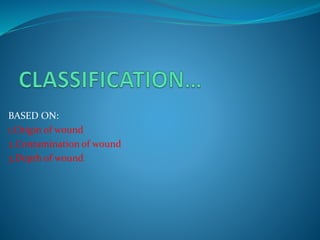
A wound is a break in the integrity of skin and tissues
often;which may be associated with disruption of structure and
function.
BASED ON:
1.Origin of wound
2.Contamination of wound
3.Depth of wound
1.MECHANICAL. 2.CHEMICAL
(a)Abraded wound Acid and base
(b)Punctured wound 3.RADIATION
(c)Incised wound
(d)Cut wound 4.THERMAL
(e)Crushed wound Burning and freezing
(f)Torn wound
(g)Bite wound 5.Special
(h)Shot wound Toxins and venoms
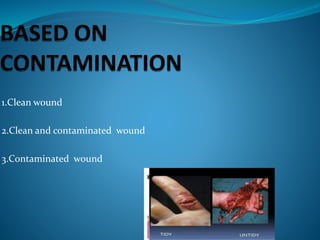
1.Clean wound
2.Clean and contaminated wound
3.Contaminated wound
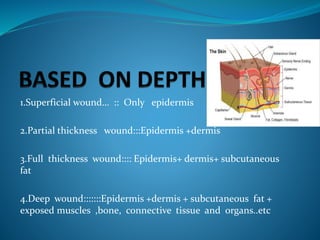
1.Superficial wound… :: Only epidermis
2.Partial thickness wound:::Epidermis +dermis
3.Full thickness wound:::: Epidermis+ dermis+ subcutaneous
fat
4.Deep wound:::::::Epidermis +dermis + subcutaneous fat +
exposed muscles ,bone, connective tissue and organs..etc
DEFINITION:
Healing is the body’s response to injury in an
attempt to restore normal structure and function
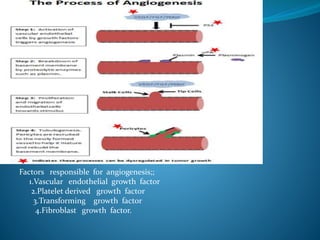
Factors responsible for angiogenesis;;
1.Vascular endothelial growth factor
2.Platelet derived growth factor
3.Transforming growth factor
4.Fibroblast growth factor.
.Recruitment and stimulation of fibroblasts is driven by growth factors
like PDGF,FGF-2 and TGF-beta..
.Macrophages elaborate host of mediators that induce fibroblast
proliferation and ECM deposition..
ROLE OF TGF-beta
.is a potent fibrogenic agent…stimulate production of
collagen,fibronectin,proteoglycans.
.inhibit collafen degradation by decreasing
proteinase activity and increasing activity of tissue inhibitors of
roteinases(TIMPs)
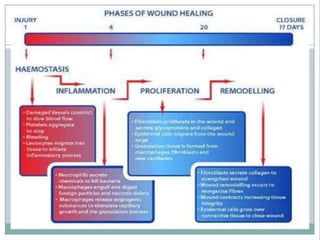
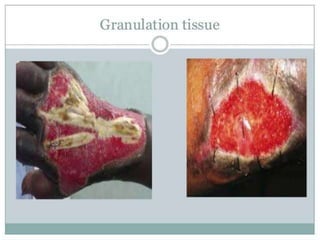
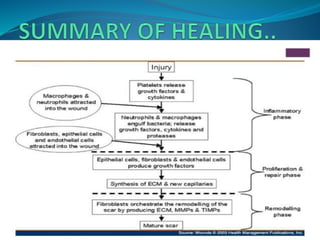
Phases in the formation of granulation tissue.
.PHASE OF INFLAMMATION.
Injury blood clot Acute
inflammatory response with exudation of plasma,
neutrophils,and some monocytes within 24 hrs.
.PHASE OF CLEARANCE
Proteolytic enzymes liberated from
neutrophis, autolytic enzymes from dead tissue and phagocytic
activity of macrophages clear off the necrotic tissue,debris and
red blood cells..
Composed of;:spindle shaped fibroblasts, dense collagen,
fragments of elastic tissue and other ECM components..
.Reepithelialization which is wound recovery with new epithelium
and consists both migration and proliferation of keratinocytes from
the lesion periphery also occurs during this phase….
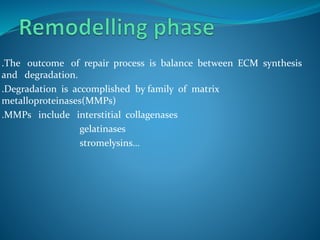
.The outcome of repair process is balance between ECM synthesis
and degradation.
.Degradation is accomplished by family of matrix
metalloproteinases(MMPs)
.MMPs include interstitial collagenases
gelatinases
stromelysins…
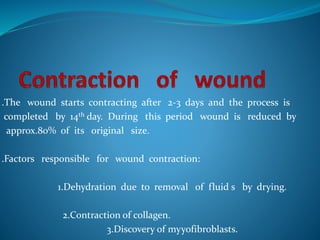
.The wound starts contracting after 2-3 days and the process is
completed by 14th day. During this period wound is reduced by
approx.80% of its original size.
.Factors responsible for wound contraction:
1.Dehydration due to removal of fluid s by drying.
2.Contraction of collagen.
3.Discovery of myyofibroblasts.
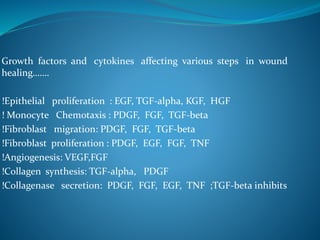
Growth factors and cytokines affecting various steps in wound
healing…….
!Epithelial proliferation : EGF, TGF-alpha, KGF, HGF
! Monocyte Chemotaxis : PDGF, FGF, TGF-beta
!Fibroblast migration: PDGF, FGF, TGF-beta
!Fibroblast proliferation : PDGF, EGF, FGF, TNF
!Angiogenesis: VEGF,FGF
!Collagen synthesis: TGF-alpha, PDGF
!Collagenase secretion: PDGF, FGF, EGF, TNF ;TGF-beta inhibits
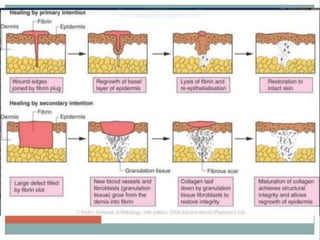
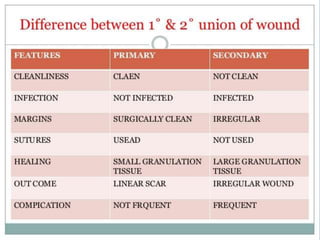
.HEALING BY FIRST INTENTION also called as PRIMARY UNION
.HEALING BY SECOND INTENTION also called as SECONDARY
HEALING…..
(A)LOCAL FACTORS :
.Infection
.Presence of necrotic tissue and foreign body.
.Poor blood supply.
.Venous or lymph stasis.
.Tissue tension
.Hematoma
.Recurrent trauma
.Immobilization
.Site of wound
.Mechanism and type of wound.
.Tissue hypoxia locally reduces macrophage and fibroblast activity..
(B)GENERAL FACTORS ;;
.Age,obesity,smoking
.Vitamin deficiency.(Vit.C and Vit.A)
Anaemia
.Malignancy
.Uremia
.Diabetes,metabolic diseases.
HIV and immunosupressive diseases
.Steroids and cytotoxic drugs.
1.Immediate reaction
2.First week wound
3.Second week wound
4.Third week wound.
5.Fourth week wound
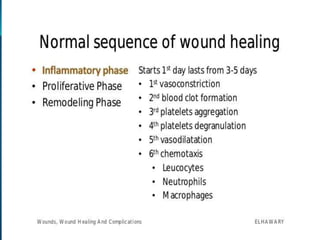
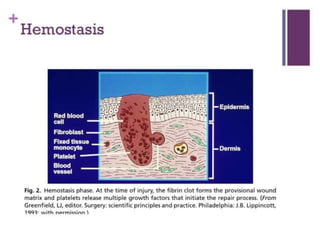
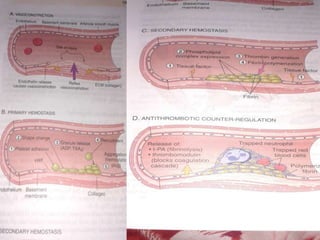
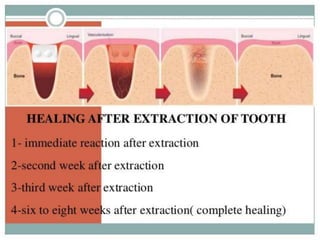
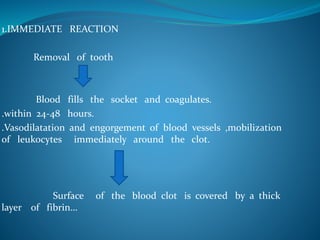
1.IMMEDIATE REACTION
Removal of tooth
Blood fills the socket and coagulates.
.within 24-48 hours.
.Vasodilatation and engorgement of blood vessels ,mobilization
of leukocytes immediately around the clot.
Surface of the blood clot is covered by a thick
layer of fibrin…
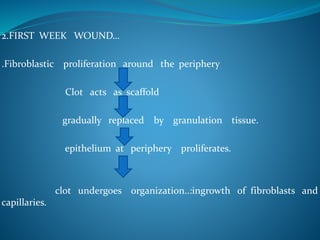
2.FIRST WEEK WOUND…
.Fibroblastic proliferation around the periphery
Clot acts as scaffold
gradually replaced by granulation tissue.
epithelium at periphery proliferates.
clot undergoes organization..:ingrowth of fibroblasts and
capillaries.
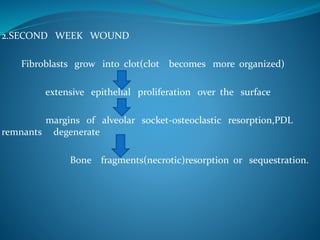
2.SECOND WEEK WOUND
Fibroblasts grow into clot(clot becomes more organized)
extensive epithelial proliferation over the surface
margins of alveolar socket-osteoclastic resorption,PDL
remnants degenerate
Bone fragments(necrotic)resorption or sequestration.
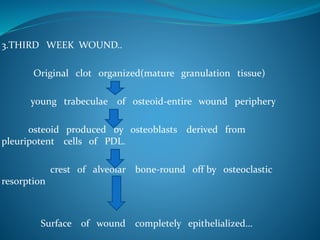
3.THIRD WEEK WOUND..
Original clot organized(mature granulation tissue)
young trabeculae of osteoid-entire wound periphery
osteoid produced by osteoblasts derived from
pleuripotent cells of PDL.
crest of alveolar bone-round off by osteoclastic
resorption
Surface of wound completely epithelialized…
4.FOURTH WEEK WOUND..
.Continued deposition and remodelling resorption of the
bone filling alveolar socket.
.Radiographic evidence of bone formation doesn’t become
prominent until 6th or 8th week….
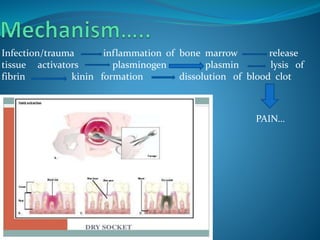
1.DRY SOCKET.
2.FIBROUS UNION.
.The most common and painful complication in the healing of
human extraction wound is alveolar osteitis or dry socket..
.The condition is extremely painful without suppuration and the
presence of foul order….
.It is more commonly associated with difficult and traumatic
extractions like the removal of impacted third molars…
Infection/trauma inflammation of bone marrow release
tissue activators plasminogen plasmin lysis of
fibrin kinin formation dissolution of blood clot
PAIN…
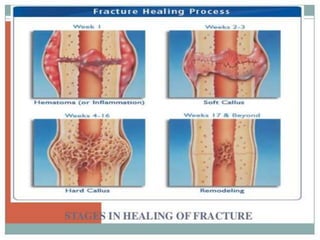
Major phases occur;
1.REACTIVE PHASE…
.Fracture and inflammation
.Granulation tissue formation
2.REPARATIVE PHASE..
.Callus formation
.Lamellar bone deposition
3.REMODELLING PHASE..
Gingivectomy??????
Excision of gingiva by removing the disesaed pocket wall
thereby exposing the tooth surface which provides the
visibility and acessibility that are essential for the complete
removal of irritating surface deposits and thorough
smoothening of roots……
.The initial response after gingivectomy is clot formation.
.Undelying tissue becomes acutely inflammed with some necrosis..
.Clot is replaced by granulation tissue.
.by 24 hrs,increase in new connective tissue cells mainly angioblasts
is seen….
by 3rd day , young fibroblasts are seen.
Highly vascular granulation tissue grows creating
new free marginal gingiva and sulcus…
.After 12-24 hrs, epithelial cells at margin start to migrate over
the granulation tissue separating it from the clot.
.Epithelial cells advance by tumbling action.
.Surface epithelialization is generally completed after 5 to 14
days….
Jonas  adk final copy

Jonas adk final copy

  • 1.
  • 2.
    A wound isa break in the integrity of skin and tissues often;which may be associated with disruption of structure and function.
  • 3.
    BASED ON: 1.Origin ofwound 2.Contamination of wound 3.Depth of wound
  • 4.
    1.MECHANICAL. 2.CHEMICAL (a)Abraded woundAcid and base (b)Punctured wound 3.RADIATION (c)Incised wound (d)Cut wound 4.THERMAL (e)Crushed wound Burning and freezing (f)Torn wound (g)Bite wound 5.Special (h)Shot wound Toxins and venoms
  • 5.
    1.Clean wound 2.Clean andcontaminated wound 3.Contaminated wound
  • 6.
    1.Superficial wound… ::Only epidermis 2.Partial thickness wound:::Epidermis +dermis 3.Full thickness wound:::: Epidermis+ dermis+ subcutaneous fat 4.Deep wound:::::::Epidermis +dermis + subcutaneous fat + exposed muscles ,bone, connective tissue and organs..etc
  • 7.
    DEFINITION: Healing is thebody’s response to injury in an attempt to restore normal structure and function
  • 15.
    Factors responsible forangiogenesis;; 1.Vascular endothelial growth factor 2.Platelet derived growth factor 3.Transforming growth factor 4.Fibroblast growth factor.
  • 17.
    .Recruitment and stimulationof fibroblasts is driven by growth factors like PDGF,FGF-2 and TGF-beta.. .Macrophages elaborate host of mediators that induce fibroblast proliferation and ECM deposition.. ROLE OF TGF-beta .is a potent fibrogenic agent…stimulate production of collagen,fibronectin,proteoglycans. .inhibit collafen degradation by decreasing proteinase activity and increasing activity of tissue inhibitors of roteinases(TIMPs)
  • 18.
    Phases in theformation of granulation tissue. .PHASE OF INFLAMMATION. Injury blood clot Acute inflammatory response with exudation of plasma, neutrophils,and some monocytes within 24 hrs. .PHASE OF CLEARANCE Proteolytic enzymes liberated from neutrophis, autolytic enzymes from dead tissue and phagocytic activity of macrophages clear off the necrotic tissue,debris and red blood cells.. Composed of;:spindle shaped fibroblasts, dense collagen, fragments of elastic tissue and other ECM components..
  • 20.
    .Reepithelialization which iswound recovery with new epithelium and consists both migration and proliferation of keratinocytes from the lesion periphery also occurs during this phase….
  • 22.
    .The outcome ofrepair process is balance between ECM synthesis and degradation. .Degradation is accomplished by family of matrix metalloproteinases(MMPs) .MMPs include interstitial collagenases gelatinases stromelysins…
  • 23.
    .The wound startscontracting after 2-3 days and the process is completed by 14th day. During this period wound is reduced by approx.80% of its original size. .Factors responsible for wound contraction: 1.Dehydration due to removal of fluid s by drying. 2.Contraction of collagen. 3.Discovery of myyofibroblasts.
  • 25.
    Growth factors andcytokines affecting various steps in wound healing……. !Epithelial proliferation : EGF, TGF-alpha, KGF, HGF ! Monocyte Chemotaxis : PDGF, FGF, TGF-beta !Fibroblast migration: PDGF, FGF, TGF-beta !Fibroblast proliferation : PDGF, EGF, FGF, TNF !Angiogenesis: VEGF,FGF !Collagen synthesis: TGF-alpha, PDGF !Collagenase secretion: PDGF, FGF, EGF, TNF ;TGF-beta inhibits
  • 26.
    .HEALING BY FIRSTINTENTION also called as PRIMARY UNION .HEALING BY SECOND INTENTION also called as SECONDARY HEALING…..
  • 29.
    (A)LOCAL FACTORS : .Infection .Presenceof necrotic tissue and foreign body. .Poor blood supply. .Venous or lymph stasis. .Tissue tension .Hematoma .Recurrent trauma .Immobilization .Site of wound .Mechanism and type of wound. .Tissue hypoxia locally reduces macrophage and fibroblast activity..
  • 30.
    (B)GENERAL FACTORS ;; .Age,obesity,smoking .Vitamindeficiency.(Vit.C and Vit.A) Anaemia .Malignancy .Uremia .Diabetes,metabolic diseases. HIV and immunosupressive diseases .Steroids and cytotoxic drugs.
  • 32.
    1.Immediate reaction 2.First weekwound 3.Second week wound 4.Third week wound. 5.Fourth week wound
  • 33.
    1.IMMEDIATE REACTION Removal oftooth Blood fills the socket and coagulates. .within 24-48 hours. .Vasodilatation and engorgement of blood vessels ,mobilization of leukocytes immediately around the clot. Surface of the blood clot is covered by a thick layer of fibrin…
  • 34.
    2.FIRST WEEK WOUND… .Fibroblasticproliferation around the periphery Clot acts as scaffold gradually replaced by granulation tissue. epithelium at periphery proliferates. clot undergoes organization..:ingrowth of fibroblasts and capillaries.
  • 35.
    2.SECOND WEEK WOUND Fibroblastsgrow into clot(clot becomes more organized) extensive epithelial proliferation over the surface margins of alveolar socket-osteoclastic resorption,PDL remnants degenerate Bone fragments(necrotic)resorption or sequestration.
  • 36.
    3.THIRD WEEK WOUND.. Originalclot organized(mature granulation tissue) young trabeculae of osteoid-entire wound periphery osteoid produced by osteoblasts derived from pleuripotent cells of PDL. crest of alveolar bone-round off by osteoclastic resorption Surface of wound completely epithelialized…
  • 37.
    4.FOURTH WEEK WOUND.. .Continueddeposition and remodelling resorption of the bone filling alveolar socket. .Radiographic evidence of bone formation doesn’t become prominent until 6th or 8th week….
  • 38.
  • 39.
    .The most commonand painful complication in the healing of human extraction wound is alveolar osteitis or dry socket.. .The condition is extremely painful without suppuration and the presence of foul order…. .It is more commonly associated with difficult and traumatic extractions like the removal of impacted third molars…
  • 40.
    Infection/trauma inflammation ofbone marrow release tissue activators plasminogen plasmin lysis of fibrin kinin formation dissolution of blood clot PAIN…
  • 41.
    Major phases occur; 1.REACTIVEPHASE… .Fracture and inflammation .Granulation tissue formation 2.REPARATIVE PHASE.. .Callus formation .Lamellar bone deposition 3.REMODELLING PHASE..
  • 44.
    Gingivectomy?????? Excision of gingivaby removing the disesaed pocket wall thereby exposing the tooth surface which provides the visibility and acessibility that are essential for the complete removal of irritating surface deposits and thorough smoothening of roots……
  • 45.
    .The initial responseafter gingivectomy is clot formation. .Undelying tissue becomes acutely inflammed with some necrosis.. .Clot is replaced by granulation tissue. .by 24 hrs,increase in new connective tissue cells mainly angioblasts is seen…. by 3rd day , young fibroblasts are seen. Highly vascular granulation tissue grows creating new free marginal gingiva and sulcus…
  • 46.
    .After 12-24 hrs,epithelial cells at margin start to migrate over the granulation tissue separating it from the clot. .Epithelial cells advance by tumbling action. .Surface epithelialization is generally completed after 5 to 14 days….