-
JONAH
(joh’nuh) HEBREW: YONA means “dove”
Jonah son of Amittai was an eight-century
B.C prophet from Gath-hepher, a small
Galilean town near Nazareth. He first
appears in the Bible to foretell that King
Jeroboam II of Israel will restore the borders
of the nation “from the entrance of Hamath as
far as the sea of the Arabah [Dead Sea]”.
The book of Jonah is written between the 6th
and 4th centuries B.C
Jonah is unique among
the 12 Minor Prophets in
that his book contains
little prophecy; its single
oracular statement,
“Yet Forty days, and
Nineveh shall be
overthrown!” (Jon 3:4)
The tale begins with
the Lord’s command to
Jonah: “Arise, go to
Nineveh, that great city,
and cry against it; for
their wickedness has
Nineveh, the capital of the powerful
Assyrian empire, a city so large it took three
days to cross, was called “the bloody city, all
fall of lies and booty” (Nah 3:1) by the
prophet Nahum.
But Jonah decided to disobey God. He went
to the seaport of Joppa and broaded a ship
heading for Tarshish. He pays his way to flee
from God’s call.
As the ship sailed across the sea, God sent a
great storm that threatened to break it apart.
The captain wakens him and urges him to
When the crew cast lots to find out
if any passenger was responsible for
the storm, Jonah revealed as the
guilty party.
They ask him to tell them who he is
and where he’s from. ‘I am a Hebrew,
and I worship the Lord, the God of
heaven, who made the sea and the
land’. (Jon 1:9)
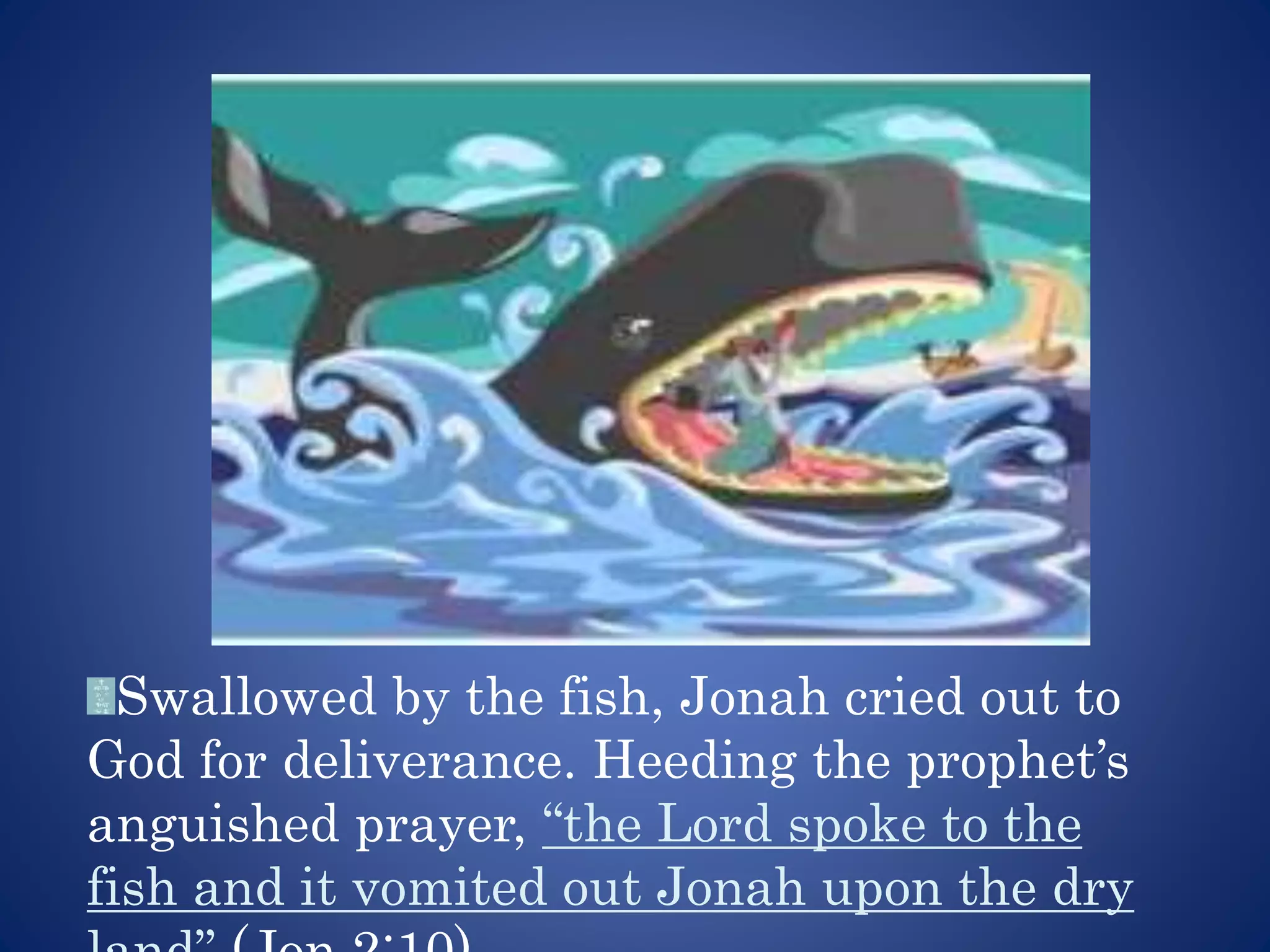
Realizing that God had sent a storm
because of his disobedience, Jonah
begged to be thrown overboard. His
wish was reluctantly granted and, as
soon as he was cast into the sea, the
storm abated.
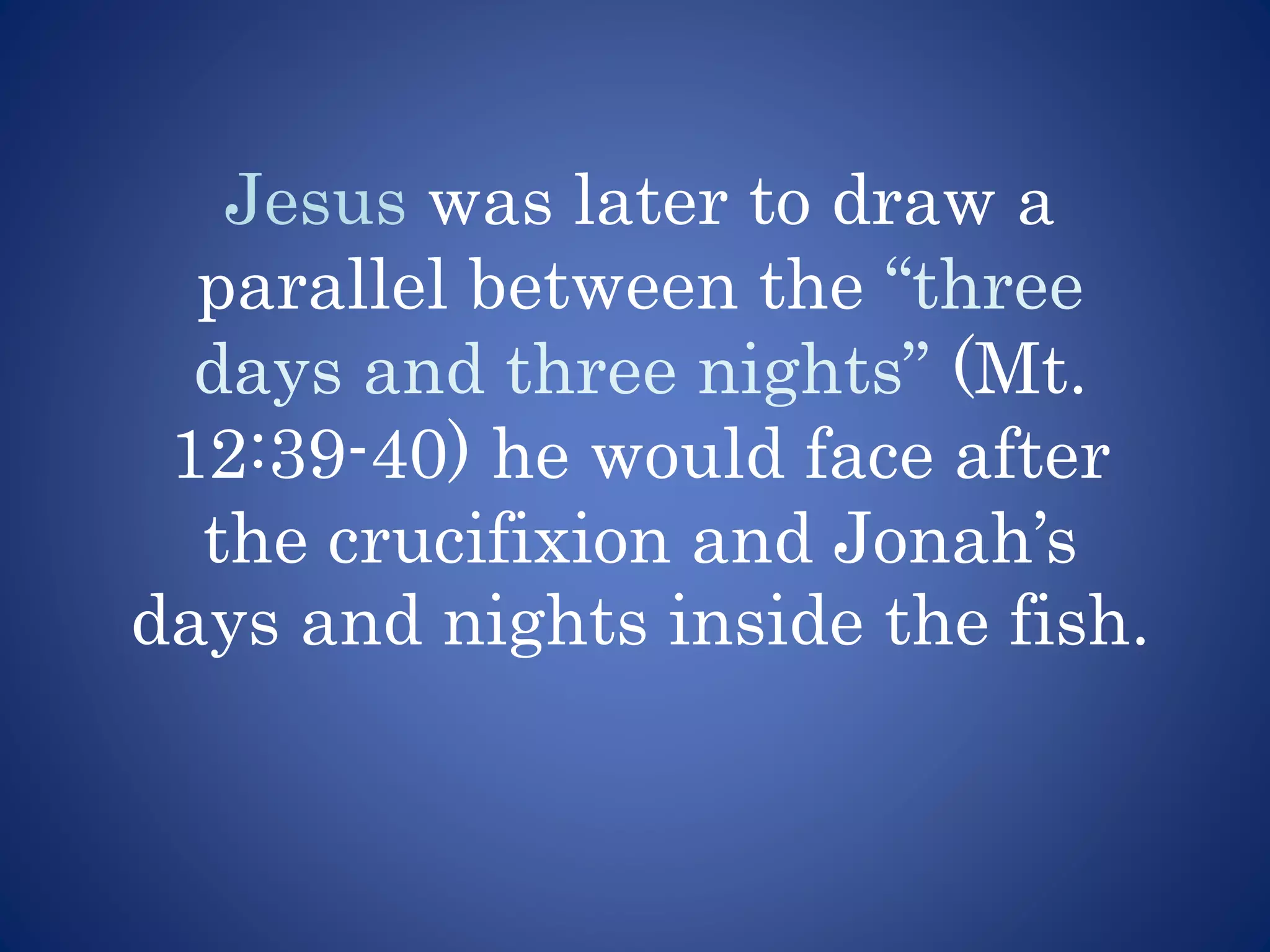
Swallowed by the fish, Jonah cried out to
God for deliverance. Heeding the prophet’s
anguished prayer, “the Lord spoke to the
fish and it vomited out Jonah upon the dry
Again God ordered Jonah to preach in
Nineveh.
Nineveh’s king and people repented,
dressing themselves and even their
animals in Sackloth as a sign of remorse.
In response to the
contrition of Nineveh’s
residents, “God
repented of the evil
which he had said he
would do to them” (Jon
3:10)
Sitting in the hot sun, Jonah
pleaded with God to end his life;
but God created a plant to shade
him. Jonah’s Anger at the Lord’s
Compassion – Jonah is angry with
God, and prays angrily:
~ this is just what I feared You
would do, God !
~ I fled to Tarshish because I
knew You would relent and not
send calamity on Ninevah.
~ ‘I knew that You are a gracious
and compassionate God, slow to
anger and abounding in love’
God questions Jonah’s ‘right to be angry’
about the vine. Jonah says he absolutely does
have the right to be angry enough to die!
God points out that Jonah was upset about
a vine which grew up one day and withered
the next, whereas Ninevah had more than
120,00 people living in it (not to mention the
animals); so, then, the book of Jonah ends
with God asking him a question, ‘Should I
not be concerned about that great city?’ (Jon
4:11)
God is keen to teach Jonah compassion…He
Jesus was later to draw a
parallel between the “three
days and three nights” (Mt.
12:39-40) he would face after
the crucifixion and Jonah’s
days and nights inside the fish.
Jonah

Jonah

  • 1.
  • 2.
    JONAH (joh’nuh) HEBREW: YONAmeans “dove” Jonah son of Amittai was an eight-century B.C prophet from Gath-hepher, a small Galilean town near Nazareth. He first appears in the Bible to foretell that King Jeroboam II of Israel will restore the borders of the nation “from the entrance of Hamath as far as the sea of the Arabah [Dead Sea]”. The book of Jonah is written between the 6th and 4th centuries B.C
  • 3.
    Jonah is uniqueamong the 12 Minor Prophets in that his book contains little prophecy; its single oracular statement, “Yet Forty days, and Nineveh shall be overthrown!” (Jon 3:4) The tale begins with the Lord’s command to Jonah: “Arise, go to Nineveh, that great city, and cry against it; for their wickedness has
  • 4.
    Nineveh, the capitalof the powerful Assyrian empire, a city so large it took three days to cross, was called “the bloody city, all fall of lies and booty” (Nah 3:1) by the prophet Nahum. But Jonah decided to disobey God. He went to the seaport of Joppa and broaded a ship heading for Tarshish. He pays his way to flee from God’s call. As the ship sailed across the sea, God sent a great storm that threatened to break it apart. The captain wakens him and urges him to
  • 5.
    When the crewcast lots to find out if any passenger was responsible for the storm, Jonah revealed as the guilty party. They ask him to tell them who he is and where he’s from. ‘I am a Hebrew, and I worship the Lord, the God of heaven, who made the sea and the land’. (Jon 1:9)
  • 6.
    Realizing that Godhad sent a storm because of his disobedience, Jonah begged to be thrown overboard. His wish was reluctantly granted and, as soon as he was cast into the sea, the storm abated.
  • 7.
    Swallowed by thefish, Jonah cried out to God for deliverance. Heeding the prophet’s anguished prayer, “the Lord spoke to the fish and it vomited out Jonah upon the dry
  • 8.
    Again God orderedJonah to preach in Nineveh. Nineveh’s king and people repented, dressing themselves and even their animals in Sackloth as a sign of remorse. In response to the contrition of Nineveh’s residents, “God repented of the evil which he had said he would do to them” (Jon 3:10)
  • 9.
    Sitting in thehot sun, Jonah pleaded with God to end his life; but God created a plant to shade him. Jonah’s Anger at the Lord’s Compassion – Jonah is angry with God, and prays angrily: ~ this is just what I feared You would do, God ! ~ I fled to Tarshish because I knew You would relent and not send calamity on Ninevah. ~ ‘I knew that You are a gracious and compassionate God, slow to anger and abounding in love’
  • 10.
    God questions Jonah’s‘right to be angry’ about the vine. Jonah says he absolutely does have the right to be angry enough to die! God points out that Jonah was upset about a vine which grew up one day and withered the next, whereas Ninevah had more than 120,00 people living in it (not to mention the animals); so, then, the book of Jonah ends with God asking him a question, ‘Should I not be concerned about that great city?’ (Jon 4:11) God is keen to teach Jonah compassion…He
  • 11.
    Jesus was laterto draw a parallel between the “three days and three nights” (Mt. 12:39-40) he would face after the crucifixion and Jonah’s days and nights inside the fish.