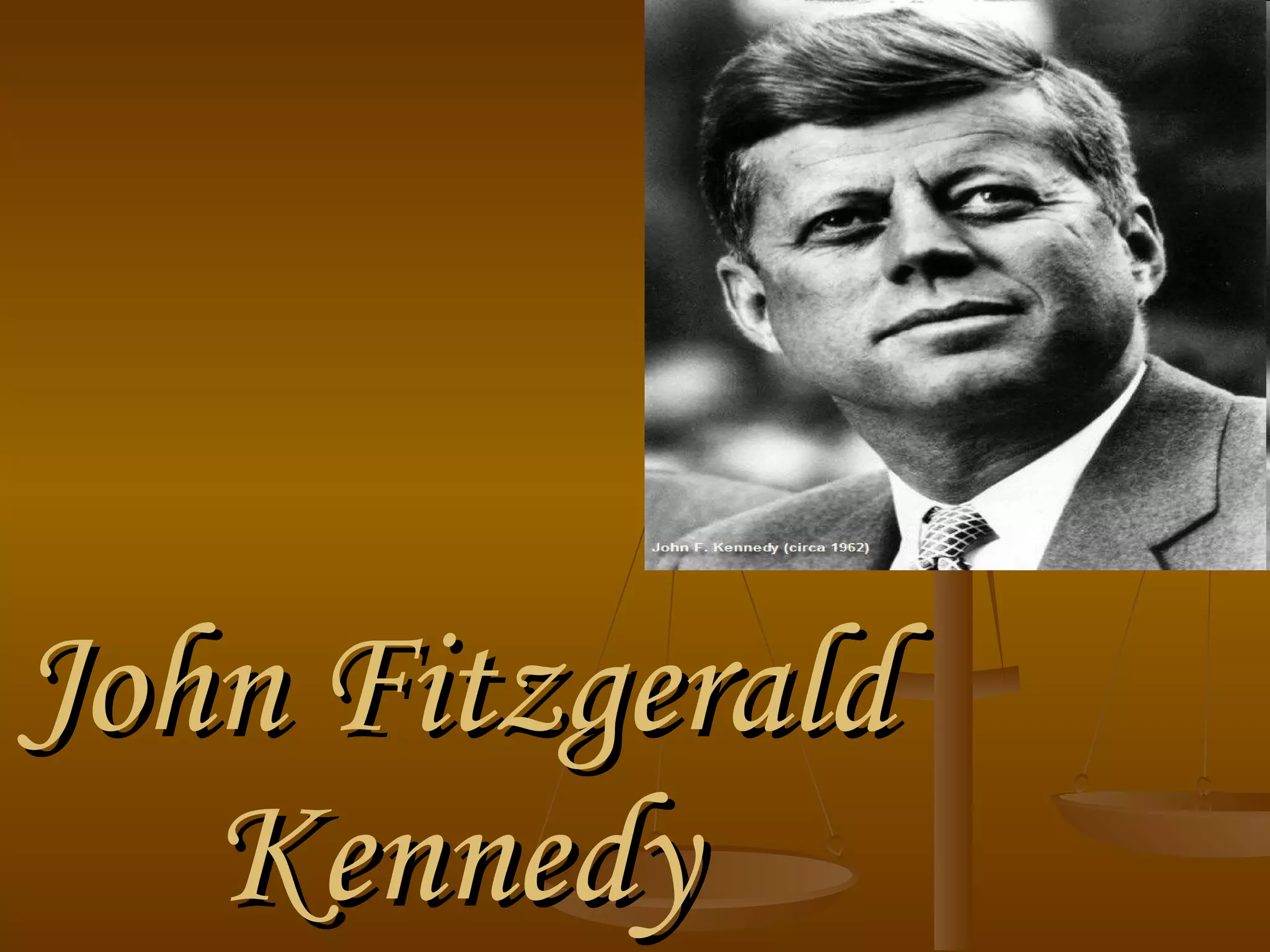
John Fitzgerald Kennedy
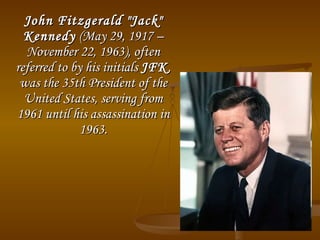
John Fitzgerald "Jack" Kennedy  (May 29, 1917 – November 22, 1963), often referred to by his initials  JFK , was the 35th President of the United States, serving from 1961 until his assassination in 1963.
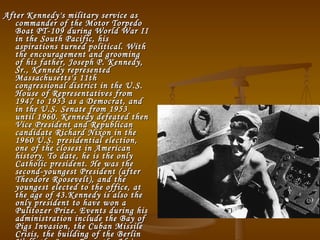
After Kennedy's military service as commander of the Motor Torpedo Boat PT-109 during World War II in the South Pacific, his aspirations turned political. With the encouragement and grooming of his father, Joseph P. Kennedy, Sr., Kennedy represented Massachusetts's 11th congressional district in the U.S. House of Representatives from 1947 to 1953 as a Democrat, and in the U.S. Senate from 1953 until 1960. Kennedy defeated then Vice President and Republican candidate Richard Nixon in the 1960 U.S. presidential election, one of the closest in American history. To date, he is the only Catholic president. He was the second-youngest President (after Theodore Roosevelt), and the youngest elected to the office, at the age of 43.Kennedy is also the only president to have won a Pulitozer Prize. Events during his administration include the Bay of Pigs Invasion, the Cuban Missile Crisis, the building of the Berlin Wall, the Space Race, the African American Civil Rights Movement and early events of the Vietnam War.
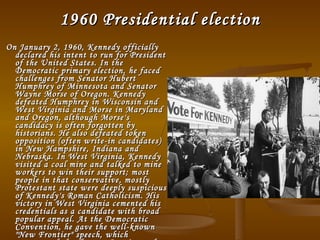
1960 Presidential election On January 2, 1960, Kennedy officially declared his intent to run for President of the United States. In the Democratic primary election, he faced challenges from Senator Hubert Humphrey of Minnesota and Senator Wayne Morse of Oregon. Kennedy defeated Humphrey in Wisconsin and West Virginia and Morse in Maryland and Oregon, although Morse's candidacy is often forgotten by historians. He also defeated token opposition (often write-in candidates) in New Hampshire, Indiana and Nebraska. In West Virginia, Kennedy visited a coal mine and talked to mine workers to win their support; most people in that conservative, mostly Protestant state were deeply suspicious of Kennedy's Roman Catholicism. His victory in West Virginia cemented his credentials as a candidate with broad popular appeal. At the Democratic Convention, he gave the well-known "New Frontier" speech, which represented the changes America and the rest of the world would be going through.
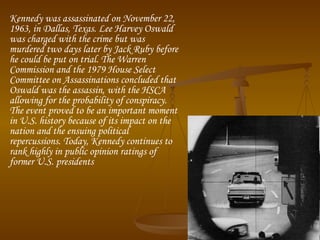
Kennedy was assassinated on November 22, 1963, in Dallas, Texas. Lee Harvey Oswald was charged with the crime but was murdered two days later by Jack Ruby before he could be put on trial. The Warren Commission and the 1979 House Select Committee on Assassinations concluded that Oswald was the assassin, with the HSCA allowing for the probability of conspiracy. The event proved to be an important moment in U.S. history because of its impact on the nation and the ensuing political repercussions. Today, Kennedy continues to rank highly in public opinion ratings of former U.S. presidents
THE END

John Fitzgerald Kennedy

  • 1.
  • 2.
    John Fitzgerald "Jack"Kennedy (May 29, 1917 – November 22, 1963), often referred to by his initials JFK , was the 35th President of the United States, serving from 1961 until his assassination in 1963.
  • 3.
    After Kennedy's militaryservice as commander of the Motor Torpedo Boat PT-109 during World War II in the South Pacific, his aspirations turned political. With the encouragement and grooming of his father, Joseph P. Kennedy, Sr., Kennedy represented Massachusetts's 11th congressional district in the U.S. House of Representatives from 1947 to 1953 as a Democrat, and in the U.S. Senate from 1953 until 1960. Kennedy defeated then Vice President and Republican candidate Richard Nixon in the 1960 U.S. presidential election, one of the closest in American history. To date, he is the only Catholic president. He was the second-youngest President (after Theodore Roosevelt), and the youngest elected to the office, at the age of 43.Kennedy is also the only president to have won a Pulitozer Prize. Events during his administration include the Bay of Pigs Invasion, the Cuban Missile Crisis, the building of the Berlin Wall, the Space Race, the African American Civil Rights Movement and early events of the Vietnam War.
  • 4.
    1960 Presidential electionOn January 2, 1960, Kennedy officially declared his intent to run for President of the United States. In the Democratic primary election, he faced challenges from Senator Hubert Humphrey of Minnesota and Senator Wayne Morse of Oregon. Kennedy defeated Humphrey in Wisconsin and West Virginia and Morse in Maryland and Oregon, although Morse's candidacy is often forgotten by historians. He also defeated token opposition (often write-in candidates) in New Hampshire, Indiana and Nebraska. In West Virginia, Kennedy visited a coal mine and talked to mine workers to win their support; most people in that conservative, mostly Protestant state were deeply suspicious of Kennedy's Roman Catholicism. His victory in West Virginia cemented his credentials as a candidate with broad popular appeal. At the Democratic Convention, he gave the well-known "New Frontier" speech, which represented the changes America and the rest of the world would be going through.
  • 5.
    Kennedy was assassinatedon November 22, 1963, in Dallas, Texas. Lee Harvey Oswald was charged with the crime but was murdered two days later by Jack Ruby before he could be put on trial. The Warren Commission and the 1979 House Select Committee on Assassinations concluded that Oswald was the assassin, with the HSCA allowing for the probability of conspiracy. The event proved to be an important moment in U.S. history because of its impact on the nation and the ensuing political repercussions. Today, Kennedy continues to rank highly in public opinion ratings of former U.S. presidents
  • 6.