1 | Flexible Office Space 2018
Flexible workspace is not just for millennial freelancers or tech startups anymore.
Large, multinational companies are rapidly adding flexible workspaces to their
global portfolios. This report examines the global trends taking place within the
flexible office sector and the implications for the Great Lakes region.
is disrupting the commercial real estate industry
Flexible
Office Space
Corporations
are embracing
flexible space
Shared workspaces have grown at an incredible
rate of 200 percent over the last five years, and
by 2020, it is estimated that there will be 26,000
flexible office locations worldwide.
From start-ups to Fortune 100 companies, flexible
space enables greater efficiency, potential cost
reductions and responsive solutions for a dynamic
business environment. Nearly half of corporations
already use some type of flexible office solution,
and by 2020, 65 percent of companies expect to
incorporate coworking into their office portfolio.
Why businesses are adopting a flexible
workspace model:
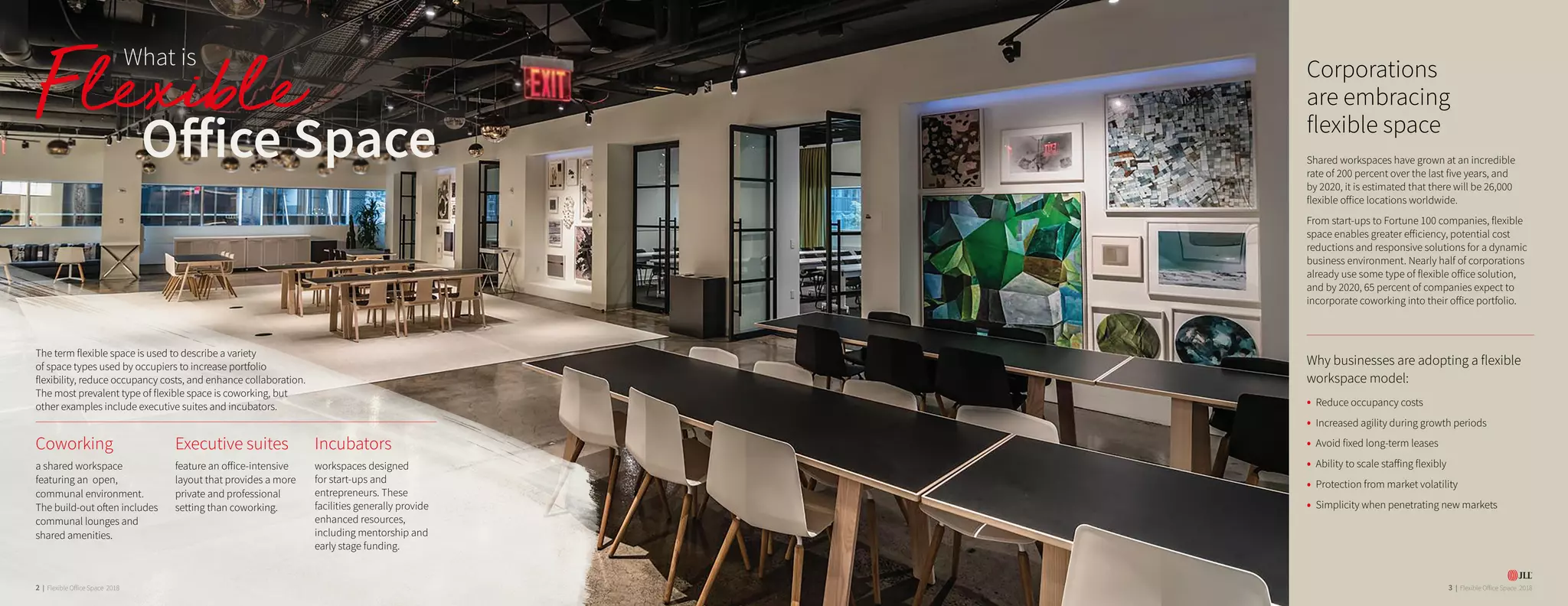
The term flexible space is used to describe a variety
of space types used by occupiers to increase portfolio
flexibility, reduce occupancy costs, and enhance collaboration.
The most prevalent type of flexible space is coworking, but
other examples include executive suites and incubators.
Coworking
a shared workspace
featuring an open,
communal environment.
The build-out often includes
communal lounges and
shared amenities.
Executive suites
feature an office-intensive
layout that provides a more
private and professional
setting than coworking.
Incubators
workspaces designed
for start-ups and
entrepreneurs. These
facilities generally provide
enhanced resources,
including mentorship and
early stage funding.
What is
Flexible
Office Space
•	Reduce occupancy costs
•	Increased agility during growth periods
•	Avoid fixed long-term leases
•	Ability to scale staffing flexibly
•	Protection from market volatility
•	Simplicity when penetrating new markets
2 | Flexible Office Space 2018 3 | Flexible Office Space 2018
Who are the
big players?
The major providers of flexible space include
Regus, WeWork and Servcorp. These three
providers represent 42 percent of the global
market, but there are an estimated 7,600 flexible
space operators worldwide, highlighting the
fragmented nature of the industry.
Are there signs of
market saturation?
Closures have been isolated and contained
mainly to small operators. Competition has
increased as large operators have expanded their
foothold, which has placed pricing pressure on
many groups within the industry.
Given the rapid pace of industry expansion, it may
take time for some markets to fully absorb the
new supply and reach full occupancy. However,
we do not feel the market risks saturation, due in
part to growing demand from corporate users.
4 | Flexible Office Space 2018 5 | Flexible Office Space 2018
for the Great Lakes
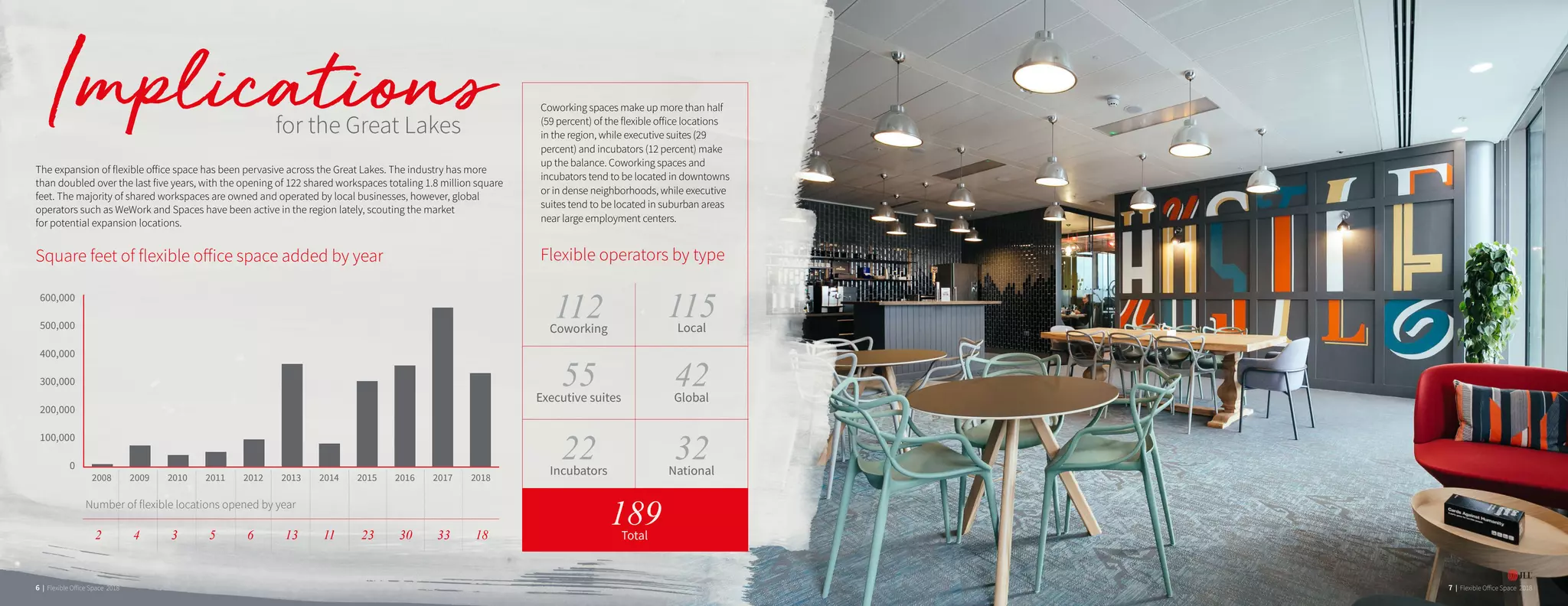
The expansion of flexible office space has been pervasive across the Great Lakes. The industry has more
than doubled over the last five years, with the opening of 122 shared workspaces totaling 1.8 million square
feet. The majority of shared workspaces are owned and operated by local businesses, however, global
operators such as WeWork and Spaces have been active in the region lately, scouting the market
for potential expansion locations.
Coworking spaces make up more than half
(59 percent) of the flexible office locations
in the region, while executive suites (29
percent) and incubators (12 percent) make
up the balance. Coworking spaces and
incubators tend to be located in downtowns
or in dense neighborhoods, while executive
suites tend to be located in suburban areas
near large employment centers.
Flexible operators by type
112Coworking
115Local
55Executive suites
42Global
22Incubators
32National
189Total
2008 2009 2010 2011 2012 2013 2014 2015 2016 2017 2018
600,000
500,000
400,000
300,000
200,000
100,000
0
2 4 3 5 6 13 11 23 30 33 18
Square feet of flexible office space added by year
Number of flexible locations opened by year
Implications
6 | Flexible Office Space 2018 7 | Flexible Office Space 2018
The average flexible office
location is 17,000 square
feet, roughly the size of
one floor in a downtown
office tower. Amenities
typically found at a flexible
office space include: free
beverages, snacks, wifi,
conference rooms, printers,
bike racks, shower rooms,
outdoor spaces, and
curated social events.
Pricing models for flexible
office space vary widely,
ranging from daily to
monthly to multi-year
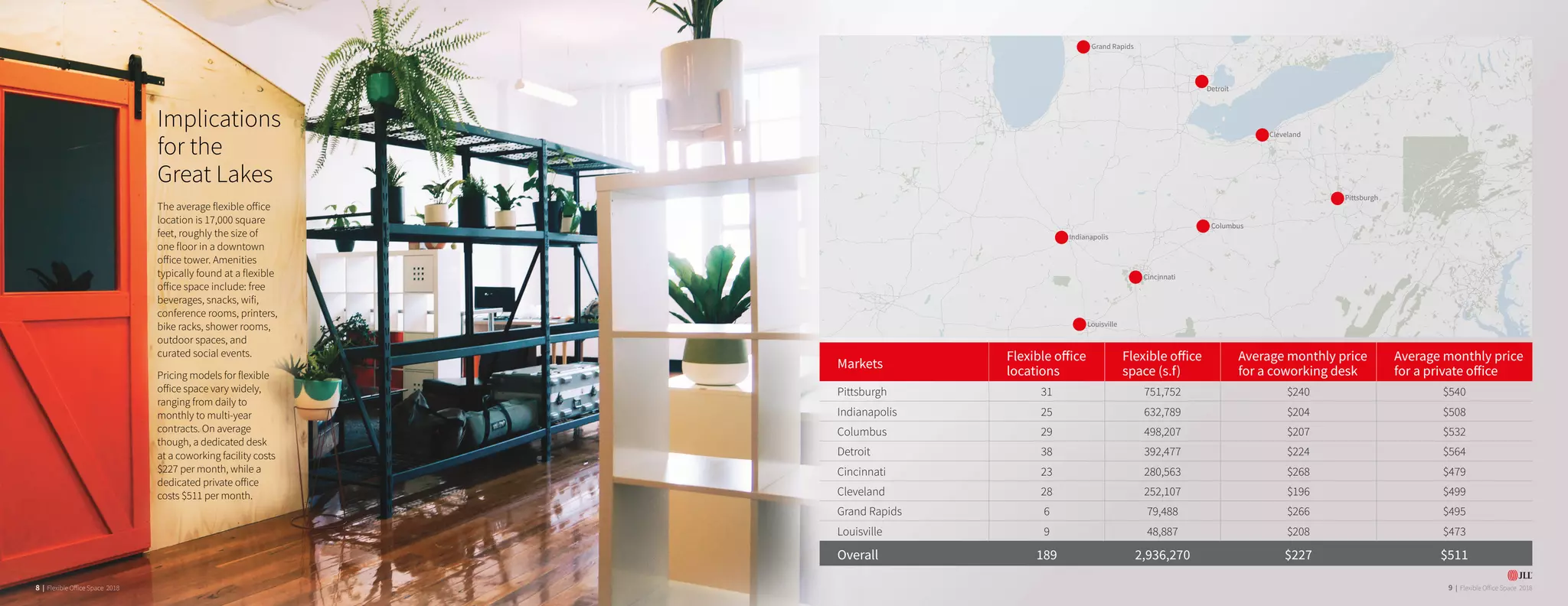
contracts. On average
though, a dedicated desk
at a coworking facility costs
$227 per month, while a
dedicated private office
costs $511 per month.
Implications
for the
Great Lakes
Markets
Flexible office
locations
Flexible office
space (s.f)
Average monthly price
for a coworking desk
Average monthly price
for a private office
Pittsburgh 31 751,752 $240 $540
Indianapolis 25 632,789 $204 $508
Columbus 29 498,207 $207 $532
Detroit 38 392,477 $224 $564
Cincinnati 23 280,563 $268 $479
Cleveland 28 252,107 $196 $499
Grand Rapids 6 79,488 $266 $495
Louisville 9 48,887 $208 $473
Overall 189 2,936,270 $227 $511
8 | Flexible Office Space 2018 9 | Flexible Office Space 2018
Detroit
Louisville
Indianapolis
Columbus
Grand Rapids
Cincinnati
Pittsburgh
Cleveland
150 mi
ForecastCorporate demand
Large-block corporate leasing will
become more prevalent.
Freelancer demand
Continued growth will supplement
the rising share of enterprise users.
Geographic reach
Operators are expanding to the suburbs
and covering more international markets.
M&A within industry
Acquisitions are helping to add scale
and enhance operators global reach.
Operator failures
Future market volatility will test commodity
players, with only the strong surviving.
Industry profitability
Margins are compressing given rising
costs and increased
What’s on the horizon
for flexible space?
The drivers of flexible
space demand
Cost
Challenge:
High capital expenditures for new
offices and an average corporate
utilization rate of just 60 percent.
Opportunity:
The adoption of flexible space can
reduce initial out-of-pocket costs,
enable greater efficiency and drive
down total occupancy costs.
Flexibility
Challenge:
Most organizations only have 24
months of revenue projections and
36 months of strategic planning.
Opportunity:
Flexible space can help organizations
buy time as they launch new initiatives,
establish growth projections and
develop long-term space strategies.
Innovation
Challenge:
In the age of digital nomads,
companies are seeking ways to drive
innovation and collaboration.
Opportunity:
Shared workspaces foster innovation
through increased employee
interaction, exposure to new
business concepts and cross-
pollination of ideas.
Talent management
Challenge:
Employers are finding it increasingly
challenging to manage their digital
workforce. Only 40 percent of
employees feel fully engaged in their
current workplace format.
Opportunity:
Retention is appreciably higher
among employees with access to
flexible workspace options.
10 | Flexible Office Space 2018 11 | Flexible Office Space 2018
About JLL
JLL (NYSE: JLL) is a leading professional services firm that specializes in real estate
and investment management. A Fortune 500 company, JLL helps real estate owners,
occupiers and investors achieve their business ambitions. In 2017, JLL had revenue
of $7.9 billion and fee revenue of $6.7 billion; managed 4.6 billion square feet; and
completed investment sales, acquisitions and finance transactions of approximately
$170 billion. At the end of 2017, JLL had nearly 300 corporate offices, operations in over
80 countries and a global workforce of 82,000. As of December 31, 2017, LaSalle had
$58.1 billion of real estate assets under management. JLL is the brand name, and a
registered trademark, of Jones Lang LaSalle Incorporated. For further information,
visit www.jll.com.
About JLL Research
JLL’s research team delivers intelligence, analysis and insight through market-leading
reports and services that illuminate today’s commercial real estate dynamics and
identify tomorrow’s challenges and opportunities. Our more than 400 global research
professionals track and analyze economic and property trends and forecast future
conditions in over 60 countries, producing unrivalled local and global perspectives.
Our research and expertise, fueled by real-time information and innovative thinking
around the world, creates a competitive advantage for our clients and drives successful
strategies and optimal real estate decisions.
© 2018 Jones Lang LaSalle IP, Inc.
All rights reserved. All information contained herein is from sources deemed reliable; however, no representation or warranty is made to the accuracy thereof.

JLL Flexible Office Space Report

  • 1.
    1 | FlexibleOffice Space 2018 Flexible workspace is not just for millennial freelancers or tech startups anymore. Large, multinational companies are rapidly adding flexible workspaces to their global portfolios. This report examines the global trends taking place within the flexible office sector and the implications for the Great Lakes region. is disrupting the commercial real estate industry Flexible Office Space
  • 2.
    Corporations are embracing flexible space Sharedworkspaces have grown at an incredible rate of 200 percent over the last five years, and by 2020, it is estimated that there will be 26,000 flexible office locations worldwide. From start-ups to Fortune 100 companies, flexible space enables greater efficiency, potential cost reductions and responsive solutions for a dynamic business environment. Nearly half of corporations already use some type of flexible office solution, and by 2020, 65 percent of companies expect to incorporate coworking into their office portfolio. Why businesses are adopting a flexible workspace model: The term flexible space is used to describe a variety of space types used by occupiers to increase portfolio flexibility, reduce occupancy costs, and enhance collaboration. The most prevalent type of flexible space is coworking, but other examples include executive suites and incubators. Coworking a shared workspace featuring an open, communal environment. The build-out often includes communal lounges and shared amenities. Executive suites feature an office-intensive layout that provides a more private and professional setting than coworking. Incubators workspaces designed for start-ups and entrepreneurs. These facilities generally provide enhanced resources, including mentorship and early stage funding. What is Flexible Office Space • Reduce occupancy costs • Increased agility during growth periods • Avoid fixed long-term leases • Ability to scale staffing flexibly • Protection from market volatility • Simplicity when penetrating new markets 2 | Flexible Office Space 2018 3 | Flexible Office Space 2018
  • 3.
    Who are the bigplayers? The major providers of flexible space include Regus, WeWork and Servcorp. These three providers represent 42 percent of the global market, but there are an estimated 7,600 flexible space operators worldwide, highlighting the fragmented nature of the industry. Are there signs of market saturation? Closures have been isolated and contained mainly to small operators. Competition has increased as large operators have expanded their foothold, which has placed pricing pressure on many groups within the industry. Given the rapid pace of industry expansion, it may take time for some markets to fully absorb the new supply and reach full occupancy. However, we do not feel the market risks saturation, due in part to growing demand from corporate users. 4 | Flexible Office Space 2018 5 | Flexible Office Space 2018
  • 4.
    for the GreatLakes The expansion of flexible office space has been pervasive across the Great Lakes. The industry has more than doubled over the last five years, with the opening of 122 shared workspaces totaling 1.8 million square feet. The majority of shared workspaces are owned and operated by local businesses, however, global operators such as WeWork and Spaces have been active in the region lately, scouting the market for potential expansion locations. Coworking spaces make up more than half (59 percent) of the flexible office locations in the region, while executive suites (29 percent) and incubators (12 percent) make up the balance. Coworking spaces and incubators tend to be located in downtowns or in dense neighborhoods, while executive suites tend to be located in suburban areas near large employment centers. Flexible operators by type 112Coworking 115Local 55Executive suites 42Global 22Incubators 32National 189Total 2008 2009 2010 2011 2012 2013 2014 2015 2016 2017 2018 600,000 500,000 400,000 300,000 200,000 100,000 0 2 4 3 5 6 13 11 23 30 33 18 Square feet of flexible office space added by year Number of flexible locations opened by year Implications 6 | Flexible Office Space 2018 7 | Flexible Office Space 2018
  • 5.
    The average flexibleoffice location is 17,000 square feet, roughly the size of one floor in a downtown office tower. Amenities typically found at a flexible office space include: free beverages, snacks, wifi, conference rooms, printers, bike racks, shower rooms, outdoor spaces, and curated social events. Pricing models for flexible office space vary widely, ranging from daily to monthly to multi-year contracts. On average though, a dedicated desk at a coworking facility costs $227 per month, while a dedicated private office costs $511 per month. Implications for the Great Lakes Markets Flexible office locations Flexible office space (s.f) Average monthly price for a coworking desk Average monthly price for a private office Pittsburgh 31 751,752 $240 $540 Indianapolis 25 632,789 $204 $508 Columbus 29 498,207 $207 $532 Detroit 38 392,477 $224 $564 Cincinnati 23 280,563 $268 $479 Cleveland 28 252,107 $196 $499 Grand Rapids 6 79,488 $266 $495 Louisville 9 48,887 $208 $473 Overall 189 2,936,270 $227 $511 8 | Flexible Office Space 2018 9 | Flexible Office Space 2018 Detroit Louisville Indianapolis Columbus Grand Rapids Cincinnati Pittsburgh Cleveland 150 mi
  • 6.
    ForecastCorporate demand Large-block corporateleasing will become more prevalent. Freelancer demand Continued growth will supplement the rising share of enterprise users. Geographic reach Operators are expanding to the suburbs and covering more international markets. M&A within industry Acquisitions are helping to add scale and enhance operators global reach. Operator failures Future market volatility will test commodity players, with only the strong surviving. Industry profitability Margins are compressing given rising costs and increased What’s on the horizon for flexible space? The drivers of flexible space demand Cost Challenge: High capital expenditures for new offices and an average corporate utilization rate of just 60 percent. Opportunity: The adoption of flexible space can reduce initial out-of-pocket costs, enable greater efficiency and drive down total occupancy costs. Flexibility Challenge: Most organizations only have 24 months of revenue projections and 36 months of strategic planning. Opportunity: Flexible space can help organizations buy time as they launch new initiatives, establish growth projections and develop long-term space strategies. Innovation Challenge: In the age of digital nomads, companies are seeking ways to drive innovation and collaboration. Opportunity: Shared workspaces foster innovation through increased employee interaction, exposure to new business concepts and cross- pollination of ideas. Talent management Challenge: Employers are finding it increasingly challenging to manage their digital workforce. Only 40 percent of employees feel fully engaged in their current workplace format. Opportunity: Retention is appreciably higher among employees with access to flexible workspace options. 10 | Flexible Office Space 2018 11 | Flexible Office Space 2018
  • 7.
    About JLL JLL (NYSE:JLL) is a leading professional services firm that specializes in real estate and investment management. A Fortune 500 company, JLL helps real estate owners, occupiers and investors achieve their business ambitions. In 2017, JLL had revenue of $7.9 billion and fee revenue of $6.7 billion; managed 4.6 billion square feet; and completed investment sales, acquisitions and finance transactions of approximately $170 billion. At the end of 2017, JLL had nearly 300 corporate offices, operations in over 80 countries and a global workforce of 82,000. As of December 31, 2017, LaSalle had $58.1 billion of real estate assets under management. JLL is the brand name, and a registered trademark, of Jones Lang LaSalle Incorporated. For further information, visit www.jll.com. About JLL Research JLL’s research team delivers intelligence, analysis and insight through market-leading reports and services that illuminate today’s commercial real estate dynamics and identify tomorrow’s challenges and opportunities. Our more than 400 global research professionals track and analyze economic and property trends and forecast future conditions in over 60 countries, producing unrivalled local and global perspectives. Our research and expertise, fueled by real-time information and innovative thinking around the world, creates a competitive advantage for our clients and drives successful strategies and optimal real estate decisions. © 2018 Jones Lang LaSalle IP, Inc. All rights reserved. All information contained herein is from sources deemed reliable; however, no representation or warranty is made to the accuracy thereof.