Jisc infrastructure
reviews of
member sites
Chair: Noel Davis,
Subject specialist (enterprise
security and information
governance), Jisc
The infrastructure
review process and
aggregated results
Rohan Slaughter,
Subject specialist
(network, technologies
and infrastructure), Jisc
> Jisc's infrastructure review is an inclusive service available to
members and provided by the enterprise infrastructure team of
subject specialists.
> This session looks at what is involved in the process, which
doesn't just check the physical infrastructure elements, but also
addresses the true value of the wider IT infrastructure.
> This session presents aggregated observations from circa 70
reviews over the past 18 months. Further addressing the ongoing
value the review has brought to organisations.
> Contributing to the pursuit of excellence
> Speaker: Caroline Cooke, AECC University College.
> Keeping FE on track and progressing
> Speaker: Rob Rawlinson, Calderdale College.
Jisc infrastructure reviews of member sites
>Most of the work of the enterprise infrastructure team of
subject specialists centres around infrastructure reviews for
member sites, consultancy that is offered as member
inclusive practical support.
>This activity involves member site staff who shape, deliver
and manage the many essential components of
infrastructure that enable the success of their organisations.
>Infrastructure review is welcomed by members as a useful
friendly assessment and serves as a vehicle to introduce
additional Jisc services.
Summary
> Our aims
> To give members an independent review of their infrastructure
> Gives Jisc improved ‘deep insight’ into the needs of members
> Jisc Account Managers have found the reports useful for
designing their account engagement moving forwards
> Identifies the (significant) pressures on members
> Allows us to signpost to other Jisc products and services, where
relevant
> IR was developed as a service based on member demand
> Members were requesting this service for a range of reasons:
> Change in staffing, change in service or due to other internally
identified need for a review.
Purpose
>Initial engagement, focusing on review overview document
>Confirm review, agree dates, assign staff (two from team)
>Arrange scoping online chat 4–6 weeks before visit date
>Obtain any available relevant documentation and prepare
>Meet range of member site staff during visit (at least one day)
>Methodically discuss structured set of infrastructure related
areas
>Prepare review report, check draft with member, publish
How we go about it
Areas covered
1. Strategic considerations
2. IT support team
3. Networks
4. Servers and storage
5. Core enterprise services
6. Enterprise applications
7. Device management
8. Security
9. Governance
Preparation
Structure of discussions
The report
Executive
summary
Key
points
Next step
recommendation
s
What are we learning…
> Welcomed by member representatives, with strong engagement
> Emerging benchmark metrics, e.g. IT support staff to users ratio
> Identifying funding, staffing and leadership pressures on members
> We can mediate effectively between parties at a member site
> Often a group wants objective confirmation of what they know
> Well endowed server room resources exist and also the opposite
> Opportunities for Jisc “match-making”, member savings and DR
facilities
> Some uncomfortable realities uncovered
> Poor security, inadequate backups and disaster recovery
arrangements
General observations from ~70 reviews
> Server room resources
> We have seen some outstanding data centre provision in FE
and HE
> We feel that there is the potential for Colleges and Universities
to offer up their ‘spare’ data centre resources to other Jisc
members
> There may be the potential for two sites to host each other’s DR
> We have suggested that Jisc could produce a template
agreement that members could use to form their own
agreements
> There is the potential for Jisc staff to identify where the ‘spare’
resources may be
General point
>Resources are highly constrained
>Many IT Teams are too small
>Difficult to maintain refresh schedules
>Project work constantly delayed or not initiated
>Strategic thinking takes a “back seat”
>In some cases leading to high organisation viability risk
>A large number of dedicated and highly skilled colleagues
>Often working under substantial pressure
>A little data warehouse “development” can go a long way
Specific Further Education points
>Smaller organisations have similar issues to FE
>Larger scale organisations usually have larger IT teams
>Organisational structures often do not match systems use
>There are significant cyber-security concerns
>Managed desktops not as common as in FE
>“Academic freedom” often cited as reason to not operate
securely
>Universities have central IT, but often departments run
their own systems
Specific Higher Education points
Concluding considerations
Interaction with the
right people
Solutions in context
Ideal basis for
ongoing
meaningful
relations
Significant value to
member and Jisc
Infrastructure review
Contact details:
Enterprise infrastructure sub team of Jisc subject
specialists
enterpriseinfrastructure@jisc365.onmicrosoft.com
Contributing to
the pursuit of
excellence
Caroline Cooke, AECC
University College
• Working alongside Jisc
• Caroline Cooke
• Head of Library and Learning Services
Contributing to the Pursuit of Excellence
• 2014: HE College
• Undergraduate Chiropractic Programme
• MSc Medical Ultrasound
• Growth in Clinical Services: Chiropractic Clinic, X-Ray facilities,
Open Upright MRI, Ultrasound Clinic
• TDAP: growth and diversification
Background
• Identified areas requiring strategic support
• Partners and experts…
• Jisc
• Digifest 2016
• Aim: Review IT provision and embed support for digital learning
and teaching within IT Strategy
Towards Transformation
• Teleconference: Where are we now?
• Led by Rohan Slaughter with
Peter Ford Executive Director of Administration, Steve Goode
IT Manager, Caroline Cooke Head of Learning Services and
E-Developments
• Strategy documents reviewed
• In-depth information on infrastructure
• Structure and team profiles
• Ongoing support outlined…
Work starts
• Subject specialists George Munroe, Rohan Slaughter
• Meetings with key stakeholders from across the
organisation: assess current situation and Vision
• Desk based Infrastructure Review
• Supportive IT skills audit workshop
Technology Strategy and
Infrastructure Review, March 2017
• Mobile devices for use in the classroom
• Flexibility: operating systems, internet browsers, access
• Fast, Integrated systems, SSO
• Seamless, simplified access to learning and teaching, EMA
• Dashboards and data
• More support for staff training
• External reporting requirements:
• HEFCE, HESA
• ASAP!
Key stakeholder meetings: themes
• Strategy and Infrastructure
• IT Skills Audit
• Key points, detailed notes
• Next steps and support
• Expert level evidence linked to strategy
• Reviewed by Executive Team and Board
Extensive Reports
Consistency across the learning and teaching experience
Real-time tools for meetings and tutorials
Virtual and Augmented Reality medical simulations
Short online polls what’s the ‘biggest issue right now’ – “discussing the ‘now’ in real time”
Student portal self-service: online payments, room bookings, admin etc.
Push notifications
Data to inform decision making
Intelligent campus
Clear expectations of digital teaching and learning
Multiple platform support, devices, Operating Systems
Staff Workshop, summer 2017:
What would Outstanding look like?
• Strategy development workshop and IT briefing
• Draft Strategy
• Digital Learning workshop ‘Has Learning Really Changed?’ James Clay (Digital Leaders)
• Informal group of digital champions – peer to peer training and support
• Presented draft strategy to Board in November
• Presented vision for digital learning and teaching to Board in Jan
• E-learning Group established
• Draft strategy reviewed by SMG
• Focus Groups to come (students and staff)
• Final presentation to Board by Peter Ford in July
Achievements since the
Infrastructure Review
• IT is a higher institutional priority; enhanced understanding of
IT at all levels
• Draft strategy, now with project timeline and costings
• Engagement and ownership from staff
• Recruiting new staff in line with strategic requirements
• Office 365 for students
• Surface tablets for staff
• Inspiring confidence across the UC
Impact
• “Reassurance that we are on the right track”
• “Reassured by the fact that it was unbiased review”
• “Confidence to know that the strategic recommendations would be in line with the
wider HE sector, rather than merely our own (sometimes insular) view”.
• “great confidence-boost to our staff to be recognised by sector-experts; often
smaller institutions lack confidence due to resources available to them, but this
showed we have the knowledge and expertise here, with a little help.”
• “We talk about digital in a strategic way now”
Feedback from SMG
Feedback from the IT Team
Clearer Shared Vision
Keeping FE on track
and progressing
Rob Rawlinson
Head of IT and estates
>2016 - New Principal and Chief Executive
>Strategic review resulting in a new 3 year strategy
>Development of a Technology Strategy, moving away
from traditional IT and ILT strategies
>Jisc identified as a key stakeholder to help develop
the Technology Strategy
Our decision to work with Jisc
>Understand Calderdale’s strategic plans
>Fact-find with key internal stakeholders to understand
priorities and constraints
>Fact-find with IT staff to establish the infrastructure and
team’s operating position
>Facilitate a Technology Strategy development day with
the College SMT:
Where are we now? How do we get there?
Where do we want to be? Who will get us there?
Working with Jisc to develop a Technology Strategy
>Infrastructure review - essential for developing the
Technology Strategy
>In scope:
- Core IT infrastructure (servers / storage / networks / phone system)
- IT security
- Management of core infrastructure and desktops
- Backups and disaster recovery
- Use of Cloud and on-premise services
- Mobile devices
- IT team capacity and capabilities
- Compliance with PREVENT
Infrastructure review service
1) Sector and subject specialists
> A comprehensive understanding of:
- The FE sector
- The operating model of FE colleges
- Senior leadership and management experience
- Technical and IT management
- Compliance with relative legislation
Infrastructure review – The benefits
2) Trusted advisors
> No hidden agenda
> Open, honest and flexible
> Products and services designed specifically to support and
enhance FE, HE, research organisations, to ultimately benefit
our students
Infrastructure review – The benefits
3) Key outcomes
> Comprehensive reports
> Identify risks
> All key stakeholders engaged
> Input and support with key decisions
> Ongoing ‘Critical Friend’ support
> Value for money
Infrastructure review – The benefits
Rohan Slaughter
Subject specialist
rohan.slaughter@jisc.ac.uk
Contact details
6th Floor, Churchgate House, 56 Oxford Street, Manchester, M1 6EU
T 07468 727047
customerservices@jisc.ac.uk
jisc.ac.uk
Thank you!
Any questions?

Jisc infrastructure reviews of member sites

  • 1.
    Jisc infrastructure reviews of membersites Chair: Noel Davis, Subject specialist (enterprise security and information governance), Jisc
  • 2.
    The infrastructure review processand aggregated results Rohan Slaughter, Subject specialist (network, technologies and infrastructure), Jisc
  • 3.
    > Jisc's infrastructurereview is an inclusive service available to members and provided by the enterprise infrastructure team of subject specialists. > This session looks at what is involved in the process, which doesn't just check the physical infrastructure elements, but also addresses the true value of the wider IT infrastructure. > This session presents aggregated observations from circa 70 reviews over the past 18 months. Further addressing the ongoing value the review has brought to organisations. > Contributing to the pursuit of excellence > Speaker: Caroline Cooke, AECC University College. > Keeping FE on track and progressing > Speaker: Rob Rawlinson, Calderdale College. Jisc infrastructure reviews of member sites
  • 4.
    >Most of thework of the enterprise infrastructure team of subject specialists centres around infrastructure reviews for member sites, consultancy that is offered as member inclusive practical support. >This activity involves member site staff who shape, deliver and manage the many essential components of infrastructure that enable the success of their organisations. >Infrastructure review is welcomed by members as a useful friendly assessment and serves as a vehicle to introduce additional Jisc services. Summary
  • 5.
    > Our aims >To give members an independent review of their infrastructure > Gives Jisc improved ‘deep insight’ into the needs of members > Jisc Account Managers have found the reports useful for designing their account engagement moving forwards > Identifies the (significant) pressures on members > Allows us to signpost to other Jisc products and services, where relevant > IR was developed as a service based on member demand > Members were requesting this service for a range of reasons: > Change in staffing, change in service or due to other internally identified need for a review. Purpose
  • 6.
    >Initial engagement, focusingon review overview document >Confirm review, agree dates, assign staff (two from team) >Arrange scoping online chat 4–6 weeks before visit date >Obtain any available relevant documentation and prepare >Meet range of member site staff during visit (at least one day) >Methodically discuss structured set of infrastructure related areas >Prepare review report, check draft with member, publish How we go about it
  • 7.
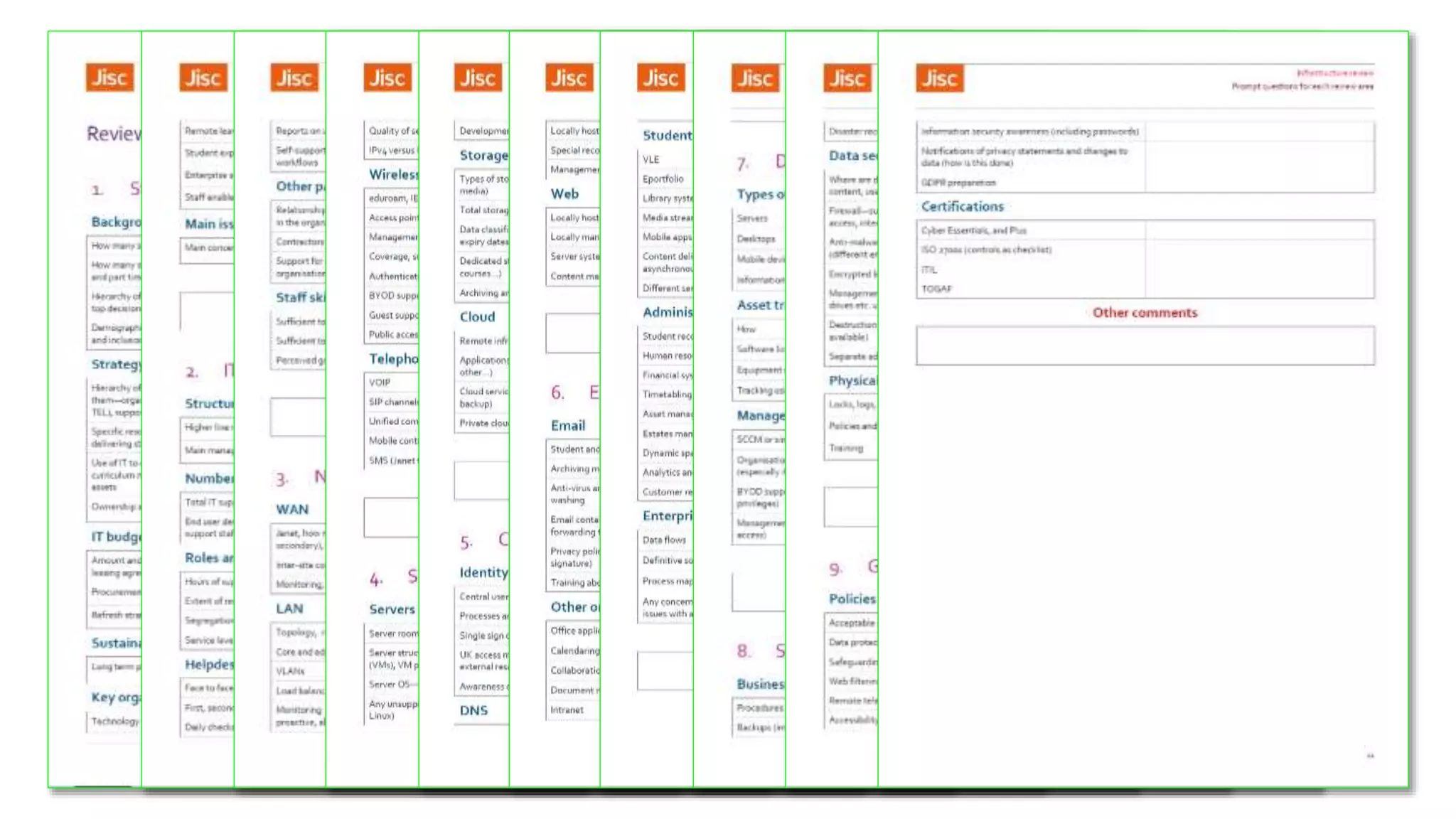
    Areas covered 1. Strategicconsiderations 2. IT support team 3. Networks 4. Servers and storage 5. Core enterprise services 6. Enterprise applications 7. Device management 8. Security 9. Governance
  • 8.
  • 9.
  • 11.
  • 12.
    What are welearning…
  • 13.
    > Welcomed bymember representatives, with strong engagement > Emerging benchmark metrics, e.g. IT support staff to users ratio > Identifying funding, staffing and leadership pressures on members > We can mediate effectively between parties at a member site > Often a group wants objective confirmation of what they know > Well endowed server room resources exist and also the opposite > Opportunities for Jisc “match-making”, member savings and DR facilities > Some uncomfortable realities uncovered > Poor security, inadequate backups and disaster recovery arrangements General observations from ~70 reviews
  • 14.
    > Server roomresources > We have seen some outstanding data centre provision in FE and HE > We feel that there is the potential for Colleges and Universities to offer up their ‘spare’ data centre resources to other Jisc members > There may be the potential for two sites to host each other’s DR > We have suggested that Jisc could produce a template agreement that members could use to form their own agreements > There is the potential for Jisc staff to identify where the ‘spare’ resources may be General point
  • 15.
    >Resources are highlyconstrained >Many IT Teams are too small >Difficult to maintain refresh schedules >Project work constantly delayed or not initiated >Strategic thinking takes a “back seat” >In some cases leading to high organisation viability risk >A large number of dedicated and highly skilled colleagues >Often working under substantial pressure >A little data warehouse “development” can go a long way Specific Further Education points
  • 16.
    >Smaller organisations havesimilar issues to FE >Larger scale organisations usually have larger IT teams >Organisational structures often do not match systems use >There are significant cyber-security concerns >Managed desktops not as common as in FE >“Academic freedom” often cited as reason to not operate securely >Universities have central IT, but often departments run their own systems Specific Higher Education points
  • 17.
    Concluding considerations Interaction withthe right people Solutions in context Ideal basis for ongoing meaningful relations Significant value to member and Jisc Infrastructure review
  • 18.
    Contact details: Enterprise infrastructuresub team of Jisc subject specialists enterpriseinfrastructure@jisc365.onmicrosoft.com
  • 19.
    Contributing to the pursuitof excellence Caroline Cooke, AECC University College
  • 20.
    • Working alongsideJisc • Caroline Cooke • Head of Library and Learning Services Contributing to the Pursuit of Excellence
  • 21.
    • 2014: HECollege • Undergraduate Chiropractic Programme • MSc Medical Ultrasound • Growth in Clinical Services: Chiropractic Clinic, X-Ray facilities, Open Upright MRI, Ultrasound Clinic • TDAP: growth and diversification Background
  • 22.
    • Identified areasrequiring strategic support • Partners and experts… • Jisc • Digifest 2016 • Aim: Review IT provision and embed support for digital learning and teaching within IT Strategy Towards Transformation
  • 23.
    • Teleconference: Whereare we now? • Led by Rohan Slaughter with Peter Ford Executive Director of Administration, Steve Goode IT Manager, Caroline Cooke Head of Learning Services and E-Developments • Strategy documents reviewed • In-depth information on infrastructure • Structure and team profiles • Ongoing support outlined… Work starts
  • 24.
    • Subject specialistsGeorge Munroe, Rohan Slaughter • Meetings with key stakeholders from across the organisation: assess current situation and Vision • Desk based Infrastructure Review • Supportive IT skills audit workshop Technology Strategy and Infrastructure Review, March 2017
  • 25.
    • Mobile devicesfor use in the classroom • Flexibility: operating systems, internet browsers, access • Fast, Integrated systems, SSO • Seamless, simplified access to learning and teaching, EMA • Dashboards and data • More support for staff training • External reporting requirements: • HEFCE, HESA • ASAP! Key stakeholder meetings: themes
  • 26.
    • Strategy andInfrastructure • IT Skills Audit • Key points, detailed notes • Next steps and support • Expert level evidence linked to strategy • Reviewed by Executive Team and Board Extensive Reports
  • 27.
    Consistency across thelearning and teaching experience Real-time tools for meetings and tutorials Virtual and Augmented Reality medical simulations Short online polls what’s the ‘biggest issue right now’ – “discussing the ‘now’ in real time” Student portal self-service: online payments, room bookings, admin etc. Push notifications Data to inform decision making Intelligent campus Clear expectations of digital teaching and learning Multiple platform support, devices, Operating Systems Staff Workshop, summer 2017: What would Outstanding look like?
  • 28.
    • Strategy developmentworkshop and IT briefing • Draft Strategy • Digital Learning workshop ‘Has Learning Really Changed?’ James Clay (Digital Leaders) • Informal group of digital champions – peer to peer training and support • Presented draft strategy to Board in November • Presented vision for digital learning and teaching to Board in Jan • E-learning Group established • Draft strategy reviewed by SMG • Focus Groups to come (students and staff) • Final presentation to Board by Peter Ford in July Achievements since the Infrastructure Review
  • 29.
    • IT isa higher institutional priority; enhanced understanding of IT at all levels • Draft strategy, now with project timeline and costings • Engagement and ownership from staff • Recruiting new staff in line with strategic requirements • Office 365 for students • Surface tablets for staff • Inspiring confidence across the UC Impact
  • 30.
    • “Reassurance thatwe are on the right track” • “Reassured by the fact that it was unbiased review” • “Confidence to know that the strategic recommendations would be in line with the wider HE sector, rather than merely our own (sometimes insular) view”. • “great confidence-boost to our staff to be recognised by sector-experts; often smaller institutions lack confidence due to resources available to them, but this showed we have the knowledge and expertise here, with a little help.” • “We talk about digital in a strategic way now” Feedback from SMG
  • 31.
  • 32.
  • 33.
    Keeping FE ontrack and progressing Rob Rawlinson Head of IT and estates
  • 35.
    >2016 - NewPrincipal and Chief Executive >Strategic review resulting in a new 3 year strategy >Development of a Technology Strategy, moving away from traditional IT and ILT strategies >Jisc identified as a key stakeholder to help develop the Technology Strategy Our decision to work with Jisc
  • 36.
    >Understand Calderdale’s strategicplans >Fact-find with key internal stakeholders to understand priorities and constraints >Fact-find with IT staff to establish the infrastructure and team’s operating position >Facilitate a Technology Strategy development day with the College SMT: Where are we now? How do we get there? Where do we want to be? Who will get us there? Working with Jisc to develop a Technology Strategy
  • 37.
    >Infrastructure review -essential for developing the Technology Strategy >In scope: - Core IT infrastructure (servers / storage / networks / phone system) - IT security - Management of core infrastructure and desktops - Backups and disaster recovery - Use of Cloud and on-premise services - Mobile devices - IT team capacity and capabilities - Compliance with PREVENT Infrastructure review service
  • 38.
    1) Sector andsubject specialists > A comprehensive understanding of: - The FE sector - The operating model of FE colleges - Senior leadership and management experience - Technical and IT management - Compliance with relative legislation Infrastructure review – The benefits
  • 39.
    2) Trusted advisors >No hidden agenda > Open, honest and flexible > Products and services designed specifically to support and enhance FE, HE, research organisations, to ultimately benefit our students Infrastructure review – The benefits
  • 40.
    3) Key outcomes >Comprehensive reports > Identify risks > All key stakeholders engaged > Input and support with key decisions > Ongoing ‘Critical Friend’ support > Value for money Infrastructure review – The benefits
  • 41.
    Rohan Slaughter Subject specialist rohan.slaughter@jisc.ac.uk Contactdetails 6th Floor, Churchgate House, 56 Oxford Street, Manchester, M1 6EU T 07468 727047 customerservices@jisc.ac.uk jisc.ac.uk
  • 42.

Editor's Notes

  • #7 Process In FE Colleges typically 2 Jisc staff are onsite for 1 day More staff deployed for longer in larger HE contexts We work through a structured template in a ‘desk based review’ Include a site tour, highlighting all IT areas as deemed relevant Review documentation: Top level network diagrams Any planning or strategy docs Allied policies / procedures relevant to the review Team organisational charts to show areas of responsibility
  • #11 Guideline questions Are used as a prompt for us to ensure all areas are covered Have been developed by the team following review Are also used to draw out member responses
  • #12 Deliver a written report structured thus: Executive summary Key points, with notes around how to address each point Suggested next steps (offers of further work to address identified needs) Appendix of IR notes, records of other conversations and other notes
  • #14 Member reasons for participation: This is not an audit, it is a collaborative review Provides a valuable external perspective, that is neutral (not a vendor looking to sell their product or solution) IT teams often understand the issues they are facing and are looking for external validation of their planning Members may have some internal pressures that are preventing improvement Political ‘buy-in’ from senior management Staffing Resources We have found that we are able to help bridge this ‘strategic disconnect’
  • #16 In FE Many IT Teams are too small Development projects are slowed as teams become too operational and not sufficiently strategic In some cases this is leading to very high organisational risk for members Resources are highly constrained This makes refresh schedules very hard to maintain Project work is delayed or not initiated We have met a large number of dedicated and highly skills colleagues, often working under a substantial amount of pressure
  • #18 Membership promotion Adds value to Jisc membership Is a much more in-depth engagement and provides outstanding access to the member and their staff Gateway to many inclusive member or paid for services These are discussed at the review meeting and are highlighted in the report Jisc members are often unaware of many of the wide range of services that are inclusive to membership, many of which can help with their current projects We have an opportunity to build momentum and follow up with other offers: Skills audit workshop and analysis paper Application level review