Meteorology 101
Weather for Teachers
National Weather Service
Part 2
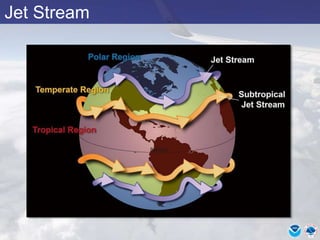
Jet Stream
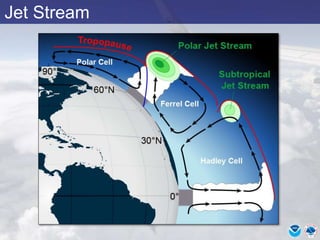
Jet Stream
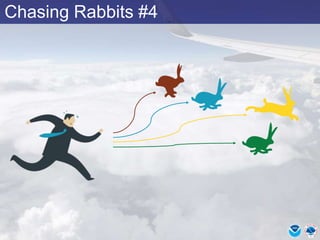
Chasing Rabbits #4
Chasing Rabbits #4
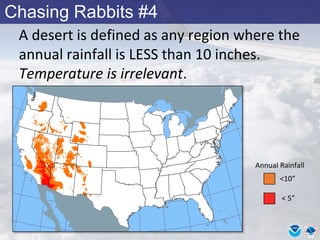
A desert is defined as any region where the
annual rainfall is LESS than 10 inches.
Temperature is irrelevant.
<10”
< 5”
Annual Rainfall
Jet Stream
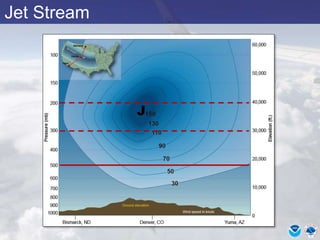
The atmosphere’s response to where
the temperature gradient is strongest
(which is also where the greatest
density change occurs).
Is identified when and where wind
speed is ≥50 kt (but can exceed 200 kt).
What is the Jet Stream?
Jet Stream
Jet Stream
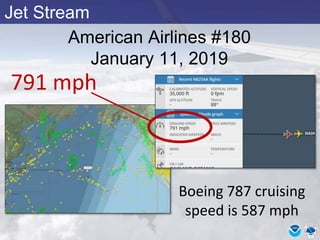
Boeing 787 cruising
speed is 587 mph
American Airlines #180
January 11, 2019
791 mph
Elevation
Jet Stream
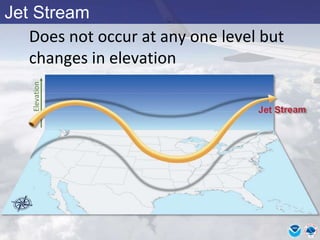
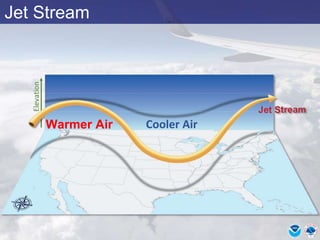
Does not occur at any one level but
changes in elevation
Jet Stream
Elevation
Jet Stream
Cooler Air
Warmer Air
Jet Stream
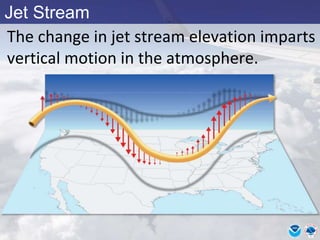
The change in jet stream elevation imparts
vertical motion in the atmosphere.
Jet Stream
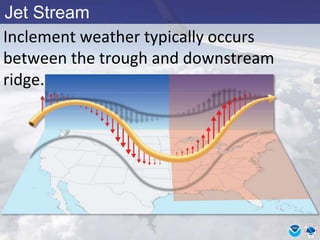
Inclement weather typically occurs
between the trough and downstream
ridge.
Jet Stream
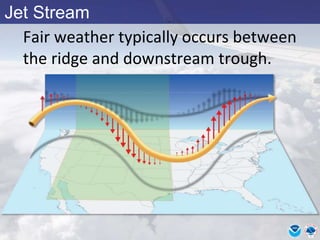
Fair weather typically occurs between
the ridge and downstream trough.
Jet Stream
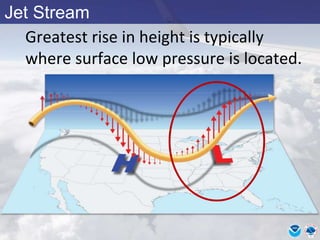
Greatest rise in height is typically
where surface low pressure is located.
Jet Stream
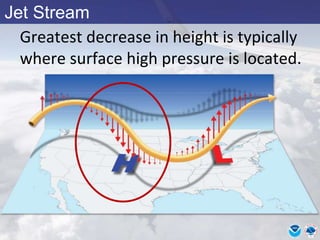
Greatest decrease in height is typically
where surface high pressure is located.
Jet Stream
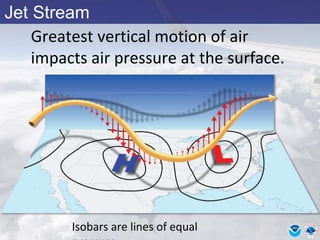
Greatest vertical motion of air
impacts air pressure at the surface.
Isobars are lines of equal
Surface Wind
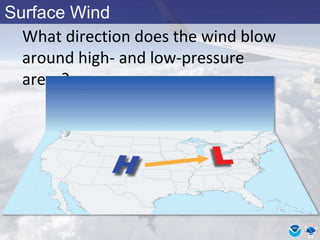
What direction does the wind blow
around high- and low-pressure
areas?
Surface Wind
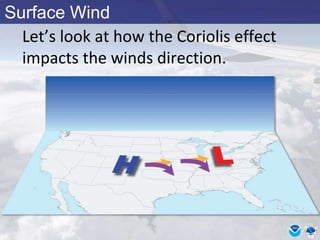
Let’s look at how the Coriolis effect
impacts the winds direction.
Surface Wind
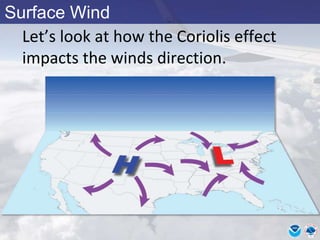
Let’s look at how the Coriolis effect
impacts the winds direction.
Surface Wind
Let’s look at how the Coriolis effect
impacts the winds direction.
Surface Wind
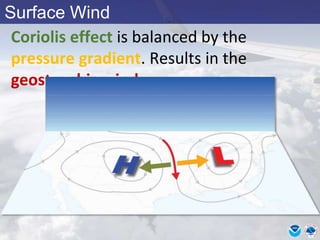
Coriolis effect is balanced by the
pressure gradient. Results in the
geostrophic wind.
Surface Wind
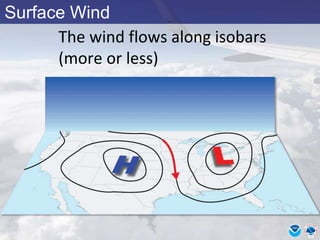
The wind flows along isobars
(more or less)
Chasing Rabbits #5
Chasing Rabbits #5
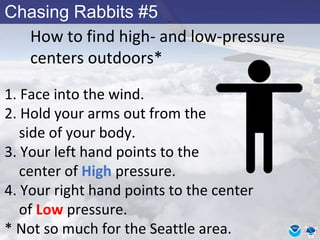
How to find high- and low-pressure
centers outdoors*
1. Face into the wind.
2. Hold your arms out from the
side of your body.
3. Your left hand points to the
center of High pressure.
4. Your right hand points to the center
of Low pressure.
* Not so much for the Seattle area.
Fronts
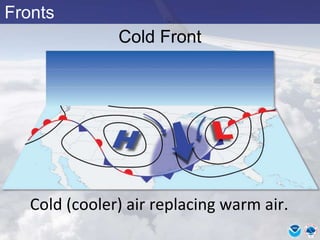
Cold Front
Cold (cooler) air replacing warm air.
Fronts
Fronts
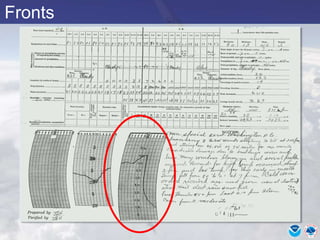
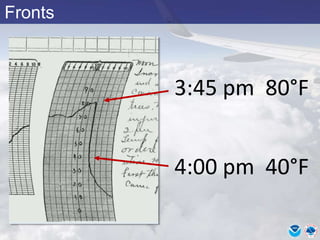
3:45 pm 80°F
4:00 pm 40°F
Fronts
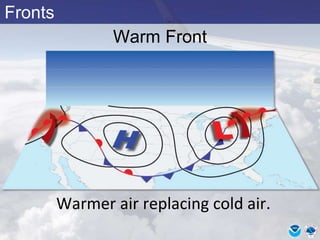
Warm Front
Warmer air replacing cold air.
Fronts
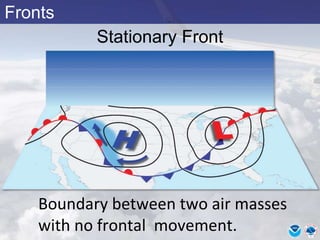
Stationary Front
Boundary between two air masses
with no frontal movement.
Fronts
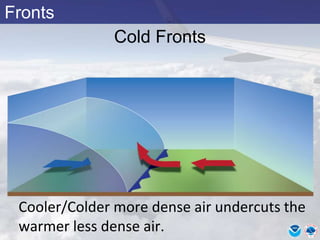
Cold Fronts
Cooler/Colder more dense air undercuts the
warmer less dense air.
Fronts
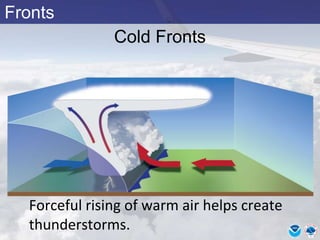
Cold Fronts
Forceful rising of warm air helps create
thunderstorms.
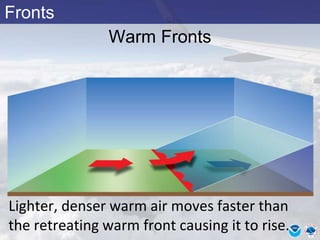
Fronts
Warm Fronts
Lighter, denser warm air moves faster than
the retreating warm front causing it to rise.
Fronts
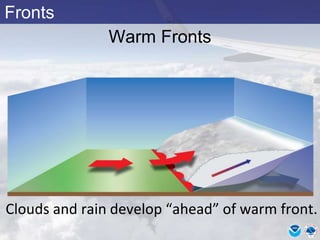
Warm Fronts
Clouds and rain develop “ahead” of warm front.
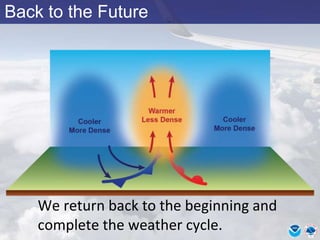
Back to the Future
We return back to the beginning and
complete the weather cycle.
Learn MORE at…
JetStream – An Online School for Weather
www.weather.gov/jetstream
A free resource with over 35 lesson plans and activities

Jet stream