Page of1
01/12/2016
** PROTECTED BY FERPA **
THOMAS, JERRY WAYNE 5
THOMAS, JERRY WAYNE
XXX-XX-XXXX
Radioman, Third Class (E4)
THOMAS, JERRY WAYNE
Transcript Sent To:
Name:
SSN:
Rank:
JOINT SERVICES
TRANSCRIPT
**UNOFFICIAL**
Military Courses
Military Experience
SeparatedStatus:
Military
Course ID
ACE Identifier
Course Title
Location-Description-Credit Areas
Dates Taken ACE
Credit Recommendation Level
Basic Military Training:
X-777-7770
To assimilate recruits into the Navy way of life and to prepare them for further advanced training in specialized Navy
occupations.
NV-2202-0014 V01 03-OCT-1985
First Aid And Safety
Personal Fitness/Conditioning
Personal/Community Health
2 SH
1 SH
1 SH
L
L
L
Radioman, Class A:
NV-1715-0595 V04 17-DEC-1985 09-APR-1986
To train enlisted personnel as radio communications operators.
A-202-0014
Service School Command
San Diego, CA
Typing 1 SH L
NONE ASSIGNEDNEC-9720 01-JUN-1986
(10/79)(10/79)
(5/82)(5/82)
to
Level
ACE
Credit Recommendation
Dates HeldACE Identifier
Title
Description-Credit Areas
Occupation ID
Page of2
01/12/2016
** PROTECTED BY FERPA **
THOMAS, JERRY WAYNE 5
Communications and Intelligence Specialist:
Seaman Recruit:
Seaman:
Radioman:
NONE ASSIGNED
NER-SN-001
NER-RM-001
NER-SR
SN
RM3
Description not available.
To assimilate recruits into the Navy way of life and to prepare them for further advanced training in specialized
Navy occupations.
Performs all basic seamanship functions aboard ship that involve line or wire, including knot tying, whipping and
seizing, and rigging used to secure the ship to a pier, moor, or anchor; is able to identify functions of navigation
and shipboard equipment, including fixed or portable items and power or non-powered items; lowers, raises, and
launches life saving equipment; handles small boats; navigates by using several different types of compasses;
keeps records by degrees or points; knows navigational aids, nautical rules of the road, and the buoys of inland
waters of the U.S.; knows the nomenclature of decks, superstructures, and parts of the hull; knows the purpose and
limitations of first aid and the first aid treatments for electrical shock, simple and compound fractures, heat
exhaustion, heat stroke, and burns; must be qualified as a Swimmer Fourth Class, requiring floating for a minimum
of five minutes, preparing and using clothing and buoyant object for staying afloat, and swimming through oil,
flames, and debris; knows how to determine the classes of fire hoses and how to use carbon dioxide, dry chemical,
and water portable fire extinguishers; knows the function of the typical fire main system, fixed carbon dioxide
system, water wash down system, and magazine sprinkling system; knows the difference between flooding and
progressive flooding and the dangers involved.
Transmits, receives, an processes all forms of telecommunic tions through various transmission media; operates,
monitors, and controls telecommunications transmission, reception, terminal and processing equipment. Identifies
common electrical and electronic terms and symbols; operates general purpose electronic test equipment; operates
and interprets readings of radio frequency power meters and voltage standing wave radio meters; detects intrusion,
jamming, and interference; operates broadcast using multichannel system; encodes, decodes, sends, and receives
messages; relates reflection, refraction, and ionosphere conditions to radiowave propagation; cleans, lubricates,
and inspects equipment; prepares maintenance data forms; uses and maintains handtools.
First Aid and Fire Science on the Basis of Institutional Evaluation
Seamanship
Small Boat Operation (Boat Coxswain)
Swimming (Swimmer First Class Only)
Basic Electronics
Electronic Communications Systems
Operation of Communications Systems
Basic Electronics
Electronic Communications Systems
Operation of Communications Systems
SH
3 SH
3 SH
1 SH
3 SH
2 SH
4 SH
3 SH
2 SH
6 SH
L
L
L
L
L
L
L
V
V
V
01-JUN-1986
02-JUL-1987
16-JUN-1988
None
None
(12/76)(12/76)
Page of3
01/12/2016
** PROTECTED BY FERPA **
THOMAS, JERRY WAYNE 5
A-260-0064
Course ID Date Taken Title Location Reason
(1) Course has not been evaluated by ACE.
(2) Class attendance dates were not recorded in the service member's record.
(3) Course was not completed during the ACE evaluation period.
(4) Course was not evaluated by ACE at this specific location.
Other Learning Experiences
College Level Test Scores
TSEC/KW-46 Service School Command
Annex, Navsta San Diego CA
102-JUL-1987
NONE ASSIGNED -- Occupation not evaluated by ACE or not evaluated during the time frame held by service member.
NONE
Radioman:
Radioman:
NER-RM-002
NER-RM-002
RM3
RM2
Transmits, receives, and processes all forms of telecommunications through various media; operates, monitors, and
controls telecommunication transmissions, reception, terminal, and processing equipment. Complies with all
requirements for secure communications; performs operational tests and required adjustments; performs
maintenance on antennas; employs touch typing at or above 35 wpm; follows directives regarding modes and
frequencies; recognizes and reports interference and jamming; maintains records and directives; utilizes equipment
operating manuals.
Transmits, receives, and processes all forms of telecommunications through various media; operates, monitors, and
controls telecommunication transmissions, reception, terminal, and processing equipment. Complies with all
requirements for secure communications; performs operational tests and required adjustments; performs
maintenance on antennas; employs touch typing at or above 35 wpm; follows directives regarding modes and
frequencies; recognizes and reports interference and jamming; maintains records and directives; utilizes equipment
operating manuals. Performs duties of traffic clerk and watch supervisor; sets up and utilizes multichannel,
diversity equipment; monitors traffic flow and, if necessary, takes corrective action; loads prepared computer
programs; operates general purpose test equipment; requisitions supplies; maintains maintenance records.
Electronic Communications Systems
Record Keeping
2 SH
2 SH
2 SH
L
L
L
16-JUN-1988
01-FEB-1995
This section provides a record of the service member's learning experiences that do not have credit recommended for one or more of the
following reasons:
(12/78)(12/78)
(12/89)(12/89)
(12/89)(12/89)
Exams taken after 31 October 2011 may have recommended college credit via the ACE National Guide.
Go to http://www2.acenet.edu/credit/?fuseaction=browse.getOrganizationDetail&FICE=190163 and look for your exam.
Page of4
01/12/2016
** PROTECTED BY FERPA **
THOMAS, JERRY WAYNE 5
END OF TRANSCRIPT
*NOTICE TO ALL TRANSCRIPT REVIEWERS:
FOR FULL EXPLANATIONS OF ALL ITEMS FLAGGED ON THIS TRANSCRIPT, PLEASE REFER TO
LEGEND FOLLOWING LAST PAGE OF TRANSCRIPT.
Page of5
01/12/2016
** PROTECTED BY FERPA **
THOMAS, JERRY WAYNE 5
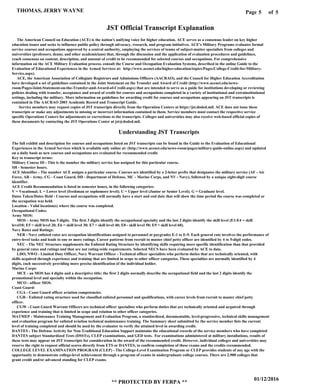
JST Official Transcript Explanation
The American Council on Education (ACE) is the nation's unifying voice for higher education. ACE serves as a consensus leader on key higher
education issues and seeks to influence public policy through advocacy, research, and program initiatives. ACE's Military Programs evaluates formal
service courses and occupations approved by a central authority, employing the services of teams of subject-matter specialists from colleges and
universities (professors, deans, and other academicians) that, through the discussion and the application of evaluation procedures and guidelines,
reach consensus on content, description, and amount of credit to be recommended for selected courses and occupations. For comprehensive
information on the ACE Military Evaluation process, consult the Course and Occupation Evaluation Systems, described in the online Guide to the
Evaluation of Educational Experiences in the Armed Services at: http://www.acenet.edu/higher-education/topics/Pages/College-Credit-for-Military-
Service.aspx).
ACE, the American Association of Collegiate Registrars and Admissions Officers (AACRAO), and the Council for Higher Education Accreditation
have developed a set of guidelines contained in the Joint Statement on the Transfer and Award of Credit (http://www.acenet.edu/news-
room/Pages/Joint-Statement-on-the-Transfer-and-Award-of-Credit.aspx) that are intended to serve as a guide for institutions developing or reviewing
policies dealing with transfer, acceptance and award of credit for courses and occupations completed in a variety of institutional and extrainstitutional
settings, including the military. More information on guidelines for awarding credit for courses and occupations appearing on JST transcripts is
contained in The AACRAO 2003 Academic Record and Transcript Guide.
Service members may request copies of JST transcripts directly from the Operation Centers at https://jst.doded.mil. ACE does not issue these
transcripts or make any adjustments to missing or incorrect information contained in them. Service members must contact the respective service
specific Operations Centers for adjustments or corrections to the transcripts. Colleges and universities may also receive web-based official copies of
these documents by contacting the JST Operations Center at jst@doded.mil.
Understanding JST Transcripts
The full exhibit and description for courses and occupations listed on JST transcripts can be found in the Guide to the Evaluation of Educational
Experiences in the Armed Services which is available only online at: (http://www.acenet.edu/news-room/pages/military-guide-online.aspx) and updated
on a daily basis as new courses and occupations are evaluated for recommended credit.
Key to transcript terms:
Military Course ID - This is the number the military service has assigned for this particular course.
SH - Semester hours.
ACE Identifier - The number ACE assigns a particular course. Courses are identified by a 2-letter prefix that designates the military service (AF - Air
Force, AR - Army, CG - Coast Guard, DD - Department of Defense, MC - Marine Corps, and NV - Navy), followed by a unique eight-digit course
identifier.
ACE Credit Recommendation is listed in semester hours, in the following categories:
V = Vocational; L = Lower level (freshman or sophomore level); U = Upper level (Junior or Senior Level); G = Graduate level.
Dates Taken/Dates Held - Courses and occupations will normally have a start and end date that will show the time period the course was completed or
the occupation was held.
Location - Valid location(s) where the course was completed.
Occupational Codes:
Army MOS:
MOS - Army MOS has 5 digits. The first 3 digits identify the occupational specialty and the last 2 digits identify the skill level (E1-E4 = skill
level10; E5 = skill level 20; E6 = skill level 30; E7 = skill level 40; E8 - skill level 50; E9 = skill level 60).
Navy Rates and Ratings:
NER - Navy enlisted rates are occupation identifications assigned to personnel at paygrades E-1 to E-9. Each general rate involves the performance of
entry-level tasks and leads to one or more ratings. Career patterns from recruit to master chief petty officer are identified by 4 to 5-digit codes.
NEC - The NEC Structure supplements the Enlisted Rating Structure by identifying skills requiring more specific identification than that provided
by general rates and ratings and that are not rating-wide requirements. Selected NECS have been evaluated by ACE to date.
LDO, NWO - Limited Duty Officer, Navy Warrant Officer - Technical officer specialists who perform duties that are technically oriented, with
skills acquired through experience and training that are limited in scope to other officer categories. These specialties are normally identified by 4
digits, each successively providing more precise identification of the individual holder.
Marine Corps:
MCE - an MOS has 4 digits and a descriptive title; the first 2 digits normally describe the occupational field and the last 2 digits identify the
promotional level and specialty within the occupation.
MCO - officer MOS.
Coast Guard:
CGA - Coast Guard officer aviation competencies.
CGR - Enlisted rating structure used for classified enlisted personnel and qualifications, with career levels from recruit to master chief petty
officer.
CGW - Coast Guard Warrant Officers are technical officer specialists who perform duties that are technically oriented and acquired through
experience and training that is limited in scope and relation to other officer categories.
MATMEP - Maintenance Training Management and Evaluation Program, a standardized, documentable, level-progressive, technical skills management
and evaluation program for enlisted aviation technical maintenance training. The Summary sheet submitted by the service member lists the current
level of training completed and should be used by the evaluator to verify the attained level in awarding credit.
DANTES - The Defense Activity for Non-Traditional Education Support maintains the educational records of the service members who have completed
DANTES subject Standardized Tests (DSSTs), CLEP examinations, and GED tests. For examinations administered at military installations, results of
these tests may appear on JST transcripts for consideration in the award of the recommended credit. However, individual colleges and universities may
reserve the right to request official scores directly from ETS or DANTES, to confirm completion of these exams and the credits recommended.
COLLEGE LEVEL EXAMINATION PROGRAM (CLEP) - The College-Level Examination Program or CLEP provides students of any age with the
opportunity to demonstrate college-level achievement through a program of exams in undergraduate college courses. There are 2,900 colleges that
grant credit and/or advanced standing for CLEP exams.

Jerry_Navy_Transcript

  • 1.
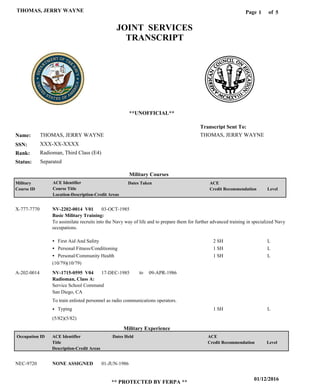
    Page of1 01/12/2016 ** PROTECTEDBY FERPA ** THOMAS, JERRY WAYNE 5 THOMAS, JERRY WAYNE XXX-XX-XXXX Radioman, Third Class (E4) THOMAS, JERRY WAYNE Transcript Sent To: Name: SSN: Rank: JOINT SERVICES TRANSCRIPT **UNOFFICIAL** Military Courses Military Experience SeparatedStatus: Military Course ID ACE Identifier Course Title Location-Description-Credit Areas Dates Taken ACE Credit Recommendation Level Basic Military Training: X-777-7770 To assimilate recruits into the Navy way of life and to prepare them for further advanced training in specialized Navy occupations. NV-2202-0014 V01 03-OCT-1985 First Aid And Safety Personal Fitness/Conditioning Personal/Community Health 2 SH 1 SH 1 SH L L L Radioman, Class A: NV-1715-0595 V04 17-DEC-1985 09-APR-1986 To train enlisted personnel as radio communications operators. A-202-0014 Service School Command San Diego, CA Typing 1 SH L NONE ASSIGNEDNEC-9720 01-JUN-1986 (10/79)(10/79) (5/82)(5/82) to Level ACE Credit Recommendation Dates HeldACE Identifier Title Description-Credit Areas Occupation ID
  • 2.
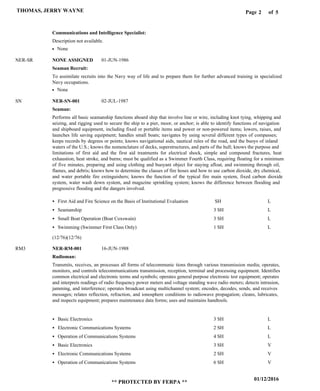
    Page of2 01/12/2016 ** PROTECTEDBY FERPA ** THOMAS, JERRY WAYNE 5 Communications and Intelligence Specialist: Seaman Recruit: Seaman: Radioman: NONE ASSIGNED NER-SN-001 NER-RM-001 NER-SR SN RM3 Description not available. To assimilate recruits into the Navy way of life and to prepare them for further advanced training in specialized Navy occupations. Performs all basic seamanship functions aboard ship that involve line or wire, including knot tying, whipping and seizing, and rigging used to secure the ship to a pier, moor, or anchor; is able to identify functions of navigation and shipboard equipment, including fixed or portable items and power or non-powered items; lowers, raises, and launches life saving equipment; handles small boats; navigates by using several different types of compasses; keeps records by degrees or points; knows navigational aids, nautical rules of the road, and the buoys of inland waters of the U.S.; knows the nomenclature of decks, superstructures, and parts of the hull; knows the purpose and limitations of first aid and the first aid treatments for electrical shock, simple and compound fractures, heat exhaustion, heat stroke, and burns; must be qualified as a Swimmer Fourth Class, requiring floating for a minimum of five minutes, preparing and using clothing and buoyant object for staying afloat, and swimming through oil, flames, and debris; knows how to determine the classes of fire hoses and how to use carbon dioxide, dry chemical, and water portable fire extinguishers; knows the function of the typical fire main system, fixed carbon dioxide system, water wash down system, and magazine sprinkling system; knows the difference between flooding and progressive flooding and the dangers involved. Transmits, receives, an processes all forms of telecommunic tions through various transmission media; operates, monitors, and controls telecommunications transmission, reception, terminal and processing equipment. Identifies common electrical and electronic terms and symbols; operates general purpose electronic test equipment; operates and interprets readings of radio frequency power meters and voltage standing wave radio meters; detects intrusion, jamming, and interference; operates broadcast using multichannel system; encodes, decodes, sends, and receives messages; relates reflection, refraction, and ionosphere conditions to radiowave propagation; cleans, lubricates, and inspects equipment; prepares maintenance data forms; uses and maintains handtools. First Aid and Fire Science on the Basis of Institutional Evaluation Seamanship Small Boat Operation (Boat Coxswain) Swimming (Swimmer First Class Only) Basic Electronics Electronic Communications Systems Operation of Communications Systems Basic Electronics Electronic Communications Systems Operation of Communications Systems SH 3 SH 3 SH 1 SH 3 SH 2 SH 4 SH 3 SH 2 SH 6 SH L L L L L L L V V V 01-JUN-1986 02-JUL-1987 16-JUN-1988 None None (12/76)(12/76)
  • 3.
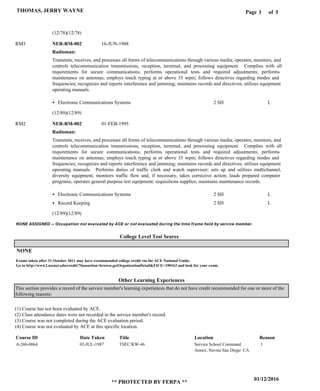
    Page of3 01/12/2016 ** PROTECTEDBY FERPA ** THOMAS, JERRY WAYNE 5 A-260-0064 Course ID Date Taken Title Location Reason (1) Course has not been evaluated by ACE. (2) Class attendance dates were not recorded in the service member's record. (3) Course was not completed during the ACE evaluation period. (4) Course was not evaluated by ACE at this specific location. Other Learning Experiences College Level Test Scores TSEC/KW-46 Service School Command Annex, Navsta San Diego CA 102-JUL-1987 NONE ASSIGNED -- Occupation not evaluated by ACE or not evaluated during the time frame held by service member. NONE Radioman: Radioman: NER-RM-002 NER-RM-002 RM3 RM2 Transmits, receives, and processes all forms of telecommunications through various media; operates, monitors, and controls telecommunication transmissions, reception, terminal, and processing equipment. Complies with all requirements for secure communications; performs operational tests and required adjustments; performs maintenance on antennas; employs touch typing at or above 35 wpm; follows directives regarding modes and frequencies; recognizes and reports interference and jamming; maintains records and directives; utilizes equipment operating manuals. Transmits, receives, and processes all forms of telecommunications through various media; operates, monitors, and controls telecommunication transmissions, reception, terminal, and processing equipment. Complies with all requirements for secure communications; performs operational tests and required adjustments; performs maintenance on antennas; employs touch typing at or above 35 wpm; follows directives regarding modes and frequencies; recognizes and reports interference and jamming; maintains records and directives; utilizes equipment operating manuals. Performs duties of traffic clerk and watch supervisor; sets up and utilizes multichannel, diversity equipment; monitors traffic flow and, if necessary, takes corrective action; loads prepared computer programs; operates general purpose test equipment; requisitions supplies; maintains maintenance records. Electronic Communications Systems Electronic Communications Systems Record Keeping 2 SH 2 SH 2 SH L L L 16-JUN-1988 01-FEB-1995 This section provides a record of the service member's learning experiences that do not have credit recommended for one or more of the following reasons: (12/78)(12/78) (12/89)(12/89) (12/89)(12/89) Exams taken after 31 October 2011 may have recommended college credit via the ACE National Guide. Go to http://www2.acenet.edu/credit/?fuseaction=browse.getOrganizationDetail&FICE=190163 and look for your exam.
  • 4.
    Page of4 01/12/2016 ** PROTECTEDBY FERPA ** THOMAS, JERRY WAYNE 5 END OF TRANSCRIPT *NOTICE TO ALL TRANSCRIPT REVIEWERS: FOR FULL EXPLANATIONS OF ALL ITEMS FLAGGED ON THIS TRANSCRIPT, PLEASE REFER TO LEGEND FOLLOWING LAST PAGE OF TRANSCRIPT.
  • 5.
    Page of5 01/12/2016 ** PROTECTEDBY FERPA ** THOMAS, JERRY WAYNE 5 JST Official Transcript Explanation The American Council on Education (ACE) is the nation's unifying voice for higher education. ACE serves as a consensus leader on key higher education issues and seeks to influence public policy through advocacy, research, and program initiatives. ACE's Military Programs evaluates formal service courses and occupations approved by a central authority, employing the services of teams of subject-matter specialists from colleges and universities (professors, deans, and other academicians) that, through the discussion and the application of evaluation procedures and guidelines, reach consensus on content, description, and amount of credit to be recommended for selected courses and occupations. For comprehensive information on the ACE Military Evaluation process, consult the Course and Occupation Evaluation Systems, described in the online Guide to the Evaluation of Educational Experiences in the Armed Services at: http://www.acenet.edu/higher-education/topics/Pages/College-Credit-for-Military- Service.aspx). ACE, the American Association of Collegiate Registrars and Admissions Officers (AACRAO), and the Council for Higher Education Accreditation have developed a set of guidelines contained in the Joint Statement on the Transfer and Award of Credit (http://www.acenet.edu/news- room/Pages/Joint-Statement-on-the-Transfer-and-Award-of-Credit.aspx) that are intended to serve as a guide for institutions developing or reviewing policies dealing with transfer, acceptance and award of credit for courses and occupations completed in a variety of institutional and extrainstitutional settings, including the military. More information on guidelines for awarding credit for courses and occupations appearing on JST transcripts is contained in The AACRAO 2003 Academic Record and Transcript Guide. Service members may request copies of JST transcripts directly from the Operation Centers at https://jst.doded.mil. ACE does not issue these transcripts or make any adjustments to missing or incorrect information contained in them. Service members must contact the respective service specific Operations Centers for adjustments or corrections to the transcripts. Colleges and universities may also receive web-based official copies of these documents by contacting the JST Operations Center at jst@doded.mil. Understanding JST Transcripts The full exhibit and description for courses and occupations listed on JST transcripts can be found in the Guide to the Evaluation of Educational Experiences in the Armed Services which is available only online at: (http://www.acenet.edu/news-room/pages/military-guide-online.aspx) and updated on a daily basis as new courses and occupations are evaluated for recommended credit. Key to transcript terms: Military Course ID - This is the number the military service has assigned for this particular course. SH - Semester hours. ACE Identifier - The number ACE assigns a particular course. Courses are identified by a 2-letter prefix that designates the military service (AF - Air Force, AR - Army, CG - Coast Guard, DD - Department of Defense, MC - Marine Corps, and NV - Navy), followed by a unique eight-digit course identifier. ACE Credit Recommendation is listed in semester hours, in the following categories: V = Vocational; L = Lower level (freshman or sophomore level); U = Upper level (Junior or Senior Level); G = Graduate level. Dates Taken/Dates Held - Courses and occupations will normally have a start and end date that will show the time period the course was completed or the occupation was held. Location - Valid location(s) where the course was completed. Occupational Codes: Army MOS: MOS - Army MOS has 5 digits. The first 3 digits identify the occupational specialty and the last 2 digits identify the skill level (E1-E4 = skill level10; E5 = skill level 20; E6 = skill level 30; E7 = skill level 40; E8 - skill level 50; E9 = skill level 60). Navy Rates and Ratings: NER - Navy enlisted rates are occupation identifications assigned to personnel at paygrades E-1 to E-9. Each general rate involves the performance of entry-level tasks and leads to one or more ratings. Career patterns from recruit to master chief petty officer are identified by 4 to 5-digit codes. NEC - The NEC Structure supplements the Enlisted Rating Structure by identifying skills requiring more specific identification than that provided by general rates and ratings and that are not rating-wide requirements. Selected NECS have been evaluated by ACE to date. LDO, NWO - Limited Duty Officer, Navy Warrant Officer - Technical officer specialists who perform duties that are technically oriented, with skills acquired through experience and training that are limited in scope to other officer categories. These specialties are normally identified by 4 digits, each successively providing more precise identification of the individual holder. Marine Corps: MCE - an MOS has 4 digits and a descriptive title; the first 2 digits normally describe the occupational field and the last 2 digits identify the promotional level and specialty within the occupation. MCO - officer MOS. Coast Guard: CGA - Coast Guard officer aviation competencies. CGR - Enlisted rating structure used for classified enlisted personnel and qualifications, with career levels from recruit to master chief petty officer. CGW - Coast Guard Warrant Officers are technical officer specialists who perform duties that are technically oriented and acquired through experience and training that is limited in scope and relation to other officer categories. MATMEP - Maintenance Training Management and Evaluation Program, a standardized, documentable, level-progressive, technical skills management and evaluation program for enlisted aviation technical maintenance training. The Summary sheet submitted by the service member lists the current level of training completed and should be used by the evaluator to verify the attained level in awarding credit. DANTES - The Defense Activity for Non-Traditional Education Support maintains the educational records of the service members who have completed DANTES subject Standardized Tests (DSSTs), CLEP examinations, and GED tests. For examinations administered at military installations, results of these tests may appear on JST transcripts for consideration in the award of the recommended credit. However, individual colleges and universities may reserve the right to request official scores directly from ETS or DANTES, to confirm completion of these exams and the credits recommended. COLLEGE LEVEL EXAMINATION PROGRAM (CLEP) - The College-Level Examination Program or CLEP provides students of any age with the opportunity to demonstrate college-level achievement through a program of exams in undergraduate college courses. There are 2,900 colleges that grant credit and/or advanced standing for CLEP exams.