Journal of Education and Practice - Vol 2, No 2                                                www.iiste.org
ISSN 2222-1735 (Paper) ISSN 2222-288X (Online)


      A Comparison of Selected Biomechanical Parameters of
        Spike Serves between Intervarsity and Intercollegiate
                                       Volleyball Players

                                                 Ikram Hussain
                              Department of Physical Health and Sports Education,
                           Aligarh Muslim University, Aligarh, 202002, (U.P.), India.
                                        E-mail: ikram.husain@gmail.com


                                       Asim Khan (Corresponding author)
                              Department of Physical Health and Sports Education,
                           Aligarh Muslim University, Aligarh, 202002, (U.P.), India.
                                        E-mail: khanasim100@gmail.com


                                                Arif Mohammad
                              Department of Physical Health and Sports Education,
                           Aligarh Muslim University, Aligarh, 202002, (U.P.), India.
                                     E-mail: arifmohammad@hotmail.co.in

The present empirical research work has been undertaken under UGC, SAP (DRS-I) Programme, running
in the Department of Physical Health and Sports Education, Aligarh Muslim University, Aligarh, India.

Abstract
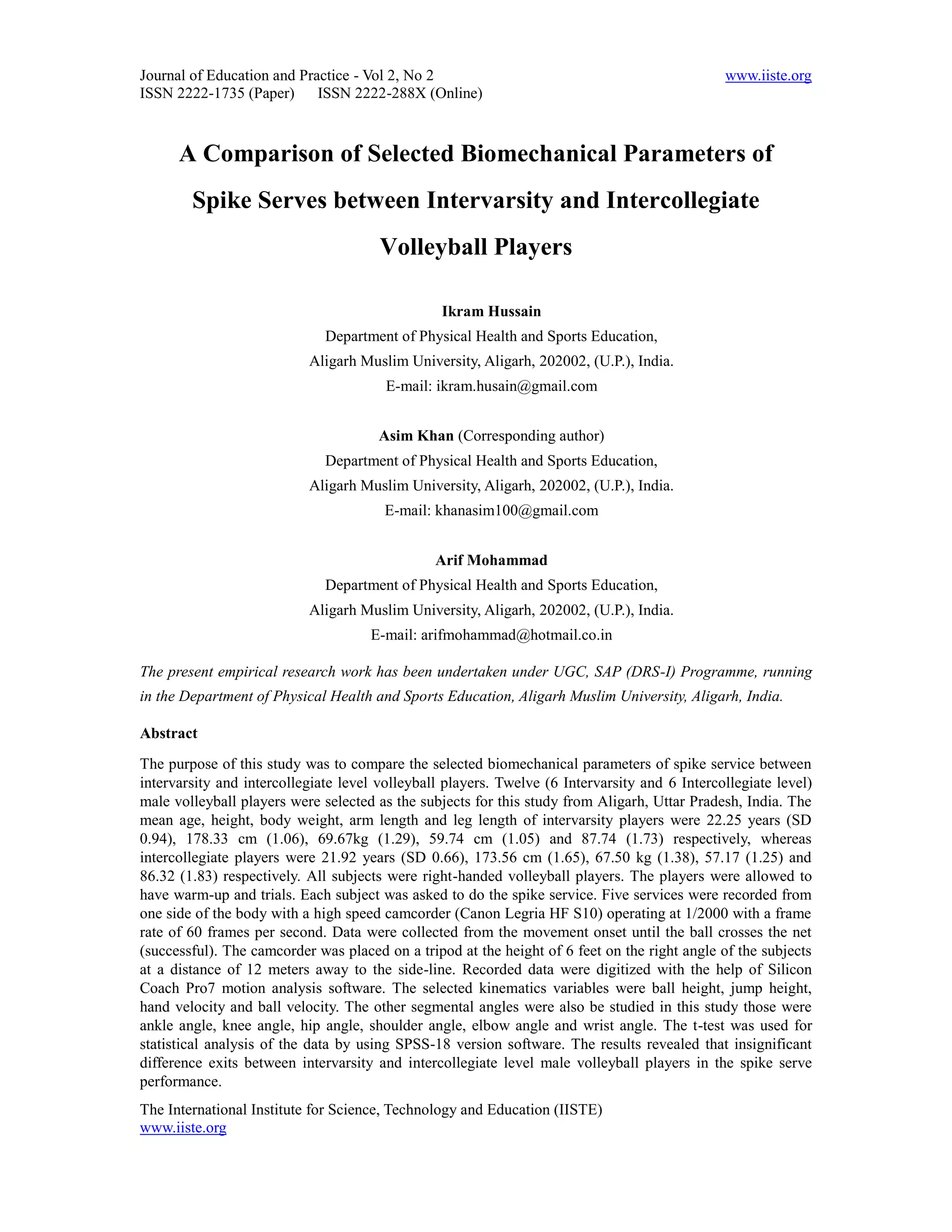
The purpose of this study was to compare the selected biomechanical parameters of spike service between
intervarsity and intercollegiate level volleyball players. Twelve (6 Intervarsity and 6 Intercollegiate level)
male volleyball players were selected as the subjects for this study from Aligarh, Uttar Pradesh, India. The
mean age, height, body weight, arm length and leg length of intervarsity players were 22.25 years (SD
0.94), 178.33 cm (1.06), 69.67kg (1.29), 59.74 cm (1.05) and 87.74 (1.73) respectively, whereas
intercollegiate players were 21.92 years (SD 0.66), 173.56 cm (1.65), 67.50 kg (1.38), 57.17 (1.25) and
86.32 (1.83) respectively. All subjects were right-handed volleyball players. The players were allowed to
have warm-up and trials. Each subject was asked to do the spike service. Five services were recorded from
one side of the body with a high speed camcorder (Canon Legria HF S10) operating at 1/2000 with a frame
rate of 60 frames per second. Data were collected from the movement onset until the ball crosses the net
(successful). The camcorder was placed on a tripod at the height of 6 feet on the right angle of the subjects
at a distance of 12 meters away to the side-line. Recorded data were digitized with the help of Silicon
Coach Pro7 motion analysis software. The selected kinematics variables were ball height, jump height,
hand velocity and ball velocity. The other segmental angles were also be studied in this study those were
ankle angle, knee angle, hip angle, shoulder angle, elbow angle and wrist angle. The t-test was used for
statistical analysis of the data by using SPSS-18 version software. The results revealed that insignificant
difference exits between intervarsity and intercollegiate level male volleyball players in the spike serve
performance.
The International Institute for Science, Technology and Education (IISTE)
www.iiste.org
Journal of Education and Practice - Vol 2, No 2                                                    www.iiste.org
ISSN 2222-1735 (Paper) ISSN 2222-288X (Online)

Keywords: Volleyball, spike service, intervarsity, segmental angle.
1. Introduction
One of the most dramatic skills in modern volleyball is the spike serve or the jump serve which provides an
exciting and dynamic skill that is captivating for players and spectators alike. It is very difficult to win
matches without an efficient serve (Hayrinen et al., 2000). The most used technique of serve in men’s
international top volleyball is jump serve. The efficiency of jump serve is related to the velocity of the serve
(Hayrinen et al., 2009). The biomechanics of jump serve has been studied before by Coleman (1997),
Huang and Hu (2007) and Masamura et al. (2007), but the serve velocities have increased so there was a
need to update earlier findings and to investigate which elements have the biggest effect to the velocity of
the jump serve. The player starts about four to five meters behind the end line of the court, uses a fast run
up, a dynamic spike take-off and an exciting spike action at the peak of their jump that sends the ball across
the net. The spike serve has become a dangerous offensive weapon for the top volleyball teams of today, as
a great spike server can produce a number of aces over the course of a match. The spike serve is somewhat
similar to the spike at the net, except the velocities after impact are somewhat lower for the serve when
compared to the spike (Tant et al., 1993). A study of the spike vs. the serve for collegiate volleyball players
revealed similar speeds for the male athletes but slower speeds for the female serve when compared to the
spike (male jump serve 19.7 m/s, male spike 22.4 m/s, female jump serve 13.2 m/s, female spike 17.8 m/s).
A study of the front row spikes of elite international volleyball spikers reported mean impact ball speeds of
27 m/s (Coleman, 1993).
The players who are generally very tall and have very high vertical jumps that allow them to produce a
downward angle on the ball: a fact exacerbated by the heavy topspin usually applied. Their strength and
athleticism also allow them to produce very high hand velocities at impact that produce high ball velocities
that are very difficult for the opponent to return. An examination of the serves of the players at different
level may provide some useful information regarding optimal technique, so that other skilled players will
be able to emulate this skill and improve their own ball speed and accuracy.
  The spike serve has many similarities to the spike itself. The player strikes the ball with maximum force at
the peak of his jump, and tries to place it so that the opponent cannot receive it cleanly. It has been
suggested that a successful spike is determined by three factors, which are likely similar to those of the
jump serve: the position of the ball at impact, the speed of the ball after impact, and the direction of
movement of the ball after impact (Chung et al., 1990). In the jump serve the ball position at impact is
determined by the toss of the server - an effective serve requires a perfectly placed toss and a perfectly
timed run up. The higher the point of impact, the sharper the downward angle of the serve, and the more
margins for error there is for the server to utilize a higher ball velocity. This makes it faster to arrive on the
other side of the net and thus there is less time for the receiver to interpret the path of the ball and move into
position to play it, increasing the chance of an error or an inaccurate pass. Therefore, it was the aim of this
study to provide descriptive kinematics of some of the biomechanical factors involved in the jump serve.


2. Methodology
The principal method used is comparative kinematics method, aimed at finding the differences in
kinematics variables purpose in gaining information of spike serve performance between intervarsity and
intercollegiate level volleyball players.


2.1 Selection of Subject
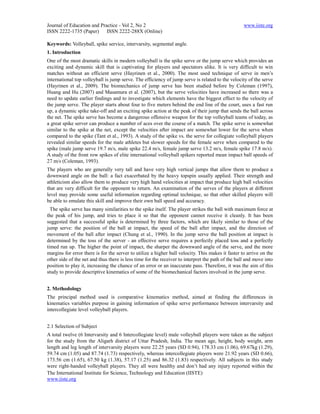
A total twelve (6 Intervarsity and 6 Intercollegiate level) male volleyball players were taken as the subject
for the study from the Aligarh district of Uttar Pradesh, India. The mean age, height, body weight, arm
length and leg length of intervarsity players were 22.25 years (SD 0.94), 178.33 cm (1.06), 69.67kg (1.29),
59.74 cm (1.05) and 87.74 (1.73) respectively, whereas intercollegiate players were 21.92 years (SD 0.66),
173.56 cm (1.65), 67.50 kg (1.38), 57.17 (1.25) and 86.32 (1.83) respectively. All subjects in this study
were right-handed volleyball players. They all were healthy and don’t had any injury reported within the
The International Institute for Science, Technology and Education (IISTE)
www.iiste.org
Journal of Education and Practice - Vol 2, No 2                                                        www.iiste.org
ISSN 2222-1735 (Paper) ISSN 2222-288X (Online)

last year.


2.2. Tools and Equipments
For the purpose of this study a high speed camcorder (Canon Legria HF S10), camera tripod, measuring
tape, marking powder, volleyballs, volleyball court, motion analysis software (Silicon Coach Pro7) and
computer system were used.


2.3. Procedure for Data Collection
For the kinematical data a high speed Canon Legria HF S10 camcorder operating at 1/2000 with a frame
rate of 60 frames per second was used to capture the spike serve performance. Data was collected from the
movement onset until the ball crosses the net. The camcorder was placed perpendicular at a distance of
twelve meters on the right side of the players mounted at a height of six feet above the ground and capture
video clips of sufficient coverage to clearly see the spike serve process. All subjects performed five
officially allotted serve but the best one valid (successful) serve was selected for further analysis. The
recorded video footages were downloaded, slashed and edited by using the downloaded version of
STHVCD55 Software. Digitization, smoothing and analysis were conducted using the Silicon Coach Pro7
motion analysis software. The selected kinematics variables were ball height, jump height, ball velocity and
hand velocity. The other selected parameters were ankle angle, knee angle, hip angle, shoulder angle, elbow
angle and wrist angle.


3. Result


Table 1: Anthropometric descriptions of Intervarsity and Intercollegiate male Volleyball Players
                                       Anthropometric Description
 Groups             Mean & SD
                                       Age              Height        Weight          Arm Length       Leg Length
                    Mean               22.25 Yrs        178.33 cm     69.67 Kg        59.74 cm         87.74 cm
 Intervarsity
                    SD                 0.94 Yrs         1.06 cm       1.29 Kg         1.05 cm          1.73 cm
                    Mean               21.92 Yrs        173.56 cm     67.50 Kg        57.17 cm         86.32 cm
 Intercollegiate
                    SD                 0.66 Yrs         1.65 cm       1.38 Kg         1.25 cm          1.83 cm


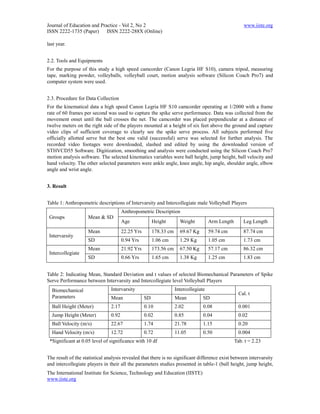
Table 2: Indicating Mean, Standard Deviation and t values of selected Biomechanical Parameters of Spike
Serve Performance between Intervarsity and Intercollegiate level Volleyball Players
  Biomechanical                 Intervarsity                        Intercollegiate
                                                                                                     Cal. t
  Parameters                    Mean               SD               Mean          SD
  Ball Height (Meter)           2.17               0.10             2.02          0.08               0.001
  Jump Height (Meter)           0.92               0.02             0.85          0.04               0.02
  Ball Velocity (m/s)           22.67              1.74             21.78         1.15               0.20
  Hand Velocity (m/s)           12.72              0.72             11.05         0.50               0.004
 *Significant at 0.05 level of significance with 10 df                                             Tab. t = 2.23


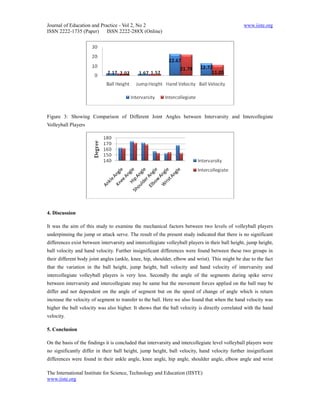
The result of the statistical analysis revealed that there is no significant difference exist between intervarsity
and intercollegiate players in their all the parameters studies presented in table-1 (ball height, jump height,
The International Institute for Science, Technology and Education (IISTE)
www.iiste.org
Journal of Education and Practice - Vol 2, No 2                                                 www.iiste.org
ISSN 2222-1735 (Paper) ISSN 2222-288X (Online)

ball velocity and hand velocity). It has showed that the calculated t values of all the selected variables were
less than tabulated t value (2.23) at 0.05 level of significance with 10 degree of freedom.


The International Institute for Science, Technology and Education (IISTE)
www.iiste.org
Journal of Education and Practice - Vol 2, No 2                                                 www.iiste.org
ISSN 2222-1735 (Paper) ISSN 2222-288X (Online)

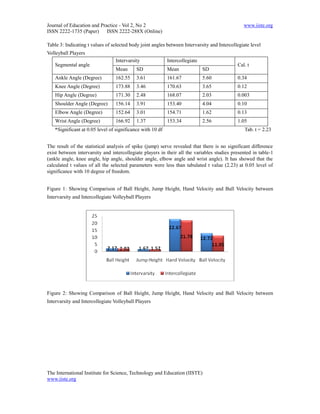
Table 3: Indicating t values of selected body joint angles between Intervarsity and Intercollegiate level
Volleyball Players
                                 Intervarsity              Intercollegiate
   Segmental angle                                                                           Cal. t
                                 Mean       SD             Mean              SD
   Ankle Angle (Degree)          162.55     3.61           161.67            5.60            0.34
   Knee Angle (Degree)           173.88     3.46           170.63            3.65            0.12
   Hip Angle (Degree)            171.30     2.48           168.07            2.03            0.003
   Shoulder Angle (Degree)       156.14     3.91           153.40            4.04            0.10
   Elbow Angle (Degree)          152.64     3.01           154.71            1.62            0.13
   Wrist Angle (Degree)          166.92     1.37           153.34            2.56            1.05
   *Significant at 0.05 level of significance with 10 df                                         Tab. t = 2.23


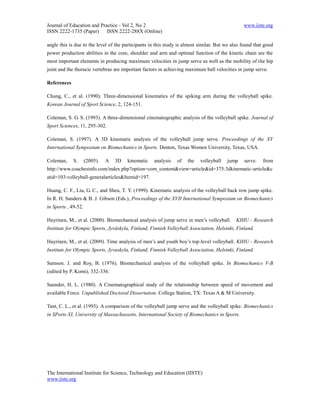
The result of the statistical analysis of spike (jump) serve revealed that there is no significant difference
exist between intervarsity and intercollegiate players in their all the variables studies presented in table-1
(ankle angle, knee angle, hip angle, shoulder angle, elbow angle and wrist angle). It has showed that the
calculated t values of all the selected parameters were less than tabulated t value (2.23) at 0.05 level of
significance with 10 degree of freedom.


Figure 1: Showing Comparison of Ball Height, Jump Height, Hand Velocity and Ball Velocity between
Intervarsity and Intercollegiate Volleyball Players


Figure 2: Showing Comparison of Ball Height, Jump Height, Hand Velocity and Ball Velocity between
Intervarsity and Intercollegiate Volleyball Players


The International Institute for Science, Technology and Education (IISTE)
www.iiste.org
Journal of Education and Practice - Vol 2, No 2                                                  www.iiste.org
ISSN 2222-1735 (Paper) ISSN 2222-288X (Online)


Figure 3: Showing Comparison of Different Joint Angles between Intervarsity and Intercollegiate
Volleyball Players


4. Discussion

It was the aim of this study to examine the mechanical factors between two levels of volleyball players
underpinning the jump or attack serve. The result of the present study indicated that there is no significant
differences exist between intervarsity and intercollegiate volleyball players in their ball height, jump height,
ball velocity and hand velocity. Further insignificant differences were found between these two groups in
their different body joint angles (ankle, knee, hip, shoulder, elbow and wrist). This might be due to the fact
that the variation in the ball height, jump height, ball velocity and hand velocity of intervarsity and
intercollegiate volleyball players is very less. Secondly the angle of the segments during spike serve
between intervarsity and intercollegiate may be same but the movement forces applied on the ball may be
differ and not dependent on the angle of segment but on the speed of change of angle which is return
increase the velocity of segment to transfer to the ball. Here we also found that when the hand velocity was
higher the ball velocity was also higher. It shows that the ball velocity is directly correlated with the hand
velocity.

5. Conclusion

On the basis of the findings it is concluded that intervarsity and intercollegiate level volleyball players were
no significantly differ in their ball height, jump height, ball velocity, hand velocity further insignificant
differences were found in their ankle angle, knee angle, hip angle, shoulder angle, elbow angle and wrist

The International Institute for Science, Technology and Education (IISTE)
www.iiste.org
Journal of Education and Practice - Vol 2, No 2                                                 www.iiste.org
ISSN 2222-1735 (Paper) ISSN 2222-288X (Online)

angle this is due to the level of the participants in this study is almost similar. But we also found that good
power production abilities in the core, shoulder and arm and optimal function of the kinetic chain are the
most important elements in producing maximum velocities in jump serve as well as the mobility of the hip
joint and the thoracic vertebrae are important factors in achieving maximum ball velocities in jump serve.

References

Chung, C., et al. (1990). Three-dimensional kinematics of the spiking arm during the volleyball spike.
Korean Journal of Sport Science, 2, 124-151.

Coleman, S. G. S. (1993). A three-dimensional cinematographic analysis of the volleyball spike. Journal of
Sport Sciences, 11, 295-302.

Coleman, S. (1997). A 3D kinematic analysis of the volleyball jump serve. Proceedings of the XV
International Symposium on Biomechanics in Sports. Denton, Texas Women University, Texas, USA.

Coleman,     S.      (2005).   A   3D   kinematic   analysis   of    the   volleyball   jump    serve.    from
http://www.coachesinfo.com/index.php?option=com_content&view=article&id=375:3dkinematic-article&c
atid=103:volleyball-generalarticles&Itemid=197.

Huang, C. F., Liu, G. C., and Sheu, T. Y. (1999). Kinematic analysis of the volleyball back row jump spike.
In R. H. Sanders & B. J. Gibson (Eds.), Proceedings of the XVII International Symposium on Biomechanics
in Sports , 49-52.

Hayrinen, M., et al. (2000). Biomechanical analysis of jump serve in men’s volleyball.      KIHU - Research
Institute for Olympic Sports, Jyväskyla, Finland, Finnish Volleyball Association, Helsinki, Finland.

Hayrinen, M., et al. (2009). Time analysis of men’s and youth boy’s top-level volleyball. KIHU - Research
Institute for Olympic Sports, Jyvaskyla, Finland, Finnish Volleyball Association, Helsinki, Finland.

Samson. J. and Roy, B. (1976). Biomechanical analysis of the volleyball spike. In Biomechanics V-B
(edited by P. Komi), 332-336.

Saunder, H. L. (1980). A Cinematographical study of the relationship between speed of movement and
available Force. Unpublished Doctoral Dissertation. College Station, TX: Texas A & M University.

Tant, C. L., et al. (1993). A comparison of the volleyball jump serve and the volleyball spike. Biomechanics
in SPorts XI, University of Massachussetts, International Society of Biomechanics in Sports.


The International Institute for Science, Technology and Education (IISTE)
www.iiste.org

Jep 2

  • 1.
    Journal of Educationand Practice - Vol 2, No 2 www.iiste.org ISSN 2222-1735 (Paper) ISSN 2222-288X (Online) A Comparison of Selected Biomechanical Parameters of Spike Serves between Intervarsity and Intercollegiate Volleyball Players Ikram Hussain Department of Physical Health and Sports Education, Aligarh Muslim University, Aligarh, 202002, (U.P.), India. E-mail: ikram.husain@gmail.com Asim Khan (Corresponding author) Department of Physical Health and Sports Education, Aligarh Muslim University, Aligarh, 202002, (U.P.), India. E-mail: khanasim100@gmail.com Arif Mohammad Department of Physical Health and Sports Education, Aligarh Muslim University, Aligarh, 202002, (U.P.), India. E-mail: arifmohammad@hotmail.co.in The present empirical research work has been undertaken under UGC, SAP (DRS-I) Programme, running in the Department of Physical Health and Sports Education, Aligarh Muslim University, Aligarh, India. Abstract The purpose of this study was to compare the selected biomechanical parameters of spike service between intervarsity and intercollegiate level volleyball players. Twelve (6 Intervarsity and 6 Intercollegiate level) male volleyball players were selected as the subjects for this study from Aligarh, Uttar Pradesh, India. The mean age, height, body weight, arm length and leg length of intervarsity players were 22.25 years (SD 0.94), 178.33 cm (1.06), 69.67kg (1.29), 59.74 cm (1.05) and 87.74 (1.73) respectively, whereas intercollegiate players were 21.92 years (SD 0.66), 173.56 cm (1.65), 67.50 kg (1.38), 57.17 (1.25) and 86.32 (1.83) respectively. All subjects were right-handed volleyball players. The players were allowed to have warm-up and trials. Each subject was asked to do the spike service. Five services were recorded from one side of the body with a high speed camcorder (Canon Legria HF S10) operating at 1/2000 with a frame rate of 60 frames per second. Data were collected from the movement onset until the ball crosses the net (successful). The camcorder was placed on a tripod at the height of 6 feet on the right angle of the subjects at a distance of 12 meters away to the side-line. Recorded data were digitized with the help of Silicon Coach Pro7 motion analysis software. The selected kinematics variables were ball height, jump height, hand velocity and ball velocity. The other segmental angles were also be studied in this study those were ankle angle, knee angle, hip angle, shoulder angle, elbow angle and wrist angle. The t-test was used for statistical analysis of the data by using SPSS-18 version software. The results revealed that insignificant difference exits between intervarsity and intercollegiate level male volleyball players in the spike serve performance. The International Institute for Science, Technology and Education (IISTE) www.iiste.org
  • 2.
    Journal of Educationand Practice - Vol 2, No 2 www.iiste.org ISSN 2222-1735 (Paper) ISSN 2222-288X (Online) Keywords: Volleyball, spike service, intervarsity, segmental angle. 1. Introduction One of the most dramatic skills in modern volleyball is the spike serve or the jump serve which provides an exciting and dynamic skill that is captivating for players and spectators alike. It is very difficult to win matches without an efficient serve (Hayrinen et al., 2000). The most used technique of serve in men’s international top volleyball is jump serve. The efficiency of jump serve is related to the velocity of the serve (Hayrinen et al., 2009). The biomechanics of jump serve has been studied before by Coleman (1997), Huang and Hu (2007) and Masamura et al. (2007), but the serve velocities have increased so there was a need to update earlier findings and to investigate which elements have the biggest effect to the velocity of the jump serve. The player starts about four to five meters behind the end line of the court, uses a fast run up, a dynamic spike take-off and an exciting spike action at the peak of their jump that sends the ball across the net. The spike serve has become a dangerous offensive weapon for the top volleyball teams of today, as a great spike server can produce a number of aces over the course of a match. The spike serve is somewhat similar to the spike at the net, except the velocities after impact are somewhat lower for the serve when compared to the spike (Tant et al., 1993). A study of the spike vs. the serve for collegiate volleyball players revealed similar speeds for the male athletes but slower speeds for the female serve when compared to the spike (male jump serve 19.7 m/s, male spike 22.4 m/s, female jump serve 13.2 m/s, female spike 17.8 m/s). A study of the front row spikes of elite international volleyball spikers reported mean impact ball speeds of 27 m/s (Coleman, 1993). The players who are generally very tall and have very high vertical jumps that allow them to produce a downward angle on the ball: a fact exacerbated by the heavy topspin usually applied. Their strength and athleticism also allow them to produce very high hand velocities at impact that produce high ball velocities that are very difficult for the opponent to return. An examination of the serves of the players at different level may provide some useful information regarding optimal technique, so that other skilled players will be able to emulate this skill and improve their own ball speed and accuracy. The spike serve has many similarities to the spike itself. The player strikes the ball with maximum force at the peak of his jump, and tries to place it so that the opponent cannot receive it cleanly. It has been suggested that a successful spike is determined by three factors, which are likely similar to those of the jump serve: the position of the ball at impact, the speed of the ball after impact, and the direction of movement of the ball after impact (Chung et al., 1990). In the jump serve the ball position at impact is determined by the toss of the server - an effective serve requires a perfectly placed toss and a perfectly timed run up. The higher the point of impact, the sharper the downward angle of the serve, and the more margins for error there is for the server to utilize a higher ball velocity. This makes it faster to arrive on the other side of the net and thus there is less time for the receiver to interpret the path of the ball and move into position to play it, increasing the chance of an error or an inaccurate pass. Therefore, it was the aim of this study to provide descriptive kinematics of some of the biomechanical factors involved in the jump serve. 2. Methodology The principal method used is comparative kinematics method, aimed at finding the differences in kinematics variables purpose in gaining information of spike serve performance between intervarsity and intercollegiate level volleyball players. 2.1 Selection of Subject A total twelve (6 Intervarsity and 6 Intercollegiate level) male volleyball players were taken as the subject for the study from the Aligarh district of Uttar Pradesh, India. The mean age, height, body weight, arm length and leg length of intervarsity players were 22.25 years (SD 0.94), 178.33 cm (1.06), 69.67kg (1.29), 59.74 cm (1.05) and 87.74 (1.73) respectively, whereas intercollegiate players were 21.92 years (SD 0.66), 173.56 cm (1.65), 67.50 kg (1.38), 57.17 (1.25) and 86.32 (1.83) respectively. All subjects in this study were right-handed volleyball players. They all were healthy and don’t had any injury reported within the The International Institute for Science, Technology and Education (IISTE) www.iiste.org
  • 3.
    Journal of Educationand Practice - Vol 2, No 2 www.iiste.org ISSN 2222-1735 (Paper) ISSN 2222-288X (Online) last year. 2.2. Tools and Equipments For the purpose of this study a high speed camcorder (Canon Legria HF S10), camera tripod, measuring tape, marking powder, volleyballs, volleyball court, motion analysis software (Silicon Coach Pro7) and computer system were used. 2.3. Procedure for Data Collection For the kinematical data a high speed Canon Legria HF S10 camcorder operating at 1/2000 with a frame rate of 60 frames per second was used to capture the spike serve performance. Data was collected from the movement onset until the ball crosses the net. The camcorder was placed perpendicular at a distance of twelve meters on the right side of the players mounted at a height of six feet above the ground and capture video clips of sufficient coverage to clearly see the spike serve process. All subjects performed five officially allotted serve but the best one valid (successful) serve was selected for further analysis. The recorded video footages were downloaded, slashed and edited by using the downloaded version of STHVCD55 Software. Digitization, smoothing and analysis were conducted using the Silicon Coach Pro7 motion analysis software. The selected kinematics variables were ball height, jump height, ball velocity and hand velocity. The other selected parameters were ankle angle, knee angle, hip angle, shoulder angle, elbow angle and wrist angle. 3. Result Table 1: Anthropometric descriptions of Intervarsity and Intercollegiate male Volleyball Players Anthropometric Description Groups Mean & SD Age Height Weight Arm Length Leg Length Mean 22.25 Yrs 178.33 cm 69.67 Kg 59.74 cm 87.74 cm Intervarsity SD 0.94 Yrs 1.06 cm 1.29 Kg 1.05 cm 1.73 cm Mean 21.92 Yrs 173.56 cm 67.50 Kg 57.17 cm 86.32 cm Intercollegiate SD 0.66 Yrs 1.65 cm 1.38 Kg 1.25 cm 1.83 cm Table 2: Indicating Mean, Standard Deviation and t values of selected Biomechanical Parameters of Spike Serve Performance between Intervarsity and Intercollegiate level Volleyball Players Biomechanical Intervarsity Intercollegiate Cal. t Parameters Mean SD Mean SD Ball Height (Meter) 2.17 0.10 2.02 0.08 0.001 Jump Height (Meter) 0.92 0.02 0.85 0.04 0.02 Ball Velocity (m/s) 22.67 1.74 21.78 1.15 0.20 Hand Velocity (m/s) 12.72 0.72 11.05 0.50 0.004 *Significant at 0.05 level of significance with 10 df Tab. t = 2.23 The result of the statistical analysis revealed that there is no significant difference exist between intervarsity and intercollegiate players in their all the parameters studies presented in table-1 (ball height, jump height, The International Institute for Science, Technology and Education (IISTE) www.iiste.org
  • 4.
    Journal of Educationand Practice - Vol 2, No 2 www.iiste.org ISSN 2222-1735 (Paper) ISSN 2222-288X (Online) ball velocity and hand velocity). It has showed that the calculated t values of all the selected variables were less than tabulated t value (2.23) at 0.05 level of significance with 10 degree of freedom. The International Institute for Science, Technology and Education (IISTE) www.iiste.org
  • 5.
    Journal of Educationand Practice - Vol 2, No 2 www.iiste.org ISSN 2222-1735 (Paper) ISSN 2222-288X (Online) Table 3: Indicating t values of selected body joint angles between Intervarsity and Intercollegiate level Volleyball Players Intervarsity Intercollegiate Segmental angle Cal. t Mean SD Mean SD Ankle Angle (Degree) 162.55 3.61 161.67 5.60 0.34 Knee Angle (Degree) 173.88 3.46 170.63 3.65 0.12 Hip Angle (Degree) 171.30 2.48 168.07 2.03 0.003 Shoulder Angle (Degree) 156.14 3.91 153.40 4.04 0.10 Elbow Angle (Degree) 152.64 3.01 154.71 1.62 0.13 Wrist Angle (Degree) 166.92 1.37 153.34 2.56 1.05 *Significant at 0.05 level of significance with 10 df Tab. t = 2.23 The result of the statistical analysis of spike (jump) serve revealed that there is no significant difference exist between intervarsity and intercollegiate players in their all the variables studies presented in table-1 (ankle angle, knee angle, hip angle, shoulder angle, elbow angle and wrist angle). It has showed that the calculated t values of all the selected parameters were less than tabulated t value (2.23) at 0.05 level of significance with 10 degree of freedom. Figure 1: Showing Comparison of Ball Height, Jump Height, Hand Velocity and Ball Velocity between Intervarsity and Intercollegiate Volleyball Players Figure 2: Showing Comparison of Ball Height, Jump Height, Hand Velocity and Ball Velocity between Intervarsity and Intercollegiate Volleyball Players The International Institute for Science, Technology and Education (IISTE) www.iiste.org
  • 6.
    Journal of Educationand Practice - Vol 2, No 2 www.iiste.org ISSN 2222-1735 (Paper) ISSN 2222-288X (Online) Figure 3: Showing Comparison of Different Joint Angles between Intervarsity and Intercollegiate Volleyball Players 4. Discussion It was the aim of this study to examine the mechanical factors between two levels of volleyball players underpinning the jump or attack serve. The result of the present study indicated that there is no significant differences exist between intervarsity and intercollegiate volleyball players in their ball height, jump height, ball velocity and hand velocity. Further insignificant differences were found between these two groups in their different body joint angles (ankle, knee, hip, shoulder, elbow and wrist). This might be due to the fact that the variation in the ball height, jump height, ball velocity and hand velocity of intervarsity and intercollegiate volleyball players is very less. Secondly the angle of the segments during spike serve between intervarsity and intercollegiate may be same but the movement forces applied on the ball may be differ and not dependent on the angle of segment but on the speed of change of angle which is return increase the velocity of segment to transfer to the ball. Here we also found that when the hand velocity was higher the ball velocity was also higher. It shows that the ball velocity is directly correlated with the hand velocity. 5. Conclusion On the basis of the findings it is concluded that intervarsity and intercollegiate level volleyball players were no significantly differ in their ball height, jump height, ball velocity, hand velocity further insignificant differences were found in their ankle angle, knee angle, hip angle, shoulder angle, elbow angle and wrist The International Institute for Science, Technology and Education (IISTE) www.iiste.org
  • 7.
    Journal of Educationand Practice - Vol 2, No 2 www.iiste.org ISSN 2222-1735 (Paper) ISSN 2222-288X (Online) angle this is due to the level of the participants in this study is almost similar. But we also found that good power production abilities in the core, shoulder and arm and optimal function of the kinetic chain are the most important elements in producing maximum velocities in jump serve as well as the mobility of the hip joint and the thoracic vertebrae are important factors in achieving maximum ball velocities in jump serve. References Chung, C., et al. (1990). Three-dimensional kinematics of the spiking arm during the volleyball spike. Korean Journal of Sport Science, 2, 124-151. Coleman, S. G. S. (1993). A three-dimensional cinematographic analysis of the volleyball spike. Journal of Sport Sciences, 11, 295-302. Coleman, S. (1997). A 3D kinematic analysis of the volleyball jump serve. Proceedings of the XV International Symposium on Biomechanics in Sports. Denton, Texas Women University, Texas, USA. Coleman, S. (2005). A 3D kinematic analysis of the volleyball jump serve. from http://www.coachesinfo.com/index.php?option=com_content&view=article&id=375:3dkinematic-article&c atid=103:volleyball-generalarticles&Itemid=197. Huang, C. F., Liu, G. C., and Sheu, T. Y. (1999). Kinematic analysis of the volleyball back row jump spike. In R. H. Sanders & B. J. Gibson (Eds.), Proceedings of the XVII International Symposium on Biomechanics in Sports , 49-52. Hayrinen, M., et al. (2000). Biomechanical analysis of jump serve in men’s volleyball. KIHU - Research Institute for Olympic Sports, Jyväskyla, Finland, Finnish Volleyball Association, Helsinki, Finland. Hayrinen, M., et al. (2009). Time analysis of men’s and youth boy’s top-level volleyball. KIHU - Research Institute for Olympic Sports, Jyvaskyla, Finland, Finnish Volleyball Association, Helsinki, Finland. Samson. J. and Roy, B. (1976). Biomechanical analysis of the volleyball spike. In Biomechanics V-B (edited by P. Komi), 332-336. Saunder, H. L. (1980). A Cinematographical study of the relationship between speed of movement and available Force. Unpublished Doctoral Dissertation. College Station, TX: Texas A & M University. Tant, C. L., et al. (1993). A comparison of the volleyball jump serve and the volleyball spike. Biomechanics in SPorts XI, University of Massachussetts, International Society of Biomechanics in Sports. The International Institute for Science, Technology and Education (IISTE) www.iiste.org