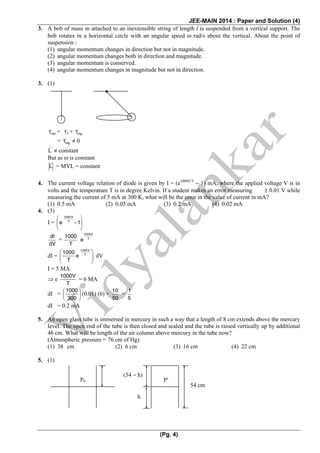
(Pg. 1)
.JEE-MAIN 2014.
PAPER - 1 : PHYSICS, MATHEMATICS & CHEMISTRY
Do not open this Test Booklet until you are asked to do so.
Read carefully the Instructions on the Back Cover of this Test Booklet.
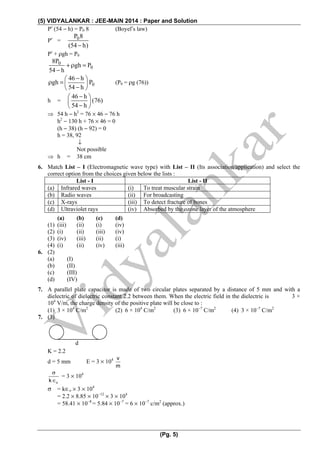
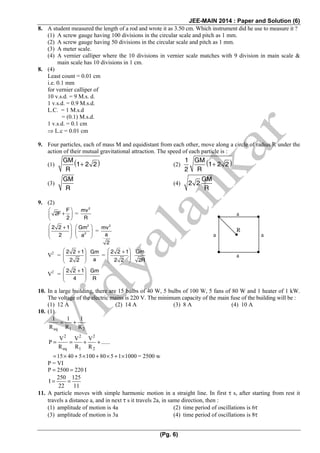
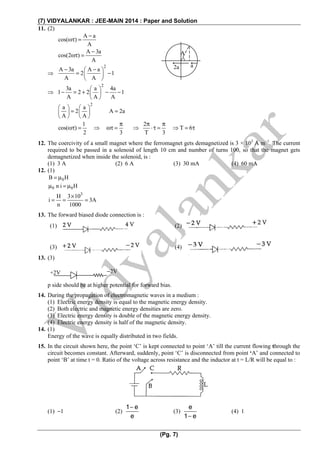
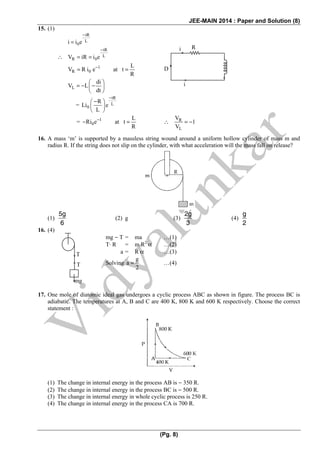
Important Instructions :
1. Immediately fill in the particulars on this page of the Test Booklet with Blue/Black Ball Point Pen. Use
of pencil is strictly prohibited.
2. The Answer Sheet is kept inside this Test Booklet. When you are directed to open the Test Booklet, take
out the Answer Sheet and fill in the particulars carefully.
3. The test is of 3 hours duration.
4. The Test Booklet consists of 90 questions. The maximum marks are 360.
5. There are three parts in the question paper A, B, C consisting of, Physics, Mathematics and Chemistry
having 30 questions in each part of equal weightage. Each question is allotted 4 (four) marks for each
correct response.
6. Candidates will be awarded marks as stated above in instruction No. 5 for correct response of each
question. 1/4 (one fourth) marks will be deducted for indicating incorrect response of each question. No
deduction from the total score will be made if no response is indicated for an item in the answer sheet.
7. There is only one correct response for each question. Filling up more than one response in each question
will be treated as wrong response and marks for wrong response will be deducted accordingly as per
instruction 6 above.
8. Use Blue/Black Ball Point Pen only for writting particulars/ marking responses on Side−1 and Side−2
of the Answer Sheet. Use of pencil is strictly prohibited.
9. No candidates is allowed to carry any textual material, printed or written, bits of papers, pager, mobile
phone, any electronic device, etc., except the Admit Card inside the examination hall/room.
10. Rough work is to be done on the space provided for this purpose in the Test Booklet only. This space is
given at the bottom of each page and in 3 pages (Pages 21−23) at the end of the booklet.
11. On completion of the test, the candidate must hand over the Answer Sheet to the Invigilator on duty in
the Room / Hall. However, the candidates are allowed to take away this Test Booklet with them.
12. The CODE for this Booklet is H. Make sure that the CODE printed on Side−2 of the Answer Sheet is
the same as that on this booklet. In case of discrepancy, the candidate should immediately report the
matter to the invigilator for replacement of both the Test Booklet and the Answer Sheet.
13. Do not fold or make any stray marks on the Answer Sheet.
Name of the Candidate (in Capital letters) : ______________________________________________
Roll Number : in figures
: in words ______________________________________________________________
Examination Centre Number :
Name of Examination Centre (in Capital letters) : ____________________________________________
Candidate’s Signature : ______________________ Invigilator’s Signature : ____________________
Test Booklet Code
H
JEE-MAIN 2014 : Paper and Solution (2)
(Pg. 2)
Read the following instructions carefully :
1. The candidates should fill in the required particulars on the Test Booklet and Answer Sheet (Side-1) with
Blue/Black Ball Point Pen.
2. For writing/marking particulars on Side-2 of the Answer Sheet, use Blue/Black Ball Point Pen only.
3. The candidates should not write their Roll Numbers anywhere else (except in the specified space) on the
Test Booklet/Answer Sheet.
4. Out of the four options given for each question, only one option is the correct answer.
5. For each incorrect response, one-fourth (¼) of the total marks allotted to the question would be
deducted from the total score. No deduction from the total score, however, will be made if no response
is indicated for an item in the Answer Sheet.
6. Handle the Test Booklet and Answer Sheet with care, as under no circumstances (except for discrepancy
in Test Booklet Code and Answer Sheet Code), another set will be provided.
7. The candidates are not allowed to do any rough work or writing work on the Answer Sheet. All
calculations/writing work are to be done in the space provided for this purpose in the Test Booklet itself,
marked ‘Space for Rough Work’. This space is given at the bottom of each page and in 3 pages (Pages
21 – 23) at the end of the booklet.
8. On completion of the test, the candidates must hand over the Answer Sheet to the Invigilator on duty in
the Room/Hall. However, the candidates are allowed to take away this Test Booklet with them.
9. Each candidate must show on demand his/her Admit Card to the Invigilator.
10. No candidate, without special permission of the Superintendent or Invigilator, should leave his/her seat.
11. The candidates should not leave the Examination Hall without handing over their Answer Sheet to the
Invigilator on duty and sign the Attendance Sheet again. Cases where a candidate has not signed the
Attendance Sheet a second time will be deemed not to have handed over the Answer Sheet and dealt with
as an unfair means case. The candidates are also required to put their left hand THUMB impression
in the space provided in the Attendance Sheet.
12. Use of Electronic/Manual Calculator and any Electronic Item like mobile phone, pager etc. is prohibited.
13. The candidates are governed by all Rules and Regulations of the JAB/Board with regard to their conduct
in the Examination Hall. All cases of unfair means will be dealt with as per Rules and Regulations of the
JAB/Board.
14. No part of the Test Booklet and Answer Sheet shall be detached under any circumstances.
15. Candidates are not allowed to carry any textual material, printed or written, bits of papers, pager,
mobile phone, electronic device or any other material except the Admit Card inside the
examination hall/room.
(3) VIDYALANKAR : JEE-MAIN 2014 : Paper and Solution
(Pg. 3)
.Questions and Solutions.
PART- A : PHYSICS
1. The pressure that has to be applied to the ends of a steel wire of length 10 cm to keep its length constant
when its temperature is raised by 100°C is :
(For steel Young’s modulus is 2 × 10¹¹
N m−2
and coefficient of thermal expansion is 1.1 × 10⁻⁵
K−1
)
(1) 2.2 × 10⁷
Pa (2) 2.2 × 10⁶
Pa (3) 2.2 × 10⁸
Pa (4) 2.2 × 10⁹
Pa
1. (3)
F
A
= Y
Δ
Δ
= TαΔ
P =
F
Y T
A
= αΔ
= 11 5
2 10 1.1 10 100−
× × × × = 8 2
2.2 10 N/m×
2. A conductor lies along the z-axis at − 1.5 ≤ z < 1.5m and carries a fixed current of 10.0 A in − za
direction (see figure). For a field B = 3.0 × 10⁻⁴
e−0.2x
ya T, find the power required to move the conductor
at constant speed to x = 2.0 m, y = 0 m in 5 × 10⁻³
s. Assume parallel motion along the x-axis.
(1) 14.85 W (2) 29.7 W (3) 1.57 W (4) 2.97 W
2. (4)
Force on conductor = I L B [+ x−direction ] (Due to magnetic field)
x
0B B e−α
= [ in +y direction]
0xT
0
0 0
1 1
P F.V.dt F dx [x 2m]
T T
= = ⋅ =∫ ∫
⇒
2
x0
0
I L B1
P e
T ( )
−α⎡ ⎤
= ⎢ ⎥−α⎣ ⎦
⇒ m)0ILB
P 1 e
T 0.2
−α(2⎡ ⎤= −
⎣ ⎦×
=
6
0.4
3
10 3 3 10
1 e
5 10 0.2
−
−
−
× × × ⎡ ⎤−
⎣ ⎦× ×
=
1.8 0.16 0.064
1 1 (0.4) .....
0.2 2 16
⎛ ⎞⎛ ⎞
− − + − +⎜ ⎟⎜ ⎟
⎝ ⎠⎝ ⎠
≈
0.64
9 2.88
2
× =
On Exact evaluation P 2.97 W=
JEE-MAIN 2014 : Paper and Solution (4)
(Pg. 4)
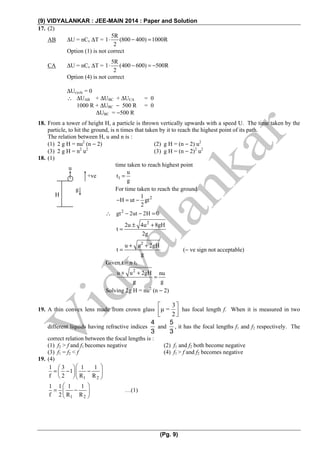
3. A bob of mass m attached to an inextensible string of length l is suspended from a vertical support. The
bob rotates in a horizontal circle with an angular speed ω rad/s about the vertical. About the point of
suspension :
(1) angular momentum changes in direction but not in magnitude.
(2) angular momentum changes both in direction and magnitude.
(3) angular momentum is conserved.
(4) angular momentum changes in magnitude but not in direction.
3. (1)
netτ = Tτ + mgτ
= '
mgτ ≠ 0
L ≠ constant
But as ω is constant
L = MVL = constant
4. The current voltage relation of diode is given by I = (e1000V/T
− 1) mA, where the applied voltage V is in
volts and the temperature T is in degree Kelvin. If a student makes an error measuring ± 0.01 V while
measuring the current of 5 mA at 300 K, what will be the error in the value of current in mA?
(1) 0.5 mA (2) 0.05 mA (3) 0.2 mA (4) 0.02 mA
4. (3)
I =
1000V
T
e 1
⎛ ⎞
−⎜ ⎟
⎝ ⎠
dI
dV
=
1000
T
1000V
T
e
dI =
1000V
T
1000
e
T
⎛ ⎞
⎜ ⎟
⎝ ⎠
dV
I = 5 MA
⇒ e
1000V
T
= 6 MA
dI =
1000
300
⎛ ⎞
⎜ ⎟
⎝ ⎠
(0.01) (6) =
10
50
=
1
5
dI = 0.2 mA
5. An open glass tube is immersed in mercury in such a way that a length of 8 cm extends above the mercury
level. The open end of the tube is then closed and sealed and the tube is raised vertically up by additional
46 cm. What will be length of the air column above mercury in the tube now?
(Atmospheric pressure = 76 cm of Hg)
(1) 38 cm (2) 6 cm (3) 16 cm (4) 22 cm
5. (1)
P0 P′
h
(54 − h)
54 cm
(5) VIDYALANKAR : JEE-MAIN 2014 : Paper and Solution
(Pg. 5)
P′ (54 − h) = P0 8 (Boyel′s law)
P′ = 0P 8
(54 h)−
P′ + ρgh = P0
0
0
8P
gh P
54 h
+ ρ =
−
0
46 h
gh P
54 h
−⎛ ⎞
ρ = ⎜ ⎟
−⎝ ⎠
(P0 = ρg (76))
h =
46 h
(76)
54 h
−⎛ ⎞
⎜ ⎟
−⎝ ⎠
⇒ 54 h − h2
= 76 × 46 − 76 h
h2
− 130 h + 76 × 46 = 0
(h − 38) (h − 92) = 0
h = 38, 92
↓
Not possible
⇒ h = 38 cm
6. Match List – I (Electromagnetic wave type) with List – II (Its association/application) and select the
correct option from the choices given below the lists :
List - I List - II
(a) Infrared waves (i) To treat muscular strain
(b) Radio waves (ii) For broadcasting
(c) X-rays (iii) To detect fracture of bones
(d) Ultraviolet rays (iv) Absorbed by the ozone layer of the atmosphere
(a) (b) (c) (d)
(1) (iii) (ii) (i) (iv)
(2) (i) (ii) (iii) (iv)
(3) (iv) (iii) (ii) (i)
(4) (i) (ii) (iv) (iii)
6. (2)
(a) (I)
(b) (II)
(c) (III)
(d) (IV)
7. A parallel plate capacitor is made of two circular plates separated by a distance of 5 mm and with a
dielectric of dielectric constant 2.2 between them. When the electric field in the dielectric is 3 ×
104
V/m, the charge density of the positive plate will be close to :
(1) 3 × 10⁴
C/m2
(2) 6 × 10⁴
C/m2
(3) 6 × 10⁻⁷
C/m2
(4) 3 × 10⁻⁷
C/m2
7. (3)
K = 2.2
d = 5 mm E = 3 × 10⁴ v
m
ok
σ
∈
= 3 × 10⁴
σ = k∈o × 3 × 104
= 2.2 × 8.85 × 10−12
× 3 × 104
= 58.41 × 10−8
= 5.84 × 10−7
= 6 × 10⁻⁷
c/m2
(approx.)
d
JEE-MAIN 2014 : Paper and Solution (6)
(Pg. 6)
8. A student measured the length of a rod and wrote it as 3.50 cm. Which instrument did he use to measure it ?
(1) A screw gauge having 100 divisions in the circular scale and pitch as 1 mm.
(2) A screw gauge having 50 divisions in the circular scale and pitch as 1 mm.
(3) A meter scale.
(4) A vernier calliper where the 10 divisions in vernier scale matches with 9 division in main scale &
main scale has 10 divisions in 1 cm.
8. (4)
Least count = 0.01 cm
i.e. 0.1 mm
for vernier calliper of
10 v.s.d. = 9 M.s. d.
1 v.s.d. = 0.9 M.s.d.
L.C. = 1 M.s.d
= (0.1) M.s.d.
1 v.s.d. = 0.1 cm
⇒ L.c = 0.01 cm
9. Four particles, each of mass M and equidistant from each other, move along a circle of radius R under the
action of their mutual gravitational attraction. The speed of each particle is :
(1) ( )GM
1 2 2
R
+ (2) ( )1 GM
1 2 2
2 R
+
(3)
GM
R
(4)
GM
2 2
R
9. (2)
F
2F
2
⎛ ⎞
+⎜ ⎟
⎝ ⎠
=
2
mv
R
2 2 1
2
⎛ ⎞+
⎜ ⎟⎜ ⎟
⎝ ⎠
2
2
Gm
a
⎛ ⎞
⎜ ⎟
⎝ ⎠
=
2
mv
a
2
V2
=
2 2 1
2 2
⎛ ⎞+
⎜ ⎟⎜ ⎟
⎝ ⎠
Gm
a
=
2 2 1
2 2
⎛ ⎞+
⎜ ⎟⎜ ⎟
⎝ ⎠
Gm
2R
V2
=
2 2 1
4
⎛ ⎞+
⎜ ⎟⎜ ⎟
⎝ ⎠
Gm
R
10. In a large building, there are 15 bulbs of 40 W, 5 bulbs of 100 W, 5 fans of 80 W and 1 heater of 1 kW.
The voltage of the electric mains is 220 V. The minimum capacity of the main fuse of the building will be :
(1) 12 A (2) 14 A (3) 8 A (4) 10 A
10. (1)
eq 1 2
1 1 1
R R R
= +
2 2 2
eq 1 2
V V V
P ......
R R R
= = + +
15 40 5 100 80 5 1 1000= × + × + × + × = 2500 w
P = VI
P 2500 220 I= =
250 125
I
22 11
= =
11. A particle moves with simple harmonic motion in a straight line. In first τ s, after starting from rest it
travels a distance a, and in next τ s it travels 2a, in same direction, then :
(1) amplitude of motion is 4a (2) time period of oscillations is 6τ
(3) amplitude of motion is 3a (4) time period of oscillations is 8τ
a
aa
a
R
(7) VIDYALANKAR : JEE-MAIN 2014 : Paper and Solution
(Pg. 7)
11. (2)
A a
cos( )
A
−
ωτ =
A 3a
cos(2 )
A
−
ωτ =
⇒
2
A 3a A a
2 1
A A
− −⎛ ⎞
= −⎜ ⎟
⎝ ⎠
⇒
2
3a a 4a
1 2 2 1
A A A
⎛ ⎞
− = + − −⎜ ⎟
⎝ ⎠
2
a a
2 A 2a
A A
⎛ ⎞ ⎛ ⎞
= =⎜ ⎟ ⎜ ⎟
⎝ ⎠ ⎝ ⎠
1 2
cos( ) T 6
2 3 T 3
π π π
ωτ = ⇒ ωτ = ⇒ ⋅τ = ⇒ = τ
12. The coercivity of a small magnet where the ferromagnet gets demagnetized is 3 × 10³
A m−1
. The current
required to be passed in a solenoid of length 10 cm and number of turns 100, so that the magnet gets
demagnetized when inside the solenoid, is :
(1) 3 A (2) 6 A (3) 30 mA (4) 60 mA
12. (1)
0B H= μ
0 0n i Hμ = μ
3
H 3 10
i 3A
n 1000
×
= = =
13. The forward biased diode connection is :
13. (3)
p side should be at higher potential for forward bias.
14. During the propagation of electromagnetic waves in a medium :
(1) Electric energy density is equal to the magnetic energy density.
(2) Both electric and magnetic energy densities are zero.
(3) Electric energy density is double of the magnetic energy density.
(4) Electric energy density is half of the magnetic density.
14. (1)
Energy of the wave is equally distributed in two fields.
15. In the circuit shown here, the point ‘C’ is kept connected to point ‘A’ till the current flowing through the
circuit becomes constant. Afterward, suddenly, point ‘C’ is disconnected from point ‘A’ and connected to
point ‘B’ at time t = 0. Ratio of the voltage across resistance and the inductor at t = L/R will be equal to :
(1) −1 (2)
1 e
e
−
(3)
e
1 e−
(4) 1
(1) (2)
(3) (4)
A
a2a
+2V −2V
JEE-MAIN 2014 : Paper and Solution (8)
(Pg. 8)
15. (1)
tR
L
0i i e
−
=
∴
tR
L
R 0V iR i e
−
= =
1
R 0
L
V R i e at t
R
−
= =
L
di
V L
dt
⎛ ⎞
= − −⎜ ⎟
⎝ ⎠
=
tR
L
0
R
Li e
L
−
−⎛ ⎞
⎜ ⎟
⎝ ⎠
= 1
0
L
Ri e at t
R
−
− = ∴ R
L
V
1
V
= −
16. A mass ‘m’ is supported by a massless string wound around a uniform hollow cylinder of mass m and
radius R. If the string does not slip on the cylinder, with what acceleration will the mass fall on release?
(1)
5g
6
(2) g (3)
2g
3
(4)
g
2
16. (4)
mg − T = ma …(1)
T· R = m R2
α …(2)
a = R α …(3)
Solving
g
a
2
= …(4)
17. One mole of diatomic ideal gas undergoes a cyclic process ABC as shown in figure. The process BC is
adiabatic. The temperatures at A, B and C are 400 K, 800 K and 600 K respectively. Choose the correct
statement :
(1) The change in internal energy in the process AB is − 350 R.
(2) The change in internal energy in the process BC is − 500 R.
(3) The change in internal energy in whole cyclic process is 250 R.
(4) The change in internal energy in the process CA is 700 R.
Ri
i
D
T
T
mg
(9) VIDYALANKAR : JEE-MAIN 2014 : Paper and Solution
(Pg. 9)
17. (2)
AB ΔU = nCv ΔT =
5R
1 (800 400) 1000R
2
⋅ − =
Option (1) is not correct
CA ΔU = nCv ΔT =
5R
1 (400 600) 500R
2
⋅ − = −
Option (4) is not correct
ΔUcycle = 0
∴ ΔUAB + ΔUBC + ΔUCA = 0
1000 R + ΔUBC − 500 R = 0
ΔUBC = −500 R
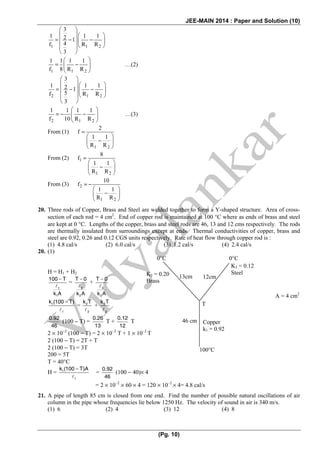
18. From a tower of height H, a particle is thrown vertically upwards with a speed U. The time taken by the
particle, to hit the ground, is n times that taken by it to reach the highest point of its path.
The relation between H, u and n is :
(1) 2 g H = nu2
(n − 2) (2) g H = (n − 2) u2
(3) 2 g H = n2
u2
(3) g H = (n − 2)2
u2
18. (1)
time taken to reach highest point
1
u
t
g
=
For time taken to reach the ground
21
H ut gt
2
− = −
∴ 2
gt 2ut 2H 0− − =
2
2u 4u 8gH
t
2g
± +
=
2
u u 2gH
t
g
+ +
= (− ve sign not acceptable)
Given t = n t1
2
u u 2gH nu
g g
+ +
=
Solving 2g H = nu2
(n − 2)
19. A thin convex lens made from crown glass
3
μ =
2
⎡ ⎤
⎢ ⎥⎣ ⎦
has focal length f. When it is measured in two
different liquids having refractive indices
4
3
and
5
3
, it has the focal lengths f1 and f2 respectively. The
correct relation between the focal lengths is :
(1) f2 > f and f1 becomes negative (2) f1 and f2 both become negative
(3) f1 = f2 < f (4) f1 > f and f2 becomes negative
19. (4)
1 2
1 3 1 1
1
f 2 R R
⎛ ⎞⎛ ⎞
= − −⎜ ⎟⎜ ⎟
⎝ ⎠⎝ ⎠
1 2
1 1 1 1
f 2 R R
⎛ ⎞
= −⎜ ⎟
⎝ ⎠
…(1)
u
H
g
+ve
JEE-MAIN 2014 : Paper and Solution (10)
(Pg. 10)
1 1 2
3
1 1 12 1
4f R R
3
⎛ ⎞
⎜ ⎟⎛ ⎞
= − −⎜ ⎟⎜ ⎟
⎝ ⎠⎜ ⎟
⎝ ⎠
1 1 2
1 1 1 1
f 8 R R
⎛ ⎞
= −⎜ ⎟
⎝ ⎠
…(2)
2 1 2
3
1 1 12 1
5f R R
3
⎛ ⎞
⎜ ⎟⎛ ⎞
= − −⎜ ⎟⎜ ⎟
⎝ ⎠⎜ ⎟
⎝ ⎠
2 1 2
1 1 1 1
f 10 R R
⎛ ⎞
= − −⎜ ⎟
⎝ ⎠
…(3)
From (1)
1 2
2
f
1 1
R R
=
⎛ ⎞
−⎜ ⎟
⎝ ⎠
From (2) 1
1 2
8
f
1 1
R R
=
⎛ ⎞
−⎜ ⎟
⎝ ⎠
From (3) 2
1 2
10
f
1 1
R R
= −
⎛ ⎞
−⎜ ⎟
⎝ ⎠
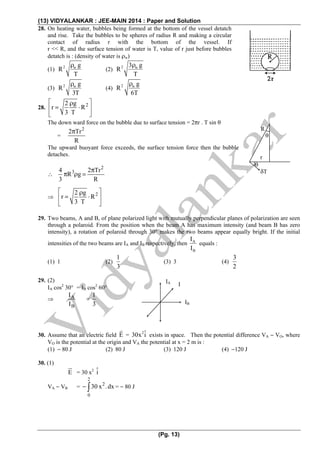
20. Three rods of Copper, Brass and Steel are welded together to form a Y-shaped structure. Area of cross-
section of each rod = 4 cm2
. End of copper rod is maintained at 100 °C where as ends of brass and steel
are kept at 0 °C. Lengths of the copper, brass and steel rods are 46, 13 and 12 cms respectively. The rods
are thermally insulated from surroundings except at ends. Thermal conductivities of copper, brass and
steel are 0.92, 0.26 and 0.12 CGS units respectively. Rate of heat flow through copper rod is :
(1) 4.8 cal/s (2) 6.0 cal/s (3) 1.2 cal/s (4) 2.4 cal/s
20. (1)
H = H1 + H2
1
1
100 T
k A
−
=
2
2
T 0
k A
−
+
3
3
T 0
k A
−
1
1
k (100 T)−
= 2
2
k T
+ 3
3
k T
0.92
46
(100 − T) =
0.26
13
T +
0.12
12
T
2 × 10⁻²
(100 − T) = 2 × 10⁻²
T + 1 × 10⁻²
T
2 (100 − T) = 2T + T
2 (100 − T) = 3T
200 = 5T
T = 40°C
H = 1
1
k (100 T)A−
=
0.92
46
(100 − 40)× 4
= 2 × 10−2
× 60 × 4 = 120 × 10−2
× 4= 4.8 cal/s
21. A pipe of length 85 cm is closed from one end. Find the number of possible natural oscillations of air
column in the pipe whose frequencies lie below 1250 Hz. The velocity of sound in air is 340 m/s.
(1) 6 (2) 4 (3) 12 (4) 8
0°C 0°C
100°C
T
13cm 12cm
K3 = 0.12
SteelK2 = 0.20
Brass
46 cm Copper
k1 = 0.92
A = 4 cm2
(11) VIDYALANKAR : JEE-MAIN 2014 : Paper and Solution
(Pg. 11)
21. (1)
L = n
2 4
λ λ
+ = (2n + 1)
4
λ
=
( )2n 1 v
4f
+
⇒ 0.85 =
( )v
2n 1
4f
+
⇒ f =
( )2n 1 85
0.85 4
+ ×
×
⇒ f = (2n + 1) 100 H2
The possible frequencies are : 100 HZ, 300 HZ, … 1100 HZ.
22. There is a circular tube in a vertical plane. Two liquids which do not mix
and of densities d1 and d2 are filled in the tube. Each liquid subtends 90°
angle at centre. Radius joining their interface makes an angle α with
vertical. Ratio 1
2
d
d
is
(1)
1 tan
1 tan
+ α
− α
(2)
1 sin
1 cos
+ α
− α
(3)
1 sin
1 sin
+ α
− α
(4)
1 cos
1 cos
+ α
− α
22. (1)
Pressure at 0 level is same from both sides.
d1 (1 − sin α) = d1 (1 − cos α) + d2 [cos α + sin α]
⇒ 1
2
d
d
=
sin cos
cos sin
α + α
α − α
23. A green light is incident from the water to the air - water interface at the critical angle (θ). Select the
correct statement.
(1) The spectrum of visible light whose frequency is more than that of green light will come out to the air
medium.
(2) The entire spectrum of visible light will come out of the water at various angles to the normal.
(3) The entire spectrum of visible light will come out of the water at an angle of 90° to the normal.
(4) The spectrum of visible light whose frequency is less than that of green light will come out to the air
medium.
23. (4)
μr < μg < μv ⇒ sin (θr) > sin (θg) > sin (θv)
⇒ θr > θg > θv [θr, θg, θv are critical angles of corresponding colors]
Thus all colors from red to green will emerge out of water
24. Hydrogen (1H1
), Deuterium (1H2
), singly ionised Helium (2He4
)+
and doubly ionised lithium (3Li6
)+ +
all
have one electron around the nucleus. Consider an electron transition from n = 2 to
n = l. If the wave lengths of emitted radiation are λ1, λ2, λ3 and λ4 respectively then approximately which
one of the following is correct ?
(1) λ1 = λ2 = 4λ3 = 9λ4 (2) λ1 = 2λ2 = 3λ3 = 4λ4
(3) 4λ1 = 2λ2 = 2λ3 = λ4 (3) λ1 = 2λ2 = 2λ3 = λ4
24. (1)
1
λ
=
2
RZ
me
1
M
⎛ ⎞
+⎜ ⎟
⎝ ⎠
1
1
4
⎡ ⎤
−⎢ ⎥
⎣ ⎦
⇒
1
λ
=
3
4
R0 ⋅
2
Z
me
1
M
⎛ ⎞
+⎜ ⎟
⎝ ⎠
[M = mass of mucleus]
1
λ
∝
p
1
me
1
M
⎛ ⎞
+⎜ ⎟⎜ ⎟
⎝ ⎠
2
1
λ
∝
p
1
me
1
2M
⎛ ⎞
+⎜ ⎟⎜ ⎟
⎝ ⎠
[Mp = mass of H − atom]
α
α
α
0
d2
JEE-MAIN 2014 : Paper and Solution (12)
(Pg. 12)
3
1
λ
∝
p
4
me
1
4M
⎛ ⎞
+⎜ ⎟⎜ ⎟
⎝ ⎠
4
1
λ
∝
p
9
me
1
6M
⎛ ⎞
+⎜ ⎟⎜ ⎟
⎝ ⎠
If
p
me
M
<< 1 : we have λ1 = λ2 = 4λ3 = 9λ4
25. The radiation corresponding to 3 → 2 transition of hydrogen atom falls on a metal surface to produce
photoelectrons. These electrons are made to enter a magnetic field of 3 × 10⁻⁴
T. If the radius of the
largest circular path followed by these electrons is 10.0 mm, the work function of the metal is close to :
(1) 0.8 eV (2) 1.6 eV (3) 1.8 eV (4) 1.1 eV
25. (4)
r =
m
eB
ν
=
p2mE
eB
[E = electron’s K.E.] [m = electron mass, e = electron charge]
E = Ep − φ Ep = photon energy = 1.9 eV.
⇒ (reB)2
= 2m [Ep − φ] ⇒ φ = Ep −
2
(reB)
2m
⇒ φ = 1.9 eV −
4 19 8
31
10 1.6 10 9 10
2 9.1 10
− − −
−
× × × ×
× ×
1.9eV − 0.79V = 1.1eV
26. A block of mass m is placed on a surface with a vertical cross section given by y =
3
x
6
. If the coefficient
of friction is 0.5, the maximum height above the ground at which the block can be placed without slipping
is :
(1)
1
m
3
(2)
1
m
2
(3)
1
m
6
(4)
2
m
3
26. (3)
mg sinθ = μs mg cos θ [when partied is just balanced]
⇒ tan θ = μs
tanθ =
dy
dx
=
2
x
2
⎛ ⎞
⎜ ⎟
⎝ ⎠
∴
2
x
2
= 0.5 ⇒ x = 1
⇒ y =
1
6
27. When a rubber-band is stretched by a distance x, it exerts a restoring force of magnitude
F = ax + bx2
where a and b are constants. The work done in stretching the unstretched rubber-band by L
is :
(1)
2 3
aL bL
2 3
+ (2)
2 3
1 aL bL
2 2 3
⎡ ⎤
+⎢ ⎥
⎣ ⎦
(3) aL2
+ bL3
(4) 2 31
(aL bL )
2
+
27. (1)
w =
L
o
F.dx∫ ⇒ ω =
2
aL
2
+
3
bL
3
N
fs
Mg sinθ Mg cosθ
(13) VIDYALANKAR : JEE-MAIN 2014 : Paper and Solution
(Pg. 13)
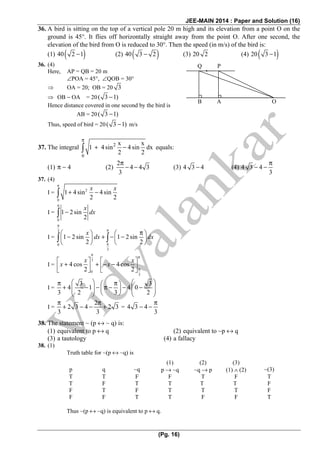
28. On heating water, bubbles being formed at the bottom of the vessel detatch
and rise. Take the bubbles to be spheres of radius R and making a circular
contact of radius r with the bottom of the vessel. If
r << R, and the surface tension of water is T, value of r just before bubbles
detatch is : (density of water is ρw)
(1) 2 w g
R
T
ρ
(2) 2 w3 g
R
T
ρ
(3) 2 w g
R
3T
ρ
(4) 2 w g
R
6T
ρ
28. 22 g
r R
3 T
⎡ ⎤ρ
= ⋅⎢ ⎥
⎣ ⎦
The down ward force on the bubble due to surface tension = 2πr . T sin θ
=
2
2 Tr
R
π
The upward buoyant force exceeds, the surface tension force then the bubble
detaches.
∴
2
34 2 Tr
R g
3 R
π
π ρ =
⇒ 22 g
r R
3 T
⎡ ⎤ρ
= ⋅⎢ ⎥
⎣ ⎦
29. Two beams, A and B, of plane polarized light with mutually perpendicular planes of polarization are seen
through a polaroid. From the position when the beam A has maximum intensity (and beam B has zero
intensity), a rotation of polaroid through 30° makes the two beams appear equally bright. If the initial
intensities of the two beams are IA and IB respectively, then A
B
I
I
equals :
(1) 1 (2)
1
3
(3) 3 (4)
3
2
29. (2)
IA cos2
30° = IB cos2
60°
⇒ A
B
I
I
=
1
3
30. Assume that an electric field E = 2ˆ30x i exists in space. Then the potential difference VA − VO, where
VO is the potential at the origin and VA the potential at x = 2 m is :
(1) − 80 J (2) 80 J (3) 120 J (4) −120 J
30. (1)
E = 30 x2
i
VA − VB =
2
2
0
30 x .dx− ∫ = − 80 J
IA
I
IB
R
θ
r
δT
θ
JEE-MAIN 2014 : Paper and Solution (14)
(Pg. 14)
PART- B : MATHEMATICS
31. The image of the line
x 1
3
−
=
y 3
1
−
=
z 4
5
−
−
in the plane 2x − y + z + 3 = 0 is the line:
(1)
x 3 y 5 z 2
3 1 5
+ − −
= =
−
(2)
x 3 y 5 z 2
3 1 5
+ − +
= =
− −
(3)
x 3 y 5 z 2
3 1 5
− + −
= =
−
(4)
x 3 y 5 z 2
3 1 5
− + −
= =
− −
31. (1)
Equation of AB is
x 1
2
−
=
y 3
1
−
−
=
z 4
1
−
= λ
Co-ordinate of point B is
⇒ x = 1 + 2λ point satisfy the equation of plane
y = 3 − λ
z = 4 + λ
2(1 + 2λ) − (3 − λ) + (4 + λ) + 3 = 0
⇒ λ = −1
⇒ Co-ordinate of point B(−1, 4, 3)
⇒ Co-ordinate of point C(−3, 5, 2)
⇒ equation of line passing through ‘C’ is
x 3
3
+
=
y 5
1
−
=
z 2
5
−
−
32. If the coefficients of x3
and x4
in the expansion of (1+ ax+ bx2
) (1−2x)18
in powers of x are both
zero, then (a, b) is equal to:
(1)
251
16,
3
⎛ ⎞
⎜ ⎟
⎝ ⎠
(2)
251
14,
3
⎛ ⎞
⎜ ⎟
⎝ ⎠
(3)
272
14,
3
⎛ ⎞
⎜ ⎟
⎝ ⎠
(4)
272
16,
3
⎛ ⎞
⎜ ⎟
⎝ ⎠
32. (4)
(1 + ax + bx2
) [1 − 18
C1 2x + 18
C2 (2x)2
) − 18
C3(2x)3
+ 18
C4 (2x)4
…]
Coefficient of x3
is
−18
C3(23
) + a(18
C2 × 4) − b(18
C1 × 2) = 0 …(i)
Coefficient of x4
is
18
C4 (24
) + a(−18
C3 23
) + 18
C2 b22
= 0 …(ii)
or solving both these equation
a = 16 and b = 272/3.
33. If a ∈ R and the equation − 3(x−[x])2
+2 (x−[x]) + a2
= 0
(where [x] denotes the greatest integer ≤ x) has no integral solution, then all possible values of a
lie in the interval:
(1) (−1, 0) ∪ (0, 1) (2) (1, 2) (3) ( −2, −1) (4) ( − ∞, −2) ∪ (2, ∞)
A
B
C
x 1
3
−
=
y 3
1
−
=
z 4
5
−
−
2x − y + z + 3 = 0
(15) VIDYALANKAR : JEE-MAIN 2014 : Paper and Solution
(Pg. 15)
33. (1)
( ) ( )2 2
3 x [x] 2 x [x] a− − + − + = 0
{ } { }2 2
3 x 2 x a 0− + + = …(1)
∴ {x} =
2
2 4 12a
6
− ± +
−
=
2
1 1 3a
3
+∓
As 0 ≤ {x} < 1
0 ≤
2
1 1 3a
1
3
+ +
<
−1 ≤ 2
1 3a 2+ <
1 + 3a2
< 4
3(a2
− 1 ) < 0
a ( 1,1)∈ −
but it a = 0
then equation (1)
has integral solution
So, a ≠ 0
Ans. a ∈ (−1, 0) ∪ (0, 1)
34. If a b b c c a⎡ ⎤× × ×⎣ ⎦ =
2
a b c⎡ ⎤λ ⎣ ⎦ then λ is equal to:
(1) 2 (2) 3 (3) 0 (4) 1
34. (4)
a b b c c a⎡ ⎤× × ×⎣ ⎦ Let u = b c×
= ( ) ( ) ( ){ }a b b c c a× ⋅ × × ×
= ( ) { }a b u (c a)× ⋅ × ×
= ( ) ( ) ( ){ }a b u a c u c a× ⋅ ⋅ − ⋅
= ( ) { }a b b c a c b c c a⎡ ⎤ ⎡ ⎤× ⋅ −⎣ ⎦ ⎣ ⎦
= b c a a b c⎡ ⎤ ⎡ ⎤⎣ ⎦ ⎣ ⎦
=
2
a b c⎡ ⎤⎣ ⎦
⇒ λ = 1
35. The variance of first 50 even natural numbers is:
(1)
833
4
(2) 833 (3) 437 (4)
437
4
35. (2)
Variance = ( )
2
2
−
∑ ix
x
n
⇒ σ2
=
22 2 2 2
2 ... 100 2 .... 100
50 50
⎛ ⎞+ 4 + 6 + + + 4 + +⎛ ⎞
−⎜ ⎟ ⎜ ⎟
⎝ ⎠⎝ ⎠
⇒ σ2
= 3434 − 2601
= 833
JEE-MAIN 2014 : Paper and Solution (16)
(Pg. 16)
36. A bird is sitting on the top of a vertical pole 20 m high and its elevation from a point O on the
ground is 45°. It flies off horizontally straight away from the point O. After one second, the
elevation of the bird from O is reduced to 30°. Then the speed (in m/s) of the bird is:
(1) 40( )2 1− (2) 40( )3 2− (3) 20 2 (4) 20( )3 1−
36. (4)
Here, AP = QB = 20 m
∠POA = 45°, ∠QOB = 30°
⇒ OA = 20; OB = 20 3
⇒ OB − OA = 20( 3 1)−
Hence distance covered in one second by the bird is
AB = 20( 3 1)−
Thus, speed of bird = 20( 3 1)− m/s
37. The integral 2
0
x x
1 4 sin 4 sin dx
2 2
π
+ −∫ equals:
(1) π − 4 (2)
2
4 4 3
3
π
− − (3) 4 3 4− (4) 4 3 4
3
π
− −
37. (4)
I = 2
0
1 4 sin 4 sin
2 2
π
+ −∫
x x
I =
0
1 2 sin
2
π
−∫
x
dx
I =
3
0
3
1 2 sin 1 2 sin
2 2
π
π
π
π⎛ ⎞ ⎛ ⎞
− + − −⎜ ⎟ ⎜ ⎟
⎝ ⎠ ⎝ ⎠
∫ ∫
x
dx dx
I =
3
0
3
4 cos 4 cos
2 2
π
π
π
⎡ ⎤ ⎡ ⎤
+ + − −⎢ ⎥ ⎢ ⎥⎣ ⎦ ⎣ ⎦
x x
x x
I =
3 3
4 1 4 0
3 2 3 2
⎛ ⎞ ⎛ ⎞π π⎛ ⎞
+ − − π − − −⎜ ⎟ ⎜ ⎟⎜ ⎟⎜ ⎟ ⎜ ⎟⎝ ⎠⎝ ⎠ ⎝ ⎠
I =
2
2 3 4 2 3
3 3
π π
+ − − + = 4 3 4
3
π
− −
38. The statement ~ (p ↔ ~ q) is:
(1) equivalent to p ↔ q (2) equivalent to ~p ↔ q
(3) a tautology (4) a fallacy
38. (1)
Truth table for ~(p ↔ ~q) is
(1) (2) (3)
p q ~q p → ~q ~q → p (1) ∧ (2) ~(3)
T T F F T F T
T F T T T T F
F T F T T T F
F F T T F F T
Thus ~(p ↔ ~q) is equivalent to p ↔ q.
Q P
B A O
(17) VIDYALANKAR : JEE-MAIN 2014 : Paper and Solution
(Pg. 17)
39. If A is an 3 × 3 non – singular matrix such that AA′ = A′A and B = A−1
A′, then BB′ equals:
(1) I + B (2) I (3) B−1
(4) (B−1
)′
39. (2)
B B T = ( )( )T1 T 1 T
A A A A− −
= ( ) ( )( )T1 T 1
A A A A− −
⋅
= ( )( )T1 T 1
A A A A− −
⋅ = ( )( )1 T 1 T
A A A A− −
= ( ) ( )1 T 1 T
A A A A− −
⋅ = ( )TT 1
A A−
⋅
= ( )T1
A A−
= I
40. The integral
1
x
x1
1 x e d x
x
+⎛ ⎞
+ −⎜ ⎟
⎝ ⎠
∫ is equal to :
(1) (x − 1)
1
x
xe c
+
+ (2)
1
x
xx e C
+
+ (3) ( )
1
x
xx 1 e c
+
+ + (4)
1
x
xx e c
+
− +
40. (2)
1
x
x
1
1 x e dx
x
+⎛ ⎞
+ −⎜ ⎟
⎝ ⎠∫
Put
1
x
xx e
+
= t
1 1
x x
x x
2
1
x e 1 e dx
x
+ +⎧ ⎫
− +⎨ ⎬
⎩ ⎭
= dt
1
x
x
2
1
x 1 1 e dx
x
+⎧ ⎫⎛ ⎞
− +⎨ ⎬⎜ ⎟
⎝ ⎠⎩ ⎭
= dt
1
x
x
1
1 x e dx
x
+⎛ ⎞
+ −⎜ ⎟
⎝ ⎠
= dt
= dt∫ = t + c =
1
x
xx e C
+
+
41. If z is a complex number such that |z| ≥ 2, then the minimum value of
1
z
2
+ :
(1) is equal to
5
2
(2) lies in the interval (1, 2)
(3) is strictly greater than
5
2
(4) is strictly greater than
3
2
but less than
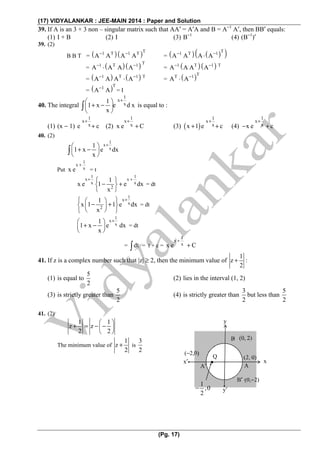
5
2
41. (2)
1 1
z z
2 2
⎛ ⎞
+ = − −⎜ ⎟
⎝ ⎠
The minimum value of
1
z
2
+ is
3
2
y
y′
x′ x
A′ A
1
,0
2
−
B′ (0,−2)
B (0, 2)
(2, 0)Q
(−2,0)
JEE-MAIN 2014 : Paper and Solution (18)
(Pg. 18)
42. If g is the inverse of a function f and f′ (x) = 5
1
1 x+
, then g′ (x) is equal to :
(1) 1 + x5
(2) 5x4
(3)
{ }5
1
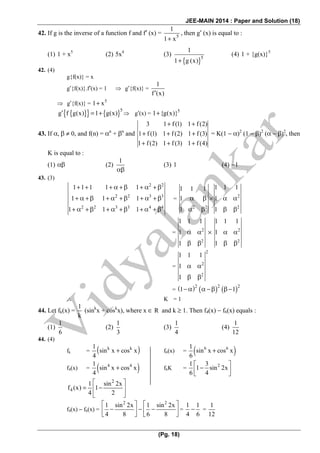
1 g (x)+
(4) 1 + {g(x)}5
42. (4)
g{f(x)} = x
g′{f(x)}.f′(x) = 1 ⇒ g′{f(x)} =
1
f (x)′
⇒ g′{f(x)} = 5
1 x+
{ }{ } { }5
g f g(x) 1 g(x)′ = + ⇒ g′(x) = 5
1 {g(x)}+
43. If α, β ≠ 0, and f(n) = αn
+ βn
and
3 1 f (1) 1 f (2)
1 f (1) 1 f (2) 1 f (3)
1 f(2) 1 f (3) 1 f (4)
+ +
+ + +
+ + +
= K(1 − α)2
(1 − β)2
(α − β)2
, then
K is equal to :
(1) αβ (2)
1
αβ
(3) 1 (4) −1
43. (3)
2 2
2 2 3 3
2 2 3 3 4 4
1 1 1 1 1
1 1 1
1 1 1
+ + + α + β + α + β
+ α + β + α + β + α + β
= 2
2 2 2
1 1 11 1 1
1 1
1 1
α β × α α
α β β β
= 2 2
2 2
1 1 1 1 1 1
1 1
1 1
α α × α α
β β β β
=
2
2
2
1 1 1
1
1
α α
β β
= ( ) ( ) ( )2 2 2
1 1− α α − β β −
∴ K = 1
44. Let fk(x) =
1
k
(sink
x + cosk
x), where x ∈ R and k ≥ 1. Then f4(x) − f6(x) equals :
(1)
1
6
(2)
1
3
(3)
1
4
(4)
1
12
44. (4)
fk = ( )k k1
sin x cos x
4
+ f6(x) = ( )6 61
sin x cos x
6
+
f4(x) = ( )4 41
sin x cos x
4
+ f6K = 21 3
1 sin 2x
6 4
⎡ ⎤
−⎢ ⎥⎣ ⎦
2
4
1 sin 2x
f (x) 1
4 2
⎡ ⎤
= −⎢ ⎥
⎢ ⎥⎣ ⎦
f4(x) − f6(x) =
2 2
1 sin 2x 1 sin 2x
4 8 6 8
⎡ ⎤ ⎡ ⎤
− − −⎢ ⎥ ⎢ ⎥
⎣ ⎦ ⎣ ⎦
=
1 1
4 6
− =
1
12
(19) VIDYALANKAR : JEE-MAIN 2014 : Paper and Solution
(Pg. 19)
45. Let α and β be the roots of equation px2
+ qx + r = 0, p ≠ 0. If p, q, r are in A.P. and
1 1
+
α β
= 4,
then the value of |α − β| is :
(1)
61
9
(2)
2 17
9
(3)
34
9
(4)
2 13
9
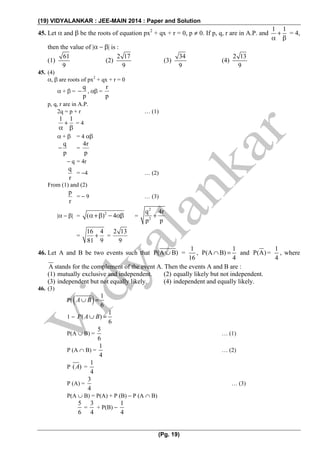
45. (4)
α, β are roots of px2
+ qx + r = 0
α + β =
q
p
− , αβ =
r
p
p, q, r are in A.P.
2q = p + r … (1)
1 1
+
α β
= 4
α + β = 4 αβ
q
p
− =
4r
p
− q = 4r
q
r
= −4 … (2)
From (1) and (2)
p
r
= − 9 … (3)
|α − β| = 2
( ) 4α + β − αβ =
2
2
q 4r
p p
+
=
16 4
81 9
+ =
2 13
9
46. Let A and B be two events such that P(A B)∪ =
1
16
,
1
P(A B)
4
∩ = and P(A) =
1
4
, where
A stands for the complement of the event A. Then the events A and B are :
(1) mutually exclusive and independent. (2) equally likely but not independent.
(3) independent but not equally likely. (4) independent and equally likely.
46. (3)
P(( ) 1
6
∪ =A B
1 −
1
( )
6
∪ =P A B
P(A ∪ B) =
5
6
… (1)
P (A ∩ B) =
1
4
… (2)
P ( )A =
1
4
P (A) =
3
4
… (3)
P(A ∪ B) = P(A) + P (B) − P (A ∩ B)
5
6
=
3
4
+ P(B) −
1
4
JEE-MAIN 2014 : Paper and Solution (20)
(Pg. 20)
P(B) =
5 1
6 2
−
P(B) =
1
3
… (iv)
A of B are Independent because P(A ∩ B) = P(A) P(B).A and B has different probability so if is not
equally likely.
47. If f and g are differentiable functions in [0, 1] satisfying f(0) = 2 = g(1), g(0) = 0 and f(1) = 6,
then for some c∈]0, 1[ :
(1) 2f′ (c) = g′ (c) (2) 2f′(c) = 3g′(c)
(3) f′ (c) = g′ (c) (4) f′ (c) = 2g′ (c)
47. (4)
Given, f(0) = 2, g(1) = 2, g(0) = 0, f(1) = 6
Let, F(x) = f(x) − 2g(x)
F(0) = f(0) − 2g(0)
F(0) = 2 − 2 × 0
F(0) = 2 … (1)
F(1) = F(1) − 2g(1)
F(1) = 6 − 2 × 2
F(1) = 2 … (2)
F(x) is continuous and differentiable in [0, 1].
F(0) = F(1)
So, according to Rolle’s theorem, there is at least are root between 0 and 1. At which
F′(x) = 0.
f′(x) − 2g′(x) = 0
f′(c) − 2g′(c) = 0
f′ (c) = 2g′ (c)
48. Let the population of rabbits surviving at a time t be governed by the differential equation
dp (t) 1
p(t) 200
dt 2
= − .
If p(0) = 100, then p(t) equals :
(1) 400 − 300 et/2
(2) 300 − 200 e−t/2
(3) 600 − 500 et/2
(4) 400 − 300 e−t/2
48. (1)
Rearranging the equation we get,
dp(t) 1
dt
p(t) 400 2
=
−
…(1)
Integrating (1) on both sides we get
p(t) = 400 + k et/2
, where k is a constant of integration.
Using p(0) = 100, we get
k = −300
∴ the relation is
p(t) = 400 − 300 et/2
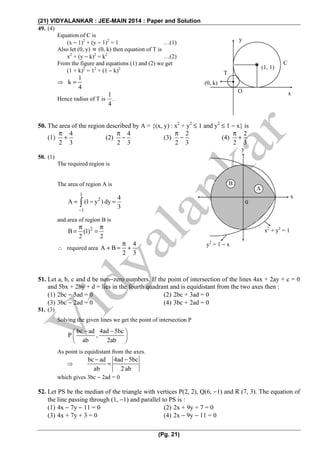
49. Let C be the circle with centre at (1, 1) and radius = 1. If T is the circle centred at (0, y), passing
through origin and touching the circle C externally, then the radius of T is equal to :
(1)
3
2
(2)
3
2
(3)
1
2
(4)
1
4
(21) VIDYALANKAR : JEE-MAIN 2014 : Paper and Solution
(Pg. 21)
49. (4)
Equation of C is
(x − 1)2
+ (y − 1)2
= 1 …(1)
Also let (0, y) ≡ (0, k) then equation of T is
x2
+ (y − k)2
= k2
…(2)
From the figure and equations (1) and (2) we get
(1 + k)2
= 12
+ (1 − k)2
⇒
1
k
4
=
Hence radius of T is
1
.
4
50. The area of the region described by A = {(x, y) : x2
+ y2
≤ 1 and y2
≤ 1 − x} is
(1)
4
2 3
π
+ (2)
4
2 3
π
− (3)
2
2 3
π
− (4)
2
2 3
π
+
50. (1)
The required region is
The area of region A is
1
2
1
4
A (1 y ) dy
3−
= − =∫
and area of region B is
2
B (1)
2 2
π π
= =
∴ required area
4
A B
2 3
π
+ = +
51. Let a, b, c and d be non−zero numbers. If the point of intersection of the lines 4ax + 2ay + c = 0
and 5bx + 2by + d = lies in the fourth quadrant and is equidistant from the two axes then :
(1) 2bc − 3ad = 0 (2) 2bc + 3ad = 0
(3) 3bc − 2ad = 0 (4) 3bc + 2ad = 0
51. (3)
Solving the given lines we get the point of intersection P
bc ad 4ad 5bc
P ,
ab 2ab
− −⎛ ⎞
⎜ ⎟
⎝ ⎠
As point is equidistant from the axes.
⇒
bc ad 4ad 5bc
ab 2 ab
− −
=
which gives 3bc − 2ad = 0
52. Let PS be the median of the triangle with vertices P(2, 2), Q(6, −1) and R (7, 3). The equation of
the line passing through (1, −1) and parallel to PS is :
(1) 4x − 7y − 11 = 0 (2) 2x + 9y + 7 = 0
(3) 4x + 7y + 3 = 0 (4) 2x − 9y − 11 = 0
(0, k)
T
O
y
C
(1, 1)
x
A
B
0
x
y
y2
= 1 − x
x2
+ y2
= 1
JEE-MAIN 2014 : Paper and Solution (22)
(Pg. 22)
52. (2)
Slope of PS =
2
9
−
Line ⇒ y + 1 = ( )
1
1
9
− −x
⇒ 9y + 2x + 7 = 0
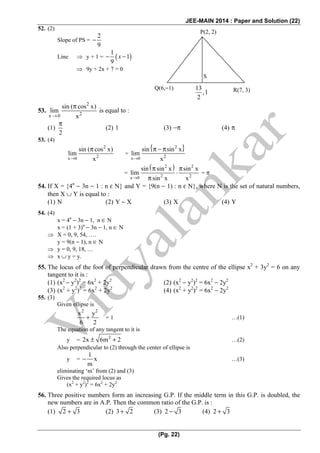
53.
2
2x 0
sin ( cos x)
lim
x→
π
is equal to :
(1)
2
π
(2) 1 (3) −π (4) π
53. (4)
2
2x 0
sin ( cos x)
lim
x→
π
=
{ }2
2x 0
sin sin x
lim
x→
π − π
=
( )2 2
2 2x 0
sin sin x sin x
lim
sin x x→
π π
⋅
π
= π
54. If X = {4n
− 3n − 1 : n ε N} and Y = {9(n − 1) : n ε N}, where N is the set of natural numbers,
then X ∪ Y is equal to :
(1) N (2) Y − X (3) X (4) Y
54. (4)
x = 4n
− 3n − 1, n ∈ N
x = (1 + 3)n
− 3n − 1, n ∈ N
⇒ X = 0, 9, 54, ….
y = 9(n − 1), n ∈ N
⇒ y = 0, 9, 18, …
⇒ x ∪ y = y.
55. The locus of the foot of perpendicular drawn from the centre of the ellipse x2
+ 3y2
= 6 on any
tangent to it is :
(1) (x2
− y2
)2
= 6x2
+ 2y2
(2) (x2
− y2
)2
= 6x2
− 2y2
(3) (x2
+ y2
)2
= 6x2
+ 2y2
(4) (x2
+ y2
)2
= 6x2
− 2y2
55. (3)
Given ellipse is
2 2
x y
6 2
+ = 1 …(1)
The equation of any tangent to it is
y = 2
2x 6m 2± + …(2)
Also perpendicular to (2) through the center of ellipse is
y =
1
x
m
− …(3)
eliminating ‘m’ from (2) and (3)
Gives the required locus as
(x2
+ y2
)2
= 6x2
+ 2y2
56. Three positive numbers form an increasing G.P. If the middle term in this G.P. is doubled, the
new numbers are in A.P. Then the common ratio of the G.P. is :
(1) 2 3+ (2) 3 2+ (3) 2 3− (4) 2 3+
Q(6,−1) 13
,1
2
R(7, 3)
S
P(2, 2)
(23) VIDYALANKAR : JEE-MAIN 2014 : Paper and Solution
(Pg. 23)
56. (4)
Let the numbers be a, ar, ar2
is G.P.
Given a, 2ar, ar2
are in A.P.
the 2ar =
2
a ar
(a 0)
2
+
≠
which gives r = 2 + 3 , as the G.P. is an increasing G.P.
57. If (10)9
+ 2(11)1
(10)8
+ 3(11)2
(10)7
+ … + 10(11)9
= k (10)9
, then k is equal to :
(1)
121
10
(2)
441
100
(3) 100 (4) 110
57. (3)
Let K =
2 9
11 11 11
1 2 3 ... 10
10 10 10
⎛ ⎞ ⎛ ⎞ ⎛ ⎞
+ + + +⎜ ⎟ ⎜ ⎟ ⎜ ⎟
⎝ ⎠ ⎝ ⎠ ⎝ ⎠
…(1)
Also,
11K
10
=
2 9 10
11 11 11 11
2 ... 10
10 10 10 10
⎛ ⎞ ⎛ ⎞ ⎛ ⎞
+ + 3 +⎜ ⎟ ⎜ ⎟ ⎜ ⎟
⎝ ⎠ ⎝ ⎠ ⎝ ⎠
…(2)
(1) − (2) gives
k
10
− =
2 9 10
11 11 11 11
1 ... 10
10 10 10 10
⎛ ⎞ ⎛ ⎞ ⎛ ⎞ ⎛ ⎞
+ + + + − ⋅⎜ ⎟ ⎜ ⎟ ⎜ ⎟ ⎜ ⎟
⎝ ⎠ ⎝ ⎠ ⎝ ⎠ ⎝ ⎠
⇒
k
10
− =
10
10
11
1
10 11
10.
11 101
10
⎛ ⎞⎛ ⎞
−⎜ ⎟⎜ ⎟
⎛ ⎞⎝ ⎠⎝ ⎠ − ⎜ ⎟
⎝ ⎠−
⇒
k
10
− =
10 10
11 11
10 10 10
10 10
⎛ ⎞ ⎛ ⎞
⋅ − −⎜ ⎟ ⎜ ⎟
⎝ ⎠ ⎝ ⎠
⇒ k = 100
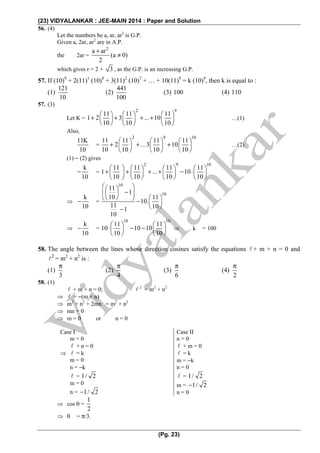
58. The angle between the lines whose direction cosines satisfy the equations + m + n = 0 and
2
= m2
+ n2
is :
(1)
3
π
(2)
4
π
(3)
6
π
(4)
2
π
58. (1)
+ m + n = 0; 2
= m2
+ n2
⇒ = −(m + n)
⇒ m2
+ n2
+ 2mn = m2
+ n2
⇒ mn = 0
⇒ m = 0 or n = 0
Case I
m = 0
+ n = 0
⇒ = k
m = 0
n = −k
= 1/ 2
m = 0
n = 1/ 2−
Case II
n = 0
+ m = 0
= k
m = −k
n = 0
= 1/ 2
m = 1/ 2−
n = 0
⇒ cos θ =
1
2
⇒ θ = π/3.
JEE-MAIN 2014 : Paper and Solution (24)
(Pg. 24)
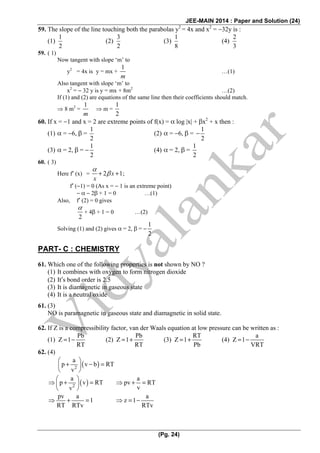
59. The slope of the line touching both the parabolas y2
= 4x and x2
= −32y is :
(1)
1
2
(2)
3
2
(3)
1
8
(4)
2
3
59. ( 1)
Now tangent with slope ‘m’ to
y2
= 4x is y = mx +
1
m
…(1)
Also tangent with slope ‘m’ to
x2
= − 32 y is y = mx + 8m2
…(2)
If (1) and (2) are equations of the same line then their coefficients should match.
⇒ 8 m2
=
1
m
⇒ m =
1
2
60. If x = −1 and x = 2 are extreme points of f(x) = α log |x| + βx2
+ x then :
(1) α = −6, β =
1
2
(2) α = −6, β =
1
2
−
(3) α = 2, β = −
1
2
(4) α = 2, β =
1
2
60. ( 3)
Here f′ (x) = 2 1+ +x
x
α
β ;
f′ (−1) = 0 (As x = − 1 is an extreme point)
− α − 2β + 1 = 0 …(1)
Also, f′ (2) = 0 gives
2
α
+ 4β + 1 = 0 …(2)
Solving (1) and (2) gives α = 2, β = −
1
2
PART- C : CHEMISTRY
61. Which one of the following properties is not shown by NO ?
(1) It combines with oxygen to form nitrogen dioxide
(2) It′s bond order is 2.5
(3) It is diamagnetic in gaseous state
(4) It is a neutral oxide
61. (3)
NO is paramagnetic in gaseous state and diamagnetic in solid state.
62. If Z is a compressibility factor, van der Waals equation at low pressure can be written as :
(1)
Pb
Z 1
RT
= − (2)
Pb
Z 1
RT
= + (3)
RT
Z 1
Pb
= + (4)
a
Z 1
VRT
= −
62. (4)
( )2
a
p v b RT
v
⎛ ⎞
+ − =⎜ ⎟
⎝ ⎠
( )2
a
p v RT
v
⎛ ⎞
⇒ + =⎜ ⎟
⎝ ⎠
a
pv RT
v
⇒ + =
pv a
1
RT RTv
⇒ + =
a
z 1
RTv
⇒ = −
(25) VIDYALANKAR : JEE-MAIN 2014 : Paper and Solution
(Pg. 25)
63. The metal that cannot be obtained by electrolysis of an aqueous solution of its salts is :
(1) Cu (2) Cr (3) Ag (4) Ca
63. (4)
Factual
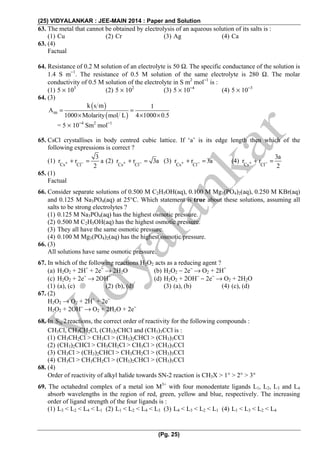
64. Resistance of 0.2 M solution of an electrolyte is 50 Ω. The specific conductance of the solution is
1.4 S m−1
. The resistance of 0.5 M solution of the same electrolyte is 280 Ω. The molar
conductivity of 0.5 M solution of the electrolyte in S m2
mol−1
is :
(1) 5 × 10³
(2) 5 × 10²
(3) 5 × 10⁻⁴
(4) 5 × 10⁻³
64. (3)
( )
( )m
k s m 1
A
1000 Molarity mol L 4 1000 0.5
= =
× × ×
= 5 × 10⁻⁴
Sm2
mol−1
65. CsCl crystallises in body centred cubic lattice. If ‘a’ is its edge length then which of the
following expressions is correct ?
(1)
Cs Cl
3
r r a
2
+ −+ = (2)
Cs Cl
r r 3a+ −+ = (3)
Cs Cl
r r 3a+ −+ = (4)
Cs Cl
3a
r r
2
+ −+ =
65. (1)
Factual
66. Consider separate solutions of 0.500 M C2H5OH(aq), 0.100 M Mg3(PO4)2(aq), 0.250 M KBr(aq)
and 0.125 M Na3PO4(aq) at 25°C. Which statement is true about these solutions, assuming all
salts to be strong electrolytes ?
(1) 0.125 M Na3PO4(aq) has the highest osmotic pressure.
(2) 0.500 M C2H5OH(aq) has the highest osmotic pressure.
(3) They all have the same osmotic pressure.
(4) 0.100 M Mg3(PO4)2(aq) has the highest osmotic pressure.
66. (3)
All solutions have same osmotic pressure.
67. In which of the following reactions H2O2 acts as a reducing agent ?
(a) H2O2 + 2H+
+ 2e−
→ 2H2O (b) H2O2 − 2e−
→ O2 + 2H+
(c) H2O2 + 2e−
→ 2OH−
(d) H2O2 + 2OH−
− 2e−
→ O2 + 2H2O
(1) (a), (c) (2) (b), (d) (3) (a), (b) (4) (c), (d)
67. (2)
H2O2 → O2 + 2H+
+ 2e−
H2O2 + 2OH−
→ O2 + 2H2O + 2e−
68. In NS 2reactions, the correct order of reactivity for the following compounds :
CH3Cl, CH3CH2Cl, (CH3)2CHCl and (CH3)3CCl is :
(1) CH3CH2Cl > CH3Cl > (CH3)2CHCl > (CH3)3CCl
(2) (CH3)2CHCl > CH3CH2Cl > CH3Cl > (CH3)3CCl
(3) CH3Cl > (CH3)2CHCl > CH3CH2Cl > (CH3)3CCl
(4) CH3Cl > CH3CH2Cl > (CH3)2CHCl > (CH3)3CCl
68. (4)
Order of reactivity of alkyl halide towards SN-2 reaction is CH3X > 1° > 2° > 3°
69. The octahedral complex of a metal ion M3+
with four monodentate ligands L1, L2, L3 and L4
absorb wavelengths in the region of red, green, yellow and blue, respectively. The increasing
order of ligand strength of the four ligands is :
(1) L3 < L2 < L4 < L1 (2) L1 < L2 < L4 < L3 (3) L4 < L3 < L2 < L1 (4) L1 < L3 < L2 < L4
JEE-MAIN 2014 : Paper and Solution (26)
(Pg. 26)
54 PclLiA H Alc. KOH
3 3 2 2 5 2 2
O
| |
CH C OH CH CH OH C H C CH CH− − ⎯⎯⎯⎯→ ⎯⎯⎯→ ⎯⎯⎯⎯⎯→ =
69. (4)
Factual
70. For the estimation of nitrogen, 1.4 g of an organic compound was digested by Kjeldahl method
and the evolved ammonia was absorbed in 60 mL of
M
10
sulphuric acid. The unreacted acid
required 20 mL of
M
10
sodium hydroxide for complete neutralization. The percentage of nitrogen
in the compound is :
(1) 3 % (2) 5 % (3) 6 % (4) 10 %
70. (4)
% of Nitrogen =
1 1
1.4 60 2 20
10 10
1.4
⎛ ⎞
× × − ×⎜ ⎟
⎝ ⎠ = 10%
71. The equivalent conductance of NaCl at concentration C and at infinite dilution are λC and λ∞,
respectively. The correct relationship between λC and λ∞ is given as :
(where the constant B is positive)
(1) C (B) C∞λ = λ − (2) C (B) C∞λ = λ +
(3) C (B) C∞λ = λ + (4) C (B)C∞λ = λ −
71. (1)
Variation of λc for strong electrotype is given by c B C∞λ = λ −
72. For the reaction 2(g) 2(g) 3(g)
1
SO O SO
2
′+ if KP = KC(RT)x
where the symbols have usual
meaning then the value of x is : (assuming ideality)
(1)
1
2
(2) 1 (3) −1 (4)
1
2
−
72. (4)
Kp = ( ) gn
cK RT
Δ
( )
1
2p cK K RT
−
=
Since g
1
n
2
⎛ ⎞
Δ = −⎜ ⎟
⎝ ⎠
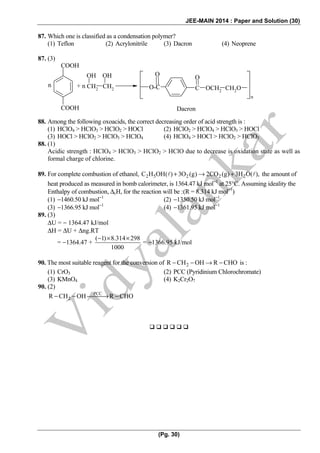
73. In the reaction, 54 PClLiAlH Alc.KOH
3CH COOH A B C,⎯⎯⎯⎯→ ⎯⎯⎯→ ⎯⎯⎯⎯→ the product C is :
(1) Ethylene (2) Acetyl chloride (3) Acetaldehyde (4) Acetylene
73. (1)
74. Sodium phenoxide when heated with CO2 under pressure at 125°C yields a product which on
acetylation produces C.
(27) VIDYALANKAR : JEE-MAIN 2014 : Paper and Solution
(Pg. 27)
The major product C would be :
(1) (2)
(3) (4)
74. (3)
ONa OH
COONa
OH
COOH
OCOCH3
COOH
+ CO2
5 atm
1250 H+
Ac2O
(Aspirin)
75. On heating an aliphatic primary amine with chloroform and ethanolic potassium hydroxide, the
organic compound formed is :
(1) an alkyl cyanide (2) an alkyl isocyanide
(3) an alkanol (4) an alkanediol
75. (2)
3CHCl
2 alc.KOH
R NH R NC− ⎯⎯⎯⎯→ −
This reaction is called carbylamines reaction.
76. The correct statement for the molecule, CsI3, is :
(1) it contains Cs3+
and I−
ions.
(2) it contains Cs+
, I−
and lattice I2 molecule.
(3) it is a covalent molecule.
(4) it contains Cs+
and 3I−
ions.
76. (4)
3 3CsI Cs I+ −
→ +
77. The equation which is balanced and represents the correct product(s) is :
(1)
excess NaOH2 4 2
2 6 2[Mg(H O) ] (EDTA) [Mg(EDTA)] 6H O+ −
+ ⎯⎯⎯⎯⎯→ +
(2) 4 2 4 2 4CuSO 4KCN K [Cu(CN) ] K SO+ → +
(3) 2 2Li O 2KCl 2LiCl K O+ → +
(4) 2
3 5 4[CoCl(NH ) ] 5H Co 5NH Cl+ + + + −
+ → + +
77. (3)
Factual
JEE-MAIN 2014 : Paper and Solution (28)
(Pg. 28)
78. For which of the following molecule significant μ ≠ 0?
(a) (b) (c) (d)
(1) Only (c) (2) (c) and (d) (3) Only (a) (4) (a) and (b)
78. (2)
Quinol (c) and thioquinol (d) do not have μ = 0 due to nonlinear alignment.
79. For the non-stoichiometre reaction 2A + B → C + D, the following kinetic data were obtained in
three separate experiments, all at 298 K.
Initial concentration (A) Initial Concentration (B) Initial rate of formation of C
(mol L−
S−
)
0.1 M 0.1 M 1.2 × 10⁻³
0.1 M 0.2 M 1.2 × 10⁻³
0.2 M 0.1 M 2.4 × 10⁻³
The rate law for the formation of C is :
(1) 2dc
k[A] [B]
dt
= (2)
dc
k[A]
dt
= (3)
dc
k[A] [B]
dt
= (4) 2dc
k[A] [B]
dt
=
79. (2)
r = k [A]x
[B]y
1.2 × 10−3
= k (0.1)x
[0.1]y
…….. (I)
1.2 × 10−3
= k (0.1)x
[0.2]y
…….. (II)
From (I) and (II)
y
1
1 y 0
2
⎛ ⎞
= ⇒ =⎜ ⎟
⎝ ⎠
…….. (III)
Now from (I) and (III)
x
1 1
x 1
2 2
⎛ ⎞ ⎛ ⎞
= ⇒ =⎜ ⎟ ⎜ ⎟
⎝ ⎠ ⎝ ⎠
Hence ( )
dc
k A '
dt
=
80. Which series of reactions correctly represents chemical relations related to iron and its
compound?
(1) 2Cl ,heat heat,air Zn
3 2Fe FeCl FeCl Fe⎯⎯⎯⎯→ ⎯⎯⎯⎯→ ⎯⎯→
(2) 2O ,heat CO,600 C CO,700 C
3 4Fe Fe O FeO Fe
° °
⎯⎯⎯⎯→ ⎯⎯⎯⎯⎯→ ⎯⎯⎯⎯⎯→
(3) 2 4 2 4 2dil H SO H SO ,O heat
4 2 4 3Fe FeSO Fe (SO ) Fe⎯⎯⎯⎯⎯→ ⎯⎯⎯⎯⎯→ ⎯⎯⎯→
(4) 2 2 4O ,heat dilH SO heat
4Fe FeO FeSO Fe⎯⎯⎯⎯→ ⎯⎯⎯⎯⎯→ ⎯⎯⎯→
80. (2)
2 3 4
600 C
3 4 2
700 C
2
3Fe 2O Fe O
Fe O CO 3FeO CO
FeO CO Fe CO
Δ
°
°
+ ⎯⎯→
+ ⎯⎯⎯→ +
+ ⎯⎯⎯→ +
(29) VIDYALANKAR : JEE-MAIN 2014 : Paper and Solution
(Pg. 29)
81. Considering the basic strength of amines in aqueous solution, which one has the smallest pKb
value?
(1) (CH3)3N (2) C6H5NH2 (3) (CH3)2NH (4) CH3NH2
81. (3)
Less is the pKb value, more is the basic strength. Order of basic strength in aq. medium is
(CH3)2NH > CH3NH2 > (CH3)3N > C6H5NH2
82. Which one of the following bases is not present in DNA?
(1) Cytosine (2) Thymine (3) Quinoline (4) Adenine
82. (3)
Quinoline is not present in DNA.
83. The correct set of four quantum numbers for the valence electrons of rubidium atom (Z = 37) is :
(1) 5, 1, 1,
1
2
+ (2) 5, 0, 1 +
1
2
(3) 5, 0, 0, +
1
2
(4) 5,1, 0, +
1
2
83. (3)
E.C. = 1s2
2s2
2p6
3s2
3p6
4s2
3d10
4p6
5s1
Valence electron is present in 5s − subshell
n = 5, = 0, m = 0, s =
1
2
84. The major organic compound formed by the reaction of 1, 1, 1 − trichloroethane with silver powder is :
(1) 2 − Butyne (2) 2 − Butene (3) Acetylene (4) Ethene
84. (1)
Ag/
3 3 3 32Cl C:CH CH C C CHΔ
⎯⎯⎯→ − ≡ −
85. Given below are the half − cell reaction :
Mn2+
+ 2e−
→ Mn; E° = −1.18 V
2(Mn3+
+ e−
→ Mn2+
) ; E° = +1.51 V.
The E° for 3Mn2+
→ Mn + 2Mn3+
will be
(1) 0.33 V ; the reaction will not occur (2) −0.33 V ; the reaction will occur
(3) −2.69 V ; the reaction will not occur (4) −2.69 V ; the reaction will occur
85. (3)
( )
2 0 0 0
1 1 1
3 2 0 0 0
2 2 2
2 3 0 0 0
3 3 3
Mn 2e Mn E 1.18V, G 2FE
2 Mn e Mn E 1.51V, G 2FE
3Mn Mn 2Mn E ? , G 2FE
+ −
+ − +
+ +
+ → = − Δ = −
+ → = Δ = −
→ + = Δ = −
0 0 0
3 1 2
0 0 0
3 1 2
G G G
E E E 1.18 1.51 2.69V
Δ = Δ − Δ
= − = − − = −
86. The ratio of masses of oxygen and nitrogen in a particular gaseous mixture is 1 : 4. The ratio of
number of their molecule is :
(1) 1 : 8 (2) 3 : 16 (3) 1 : 4 (4) 7 : 32
86. (4)
2 2 2
2 2 2
O O N
N O N
n W M 1 28 7
n M W 4 32 32
= × = × =
JEE-MAIN 2014 : Paper and Solution (30)
(Pg. 30)
87. Which one is classified as a condensation polymer?
(1) Teflon (2) Acrylonitrile (3) Dacron (4) Neoprene
87. (3)
COOH
COOH
CH2 CH2
OH OH
O-C C
O
OCH2 CH2O
n
O
+ nn
Dacron
88. Among the following oxoacids, the correct decreasing order of acid strength is :
(1) HClO4 > HClO3 > HClO2 > HOCl (2) HClO2 > HClO4 > HClO3 > HOCl
(3) HOCl > HClO2 > HClO3 > HClO4 (4) HClO4 > HOCl > HClO2 > HClO3
88. (1)
Acidic strength : HClO4 > HClO3 > HClO2 > HClO due to decrease is oxidation state as well as
formal charge of chlorine.
89. For complete combustion of ethanol, 2 5 2 2 2C H OH( ) 3O (g) 2CO (g) 3H O( ),+ → + the amount of
heat produced as measured in bomb calorimeter, is 1364.47 kJ mol−1
at 25°C. Assuming ideality the
Enthalpy of combustion, ΔcH, for the reaction will be :(R = 8.314 kJ mol−1
)
(1) −1460.50 kJ mol−1
(2) −1350.50 kJ mol−1
(3) −1366.95 kJ mol−1
(4) −1361.95 kJ mol−1
89. (3)
ΔU = − 1364.47 kJ/mol
ΔH = ΔU + Δng.RT
= −1364.47 +
( 1) 8.314 298
1000
− × ×
= −1366.95 kJ/mol
90. The most suitable reagent for the conversion of 2R CH OH R CHO− − → − is :
(1) CrO3 (2) PCC (Pyridinium Chlorochromate)
(3) KMnO4 (4) K2Cr2O7
90. (2)
PCC
2R CH OH R CHO− − ⎯⎯⎯→ −

Jee main-2014-question-paper-and-solution

  • 1.
    (Pg. 1) .JEE-MAIN 2014. PAPER- 1 : PHYSICS, MATHEMATICS & CHEMISTRY Do not open this Test Booklet until you are asked to do so. Read carefully the Instructions on the Back Cover of this Test Booklet. Important Instructions : 1. Immediately fill in the particulars on this page of the Test Booklet with Blue/Black Ball Point Pen. Use of pencil is strictly prohibited. 2. The Answer Sheet is kept inside this Test Booklet. When you are directed to open the Test Booklet, take out the Answer Sheet and fill in the particulars carefully. 3. The test is of 3 hours duration. 4. The Test Booklet consists of 90 questions. The maximum marks are 360. 5. There are three parts in the question paper A, B, C consisting of, Physics, Mathematics and Chemistry having 30 questions in each part of equal weightage. Each question is allotted 4 (four) marks for each correct response. 6. Candidates will be awarded marks as stated above in instruction No. 5 for correct response of each question. 1/4 (one fourth) marks will be deducted for indicating incorrect response of each question. No deduction from the total score will be made if no response is indicated for an item in the answer sheet. 7. There is only one correct response for each question. Filling up more than one response in each question will be treated as wrong response and marks for wrong response will be deducted accordingly as per instruction 6 above. 8. Use Blue/Black Ball Point Pen only for writting particulars/ marking responses on Side−1 and Side−2 of the Answer Sheet. Use of pencil is strictly prohibited. 9. No candidates is allowed to carry any textual material, printed or written, bits of papers, pager, mobile phone, any electronic device, etc., except the Admit Card inside the examination hall/room. 10. Rough work is to be done on the space provided for this purpose in the Test Booklet only. This space is given at the bottom of each page and in 3 pages (Pages 21−23) at the end of the booklet. 11. On completion of the test, the candidate must hand over the Answer Sheet to the Invigilator on duty in the Room / Hall. However, the candidates are allowed to take away this Test Booklet with them. 12. The CODE for this Booklet is H. Make sure that the CODE printed on Side−2 of the Answer Sheet is the same as that on this booklet. In case of discrepancy, the candidate should immediately report the matter to the invigilator for replacement of both the Test Booklet and the Answer Sheet. 13. Do not fold or make any stray marks on the Answer Sheet. Name of the Candidate (in Capital letters) : ______________________________________________ Roll Number : in figures : in words ______________________________________________________________ Examination Centre Number : Name of Examination Centre (in Capital letters) : ____________________________________________ Candidate’s Signature : ______________________ Invigilator’s Signature : ____________________ Test Booklet Code H
  • 2.
    JEE-MAIN 2014 :Paper and Solution (2) (Pg. 2) Read the following instructions carefully : 1. The candidates should fill in the required particulars on the Test Booklet and Answer Sheet (Side-1) with Blue/Black Ball Point Pen. 2. For writing/marking particulars on Side-2 of the Answer Sheet, use Blue/Black Ball Point Pen only. 3. The candidates should not write their Roll Numbers anywhere else (except in the specified space) on the Test Booklet/Answer Sheet. 4. Out of the four options given for each question, only one option is the correct answer. 5. For each incorrect response, one-fourth (¼) of the total marks allotted to the question would be deducted from the total score. No deduction from the total score, however, will be made if no response is indicated for an item in the Answer Sheet. 6. Handle the Test Booklet and Answer Sheet with care, as under no circumstances (except for discrepancy in Test Booklet Code and Answer Sheet Code), another set will be provided. 7. The candidates are not allowed to do any rough work or writing work on the Answer Sheet. All calculations/writing work are to be done in the space provided for this purpose in the Test Booklet itself, marked ‘Space for Rough Work’. This space is given at the bottom of each page and in 3 pages (Pages 21 – 23) at the end of the booklet. 8. On completion of the test, the candidates must hand over the Answer Sheet to the Invigilator on duty in the Room/Hall. However, the candidates are allowed to take away this Test Booklet with them. 9. Each candidate must show on demand his/her Admit Card to the Invigilator. 10. No candidate, without special permission of the Superintendent or Invigilator, should leave his/her seat. 11. The candidates should not leave the Examination Hall without handing over their Answer Sheet to the Invigilator on duty and sign the Attendance Sheet again. Cases where a candidate has not signed the Attendance Sheet a second time will be deemed not to have handed over the Answer Sheet and dealt with as an unfair means case. The candidates are also required to put their left hand THUMB impression in the space provided in the Attendance Sheet. 12. Use of Electronic/Manual Calculator and any Electronic Item like mobile phone, pager etc. is prohibited. 13. The candidates are governed by all Rules and Regulations of the JAB/Board with regard to their conduct in the Examination Hall. All cases of unfair means will be dealt with as per Rules and Regulations of the JAB/Board. 14. No part of the Test Booklet and Answer Sheet shall be detached under any circumstances. 15. Candidates are not allowed to carry any textual material, printed or written, bits of papers, pager, mobile phone, electronic device or any other material except the Admit Card inside the examination hall/room.
  • 3.
    (3) VIDYALANKAR :JEE-MAIN 2014 : Paper and Solution (Pg. 3) .Questions and Solutions. PART- A : PHYSICS 1. The pressure that has to be applied to the ends of a steel wire of length 10 cm to keep its length constant when its temperature is raised by 100°C is : (For steel Young’s modulus is 2 × 10¹¹ N m−2 and coefficient of thermal expansion is 1.1 × 10⁻⁵ K−1 ) (1) 2.2 × 10⁷ Pa (2) 2.2 × 10⁶ Pa (3) 2.2 × 10⁸ Pa (4) 2.2 × 10⁹ Pa 1. (3) F A = Y Δ Δ = TαΔ P = F Y T A = αΔ = 11 5 2 10 1.1 10 100− × × × × = 8 2 2.2 10 N/m× 2. A conductor lies along the z-axis at − 1.5 ≤ z < 1.5m and carries a fixed current of 10.0 A in − za direction (see figure). For a field B = 3.0 × 10⁻⁴ e−0.2x ya T, find the power required to move the conductor at constant speed to x = 2.0 m, y = 0 m in 5 × 10⁻³ s. Assume parallel motion along the x-axis. (1) 14.85 W (2) 29.7 W (3) 1.57 W (4) 2.97 W 2. (4) Force on conductor = I L B [+ x−direction ] (Due to magnetic field) x 0B B e−α = [ in +y direction] 0xT 0 0 0 1 1 P F.V.dt F dx [x 2m] T T = = ⋅ =∫ ∫ ⇒ 2 x0 0 I L B1 P e T ( ) −α⎡ ⎤ = ⎢ ⎥−α⎣ ⎦ ⇒ m)0ILB P 1 e T 0.2 −α(2⎡ ⎤= − ⎣ ⎦× = 6 0.4 3 10 3 3 10 1 e 5 10 0.2 − − − × × × ⎡ ⎤− ⎣ ⎦× × = 1.8 0.16 0.064 1 1 (0.4) ..... 0.2 2 16 ⎛ ⎞⎛ ⎞ − − + − +⎜ ⎟⎜ ⎟ ⎝ ⎠⎝ ⎠ ≈ 0.64 9 2.88 2 × = On Exact evaluation P 2.97 W=
  • 4.
    JEE-MAIN 2014 :Paper and Solution (4) (Pg. 4) 3. A bob of mass m attached to an inextensible string of length l is suspended from a vertical support. The bob rotates in a horizontal circle with an angular speed ω rad/s about the vertical. About the point of suspension : (1) angular momentum changes in direction but not in magnitude. (2) angular momentum changes both in direction and magnitude. (3) angular momentum is conserved. (4) angular momentum changes in magnitude but not in direction. 3. (1) netτ = Tτ + mgτ = ' mgτ ≠ 0 L ≠ constant But as ω is constant L = MVL = constant 4. The current voltage relation of diode is given by I = (e1000V/T − 1) mA, where the applied voltage V is in volts and the temperature T is in degree Kelvin. If a student makes an error measuring ± 0.01 V while measuring the current of 5 mA at 300 K, what will be the error in the value of current in mA? (1) 0.5 mA (2) 0.05 mA (3) 0.2 mA (4) 0.02 mA 4. (3) I = 1000V T e 1 ⎛ ⎞ −⎜ ⎟ ⎝ ⎠ dI dV = 1000 T 1000V T e dI = 1000V T 1000 e T ⎛ ⎞ ⎜ ⎟ ⎝ ⎠ dV I = 5 MA ⇒ e 1000V T = 6 MA dI = 1000 300 ⎛ ⎞ ⎜ ⎟ ⎝ ⎠ (0.01) (6) = 10 50 = 1 5 dI = 0.2 mA 5. An open glass tube is immersed in mercury in such a way that a length of 8 cm extends above the mercury level. The open end of the tube is then closed and sealed and the tube is raised vertically up by additional 46 cm. What will be length of the air column above mercury in the tube now? (Atmospheric pressure = 76 cm of Hg) (1) 38 cm (2) 6 cm (3) 16 cm (4) 22 cm 5. (1) P0 P′ h (54 − h) 54 cm
  • 5.
    (5) VIDYALANKAR :JEE-MAIN 2014 : Paper and Solution (Pg. 5) P′ (54 − h) = P0 8 (Boyel′s law) P′ = 0P 8 (54 h)− P′ + ρgh = P0 0 0 8P gh P 54 h + ρ = − 0 46 h gh P 54 h −⎛ ⎞ ρ = ⎜ ⎟ −⎝ ⎠ (P0 = ρg (76)) h = 46 h (76) 54 h −⎛ ⎞ ⎜ ⎟ −⎝ ⎠ ⇒ 54 h − h2 = 76 × 46 − 76 h h2 − 130 h + 76 × 46 = 0 (h − 38) (h − 92) = 0 h = 38, 92 ↓ Not possible ⇒ h = 38 cm 6. Match List – I (Electromagnetic wave type) with List – II (Its association/application) and select the correct option from the choices given below the lists : List - I List - II (a) Infrared waves (i) To treat muscular strain (b) Radio waves (ii) For broadcasting (c) X-rays (iii) To detect fracture of bones (d) Ultraviolet rays (iv) Absorbed by the ozone layer of the atmosphere (a) (b) (c) (d) (1) (iii) (ii) (i) (iv) (2) (i) (ii) (iii) (iv) (3) (iv) (iii) (ii) (i) (4) (i) (ii) (iv) (iii) 6. (2) (a) (I) (b) (II) (c) (III) (d) (IV) 7. A parallel plate capacitor is made of two circular plates separated by a distance of 5 mm and with a dielectric of dielectric constant 2.2 between them. When the electric field in the dielectric is 3 × 10⁴ V/m, the charge density of the positive plate will be close to : (1) 3 × 10⁴ C/m2 (2) 6 × 10⁴ C/m2 (3) 6 × 10⁻⁷ C/m2 (4) 3 × 10⁻⁷ C/m2 7. (3) K = 2.2 d = 5 mm E = 3 × 10⁴ v m ok σ ∈ = 3 × 10⁴ σ = k∈o × 3 × 104 = 2.2 × 8.85 × 10−12 × 3 × 104 = 58.41 × 10−8 = 5.84 × 10−7 = 6 × 10⁻⁷ c/m2 (approx.) d
  • 6.
    JEE-MAIN 2014 :Paper and Solution (6) (Pg. 6) 8. A student measured the length of a rod and wrote it as 3.50 cm. Which instrument did he use to measure it ? (1) A screw gauge having 100 divisions in the circular scale and pitch as 1 mm. (2) A screw gauge having 50 divisions in the circular scale and pitch as 1 mm. (3) A meter scale. (4) A vernier calliper where the 10 divisions in vernier scale matches with 9 division in main scale & main scale has 10 divisions in 1 cm. 8. (4) Least count = 0.01 cm i.e. 0.1 mm for vernier calliper of 10 v.s.d. = 9 M.s. d. 1 v.s.d. = 0.9 M.s.d. L.C. = 1 M.s.d = (0.1) M.s.d. 1 v.s.d. = 0.1 cm ⇒ L.c = 0.01 cm 9. Four particles, each of mass M and equidistant from each other, move along a circle of radius R under the action of their mutual gravitational attraction. The speed of each particle is : (1) ( )GM 1 2 2 R + (2) ( )1 GM 1 2 2 2 R + (3) GM R (4) GM 2 2 R 9. (2) F 2F 2 ⎛ ⎞ +⎜ ⎟ ⎝ ⎠ = 2 mv R 2 2 1 2 ⎛ ⎞+ ⎜ ⎟⎜ ⎟ ⎝ ⎠ 2 2 Gm a ⎛ ⎞ ⎜ ⎟ ⎝ ⎠ = 2 mv a 2 V2 = 2 2 1 2 2 ⎛ ⎞+ ⎜ ⎟⎜ ⎟ ⎝ ⎠ Gm a = 2 2 1 2 2 ⎛ ⎞+ ⎜ ⎟⎜ ⎟ ⎝ ⎠ Gm 2R V2 = 2 2 1 4 ⎛ ⎞+ ⎜ ⎟⎜ ⎟ ⎝ ⎠ Gm R 10. In a large building, there are 15 bulbs of 40 W, 5 bulbs of 100 W, 5 fans of 80 W and 1 heater of 1 kW. The voltage of the electric mains is 220 V. The minimum capacity of the main fuse of the building will be : (1) 12 A (2) 14 A (3) 8 A (4) 10 A 10. (1) eq 1 2 1 1 1 R R R = + 2 2 2 eq 1 2 V V V P ...... R R R = = + + 15 40 5 100 80 5 1 1000= × + × + × + × = 2500 w P = VI P 2500 220 I= = 250 125 I 22 11 = = 11. A particle moves with simple harmonic motion in a straight line. In first τ s, after starting from rest it travels a distance a, and in next τ s it travels 2a, in same direction, then : (1) amplitude of motion is 4a (2) time period of oscillations is 6τ (3) amplitude of motion is 3a (4) time period of oscillations is 8τ a aa a R
  • 7.
    (7) VIDYALANKAR :JEE-MAIN 2014 : Paper and Solution (Pg. 7) 11. (2) A a cos( ) A − ωτ = A 3a cos(2 ) A − ωτ = ⇒ 2 A 3a A a 2 1 A A − −⎛ ⎞ = −⎜ ⎟ ⎝ ⎠ ⇒ 2 3a a 4a 1 2 2 1 A A A ⎛ ⎞ − = + − −⎜ ⎟ ⎝ ⎠ 2 a a 2 A 2a A A ⎛ ⎞ ⎛ ⎞ = =⎜ ⎟ ⎜ ⎟ ⎝ ⎠ ⎝ ⎠ 1 2 cos( ) T 6 2 3 T 3 π π π ωτ = ⇒ ωτ = ⇒ ⋅τ = ⇒ = τ 12. The coercivity of a small magnet where the ferromagnet gets demagnetized is 3 × 10³ A m−1 . The current required to be passed in a solenoid of length 10 cm and number of turns 100, so that the magnet gets demagnetized when inside the solenoid, is : (1) 3 A (2) 6 A (3) 30 mA (4) 60 mA 12. (1) 0B H= μ 0 0n i Hμ = μ 3 H 3 10 i 3A n 1000 × = = = 13. The forward biased diode connection is : 13. (3) p side should be at higher potential for forward bias. 14. During the propagation of electromagnetic waves in a medium : (1) Electric energy density is equal to the magnetic energy density. (2) Both electric and magnetic energy densities are zero. (3) Electric energy density is double of the magnetic energy density. (4) Electric energy density is half of the magnetic density. 14. (1) Energy of the wave is equally distributed in two fields. 15. In the circuit shown here, the point ‘C’ is kept connected to point ‘A’ till the current flowing through the circuit becomes constant. Afterward, suddenly, point ‘C’ is disconnected from point ‘A’ and connected to point ‘B’ at time t = 0. Ratio of the voltage across resistance and the inductor at t = L/R will be equal to : (1) −1 (2) 1 e e − (3) e 1 e− (4) 1 (1) (2) (3) (4) A a2a +2V −2V
  • 8.
    JEE-MAIN 2014 :Paper and Solution (8) (Pg. 8) 15. (1) tR L 0i i e − = ∴ tR L R 0V iR i e − = = 1 R 0 L V R i e at t R − = = L di V L dt ⎛ ⎞ = − −⎜ ⎟ ⎝ ⎠ = tR L 0 R Li e L − −⎛ ⎞ ⎜ ⎟ ⎝ ⎠ = 1 0 L Ri e at t R − − = ∴ R L V 1 V = − 16. A mass ‘m’ is supported by a massless string wound around a uniform hollow cylinder of mass m and radius R. If the string does not slip on the cylinder, with what acceleration will the mass fall on release? (1) 5g 6 (2) g (3) 2g 3 (4) g 2 16. (4) mg − T = ma …(1) T· R = m R2 α …(2) a = R α …(3) Solving g a 2 = …(4) 17. One mole of diatomic ideal gas undergoes a cyclic process ABC as shown in figure. The process BC is adiabatic. The temperatures at A, B and C are 400 K, 800 K and 600 K respectively. Choose the correct statement : (1) The change in internal energy in the process AB is − 350 R. (2) The change in internal energy in the process BC is − 500 R. (3) The change in internal energy in whole cyclic process is 250 R. (4) The change in internal energy in the process CA is 700 R. Ri i D T T mg
  • 9.
    (9) VIDYALANKAR :JEE-MAIN 2014 : Paper and Solution (Pg. 9) 17. (2) AB ΔU = nCv ΔT = 5R 1 (800 400) 1000R 2 ⋅ − = Option (1) is not correct CA ΔU = nCv ΔT = 5R 1 (400 600) 500R 2 ⋅ − = − Option (4) is not correct ΔUcycle = 0 ∴ ΔUAB + ΔUBC + ΔUCA = 0 1000 R + ΔUBC − 500 R = 0 ΔUBC = −500 R 18. From a tower of height H, a particle is thrown vertically upwards with a speed U. The time taken by the particle, to hit the ground, is n times that taken by it to reach the highest point of its path. The relation between H, u and n is : (1) 2 g H = nu2 (n − 2) (2) g H = (n − 2) u2 (3) 2 g H = n2 u2 (3) g H = (n − 2)2 u2 18. (1) time taken to reach highest point 1 u t g = For time taken to reach the ground 21 H ut gt 2 − = − ∴ 2 gt 2ut 2H 0− − = 2 2u 4u 8gH t 2g ± + = 2 u u 2gH t g + + = (− ve sign not acceptable) Given t = n t1 2 u u 2gH nu g g + + = Solving 2g H = nu2 (n − 2) 19. A thin convex lens made from crown glass 3 μ = 2 ⎡ ⎤ ⎢ ⎥⎣ ⎦ has focal length f. When it is measured in two different liquids having refractive indices 4 3 and 5 3 , it has the focal lengths f1 and f2 respectively. The correct relation between the focal lengths is : (1) f2 > f and f1 becomes negative (2) f1 and f2 both become negative (3) f1 = f2 < f (4) f1 > f and f2 becomes negative 19. (4) 1 2 1 3 1 1 1 f 2 R R ⎛ ⎞⎛ ⎞ = − −⎜ ⎟⎜ ⎟ ⎝ ⎠⎝ ⎠ 1 2 1 1 1 1 f 2 R R ⎛ ⎞ = −⎜ ⎟ ⎝ ⎠ …(1) u H g +ve
  • 10.
    JEE-MAIN 2014 :Paper and Solution (10) (Pg. 10) 1 1 2 3 1 1 12 1 4f R R 3 ⎛ ⎞ ⎜ ⎟⎛ ⎞ = − −⎜ ⎟⎜ ⎟ ⎝ ⎠⎜ ⎟ ⎝ ⎠ 1 1 2 1 1 1 1 f 8 R R ⎛ ⎞ = −⎜ ⎟ ⎝ ⎠ …(2) 2 1 2 3 1 1 12 1 5f R R 3 ⎛ ⎞ ⎜ ⎟⎛ ⎞ = − −⎜ ⎟⎜ ⎟ ⎝ ⎠⎜ ⎟ ⎝ ⎠ 2 1 2 1 1 1 1 f 10 R R ⎛ ⎞ = − −⎜ ⎟ ⎝ ⎠ …(3) From (1) 1 2 2 f 1 1 R R = ⎛ ⎞ −⎜ ⎟ ⎝ ⎠ From (2) 1 1 2 8 f 1 1 R R = ⎛ ⎞ −⎜ ⎟ ⎝ ⎠ From (3) 2 1 2 10 f 1 1 R R = − ⎛ ⎞ −⎜ ⎟ ⎝ ⎠ 20. Three rods of Copper, Brass and Steel are welded together to form a Y-shaped structure. Area of cross- section of each rod = 4 cm2 . End of copper rod is maintained at 100 °C where as ends of brass and steel are kept at 0 °C. Lengths of the copper, brass and steel rods are 46, 13 and 12 cms respectively. The rods are thermally insulated from surroundings except at ends. Thermal conductivities of copper, brass and steel are 0.92, 0.26 and 0.12 CGS units respectively. Rate of heat flow through copper rod is : (1) 4.8 cal/s (2) 6.0 cal/s (3) 1.2 cal/s (4) 2.4 cal/s 20. (1) H = H1 + H2 1 1 100 T k A − = 2 2 T 0 k A − + 3 3 T 0 k A − 1 1 k (100 T)− = 2 2 k T + 3 3 k T 0.92 46 (100 − T) = 0.26 13 T + 0.12 12 T 2 × 10⁻² (100 − T) = 2 × 10⁻² T + 1 × 10⁻² T 2 (100 − T) = 2T + T 2 (100 − T) = 3T 200 = 5T T = 40°C H = 1 1 k (100 T)A− = 0.92 46 (100 − 40)× 4 = 2 × 10−2 × 60 × 4 = 120 × 10−2 × 4= 4.8 cal/s 21. A pipe of length 85 cm is closed from one end. Find the number of possible natural oscillations of air column in the pipe whose frequencies lie below 1250 Hz. The velocity of sound in air is 340 m/s. (1) 6 (2) 4 (3) 12 (4) 8 0°C 0°C 100°C T 13cm 12cm K3 = 0.12 SteelK2 = 0.20 Brass 46 cm Copper k1 = 0.92 A = 4 cm2
  • 11.
    (11) VIDYALANKAR :JEE-MAIN 2014 : Paper and Solution (Pg. 11) 21. (1) L = n 2 4 λ λ + = (2n + 1) 4 λ = ( )2n 1 v 4f + ⇒ 0.85 = ( )v 2n 1 4f + ⇒ f = ( )2n 1 85 0.85 4 + × × ⇒ f = (2n + 1) 100 H2 The possible frequencies are : 100 HZ, 300 HZ, … 1100 HZ. 22. There is a circular tube in a vertical plane. Two liquids which do not mix and of densities d1 and d2 are filled in the tube. Each liquid subtends 90° angle at centre. Radius joining their interface makes an angle α with vertical. Ratio 1 2 d d is (1) 1 tan 1 tan + α − α (2) 1 sin 1 cos + α − α (3) 1 sin 1 sin + α − α (4) 1 cos 1 cos + α − α 22. (1) Pressure at 0 level is same from both sides. d1 (1 − sin α) = d1 (1 − cos α) + d2 [cos α + sin α] ⇒ 1 2 d d = sin cos cos sin α + α α − α 23. A green light is incident from the water to the air - water interface at the critical angle (θ). Select the correct statement. (1) The spectrum of visible light whose frequency is more than that of green light will come out to the air medium. (2) The entire spectrum of visible light will come out of the water at various angles to the normal. (3) The entire spectrum of visible light will come out of the water at an angle of 90° to the normal. (4) The spectrum of visible light whose frequency is less than that of green light will come out to the air medium. 23. (4) μr < μg < μv ⇒ sin (θr) > sin (θg) > sin (θv) ⇒ θr > θg > θv [θr, θg, θv are critical angles of corresponding colors] Thus all colors from red to green will emerge out of water 24. Hydrogen (1H1 ), Deuterium (1H2 ), singly ionised Helium (2He4 )+ and doubly ionised lithium (3Li6 )+ + all have one electron around the nucleus. Consider an electron transition from n = 2 to n = l. If the wave lengths of emitted radiation are λ1, λ2, λ3 and λ4 respectively then approximately which one of the following is correct ? (1) λ1 = λ2 = 4λ3 = 9λ4 (2) λ1 = 2λ2 = 3λ3 = 4λ4 (3) 4λ1 = 2λ2 = 2λ3 = λ4 (3) λ1 = 2λ2 = 2λ3 = λ4 24. (1) 1 λ = 2 RZ me 1 M ⎛ ⎞ +⎜ ⎟ ⎝ ⎠ 1 1 4 ⎡ ⎤ −⎢ ⎥ ⎣ ⎦ ⇒ 1 λ = 3 4 R0 ⋅ 2 Z me 1 M ⎛ ⎞ +⎜ ⎟ ⎝ ⎠ [M = mass of mucleus] 1 λ ∝ p 1 me 1 M ⎛ ⎞ +⎜ ⎟⎜ ⎟ ⎝ ⎠ 2 1 λ ∝ p 1 me 1 2M ⎛ ⎞ +⎜ ⎟⎜ ⎟ ⎝ ⎠ [Mp = mass of H − atom] α α α 0 d2
  • 12.
    JEE-MAIN 2014 :Paper and Solution (12) (Pg. 12) 3 1 λ ∝ p 4 me 1 4M ⎛ ⎞ +⎜ ⎟⎜ ⎟ ⎝ ⎠ 4 1 λ ∝ p 9 me 1 6M ⎛ ⎞ +⎜ ⎟⎜ ⎟ ⎝ ⎠ If p me M << 1 : we have λ1 = λ2 = 4λ3 = 9λ4 25. The radiation corresponding to 3 → 2 transition of hydrogen atom falls on a metal surface to produce photoelectrons. These electrons are made to enter a magnetic field of 3 × 10⁻⁴ T. If the radius of the largest circular path followed by these electrons is 10.0 mm, the work function of the metal is close to : (1) 0.8 eV (2) 1.6 eV (3) 1.8 eV (4) 1.1 eV 25. (4) r = m eB ν = p2mE eB [E = electron’s K.E.] [m = electron mass, e = electron charge] E = Ep − φ Ep = photon energy = 1.9 eV. ⇒ (reB)2 = 2m [Ep − φ] ⇒ φ = Ep − 2 (reB) 2m ⇒ φ = 1.9 eV − 4 19 8 31 10 1.6 10 9 10 2 9.1 10 − − − − × × × × × × 1.9eV − 0.79V = 1.1eV 26. A block of mass m is placed on a surface with a vertical cross section given by y = 3 x 6 . If the coefficient of friction is 0.5, the maximum height above the ground at which the block can be placed without slipping is : (1) 1 m 3 (2) 1 m 2 (3) 1 m 6 (4) 2 m 3 26. (3) mg sinθ = μs mg cos θ [when partied is just balanced] ⇒ tan θ = μs tanθ = dy dx = 2 x 2 ⎛ ⎞ ⎜ ⎟ ⎝ ⎠ ∴ 2 x 2 = 0.5 ⇒ x = 1 ⇒ y = 1 6 27. When a rubber-band is stretched by a distance x, it exerts a restoring force of magnitude F = ax + bx2 where a and b are constants. The work done in stretching the unstretched rubber-band by L is : (1) 2 3 aL bL 2 3 + (2) 2 3 1 aL bL 2 2 3 ⎡ ⎤ +⎢ ⎥ ⎣ ⎦ (3) aL2 + bL3 (4) 2 31 (aL bL ) 2 + 27. (1) w = L o F.dx∫ ⇒ ω = 2 aL 2 + 3 bL 3 N fs Mg sinθ Mg cosθ
  • 13.
    (13) VIDYALANKAR :JEE-MAIN 2014 : Paper and Solution (Pg. 13) 28. On heating water, bubbles being formed at the bottom of the vessel detatch and rise. Take the bubbles to be spheres of radius R and making a circular contact of radius r with the bottom of the vessel. If r << R, and the surface tension of water is T, value of r just before bubbles detatch is : (density of water is ρw) (1) 2 w g R T ρ (2) 2 w3 g R T ρ (3) 2 w g R 3T ρ (4) 2 w g R 6T ρ 28. 22 g r R 3 T ⎡ ⎤ρ = ⋅⎢ ⎥ ⎣ ⎦ The down ward force on the bubble due to surface tension = 2πr . T sin θ = 2 2 Tr R π The upward buoyant force exceeds, the surface tension force then the bubble detaches. ∴ 2 34 2 Tr R g 3 R π π ρ = ⇒ 22 g r R 3 T ⎡ ⎤ρ = ⋅⎢ ⎥ ⎣ ⎦ 29. Two beams, A and B, of plane polarized light with mutually perpendicular planes of polarization are seen through a polaroid. From the position when the beam A has maximum intensity (and beam B has zero intensity), a rotation of polaroid through 30° makes the two beams appear equally bright. If the initial intensities of the two beams are IA and IB respectively, then A B I I equals : (1) 1 (2) 1 3 (3) 3 (4) 3 2 29. (2) IA cos2 30° = IB cos2 60° ⇒ A B I I = 1 3 30. Assume that an electric field E = 2ˆ30x i exists in space. Then the potential difference VA − VO, where VO is the potential at the origin and VA the potential at x = 2 m is : (1) − 80 J (2) 80 J (3) 120 J (4) −120 J 30. (1) E = 30 x2 i VA − VB = 2 2 0 30 x .dx− ∫ = − 80 J IA I IB R θ r δT θ
  • 14.
    JEE-MAIN 2014 :Paper and Solution (14) (Pg. 14) PART- B : MATHEMATICS 31. The image of the line x 1 3 − = y 3 1 − = z 4 5 − − in the plane 2x − y + z + 3 = 0 is the line: (1) x 3 y 5 z 2 3 1 5 + − − = = − (2) x 3 y 5 z 2 3 1 5 + − + = = − − (3) x 3 y 5 z 2 3 1 5 − + − = = − (4) x 3 y 5 z 2 3 1 5 − + − = = − − 31. (1) Equation of AB is x 1 2 − = y 3 1 − − = z 4 1 − = λ Co-ordinate of point B is ⇒ x = 1 + 2λ point satisfy the equation of plane y = 3 − λ z = 4 + λ 2(1 + 2λ) − (3 − λ) + (4 + λ) + 3 = 0 ⇒ λ = −1 ⇒ Co-ordinate of point B(−1, 4, 3) ⇒ Co-ordinate of point C(−3, 5, 2) ⇒ equation of line passing through ‘C’ is x 3 3 + = y 5 1 − = z 2 5 − − 32. If the coefficients of x3 and x4 in the expansion of (1+ ax+ bx2 ) (1−2x)18 in powers of x are both zero, then (a, b) is equal to: (1) 251 16, 3 ⎛ ⎞ ⎜ ⎟ ⎝ ⎠ (2) 251 14, 3 ⎛ ⎞ ⎜ ⎟ ⎝ ⎠ (3) 272 14, 3 ⎛ ⎞ ⎜ ⎟ ⎝ ⎠ (4) 272 16, 3 ⎛ ⎞ ⎜ ⎟ ⎝ ⎠ 32. (4) (1 + ax + bx2 ) [1 − 18 C1 2x + 18 C2 (2x)2 ) − 18 C3(2x)3 + 18 C4 (2x)4 …] Coefficient of x3 is −18 C3(23 ) + a(18 C2 × 4) − b(18 C1 × 2) = 0 …(i) Coefficient of x4 is 18 C4 (24 ) + a(−18 C3 23 ) + 18 C2 b22 = 0 …(ii) or solving both these equation a = 16 and b = 272/3. 33. If a ∈ R and the equation − 3(x−[x])2 +2 (x−[x]) + a2 = 0 (where [x] denotes the greatest integer ≤ x) has no integral solution, then all possible values of a lie in the interval: (1) (−1, 0) ∪ (0, 1) (2) (1, 2) (3) ( −2, −1) (4) ( − ∞, −2) ∪ (2, ∞) A B C x 1 3 − = y 3 1 − = z 4 5 − − 2x − y + z + 3 = 0
  • 15.
    (15) VIDYALANKAR :JEE-MAIN 2014 : Paper and Solution (Pg. 15) 33. (1) ( ) ( )2 2 3 x [x] 2 x [x] a− − + − + = 0 { } { }2 2 3 x 2 x a 0− + + = …(1) ∴ {x} = 2 2 4 12a 6 − ± + − = 2 1 1 3a 3 +∓ As 0 ≤ {x} < 1 0 ≤ 2 1 1 3a 1 3 + + < −1 ≤ 2 1 3a 2+ < 1 + 3a2 < 4 3(a2 − 1 ) < 0 a ( 1,1)∈ − but it a = 0 then equation (1) has integral solution So, a ≠ 0 Ans. a ∈ (−1, 0) ∪ (0, 1) 34. If a b b c c a⎡ ⎤× × ×⎣ ⎦ = 2 a b c⎡ ⎤λ ⎣ ⎦ then λ is equal to: (1) 2 (2) 3 (3) 0 (4) 1 34. (4) a b b c c a⎡ ⎤× × ×⎣ ⎦ Let u = b c× = ( ) ( ) ( ){ }a b b c c a× ⋅ × × × = ( ) { }a b u (c a)× ⋅ × × = ( ) ( ) ( ){ }a b u a c u c a× ⋅ ⋅ − ⋅ = ( ) { }a b b c a c b c c a⎡ ⎤ ⎡ ⎤× ⋅ −⎣ ⎦ ⎣ ⎦ = b c a a b c⎡ ⎤ ⎡ ⎤⎣ ⎦ ⎣ ⎦ = 2 a b c⎡ ⎤⎣ ⎦ ⇒ λ = 1 35. The variance of first 50 even natural numbers is: (1) 833 4 (2) 833 (3) 437 (4) 437 4 35. (2) Variance = ( ) 2 2 − ∑ ix x n ⇒ σ2 = 22 2 2 2 2 ... 100 2 .... 100 50 50 ⎛ ⎞+ 4 + 6 + + + 4 + +⎛ ⎞ −⎜ ⎟ ⎜ ⎟ ⎝ ⎠⎝ ⎠ ⇒ σ2 = 3434 − 2601 = 833
  • 16.
    JEE-MAIN 2014 :Paper and Solution (16) (Pg. 16) 36. A bird is sitting on the top of a vertical pole 20 m high and its elevation from a point O on the ground is 45°. It flies off horizontally straight away from the point O. After one second, the elevation of the bird from O is reduced to 30°. Then the speed (in m/s) of the bird is: (1) 40( )2 1− (2) 40( )3 2− (3) 20 2 (4) 20( )3 1− 36. (4) Here, AP = QB = 20 m ∠POA = 45°, ∠QOB = 30° ⇒ OA = 20; OB = 20 3 ⇒ OB − OA = 20( 3 1)− Hence distance covered in one second by the bird is AB = 20( 3 1)− Thus, speed of bird = 20( 3 1)− m/s 37. The integral 2 0 x x 1 4 sin 4 sin dx 2 2 π + −∫ equals: (1) π − 4 (2) 2 4 4 3 3 π − − (3) 4 3 4− (4) 4 3 4 3 π − − 37. (4) I = 2 0 1 4 sin 4 sin 2 2 π + −∫ x x I = 0 1 2 sin 2 π −∫ x dx I = 3 0 3 1 2 sin 1 2 sin 2 2 π π π π⎛ ⎞ ⎛ ⎞ − + − −⎜ ⎟ ⎜ ⎟ ⎝ ⎠ ⎝ ⎠ ∫ ∫ x dx dx I = 3 0 3 4 cos 4 cos 2 2 π π π ⎡ ⎤ ⎡ ⎤ + + − −⎢ ⎥ ⎢ ⎥⎣ ⎦ ⎣ ⎦ x x x x I = 3 3 4 1 4 0 3 2 3 2 ⎛ ⎞ ⎛ ⎞π π⎛ ⎞ + − − π − − −⎜ ⎟ ⎜ ⎟⎜ ⎟⎜ ⎟ ⎜ ⎟⎝ ⎠⎝ ⎠ ⎝ ⎠ I = 2 2 3 4 2 3 3 3 π π + − − + = 4 3 4 3 π − − 38. The statement ~ (p ↔ ~ q) is: (1) equivalent to p ↔ q (2) equivalent to ~p ↔ q (3) a tautology (4) a fallacy 38. (1) Truth table for ~(p ↔ ~q) is (1) (2) (3) p q ~q p → ~q ~q → p (1) ∧ (2) ~(3) T T F F T F T T F T T T T F F T F T T T F F F T T F F T Thus ~(p ↔ ~q) is equivalent to p ↔ q. Q P B A O
  • 17.
    (17) VIDYALANKAR :JEE-MAIN 2014 : Paper and Solution (Pg. 17) 39. If A is an 3 × 3 non – singular matrix such that AA′ = A′A and B = A−1 A′, then BB′ equals: (1) I + B (2) I (3) B−1 (4) (B−1 )′ 39. (2) B B T = ( )( )T1 T 1 T A A A A− − = ( ) ( )( )T1 T 1 A A A A− − ⋅ = ( )( )T1 T 1 A A A A− − ⋅ = ( )( )1 T 1 T A A A A− − = ( ) ( )1 T 1 T A A A A− − ⋅ = ( )TT 1 A A− ⋅ = ( )T1 A A− = I 40. The integral 1 x x1 1 x e d x x +⎛ ⎞ + −⎜ ⎟ ⎝ ⎠ ∫ is equal to : (1) (x − 1) 1 x xe c + + (2) 1 x xx e C + + (3) ( ) 1 x xx 1 e c + + + (4) 1 x xx e c + − + 40. (2) 1 x x 1 1 x e dx x +⎛ ⎞ + −⎜ ⎟ ⎝ ⎠∫ Put 1 x xx e + = t 1 1 x x x x 2 1 x e 1 e dx x + +⎧ ⎫ − +⎨ ⎬ ⎩ ⎭ = dt 1 x x 2 1 x 1 1 e dx x +⎧ ⎫⎛ ⎞ − +⎨ ⎬⎜ ⎟ ⎝ ⎠⎩ ⎭ = dt 1 x x 1 1 x e dx x +⎛ ⎞ + −⎜ ⎟ ⎝ ⎠ = dt = dt∫ = t + c = 1 x xx e C + + 41. If z is a complex number such that |z| ≥ 2, then the minimum value of 1 z 2 + : (1) is equal to 5 2 (2) lies in the interval (1, 2) (3) is strictly greater than 5 2 (4) is strictly greater than 3 2 but less than 5 2 41. (2) 1 1 z z 2 2 ⎛ ⎞ + = − −⎜ ⎟ ⎝ ⎠ The minimum value of 1 z 2 + is 3 2 y y′ x′ x A′ A 1 ,0 2 − B′ (0,−2) B (0, 2) (2, 0)Q (−2,0)
  • 18.
    JEE-MAIN 2014 :Paper and Solution (18) (Pg. 18) 42. If g is the inverse of a function f and f′ (x) = 5 1 1 x+ , then g′ (x) is equal to : (1) 1 + x5 (2) 5x4 (3) { }5 1 1 g (x)+ (4) 1 + {g(x)}5 42. (4) g{f(x)} = x g′{f(x)}.f′(x) = 1 ⇒ g′{f(x)} = 1 f (x)′ ⇒ g′{f(x)} = 5 1 x+ { }{ } { }5 g f g(x) 1 g(x)′ = + ⇒ g′(x) = 5 1 {g(x)}+ 43. If α, β ≠ 0, and f(n) = αn + βn and 3 1 f (1) 1 f (2) 1 f (1) 1 f (2) 1 f (3) 1 f(2) 1 f (3) 1 f (4) + + + + + + + + = K(1 − α)2 (1 − β)2 (α − β)2 , then K is equal to : (1) αβ (2) 1 αβ (3) 1 (4) −1 43. (3) 2 2 2 2 3 3 2 2 3 3 4 4 1 1 1 1 1 1 1 1 1 1 1 + + + α + β + α + β + α + β + α + β + α + β + α + β + α + β + α + β = 2 2 2 2 1 1 11 1 1 1 1 1 1 α β × α α α β β β = 2 2 2 2 1 1 1 1 1 1 1 1 1 1 α α × α α β β β β = 2 2 2 1 1 1 1 1 α α β β = ( ) ( ) ( )2 2 2 1 1− α α − β β − ∴ K = 1 44. Let fk(x) = 1 k (sink x + cosk x), where x ∈ R and k ≥ 1. Then f4(x) − f6(x) equals : (1) 1 6 (2) 1 3 (3) 1 4 (4) 1 12 44. (4) fk = ( )k k1 sin x cos x 4 + f6(x) = ( )6 61 sin x cos x 6 + f4(x) = ( )4 41 sin x cos x 4 + f6K = 21 3 1 sin 2x 6 4 ⎡ ⎤ −⎢ ⎥⎣ ⎦ 2 4 1 sin 2x f (x) 1 4 2 ⎡ ⎤ = −⎢ ⎥ ⎢ ⎥⎣ ⎦ f4(x) − f6(x) = 2 2 1 sin 2x 1 sin 2x 4 8 6 8 ⎡ ⎤ ⎡ ⎤ − − −⎢ ⎥ ⎢ ⎥ ⎣ ⎦ ⎣ ⎦ = 1 1 4 6 − = 1 12
  • 19.
    (19) VIDYALANKAR :JEE-MAIN 2014 : Paper and Solution (Pg. 19) 45. Let α and β be the roots of equation px2 + qx + r = 0, p ≠ 0. If p, q, r are in A.P. and 1 1 + α β = 4, then the value of |α − β| is : (1) 61 9 (2) 2 17 9 (3) 34 9 (4) 2 13 9 45. (4) α, β are roots of px2 + qx + r = 0 α + β = q p − , αβ = r p p, q, r are in A.P. 2q = p + r … (1) 1 1 + α β = 4 α + β = 4 αβ q p − = 4r p − q = 4r q r = −4 … (2) From (1) and (2) p r = − 9 … (3) |α − β| = 2 ( ) 4α + β − αβ = 2 2 q 4r p p + = 16 4 81 9 + = 2 13 9 46. Let A and B be two events such that P(A B)∪ = 1 16 , 1 P(A B) 4 ∩ = and P(A) = 1 4 , where A stands for the complement of the event A. Then the events A and B are : (1) mutually exclusive and independent. (2) equally likely but not independent. (3) independent but not equally likely. (4) independent and equally likely. 46. (3) P(( ) 1 6 ∪ =A B 1 − 1 ( ) 6 ∪ =P A B P(A ∪ B) = 5 6 … (1) P (A ∩ B) = 1 4 … (2) P ( )A = 1 4 P (A) = 3 4 … (3) P(A ∪ B) = P(A) + P (B) − P (A ∩ B) 5 6 = 3 4 + P(B) − 1 4
  • 20.
    JEE-MAIN 2014 :Paper and Solution (20) (Pg. 20) P(B) = 5 1 6 2 − P(B) = 1 3 … (iv) A of B are Independent because P(A ∩ B) = P(A) P(B).A and B has different probability so if is not equally likely. 47. If f and g are differentiable functions in [0, 1] satisfying f(0) = 2 = g(1), g(0) = 0 and f(1) = 6, then for some c∈]0, 1[ : (1) 2f′ (c) = g′ (c) (2) 2f′(c) = 3g′(c) (3) f′ (c) = g′ (c) (4) f′ (c) = 2g′ (c) 47. (4) Given, f(0) = 2, g(1) = 2, g(0) = 0, f(1) = 6 Let, F(x) = f(x) − 2g(x) F(0) = f(0) − 2g(0) F(0) = 2 − 2 × 0 F(0) = 2 … (1) F(1) = F(1) − 2g(1) F(1) = 6 − 2 × 2 F(1) = 2 … (2) F(x) is continuous and differentiable in [0, 1]. F(0) = F(1) So, according to Rolle’s theorem, there is at least are root between 0 and 1. At which F′(x) = 0. f′(x) − 2g′(x) = 0 f′(c) − 2g′(c) = 0 f′ (c) = 2g′ (c) 48. Let the population of rabbits surviving at a time t be governed by the differential equation dp (t) 1 p(t) 200 dt 2 = − . If p(0) = 100, then p(t) equals : (1) 400 − 300 et/2 (2) 300 − 200 e−t/2 (3) 600 − 500 et/2 (4) 400 − 300 e−t/2 48. (1) Rearranging the equation we get, dp(t) 1 dt p(t) 400 2 = − …(1) Integrating (1) on both sides we get p(t) = 400 + k et/2 , where k is a constant of integration. Using p(0) = 100, we get k = −300 ∴ the relation is p(t) = 400 − 300 et/2 49. Let C be the circle with centre at (1, 1) and radius = 1. If T is the circle centred at (0, y), passing through origin and touching the circle C externally, then the radius of T is equal to : (1) 3 2 (2) 3 2 (3) 1 2 (4) 1 4
  • 21.
    (21) VIDYALANKAR :JEE-MAIN 2014 : Paper and Solution (Pg. 21) 49. (4) Equation of C is (x − 1)2 + (y − 1)2 = 1 …(1) Also let (0, y) ≡ (0, k) then equation of T is x2 + (y − k)2 = k2 …(2) From the figure and equations (1) and (2) we get (1 + k)2 = 12 + (1 − k)2 ⇒ 1 k 4 = Hence radius of T is 1 . 4 50. The area of the region described by A = {(x, y) : x2 + y2 ≤ 1 and y2 ≤ 1 − x} is (1) 4 2 3 π + (2) 4 2 3 π − (3) 2 2 3 π − (4) 2 2 3 π + 50. (1) The required region is The area of region A is 1 2 1 4 A (1 y ) dy 3− = − =∫ and area of region B is 2 B (1) 2 2 π π = = ∴ required area 4 A B 2 3 π + = + 51. Let a, b, c and d be non−zero numbers. If the point of intersection of the lines 4ax + 2ay + c = 0 and 5bx + 2by + d = lies in the fourth quadrant and is equidistant from the two axes then : (1) 2bc − 3ad = 0 (2) 2bc + 3ad = 0 (3) 3bc − 2ad = 0 (4) 3bc + 2ad = 0 51. (3) Solving the given lines we get the point of intersection P bc ad 4ad 5bc P , ab 2ab − −⎛ ⎞ ⎜ ⎟ ⎝ ⎠ As point is equidistant from the axes. ⇒ bc ad 4ad 5bc ab 2 ab − − = which gives 3bc − 2ad = 0 52. Let PS be the median of the triangle with vertices P(2, 2), Q(6, −1) and R (7, 3). The equation of the line passing through (1, −1) and parallel to PS is : (1) 4x − 7y − 11 = 0 (2) 2x + 9y + 7 = 0 (3) 4x + 7y + 3 = 0 (4) 2x − 9y − 11 = 0 (0, k) T O y C (1, 1) x A B 0 x y y2 = 1 − x x2 + y2 = 1
  • 22.
    JEE-MAIN 2014 :Paper and Solution (22) (Pg. 22) 52. (2) Slope of PS = 2 9 − Line ⇒ y + 1 = ( ) 1 1 9 − −x ⇒ 9y + 2x + 7 = 0 53. 2 2x 0 sin ( cos x) lim x→ π is equal to : (1) 2 π (2) 1 (3) −π (4) π 53. (4) 2 2x 0 sin ( cos x) lim x→ π = { }2 2x 0 sin sin x lim x→ π − π = ( )2 2 2 2x 0 sin sin x sin x lim sin x x→ π π ⋅ π = π 54. If X = {4n − 3n − 1 : n ε N} and Y = {9(n − 1) : n ε N}, where N is the set of natural numbers, then X ∪ Y is equal to : (1) N (2) Y − X (3) X (4) Y 54. (4) x = 4n − 3n − 1, n ∈ N x = (1 + 3)n − 3n − 1, n ∈ N ⇒ X = 0, 9, 54, …. y = 9(n − 1), n ∈ N ⇒ y = 0, 9, 18, … ⇒ x ∪ y = y. 55. The locus of the foot of perpendicular drawn from the centre of the ellipse x2 + 3y2 = 6 on any tangent to it is : (1) (x2 − y2 )2 = 6x2 + 2y2 (2) (x2 − y2 )2 = 6x2 − 2y2 (3) (x2 + y2 )2 = 6x2 + 2y2 (4) (x2 + y2 )2 = 6x2 − 2y2 55. (3) Given ellipse is 2 2 x y 6 2 + = 1 …(1) The equation of any tangent to it is y = 2 2x 6m 2± + …(2) Also perpendicular to (2) through the center of ellipse is y = 1 x m − …(3) eliminating ‘m’ from (2) and (3) Gives the required locus as (x2 + y2 )2 = 6x2 + 2y2 56. Three positive numbers form an increasing G.P. If the middle term in this G.P. is doubled, the new numbers are in A.P. Then the common ratio of the G.P. is : (1) 2 3+ (2) 3 2+ (3) 2 3− (4) 2 3+ Q(6,−1) 13 ,1 2 R(7, 3) S P(2, 2)
  • 23.
    (23) VIDYALANKAR :JEE-MAIN 2014 : Paper and Solution (Pg. 23) 56. (4) Let the numbers be a, ar, ar2 is G.P. Given a, 2ar, ar2 are in A.P. the 2ar = 2 a ar (a 0) 2 + ≠ which gives r = 2 + 3 , as the G.P. is an increasing G.P. 57. If (10)9 + 2(11)1 (10)8 + 3(11)2 (10)7 + … + 10(11)9 = k (10)9 , then k is equal to : (1) 121 10 (2) 441 100 (3) 100 (4) 110 57. (3) Let K = 2 9 11 11 11 1 2 3 ... 10 10 10 10 ⎛ ⎞ ⎛ ⎞ ⎛ ⎞ + + + +⎜ ⎟ ⎜ ⎟ ⎜ ⎟ ⎝ ⎠ ⎝ ⎠ ⎝ ⎠ …(1) Also, 11K 10 = 2 9 10 11 11 11 11 2 ... 10 10 10 10 10 ⎛ ⎞ ⎛ ⎞ ⎛ ⎞ + + 3 +⎜ ⎟ ⎜ ⎟ ⎜ ⎟ ⎝ ⎠ ⎝ ⎠ ⎝ ⎠ …(2) (1) − (2) gives k 10 − = 2 9 10 11 11 11 11 1 ... 10 10 10 10 10 ⎛ ⎞ ⎛ ⎞ ⎛ ⎞ ⎛ ⎞ + + + + − ⋅⎜ ⎟ ⎜ ⎟ ⎜ ⎟ ⎜ ⎟ ⎝ ⎠ ⎝ ⎠ ⎝ ⎠ ⎝ ⎠ ⇒ k 10 − = 10 10 11 1 10 11 10. 11 101 10 ⎛ ⎞⎛ ⎞ −⎜ ⎟⎜ ⎟ ⎛ ⎞⎝ ⎠⎝ ⎠ − ⎜ ⎟ ⎝ ⎠− ⇒ k 10 − = 10 10 11 11 10 10 10 10 10 ⎛ ⎞ ⎛ ⎞ ⋅ − −⎜ ⎟ ⎜ ⎟ ⎝ ⎠ ⎝ ⎠ ⇒ k = 100 58. The angle between the lines whose direction cosines satisfy the equations + m + n = 0 and 2 = m2 + n2 is : (1) 3 π (2) 4 π (3) 6 π (4) 2 π 58. (1) + m + n = 0; 2 = m2 + n2 ⇒ = −(m + n) ⇒ m2 + n2 + 2mn = m2 + n2 ⇒ mn = 0 ⇒ m = 0 or n = 0 Case I m = 0 + n = 0 ⇒ = k m = 0 n = −k = 1/ 2 m = 0 n = 1/ 2− Case II n = 0 + m = 0 = k m = −k n = 0 = 1/ 2 m = 1/ 2− n = 0 ⇒ cos θ = 1 2 ⇒ θ = π/3.
  • 24.
    JEE-MAIN 2014 :Paper and Solution (24) (Pg. 24) 59. The slope of the line touching both the parabolas y2 = 4x and x2 = −32y is : (1) 1 2 (2) 3 2 (3) 1 8 (4) 2 3 59. ( 1) Now tangent with slope ‘m’ to y2 = 4x is y = mx + 1 m …(1) Also tangent with slope ‘m’ to x2 = − 32 y is y = mx + 8m2 …(2) If (1) and (2) are equations of the same line then their coefficients should match. ⇒ 8 m2 = 1 m ⇒ m = 1 2 60. If x = −1 and x = 2 are extreme points of f(x) = α log |x| + βx2 + x then : (1) α = −6, β = 1 2 (2) α = −6, β = 1 2 − (3) α = 2, β = − 1 2 (4) α = 2, β = 1 2 60. ( 3) Here f′ (x) = 2 1+ +x x α β ; f′ (−1) = 0 (As x = − 1 is an extreme point) − α − 2β + 1 = 0 …(1) Also, f′ (2) = 0 gives 2 α + 4β + 1 = 0 …(2) Solving (1) and (2) gives α = 2, β = − 1 2 PART- C : CHEMISTRY 61. Which one of the following properties is not shown by NO ? (1) It combines with oxygen to form nitrogen dioxide (2) It′s bond order is 2.5 (3) It is diamagnetic in gaseous state (4) It is a neutral oxide 61. (3) NO is paramagnetic in gaseous state and diamagnetic in solid state. 62. If Z is a compressibility factor, van der Waals equation at low pressure can be written as : (1) Pb Z 1 RT = − (2) Pb Z 1 RT = + (3) RT Z 1 Pb = + (4) a Z 1 VRT = − 62. (4) ( )2 a p v b RT v ⎛ ⎞ + − =⎜ ⎟ ⎝ ⎠ ( )2 a p v RT v ⎛ ⎞ ⇒ + =⎜ ⎟ ⎝ ⎠ a pv RT v ⇒ + = pv a 1 RT RTv ⇒ + = a z 1 RTv ⇒ = −
  • 25.
    (25) VIDYALANKAR :JEE-MAIN 2014 : Paper and Solution (Pg. 25) 63. The metal that cannot be obtained by electrolysis of an aqueous solution of its salts is : (1) Cu (2) Cr (3) Ag (4) Ca 63. (4) Factual 64. Resistance of 0.2 M solution of an electrolyte is 50 Ω. The specific conductance of the solution is 1.4 S m−1 . The resistance of 0.5 M solution of the same electrolyte is 280 Ω. The molar conductivity of 0.5 M solution of the electrolyte in S m2 mol−1 is : (1) 5 × 10³ (2) 5 × 10² (3) 5 × 10⁻⁴ (4) 5 × 10⁻³ 64. (3) ( ) ( )m k s m 1 A 1000 Molarity mol L 4 1000 0.5 = = × × × = 5 × 10⁻⁴ Sm2 mol−1 65. CsCl crystallises in body centred cubic lattice. If ‘a’ is its edge length then which of the following expressions is correct ? (1) Cs Cl 3 r r a 2 + −+ = (2) Cs Cl r r 3a+ −+ = (3) Cs Cl r r 3a+ −+ = (4) Cs Cl 3a r r 2 + −+ = 65. (1) Factual 66. Consider separate solutions of 0.500 M C2H5OH(aq), 0.100 M Mg3(PO4)2(aq), 0.250 M KBr(aq) and 0.125 M Na3PO4(aq) at 25°C. Which statement is true about these solutions, assuming all salts to be strong electrolytes ? (1) 0.125 M Na3PO4(aq) has the highest osmotic pressure. (2) 0.500 M C2H5OH(aq) has the highest osmotic pressure. (3) They all have the same osmotic pressure. (4) 0.100 M Mg3(PO4)2(aq) has the highest osmotic pressure. 66. (3) All solutions have same osmotic pressure. 67. In which of the following reactions H2O2 acts as a reducing agent ? (a) H2O2 + 2H+ + 2e− → 2H2O (b) H2O2 − 2e− → O2 + 2H+ (c) H2O2 + 2e− → 2OH− (d) H2O2 + 2OH− − 2e− → O2 + 2H2O (1) (a), (c) (2) (b), (d) (3) (a), (b) (4) (c), (d) 67. (2) H2O2 → O2 + 2H+ + 2e− H2O2 + 2OH− → O2 + 2H2O + 2e− 68. In NS 2reactions, the correct order of reactivity for the following compounds : CH3Cl, CH3CH2Cl, (CH3)2CHCl and (CH3)3CCl is : (1) CH3CH2Cl > CH3Cl > (CH3)2CHCl > (CH3)3CCl (2) (CH3)2CHCl > CH3CH2Cl > CH3Cl > (CH3)3CCl (3) CH3Cl > (CH3)2CHCl > CH3CH2Cl > (CH3)3CCl (4) CH3Cl > CH3CH2Cl > (CH3)2CHCl > (CH3)3CCl 68. (4) Order of reactivity of alkyl halide towards SN-2 reaction is CH3X > 1° > 2° > 3° 69. The octahedral complex of a metal ion M3+ with four monodentate ligands L1, L2, L3 and L4 absorb wavelengths in the region of red, green, yellow and blue, respectively. The increasing order of ligand strength of the four ligands is : (1) L3 < L2 < L4 < L1 (2) L1 < L2 < L4 < L3 (3) L4 < L3 < L2 < L1 (4) L1 < L3 < L2 < L4
  • 26.
    JEE-MAIN 2014 :Paper and Solution (26) (Pg. 26) 54 PclLiA H Alc. KOH 3 3 2 2 5 2 2 O | | CH C OH CH CH OH C H C CH CH− − ⎯⎯⎯⎯→ ⎯⎯⎯→ ⎯⎯⎯⎯⎯→ = 69. (4) Factual 70. For the estimation of nitrogen, 1.4 g of an organic compound was digested by Kjeldahl method and the evolved ammonia was absorbed in 60 mL of M 10 sulphuric acid. The unreacted acid required 20 mL of M 10 sodium hydroxide for complete neutralization. The percentage of nitrogen in the compound is : (1) 3 % (2) 5 % (3) 6 % (4) 10 % 70. (4) % of Nitrogen = 1 1 1.4 60 2 20 10 10 1.4 ⎛ ⎞ × × − ×⎜ ⎟ ⎝ ⎠ = 10% 71. The equivalent conductance of NaCl at concentration C and at infinite dilution are λC and λ∞, respectively. The correct relationship between λC and λ∞ is given as : (where the constant B is positive) (1) C (B) C∞λ = λ − (2) C (B) C∞λ = λ + (3) C (B) C∞λ = λ + (4) C (B)C∞λ = λ − 71. (1) Variation of λc for strong electrotype is given by c B C∞λ = λ − 72. For the reaction 2(g) 2(g) 3(g) 1 SO O SO 2 ′+ if KP = KC(RT)x where the symbols have usual meaning then the value of x is : (assuming ideality) (1) 1 2 (2) 1 (3) −1 (4) 1 2 − 72. (4) Kp = ( ) gn cK RT Δ ( ) 1 2p cK K RT − = Since g 1 n 2 ⎛ ⎞ Δ = −⎜ ⎟ ⎝ ⎠ 73. In the reaction, 54 PClLiAlH Alc.KOH 3CH COOH A B C,⎯⎯⎯⎯→ ⎯⎯⎯→ ⎯⎯⎯⎯→ the product C is : (1) Ethylene (2) Acetyl chloride (3) Acetaldehyde (4) Acetylene 73. (1) 74. Sodium phenoxide when heated with CO2 under pressure at 125°C yields a product which on acetylation produces C.
  • 27.
    (27) VIDYALANKAR :JEE-MAIN 2014 : Paper and Solution (Pg. 27) The major product C would be : (1) (2) (3) (4) 74. (3) ONa OH COONa OH COOH OCOCH3 COOH + CO2 5 atm 1250 H+ Ac2O (Aspirin) 75. On heating an aliphatic primary amine with chloroform and ethanolic potassium hydroxide, the organic compound formed is : (1) an alkyl cyanide (2) an alkyl isocyanide (3) an alkanol (4) an alkanediol 75. (2) 3CHCl 2 alc.KOH R NH R NC− ⎯⎯⎯⎯→ − This reaction is called carbylamines reaction. 76. The correct statement for the molecule, CsI3, is : (1) it contains Cs3+ and I− ions. (2) it contains Cs+ , I− and lattice I2 molecule. (3) it is a covalent molecule. (4) it contains Cs+ and 3I− ions. 76. (4) 3 3CsI Cs I+ − → + 77. The equation which is balanced and represents the correct product(s) is : (1) excess NaOH2 4 2 2 6 2[Mg(H O) ] (EDTA) [Mg(EDTA)] 6H O+ − + ⎯⎯⎯⎯⎯→ + (2) 4 2 4 2 4CuSO 4KCN K [Cu(CN) ] K SO+ → + (3) 2 2Li O 2KCl 2LiCl K O+ → + (4) 2 3 5 4[CoCl(NH ) ] 5H Co 5NH Cl+ + + + − + → + + 77. (3) Factual
  • 28.
    JEE-MAIN 2014 :Paper and Solution (28) (Pg. 28) 78. For which of the following molecule significant μ ≠ 0? (a) (b) (c) (d) (1) Only (c) (2) (c) and (d) (3) Only (a) (4) (a) and (b) 78. (2) Quinol (c) and thioquinol (d) do not have μ = 0 due to nonlinear alignment. 79. For the non-stoichiometre reaction 2A + B → C + D, the following kinetic data were obtained in three separate experiments, all at 298 K. Initial concentration (A) Initial Concentration (B) Initial rate of formation of C (mol L− S− ) 0.1 M 0.1 M 1.2 × 10⁻³ 0.1 M 0.2 M 1.2 × 10⁻³ 0.2 M 0.1 M 2.4 × 10⁻³ The rate law for the formation of C is : (1) 2dc k[A] [B] dt = (2) dc k[A] dt = (3) dc k[A] [B] dt = (4) 2dc k[A] [B] dt = 79. (2) r = k [A]x [B]y 1.2 × 10−3 = k (0.1)x [0.1]y …….. (I) 1.2 × 10−3 = k (0.1)x [0.2]y …….. (II) From (I) and (II) y 1 1 y 0 2 ⎛ ⎞ = ⇒ =⎜ ⎟ ⎝ ⎠ …….. (III) Now from (I) and (III) x 1 1 x 1 2 2 ⎛ ⎞ ⎛ ⎞ = ⇒ =⎜ ⎟ ⎜ ⎟ ⎝ ⎠ ⎝ ⎠ Hence ( ) dc k A ' dt = 80. Which series of reactions correctly represents chemical relations related to iron and its compound? (1) 2Cl ,heat heat,air Zn 3 2Fe FeCl FeCl Fe⎯⎯⎯⎯→ ⎯⎯⎯⎯→ ⎯⎯→ (2) 2O ,heat CO,600 C CO,700 C 3 4Fe Fe O FeO Fe ° ° ⎯⎯⎯⎯→ ⎯⎯⎯⎯⎯→ ⎯⎯⎯⎯⎯→ (3) 2 4 2 4 2dil H SO H SO ,O heat 4 2 4 3Fe FeSO Fe (SO ) Fe⎯⎯⎯⎯⎯→ ⎯⎯⎯⎯⎯→ ⎯⎯⎯→ (4) 2 2 4O ,heat dilH SO heat 4Fe FeO FeSO Fe⎯⎯⎯⎯→ ⎯⎯⎯⎯⎯→ ⎯⎯⎯→ 80. (2) 2 3 4 600 C 3 4 2 700 C 2 3Fe 2O Fe O Fe O CO 3FeO CO FeO CO Fe CO Δ ° ° + ⎯⎯→ + ⎯⎯⎯→ + + ⎯⎯⎯→ +
  • 29.
    (29) VIDYALANKAR :JEE-MAIN 2014 : Paper and Solution (Pg. 29) 81. Considering the basic strength of amines in aqueous solution, which one has the smallest pKb value? (1) (CH3)3N (2) C6H5NH2 (3) (CH3)2NH (4) CH3NH2 81. (3) Less is the pKb value, more is the basic strength. Order of basic strength in aq. medium is (CH3)2NH > CH3NH2 > (CH3)3N > C6H5NH2 82. Which one of the following bases is not present in DNA? (1) Cytosine (2) Thymine (3) Quinoline (4) Adenine 82. (3) Quinoline is not present in DNA. 83. The correct set of four quantum numbers for the valence electrons of rubidium atom (Z = 37) is : (1) 5, 1, 1, 1 2 + (2) 5, 0, 1 + 1 2 (3) 5, 0, 0, + 1 2 (4) 5,1, 0, + 1 2 83. (3) E.C. = 1s2 2s2 2p6 3s2 3p6 4s2 3d10 4p6 5s1 Valence electron is present in 5s − subshell n = 5, = 0, m = 0, s = 1 2 84. The major organic compound formed by the reaction of 1, 1, 1 − trichloroethane with silver powder is : (1) 2 − Butyne (2) 2 − Butene (3) Acetylene (4) Ethene 84. (1) Ag/ 3 3 3 32Cl C:CH CH C C CHΔ ⎯⎯⎯→ − ≡ − 85. Given below are the half − cell reaction : Mn2+ + 2e− → Mn; E° = −1.18 V 2(Mn3+ + e− → Mn2+ ) ; E° = +1.51 V. The E° for 3Mn2+ → Mn + 2Mn3+ will be (1) 0.33 V ; the reaction will not occur (2) −0.33 V ; the reaction will occur (3) −2.69 V ; the reaction will not occur (4) −2.69 V ; the reaction will occur 85. (3) ( ) 2 0 0 0 1 1 1 3 2 0 0 0 2 2 2 2 3 0 0 0 3 3 3 Mn 2e Mn E 1.18V, G 2FE 2 Mn e Mn E 1.51V, G 2FE 3Mn Mn 2Mn E ? , G 2FE + − + − + + + + → = − Δ = − + → = Δ = − → + = Δ = − 0 0 0 3 1 2 0 0 0 3 1 2 G G G E E E 1.18 1.51 2.69V Δ = Δ − Δ = − = − − = − 86. The ratio of masses of oxygen and nitrogen in a particular gaseous mixture is 1 : 4. The ratio of number of their molecule is : (1) 1 : 8 (2) 3 : 16 (3) 1 : 4 (4) 7 : 32 86. (4) 2 2 2 2 2 2 O O N N O N n W M 1 28 7 n M W 4 32 32 = × = × =
  • 30.
    JEE-MAIN 2014 :Paper and Solution (30) (Pg. 30) 87. Which one is classified as a condensation polymer? (1) Teflon (2) Acrylonitrile (3) Dacron (4) Neoprene 87. (3) COOH COOH CH2 CH2 OH OH O-C C O OCH2 CH2O n O + nn Dacron 88. Among the following oxoacids, the correct decreasing order of acid strength is : (1) HClO4 > HClO3 > HClO2 > HOCl (2) HClO2 > HClO4 > HClO3 > HOCl (3) HOCl > HClO2 > HClO3 > HClO4 (4) HClO4 > HOCl > HClO2 > HClO3 88. (1) Acidic strength : HClO4 > HClO3 > HClO2 > HClO due to decrease is oxidation state as well as formal charge of chlorine. 89. For complete combustion of ethanol, 2 5 2 2 2C H OH( ) 3O (g) 2CO (g) 3H O( ),+ → + the amount of heat produced as measured in bomb calorimeter, is 1364.47 kJ mol−1 at 25°C. Assuming ideality the Enthalpy of combustion, ΔcH, for the reaction will be :(R = 8.314 kJ mol−1 ) (1) −1460.50 kJ mol−1 (2) −1350.50 kJ mol−1 (3) −1366.95 kJ mol−1 (4) −1361.95 kJ mol−1 89. (3) ΔU = − 1364.47 kJ/mol ΔH = ΔU + Δng.RT = −1364.47 + ( 1) 8.314 298 1000 − × × = −1366.95 kJ/mol 90. The most suitable reagent for the conversion of 2R CH OH R CHO− − → − is : (1) CrO3 (2) PCC (Pyridinium Chlorochromate) (3) KMnO4 (4) K2Cr2O7 90. (2) PCC 2R CH OH R CHO− − ⎯⎯⎯→ −