Understanding Insurance Eligibility coverage & BENEFITSFor: Residential behavioral health settingPrepared by: Johana Désir
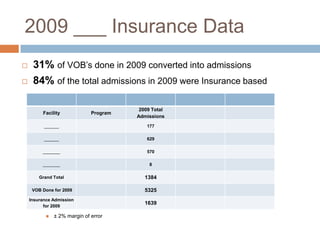
2009 ___ Insurance Data31% of VOB’s done in 2009 converted into admissions  84%of the total admissions in 2009 were Insurance based± 2% margin of error
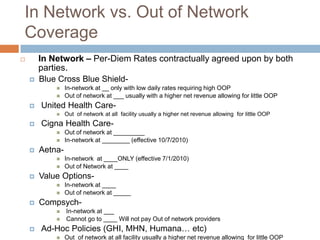
In Network vs. Out of Network CoverageIn Network – Per-Diem Rates contractually agreed upon by both parties. Blue Cross Blue Shield-In-network at __ only with low daily rates requiring high OOPOut of network at ___ usually with a higher net revenue allowing for little OOP United Health Care-Out  of network at all  facility usually a higher net revenue allowing  for little OOP Cigna Health Care-Out of network at _________In-network at ________ (effective 10/7/2010)Aetna-In-network  at ____ONLY (effective 7/1/2010) Out of Network at ____Value Options- In-network at ____Out of network at _____Compsych- In-network at ___ Cannot go to ____ Will not pay Out of network providersAd-Hoc Policies (GHI, MHN, Humana… etc)Out  of network at all facility usually a higher net revenue allowing  for little OOP
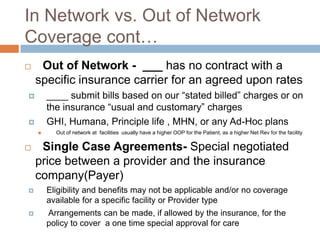
In Network vs. Out of Network Coverage cont…Out of Network -  ___ has no contract with a specific insurance carrier for an agreed upon rates____ submit bills based on our “stated billed” charges or on the insurance “usual and customary” chargesGHI, Humana, Principle life , MHN, or any Ad-Hoc plansOut of network at  facilities  usually have a higher OOP for the Patient, as a higher Net Rev for the facilitySingle Case Agreements- Special negotiated price between a provider and the insurance company(Payer)Eligibility and benefits may not be applicable and/or no coverage available for a specific facility or Provider type Arrangements can be made, if allowed by the insurance, for the  policy to cover  a one time special approval for care
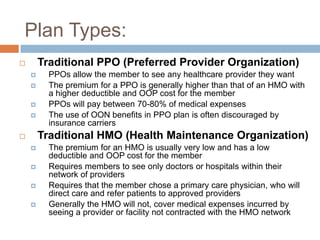
 Plan Types:Traditional PPO (Preferred Provider Organization) PPOs allow the member to see any healthcare provider they wantThe premium for a PPO is generally higher than that of an HMO with a higher deductible and OOP cost for the memberPPOs will pay between 70-80% of medical expenses The use of OON benefits in PPO plan is often discouraged by insurance carriersTraditional HMO (Health Maintenance Organization)The premium for an HMO is usually very low and has a low deductible and OOP cost for the memberRequires members to see only doctors or hospitals within their network of providersRequires that the member chose a primary care physician, who will direct care and refer patients to approved providersGenerally the HMO will not, cover medical expenses incurred by seeing a provider or facility not contracted with the HMO network
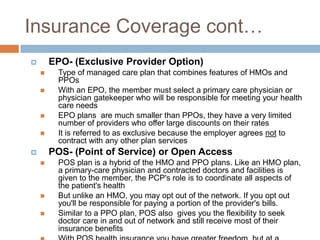
Insurance Coverage cont…EPO- (Exclusive Provider Option)Type of managed care plan that combines features of HMOs and PPOsWith an EPO, the member must select a primary care physician or physician gatekeeper who will be responsible for meeting your health care needsEPO plans  are much smaller than PPOs, they have a very limited number of providers who offer large discounts on their ratesIt is referred to as exclusive because the employer agrees not to contract with any other plan services POS- (Point of Service) or Open AccessPOS plan is a hybrid of the HMO and PPO plans. Like an HMO plan, a primary-care physician and contracted doctors and facilities is given to the member, the PCP's role is to coordinate all aspects of the patient's health But unlike an HMO, you may opt out of the network. If you opt out you'll be responsible for paying a portion of the provider's bills.Similar to a PPO plan, POS also  gives you the flexibility to seek doctor care in and out of network and still receive most of their insurance benefitsWith POS health insurance you have greater freedom, but at a higher cost
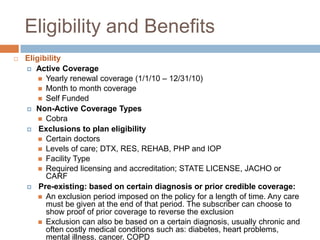
Eligibility and BenefitsEligibilityActive CoverageYearly renewal coverage (1/1/10 – 12/31/10)Month to month coverageSelf FundedNon-Active Coverage TypesCobraExclusions to plan eligibilityCertain doctorsLevels of care; DTX, RES, REHAB, PHP and IOPFacility TypeRequired licensing and accreditation; STATE LICENSE, JACHO or CARFPre-existing: based on certain diagnosis or prior credible coverage:An exclusion period imposed on the policy for a length of time. Any care must be given at the end of that period. The subscriber can choose to show proof of prior coverage to reverse the exclusionExclusion can also be based on a certain diagnosis, usually chronic and often costly medical conditions such as: diabetes, heart problems, mental illness, cancer, COPD
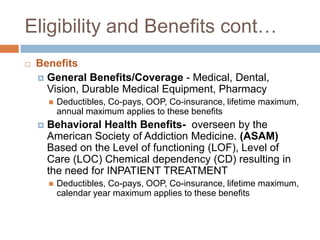
Eligibility and Benefits cont…BenefitsGeneral Benefits/Coverage - Medical, Dental, Vision, Durable Medical Equipment, PharmacyDeductibles, Co-pays, OOP, Co-insurance, lifetime maximum, annual maximum applies to these benefitsBehavioral Health Benefits-  overseen by the American Society of Addiction Medicine. (ASAM) Based on the Level of functioning (LOF), Level of Care (LOC) Chemical dependency (CD) resulting in the need for INPATIENT TREATMENTDeductibles, Co-pays, OOP, Co-insurance, lifetime maximum, calendar year maximum applies to these benefits
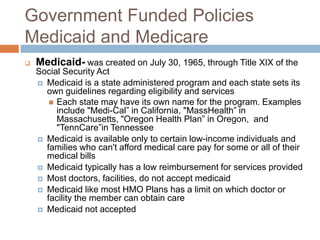
Government Funded PoliciesMedicaid and MedicareMedicaid-was created on July 30, 1965, through Title XIX of the Social Security Act Medicaid is a state administered program and each state sets its own guidelines regarding eligibility and servicesEach state may have its own name for the program. Examples include "Medi-Cal” in California, "MassHealth” in Massachusetts, "Oregon Health Plan” in Oregon,  and "TennCare”in TennesseeMedicaid is available only to certain low-income individuals and families who can't afford medical care pay for some or all of their medical billsMedicaid typically has a low reimbursement for services providedMost doctors, facilities, do notaccept medicaidMedicaid like most HMO Plans has a limit on which doctor or facility the member can obtain careMedicaid not accepted
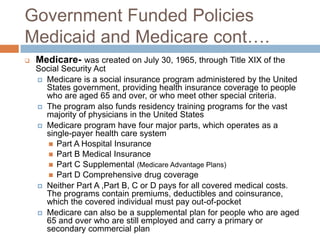
Government Funded PoliciesMedicaid and Medicare cont….Medicare-was created on July 30, 1965, through Title XIX of the Social Security Act Medicare is a social insurance program administered by the United States government, providing health insurance coverage to people who are aged 65 and over, or who meet other special criteria. The program also funds residency training programs for the vast majority of physicians in the United StatesMedicare program have four major parts, which operates as a single-payer health care systemPart A Hospital Insurance Part B Medical Insurance Part C Supplemental (Medicare Advantage Plans)Part D Comprehensive drug coverageNeither Part A ,Part B, C or D pays for all covered medical costs. The programs contain premiums, deductibles and coinsurance, which the covered individual must pay out-of-pocketMedicare can also be a supplemental plan for people who are aged 65 and over who are still employed and carry a primary or secondary commercial plan
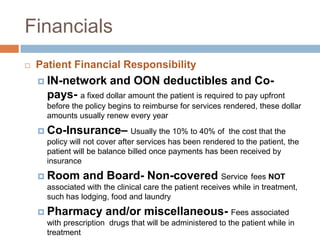
FinancialsPatient Financial ResponsibilityIN-network and OON deductibles and Co-pays-a fixed dollar amount the patient is required to pay upfront before the policy begins to reimburse for services rendered, these dollar amounts usually renew every yearCo-Insurance– Usually the 10% to 40% of  the cost that the policy will not cover after services has been rendered to the patient, the patient will be balance billed once payments has been received by  insuranceRoom and Board- Non-covered Servicefees NOT associated with the clinical care the patient receives while in treatment, such has lodging, food and laundryPharmacy and/or miscellaneous- Fees associated with prescription  drugs that will be administered to the patient while in treatment
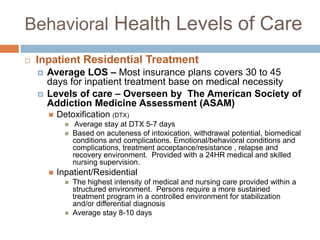
Behavioral Health Levels of CareInpatient Residential Treatment Average LOS – Most insurance plans covers 30 to 45 days for inpatient treatment base on medical necessity Levels of care – Overseen by  The American Society of Addiction Medicine Assessment (ASAM)Detoxification (DTX) Average stay at DTX 5-7 daysBased on acuteness of intoxication, withdrawal potential, biomedical conditions and complications. Emotional/behavioral conditions and complications, treatment acceptance/resistance , relapse and recovery environment.  Provided with a 24HR medical and skilled nursing supervision.Inpatient/ResidentialThe highest intensity of medical and nursing care provided within a structured environment.  Persons require a more sustained treatment program in a controlled environment for stabilization and/or differential diagnosis Average stay 8-10 days
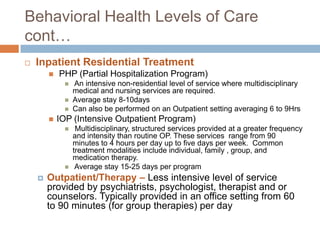
Behavioral Health Levels of Care cont…Inpatient Residential Treatment PHP (Partial Hospitalization Program) An intensive non-residential level of service where multidisciplinary medical and nursing services are required. Average stay 8-10daysCan also be performed on an Outpatient setting averaging 6 to 9HrsIOP (Intensive Outpatient Program) Multidisciplinary, structured services provided at a greater frequency and intensity than routine OP. These services  range from 90 minutes to 4 hours per day up to five days per week.  Common treatment modalities include individual, family , group, and medication therapy.  Average stay 15-25 days per programOutpatient/Therapy – Less intensive level of service provided by psychiatrists, psychologist, therapist and or counselors. Typically provided in an office setting from 60 to 90 minutes (for group therapies) per day
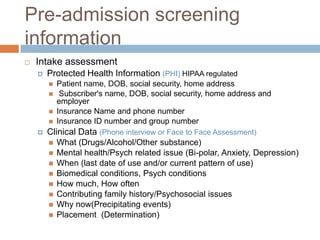
Pre-admission screening informationIntake assessmentProtected Health Information (PHI) HIPAA regulatedPatient name, DOB, social security, home address Subscriber's name, DOB, social security, home address and employerInsurance Name and phone numberInsurance ID number and group number Clinical Data (Phone interview or Face to Face Assessment)What (Drugs/Alcohol/Other substance)Mental health/Psych related issue (Bi-polar, Anxiety, Depression)When (last date of use and/or current pattern of use)Biomedical conditions, Psych conditionsHow much, How often Contributing family history/Psychosocial issuesWhy now(Precipitating events)Placement  (Determination)
References	http://en.wikipedia.org/wiki/Diagnostic_and_Statistical_Manual_of_Mental_Disorders http://allpsych.com/disorders/dsm.html:http://psyweb.com/Mdisord/jsp/mental.jsp:http://bcbst.com/health-plans/grouphttp://www.cms.gov/home/medicaid.asp

Jd Revised Undestanding Insurance Eliigibilityprocess Iii

  • 1.
    Understanding Insurance Eligibilitycoverage & BENEFITSFor: Residential behavioral health settingPrepared by: Johana Désir
  • 2.
    2009 ___ InsuranceData31% of VOB’s done in 2009 converted into admissions 84%of the total admissions in 2009 were Insurance based± 2% margin of error
  • 3.
    In Network vs.Out of Network CoverageIn Network – Per-Diem Rates contractually agreed upon by both parties. Blue Cross Blue Shield-In-network at __ only with low daily rates requiring high OOPOut of network at ___ usually with a higher net revenue allowing for little OOP United Health Care-Out of network at all facility usually a higher net revenue allowing for little OOP Cigna Health Care-Out of network at _________In-network at ________ (effective 10/7/2010)Aetna-In-network at ____ONLY (effective 7/1/2010) Out of Network at ____Value Options- In-network at ____Out of network at _____Compsych- In-network at ___ Cannot go to ____ Will not pay Out of network providersAd-Hoc Policies (GHI, MHN, Humana… etc)Out of network at all facility usually a higher net revenue allowing for little OOP
  • 4.
    In Network vs.Out of Network Coverage cont…Out of Network - ___ has no contract with a specific insurance carrier for an agreed upon rates____ submit bills based on our “stated billed” charges or on the insurance “usual and customary” chargesGHI, Humana, Principle life , MHN, or any Ad-Hoc plansOut of network at facilities usually have a higher OOP for the Patient, as a higher Net Rev for the facilitySingle Case Agreements- Special negotiated price between a provider and the insurance company(Payer)Eligibility and benefits may not be applicable and/or no coverage available for a specific facility or Provider type Arrangements can be made, if allowed by the insurance, for the policy to cover a one time special approval for care
  • 5.
    Plan Types:TraditionalPPO (Preferred Provider Organization) PPOs allow the member to see any healthcare provider they wantThe premium for a PPO is generally higher than that of an HMO with a higher deductible and OOP cost for the memberPPOs will pay between 70-80% of medical expenses The use of OON benefits in PPO plan is often discouraged by insurance carriersTraditional HMO (Health Maintenance Organization)The premium for an HMO is usually very low and has a low deductible and OOP cost for the memberRequires members to see only doctors or hospitals within their network of providersRequires that the member chose a primary care physician, who will direct care and refer patients to approved providersGenerally the HMO will not, cover medical expenses incurred by seeing a provider or facility not contracted with the HMO network
  • 6.
    Insurance Coverage cont…EPO-(Exclusive Provider Option)Type of managed care plan that combines features of HMOs and PPOsWith an EPO, the member must select a primary care physician or physician gatekeeper who will be responsible for meeting your health care needsEPO plans are much smaller than PPOs, they have a very limited number of providers who offer large discounts on their ratesIt is referred to as exclusive because the employer agrees not to contract with any other plan services POS- (Point of Service) or Open AccessPOS plan is a hybrid of the HMO and PPO plans. Like an HMO plan, a primary-care physician and contracted doctors and facilities is given to the member, the PCP's role is to coordinate all aspects of the patient's health But unlike an HMO, you may opt out of the network. If you opt out you'll be responsible for paying a portion of the provider's bills.Similar to a PPO plan, POS also gives you the flexibility to seek doctor care in and out of network and still receive most of their insurance benefitsWith POS health insurance you have greater freedom, but at a higher cost
  • 7.
    Eligibility and BenefitsEligibilityActiveCoverageYearly renewal coverage (1/1/10 – 12/31/10)Month to month coverageSelf FundedNon-Active Coverage TypesCobraExclusions to plan eligibilityCertain doctorsLevels of care; DTX, RES, REHAB, PHP and IOPFacility TypeRequired licensing and accreditation; STATE LICENSE, JACHO or CARFPre-existing: based on certain diagnosis or prior credible coverage:An exclusion period imposed on the policy for a length of time. Any care must be given at the end of that period. The subscriber can choose to show proof of prior coverage to reverse the exclusionExclusion can also be based on a certain diagnosis, usually chronic and often costly medical conditions such as: diabetes, heart problems, mental illness, cancer, COPD
  • 8.
    Eligibility and Benefitscont…BenefitsGeneral Benefits/Coverage - Medical, Dental, Vision, Durable Medical Equipment, PharmacyDeductibles, Co-pays, OOP, Co-insurance, lifetime maximum, annual maximum applies to these benefitsBehavioral Health Benefits- overseen by the American Society of Addiction Medicine. (ASAM) Based on the Level of functioning (LOF), Level of Care (LOC) Chemical dependency (CD) resulting in the need for INPATIENT TREATMENTDeductibles, Co-pays, OOP, Co-insurance, lifetime maximum, calendar year maximum applies to these benefits
  • 9.
    Government Funded PoliciesMedicaidand MedicareMedicaid-was created on July 30, 1965, through Title XIX of the Social Security Act Medicaid is a state administered program and each state sets its own guidelines regarding eligibility and servicesEach state may have its own name for the program. Examples include "Medi-Cal” in California, "MassHealth” in Massachusetts, "Oregon Health Plan” in Oregon, and "TennCare”in TennesseeMedicaid is available only to certain low-income individuals and families who can't afford medical care pay for some or all of their medical billsMedicaid typically has a low reimbursement for services providedMost doctors, facilities, do notaccept medicaidMedicaid like most HMO Plans has a limit on which doctor or facility the member can obtain careMedicaid not accepted
  • 10.
    Government Funded PoliciesMedicaidand Medicare cont….Medicare-was created on July 30, 1965, through Title XIX of the Social Security Act Medicare is a social insurance program administered by the United States government, providing health insurance coverage to people who are aged 65 and over, or who meet other special criteria. The program also funds residency training programs for the vast majority of physicians in the United StatesMedicare program have four major parts, which operates as a single-payer health care systemPart A Hospital Insurance Part B Medical Insurance Part C Supplemental (Medicare Advantage Plans)Part D Comprehensive drug coverageNeither Part A ,Part B, C or D pays for all covered medical costs. The programs contain premiums, deductibles and coinsurance, which the covered individual must pay out-of-pocketMedicare can also be a supplemental plan for people who are aged 65 and over who are still employed and carry a primary or secondary commercial plan
  • 11.
    FinancialsPatient Financial ResponsibilityIN-networkand OON deductibles and Co-pays-a fixed dollar amount the patient is required to pay upfront before the policy begins to reimburse for services rendered, these dollar amounts usually renew every yearCo-Insurance– Usually the 10% to 40% of the cost that the policy will not cover after services has been rendered to the patient, the patient will be balance billed once payments has been received by insuranceRoom and Board- Non-covered Servicefees NOT associated with the clinical care the patient receives while in treatment, such has lodging, food and laundryPharmacy and/or miscellaneous- Fees associated with prescription drugs that will be administered to the patient while in treatment
  • 12.
    Behavioral Health Levelsof CareInpatient Residential Treatment Average LOS – Most insurance plans covers 30 to 45 days for inpatient treatment base on medical necessity Levels of care – Overseen by The American Society of Addiction Medicine Assessment (ASAM)Detoxification (DTX) Average stay at DTX 5-7 daysBased on acuteness of intoxication, withdrawal potential, biomedical conditions and complications. Emotional/behavioral conditions and complications, treatment acceptance/resistance , relapse and recovery environment. Provided with a 24HR medical and skilled nursing supervision.Inpatient/ResidentialThe highest intensity of medical and nursing care provided within a structured environment. Persons require a more sustained treatment program in a controlled environment for stabilization and/or differential diagnosis Average stay 8-10 days
  • 13.
    Behavioral Health Levelsof Care cont…Inpatient Residential Treatment PHP (Partial Hospitalization Program) An intensive non-residential level of service where multidisciplinary medical and nursing services are required. Average stay 8-10daysCan also be performed on an Outpatient setting averaging 6 to 9HrsIOP (Intensive Outpatient Program) Multidisciplinary, structured services provided at a greater frequency and intensity than routine OP. These services range from 90 minutes to 4 hours per day up to five days per week. Common treatment modalities include individual, family , group, and medication therapy. Average stay 15-25 days per programOutpatient/Therapy – Less intensive level of service provided by psychiatrists, psychologist, therapist and or counselors. Typically provided in an office setting from 60 to 90 minutes (for group therapies) per day
  • 14.
    Pre-admission screening informationIntakeassessmentProtected Health Information (PHI) HIPAA regulatedPatient name, DOB, social security, home address Subscriber's name, DOB, social security, home address and employerInsurance Name and phone numberInsurance ID number and group number Clinical Data (Phone interview or Face to Face Assessment)What (Drugs/Alcohol/Other substance)Mental health/Psych related issue (Bi-polar, Anxiety, Depression)When (last date of use and/or current pattern of use)Biomedical conditions, Psych conditionsHow much, How often Contributing family history/Psychosocial issuesWhy now(Precipitating events)Placement (Determination)
  • 15.

Editor's Notes

  • #2 This presentation should help clarify some of your questions on insurance admissions and to respond to some basic question the patients may have prior to their admission.
  • #3 Why it is important to work the insurance intakes as much as the private pay intakes.
  • #4 Most commercial policy have either an in-network contract or out of network contract, with some policy having both in and out of network benefits.
  • #6 PPO affiliation: LAP in-network with BCBS/Magellan PPO, Value Options, Cigna/GM, Compsych. NO HMO. PPO affiliation: MH Out of network with all insurance (policy must have OON coverage)
  • #8 Eligibility: Policy must be effective prior to admission or treatment.Non active coverage: Policy termed or termination of employment or non payment for month to month policy.Cobra: Payment to extend coverage after policy term. Patient either pays directly to insurance company or bring the payment at admission along with the cobra paper work.Pre-exiting: Insurance companies impose an exclusion for care base on either a particular diagnosis or length of coverage.Benefits: Detail descriptions of what exactly the policy covers. What portion of care is the patient’s responsibility and what portion is the insurance responsibility.
  • #13 Mental health and substance care are base on different level of care base on medical necessity which make up the 30 days stay. Most patient will stay for 30 days in treatment at different level during that stay. The insurance companies have strict guidelines for qualification at those level of care. A full face to face assessment at the upon admission is required to determine at what level of care the patient will be placed.
  • #15 These are some basic information necessary for pre-admission and admission. The pre-admission step is a crucial part of the intake assessment in order to ensure a smooth admission in our facilities.