Java (8)
Brian Vermeer (@BrianVerm)
Java
Java 5 (Tiger) - Sept 2004
Java 6 (Mustang) - Dec 2006

Java 7 (Dolphin) - July 2011
Java 8 (Spider) - March 2014
Java 9 - Sept 2017
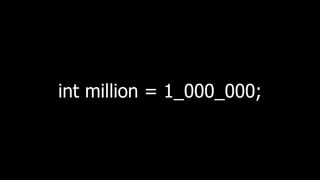
int million = 1_000_000;
Java
Java 5 (Tiger) - Sept 2004
Java 6 (Mustang) - Dec 2006

Java 7 (Dolphin) - July 2011
Java 8 (Spider) - March 2014
Java 9 - Sept 2017
Java 8
March 2014
Working from a more functional
perspective

Some “life changing” code constructions
In retrospect: 

What is GOOD, BAD and UGLY
Brian Vermeer
Software Engineer
Disclaimer
Best Practices are based on opinions


Different conclusions are possible
Think, and make your own
judgement
Why Java 8
Doing things in parallel
Less code
Minimise Errors
New (functional) solutions
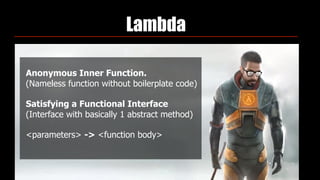
Lambda
Anonymous Inner Function.

(Nameless function without boilerplate code)
Satisfying a Functional Interface

(Interface with basically 1 abstract method)
<parameters> -> <function body>
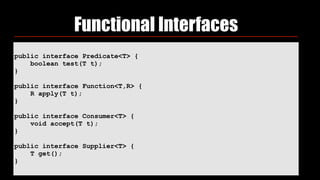
public interface Predicate<T> {
boolean test(T t);
}
public interface Function<T,R> {
R apply(T t);
}
public interface Consumer<T> {
void accept(T t);
}
public interface Supplier<T> {
T get();
}
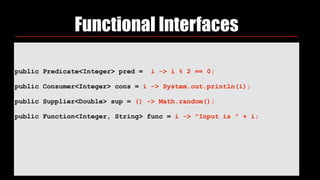
Functional Interfaces
public Predicate<Integer> pred = i -> i % 2 == 0;


public Consumer<Integer> cons = i -> System.out.println(i);


public Supplier<Double> sup = () -> Math.random();


public Function<Integer, String> func = i -> "Input is " + i;
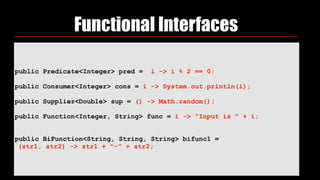
Functional Interfaces
public Predicate<Integer> pred = i -> i % 2 == 0;


public Consumer<Integer> cons = i -> System.out.println(i);


public Supplier<Double> sup = () -> Math.random();


public Function<Integer, String> func = i -> "Input is " + i;
public BiFunction<String, String, String> bifunc1 =
(str1, str2) -> str1 + "-" + str2;
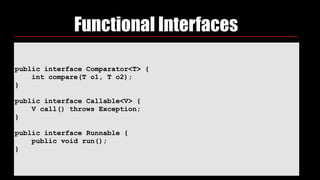
Functional Interfaces


public interface Comparator<T> {
int compare(T o1, T o2);
}
public interface Callable<V> {
V call() throws Exception;
}
public interface Runnable {
public void run();
}
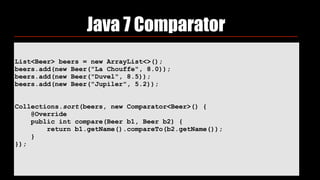
Functional Interfaces
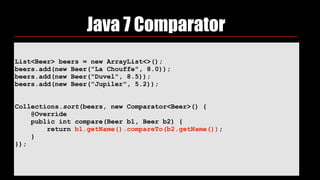
List<Beer> beers = new ArrayList<>();

beers.add(new Beer("La Chouffe", 8.0));

beers.add(new Beer("Duvel", 8.5));

beers.add(new Beer("Jupiler", 5.2));


Collections.sort(beers, new Comparator<Beer>() {

@Override

public int compare(Beer b1, Beer b2) {

return b1.getName().compareTo(b2.getName());

}

});

Java 7 Comparator
List<Beer> beers = new ArrayList<>();

beers.add(new Beer("La Chouffe", 8.0));

beers.add(new Beer("Duvel", 8.5));

beers.add(new Beer("Jupiler", 5.2));


Collections.sort(beers, new Comparator<Beer>() {

@Override

public int compare(Beer b1, Beer b2) {

return b1.getName().compareTo(b2.getName());

}

});

Java 7 Comparator
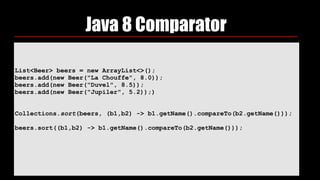
List<Beer> beers = new ArrayList<>();

beers.add(new Beer("La Chouffe", 8.0));

beers.add(new Beer("Duvel", 8.5));

beers.add(new Beer("Jupiler", 5.2));)


Collections.sort(beers, (b1,b2) -> b1.getName().compareTo(b2.getName()));


beers.sort((b1,b2) -> b1.getName().compareTo(b2.getName()));


Java 8 Comparator
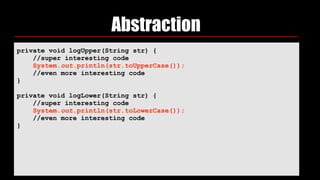
Abstraction
private void logUpper(String str) {

//super interesting code

System.out.println(str.toUpperCase());

//even more interesting code

}


private void logLower(String str) {

//super interesting code

System.out.println(str.toLowerCase());

//even more interesting code

}


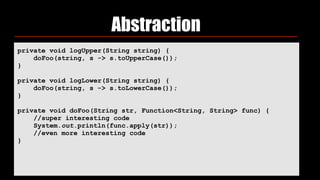
Abstraction
private void logUpper(String string) {

doFoo(string, s -> s.toUpperCase());

}


private void logLower(String string) {

doFoo(string, s -> s.toLowerCase());

}


private void doFoo(String str, Function<String, String> func) {

//super interesting code

System.out.println(func.apply(str));

//even more interesting code

}


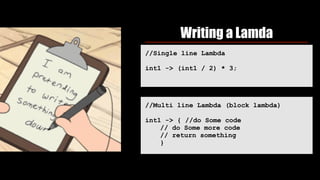
Writing a Lamda
//Single line Lambda
int1 -> (int1 / 2) * 3;
//Multi line Lambda (block lambda)
int1 -> { //do Some code
// do Some more code
// return something
}
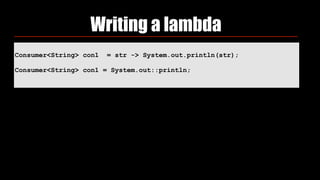
Consumer<String> con1 = str -> System.out.println(str);
Consumer<String> con1 = System.out::println;
Writing a lambda
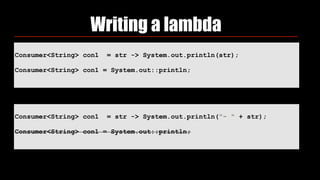
Consumer<String> con1 = str -> System.out.println(str);
Consumer<String> con1 = System.out::println;
Writing a lambda
Consumer<String> con1 = str -> System.out.println("- " + str);
Consumer<String> con1 = System.out::println;
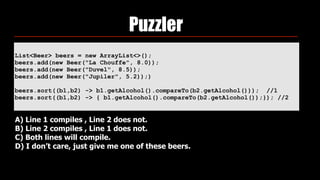
List<Beer> beers = new ArrayList<>();

beers.add(new Beer("La Chouffe", 8.0));

beers.add(new Beer("Duvel", 8.5));

beers.add(new Beer("Jupiler", 5.2));)
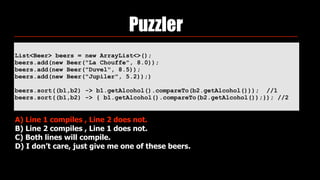
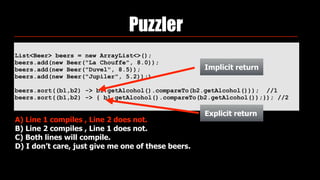
beers.sort((b1,b2) -> b1.getAlcohol().compareTo(b2.getAlcohol())); //1
beers.sort((b1,b2) -> { b1.getAlcohol().compareTo(b2.getAlcohol());}); //2
Puzzler
A) Line 1 compiles , Line 2 does not.
B) Line 2 compiles , Line 1 does not.
C) Both lines will compile.
D) I don’t care, just give me one of these beers.
List<Beer> beers = new ArrayList<>();

beers.add(new Beer("La Chouffe", 8.0));

beers.add(new Beer("Duvel", 8.5));

beers.add(new Beer("Jupiler", 5.2));)
beers.sort((b1,b2) -> b1.getAlcohol().compareTo(b2.getAlcohol())); //1
beers.sort((b1,b2) -> { b1.getAlcohol().compareTo(b2.getAlcohol());}); //2
Puzzler
A) Line 1 compiles , Line 2 does not.
B) Line 2 compiles , Line 1 does not.
C) Both lines will compile.
D) I don’t care, just give me one of these beers.
List<Beer> beers = new ArrayList<>();

beers.add(new Beer("La Chouffe", 8.0));

beers.add(new Beer("Duvel", 8.5));

beers.add(new Beer("Jupiler", 5.2));)
beers.sort((b1,b2) -> b1.getAlcohol().compareTo(b2.getAlcohol())); //1
beers.sort((b1,b2) -> { b1.getAlcohol().compareTo(b2.getAlcohol());}); //2
Puzzler
A) Line 1 compiles , Line 2 does not.
B) Line 2 compiles , Line 1 does not.
C) Both lines will compile.
D) I don’t care, just give me one of these beers.
Implicit return
Explicit return
Block Lambda
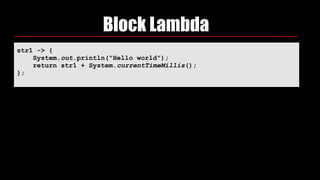
str1 -> {

System.out.println("Hello world");

return str1 + System.currentTimeMillis();

};


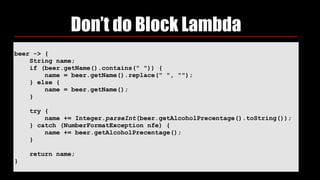
Don’t do Block Lambda
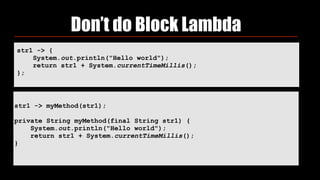
str1 -> {

System.out.println("Hello world");

return str1 + System.currentTimeMillis();

};


str1 -> myMethod(str1);
private String myMethod(final String str1) {

System.out.println("Hello world");

return str1 + System.currentTimeMillis();

}
Don’t do Block Lambda
beer -> {
String name;
if (beer.getName().contains(" ")) {
name = beer.getName().replace(" ", "");
} else {
name = beer.getName();
}
try {
name += Integer.parseInt(beer.getAlcoholPrecentage().toString());
} catch (NumberFormatException nfe) {
name += beer.getAlcoholPrecentage();
}
return name;
}
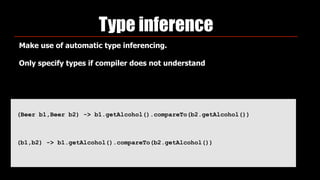
Type inference
(Beer b1,Beer b2) -> b1.getAlcohol().compareTo(b2.getAlcohol())
(b1,b2) -> b1.getAlcohol().compareTo(b2.getAlcohol())
Make use of automatic type inferencing.
Only specify types if compiler does not understand
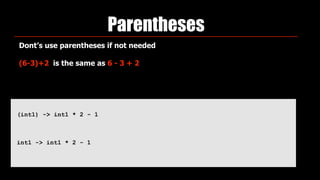
Parentheses
(int1) -> int1 * 2 - 1
int1 -> int1 * 2 - 1
Dont’s use parentheses if not needed
(6-3)+2 is the same as 6 - 3 + 2
Exceptions
Exception handling
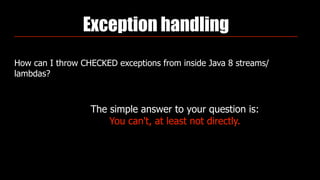
How can I throw CHECKED exceptions from inside Java 8 streams/
lambdas?
Exception handling
How can I throw CHECKED exceptions from inside Java 8 streams/
lambdas?
The simple answer to your question is: 

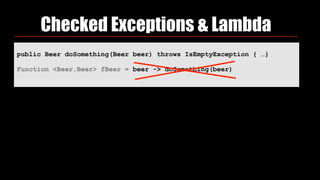
You can't, at least not directly.
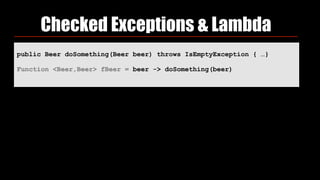
Checked Exceptions & Lambda
public Beer doSomething(Beer beer) throws IsEmptyException { …}
Function <Beer,Beer> fBeer = beer -> doSomething(beer)


Checked Exceptions & Lambda
public Beer doSomething(Beer beer) throws IsEmptyException { …}
Function <Beer,Beer> fBeer = beer -> doSomething(beer)


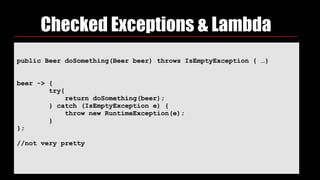
Checked Exceptions & Lambda
public Beer doSomething(Beer beer) throws IsEmptyException { …}
beer -> {

try{

return doSomething(beer);

} catch (IsEmptyException e) {

throw new RuntimeException(e);

}

};
//not very pretty
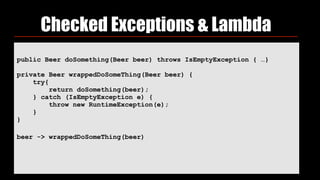
Checked Exceptions & Lambda
public Beer doSomething(Beer beer) throws IsEmptyException { …}
private Beer wrappedDoSomeThing(Beer beer) {

try{

return doSomething(beer);

} catch (IsEmptyException e) {

throw new RuntimeException(e);

}

}
beer -> wrappedDoSomeThing(beer)
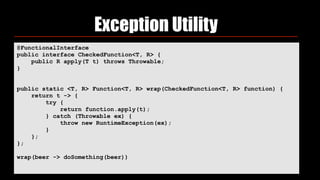
Exception Utility
@FunctionalInterface

public interface CheckedFunction<T, R> {

public R apply(T t) throws Throwable;

}
public static <T, R> Function<T, R> wrap(CheckedFunction<T, R> function) {

return t -> {

try {

return function.apply(t);

} catch (Throwable ex) {

throw new RuntimeException(ex);

}

};

};
wrap(beer -> doSomething(beer))
Optional
Optional
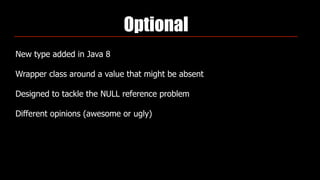
New type added in Java 8
Wrapper class around a value that might be absent
Designed to tackle the NULL reference problem
Different opinions (awesome or ugly)
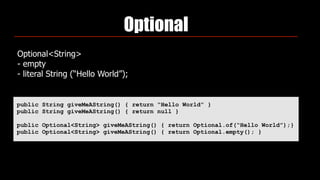
Optional
Optional<String>

- empty

- literal String (“Hello World”);
public String giveMeAString() { return “Hello World” }
public String giveMeAString() { return null }
public Optional<String> giveMeAString() { return Optional.of(“Hello World”);}
public Optional<String> giveMeAString() { return Optional.empty(); }


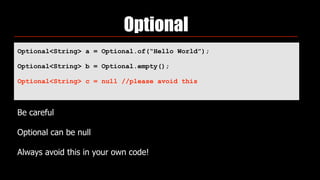
Optional
Optional<String> a = Optional.of(“Hello World”);
Optional<String> b = Optional.empty();
Optional<String> c = null //please avoid this


Be careful
Optional can be null
Always avoid this in your own code!
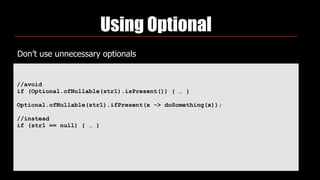
Using Optional
Don’t use unnecessary optionals
//avoid
if (Optional.ofNullable(str1).isPresent()) { … }
Optional.ofNullable(str1).ifPresent(x -> doSomething(x));
//instead
if (str1 == null) { … }


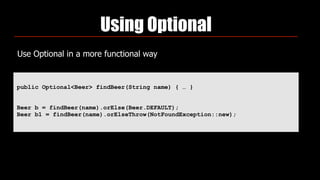
Using Optional
Use Optional in a more functional way
public Optional<Beer> findBeer(String name) { … }
Beer b = findBeer(name).orElse(Beer.DEFAULT);
Beer b1 = findBeer(name).orElseThrow(NotFoundException::new);


Optional
Optional can have 3 options, be aware ….
Never assign to null in your own code.
Choose when to use Optional en stick to that

- everywhere

- only what is publicly available

- don’t use it at all
Optional is designed as return type, not as input type
Streams
What is Stream ( in Java8 )
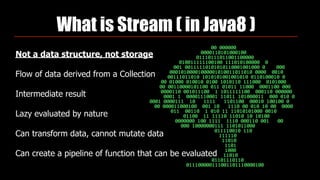
Not a data structure, not storage
Flow of data derived from a Collection
Intermediate result
Lazy evaluated by nature
Can transform data, cannot mutate data
Can create a pipeline of function that can be evaluated
JAVA 8 Streams
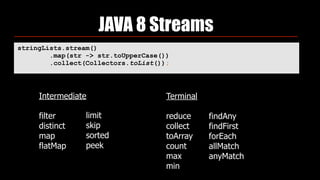
stringLists.stream()

.map(str -> str.toUpperCase())

.collect(Collectors.toList());
Intermediate
filter 

distinct

map 

flatMap

Terminal
reduce

collect

toArray

count

max

min

limit 

skip

sorted

peek
findAny

findFirst

forEach

allMatch

anyMatch
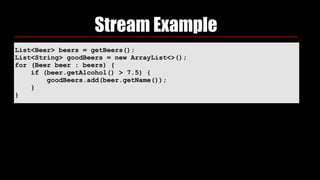
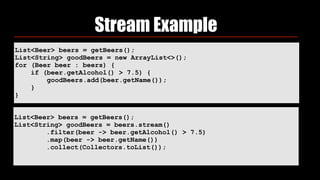
List<Beer> beers = getBeers();
List<String> goodBeers = new ArrayList<>();

for (Beer beer : beers) {

if (beer.getAlcohol() > 7.5) {

goodBeers.add(beer.getName());

}

}
Stream Example
List<Beer> beers = getBeers();
List<String> goodBeers = new ArrayList<>();

for (Beer beer : beers) {

if (beer.getAlcohol() > 7.5) {

goodBeers.add(beer.getName());

}

}
Stream Example
List<Beer> beers = getBeers();
List<String> goodBeers = beers.stream()

.filter(beer -> beer.getAlcohol() > 7.5)

.map(beer -> beer.getName())

.collect(Collectors.toList());
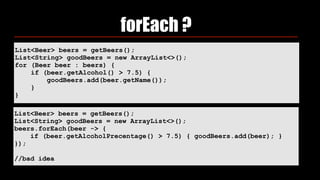
List<Beer> beers = getBeers();
List<String> goodBeers = new ArrayList<>();

for (Beer beer : beers) {

if (beer.getAlcohol() > 7.5) {

goodBeers.add(beer.getName());

}

}
forEach ?
List<Beer> beers = getBeers();
List<String> goodBeers = new ArrayList<>();
beers.forEach(beer -> {
if (beer.getAlcoholPrecentage() > 7.5) { goodBeers.add(beer); }
});
//bad idea
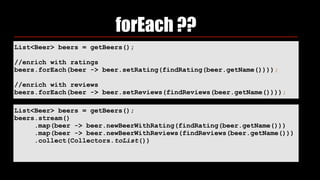
List<Beer> beers = getBeers();
//enrich with ratings
beers.forEach(beer -> beer.setRating(findRating(beer.getName())));
//enrich with reviews
beers.forEach(beer -> beer.setReviews(findReviews(beer.getName())));
forEach ??
List<Beer> beers = getBeers();
beers.stream()
.map(beer -> beer.newBeerWithRating(findRating(beer.getName()))
.map(beer -> beer.newBeerWithReviews(findReviews(beer.getName()))
.collect(Collectors.toList())
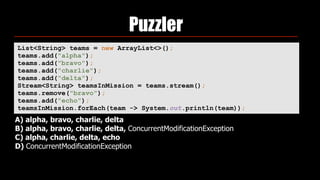
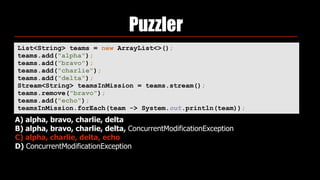
Puzzler
List<String> teams = new ArrayList<>();

teams.add("alpha");

teams.add("bravo");

teams.add("charlie");

teams.add("delta");

Stream<String> teamsInMission = teams.stream();

teams.remove("bravo");

teams.add("echo");

teamsInMission.forEach(team -> System.out.println(team));
A) alpha, bravo, charlie, delta
B) alpha, bravo, charlie, delta, ConcurrentModificationException
C) alpha, charlie, delta, echo
D) ConcurrentModificationException
Puzzler
List<String> teams = new ArrayList<>();

teams.add("alpha");

teams.add("bravo");

teams.add("charlie");

teams.add("delta");

Stream<String> teamsInMission = teams.stream();

teams.remove("bravo");

teams.add("echo");

teamsInMission.forEach(team -> System.out.println(team));
A) alpha, bravo, charlie, delta
B) alpha, bravo, charlie, delta, ConcurrentModificationException
C) alpha, charlie, delta, echo
D) ConcurrentModificationException
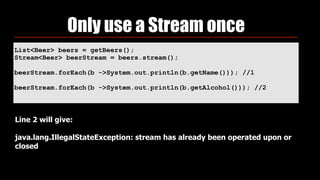
List<Beer> beers = getBeers();

Stream<Beer> beerStream = beers.stream();


beerStream.forEach(b ->System.out.println(b.getName())); //1


beerStream.forEach(b ->System.out.println(b.getAlcohol())); //2
Only use a Stream once
Line 2 will give: 


java.lang.IllegalStateException: stream has already been operated upon or
closed
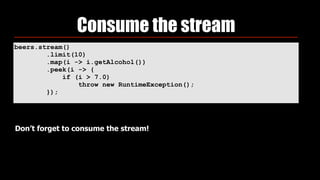
beers.stream()

.limit(10)

.map(i -> i.getAlcohol())

.peek(i -> {

if (i > 7.0)

throw new RuntimeException();

});
Consume the stream
Don’t forget to consume the stream!
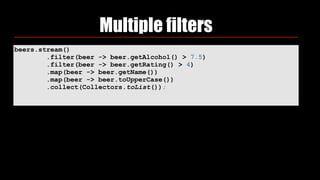
beers.stream()
.filter(beer -> beer.getAlcohol() > 7.5)
.filter(beer -> beer.getRating() > 4)
.map(beer -> beer.getName())
.map(beer -> beer.toUpperCase())
.collect(Collectors.toList());
Multiple filters
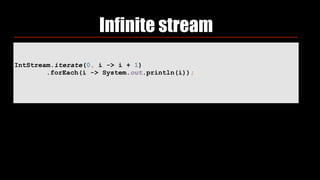
IntStream.iterate(0, i -> i + 1)

.forEach(i -> System.out.println(i));
Infinite stream
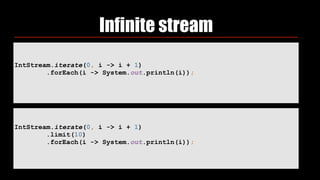
IntStream.iterate(0, i -> i + 1)

.forEach(i -> System.out.println(i));
Infinite stream
IntStream.iterate(0, i -> i + 1)

.limit(10)

.forEach(i -> System.out.println(i));
Infinite stream
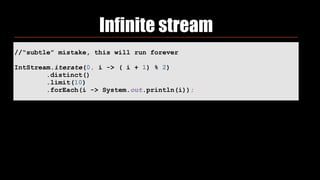
//“subtle” mistake, this will run forever
IntStream.iterate(0, i -> ( i + 1) % 2)

.distinct()

.limit(10)

.forEach(i -> System.out.println(i));
Infinite stream
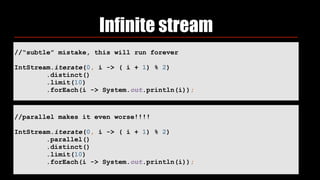
//“subtle” mistake, this will run forever
IntStream.iterate(0, i -> ( i + 1) % 2)

.distinct()

.limit(10)

.forEach(i -> System.out.println(i));
//parallel makes it even worse!!!!
IntStream.iterate(0, i -> ( i + 1) % 2)
.parallel()
.distinct()

.limit(10)

.forEach(i -> System.out.println(i));
Watch out with parallel
Watch out with parallel in general
Parallel stream all use the common fork-join
thread pool
Parallel can slow you down.
Streams
Don’t replace every loop with Stream
Be careful with infinite streams
Only uses streams once
Be very careful with parallel
A stream is not a data structure
Stream pipelines don’t do anything until consumed
Summary
Java is a Object Oriented Language
Java is not a Functional Language
There are some nice new “functional”
code constructions you can use
Use them with care
Don’t be a cowboy
More …
Java 8 Puzzlers: The Strange, the Bizarre, and the Wonderful

vJug Session by Baruch Sadogursky and Viktor Gamov

https://youtu.be/lu4UTY940tg
Optional - The Mother of All Bikesheds

Devoxx 2016 by Stuart Marks

https://youtu.be/Ej0sss6cq14
Brian Vermeer
@BrianVerm
brian@brianvermeer.nl

Java(8) The Good, The Bad and the Ugly

  • 1.
  • 2.
    Java Java 5 (Tiger)- Sept 2004 Java 6 (Mustang) - Dec 2006
 Java 7 (Dolphin) - July 2011 Java 8 (Spider) - March 2014 Java 9 - Sept 2017
  • 3.
    int million =1_000_000;
  • 4.
    Java Java 5 (Tiger)- Sept 2004 Java 6 (Mustang) - Dec 2006
 Java 7 (Dolphin) - July 2011 Java 8 (Spider) - March 2014 Java 9 - Sept 2017
  • 5.
    Java 8 March 2014 Workingfrom a more functional perspective
 Some “life changing” code constructions In retrospect: 
 What is GOOD, BAD and UGLY
  • 6.
  • 7.
    Disclaimer Best Practices arebased on opinions
 
 Different conclusions are possible Think, and make your own judgement
  • 8.
    Why Java 8 Doingthings in parallel Less code Minimise Errors New (functional) solutions
  • 10.
    Lambda Anonymous Inner Function.
 (Namelessfunction without boilerplate code) Satisfying a Functional Interface
 (Interface with basically 1 abstract method) <parameters> -> <function body>
  • 11.
    public interface Predicate<T>{ boolean test(T t); } public interface Function<T,R> { R apply(T t); } public interface Consumer<T> { void accept(T t); } public interface Supplier<T> { T get(); } Functional Interfaces
  • 12.
    public Predicate<Integer> pred= i -> i % 2 == 0; 
 public Consumer<Integer> cons = i -> System.out.println(i); 
 public Supplier<Double> sup = () -> Math.random(); 
 public Function<Integer, String> func = i -> "Input is " + i; Functional Interfaces
  • 13.
    public Predicate<Integer> pred= i -> i % 2 == 0; 
 public Consumer<Integer> cons = i -> System.out.println(i); 
 public Supplier<Double> sup = () -> Math.random(); 
 public Function<Integer, String> func = i -> "Input is " + i; public BiFunction<String, String, String> bifunc1 = (str1, str2) -> str1 + "-" + str2; Functional Interfaces
  • 14.
    
 public interface Comparator<T>{ int compare(T o1, T o2); } public interface Callable<V> { V call() throws Exception; } public interface Runnable { public void run(); } Functional Interfaces
  • 15.
    List<Beer> beers =new ArrayList<>();
 beers.add(new Beer("La Chouffe", 8.0));
 beers.add(new Beer("Duvel", 8.5));
 beers.add(new Beer("Jupiler", 5.2));
 
 
 Collections.sort(beers, new Comparator<Beer>() {
 @Override
 public int compare(Beer b1, Beer b2) {
 return b1.getName().compareTo(b2.getName());
 }
 });
 Java 7 Comparator
  • 16.
    List<Beer> beers =new ArrayList<>();
 beers.add(new Beer("La Chouffe", 8.0));
 beers.add(new Beer("Duvel", 8.5));
 beers.add(new Beer("Jupiler", 5.2));
 
 
 Collections.sort(beers, new Comparator<Beer>() {
 @Override
 public int compare(Beer b1, Beer b2) {
 return b1.getName().compareTo(b2.getName());
 }
 });
 Java 7 Comparator
  • 17.
    List<Beer> beers =new ArrayList<>();
 beers.add(new Beer("La Chouffe", 8.0));
 beers.add(new Beer("Duvel", 8.5));
 beers.add(new Beer("Jupiler", 5.2));)
 
 
 Collections.sort(beers, (b1,b2) -> b1.getName().compareTo(b2.getName()));
 
 beers.sort((b1,b2) -> b1.getName().compareTo(b2.getName())); 
 Java 8 Comparator
  • 18.
    Abstraction private void logUpper(Stringstr) {
 //super interesting code
 System.out.println(str.toUpperCase());
 //even more interesting code
 }
 
 private void logLower(String str) {
 //super interesting code
 System.out.println(str.toLowerCase());
 //even more interesting code
 }


  • 19.
    Abstraction private void logUpper(Stringstring) {
 doFoo(string, s -> s.toUpperCase());
 }
 
 private void logLower(String string) {
 doFoo(string, s -> s.toLowerCase());
 }
 
 private void doFoo(String str, Function<String, String> func) {
 //super interesting code
 System.out.println(func.apply(str));
 //even more interesting code
 } 

  • 20.
    Writing a Lamda //Singleline Lambda int1 -> (int1 / 2) * 3; //Multi line Lambda (block lambda) int1 -> { //do Some code // do Some more code // return something }
  • 21.
    Consumer<String> con1 =str -> System.out.println(str); Consumer<String> con1 = System.out::println; Writing a lambda
  • 22.
    Consumer<String> con1 =str -> System.out.println(str); Consumer<String> con1 = System.out::println; Writing a lambda Consumer<String> con1 = str -> System.out.println("- " + str); Consumer<String> con1 = System.out::println;
  • 23.
    List<Beer> beers =new ArrayList<>();
 beers.add(new Beer("La Chouffe", 8.0));
 beers.add(new Beer("Duvel", 8.5));
 beers.add(new Beer("Jupiler", 5.2));) beers.sort((b1,b2) -> b1.getAlcohol().compareTo(b2.getAlcohol())); //1 beers.sort((b1,b2) -> { b1.getAlcohol().compareTo(b2.getAlcohol());}); //2 Puzzler A) Line 1 compiles , Line 2 does not. B) Line 2 compiles , Line 1 does not. C) Both lines will compile. D) I don’t care, just give me one of these beers.
  • 24.
    List<Beer> beers =new ArrayList<>();
 beers.add(new Beer("La Chouffe", 8.0));
 beers.add(new Beer("Duvel", 8.5));
 beers.add(new Beer("Jupiler", 5.2));) beers.sort((b1,b2) -> b1.getAlcohol().compareTo(b2.getAlcohol())); //1 beers.sort((b1,b2) -> { b1.getAlcohol().compareTo(b2.getAlcohol());}); //2 Puzzler A) Line 1 compiles , Line 2 does not. B) Line 2 compiles , Line 1 does not. C) Both lines will compile. D) I don’t care, just give me one of these beers.
  • 25.
    List<Beer> beers =new ArrayList<>();
 beers.add(new Beer("La Chouffe", 8.0));
 beers.add(new Beer("Duvel", 8.5));
 beers.add(new Beer("Jupiler", 5.2));) beers.sort((b1,b2) -> b1.getAlcohol().compareTo(b2.getAlcohol())); //1 beers.sort((b1,b2) -> { b1.getAlcohol().compareTo(b2.getAlcohol());}); //2 Puzzler A) Line 1 compiles , Line 2 does not. B) Line 2 compiles , Line 1 does not. C) Both lines will compile. D) I don’t care, just give me one of these beers. Implicit return Explicit return
  • 26.
    Block Lambda str1 ->{
 System.out.println("Hello world");
 return str1 + System.currentTimeMillis();
 }; 

  • 27.
    Don’t do BlockLambda str1 -> {
 System.out.println("Hello world");
 return str1 + System.currentTimeMillis();
 }; 
 str1 -> myMethod(str1); private String myMethod(final String str1) {
 System.out.println("Hello world");
 return str1 + System.currentTimeMillis();
 }
  • 28.
    Don’t do BlockLambda beer -> { String name; if (beer.getName().contains(" ")) { name = beer.getName().replace(" ", ""); } else { name = beer.getName(); } try { name += Integer.parseInt(beer.getAlcoholPrecentage().toString()); } catch (NumberFormatException nfe) { name += beer.getAlcoholPrecentage(); } return name; }
  • 29.
    Type inference (Beer b1,Beerb2) -> b1.getAlcohol().compareTo(b2.getAlcohol()) (b1,b2) -> b1.getAlcohol().compareTo(b2.getAlcohol()) Make use of automatic type inferencing. Only specify types if compiler does not understand
  • 30.
    Parentheses (int1) -> int1* 2 - 1 int1 -> int1 * 2 - 1 Dont’s use parentheses if not needed (6-3)+2 is the same as 6 - 3 + 2
  • 31.
  • 32.
    Exception handling How canI throw CHECKED exceptions from inside Java 8 streams/ lambdas?
  • 33.
    Exception handling How canI throw CHECKED exceptions from inside Java 8 streams/ lambdas? The simple answer to your question is: 
 You can't, at least not directly.
  • 34.
    Checked Exceptions &Lambda public Beer doSomething(Beer beer) throws IsEmptyException { …} Function <Beer,Beer> fBeer = beer -> doSomething(beer) 

  • 35.
    Checked Exceptions &Lambda public Beer doSomething(Beer beer) throws IsEmptyException { …} Function <Beer,Beer> fBeer = beer -> doSomething(beer) 

  • 36.
    Checked Exceptions &Lambda public Beer doSomething(Beer beer) throws IsEmptyException { …} beer -> {
 try{
 return doSomething(beer);
 } catch (IsEmptyException e) {
 throw new RuntimeException(e);
 }
 }; //not very pretty
  • 37.
    Checked Exceptions &Lambda public Beer doSomething(Beer beer) throws IsEmptyException { …} private Beer wrappedDoSomeThing(Beer beer) {
 try{
 return doSomething(beer);
 } catch (IsEmptyException e) {
 throw new RuntimeException(e);
 }
 } beer -> wrappedDoSomeThing(beer)
  • 38.
    Exception Utility @FunctionalInterface
 public interfaceCheckedFunction<T, R> {
 public R apply(T t) throws Throwable;
 } public static <T, R> Function<T, R> wrap(CheckedFunction<T, R> function) {
 return t -> {
 try {
 return function.apply(t);
 } catch (Throwable ex) {
 throw new RuntimeException(ex);
 }
 };
 }; wrap(beer -> doSomething(beer))
  • 39.
  • 40.
    Optional New type addedin Java 8 Wrapper class around a value that might be absent Designed to tackle the NULL reference problem Different opinions (awesome or ugly)
  • 41.
    Optional Optional<String>
 - empty
 - literalString (“Hello World”); public String giveMeAString() { return “Hello World” } public String giveMeAString() { return null } public Optional<String> giveMeAString() { return Optional.of(“Hello World”);} public Optional<String> giveMeAString() { return Optional.empty(); } 

  • 42.
    Optional Optional<String> a =Optional.of(“Hello World”); Optional<String> b = Optional.empty(); Optional<String> c = null //please avoid this 
 Be careful Optional can be null Always avoid this in your own code!
  • 43.
    Using Optional Don’t useunnecessary optionals //avoid if (Optional.ofNullable(str1).isPresent()) { … } Optional.ofNullable(str1).ifPresent(x -> doSomething(x)); //instead if (str1 == null) { … } 

  • 44.
    Using Optional Use Optionalin a more functional way public Optional<Beer> findBeer(String name) { … } Beer b = findBeer(name).orElse(Beer.DEFAULT); Beer b1 = findBeer(name).orElseThrow(NotFoundException::new); 

  • 45.
    Optional Optional can have3 options, be aware …. Never assign to null in your own code. Choose when to use Optional en stick to that
 - everywhere
 - only what is publicly available
 - don’t use it at all Optional is designed as return type, not as input type
  • 46.
  • 47.
    What is Stream( in Java8 ) Not a data structure, not storage Flow of data derived from a Collection Intermediate result Lazy evaluated by nature Can transform data, cannot mutate data Can create a pipeline of function that can be evaluated
  • 48.
    JAVA 8 Streams stringLists.stream()
 .map(str-> str.toUpperCase())
 .collect(Collectors.toList()); Intermediate filter 
 distinct
 map 
 flatMap
 Terminal reduce
 collect
 toArray
 count
 max
 min
 limit 
 skip
 sorted
 peek findAny
 findFirst
 forEach
 allMatch
 anyMatch
  • 49.
    List<Beer> beers =getBeers(); List<String> goodBeers = new ArrayList<>();
 for (Beer beer : beers) {
 if (beer.getAlcohol() > 7.5) {
 goodBeers.add(beer.getName());
 }
 } Stream Example
  • 50.
    List<Beer> beers =getBeers(); List<String> goodBeers = new ArrayList<>();
 for (Beer beer : beers) {
 if (beer.getAlcohol() > 7.5) {
 goodBeers.add(beer.getName());
 }
 } Stream Example List<Beer> beers = getBeers(); List<String> goodBeers = beers.stream()
 .filter(beer -> beer.getAlcohol() > 7.5)
 .map(beer -> beer.getName())
 .collect(Collectors.toList());
  • 51.
    List<Beer> beers =getBeers(); List<String> goodBeers = new ArrayList<>();
 for (Beer beer : beers) {
 if (beer.getAlcohol() > 7.5) {
 goodBeers.add(beer.getName());
 }
 } forEach ? List<Beer> beers = getBeers(); List<String> goodBeers = new ArrayList<>(); beers.forEach(beer -> { if (beer.getAlcoholPrecentage() > 7.5) { goodBeers.add(beer); } }); //bad idea
  • 52.
    List<Beer> beers =getBeers(); //enrich with ratings beers.forEach(beer -> beer.setRating(findRating(beer.getName()))); //enrich with reviews beers.forEach(beer -> beer.setReviews(findReviews(beer.getName()))); forEach ?? List<Beer> beers = getBeers(); beers.stream() .map(beer -> beer.newBeerWithRating(findRating(beer.getName())) .map(beer -> beer.newBeerWithReviews(findReviews(beer.getName())) .collect(Collectors.toList())
  • 53.
    Puzzler List<String> teams =new ArrayList<>();
 teams.add("alpha");
 teams.add("bravo");
 teams.add("charlie");
 teams.add("delta");
 Stream<String> teamsInMission = teams.stream();
 teams.remove("bravo");
 teams.add("echo");
 teamsInMission.forEach(team -> System.out.println(team)); A) alpha, bravo, charlie, delta B) alpha, bravo, charlie, delta, ConcurrentModificationException C) alpha, charlie, delta, echo D) ConcurrentModificationException
  • 54.
    Puzzler List<String> teams =new ArrayList<>();
 teams.add("alpha");
 teams.add("bravo");
 teams.add("charlie");
 teams.add("delta");
 Stream<String> teamsInMission = teams.stream();
 teams.remove("bravo");
 teams.add("echo");
 teamsInMission.forEach(team -> System.out.println(team)); A) alpha, bravo, charlie, delta B) alpha, bravo, charlie, delta, ConcurrentModificationException C) alpha, charlie, delta, echo D) ConcurrentModificationException
  • 55.
    List<Beer> beers =getBeers();
 Stream<Beer> beerStream = beers.stream();
 
 beerStream.forEach(b ->System.out.println(b.getName())); //1 
 beerStream.forEach(b ->System.out.println(b.getAlcohol())); //2 Only use a Stream once Line 2 will give: 
 
 java.lang.IllegalStateException: stream has already been operated upon or closed
  • 56.
    beers.stream()
 .limit(10)
 .map(i -> i.getAlcohol())
 .peek(i-> {
 if (i > 7.0)
 throw new RuntimeException();
 }); Consume the stream Don’t forget to consume the stream!
  • 57.
    beers.stream() .filter(beer -> beer.getAlcohol()> 7.5) .filter(beer -> beer.getRating() > 4) .map(beer -> beer.getName()) .map(beer -> beer.toUpperCase()) .collect(Collectors.toList()); Multiple filters
  • 58.
    IntStream.iterate(0, i ->i + 1)
 .forEach(i -> System.out.println(i)); Infinite stream
  • 59.
    IntStream.iterate(0, i ->i + 1)
 .forEach(i -> System.out.println(i)); Infinite stream IntStream.iterate(0, i -> i + 1)
 .limit(10)
 .forEach(i -> System.out.println(i));
  • 60.
    Infinite stream //“subtle” mistake,this will run forever IntStream.iterate(0, i -> ( i + 1) % 2)
 .distinct()
 .limit(10)
 .forEach(i -> System.out.println(i));
  • 61.
    Infinite stream //“subtle” mistake,this will run forever IntStream.iterate(0, i -> ( i + 1) % 2)
 .distinct()
 .limit(10)
 .forEach(i -> System.out.println(i)); //parallel makes it even worse!!!! IntStream.iterate(0, i -> ( i + 1) % 2) .parallel() .distinct()
 .limit(10)
 .forEach(i -> System.out.println(i));
  • 62.
    Watch out withparallel Watch out with parallel in general Parallel stream all use the common fork-join thread pool Parallel can slow you down.
  • 63.
    Streams Don’t replace everyloop with Stream Be careful with infinite streams Only uses streams once Be very careful with parallel A stream is not a data structure Stream pipelines don’t do anything until consumed
  • 64.
    Summary Java is aObject Oriented Language Java is not a Functional Language There are some nice new “functional” code constructions you can use Use them with care Don’t be a cowboy
  • 65.
    More … Java 8Puzzlers: The Strange, the Bizarre, and the Wonderful
 vJug Session by Baruch Sadogursky and Viktor Gamov
 https://youtu.be/lu4UTY940tg Optional - The Mother of All Bikesheds
 Devoxx 2016 by Stuart Marks
 https://youtu.be/Ej0sss6cq14
  • 66.