Java Type System for object oriented programming.pptx
1.
Java Type System
Whatis type in Java?
Set of Values with a set of Operations that can be
applied to the values.
Example :
int type - Set of values { [-2^31] to [+2^31-1])}
Operations : All Arithmetic Operations
BOX type - Set of all BOX object references
Operations : area() , volume() , toString()
Java is Strongly Typed Language.
Type checking is done both at Compile and Run Time.
• If a Type Check Fails at Compile Time - Compile Time
Error
• If a Type Check Fails at Run Time - RunTime Exception
2.
Types in Java
1.Primitive Type( int, float, double, byte, char,
boolean, short, long)
2. A class Type [BOX, String, Arrays , Student etc]
3. An interface Type [ Either User Defined OR Libarary
interfaces such as Comparable]
4. An array type
5. null type
Note :
6. Arrays have a component type (Type of array elements) e.g
String[] array has component type as String int[] array
has Component type as int
2. void is not a type in java. [only a keyword to denote
that a method does not return anything]
3. Object[] names = new String[10]; What’s Array Type and
its component type.
3.
Values in Java
1.A Value of Primitive type
2. A reference to an object
3. reference to an array
4. Null
Examples :
10 , 10.35 , true
new BOX(10,6,8);
new int[] { 10,6,8}
null
Note : You can not have a value of type interface.
Reference to array
Reference to an object
Primitive Type Values
4.
Sub Types
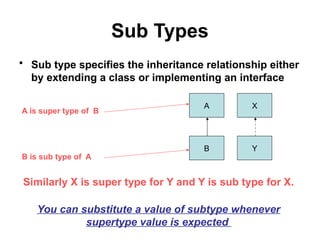
• Subtype specifies the inheritance relationship either
by extending a class or implementing an interface
A
B
X
Y
A is super type of B
B is sub type of A
Similarly X is super type for Y and Y is sub type for X.
You can substitute a value of subtype whenever
supertype value is expected
5.
Example
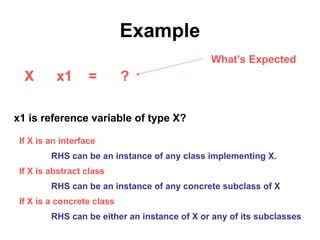
X x1 =?
What’s Expected
x1 is reference variable of type X?
If X is an interface
RHS can be an instance of any class implementing X.
If X is abstract class
RHS can be an instance of any concrete subclass of X
If X is a concrete class
RHS can be either an instance of X or any of its subclasses
6.
Rules for SubtypeRelationships
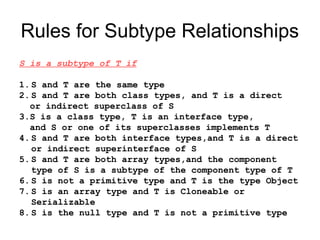
S is a subtype of T if
1.S and T are the same type
2.S and T are both class types, and T is a direct
or indirect superclass of S
3.S is a class type, T is an interface type,
and S or one of its superclasses implements T
4.S and T are both interface types,and T is a direct
or indirect superinterface of S
5.S and T are both array types,and the component
type of S is a subtype of the component type of T
6.S is not a primitive type and T is the type Object
7.S is an array type and T is Cloneable or
Serializable
8.S is the null type and T is not a primitive type
7.
Examples
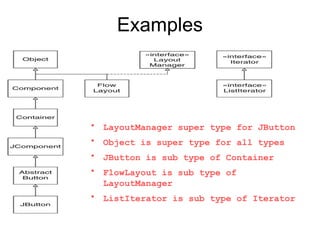
• LayoutManager supertype for JButton
• Object is super type for all types
• JButton is sub type of Container
• FlowLayout is sub type of
LayoutManager
• ListIterator is sub type of Iterator
8.
Examples continued …
1.Is Container is a subtype of Component ?.
2. Is JButton is a subtype of Component ?
3. Is FlowLayout is a subtype of LayoutManager?
4. Is ListIterator is a subtype of Iterator ?
5. Is Rectangle[ ] is a subtype of Shape[ ] ?
6. Is int[ ] is a subtype of Object ?
7. Is int is subtype of long ?
8. Is long is a subtype of int ?
9. Is int[ ] is a subtype of Object[ ] ?
10. Is int[] is a subtype of Object ?
Primitive Types are not implemented as
Objects
TRUE
TRUE
TRUE
TRUE
TRUE
TRUE
NO
NO
NO
YES
9.
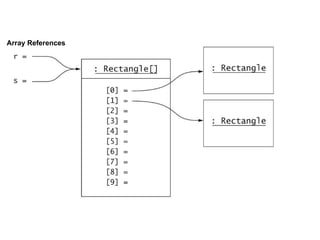
The ArrayStoreException
• Rectangle[]is a subtype of Shape[] ?. TRUE
• Can assign Rectangle[] value to Shape[] variable:
• Rectangle[] r = new Rectangle[10];
Shape[] s = r;
• Both r and s are references to the same array
• The assignment
s[0] = new Polygon(); compiles
But Throws an ArrayStoreException at runtime
• Each array remembers its component type
Type Inquiry
1. instanceofoperator tests whether the type of an object reference is a
subtype of given type or not.
2. Syntax :
if( e instanceof S) { ………. }
Object
reference
Type [may be a class or interface]
3. The above statement tests whether e is a instance of type S or not.
4. This statement returns true if e is a direct instance of S or e belongs to
one of the sub classes of S.
5. Instanceof operator can test whether the type of a value is subtype of a
given type or not. But it does not give the exact type to which e belongs.
6. If e is null then instanceof does not throw an Exception but simply returns
false.
12.
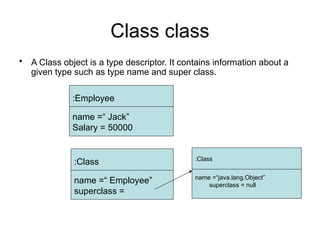
Class class
• AClass object is a type descriptor. It contains information about a
given type such as type name and super class.
:Employee
name =“ Jack”
Salary = 50000
:Class
name =“ Employee”
superclass =
:Class
name =“java.lang.Object”
superclass = null
13.
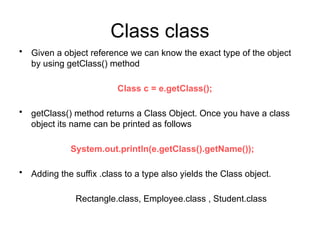
Class class
• Givena object reference we can know the exact type of the object
by using getClass() method
Class c = e.getClass();
• getClass() method returns a Class Object. Once you have a class
object its name can be printed as follows
System.out.println(e.getClass().getName());
• Adding the suffix .class to a type also yields the Class object.
Rectangle.class, Employee.class , Student.class
14.
Knowing Exact classof Reference
1. Adding a suffix .class to a class name always yields a Class Object.
2. To test wheher std is a reference belonging to class Student or not use
if (std.getClass() == Student.class)
3. To test whether emp is a refrence for Employee class object or not
if(emp.getClass() == Emplyoee.class)
4. What about Arrays ?
BOX[ ] box = new BOX[5];
Class c = box.getClass();
if( c.isArray())
S.O.P (“ Component Type :”+ c.getComponentType());
Object class
• Commonsuper class for all other java classes.
• A class which is defined without extends clause is a direct sub
class of Object class.
• Methods of Object class applies to all Java Objects.
• Important Methods:
1. String toString()
2. boolean equals(Object other)
3. int hashCode()
4. Object clone()
17.
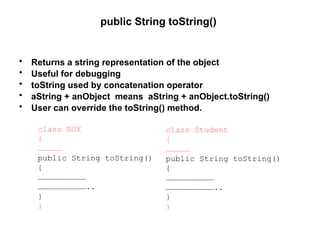
public String toString()
•Returns a string representation of the object
• Useful for debugging
• toString used by concatenation operator
• aString + anObject means aString + anObject.toString()
• User can override the toString() method.
class BOX
{
……………
public String toString()
{
…………………………
…………………………..
}
}
class Student
{
……………
public String toString()
{
…………………………
…………………………..
}
}
18.
toString() continued…
• toString()is automatically called when you
1. concatenate an object with a string
2. print an object with print or println method
3. when you pass an object reference e to assert statement
• Default implementation of toString() method returns the name
of the class and the hash code of the object.
19.
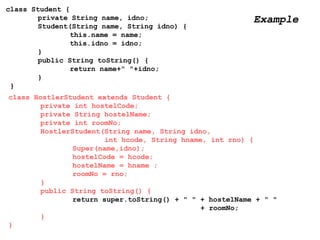
Example
class Student {
privateString name, idno;
Student(String name, String idno) {
this.name = name;
this.idno = idno;
}
public String toString() {
return name+" "+idno;
}
}
class HostlerStudent extends Student {
private int hostelCode;
private String hostelName;
private int roomNo;
HostlerStudent(String name, String idno,
int hcode, String hname, int rno) {
Super(name,idno);
hostelCode = hcode;
hostelName = hname ;
roomNo = rno;
}
public String toString() {
return super.toString() + " " + hostelName + " "
+ roomNo;
}
}
20.
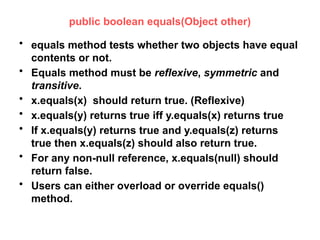
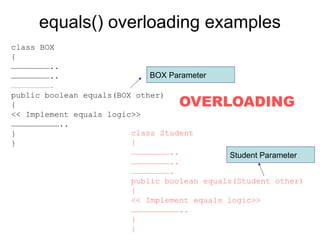
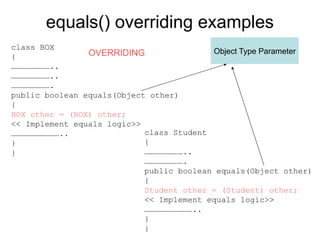
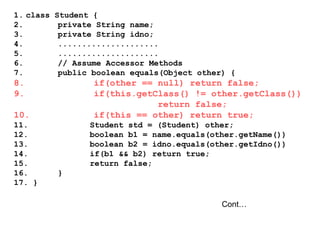
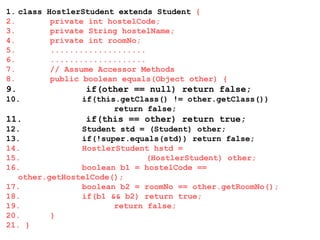
public boolean equals(Objectother)
• equals method tests whether two objects have equal
contents or not.
• Equals method must be reflexive, symmetric and
transitive.
• x.equals(x) should return true. (Reflexive)
• x.equals(y) returns true iff y.equals(x) returns true
• If x.equals(y) returns true and y.equals(z) returns
true then x.equals(z) should also return true.
• For any non-null reference, x.equals(null) should
return false.
• Users can either overload or override equals()
method.
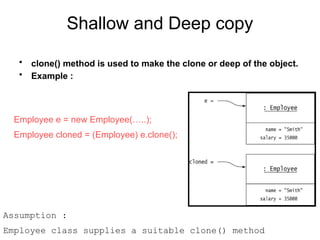
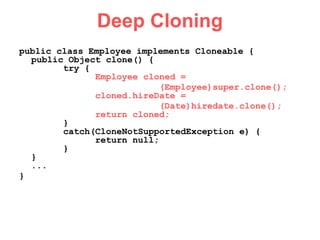
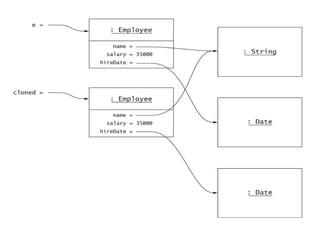
Shallow and Deepcopy
• clone() method is used to make the clone or deep of the object.
• Example :
Employee e = new Employee(…..);
Employee cloned = (Employee) e.clone();
Assumption :
Employee class supplies a suitable clone() method
26.
Cloning Conditions
• x.clone()!= x
• x.clone().equals(x) return true
• x.clone().getClass() == x.getClass()
“ clone should be a new object but it
should be equals to its original”
27.
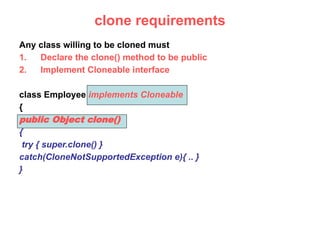
clone requirements
Any classwilling to be cloned must
1. Declare the clone() method to be public
2. Implement Cloneable interface
class Employee implements Cloneable
{
public Object clone()
{
try { super.clone() }
catch(CloneNotSupportedException e){ .. }
}
28.
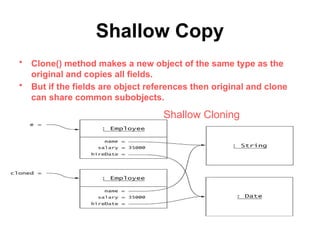
Shallow Copy
• Clone()method makes a new object of the same type as the
original and copies all fields.
• But if the fields are object references then original and clone
can share common subobjects.
Shallow Cloning
class A {}
classB extends A{}
class C extends B{}
class TestA {
public static void main(String args[]) {
Object o1 = new C();
C c1 = (C) o1;
B b1 = (B) o1;
A a1 = (A) o1;
}
}
What’s Wrong here? NOTHING
Object
A
B
C
<< Employee>>
<< Manager>>
32.
class A {}
classB extends A{}
class C extends B{}
class TestA {
public static void main(String args[]) {
C c1 = new C();
A a1 = (A) c1;
B b1 = (B) c1;
}
}
What’s Wrong here?
NOTHING
Object
A
B
C
<< Employee>>
<< Manager>>
33.
class A {}
classB extends A{}
class C extends B{}
class TestA {
public static void main(String args[]){
A a1 = new A();
C c1 = (C) a1;
}
}
What’s Wrong here?
Object
A
B
C
$ java TestA
Exception in thread "main"
java.lang.ClassCastException: A
at TestA.main(TestA.java:10)
34.
class BOX {
privatedouble l,b,h;
BOX(double l,double b,double h) {
this.l = l;
this.b = b;
this.h = h;
}
}
class CloneTest {
public static void main(String args[]) {
BOX b1 = new BOX(10,6,8);
BOX b2 = (BOX)b1.clone();
}
}
$ javac CloneTest.java
CloneTest.java:16: clone() has protected
access in java.lang.Object
BOX b2 = (BOX)b1.clone();
^
1 error
35.
class BOX {
privatedouble l,b,h;
BOX(double l,double b,double h){
this.l = l;
this.b = b;
this.h = h;
}
public Object clone() {
return super.clone();
}
}
class CloneTest {
public static void main(String args[]) {
BOX b1 = new BOX(10,6,8);
BOX b2 = (BOX)b1.clone();
}
}
$ javac CloneTest.java
CloneTest.java:12: unreported exception
java.lang.CloneNotSupportedException;
must be caught or declared to be thrown
return super.clone();
^
1 error
import java.util.*;
class DateTest{
public static void main(String args[]) {
Date d1 = new Date();
Date d2 = new Date();
System.out.println(d1);
System.out.println(d2);
System.out.println(d1.getTime());
d1.setTime(1000);
System.out.println(d1);
}
}
$ java DateTest
Mon Mar 28 13:11:45 IST 2022
Mon Mar 28 13:11:45 IST 2022
1648453305126
Thu Jan 01 05:30:01 IST 1970
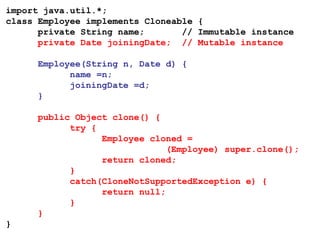
38.
import java.util.*;
class Employeeimplements Cloneable {
private String name; // Immutable instance
private Date joiningDate; // Mutable instance
Employee(String n, Date d) {
name =n;
joiningDate =d;
}
public Object clone() {
try {
Employee cloned =
(Employee) super.clone();
return cloned;
}
catch(CloneNotSupportedException e) {
return null;
}
}
}
39.
class CloneTest {
publicstatic void main(String args[]) {
Employee e1 = new Employee("Ram", new Date());
Employee e2 = (Employee) e1.clone();
}
}
name
Joining
Date
e1
Ram
new Date();
<<String>>
<<Date>>
name
Joining
Date
e2
SHALLOW COPY
40.
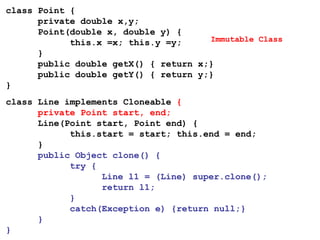
class Point {
privatedouble x,y;
Point(double x, double y) {
this.x =x; this.y =y;
}
public double getX() { return x;}
public double getY() { return y;}
}
class Line implements Cloneable {
private Point start, end;
Line(Point start, Point end) {
this.start = start; this.end = end;
}
public Object clone() {
try {
Line l1 = (Line) super.clone();
return l1;
}
catch(Exception e) {return null;}
}
}
Immutable Class
41.
Class CloneTest {
publicstatic void main(String args[]) {
Line l1 = new Line(new Point(5,6), new Point(4,5));
Line l2 = (Line) l1.clone();
}
}
start
end
l1
new Point(5,6),
new Point(4,5),
<<Point>>
<<Point>>
start
end
l2
NO PROBLEM IN SHARING
42.
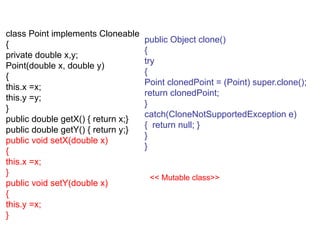
class Point implementsCloneable
{
private double x,y;
Point(double x, double y)
{
this.x =x;
this.y =y;
}
public double getX() { return x;}
public double getY() { return y;}
public void setX(double x)
{
this.x =x;
}
public void setY(double x)
{
this.y =x;
}
public Object clone()
{
try
{
Point clonedPoint = (Point) super.clone();
return clonedPoint;
}
catch(CloneNotSupportedException e)
{ return null; }
}
}
<< Mutable class>>
43.
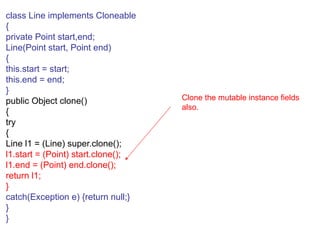
class Line implementsCloneable
{
private Point start,end;
Line(Point start, Point end)
{
this.start = start;
this.end = end;
}
public Object clone()
{
try
{
Line l1 = (Line) super.clone();
l1.start = (Point) start.clone();
l1.end = (Point) end.clone();
return l1;
}
catch(Exception e) {return null;}
}
}
Clone the mutable instance fields
also.
44.
class clonetest11
{
public staticvoid main(String args[])
{
Line l1 = new Line(new Point(5,6), new Point(4,5));
Line l2 = (Line) l1.clone();
}
}
start
end
new Point(5,6),
new Point(4,5),
<<Point>>
<<Point>>
start
end
l2
new Point(5,6),
new Point(4,5),
<<Point>>
<<Point>>
SUFFICIENT
DEEP COPY
l1
45.
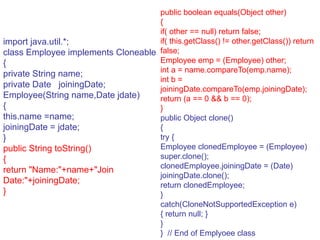
import java.util.*;
class Employeeimplements Cloneable
{
private String name;
private Date joiningDate;
Employee(String name,Date jdate)
{
this.name =name;
joiningDate = jdate;
}
public String toString()
{
return "Name:"+name+"Join
Date:"+joiningDate;
}
public boolean equals(Object other)
{
if( other == null) return false;
if( this.getClass() != other.getClass()) return
false;
Employee emp = (Employee) other;
int a = name.compareTo(emp.name);
int b =
joiningDate.compareTo(emp.joiningDate);
return (a == 0 && b == 0);
}
public Object clone()
{
try {
Employee clonedEmployee = (Employee)
super.clone();
clonedEmployee.joiningDate = (Date)
joiningDate.clone();
return clonedEmployee;
}
catch(CloneNotSupportedException e)
{ return null; }
}
} // End of Emplyoee class
![Java Type System
What is type in Java?
Set of Values with a set of Operations that can be
applied to the values.
Example :
int type - Set of values { [-2^31] to [+2^31-1])}
Operations : All Arithmetic Operations
BOX type - Set of all BOX object references
Operations : area() , volume() , toString()
Java is Strongly Typed Language.
Type checking is done both at Compile and Run Time.
• If a Type Check Fails at Compile Time - Compile Time
Error
• If a Type Check Fails at Run Time - RunTime Exception](https://image.slidesharecdn.com/javatypesystem-250905153004-b70fd738/85/Java-Type-System-for-object-oriented-programming-pptx-1-320.jpg)
![Java Type System
What is type in Java?
Set of Values with a set of Operations that can be
applied to the values.
Example :
int type - Set of values { [-2^31] to [+2^31-1])}
Operations : All Arithmetic Operations
BOX type - Set of all BOX object references
Operations : area() , volume() , toString()
Java is Strongly Typed Language.
Type checking is done both at Compile and Run Time.
• If a Type Check Fails at Compile Time - Compile Time
Error
• If a Type Check Fails at Run Time - RunTime Exception](https://image.slidesharecdn.com/javatypesystem-250905153004-b70fd738/75/Java-Type-System-for-object-oriented-programming-pptx-1-2048.jpg)
![Types in Java
1. Primitive Type( int, float, double, byte, char,
boolean, short, long)
2. A class Type [BOX, String, Arrays , Student etc]
3. An interface Type [ Either User Defined OR Libarary
interfaces such as Comparable]
4. An array type
5. null type
Note :
6. Arrays have a component type (Type of array elements) e.g
String[] array has component type as String int[] array
has Component type as int
2. void is not a type in java. [only a keyword to denote
that a method does not return anything]
3. Object[] names = new String[10]; What’s Array Type and
its component type.](https://image.slidesharecdn.com/javatypesystem-250905153004-b70fd738/85/Java-Type-System-for-object-oriented-programming-pptx-2-320.jpg)
![Values in Java
1. A Value of Primitive type
2. A reference to an object
3. reference to an array
4. Null
Examples :
10 , 10.35 , true
new BOX(10,6,8);
new int[] { 10,6,8}
null
Note : You can not have a value of type interface.
Reference to array
Reference to an object
Primitive Type Values](https://image.slidesharecdn.com/javatypesystem-250905153004-b70fd738/85/Java-Type-System-for-object-oriented-programming-pptx-3-320.jpg)
![Examples continued …
1. Is Container is a subtype of Component ?.
2. Is JButton is a subtype of Component ?
3. Is FlowLayout is a subtype of LayoutManager?
4. Is ListIterator is a subtype of Iterator ?
5. Is Rectangle[ ] is a subtype of Shape[ ] ?
6. Is int[ ] is a subtype of Object ?
7. Is int is subtype of long ?
8. Is long is a subtype of int ?
9. Is int[ ] is a subtype of Object[ ] ?
10. Is int[] is a subtype of Object ?
Primitive Types are not implemented as
Objects
TRUE
TRUE
TRUE
TRUE
TRUE
TRUE
NO
NO
NO
YES](https://image.slidesharecdn.com/javatypesystem-250905153004-b70fd738/85/Java-Type-System-for-object-oriented-programming-pptx-8-320.jpg)
![The ArrayStoreException
• Rectangle[] is a subtype of Shape[] ?. TRUE
• Can assign Rectangle[] value to Shape[] variable:
• Rectangle[] r = new Rectangle[10];
Shape[] s = r;
• Both r and s are references to the same array
• The assignment
s[0] = new Polygon(); compiles
But Throws an ArrayStoreException at runtime
• Each array remembers its component type](https://image.slidesharecdn.com/javatypesystem-250905153004-b70fd738/85/Java-Type-System-for-object-oriented-programming-pptx-9-320.jpg)
![Type Inquiry
1. instanceof operator tests whether the type of an object reference is a
subtype of given type or not.
2. Syntax :
if( e instanceof S) { ………. }
Object
reference
Type [may be a class or interface]
3. The above statement tests whether e is a instance of type S or not.
4. This statement returns true if e is a direct instance of S or e belongs to
one of the sub classes of S.
5. Instanceof operator can test whether the type of a value is subtype of a
given type or not. But it does not give the exact type to which e belongs.
6. If e is null then instanceof does not throw an Exception but simply returns
false.](https://image.slidesharecdn.com/javatypesystem-250905153004-b70fd738/85/Java-Type-System-for-object-oriented-programming-pptx-11-320.jpg)
![Knowing Exact class of Reference
1. Adding a suffix .class to a class name always yields a Class Object.
2. To test wheher std is a reference belonging to class Student or not use
if (std.getClass() == Student.class)
3. To test whether emp is a refrence for Employee class object or not
if(emp.getClass() == Emplyoee.class)
4. What about Arrays ?
BOX[ ] box = new BOX[5];
Class c = box.getClass();
if( c.isArray())
S.O.P (“ Component Type :”+ c.getComponentType());](https://image.slidesharecdn.com/javatypesystem-250905153004-b70fd738/85/Java-Type-System-for-object-oriented-programming-pptx-14-320.jpg)
![class TypeTest {
public static void main(String args[]){
String str = new String("Object");
System.out.println(str.getClass().getName());
// Checking whether str belongs to Object
if(str instanceof Object)
System.out.println("Hello");
else
System.out.println("Hi");
// Checking whether str belongs to String
if(str instanceof String)
System.out.println("Hello");
else
System.out.println("Hi");
if(str.getClass() == String.class)
System.out.println("Hello");
else
System.out.println("Hi");
}
} $ java TypeTest
java.lang.String
Hello
Hello
Hello](https://image.slidesharecdn.com/javatypesystem-250905153004-b70fd738/85/Java-Type-System-for-object-oriented-programming-pptx-15-320.jpg)
![class A {}
class B extends A{}
class C extends B{}
class TestA {
public static void main(String args[]) {
Object o1 = new C();
C c1 = (C) o1;
B b1 = (B) o1;
A a1 = (A) o1;
}
}
What’s Wrong here? NOTHING
Object
A
B
C
<< Employee>>
<< Manager>>](https://image.slidesharecdn.com/javatypesystem-250905153004-b70fd738/85/Java-Type-System-for-object-oriented-programming-pptx-31-320.jpg)
![class A {}
class B extends A{}
class C extends B{}
class TestA {
public static void main(String args[]) {
C c1 = new C();
A a1 = (A) c1;
B b1 = (B) c1;
}
}
What’s Wrong here?
NOTHING
Object
A
B
C
<< Employee>>
<< Manager>>](https://image.slidesharecdn.com/javatypesystem-250905153004-b70fd738/85/Java-Type-System-for-object-oriented-programming-pptx-32-320.jpg)
![class A {}
class B extends A{}
class C extends B{}
class TestA {
public static void main(String args[]){
A a1 = new A();
C c1 = (C) a1;
}
}
What’s Wrong here?
Object
A
B
C
$ java TestA
Exception in thread "main"
java.lang.ClassCastException: A
at TestA.main(TestA.java:10)](https://image.slidesharecdn.com/javatypesystem-250905153004-b70fd738/85/Java-Type-System-for-object-oriented-programming-pptx-33-320.jpg)
![class BOX {
private double l,b,h;
BOX(double l,double b,double h) {
this.l = l;
this.b = b;
this.h = h;
}
}
class CloneTest {
public static void main(String args[]) {
BOX b1 = new BOX(10,6,8);
BOX b2 = (BOX)b1.clone();
}
}
$ javac CloneTest.java
CloneTest.java:16: clone() has protected
access in java.lang.Object
BOX b2 = (BOX)b1.clone();
^
1 error](https://image.slidesharecdn.com/javatypesystem-250905153004-b70fd738/85/Java-Type-System-for-object-oriented-programming-pptx-34-320.jpg)
![class BOX {
private double l,b,h;
BOX(double l,double b,double h){
this.l = l;
this.b = b;
this.h = h;
}
public Object clone() {
return super.clone();
}
}
class CloneTest {
public static void main(String args[]) {
BOX b1 = new BOX(10,6,8);
BOX b2 = (BOX)b1.clone();
}
}
$ javac CloneTest.java
CloneTest.java:12: unreported exception
java.lang.CloneNotSupportedException;
must be caught or declared to be thrown
return super.clone();
^
1 error](https://image.slidesharecdn.com/javatypesystem-250905153004-b70fd738/85/Java-Type-System-for-object-oriented-programming-pptx-35-320.jpg)
![class BOX implements Cloneable {
private double l,b,h;
BOX(double l,double b,double h){
this.l = l; this.b = b; this.h = h;
}
public Object clone() {
try {
return super.clone();
}
catch(Exception e){
return null;
}
}
}
class CloneTest {
public static void main(String args[]) {
BOX b1 = new BOX(10,6,8);
BOX b2 = (BOX)b1.clone();
}
}](https://image.slidesharecdn.com/javatypesystem-250905153004-b70fd738/85/Java-Type-System-for-object-oriented-programming-pptx-36-320.jpg)
![import java.util.*;
class DateTest {
public static void main(String args[]) {
Date d1 = new Date();
Date d2 = new Date();
System.out.println(d1);
System.out.println(d2);
System.out.println(d1.getTime());
d1.setTime(1000);
System.out.println(d1);
}
}
$ java DateTest
Mon Mar 28 13:11:45 IST 2022
Mon Mar 28 13:11:45 IST 2022
1648453305126
Thu Jan 01 05:30:01 IST 1970](https://image.slidesharecdn.com/javatypesystem-250905153004-b70fd738/85/Java-Type-System-for-object-oriented-programming-pptx-37-320.jpg)
![class CloneTest {
public static void main(String args[]) {
Employee e1 = new Employee("Ram", new Date());
Employee e2 = (Employee) e1.clone();
}
}
name
Joining
Date
e1
Ram
new Date();
<<String>>
<<Date>>
name
Joining
Date
e2
SHALLOW COPY](https://image.slidesharecdn.com/javatypesystem-250905153004-b70fd738/85/Java-Type-System-for-object-oriented-programming-pptx-39-320.jpg)
![Class CloneTest {
public static void main(String args[]) {
Line l1 = new Line(new Point(5,6), new Point(4,5));
Line l2 = (Line) l1.clone();
}
}
start
end
l1
new Point(5,6),
new Point(4,5),
<<Point>>
<<Point>>
start
end
l2
NO PROBLEM IN SHARING](https://image.slidesharecdn.com/javatypesystem-250905153004-b70fd738/85/Java-Type-System-for-object-oriented-programming-pptx-41-320.jpg)
![class clonetest11
{
public static void main(String args[])
{
Line l1 = new Line(new Point(5,6), new Point(4,5));
Line l2 = (Line) l1.clone();
}
}
start
end
new Point(5,6),
new Point(4,5),
<<Point>>
<<Point>>
start
end
l2
new Point(5,6),
new Point(4,5),
<<Point>>
<<Point>>
SUFFICIENT
DEEP COPY
l1](https://image.slidesharecdn.com/javatypesystem-250905153004-b70fd738/85/Java-Type-System-for-object-oriented-programming-pptx-44-320.jpg)
![class clonetest12
{
public static void main(String args[])
{
Manager m1 = new Manager("Davis",new
Date(),"Personal",2000);
Manager m2 = (Manager) m1.clone();
Manager m3 = new Manager("Davis",new
Date(),"Personal",2000);
System.out.println(m1);
System.out.println(m1.equals(m2));
System.out.println(m1.equals(m3));
}
}](https://image.slidesharecdn.com/javatypesystem-250905153004-b70fd738/85/Java-Type-System-for-object-oriented-programming-pptx-47-320.jpg)


