CITS2200 Data Structuresand Algorithms
Topic 0
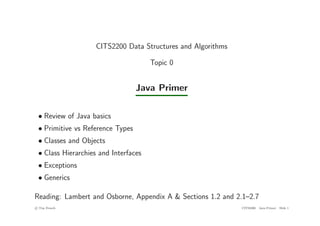
Java Primer
• Review of Java basics
• Primitive vs Reference Types
• Classes and Objects
• Class Hierarchies and Interfaces
• Exceptions
• Generics
Reading: Lambert and Osborne, Appendix A & Sections 1.2 and 2.1–2.7
c
! Tim French CITS2200 Java Primer Slide 1
2.
1. Review ofJava Basics
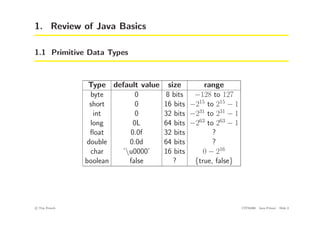
1.1 Primitive Data Types
Type default value size range
byte 0 8 bits −128 to 127
short 0 16 bits −215
to 215
− 1
int 0 32 bits −231
to 231
− 1
long 0L 64 bits −263
to 263
− 1
float 0.0f 32 bits ?
double 0.0d 64 bits ?
char ’u0000’ 16 bits 0 − 216
boolean false ? {true, false}
c
! Tim French CITS2200 Java Primer Slide 2
3.
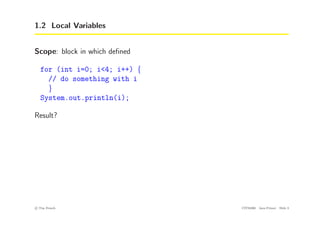
1.2 Local Variables
Scope:block in which defined
for (int i=0; i<4; i++) {
// do something with i
}
System.out.println(i);
Result?
c
! Tim French CITS2200 Java Primer Slide 3
4.
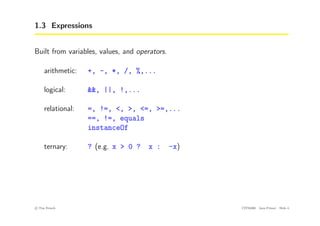
1.3 Expressions
Built fromvariables, values, and operators.
arithmetic: +, -, *, /, %,...
logical: &&, ||, !,...
relational: =, !=, <, >, <=, >=,...
==, !=, equals
instanceOf
ternary: ? (e.g. x > 0 ? x : -x)
c
! Tim French CITS2200 Java Primer Slide 4
5.
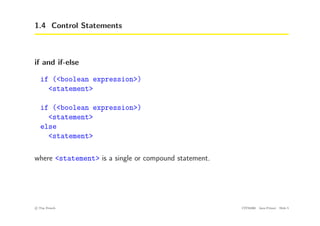
1.4 Control Statements
ifand if-else
if (<boolean expression>)
<statement>
if (<boolean expression>)
<statement>
else
<statement>
where <statement> is a single or compound statement.
c
! Tim French CITS2200 Java Primer Slide 5
6.
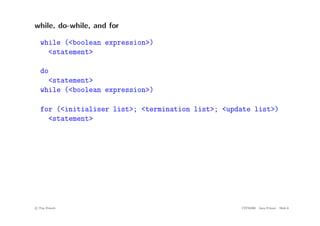
while, do-while, andfor
while (<boolean expression>)
<statement>
do
<statement>
while (<boolean expression>)
for (<initialiser list>; <termination list>; <update list>)
<statement>
c
! Tim French CITS2200 Java Primer Slide 6
7.
Example
for (int i=0;i<4; i++) System.out.println(i);
0
1
2
3
for (String s=""; !s.equals("aaaa"); s=s+"a")
System.out.println(s.length());
In Java 5 we also have an enhanced for loop:
int[] array = {0,2,4};
for (int i : array)
System.out.println("i is: " + i);
c
! Tim French CITS2200 Java Primer Slide 7
1.5 Methods
Methods havethe form (ignoring access modifiers for the moment)
<return type> <name> (<parameter list>) {
<local data declarations and statements>
}
Example
void set (int i, int j, int value) {
matrixArray[i][j]=value;
}
int get (int i, int j) {return matrixArray[i][j];}
c
! Tim French CITS2200 Java Primer Slide 9
10.
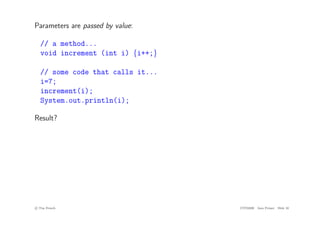
Parameters are passedby value:
// a method...
void increment (int i) {i++;}
// some code that calls it...
i=7;
increment(i);
System.out.println(i);
Result?
c
! Tim French CITS2200 Java Primer Slide 10
11.
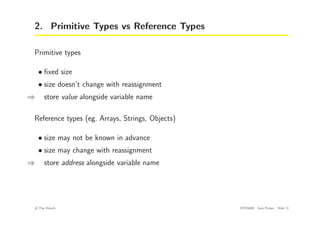
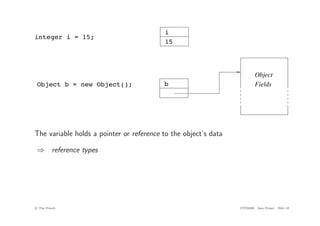
2. Primitive Typesvs Reference Types
Primitive types
• fixed size
• size doesn’t change with reassignment
⇒ store value alongside variable name
Reference types (eg. Arrays, Strings, Objects)
• size may not be known in advance
• size may change with reassignment
⇒ store address alongside variable name
c
! Tim French CITS2200 Java Primer Slide 11
12.
Object
Fields
b
i
15
Object b =new Object();
integer i = 15;
The variable holds a pointer or reference to the object’s data
⇒ reference types
c
! Tim French CITS2200 Java Primer Slide 12
13.
int[] a ={0,1,2,3};
int[] b = a;
b[0]++;
System.out.println(a[0]);
Result?
// a method...
void incrementAll (int[] a) {
for (int i=0; i<a.length; i++) a[i]++;
}
// some code that calls it...
int[] b = {0,1,2,3};
incrementAll(b);
System.out.println(b[0]);
Result?
c
! Tim French CITS2200 Java Primer Slide 13
14.
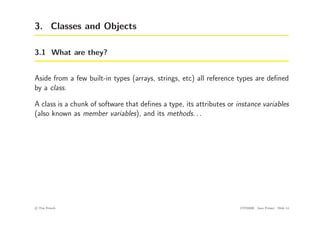
3. Classes andObjects
3.1 What are they?
Aside from a few built-in types (arrays, strings, etc) all reference types are defined
by a class.
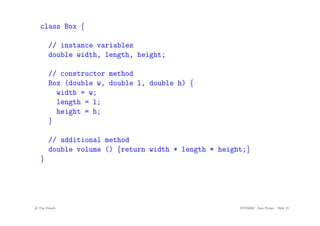
A class is a chunk of software that defines a type, its attributes or instance variables
(also known as member variables), and its methods. . .
c
! Tim French CITS2200 Java Primer Slide 14
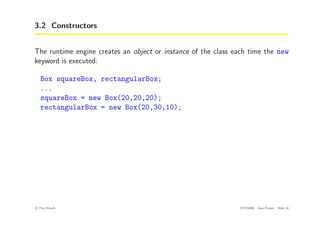
3.2 Constructors
The runtimeengine creates an object or instance of the class each time the new
keyword is executed:
Box squareBox, rectangularBox;
...
squareBox = new Box(20,20,20);
rectangularBox = new Box(20,30,10);
c
! Tim French CITS2200 Java Primer Slide 16
17.
3.3 Different Kindsof Methods
constructor — tells the runtime engine how to initialise the object
accessor — returns information about an object’s state without modifying the
object
mutator — changes the object’s state
c
! Tim French CITS2200 Java Primer Slide 17
18.
3.4 Packages
A collectionof related classes. E.g. java.io
In Java:
• must be in same directory
• directory name matches package name
Specifying your own package
package myMaths;
class Matrix {
...
If you don’t specify a package Java will make a default package from all classes in
the directory.
c
! Tim French CITS2200 Java Primer Slide 18
19.
Using someone else’spackage
package myMaths;
import java.io.*;
class Matrix {
...
Note that java.lang.* is automatically imported.
c
! Tim French CITS2200 Java Primer Slide 19
20.
3.5 Access Modifiers
Specifyaccess to classes, variables, and methods.
public — accessible by all
private — access restricted to within class
(none) — access restricted to within package
protected — access to package and subclasses
c
! Tim French CITS2200 Java Primer Slide 20
21.
3.6 The staticKeyword
Used for methods and variables in classes that don’t create objects, or for variables
shared by all instances of a class.
Example:
public class MatrixTest {
static Matrix m;
public static void main (String[] args) {
m = new Matrix(2,2);
m.set(0,0,1);
...
Called class variables and class methods.
c
! Tim French CITS2200 Java Primer Slide 21
22.
Also used for“constants”.
Example:
public class Matrix {
static final int MAX_SIZE=100;
private int[][] matrixArray;
...
Keyword final means the value cannot be changed at runtime.
c
! Tim French CITS2200 Java Primer Slide 22
23.
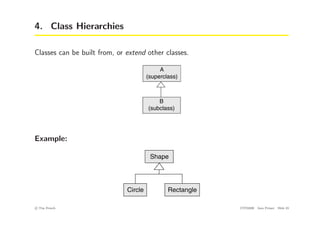
4. Class Hierarchies
Classescan be built from, or extend other classes.
Example:
c
! Tim French CITS2200 Java Primer Slide 23
24.
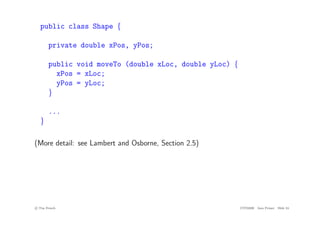
public class Shape{
private double xPos, yPos;
public void moveTo (double xLoc, double yLoc) {
xPos = xLoc;
yPos = yLoc;
}
...
}
(More detail: see Lambert and Osborne, Section 2.5)
c
! Tim French CITS2200 Java Primer Slide 24
25.
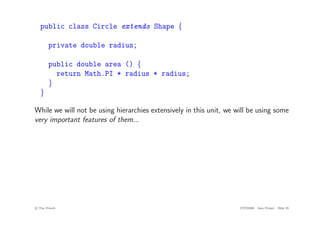
public class Circleextends Shape {
private double radius;
public double area () {
return Math.PI * radius * radius;
}
}
While we will not be using hierarchies extensively in this unit, we will be using some
very important features of them...
c
! Tim French CITS2200 Java Primer Slide 25
26.
1. Any superclassreference (variable) can hold and access a subclass object.
Example:
public class ShapeTest {
public static void main (String[] args) {
Shape sh; // declare reference of type Shape
sh = new Circle(); // hold a Circle object in sh
sh.moveTo(2.0,3.0); // access a Shape method
double a=sh.area(); // access a Circle method
...
c
! Tim French CITS2200 Java Primer Slide 26
27.
2. All Javaclasses are (automatically) subclasses of Object
Example:
Object holdsAnything;
holdsAnything = new Circle();
holdsAnything = new Rectangle();
holdsAnything = new Shape();
Example:
Object[] arrayOfAnythings = new Object[10];
arrayOfAnythings[0] = new Circle();
arrayOfAnythings[1] = new Rectangle();
arrayOfAnythings[2] = new Shape();
c
! Tim French CITS2200 Java Primer Slide 27
28.
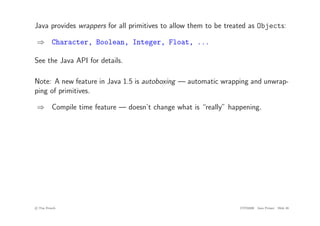
Java provides wrappersfor all primitives to allow them to be treated as Objects:
⇒ Character, Boolean, Integer, Float, ...
See the Java API for details.
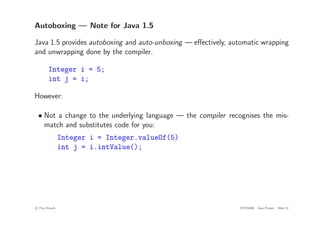
Note: A new feature in Java 1.5 is autoboxing — automatic wrapping and unwrap-
ping of primitives.
⇒ Compile time feature — doesn’t change what is “really” happening.
c
! Tim French CITS2200 Java Primer Slide 28
29.
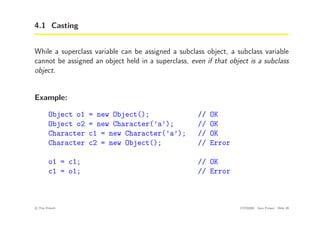
4.1 Casting
While asuperclass variable can be assigned a subclass object, a subclass variable
cannot be assigned an object held in a superclass, even if that object is a subclass
object.
Example:
Object o1 = new Object(); // OK
Object o2 = new Character(’a’); // OK
Character c1 = new Character(’a’); // OK
Character c2 = new Object(); // Error
o1 = c1; // OK
c1 = o1; // Error
c
! Tim French CITS2200 Java Primer Slide 29
30.
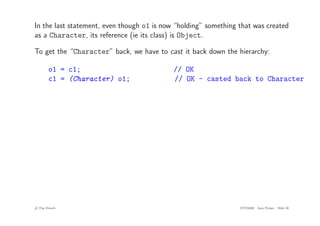
In the laststatement, even though o1 is now “holding” something that was created
as a Character, its reference (ie its class) is Object.
To get the “Character” back, we have to cast it back down the hierarchy:
o1 = c1; // OK
c1 = (Character) o1; // OK - casted back to Character
c
! Tim French CITS2200 Java Primer Slide 30
31.
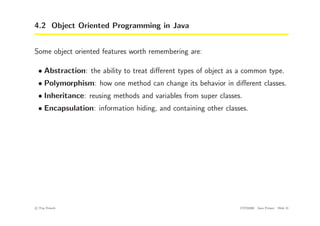
4.2 Object OrientedProgramming in Java
Some object oriented features worth remembering are:
• Abstraction: the ability to treat different types of object as a common type.
• Polymorphism: how one method can change its behavior in different classes.
• Inheritance: reusing methods and variables from super classes.
• Encapsulation: information hiding, and containing other classes.
c
! Tim French CITS2200 Java Primer Slide 31
32.
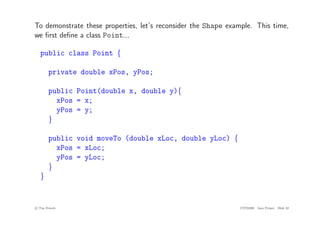
To demonstrate theseproperties, let’s reconsider the Shape example. This time,
we first define a class Point...
public class Point {
private double xPos, yPos;
public Point(double x, double y){
xPos = x;
yPos = y;
}
public void moveTo (double xLoc, double yLoc) {
xPos = xLoc;
yPos = yLoc;
}
}
c
! Tim French CITS2200 Java Primer Slide 32
33.
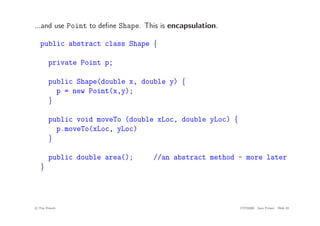
...and use Pointto define Shape. This is encapsulation.
public abstract class Shape {
private Point p;
public Shape(double x, double y) {
p = new Point(x,y);
}
public void moveTo (double xLoc, double yLoc) {
p.moveTo(xLoc, yLoc)
}
public double area(); //an abstract method - more later
}
c
! Tim French CITS2200 Java Primer Slide 33
34.
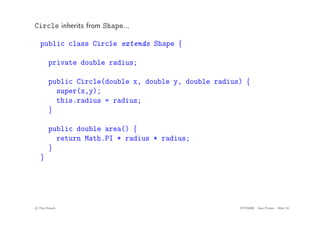
Circle inherits fromShape...
public class Circle extends Shape {
private double radius;
public Circle(double x, double y, double radius) {
super(x,y);
this.radius = radius;
}
public double area() {
return Math.PI * radius * radius;
}
}
c
! Tim French CITS2200 Java Primer Slide 34
35.
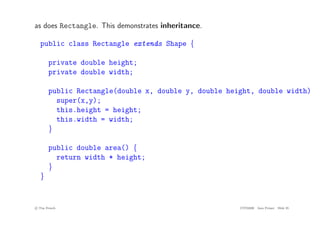
as does Rectangle.This demonstrates inheritance.
public class Rectangle extends Shape {
private double height;
private double width;
public Rectangle(double x, double y, double height, double width) {
super(x,y);
this.height = height;
this.width = width;
}
public double area() {
return width * height;
}
}
c
! Tim French CITS2200 Java Primer Slide 35
36.
We can nowtreat Rectangles and Circles as the more general type Shape:
Example:
public class ShapeTest {
public static void main (String[] args) {
Shape[] sA = new Shape[2];
sA[0] = new Circle(1,1,1);
sA[1] = new Rectangle(1,1,1,1); // This is abstraction
for(int i = 0; i < 2; i++)
sA[i].moveTo(0,0);
int totArea = 0;
for(int i = 0; i < 2; i++)
totArea += sA[i].area(); // This is polymorphism
}
}
c
! Tim French CITS2200 Java Primer Slide 36
37.
Note:
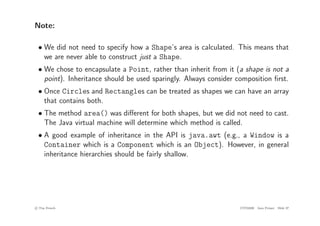
• We didnot need to specify how a Shape’s area is calculated. This means that
we are never able to construct just a Shape.
• We chose to encapsulate a Point, rather than inherit from it (a shape is not a
point). Inheritance should be used sparingly. Always consider composition first.
• Once Circles and Rectangles can be treated as shapes we can have an array
that contains both.
• The method area() was different for both shapes, but we did not need to cast.
The Java virtual machine will determine which method is called.
• A good example of inheritance in the API is java.awt (e.g., a Window is a
Container which is a Component which is an Object). However, in general
inheritance hierarchies should be fairly shallow.
c
! Tim French CITS2200 Java Primer Slide 37
38.
5. Interfaces andAbstract Classes
An interface:
• looks much like a class, but uses the keyword interface
• contains a list of method headers — name, list of parameters, return type (and
exceptions)
• no method contents (they are called abstract, but abstract classes may have
some methods specified)
• can only have constant variables declared
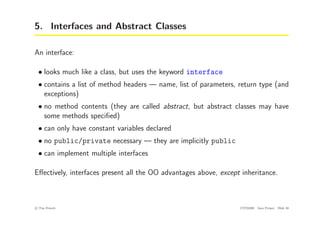
• no public/private necessary — they are implicitly public
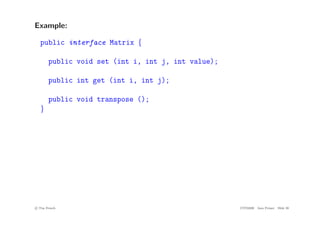
• can implement multiple interfaces
Effectively, interfaces present all the OO advantages above, except inheritance.
c
! Tim French CITS2200 Java Primer Slide 38
39.
Example:
public interface Matrix{
public void set (int i, int j, int value);
public int get (int i, int j);
public void transpose ();
}
c
! Tim French CITS2200 Java Primer Slide 39
40.
Classes can implementan interface:
Implementation 1:
public class MatrixReloaded implements Matrix {
private int[][] matrixArray;
public void transpose () {
// do it one way
}
...
Implementation 2:
public class MatrixRevolutions implements Matrix {
private int[][] somethingDifferent;
public void transpose () {
// do it yet another way
}
c
! Tim French CITS2200 Java Primer Slide 40
41.
Why use interfaces?
1.Can be used like a superclass:
Example:
Matrix[] myMatrixHolder = new Matrix[10];
myMatrixHolder[0] = new MatrixReloaded(2,2);
myMatrixHolder[1] = new MatrixRevolutions(20,20);
...
myMatrixHolder[0] = myMatrixHolder[1];
c
! Tim French CITS2200 Java Primer Slide 41
42.
2. Specifies themethods that any implementation must implement.
Example:
Matrix[] myMatrixHolder = new Matrix[10];
myMatrixHolder[0] = new MatrixReloaded(2,2);
myMatrixHolder[1] = new MatrixRevolutions(20,20);
...
for (int i=0; i<10; i++)
myMatrixHolder[i].transpose();
Note: this doesn’t mean the methods are implemented correctly.
c
! Tim French CITS2200 Java Primer Slide 42
43.
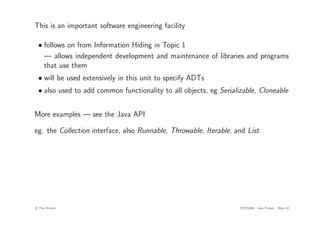
This is animportant software engineering facility
• follows on from Information Hiding in Topic 1
— allows independent development and maintenance of libraries and programs
that use them
• will be used extensively in this unit to specify ADTs
• also used to add common functionality to all objects, eg Serializable, Cloneable
More examples — see the Java API
eg. the Collection interface, also Runnable, Throwable, Iterable, and List.
c
! Tim French CITS2200 Java Primer Slide 43
44.
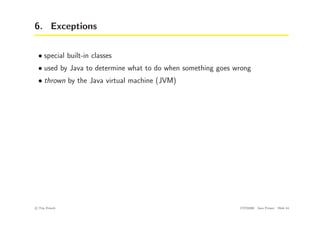
6. Exceptions
• specialbuilt-in classes
• used by Java to determine what to do when something goes wrong
• thrown by the Java virtual machine (JVM)
c
! Tim French CITS2200 Java Primer Slide 44
45.
Example program
int[] myArray= {0,1,2,3};
System.out.println("The last number is:");
System.out.println(myArray[4]);
Output
The last number is:
Exception in thread "main"
java.lang.ArrayIndexOutOfBoundsException: 4
at Test.main(Test.java:31)
Process Test exited abnormally with code 1
See the Java API for ArrayIndexOutOfBoundsException.
c
! Tim French CITS2200 Java Primer Slide 45
46.
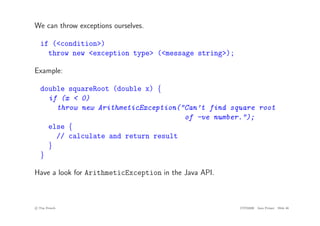
We can throwexceptions ourselves.
if (<condition>)
throw new <exception type> (<message string>);
Example:
double squareRoot (double x) {
if (x < 0)
throw new ArithmeticException("Can’t find square root
of -ve number.");
else {
// calculate and return result
}
}
Have a look for ArithmeticException in the Java API.
c
! Tim French CITS2200 Java Primer Slide 46
47.
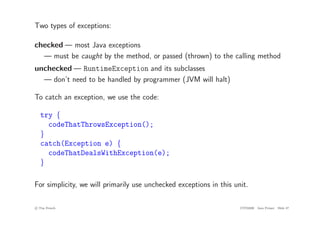
Two types ofexceptions:
checked — most Java exceptions
— must be caught by the method, or passed (thrown) to the calling method
unchecked — RuntimeException and its subclasses
— don’t need to be handled by programmer (JVM will halt)
To catch an exception, we use the code:
try {
codeThatThrowsException();
}
catch(Exception e) {
codeThatDealsWithException(e);
}
For simplicity, we will primarily use unchecked exceptions in this unit.
c
! Tim French CITS2200 Java Primer Slide 47
48.
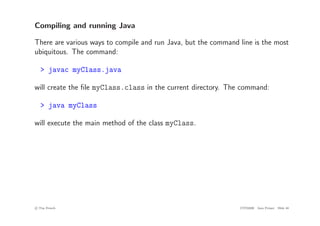
Compiling and runningJava
There are various ways to compile and run Java, but the command line is the most
ubiquitous. The command:
> javac myClass.java
will create the file myClass.class in the current directory. The command:
> java myClass
will execute the main method of the class myClass.
c
! Tim French CITS2200 Java Primer Slide 48
49.
Objects and GenericData Structures
/**
* Block representation of a queue (of objects).
*/
public class QueueBlock {
private Object[] items; // array of Objects
private int first;
private int last;
public Object dequeue() throws Underflow { // returns an Object
if (!isEmpty()) {
Object a = items[first];
first++;
return a;
}
else throw new Underflow("dequeuing from empty queue");
}
c
! Tim French CITS2200 Java Primer Slide 49
50.
6.1 Wrappers
The abovequeue is able to hold any type of object — that is, an instance of any
subclass of the class Object. (More accurately, it can hold any reference type.)
But there are some commonly used things that are not objects — the primitive
types.
In order to use the queue with primitive types, they must be “wrapped” in an object.
Recall from Topic 4 that Java provides wrapper classes for all primitive types.
c
! Tim French CITS2200 Java Primer Slide 50
51.
Autoboxing — Notefor Java 1.5
Java 1.5 provides autoboxing and auto-unboxing — effectively, automatic wrapping
and unwrapping done by the compiler.
Integer i = 5;
int j = i;
However:
• Not a change to the underlying language — the compiler recognises the mis-
match and substitutes code for you:
Integer i = Integer.valueOf(5)
int j = i.intValue();
c
! Tim French CITS2200 Java Primer Slide 51
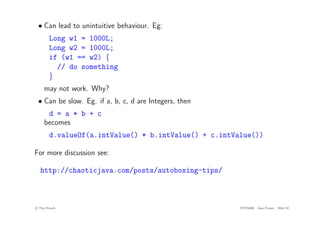
52.
• Can leadto unintuitive behaviour. Eg:
Long w1 = 1000L;
Long w2 = 1000L;
if (w1 == w2) {
// do something
}
may not work. Why?
• Can be slow. Eg. if a, b, c, d are Integers, then
d = a * b + c
becomes
d.valueOf(a.intValue() * b.intValue() + c.intValue())
For more discussion see:
http://chaoticjava.com/posts/autoboxing-tips/
c
! Tim French CITS2200 Java Primer Slide 52
53.
6.2 Casting
Recall thatin Java we can assign “up” the hierarchy — a variable of some class
(which we call its reference) can be assigned an object whose reference is a subclass.
However the converse is not true — a subclass variable cannot be assigned an object
whose reference is a superclass, even if that object is a subclass object.
In order to assign back down the hierarchy, we must use casting.
This issue occurs more subtly when using ADTs. Recall our implementation of a
queue. . .
c
! Tim French CITS2200 Java Primer Slide 53
54.
public class QueueBlock{
private Object[] items; // array of Objects
...
public Object dequeue() throws Underflow { // returns an Object
if (!isEmpty()) {
Object a = items[first];
first++;
return a;
}
else...
Consider the calling program:
QueueBlock q = new QueueBlock();
String s = "OK, I’m going in!";
q.enqueue(s); // put it in the queue
s = q.dequeue(); // get it back off ???
The last statement fails. Why?
c
! Tim French CITS2200 Java Primer Slide 54
55.
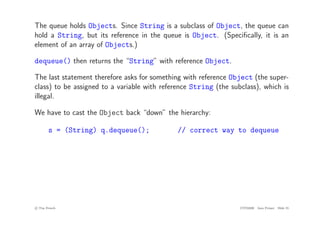
The queue holdsObjects. Since String is a subclass of Object, the queue can
hold a String, but its reference in the queue is Object. (Specifically, it is an
element of an array of Objects.)
dequeue() then returns the “String” with reference Object.
The last statement therefore asks for something with reference Object (the super-
class) to be assigned to a variable with reference String (the subclass), which is
illegal.
We have to cast the Object back “down” the hierarchy:
s = (String) q.dequeue(); // correct way to dequeue
c
! Tim French CITS2200 Java Primer Slide 55
56.
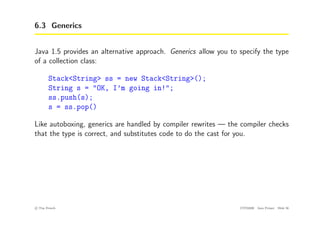
6.3 Generics
Java 1.5provides an alternative approach. Generics allow you to specify the type
of a collection class:
Stack<String> ss = new Stack<String>();
String s = "OK, I’m going in!";
ss.push(s);
s = ss.pop()
Like autoboxing, generics are handled by compiler rewrites — the compiler checks
that the type is correct, and substitutes code to do the cast for you.
c
! Tim French CITS2200 Java Primer Slide 56
57.
Writing Generic Classes
/**
*A simple generic block stack for
* holding object of type E
**/
class Stack<E> {
private Object[] block;
private int size;
public Stack(int size) {block = new Object[size];}
public E pop() {return (E) block[--size];}
public void push(E el) {block[size++] = el;}
}
c
! Tim French CITS2200 Java Primer Slide 57
58.
Using Generic Classes
publicstatic void main(String[] args){
//create a Stack of Strings
Stack<String> s = new Stack<String>(10);
s.push("abc");
System.out.println(s.pop());
//create a stack of Integers
Stack<Integer> t = new Stack<Integer>(1);
t.push(7);
System.out.println(t.pop());
}
c
! Tim French CITS2200 Java Primer Slide 58
59.
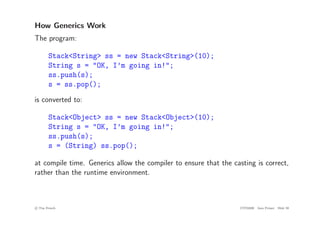
How Generics Work
Theprogram:
Stack<String> ss = new Stack<String>(10);
String s = "OK, I’m going in!";
ss.push(s);
s = ss.pop();
is converted to:
Stack<Object> ss = new Stack<Object>(10);
String s = "OK, I’m going in!";
ss.push(s);
s = (String) ss.pop();
at compile time. Generics allow the compiler to ensure that the casting is correct,
rather than the runtime environment.
c
! Tim French CITS2200 Java Primer Slide 59
60.
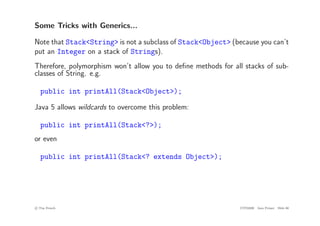
Some Tricks withGenerics...
Note that Stack<String> is not a subclass of Stack<Object> (because you can’t
put an Integer on a stack of Strings).
Therefore, polymorphism won’t allow you to define methods for all stacks of sub-
classes of String. e.g.
public int printAll(Stack<Object>);
Java 5 allows wildcards to overcome this problem:
public int printAll(Stack<?>);
or even
public int printAll(Stack<? extends Object>);
c
! Tim French CITS2200 Java Primer Slide 60
61.
Generics in Javaare complex and are the subject of considerable debate. While you
may not need to write them often, it is important you understand them as the Java
Collection classes all use generics.
Some interesting articles:
http://www-128.ibm.com/developerworks/java/library/
j-jtp01255.html
http://weblogs.java.net/blog/arnold/archive/2005/06/
generics_consid_1.html
http://java.sun.com/j2se/1.5/pdf/generics-tutorial.pdf
c
! Tim French CITS2200 Java Primer Slide 61
![Example
for (int i=0; i<4; i++) System.out.println(i);
0
1
2
3
for (String s=""; !s.equals("aaaa"); s=s+"a")
System.out.println(s.length());
In Java 5 we also have an enhanced for loop:
int[] array = {0,2,4};
for (int i : array)
System.out.println("i is: " + i);
c
! Tim French CITS2200 Java Primer Slide 7](https://image.slidesharecdn.com/javaprimer-250602042150-d95e68b3/85/adfasdfasdfasdfasdfasdfsadfsadfasdfasfasdfasdfasdfa-7-320.jpg)
![Arrays
Declaration
<type>[] <name>;
<type>[]...[] <name>;
Instantiation
<name> = new <type>[<int-exp>];
<name> = new <type>[<int-exp>]...[<int-exp>];
Example
int[][] matrixArray;
matrixArray = new int[rows][columns];
int[] array = {0,2,4};
c
! Tim French CITS2200 Java Primer Slide 8](https://image.slidesharecdn.com/javaprimer-250602042150-d95e68b3/85/adfasdfasdfasdfasdfasdfsadfsadfasdfasfasdfasdfasdfa-8-320.jpg)
![1.5 Methods
Methods have the form (ignoring access modifiers for the moment)
<return type> <name> (<parameter list>) {
<local data declarations and statements>
}
Example
void set (int i, int j, int value) {
matrixArray[i][j]=value;
}
int get (int i, int j) {return matrixArray[i][j];}
c
! Tim French CITS2200 Java Primer Slide 9](https://image.slidesharecdn.com/javaprimer-250602042150-d95e68b3/85/adfasdfasdfasdfasdfasdfsadfsadfasdfasfasdfasdfasdfa-9-320.jpg)
![int[] a = {0,1,2,3};
int[] b = a;
b[0]++;
System.out.println(a[0]);
Result?
// a method...
void incrementAll (int[] a) {
for (int i=0; i<a.length; i++) a[i]++;
}
// some code that calls it...
int[] b = {0,1,2,3};
incrementAll(b);
System.out.println(b[0]);
Result?
c
! Tim French CITS2200 Java Primer Slide 13](https://image.slidesharecdn.com/javaprimer-250602042150-d95e68b3/85/adfasdfasdfasdfasdfasdfsadfsadfasdfasfasdfasdfasdfa-13-320.jpg)
![3.6 The static Keyword
Used for methods and variables in classes that don’t create objects, or for variables
shared by all instances of a class.
Example:
public class MatrixTest {
static Matrix m;
public static void main (String[] args) {
m = new Matrix(2,2);
m.set(0,0,1);
...
Called class variables and class methods.
c
! Tim French CITS2200 Java Primer Slide 21](https://image.slidesharecdn.com/javaprimer-250602042150-d95e68b3/85/adfasdfasdfasdfasdfasdfsadfsadfasdfasfasdfasdfasdfa-21-320.jpg)
![Also used for “constants”.
Example:
public class Matrix {
static final int MAX_SIZE=100;
private int[][] matrixArray;
...
Keyword final means the value cannot be changed at runtime.
c
! Tim French CITS2200 Java Primer Slide 22](https://image.slidesharecdn.com/javaprimer-250602042150-d95e68b3/85/adfasdfasdfasdfasdfasdfsadfsadfasdfasfasdfasdfasdfa-22-320.jpg)
![1. Any superclass reference (variable) can hold and access a subclass object.
Example:
public class ShapeTest {
public static void main (String[] args) {
Shape sh; // declare reference of type Shape
sh = new Circle(); // hold a Circle object in sh
sh.moveTo(2.0,3.0); // access a Shape method
double a=sh.area(); // access a Circle method
...
c
! Tim French CITS2200 Java Primer Slide 26](https://image.slidesharecdn.com/javaprimer-250602042150-d95e68b3/85/adfasdfasdfasdfasdfasdfsadfsadfasdfasfasdfasdfasdfa-26-320.jpg)
![2. All Java classes are (automatically) subclasses of Object
Example:
Object holdsAnything;
holdsAnything = new Circle();
holdsAnything = new Rectangle();
holdsAnything = new Shape();
Example:
Object[] arrayOfAnythings = new Object[10];
arrayOfAnythings[0] = new Circle();
arrayOfAnythings[1] = new Rectangle();
arrayOfAnythings[2] = new Shape();
c
! Tim French CITS2200 Java Primer Slide 27](https://image.slidesharecdn.com/javaprimer-250602042150-d95e68b3/85/adfasdfasdfasdfasdfasdfsadfsadfasdfasfasdfasdfasdfa-27-320.jpg)
![We can now treat Rectangles and Circles as the more general type Shape:
Example:
public class ShapeTest {
public static void main (String[] args) {
Shape[] sA = new Shape[2];
sA[0] = new Circle(1,1,1);
sA[1] = new Rectangle(1,1,1,1); // This is abstraction
for(int i = 0; i < 2; i++)
sA[i].moveTo(0,0);
int totArea = 0;
for(int i = 0; i < 2; i++)
totArea += sA[i].area(); // This is polymorphism
}
}
c
! Tim French CITS2200 Java Primer Slide 36](https://image.slidesharecdn.com/javaprimer-250602042150-d95e68b3/85/adfasdfasdfasdfasdfasdfsadfsadfasdfasfasdfasdfasdfa-36-320.jpg)
![Classes can implement an interface:
Implementation 1:
public class MatrixReloaded implements Matrix {
private int[][] matrixArray;
public void transpose () {
// do it one way
}
...
Implementation 2:
public class MatrixRevolutions implements Matrix {
private int[][] somethingDifferent;
public void transpose () {
// do it yet another way
}
c
! Tim French CITS2200 Java Primer Slide 40](https://image.slidesharecdn.com/javaprimer-250602042150-d95e68b3/85/adfasdfasdfasdfasdfasdfsadfsadfasdfasfasdfasdfasdfa-40-320.jpg)
![Why use interfaces?
1. Can be used like a superclass:
Example:
Matrix[] myMatrixHolder = new Matrix[10];
myMatrixHolder[0] = new MatrixReloaded(2,2);
myMatrixHolder[1] = new MatrixRevolutions(20,20);
...
myMatrixHolder[0] = myMatrixHolder[1];
c
! Tim French CITS2200 Java Primer Slide 41](https://image.slidesharecdn.com/javaprimer-250602042150-d95e68b3/85/adfasdfasdfasdfasdfasdfsadfsadfasdfasfasdfasdfasdfa-41-320.jpg)
![2. Specifies the methods that any implementation must implement.
Example:
Matrix[] myMatrixHolder = new Matrix[10];
myMatrixHolder[0] = new MatrixReloaded(2,2);
myMatrixHolder[1] = new MatrixRevolutions(20,20);
...
for (int i=0; i<10; i++)
myMatrixHolder[i].transpose();
Note: this doesn’t mean the methods are implemented correctly.
c
! Tim French CITS2200 Java Primer Slide 42](https://image.slidesharecdn.com/javaprimer-250602042150-d95e68b3/85/adfasdfasdfasdfasdfasdfsadfsadfasdfasfasdfasdfasdfa-42-320.jpg)
![Example program
int[] myArray = {0,1,2,3};
System.out.println("The last number is:");
System.out.println(myArray[4]);
Output
The last number is:
Exception in thread "main"
java.lang.ArrayIndexOutOfBoundsException: 4
at Test.main(Test.java:31)
Process Test exited abnormally with code 1
See the Java API for ArrayIndexOutOfBoundsException.
c
! Tim French CITS2200 Java Primer Slide 45](https://image.slidesharecdn.com/javaprimer-250602042150-d95e68b3/85/adfasdfasdfasdfasdfasdfsadfsadfasdfasfasdfasdfasdfa-45-320.jpg)
![Objects and Generic Data Structures
/**
* Block representation of a queue (of objects).
*/
public class QueueBlock {
private Object[] items; // array of Objects
private int first;
private int last;
public Object dequeue() throws Underflow { // returns an Object
if (!isEmpty()) {
Object a = items[first];
first++;
return a;
}
else throw new Underflow("dequeuing from empty queue");
}
c
! Tim French CITS2200 Java Primer Slide 49](https://image.slidesharecdn.com/javaprimer-250602042150-d95e68b3/85/adfasdfasdfasdfasdfasdfsadfsadfasdfasfasdfasdfasdfa-49-320.jpg)
![public class QueueBlock {
private Object[] items; // array of Objects
...
public Object dequeue() throws Underflow { // returns an Object
if (!isEmpty()) {
Object a = items[first];
first++;
return a;
}
else...
Consider the calling program:
QueueBlock q = new QueueBlock();
String s = "OK, I’m going in!";
q.enqueue(s); // put it in the queue
s = q.dequeue(); // get it back off ???
The last statement fails. Why?
c
! Tim French CITS2200 Java Primer Slide 54](https://image.slidesharecdn.com/javaprimer-250602042150-d95e68b3/85/adfasdfasdfasdfasdfasdfsadfsadfasdfasfasdfasdfasdfa-54-320.jpg)
![Writing Generic Classes
/**
* A simple generic block stack for
* holding object of type E
**/
class Stack<E> {
private Object[] block;
private int size;
public Stack(int size) {block = new Object[size];}
public E pop() {return (E) block[--size];}
public void push(E el) {block[size++] = el;}
}
c
! Tim French CITS2200 Java Primer Slide 57](https://image.slidesharecdn.com/javaprimer-250602042150-d95e68b3/85/adfasdfasdfasdfasdfasdfsadfsadfasdfasfasdfasdfasdfa-57-320.jpg)
![Using Generic Classes
public static void main(String[] args){
//create a Stack of Strings
Stack<String> s = new Stack<String>(10);
s.push("abc");
System.out.println(s.pop());
//create a stack of Integers
Stack<Integer> t = new Stack<Integer>(1);
t.push(7);
System.out.println(t.pop());
}
c
! Tim French CITS2200 Java Primer Slide 58](https://image.slidesharecdn.com/javaprimer-250602042150-d95e68b3/85/adfasdfasdfasdfasdfasdfsadfsadfasdfasfasdfasdfasdfa-58-320.jpg)


![[DSC Europe 25] Borko Kozomora - Optimizing business workflows with advances ...](https://cdn.slidesharecdn.com/ss_thumbnails/hbgekyb0txw0xpo4yfml-borko-kozomora-leading-ai-transformation-260122103838-cc29ee38-thumbnail.jpg?width=640&height=640&fit=bounds)


