Java Training in Chandigarh
Java:-
Java is an object-oriented, class-based, concurrent, secured and general-
purpose computer-programming language. It is a widely used robust
technology.Java is a programming language and a platform. Java is a high
level, robust, object-oriented and secure programming language.
Platform: Any hardware or software environment in which a program
runs, is known as a platform. Since Java has a runtime environment
(JRE) and API, it is called a platform.
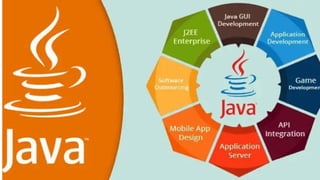
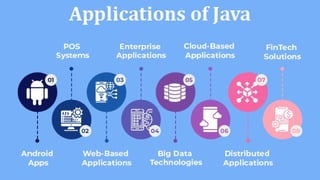
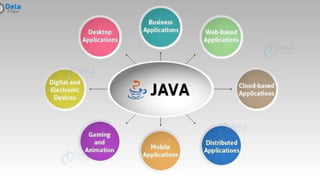
Desktop Applications such as acrobat reader, media player,
antivirus, etc.
Web Applications such as irctc.co.in, javatpoint.com, etc.
Enterprise Applications such as banking applications.
Mobile
Embedded System
Smart Card
Robotics
Games, etc.
Applications of Java
According to Sun, 3 billion devices run Java. There are many
devices where Java is currently used. Some of them are as follows:
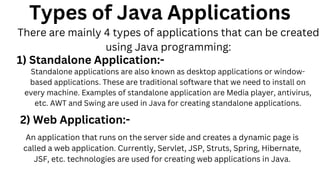
Types of Java Applications
There are mainly 4 types of applications that can be created
using Java programming:
1) Standalone Application:-
Standalone applications are also known as desktop applications or window-
based applications. These are traditional software that we need to install on
every machine. Examples of standalone application are Media player, antivirus,
etc. AWT and Swing are used in Java for creating standalone applications.
2) Web Application:-
An application that runs on the server side and creates a dynamic page is
called a web application. Currently, Servlet, JSP, Struts, Spring, Hibernate,
JSF, etc. technologies are used for creating web applications in Java.
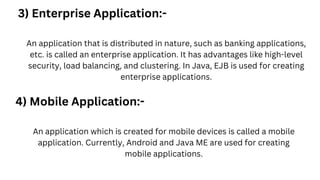
3) Enterprise Application:-
An application that is distributed in nature, such as banking applications,
etc. is called an enterprise application. It has advantages like high-level
security, load balancing, and clustering. In Java, EJB is used for creating
enterprise applications.
4) Mobile Application:-
An application which is created for mobile devices is called a mobile
application. Currently, Android and Java ME are used for creating
mobile applications.
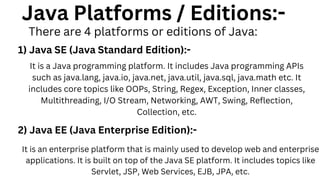
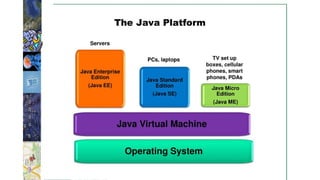
Java Platforms / Editions:-
There are 4 platforms or editions of Java:
1) Java SE (Java Standard Edition):-
It is a Java programming platform. It includes Java programming APIs
such as java.lang, java.io, java.net, java.util, java.sql, java.math etc. It
includes core topics like OOPs, String, Regex, Exception, Inner classes,
Multithreading, I/O Stream, Networking, AWT, Swing, Reflection,
Collection, etc.
2) Java EE (Java Enterprise Edition):-
It is an enterprise platform that is mainly used to develop web and enterprise
applications. It is built on top of the Java SE platform. It includes topics like
Servlet, JSP, Web Services, EJB, JPA, etc.
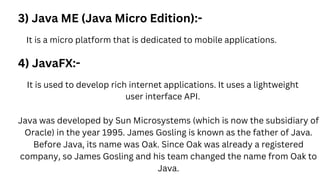
3) Java ME (Java Micro Edition):-
It is a micro platform that is dedicated to mobile applications.
4) JavaFX:-
It is used to develop rich internet applications. It uses a lightweight
user interface API.
Java was developed by Sun Microsystems (which is now the subsidiary of
Oracle) in the year 1995. James Gosling is known as the father of Java.
Before Java, its name was Oak. Since Oak was already a registered
company, so James Gosling and his team changed the name from Oak to
Java.
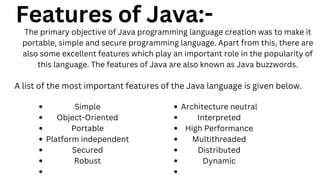
Features of Java:-
The primary objective of Java programming language creation was to make it
portable, simple and secure programming language. Apart from this, there are
also some excellent features which play an important role in the popularity of
this language. The features of Java are also known as Java buzzwords.
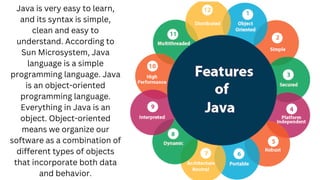
A list of the most important features of the Java language is given below.
Simple
Object-Oriented
Portable
Platform independent
Secured
Robust
Architecture neutral
Interpreted
High Performance
Multithreaded
Distributed
Dynamic
Java is very easy to learn,
and its syntax is simple,
clean and easy to
understand. According to
Sun Microsystem, Java
language is a simple
programming language. Java
is an object-oriented
programming language.
Everything in Java is an
object. Object-oriented
means we organize our
software as a combination of
different types of objects
that incorporate both data
and behavior.

Java Training in Chandigarh.pdf

  • 1.
    Java Training inChandigarh Java:- Java is an object-oriented, class-based, concurrent, secured and general- purpose computer-programming language. It is a widely used robust technology.Java is a programming language and a platform. Java is a high level, robust, object-oriented and secure programming language. Platform: Any hardware or software environment in which a program runs, is known as a platform. Since Java has a runtime environment (JRE) and API, it is called a platform.
  • 3.
    Desktop Applications suchas acrobat reader, media player, antivirus, etc. Web Applications such as irctc.co.in, javatpoint.com, etc. Enterprise Applications such as banking applications. Mobile Embedded System Smart Card Robotics Games, etc. Applications of Java According to Sun, 3 billion devices run Java. There are many devices where Java is currently used. Some of them are as follows:
  • 5.
    Types of JavaApplications There are mainly 4 types of applications that can be created using Java programming: 1) Standalone Application:- Standalone applications are also known as desktop applications or window- based applications. These are traditional software that we need to install on every machine. Examples of standalone application are Media player, antivirus, etc. AWT and Swing are used in Java for creating standalone applications. 2) Web Application:- An application that runs on the server side and creates a dynamic page is called a web application. Currently, Servlet, JSP, Struts, Spring, Hibernate, JSF, etc. technologies are used for creating web applications in Java.
  • 6.
    3) Enterprise Application:- Anapplication that is distributed in nature, such as banking applications, etc. is called an enterprise application. It has advantages like high-level security, load balancing, and clustering. In Java, EJB is used for creating enterprise applications. 4) Mobile Application:- An application which is created for mobile devices is called a mobile application. Currently, Android and Java ME are used for creating mobile applications.
  • 8.
    Java Platforms /Editions:- There are 4 platforms or editions of Java: 1) Java SE (Java Standard Edition):- It is a Java programming platform. It includes Java programming APIs such as java.lang, java.io, java.net, java.util, java.sql, java.math etc. It includes core topics like OOPs, String, Regex, Exception, Inner classes, Multithreading, I/O Stream, Networking, AWT, Swing, Reflection, Collection, etc. 2) Java EE (Java Enterprise Edition):- It is an enterprise platform that is mainly used to develop web and enterprise applications. It is built on top of the Java SE platform. It includes topics like Servlet, JSP, Web Services, EJB, JPA, etc.
  • 9.
    3) Java ME(Java Micro Edition):- It is a micro platform that is dedicated to mobile applications. 4) JavaFX:- It is used to develop rich internet applications. It uses a lightweight user interface API. Java was developed by Sun Microsystems (which is now the subsidiary of Oracle) in the year 1995. James Gosling is known as the father of Java. Before Java, its name was Oak. Since Oak was already a registered company, so James Gosling and his team changed the name from Oak to Java.
  • 11.
    Features of Java:- Theprimary objective of Java programming language creation was to make it portable, simple and secure programming language. Apart from this, there are also some excellent features which play an important role in the popularity of this language. The features of Java are also known as Java buzzwords. A list of the most important features of the Java language is given below. Simple Object-Oriented Portable Platform independent Secured Robust Architecture neutral Interpreted High Performance Multithreaded Distributed Dynamic
  • 12.
    Java is veryeasy to learn, and its syntax is simple, clean and easy to understand. According to Sun Microsystem, Java language is a simple programming language. Java is an object-oriented programming language. Everything in Java is an object. Object-oriented means we organize our software as a combination of different types of objects that incorporate both data and behavior.