Java SE 8 Library Design
Using the new features well
Stephen Colebourne
Engineering Lead, OpenGamma
October 2016
Stephen Colebourne
● Java Champion, regular conference speaker
● Best known for date & time - Joda-Time and JSR-310
● More Joda projects - http://www.joda.org
● Major contributions in Apache Commons
● Blog - http://blog.joda.org
● Worked at OpenGamma for 6 years
Strata, from OpenGamma
● Open Source market risk library
● Valuation and risk calcs for finance
○ interest rate swap, FRA, CDS
● Great example of Java SE 8 coding style
http://strata.opengamma.io/
Introduction
⇒
Introduction
● Java SE 8 is a major update to Java
● Major new features
○ Lambdas
○ Streams
○ Methods on interfaces
○ Date and Time
Introduction
● Essential to rethink how you code
● Reconsider coding conventions
● Appreciate new design options
Agenda
● Lambdas
● Streams
● Design with Lambdas
● Abstraction
● Immutability
● Interfaces
● Optional
● Odds and Ends
Lambdas
λ
Lambdas
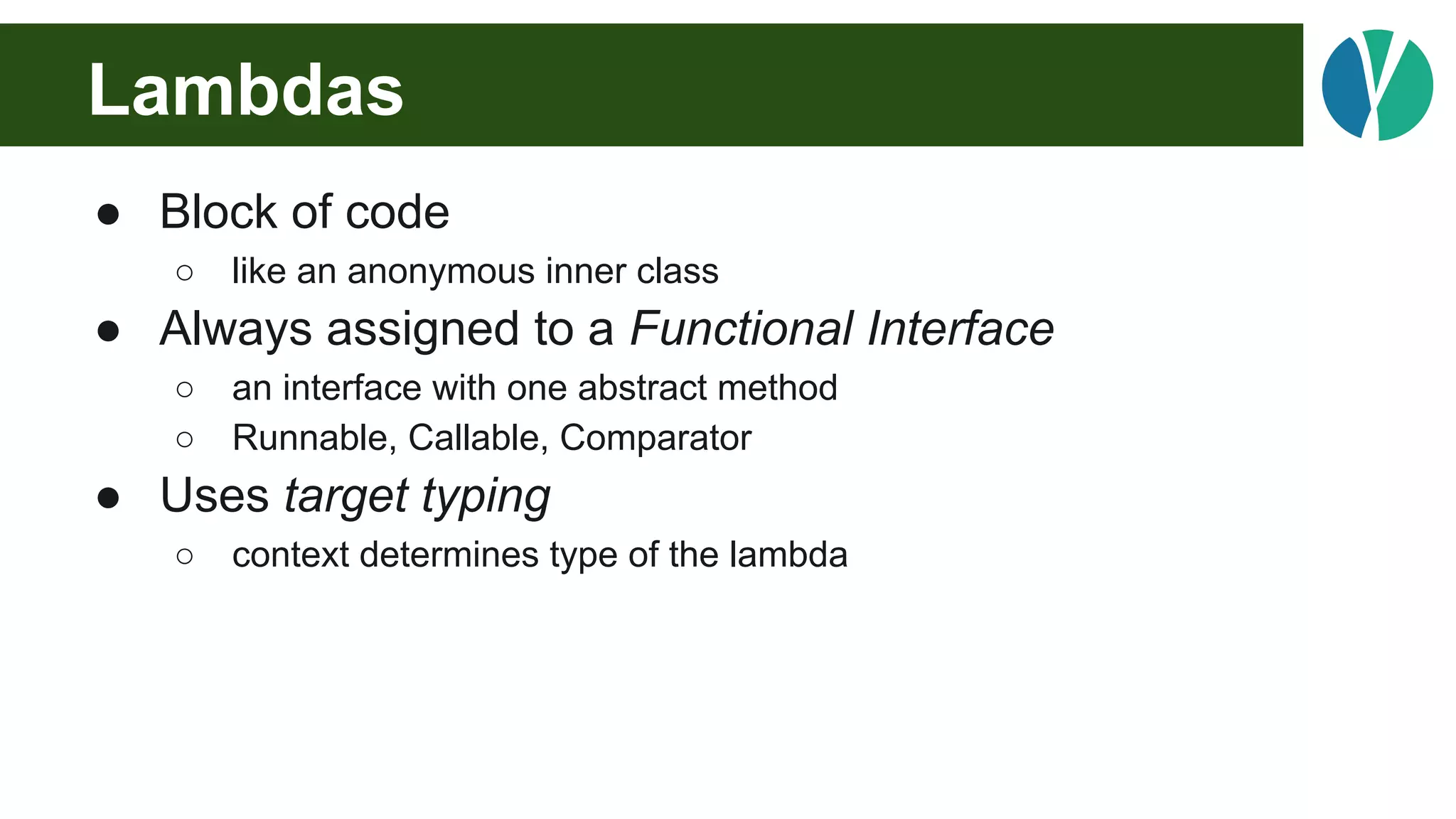
● Block of code
○ like an anonymous inner class
● Always assigned to a Functional Interface
○ an interface with one abstract method
○ Runnable, Callable, Comparator
● Uses target typing
○ context determines type of the lambda
// Java 7
List<Person> people = loadPeople();
Collections.sort(people, new Comparator<Person>() {
@Override
public int compare(Person p1, Person p2) {
return p1.name.compareTo(p2.name);
}
});
Lambdas
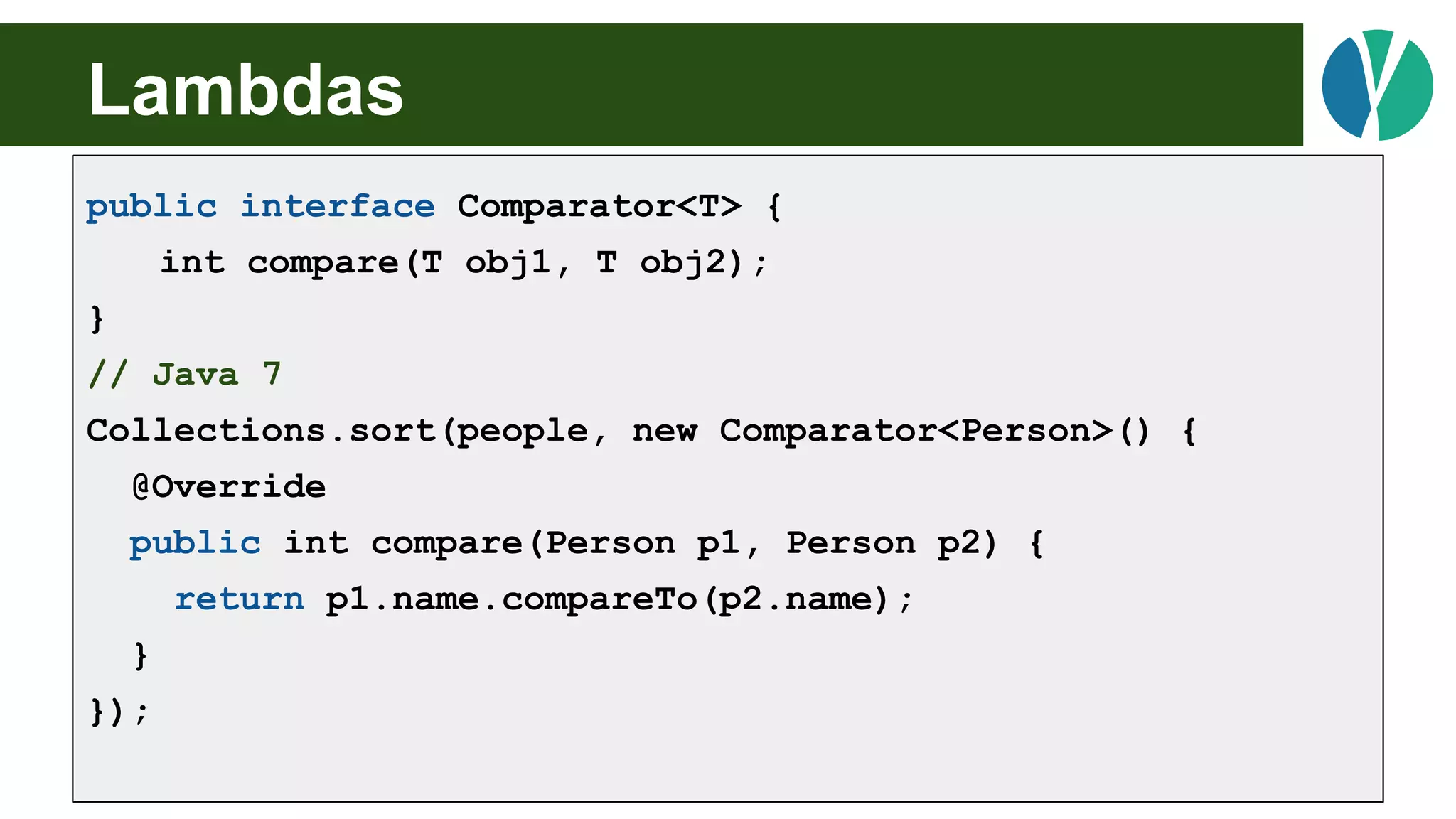
public interface Comparator<T> {
int compare(T obj1, T obj2);
}
// Java 7
Collections.sort(people, new Comparator<Person>() {
@Override
public int compare(Person p1, Person p2) {
return p1.name.compareTo(p2.name);
}
});
// Java 7
List<Person> people = loadPeople();
Collections.sort(people, new Comparator<Person>() {
@Override
public int compare(Person p1, Person p2) {
return p1.name.compareTo(p2.name);
}
});
Lambdas
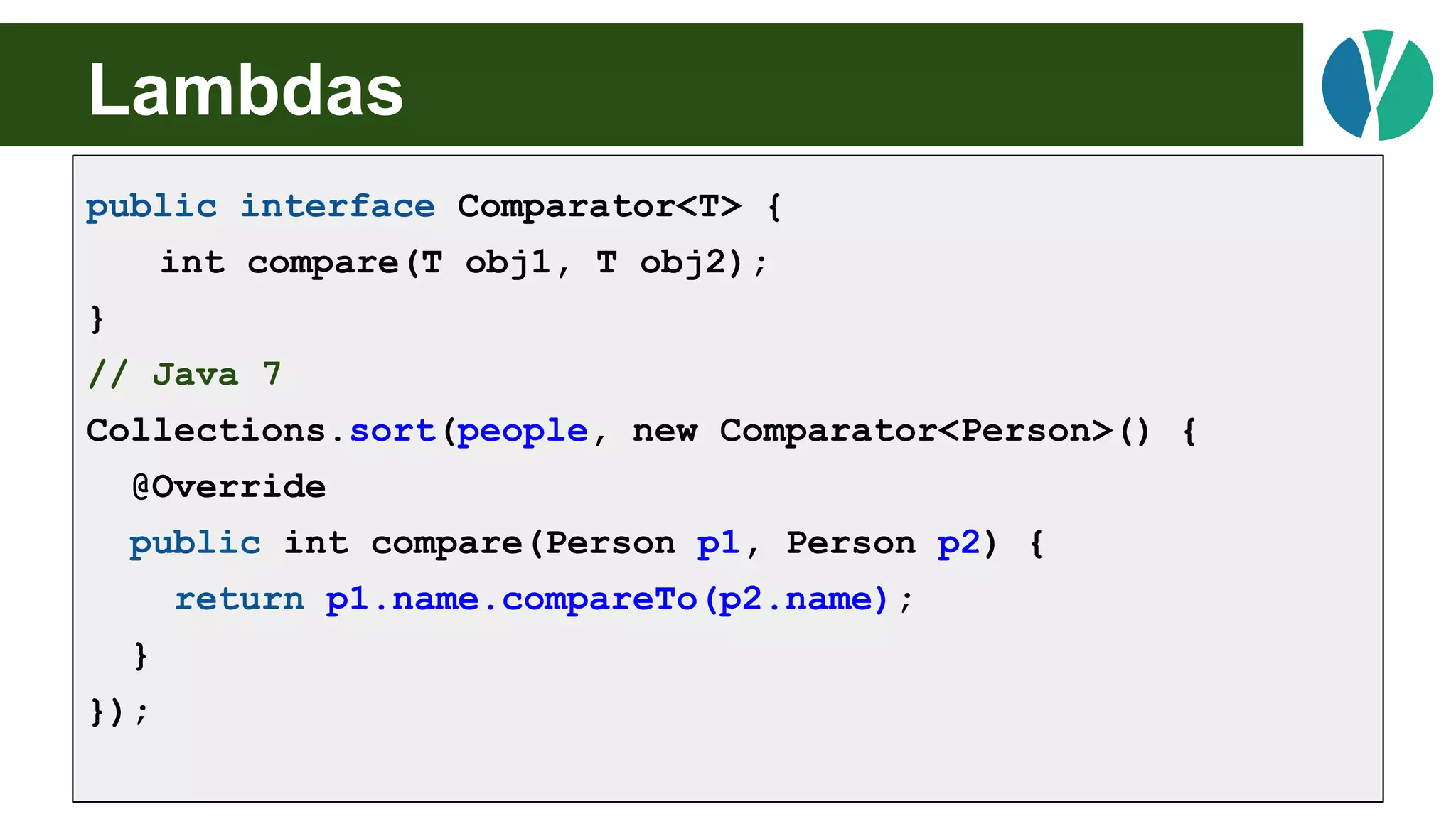
public interface Comparator<T> {
int compare(T obj1, T obj2);
}
// Java 7
Collections.sort(people, new Comparator<Person>() {
@Override
public int compare(Person p1, Person p2) {
return p1.name.compareTo(p2.name);
}
});
// Java 7
List<Person> people = loadPeople();
Collections.sort(people, new Comparator<Person>() {
@Override
public int compare(Person p1, Person p2) {
return p1.name.compareTo(p2.name);
}
});
Lambdas
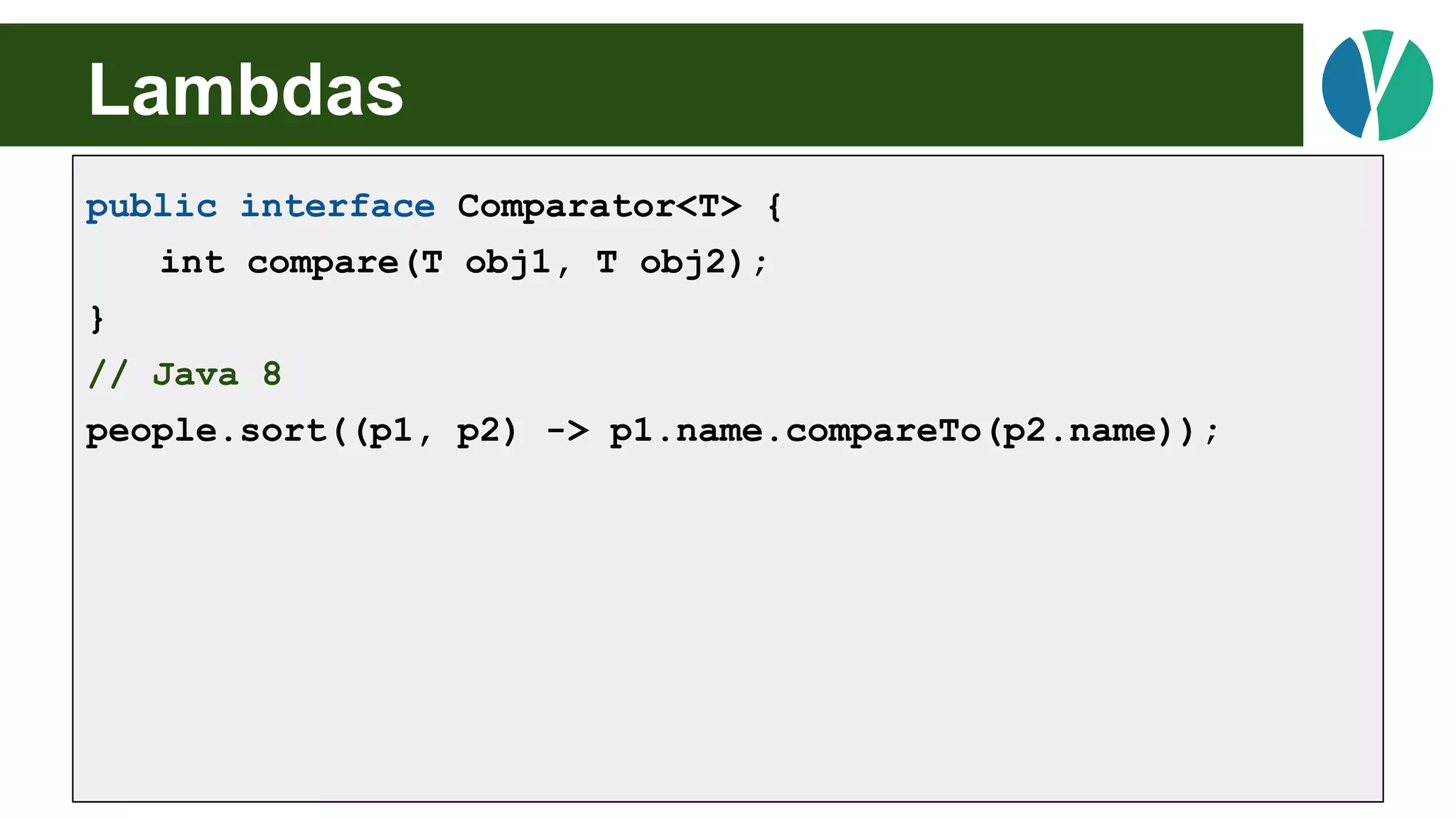
public interface Comparator<T> {
int compare(T obj1, T obj2);
}
// Java 8
people.sort((p1, p2) -> p1.name.compareTo(p2.name));
Top tips for Lambdas
● Use lambdas wherever appropriate
● Mostly, they just work
● Sometimes, the compiler needs a hint
○ use local variable
○ add the type to the lambda parameter
Lambdas
Lambdas affect code
but do they affect design?
Streams
♒
Streams
● Many loops have a similar "shape"
● Repetitive design patterns
● Stream library provides a way to abstract this
● Lambdas used to pass the interesting bits
Streams
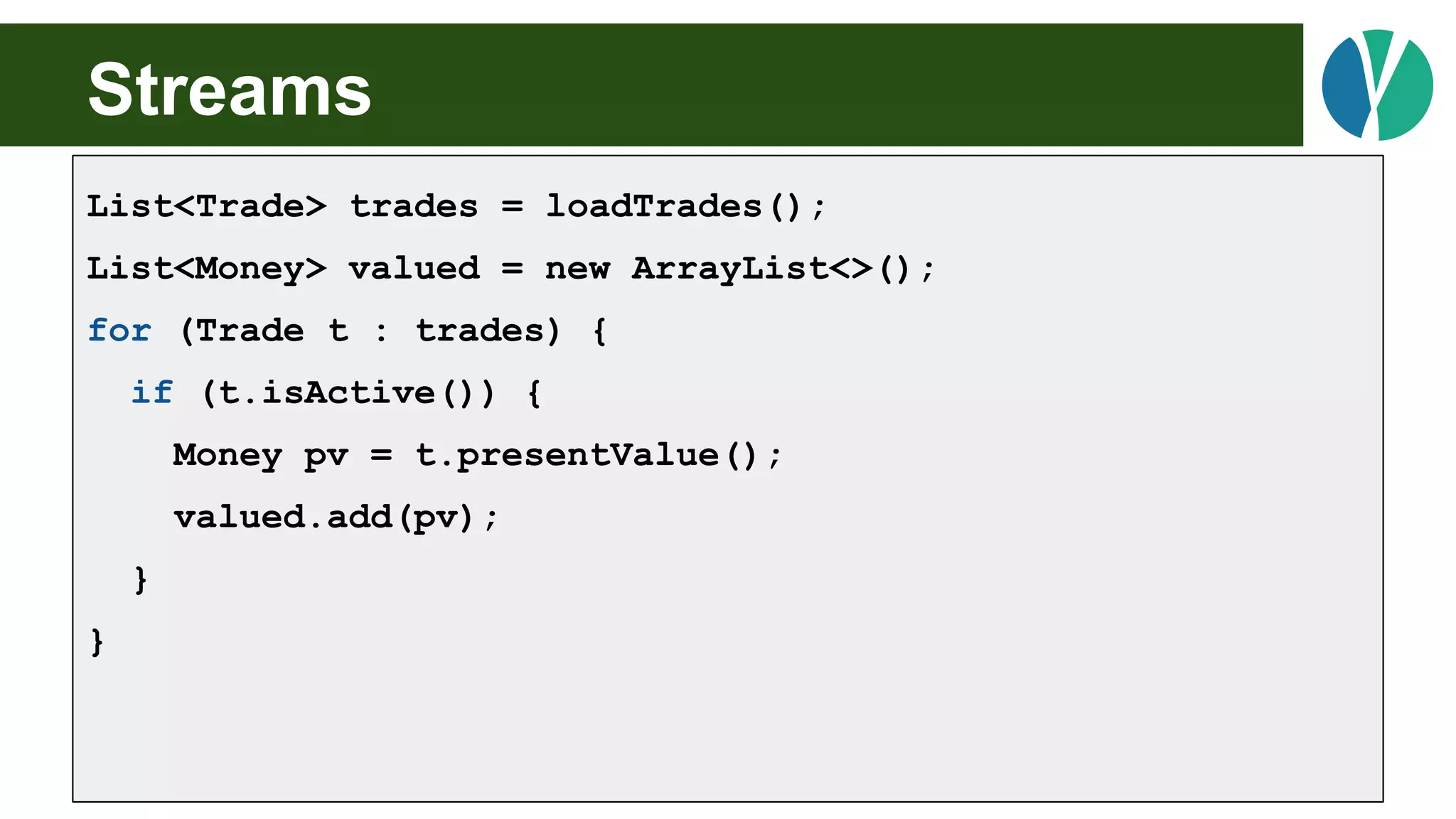
List<Trade> trades = loadTrades();
List<Money> valued = new ArrayList<>();
for (Trade t : trades) {
if (t.isActive()) {
Money pv = t.presentValue();
valued.add(pv);
}
}
Streams
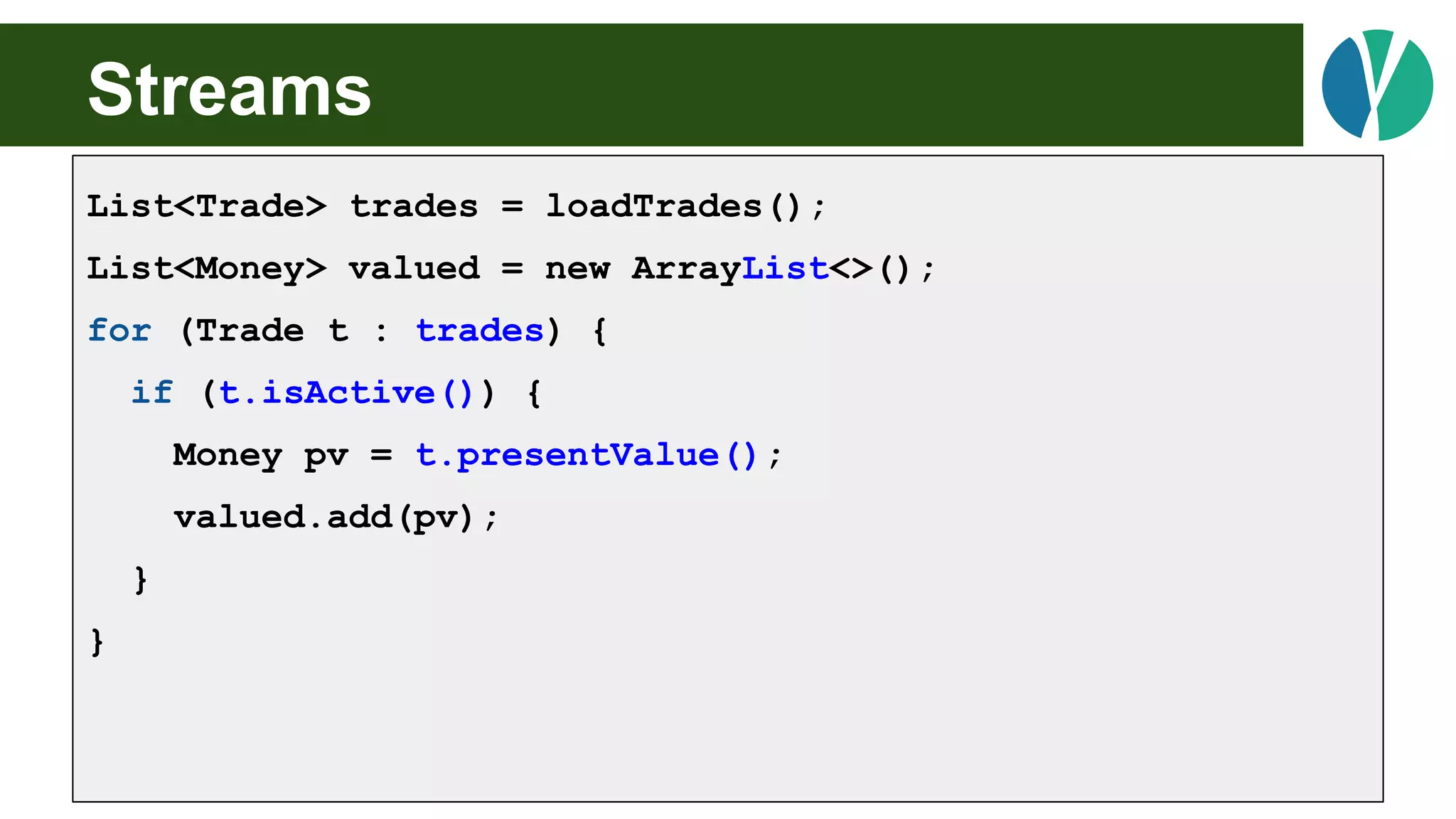
List<Trade> trades = loadTrades();
List<Money> valued = new ArrayList<>();
for (Trade t : trades) {
if (t.isActive()) {
Money pv = t.presentValue();
valued.add(pv);
}
}
Streams
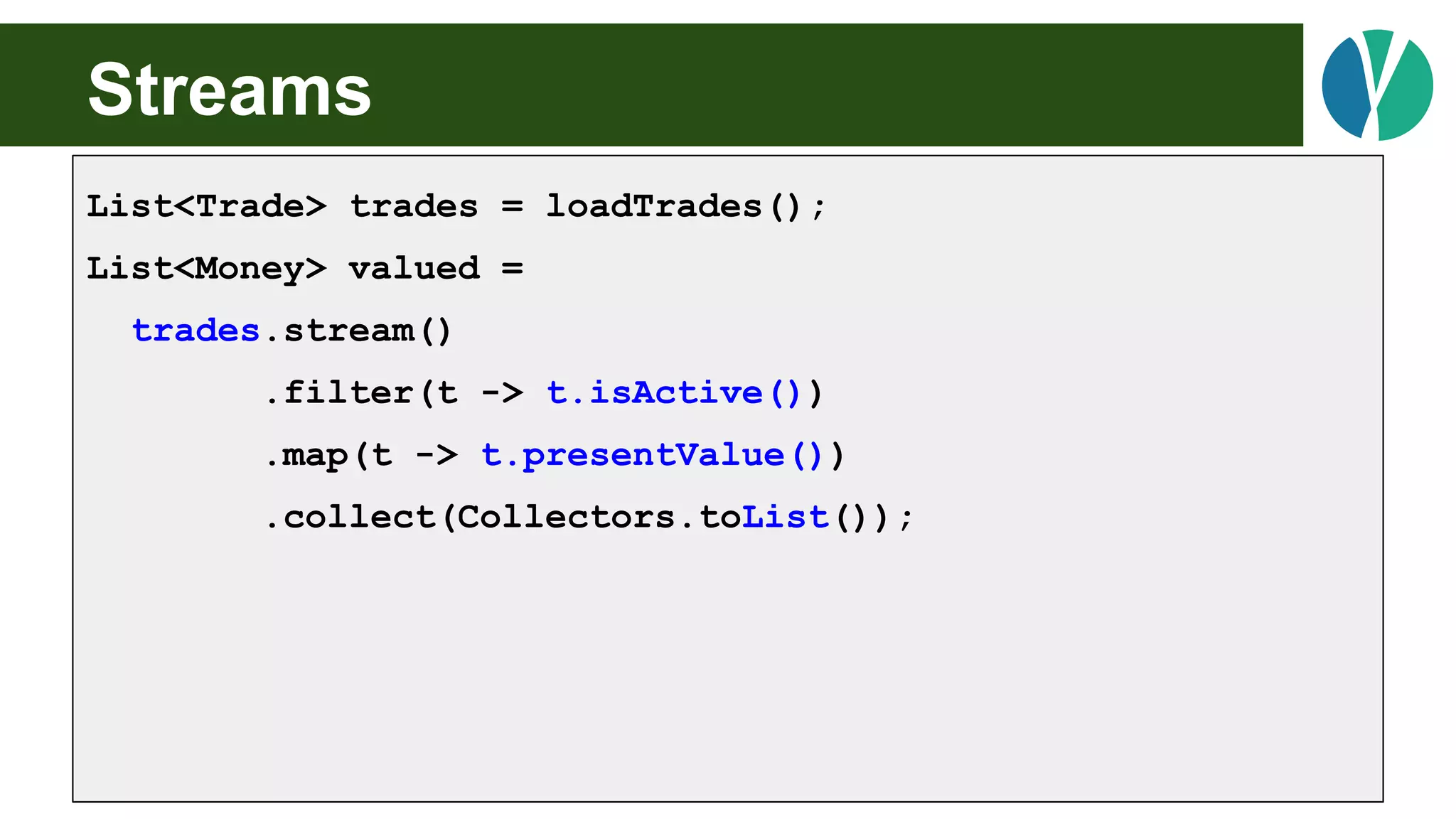
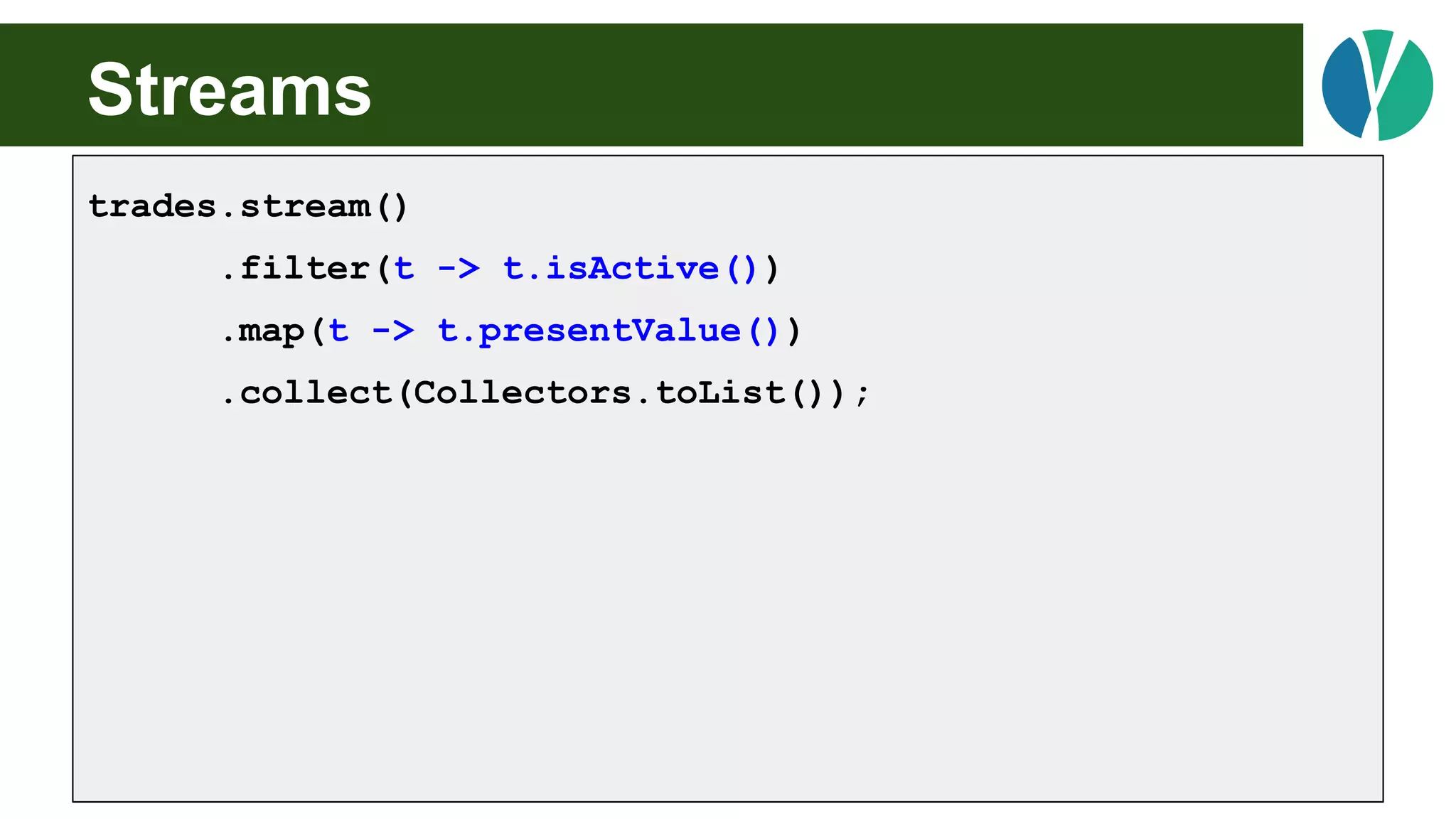
List<Trade> trades = loadTrades();
List<Money> valued =
trades.stream()
.filter(t -> t.isActive())
.map(t -> t.presentValue())
.collect(Collectors.toList());
Streams
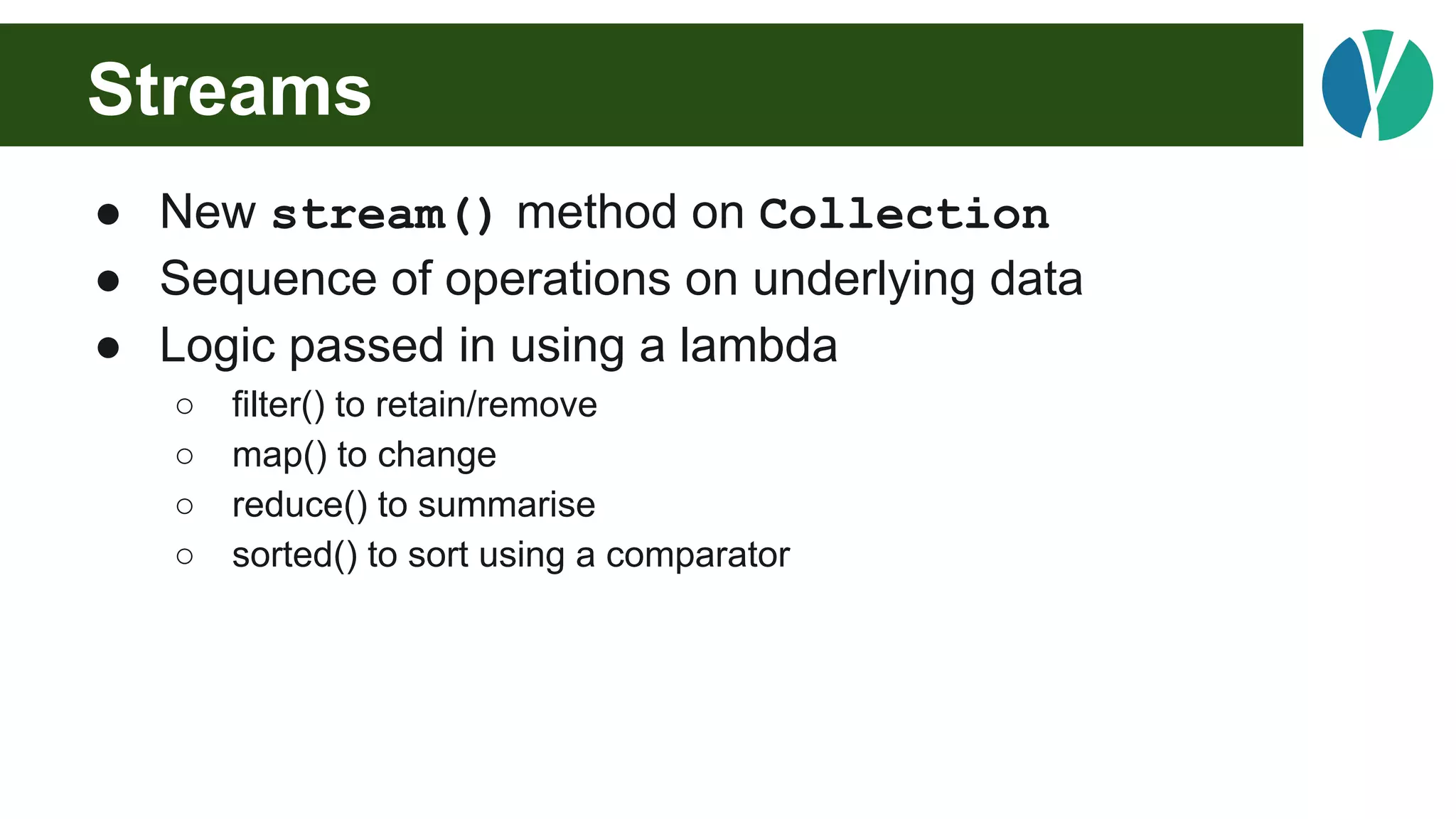
● New stream() method on Collection
● Sequence of operations on underlying data
● Logic passed in using a lambda
○ filter() to retain/remove
○ map() to change
○ reduce() to summarise
○ sorted() to sort using a comparator
Streams
trades.stream()
.filter(t -> t.isActive())
.map(t -> t.presentValue())
.collect(Collectors.toList());
Streams
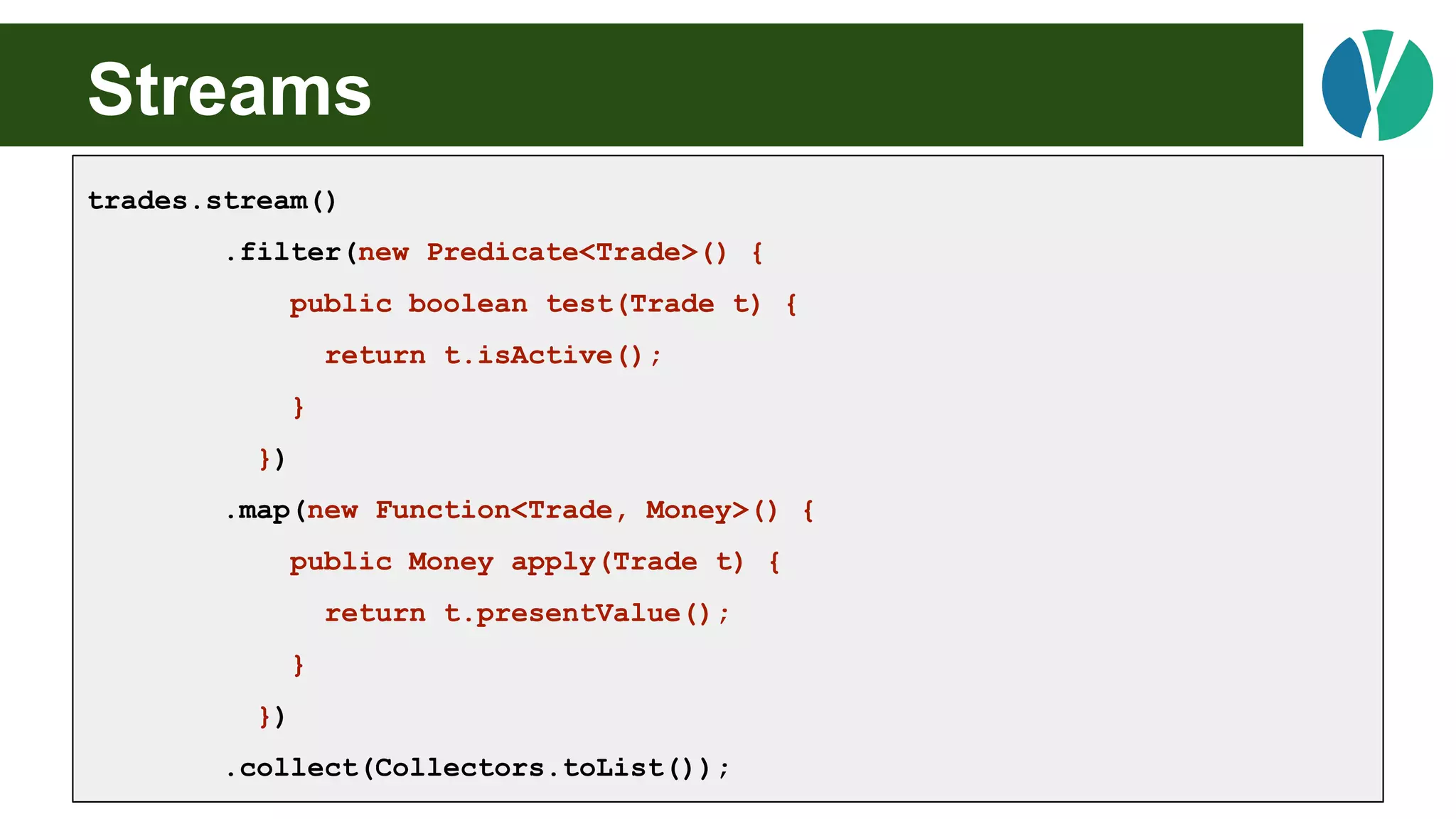
trades.stream()
.filter(new Predicate<Trade>() {
public boolean test(Trade t) {
return t.isActive();
}
})
.map(new Function<Trade, Money>() {
public Money apply(Trade t) {
return t.presentValue();
}
})
.collect(Collectors.toList());
Streams
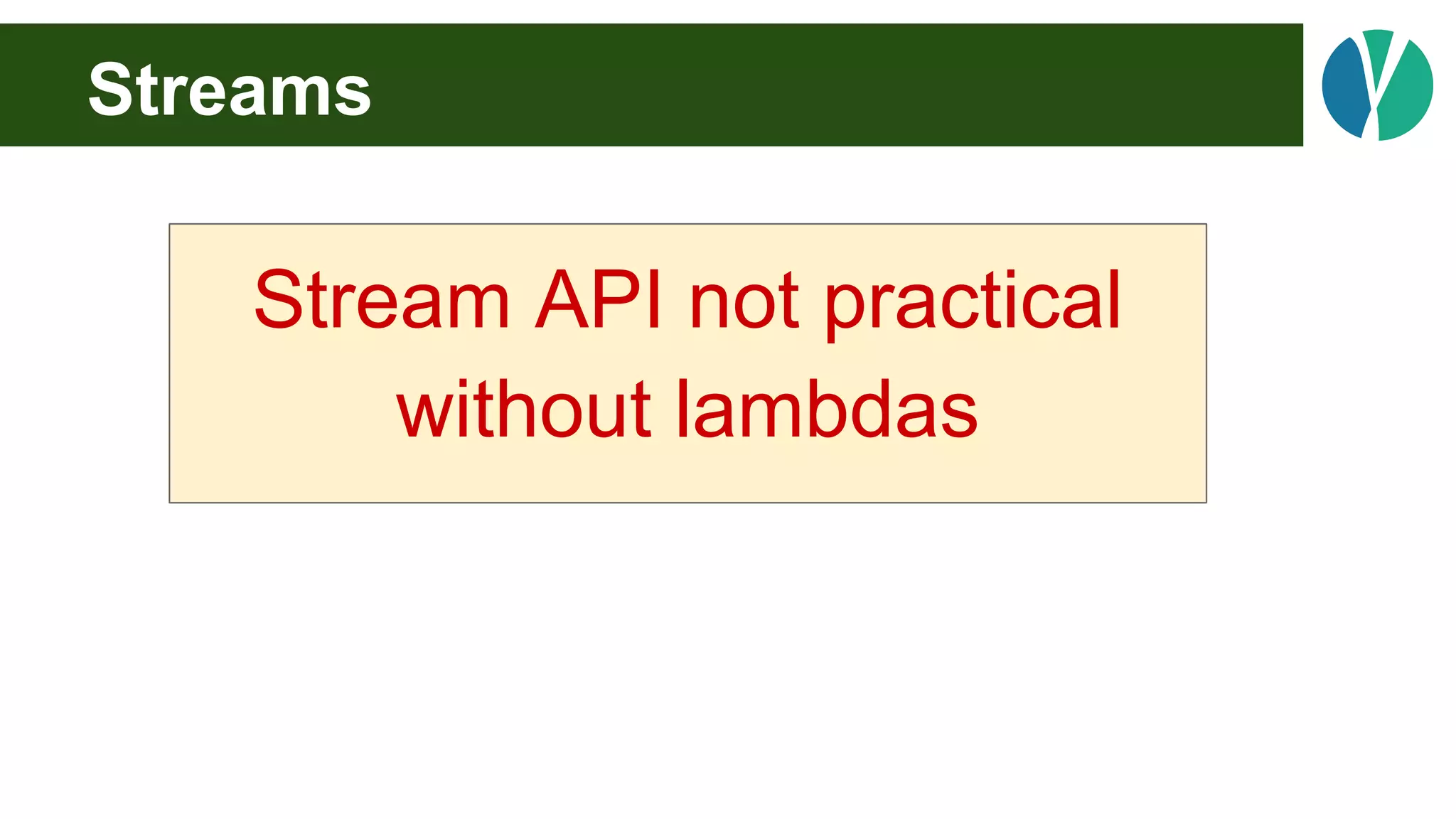
Stream API not practical
without lambdas
Exceptions in Streams
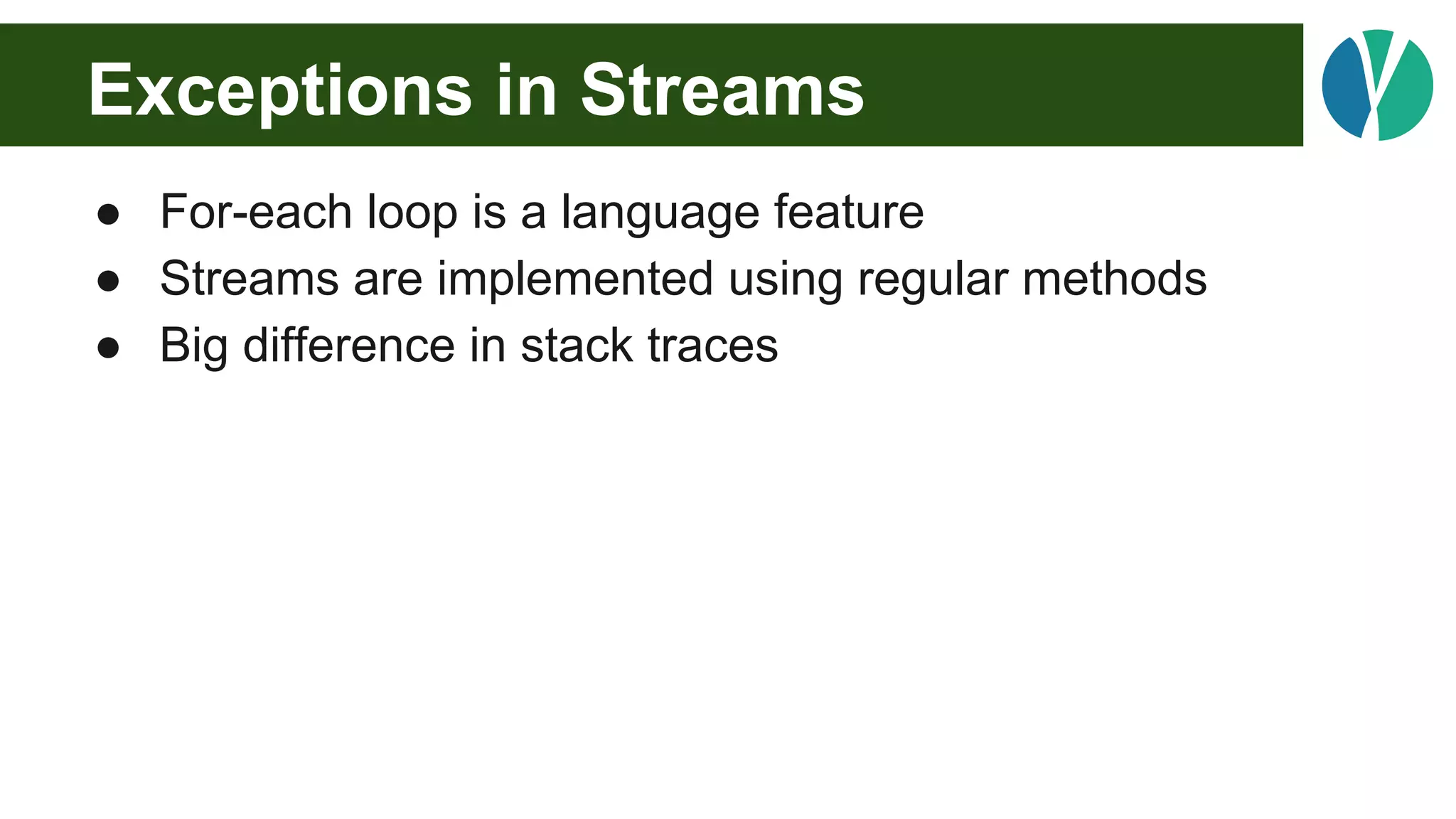
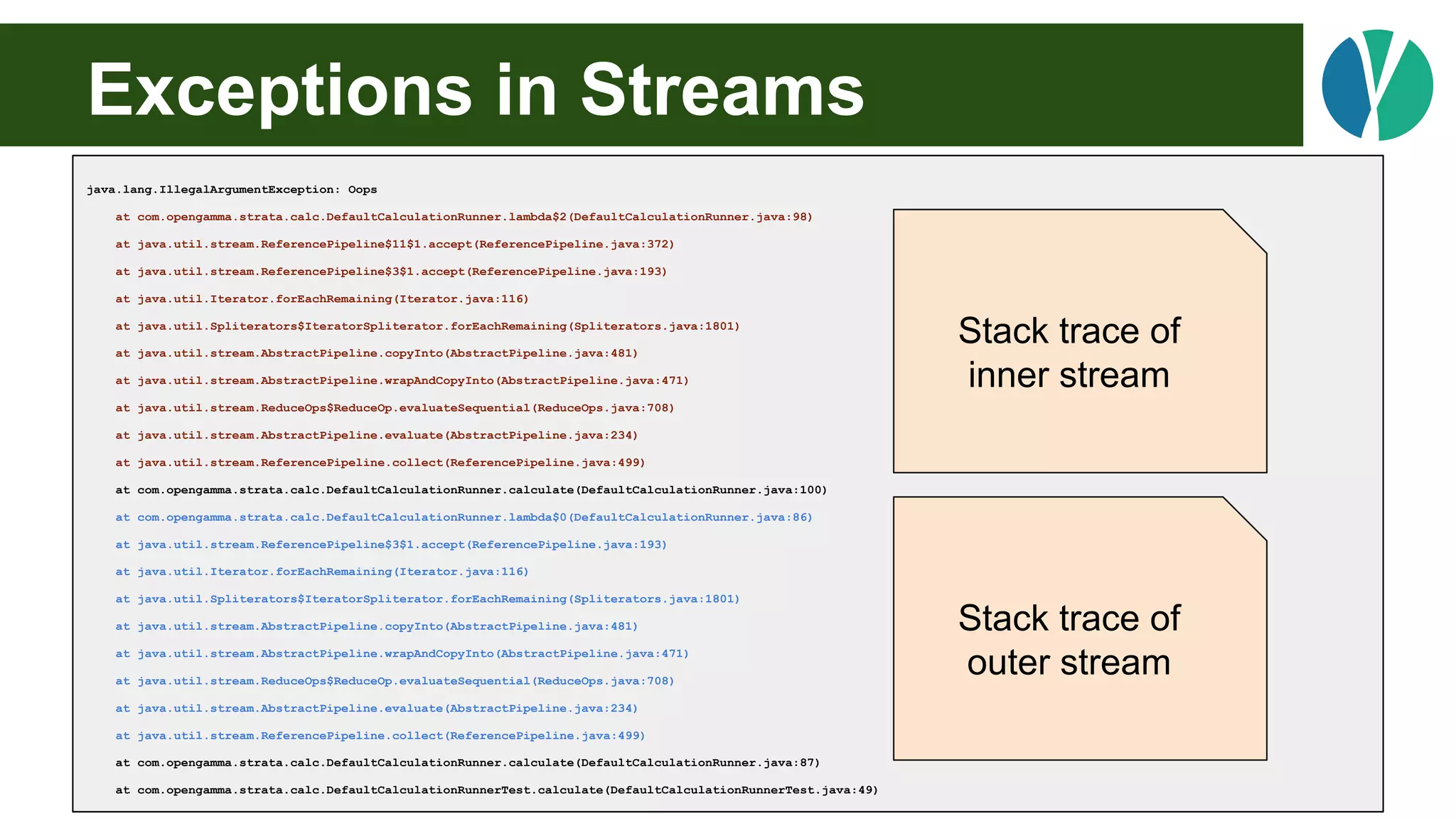
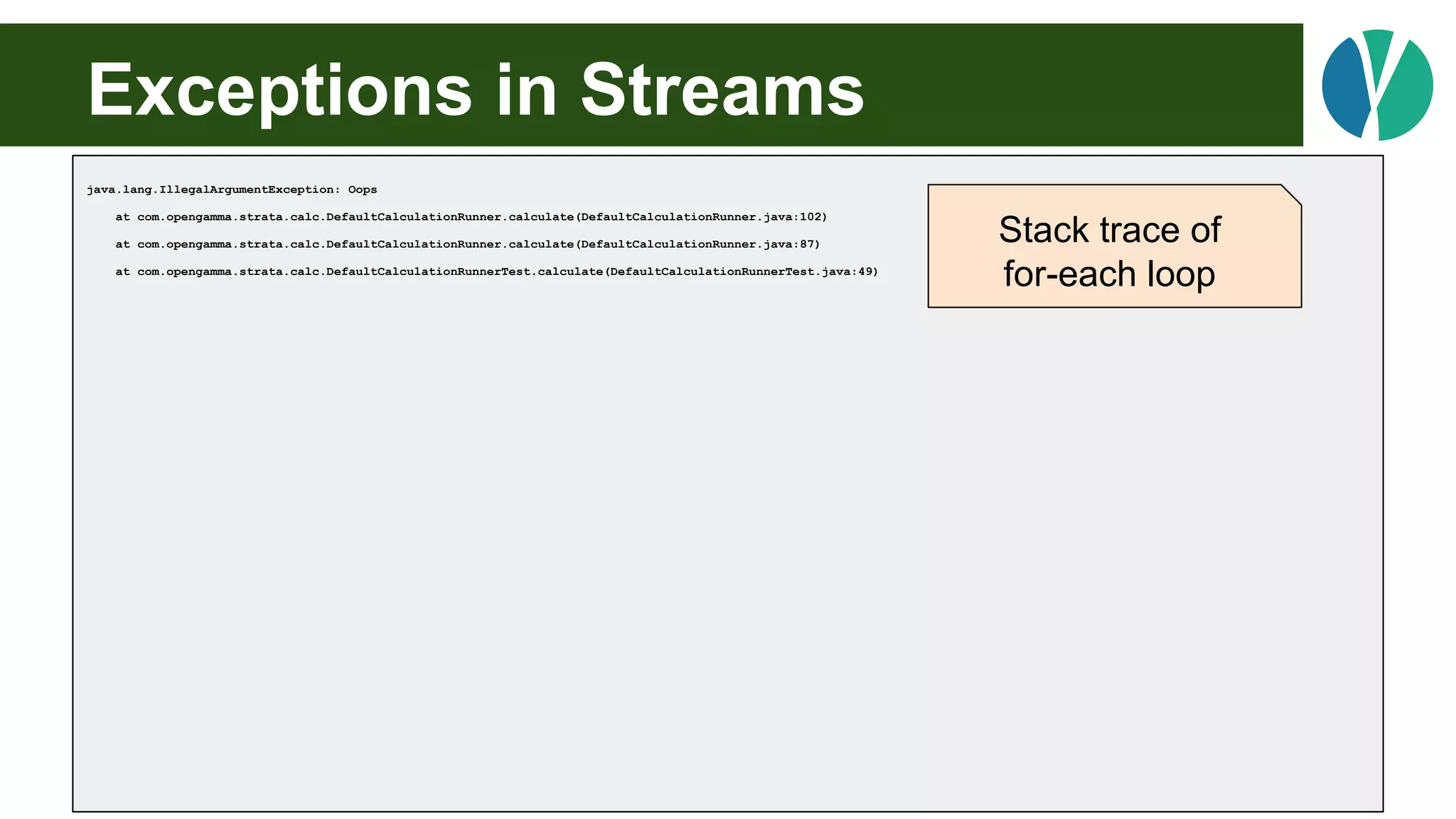
● For-each loop is a language feature
● Streams are implemented using regular methods
● Big difference in stack traces
Exceptions in Streams
java.lang.IllegalArgumentException: Oops
at com.opengamma.strata.calc.DefaultCalculationRunner.lambda$2(DefaultCalculationRunner.java:98)
at java.util.stream.ReferencePipeline$11$1.accept(ReferencePipeline.java:372)
at java.util.stream.ReferencePipeline$3$1.accept(ReferencePipeline.java:193)
at java.util.Iterator.forEachRemaining(Iterator.java:116)
at java.util.Spliterators$IteratorSpliterator.forEachRemaining(Spliterators.java:1801)
at java.util.stream.AbstractPipeline.copyInto(AbstractPipeline.java:481)
at java.util.stream.AbstractPipeline.wrapAndCopyInto(AbstractPipeline.java:471)
at java.util.stream.ReduceOps$ReduceOp.evaluateSequential(ReduceOps.java:708)
at java.util.stream.AbstractPipeline.evaluate(AbstractPipeline.java:234)
at java.util.stream.ReferencePipeline.collect(ReferencePipeline.java:499)
at com.opengamma.strata.calc.DefaultCalculationRunner.calculate(DefaultCalculationRunner.java:100)
at com.opengamma.strata.calc.DefaultCalculationRunner.lambda$0(DefaultCalculationRunner.java:86)
at java.util.stream.ReferencePipeline$3$1.accept(ReferencePipeline.java:193)
at java.util.Iterator.forEachRemaining(Iterator.java:116)
at java.util.Spliterators$IteratorSpliterator.forEachRemaining(Spliterators.java:1801)
at java.util.stream.AbstractPipeline.copyInto(AbstractPipeline.java:481)
at java.util.stream.AbstractPipeline.wrapAndCopyInto(AbstractPipeline.java:471)
at java.util.stream.ReduceOps$ReduceOp.evaluateSequential(ReduceOps.java:708)
at java.util.stream.AbstractPipeline.evaluate(AbstractPipeline.java:234)
at java.util.stream.ReferencePipeline.collect(ReferencePipeline.java:499)
at com.opengamma.strata.calc.DefaultCalculationRunner.calculate(DefaultCalculationRunner.java:87)
at com.opengamma.strata.calc.DefaultCalculationRunnerTest.calculate(DefaultCalculationRunnerTest.java:49)
Stack trace of
inner stream
Stack trace of
outer stream
Exceptions in Streams
java.lang.IllegalArgumentException: Oops
at com.opengamma.strata.calc.DefaultCalculationRunner.calculate(DefaultCalculationRunner.java:102)
at com.opengamma.strata.calc.DefaultCalculationRunner.calculate(DefaultCalculationRunner.java:87)
at com.opengamma.strata.calc.DefaultCalculationRunnerTest.calculate(DefaultCalculationRunnerTest.java:49)
Stack trace of
for-each loop
Top tips for streams
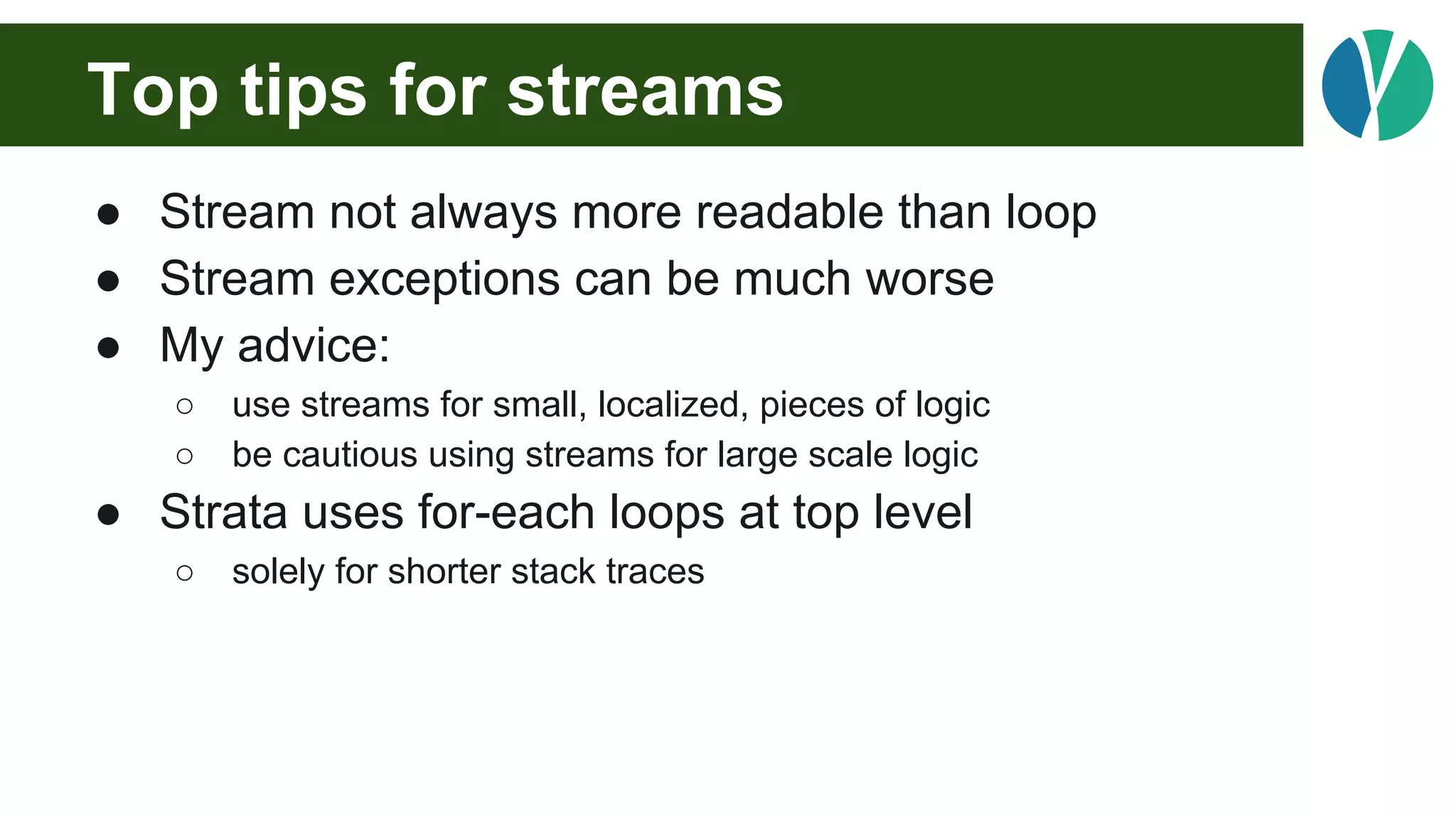
● Stream not always more readable than loop
● Stream exceptions can be much worse
● My advice:
○ use streams for small, localized, pieces of logic
○ be cautious using streams for large scale logic
● Strata uses for-each loops at top level
○ solely for shorter stack traces
Design with Lambdas
Design with Lambdas
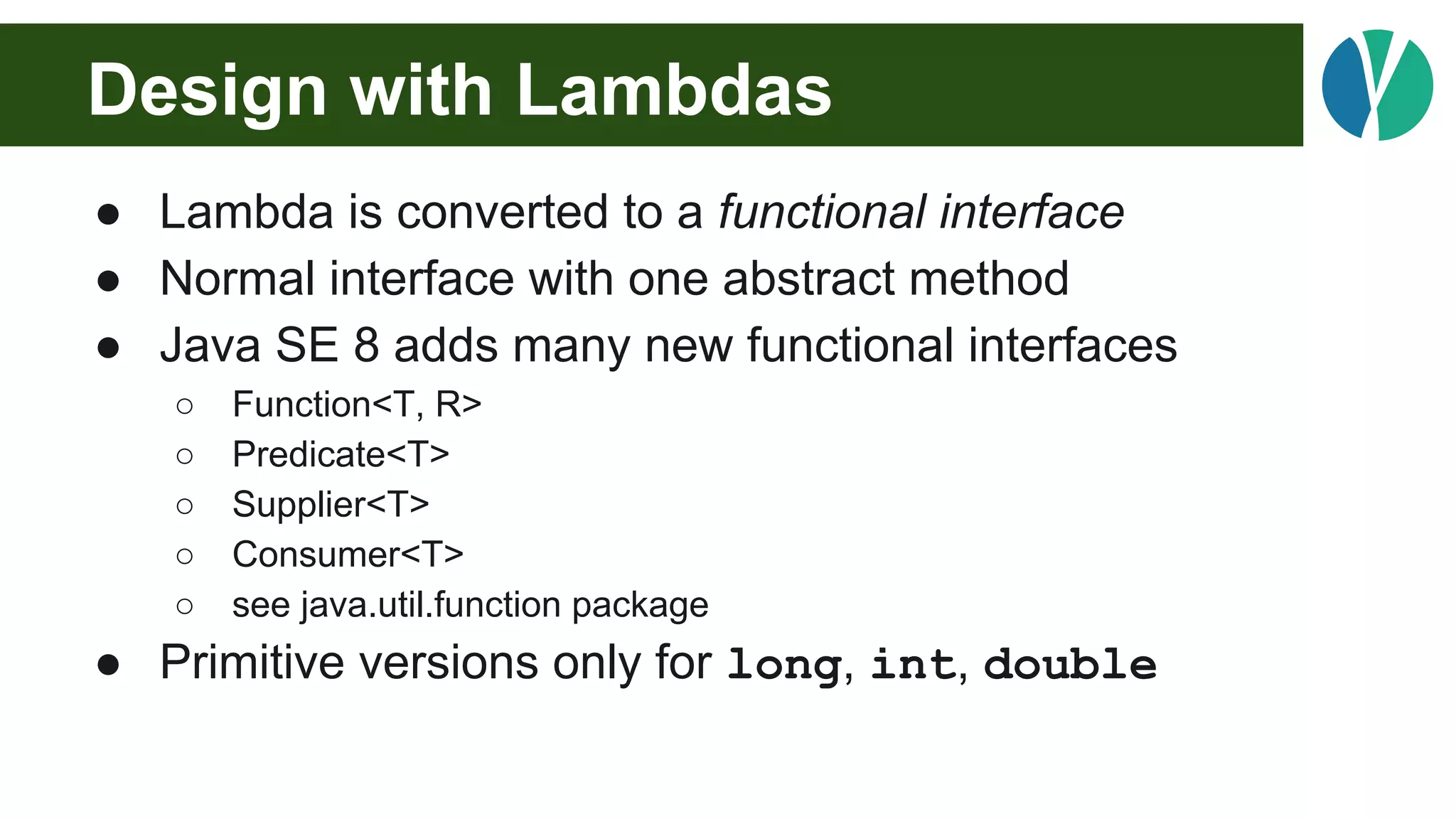
● Lambda is converted to a functional interface
● Normal interface with one abstract method
● Java SE 8 adds many new functional interfaces
○ Function<T, R>
○ Predicate<T>
○ Supplier<T>
○ Consumer<T>
○ see java.util.function package
● Primitive versions only for long, int, double
Functional interfaces
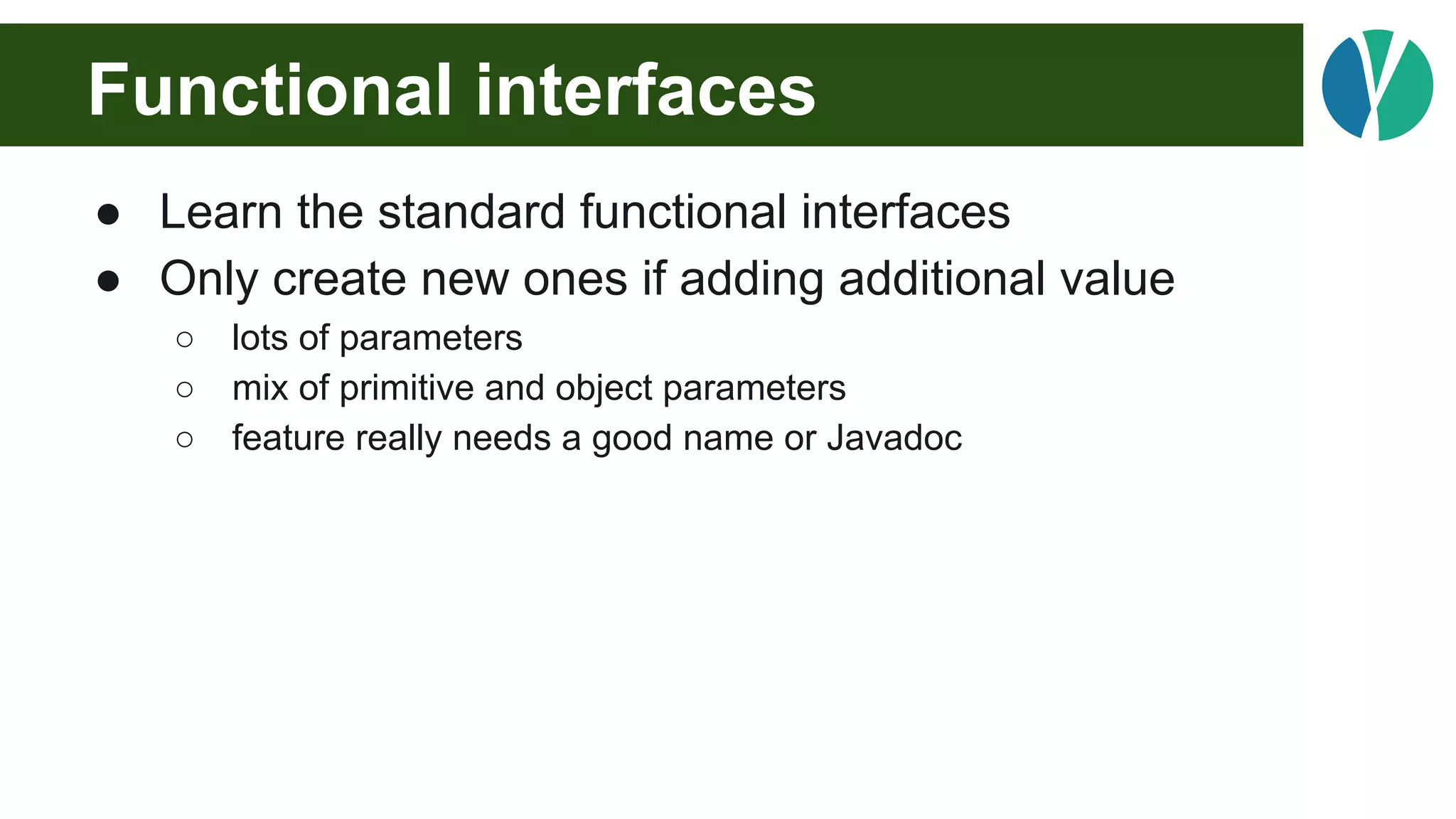
● Learn the standard functional interfaces
● Only create new ones if adding additional value
○ lots of parameters
○ mix of primitive and object parameters
○ feature really needs a good name or Javadoc
Functional interface example
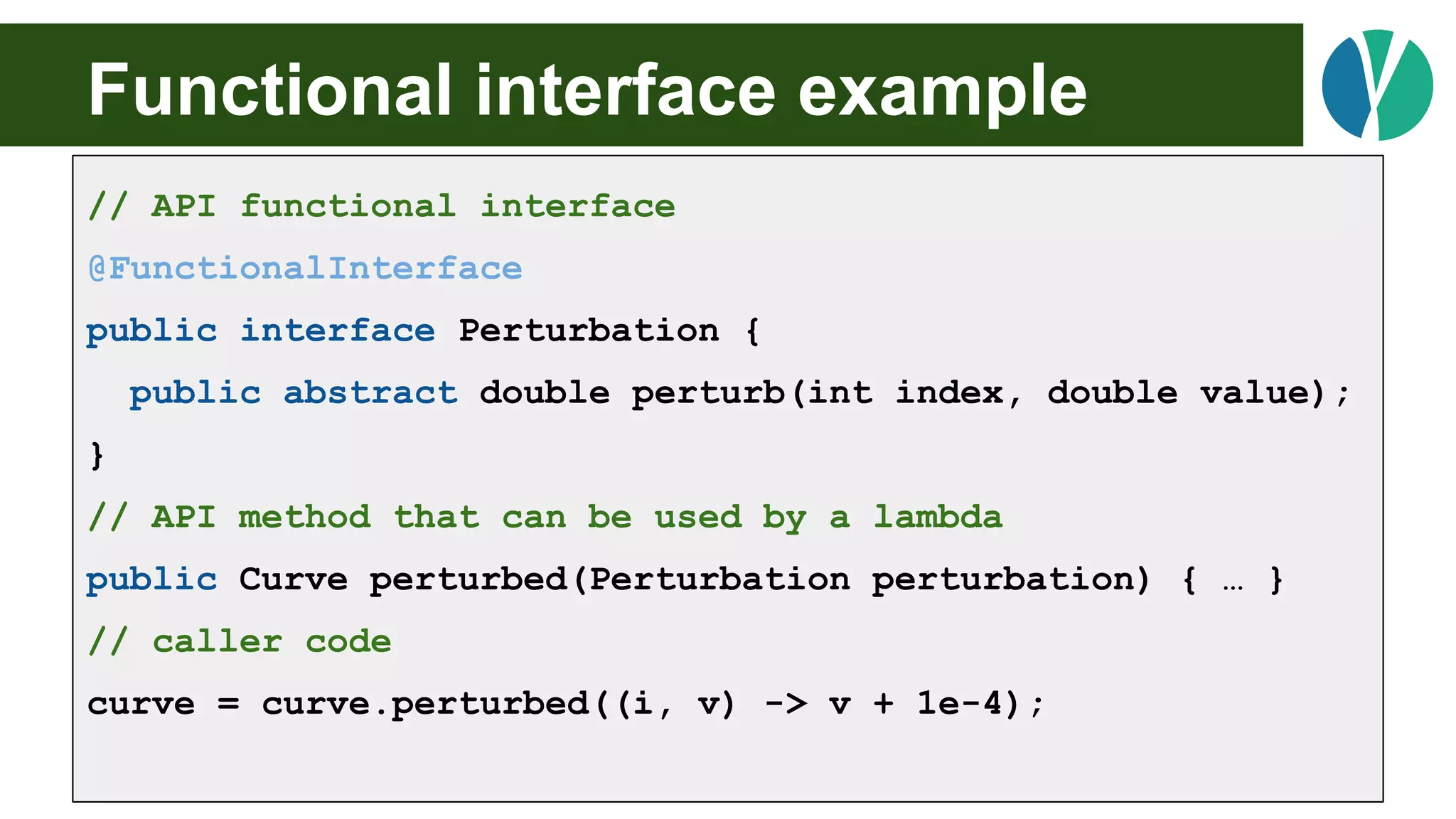
// API functional interface
@FunctionalInterface
public interface Perturbation {
public abstract double perturb(int index, double value);
}
// API method that can be used by a lambda
public Curve perturbed(Perturbation perturbation) { … }
// caller code
curve = curve.perturbed((i, v) -> v + 1e-4);
Functional interface example
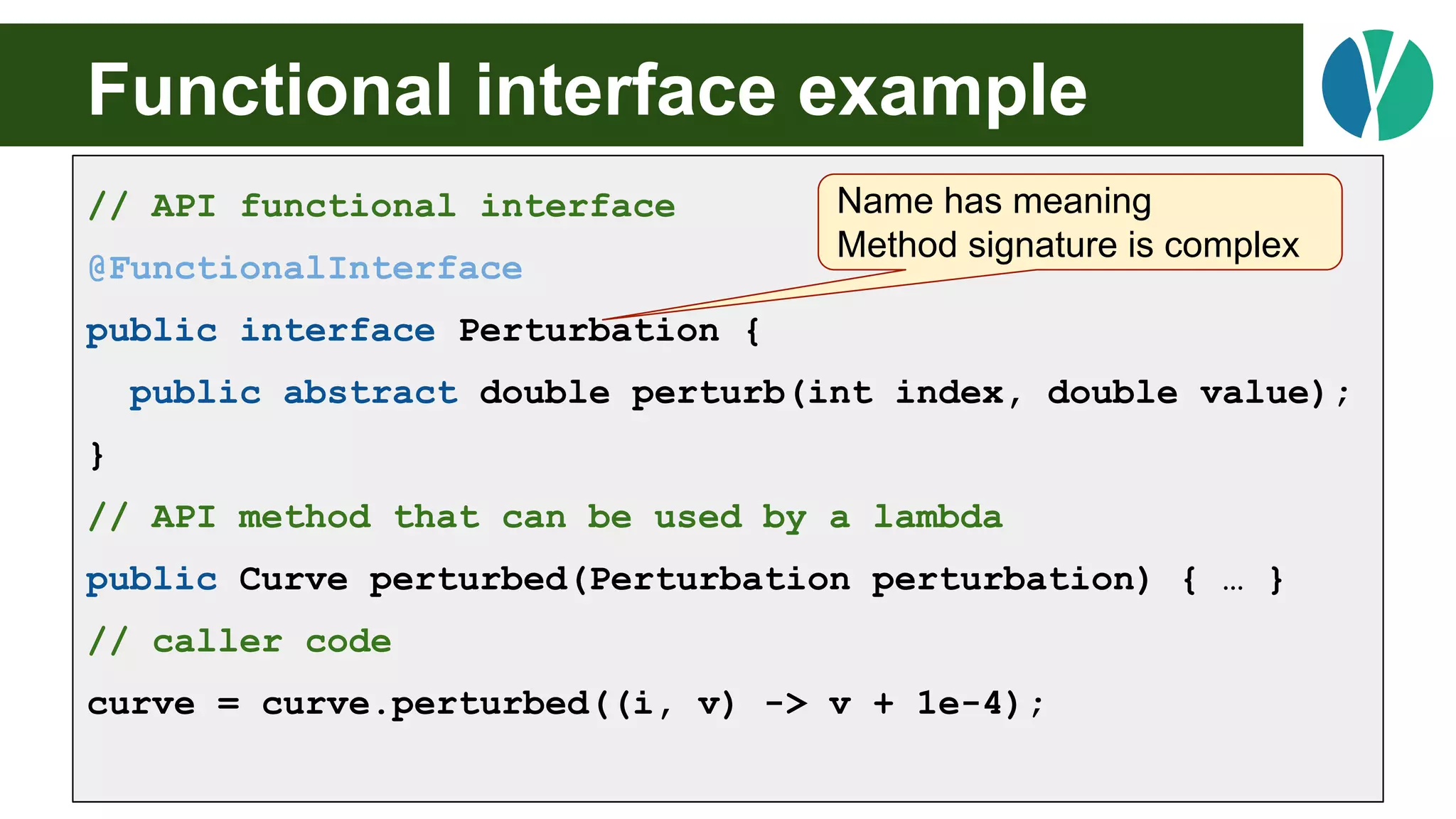
// API functional interface
@FunctionalInterface
public interface Perturbation {
public abstract double perturb(int index, double value);
}
// API method that can be used by a lambda
public Curve perturbed(Perturbation perturbation) { … }
// caller code
curve = curve.perturbed((i, v) -> v + 1e-4);
Name has meaning
Method signature is complex
Time-series example
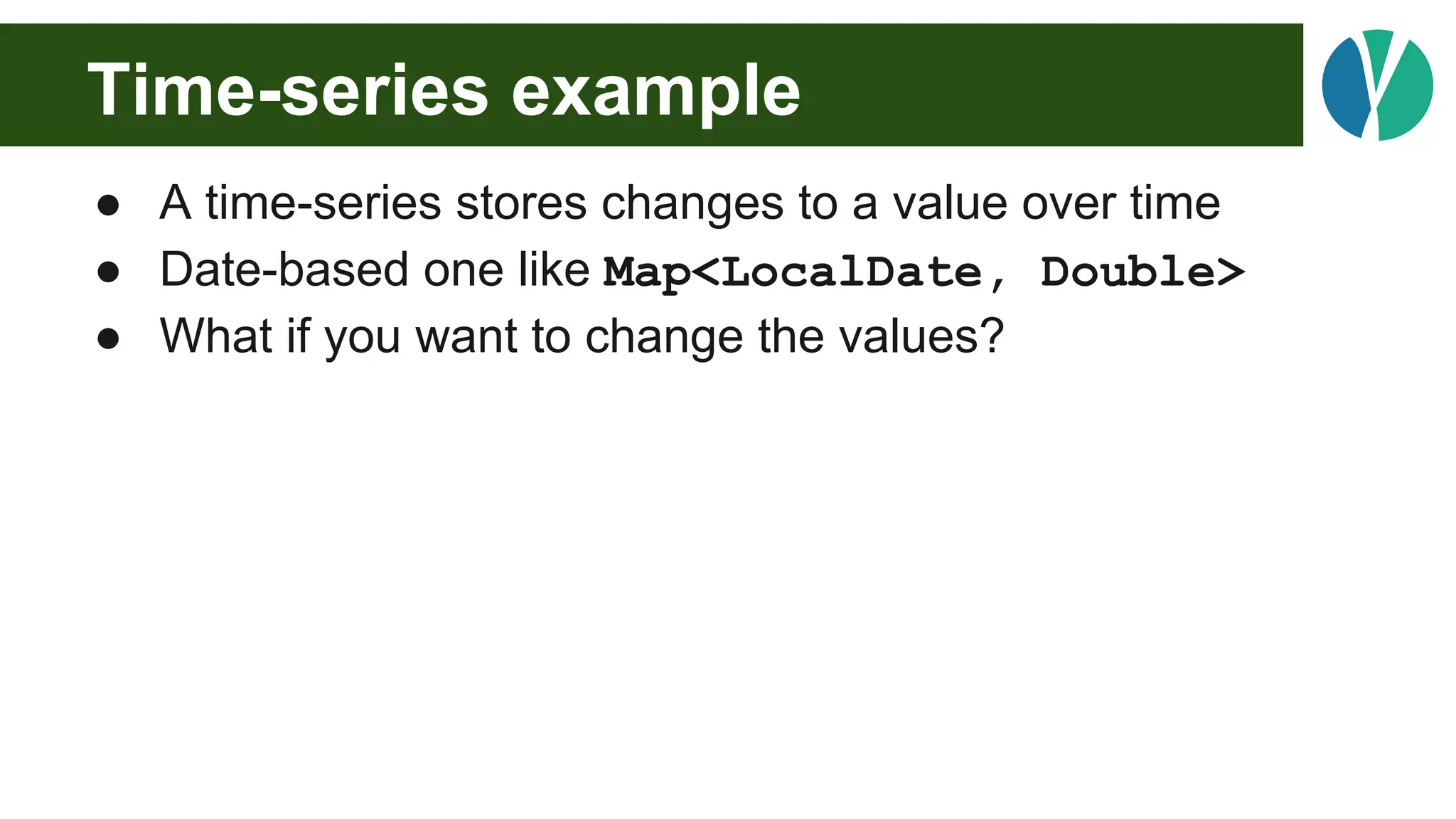
● A time-series stores changes to a value over time
● Date-based one like Map<LocalDate, Double>
● What if you want to change the values?
Time-series example
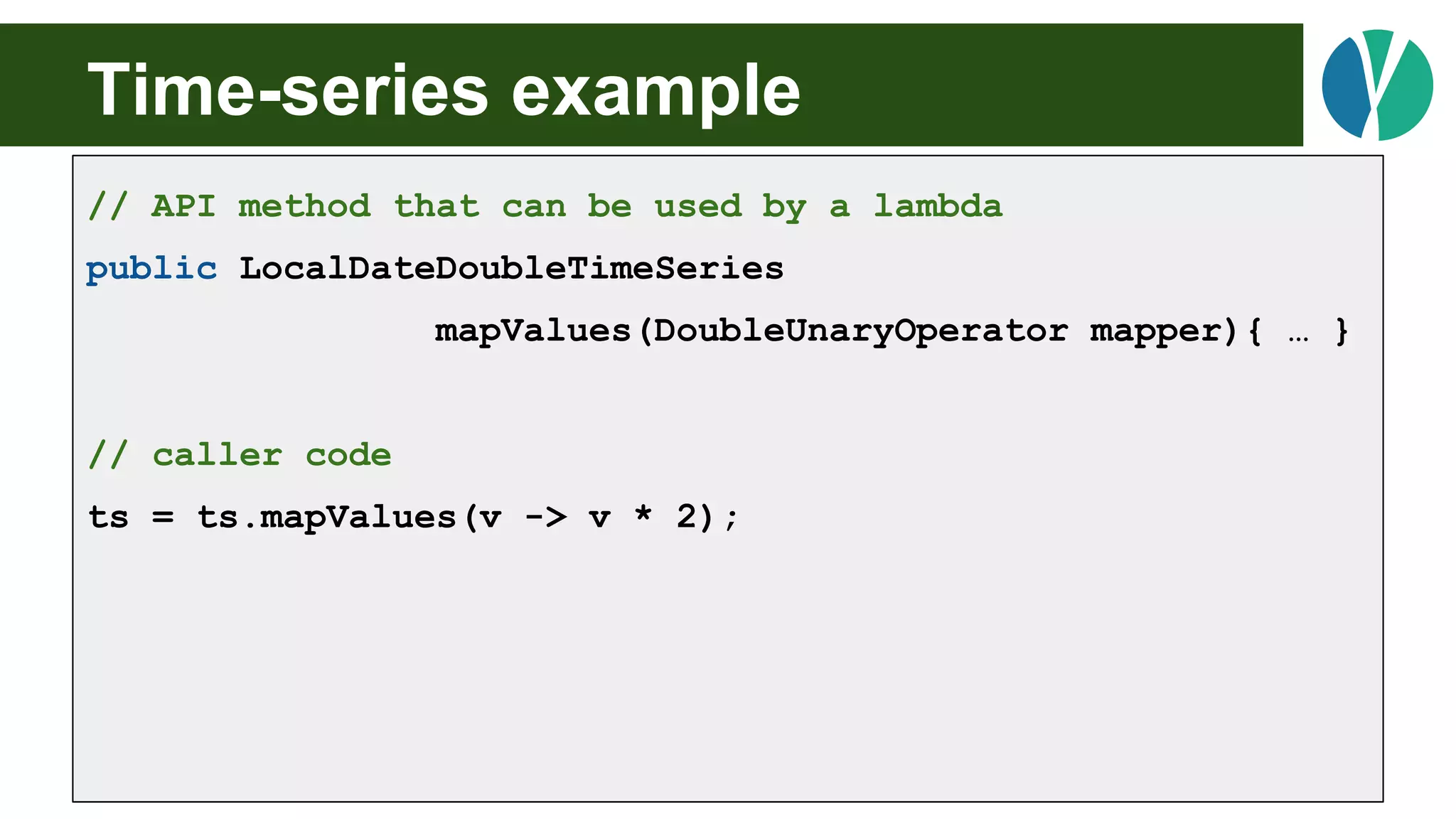
// API method that can be used by a lambda
public LocalDateDoubleTimeSeries
mapValues(DoubleUnaryOperator mapper){ … }
// caller code
ts = ts.mapValues(v -> v * 2);
Time-series example
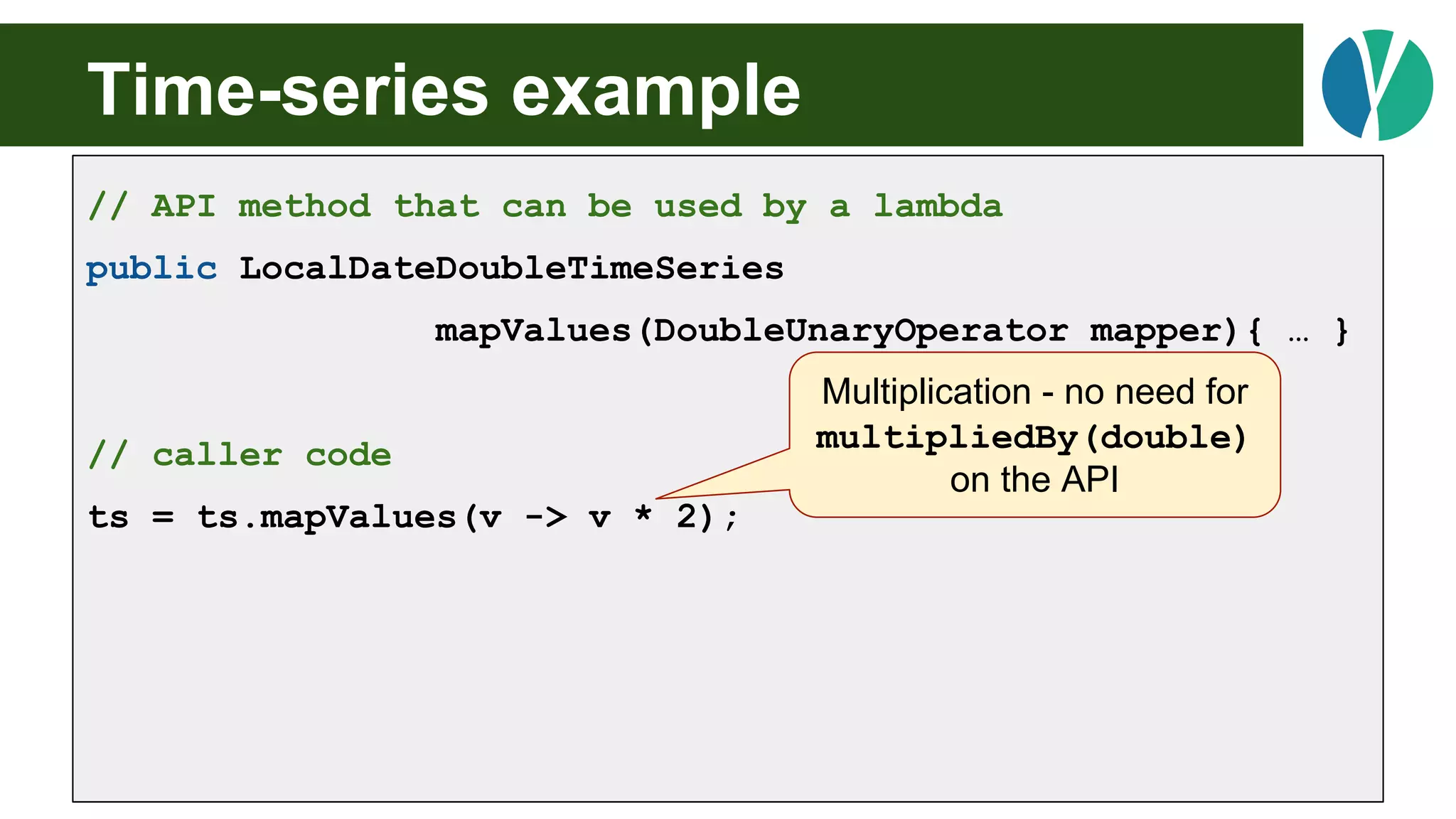
// API method that can be used by a lambda
public LocalDateDoubleTimeSeries
mapValues(DoubleUnaryOperator mapper){ … }
// caller code
ts = ts.mapValues(v -> v * 2);
Multiplication - no need for
multipliedBy(double)
on the API
Time-series example
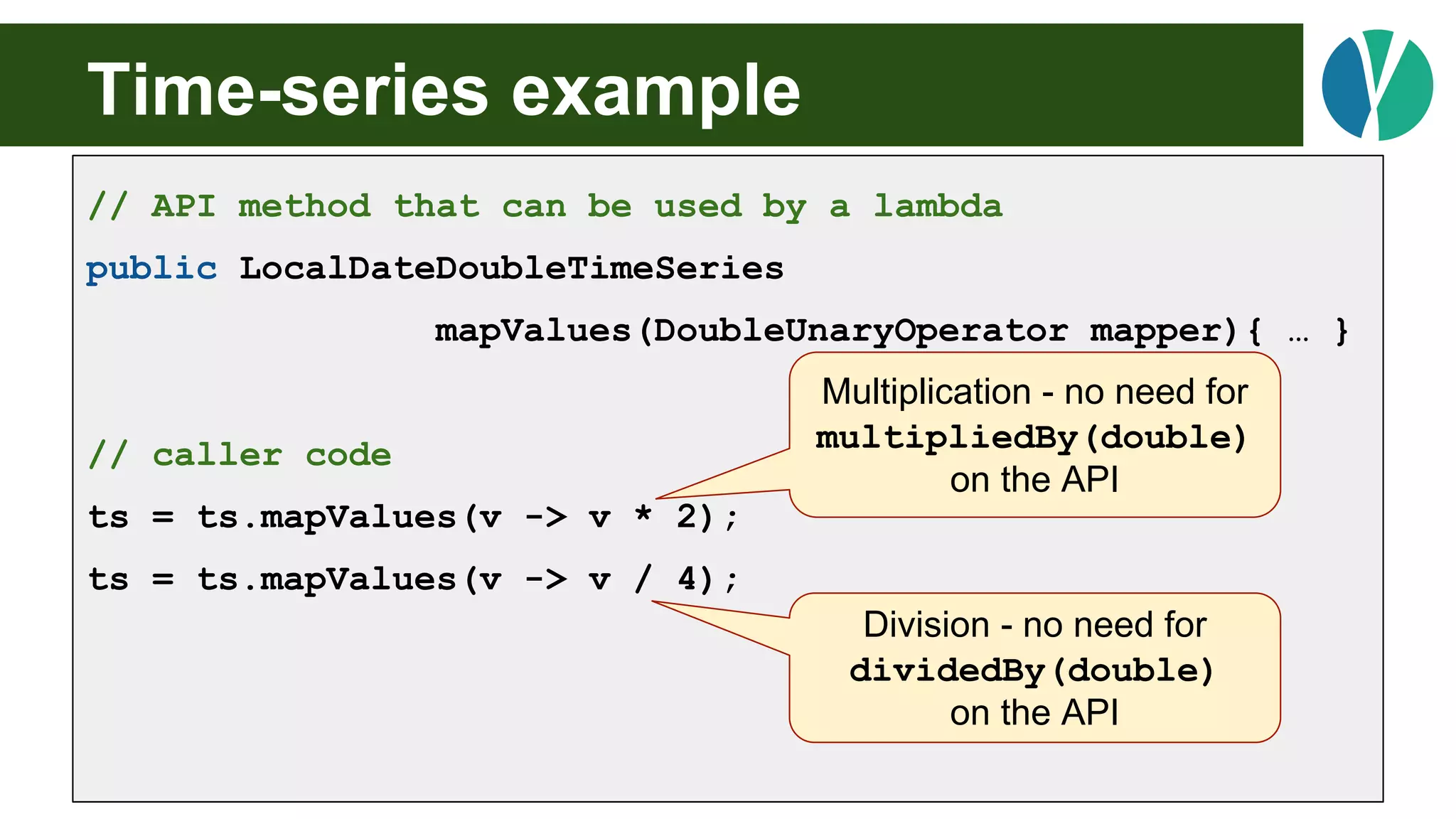
// API method that can be used by a lambda
public LocalDateDoubleTimeSeries
mapValues(DoubleUnaryOperator mapper){ … }
// caller code
ts = ts.mapValues(v -> v * 2);
ts = ts.mapValues(v -> v / 4);
Multiplication - no need for
multipliedBy(double)
on the API
Division - no need for
dividedBy(double)
on the API
Design with Lambdas
Method taking a lambda
can be more flexible design
Abstraction with Lambdas
✯
Abstraction
● Two or more classes with the same methods
● Abstract using an interface?
● Lambdas provide an alternative
● Consider an example with static methods
○ no way to abstract that with interfaces...
Abstraction
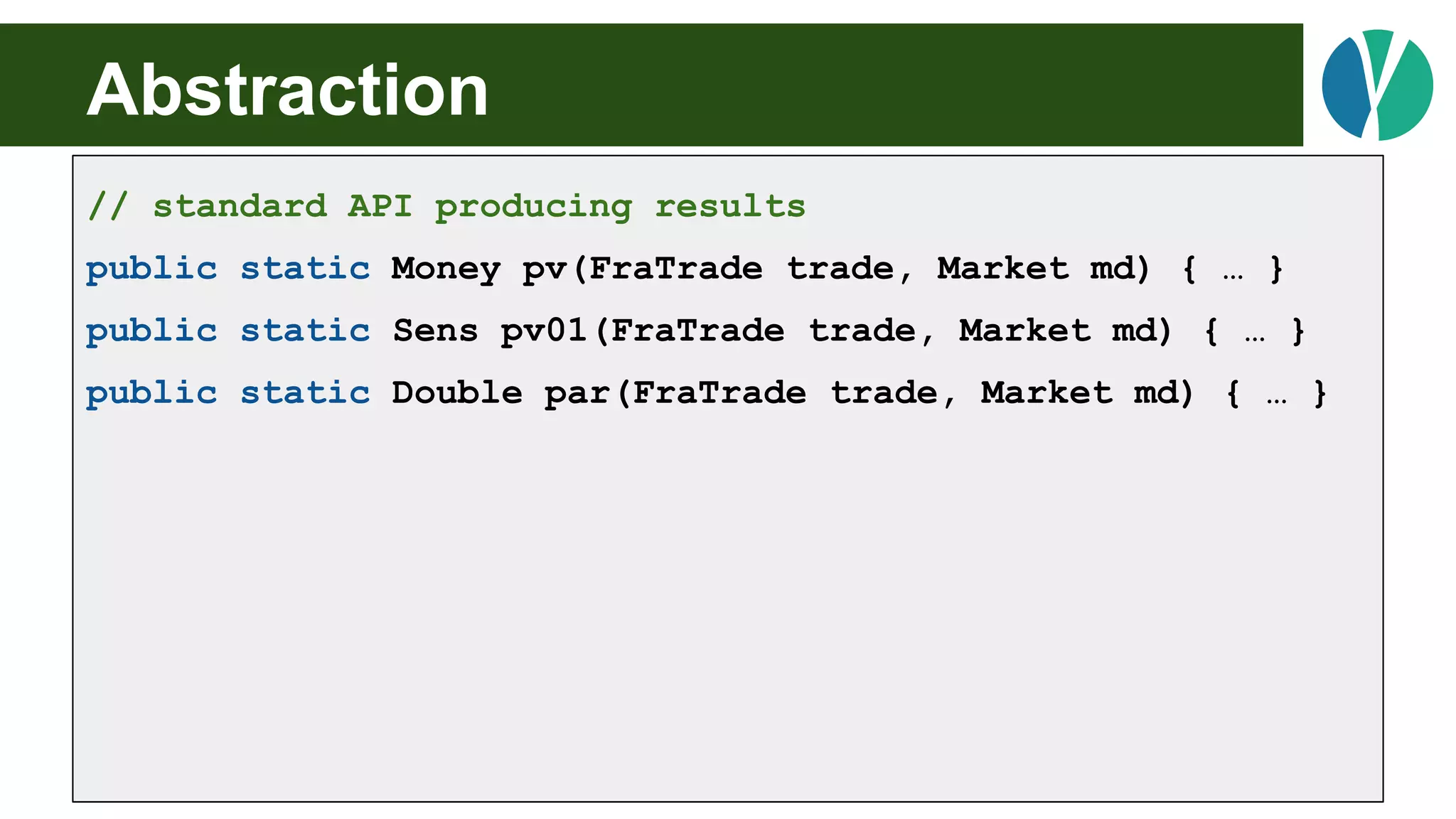
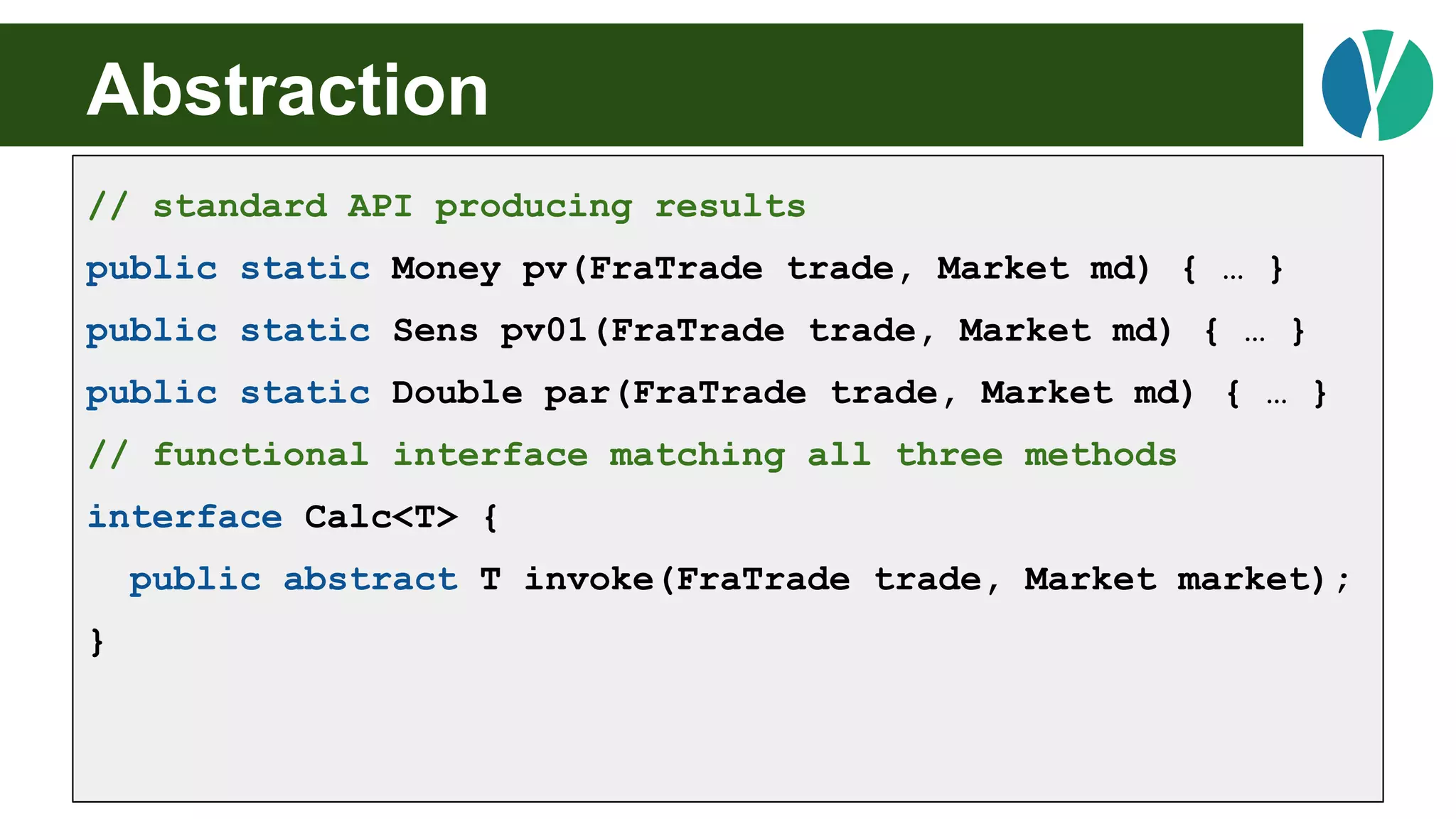
// standard API producing results
public static Money pv(FraTrade trade, Market md) { … }
public static Sens pv01(FraTrade trade, Market md) { … }
public static Double par(FraTrade trade, Market md) { … }
Abstraction
// standard API producing results
public static Money pv(FraTrade trade, Market md) { … }
public static Sens pv01(FraTrade trade, Market md) { … }
public static Double par(FraTrade trade, Market md) { … }
// functional interface matching all three methods
interface Calc<T> {
public abstract T invoke(FraTrade trade, Market market);
}
Abstraction
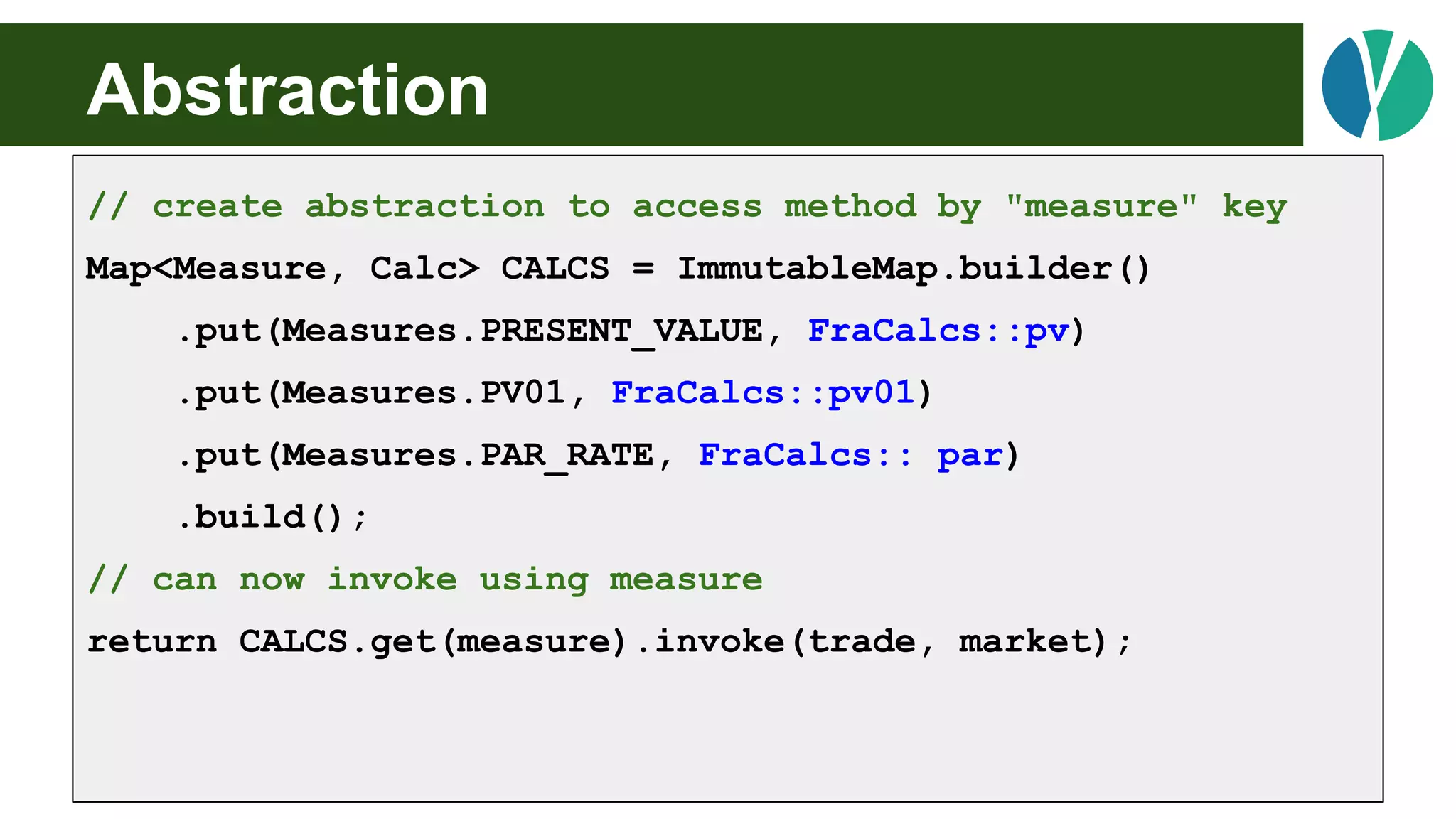
// create abstraction to access method by "measure" key
Map<Measure, Calc> CALCS = ImmutableMap.builder()
.put(Measures.PRESENT_VALUE, FraCalcs::pv)
.put(Measures.PV01, FraCalcs::pv01)
.put(Measures.PAR_RATE, FraCalcs:: par)
.build();
// can now invoke using measure
return CALCS.get(measure).invoke(trade, market);
Abstraction
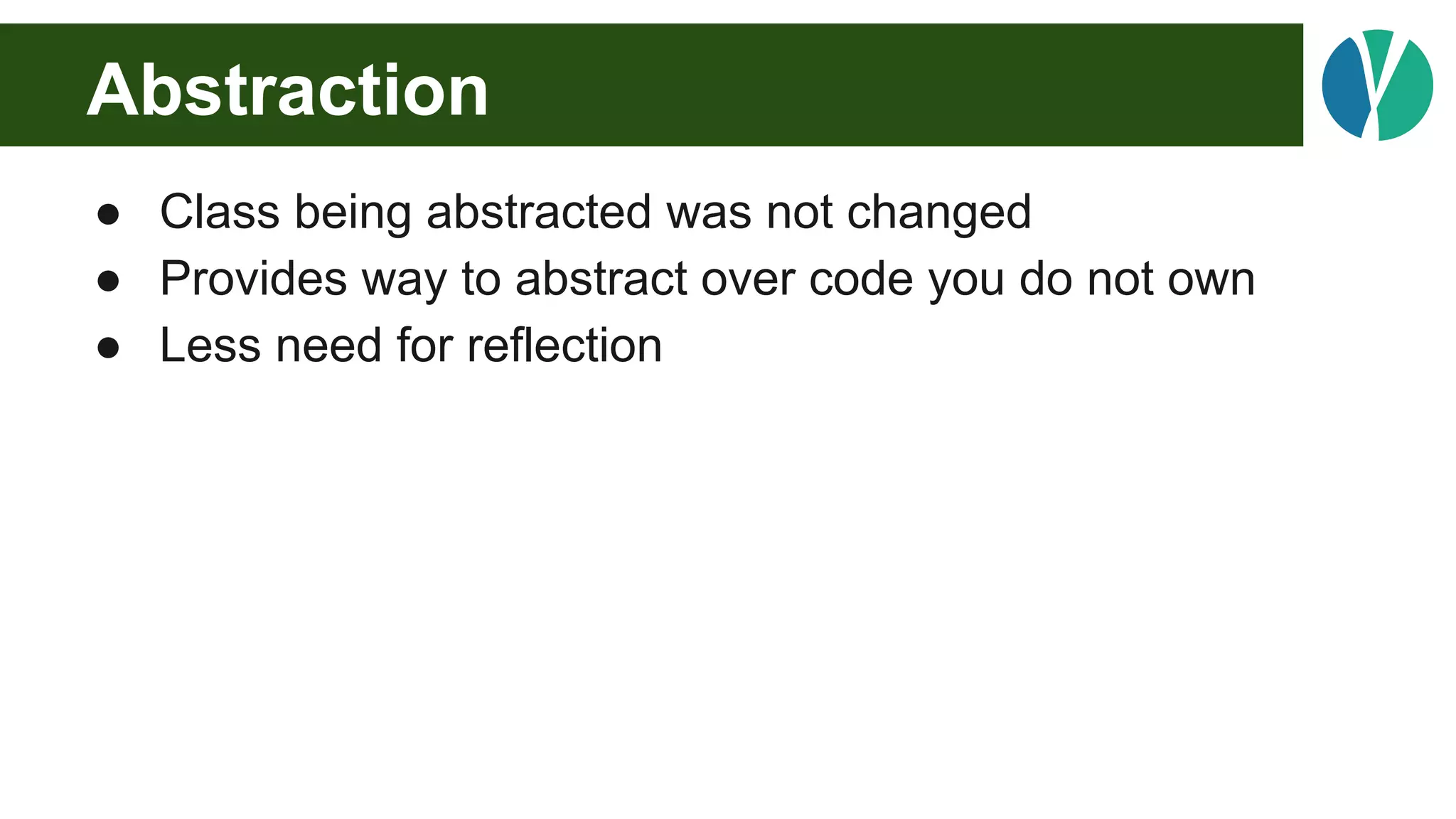
● Class being abstracted was not changed
● Provides way to abstract over code you do not own
● Less need for reflection
Design with Lambdas
Lambdas can abstract
in dynamic/flexible ways
Immutability
Multi-threaded
● JDK provides many tools for concurrency
● Parallel streams makes it even easier
● But parallel code is not simple to get right
Thread problems
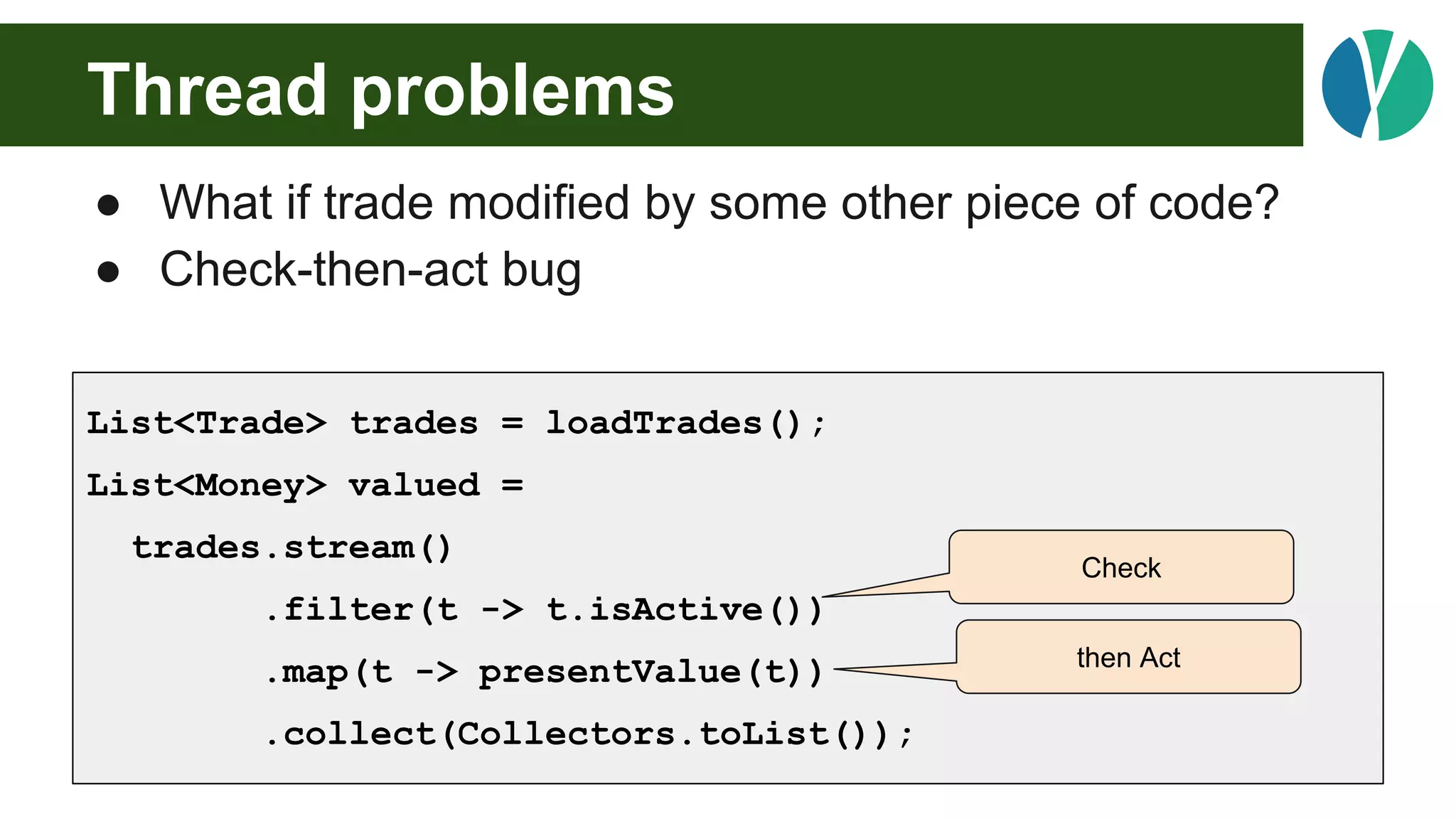
● What if trade modified by some other piece of code?
● Check-then-act bug
List<Trade> trades = loadTrades();
List<Money> valued =
trades.stream()
.filter(t -> t.isActive())
.map(t -> presentValue(t))
.collect(Collectors.toList());
Check
then Act
Immutable
● Threading bugs due to shared mutable state
● One solution is to use immutable beans
● No possibility of check-then-act type bug
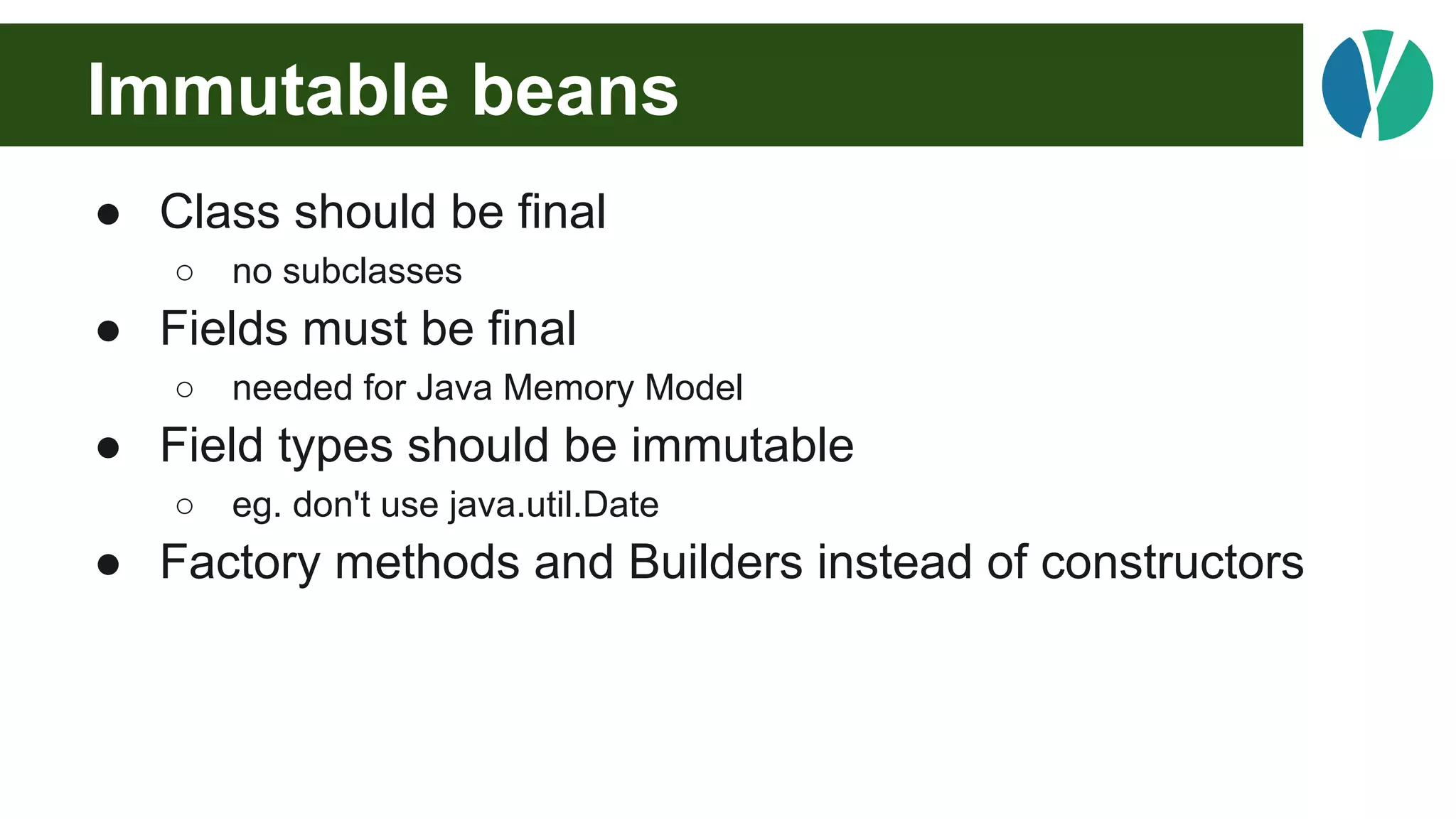
Immutable beans
● Class should be final
○ no subclasses
● Fields must be final
○ needed for Java Memory Model
● Field types should be immutable
○ eg. don't use java.util.Date
● Factory methods and Builders instead of constructors
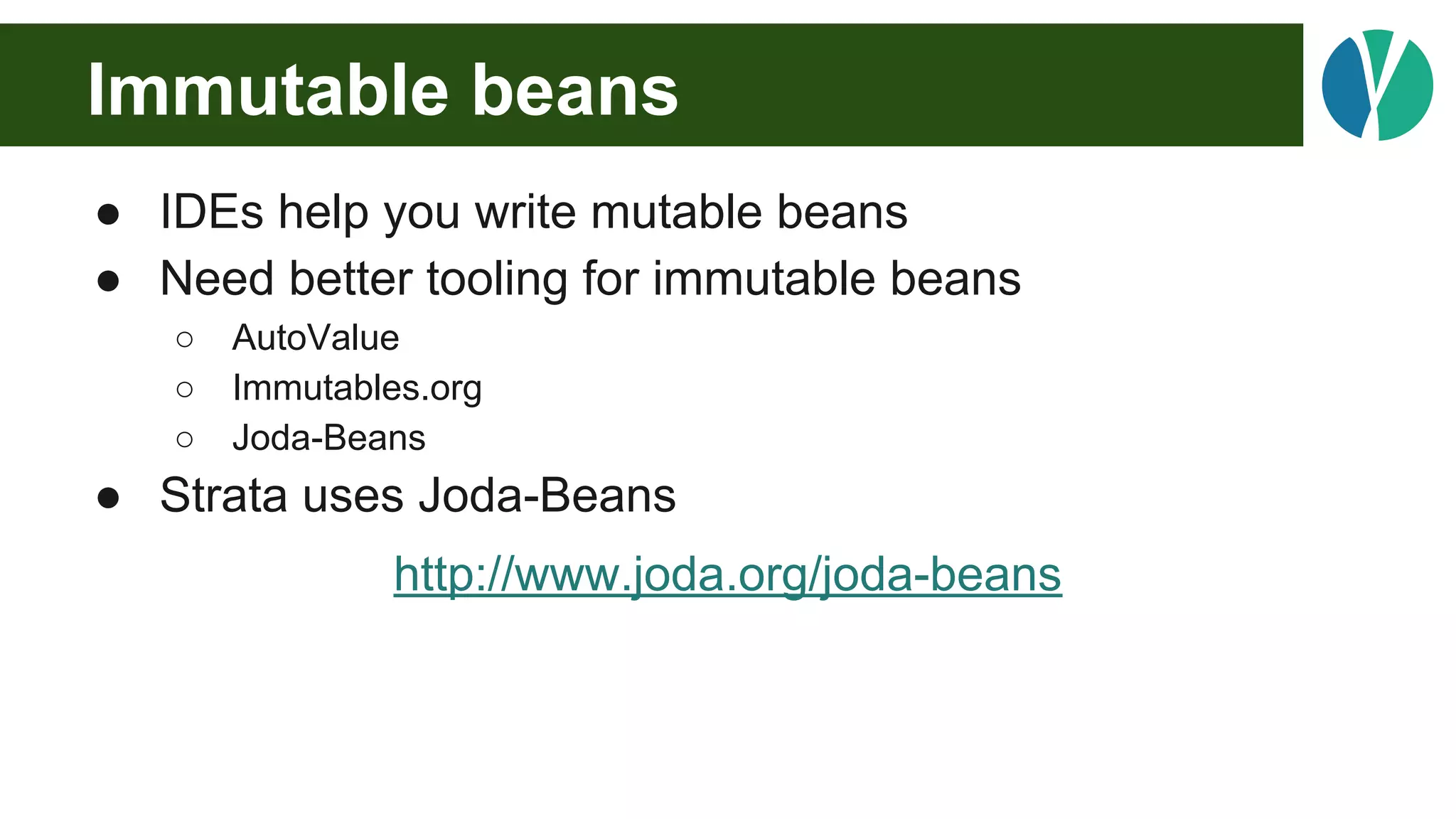
Immutable beans
● IDEs help you write mutable beans
● Need better tooling for immutable beans
○ AutoValue
○ Immutables.org
○ Joda-Beans
● Strata uses Joda-Beans
http://www.joda.org/joda-beans
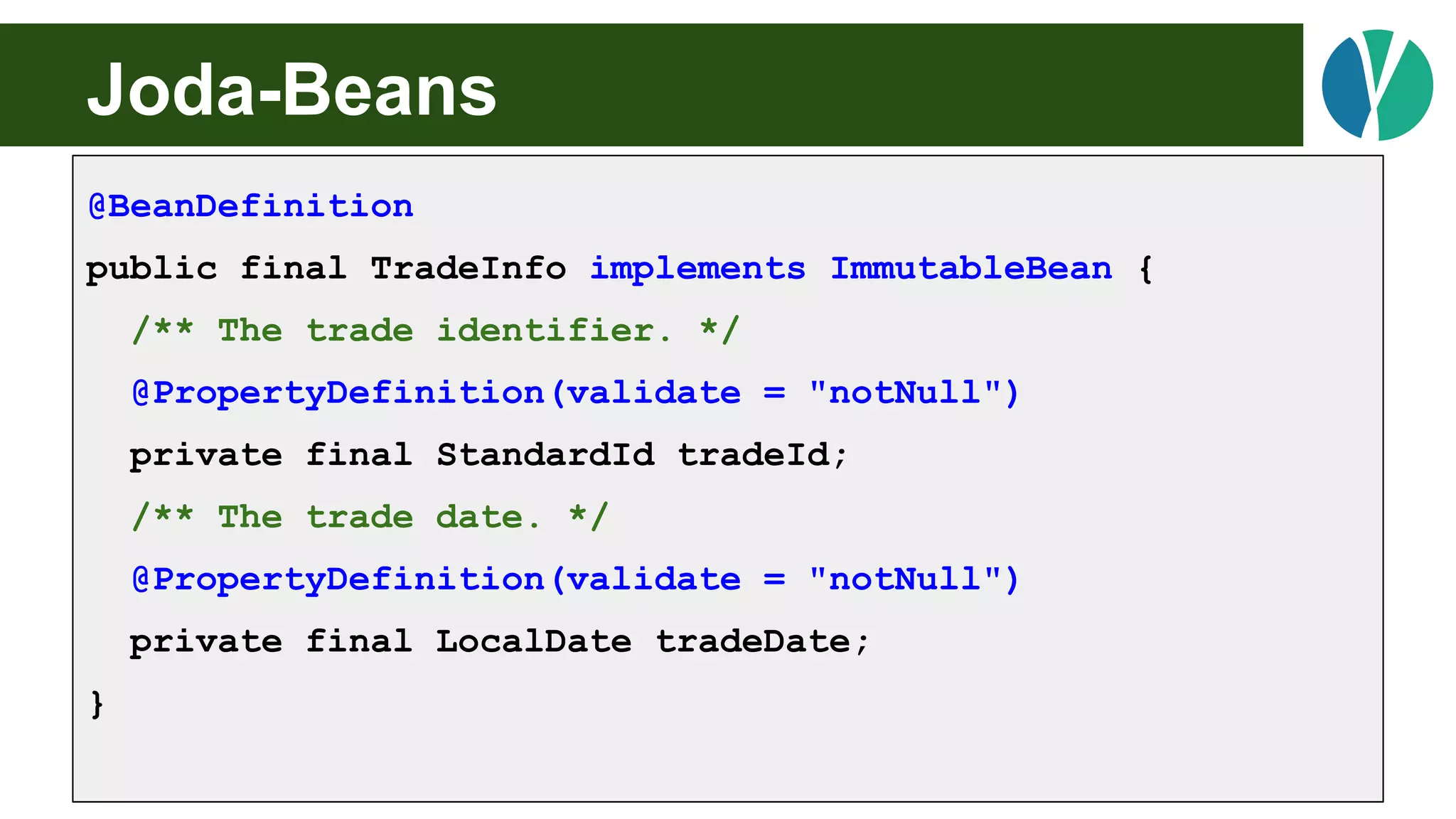
Joda-Beans
@BeanDefinition
public final TradeInfo implements ImmutableBean {
/** The trade identifier. */
@PropertyDefinition(validate = "notNull")
private final StandardId tradeId;
/** The trade date. */
@PropertyDefinition(validate = "notNull")
private final LocalDate tradeDate;
}
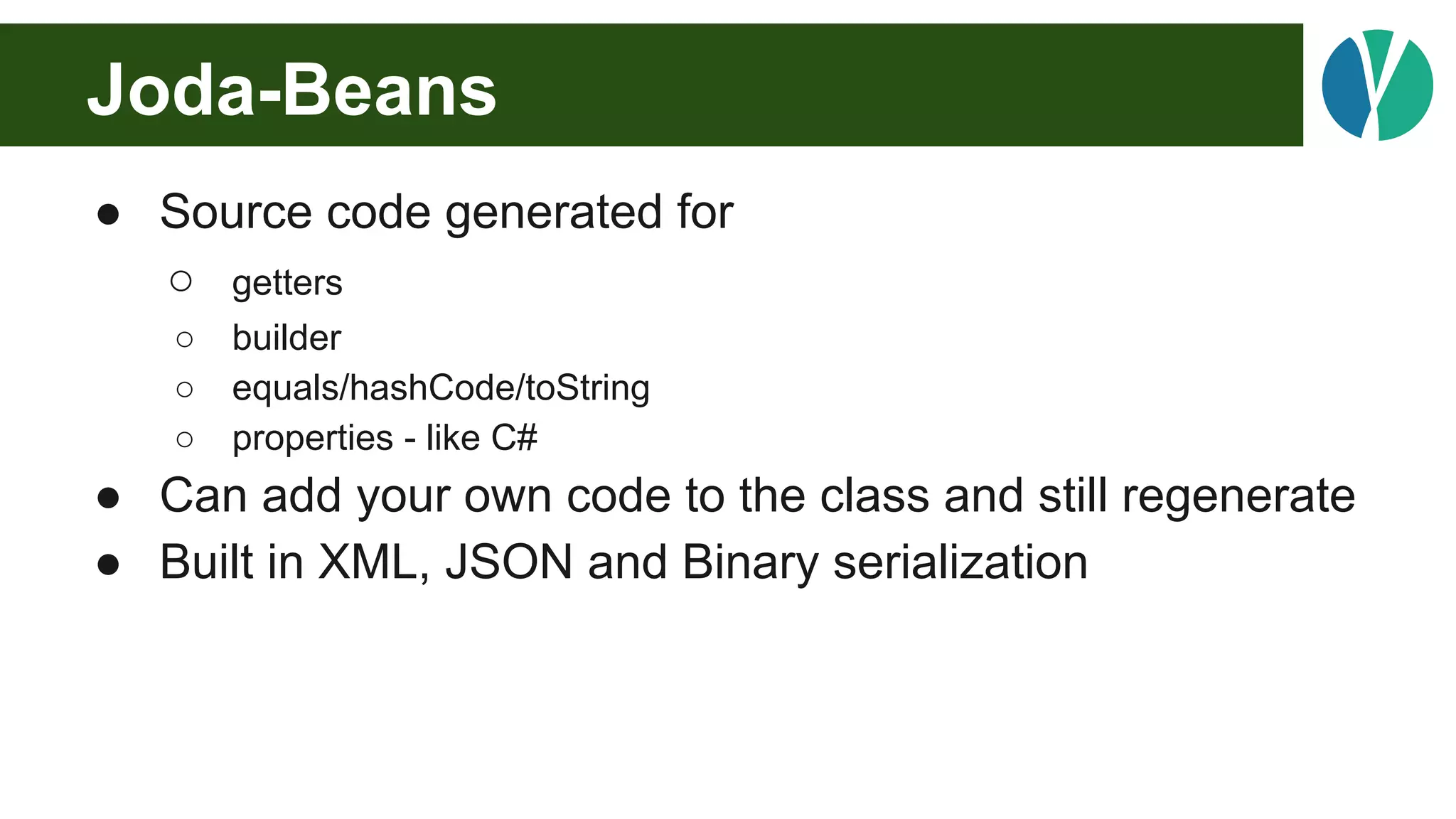
Joda-Beans
● Source code generated for
○ getters
○ builder
○ equals/hashCode/toString
○ properties - like C#
● Can add your own code to the class and still regenerate
● Built in XML, JSON and Binary serialization
Immutable beans
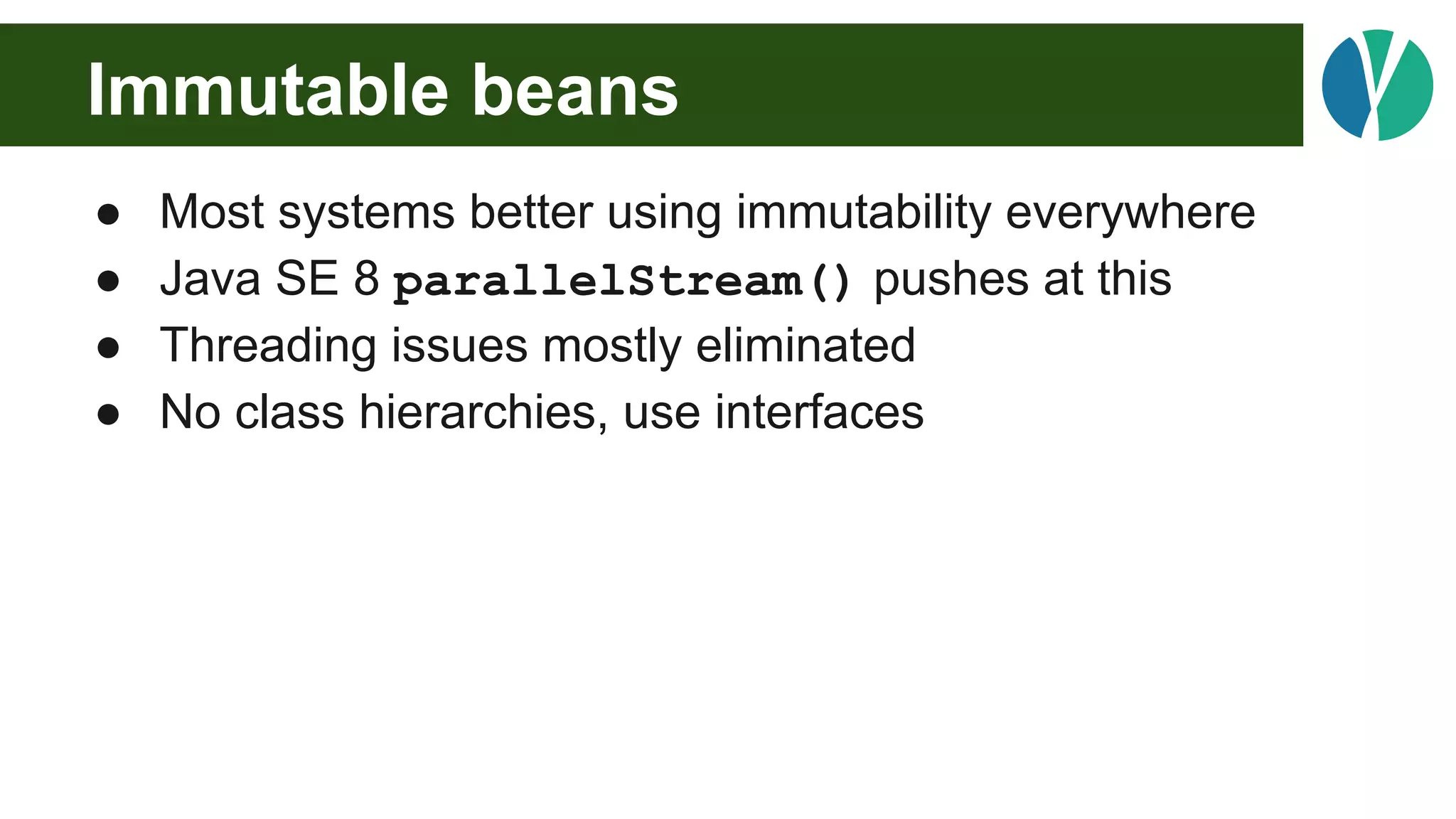
● Most systems better using immutability everywhere
● Java SE 8 parallelStream() pushes at this
● Threading issues mostly eliminated
● No class hierarchies, use interfaces
Use interfaces
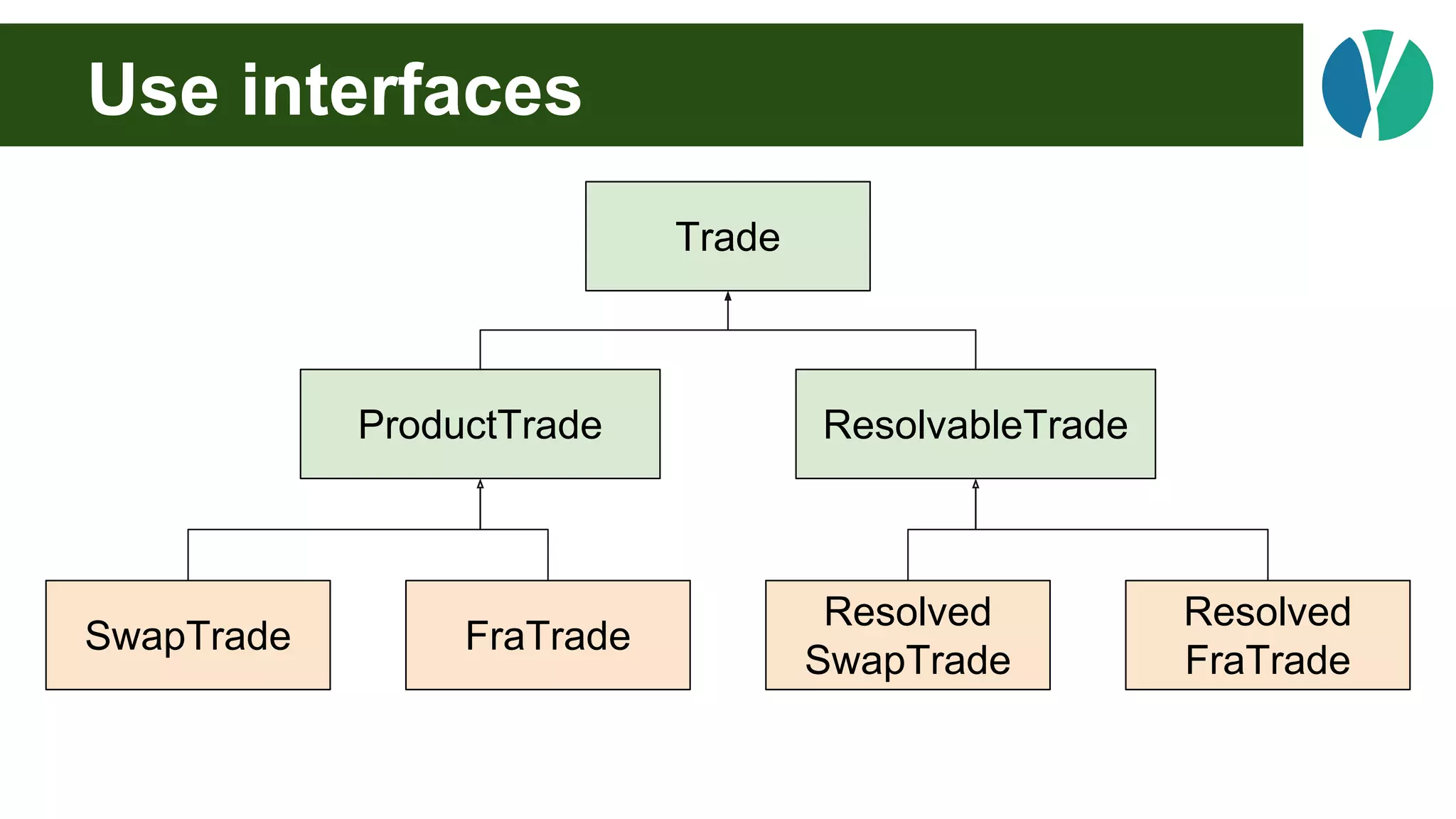
Trade
ProductTrade ResolvableTrade
SwapTrade FraTrade
Resolved
SwapTrade
Resolved
FraTrade
Use interfaces
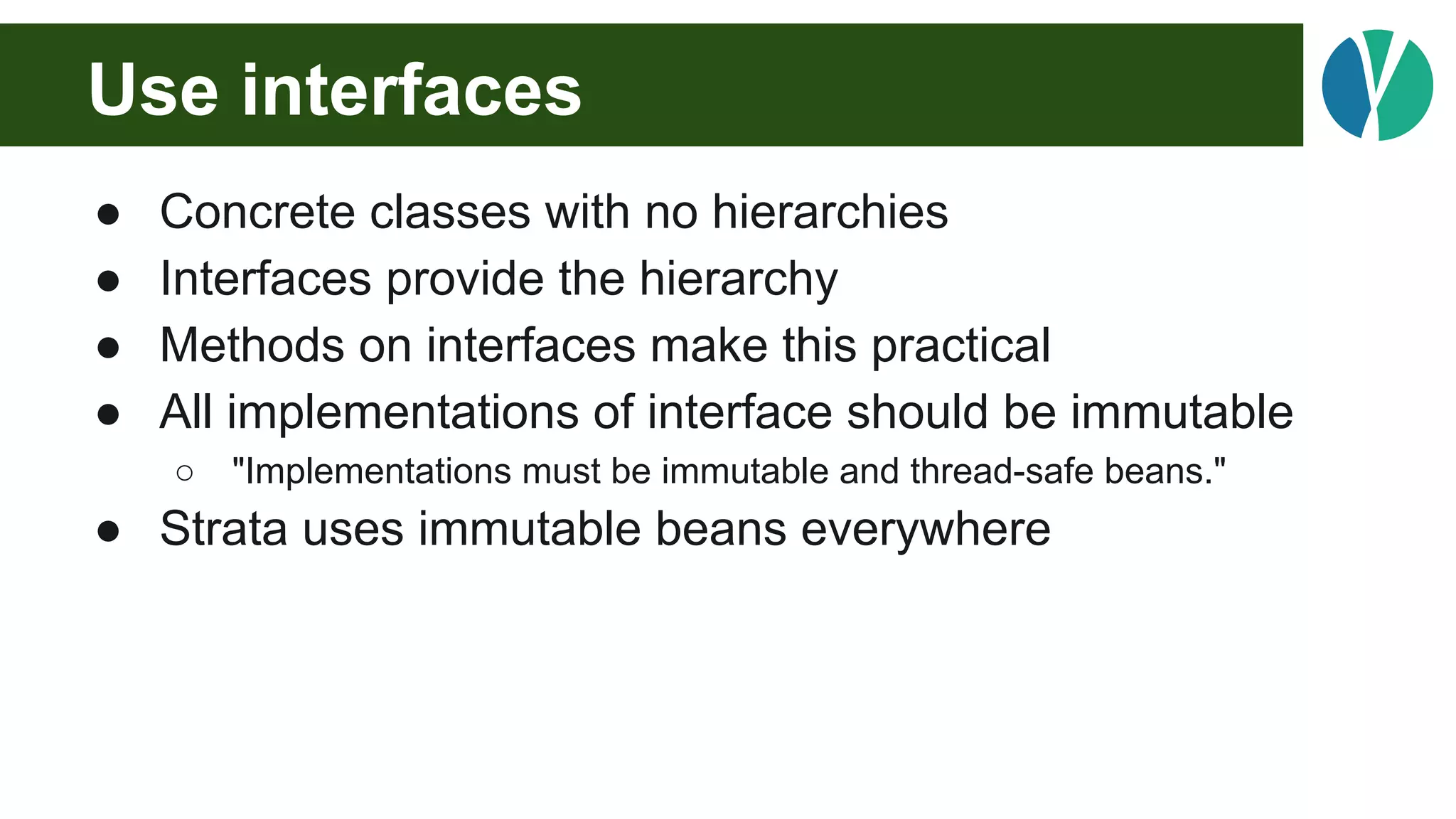
● Concrete classes with no hierarchies
● Interfaces provide the hierarchy
● Methods on interfaces make this practical
● All implementations of interface should be immutable
○ "Implementations must be immutable and thread-safe beans."
● Strata uses immutable beans everywhere
Immutability
It is time to move on
from mutable data objects
Interfaces
I
Interfaces
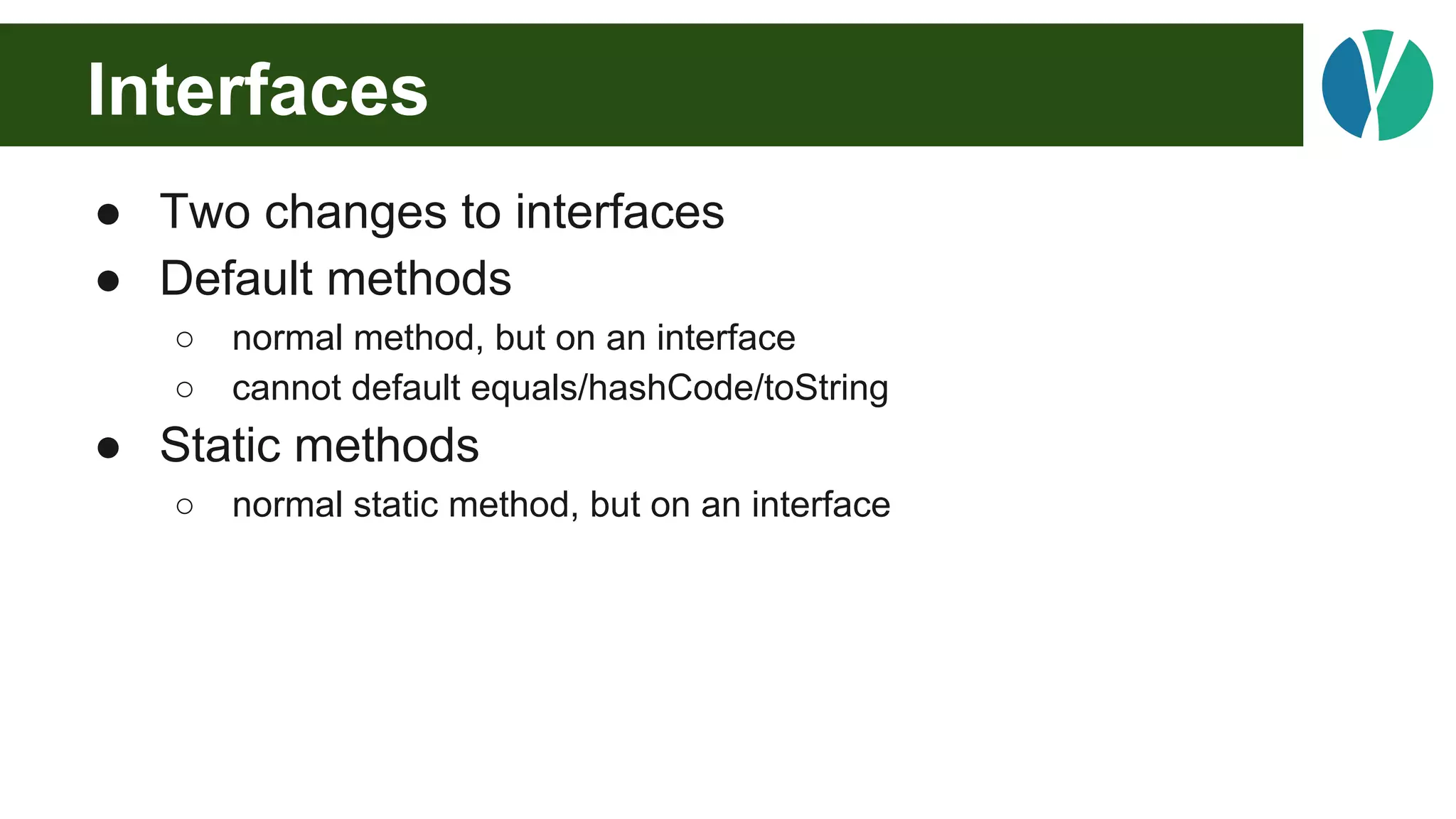
● Two changes to interfaces
● Default methods
○ normal method, but on an interface
○ cannot default equals/hashCode/toString
● Static methods
○ normal static method, but on an interface
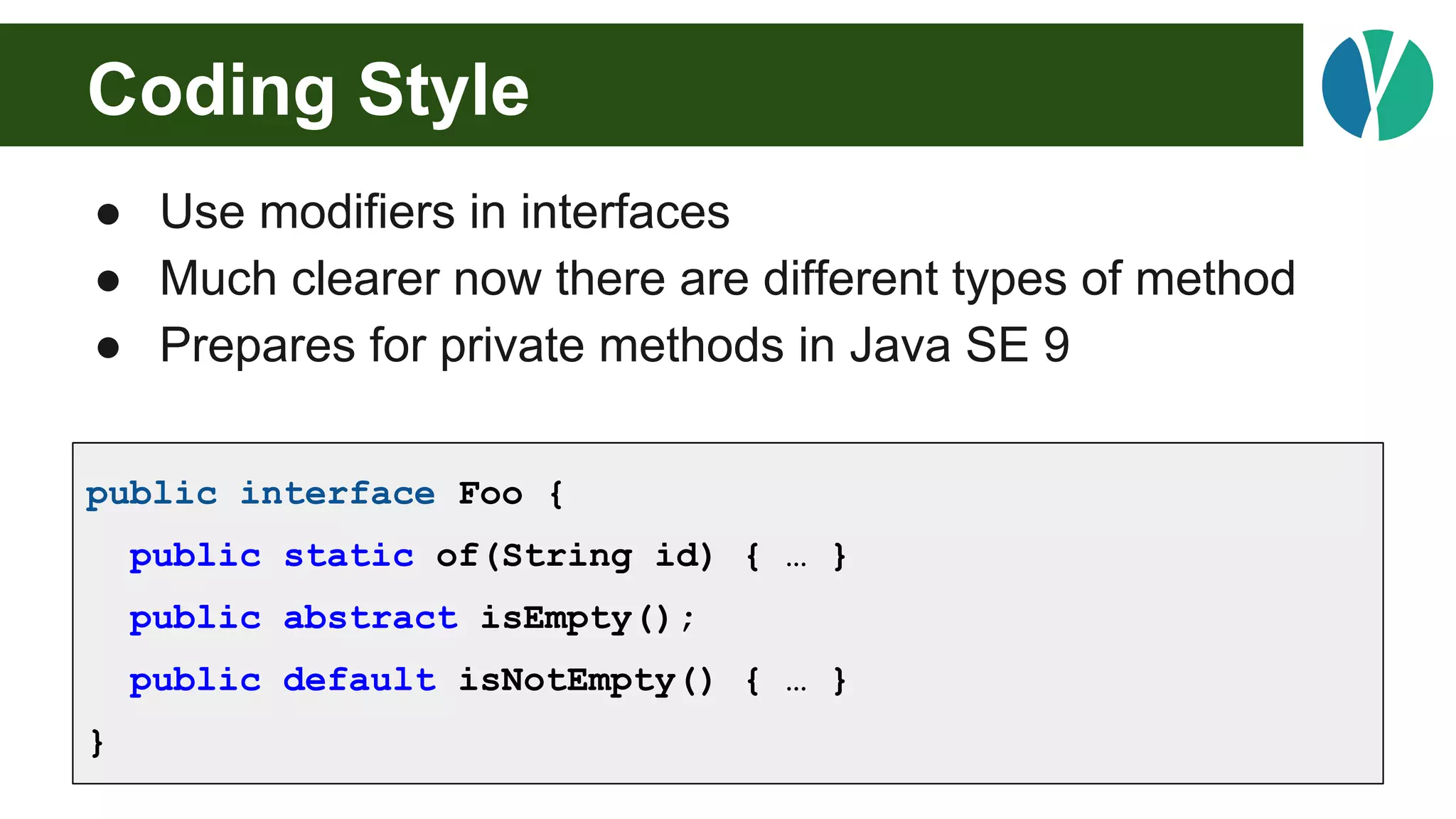
Coding Style
● Use modifiers in interfaces
● Much clearer now there are different types of method
● Prepares for private methods in Java SE 9
public interface Foo {
public static of(String id) { … }
public abstract isEmpty();
public default isNotEmpty() { … }
}
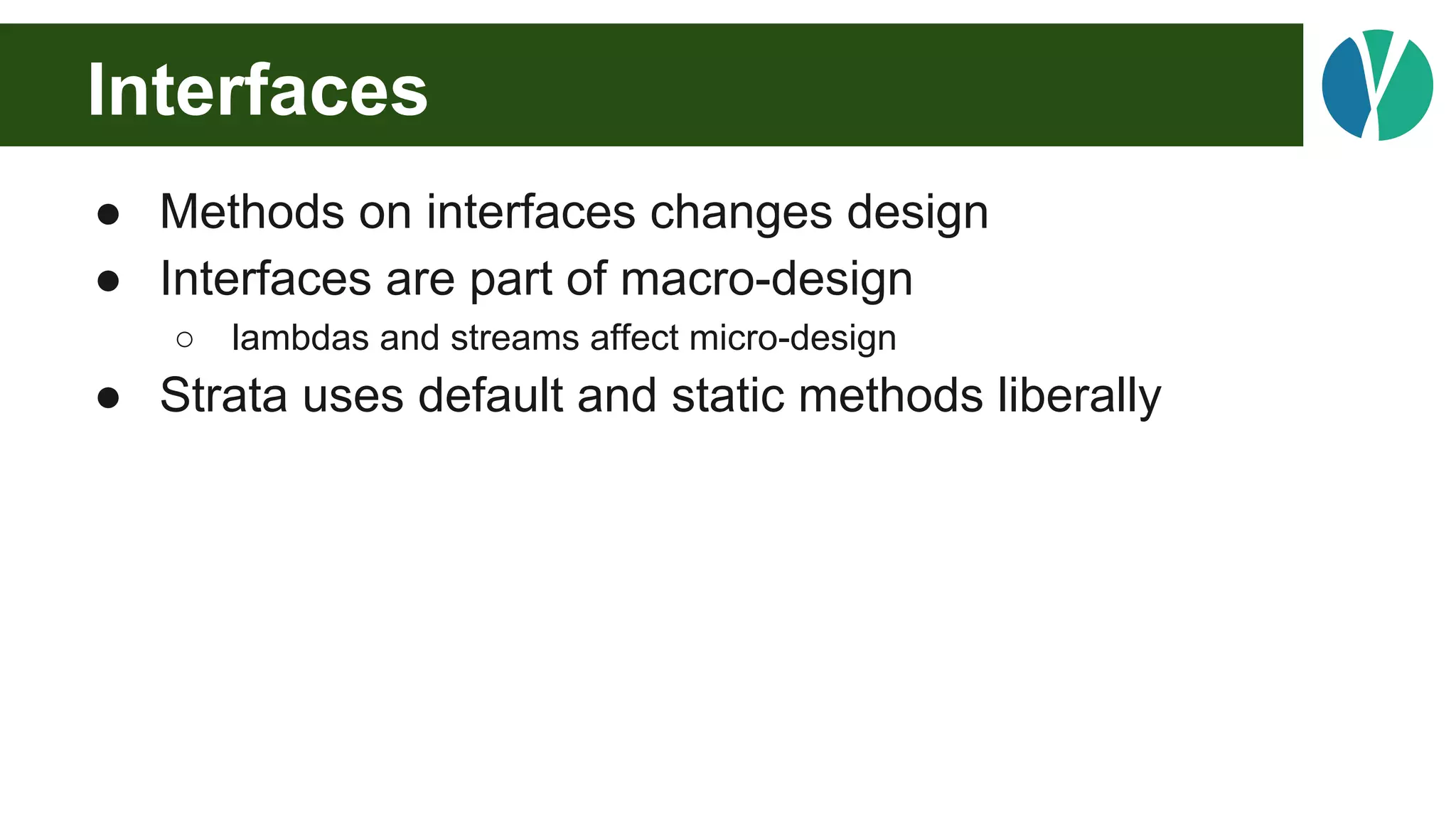
Interfaces
● Methods on interfaces changes design
● Interfaces are part of macro-design
○ lambdas and streams affect micro-design
● Strata uses default and static methods liberally
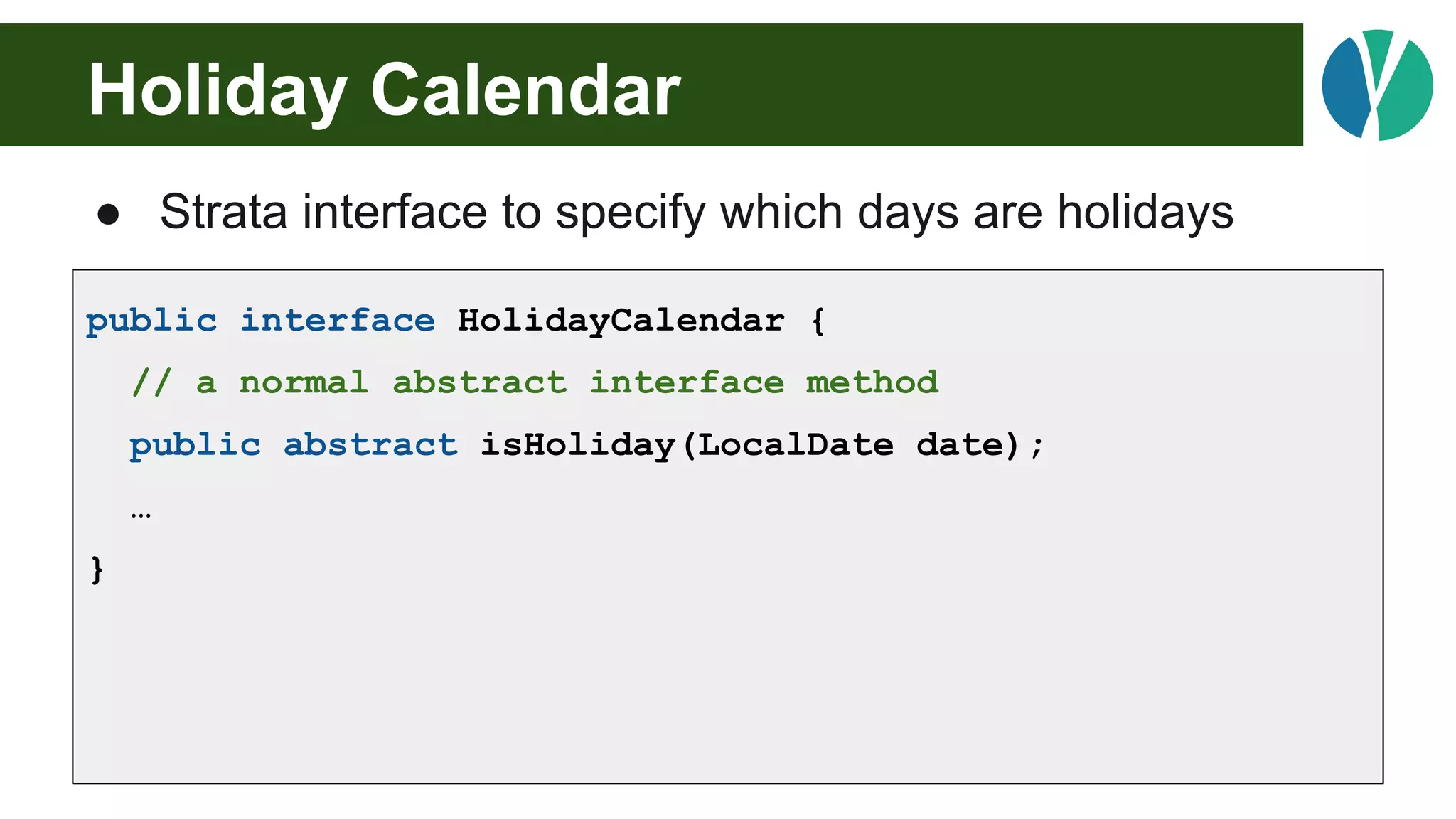
Holiday Calendar
● Strata interface to specify which days are holidays
public interface HolidayCalendar {
// a normal abstract interface method
public abstract isHoliday(LocalDate date);
…
}
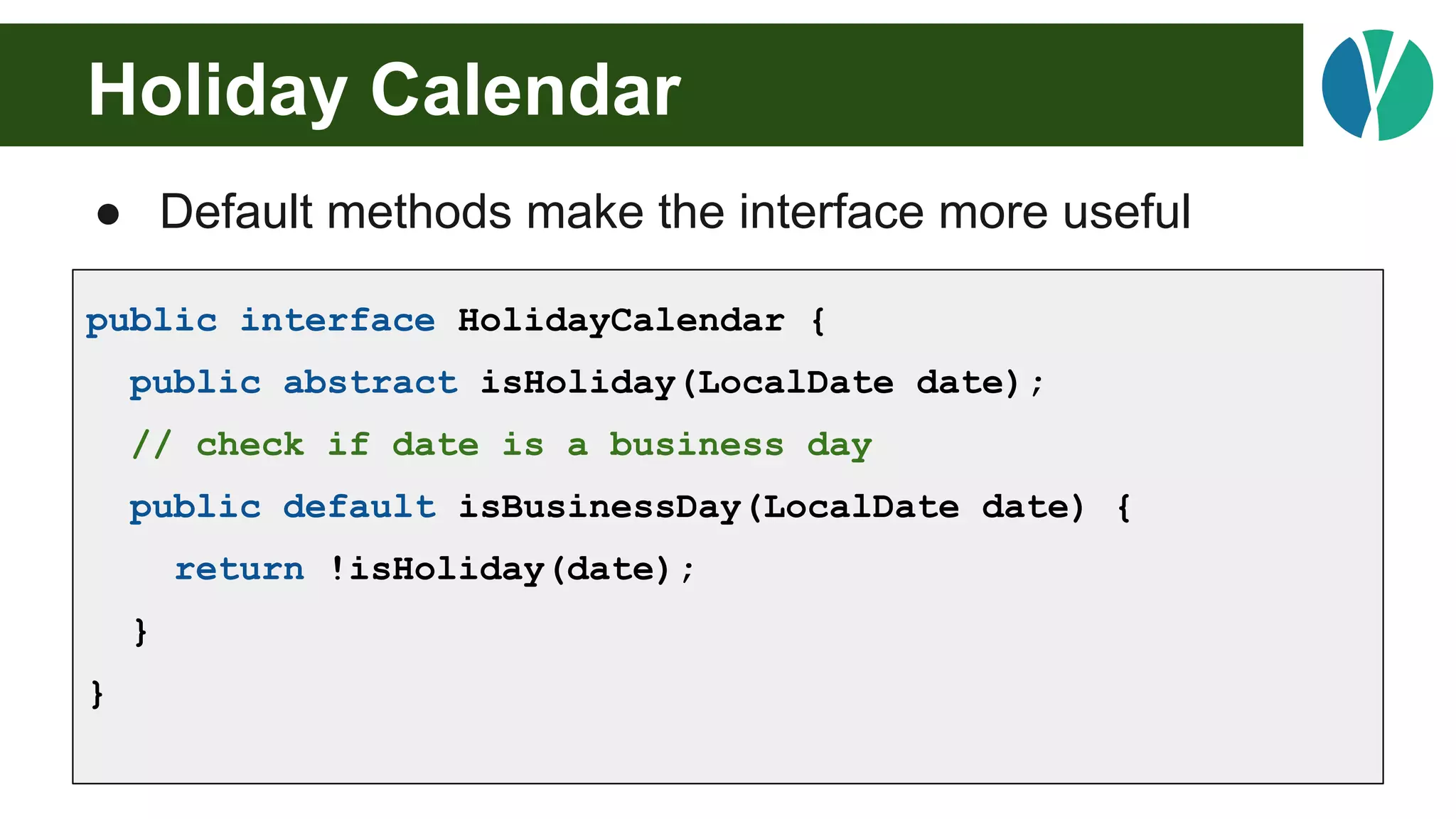
Holiday Calendar
● Default methods make the interface more useful
public interface HolidayCalendar {
public abstract isHoliday(LocalDate date);
// check if date is a business day
public default isBusinessDay(LocalDate date) {
return !isHoliday(date);
}
}
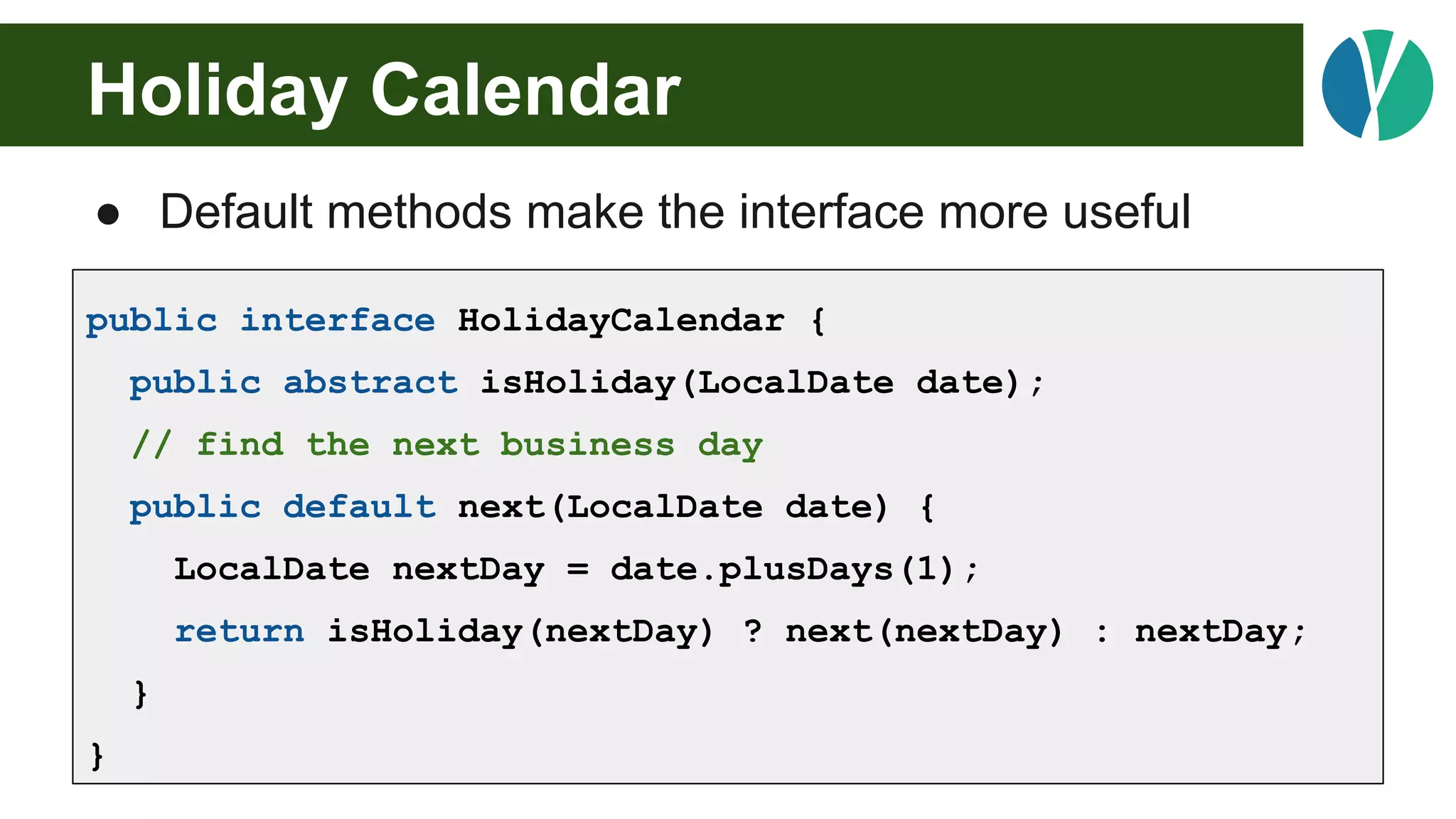
Holiday Calendar
● Default methods make the interface more useful
public interface HolidayCalendar {
public abstract isHoliday(LocalDate date);
// find the next business day
public default next(LocalDate date) {
LocalDate nextDay = date.plusDays(1);
return isHoliday(nextDay) ? next(nextDay) : nextDay;
}
}
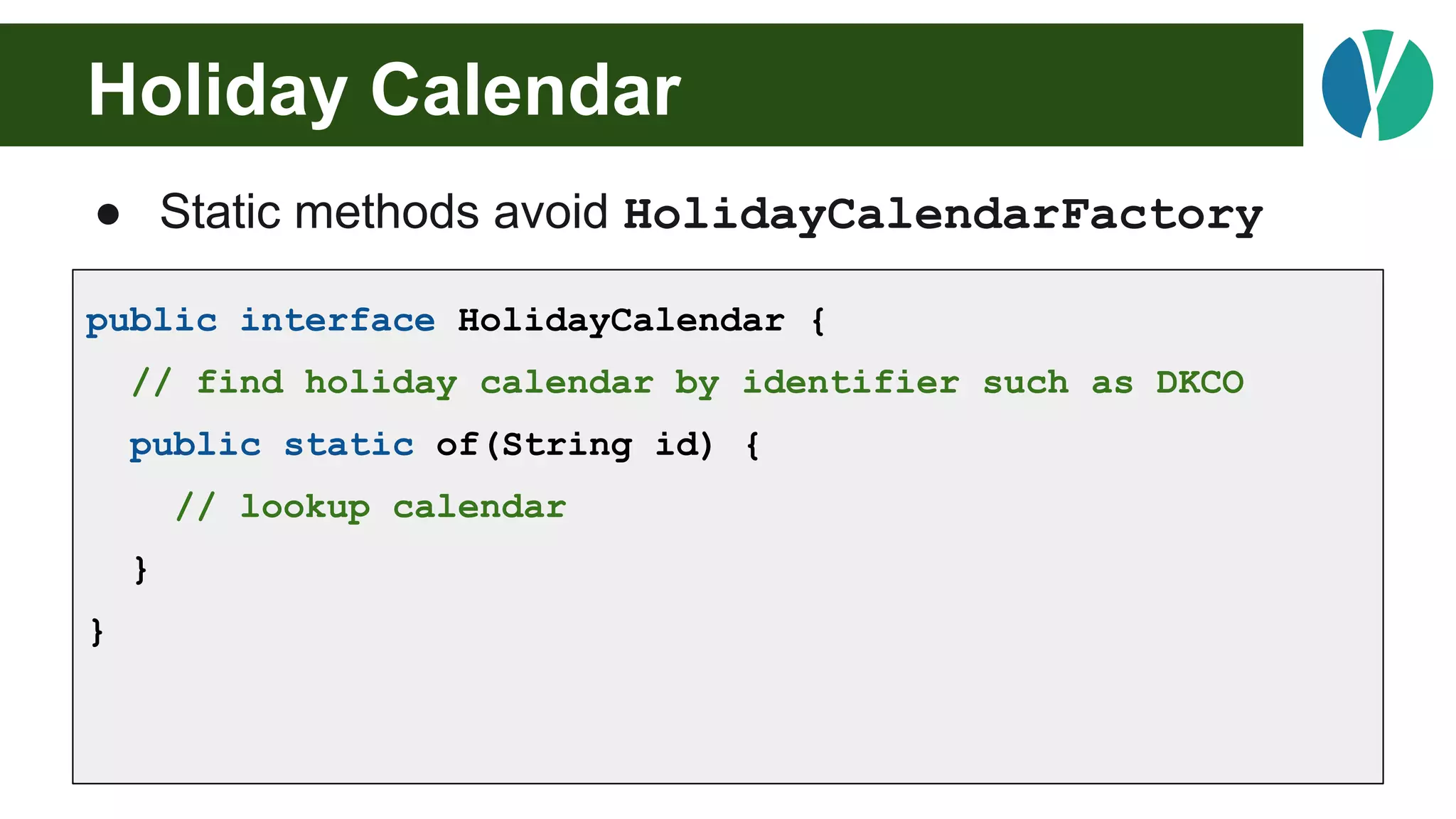
Holiday Calendar
● Static methods avoid HolidayCalendarFactory
public interface HolidayCalendar {
// find holiday calendar by identifier such as DKCO
public static of(String id) {
// lookup calendar
}
}
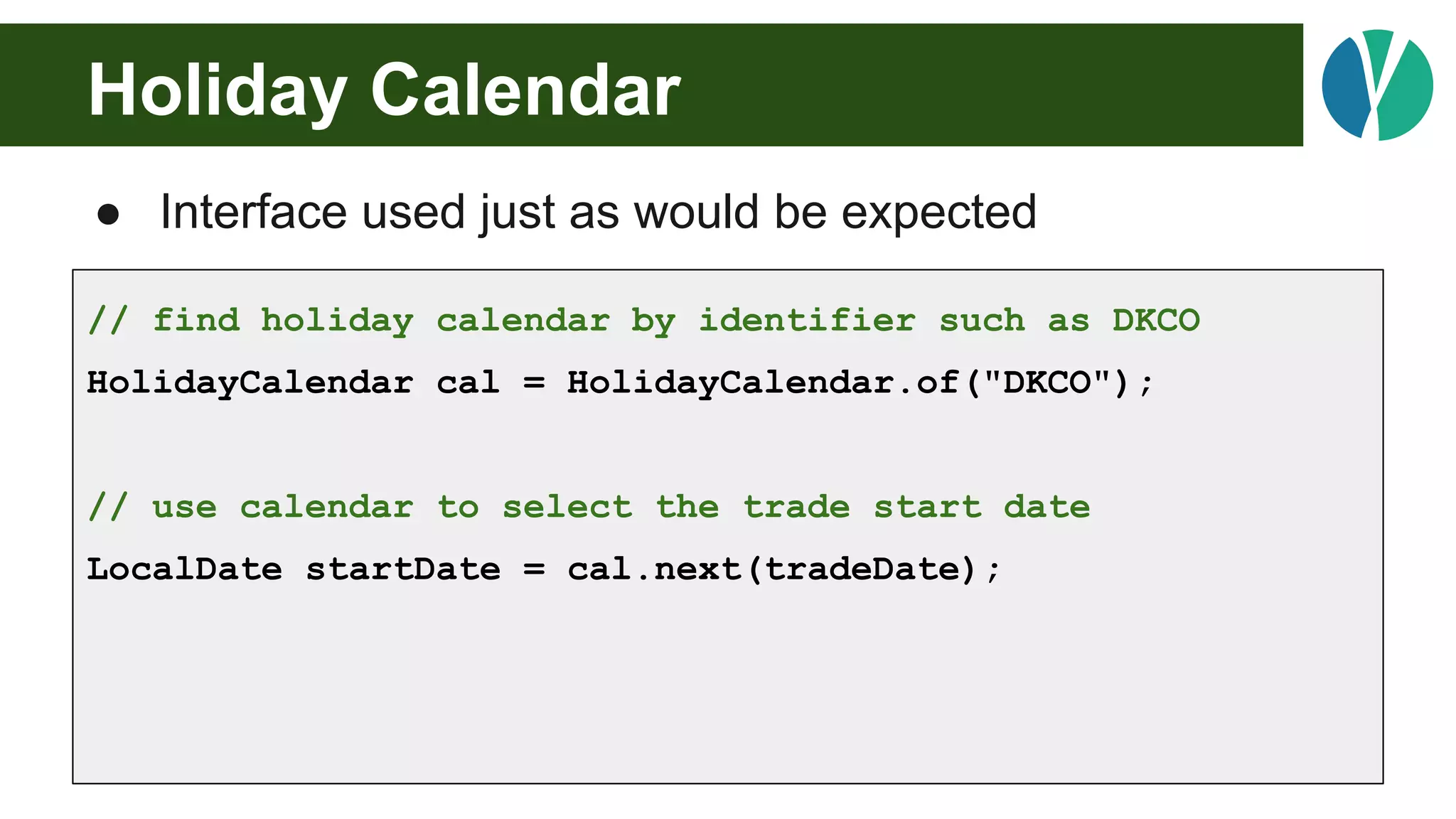
Holiday Calendar
● Interface used just as would be expected
// find holiday calendar by identifier such as DKCO
HolidayCalendar cal = HolidayCalendar.of("DKCO");
// use calendar to select the trade start date
LocalDate startDate = cal.next(tradeDate);
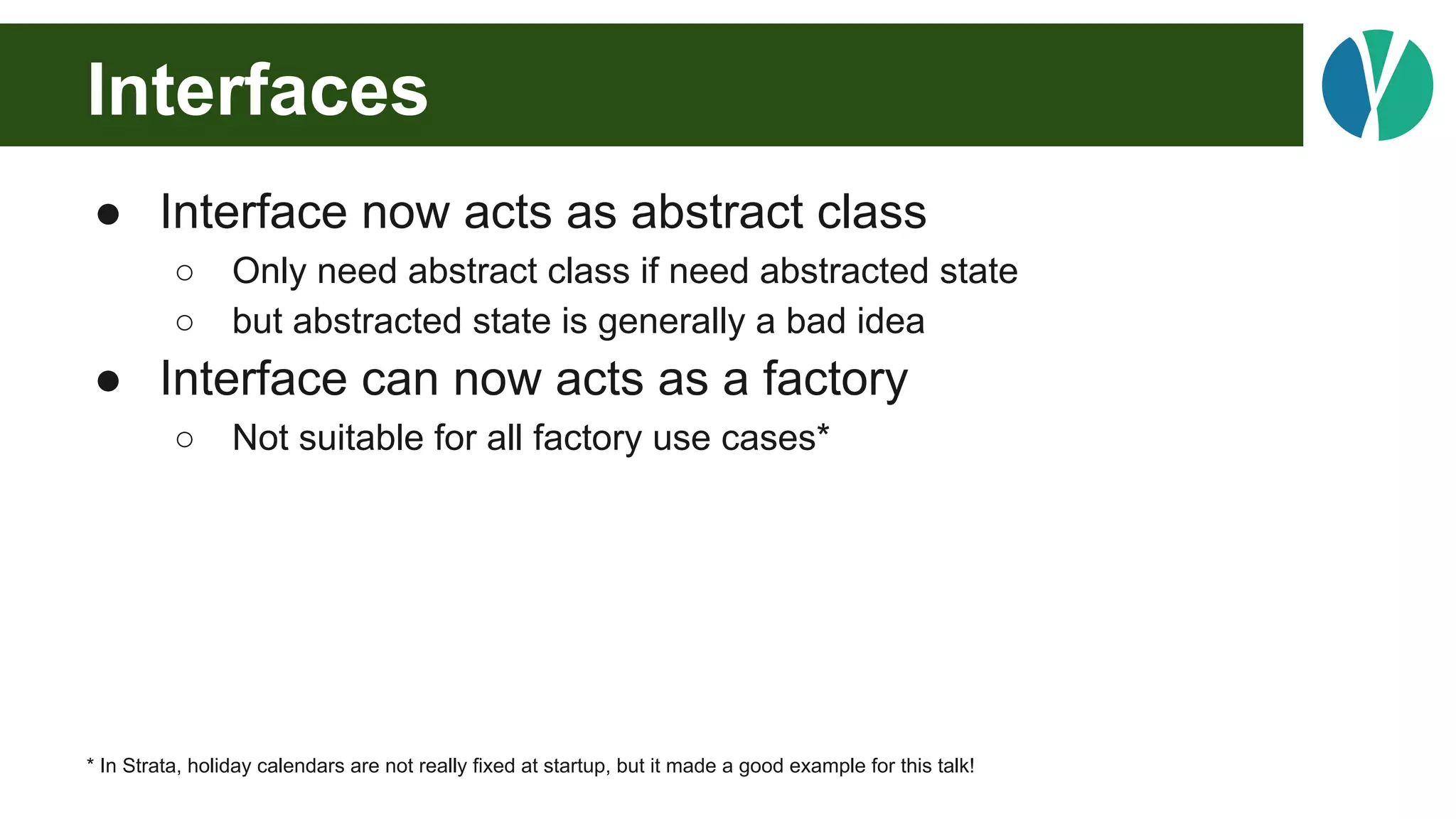
Interfaces
● Interface now acts as abstract class
○ Only need abstract class if need abstracted state
○ but abstracted state is generally a bad idea
● Interface can now acts as a factory
○ Not suitable for all factory use cases*
* In Strata, holiday calendars are not really fixed at startup, but it made a good example for this talk!
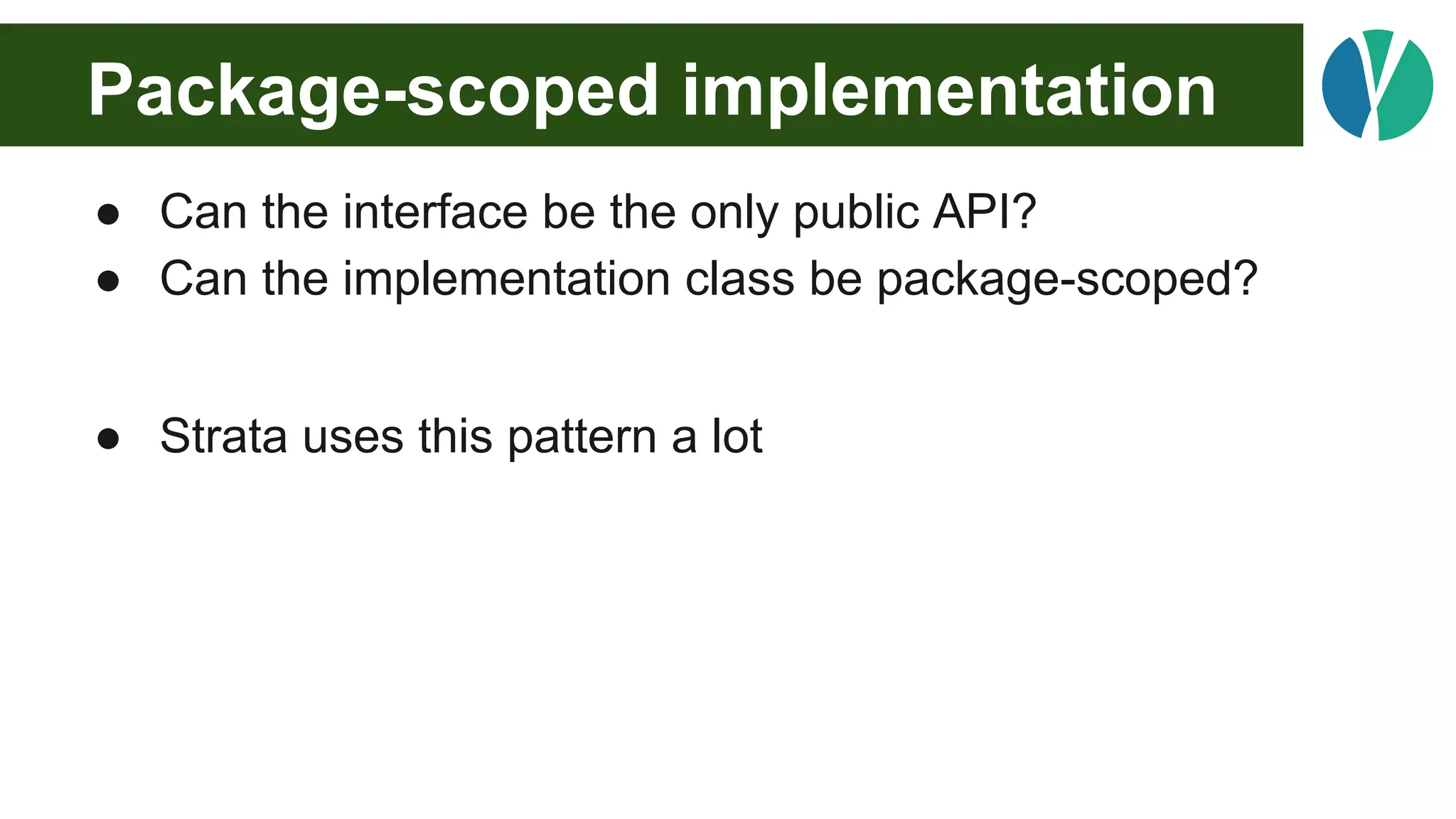
Package-scoped implementation
● Can the interface be the only public API?
● Can the implementation class be package-scoped?
● Strata uses this pattern a lot
Interfaces
Consider package-scoped
factory and implementation
Optional and null
?
Optional and null
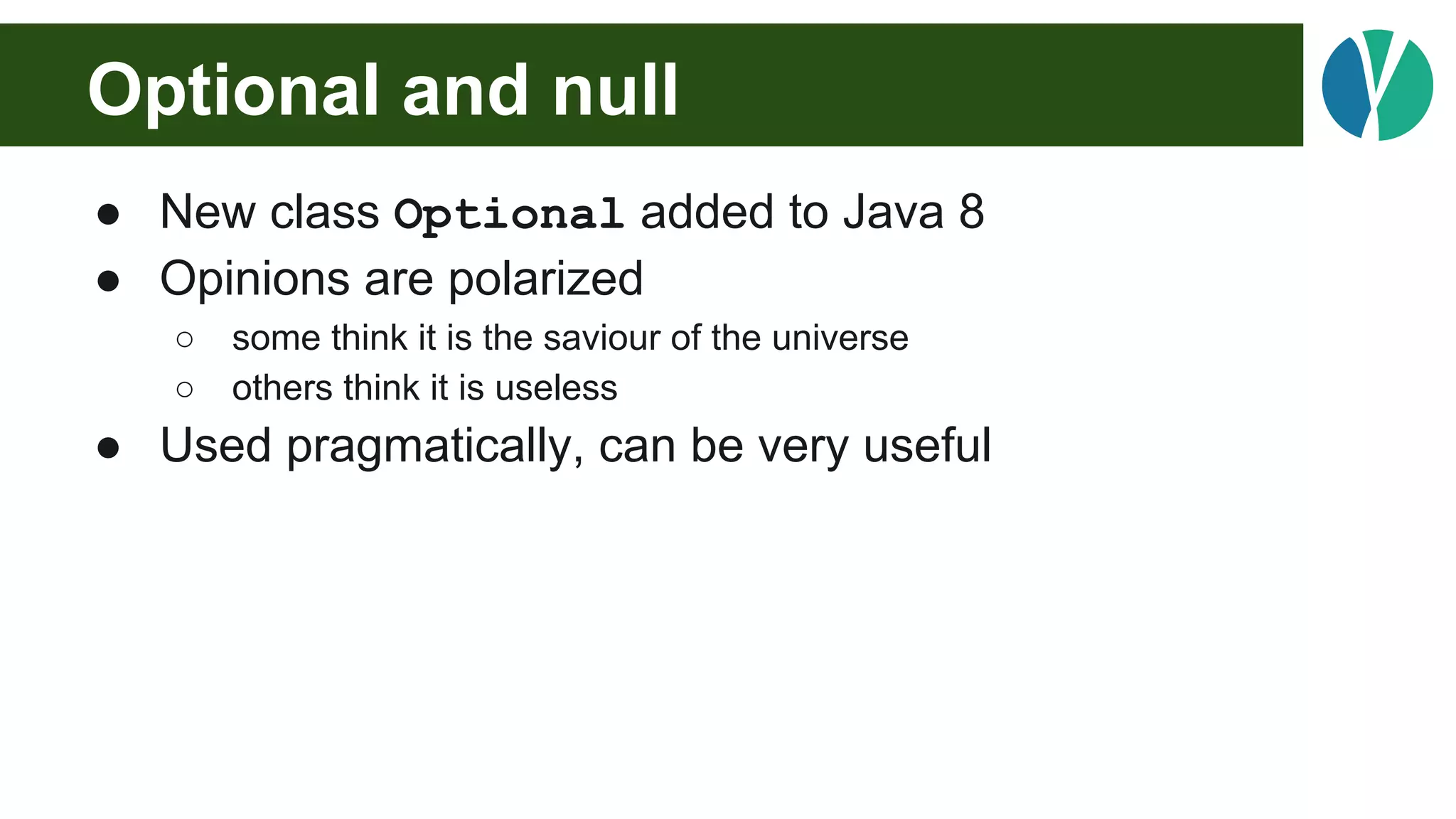
● New class Optional added to Java 8
● Opinions are polarized
○ some think it is the saviour of the universe
○ others think it is useless
● Used pragmatically, can be very useful
Optional and null
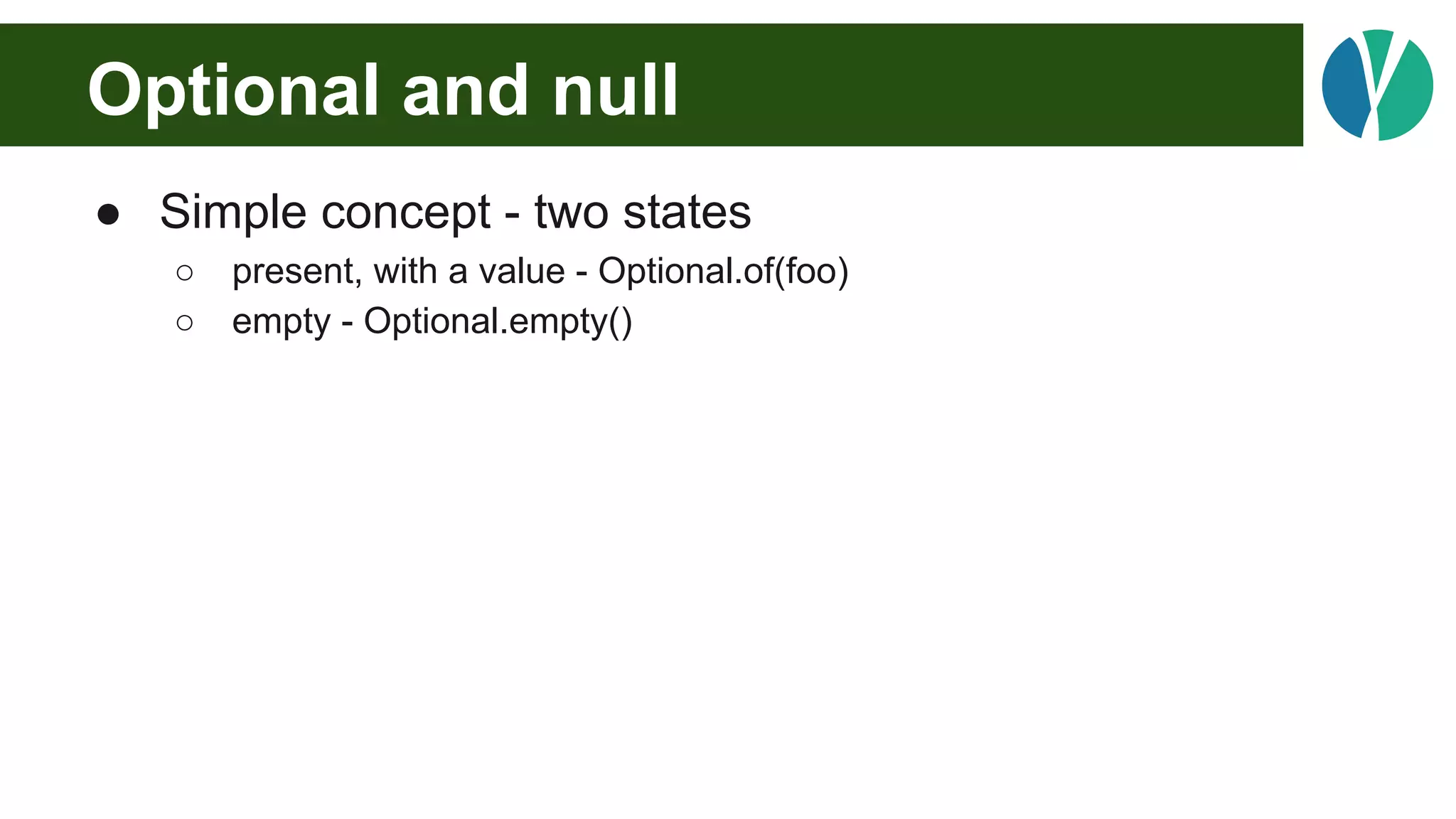
● Simple concept - two states
○ present, with a value - Optional.of(foo)
○ empty - Optional.empty()
Optional and null
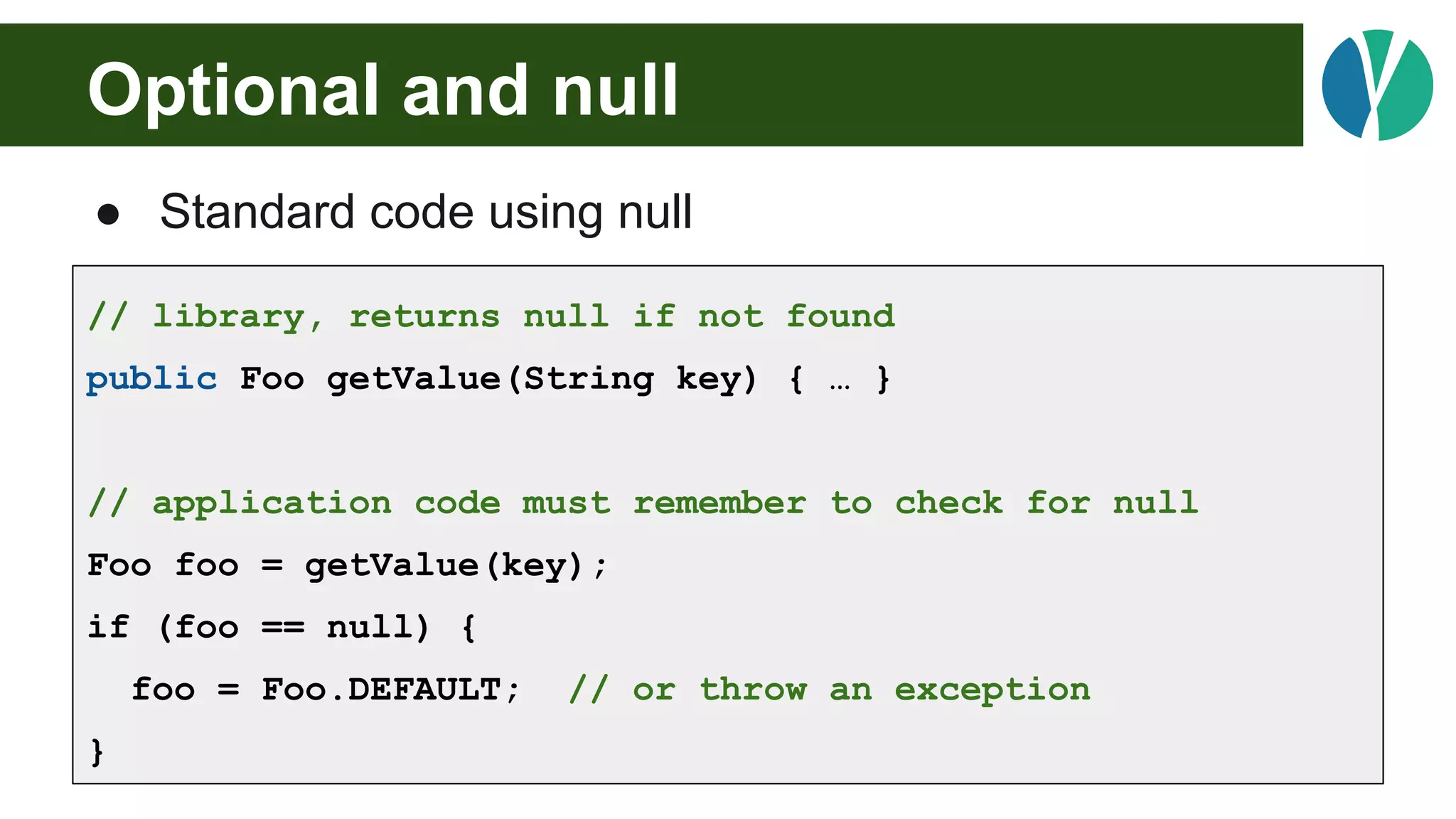
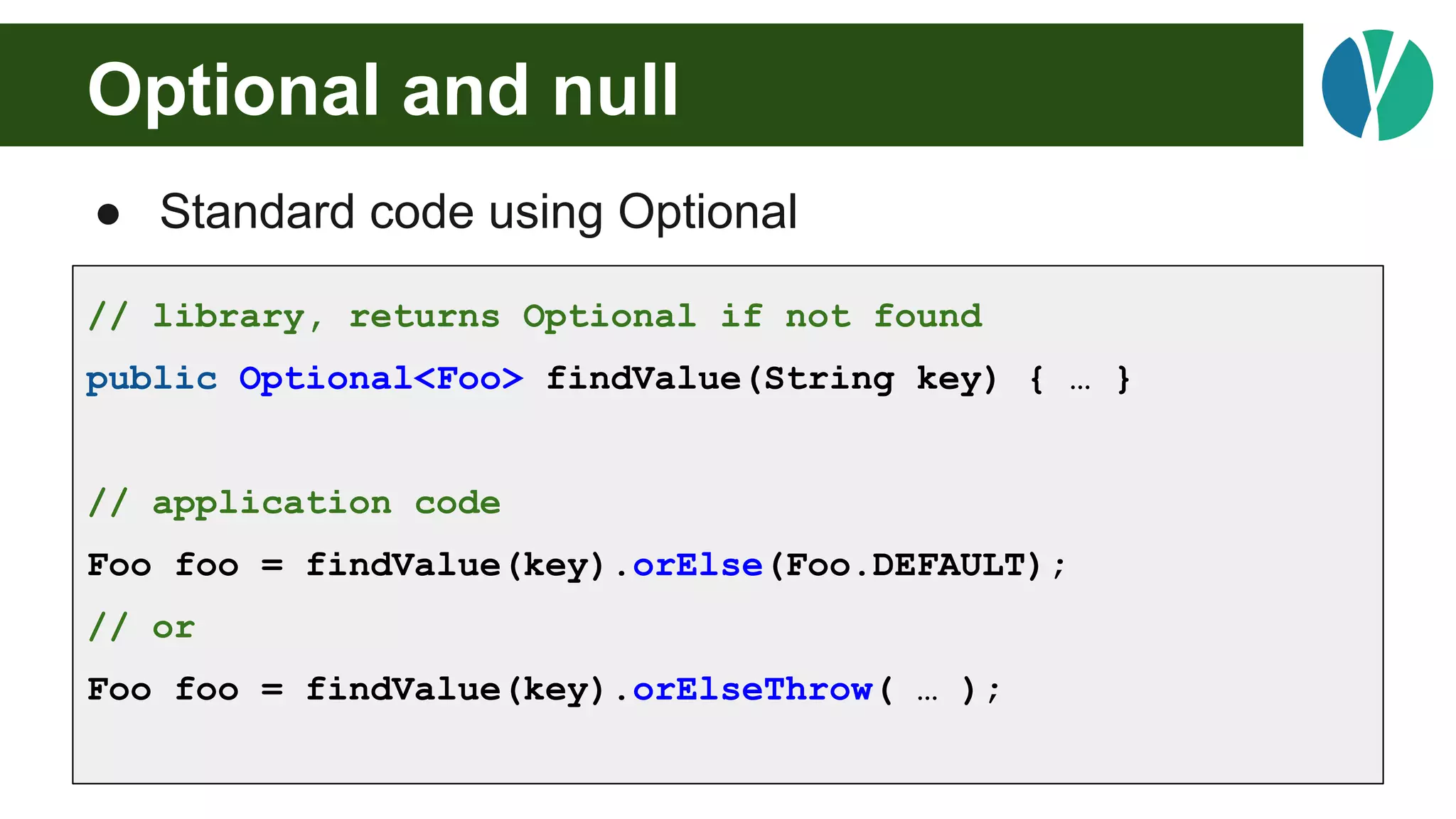
● Standard code using null
// library, returns null if not found
public Foo getValue(String key) { … }
// application code must remember to check for null
Foo foo = getValue(key);
if (foo == null) {
foo = Foo.DEFAULT; // or throw an exception
}
Optional and null
● Standard code using Optional
// library, returns Optional if not found
public Optional<Foo> findValue(String key) { … }
// application code
Foo foo = findValue(key).orElse(Foo.DEFAULT);
// or
Foo foo = findValue(key).orElseThrow( … );
Optional and null
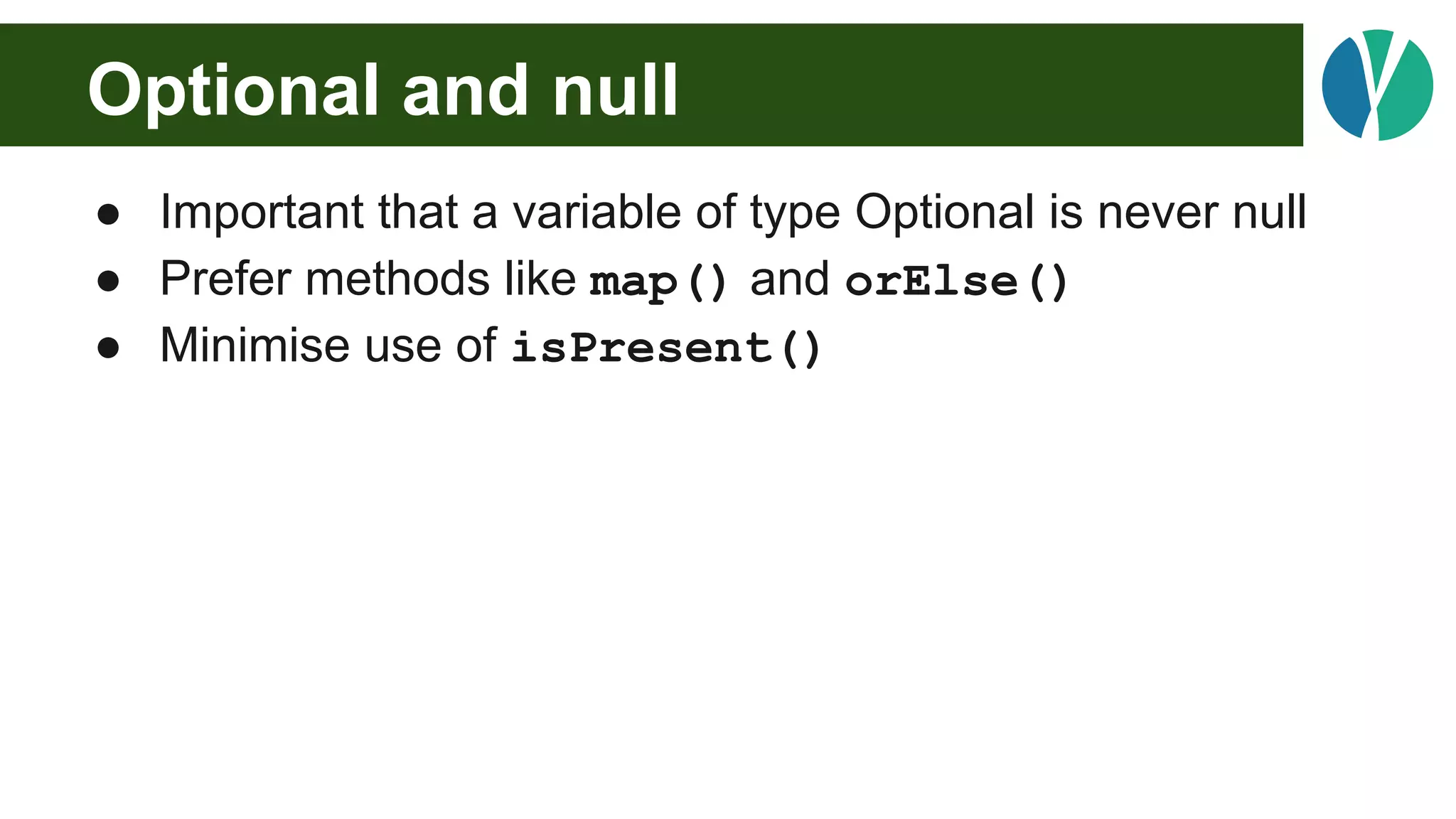
● Important that a variable of type Optional is never null
● Prefer methods like map() and orElse()
● Minimise use of isPresent()
Optional
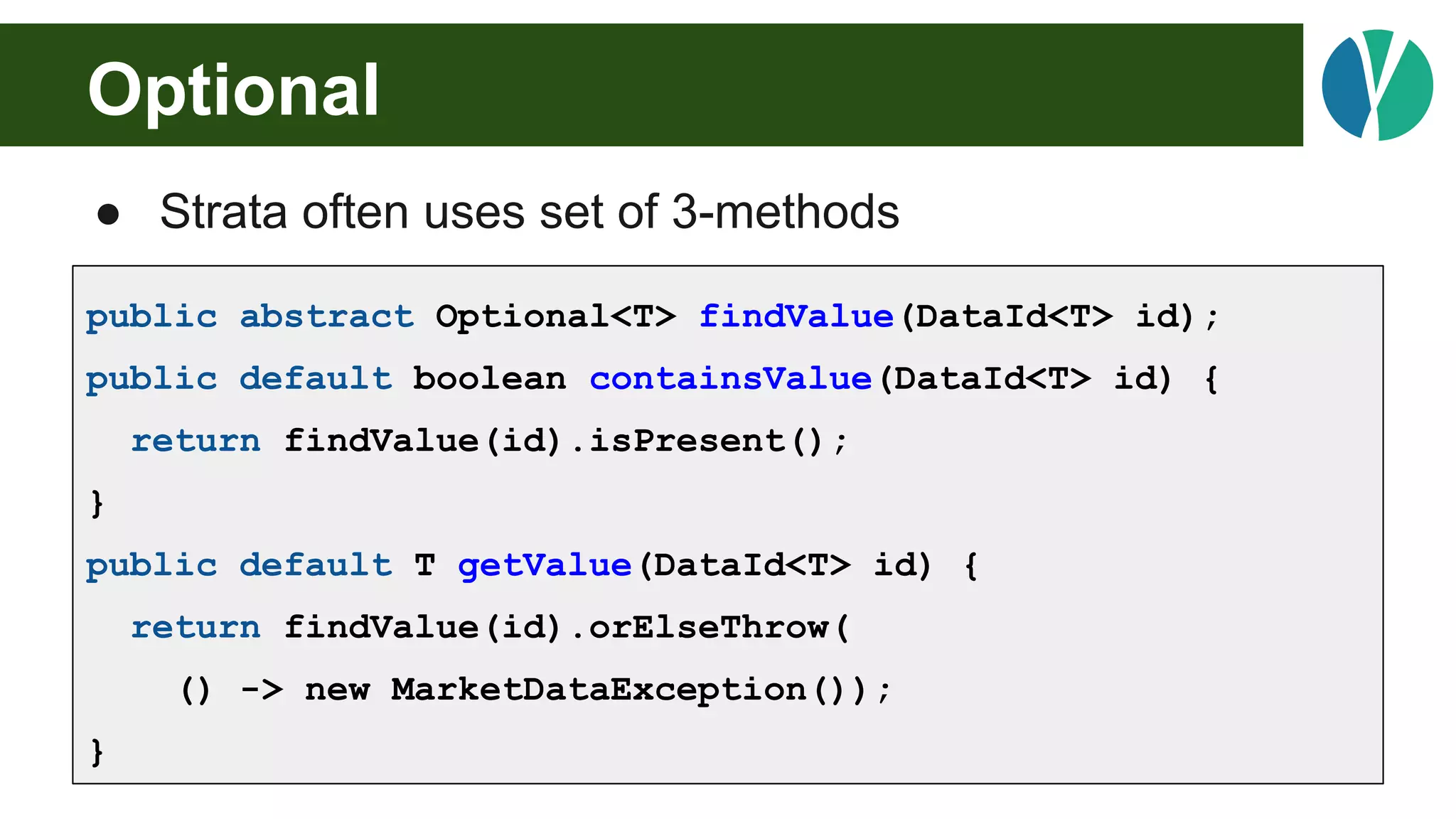
● Strata often uses set of 3-methods
public abstract Optional<T> findValue(DataId<T> id);
public default boolean containsValue(DataId<T> id) {
return findValue(id).isPresent();
}
public default T getValue(DataId<T> id) {
return findValue(id).orElseThrow(
() -> new MarketDataException());
}
Optional
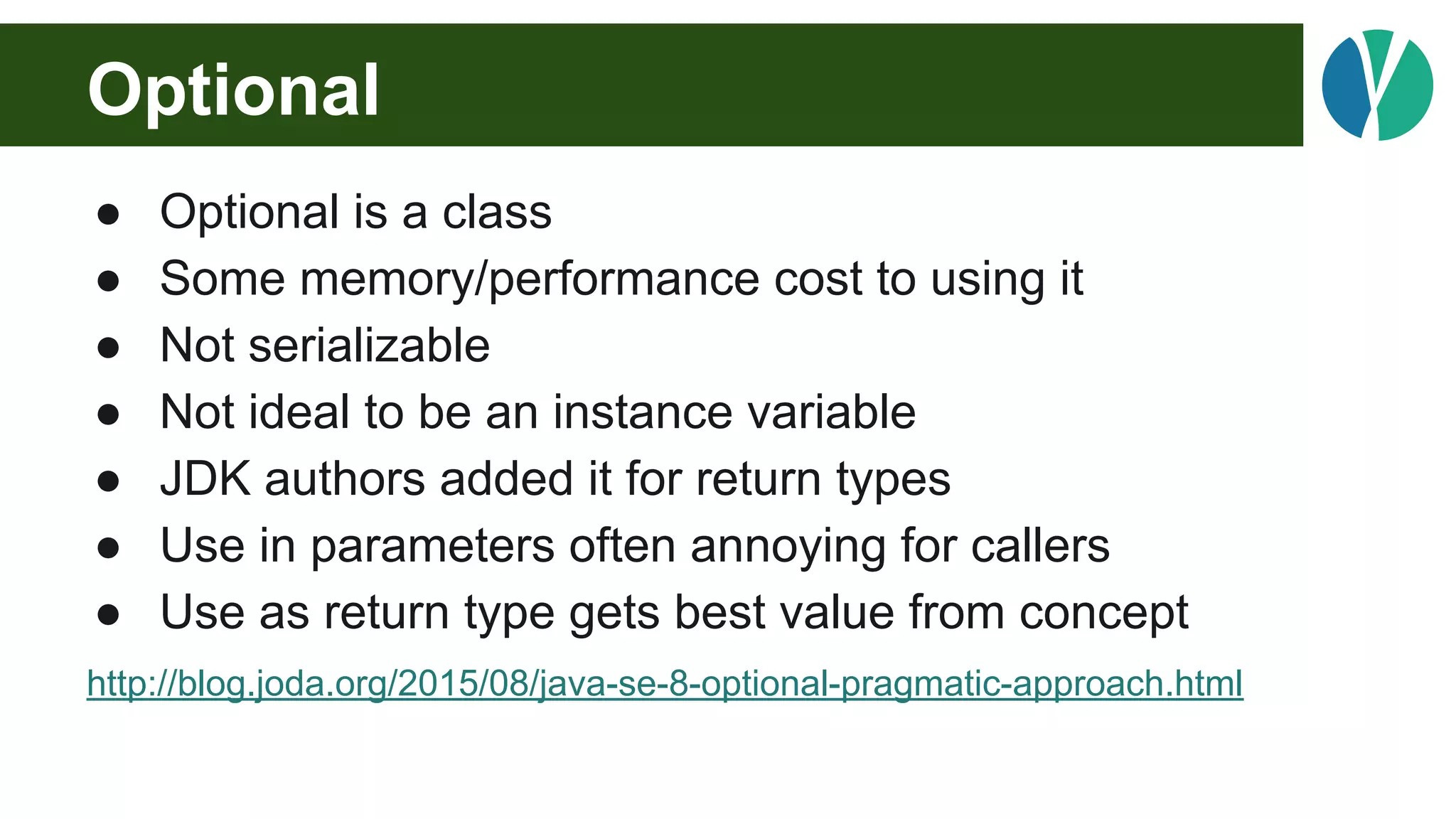
● Optional is a class
● Some memory/performance cost to using it
● Not serializable
● Not ideal to be an instance variable
● JDK authors added it for return types
● Use in parameters often annoying for callers
● Use as return type gets best value from concept
http://blog.joda.org/2015/08/java-se-8-optional-pragmatic-approach.html
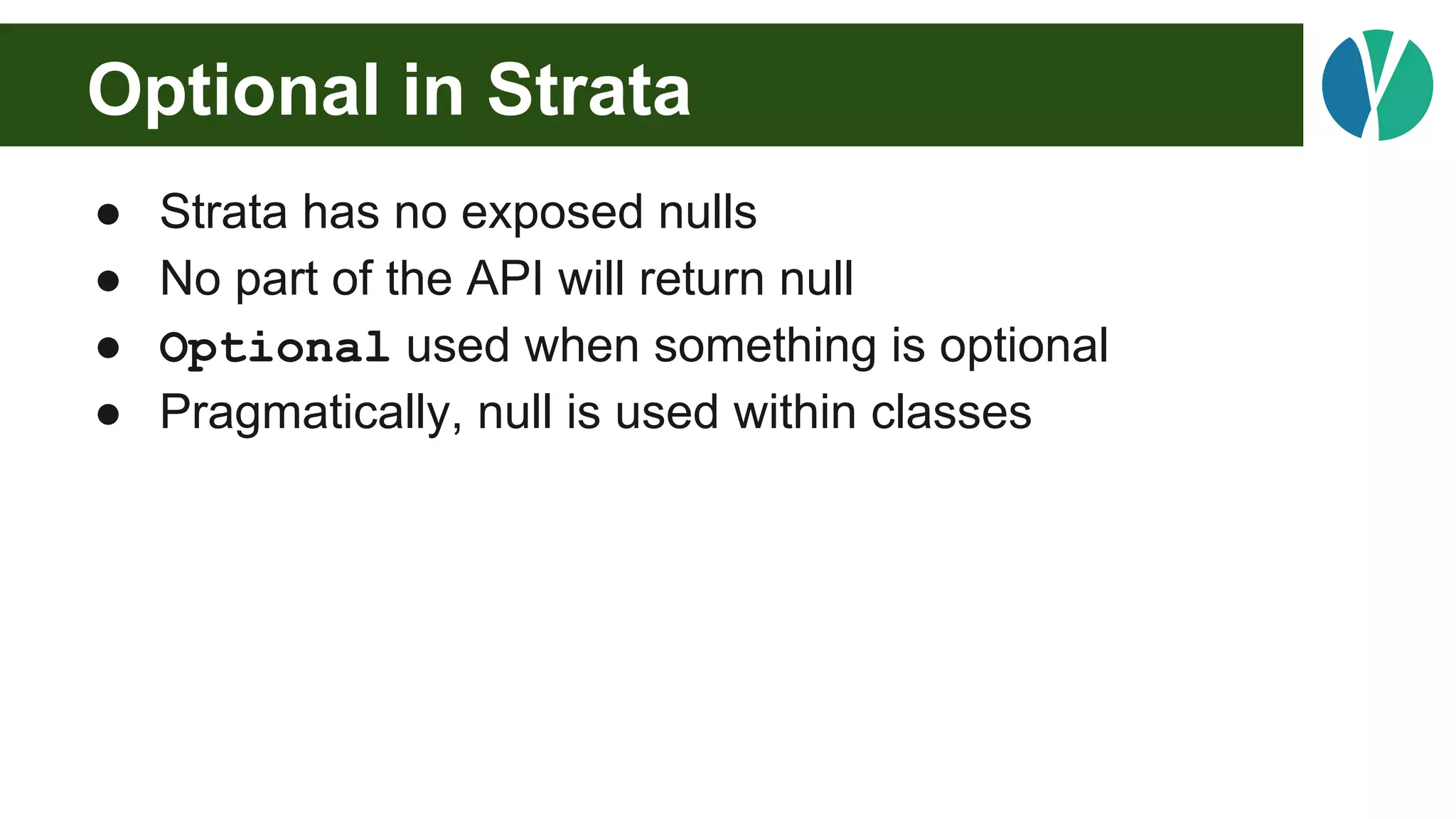
Optional in Strata
● Strata has no exposed nulls
● No part of the API will return null
● Optional used when something is optional
● Pragmatically, null is used within classes
Optional
Use Optional in a
pragmatic way
Odds and Ends
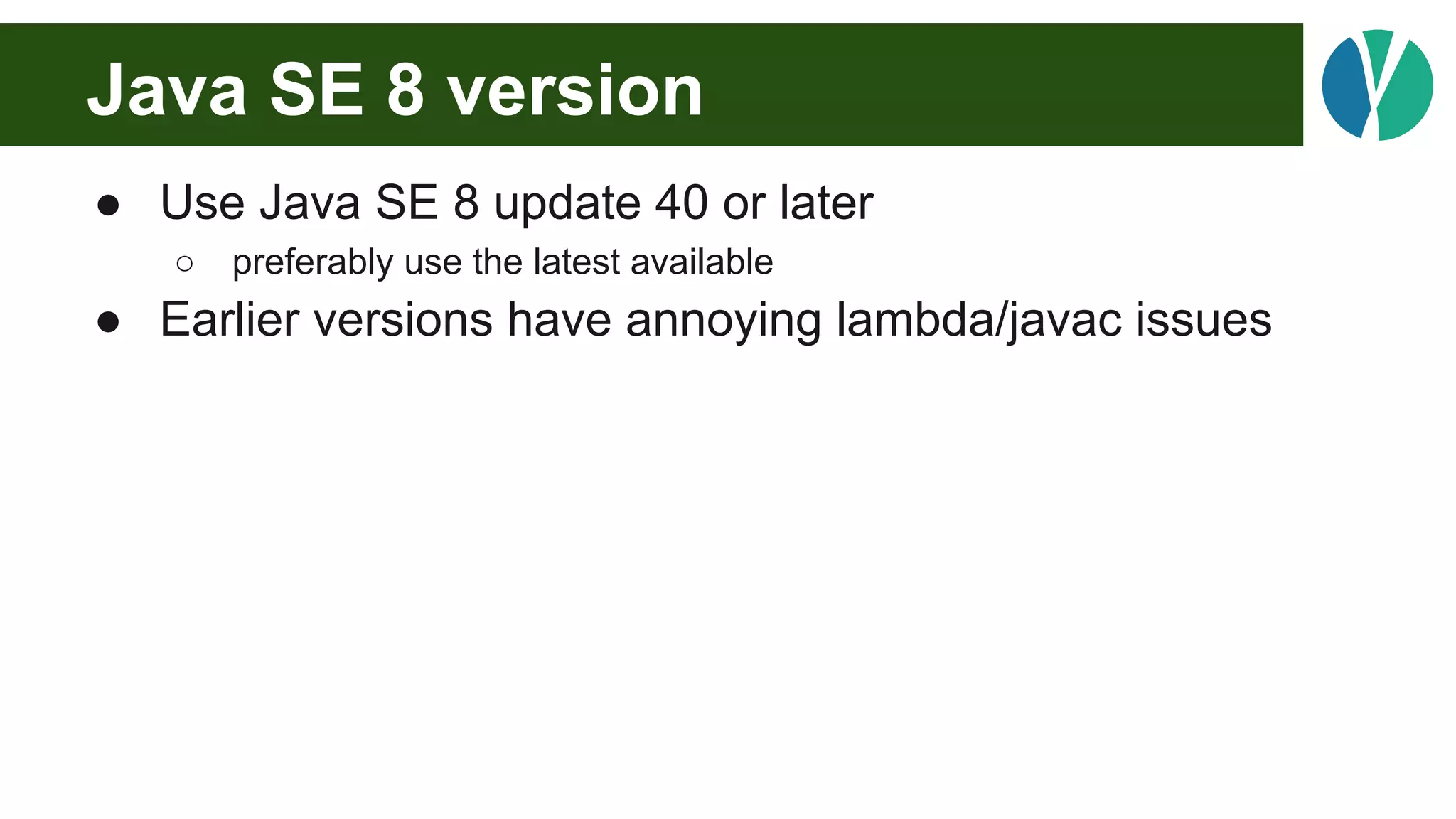
Java SE 8 version
● Use Java SE 8 update 40 or later
○ preferably use the latest available
● Earlier versions have annoying lambda/javac issues
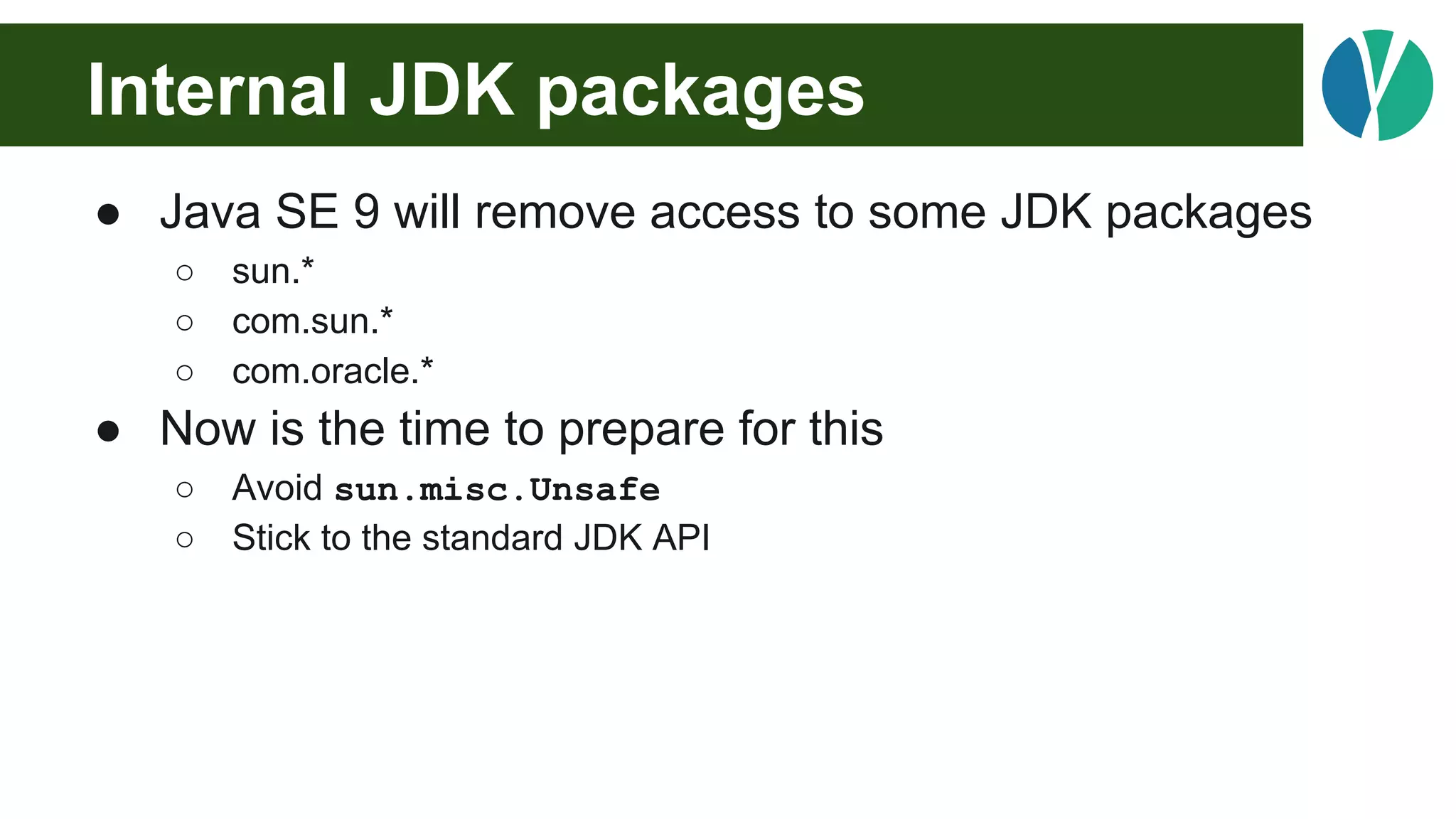
Internal JDK packages
● Java SE 9 will remove access to some JDK packages
○ sun.*
○ com.sun.*
○ com.oracle.*
● Now is the time to prepare for this
○ Avoid sun.misc.Unsafe
○ Stick to the standard JDK API
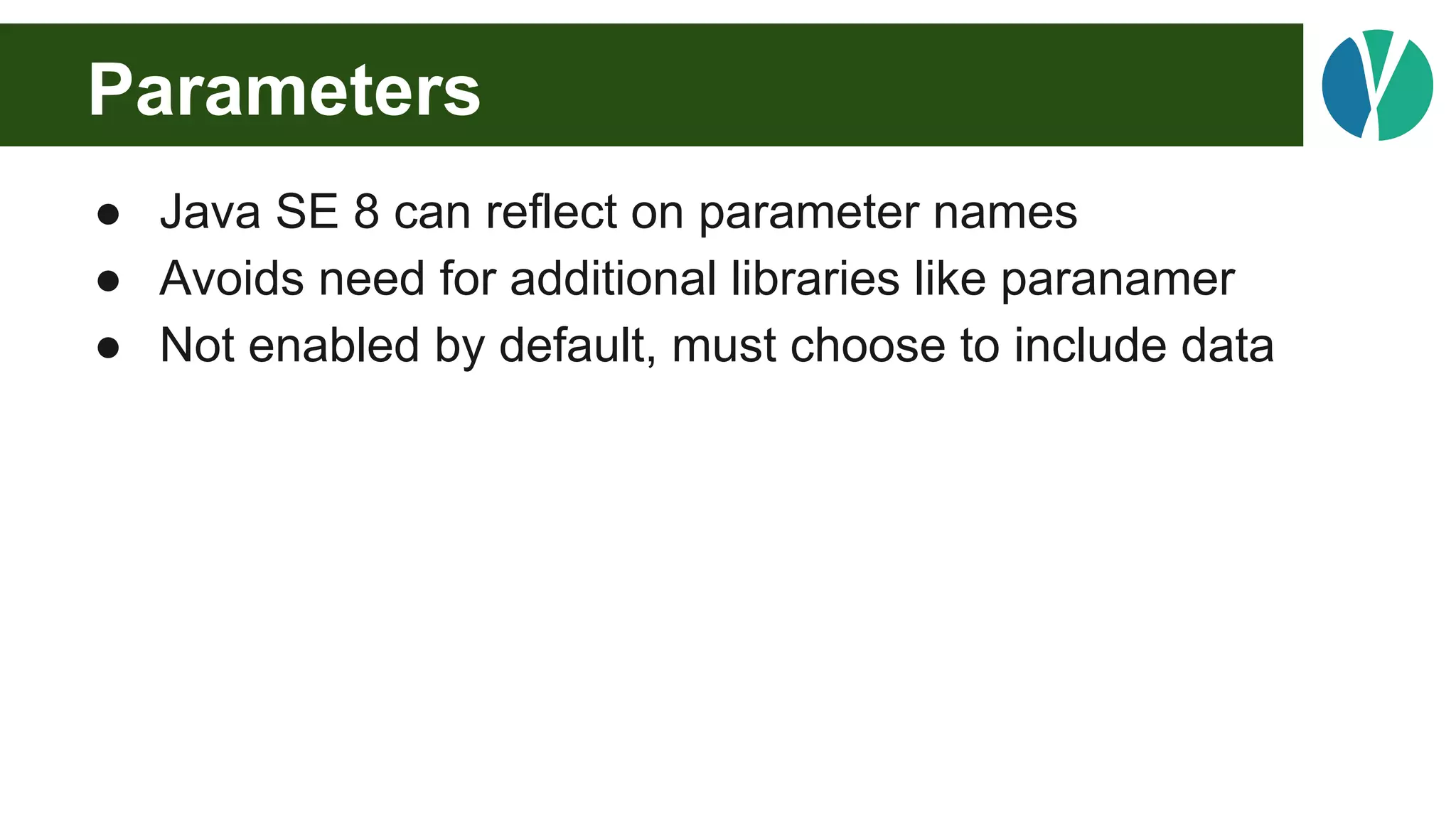
Parameters
● Java SE 8 can reflect on parameter names
● Avoids need for additional libraries like paranamer
● Not enabled by default, must choose to include data
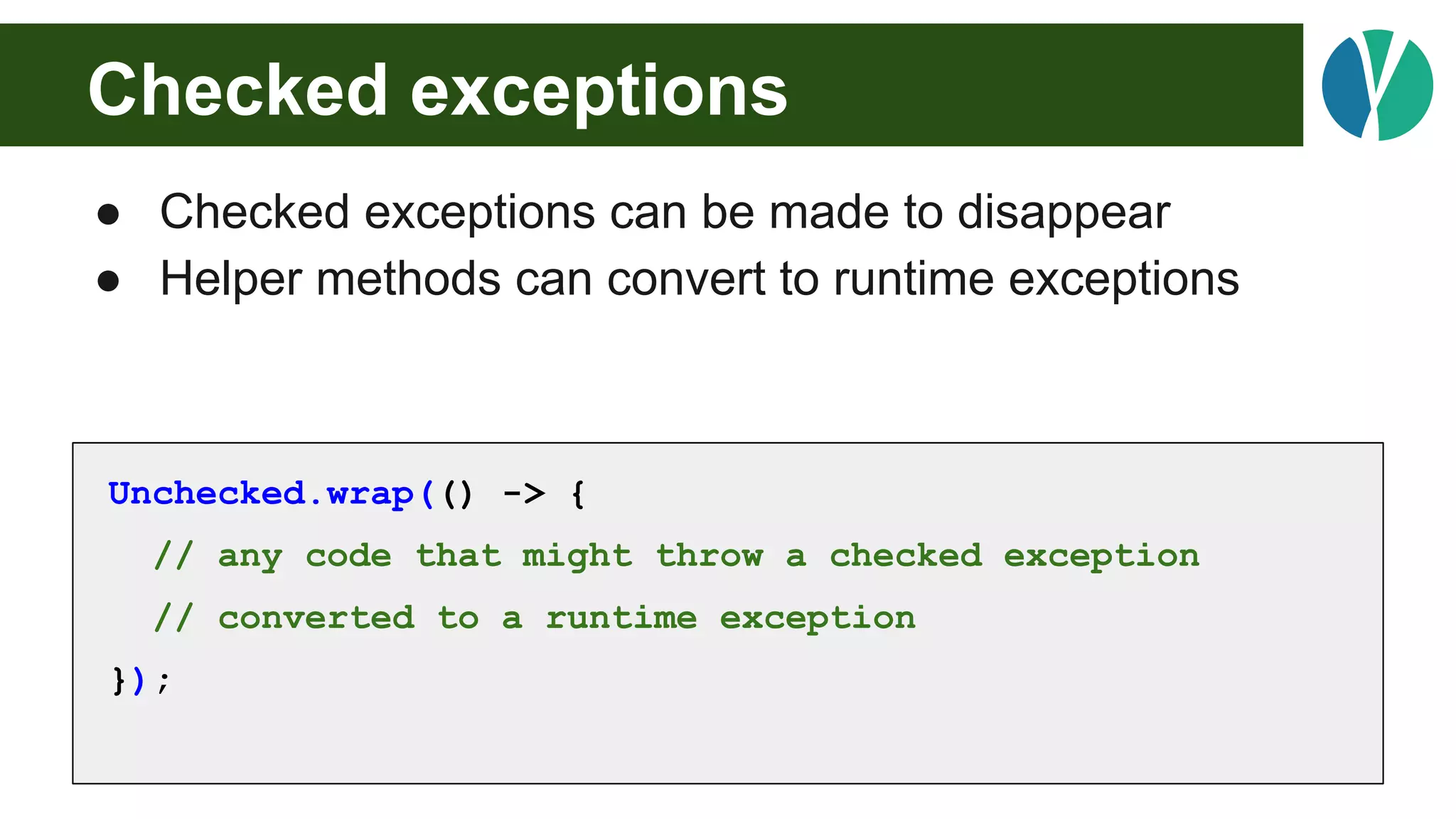
Checked exceptions
● Checked exceptions can be made to disappear
● Helper methods can convert to runtime exceptions
Unchecked.wrap(() -> {
// any code that might throw a checked exception
// converted to a runtime exception
});
Summary
J8
Summary
● Lots of good stuff in Java SE 8
● Design and coding standards change
● Lots more potential to abstract, but don't over-use
● Methods on interfaces add a lot of power
Key Strata design features
● Immutable data objects, using Joda-Beans
● Static methods on interfaces, package-scope impls
● Make use of new abstractions
● Beware stack traces with streams
● Pragmatic use of Optional, null never returned from API
Work in Finance?
● Take a look at OpenGamma Strata
○ developed from the ground up in Java 8
○ lots of good Java 8 techniques and utilities
● High quality library for market risk
○ day counts, schedules, holidays, indices
○ models and pricing for swaps, FRAs, swaptions, FX, futures…
○ open source and stable release v1.1
http://strata.opengamma.io/

Java SE 8 library design

  • 1.
    Java SE 8Library Design Using the new features well Stephen Colebourne Engineering Lead, OpenGamma October 2016
  • 2.
    Stephen Colebourne ● JavaChampion, regular conference speaker ● Best known for date & time - Joda-Time and JSR-310 ● More Joda projects - http://www.joda.org ● Major contributions in Apache Commons ● Blog - http://blog.joda.org ● Worked at OpenGamma for 6 years
  • 3.
    Strata, from OpenGamma ●Open Source market risk library ● Valuation and risk calcs for finance ○ interest rate swap, FRA, CDS ● Great example of Java SE 8 coding style http://strata.opengamma.io/
  • 4.
  • 5.
    Introduction ● Java SE8 is a major update to Java ● Major new features ○ Lambdas ○ Streams ○ Methods on interfaces ○ Date and Time
  • 6.
    Introduction ● Essential torethink how you code ● Reconsider coding conventions ● Appreciate new design options
  • 7.
    Agenda ● Lambdas ● Streams ●Design with Lambdas ● Abstraction ● Immutability ● Interfaces ● Optional ● Odds and Ends
  • 8.
  • 9.
    Lambdas ● Block ofcode ○ like an anonymous inner class ● Always assigned to a Functional Interface ○ an interface with one abstract method ○ Runnable, Callable, Comparator ● Uses target typing ○ context determines type of the lambda
  • 10.
    // Java 7 List<Person>people = loadPeople(); Collections.sort(people, new Comparator<Person>() { @Override public int compare(Person p1, Person p2) { return p1.name.compareTo(p2.name); } }); Lambdas public interface Comparator<T> { int compare(T obj1, T obj2); } // Java 7 Collections.sort(people, new Comparator<Person>() { @Override public int compare(Person p1, Person p2) { return p1.name.compareTo(p2.name); } });
  • 11.
    // Java 7 List<Person>people = loadPeople(); Collections.sort(people, new Comparator<Person>() { @Override public int compare(Person p1, Person p2) { return p1.name.compareTo(p2.name); } }); Lambdas public interface Comparator<T> { int compare(T obj1, T obj2); } // Java 7 Collections.sort(people, new Comparator<Person>() { @Override public int compare(Person p1, Person p2) { return p1.name.compareTo(p2.name); } });
  • 12.
    // Java 7 List<Person>people = loadPeople(); Collections.sort(people, new Comparator<Person>() { @Override public int compare(Person p1, Person p2) { return p1.name.compareTo(p2.name); } }); Lambdas public interface Comparator<T> { int compare(T obj1, T obj2); } // Java 8 people.sort((p1, p2) -> p1.name.compareTo(p2.name));
  • 13.
    Top tips forLambdas ● Use lambdas wherever appropriate ● Mostly, they just work ● Sometimes, the compiler needs a hint ○ use local variable ○ add the type to the lambda parameter
  • 14.
    Lambdas Lambdas affect code butdo they affect design?
  • 15.
  • 16.
    Streams ● Many loopshave a similar "shape" ● Repetitive design patterns ● Stream library provides a way to abstract this ● Lambdas used to pass the interesting bits
  • 17.
    Streams List<Trade> trades =loadTrades(); List<Money> valued = new ArrayList<>(); for (Trade t : trades) { if (t.isActive()) { Money pv = t.presentValue(); valued.add(pv); } }
  • 18.
    Streams List<Trade> trades =loadTrades(); List<Money> valued = new ArrayList<>(); for (Trade t : trades) { if (t.isActive()) { Money pv = t.presentValue(); valued.add(pv); } }
  • 19.
    Streams List<Trade> trades =loadTrades(); List<Money> valued = trades.stream() .filter(t -> t.isActive()) .map(t -> t.presentValue()) .collect(Collectors.toList());
  • 20.
    Streams ● New stream()method on Collection ● Sequence of operations on underlying data ● Logic passed in using a lambda ○ filter() to retain/remove ○ map() to change ○ reduce() to summarise ○ sorted() to sort using a comparator
  • 21.
    Streams trades.stream() .filter(t -> t.isActive()) .map(t-> t.presentValue()) .collect(Collectors.toList());
  • 22.
    Streams trades.stream() .filter(new Predicate<Trade>() { publicboolean test(Trade t) { return t.isActive(); } }) .map(new Function<Trade, Money>() { public Money apply(Trade t) { return t.presentValue(); } }) .collect(Collectors.toList());
  • 23.
    Streams Stream API notpractical without lambdas
  • 24.
    Exceptions in Streams ●For-each loop is a language feature ● Streams are implemented using regular methods ● Big difference in stack traces
  • 25.
    Exceptions in Streams java.lang.IllegalArgumentException:Oops at com.opengamma.strata.calc.DefaultCalculationRunner.lambda$2(DefaultCalculationRunner.java:98) at java.util.stream.ReferencePipeline$11$1.accept(ReferencePipeline.java:372) at java.util.stream.ReferencePipeline$3$1.accept(ReferencePipeline.java:193) at java.util.Iterator.forEachRemaining(Iterator.java:116) at java.util.Spliterators$IteratorSpliterator.forEachRemaining(Spliterators.java:1801) at java.util.stream.AbstractPipeline.copyInto(AbstractPipeline.java:481) at java.util.stream.AbstractPipeline.wrapAndCopyInto(AbstractPipeline.java:471) at java.util.stream.ReduceOps$ReduceOp.evaluateSequential(ReduceOps.java:708) at java.util.stream.AbstractPipeline.evaluate(AbstractPipeline.java:234) at java.util.stream.ReferencePipeline.collect(ReferencePipeline.java:499) at com.opengamma.strata.calc.DefaultCalculationRunner.calculate(DefaultCalculationRunner.java:100) at com.opengamma.strata.calc.DefaultCalculationRunner.lambda$0(DefaultCalculationRunner.java:86) at java.util.stream.ReferencePipeline$3$1.accept(ReferencePipeline.java:193) at java.util.Iterator.forEachRemaining(Iterator.java:116) at java.util.Spliterators$IteratorSpliterator.forEachRemaining(Spliterators.java:1801) at java.util.stream.AbstractPipeline.copyInto(AbstractPipeline.java:481) at java.util.stream.AbstractPipeline.wrapAndCopyInto(AbstractPipeline.java:471) at java.util.stream.ReduceOps$ReduceOp.evaluateSequential(ReduceOps.java:708) at java.util.stream.AbstractPipeline.evaluate(AbstractPipeline.java:234) at java.util.stream.ReferencePipeline.collect(ReferencePipeline.java:499) at com.opengamma.strata.calc.DefaultCalculationRunner.calculate(DefaultCalculationRunner.java:87) at com.opengamma.strata.calc.DefaultCalculationRunnerTest.calculate(DefaultCalculationRunnerTest.java:49) Stack trace of inner stream Stack trace of outer stream
  • 26.
    Exceptions in Streams java.lang.IllegalArgumentException:Oops at com.opengamma.strata.calc.DefaultCalculationRunner.calculate(DefaultCalculationRunner.java:102) at com.opengamma.strata.calc.DefaultCalculationRunner.calculate(DefaultCalculationRunner.java:87) at com.opengamma.strata.calc.DefaultCalculationRunnerTest.calculate(DefaultCalculationRunnerTest.java:49) Stack trace of for-each loop
  • 27.
    Top tips forstreams ● Stream not always more readable than loop ● Stream exceptions can be much worse ● My advice: ○ use streams for small, localized, pieces of logic ○ be cautious using streams for large scale logic ● Strata uses for-each loops at top level ○ solely for shorter stack traces
  • 28.
  • 29.
    Design with Lambdas ●Lambda is converted to a functional interface ● Normal interface with one abstract method ● Java SE 8 adds many new functional interfaces ○ Function<T, R> ○ Predicate<T> ○ Supplier<T> ○ Consumer<T> ○ see java.util.function package ● Primitive versions only for long, int, double
  • 30.
    Functional interfaces ● Learnthe standard functional interfaces ● Only create new ones if adding additional value ○ lots of parameters ○ mix of primitive and object parameters ○ feature really needs a good name or Javadoc
  • 31.
    Functional interface example //API functional interface @FunctionalInterface public interface Perturbation { public abstract double perturb(int index, double value); } // API method that can be used by a lambda public Curve perturbed(Perturbation perturbation) { … } // caller code curve = curve.perturbed((i, v) -> v + 1e-4);
  • 32.
    Functional interface example //API functional interface @FunctionalInterface public interface Perturbation { public abstract double perturb(int index, double value); } // API method that can be used by a lambda public Curve perturbed(Perturbation perturbation) { … } // caller code curve = curve.perturbed((i, v) -> v + 1e-4); Name has meaning Method signature is complex
  • 33.
    Time-series example ● Atime-series stores changes to a value over time ● Date-based one like Map<LocalDate, Double> ● What if you want to change the values?
  • 34.
    Time-series example // APImethod that can be used by a lambda public LocalDateDoubleTimeSeries mapValues(DoubleUnaryOperator mapper){ … } // caller code ts = ts.mapValues(v -> v * 2);
  • 35.
    Time-series example // APImethod that can be used by a lambda public LocalDateDoubleTimeSeries mapValues(DoubleUnaryOperator mapper){ … } // caller code ts = ts.mapValues(v -> v * 2); Multiplication - no need for multipliedBy(double) on the API
  • 36.
    Time-series example // APImethod that can be used by a lambda public LocalDateDoubleTimeSeries mapValues(DoubleUnaryOperator mapper){ … } // caller code ts = ts.mapValues(v -> v * 2); ts = ts.mapValues(v -> v / 4); Multiplication - no need for multipliedBy(double) on the API Division - no need for dividedBy(double) on the API
  • 37.
    Design with Lambdas Methodtaking a lambda can be more flexible design
  • 38.
  • 39.
    Abstraction ● Two ormore classes with the same methods ● Abstract using an interface? ● Lambdas provide an alternative ● Consider an example with static methods ○ no way to abstract that with interfaces...
  • 40.
    Abstraction // standard APIproducing results public static Money pv(FraTrade trade, Market md) { … } public static Sens pv01(FraTrade trade, Market md) { … } public static Double par(FraTrade trade, Market md) { … }
  • 41.
    Abstraction // standard APIproducing results public static Money pv(FraTrade trade, Market md) { … } public static Sens pv01(FraTrade trade, Market md) { … } public static Double par(FraTrade trade, Market md) { … } // functional interface matching all three methods interface Calc<T> { public abstract T invoke(FraTrade trade, Market market); }
  • 42.
    Abstraction // create abstractionto access method by "measure" key Map<Measure, Calc> CALCS = ImmutableMap.builder() .put(Measures.PRESENT_VALUE, FraCalcs::pv) .put(Measures.PV01, FraCalcs::pv01) .put(Measures.PAR_RATE, FraCalcs:: par) .build(); // can now invoke using measure return CALCS.get(measure).invoke(trade, market);
  • 43.
    Abstraction ● Class beingabstracted was not changed ● Provides way to abstract over code you do not own ● Less need for reflection
  • 44.
    Design with Lambdas Lambdascan abstract in dynamic/flexible ways
  • 45.
  • 46.
    Multi-threaded ● JDK providesmany tools for concurrency ● Parallel streams makes it even easier ● But parallel code is not simple to get right
  • 47.
    Thread problems ● Whatif trade modified by some other piece of code? ● Check-then-act bug List<Trade> trades = loadTrades(); List<Money> valued = trades.stream() .filter(t -> t.isActive()) .map(t -> presentValue(t)) .collect(Collectors.toList()); Check then Act
  • 48.
    Immutable ● Threading bugsdue to shared mutable state ● One solution is to use immutable beans ● No possibility of check-then-act type bug
  • 49.
    Immutable beans ● Classshould be final ○ no subclasses ● Fields must be final ○ needed for Java Memory Model ● Field types should be immutable ○ eg. don't use java.util.Date ● Factory methods and Builders instead of constructors
  • 50.
    Immutable beans ● IDEshelp you write mutable beans ● Need better tooling for immutable beans ○ AutoValue ○ Immutables.org ○ Joda-Beans ● Strata uses Joda-Beans http://www.joda.org/joda-beans
  • 51.
    Joda-Beans @BeanDefinition public final TradeInfoimplements ImmutableBean { /** The trade identifier. */ @PropertyDefinition(validate = "notNull") private final StandardId tradeId; /** The trade date. */ @PropertyDefinition(validate = "notNull") private final LocalDate tradeDate; }
  • 52.
    Joda-Beans ● Source codegenerated for ○ getters ○ builder ○ equals/hashCode/toString ○ properties - like C# ● Can add your own code to the class and still regenerate ● Built in XML, JSON and Binary serialization
  • 53.
    Immutable beans ● Mostsystems better using immutability everywhere ● Java SE 8 parallelStream() pushes at this ● Threading issues mostly eliminated ● No class hierarchies, use interfaces
  • 54.
    Use interfaces Trade ProductTrade ResolvableTrade SwapTradeFraTrade Resolved SwapTrade Resolved FraTrade
  • 55.
    Use interfaces ● Concreteclasses with no hierarchies ● Interfaces provide the hierarchy ● Methods on interfaces make this practical ● All implementations of interface should be immutable ○ "Implementations must be immutable and thread-safe beans." ● Strata uses immutable beans everywhere
  • 56.
    Immutability It is timeto move on from mutable data objects
  • 57.
  • 58.
    Interfaces ● Two changesto interfaces ● Default methods ○ normal method, but on an interface ○ cannot default equals/hashCode/toString ● Static methods ○ normal static method, but on an interface
  • 59.
    Coding Style ● Usemodifiers in interfaces ● Much clearer now there are different types of method ● Prepares for private methods in Java SE 9 public interface Foo { public static of(String id) { … } public abstract isEmpty(); public default isNotEmpty() { … } }
  • 60.
    Interfaces ● Methods oninterfaces changes design ● Interfaces are part of macro-design ○ lambdas and streams affect micro-design ● Strata uses default and static methods liberally
  • 61.
    Holiday Calendar ● Stratainterface to specify which days are holidays public interface HolidayCalendar { // a normal abstract interface method public abstract isHoliday(LocalDate date); … }
  • 62.
    Holiday Calendar ● Defaultmethods make the interface more useful public interface HolidayCalendar { public abstract isHoliday(LocalDate date); // check if date is a business day public default isBusinessDay(LocalDate date) { return !isHoliday(date); } }
  • 63.
    Holiday Calendar ● Defaultmethods make the interface more useful public interface HolidayCalendar { public abstract isHoliday(LocalDate date); // find the next business day public default next(LocalDate date) { LocalDate nextDay = date.plusDays(1); return isHoliday(nextDay) ? next(nextDay) : nextDay; } }
  • 64.
    Holiday Calendar ● Staticmethods avoid HolidayCalendarFactory public interface HolidayCalendar { // find holiday calendar by identifier such as DKCO public static of(String id) { // lookup calendar } }
  • 65.
    Holiday Calendar ● Interfaceused just as would be expected // find holiday calendar by identifier such as DKCO HolidayCalendar cal = HolidayCalendar.of("DKCO"); // use calendar to select the trade start date LocalDate startDate = cal.next(tradeDate);
  • 66.
    Interfaces ● Interface nowacts as abstract class ○ Only need abstract class if need abstracted state ○ but abstracted state is generally a bad idea ● Interface can now acts as a factory ○ Not suitable for all factory use cases* * In Strata, holiday calendars are not really fixed at startup, but it made a good example for this talk!
  • 67.
    Package-scoped implementation ● Canthe interface be the only public API? ● Can the implementation class be package-scoped? ● Strata uses this pattern a lot
  • 68.
  • 69.
  • 70.
    Optional and null ●New class Optional added to Java 8 ● Opinions are polarized ○ some think it is the saviour of the universe ○ others think it is useless ● Used pragmatically, can be very useful
  • 71.
    Optional and null ●Simple concept - two states ○ present, with a value - Optional.of(foo) ○ empty - Optional.empty()
  • 72.
    Optional and null ●Standard code using null // library, returns null if not found public Foo getValue(String key) { … } // application code must remember to check for null Foo foo = getValue(key); if (foo == null) { foo = Foo.DEFAULT; // or throw an exception }
  • 73.
    Optional and null ●Standard code using Optional // library, returns Optional if not found public Optional<Foo> findValue(String key) { … } // application code Foo foo = findValue(key).orElse(Foo.DEFAULT); // or Foo foo = findValue(key).orElseThrow( … );
  • 74.
    Optional and null ●Important that a variable of type Optional is never null ● Prefer methods like map() and orElse() ● Minimise use of isPresent()
  • 75.
    Optional ● Strata oftenuses set of 3-methods public abstract Optional<T> findValue(DataId<T> id); public default boolean containsValue(DataId<T> id) { return findValue(id).isPresent(); } public default T getValue(DataId<T> id) { return findValue(id).orElseThrow( () -> new MarketDataException()); }
  • 76.
    Optional ● Optional isa class ● Some memory/performance cost to using it ● Not serializable ● Not ideal to be an instance variable ● JDK authors added it for return types ● Use in parameters often annoying for callers ● Use as return type gets best value from concept http://blog.joda.org/2015/08/java-se-8-optional-pragmatic-approach.html
  • 77.
    Optional in Strata ●Strata has no exposed nulls ● No part of the API will return null ● Optional used when something is optional ● Pragmatically, null is used within classes
  • 78.
    Optional Use Optional ina pragmatic way
  • 79.
  • 80.
    Java SE 8version ● Use Java SE 8 update 40 or later ○ preferably use the latest available ● Earlier versions have annoying lambda/javac issues
  • 81.
    Internal JDK packages ●Java SE 9 will remove access to some JDK packages ○ sun.* ○ com.sun.* ○ com.oracle.* ● Now is the time to prepare for this ○ Avoid sun.misc.Unsafe ○ Stick to the standard JDK API
  • 82.
    Parameters ● Java SE8 can reflect on parameter names ● Avoids need for additional libraries like paranamer ● Not enabled by default, must choose to include data
  • 83.
    Checked exceptions ● Checkedexceptions can be made to disappear ● Helper methods can convert to runtime exceptions Unchecked.wrap(() -> { // any code that might throw a checked exception // converted to a runtime exception });
  • 84.
  • 85.
    Summary ● Lots ofgood stuff in Java SE 8 ● Design and coding standards change ● Lots more potential to abstract, but don't over-use ● Methods on interfaces add a lot of power
  • 86.
    Key Strata designfeatures ● Immutable data objects, using Joda-Beans ● Static methods on interfaces, package-scope impls ● Make use of new abstractions ● Beware stack traces with streams ● Pragmatic use of Optional, null never returned from API
  • 87.
    Work in Finance? ●Take a look at OpenGamma Strata ○ developed from the ground up in Java 8 ○ lots of good Java 8 techniques and utilities ● High quality library for market risk ○ day counts, schedules, holidays, indices ○ models and pricing for swaps, FRAs, swaptions, FX, futures… ○ open source and stable release v1.1 http://strata.opengamma.io/