Java Basics 1
Welcome !!!
Introduction to Java Programming
Organized by
Java Basics 2
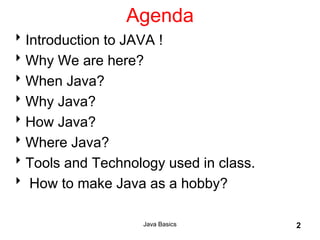
Agenda
Introduction to JAVA !
Why We are here?
When Java?
Why Java?
How Java?
Where Java?
Tools and Technology used in class.
 How to make Java as a hobby?
Java Basics 3
Why We are here?
Make Learning online.
New technology in industry.
MindLabz make us interaction – Thank you
MindLabz!!!
Sharing my knowledge.
Know about new techie mind and what they
thing about coding, programming, language
Covid -19
Make you easy about software company.
etc.
Java Basics 4
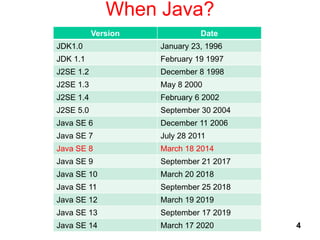
When Java?
Version Date
JDK1.0 January 23, 1996
JDK 1.1 February 19 1997
J2SE 1.2 December 8 1998
J2SE 1.3 May 8 2000
J2SE 1.4 February 6 2002
J2SE 5.0 September 30 2004
Java SE 6 December 11 2006
Java SE 7 July 28 2011
Java SE 8 March 18 2014
Java SE 9 September 21 2017
Java SE 10 March 20 2018
Java SE 11 September 25 2018
Java SE 12 March 19 2019
Java SE 13 September 17 2019
Java SE 14 March 17 2020
Java Basics 5
A brief history of Java
– "Java, whose original name was Oak, was developed as a
part of the Green project at Sun. It was started in
December '90 by Patrick Naughton, Mike Sheridan and
James Gosling and was chartered to spend time trying to
figure out what would be the "next wave" of computing and
how we might catch it. They came to the conclusion that at
least one of the waves was going to be the convergence of
digitally controlled consumer devices and computers. "
Java Basics 6
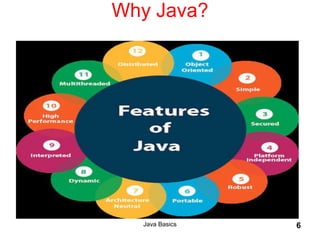
Why Java?
Java Basics 7
Java Basics 8
This year Java grew by around 6% compared to last
January, which was right around 62,000 job postings at the
time.
Java is just about to celebrate its 24-year birthday, and as a
programming language, it has definitely stood the test of
time.
Java was developed by a Canadian computer scientist that
used to work with Sun Microsystems, James Gosling.
It’s a language that lets developers “write once, run
everywhere,” (WORA), which mean its compiled code, also
known as bytecode, can run on almost any platform without
recompilation.
Java Basics 9
How Java Works
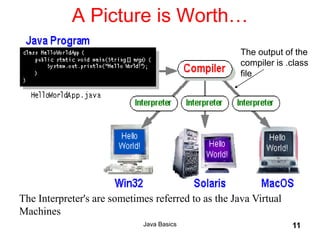
Java's platform independence is achieved by the
use of the Java Virtual Machine
A Java program consists of one or more files with a
.java extension
– these are plain old text files
When a Java program is compiled the .java files
are fed to a compiler which produces a .class file
for each .java file
The .class file contains Java bytecode.
Bytecode is like machine language, but it is
intended for the Java Virtual Machine not a specific
chip such as a Pentium or PowerPC chip
Java Basics 10
More on How Java Works
To run a Java program the bytecode in a .class file
is fed to an interpreter which converts the byte code
to machine code.
Some people refer to the interpreter as "The Java
Virtual Machine" (JVM)
The interpreter is platform specific because it takes
the platform independent bytecode and produces
machine language instructions for a particular chip
So a Java program could be run an any type of
computer that has a JVM written for it.
– PC, Mac, Unix, Linux, BeaOS, Sparc
Java Basics 11
A Picture is Worth…
The Interpreter's are sometimes referred to as the Java Virtual
Machines
The output of the
compiler is .class
file
Java Basics 12
So What!
The platform independence of Java may be a huge
marketing tool, but is actually of little use to people
learning Object Oriented Programming and
Abstract Data Types
What is of use is the simplicity of the Java syntax
and programming concepts
Java is a "pure" Object Oriented Language
– encapsulation, inheritance, and polymorphism
– all code must be contained in a class
– no free functions (functions that do not belong to some
class) like C++, although someone who wants to write
messy Java code certainly can
– Is OO the best programming paradigm?
Java Basics 13
HelloWorld.java
/**
* A simple program
*/
public class HelloWorld
{
public static void main(String[] args)
{
System.out.println("Hello World!");
}
}
Java Basics 14
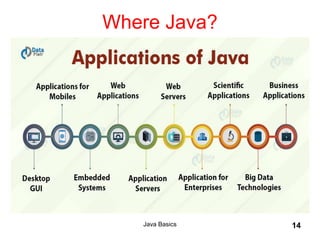
Where Java?
Java Basics 15
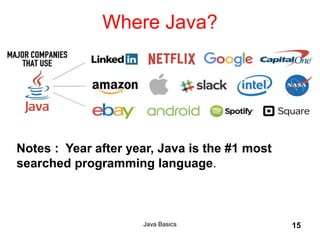
Where Java?
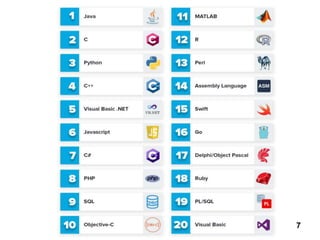
Notes : Year after year, Java is the #1 most
searched programming language.
Java Basics 16
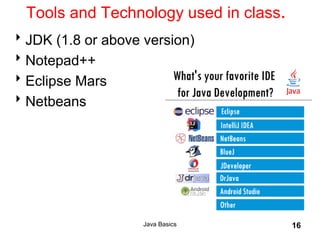
Tools and Technology used in class.
JDK (1.8 or above version)
Notepad++
Eclipse Mars
Netbeans
Java Basics 17
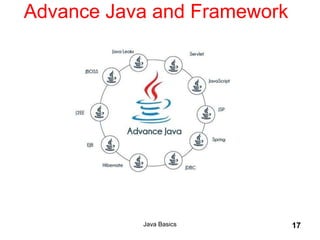
Advance Java and Framework
Java Basics 18
How to make Java as a hobby?
Start from Simple.
Co-Related it to day to day life.
Make third eye open and think beyond limit.
Once Start , Finish any how !
Momentum slow but steady.
Step - by- Step (one at a time ).
Never Shy to asked Question or queries.
Achieved little and enjoy yourself.
Practise. Practise. Practise !!!
Java Basics 19
Syllabus over view
Excited??
Java Basics 20
Attendance Question 1
What does 6,967 * 7,793 equal?
A. 10,000
B. 23,756,201
C. 54,293,831
D. 2,147,483,647
E. - 2,147,483,648
Java Basics 21
Attendance Question
Write a table from 2 to 20.
Fibonacci series program.
Armstrong number.
Star patterns.
Java Basics 22
Q&A Session

Java introduction

  • 1.
    Java Basics 1 Welcome!!! Introduction to Java Programming Organized by
  • 2.
    Java Basics 2 Agenda Introductionto JAVA ! Why We are here? When Java? Why Java? How Java? Where Java? Tools and Technology used in class.  How to make Java as a hobby?
  • 3.
    Java Basics 3 WhyWe are here? Make Learning online. New technology in industry. MindLabz make us interaction – Thank you MindLabz!!! Sharing my knowledge. Know about new techie mind and what they thing about coding, programming, language Covid -19 Make you easy about software company. etc.
  • 4.
    Java Basics 4 WhenJava? Version Date JDK1.0 January 23, 1996 JDK 1.1 February 19 1997 J2SE 1.2 December 8 1998 J2SE 1.3 May 8 2000 J2SE 1.4 February 6 2002 J2SE 5.0 September 30 2004 Java SE 6 December 11 2006 Java SE 7 July 28 2011 Java SE 8 March 18 2014 Java SE 9 September 21 2017 Java SE 10 March 20 2018 Java SE 11 September 25 2018 Java SE 12 March 19 2019 Java SE 13 September 17 2019 Java SE 14 March 17 2020
  • 5.
    Java Basics 5 Abrief history of Java – "Java, whose original name was Oak, was developed as a part of the Green project at Sun. It was started in December '90 by Patrick Naughton, Mike Sheridan and James Gosling and was chartered to spend time trying to figure out what would be the "next wave" of computing and how we might catch it. They came to the conclusion that at least one of the waves was going to be the convergence of digitally controlled consumer devices and computers. "
  • 6.
  • 7.
  • 8.
    Java Basics 8 Thisyear Java grew by around 6% compared to last January, which was right around 62,000 job postings at the time. Java is just about to celebrate its 24-year birthday, and as a programming language, it has definitely stood the test of time. Java was developed by a Canadian computer scientist that used to work with Sun Microsystems, James Gosling. It’s a language that lets developers “write once, run everywhere,” (WORA), which mean its compiled code, also known as bytecode, can run on almost any platform without recompilation.
  • 9.
    Java Basics 9 HowJava Works Java's platform independence is achieved by the use of the Java Virtual Machine A Java program consists of one or more files with a .java extension – these are plain old text files When a Java program is compiled the .java files are fed to a compiler which produces a .class file for each .java file The .class file contains Java bytecode. Bytecode is like machine language, but it is intended for the Java Virtual Machine not a specific chip such as a Pentium or PowerPC chip
  • 10.
    Java Basics 10 Moreon How Java Works To run a Java program the bytecode in a .class file is fed to an interpreter which converts the byte code to machine code. Some people refer to the interpreter as "The Java Virtual Machine" (JVM) The interpreter is platform specific because it takes the platform independent bytecode and produces machine language instructions for a particular chip So a Java program could be run an any type of computer that has a JVM written for it. – PC, Mac, Unix, Linux, BeaOS, Sparc
  • 11.
    Java Basics 11 APicture is Worth… The Interpreter's are sometimes referred to as the Java Virtual Machines The output of the compiler is .class file
  • 12.
    Java Basics 12 SoWhat! The platform independence of Java may be a huge marketing tool, but is actually of little use to people learning Object Oriented Programming and Abstract Data Types What is of use is the simplicity of the Java syntax and programming concepts Java is a "pure" Object Oriented Language – encapsulation, inheritance, and polymorphism – all code must be contained in a class – no free functions (functions that do not belong to some class) like C++, although someone who wants to write messy Java code certainly can – Is OO the best programming paradigm?
  • 13.
    Java Basics 13 HelloWorld.java /** *A simple program */ public class HelloWorld { public static void main(String[] args) { System.out.println("Hello World!"); } }
  • 14.
  • 15.
    Java Basics 15 WhereJava? Notes : Year after year, Java is the #1 most searched programming language.
  • 16.
    Java Basics 16 Toolsand Technology used in class. JDK (1.8 or above version) Notepad++ Eclipse Mars Netbeans
  • 17.
    Java Basics 17 AdvanceJava and Framework
  • 18.
    Java Basics 18 Howto make Java as a hobby? Start from Simple. Co-Related it to day to day life. Make third eye open and think beyond limit. Once Start , Finish any how ! Momentum slow but steady. Step - by- Step (one at a time ). Never Shy to asked Question or queries. Achieved little and enjoy yourself. Practise. Practise. Practise !!!
  • 19.
    Java Basics 19 Syllabusover view Excited??
  • 20.
    Java Basics 20 AttendanceQuestion 1 What does 6,967 * 7,793 equal? A. 10,000 B. 23,756,201 C. 54,293,831 D. 2,147,483,647 E. - 2,147,483,648
  • 21.
    Java Basics 21 AttendanceQuestion Write a table from 2 to 20. Fibonacci series program. Armstrong number. Star patterns.
  • 22.

Editor's Notes