Jaundice
PA 25.3
Describe Bilirubin Metabolism, Enumerate
etipathogenesis of , jaundice & Distinguish
between Direct and Indirect hyperbilirubinemia
Bilirubin Metabolism
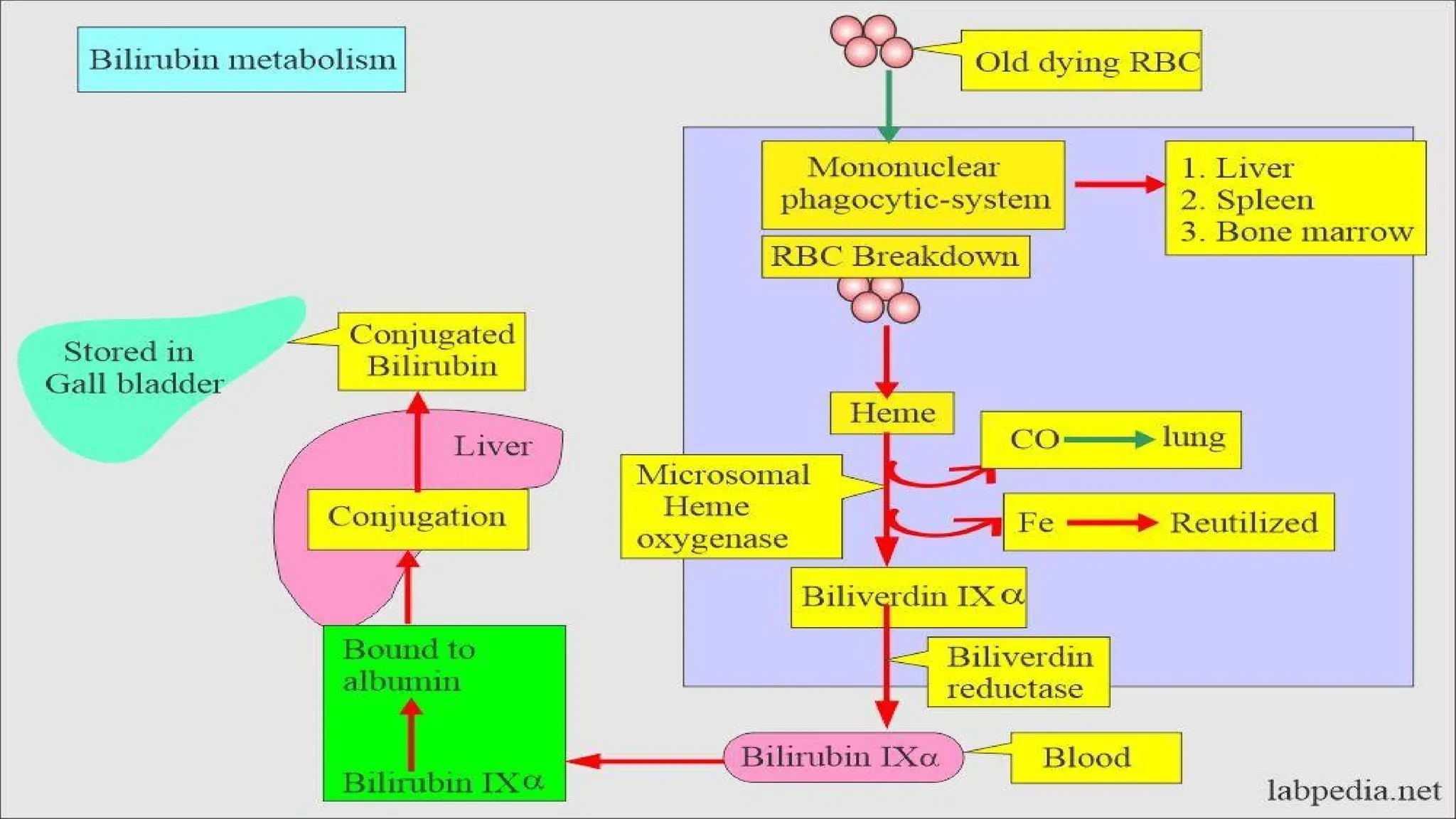
• Bilirubin is a toxic end product of heme degradation that is
processed by the liver and excreted in the bile
• The majority of the bilirubin produced daily (0.2 to 0.3 g, 85%) is
derived from breakdown of senescent red cells by macrophages
in the spleen, liver, and bone marrow.
• The remaining bilirubin comes from multiple sources like
myoglobin,cytochromes etc
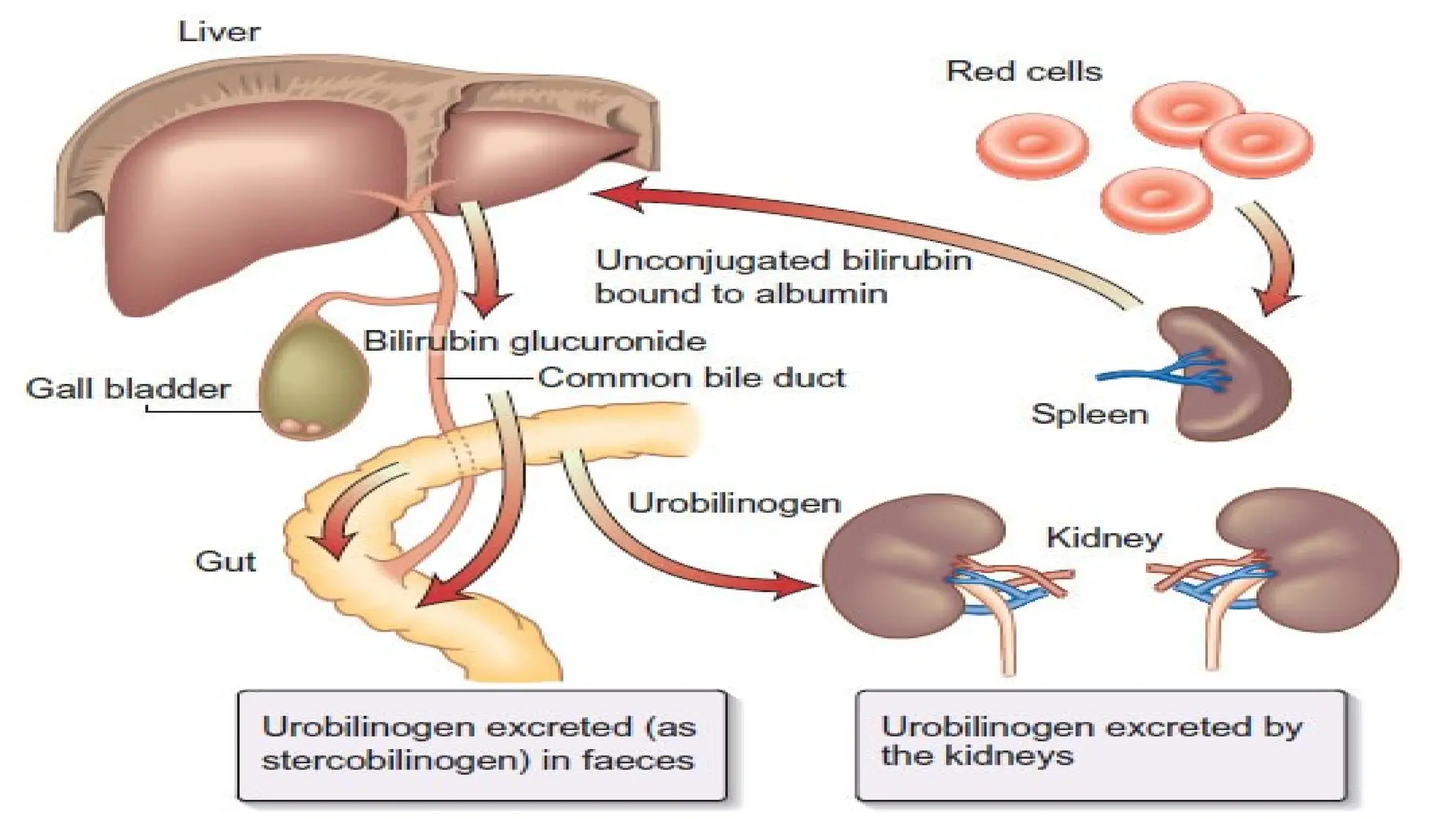
• The bilirubin produced is then transported to the liver in the
bound form with plasma albumin.
BILIRUBIN METABOLISM
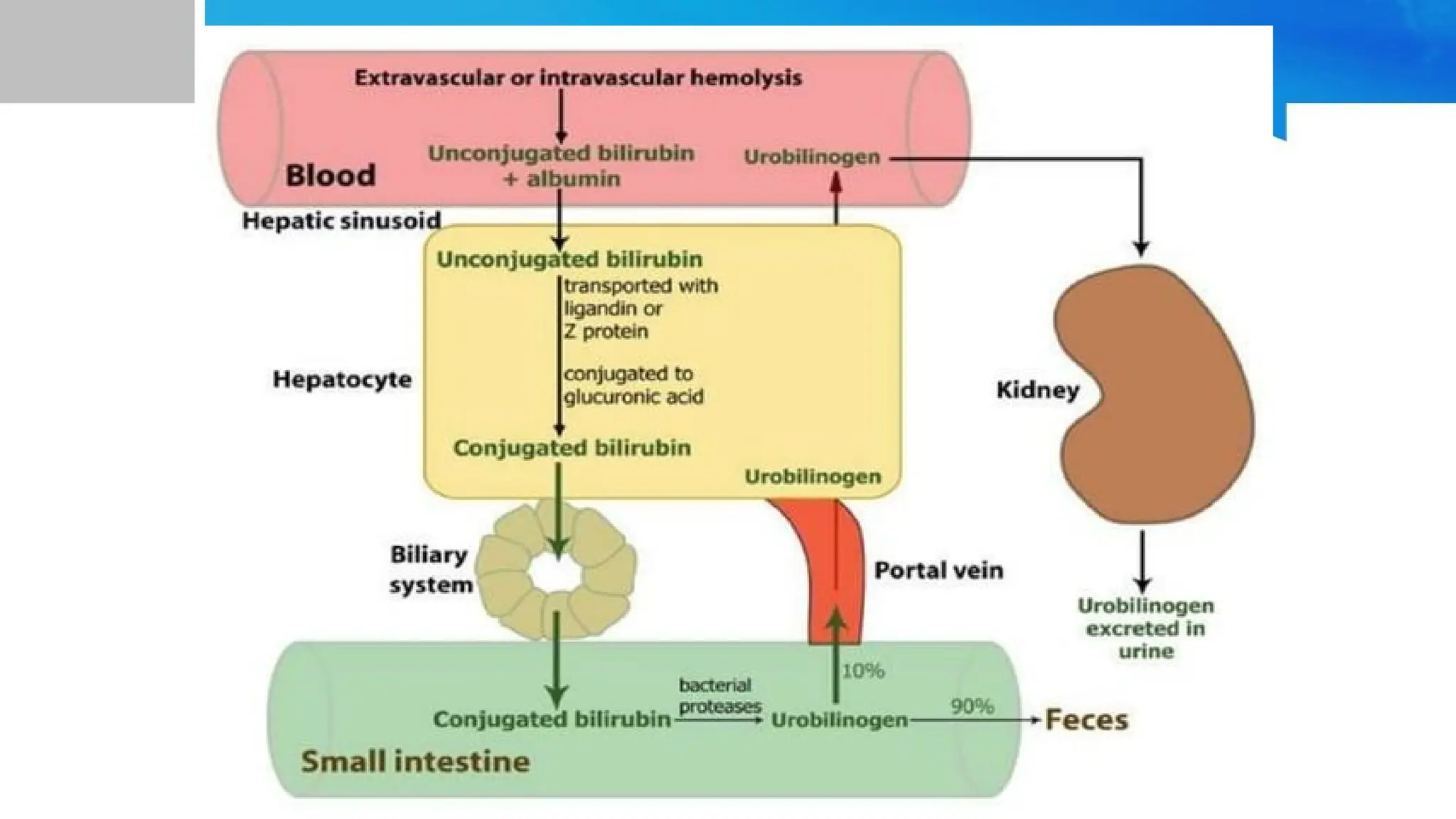
• Conjugation of bilirubin takes place in the liver by UDP-
glucronyltransferase and this conjugation is essential for
water solubility and elimination.
• Conjugated bilirubin is excreted into the bile. The bile is
then passed to the duodenum via biliary system.
• Some bilirubin is metabolized by the intestinal flora into
urobilinogens and then reabsorbed.
• urinobilinogens are then removed by the kidney and
excreted via urinary system.
Jaundice
• The word Jaundice is actually a derivative of French word
‘Jaune’ which means ‘yellow’.
• Jaundice is defined as a yellowing of skin, mucous
membranes and sclera due to the deposition of yellow
orange bile pigment i.e. bilirubin
• Normal Serum bilirubin levels -0.3 and 1.2 mg/dL. Jaundice
becomes evident when the serum bilirubin levels rise above 2
to 2.5 mg/dL.
Hyperbilirubinemia Types
• Depending on the underlying etiology the elevation can
predominantly involve unconjugated (indirect) or
conjugated (direct) bilirubin.
• Excess bilirubin production or defective conjugation leads
to the accumulation of unconjugated bilirubin which is
insoluble and cannot be excreted in the urine.
Hyperbilirubinemia Types
• At excessive levels the unbound fraction rises and may
diffuse into tissues, particularly the brain in infants, and
produce neurologic damage (kernicterus).
• Conjugated hyperbilirubinemia most often results from
hepatocellular disease, bile duct injury, and biliary
obstruction. Since this form is water-soluble and loosely
bound to serum albumin, it can be excreted in the urine
TYPES of JAUNDICE
• Pre Hepatic/Hemolytic Jaundice
• Intra Hepatic/Hepatocellular Jaundice
• Post Hepatic/Obstructive Jaundice
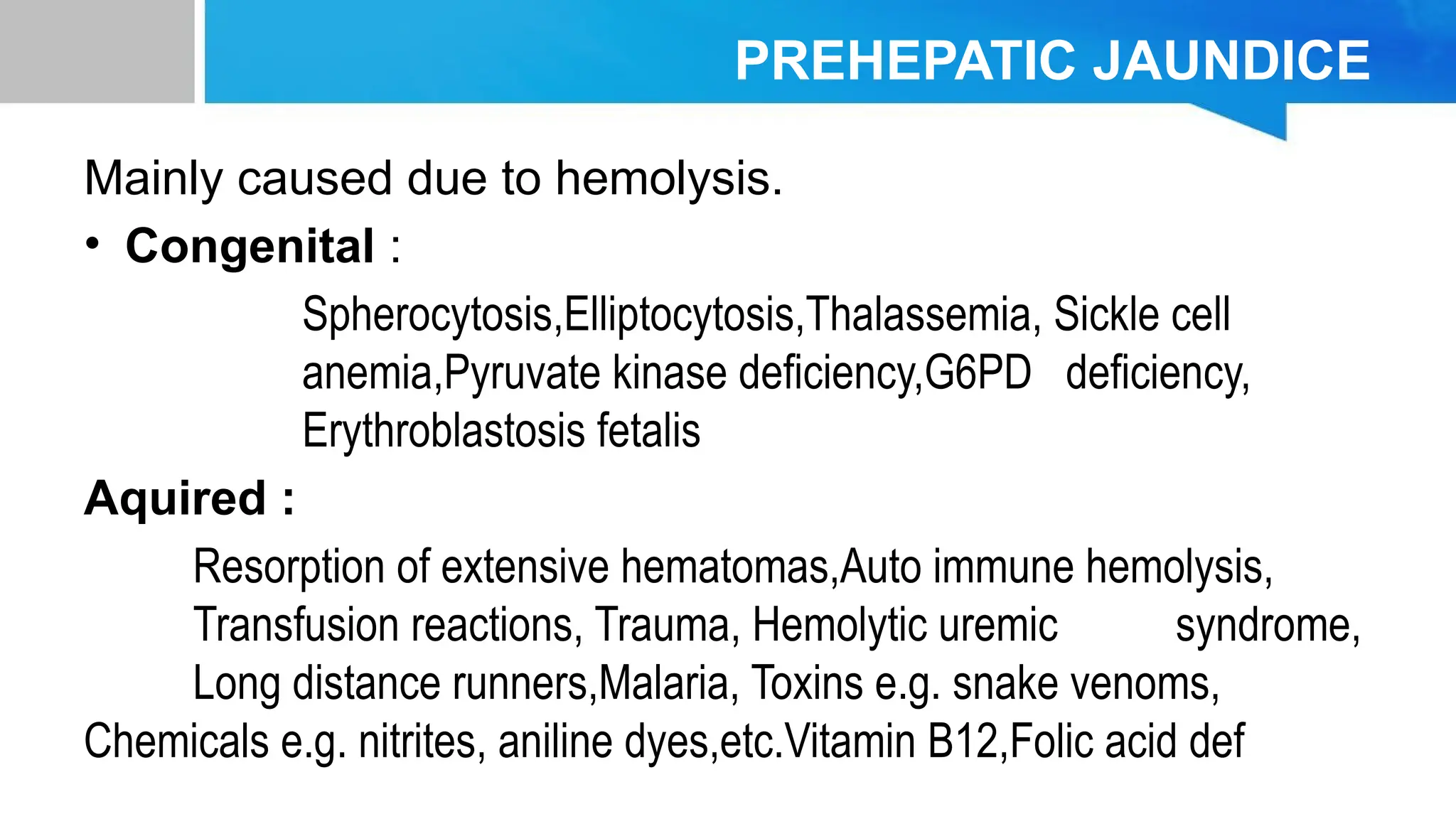
PREHEPATIC JAUNDICE
Mainly caused due to hemolysis.
• Congenital :
Spherocytosis,Elliptocytosis,Thalassemia, Sickle cell
anemia,Pyruvate kinase deficiency,G6PD deficiency,
Erythroblastosis fetalis
Aquired :
Resorption of extensive hematomas,Auto immune hemolysis,
Transfusion reactions, Trauma, Hemolytic uremic syndrome,
Long distance runners,Malaria, Toxins e.g. snake venoms,
Chemicals e.g. nitrites, aniline dyes,etc.Vitamin B12,Folic acid def
Clinical presentation
• Anemia,
• Yellowing of sclera
• Dark yellow-brown colored urine
• Yellowish skin and
• High bilirubin levels.
HEPATIC JAUNDICE
• Basic defect lies within the liver mainly in the hepatocytes.
• Any pathology of the liver leading to defect in capture,
conjugation and excretion can cause hepatic jaundice
• Main enzyme of conjugation is UDP-Glucronyltransferase
• This enzyme can be defective due to the genetic mutation of the
UTG1A gene on chromosome 2
• The defective conjugating enzyme leads to the hepatic jaundice.
HEPATIC JAUNDICE
• Any defect in the hepatic excretory mechanism of bilirubin can
also cause hepatic jaundice.
• The excretory mechanisms involve hepatocytic bile acid-
independent secretion hepatocytic bile acid-dependent secretion
and bile ductular secretion.
• Any defect in the above mentioned excretory mechanisms can
lead to the accumulation of bilirubin in blood causing hepatic
jaundice.
HEPATIC JAUNDICE-Congenital Causes
• Wilson’s Disease
• Rotor’s Syndrome
• Haemochromatosis
• CriglerNajar syndrome
• Gilbert’s syndrome
• Dubin-Johnson’s syndrome
NEONATAL JAUNDICE
Physiologic Jaundice of the Newborn
• The amount of bilirubin production in neonates is much higher
than adults.
• Levels of UGT1A1 the enzyme that is responsible for bilirubin
glucuronidation are low at birth
• Transient and mild unconjugated hyperbilirubinemia is nearly
universal in the first week
• Breastfeeding may exacerbate unconjugated
hyperbilirubinemia, possibly because of the presence of
bilirubin deconjugating enzymes in breast milk.
NEONATAL JAUNDICE
Hereditary Hyperbilirubinemia
• Crigler-Najjar syndrome type 1 -caused by severe UGT1A1
deficiency and is fatal around birth;
• Crigler-Najjar type 2 and Gilbert syndrome, -some UGT1A1
activity is preserved, leading to a milder phenotype.
• Dubin-Johnson syndrome and Rotor syndrome lead to
conjugated hyperbilirubinemia.Both are autosomal recessive
disorders and clinically innocuous
Acquired causes of Hepatic Jaundice
Acquired causes of hepatic jaundice
• Viral Hepatitis
• Alcoholic Hepatitis
• Auto immune Hepatitis
• Drug related Hepatitis (e.g. NSAIDs)
• Sepsis
• Systemic Diseases (e.g. celiac disease)
Clinical Presentation
• Abdominal pain
• Fever, vomiting and nausea along with
• the complications involving satiety
• Gastrointestinal bleeding
• Diarrhea
• Anemia
• Weight-loss and associated weakness
• If unchecked leading to mental disturbances like
kernicterus, coma or even death.
POST HEPATIC JAUNDICE
• Cause lies in the biliary portion of hepatobiliary system
• The major cause of post hepatic jaundice is extra hepatic biliary
obstruction. Therefore it is also known as obstructive jaundice.
Congenital obstruction
The congenital obstruction involves
• Biliary Atresia
• • Cystic Fibrosis
• • Idiopathic dilation of common bile duct
• • Pancreatic biliary malfunction
• • Choledochal CyST
Acquired Causes of Biliary Obstruction
• Cholecystitis
• • Trauma
• • Pancreatitis
• • Strictures
• • Choledocholithiasis
• • AIDS
• • Intra-Abdominal Tuberculosis
• • Tumors
• • Common bile duct Obstruction
Clinical Presentation
• Dark urine
• Pale stools and generalized pruritus
• History of fever
• Biliary colic
• Weight loss
• Abdominal pain and abdominal mass
• Obstructive Jaundice may lead to various complications
including cholangitis, pancreatitis,renal and hepatic
failure.
Differentiating types of Jaundice
• Elevated serum levels of unconjugated bilirubin and Urobilinogen & Normal
serum levels on conjugated bilirubin,alkaline phosphatase, Alanine
transferase and Aspartate transferase -pre-hepatic jaundice
• The hepatic jaundice can be differentiated from post hepatic and pre hepatic
jaundice on the basis of five times high bilirubin levels.
• Post Hepatic-Elevated serum bilirubin level along with the
conjugation .Serum gamaglutamyltranspeptidase (Serum GGT), alkaline
phosphatase and transaminases may be elevated
Jaundice _Pathophysiology and diagnosis an

Jaundice _Pathophysiology and diagnosis an

  • 1.
  • 2.
    PA 25.3 Describe BilirubinMetabolism, Enumerate etipathogenesis of , jaundice & Distinguish between Direct and Indirect hyperbilirubinemia
  • 3.
    Bilirubin Metabolism • Bilirubinis a toxic end product of heme degradation that is processed by the liver and excreted in the bile • The majority of the bilirubin produced daily (0.2 to 0.3 g, 85%) is derived from breakdown of senescent red cells by macrophages in the spleen, liver, and bone marrow. • The remaining bilirubin comes from multiple sources like myoglobin,cytochromes etc • The bilirubin produced is then transported to the liver in the bound form with plasma albumin.
  • 4.
    BILIRUBIN METABOLISM • Conjugationof bilirubin takes place in the liver by UDP- glucronyltransferase and this conjugation is essential for water solubility and elimination. • Conjugated bilirubin is excreted into the bile. The bile is then passed to the duodenum via biliary system. • Some bilirubin is metabolized by the intestinal flora into urobilinogens and then reabsorbed. • urinobilinogens are then removed by the kidney and excreted via urinary system.
  • 8.
    Jaundice • The wordJaundice is actually a derivative of French word ‘Jaune’ which means ‘yellow’. • Jaundice is defined as a yellowing of skin, mucous membranes and sclera due to the deposition of yellow orange bile pigment i.e. bilirubin • Normal Serum bilirubin levels -0.3 and 1.2 mg/dL. Jaundice becomes evident when the serum bilirubin levels rise above 2 to 2.5 mg/dL.
  • 9.
    Hyperbilirubinemia Types • Dependingon the underlying etiology the elevation can predominantly involve unconjugated (indirect) or conjugated (direct) bilirubin. • Excess bilirubin production or defective conjugation leads to the accumulation of unconjugated bilirubin which is insoluble and cannot be excreted in the urine.
  • 10.
    Hyperbilirubinemia Types • Atexcessive levels the unbound fraction rises and may diffuse into tissues, particularly the brain in infants, and produce neurologic damage (kernicterus). • Conjugated hyperbilirubinemia most often results from hepatocellular disease, bile duct injury, and biliary obstruction. Since this form is water-soluble and loosely bound to serum albumin, it can be excreted in the urine
  • 11.
    TYPES of JAUNDICE •Pre Hepatic/Hemolytic Jaundice • Intra Hepatic/Hepatocellular Jaundice • Post Hepatic/Obstructive Jaundice
  • 13.
    PREHEPATIC JAUNDICE Mainly causeddue to hemolysis. • Congenital : Spherocytosis,Elliptocytosis,Thalassemia, Sickle cell anemia,Pyruvate kinase deficiency,G6PD deficiency, Erythroblastosis fetalis Aquired : Resorption of extensive hematomas,Auto immune hemolysis, Transfusion reactions, Trauma, Hemolytic uremic syndrome, Long distance runners,Malaria, Toxins e.g. snake venoms, Chemicals e.g. nitrites, aniline dyes,etc.Vitamin B12,Folic acid def
  • 14.
    Clinical presentation • Anemia, •Yellowing of sclera • Dark yellow-brown colored urine • Yellowish skin and • High bilirubin levels.
  • 15.
    HEPATIC JAUNDICE • Basicdefect lies within the liver mainly in the hepatocytes. • Any pathology of the liver leading to defect in capture, conjugation and excretion can cause hepatic jaundice • Main enzyme of conjugation is UDP-Glucronyltransferase • This enzyme can be defective due to the genetic mutation of the UTG1A gene on chromosome 2 • The defective conjugating enzyme leads to the hepatic jaundice.
  • 16.
    HEPATIC JAUNDICE • Anydefect in the hepatic excretory mechanism of bilirubin can also cause hepatic jaundice. • The excretory mechanisms involve hepatocytic bile acid- independent secretion hepatocytic bile acid-dependent secretion and bile ductular secretion. • Any defect in the above mentioned excretory mechanisms can lead to the accumulation of bilirubin in blood causing hepatic jaundice.
  • 17.
    HEPATIC JAUNDICE-Congenital Causes •Wilson’s Disease • Rotor’s Syndrome • Haemochromatosis • CriglerNajar syndrome • Gilbert’s syndrome • Dubin-Johnson’s syndrome
  • 18.
    NEONATAL JAUNDICE Physiologic Jaundiceof the Newborn • The amount of bilirubin production in neonates is much higher than adults. • Levels of UGT1A1 the enzyme that is responsible for bilirubin glucuronidation are low at birth • Transient and mild unconjugated hyperbilirubinemia is nearly universal in the first week • Breastfeeding may exacerbate unconjugated hyperbilirubinemia, possibly because of the presence of bilirubin deconjugating enzymes in breast milk.
  • 19.
    NEONATAL JAUNDICE Hereditary Hyperbilirubinemia •Crigler-Najjar syndrome type 1 -caused by severe UGT1A1 deficiency and is fatal around birth; • Crigler-Najjar type 2 and Gilbert syndrome, -some UGT1A1 activity is preserved, leading to a milder phenotype. • Dubin-Johnson syndrome and Rotor syndrome lead to conjugated hyperbilirubinemia.Both are autosomal recessive disorders and clinically innocuous
  • 20.
    Acquired causes ofHepatic Jaundice Acquired causes of hepatic jaundice • Viral Hepatitis • Alcoholic Hepatitis • Auto immune Hepatitis • Drug related Hepatitis (e.g. NSAIDs) • Sepsis • Systemic Diseases (e.g. celiac disease)
  • 21.
    Clinical Presentation • Abdominalpain • Fever, vomiting and nausea along with • the complications involving satiety • Gastrointestinal bleeding • Diarrhea • Anemia • Weight-loss and associated weakness • If unchecked leading to mental disturbances like kernicterus, coma or even death.
  • 22.
    POST HEPATIC JAUNDICE •Cause lies in the biliary portion of hepatobiliary system • The major cause of post hepatic jaundice is extra hepatic biliary obstruction. Therefore it is also known as obstructive jaundice.
  • 23.
    Congenital obstruction The congenitalobstruction involves • Biliary Atresia • • Cystic Fibrosis • • Idiopathic dilation of common bile duct • • Pancreatic biliary malfunction • • Choledochal CyST
  • 24.
    Acquired Causes ofBiliary Obstruction • Cholecystitis • • Trauma • • Pancreatitis • • Strictures • • Choledocholithiasis • • AIDS • • Intra-Abdominal Tuberculosis • • Tumors • • Common bile duct Obstruction
  • 25.
    Clinical Presentation • Darkurine • Pale stools and generalized pruritus • History of fever • Biliary colic • Weight loss • Abdominal pain and abdominal mass • Obstructive Jaundice may lead to various complications including cholangitis, pancreatitis,renal and hepatic failure.
  • 26.
    Differentiating types ofJaundice • Elevated serum levels of unconjugated bilirubin and Urobilinogen & Normal serum levels on conjugated bilirubin,alkaline phosphatase, Alanine transferase and Aspartate transferase -pre-hepatic jaundice • The hepatic jaundice can be differentiated from post hepatic and pre hepatic jaundice on the basis of five times high bilirubin levels. • Post Hepatic-Elevated serum bilirubin level along with the conjugation .Serum gamaglutamyltranspeptidase (Serum GGT), alkaline phosphatase and transaminases may be elevated