THE LAND OF THE RAISING SUN
Land of culture, traditions and superstitions
Land of crafters, and of working people
Land of techonological advancements
By: ladysearch
The early Japanese called their nation Nihon or
Nippon “The Land of the Rising Sun”. The chinese
pronounced it “jihpen” and Marco Polo brought the
pronunciation of Japan to Europe.
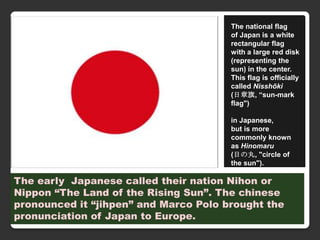
The national flag
of Japan is a white
rectangular flag
with a large red disk
(representing the
sun) in the center.
This flag is officially
called Nisshōki
(日章旗, “sun-mark
flag")
in Japanese,
but is more
commonly known
as Hinomaru
(日の丸, "circle of
the sun").
MAP OF JAPAN
Japan is a nation composed of over 1,000
islands. Such a string of islands is called an
archipelago.
The country
consist of 4 major
islands and nearly
4,000 smaller
ones, as they part
of the “Ring of
Fire” the largest,
Honshu, is the
focal point for
Japanese
historical and
cultural
development.
The capital city is in Kyoto which quickly
becomes the cultural center of Japan as
well. Well situated in the Kanto Plain, it
is a natural crossroads area.
Tokyo ("Eastern Capital")東京 Tōkyō
Architecture in Tokyo has largely been shaped by Tokyo's
history. Twice in recent history has the metropolis been left in
ruins: first in the 1923 Great Kantō earthquake and later
after extensive fire bombing in world war II. Because of this,
Tokyo's urban landscape consists mainly of modern and
contemporary architecture, and older buildings are
scarce. Tokyo features many internationally famous forms of
modern architecture
HISTORY OF THE JAPANESE
TEA CEREMONY GREEN TEA
Sen (煎茶) Green tea
Friendship, good manners
and nature, which are
three things, that are
highly valued in Japan
The Japanese tea ceremony, also
called the Way of Tea, is
a Japanese cultural activity
involving the ceremonial
preparation and presentation
of matcha. powdered green tea.
In Japanese, it is called chanoyu (茶
の湯) or sadō, chadō (茶道). The
manner in which it is performed, or
the art of its performance, is
called otemae (お手前; お点前). Zen
Buddhism was a primary influence
in the development of the tea
ceremony
In Japanese tradition, architectural spaces
designed to be used for tea ceremony (chanoyu)
gatherings are known as chashitsu (茶室, literally "tea
rooms")
CHANOYU=TEA
CEREMONY THE TEA ROOM
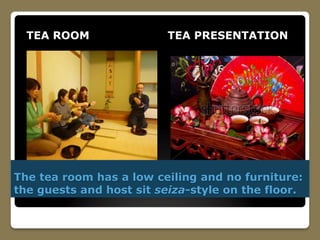
The tea room has a low ceiling and no furniture:
the guests and host sit seiza-style on the floor.
TEA ROOM TEA PRESENTATION
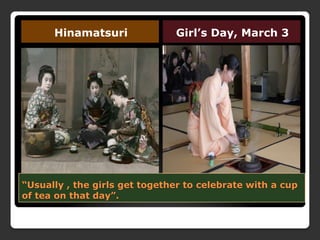
“Usually , the girls get together to celebrate with a cup
of tea on that day”.
Hinamatsuri Girl’s Day, March 3
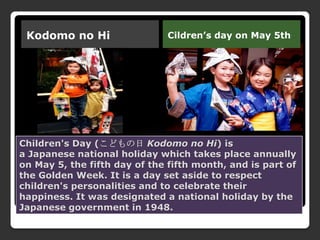
Children's Day (こどもの日 Kodomo no Hi) is
a Japanese national holiday which takes place annually
on May 5, the fifth day of the fifth month, and is part of
the Golden Week. It is a day set aside to respect
children's personalities and to celebrate their
happiness. It was designated a national holiday by the
Japanese government in 1948.
Kodomo no Hi Cildren’s day on May 5th
Children’s Day on May 5th
The musical
Instruments Strings Instruments
Percussion
Wedding Ceremony
Manga (漫画) are comics created in Japan, or
by Japanese creators in the Japanese language,
conforming to a style developed in Japan in the late
19th century. They have a long, complex pre-history in
earlier Japanese art.
Comics=Manga Cartoons
In Japan, people of all ages read manga. The medium
includes works in a broad range of genres: action-adventure,
romance, sports and games, historical drama, comedy,
science fiction and fantasy, mystery, suspense, detective,
horror, sexuality, and business/commerce, among
others. Since the 1950s, manga has steadily become a major
part of the Japanese publishing industry, representing a 406
billion market in Japan
Yen ¥ = is a currency money in
Japan
Early: end of 7th
century, copper To date
A hand-held fan is an implement used to induce an airflow for
the purpose of cooling or refreshing oneself. Any broad, flat
surface waved back-and-forth will create a small airflow and
therefore can be considered a rudimentary fan. But generally,
purpose-made hand-held fans are shaped like a sector of a
circle and made of a thin material (such as paper or feathers)
mounted on slats which revolve around a pivot so that it can
be closed when not in use.
JAPANESE NATIONAL FLOWER
CHERRY BLOSSOM
Somei-Yoshino
Cherry blossom
Other than the purpose of providing shade, oil-paper
umbrellas are also traditional essential wedding items.
With Japan’s economy on the cusp of a third recession since
2008, and household incomes falling for the last three years,
the country’s famously picky and brand-enamored shoppers
are in a bargain-hunting mood.
The Japanese Automotive Industry is one of the most
prominent and largest industries in the world.
The car Industry Their worldwide logos
EARTHQUEAKES AND TSUNAMIES
Great East Japan Earthquake (東日
本大震災Higashi nihon daishinsa
It was the most powerful
known earthquake ever to have hit
Japan and the fifth most powerful
earthquake in the world since modern
record-keeping began in 1900.
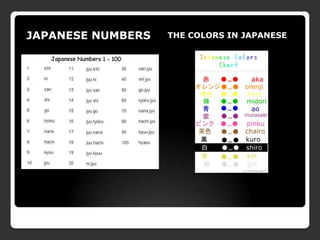
JAPANESE NUMBERS THE COLORS IN JAPANESE
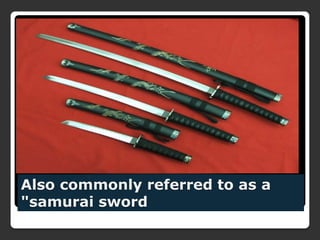
Historically, katana (刀) were one of the traditionally
made Japanese swords (日本刀 nihontō)that were worn by
the samurai class of feudal Japan, also commonly referred to as a
"samurai sword".Modern versions of the katana are sometimes
made using non-traditional materials and methods.
The katana is characterized by its distinctive appearance: a
curved, slender, single-edged blade with a circular or squared
guard and long grip to accommodate two hands. It has
historically been associated with the samurai of feudal Japan and
has become renowned for its sharpness and strength.
Also commonly referred to as a
"samurai sword
LEARNING JAPANESE
GREETINGS Name of animales in Japan
Activity: hand out questions to work during the first
work of the program.
 NAME:

 DATE:

 FOLLOWING DIRECTIONS

 Directions: Complete page 2 of this handout. Use the atlas in the back of your text or a regular atlas.

 Write “Japan” on the line west of the country.

 Outline the map of Japan with a black crayon.

 Locate and write the name of the body of water east of Japan.

 Locate and write the name of the body of water west of Japan.

 Place a yellow star where Tokyo is located and write its name.

 Write the name of the largest island across its center.

 Place a large red dot where the city of Yokohama is located and write its name to the right of the dot.

 Color the water blue.

 Color the mountainous areas of Japan brown.

 Draw and label the parallel line just south of Japan.














SEARCHING ABOUT

  • 1.
    THE LAND OFTHE RAISING SUN Land of culture, traditions and superstitions Land of crafters, and of working people Land of techonological advancements By: ladysearch
  • 2.
    The early Japanesecalled their nation Nihon or Nippon “The Land of the Rising Sun”. The chinese pronounced it “jihpen” and Marco Polo brought the pronunciation of Japan to Europe. The national flag of Japan is a white rectangular flag with a large red disk (representing the sun) in the center. This flag is officially called Nisshōki (日章旗, “sun-mark flag") in Japanese, but is more commonly known as Hinomaru (日の丸, "circle of the sun").
  • 3.
    MAP OF JAPAN Japanis a nation composed of over 1,000 islands. Such a string of islands is called an archipelago. The country consist of 4 major islands and nearly 4,000 smaller ones, as they part of the “Ring of Fire” the largest, Honshu, is the focal point for Japanese historical and cultural development.
  • 4.
    The capital cityis in Kyoto which quickly becomes the cultural center of Japan as well. Well situated in the Kanto Plain, it is a natural crossroads area. Tokyo ("Eastern Capital")東京 Tōkyō
  • 5.
    Architecture in Tokyohas largely been shaped by Tokyo's history. Twice in recent history has the metropolis been left in ruins: first in the 1923 Great Kantō earthquake and later after extensive fire bombing in world war II. Because of this, Tokyo's urban landscape consists mainly of modern and contemporary architecture, and older buildings are scarce. Tokyo features many internationally famous forms of modern architecture
  • 6.
    HISTORY OF THEJAPANESE TEA CEREMONY GREEN TEA Sen (煎茶) Green tea Friendship, good manners and nature, which are three things, that are highly valued in Japan The Japanese tea ceremony, also called the Way of Tea, is a Japanese cultural activity involving the ceremonial preparation and presentation of matcha. powdered green tea. In Japanese, it is called chanoyu (茶 の湯) or sadō, chadō (茶道). The manner in which it is performed, or the art of its performance, is called otemae (お手前; お点前). Zen Buddhism was a primary influence in the development of the tea ceremony
  • 7.
    In Japanese tradition,architectural spaces designed to be used for tea ceremony (chanoyu) gatherings are known as chashitsu (茶室, literally "tea rooms") CHANOYU=TEA CEREMONY THE TEA ROOM
  • 8.
    The tea roomhas a low ceiling and no furniture: the guests and host sit seiza-style on the floor. TEA ROOM TEA PRESENTATION
  • 9.
    “Usually , thegirls get together to celebrate with a cup of tea on that day”. Hinamatsuri Girl’s Day, March 3
  • 10.
    Children's Day (こどもの日Kodomo no Hi) is a Japanese national holiday which takes place annually on May 5, the fifth day of the fifth month, and is part of the Golden Week. It is a day set aside to respect children's personalities and to celebrate their happiness. It was designated a national holiday by the Japanese government in 1948. Kodomo no Hi Cildren’s day on May 5th
  • 11.
  • 12.
    The musical Instruments StringsInstruments Percussion
  • 13.
  • 14.
    Manga (漫画) arecomics created in Japan, or by Japanese creators in the Japanese language, conforming to a style developed in Japan in the late 19th century. They have a long, complex pre-history in earlier Japanese art. Comics=Manga Cartoons
  • 15.
    In Japan, peopleof all ages read manga. The medium includes works in a broad range of genres: action-adventure, romance, sports and games, historical drama, comedy, science fiction and fantasy, mystery, suspense, detective, horror, sexuality, and business/commerce, among others. Since the 1950s, manga has steadily become a major part of the Japanese publishing industry, representing a 406 billion market in Japan
  • 16.
    Yen ¥ =is a currency money in Japan Early: end of 7th century, copper To date
  • 17.
    A hand-held fanis an implement used to induce an airflow for the purpose of cooling or refreshing oneself. Any broad, flat surface waved back-and-forth will create a small airflow and therefore can be considered a rudimentary fan. But generally, purpose-made hand-held fans are shaped like a sector of a circle and made of a thin material (such as paper or feathers) mounted on slats which revolve around a pivot so that it can be closed when not in use.
  • 18.
    JAPANESE NATIONAL FLOWER CHERRYBLOSSOM Somei-Yoshino Cherry blossom
  • 19.
    Other than thepurpose of providing shade, oil-paper umbrellas are also traditional essential wedding items.
  • 20.
    With Japan’s economyon the cusp of a third recession since 2008, and household incomes falling for the last three years, the country’s famously picky and brand-enamored shoppers are in a bargain-hunting mood.
  • 21.
    The Japanese AutomotiveIndustry is one of the most prominent and largest industries in the world. The car Industry Their worldwide logos
  • 22.
    EARTHQUEAKES AND TSUNAMIES GreatEast Japan Earthquake (東日 本大震災Higashi nihon daishinsa It was the most powerful known earthquake ever to have hit Japan and the fifth most powerful earthquake in the world since modern record-keeping began in 1900.
  • 23.
    JAPANESE NUMBERS THECOLORS IN JAPANESE
  • 24.
    Historically, katana (刀)were one of the traditionally made Japanese swords (日本刀 nihontō)that were worn by the samurai class of feudal Japan, also commonly referred to as a "samurai sword".Modern versions of the katana are sometimes made using non-traditional materials and methods. The katana is characterized by its distinctive appearance: a curved, slender, single-edged blade with a circular or squared guard and long grip to accommodate two hands. It has historically been associated with the samurai of feudal Japan and has become renowned for its sharpness and strength.
  • 25.
    Also commonly referredto as a "samurai sword
  • 26.
  • 27.
    Activity: hand outquestions to work during the first work of the program.  NAME:   DATE:   FOLLOWING DIRECTIONS   Directions: Complete page 2 of this handout. Use the atlas in the back of your text or a regular atlas.   Write “Japan” on the line west of the country.   Outline the map of Japan with a black crayon.   Locate and write the name of the body of water east of Japan.   Locate and write the name of the body of water west of Japan.   Place a yellow star where Tokyo is located and write its name.   Write the name of the largest island across its center.   Place a large red dot where the city of Yokohama is located and write its name to the right of the dot.   Color the water blue.   Color the mountainous areas of Japan brown.   Draw and label the parallel line just south of Japan.             

Editor's Notes

  • #4 Depictions of dragons are used throughout the Japanese culture as symbols of strength, courage and magic. Unlike the dragons found in Western mythology, Asian dragons don't have wings but most can fly. Asian dragons can fly due to a knot on top of its head called Chi'ihmuh which magically enables it to fly. Some dragons can also live underneath the water and were believed to reside in large bodies of water such as lakes and oceans.
  • #7 The tea ceremony (sado: "the way of the tea") is a ceremonial way of preparing and drinking tea. The custom has been strongly influenced by Zen Buddhism.Nowadays, the tea ceremony is a relatively popular hobby. Many Japanese, who are interested in their own culture, take tea ceremony lessons. Tea ceremonies are held in traditional Japanese rooms in cultural community centres or private houses.The ceremony itself consists of many rituals that have to be learned by heart. Almost each hand movement is prescribed. Basically, the tea is first prepared by the host, and then drunk by the guests. The tea is matchagreen tea made of powdered tea leaves. 
  • #17 Japanese currency has a history covering the period from the 8th century to the present. After the traditional usage of rice as currency medium, Japan's currency was characterized by an early adoption of currency systems and designs from mainland China, before developing into an original system of its own.
  • #18 Japanese fans are made of paper on a bamboo frame, usually with a design painted on them. In addition to folding fans (ōgi), the non-bending fans (uchiwa) are popular and commonplace. The fan is primarily used for fanning oneself in hot weather.It was also used in the military as a way of sending signals on the field of battle, however fans were mainly used for social and court activities.In Japan, fans were variously used by warriors as a form of weapon, by actors and dancers for performances, and by children as a toy.
  • #23 Since 11 March 2011, one can not talk about Japan, because of the devastating earthquake and tsunami that struck northeast of Japan. Ten percent of the worold’s active volcanoes are found in Japan which lies in a zone of extreme crustalinstability