Electrochemical Energy Storage Systems
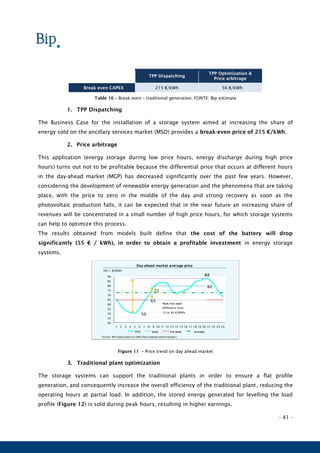
in the Italian Power Industry
November 21st
, 2013
- 1 -
Contents
1 EXCUTIVE SUMMARY ........................................................................................- 3 -
1.1 KEY MESSAGES AND NUMBERS .................................................................................................. - 4 -
1.2 SUMMARY OF EXPECTED MARKET SIZE AND ACTUAL BREAK EVEN COSTS ......................................... - 5 -
2 INTRODUCTION AND ITALIAN CONTEXT ..........................................................- 6 -
2.1 THE EVOLUTION OF THE ITALIAN ELECTRICITY SECTOR ................................................................ - 7 -
2.2 SMART GRIDS .......................................................................................................................- 10 -
2.3 STATE OF THE ART OF STORAGE SYSTEMS ................................................................................- 11 -
3 APPLICATIONS AND SERVICES OF EESS ...........................................................- 13 -
3.1 SUMMARY ............................................................................................................................- 13 -
3.2 APPLICATIONS AND SERVICES..................................................................................................- 13 -
3.2.1 Energy Applications ..........................................................................................- 15 -
3.2.2 Power Applications ...........................................................................................- 15 -
3.3 MARKET SEGMENTS ...............................................................................................................- 19 -
3.3.1 Transmission Grid.............................................................................................- 21 -
3.3.1.1 Market Needs and Dynamics.......................................................- 21 -
3.3.1.2 Regulatory Aspects ......................................................................- 22 -
3.3.2 Traditional Generation......................................................................................- 23 -
3.3.2.1 Market Needs and Dynamics.......................................................- 23 -
3.3.2.2 Regulatory Aspects ......................................................................- 25 -
3.3.1 Renewable Generation......................................................................................- 25 -
3.3.1.1 Market Needs and Dynamics.......................................................- 25 -
3.3.1.2 Regulatory Aspects ......................................................................- 27 -
3.3.2 Distribution Grid ...............................................................................................- 27 -
3.3.2.1 Market Needs and Dynamics.......................................................- 27 -
3.3.2.2 Regulatory Aspects ......................................................................- 30 -
3.3.3 End User.............................................................................................................- 30 -
3.3.3.1 Market Needs and Dynamics.......................................................- 30 -
3.3.3.2 Regulatory Aspects ......................................................................- 31 -
3.4 CONSIDERATIONS AND CONCLUSIONS ......................................................................................- 32 -
4 PRESENT AND FUTURE ITALIAN MARKET SIZE .................................................- 34 -
4.1 SUMMARY ............................................................................................................................- 34 -
4.2 MARKET ANALYSIS FOR ELECTROCHEMICAL ENERGY STORAGE SYSTEMS........................................- 34 -
4.2.1 Transmission Grid.............................................................................................- 35 -
- 2 -
4.2.2 Traditional Generation......................................................................................- 36 -
4.2.3 Renewable Generation......................................................................................- 36 -
4.2.4 Distribution GRID..............................................................................................- 37 -
4.3 CONSIDERATIONS AND CONCLUSIONS ......................................................................................- 37 -
5 BUSINESS CASES FOR EESS APPLICATIONS.......................................................- 39 -
5.1 SUMMARY ............................................................................................................................- 39 -
5.2 TRANSMISSION GRID..............................................................................................................- 39 -
5.3 TRADITIONAL GENERATION ....................................................................................................- 40 -
5.4 RENEWABLE GENERATION .......................................................................................................- 42 -
5.4.1 Joint application for RES Integration Services.................................................- 43 -
5.5 DITRIBUTION GRID ................................................................................................................- 45 -
5.5.1 Joint Application for Distribution Grid services..............................................- 47 -
5.6 END USER ............................................................................................................................- 49 -
5.6.1 Analysis of the Optimal Solution .....................................................................- 49 -
5.6.2 Analysis Results ................................................................................................- 50 -
5.7 CONSIDERATIONS AND CONCLUSIONS ......................................................................................- 51 -
6 BARRIERS TO THE COMMERCIAL DEVELOPMENT OF EESS ................................- 53 -
7 EXPECTED REGULATORY CHANGES IN ITALY...................................................- 54 -
8 THE INTERNATIONAL CONTEXT......................................................................- 55 -
8.1 GERMANY ............................................................................................................................- 56 -
8.2 UNITED STATES ....................................................................................................................- 57 -
8.3 JAPAN - 58 -
8.4 UNITED KINGDOM .................................................................................................................- 59 -
9 CONCLUSIONS ...............................................................................................- 60 -
DEFINITIONS AND ACRONYMS..............................................................................- 62 -
BIBLIOGRAPHY .....................................................................................................- 63 -
FIGURES INDEX.....................................................................................................- 65 -
TABLES INDEX ......................................................................................................- 66 -
- 3 -
1 EXCUTIVE SUMMARY
In a context of profound change in the Italian electricity system, due to the increasing
penetration of non-programmable renewable and distributed generation, there is a clear need
to promote a rapid and radical change towards a more integrated management of the
national grid.
The strong growth of electricity generation from renewable sources (solar and wind), aimed
at achieving the objectives set forth by the increasingly challenging European and Italian Politics,
has led to several problems for the electrical system, such as the need to increase
programmable reserves, the reduction the operating hours of thermal power plants resulting in
reduced availability of grid services (frequency control, balancing, reserves), the risk of
modulation of RES linked to the grid’s poor capacity to transport energy.
Electrochemical storage systems, referred to hereafter EESS "Electrochemical Energy Storage
Systems", are one of the solutions identified in Italy to resolve the issues raised in the
transmission and distribution grid, to contribute to the further increase of renewable energy
sources and to lead in the short/medium term to the smart grids.
The EESS have undergone a rapid technological development in recent years, increasing
their safety, reliability, performance and proving to be able to respond effectively to the new
requirements, particularly lithium-ion and sodium-based technologies. However, the phase of
research and development is not yet complete and Italy is a forerunner of EESS testing:
example initiatives in this direction are pilot projects promoted by the Italian TSO (Terna) and
approved by the Authority for Electricity and Gas (AEEG).
EESSs show the need to undergo a massive spread, useful to the whole electrical system,
which could lead to a significant reduction in investment costs for the electrochemical
storage technologies on the market in the short term and ensure the transition from the small
lots production (for demonstration projects) to the large-scale commercialization.
At the same time it will be necessary to introduce regulations not only in individual segments
of the energy value chain (which are necessary in order to define clear and unambiguous rules
for EESS systems), but also rules of energy exchange between the segments.
Currently, Italy is promoting solutions for transmission grid (Terna): this highlights the desire of
authority and policy to enhance this segment, but policies must be done in order to enhance the
entire Italian industry through a schedule of the possible market scenarios, in order to prevent
the occurrence of uncontrollable phenomena of development.
- 4 -
1.1 KEY MESSAGES AND NUMBERS
The analysis carried out by Bip highlights Italy is a very promising market for EESS and investments
may bring many benefits to both the Italian electric system and economic system.
 The potential market size for EESS is somewhat like 9 GWh up to 2020, while the
overall market size is estimate is 27 GWh
 Expected rated power of EESS in 2020 will be 25% of actual hydropower
pumping storage installed
 In 2018 technology costs will meet break even prices (400 €/KWh) for DSO
applications
 Investors may supply the electric system with more than 2 billion € investments, but
require clear regulatory framework
 Investments in energy storage may also determine the growth of a new industry and
new massive employment in the energy sector
 Grid parity is coming closer and closer for photovoltaic and wind installations and the
expected +150% growth in 2020 (up to 30 GW PV and 14 GW wind) will distress the
grids, if not adequately supported by storage systems
 Electrochemical batteries are the best solution to manage networks in security and
minimizing losses (more than 130 GWh of wind energy has been wasted in
2012 and is expected to grow in the future)
- 5 -
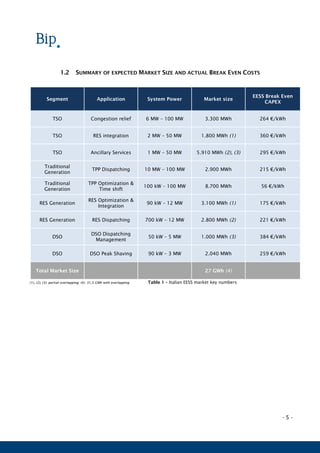
1.2 SUMMARY OF EXPECTED MARKET SIZE AND ACTUAL BREAK EVEN COSTS
Segment Application System Power Market size
EESS Break Even
CAPEX
TSO Congestion relief 6 MW – 100 MW 3.300 MWh 264 €/kWh
TSO RES integration 2 MW – 50 MW 1.800 MWh (1) 360 €/kWh
TSO Ancillary Services 1 MW – 50 MW 5.910 MWh (2), (3) 295 €/kWh
Traditional
Generation
TPP Dispatching 10 MW – 100 MW 2.900 MWh 215 €/kWh
Traditional
Generation
TPP Optimization &
Time shift
100 kW – 100 MW 8.700 MWh 56 €/kWh
RES Generation
RES Optimization &
Integration
90 kW – 12 MW 3.100 MWh (1) 175 €/kWh
RES Generation RES Dispatching 700 kW – 12 MW 2.800 MWh (2) 221 €/kWh
DSO
DSO Dispatching
Management
50 kW – 5 MW 1.000 MWh (3) 384 €/kWh
DSO DSO Peak Shaving 90 kW – 3 MW 2.040 MWh 259 €/kWh
Total Market Size 27 GWh (4)
(1), (2), (3): partial overlapping; (4): 31,5 GWh with overlapping Table 1 – Italian EESS market key numbers
- 6 -
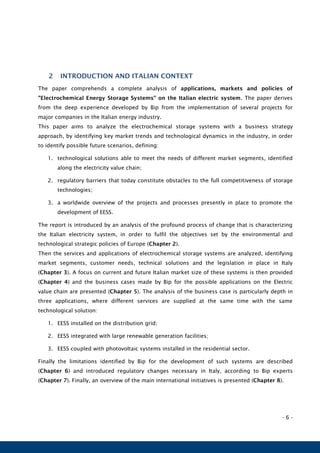
2 INTRODUCTION AND ITALIAN CONTEXT
The paper comprehends a complete analysis of applications, markets and policies of
"Electrochemical Energy Storage Systems" on the Italian electric system. The paper derives
from the deep experience developed by Bip from the implementation of several projects for
major companies in the Italian energy industry.
This paper aims to analyze the electrochemical storage systems with a business strategy
approach, by identifying key market trends and technological dynamics in the industry, in order
to identify possible future scenarios, defining:
1. technological solutions able to meet the needs of different market segments, identified
along the electricity value chain;
2. regulatory barriers that today constitute obstacles to the full competitiveness of storage
technologies;
3. a worldwide overview of the projects and processes presently in place to promote the
development of EESS.
The report is introduced by an analysis of the profound process of change that is characterizing
the Italian electricity system, in order to fulfil the objectives set by the environmental and
technological strategic policies of Europe (Chapter 2).
Then the services and applications of electrochemical storage systems are analyzed, identifying
market segments, customer needs, technical solutions and the legislation in place in Italy
(Chapter 3). A focus on current and future Italian market size of these systems is then provided
(Chapter 4) and the business cases made by Bip for the possible applications on the Electric
value chain are presented (Chapter 5). The analysis of the business case is particularly depth in
three applications, where different services are supplied at the same time with the same
technological solution:
1. EESS installed on the distribution grid;
2. EESS integrated with large renewable generation facilities;
3. EESS coupled with photovoltaic systems installed in the residential sector.
Finally the limitations identified by Bip for the development of such systems are described
(Chapter 6) and introduced regulatory changes necessary in Italy, according to Bip experts
(Chapter 7). Finally, an overview of the main international initiatives is presented (Chapter 8).
- 7 -
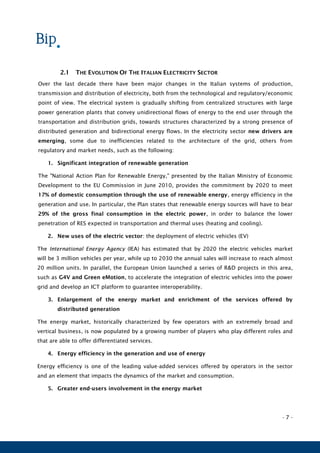
2.1 THE EVOLUTION OF THE ITALIAN ELECTRICITY SECTOR
Over the last decade there have been major changes in the Italian systems of production,
transmission and distribution of electricity, both from the technological and regulatory/economic
point of view. The electrical system is gradually shifting from centralized structures with large
power generation plants that convey unidirectional flows of energy to the end user through the
transportation and distribution grids, towards structures characterized by a strong presence of
distributed generation and bidirectional energy flows. In the electricity sector new drivers are
emerging, some due to inefficiencies related to the architecture of the grid, others from
regulatory and market needs, such as the following:
1. Significant integration of renewable generation
The "National Action Plan for Renewable Energy," presented by the Italian Ministry of Economic
Development to the EU Commission in June 2010, provides the commitment by 2020 to meet
17% of domestic consumption through the use of renewable energy, energy efficiency in the
generation and use. In particular, the Plan states that renewable energy sources will have to bear
29% of the gross final consumption in the electric power, in order to balance the lower
penetration of RES expected in transportation and thermal uses (heating and cooling).
2. New uses of the electric vector: the deployment of electric vehicles (EV)
The International Energy Agency (IEA) has estimated that by 2020 the electric vehicles market
will be 3 million vehicles per year, while up to 2030 the annual sales will increase to reach almost
20 million units. In parallel, the European Union launched a series of R&D projects in this area,
such as G4V and Green eMotion, to accelerate the integration of electric vehicles into the power
grid and develop an ICT platform to guarantee interoperability.
3. Enlargement of the energy market and enrichment of the services offered by
distributed generation
The energy market, historically characterized by few operators with an extremely broad and
vertical business, is now populated by a growing number of players who play different roles and
that are able to offer differentiated services.
4. Energy efficiency in the generation and use of energy
Energy efficiency is one of the leading value-added services offered by operators in the sector
and an element that impacts the dynamics of the market and consumption.
5. Greater end-users involvement in the energy market
- 8 -
Thanks to the spread of Smart Meters and the launch of awareness campaigns to end consumers
for a more efficient use of energy, users are increasingly interested in issues related to the
electricity sector and many of them already are configured as prosumer, according to a
neologism recently introduced. Moreover, in the near future new demand response technologies
and procedures will further increase this trend.
The distributed generation and the new organization of the electricity sector are benefiting users
and generators, but they involve a number of critical issues related to the current electrical
system, designed in a totally different context and unable to deal with the new drivers.
The main issues arising are:
1. Inefficiencies related to grid congestion: the strong localization and rapid growth of
renewable generation have created areas of concentrated generation (especially in
southern Italy), that during high availability of primary sources fail to provide all the
energy available to the electrical grid, due to the limitations of transport infrastructure.
2. Inefficiencies related to security: in order to ensure the safety and reliability of the
system, the transmission system operator (TSO) must provide the procurement of
resources for the resolution of congestions and the creation of appropriate reserve
margins. The purchase of these "ancillary services" by the grid operator has been growing
steadily in recent years, becoming more and more expensive, as the strong penetration
of non-programmable generation has greatly increased the level of uncertainty of energy
transit across the grid, making greater quantities of reserves needed in order to
guarantee the security of the system.
3. Reverse power flows on the distribution grid: the increase of distributed generation is
altering the traditional one-way flow of energy (from generators to the end user), creating
unusual flows of energy in the opposite direction, ranging from distribution substations
to the power transmission grid. The distribution grid is currently not designed to handle
this phenomenon.
4. Strong imbalance between energy supply and demand: high overcapacity and reduced
load factor of recent CCGT power plants. In addition, the increasing penetration of
intermittent renewable reduces the amount of the tradable energy on the market, causing
an increase in the volatility of tradable demand (with a few hours of peak demand and a
high number of hours at very low demand) and an increase in adjustment volumes for the
balancing market and ancillary services, to guarantee the system security. These
phenomena particularly affect the load factor and economic results of thermal power
- 9 -
plants, which are the technologies that best respond to the increase of flexibility required
by the system.
5. New dynamics on the Day-Ahead Market: The increase of renewable sources has
reduced tradable demand on the market and created new hour profiles of the energy
price (PUN). The figure shows two Sundays in which there was a high variability of the
PUN profile. The price profile of the two Sundays of 2013 compared to 2012 decreased
substantially, reaching a null value in the hours when energy produced by photovoltaic
systems is at its maximum; at the same time has increased the price in the evening
hours.
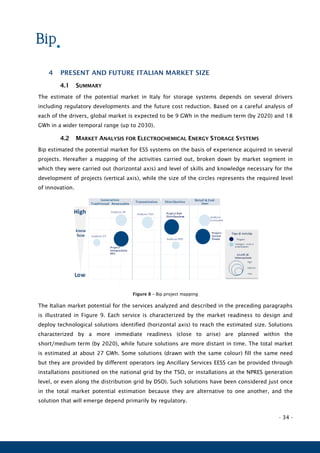
Figure 1 – Price (PUN) in two 2012-2013 significant days (Sundays)
6. Reduction in the availability of primary reserve after markets negotiations: changes
in the operational management for system safety. In order to comply with the safety
standards in the exercise of the electrical system, an adequate capacity of primary
reserve must be provided, able to ensure the stability of the power supply in all operating
conditions. The rise of NPRES power plants and DG occurred in Italy in recent years
involves a substantial reduction in the primary reserve due to the lack of inertia of most
of the systems used to produce energy from NP sources (full-converter wind turbines and
PV generators).
The issues raised can be resolved or effectively limited by the implementation of systems that
allow greater interaction between grid, users and generation. Such systems are called smart
grids: they consist in a clever use of communication systems that allow to overcome the present
limitations of energy grids and that enable a significant increase in the contribution of DG, while
maintaining a high level of security and reliability of the entire system.
-60
-40
-20
0
20
40
60
80
100
120
140
1 2 3 4 5 6 7 8 9 101112131415161718192021222324
delta PUN 02/06/2013 e
03/06/2012 [€/MWh]
delta PUN 16/06/2013 e
17/06/2012 [€/MWh]
PUN 02/06/2013
[€/MWh]
PUN 16/06/2013
[€/MWh]
PUN 03/06/2012
[€/MWh]
PUN 17/06/2012
[€/MWh]
- 10 -
The electricity storage technologies are an enabler for the Smart Grid, allowing for a planned
management of energy flows and decoupling NP generation from consumption needs of end
customers.
2.2 SMART GRIDS
The European Technology Platform Smart Grids defines the Smart Grid as "an electricity grid that
integrates and efficiently manages the behaviour and actions of all connected users (generators,
sampling points and points with presence of both generation and sampling), with the aim of
ensuring an economically efficient operation of the electrical system, with a high level of safety,
quality and continuity of supply". The achievement of the smart grid requires the implementation
of appropriate "intelligent" functionalities by different phases of the electrical system.
1. Generation: optimization of the performances of the different sources of generation,
according to grid conditions and characteristics of consumption (generation of smart
functionality).
2. Transmission and Distribution: reliability, quality and safety of the grids, by
implementing mechanisms of action-reaction involving both generation and consumption
(smart grid functionality).
3. Consumption and use of electricity: the consumer assumes an active role in the system,
through forms of monitoring and interaction with other actors in the electricity system
(functionality of smart metering & active demand).
To date, the transformation of the electricity grid into a Smart Grid with these characteristics
requires a series of activities, as pointed out in the following points:
1. Identification and implementation of technical solutions that allow managing two-way
flows of energy through the grid, at low cost, while ensuring the security and flexibility
for future technology upgrades.
2. Homogenization of the adjustment protocols and of European electricity markets, to
facilitate transactions at supra-national level and give maximum opportunity to free
electricity market development.
3. Definition of technical standards shared at European level to ensure grid compatibility
and a freely competitive market for the supply of the technologies needed to adapt the
grids.
4. Development of a dedicated ICT system, able to manage safely and transparently the
complexity of the new electrical system.
- 11 -
The combination of these "smart" features, enabled by the adoption of appropriate technological
solutions, makes the electrical system a "smart" system and can therefore ensure the diffusion of
renewable energy generation on a larger scale, without compromising the correct functionality
and stability of the power system itself.
The full development of energy storage systems and innovative electrical power distribution
systems, however, still faces difficulties related to the technologies to be developed, the full
involvement of consumers, but also to boost regulatory essential to favour future investments in
advanced infrastructure.
2.3 STATE OF THE ART OF STORAGE SYSTEMS
The electrical energy storage systems can solve many of the problems found in the electricity
sector: from grid congestions to the voltage quality, from reserves availability to the active role
of end-users on the grid. The growing interest in the Smart Grid has then led to launch a phase
of rapid development and innovation in the field of storage technologies, in particular
electrochemical storage. Some electrochemical storage solutions are already available, and now
fully mature, but many others have yet to demonstrate their performance in the electricity sector.
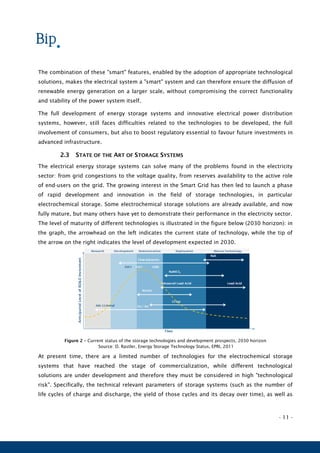
The level of maturity of different technologies is illustrated in the figure below (2030 horizon): in
the graph, the arrowhead on the left indicates the current state of technology, while the tip of
the arrow on the right indicates the level of development expected in 2030.
Figure 2 – Current status of the storage technologies and development prospects, 2030 horizon
Source: D. Rastler, Energy Storage Technology Status, EPRI, 2011
At present time, there are a limited number of technologies for the electrochemical storage
systems that have reached the stage of commercialization, while different technological
solutions are under development and therefore they must be considered in high "technological
risk". Specifically, the technical relevant parameters of storage systems (such as the number of
life cycles of charge and discharge, the yield of those cycles and its decay over time), as well as
- 12 -
the unit costs, are not currently known with a sufficient reliability, so a certain amount of
experimentation is still needed.
The more mature technology of electrochemical storage for providing services to the electrical
system are the sodium-sulphur batteries (NaS), followed by lead acid (Pb-acid), ZEBRA (NaNiCl2)
and lithium ion (Li-ion). The Pb-acid batteries are commonly used in automotive and stationary
applications, however, there are active projects (including DEMO-RESTORE, funded UN and FP6),
which are proposed to test the Pb-acid batteries to support photovoltaic systems. Other major
projects include the systems Li-ion and ZEBRA.
As regards the Lithium accumulators, the major research activity are being conducted, since this
solutions offer several advantages from the performances point of view, compared to all other
types of accumulators. Among their main advantages there is the high energy density, which
makes them suitable for all types of future application. The lithium-ion technology, in fact, offers
high storage capacity and a low weight, compared to other technologies.
In conclusion, in order to start a massive deployment of storage technologies, in particular
electrochemical, a thorough testing phase is still required. In fact the Italian Authority approved
some pilot projects in order to test performances, so in the next few years we will probably see a
reversal of the current view of technologies, and also further innovations development is
expected.
- 13 -
3 APPLICATIONS AND SERVICES OF EESS
3.1 SUMMARY
The electrochemical storage systems may provide different services along the electricity value
chain and some of these are combined with each other, increasing the EESS potential and a
consequent greater return on investment.
The EESS systems can facilitate the integration of energy generation from renewable sources,
helping to solve some problems in the voltage and frequency adjustment services. They are able
to elevate the level of quality of electricity service and participate in the optimal management of
all grid resources: generation plants, grids and loads.
3.2 APPLICATIONS AND SERVICES
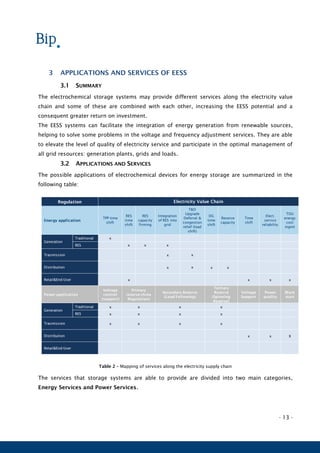
The possible applications of electrochemical devices for energy storage are summarized in the
following table:
Table 2 – Mapping of services along the electricity supply chain
The services that storage systems are able to provide are divided into two main categories,
Energy Services and Power Services.
Regulation Electricity Value Chain
Energy application
TPP time
shift
RES
time
shift
RES
capacity
firming
Integration
of RES into
grid
T&D
Upgrade
Deferral &
congestion
relief (load
shift)
DG
time
shift
Reserve
capacity
Time
shift
Elect.
service
reliability
TOU
energy
cost
mgmt
Generation
Traditional x
RES x x x
Trasmission x x
Distribution x x x x
Retail&End-User x x x x
Power application
Voltage
control
(support)
Primary
reserve (Area
Regulation)
Secondary Reserve
(Load Following)
Tertiary
Reserve
(Spinning
Reserve)
Voltage
Support
Power
quality
Black
start
Generation
Traditional x x x x
RES x x x x
Trasmission x x x x
Distribution x x X
Retail&End-User
- 14 -
1. Systems with energy performance are suitable for feed / absorb the rated power with a
few hours of autonomy.
2. Systems with power performance are suitable to feed / absorb very high power with very
fast response times (fractions of seconds) and autonomy of tens of minutes.
The different applications of the storage systems, in function of energy, power, response time
requirements, can be divided into three main classes, each of which requires systems with
adequate performances:
1. Time Shift: temporal decoupling of generation from the use of energy, both to the
technical objectives (solution of grid congestions, peak shaving with the function of
levelling the peak load and dimension the grid on the average power) and an economic
(such as arbitrage: purchase of energy in hours when it costs less and selling in hours
when the price is higher). The storage system for this class must supply the nominal
power for many hours;
2. Power Balancing: making NPRES generation more regular and predictable and
compensating variations in load (load following). The accumulation system must have
performance in energy with fast response times because of the continuous transitions
from the state of charge to discharge and it must be able to provide an adequate power;
3. High power ancillary services for the adjustment of grid tension, that can be performed
through the control of reactive power fed into the grid through the inverter needed for
the interface of the accumulator with the grid, the improvement of the quality of the grid
voltage (Power Quality), the adjustment of frequency. In this type of application the
storage system must be capable of delivering the maximum power in the charge and
discharge with response times shorter than one second, with autonomy that may vary
from a few seconds (as in the applications of Power Quality) to a few hours (as in the
secondary control of frequency).
The EESS is an integrated system made of multiple components: the electrochemical storage
system (e.g. cell modules connected in series and in parallel in order to obtain the values of
voltage and current required by the system), the electromechanical equipment for the
connection of the components of the storage system with the electrical grid, the systems
necessary for the control and safety of the battery modules, the power section and auxiliary
systems needed to ensure the technical performance expectations and for the safety of the
whole apparatus, and finally, ICT systems for the remote control of the operation of the EESS
system to provide the required services.
- 15 -
3.2.1 ENERGY APPLICATIONS
Integration of RES into the grid. The NPRES plants (wind and solar) are characterized by rapid
changes in power output, due to the unpredictable variability of the primary source that feeds
the plant (wind speed and solar radiation). The installation of storage systems can compensate
fluctuations of the power generated in order to obtain a more regular and predictable generating
profile.
RES time shift. Given the high variability of RES generation, storage systems can be used to
perform arbitrage strategies, storing energy during periods when the sale price is less profitable,
and selling it (or directly using it) during periods of limited production and/or high electricity
price.
Thermal Power Plant (TPP) Time shift. The traditional thermoelectric plants could increase
their revenues with a storage system, storing energy during lower load periods and releasing it
in peak periods (price arbitrage). In addition, a storage system can make the plant work with a
more regular profile, allowing a more efficient use of primary sources and a consequent
reduction in operating costs.
Transmission & Distribution (T&D) congestion relief & upgrade deferral. The use of the
storage system in sections of the grid where there are congestions allows the grid operator to
manage these phenomena with lower costs. In addition, the time shift function also allows the
operator to defer grid investments needed to strengthen the lines, thus allowing the
optimization of fixed investment.
Time of use energy cost management. The end-users (also domestic) pay the energy
depending on the time profile of usage and can reduce overall costs by adopting a storage
system capable of moving energy consumption in the hours characterized by the lowest price.
3.2.2 POWER APPLICATIONS
RES Capacity Firming. This application is aimed at making the profile of production of RES
plants more regular and predictable levelling power peaks, so as to reduce the costs related to
power fluctuations.
Primary reserve. With the massive penetration of NP renewable energy plants, the national
electricity system is undergoing a reduction in the number of thermal power plants in service,
thus causing a reduction of the primary reserve available (regulation band not less than 1.5% of
the efficient power, usually offered by thermal power plants), which instead is required in greater
quantity because of the intermittence of the NPRES installations. The EESS are suitable to
- 16 -
accomplish this type of application also at plants NPRES (as characterized by rapid response to
load variation), thus increasing the margin of primary reserve.
Secondary reserve. Storage systems, coupled to conventional systems, can adequately provide
secondary and tertiary regulation services, reducing the need for modulation and partial load
operation of thermal power units: in this way the traditional plants can work at full capacity and
provide ancillary services through the management of the storage system.
In the future, the provision of secondary and tertiary reserve power may also be granted to the
units powered by NPRES (on the transmission or distribution grid). Through the installation of
storage systems at the NPRES facilities, it is possible to compensate the gap between generation
and demand, bringing the power exchange to program values, and contributing to the
restoration of the entire grid frequency.
Tertiary reserve. Resources for tertiary power reserve are designed to constitute appropriate
margins, considered the minimum and maximum power production schedules defined in the
planning stage. There are two types of reserves:
1. Ready Reserve: increase of power that can be fed into the grid to quickly restore
secondary reserve margins and to maintain the equilibrium of the system in case of
sudden changes in demand;
2. Replacement Reserve: power variation with the goal of restoring the secondary reserve
eroded by deflection of the load, failure of power plants, or change in production from
NPRES.
Furthermore, since the tertiary reserve margins are wider than primary and secondary reserve
margins, their impact on partial load operation of thermoelectric generation units, and hence the
relative reduction in the generation efficiency, is greater. So the benefit resulting from the use of
a storage system with high efficiency is more significant than in the case of primary and
secondary regulation services described above.
Electric service power quality. The grid operators are required to maintain the energy
transmission within the established limits of quality, in order to ensure the security of the grid
and meet specific customer requirements. The storage systems can be used to provide some
ancillary services or for improving the quality of delivery in the presence of grid disturbances
(Power Quality), for these applications the autonomy required can span from a few fractions of a
second to several seconds.
Electric service reliability. The storage systems are able to provide a backup power source
supply that guarantees the continuity of the electrical service even after outages on the
- 17 -
distribution grid. Storage systems may also be supportive in the case of long breaks, to guide
users in a controlled outage that has limited impacts on production processes.
Voltage support. Within the power system management, it is important to maintain adequate
levels of tension with the necessary stability in the different nodes of the grid. A storage system
can generate or absorb reactive power in both the charging and in that the discharge phases,
and provide the service in a few seconds. The use for this service is complementary to all the
others, because the absorption or the supply of reactive energy can take place in any operating
condition of the battery, as long as it is in use.
Reserve capacity. The sharp increase of the connections of distributed generation has
determined the need to delegate some of dispatching activities also to distribution grids (at
present time the TSO is the only owner of these assets). In order to create a local market for
frequency adjustment, it is necessary to provide a reserve capacity that can be used in case of
sudden unavailability of part of the generation systems located throughout the area. Storage
systems can help restore reserves rapidly, reducing the need for backup power from thermal
power plants that represent a minority in the installed capacity in the distribution grid.
Black start. After an extended black-out, the electrical system needs systems capable of
autonomous restart without grid supply, in order to power other installations and restore the
normal operations. This service is usually provided by hydroelectric plants. The energy storage
systems can efficiently provide the same service, because they are able to provide energy without
any external input.
In order to select the most appropriate technologies for the performance of specific applications,
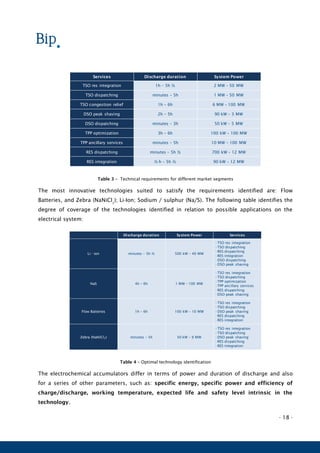
the specific needs in terms of potency and duration of discharge are summarized in the
following table:
- 18 -
Table 3 – Technical requirements for different market segments
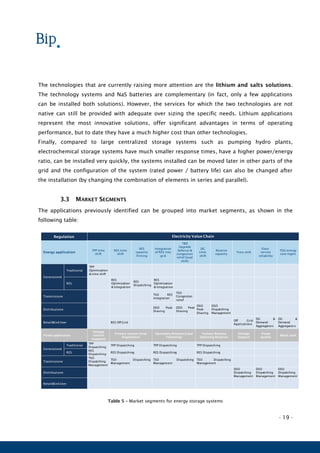
The most innovative technologies suited to satisfy the requirements identified are: Flow
Batteries, and Zebra (NaNiCl2
); Li-Ion; Sodium / sulphur (Na/S). The following table identifies the
degree of coverage of the technologies identified in relation to possible applications on the
electrical system:
Table 4 – Optimal technology identification
The electrochemical accumulators differ in terms of power and duration of discharge and also
for a series of other parameters, such as: specific energy, specific power and efficiency of
charge/discharge, working temperature, expected life and safety level intrinsic in the
technology.
Services Discharge duration System Power
TSO res integration 1h – 5h ½ 2 MW – 50 MW
TSO dispatching minutes – 5h 1 MW – 50 MW
TSO congestion relief 1h – 6h 6 MW – 100 MW
DSO peak shaving 2h – 5h 90 kW – 3 MW
DSO dispatching minutes – 3h 50 kW – 5 MW
TPP optimization 3h – 6h 100 kW – 100 MW
TPP ancillary services minutes – 5h 10 MW – 100 MW
RES dispatching minutes – 5h ½ 700 kW – 12 MW
RES integration ½ h – 5h ½ 90 kW – 12 MW
Discharge duration System Power Services
Li - ion minutes – 5h ½ 500 kW – 40 MW
- TSO res integration
- TSO dispatching
- RES dispatching
- RES integration
- DSO dispatching
- DSO peak shaving
NaS 4h – 6h 1 MW – 100 MW
- TSO res integration
- TSO dispatching
- TPP optimization
- TPP ancillary services
- RES dispatching
- DSO peak shaving
Flow Batteries 1h – 6h 100 kW – 10 MW
- TSO res integration
- TSO dispatching
- DSO peak shaving
- RES dispatching
- RES integration
Zebra (NaNiCl2) minutes – 5h 50 kW – 9 MW
- TSO res integration
- TSO dispatching
- DSO peak shaving
- RES dispatching
- RES integration
- 19 -
The technologies that are currently raising more attention are the lithium and salts solutions.
The technology systems and NaS batteries are complementary (in fact, only a few applications
can be installed both solutions). However, the services for which the two technologies are not
native can still be provided with adequate over sizing the specific needs. Lithium applications
represent the most innovative solutions, offer significant advantages in terms of operating
performance, but to date they have a much higher cost than other technologies.
Finally, compared to large centralized storage systems such as pumping hydro plants,
electrochemical storage systems have much smaller response times, have a higher power/energy
ratio, can be installed very quickly, the systems installed can be moved later in other parts of the
grid and the configuration of the system (rated power / battery life) can also be changed after
the installation (by changing the combination of elements in series and parallel).
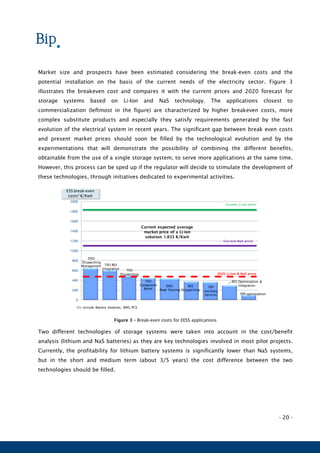
3.3 MARKET SEGMENTS
The applications previously identified can be grouped into market segments, as shown in the
following table:
Table 5 – Market segments for energy storage systems
Regulation Electricity Value Chain
Energy application
TPP time
shift
RES time
shift
RES
capacity
firming
Integration
of RES into
grid
T&D
Upgrade
Deferral &
congestion
relief (load
shift)
DG
time
shift
Reserve
capacity
Time shift
Elect.
service
reliability
TOU energy
cost mgmt
Generazione
Traditional
TPP
Optimization
& time shift
RES
RES
Optimization
& Integration
RES
Dispatching
RES
Optimization
& Integration
Trasmissione
TSO RES
Integration
TSO
Congestion
relief
Distribuzione
DSO Peak
Shaving
DSO Peak
Shaving
DSO
Peak
Shaving
DSO
Dispatching
Management
Retail&End-User RES Off Grid
Off Grid
Applications
DG &
Demand
Aggregators
DG &
Demand
Aggregators
Power application
Voltage
control
(support)
Primary reserve (Area
Regulation)
Secondary Reserve (Load
Following)
Tertiary Reserve
(Spinning Reserve)
Voltage
Support
Power
quality
Black start
Generazione
Traditional
TPP
Dispatching
TPP Dispatching TPP Dispatching TPP Dispatching
RES
RES
Dispatching
RES Dispatching RES Dispatching RES Dispatching
Trasmissione
TSO
Dispatching
Management
TSO Dispatching
Management
TSO Dispatching
Management
TSO Dispatching
Management
Distribuzione
DSO
Dispatching
Management
DSO
Dispatching
Management
DSO
Dispatching
Management
Retail&End-User
- 20 -
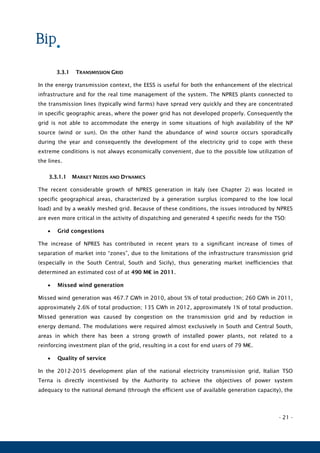
Market size and prospects have been estimated considering the break-even costs and the
potential installation on the basis of the current needs of the electricity sector. Figure 3
illustrates the breakeven cost and compares it with the current prices and 2020 forecast for
storage systems based on Li-Ion and NaS technology. The applications closest to
commercialization (leftmost in the figure) are characterized by higher breakeven costs, more
complex substitute products and especially they satisfy requirements generated by the fast
evolution of the electrical system in recent years. The significant gap between break even costs
and present market prices should soon be filled by the technological evolution and by the
experimentations that will demonstrate the possibility of combining the different benefits,
obtainable from the use of a single storage system, to serve more applications at the same time.
However, this process can be sped up if the regulator will decide to stimulate the development of
these technologies, through initiatives dedicated to experimental activities.
Figure 3 – Break-even costs for EESS applications
Two different technologies of storage systems were taken into account in the cost/benefit
analysis (lithium and NaS batteries) as they are key technologies involved in most pilot projects.
Currently, the profitability for lithium battery systems is significantly lower than NaS systems,
but in the short and medium term (about 3/5 years) the cost difference between the two
technologies should be filled.
DSO
Dispatching
Management TSO RES
Integration TSO
Dispatching
TSO
Congestion
Relief
DSO
Peak Shaving
TPP
ancillary
services
RES
Dispatching
RES Optimization &
Integration
TPP optimization
0
200
400
600
800
1000
1200
1400
1600
1800
2000
2020 Li-ion & NaS price
Current NaS price
Current Li-ion price
(1): include Battery modules, BMS, PCS
Current expected average
market price of a Li-ion
solution: 1.833 €/Kwh
ESS break-even
costs1 €/Kwh
- 21 -
3.3.1 TRANSMISSION GRID
In the energy transmission context, the EESS is useful for both the enhancement of the electrical
infrastructure and for the real time management of the system. The NPRES plants connected to
the transmission lines (typically wind farms) have spread very quickly and they are concentrated
in specific geographic areas, where the power grid has not developed properly. Consequently the
grid is not able to accommodate the energy in some situations of high availability of the NP
source (wind or sun). On the other hand the abundance of wind source occurs sporadically
during the year and consequently the development of the electricity grid to cope with these
extreme conditions is not always economically convenient, due to the possible low utilization of
the lines.
3.3.1.1 MARKET NEEDS AND DYNAMICS
The recent considerable growth of NPRES generation in Italy (see Chapter 2) was located in
specific geographical areas, characterized by a generation surplus (compared to the low local
load) and by a weakly meshed grid. Because of these conditions, the issues introduced by NPRES
are even more critical in the activity of dispatching and generated 4 specific needs for the TSO:
 Grid congestions
The increase of NPRES has contributed in recent years to a significant increase of times of
separation of market into “zones”, due to the limitations of the infrastructure transmission grid
(especially in the South Central, South and Sicily), thus generating market inefficiencies that
determined an estimated cost of at 490 M€ in 2011.
 Missed wind generation
Missed wind generation was 467.7 GWh in 2010, about 5% of total production; 260 GWh in 2011,
approximately 2.6% of total production; 135 GWh in 2012, approximately 1% of total production.
Missed generation was caused by congestion on the transmission grid and by reduction in
energy demand. The modulations were required almost exclusively in South and Central South,
areas in which there has been a strong growth of installed power plants, not related to a
reinforcing investment plan of the grid, resulting in a cost for end users of 79 M€.
 Quality of service
In the 2012-2015 development plan of the national electricity transmission grid, Italian TSO
Terna is directly incentivised by the Authority to achieve the objectives of power system
adequacy to the national demand (through the efficient use of available generation capacity), the
- 22 -
compliance with safety operating conditions, the reliability and affordability increase of the
transmission grid and finally to improve the quality and continuity of service.
In particular Terna has provided important investments, in order to ensure adequate and
improving levels of quality and continuity of the transmission grid in the most critical areas.
 Optimization of Ancillary Services Market
In order to ensure the safety of the national transmission grid (Rete di Trasmissione Nazionale –
RTN), TSO must guarantee the required quantities of secondary reserve (14 GWh/day) and
tertiary reserve (71 GWh/day) on the Ancillary Services Market, to be used to maintain the
balance between energy generation and consumption. The secondary and tertiary reserve is
usually offered by thermal power plants (to date, 90% increase reserve and 71% decrease reserve)
and paid according to a pay-as-bid mechanism. The installation of the new large NPRES capacity
on the electrical system determines strong critical issues in the exercise of the system as a
whole, particularly during periods of low load. The diffusion of NPRES installations (characterised
by limited predictability and not allowed to offer reserve on the markets) determines a high
degree of randomness in the electrical system, which requires Terna to purchase larger
quantities of the secondary and tertiary (spinning) reserve.
3.3.1.2 REGULATORY ASPECTS
Regulation Description
Delibera 66/2013/R/eel
The Authority admitted 2 EESS pilot projects systems to the incentive treatment
for "power intensive” applications, included in the 2012 Terna Defence Plan
approved by the MSE, for a total of 16 MW.
Delibera 43/2013/R/eel
The Authority admitted 6 EESS pilot projects to the incentive treatment for
"Energy intensive" applications, included in the 2011 Terna Development Plan
approved by the MSE, for a total of 35 MW.
Delibera ARG/elt 199/11
The only battery installation allowed on the national transmission grid are those
characterized as: pilot projects for the testing of EESS potential, effectiveness
and efficiency.
Delibera 288/2012/R/eel
Defines the criteria and procedures for the selection of EESS pilot projects on the
national grid.
D.LGS 93/11 (art. 36 comma 4)
States that the operator of the national transmission system can install and
manage distributed electricity storage systems through batteries and that such
systems can also be built and managed by the managers of the distribution
system.
D.LGS 28/11 (art17)
States that TSO can include electrical energy storage systems in its Development
Plan, aimed at facilitating the dispatch of non-programmable generation.
Table 6 – Regulation Summary - Transmission Grid
- 23 -
3.3.2 TRADITIONAL GENERATION
The increasing share of NPRES generation and the contraction of electricity consumption (due to
the economic crisis), push to a more flexible use of large thermal power plants, previously
dedicated to base load generation (with few modulation orders just to meet demand variations).
Now greater variation is required in the traditional thermal plants use, in particular for gas-fired
combined cycle, as a result of the outcomes of both energy and ancillary services markets. Also,
the Transmission System occurs more frequently and heavily to the ancillary services markets,
having to integrate a considerable and growing share of NPRES into the system. In this sense, the
use of storage systems in traditional production systems allows a partial decoupling of the plant
operation and the grid demand, reducing the stress on the grid equipment and allowing a
greater utilization of power plants.
3.3.2.1 MARKET NEEDS AND DYNAMICS
Storage systems can satisfy three different needs for traditional generation:
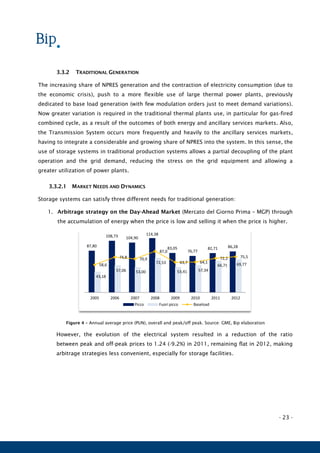
1. Arbitrage strategy on the Day-Ahead Market (Mercato del Giorno Prima – MGP) through
the accumulation of energy when the price is low and selling it when the price is higher.
Figure 4 – Annual average price (PUN), overall and peak/off peak. Source: GME, Bip elaboration
However, the evolution of the electrical system resulted in a reduction of the ratio
between peak and off-peak prices to 1.24 (-9.2%) in 2011, remaining flat in 2012, making
arbitrage strategies less convenient, especially for storage facilities.
87,80
108,73 104,90
114,38
83,05
76,77
82,71 86,28
43,18
57,06 53,00
72,53
53,41 57,34
66,71 69,7758,6
74,8 70,9
87,0
63,7 64,1
72,2 75,5
2005 2006 2007 2008 2009 2010 2011 2012
Picco Fuori picco Baseload
- 24 -
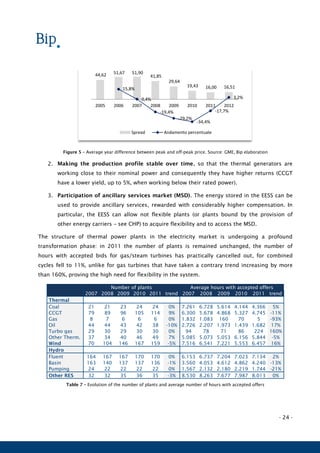
Figure 5 – Average year difference between peak and off-peak price. Source: GME, Bip elaboration
2. Making the production profile stable over time, so that the thermal generators are
working close to their nominal power and consequently they have higher returns (CCGT
have a lower yield, up to 5%, when working below their rated power).
3. Participation of ancillary services market (MSD). The energy stored in the EESS can be
used to provide ancillary services, rewarded with considerably higher compensation. In
particular, the EESS can allow not flexible plants (or plants bound by the provision of
other energy carriers – see CHP) to acquire flexibility and to access the MSD.
The structure of thermal power plants in the electricity market is undergoing a profound
transformation phase: in 2011 the number of plants is remained unchanged, the number of
hours with accepted bids for gas/steam turbines has practically cancelled out, for combined
cycles fell to 11%, unlike for gas turbines that have taken a contrary trend increasing by more
than 160%, proving the high need for flexibility in the system.
Number of plants Average hours with accepted offers
2007 2008 2009 2010 2011 trend 2007 2008 2009 2010 2011 trend
Thermal
Coal 21 21 23 24 24 0% 7.261 6.728 5.614 4.144 4.366 5%
CCGT 79 89 96 105 114 9% 6.300 5.678 4.868 5.327 4.745 -11%
Gas 8 7 6 6 6 0% 1.832 1.083 160 70 5 -93%
Oil 44 44 43 42 38 -10% 2.726 2.207 1.973 1.439 1.682 17%
Turbo gas 29 30 29 30 30 0% 94 78 71 86 224 160%
Other Therm. 37 34 40 46 49 7% 5.085 5.073 5.053 6.156 5.844 -5%
Wind 70 104 146 167 159 -5% 7.516 6.541 7.221 5.553 6.457 16%
Hydro
Fluent 164 167 167 170 170 0% 6.153 6.737 7.204 7.023 7.134 2%
Basin 163 140 137 137 136 -1% 3.560 4.053 4.612 4.862 4.240 -13%
Pumping 24 22 22 22 22 0% 1.567 2.132 2.180 2.219 1.744 -21%
Other RES 32 32 35 36 35 -3% 8.530 8.263 7.677 7.987 8.013 0%
Table 7 – Evolution of the number of plants and average number of hours with accepted offers
44,62 51,67 51,90
41,85
29,64
19,43 16,00 16,5115,8%
0,4%
-19,4%
-29,2%
-34,4%
-17,7%
3,2%
-0,4
-0,2
0
0,2
0,4
-60
-50
-40
-30
-20
-10
-
10
20
30
40
50
60
2005 2006 2007 2008 2009 2010 2011 2012
Spread Andamento percentuale
- 25 -
3.3.2.2 REGULATORY ASPECTS
There is currently no legislation regulating the EESS in this market segment, but major
manufacturers are willing to establish guidelines to include energy storage systems within the
free market, in accordance with the liberalization criteria introduced in the electricity sector more
than 10 years ago.
3.3.1 RENEWABLE GENERATION
Renewable generation are today characterized by management issues (highlighted by the latest
regulations) that require some technical capabilities from the grid for the correct dispatching of
energy and a careful planning/forecast, with consequent penalties in case that effective
generation is different from planned. Many renewable energy generators are therefore
considering the possibility of using EESS systems to reduce the problems and support the
generation management.
3.3.1.1 MARKET NEEDS AND DYNAMICS
EESS systems can be installed at generation sites and provide specific services depending on the
industry needs, the grid line, the degree of desired innovation on the basis of sustainable costs.
These special needs can be summarized as follows, divided into three main services:
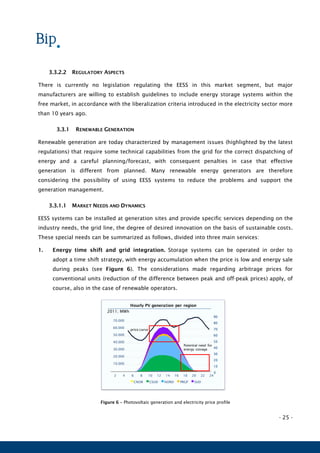
1. Energy time shift and grid integration. Storage systems can be operated in order to
adopt a time shift strategy, with energy accumulation when the price is low and energy sale
during peaks (see Figure 6). The considerations made regarding arbitrage prices for
conventional units (reduction of the difference between peak and off-peak prices) apply, of
course, also in the case of renewable operators.
Figure 6 – Photovoltaic generation and electricity price profile
Hourly PV generation per region
2011; MWh
10.000
20.000
30.000
40.000
50.000
60.000
70.000
2 4 6 8 10 12 14 16 18 20 22 24
CNOR CSUD NORD PRGP SUD
Potential need for
energy storage
0
10
20
30
40
50
60
70
80
90
price curve
- 26 -
Another application of the storage system for renewable energy plants is related to the
generation profile of PV systems. The daily profile, in fact, is characterized by a peak of
generation in the middle of the day (during the first peak of the load curve) and no
generation in the evening hours (during the second peak of the load curve). Storage
systems can optimize this situation and shift generation.
Finally, the storage systems applied to NPRES plants can improve their integration, enabling
the grid to dispatch the entire generation (Hosting Capacity), storing energy when
production from renewable sources exceeds the capacity of dispatching of the grid (for
technical limitations), and delivering it later. This application is particularly critical for wind
power plants, because they are often installed in remote areas, characterized by a relatively
weak transmission grid.
2. Primary reserve and frequency regulation. Distributed NPRES plants are excluded from
the primary reserve obligation, but in the future such facilities could be called to provide
that service. In fact the orientation of the regulator is clear and it is likely that in the future
it will require both generation planning and frequency regulation from FRNP.
3. Secondary and tertiary reserve market. The current regulation does not allow NPRES
operators to participate to the MSD, but the rules evolution will probably have to allow
renewable energy producers to access those markets, that are also the most profitable. In
this case the storage systems, for their technical characteristics, can be used to supply
both secondary and tertiary reserve. Their extremely short response time make them
potentially integrated into the defence system, allowing to improve the management of
existing grid resources.
- 27 -
3.3.1.2 REGULATORY ASPECTS
Regulation Description
D.LGS 93/11 (art. 36 comma 4)
It lets the TSO install and manage distributed electricity storage systems
through batteries. Also DSOs can install and manage this kind of systems.
D.LGS 28/11 (art17)
It lets TSO (Terna) include electrical energy storage systems in its
Development Plan, aimed at facilitating the dispatch of non-programmable
RES plants.
Delibera ARG/elt 199/11
Battery storage systems installed on the national transmission grid will be
rewarded within the tariff system only when these investments are
characterized as pilot projects for the testing of EESS potential,
effectiveness and efficiency.
Delibera ARG/elt 281/12
The Authority has established transitional provisions for the application of
the imbalance penalties to NPRES production units in order to reduce costs
due to poor predictability of such systems.
The resolution 281/2012/R/efr was canceled by local court (TAR) of
Lombardia but later restored by the Authority (October 2013).
Delibera ARG/elt 5/10 Conditions for the dispatch of electricity produced from NPRES
Table 8 – Regulation Summary – Renewable generation
3.3.2 DISTRIBUTION GRID
The non-programmable renewable sources connected to the distribution grid have completely
changed the management of the control, regulation and protection systems of this grid segment,
historically relegated to the simple role of connection between producers and loads. The
expected evolution, necessary for the present state of distributed generation, will significantly
change the role of the distribution grid operators: the distributor will be responsible for
overseeing the system, to develop real-time analysis, to properly manage contingencies, to
adjust the tension, to evaluate the security level of power quality, to check the level of failure, to
manage interactions between generators, to manage intentional islanding operation and
ultimately to ensure a free grid access to all actors operating on the market.
In this context, a key market driver will be the development of storage systems integrated within
the grids, which will become "smart".
3.3.2.1 MARKET NEEDS AND DYNAMICS
Storage systems can be installed to support the distribution grid to respond to some of the new
requirements arising from the massive penetration of distributed generation, such as the
mitigation of the effects of intermittent generation or to meet to lacks of the local electrical
distribution grid. Furthermore, the storage systems can replace more expensive interventions,
such as in cases where the grid faces overloads only for a few moments a day.
- 28 -
1. Reduction of reverse flow
A reverse power flow from the LV/MV grid goes back to the HV lines when the distributed
generation (DG) exceeds the load profile in that grid segment, causing several problems
mainly related to the "uncontrolled islanding" (quality supply, voltage regulation, phase shift)
and this happens because the distribution grid was not designed to collect energy from DG.
In Italy, the reverse flows occur on a significant share of HV/MV and this share is increasing
rapidly:
 from 7% in 7/2010 to 23% in 7/2012, for a period of more than 7 hours per month;
 from 5% in 7/2010 to 16% in 7/2012, for a period exceeding 36 hours per month.
In order to reduce this phenomenon, connection rules of the installations of GD in LV/MV
have been implemented and also installation of storage systems are now being considered.
2. Decrease of grid congestion
Congestion problems have become more critical in the central-southern and insular area of
the country, where most of NPRES are located and where the grid has a lower level of
meshing and a more limited transmission capacity. The DSO needs to control and reduce this
phenomenon and a solution may be represented by electrical energy storage systems.
3. Hosting Capacity increase
The distribution grid needs to increase the hosting capacity (ability to connect Distributed
Generation) ensuring the quality of service to all users. The current "fit & forget" approach is
limiting the hosting capacity and the technical evolution of the grid. The analysis conducted
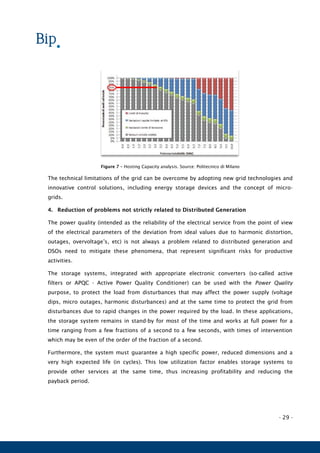
by Politecnico di Milano about the hosting Capacity has estimated that about 85% of the
nodes of the MV distribution grids can connect no more than 3 MW of DG, without violating
grid constraints.
- 29 -
Figure 7 – Hosting Capacity analysis. Source: Politecnico di Milano
The technical limitations of the grid can be overcome by adopting new grid technologies and
innovative control solutions, including energy storage devices and the concept of micro-
grids.
4. Reduction of problems not strictly related to Distributed Generation
The power quality (intended as the reliability of the electrical service from the point of view
of the electrical parameters of the deviation from ideal values due to harmonic distortion,
outages, overvoltage’s, etc) is not always a problem related to distributed generation and
DSOs need to mitigate these phenomena, that represent significant risks for productive
activities.
The storage systems, integrated with appropriate electronic converters (so-called active
filters or APQC - Active Power Quality Conditioner) can be used with the Power Quality
purpose, to protect the load from disturbances that may affect the power supply (voltage
dips, micro outages, harmonic disturbances) and at the same time to protect the grid from
disturbances due to rapid changes in the power required by the load. In these applications,
the storage system remains in stand-by for most of the time and works at full power for a
time ranging from a few fractions of a second to a few seconds, with times of intervention
which may be even of the order of the fraction of a second.
Furthermore, the system must guarantee a high specific power, reduced dimensions and a
very high expected life (in cycles). This low utilization factor enables storage systems to
provide other services at the same time, thus increasing profitability and reducing the
payback period.
- 30 -
3.3.2.2 REGULATORY ASPECTS
Regulation Description
D.LGS 93/11 (art. 36 comma 4)
TSO can install and manage distributed electricity storage systems
through batteries. Also DSOs can install and manage this kind of
systems.
Delibera ARG/elt 199/11
The Authority has promoted the launch of EESS tests on national
transmission and distribution grids.
Delibera 288/12/R/eel
The resolution "procedure and criteria for the selection of pilot
projects on EESS with incentive treatment" has detailed rules for
the implementation of the energy storage trials.
Delibera 84/2012/R/eel
The resolutions approves new annexes to the Code of TSO grid.
Annex A70, in particular, introduces requirements for production
facilities related to MV and LV grids. The resolution also sets the
timing for the application of these requirements to facilities,
including a retrofit for existing installations to avoid critical
situations on the power grid by next summer.
Table 9 – Regulation Summary – Distribution grid
3.3.3 END USER
Storage technologies can be coupled to domestic NPRES generation systems, with an increase of
self consumption and a consequent reduction of costs in the electricity bill. The EESS also allows
end users to decouple the energy produced and the energy absorbed, and make more regular
and predictable power exchanges with the power grid. A storage system may finally give
additional advantages, by making improvements to the quality and continuity of service and to
avoid the overcoming of the contractual power.
3.3.3.1 MARKET NEEDS AND DYNAMICS
1. Peak Shaving: the maximum power consumption is usually kept for a very limited period
during the year (maximum 2 hours). Storage systems can reduce peaks, feeding the load
when it requires a higher power to a given threshold.
Furthermore, if the absorption peak of the end user are diurnal, a second advantage
obtainable from the storage system is the shift of the energy consumption from peak to
off-peak hours, since the EESS charges at times when the user does not exceed the
threshold and discharges during periods of peak demand. The transfer of energy from
peak hours to off-peak hours leads to a reduction of the bill.
2. Power Quality: the EESS guarantees the continuity and quality of service by eliminating
micro outages, surges of power and compensating the lack of electricity in case of power
failure.
- 31 -
3. Renewable self consumption: the installation of an EESS by end user owing a NPRES
home generator enables the maximization of the self consumption of energy produced.
In this context, the daily production can be accumulated and used to cover the evening
peak or however domestic consumption that is not carried out in conjunction with the
production.
4. Distributed Generation Hosting Capacity: the participation of distributors in the MSD
(currently under discussion) will probably cause DG to provide grid services, and in this
context storage systems represent a fundamental support.
5. Demand Aggregator: in a sector perspective based on smart grids, new subjects may
emerge, acting as aggregators of small domestic and commercial customers and
managing their portfolio of consumption and production with not only a commercial
view, but also optimizing energy flows on the grids and maximizing the consumption at
the local level. Electrochemical storage systems are an essential enabler to the
implementation of such services.
3.3.3.2 REGULATORY ASPECTS
The legislation does not directly regulate domestic storage systems, but it is going in the
direction of making renewable producers participate in the operating costs that they generate.
Moreover, the latest PV incentive programme (Quinto Conto Energia), although it has now
exhausted its validity, was extremely interesting because it rewarded PV self consumption more
than the sale of energy to the grid. This mechanism for the first time tries to recognize the
economic impacts of distributed generation and this mechanism were to be repeated (even
beyond the incentives of renewable energy) it would provide a substantial boost to the
development of EESS on the electrical system, which represent the main tool to reduce feed-in
energy into the grid.
- 32 -
Regulation Description
Deliberazione 5 luglio 2012
281/2012/R/EFR (AEEG)
Possibility of new charges for residential photovoltaic owners deriving from
the allocation imbalance costs by GSE
Deliberazione 20 dicembre 2012
5701/2012/R/EFR (AEEG)
Possibility of new charges for PV owners due to the potential abolition of
the reimbursement of the system costs even for small installation
Decreto 5 luglio 2012 (Ministero)
Possible rewards / incentives for self consumption / energy independence
from the grid
Delibere di approvazione dei
progetti pilota di Terna
(288/12,43/13,66/13)
Willingness of the Authority to encourage pilot projects on energy storage
systems
Deliberazione 8 marzo 2012
84/2012/R/EEL (AEEG)
Highlights the need to improve the distributor grid infrastructure
Norma CEI-021 II edizione (AEEG)
1 luglio 2012
The distributed generation must upgrade the inverter, making them more
intelligent/smarter
Norma CEI-016 III edizione (AEEG)
21 dicembre 2012
The distributed generation connected to the HV and MV grid must
communicate with the grid and preserve its stability
Direttiva 2010/31/UE del
parlamento EU e del consiglio
The buildings will have more stringent energy efficiency requirements in
the future, increasing the spread of renewable energy plants
Table 10 – Regulation Summary – End User
3.4 CONSIDERATIONS AND CONCLUSIONS
This chapter has carried out a comprehensive overview of the applications of electrochemical
storage systems by defining the needs of the individual electric system segments and the legal
framework in force has been outlined.
The analysis of the present regulations highlights the need of an evolution of the regulatory
framework in order to facilitate the adoption of storage systems. In particular, the need of an
update of the dispatching rules, even regarding the management of energy storage systems
installed/used by regulated operators (about the participation to the electricity market), in order
to facilitate the operators to make greater investments in storage systems for the grid safety
and, at the same time, protecting the liberalization process.. Moreover, the need to provide
adjustment services also by NPRES installations (for example through storage systems)
emerged in the latest period, so that the system is starting to perceive these generation units no
longer as a source of unpredictability, but as subjects able to contribute to the security
management of complex electrical system.
Another possible measure to ensure the safety of the electrical system is to require DSOs to
maintain a predictable exchange profile for each individual primary station, in order to have a
reduction in the variability of the difference between load and generation (equivalent to a smaller
share of control reserve the TSO must supply from the MSD). In this arrangement the production
systems connected to the distribution grid will respond directly to the DSO, and the DSO will
- 33 -
respond to the TSO, which will continue to provide the dispatching in the transmission grid and
will be responsible for generation systems connected to the transmission grid.
Clear rules on the possibilities and obligations of regulated operators (DSO and TSO) and
services that customers and market players can offer on the market also in support of
distribution grids, will also be an important stimulus to the creation of new businesses and new
operators such as aggregators or other service companies, with clear positive effects on the
economy of our country.
The contribution that storage systems will provide to the integration of residential photovoltaic
systems is also significant. Despite the end of the incentive programme and the achievement of
grid parity, the weaknesses of the electricity grid and the high time required for its further
development is a strong obstacle to the future development of photovoltaic industry. The
saturation of the grid, already in place in different areas of Italy, will prevent further installations
unless storage systems will be used to minimize the energy dispatched to the low and medium
voltage grid.
Electric mobility is finally a key sector, because it is driven by the development of storage
technologies. Undoubtedly the development of electric cars is a key factor that can create the
economies of scale that will significantly lower the batteries costs. On the other hand the
experience and capacity of the electricity sector to exploit and benefit from the presence of
storage systems is also an important element to take advantage of the automotive storage
systems.
- 34 -
4 PRESENT AND FUTURE ITALIAN MARKET SIZE
4.1 SUMMARY
The estimate of the potential market in Italy for storage systems depends on several drivers
including regulatory developments and the future cost reduction. Based on a careful analysis of
each of the drivers, global market is expected to be 9 GWh in the medium term (by 2020) and 18
GWh in a wider temporal range (up to 2030).
4.2 MARKET ANALYSIS FOR ELECTROCHEMICAL ENERGY STORAGE SYSTEMS
Bip estimated the potential market for ESS systems on the basis of experience acquired in several
projects. Hereafter a mapping of the activities carried out, broken down by market segment in
which they were carried out (horizontal axis) and level of skills and knowledge necessary for the
development of projects (vertical axis), while the size of the circles represents the required level
of innovation.
Figure 8 – Bip project mapping
The Italian market potential for the services analyzed and described in the preceding paragraphs
is illustrated in Figure 9. Each service is characterized by the market readiness to design and
deploy technological solutions identified (horizontal axis) to reach the estimated size. Solutions
characterized by a more immediate readiness (close to arise) are planned within the
short/medium term (by 2020), while future solutions are more distant in time. The total market
is estimated at about 27 GWh. Some solutions (drawn with the same colour) fill the same need
but they are provided by different operators (eg Ancillary Services EESS can be provided through
installations positioned on the national grid by the TSO, or installations at the NPRES generation
level, or even along the distribution grid by DSO). Such solutions have been considered just once
in the total market potential estimation because they are alternative to one another, and the
solution that will emerge depend primarily by regulatory.
- 35 -
Figure 9 – EESS potential market. Source: Bip estimates
The realization speed of this potential is strongly influenced by the legislation evolution on
renewable sources, the dispatching rules that will be introduced, the evolution of the DSO and
the future creation of the Smart Grid. Based on the current view and assumptions introduced for
future development a potential market of 9 GWh has been identified up to 2020.
Among the more promising applications, the dispatching of renewable energy shows the greater
market potential with 2.8 GWh, followed by the other TSO needs with about 1.9 GWh and then
the need for renewable integration (1.8 GWh). The optimization of renewable generation is a
potential of 1.3 GWh and the dispatching of distribution grid has 1 GWh, while the market size
for off grid applications is about 0,5 GWh.
Other applications related to traditional generators, peak shaving and demand response are still
far to come due to the high costs of the technologies, that are far away from break-evenfor these
applications, and because of the lack of regulation, that is not able to target these segments.
4.2.1 TRANSMISSION GRID
Based on the problems arisen in recent years to the transmission grid, as discussed in Section
3.3.2, and considering the technological development planned for storage systems in this
specific segment, Bip estimated that the market potential of the storage will reach 3,000 MW and
11,000 MWh in the next 5 years (horizon 2017).
1. Congestion relief: installation of EESS systems at the end of the power line, able to
provide the energy that exceeds the transport capacity and selling these quantities in the
following hours, thus eliminating the market splitting;
1,8 1,8
2,8 2,8
0,2 0,3
1,3
1,9
1
1
Off Grid
Applications
RES Off Grid DSO
Dispatching
TSO RES
Integration
RES
Dispatching
RES
Optimization
& Integration
TSO
Dispatching
Source: BIP estimates
Dispatching services alternatives
• RES asked to provide balancing capacity
• DSOs active role in dispatching services
• TSO will maintain a ESS share for ancillary
services
RES integration alternatives
• RES integration may be addressed on the
grid (TSO) or by generator
• Generators will maintain a ESS share for
capacity firming
Close to arise: 9 GWh Future: 18 GWh
0,8
2
2,9
3,3
8,7
DG & Demand
Aggregators
DSO peak
shaving
TPP ancillary
services
TSO
Congestion
Relief
TPP
optimization
- 36 -
2. Res Integration: sizing on the assumption of integrating the missed wind generation,
that is expected to increase due to the growth of NPRES installation;
3. Ancillary services: the size of the EESS market for ancillary services was conducted by
considering the hypothesis of reserve margins increase, provided by the TSO and
assuming to provide part of those services with electrochemical storage systems
The potential market size for the three TSO segments are:
Congestion relief RES integration Ancillary Services
Potential market 550 MW/3.300 MWh 300 MW/1.800 MWh 2.160 MW/5.910 MWh
Table 11 – Potential Market - Distribution grid. Source: Bip Estimate
4.2.2 TRADITIONAL GENERATION
EESS coupled to conventional power plants can increase their performance and provide services
in the markets.
1. Traditional Power Plant (TPP) Dispatching: traditional generators can provide services
(such as reserves capacity dispatching and ancillary services) through the EESS, rather
than through modulation of their production;
2. TPP Optimization & Time Shift: traditional generators can optimize and stabilize their
production with EESS and also exploit arbitrage strategies prices.
TPP Dispatching
TPP Optimization &
Time shift
Potential market 2.900 MWh 8.700 MWh
Table 12 – Market Potential - Traditional generation. SOURCE: Bip Estimate
4.2.3 RENEWABLE GENERATION
Two market segments have been identified:
1. RES optimization and integration: services that can be provided through EESS are the
Time Shift (arbitrage; hypothesized to install an EESS on 20% of the systems installed) and
the recovery of the MWG (Missed Wind Generation, assumed to be 5%) due to the
limitation of the grid capacity;
2. RES dispatching: the size of the market for ancillary services only takes into account
large wind farms. Storage systems provide reserve capacity for MSD. Furthermore the
reserves have been estimated as the average of the quantities of primary and secondary
reserve (1.5% and 6%).
- 37 -
The overall sizing of the market for NPRES plants is summarized in Table:
RES Optimization &
Integration
RES Dispatching
Potential market 3.100 MWh 2.800 MWh
Table 13 – Market Potential - Renewable Generation. SOURCE: Bip Estimate
4.2.4 DISTRIBUTION GRID
Bip has identified two market segments deriving from DSO needs:
1. DSO dispatching: DSO plays an active role, releasing stored energy to solve grid
criticalities (mainly power applications), optimizing the uncertainties in load prediction /
dispatching (DSO similar to TSO). It is assumed to install EESSs on 30% of Enel
Distribuzione’s substation and 12% on other distributors’ substations.
2. DSO Peak shaving: DSO releases the stored energy to avoid congestion on the
distribution grid [energy demand]. In the market sizing, standard penetration rates have
been hypothesized based on the transformer size.
DSO Dispatching
Management
DSO Peak Shaving
Potential market 1.000 MWh 2.040 MWh
Table 14 – Market Potential – Distribution grid. SOURCE: Bip Estimate
4.3 CONSIDERATIONS AND CONCLUSIONS
In this chapter estimates of the market size for EESS have been presented, broken down by
application and service. The total potential market is expected to be 9 GWh in 2020 and 18 GWh
in 2030, and this potential will be divided unevenly between different actors. Especially since
many players, even on different stages of the value chain electric, will contend market shares for
the same services.
The global market for storage systems has increased substantially in recent years and will
continue to growth more and more in the future, both for its potential to support the grid in its
transformation into a Smart Grid and for the evolution of the electricity market. The major
beneficiaries of the growth of the EESS market will be the electric mobility market and NPRES
generation, while the traditional generation will lose further market shares in the electricity
market.
The electric mobility will drive the development of the storage market as it will enable scale
effects in the production of these technologies that will lead to a reduction in costs and an
increase in the competitiveness of EESS.
- 38 -
Regardless the actual construction cost of EESS, energy storage implementation expands
business opportunities for different technologies, particularly for renewable energy that, if the
regulator will allow, may have the ability to provide balancing services on the market, being able
to get revenues currently precluded.
It should also be made a final consideration on the need to ensure the grid security and on the
compatibility of EESS with the TSO activities. In fact, even if the regulation of energy on the grid
is essential, the fact that this adjustment can be made directly by the TSO with its own storage
equipments might lead to a distortion of the free competition in the market. Instead, the
possibility that this activity may be performed by thermal and/or renewable generators, or even
by a third parties that identifies itself as the realization of business activities of storage systems
and the provision of services for the management of the balance of the net, would open a new
market segment and solve the problems connected to the growth of renewable energy.
It is now up to the regulator to ensure that this market can be started and that the management
of the grid balance can be as profitable as necessary for the balance of the system.
Traditional generation, although is expected to take advantage of massively storage systems to
improve its economic performance in the long term, may anticipate the market with investments
and experiments that enable it to limit the reduction of business, anticipating other players on
the electricity value chain. In fact these operators, although they may take advantage of
applications almost ready for commercialization, are also characterized by a greater inertia in the
development of new business (DSO and TSO), or a lower propensity to research and development
of innovative solutions (renewable producers).
- 39 -
5 BUSINESS CASES FOR EESS APPLICATIONS
5.1 SUMMARY
Business cases for all major applications have been developed on the basis of Italian energy
system’s needs and evolution, with the aim of identifying the breakeven prices. Breakeven prices
are expressed in € per kWh of installed storage and they exclusively refer to the battery cost:
auxiliaries (air conditioning, transformers, inverters...) have already been discounted.
Moreover, for specific interesting applications (NPRES large plants, distribution grid,
applications, user at home) specific business cases have been developed.
Finally, other considerations must be made to assess the possibility of developing storage
systems: considering the potential benefits for the electric national system thanks to a massive
diffusion of storage systems (on the grid, generation and end users), new regulatory schemes
could be useful and profitable and could greatly improve the results obtained by the following
business case.
5.2 TRANSMISSION GRID
The breakeven identified by Bip for the three segments of the transmission grid, defined on the
basis of EESS services, are shown in Table:
Congestion relief RES integration Ancillary Services
Break even CAPEX 264 €/kWh 360 €/kWh 295 €/kWh
Table 15 – Break even cost – Transmission grid. Source: Bip estimate
1. Congestion relief
The installation of a storage system on a transmission line, capable of avoiding the overload in
the critical moments, can avoid or defer the investment and increase the capacity of the grid
properly, reducing congestion problems.
The simulation algorithm developed by Bip for a storage system capable of providing this service
quantifies a break-even price for the battery of 264 € / kWh installed. This value was obtained
by assuming a gradual reduction of critical situations on the grid and consequently a reduction
of the cost of transport capacity..
2. RES Integration
The business model to calculate the break-even cost has been set assuming two possible
scenarios, in order to quantify the benefits deriving from the installation of systems EESS close
to the wind farms, for the accumulation of excess energy produced:
- 40 -
1. The TSO is allowed to participate in the day ahead market (MGP), presenting sell offers
for cut and stored energy;
2. The TSO uses the stored energy as a reserve, reducing the purchase on the ancillary
services market.
Taking into account the ongoing discussions between TSO and producers about the
subject/operator who will manage the storage systems, and the guidelines so far expressed by
the regulator, scenario 2 is the more realistic. Moreover, the scenario 2 provides greater benefits
due to the higher economic value of reserve energy, and the break-even price of the battery in
this solution is 360 €/kWh, considering the average price of increase reserve MSD is 175 €/MWh.
3. Ancillary services
At this time CCGT plants are the most competitive in the ancillary services market (MSD) due to
their high flexibility and generation cost, even under stressing conditions, that is lower than 70
€/MWh, compared with a market price of 175 € / MWh.
In order to make the EESS solution competitive with the other technologies on the market, the
break even cost estimated by Bip for these applications is 295 €/MWh. The most suitable
technology, with the highest potential in terms of performance for this application, is Lithium Ion
technology.
Figure 10 – Source: Bip elaboration on GME data
5.3 TRADITIONAL GENERATION
The breakeven costs identified by Bip for the two market segments (traditional generation),
defined depending on the EESS services, are shown in the table:
367
33
0
100
200
300
400
500
CCGT OCGT Pumped Hydro Flow Batteries NASBatteries Li-ion Batteries
Source: Ref. analysis and BIP elaboration on GME’s data
Variable Costs:
77 €/MWh
Ancillary Services total offering costs – Technology comparison
2011; €/MWh
Average
MSD price:
175 €/MWh
OPEX
CAPEX
400
- 41 -
TPP Dispatching
TPP Optimization &
Price arbitrage
Break even CAPEX 215 €/kWh 56 €/kWh
Table 16 – Break even – traditional generation. FONTE: Bip estimate
1. TPP Dispatching
The Business Case for the installation of a storage system aimed at increasing the share of
energy sold on the ancillary services market (MSD) provides a break-even price of 215 €/kWh.
2. Price arbitrage
This application (energy storage during low price hours, energy discharge during high price
hours) turns out not to be profitable because the differential price that occurs at different hours
in the day-ahead market (MGP) has decreased significantly over the past few years. However,
considering the development of renewable energy generation and the phenomena that are taking
place, with the price to zero in the middle of the day and strong recovery as soon as the
photovoltaic production falls, it can be expected that in the near future an increasing share of
revenues will be concentrated in a small number of high price hours, for which storage systems
can help to optimize this process.
The results obtained from models built define that the cost of the battery will drop
significantly (55 € / kWh), in order to obtain a profitable investment in energy storage
systems.
Figure 11 – Price trend on day ahead market
3. Traditional plant optimization
The storage systems can support the traditional plants in order to ensure a flat profile
generation, and consequently increase the overall efficiency of the traditional plant, reducing the
operating hours at partial load. In addition, the stored energy generated for levelling the load
profile (Figure 12) is sold during peak hours, resulting in higher earnings.
40
45
50
55
60
65
70
75
80
85
90
1 2 3 4 5 6 7 8 9 10 11 12 13 14 15 16 17 18 19 20 21 22 23 24
PUN peak not peak average
Day ahead market average price
2011; €/MWh
Peak/not peak
difference from
15 to 38 €/MWh
Source: BIP elaboration on GME data (market administrator)
65
80
72
88
50
- 42 -
The cost-benefit analysis carried out by simulating the operations of a storage system has
highlights that the investment cost for the battery should drop significantly to 56 €/kWh, in
order to make the application viable.
Figure 12 – Weekly load of a traditional power plant
5.4 RENEWABLE GENERATION
The breakeven costs identified by Bip for the two renewable generation segments, defined
depending on the possible ESS services, are shown in Table EESS
RES Optimization &
Integration
RES Dispatching
Break even CAPEX 175 €/kWh 221 €/kWh
Table 17 – Break even – Renewable generation. Source: Bip estimate
1. Missed wind generation
The non-production of wind farms imposed by the constraints of the grid implies the use of
other power plants of compensation, with attached costs and emissions. The business case for
these applications considers the lack of production from wind power equal to 10% of total
production. The analyzes define a breakeven cost of the batteries of 175 € / kWh.
2. Ancillary Services
Storage systems that provide ancillary services store energy during the night (giving up a sale
price of 58 €/MWh) and sell it at a price of 175 €/MWh in the MSD. The business case for this
application provides a break-even price of 221 €/kWh for the batteries (and 300 €/kWh for the
overall EESS).
3. Time shift
Baseload Mid merit Peaking
Weekly load scenarios for CCGT
2011; % load
0%
20%
40%
60%
80%
100%
120%
M T W T F S S
Stored energy
- 43 -
The off peaks generation is estimated to be approximately 23% of total generation. By optimizing
the charging and discharging phases of the storage system, the EESS can store energy at night
and sell it during peak hours and the gain between prices.
The profitability analysis has defined a breakeven price of 51 €/kWh for the batteries that
provide time shift services at renewable generation plants.
Figure 13 – Storage system operation at wind farm facilities
5.4.1 JOINT APPLICATION FOR RES INTEGRATION SERVICES
The infrastructure deficiencies of the electric system and the rapid growth of NP renewable
energy generation imposed the introduction of regulation mechanisms that threaten the
profitability of RES investment, such as:
1. Unbalances penalties;
2. Generation limitations for NPRES by TSO (when transport capacity is less than the
maximum output power from the plants)
Bip has simulated an EESS for such applications based on actual data (actual generation and
limitations imposed by Terna). The services provided by the ESS system are:
1. Reduction of forecast errors (minimizing imbalances)
2. Energy recovery from power plant limitations (due to TSO order)
0
10
20
30
40
50
60
70
80
90
100
500
1.000
1.500
2.000
2.500
3.000
3.500
4.000
4.500
5.000
1 2 3 4 5 6 7 8 9 101112131415161718192021222324
Stored energy
Average generation
PUN (average 2011)
23 €/MWh
RE time shift
- 44 -
The solution analyzed is characterized by the following technical parameters:
Tecnical parameters Value
Rated power: 0,4 MW
C-rate 2
Energy 0,2 MWh
ηPCS charge/discharge 95%
ηbatteria carica/scarica 97,5%
N° of cycles 4.000
Table 18 – Application per RES integration
The EESS management for power limitation application is shown in Figure 14.
Figure 14 – Power limitation application
For the application if error forecasting reduction, the control of the phase of charging and
discharging takes place as in Figure 15.
Figure 15 – Forecast error reduction application
0,30
0,35
0,40
0,45
0,50
0,55
0,60
1 2 3 4 5 6 7 8 9 10 11 12
Produzione producibile Produzione immessa
[MWh]
Scarica
Carica
- 45 -
The results obtained for the proposed solution are detailed in the table:
Economics Value
Generation 5,98 GWh
Total Energy provided by EESS 36 MWh
N° of cycles 577
Lifetime 7
Recovered Energy revenues 2.573 €/year
Revenues with penalties (no ESS): 395.534 €/year
Revenues with penalties (with ESS) 400.874 €/anno
Revenues actualization 45.788 €
ESS Break Even Price 229 €/kWh
Table 19 – Simulation results. Applications for RES integration. Source: Bip
Compared to the separate solutions for each individual service, the use of a single battery to
support multiple requirements does not guarantee a significant reduction of the break-even: 229
€/kWh, compared with about 200 €/kWh of the application of the reduction of missed wind
generation. In fact the support services for renewable energy plants are not always widely
overlapping and often, as in the case analyzed, they are in mutual contrast.
5.5 DITRIBUTION GRID
The breakeven prices for the distribution market segments are:
DSO Dispatching
Management
DSO Peak Shaving
Break even CAPEX 384 €/kWh 259 €/kWh
Table 20 – Break even prices for Distribution Grid application. Source: Bip estimate
1. Dispatching management
The business case is aimed at reducing the reverse power flow and optimizing the load forecast
in the critical areas of the local distribution grids.
- 46 -
Figure 16 – (a) Critical areas for Enel Distribuzione (b) reverse power flow HV/MV e MV/LW
The benefits guaranteed by the storage system consist in the deferral of grid
investment/expansion and improvement of the electrical system programming, thanks to the
better forecasting of energy flows through the primary substations. The battery break-even is
384 €/kWh.
This application is the one with higher Breakeven price, closer to the market price and it will
probably be one of the initiatives that will faster spread in the coming years.
2. Peak shaving
The load profile of the solution applied to the distribution grid (substation) is represented in
figure, by adopting the ESS system optimized management.
Figure 17 – Load profile with/without storage
61 orange areas
18 white areas
Reverse power flow
> 1% of a year’s
time
14 critical areas
Reverse power flow
> 5% of a year’s
time
Not violated grid constrain
15 yellow areas
Enel Distribuzione critical areas (update 30/06/2011)
Note: 1
Bip Estimation based on DSOs data
2010 20162008
HV/MV substation in
critical areas [#]
MV/LV substation in
orange areas [#]
# of HV/MV Substation observing a Reverse Power Flow
About 17% of
HV/MV substations
observe a reverse
power flow
About 25% of
HV/MV substations
observe a reverse
power flow1
258
374
76
110
0
400.000
800.000
1.200.000
1.600.000
1 2 3 4 5 6 7 8 9 10 11 12 13 14 15 16 17 18 19 20 21 22 23 24
Charge
ESS
Discharge
ESS
Load Profile [storage/no storage]
Hours
kW
- 47 -
The simulation algorithm has been implemented considering the benefits deriving from the
reduction of grid losses, and to the deferral of investment in upgrading infrastructure. The
break-even price for the batteries has been estimated in 259 €/kWh.
5.5.1 JOINT APPLICATION FOR DISTRIBUTION GRID SERVICES
Bip developed a simulation model of the storage system, operation on the basis of real data of
active and reactive power of some Primary substations, evaluating the benefits related with the
application of such systems in the electricity distribution grids.
The services considered are:
1. Peak Shaving: use of the EESS to reduce the peak on the Primary Substation lines, in
order to reduce the capital exposure;
2. Dispatching: minimization of forecasting errors of energy in transit on the primary
substations, in order to ensure a proper planning of the exchange with the HV grid and
properly manage the dispatching activities of the TSO;
3. Power factor correction: provide reactive power in order to restore appropriate levels of
power factor and limit the overall losses of the area served by the Primary Substation.
For the Peak Shaving application, the operation algorithm has been developed in order to
reduce the power closer to the upper safety limit of the Primary cabin transformer (Figure 18). In
the analyzed cabins energy flows approached the safety limit both in normal flow (from HV to
MV) and in reverse flow (from MV to HV).
Figure 18 – Power profile with ESS application for Peak Shaving application. Source: Bip
The use of the energy storage systems delays the investment for the replacing the HV/MV
transformer in primary substation (upgrade deferral).
In order to facilitate the dispatching activities and contain the forecasting errors in Primary
Substation, battery realigns the effective energy transits in PS to the previous forecast, giving a
-80.000
-60.000
-40.000
-20.000
0
20.000
40.000
60.000
0:00 6:00 12:00 18:00
[kW]
Consuntivo Previsione
Erogazione
Accumulo
Accumulo
Erogazione
Erogazione
Accumulo
Erogazione
Potenza Apparente Trasformatore
- 48 -
reduction of forecast errors and thus providing a higher reliability of the HV transit
programming. Hereafter the profile to the operation modes of the batteries:
Figure 19 – Operation mode for the reduction of forecast errors
Finally, the simulation algorithm takes into account that the bidirectional inverter is capable of
handling reactive power each time the battery is being charged or discharged, and in this way it
can improve the power factor of the grid.
The simulation model also takes into account the realized costs and benefits of different storage
systems technologies, as well as technical performance, applied to the distribution grid within
the primary substations analyzed.
The possible benefits are:
1. Deferral investment for transformer replacement;
2. Reducing forecast error of the energy transits (quantified by the spread between the price
of energy on the day ahead market MGP and balancing market MB);
3. Reduction of reactive energy in transit on the grid (quantified as the penalties provided
by TSO for the use of reactive power from the HV grid);
The results obtained show that for the 4 analyzed technologies (PbA, Li-Ion, NaS, Zebra) the
investment is not profitable at present prices. This is mainly due to the high investment costs of
the batteries. However, the technologies that show the greatest potential for possible
experimental applications are the NaS and lithium ion batteries. NaS batteries present the
cost/benefit ratio closer to unity, although they do not guarantee very high benefits. The lithium
ion, because of their flexibility, can ensure the highest benefits (in absolute value double
compared to the other technologies), although their current cost is almost 3 times the possible
benefits. In addition, a prospective analysis of the prices of these technologies shows that both
NaS and lithium ion will reach the break-even price in 2018.
-800
-600
-400
-200
0
200
400
600
800
1000
01:00 04:00 07:00 10:00 13:00 16:00 19:00 22:00
Errore[kW]
Errore Previsione
Accumulo
Accumulo
Erogazione
Erogazione
Soglia accettabilità dell’errore
- 49 -
5.6 END USER
5.6.1 ANALYSIS OF THE OPTIMAL SOLUTION
Bip has developed a simulation model for the application of a storage system integrated with a
photovoltaic system in Italy, developing different scenarios for:
 Geographical area (North, Central, South Italy), with different generation/consumption
profiles;
 Type of PV system: existing and incentivized, or new and not incentivized;
 Benefits attributable to PV and benefits generated by the storage system;
 Type of user: households and small business.
In the realization of the business case user profiles characterized by average fuel consumptions
(consumption band between 2,640 and 4,400 kWh per year) have been considered.
The results reported hereafter refer to only one specific scenario (considering that this
configuration does not differ much from other possible solutions obtained by varying the first
three characteristics here listed):
 Geographical area: South
 Type of PV system: New system without incentives
 Type of user: households
The plant configuration in the case of installation at a new (not incentivized) photovoltaic plant
involves the installation of a single inverter for the battery and for the PV system and a
bidirectional DSO meter.
Figure 20 – EESS configuration on a new/not incentivized PV system
IMPIANTO PV
CONTATORE
DSOINVERTER
RETE
STORAGE
Soluzione RESS1 per impianto FV nuovo2
Generazione FV
Scarica ESS
Energia dalla rete 1 2 3 Ordine di merito nel coprire i carichi domestici
1
2 3
(1): Residential Electrochemical Storage System (2): Il contatore di produzione non è necessario se
l’impianto FV ha potenza < 20kW e non è incentivato
- 50 -
The plant is dimensioned in order to generate the energy consumed by the user during the year.
The battery management is performed in order to charge during the day, up to 100%, and
discharge as soon as energy demand rises, down to 0% (consistent with the availability of
generation and energy demand from the user). The simulation algorithm includes the rule that
the storage system does not interact directly with the grid (does not charge and discharge
energy within the grid), the performance of the battery is 90% in discharging and the storage
system is characterised by dimensions that optimize the self consumption of energy. The daily
average profile of the storage system is the following:
Figure 21 – Average daily profile for a PV + EESS system, home user, South area
5.6.2 ANALYSIS RESULTS
The results of the analysis are the following:
1. An estimate of annual benefits obtainable by the Italian user, in terms of revenue
from the sale of energy and reduction of the bill, and an estimate of the
consumer/domestic producer new interaction profile with the grid.
2. An estimate of annual benefits obtainable for the Italian electrical system (reduction
of thermal power installed capacity, improvement of the predictability of the DG,
reduction of grid losses, reduction of the modulation of the NPRES plants, investment
deferral of the distribution grid, fewer interruptions, reduction of CO2 emissions,
enabling an increasing penetration of RES).
The storage system allows a complete independence from the grid for about 64% of the time and
it increases the share of self consumption from 32% (without storage system) to 73% (with
accumulation).
Considering the investment and maintenance costs of photovoltaic system and EESS, the result is
that prices of battery technologies on the market are today too high to allow massive
-50%
-25%
0%
25%
50%
75%
100%
-1
-0,5
0
0,5
1
1,5
2
1 3 5 7 9 11 13 15 17 19 21 23
Charge (Discharge) [Kwh] Generazione [Kwh]
Consumo [Kwh] Stato di Accumulo [ %]
- 51 -
deployment of this sector: the lithium-ion battery solutions have a break-even value around
1,562 €/year in 2012, while in the future the breakeven will be 828 €/year in 2020, as a result
of the cost decrease of the batteries. NaS technology, instead, has a breakeven value of 999.3
€/year 2012 and 844.7 €/year in 2020. Both technologies in 2020 will be a profitable
investment, in fact, the cost of residential customers who will not have photovoltaic nor storage
system will be significantly higher.
Figure 22 – Break even cost 2012-2020 for Li-Ion and NaS
The benefits for the system have been quantified by assuming different scenarios of PV
penetration in Italian households, but only the more protective scenario is here summarized. In
this scenario 1% of the families will install a PV system with an integrated EESS, for a total of
250,000 households systems (PV and storage). In such Scenario, the electrical system will
benefit 89.4 €/year for each unit installed.
5.7 CONSIDERATIONS AND CONCLUSIONS
Bip has done many studies on the possible applications of the storage systems in the electrical
value chain in Italy and identified the breakeven prices required for such systems (and batteries)
to enable the full return of the investment.
The results obtained show that to date storage systems are not cost-effective solutions, mainly
due to the high cost of batteries. However, a decrease of the batteries prices is expected for the
next years and it will allow realizing profitable applications by the end of this decade. In the next
few years there will probably be a reduction of batteries production cost, a reduction in raw
material costs and auxiliary components and, moreover, there will be heavy investment in R&D
that will enable an increased storage capacity, better energy efficiency and better performing
management algorithms.
It is also important to underline that the low breakeven prices for many applications are not an
obstacle to the development of such systems, because in many contexts the needs are urgent
1.561,2
999,3
828,4 844,7
FV+RESS (Li-Ion) FV+RESS (NaS)
Costo senza nessun sistema 873,74 [€/anno]
- 52 -
and there are no adequate substitute solutions that provide the same services. This is the
situation caused by the increase of distributed generation on DSO grids, where the necessary
upgrading infrastructure projects take too long, while the construction of energy storage
systems can bring immediate benefits. The same applies to the integration of renewable energy
in transmission grids, particularly in southern areas, that are historically weakly meshed.
In this context, the role of the regulator is two-fold: on the one hand it is required a regulatory
framework for the sector that properly allocates roles and responsibilities of the electricity
industry, so that investments are made easier and aimed at improving the operating conditions
of the national electricity system. On the other hand central industrial policies are necessary to
coordinate the creation of an integrated supply chain, useful to meet the needs of innovation and
excellence that these systems require. Only these elements can lead to the long-awaited
reduction in the prices of storage systems that will provide the final and decisive push to their
massive development.
- 53 -
6 BARRIERS TO THE COMMERCIAL DEVELOPMENT OF EESS
Storage systems, like any new technology that crosses the primordial stage, must overcome
several political, regulatory, technological and social barriers in order to get to a full commercial
development.
The EESSs enable several new services that create value to the different players of the electrical
system. In this context, unclear policies may hinder the development of the sector by increasing
the uncertainty of the scenario, the rules which will be defined and the more promising
technologies. By their nature, markets allocate resources where the expected growth is higher.
The lack of clarity about the future scenario (market, roles, rules) may block the development of
storage systems.
Among the various political / regulatory barriers, there is also the fragmentation of the business
case between the different players along the value chain: they are competing to assure the
benefits generated by the EESS, leading to a difficult optimization of the business cases.
About social barriers, the public has a low awareness and acceptance of EESS systems. In
particular, these limits are found in residential applications where storage systems (with
integrated photovoltaic systems) are still seen as an unknown device that can potentially create
problems, and this is not accepted by the consumer. However, the high cost of investment
solutions on the market today is still the most important barrier that hinders investment in these
new technologies.
The different storage technologies are now under significant research and innovation efforts.
EESS systems are characterized by a high degree of innovation and so they need strong
investments in R&D and a period of time to be tested before they reach full maturity (and the
consequent industrialization). Efforts in R&D are directed to improve not only the storage
technologies, but also the management systems, remote monitoring and other auxiliary
equipment.
In order to better respond to the needs of the storage systems, investment in research and
development represent a fundamental element that will enable the massive diffusion of such
systems. In particular, the research will have to act towards the reduction of costs, which are still
too high to allow the industrialization of the systems.
- 54 -
7 EXPECTED REGULATORY CHANGES IN ITALY
The Italian legislation is currently showing limits in the EESS context and it is not tackling the
problem in its entirety. In fact, the adoption of isolated solutions is presently favoured, only on
one specific segment of the energy value chain (transmission). For example, no regulation has
been introduced to push the adoption of solutions in the generation and active user segments,
especially based on the principle "output-based" incentives, that are defined based on the actual
performance improvement that can be achieved with the investment. Since the "active" role of
the consumer is crucial for the evolution of the electrical system towards the Smart Grid, the
Authority should promote as soon as possible the consumer participation to the electric system
evolution, through better information and greater involvement, also from an economic point of
view, based on proper cost allocation.
Other regulation presently expected by storage players is about the evolution ancillary services
market, in particular with regard to the storage systems managed by regulated players and the
enablement of NPRES to provide reserve services thanks to the adoption of EESS.
As mentioned before, there are disputes in place between TSO and Market Players for who will be
in charge of managing storage systems installed for the grid optimization. The Authority does
not seem willing to promote a large diffusion of energy storage systems on the transmission
grid, because such systems are considered too much expensive, even compared to current social
costs caused by NPRES on the national electricity system. However, EESS systems has been
recognized as a viable solution for temporary applications, in order for example to store the
wind generation and to solve some grid pending criticalities, in anticipation of traditional
infrastructure solutions that require longer implementation times. For this reason, the ESS
incentive scheme currently granted by the Authority is limited to temporary and pilot
installations, with the aim of collecting data on the EESS performances and evaluating the
convenience of the systems.
It should also be said that the Italian regulator is internationally at the forefront for pilot projects
on MV grids, and it is heavily involved in filling the regulatory gaps compared to the European
guidelines.
On the basis of these considerations it is likely, as well as desirable, that the future regulatory
landscape converges quickly towards full maturity, in conjunction with technological
development and analysis of the results that will be collected in the pilot projects of such
systems in the transmission grids.
- 55 -
Finally it should be emphasized that Italy is at a good level also on the quantity of active
projects, as you can see from the figure below, where all ongoing projects are highlighted.
Figure 23 – Map of storage projects in Italy
The proactivity of the electricity supply industry in Italy and the availability of the regulator, in
addition to the undoubted strong need for flexibility of the electricity system, will make Italy a
country force for the development of these technologies.
8 THE INTERNATIONAL CONTEXT
Energy storage is becoming increasingly important at international level: from trial technology,
the EESSs are becoming more and more innovative and mature, enlarging the number of involved
companies and players.
Pilot projects in electrochemical storage are in place worldwide in grid support, for a total power
of 428 MW, now monitored in the DOE database (www.energystorageexchange.org).
Most of investments are concentrated in lithium-ion battery technology and in fact these
technologies hold the largest share of installed rated power in the world (49.6% of the total),
followed by NaS batteries which hold 14.7% (see Figure 24).
1 MVA / 1 MWh, progetto Grid4you, Forlì
(Litio, fornitore: da Loccioni – Samsung SDI)
0,7 MVA / 0,5 MWh, progetto
pilota Smart Grid, Isernia (Litio,
fornitore: Siemens)
2 MW / 1 MWh,
progetto POI Energia,
Campi Salentina (Litio,
fornitore: Saet - Saft)
2 MW / 2 MWh,
progetto POI Energia,
Chiaravalle (Litio, fornitore: Nec)
2 MW / 1 MWh,
progetto POI Energia,
Dirillo (Litio, fornitore: ABB)
Progetto Smart Grid
•100 kW/17,6 kWh (Litio, fornitore: Toshiba)
•160 kW/45 kWh (Litio, fornitore: Nec)
•100 kW/45 kWh (Litio, fornitore Nec)
1 MVA / 0,5
MWh, progetto
Ventotene
8 MW per Piano di Difesa 2012,
Caltanissetta (power intensive)
8 MW per Piano di Difesa
2012, Ottana (power intensive)
Progetti da PdS 2011 (NaS, fornitore: NGK)
•12 MW/ 80 MWh su Campobasso – Celle
San Vito
•23 MW/152 MWh su Benevento- Bisaccia
230 kWh su impianto FV da
180 kWp (Zebra, fornitore: Fiamm)
Stato di avanzamento
Autorizzati / in
realizzazione
Operativo
- 56 -
Figure 24 – Worldwide projects. Distribution of the Rated Power for technology
Major countries implementing policies to significantly promote the development of storage
systems are Germany, the United States, Japan and the UK.
Germany is heavily investing in electrochemical storage as an integral part of the production
process, particularly in the residential sector (with storage systems integrated to photovoltaic).
The development of storage technologies in the U.S. is instead focused on applications to
distributed generation units (DG).
Japan is moving towards becoming one of the most important global players with regard to
smart grids and cities, and so it is developing energy storage systems too.
Finally, in the United Kingdom has approved a project for a 6MW storage system to increase the
share of energy from renewable sources.
In the following paragraphs the regulatory schemes in the four more important countries
(Germany, USA, Japan and United Kingdom) will be detailed.
8.1 GERMANY
The German "Program 275" (active from May 1st
, 2013) financially supports storage systems
combined with residential photovoltaic systems, with a budget of 50 M€ in 2 years. The German
government has set an incentive covering 30% of the eligible cost of the storage system
associated with a photovoltaic system. The incentive is proportional to the energy storable in
€/kWh and will be dispensed by the Ministry of Environment.
The incentive is combined with a low-interest loan, up to 100% of the investment cost, which can
be requested from the local bank to KfW as soon as the storage system has been installed. The
duration of the loan can be 5, 10 or 20 years and it covers all of the investment.
16,6%
1,8%
1,3%
6,3%
14,7%
5,8%1,6%
49,6%
2,2%
Advanced Lead Acid Battery Vanadium Redox Flow Battery
Valve Regulated Lead Acid Battery (VRLA) Nickel Cadmium Battery
Sodium Sulfur Battery (NaS) Zinc Chlorine Redox Flow Battery
UltraBattery Lithium Ion Battery
Altro
- 57 -
The new incentive scheme will be extended also to photovoltaic systems installed after
December 31st
, 2012 and the program will be eligible for photovoltaic plants that feed-in up to
60 % of their generation, considering the entire life of the system. The incentive system can be
accessed by private citizens, domestic and foreign companies, farmers and professionals, except
Public Administration.
Another ongoing funding in Germany is a joint initiative started in 2011 by the Federal Ministries
of Economics and Technology, Environment, Education and Research, and it is named "Energy
Storage Funding Initiative". It promotes the research and development in the field of energy
storage technologies. The funding is motivated by the desire to accelerate the deployment of
renewable energy in Germany, optimizing its integration in the energy system. The objective is
to achieve the coverage of 80% from renewable sources in electricity demand expected in
Germany for 2050. The spread of EESS infrastructure will be important in the medium/long term
to guarantee the security and reliability of electricity supply. In the first phase (until 2014), the
three ministries will dispense 200 M€ overall for the "Energy Storage Funding Initiative" and will
manage the program jointly, in order to ensure that the support is provided in a targeted and
efficient way. The target of the initiative is represented by research projects to develop a broad
spectrum of technologies for the storage of electricity, heat and other forms of energy.
8.2 UNITED STATES
In California an incentive mechanism called Self Generation Incentive Program (SGIP) was
introduced in 2001 to overcome the lack of power generation and to stimulate self-generation. In
2011 it was expanded the purpose of the program which now is also intended to reduce climate-
altering emissions. The goal is to develop innovative technologies after the power meter that can
contribute to reducing the consumption of hydrocarbons. The technologies considered are
divided into 2 categories:
1. Renewable and emerging technologies ( 75% of the budget);
2. Non-renewable fueled Conventional CHP (25% of the budget).
The funds allocated for the period 2011-2014 (77.2 M$) are provided to 4 California distribution
companies: Pacific Gas & Electric (PG&E, 33.5 M$), Southern California Edison (SCE, 26.0 M$),
Southern California Gas (SoCalGas 7.4 M$), San Diego Gas & Electric (SDG&E, 10.2 M$).
The innovative technology projects are funded through an incentive on the installed capacity (for
storage systems the incentive is 1.8 $/W), plus 20% if the system is purchased from a California
supplier. The maximum amount payable for a single project is 5 M$. In addition, applicants can
also access to the tax relief up to 30% of the investment. The allocation of funds is done
sequentially until exhaustion. Storage systems must respond to specific requirements in order to
- 58 -
get the incentives: they must be able to provide the rated power for at least 2 hours; discharge
completely at least once a day; if connected to wind power plants they have to endure hundreds
of partial cycles per day and, finally, the efficiency of the charge cycle discharge should be not
less than 63.5%.
The Advanced Energy Storage (AES) are included in Renewable and emerging technologies. They
can be installed as stand-alone systems or linked to photovoltaic systems or any other
generation technology supported by the SGIP program. They must be installed in parallel with
the grid, so they can charge either with the grid or with the associated plant and discharge
energy to cover the loads.
There is no limits to the size of the installations that can get incentives, but only those under 1
MW will get full incentive, while it is reduced to 50% for installations between 1 and 2 MW and
25% between 2 and 3 MW, while there is no incentive for power more than 3 MW.
Only for power less than 30 kW all the incentive is delivered immediately, while for higher power,
50% is related to the operation of the KPI.
Some examples of prototype designs developed in America are illustrated in Figure 25.
Figure 25 (a), (b), (c) – AES projects – America
8.3 JAPAN
Post Fukushima Japan is going to become one of the most flourishing markets for photovoltaic,
as well as other sources, and the government is also thinking to storage for green not
programmable energy.
The Ministry of Economy, Trade and Industry announced a plan that will lead to the installation
of larger storage system with batteries in the world by March 2015. An investment of nearly 300
million $, with a storage capacity of 60 MWh, which will be born in the island of Okkaido, the
second by extension in Japan, which is already the prefecture with the highest number and
power of systems installed. According to the Ministry of Economy the field of Japanese storage
will account for about half of the global market in the coming years.
2020 forecasts consider a third of this market reserved to large projects, two thirds to small and
medium size and power installations.
- 59 -
It is also important to consider that Japan already has a consolidated industrial chain, involved in
many foreign contracts within the electrochemical storage. Some of the most important
companies producing batteries are Japanese: NEC (Li-Ion), Toshiba (Li-Ion) and NGK (NaS).
8.4 UNITED KINGDOM
The UK is showing great interest in energy storage technologies and is managing different pilot
initiatives as a policy instrument in the hope that investors are attracted to guarantee the
development of an entire production chain.
The United Kingdom has recently approved a 6 MW test facility for energy storage technologies,
to integrate the renewable energy plants.
Also, the Smarter Network Storage will be a major project at European level. The system has
been seized in order to optimize the storage power and it will allow to feed-in a greater share of
energy from renewable energy into the grid; the chosen technology is Li-Ion, recognized as the
best solution in terms of performance.
The laboratory simulations have estimated an increase of 60-70% of the amount of renewable
energy fed into the grid thanks to an optimized management of the storage system and they
quantified in 8.6 million £ savings that the grid might have with the installation of large storage
systems instead of upgrading the grid.
The project will be monitored for four years, and the system will be managed in order to provide
power frequency regulation, it will be sized to take advantage of the greater amount of
renewable energy and finally it will enable to meet the present energy demand.
UK Power Networks (distribution grid operator), which delivers 27% of the UK electricity, has
received £ 13.2 million of funding for the SNS project from the regulator Ofgem's Low Carbon
Networks Fund (LCN Fund) in November 2012 and it has received permission for the SNS project
in May 2013.
- 60 -
9 CONCLUSIONS
The worldwide electrical systems are rapidly evolving from a centralized structure characterized
by a clear separation between user (consummating energy) and utility (generating energy),
towards a mixed structure characterized by a strong presence of distributed generation and non-
programmable renewable energy plants at intermediate levels and in the proximity of users.
The non-programmable renewable generation was developed in Italy in considerably over the
past few years. If the current strong growth trend will continue in the coming years, it will reach
the minimum targets set by the National Action Plan on 30 June 2010 well before the target year
2020, but on the other hand it will require the full revision of balance management mechanisms
of the electricity sector and considerable investment in infrastructures.
Within the electricity sector, there is a general consensus that the storage of electrical energy has
the potential to play a leading role in improving the management, control, predictability and
flexibility of the electricity grid and to facilitate the evolution towards a "smart" electricity
system.
Storage technologies can offer a wide range of services for the electrical system, as highlighted
in this report, they can help solve grid congestions, level consumption and the related peaks,
reserve supply for the electrical system, provide capacity of primary frequency regulation with
higher performance than conventional systems and still provide reserves for balancing the
electricity system, generating benefits for all grid segments, from generation to final consumer.
Many of these services can be provided by different actors along the value chain, although at this
time grid operators are the more proactive, in the future the regulator will have to set out clearly
the roles and responsibilities of the different players, taking care to maintain the principles of
the free market.
In this report the services provided by the storage systems have been analyzed in detail,
highlighting their strengths and the limitations that they will have to overcome in the short term.
On the one hand, different players will have to continue R&D activities. On the other hand they
need the support of regulators and industrial policies that enable the creation of an integrated
chain of such systems, which the Italian excellence can definitely provide an important and
internationally recognized contribution.
At present time there is a great gap between the breakeven prices and market prices. Moreover,
the pressure of some grid problems is already enabling a fairly wide spread of these systems. In
addition, technological developments and the ongoing trials may prove to be the accumulation of
benefits obtained from the use of a single storage system to service more contemporary
- 61 -
applications with a consequent increase in economic benefits, and a reduction of the cost of
production and raw materials. This will lead by the end of this decade to achieve the condition of
profitability for many of the possible applications.
Many projects are worldwide under construction: in this document only the major countries
(Germany, America, Japan and the UK) have been reported but other countries are beginning to
develop strategic plans for energy systems that take into considerations storage, many of them
driven by the uncontrolled increase of renewable sources.
In the light of the findings from the report, Bip believes that storage systems are one of the main
solutions that will help make it more secure and more efficient and analytical models
implemented in 2020 provides that the overall storage market will reach a strong increase also
thanks to the full maturity of the storage technologies.
- 62 -
DEFINITIONS AND ACRONYMS
AEEG Italian Energy Authority
AES Advanced Energy Storage
BMS Battery Management System
CAPEX CAPital Expenditure
Crate Average electricity intensity when the battery in discharged in one hour
DoD Depth of Discharge
DOE U.S. Department of Energy
DG Distributed Generation
EPRI Electric Power Research Institute
GME Italian Energy Market Manager
Pb-acid Lead Acid
Li-Ion Lithium Ion
LV Low Voltage
MB Balancing Market
MGP Day Ahead Market
MI Intraday market
MV Medium Voltage
MSD Italian ancillary services market
NaS Sodium-sulphur
NiCad Nickel-cadmium
Ni-MH Nickel-metal hydride
NPRES Non Programmable Renewable Energy Source
O&M Operation and Maintenance
OPEX OPerating EXpenditure;
PUN Italian energy price on the day ahead market
R&D Research and Development
SoC State of Charge
WACC Weighted Average Cost Of Capital
VLA Vented Lead Acid
VRB Vanadium Redox Battery
VRLA Valve Regulated Lead Acid
ZEBRA Zero Emission Battery Research Activities, molten salt (NACl) and Nickel Chloride (Ni) battery
Zn/Air Zinc –Air
Zn/Br Zinc – Bromine
Zn/Cl Zin – Chlorine
- 63 -
BIBLIOGRAPHY
Autorità per l’energia elettrica e il gas : “Testo integrato delle condizioni tecniche ed economiche per la connessione alle
reti con obbligo di connessione di terzi degli impianti di produzione”, Allegato A alla deliberazione ARG/elt 99/08, Luglio
2008
Maurizio Delfanti, Davide Falabretti, Marco Merlo, Gabriele Monfredini, Valeria Olivieri, Mauro Pozzi. “Smart Grid: i primi
progetti pilota in Italia”. Politecnico di Milano – Dipartimento di Energia, via La Masa, 34 Milano
Sandia National Laboratories: “Energy Storage for the Electricity Grid: Benefits and Market Potential Assessment Guide - A
Study for the DOE Energy Storage Systems Program”, Report, Febbraio 2010.
ENEA: “Studio di fattibilità tecnica sull’applicabilità delle batterie al litio nelle reti elettriche – Stato dell’arte e limiti
scientifici e tecnologici”, ENEA Report Ricerca di Sistema Elettrico, Settembre 2010
Pike Research: “ Energy Storage on the Grid Long Duration Energy Storage Systems: Compressed Air, Pumped Hydro, NAS
Batteries, Flow Batteries, and Lithium Ion Batteries for Utility-Scale Storage”, Ottobre 2010
EPRI (Electric Power Research Institute): “Electricity Energy Storage Technology Options - A White Paper Primer on
Applications, Costs, and Benefits”, Report, Dicembre 2010
RSE Spa (Ricerca sul Sistema Energetico): “L’accumulo di energia elettrica”,Il Melograno Editore, review, Dicembre 2011
Euroelectric: “Decentralised Storage: impact on future distribution grids”, Eurelectric Report, Giugno 2012
European Technology Platform Smart Grid, “Vision and Strategy for Europe’s Electricity Networks of the Future”, UE
Report 22040, published by the Luxembourg Office for Official Publications of the European Communities, 2006.(4.1)
C. Casale, “Gli Impianti di generazione da fonti rinnovabili non programmabili nel sistema elettrico”, RSE, Marzo 2011
Verein Smart Grid Schweiz VSGS (Associazione Smart Grid Svizzera) “Libro bianco sulle smart grid”, 28 febbraio 2013;
M. Conte, G. Graditi, M.G. Ippolito, E. Riva Sanseverino, E. Telaretti, G. Zizzo “Analisi e definizione di strategie di gestione e
controllo di sistemi di accumulo elettrico per applicazioni in reti di distribuzione attive automatizzate Report 1 – Analisi
dello stato dell’arte" .RdS/2011/ 303
Terna Piano di sviluppo 2013
AEEG, Decisione Arg/elt 199/11: Disposizioni dell’ Autorità per l’Energia Elettrica e il Gas per l’erogazione dei servizi di
trasmissione, distribuzione e misura dell’energia elettrica per il periodo di regolazione 2013-2015 e disposizioni in
materia di condizioni economiche per l’erogazione del servizio di connessione;
AEEG, Delibera AEG/elt 25/09, Monitoraggio dello sviluppo degli impianti di generazione distribuita in Italia per l’anno
2006 ed analisi dei possibili effetti della generazione distribuita sul sistema elettrico nazionale;
AEEG, Delibera ARG/elt 39/10, Procedura e criteri di selezione degli investimenti ammessi al trattamento incentivante di
cui al comma 11.4 lettera d) dell’allegato A alla deliberazione dell’Autorità per l’Energia elettrica e il Gas 29 dicembre
2007, n. 348/07
Artcolo su Energie rinnovabili.it: “In Cina l’impianto di stoccaggio più grande al mondo”
http://www.rinnovabili.it/energia/efficienza-energetica/in-cina-l%E2%80%99impianto-di-stoccaggio-piu-grande-al-
mondo6271/
Maturity and state of the art of storage systems for electrical energy (Fraunhofer ISE) , THINK is financially supported by
the EU’s 7th framework programme Electricity Storage: How to Facilitate its Deployment and Operation in the EU Final
Report June 2012.
www.iea.org- www.worldenergyoutlook.org - World Energy Outlook 2010, l’International Energy Agency (IEA)
Federico Bellio, RomanoNapolitano, Gianluigi Pugni, Carlo Tornelli, Mario Calabrese, “Smart Grids: l’evoluzione delle reti
elettriche tra architetture e normativa tecnica” Osservatorio CEI, sole 24 ore, 2013
- 64 -
European Technology Platform Smart Grid, “Vision and Strategy for Europe’s Electricity Networks of the Future”, UE
Report 22040, published by the Luxembourg Office for Official Publications of the European Communities, 2006.
E. Micolano "Stato dell’arte e confronto tecnico-economico delle tecnologie di accumulo elettrico. Sviluppo di un sistema
con supercapacitori per applicazioni di Power Quality: sperimentazione delle funzioni in ambiente di simulazione" CESI
Ricerca, Febbraio 2009.
H. Ibrahim, A. Ilinca, J. Perron. Energy storage systems—Characteristics and comparisons. Renewable and Sustainable
Energy Reviews. Vol 12 (2008). pp. 1221–1250
Schmiegel, Dittmer, Cousseau, Lippert: “Demand driven integrated PV-system with lithium-ion batteries for storage to
boost self consumption.” 24th EU PVSEC Hamburg, September 2009
By Bradford P. Roberts, Life Senior Member IEEE, and Chet Sandberg, Fellow IEEE, “The Role of Energy Storage in
Development of Smart Grids”. Digital Object Identifier: 0.1109/ JPROC.2011. 2116752. 2011 IEEE
Binder, J.C. Marcel, A.U. Schmiegel, U. Thomas, N. Martin, C. Jehoulet, M. Landau, H.-D. Mohring Zentrum für
Sonnenenergie- und Wasserstoff-Forschung Baden-Württemberg (ZSW), Industriestraße, Tenesol, La Tour de Salvagny,
France, voltwerk electronics GmbH, Hamburg, Germany,E.ON Bayern AG, Munich, Germany, INES-CEA. Le-Bourget-du-Lac
Cedec, France, Saft Batteries, Bordeaux, France, 7Fraunhofer IWES, Kassel, Germany. “The Sol-ion system:Prototype
deployment in French overseas and southern german field trial locations and logged parameters for PV storage system at
home locations”.
Sandia National Laboratories, Electric Utility Transmission and Distribution Upgrade Deferral Benefits from Modular
Electricity Storage, June 2009.
Sandia National Laboratories, Estimating Electricity Storage Power Rating and Discharge Duration for Utility
Transmission and Distribution Deferral, November 2005.
ENEL Distribuzione S.p.A, Guida per le connessioni alla rete elettrica di ENEL Distribuzione, Ed. 2.1, 2010.
Chaitanya K. Narula, Rocio Martinez, Omer Onar, Michael R. Starke, George Andrews, Final Report Economic Analysis of
Deploying Used Batteries in Power Systems, June 2011.
ENEL Distribuzione S.p.A, Piano di Sviluppo annuale e pluriennale delle Infrastrutture di Enel Distribuzione S.p.A. 2013 –
2015.
Progetto Sol-ion: http://www.sol-ion-project.eu/sites/en/sol-ion-project/overview.html.
FIGURES INDEX
Figure 1 – Price (PUN) in two 2012-2013 significant days (Sundays) ..................................................- 9 -
Figure 2 – Current status of the storage technologies and development prospects, 2030 horizon- 11 -
Figure 3 – Break-even costs for EESS applications ............................................................................. - 20 -
Figure 4 – Annual average price (PUN), overall and peak/off peak. Source: GME, Bip elaboration - 23 -
Figure 5 – Average year difference between peak and off-peak price. Source: GME, Bip elaboration- 24 -
Figure 6 – Photovoltaic generation and electricity price profile ....................................................... - 25 -
Figure 7 – Hosting Capacity analysis. Source: Politecnico di Milano................................................ - 29 -
Figure 8 – Bip project mapping ........................................................................................................... - 34 -
Figure 9 – EESS potential market. Source: Bip estimates................................................................... - 35 -
Figure 10 – Source: Bip elaboration on GME data.............................................................................. - 40 -
Figure 11 – Price trend on day ahead market ................................................................................... - 41 -
Figure 12 – Weekly load of a traditional power plant ........................................................................ - 42 -
Figure 13 – Storage system operation at wind farm facilities........................................................... - 43 -
Figure 14 – Power limitation application ............................................................................................ - 44 -
Figure 15 – Forecast error reduction application............................................................................... - 44 -
Figure 16 – (a) Critical areas for Enel Distribuzione (b) reverse power flow HV/MV e MV/LW....... - 46 -
Figure 17 – Load profile with/without storage................................................................................... - 46 -
Figure 18 – Power profile with ESS application for Peak Shaving application. Source: Bip............. - 47 -
Figure 19 – Operation mode for the reduction of forecast errors.................................................... - 48 -
Figure 20 – EESS configuration on a new/not incentivized PV system............................................. - 49 -
Figure 21 – Average daily profile for a PV + EESS system, home user, South area ......................... - 50 -
Figure 22 – Break even cost 2012-2020 for Li-Ion and NaS.............................................................. - 51 -
Figure 23 – Map of storage projects in Italy....................................................................................... - 55 -
Figure 24 – Worldwide projects. Distribution of the Rated Power for technology .......................... - 56 -
Figure 25 (a), (b), (c) – AES projects – America .................................................................................. - 58 -
- 66 -
TABLES INDEX
Table 1 – Italian EESS market key numbers ...........................................................................................- 5 -
Table 2 – Mapping of services along the electricity supply chain .................................................... - 13 -
Table 3 – Technical requirements for different market segments .................................................. - 18 -
Table 4 – Optimal technology identification ...................................................................................... - 18 -
Table 5 – Market segments for energy storage systems................................................................... - 19 -
Table 6 – Regulation Summary - Transmission Grid.......................................................................... - 22 -
Table 7 – Evolution of the number of plants and average number of hours with accepted offers - 24 -
Table 8 – Regulation Summary – Renewable generation................................................................... - 27 -
Table 9 – Regulation Summary – Distribution grid ............................................................................ - 30 -
Table 10 – Regulation Summary – End User....................................................................................... - 32 -
Table 11 – Potential Market - Distribution grid. Source: Bip Estimate.............................................. - 36 -
Table 12 – Market Potential - Traditional generation. SOURCE: Bip Estimate.................................. - 36 -
Table 13 – Market Potential - Renewable Generation. SOURCE: Bip Estimate.................................. - 37 -
Table 14 – Market Potential – Distribution grid. SOURCE: Bip Estimate........................................... - 37 -
Table 15 – Break even cost – Transmission grid. Source: Bip estimate ........................................... - 39 -
Table 16 – Break even – traditional generation. FONTE: Bip estimate ............................................. - 41 -
Table 17 – Break even – Renewable generation. Source: Bip estimate............................................. - 42 -
Table 18 – Application per RES integration ........................................................................................ - 44 -
Table 19 – Simulation results. Applications for RES integration. Source: Bip.................................. - 45 -
Table 20 – Break even prices for Distribution Grid application. Source: Bip estimate.................... - 45 -
Business Integration Partners
www.businessintegrationpartners.com
Roberto Libero
roberto.libero@mail-bip.com
+39 06 454 0161
Claudio Lui
claudio.lui@mail-bip.com
+39 02 454 1521
Main Contributors:
Riccardo Bonsignore
Anna Rosa Coccia
Stefano Gironi
Vito Maioli
Paolo Polinelli

EESS-Bip Paper_Short_1.0

  • 1.
    Electrochemical Energy StorageSystems in the Italian Power Industry November 21st , 2013
  • 2.
    - 1 - Contents 1EXCUTIVE SUMMARY ........................................................................................- 3 - 1.1 KEY MESSAGES AND NUMBERS .................................................................................................. - 4 - 1.2 SUMMARY OF EXPECTED MARKET SIZE AND ACTUAL BREAK EVEN COSTS ......................................... - 5 - 2 INTRODUCTION AND ITALIAN CONTEXT ..........................................................- 6 - 2.1 THE EVOLUTION OF THE ITALIAN ELECTRICITY SECTOR ................................................................ - 7 - 2.2 SMART GRIDS .......................................................................................................................- 10 - 2.3 STATE OF THE ART OF STORAGE SYSTEMS ................................................................................- 11 - 3 APPLICATIONS AND SERVICES OF EESS ...........................................................- 13 - 3.1 SUMMARY ............................................................................................................................- 13 - 3.2 APPLICATIONS AND SERVICES..................................................................................................- 13 - 3.2.1 Energy Applications ..........................................................................................- 15 - 3.2.2 Power Applications ...........................................................................................- 15 - 3.3 MARKET SEGMENTS ...............................................................................................................- 19 - 3.3.1 Transmission Grid.............................................................................................- 21 - 3.3.1.1 Market Needs and Dynamics.......................................................- 21 - 3.3.1.2 Regulatory Aspects ......................................................................- 22 - 3.3.2 Traditional Generation......................................................................................- 23 - 3.3.2.1 Market Needs and Dynamics.......................................................- 23 - 3.3.2.2 Regulatory Aspects ......................................................................- 25 - 3.3.1 Renewable Generation......................................................................................- 25 - 3.3.1.1 Market Needs and Dynamics.......................................................- 25 - 3.3.1.2 Regulatory Aspects ......................................................................- 27 - 3.3.2 Distribution Grid ...............................................................................................- 27 - 3.3.2.1 Market Needs and Dynamics.......................................................- 27 - 3.3.2.2 Regulatory Aspects ......................................................................- 30 - 3.3.3 End User.............................................................................................................- 30 - 3.3.3.1 Market Needs and Dynamics.......................................................- 30 - 3.3.3.2 Regulatory Aspects ......................................................................- 31 - 3.4 CONSIDERATIONS AND CONCLUSIONS ......................................................................................- 32 - 4 PRESENT AND FUTURE ITALIAN MARKET SIZE .................................................- 34 - 4.1 SUMMARY ............................................................................................................................- 34 - 4.2 MARKET ANALYSIS FOR ELECTROCHEMICAL ENERGY STORAGE SYSTEMS........................................- 34 - 4.2.1 Transmission Grid.............................................................................................- 35 -
  • 3.
    - 2 - 4.2.2Traditional Generation......................................................................................- 36 - 4.2.3 Renewable Generation......................................................................................- 36 - 4.2.4 Distribution GRID..............................................................................................- 37 - 4.3 CONSIDERATIONS AND CONCLUSIONS ......................................................................................- 37 - 5 BUSINESS CASES FOR EESS APPLICATIONS.......................................................- 39 - 5.1 SUMMARY ............................................................................................................................- 39 - 5.2 TRANSMISSION GRID..............................................................................................................- 39 - 5.3 TRADITIONAL GENERATION ....................................................................................................- 40 - 5.4 RENEWABLE GENERATION .......................................................................................................- 42 - 5.4.1 Joint application for RES Integration Services.................................................- 43 - 5.5 DITRIBUTION GRID ................................................................................................................- 45 - 5.5.1 Joint Application for Distribution Grid services..............................................- 47 - 5.6 END USER ............................................................................................................................- 49 - 5.6.1 Analysis of the Optimal Solution .....................................................................- 49 - 5.6.2 Analysis Results ................................................................................................- 50 - 5.7 CONSIDERATIONS AND CONCLUSIONS ......................................................................................- 51 - 6 BARRIERS TO THE COMMERCIAL DEVELOPMENT OF EESS ................................- 53 - 7 EXPECTED REGULATORY CHANGES IN ITALY...................................................- 54 - 8 THE INTERNATIONAL CONTEXT......................................................................- 55 - 8.1 GERMANY ............................................................................................................................- 56 - 8.2 UNITED STATES ....................................................................................................................- 57 - 8.3 JAPAN - 58 - 8.4 UNITED KINGDOM .................................................................................................................- 59 - 9 CONCLUSIONS ...............................................................................................- 60 - DEFINITIONS AND ACRONYMS..............................................................................- 62 - BIBLIOGRAPHY .....................................................................................................- 63 - FIGURES INDEX.....................................................................................................- 65 - TABLES INDEX ......................................................................................................- 66 -
  • 4.
    - 3 - 1EXCUTIVE SUMMARY In a context of profound change in the Italian electricity system, due to the increasing penetration of non-programmable renewable and distributed generation, there is a clear need to promote a rapid and radical change towards a more integrated management of the national grid. The strong growth of electricity generation from renewable sources (solar and wind), aimed at achieving the objectives set forth by the increasingly challenging European and Italian Politics, has led to several problems for the electrical system, such as the need to increase programmable reserves, the reduction the operating hours of thermal power plants resulting in reduced availability of grid services (frequency control, balancing, reserves), the risk of modulation of RES linked to the grid’s poor capacity to transport energy. Electrochemical storage systems, referred to hereafter EESS "Electrochemical Energy Storage Systems", are one of the solutions identified in Italy to resolve the issues raised in the transmission and distribution grid, to contribute to the further increase of renewable energy sources and to lead in the short/medium term to the smart grids. The EESS have undergone a rapid technological development in recent years, increasing their safety, reliability, performance and proving to be able to respond effectively to the new requirements, particularly lithium-ion and sodium-based technologies. However, the phase of research and development is not yet complete and Italy is a forerunner of EESS testing: example initiatives in this direction are pilot projects promoted by the Italian TSO (Terna) and approved by the Authority for Electricity and Gas (AEEG). EESSs show the need to undergo a massive spread, useful to the whole electrical system, which could lead to a significant reduction in investment costs for the electrochemical storage technologies on the market in the short term and ensure the transition from the small lots production (for demonstration projects) to the large-scale commercialization. At the same time it will be necessary to introduce regulations not only in individual segments of the energy value chain (which are necessary in order to define clear and unambiguous rules for EESS systems), but also rules of energy exchange between the segments. Currently, Italy is promoting solutions for transmission grid (Terna): this highlights the desire of authority and policy to enhance this segment, but policies must be done in order to enhance the entire Italian industry through a schedule of the possible market scenarios, in order to prevent the occurrence of uncontrollable phenomena of development.
  • 5.
    - 4 - 1.1KEY MESSAGES AND NUMBERS The analysis carried out by Bip highlights Italy is a very promising market for EESS and investments may bring many benefits to both the Italian electric system and economic system.  The potential market size for EESS is somewhat like 9 GWh up to 2020, while the overall market size is estimate is 27 GWh  Expected rated power of EESS in 2020 will be 25% of actual hydropower pumping storage installed  In 2018 technology costs will meet break even prices (400 €/KWh) for DSO applications  Investors may supply the electric system with more than 2 billion € investments, but require clear regulatory framework  Investments in energy storage may also determine the growth of a new industry and new massive employment in the energy sector  Grid parity is coming closer and closer for photovoltaic and wind installations and the expected +150% growth in 2020 (up to 30 GW PV and 14 GW wind) will distress the grids, if not adequately supported by storage systems  Electrochemical batteries are the best solution to manage networks in security and minimizing losses (more than 130 GWh of wind energy has been wasted in 2012 and is expected to grow in the future)
  • 6.
    - 5 - 1.2SUMMARY OF EXPECTED MARKET SIZE AND ACTUAL BREAK EVEN COSTS Segment Application System Power Market size EESS Break Even CAPEX TSO Congestion relief 6 MW – 100 MW 3.300 MWh 264 €/kWh TSO RES integration 2 MW – 50 MW 1.800 MWh (1) 360 €/kWh TSO Ancillary Services 1 MW – 50 MW 5.910 MWh (2), (3) 295 €/kWh Traditional Generation TPP Dispatching 10 MW – 100 MW 2.900 MWh 215 €/kWh Traditional Generation TPP Optimization & Time shift 100 kW – 100 MW 8.700 MWh 56 €/kWh RES Generation RES Optimization & Integration 90 kW – 12 MW 3.100 MWh (1) 175 €/kWh RES Generation RES Dispatching 700 kW – 12 MW 2.800 MWh (2) 221 €/kWh DSO DSO Dispatching Management 50 kW – 5 MW 1.000 MWh (3) 384 €/kWh DSO DSO Peak Shaving 90 kW – 3 MW 2.040 MWh 259 €/kWh Total Market Size 27 GWh (4) (1), (2), (3): partial overlapping; (4): 31,5 GWh with overlapping Table 1 – Italian EESS market key numbers
  • 7.
    - 6 - 2INTRODUCTION AND ITALIAN CONTEXT The paper comprehends a complete analysis of applications, markets and policies of "Electrochemical Energy Storage Systems" on the Italian electric system. The paper derives from the deep experience developed by Bip from the implementation of several projects for major companies in the Italian energy industry. This paper aims to analyze the electrochemical storage systems with a business strategy approach, by identifying key market trends and technological dynamics in the industry, in order to identify possible future scenarios, defining: 1. technological solutions able to meet the needs of different market segments, identified along the electricity value chain; 2. regulatory barriers that today constitute obstacles to the full competitiveness of storage technologies; 3. a worldwide overview of the projects and processes presently in place to promote the development of EESS. The report is introduced by an analysis of the profound process of change that is characterizing the Italian electricity system, in order to fulfil the objectives set by the environmental and technological strategic policies of Europe (Chapter 2). Then the services and applications of electrochemical storage systems are analyzed, identifying market segments, customer needs, technical solutions and the legislation in place in Italy (Chapter 3). A focus on current and future Italian market size of these systems is then provided (Chapter 4) and the business cases made by Bip for the possible applications on the Electric value chain are presented (Chapter 5). The analysis of the business case is particularly depth in three applications, where different services are supplied at the same time with the same technological solution: 1. EESS installed on the distribution grid; 2. EESS integrated with large renewable generation facilities; 3. EESS coupled with photovoltaic systems installed in the residential sector. Finally the limitations identified by Bip for the development of such systems are described (Chapter 6) and introduced regulatory changes necessary in Italy, according to Bip experts (Chapter 7). Finally, an overview of the main international initiatives is presented (Chapter 8).
  • 8.
    - 7 - 2.1THE EVOLUTION OF THE ITALIAN ELECTRICITY SECTOR Over the last decade there have been major changes in the Italian systems of production, transmission and distribution of electricity, both from the technological and regulatory/economic point of view. The electrical system is gradually shifting from centralized structures with large power generation plants that convey unidirectional flows of energy to the end user through the transportation and distribution grids, towards structures characterized by a strong presence of distributed generation and bidirectional energy flows. In the electricity sector new drivers are emerging, some due to inefficiencies related to the architecture of the grid, others from regulatory and market needs, such as the following: 1. Significant integration of renewable generation The "National Action Plan for Renewable Energy," presented by the Italian Ministry of Economic Development to the EU Commission in June 2010, provides the commitment by 2020 to meet 17% of domestic consumption through the use of renewable energy, energy efficiency in the generation and use. In particular, the Plan states that renewable energy sources will have to bear 29% of the gross final consumption in the electric power, in order to balance the lower penetration of RES expected in transportation and thermal uses (heating and cooling). 2. New uses of the electric vector: the deployment of electric vehicles (EV) The International Energy Agency (IEA) has estimated that by 2020 the electric vehicles market will be 3 million vehicles per year, while up to 2030 the annual sales will increase to reach almost 20 million units. In parallel, the European Union launched a series of R&D projects in this area, such as G4V and Green eMotion, to accelerate the integration of electric vehicles into the power grid and develop an ICT platform to guarantee interoperability. 3. Enlargement of the energy market and enrichment of the services offered by distributed generation The energy market, historically characterized by few operators with an extremely broad and vertical business, is now populated by a growing number of players who play different roles and that are able to offer differentiated services. 4. Energy efficiency in the generation and use of energy Energy efficiency is one of the leading value-added services offered by operators in the sector and an element that impacts the dynamics of the market and consumption. 5. Greater end-users involvement in the energy market
  • 9.
    - 8 - Thanksto the spread of Smart Meters and the launch of awareness campaigns to end consumers for a more efficient use of energy, users are increasingly interested in issues related to the electricity sector and many of them already are configured as prosumer, according to a neologism recently introduced. Moreover, in the near future new demand response technologies and procedures will further increase this trend. The distributed generation and the new organization of the electricity sector are benefiting users and generators, but they involve a number of critical issues related to the current electrical system, designed in a totally different context and unable to deal with the new drivers. The main issues arising are: 1. Inefficiencies related to grid congestion: the strong localization and rapid growth of renewable generation have created areas of concentrated generation (especially in southern Italy), that during high availability of primary sources fail to provide all the energy available to the electrical grid, due to the limitations of transport infrastructure. 2. Inefficiencies related to security: in order to ensure the safety and reliability of the system, the transmission system operator (TSO) must provide the procurement of resources for the resolution of congestions and the creation of appropriate reserve margins. The purchase of these "ancillary services" by the grid operator has been growing steadily in recent years, becoming more and more expensive, as the strong penetration of non-programmable generation has greatly increased the level of uncertainty of energy transit across the grid, making greater quantities of reserves needed in order to guarantee the security of the system. 3. Reverse power flows on the distribution grid: the increase of distributed generation is altering the traditional one-way flow of energy (from generators to the end user), creating unusual flows of energy in the opposite direction, ranging from distribution substations to the power transmission grid. The distribution grid is currently not designed to handle this phenomenon. 4. Strong imbalance between energy supply and demand: high overcapacity and reduced load factor of recent CCGT power plants. In addition, the increasing penetration of intermittent renewable reduces the amount of the tradable energy on the market, causing an increase in the volatility of tradable demand (with a few hours of peak demand and a high number of hours at very low demand) and an increase in adjustment volumes for the balancing market and ancillary services, to guarantee the system security. These phenomena particularly affect the load factor and economic results of thermal power
  • 10.
    - 9 - plants,which are the technologies that best respond to the increase of flexibility required by the system. 5. New dynamics on the Day-Ahead Market: The increase of renewable sources has reduced tradable demand on the market and created new hour profiles of the energy price (PUN). The figure shows two Sundays in which there was a high variability of the PUN profile. The price profile of the two Sundays of 2013 compared to 2012 decreased substantially, reaching a null value in the hours when energy produced by photovoltaic systems is at its maximum; at the same time has increased the price in the evening hours. Figure 1 – Price (PUN) in two 2012-2013 significant days (Sundays) 6. Reduction in the availability of primary reserve after markets negotiations: changes in the operational management for system safety. In order to comply with the safety standards in the exercise of the electrical system, an adequate capacity of primary reserve must be provided, able to ensure the stability of the power supply in all operating conditions. The rise of NPRES power plants and DG occurred in Italy in recent years involves a substantial reduction in the primary reserve due to the lack of inertia of most of the systems used to produce energy from NP sources (full-converter wind turbines and PV generators). The issues raised can be resolved or effectively limited by the implementation of systems that allow greater interaction between grid, users and generation. Such systems are called smart grids: they consist in a clever use of communication systems that allow to overcome the present limitations of energy grids and that enable a significant increase in the contribution of DG, while maintaining a high level of security and reliability of the entire system. -60 -40 -20 0 20 40 60 80 100 120 140 1 2 3 4 5 6 7 8 9 101112131415161718192021222324 delta PUN 02/06/2013 e 03/06/2012 [€/MWh] delta PUN 16/06/2013 e 17/06/2012 [€/MWh] PUN 02/06/2013 [€/MWh] PUN 16/06/2013 [€/MWh] PUN 03/06/2012 [€/MWh] PUN 17/06/2012 [€/MWh]
  • 11.
    - 10 - Theelectricity storage technologies are an enabler for the Smart Grid, allowing for a planned management of energy flows and decoupling NP generation from consumption needs of end customers. 2.2 SMART GRIDS The European Technology Platform Smart Grids defines the Smart Grid as "an electricity grid that integrates and efficiently manages the behaviour and actions of all connected users (generators, sampling points and points with presence of both generation and sampling), with the aim of ensuring an economically efficient operation of the electrical system, with a high level of safety, quality and continuity of supply". The achievement of the smart grid requires the implementation of appropriate "intelligent" functionalities by different phases of the electrical system. 1. Generation: optimization of the performances of the different sources of generation, according to grid conditions and characteristics of consumption (generation of smart functionality). 2. Transmission and Distribution: reliability, quality and safety of the grids, by implementing mechanisms of action-reaction involving both generation and consumption (smart grid functionality). 3. Consumption and use of electricity: the consumer assumes an active role in the system, through forms of monitoring and interaction with other actors in the electricity system (functionality of smart metering & active demand). To date, the transformation of the electricity grid into a Smart Grid with these characteristics requires a series of activities, as pointed out in the following points: 1. Identification and implementation of technical solutions that allow managing two-way flows of energy through the grid, at low cost, while ensuring the security and flexibility for future technology upgrades. 2. Homogenization of the adjustment protocols and of European electricity markets, to facilitate transactions at supra-national level and give maximum opportunity to free electricity market development. 3. Definition of technical standards shared at European level to ensure grid compatibility and a freely competitive market for the supply of the technologies needed to adapt the grids. 4. Development of a dedicated ICT system, able to manage safely and transparently the complexity of the new electrical system.
  • 12.
    - 11 - Thecombination of these "smart" features, enabled by the adoption of appropriate technological solutions, makes the electrical system a "smart" system and can therefore ensure the diffusion of renewable energy generation on a larger scale, without compromising the correct functionality and stability of the power system itself. The full development of energy storage systems and innovative electrical power distribution systems, however, still faces difficulties related to the technologies to be developed, the full involvement of consumers, but also to boost regulatory essential to favour future investments in advanced infrastructure. 2.3 STATE OF THE ART OF STORAGE SYSTEMS The electrical energy storage systems can solve many of the problems found in the electricity sector: from grid congestions to the voltage quality, from reserves availability to the active role of end-users on the grid. The growing interest in the Smart Grid has then led to launch a phase of rapid development and innovation in the field of storage technologies, in particular electrochemical storage. Some electrochemical storage solutions are already available, and now fully mature, but many others have yet to demonstrate their performance in the electricity sector. The level of maturity of different technologies is illustrated in the figure below (2030 horizon): in the graph, the arrowhead on the left indicates the current state of technology, while the tip of the arrow on the right indicates the level of development expected in 2030. Figure 2 – Current status of the storage technologies and development prospects, 2030 horizon Source: D. Rastler, Energy Storage Technology Status, EPRI, 2011 At present time, there are a limited number of technologies for the electrochemical storage systems that have reached the stage of commercialization, while different technological solutions are under development and therefore they must be considered in high "technological risk". Specifically, the technical relevant parameters of storage systems (such as the number of life cycles of charge and discharge, the yield of those cycles and its decay over time), as well as
  • 13.
    - 12 - theunit costs, are not currently known with a sufficient reliability, so a certain amount of experimentation is still needed. The more mature technology of electrochemical storage for providing services to the electrical system are the sodium-sulphur batteries (NaS), followed by lead acid (Pb-acid), ZEBRA (NaNiCl2) and lithium ion (Li-ion). The Pb-acid batteries are commonly used in automotive and stationary applications, however, there are active projects (including DEMO-RESTORE, funded UN and FP6), which are proposed to test the Pb-acid batteries to support photovoltaic systems. Other major projects include the systems Li-ion and ZEBRA. As regards the Lithium accumulators, the major research activity are being conducted, since this solutions offer several advantages from the performances point of view, compared to all other types of accumulators. Among their main advantages there is the high energy density, which makes them suitable for all types of future application. The lithium-ion technology, in fact, offers high storage capacity and a low weight, compared to other technologies. In conclusion, in order to start a massive deployment of storage technologies, in particular electrochemical, a thorough testing phase is still required. In fact the Italian Authority approved some pilot projects in order to test performances, so in the next few years we will probably see a reversal of the current view of technologies, and also further innovations development is expected.
  • 14.
    - 13 - 3APPLICATIONS AND SERVICES OF EESS 3.1 SUMMARY The electrochemical storage systems may provide different services along the electricity value chain and some of these are combined with each other, increasing the EESS potential and a consequent greater return on investment. The EESS systems can facilitate the integration of energy generation from renewable sources, helping to solve some problems in the voltage and frequency adjustment services. They are able to elevate the level of quality of electricity service and participate in the optimal management of all grid resources: generation plants, grids and loads. 3.2 APPLICATIONS AND SERVICES The possible applications of electrochemical devices for energy storage are summarized in the following table: Table 2 – Mapping of services along the electricity supply chain The services that storage systems are able to provide are divided into two main categories, Energy Services and Power Services. Regulation Electricity Value Chain Energy application TPP time shift RES time shift RES capacity firming Integration of RES into grid T&D Upgrade Deferral & congestion relief (load shift) DG time shift Reserve capacity Time shift Elect. service reliability TOU energy cost mgmt Generation Traditional x RES x x x Trasmission x x Distribution x x x x Retail&End-User x x x x Power application Voltage control (support) Primary reserve (Area Regulation) Secondary Reserve (Load Following) Tertiary Reserve (Spinning Reserve) Voltage Support Power quality Black start Generation Traditional x x x x RES x x x x Trasmission x x x x Distribution x x X Retail&End-User
  • 15.
    - 14 - 1.Systems with energy performance are suitable for feed / absorb the rated power with a few hours of autonomy. 2. Systems with power performance are suitable to feed / absorb very high power with very fast response times (fractions of seconds) and autonomy of tens of minutes. The different applications of the storage systems, in function of energy, power, response time requirements, can be divided into three main classes, each of which requires systems with adequate performances: 1. Time Shift: temporal decoupling of generation from the use of energy, both to the technical objectives (solution of grid congestions, peak shaving with the function of levelling the peak load and dimension the grid on the average power) and an economic (such as arbitrage: purchase of energy in hours when it costs less and selling in hours when the price is higher). The storage system for this class must supply the nominal power for many hours; 2. Power Balancing: making NPRES generation more regular and predictable and compensating variations in load (load following). The accumulation system must have performance in energy with fast response times because of the continuous transitions from the state of charge to discharge and it must be able to provide an adequate power; 3. High power ancillary services for the adjustment of grid tension, that can be performed through the control of reactive power fed into the grid through the inverter needed for the interface of the accumulator with the grid, the improvement of the quality of the grid voltage (Power Quality), the adjustment of frequency. In this type of application the storage system must be capable of delivering the maximum power in the charge and discharge with response times shorter than one second, with autonomy that may vary from a few seconds (as in the applications of Power Quality) to a few hours (as in the secondary control of frequency). The EESS is an integrated system made of multiple components: the electrochemical storage system (e.g. cell modules connected in series and in parallel in order to obtain the values of voltage and current required by the system), the electromechanical equipment for the connection of the components of the storage system with the electrical grid, the systems necessary for the control and safety of the battery modules, the power section and auxiliary systems needed to ensure the technical performance expectations and for the safety of the whole apparatus, and finally, ICT systems for the remote control of the operation of the EESS system to provide the required services.
  • 16.
    - 15 - 3.2.1ENERGY APPLICATIONS Integration of RES into the grid. The NPRES plants (wind and solar) are characterized by rapid changes in power output, due to the unpredictable variability of the primary source that feeds the plant (wind speed and solar radiation). The installation of storage systems can compensate fluctuations of the power generated in order to obtain a more regular and predictable generating profile. RES time shift. Given the high variability of RES generation, storage systems can be used to perform arbitrage strategies, storing energy during periods when the sale price is less profitable, and selling it (or directly using it) during periods of limited production and/or high electricity price. Thermal Power Plant (TPP) Time shift. The traditional thermoelectric plants could increase their revenues with a storage system, storing energy during lower load periods and releasing it in peak periods (price arbitrage). In addition, a storage system can make the plant work with a more regular profile, allowing a more efficient use of primary sources and a consequent reduction in operating costs. Transmission & Distribution (T&D) congestion relief & upgrade deferral. The use of the storage system in sections of the grid where there are congestions allows the grid operator to manage these phenomena with lower costs. In addition, the time shift function also allows the operator to defer grid investments needed to strengthen the lines, thus allowing the optimization of fixed investment. Time of use energy cost management. The end-users (also domestic) pay the energy depending on the time profile of usage and can reduce overall costs by adopting a storage system capable of moving energy consumption in the hours characterized by the lowest price. 3.2.2 POWER APPLICATIONS RES Capacity Firming. This application is aimed at making the profile of production of RES plants more regular and predictable levelling power peaks, so as to reduce the costs related to power fluctuations. Primary reserve. With the massive penetration of NP renewable energy plants, the national electricity system is undergoing a reduction in the number of thermal power plants in service, thus causing a reduction of the primary reserve available (regulation band not less than 1.5% of the efficient power, usually offered by thermal power plants), which instead is required in greater quantity because of the intermittence of the NPRES installations. The EESS are suitable to
  • 17.
    - 16 - accomplishthis type of application also at plants NPRES (as characterized by rapid response to load variation), thus increasing the margin of primary reserve. Secondary reserve. Storage systems, coupled to conventional systems, can adequately provide secondary and tertiary regulation services, reducing the need for modulation and partial load operation of thermal power units: in this way the traditional plants can work at full capacity and provide ancillary services through the management of the storage system. In the future, the provision of secondary and tertiary reserve power may also be granted to the units powered by NPRES (on the transmission or distribution grid). Through the installation of storage systems at the NPRES facilities, it is possible to compensate the gap between generation and demand, bringing the power exchange to program values, and contributing to the restoration of the entire grid frequency. Tertiary reserve. Resources for tertiary power reserve are designed to constitute appropriate margins, considered the minimum and maximum power production schedules defined in the planning stage. There are two types of reserves: 1. Ready Reserve: increase of power that can be fed into the grid to quickly restore secondary reserve margins and to maintain the equilibrium of the system in case of sudden changes in demand; 2. Replacement Reserve: power variation with the goal of restoring the secondary reserve eroded by deflection of the load, failure of power plants, or change in production from NPRES. Furthermore, since the tertiary reserve margins are wider than primary and secondary reserve margins, their impact on partial load operation of thermoelectric generation units, and hence the relative reduction in the generation efficiency, is greater. So the benefit resulting from the use of a storage system with high efficiency is more significant than in the case of primary and secondary regulation services described above. Electric service power quality. The grid operators are required to maintain the energy transmission within the established limits of quality, in order to ensure the security of the grid and meet specific customer requirements. The storage systems can be used to provide some ancillary services or for improving the quality of delivery in the presence of grid disturbances (Power Quality), for these applications the autonomy required can span from a few fractions of a second to several seconds. Electric service reliability. The storage systems are able to provide a backup power source supply that guarantees the continuity of the electrical service even after outages on the
  • 18.
    - 17 - distributiongrid. Storage systems may also be supportive in the case of long breaks, to guide users in a controlled outage that has limited impacts on production processes. Voltage support. Within the power system management, it is important to maintain adequate levels of tension with the necessary stability in the different nodes of the grid. A storage system can generate or absorb reactive power in both the charging and in that the discharge phases, and provide the service in a few seconds. The use for this service is complementary to all the others, because the absorption or the supply of reactive energy can take place in any operating condition of the battery, as long as it is in use. Reserve capacity. The sharp increase of the connections of distributed generation has determined the need to delegate some of dispatching activities also to distribution grids (at present time the TSO is the only owner of these assets). In order to create a local market for frequency adjustment, it is necessary to provide a reserve capacity that can be used in case of sudden unavailability of part of the generation systems located throughout the area. Storage systems can help restore reserves rapidly, reducing the need for backup power from thermal power plants that represent a minority in the installed capacity in the distribution grid. Black start. After an extended black-out, the electrical system needs systems capable of autonomous restart without grid supply, in order to power other installations and restore the normal operations. This service is usually provided by hydroelectric plants. The energy storage systems can efficiently provide the same service, because they are able to provide energy without any external input. In order to select the most appropriate technologies for the performance of specific applications, the specific needs in terms of potency and duration of discharge are summarized in the following table:
  • 19.
    - 18 - Table3 – Technical requirements for different market segments The most innovative technologies suited to satisfy the requirements identified are: Flow Batteries, and Zebra (NaNiCl2 ); Li-Ion; Sodium / sulphur (Na/S). The following table identifies the degree of coverage of the technologies identified in relation to possible applications on the electrical system: Table 4 – Optimal technology identification The electrochemical accumulators differ in terms of power and duration of discharge and also for a series of other parameters, such as: specific energy, specific power and efficiency of charge/discharge, working temperature, expected life and safety level intrinsic in the technology. Services Discharge duration System Power TSO res integration 1h – 5h ½ 2 MW – 50 MW TSO dispatching minutes – 5h 1 MW – 50 MW TSO congestion relief 1h – 6h 6 MW – 100 MW DSO peak shaving 2h – 5h 90 kW – 3 MW DSO dispatching minutes – 3h 50 kW – 5 MW TPP optimization 3h – 6h 100 kW – 100 MW TPP ancillary services minutes – 5h 10 MW – 100 MW RES dispatching minutes – 5h ½ 700 kW – 12 MW RES integration ½ h – 5h ½ 90 kW – 12 MW Discharge duration System Power Services Li - ion minutes – 5h ½ 500 kW – 40 MW - TSO res integration - TSO dispatching - RES dispatching - RES integration - DSO dispatching - DSO peak shaving NaS 4h – 6h 1 MW – 100 MW - TSO res integration - TSO dispatching - TPP optimization - TPP ancillary services - RES dispatching - DSO peak shaving Flow Batteries 1h – 6h 100 kW – 10 MW - TSO res integration - TSO dispatching - DSO peak shaving - RES dispatching - RES integration Zebra (NaNiCl2) minutes – 5h 50 kW – 9 MW - TSO res integration - TSO dispatching - DSO peak shaving - RES dispatching - RES integration
  • 20.
    - 19 - Thetechnologies that are currently raising more attention are the lithium and salts solutions. The technology systems and NaS batteries are complementary (in fact, only a few applications can be installed both solutions). However, the services for which the two technologies are not native can still be provided with adequate over sizing the specific needs. Lithium applications represent the most innovative solutions, offer significant advantages in terms of operating performance, but to date they have a much higher cost than other technologies. Finally, compared to large centralized storage systems such as pumping hydro plants, electrochemical storage systems have much smaller response times, have a higher power/energy ratio, can be installed very quickly, the systems installed can be moved later in other parts of the grid and the configuration of the system (rated power / battery life) can also be changed after the installation (by changing the combination of elements in series and parallel). 3.3 MARKET SEGMENTS The applications previously identified can be grouped into market segments, as shown in the following table: Table 5 – Market segments for energy storage systems Regulation Electricity Value Chain Energy application TPP time shift RES time shift RES capacity firming Integration of RES into grid T&D Upgrade Deferral & congestion relief (load shift) DG time shift Reserve capacity Time shift Elect. service reliability TOU energy cost mgmt Generazione Traditional TPP Optimization & time shift RES RES Optimization & Integration RES Dispatching RES Optimization & Integration Trasmissione TSO RES Integration TSO Congestion relief Distribuzione DSO Peak Shaving DSO Peak Shaving DSO Peak Shaving DSO Dispatching Management Retail&End-User RES Off Grid Off Grid Applications DG & Demand Aggregators DG & Demand Aggregators Power application Voltage control (support) Primary reserve (Area Regulation) Secondary Reserve (Load Following) Tertiary Reserve (Spinning Reserve) Voltage Support Power quality Black start Generazione Traditional TPP Dispatching TPP Dispatching TPP Dispatching TPP Dispatching RES RES Dispatching RES Dispatching RES Dispatching RES Dispatching Trasmissione TSO Dispatching Management TSO Dispatching Management TSO Dispatching Management TSO Dispatching Management Distribuzione DSO Dispatching Management DSO Dispatching Management DSO Dispatching Management Retail&End-User
  • 21.
    - 20 - Marketsize and prospects have been estimated considering the break-even costs and the potential installation on the basis of the current needs of the electricity sector. Figure 3 illustrates the breakeven cost and compares it with the current prices and 2020 forecast for storage systems based on Li-Ion and NaS technology. The applications closest to commercialization (leftmost in the figure) are characterized by higher breakeven costs, more complex substitute products and especially they satisfy requirements generated by the fast evolution of the electrical system in recent years. The significant gap between break even costs and present market prices should soon be filled by the technological evolution and by the experimentations that will demonstrate the possibility of combining the different benefits, obtainable from the use of a single storage system, to serve more applications at the same time. However, this process can be sped up if the regulator will decide to stimulate the development of these technologies, through initiatives dedicated to experimental activities. Figure 3 – Break-even costs for EESS applications Two different technologies of storage systems were taken into account in the cost/benefit analysis (lithium and NaS batteries) as they are key technologies involved in most pilot projects. Currently, the profitability for lithium battery systems is significantly lower than NaS systems, but in the short and medium term (about 3/5 years) the cost difference between the two technologies should be filled. DSO Dispatching Management TSO RES Integration TSO Dispatching TSO Congestion Relief DSO Peak Shaving TPP ancillary services RES Dispatching RES Optimization & Integration TPP optimization 0 200 400 600 800 1000 1200 1400 1600 1800 2000 2020 Li-ion & NaS price Current NaS price Current Li-ion price (1): include Battery modules, BMS, PCS Current expected average market price of a Li-ion solution: 1.833 €/Kwh ESS break-even costs1 €/Kwh
  • 22.
    - 21 - 3.3.1TRANSMISSION GRID In the energy transmission context, the EESS is useful for both the enhancement of the electrical infrastructure and for the real time management of the system. The NPRES plants connected to the transmission lines (typically wind farms) have spread very quickly and they are concentrated in specific geographic areas, where the power grid has not developed properly. Consequently the grid is not able to accommodate the energy in some situations of high availability of the NP source (wind or sun). On the other hand the abundance of wind source occurs sporadically during the year and consequently the development of the electricity grid to cope with these extreme conditions is not always economically convenient, due to the possible low utilization of the lines. 3.3.1.1 MARKET NEEDS AND DYNAMICS The recent considerable growth of NPRES generation in Italy (see Chapter 2) was located in specific geographical areas, characterized by a generation surplus (compared to the low local load) and by a weakly meshed grid. Because of these conditions, the issues introduced by NPRES are even more critical in the activity of dispatching and generated 4 specific needs for the TSO:  Grid congestions The increase of NPRES has contributed in recent years to a significant increase of times of separation of market into “zones”, due to the limitations of the infrastructure transmission grid (especially in the South Central, South and Sicily), thus generating market inefficiencies that determined an estimated cost of at 490 M€ in 2011.  Missed wind generation Missed wind generation was 467.7 GWh in 2010, about 5% of total production; 260 GWh in 2011, approximately 2.6% of total production; 135 GWh in 2012, approximately 1% of total production. Missed generation was caused by congestion on the transmission grid and by reduction in energy demand. The modulations were required almost exclusively in South and Central South, areas in which there has been a strong growth of installed power plants, not related to a reinforcing investment plan of the grid, resulting in a cost for end users of 79 M€.  Quality of service In the 2012-2015 development plan of the national electricity transmission grid, Italian TSO Terna is directly incentivised by the Authority to achieve the objectives of power system adequacy to the national demand (through the efficient use of available generation capacity), the
  • 23.
    - 22 - compliancewith safety operating conditions, the reliability and affordability increase of the transmission grid and finally to improve the quality and continuity of service. In particular Terna has provided important investments, in order to ensure adequate and improving levels of quality and continuity of the transmission grid in the most critical areas.  Optimization of Ancillary Services Market In order to ensure the safety of the national transmission grid (Rete di Trasmissione Nazionale – RTN), TSO must guarantee the required quantities of secondary reserve (14 GWh/day) and tertiary reserve (71 GWh/day) on the Ancillary Services Market, to be used to maintain the balance between energy generation and consumption. The secondary and tertiary reserve is usually offered by thermal power plants (to date, 90% increase reserve and 71% decrease reserve) and paid according to a pay-as-bid mechanism. The installation of the new large NPRES capacity on the electrical system determines strong critical issues in the exercise of the system as a whole, particularly during periods of low load. The diffusion of NPRES installations (characterised by limited predictability and not allowed to offer reserve on the markets) determines a high degree of randomness in the electrical system, which requires Terna to purchase larger quantities of the secondary and tertiary (spinning) reserve. 3.3.1.2 REGULATORY ASPECTS Regulation Description Delibera 66/2013/R/eel The Authority admitted 2 EESS pilot projects systems to the incentive treatment for "power intensive” applications, included in the 2012 Terna Defence Plan approved by the MSE, for a total of 16 MW. Delibera 43/2013/R/eel The Authority admitted 6 EESS pilot projects to the incentive treatment for "Energy intensive" applications, included in the 2011 Terna Development Plan approved by the MSE, for a total of 35 MW. Delibera ARG/elt 199/11 The only battery installation allowed on the national transmission grid are those characterized as: pilot projects for the testing of EESS potential, effectiveness and efficiency. Delibera 288/2012/R/eel Defines the criteria and procedures for the selection of EESS pilot projects on the national grid. D.LGS 93/11 (art. 36 comma 4) States that the operator of the national transmission system can install and manage distributed electricity storage systems through batteries and that such systems can also be built and managed by the managers of the distribution system. D.LGS 28/11 (art17) States that TSO can include electrical energy storage systems in its Development Plan, aimed at facilitating the dispatch of non-programmable generation. Table 6 – Regulation Summary - Transmission Grid
  • 24.
    - 23 - 3.3.2TRADITIONAL GENERATION The increasing share of NPRES generation and the contraction of electricity consumption (due to the economic crisis), push to a more flexible use of large thermal power plants, previously dedicated to base load generation (with few modulation orders just to meet demand variations). Now greater variation is required in the traditional thermal plants use, in particular for gas-fired combined cycle, as a result of the outcomes of both energy and ancillary services markets. Also, the Transmission System occurs more frequently and heavily to the ancillary services markets, having to integrate a considerable and growing share of NPRES into the system. In this sense, the use of storage systems in traditional production systems allows a partial decoupling of the plant operation and the grid demand, reducing the stress on the grid equipment and allowing a greater utilization of power plants. 3.3.2.1 MARKET NEEDS AND DYNAMICS Storage systems can satisfy three different needs for traditional generation: 1. Arbitrage strategy on the Day-Ahead Market (Mercato del Giorno Prima – MGP) through the accumulation of energy when the price is low and selling it when the price is higher. Figure 4 – Annual average price (PUN), overall and peak/off peak. Source: GME, Bip elaboration However, the evolution of the electrical system resulted in a reduction of the ratio between peak and off-peak prices to 1.24 (-9.2%) in 2011, remaining flat in 2012, making arbitrage strategies less convenient, especially for storage facilities. 87,80 108,73 104,90 114,38 83,05 76,77 82,71 86,28 43,18 57,06 53,00 72,53 53,41 57,34 66,71 69,7758,6 74,8 70,9 87,0 63,7 64,1 72,2 75,5 2005 2006 2007 2008 2009 2010 2011 2012 Picco Fuori picco Baseload
  • 25.
    - 24 - Figure5 – Average year difference between peak and off-peak price. Source: GME, Bip elaboration 2. Making the production profile stable over time, so that the thermal generators are working close to their nominal power and consequently they have higher returns (CCGT have a lower yield, up to 5%, when working below their rated power). 3. Participation of ancillary services market (MSD). The energy stored in the EESS can be used to provide ancillary services, rewarded with considerably higher compensation. In particular, the EESS can allow not flexible plants (or plants bound by the provision of other energy carriers – see CHP) to acquire flexibility and to access the MSD. The structure of thermal power plants in the electricity market is undergoing a profound transformation phase: in 2011 the number of plants is remained unchanged, the number of hours with accepted bids for gas/steam turbines has practically cancelled out, for combined cycles fell to 11%, unlike for gas turbines that have taken a contrary trend increasing by more than 160%, proving the high need for flexibility in the system. Number of plants Average hours with accepted offers 2007 2008 2009 2010 2011 trend 2007 2008 2009 2010 2011 trend Thermal Coal 21 21 23 24 24 0% 7.261 6.728 5.614 4.144 4.366 5% CCGT 79 89 96 105 114 9% 6.300 5.678 4.868 5.327 4.745 -11% Gas 8 7 6 6 6 0% 1.832 1.083 160 70 5 -93% Oil 44 44 43 42 38 -10% 2.726 2.207 1.973 1.439 1.682 17% Turbo gas 29 30 29 30 30 0% 94 78 71 86 224 160% Other Therm. 37 34 40 46 49 7% 5.085 5.073 5.053 6.156 5.844 -5% Wind 70 104 146 167 159 -5% 7.516 6.541 7.221 5.553 6.457 16% Hydro Fluent 164 167 167 170 170 0% 6.153 6.737 7.204 7.023 7.134 2% Basin 163 140 137 137 136 -1% 3.560 4.053 4.612 4.862 4.240 -13% Pumping 24 22 22 22 22 0% 1.567 2.132 2.180 2.219 1.744 -21% Other RES 32 32 35 36 35 -3% 8.530 8.263 7.677 7.987 8.013 0% Table 7 – Evolution of the number of plants and average number of hours with accepted offers 44,62 51,67 51,90 41,85 29,64 19,43 16,00 16,5115,8% 0,4% -19,4% -29,2% -34,4% -17,7% 3,2% -0,4 -0,2 0 0,2 0,4 -60 -50 -40 -30 -20 -10 - 10 20 30 40 50 60 2005 2006 2007 2008 2009 2010 2011 2012 Spread Andamento percentuale
  • 26.
    - 25 - 3.3.2.2REGULATORY ASPECTS There is currently no legislation regulating the EESS in this market segment, but major manufacturers are willing to establish guidelines to include energy storage systems within the free market, in accordance with the liberalization criteria introduced in the electricity sector more than 10 years ago. 3.3.1 RENEWABLE GENERATION Renewable generation are today characterized by management issues (highlighted by the latest regulations) that require some technical capabilities from the grid for the correct dispatching of energy and a careful planning/forecast, with consequent penalties in case that effective generation is different from planned. Many renewable energy generators are therefore considering the possibility of using EESS systems to reduce the problems and support the generation management. 3.3.1.1 MARKET NEEDS AND DYNAMICS EESS systems can be installed at generation sites and provide specific services depending on the industry needs, the grid line, the degree of desired innovation on the basis of sustainable costs. These special needs can be summarized as follows, divided into three main services: 1. Energy time shift and grid integration. Storage systems can be operated in order to adopt a time shift strategy, with energy accumulation when the price is low and energy sale during peaks (see Figure 6). The considerations made regarding arbitrage prices for conventional units (reduction of the difference between peak and off-peak prices) apply, of course, also in the case of renewable operators. Figure 6 – Photovoltaic generation and electricity price profile Hourly PV generation per region 2011; MWh 10.000 20.000 30.000 40.000 50.000 60.000 70.000 2 4 6 8 10 12 14 16 18 20 22 24 CNOR CSUD NORD PRGP SUD Potential need for energy storage 0 10 20 30 40 50 60 70 80 90 price curve
  • 27.
    - 26 - Anotherapplication of the storage system for renewable energy plants is related to the generation profile of PV systems. The daily profile, in fact, is characterized by a peak of generation in the middle of the day (during the first peak of the load curve) and no generation in the evening hours (during the second peak of the load curve). Storage systems can optimize this situation and shift generation. Finally, the storage systems applied to NPRES plants can improve their integration, enabling the grid to dispatch the entire generation (Hosting Capacity), storing energy when production from renewable sources exceeds the capacity of dispatching of the grid (for technical limitations), and delivering it later. This application is particularly critical for wind power plants, because they are often installed in remote areas, characterized by a relatively weak transmission grid. 2. Primary reserve and frequency regulation. Distributed NPRES plants are excluded from the primary reserve obligation, but in the future such facilities could be called to provide that service. In fact the orientation of the regulator is clear and it is likely that in the future it will require both generation planning and frequency regulation from FRNP. 3. Secondary and tertiary reserve market. The current regulation does not allow NPRES operators to participate to the MSD, but the rules evolution will probably have to allow renewable energy producers to access those markets, that are also the most profitable. In this case the storage systems, for their technical characteristics, can be used to supply both secondary and tertiary reserve. Their extremely short response time make them potentially integrated into the defence system, allowing to improve the management of existing grid resources.
  • 28.
    - 27 - 3.3.1.2REGULATORY ASPECTS Regulation Description D.LGS 93/11 (art. 36 comma 4) It lets the TSO install and manage distributed electricity storage systems through batteries. Also DSOs can install and manage this kind of systems. D.LGS 28/11 (art17) It lets TSO (Terna) include electrical energy storage systems in its Development Plan, aimed at facilitating the dispatch of non-programmable RES plants. Delibera ARG/elt 199/11 Battery storage systems installed on the national transmission grid will be rewarded within the tariff system only when these investments are characterized as pilot projects for the testing of EESS potential, effectiveness and efficiency. Delibera ARG/elt 281/12 The Authority has established transitional provisions for the application of the imbalance penalties to NPRES production units in order to reduce costs due to poor predictability of such systems. The resolution 281/2012/R/efr was canceled by local court (TAR) of Lombardia but later restored by the Authority (October 2013). Delibera ARG/elt 5/10 Conditions for the dispatch of electricity produced from NPRES Table 8 – Regulation Summary – Renewable generation 3.3.2 DISTRIBUTION GRID The non-programmable renewable sources connected to the distribution grid have completely changed the management of the control, regulation and protection systems of this grid segment, historically relegated to the simple role of connection between producers and loads. The expected evolution, necessary for the present state of distributed generation, will significantly change the role of the distribution grid operators: the distributor will be responsible for overseeing the system, to develop real-time analysis, to properly manage contingencies, to adjust the tension, to evaluate the security level of power quality, to check the level of failure, to manage interactions between generators, to manage intentional islanding operation and ultimately to ensure a free grid access to all actors operating on the market. In this context, a key market driver will be the development of storage systems integrated within the grids, which will become "smart". 3.3.2.1 MARKET NEEDS AND DYNAMICS Storage systems can be installed to support the distribution grid to respond to some of the new requirements arising from the massive penetration of distributed generation, such as the mitigation of the effects of intermittent generation or to meet to lacks of the local electrical distribution grid. Furthermore, the storage systems can replace more expensive interventions, such as in cases where the grid faces overloads only for a few moments a day.
  • 29.
    - 28 - 1.Reduction of reverse flow A reverse power flow from the LV/MV grid goes back to the HV lines when the distributed generation (DG) exceeds the load profile in that grid segment, causing several problems mainly related to the "uncontrolled islanding" (quality supply, voltage regulation, phase shift) and this happens because the distribution grid was not designed to collect energy from DG. In Italy, the reverse flows occur on a significant share of HV/MV and this share is increasing rapidly:  from 7% in 7/2010 to 23% in 7/2012, for a period of more than 7 hours per month;  from 5% in 7/2010 to 16% in 7/2012, for a period exceeding 36 hours per month. In order to reduce this phenomenon, connection rules of the installations of GD in LV/MV have been implemented and also installation of storage systems are now being considered. 2. Decrease of grid congestion Congestion problems have become more critical in the central-southern and insular area of the country, where most of NPRES are located and where the grid has a lower level of meshing and a more limited transmission capacity. The DSO needs to control and reduce this phenomenon and a solution may be represented by electrical energy storage systems. 3. Hosting Capacity increase The distribution grid needs to increase the hosting capacity (ability to connect Distributed Generation) ensuring the quality of service to all users. The current "fit & forget" approach is limiting the hosting capacity and the technical evolution of the grid. The analysis conducted by Politecnico di Milano about the hosting Capacity has estimated that about 85% of the nodes of the MV distribution grids can connect no more than 3 MW of DG, without violating grid constraints.
  • 30.
    - 29 - Figure7 – Hosting Capacity analysis. Source: Politecnico di Milano The technical limitations of the grid can be overcome by adopting new grid technologies and innovative control solutions, including energy storage devices and the concept of micro- grids. 4. Reduction of problems not strictly related to Distributed Generation The power quality (intended as the reliability of the electrical service from the point of view of the electrical parameters of the deviation from ideal values due to harmonic distortion, outages, overvoltage’s, etc) is not always a problem related to distributed generation and DSOs need to mitigate these phenomena, that represent significant risks for productive activities. The storage systems, integrated with appropriate electronic converters (so-called active filters or APQC - Active Power Quality Conditioner) can be used with the Power Quality purpose, to protect the load from disturbances that may affect the power supply (voltage dips, micro outages, harmonic disturbances) and at the same time to protect the grid from disturbances due to rapid changes in the power required by the load. In these applications, the storage system remains in stand-by for most of the time and works at full power for a time ranging from a few fractions of a second to a few seconds, with times of intervention which may be even of the order of the fraction of a second. Furthermore, the system must guarantee a high specific power, reduced dimensions and a very high expected life (in cycles). This low utilization factor enables storage systems to provide other services at the same time, thus increasing profitability and reducing the payback period.
  • 31.
    - 30 - 3.3.2.2REGULATORY ASPECTS Regulation Description D.LGS 93/11 (art. 36 comma 4) TSO can install and manage distributed electricity storage systems through batteries. Also DSOs can install and manage this kind of systems. Delibera ARG/elt 199/11 The Authority has promoted the launch of EESS tests on national transmission and distribution grids. Delibera 288/12/R/eel The resolution "procedure and criteria for the selection of pilot projects on EESS with incentive treatment" has detailed rules for the implementation of the energy storage trials. Delibera 84/2012/R/eel The resolutions approves new annexes to the Code of TSO grid. Annex A70, in particular, introduces requirements for production facilities related to MV and LV grids. The resolution also sets the timing for the application of these requirements to facilities, including a retrofit for existing installations to avoid critical situations on the power grid by next summer. Table 9 – Regulation Summary – Distribution grid 3.3.3 END USER Storage technologies can be coupled to domestic NPRES generation systems, with an increase of self consumption and a consequent reduction of costs in the electricity bill. The EESS also allows end users to decouple the energy produced and the energy absorbed, and make more regular and predictable power exchanges with the power grid. A storage system may finally give additional advantages, by making improvements to the quality and continuity of service and to avoid the overcoming of the contractual power. 3.3.3.1 MARKET NEEDS AND DYNAMICS 1. Peak Shaving: the maximum power consumption is usually kept for a very limited period during the year (maximum 2 hours). Storage systems can reduce peaks, feeding the load when it requires a higher power to a given threshold. Furthermore, if the absorption peak of the end user are diurnal, a second advantage obtainable from the storage system is the shift of the energy consumption from peak to off-peak hours, since the EESS charges at times when the user does not exceed the threshold and discharges during periods of peak demand. The transfer of energy from peak hours to off-peak hours leads to a reduction of the bill. 2. Power Quality: the EESS guarantees the continuity and quality of service by eliminating micro outages, surges of power and compensating the lack of electricity in case of power failure.
  • 32.
    - 31 - 3.Renewable self consumption: the installation of an EESS by end user owing a NPRES home generator enables the maximization of the self consumption of energy produced. In this context, the daily production can be accumulated and used to cover the evening peak or however domestic consumption that is not carried out in conjunction with the production. 4. Distributed Generation Hosting Capacity: the participation of distributors in the MSD (currently under discussion) will probably cause DG to provide grid services, and in this context storage systems represent a fundamental support. 5. Demand Aggregator: in a sector perspective based on smart grids, new subjects may emerge, acting as aggregators of small domestic and commercial customers and managing their portfolio of consumption and production with not only a commercial view, but also optimizing energy flows on the grids and maximizing the consumption at the local level. Electrochemical storage systems are an essential enabler to the implementation of such services. 3.3.3.2 REGULATORY ASPECTS The legislation does not directly regulate domestic storage systems, but it is going in the direction of making renewable producers participate in the operating costs that they generate. Moreover, the latest PV incentive programme (Quinto Conto Energia), although it has now exhausted its validity, was extremely interesting because it rewarded PV self consumption more than the sale of energy to the grid. This mechanism for the first time tries to recognize the economic impacts of distributed generation and this mechanism were to be repeated (even beyond the incentives of renewable energy) it would provide a substantial boost to the development of EESS on the electrical system, which represent the main tool to reduce feed-in energy into the grid.
  • 33.
    - 32 - RegulationDescription Deliberazione 5 luglio 2012 281/2012/R/EFR (AEEG) Possibility of new charges for residential photovoltaic owners deriving from the allocation imbalance costs by GSE Deliberazione 20 dicembre 2012 5701/2012/R/EFR (AEEG) Possibility of new charges for PV owners due to the potential abolition of the reimbursement of the system costs even for small installation Decreto 5 luglio 2012 (Ministero) Possible rewards / incentives for self consumption / energy independence from the grid Delibere di approvazione dei progetti pilota di Terna (288/12,43/13,66/13) Willingness of the Authority to encourage pilot projects on energy storage systems Deliberazione 8 marzo 2012 84/2012/R/EEL (AEEG) Highlights the need to improve the distributor grid infrastructure Norma CEI-021 II edizione (AEEG) 1 luglio 2012 The distributed generation must upgrade the inverter, making them more intelligent/smarter Norma CEI-016 III edizione (AEEG) 21 dicembre 2012 The distributed generation connected to the HV and MV grid must communicate with the grid and preserve its stability Direttiva 2010/31/UE del parlamento EU e del consiglio The buildings will have more stringent energy efficiency requirements in the future, increasing the spread of renewable energy plants Table 10 – Regulation Summary – End User 3.4 CONSIDERATIONS AND CONCLUSIONS This chapter has carried out a comprehensive overview of the applications of electrochemical storage systems by defining the needs of the individual electric system segments and the legal framework in force has been outlined. The analysis of the present regulations highlights the need of an evolution of the regulatory framework in order to facilitate the adoption of storage systems. In particular, the need of an update of the dispatching rules, even regarding the management of energy storage systems installed/used by regulated operators (about the participation to the electricity market), in order to facilitate the operators to make greater investments in storage systems for the grid safety and, at the same time, protecting the liberalization process.. Moreover, the need to provide adjustment services also by NPRES installations (for example through storage systems) emerged in the latest period, so that the system is starting to perceive these generation units no longer as a source of unpredictability, but as subjects able to contribute to the security management of complex electrical system. Another possible measure to ensure the safety of the electrical system is to require DSOs to maintain a predictable exchange profile for each individual primary station, in order to have a reduction in the variability of the difference between load and generation (equivalent to a smaller share of control reserve the TSO must supply from the MSD). In this arrangement the production systems connected to the distribution grid will respond directly to the DSO, and the DSO will
  • 34.
    - 33 - respondto the TSO, which will continue to provide the dispatching in the transmission grid and will be responsible for generation systems connected to the transmission grid. Clear rules on the possibilities and obligations of regulated operators (DSO and TSO) and services that customers and market players can offer on the market also in support of distribution grids, will also be an important stimulus to the creation of new businesses and new operators such as aggregators or other service companies, with clear positive effects on the economy of our country. The contribution that storage systems will provide to the integration of residential photovoltaic systems is also significant. Despite the end of the incentive programme and the achievement of grid parity, the weaknesses of the electricity grid and the high time required for its further development is a strong obstacle to the future development of photovoltaic industry. The saturation of the grid, already in place in different areas of Italy, will prevent further installations unless storage systems will be used to minimize the energy dispatched to the low and medium voltage grid. Electric mobility is finally a key sector, because it is driven by the development of storage technologies. Undoubtedly the development of electric cars is a key factor that can create the economies of scale that will significantly lower the batteries costs. On the other hand the experience and capacity of the electricity sector to exploit and benefit from the presence of storage systems is also an important element to take advantage of the automotive storage systems.
  • 35.
    - 34 - 4PRESENT AND FUTURE ITALIAN MARKET SIZE 4.1 SUMMARY The estimate of the potential market in Italy for storage systems depends on several drivers including regulatory developments and the future cost reduction. Based on a careful analysis of each of the drivers, global market is expected to be 9 GWh in the medium term (by 2020) and 18 GWh in a wider temporal range (up to 2030). 4.2 MARKET ANALYSIS FOR ELECTROCHEMICAL ENERGY STORAGE SYSTEMS Bip estimated the potential market for ESS systems on the basis of experience acquired in several projects. Hereafter a mapping of the activities carried out, broken down by market segment in which they were carried out (horizontal axis) and level of skills and knowledge necessary for the development of projects (vertical axis), while the size of the circles represents the required level of innovation. Figure 8 – Bip project mapping The Italian market potential for the services analyzed and described in the preceding paragraphs is illustrated in Figure 9. Each service is characterized by the market readiness to design and deploy technological solutions identified (horizontal axis) to reach the estimated size. Solutions characterized by a more immediate readiness (close to arise) are planned within the short/medium term (by 2020), while future solutions are more distant in time. The total market is estimated at about 27 GWh. Some solutions (drawn with the same colour) fill the same need but they are provided by different operators (eg Ancillary Services EESS can be provided through installations positioned on the national grid by the TSO, or installations at the NPRES generation level, or even along the distribution grid by DSO). Such solutions have been considered just once in the total market potential estimation because they are alternative to one another, and the solution that will emerge depend primarily by regulatory.
  • 36.
    - 35 - Figure9 – EESS potential market. Source: Bip estimates The realization speed of this potential is strongly influenced by the legislation evolution on renewable sources, the dispatching rules that will be introduced, the evolution of the DSO and the future creation of the Smart Grid. Based on the current view and assumptions introduced for future development a potential market of 9 GWh has been identified up to 2020. Among the more promising applications, the dispatching of renewable energy shows the greater market potential with 2.8 GWh, followed by the other TSO needs with about 1.9 GWh and then the need for renewable integration (1.8 GWh). The optimization of renewable generation is a potential of 1.3 GWh and the dispatching of distribution grid has 1 GWh, while the market size for off grid applications is about 0,5 GWh. Other applications related to traditional generators, peak shaving and demand response are still far to come due to the high costs of the technologies, that are far away from break-evenfor these applications, and because of the lack of regulation, that is not able to target these segments. 4.2.1 TRANSMISSION GRID Based on the problems arisen in recent years to the transmission grid, as discussed in Section 3.3.2, and considering the technological development planned for storage systems in this specific segment, Bip estimated that the market potential of the storage will reach 3,000 MW and 11,000 MWh in the next 5 years (horizon 2017). 1. Congestion relief: installation of EESS systems at the end of the power line, able to provide the energy that exceeds the transport capacity and selling these quantities in the following hours, thus eliminating the market splitting; 1,8 1,8 2,8 2,8 0,2 0,3 1,3 1,9 1 1 Off Grid Applications RES Off Grid DSO Dispatching TSO RES Integration RES Dispatching RES Optimization & Integration TSO Dispatching Source: BIP estimates Dispatching services alternatives • RES asked to provide balancing capacity • DSOs active role in dispatching services • TSO will maintain a ESS share for ancillary services RES integration alternatives • RES integration may be addressed on the grid (TSO) or by generator • Generators will maintain a ESS share for capacity firming Close to arise: 9 GWh Future: 18 GWh 0,8 2 2,9 3,3 8,7 DG & Demand Aggregators DSO peak shaving TPP ancillary services TSO Congestion Relief TPP optimization
  • 37.
    - 36 - 2.Res Integration: sizing on the assumption of integrating the missed wind generation, that is expected to increase due to the growth of NPRES installation; 3. Ancillary services: the size of the EESS market for ancillary services was conducted by considering the hypothesis of reserve margins increase, provided by the TSO and assuming to provide part of those services with electrochemical storage systems The potential market size for the three TSO segments are: Congestion relief RES integration Ancillary Services Potential market 550 MW/3.300 MWh 300 MW/1.800 MWh 2.160 MW/5.910 MWh Table 11 – Potential Market - Distribution grid. Source: Bip Estimate 4.2.2 TRADITIONAL GENERATION EESS coupled to conventional power plants can increase their performance and provide services in the markets. 1. Traditional Power Plant (TPP) Dispatching: traditional generators can provide services (such as reserves capacity dispatching and ancillary services) through the EESS, rather than through modulation of their production; 2. TPP Optimization & Time Shift: traditional generators can optimize and stabilize their production with EESS and also exploit arbitrage strategies prices. TPP Dispatching TPP Optimization & Time shift Potential market 2.900 MWh 8.700 MWh Table 12 – Market Potential - Traditional generation. SOURCE: Bip Estimate 4.2.3 RENEWABLE GENERATION Two market segments have been identified: 1. RES optimization and integration: services that can be provided through EESS are the Time Shift (arbitrage; hypothesized to install an EESS on 20% of the systems installed) and the recovery of the MWG (Missed Wind Generation, assumed to be 5%) due to the limitation of the grid capacity; 2. RES dispatching: the size of the market for ancillary services only takes into account large wind farms. Storage systems provide reserve capacity for MSD. Furthermore the reserves have been estimated as the average of the quantities of primary and secondary reserve (1.5% and 6%).
  • 38.
    - 37 - Theoverall sizing of the market for NPRES plants is summarized in Table: RES Optimization & Integration RES Dispatching Potential market 3.100 MWh 2.800 MWh Table 13 – Market Potential - Renewable Generation. SOURCE: Bip Estimate 4.2.4 DISTRIBUTION GRID Bip has identified two market segments deriving from DSO needs: 1. DSO dispatching: DSO plays an active role, releasing stored energy to solve grid criticalities (mainly power applications), optimizing the uncertainties in load prediction / dispatching (DSO similar to TSO). It is assumed to install EESSs on 30% of Enel Distribuzione’s substation and 12% on other distributors’ substations. 2. DSO Peak shaving: DSO releases the stored energy to avoid congestion on the distribution grid [energy demand]. In the market sizing, standard penetration rates have been hypothesized based on the transformer size. DSO Dispatching Management DSO Peak Shaving Potential market 1.000 MWh 2.040 MWh Table 14 – Market Potential – Distribution grid. SOURCE: Bip Estimate 4.3 CONSIDERATIONS AND CONCLUSIONS In this chapter estimates of the market size for EESS have been presented, broken down by application and service. The total potential market is expected to be 9 GWh in 2020 and 18 GWh in 2030, and this potential will be divided unevenly between different actors. Especially since many players, even on different stages of the value chain electric, will contend market shares for the same services. The global market for storage systems has increased substantially in recent years and will continue to growth more and more in the future, both for its potential to support the grid in its transformation into a Smart Grid and for the evolution of the electricity market. The major beneficiaries of the growth of the EESS market will be the electric mobility market and NPRES generation, while the traditional generation will lose further market shares in the electricity market. The electric mobility will drive the development of the storage market as it will enable scale effects in the production of these technologies that will lead to a reduction in costs and an increase in the competitiveness of EESS.
  • 39.
    - 38 - Regardlessthe actual construction cost of EESS, energy storage implementation expands business opportunities for different technologies, particularly for renewable energy that, if the regulator will allow, may have the ability to provide balancing services on the market, being able to get revenues currently precluded. It should also be made a final consideration on the need to ensure the grid security and on the compatibility of EESS with the TSO activities. In fact, even if the regulation of energy on the grid is essential, the fact that this adjustment can be made directly by the TSO with its own storage equipments might lead to a distortion of the free competition in the market. Instead, the possibility that this activity may be performed by thermal and/or renewable generators, or even by a third parties that identifies itself as the realization of business activities of storage systems and the provision of services for the management of the balance of the net, would open a new market segment and solve the problems connected to the growth of renewable energy. It is now up to the regulator to ensure that this market can be started and that the management of the grid balance can be as profitable as necessary for the balance of the system. Traditional generation, although is expected to take advantage of massively storage systems to improve its economic performance in the long term, may anticipate the market with investments and experiments that enable it to limit the reduction of business, anticipating other players on the electricity value chain. In fact these operators, although they may take advantage of applications almost ready for commercialization, are also characterized by a greater inertia in the development of new business (DSO and TSO), or a lower propensity to research and development of innovative solutions (renewable producers).
  • 40.
    - 39 - 5BUSINESS CASES FOR EESS APPLICATIONS 5.1 SUMMARY Business cases for all major applications have been developed on the basis of Italian energy system’s needs and evolution, with the aim of identifying the breakeven prices. Breakeven prices are expressed in € per kWh of installed storage and they exclusively refer to the battery cost: auxiliaries (air conditioning, transformers, inverters...) have already been discounted. Moreover, for specific interesting applications (NPRES large plants, distribution grid, applications, user at home) specific business cases have been developed. Finally, other considerations must be made to assess the possibility of developing storage systems: considering the potential benefits for the electric national system thanks to a massive diffusion of storage systems (on the grid, generation and end users), new regulatory schemes could be useful and profitable and could greatly improve the results obtained by the following business case. 5.2 TRANSMISSION GRID The breakeven identified by Bip for the three segments of the transmission grid, defined on the basis of EESS services, are shown in Table: Congestion relief RES integration Ancillary Services Break even CAPEX 264 €/kWh 360 €/kWh 295 €/kWh Table 15 – Break even cost – Transmission grid. Source: Bip estimate 1. Congestion relief The installation of a storage system on a transmission line, capable of avoiding the overload in the critical moments, can avoid or defer the investment and increase the capacity of the grid properly, reducing congestion problems. The simulation algorithm developed by Bip for a storage system capable of providing this service quantifies a break-even price for the battery of 264 € / kWh installed. This value was obtained by assuming a gradual reduction of critical situations on the grid and consequently a reduction of the cost of transport capacity.. 2. RES Integration The business model to calculate the break-even cost has been set assuming two possible scenarios, in order to quantify the benefits deriving from the installation of systems EESS close to the wind farms, for the accumulation of excess energy produced:
  • 41.
    - 40 - 1.The TSO is allowed to participate in the day ahead market (MGP), presenting sell offers for cut and stored energy; 2. The TSO uses the stored energy as a reserve, reducing the purchase on the ancillary services market. Taking into account the ongoing discussions between TSO and producers about the subject/operator who will manage the storage systems, and the guidelines so far expressed by the regulator, scenario 2 is the more realistic. Moreover, the scenario 2 provides greater benefits due to the higher economic value of reserve energy, and the break-even price of the battery in this solution is 360 €/kWh, considering the average price of increase reserve MSD is 175 €/MWh. 3. Ancillary services At this time CCGT plants are the most competitive in the ancillary services market (MSD) due to their high flexibility and generation cost, even under stressing conditions, that is lower than 70 €/MWh, compared with a market price of 175 € / MWh. In order to make the EESS solution competitive with the other technologies on the market, the break even cost estimated by Bip for these applications is 295 €/MWh. The most suitable technology, with the highest potential in terms of performance for this application, is Lithium Ion technology. Figure 10 – Source: Bip elaboration on GME data 5.3 TRADITIONAL GENERATION The breakeven costs identified by Bip for the two market segments (traditional generation), defined depending on the EESS services, are shown in the table: 367 33 0 100 200 300 400 500 CCGT OCGT Pumped Hydro Flow Batteries NASBatteries Li-ion Batteries Source: Ref. analysis and BIP elaboration on GME’s data Variable Costs: 77 €/MWh Ancillary Services total offering costs – Technology comparison 2011; €/MWh Average MSD price: 175 €/MWh OPEX CAPEX 400
  • 42.
    - 41 - TPPDispatching TPP Optimization & Price arbitrage Break even CAPEX 215 €/kWh 56 €/kWh Table 16 – Break even – traditional generation. FONTE: Bip estimate 1. TPP Dispatching The Business Case for the installation of a storage system aimed at increasing the share of energy sold on the ancillary services market (MSD) provides a break-even price of 215 €/kWh. 2. Price arbitrage This application (energy storage during low price hours, energy discharge during high price hours) turns out not to be profitable because the differential price that occurs at different hours in the day-ahead market (MGP) has decreased significantly over the past few years. However, considering the development of renewable energy generation and the phenomena that are taking place, with the price to zero in the middle of the day and strong recovery as soon as the photovoltaic production falls, it can be expected that in the near future an increasing share of revenues will be concentrated in a small number of high price hours, for which storage systems can help to optimize this process. The results obtained from models built define that the cost of the battery will drop significantly (55 € / kWh), in order to obtain a profitable investment in energy storage systems. Figure 11 – Price trend on day ahead market 3. Traditional plant optimization The storage systems can support the traditional plants in order to ensure a flat profile generation, and consequently increase the overall efficiency of the traditional plant, reducing the operating hours at partial load. In addition, the stored energy generated for levelling the load profile (Figure 12) is sold during peak hours, resulting in higher earnings. 40 45 50 55 60 65 70 75 80 85 90 1 2 3 4 5 6 7 8 9 10 11 12 13 14 15 16 17 18 19 20 21 22 23 24 PUN peak not peak average Day ahead market average price 2011; €/MWh Peak/not peak difference from 15 to 38 €/MWh Source: BIP elaboration on GME data (market administrator) 65 80 72 88 50
  • 43.
    - 42 - Thecost-benefit analysis carried out by simulating the operations of a storage system has highlights that the investment cost for the battery should drop significantly to 56 €/kWh, in order to make the application viable. Figure 12 – Weekly load of a traditional power plant 5.4 RENEWABLE GENERATION The breakeven costs identified by Bip for the two renewable generation segments, defined depending on the possible ESS services, are shown in Table EESS RES Optimization & Integration RES Dispatching Break even CAPEX 175 €/kWh 221 €/kWh Table 17 – Break even – Renewable generation. Source: Bip estimate 1. Missed wind generation The non-production of wind farms imposed by the constraints of the grid implies the use of other power plants of compensation, with attached costs and emissions. The business case for these applications considers the lack of production from wind power equal to 10% of total production. The analyzes define a breakeven cost of the batteries of 175 € / kWh. 2. Ancillary Services Storage systems that provide ancillary services store energy during the night (giving up a sale price of 58 €/MWh) and sell it at a price of 175 €/MWh in the MSD. The business case for this application provides a break-even price of 221 €/kWh for the batteries (and 300 €/kWh for the overall EESS). 3. Time shift Baseload Mid merit Peaking Weekly load scenarios for CCGT 2011; % load 0% 20% 40% 60% 80% 100% 120% M T W T F S S Stored energy
  • 44.
    - 43 - Theoff peaks generation is estimated to be approximately 23% of total generation. By optimizing the charging and discharging phases of the storage system, the EESS can store energy at night and sell it during peak hours and the gain between prices. The profitability analysis has defined a breakeven price of 51 €/kWh for the batteries that provide time shift services at renewable generation plants. Figure 13 – Storage system operation at wind farm facilities 5.4.1 JOINT APPLICATION FOR RES INTEGRATION SERVICES The infrastructure deficiencies of the electric system and the rapid growth of NP renewable energy generation imposed the introduction of regulation mechanisms that threaten the profitability of RES investment, such as: 1. Unbalances penalties; 2. Generation limitations for NPRES by TSO (when transport capacity is less than the maximum output power from the plants) Bip has simulated an EESS for such applications based on actual data (actual generation and limitations imposed by Terna). The services provided by the ESS system are: 1. Reduction of forecast errors (minimizing imbalances) 2. Energy recovery from power plant limitations (due to TSO order) 0 10 20 30 40 50 60 70 80 90 100 500 1.000 1.500 2.000 2.500 3.000 3.500 4.000 4.500 5.000 1 2 3 4 5 6 7 8 9 101112131415161718192021222324 Stored energy Average generation PUN (average 2011) 23 €/MWh RE time shift
  • 45.
    - 44 - Thesolution analyzed is characterized by the following technical parameters: Tecnical parameters Value Rated power: 0,4 MW C-rate 2 Energy 0,2 MWh ηPCS charge/discharge 95% ηbatteria carica/scarica 97,5% N° of cycles 4.000 Table 18 – Application per RES integration The EESS management for power limitation application is shown in Figure 14. Figure 14 – Power limitation application For the application if error forecasting reduction, the control of the phase of charging and discharging takes place as in Figure 15. Figure 15 – Forecast error reduction application 0,30 0,35 0,40 0,45 0,50 0,55 0,60 1 2 3 4 5 6 7 8 9 10 11 12 Produzione producibile Produzione immessa [MWh] Scarica Carica
  • 46.
    - 45 - Theresults obtained for the proposed solution are detailed in the table: Economics Value Generation 5,98 GWh Total Energy provided by EESS 36 MWh N° of cycles 577 Lifetime 7 Recovered Energy revenues 2.573 €/year Revenues with penalties (no ESS): 395.534 €/year Revenues with penalties (with ESS) 400.874 €/anno Revenues actualization 45.788 € ESS Break Even Price 229 €/kWh Table 19 – Simulation results. Applications for RES integration. Source: Bip Compared to the separate solutions for each individual service, the use of a single battery to support multiple requirements does not guarantee a significant reduction of the break-even: 229 €/kWh, compared with about 200 €/kWh of the application of the reduction of missed wind generation. In fact the support services for renewable energy plants are not always widely overlapping and often, as in the case analyzed, they are in mutual contrast. 5.5 DITRIBUTION GRID The breakeven prices for the distribution market segments are: DSO Dispatching Management DSO Peak Shaving Break even CAPEX 384 €/kWh 259 €/kWh Table 20 – Break even prices for Distribution Grid application. Source: Bip estimate 1. Dispatching management The business case is aimed at reducing the reverse power flow and optimizing the load forecast in the critical areas of the local distribution grids.
  • 47.
    - 46 - Figure16 – (a) Critical areas for Enel Distribuzione (b) reverse power flow HV/MV e MV/LW The benefits guaranteed by the storage system consist in the deferral of grid investment/expansion and improvement of the electrical system programming, thanks to the better forecasting of energy flows through the primary substations. The battery break-even is 384 €/kWh. This application is the one with higher Breakeven price, closer to the market price and it will probably be one of the initiatives that will faster spread in the coming years. 2. Peak shaving The load profile of the solution applied to the distribution grid (substation) is represented in figure, by adopting the ESS system optimized management. Figure 17 – Load profile with/without storage 61 orange areas 18 white areas Reverse power flow > 1% of a year’s time 14 critical areas Reverse power flow > 5% of a year’s time Not violated grid constrain 15 yellow areas Enel Distribuzione critical areas (update 30/06/2011) Note: 1 Bip Estimation based on DSOs data 2010 20162008 HV/MV substation in critical areas [#] MV/LV substation in orange areas [#] # of HV/MV Substation observing a Reverse Power Flow About 17% of HV/MV substations observe a reverse power flow About 25% of HV/MV substations observe a reverse power flow1 258 374 76 110 0 400.000 800.000 1.200.000 1.600.000 1 2 3 4 5 6 7 8 9 10 11 12 13 14 15 16 17 18 19 20 21 22 23 24 Charge ESS Discharge ESS Load Profile [storage/no storage] Hours kW
  • 48.
    - 47 - Thesimulation algorithm has been implemented considering the benefits deriving from the reduction of grid losses, and to the deferral of investment in upgrading infrastructure. The break-even price for the batteries has been estimated in 259 €/kWh. 5.5.1 JOINT APPLICATION FOR DISTRIBUTION GRID SERVICES Bip developed a simulation model of the storage system, operation on the basis of real data of active and reactive power of some Primary substations, evaluating the benefits related with the application of such systems in the electricity distribution grids. The services considered are: 1. Peak Shaving: use of the EESS to reduce the peak on the Primary Substation lines, in order to reduce the capital exposure; 2. Dispatching: minimization of forecasting errors of energy in transit on the primary substations, in order to ensure a proper planning of the exchange with the HV grid and properly manage the dispatching activities of the TSO; 3. Power factor correction: provide reactive power in order to restore appropriate levels of power factor and limit the overall losses of the area served by the Primary Substation. For the Peak Shaving application, the operation algorithm has been developed in order to reduce the power closer to the upper safety limit of the Primary cabin transformer (Figure 18). In the analyzed cabins energy flows approached the safety limit both in normal flow (from HV to MV) and in reverse flow (from MV to HV). Figure 18 – Power profile with ESS application for Peak Shaving application. Source: Bip The use of the energy storage systems delays the investment for the replacing the HV/MV transformer in primary substation (upgrade deferral). In order to facilitate the dispatching activities and contain the forecasting errors in Primary Substation, battery realigns the effective energy transits in PS to the previous forecast, giving a -80.000 -60.000 -40.000 -20.000 0 20.000 40.000 60.000 0:00 6:00 12:00 18:00 [kW] Consuntivo Previsione Erogazione Accumulo Accumulo Erogazione Erogazione Accumulo Erogazione Potenza Apparente Trasformatore Potenza Apparente Trasformatore
  • 49.
    - 48 - reductionof forecast errors and thus providing a higher reliability of the HV transit programming. Hereafter the profile to the operation modes of the batteries: Figure 19 – Operation mode for the reduction of forecast errors Finally, the simulation algorithm takes into account that the bidirectional inverter is capable of handling reactive power each time the battery is being charged or discharged, and in this way it can improve the power factor of the grid. The simulation model also takes into account the realized costs and benefits of different storage systems technologies, as well as technical performance, applied to the distribution grid within the primary substations analyzed. The possible benefits are: 1. Deferral investment for transformer replacement; 2. Reducing forecast error of the energy transits (quantified by the spread between the price of energy on the day ahead market MGP and balancing market MB); 3. Reduction of reactive energy in transit on the grid (quantified as the penalties provided by TSO for the use of reactive power from the HV grid); The results obtained show that for the 4 analyzed technologies (PbA, Li-Ion, NaS, Zebra) the investment is not profitable at present prices. This is mainly due to the high investment costs of the batteries. However, the technologies that show the greatest potential for possible experimental applications are the NaS and lithium ion batteries. NaS batteries present the cost/benefit ratio closer to unity, although they do not guarantee very high benefits. The lithium ion, because of their flexibility, can ensure the highest benefits (in absolute value double compared to the other technologies), although their current cost is almost 3 times the possible benefits. In addition, a prospective analysis of the prices of these technologies shows that both NaS and lithium ion will reach the break-even price in 2018. -800 -600 -400 -200 0 200 400 600 800 1000 01:00 04:00 07:00 10:00 13:00 16:00 19:00 22:00 Errore[kW] Errore Previsione Accumulo Accumulo Erogazione Erogazione Soglia accettabilità dell’errore Soglia accettabilità dell’errore
  • 50.
    - 49 - 5.6END USER 5.6.1 ANALYSIS OF THE OPTIMAL SOLUTION Bip has developed a simulation model for the application of a storage system integrated with a photovoltaic system in Italy, developing different scenarios for:  Geographical area (North, Central, South Italy), with different generation/consumption profiles;  Type of PV system: existing and incentivized, or new and not incentivized;  Benefits attributable to PV and benefits generated by the storage system;  Type of user: households and small business. In the realization of the business case user profiles characterized by average fuel consumptions (consumption band between 2,640 and 4,400 kWh per year) have been considered. The results reported hereafter refer to only one specific scenario (considering that this configuration does not differ much from other possible solutions obtained by varying the first three characteristics here listed):  Geographical area: South  Type of PV system: New system without incentives  Type of user: households The plant configuration in the case of installation at a new (not incentivized) photovoltaic plant involves the installation of a single inverter for the battery and for the PV system and a bidirectional DSO meter. Figure 20 – EESS configuration on a new/not incentivized PV system IMPIANTO PV CONTATORE DSOINVERTER RETE STORAGE Soluzione RESS1 per impianto FV nuovo2 Generazione FV Scarica ESS Energia dalla rete 1 2 3 Ordine di merito nel coprire i carichi domestici 1 2 3 (1): Residential Electrochemical Storage System (2): Il contatore di produzione non è necessario se l’impianto FV ha potenza < 20kW e non è incentivato
  • 51.
    - 50 - Theplant is dimensioned in order to generate the energy consumed by the user during the year. The battery management is performed in order to charge during the day, up to 100%, and discharge as soon as energy demand rises, down to 0% (consistent with the availability of generation and energy demand from the user). The simulation algorithm includes the rule that the storage system does not interact directly with the grid (does not charge and discharge energy within the grid), the performance of the battery is 90% in discharging and the storage system is characterised by dimensions that optimize the self consumption of energy. The daily average profile of the storage system is the following: Figure 21 – Average daily profile for a PV + EESS system, home user, South area 5.6.2 ANALYSIS RESULTS The results of the analysis are the following: 1. An estimate of annual benefits obtainable by the Italian user, in terms of revenue from the sale of energy and reduction of the bill, and an estimate of the consumer/domestic producer new interaction profile with the grid. 2. An estimate of annual benefits obtainable for the Italian electrical system (reduction of thermal power installed capacity, improvement of the predictability of the DG, reduction of grid losses, reduction of the modulation of the NPRES plants, investment deferral of the distribution grid, fewer interruptions, reduction of CO2 emissions, enabling an increasing penetration of RES). The storage system allows a complete independence from the grid for about 64% of the time and it increases the share of self consumption from 32% (without storage system) to 73% (with accumulation). Considering the investment and maintenance costs of photovoltaic system and EESS, the result is that prices of battery technologies on the market are today too high to allow massive -50% -25% 0% 25% 50% 75% 100% -1 -0,5 0 0,5 1 1,5 2 1 3 5 7 9 11 13 15 17 19 21 23 Charge (Discharge) [Kwh] Generazione [Kwh] Consumo [Kwh] Stato di Accumulo [ %]
  • 52.
    - 51 - deploymentof this sector: the lithium-ion battery solutions have a break-even value around 1,562 €/year in 2012, while in the future the breakeven will be 828 €/year in 2020, as a result of the cost decrease of the batteries. NaS technology, instead, has a breakeven value of 999.3 €/year 2012 and 844.7 €/year in 2020. Both technologies in 2020 will be a profitable investment, in fact, the cost of residential customers who will not have photovoltaic nor storage system will be significantly higher. Figure 22 – Break even cost 2012-2020 for Li-Ion and NaS The benefits for the system have been quantified by assuming different scenarios of PV penetration in Italian households, but only the more protective scenario is here summarized. In this scenario 1% of the families will install a PV system with an integrated EESS, for a total of 250,000 households systems (PV and storage). In such Scenario, the electrical system will benefit 89.4 €/year for each unit installed. 5.7 CONSIDERATIONS AND CONCLUSIONS Bip has done many studies on the possible applications of the storage systems in the electrical value chain in Italy and identified the breakeven prices required for such systems (and batteries) to enable the full return of the investment. The results obtained show that to date storage systems are not cost-effective solutions, mainly due to the high cost of batteries. However, a decrease of the batteries prices is expected for the next years and it will allow realizing profitable applications by the end of this decade. In the next few years there will probably be a reduction of batteries production cost, a reduction in raw material costs and auxiliary components and, moreover, there will be heavy investment in R&D that will enable an increased storage capacity, better energy efficiency and better performing management algorithms. It is also important to underline that the low breakeven prices for many applications are not an obstacle to the development of such systems, because in many contexts the needs are urgent 1.561,2 999,3 828,4 844,7 FV+RESS (Li-Ion) FV+RESS (NaS) Costo senza nessun sistema 873,74 [€/anno]
  • 53.
    - 52 - andthere are no adequate substitute solutions that provide the same services. This is the situation caused by the increase of distributed generation on DSO grids, where the necessary upgrading infrastructure projects take too long, while the construction of energy storage systems can bring immediate benefits. The same applies to the integration of renewable energy in transmission grids, particularly in southern areas, that are historically weakly meshed. In this context, the role of the regulator is two-fold: on the one hand it is required a regulatory framework for the sector that properly allocates roles and responsibilities of the electricity industry, so that investments are made easier and aimed at improving the operating conditions of the national electricity system. On the other hand central industrial policies are necessary to coordinate the creation of an integrated supply chain, useful to meet the needs of innovation and excellence that these systems require. Only these elements can lead to the long-awaited reduction in the prices of storage systems that will provide the final and decisive push to their massive development.
  • 54.
    - 53 - 6BARRIERS TO THE COMMERCIAL DEVELOPMENT OF EESS Storage systems, like any new technology that crosses the primordial stage, must overcome several political, regulatory, technological and social barriers in order to get to a full commercial development. The EESSs enable several new services that create value to the different players of the electrical system. In this context, unclear policies may hinder the development of the sector by increasing the uncertainty of the scenario, the rules which will be defined and the more promising technologies. By their nature, markets allocate resources where the expected growth is higher. The lack of clarity about the future scenario (market, roles, rules) may block the development of storage systems. Among the various political / regulatory barriers, there is also the fragmentation of the business case between the different players along the value chain: they are competing to assure the benefits generated by the EESS, leading to a difficult optimization of the business cases. About social barriers, the public has a low awareness and acceptance of EESS systems. In particular, these limits are found in residential applications where storage systems (with integrated photovoltaic systems) are still seen as an unknown device that can potentially create problems, and this is not accepted by the consumer. However, the high cost of investment solutions on the market today is still the most important barrier that hinders investment in these new technologies. The different storage technologies are now under significant research and innovation efforts. EESS systems are characterized by a high degree of innovation and so they need strong investments in R&D and a period of time to be tested before they reach full maturity (and the consequent industrialization). Efforts in R&D are directed to improve not only the storage technologies, but also the management systems, remote monitoring and other auxiliary equipment. In order to better respond to the needs of the storage systems, investment in research and development represent a fundamental element that will enable the massive diffusion of such systems. In particular, the research will have to act towards the reduction of costs, which are still too high to allow the industrialization of the systems.
  • 55.
    - 54 - 7EXPECTED REGULATORY CHANGES IN ITALY The Italian legislation is currently showing limits in the EESS context and it is not tackling the problem in its entirety. In fact, the adoption of isolated solutions is presently favoured, only on one specific segment of the energy value chain (transmission). For example, no regulation has been introduced to push the adoption of solutions in the generation and active user segments, especially based on the principle "output-based" incentives, that are defined based on the actual performance improvement that can be achieved with the investment. Since the "active" role of the consumer is crucial for the evolution of the electrical system towards the Smart Grid, the Authority should promote as soon as possible the consumer participation to the electric system evolution, through better information and greater involvement, also from an economic point of view, based on proper cost allocation. Other regulation presently expected by storage players is about the evolution ancillary services market, in particular with regard to the storage systems managed by regulated players and the enablement of NPRES to provide reserve services thanks to the adoption of EESS. As mentioned before, there are disputes in place between TSO and Market Players for who will be in charge of managing storage systems installed for the grid optimization. The Authority does not seem willing to promote a large diffusion of energy storage systems on the transmission grid, because such systems are considered too much expensive, even compared to current social costs caused by NPRES on the national electricity system. However, EESS systems has been recognized as a viable solution for temporary applications, in order for example to store the wind generation and to solve some grid pending criticalities, in anticipation of traditional infrastructure solutions that require longer implementation times. For this reason, the ESS incentive scheme currently granted by the Authority is limited to temporary and pilot installations, with the aim of collecting data on the EESS performances and evaluating the convenience of the systems. It should also be said that the Italian regulator is internationally at the forefront for pilot projects on MV grids, and it is heavily involved in filling the regulatory gaps compared to the European guidelines. On the basis of these considerations it is likely, as well as desirable, that the future regulatory landscape converges quickly towards full maturity, in conjunction with technological development and analysis of the results that will be collected in the pilot projects of such systems in the transmission grids.
  • 56.
    - 55 - Finallyit should be emphasized that Italy is at a good level also on the quantity of active projects, as you can see from the figure below, where all ongoing projects are highlighted. Figure 23 – Map of storage projects in Italy The proactivity of the electricity supply industry in Italy and the availability of the regulator, in addition to the undoubted strong need for flexibility of the electricity system, will make Italy a country force for the development of these technologies. 8 THE INTERNATIONAL CONTEXT Energy storage is becoming increasingly important at international level: from trial technology, the EESSs are becoming more and more innovative and mature, enlarging the number of involved companies and players. Pilot projects in electrochemical storage are in place worldwide in grid support, for a total power of 428 MW, now monitored in the DOE database (www.energystorageexchange.org). Most of investments are concentrated in lithium-ion battery technology and in fact these technologies hold the largest share of installed rated power in the world (49.6% of the total), followed by NaS batteries which hold 14.7% (see Figure 24). 1 MVA / 1 MWh, progetto Grid4you, Forlì (Litio, fornitore: da Loccioni – Samsung SDI) 0,7 MVA / 0,5 MWh, progetto pilota Smart Grid, Isernia (Litio, fornitore: Siemens) 2 MW / 1 MWh, progetto POI Energia, Campi Salentina (Litio, fornitore: Saet - Saft) 2 MW / 2 MWh, progetto POI Energia, Chiaravalle (Litio, fornitore: Nec) 2 MW / 1 MWh, progetto POI Energia, Dirillo (Litio, fornitore: ABB) Progetto Smart Grid •100 kW/17,6 kWh (Litio, fornitore: Toshiba) •160 kW/45 kWh (Litio, fornitore: Nec) •100 kW/45 kWh (Litio, fornitore Nec) 1 MVA / 0,5 MWh, progetto Ventotene 8 MW per Piano di Difesa 2012, Caltanissetta (power intensive) 8 MW per Piano di Difesa 2012, Ottana (power intensive) Progetti da PdS 2011 (NaS, fornitore: NGK) •12 MW/ 80 MWh su Campobasso – Celle San Vito •23 MW/152 MWh su Benevento- Bisaccia 230 kWh su impianto FV da 180 kWp (Zebra, fornitore: Fiamm) Stato di avanzamento Autorizzati / in realizzazione Operativo
  • 57.
    - 56 - Figure24 – Worldwide projects. Distribution of the Rated Power for technology Major countries implementing policies to significantly promote the development of storage systems are Germany, the United States, Japan and the UK. Germany is heavily investing in electrochemical storage as an integral part of the production process, particularly in the residential sector (with storage systems integrated to photovoltaic). The development of storage technologies in the U.S. is instead focused on applications to distributed generation units (DG). Japan is moving towards becoming one of the most important global players with regard to smart grids and cities, and so it is developing energy storage systems too. Finally, in the United Kingdom has approved a project for a 6MW storage system to increase the share of energy from renewable sources. In the following paragraphs the regulatory schemes in the four more important countries (Germany, USA, Japan and United Kingdom) will be detailed. 8.1 GERMANY The German "Program 275" (active from May 1st , 2013) financially supports storage systems combined with residential photovoltaic systems, with a budget of 50 M€ in 2 years. The German government has set an incentive covering 30% of the eligible cost of the storage system associated with a photovoltaic system. The incentive is proportional to the energy storable in €/kWh and will be dispensed by the Ministry of Environment. The incentive is combined with a low-interest loan, up to 100% of the investment cost, which can be requested from the local bank to KfW as soon as the storage system has been installed. The duration of the loan can be 5, 10 or 20 years and it covers all of the investment. 16,6% 1,8% 1,3% 6,3% 14,7% 5,8%1,6% 49,6% 2,2% Advanced Lead Acid Battery Vanadium Redox Flow Battery Valve Regulated Lead Acid Battery (VRLA) Nickel Cadmium Battery Sodium Sulfur Battery (NaS) Zinc Chlorine Redox Flow Battery UltraBattery Lithium Ion Battery Altro
  • 58.
    - 57 - Thenew incentive scheme will be extended also to photovoltaic systems installed after December 31st , 2012 and the program will be eligible for photovoltaic plants that feed-in up to 60 % of their generation, considering the entire life of the system. The incentive system can be accessed by private citizens, domestic and foreign companies, farmers and professionals, except Public Administration. Another ongoing funding in Germany is a joint initiative started in 2011 by the Federal Ministries of Economics and Technology, Environment, Education and Research, and it is named "Energy Storage Funding Initiative". It promotes the research and development in the field of energy storage technologies. The funding is motivated by the desire to accelerate the deployment of renewable energy in Germany, optimizing its integration in the energy system. The objective is to achieve the coverage of 80% from renewable sources in electricity demand expected in Germany for 2050. The spread of EESS infrastructure will be important in the medium/long term to guarantee the security and reliability of electricity supply. In the first phase (until 2014), the three ministries will dispense 200 M€ overall for the "Energy Storage Funding Initiative" and will manage the program jointly, in order to ensure that the support is provided in a targeted and efficient way. The target of the initiative is represented by research projects to develop a broad spectrum of technologies for the storage of electricity, heat and other forms of energy. 8.2 UNITED STATES In California an incentive mechanism called Self Generation Incentive Program (SGIP) was introduced in 2001 to overcome the lack of power generation and to stimulate self-generation. In 2011 it was expanded the purpose of the program which now is also intended to reduce climate- altering emissions. The goal is to develop innovative technologies after the power meter that can contribute to reducing the consumption of hydrocarbons. The technologies considered are divided into 2 categories: 1. Renewable and emerging technologies ( 75% of the budget); 2. Non-renewable fueled Conventional CHP (25% of the budget). The funds allocated for the period 2011-2014 (77.2 M$) are provided to 4 California distribution companies: Pacific Gas & Electric (PG&E, 33.5 M$), Southern California Edison (SCE, 26.0 M$), Southern California Gas (SoCalGas 7.4 M$), San Diego Gas & Electric (SDG&E, 10.2 M$). The innovative technology projects are funded through an incentive on the installed capacity (for storage systems the incentive is 1.8 $/W), plus 20% if the system is purchased from a California supplier. The maximum amount payable for a single project is 5 M$. In addition, applicants can also access to the tax relief up to 30% of the investment. The allocation of funds is done sequentially until exhaustion. Storage systems must respond to specific requirements in order to
  • 59.
    - 58 - getthe incentives: they must be able to provide the rated power for at least 2 hours; discharge completely at least once a day; if connected to wind power plants they have to endure hundreds of partial cycles per day and, finally, the efficiency of the charge cycle discharge should be not less than 63.5%. The Advanced Energy Storage (AES) are included in Renewable and emerging technologies. They can be installed as stand-alone systems or linked to photovoltaic systems or any other generation technology supported by the SGIP program. They must be installed in parallel with the grid, so they can charge either with the grid or with the associated plant and discharge energy to cover the loads. There is no limits to the size of the installations that can get incentives, but only those under 1 MW will get full incentive, while it is reduced to 50% for installations between 1 and 2 MW and 25% between 2 and 3 MW, while there is no incentive for power more than 3 MW. Only for power less than 30 kW all the incentive is delivered immediately, while for higher power, 50% is related to the operation of the KPI. Some examples of prototype designs developed in America are illustrated in Figure 25. Figure 25 (a), (b), (c) – AES projects – America 8.3 JAPAN Post Fukushima Japan is going to become one of the most flourishing markets for photovoltaic, as well as other sources, and the government is also thinking to storage for green not programmable energy. The Ministry of Economy, Trade and Industry announced a plan that will lead to the installation of larger storage system with batteries in the world by March 2015. An investment of nearly 300 million $, with a storage capacity of 60 MWh, which will be born in the island of Okkaido, the second by extension in Japan, which is already the prefecture with the highest number and power of systems installed. According to the Ministry of Economy the field of Japanese storage will account for about half of the global market in the coming years. 2020 forecasts consider a third of this market reserved to large projects, two thirds to small and medium size and power installations.
  • 60.
    - 59 - Itis also important to consider that Japan already has a consolidated industrial chain, involved in many foreign contracts within the electrochemical storage. Some of the most important companies producing batteries are Japanese: NEC (Li-Ion), Toshiba (Li-Ion) and NGK (NaS). 8.4 UNITED KINGDOM The UK is showing great interest in energy storage technologies and is managing different pilot initiatives as a policy instrument in the hope that investors are attracted to guarantee the development of an entire production chain. The United Kingdom has recently approved a 6 MW test facility for energy storage technologies, to integrate the renewable energy plants. Also, the Smarter Network Storage will be a major project at European level. The system has been seized in order to optimize the storage power and it will allow to feed-in a greater share of energy from renewable energy into the grid; the chosen technology is Li-Ion, recognized as the best solution in terms of performance. The laboratory simulations have estimated an increase of 60-70% of the amount of renewable energy fed into the grid thanks to an optimized management of the storage system and they quantified in 8.6 million £ savings that the grid might have with the installation of large storage systems instead of upgrading the grid. The project will be monitored for four years, and the system will be managed in order to provide power frequency regulation, it will be sized to take advantage of the greater amount of renewable energy and finally it will enable to meet the present energy demand. UK Power Networks (distribution grid operator), which delivers 27% of the UK electricity, has received £ 13.2 million of funding for the SNS project from the regulator Ofgem's Low Carbon Networks Fund (LCN Fund) in November 2012 and it has received permission for the SNS project in May 2013.
  • 61.
    - 60 - 9CONCLUSIONS The worldwide electrical systems are rapidly evolving from a centralized structure characterized by a clear separation between user (consummating energy) and utility (generating energy), towards a mixed structure characterized by a strong presence of distributed generation and non- programmable renewable energy plants at intermediate levels and in the proximity of users. The non-programmable renewable generation was developed in Italy in considerably over the past few years. If the current strong growth trend will continue in the coming years, it will reach the minimum targets set by the National Action Plan on 30 June 2010 well before the target year 2020, but on the other hand it will require the full revision of balance management mechanisms of the electricity sector and considerable investment in infrastructures. Within the electricity sector, there is a general consensus that the storage of electrical energy has the potential to play a leading role in improving the management, control, predictability and flexibility of the electricity grid and to facilitate the evolution towards a "smart" electricity system. Storage technologies can offer a wide range of services for the electrical system, as highlighted in this report, they can help solve grid congestions, level consumption and the related peaks, reserve supply for the electrical system, provide capacity of primary frequency regulation with higher performance than conventional systems and still provide reserves for balancing the electricity system, generating benefits for all grid segments, from generation to final consumer. Many of these services can be provided by different actors along the value chain, although at this time grid operators are the more proactive, in the future the regulator will have to set out clearly the roles and responsibilities of the different players, taking care to maintain the principles of the free market. In this report the services provided by the storage systems have been analyzed in detail, highlighting their strengths and the limitations that they will have to overcome in the short term. On the one hand, different players will have to continue R&D activities. On the other hand they need the support of regulators and industrial policies that enable the creation of an integrated chain of such systems, which the Italian excellence can definitely provide an important and internationally recognized contribution. At present time there is a great gap between the breakeven prices and market prices. Moreover, the pressure of some grid problems is already enabling a fairly wide spread of these systems. In addition, technological developments and the ongoing trials may prove to be the accumulation of benefits obtained from the use of a single storage system to service more contemporary
  • 62.
    - 61 - applicationswith a consequent increase in economic benefits, and a reduction of the cost of production and raw materials. This will lead by the end of this decade to achieve the condition of profitability for many of the possible applications. Many projects are worldwide under construction: in this document only the major countries (Germany, America, Japan and the UK) have been reported but other countries are beginning to develop strategic plans for energy systems that take into considerations storage, many of them driven by the uncontrolled increase of renewable sources. In the light of the findings from the report, Bip believes that storage systems are one of the main solutions that will help make it more secure and more efficient and analytical models implemented in 2020 provides that the overall storage market will reach a strong increase also thanks to the full maturity of the storage technologies.
  • 63.
    - 62 - DEFINITIONSAND ACRONYMS AEEG Italian Energy Authority AES Advanced Energy Storage BMS Battery Management System CAPEX CAPital Expenditure Crate Average electricity intensity when the battery in discharged in one hour DoD Depth of Discharge DOE U.S. Department of Energy DG Distributed Generation EPRI Electric Power Research Institute GME Italian Energy Market Manager Pb-acid Lead Acid Li-Ion Lithium Ion LV Low Voltage MB Balancing Market MGP Day Ahead Market MI Intraday market MV Medium Voltage MSD Italian ancillary services market NaS Sodium-sulphur NiCad Nickel-cadmium Ni-MH Nickel-metal hydride NPRES Non Programmable Renewable Energy Source O&M Operation and Maintenance OPEX OPerating EXpenditure; PUN Italian energy price on the day ahead market R&D Research and Development SoC State of Charge WACC Weighted Average Cost Of Capital VLA Vented Lead Acid VRB Vanadium Redox Battery VRLA Valve Regulated Lead Acid ZEBRA Zero Emission Battery Research Activities, molten salt (NACl) and Nickel Chloride (Ni) battery Zn/Air Zinc –Air Zn/Br Zinc – Bromine Zn/Cl Zin – Chlorine
  • 64.
    - 63 - BIBLIOGRAPHY Autoritàper l’energia elettrica e il gas : “Testo integrato delle condizioni tecniche ed economiche per la connessione alle reti con obbligo di connessione di terzi degli impianti di produzione”, Allegato A alla deliberazione ARG/elt 99/08, Luglio 2008 Maurizio Delfanti, Davide Falabretti, Marco Merlo, Gabriele Monfredini, Valeria Olivieri, Mauro Pozzi. “Smart Grid: i primi progetti pilota in Italia”. Politecnico di Milano – Dipartimento di Energia, via La Masa, 34 Milano Sandia National Laboratories: “Energy Storage for the Electricity Grid: Benefits and Market Potential Assessment Guide - A Study for the DOE Energy Storage Systems Program”, Report, Febbraio 2010. ENEA: “Studio di fattibilità tecnica sull’applicabilità delle batterie al litio nelle reti elettriche – Stato dell’arte e limiti scientifici e tecnologici”, ENEA Report Ricerca di Sistema Elettrico, Settembre 2010 Pike Research: “ Energy Storage on the Grid Long Duration Energy Storage Systems: Compressed Air, Pumped Hydro, NAS Batteries, Flow Batteries, and Lithium Ion Batteries for Utility-Scale Storage”, Ottobre 2010 EPRI (Electric Power Research Institute): “Electricity Energy Storage Technology Options - A White Paper Primer on Applications, Costs, and Benefits”, Report, Dicembre 2010 RSE Spa (Ricerca sul Sistema Energetico): “L’accumulo di energia elettrica”,Il Melograno Editore, review, Dicembre 2011 Euroelectric: “Decentralised Storage: impact on future distribution grids”, Eurelectric Report, Giugno 2012 European Technology Platform Smart Grid, “Vision and Strategy for Europe’s Electricity Networks of the Future”, UE Report 22040, published by the Luxembourg Office for Official Publications of the European Communities, 2006.(4.1) C. Casale, “Gli Impianti di generazione da fonti rinnovabili non programmabili nel sistema elettrico”, RSE, Marzo 2011 Verein Smart Grid Schweiz VSGS (Associazione Smart Grid Svizzera) “Libro bianco sulle smart grid”, 28 febbraio 2013; M. Conte, G. Graditi, M.G. Ippolito, E. Riva Sanseverino, E. Telaretti, G. Zizzo “Analisi e definizione di strategie di gestione e controllo di sistemi di accumulo elettrico per applicazioni in reti di distribuzione attive automatizzate Report 1 – Analisi dello stato dell’arte" .RdS/2011/ 303 Terna Piano di sviluppo 2013 AEEG, Decisione Arg/elt 199/11: Disposizioni dell’ Autorità per l’Energia Elettrica e il Gas per l’erogazione dei servizi di trasmissione, distribuzione e misura dell’energia elettrica per il periodo di regolazione 2013-2015 e disposizioni in materia di condizioni economiche per l’erogazione del servizio di connessione; AEEG, Delibera AEG/elt 25/09, Monitoraggio dello sviluppo degli impianti di generazione distribuita in Italia per l’anno 2006 ed analisi dei possibili effetti della generazione distribuita sul sistema elettrico nazionale; AEEG, Delibera ARG/elt 39/10, Procedura e criteri di selezione degli investimenti ammessi al trattamento incentivante di cui al comma 11.4 lettera d) dell’allegato A alla deliberazione dell’Autorità per l’Energia elettrica e il Gas 29 dicembre 2007, n. 348/07 Artcolo su Energie rinnovabili.it: “In Cina l’impianto di stoccaggio più grande al mondo” http://www.rinnovabili.it/energia/efficienza-energetica/in-cina-l%E2%80%99impianto-di-stoccaggio-piu-grande-al- mondo6271/ Maturity and state of the art of storage systems for electrical energy (Fraunhofer ISE) , THINK is financially supported by the EU’s 7th framework programme Electricity Storage: How to Facilitate its Deployment and Operation in the EU Final Report June 2012. www.iea.org- www.worldenergyoutlook.org - World Energy Outlook 2010, l’International Energy Agency (IEA) Federico Bellio, RomanoNapolitano, Gianluigi Pugni, Carlo Tornelli, Mario Calabrese, “Smart Grids: l’evoluzione delle reti elettriche tra architetture e normativa tecnica” Osservatorio CEI, sole 24 ore, 2013
  • 65.
    - 64 - EuropeanTechnology Platform Smart Grid, “Vision and Strategy for Europe’s Electricity Networks of the Future”, UE Report 22040, published by the Luxembourg Office for Official Publications of the European Communities, 2006. E. Micolano "Stato dell’arte e confronto tecnico-economico delle tecnologie di accumulo elettrico. Sviluppo di un sistema con supercapacitori per applicazioni di Power Quality: sperimentazione delle funzioni in ambiente di simulazione" CESI Ricerca, Febbraio 2009. H. Ibrahim, A. Ilinca, J. Perron. Energy storage systems—Characteristics and comparisons. Renewable and Sustainable Energy Reviews. Vol 12 (2008). pp. 1221–1250 Schmiegel, Dittmer, Cousseau, Lippert: “Demand driven integrated PV-system with lithium-ion batteries for storage to boost self consumption.” 24th EU PVSEC Hamburg, September 2009 By Bradford P. Roberts, Life Senior Member IEEE, and Chet Sandberg, Fellow IEEE, “The Role of Energy Storage in Development of Smart Grids”. Digital Object Identifier: 0.1109/ JPROC.2011. 2116752. 2011 IEEE Binder, J.C. Marcel, A.U. Schmiegel, U. Thomas, N. Martin, C. Jehoulet, M. Landau, H.-D. Mohring Zentrum für Sonnenenergie- und Wasserstoff-Forschung Baden-Württemberg (ZSW), Industriestraße, Tenesol, La Tour de Salvagny, France, voltwerk electronics GmbH, Hamburg, Germany,E.ON Bayern AG, Munich, Germany, INES-CEA. Le-Bourget-du-Lac Cedec, France, Saft Batteries, Bordeaux, France, 7Fraunhofer IWES, Kassel, Germany. “The Sol-ion system:Prototype deployment in French overseas and southern german field trial locations and logged parameters for PV storage system at home locations”. Sandia National Laboratories, Electric Utility Transmission and Distribution Upgrade Deferral Benefits from Modular Electricity Storage, June 2009. Sandia National Laboratories, Estimating Electricity Storage Power Rating and Discharge Duration for Utility Transmission and Distribution Deferral, November 2005. ENEL Distribuzione S.p.A, Guida per le connessioni alla rete elettrica di ENEL Distribuzione, Ed. 2.1, 2010. Chaitanya K. Narula, Rocio Martinez, Omer Onar, Michael R. Starke, George Andrews, Final Report Economic Analysis of Deploying Used Batteries in Power Systems, June 2011. ENEL Distribuzione S.p.A, Piano di Sviluppo annuale e pluriennale delle Infrastrutture di Enel Distribuzione S.p.A. 2013 – 2015. Progetto Sol-ion: http://www.sol-ion-project.eu/sites/en/sol-ion-project/overview.html.
  • 66.
    FIGURES INDEX Figure 1– Price (PUN) in two 2012-2013 significant days (Sundays) ..................................................- 9 - Figure 2 – Current status of the storage technologies and development prospects, 2030 horizon- 11 - Figure 3 – Break-even costs for EESS applications ............................................................................. - 20 - Figure 4 – Annual average price (PUN), overall and peak/off peak. Source: GME, Bip elaboration - 23 - Figure 5 – Average year difference between peak and off-peak price. Source: GME, Bip elaboration- 24 - Figure 6 – Photovoltaic generation and electricity price profile ....................................................... - 25 - Figure 7 – Hosting Capacity analysis. Source: Politecnico di Milano................................................ - 29 - Figure 8 – Bip project mapping ........................................................................................................... - 34 - Figure 9 – EESS potential market. Source: Bip estimates................................................................... - 35 - Figure 10 – Source: Bip elaboration on GME data.............................................................................. - 40 - Figure 11 – Price trend on day ahead market ................................................................................... - 41 - Figure 12 – Weekly load of a traditional power plant ........................................................................ - 42 - Figure 13 – Storage system operation at wind farm facilities........................................................... - 43 - Figure 14 – Power limitation application ............................................................................................ - 44 - Figure 15 – Forecast error reduction application............................................................................... - 44 - Figure 16 – (a) Critical areas for Enel Distribuzione (b) reverse power flow HV/MV e MV/LW....... - 46 - Figure 17 – Load profile with/without storage................................................................................... - 46 - Figure 18 – Power profile with ESS application for Peak Shaving application. Source: Bip............. - 47 - Figure 19 – Operation mode for the reduction of forecast errors.................................................... - 48 - Figure 20 – EESS configuration on a new/not incentivized PV system............................................. - 49 - Figure 21 – Average daily profile for a PV + EESS system, home user, South area ......................... - 50 - Figure 22 – Break even cost 2012-2020 for Li-Ion and NaS.............................................................. - 51 - Figure 23 – Map of storage projects in Italy....................................................................................... - 55 - Figure 24 – Worldwide projects. Distribution of the Rated Power for technology .......................... - 56 - Figure 25 (a), (b), (c) – AES projects – America .................................................................................. - 58 -
  • 67.
    - 66 - TABLESINDEX Table 1 – Italian EESS market key numbers ...........................................................................................- 5 - Table 2 – Mapping of services along the electricity supply chain .................................................... - 13 - Table 3 – Technical requirements for different market segments .................................................. - 18 - Table 4 – Optimal technology identification ...................................................................................... - 18 - Table 5 – Market segments for energy storage systems................................................................... - 19 - Table 6 – Regulation Summary - Transmission Grid.......................................................................... - 22 - Table 7 – Evolution of the number of plants and average number of hours with accepted offers - 24 - Table 8 – Regulation Summary – Renewable generation................................................................... - 27 - Table 9 – Regulation Summary – Distribution grid ............................................................................ - 30 - Table 10 – Regulation Summary – End User....................................................................................... - 32 - Table 11 – Potential Market - Distribution grid. Source: Bip Estimate.............................................. - 36 - Table 12 – Market Potential - Traditional generation. SOURCE: Bip Estimate.................................. - 36 - Table 13 – Market Potential - Renewable Generation. SOURCE: Bip Estimate.................................. - 37 - Table 14 – Market Potential – Distribution grid. SOURCE: Bip Estimate........................................... - 37 - Table 15 – Break even cost – Transmission grid. Source: Bip estimate ........................................... - 39 - Table 16 – Break even – traditional generation. FONTE: Bip estimate ............................................. - 41 - Table 17 – Break even – Renewable generation. Source: Bip estimate............................................. - 42 - Table 18 – Application per RES integration ........................................................................................ - 44 - Table 19 – Simulation results. Applications for RES integration. Source: Bip.................................. - 45 - Table 20 – Break even prices for Distribution Grid application. Source: Bip estimate.................... - 45 -
  • 68.
    Business Integration Partners www.businessintegrationpartners.com RobertoLibero roberto.libero@mail-bip.com +39 06 454 0161 Claudio Lui claudio.lui@mail-bip.com +39 02 454 1521 Main Contributors: Riccardo Bonsignore Anna Rosa Coccia Stefano Gironi Vito Maioli Paolo Polinelli