Relations among the 
government, labor 
and business 
Topical Seminar in Japanese Political Economy 
Hang Nguyen – I32031
Oil crisis of 1973 
 Japan: survived 
 Enjoyed steady economic growth without serious 
inflation or high unemployment 
 Second oil crisis 1979: less troubled than the first 
one 
Cooperative and ‘rational’ labor unions, 
industrial policies and corporate strategy 
Transformation of the Shuntou (春闘) system
Shuntou (春闘) system (to 1974) 
 Shuntou: the spring labor offensive – wage negotiation system 
 A concerted campaign by workers in all industries 
 National level 
 Originally proposed in 1954, by K. Ohta (later chairman of 
Sohyo) 
 The most booming industries would lead the year’s 
bargaining, the rest would follow the pattern 
  1969-1974: wage increases by a considerable margin
After oil crisis 
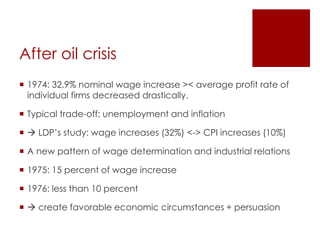
 1974: 32.9% nominal wage increase >< average profit rate of 
individual firms decreased drastically. 
 Typical trade-off: unemployment and inflation 
  LDP’s study: wage increases (32%) <-> CPI increases (10%) 
 A new pattern of wage determination and industrial relations 
 1975: 15 percent of wage increase 
 1976: less than 10 percent 
  create favorable economic circumstances + persuasion
Labor – politics 
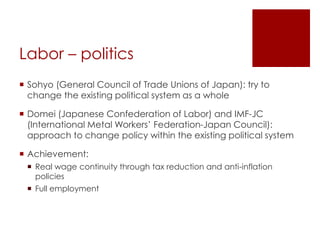
 Sohyo (General Council of Trade Unions of Japan): try to 
change the existing political system as a whole 
 Domei (Japanese Confederation of Labor) and IMF-JC 
(International Metal Workers’ Federation-Japan Council): 
approach to change policy within the existing political system 
 Achievement: 
 Real wage continuity through tax reduction and anti-inflation 
policies 
 Full employment
Labor – politics 
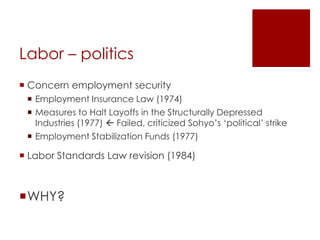
 Concern employment security 
 Employment Insurance Law (1974) 
 Measures to Halt Layoffs in the Structurally Depressed 
Industries (1977)  Failed, criticized Sohyo’s ‘political’ strike 
 Employment Stabilization Funds (1977) 
 Labor Standards Law revision (1984) 
WHY?
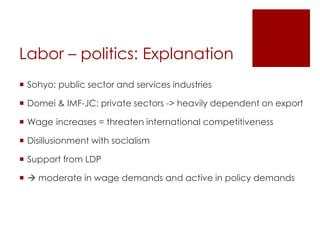
Labor – politics: Explanation 
 Sohyo: public sector and services industries 
 Domei & IMF-JC: private sectors -> heavily dependent on export 
 Wage increases = threaten international competitiveness 
 Disillusionment with socialism 
 Support from LDP 
  moderate in wage demands and active in policy demands
The “Old Boy” Network 
 ‘Old Boy’ : retired government officials  boardrooms of private 
corporations 
 Network  phenomenon 
 Hypothesis: 
 “bureaucrat-led economic growth’ mechanism 
 Small firms need OB for governmental information & lobbying
OB standard career path 
 Bureaucrats: long-term civil servants 
 Employed annually, ‘vintage’ groups with close contact 
 Low salary -> dependent on employment after retirement 
 ‘Amakudari’: appointed by National Personnel Authority 
 Alternatives: 
 Head of public corporation 
 Private non-profit associations 
 Politics 
 Transfer to further government agency
OB mechanism 
 Personal connections and seniority hierarchies 
 ‘vintage’ meetings 
 Smooth flow of information 
 Remain loyal to government 
Hypothesis: 
 Preferential treatment 
 Government ties with business 
 Prospect high-paying motivation of second-employment 
 Power equalization
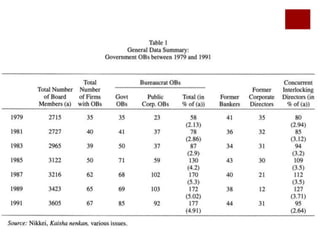
OB network 
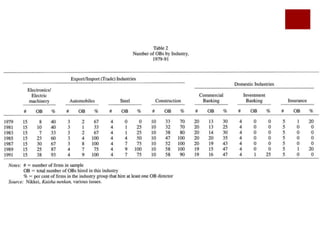
 Distribution: 
 Commercial banking, investment banking, insurance: <50% 
 Electronics, automobiles, steel and construction: >75% 
 Factor: ‘trade industry’ (trade restraints) 
 VERs in TV sets (1977, U.S.) 
 VCRs (1983, EC) 
 Semiconductors (1986-91, U.S.) 
 Automobiles (1980s, U.S. and EC) 
 Steel (1980s) 
  MITI advocated “export control scheme”
OB network 
 Purpose: 
 Quotas information 
 Industry competition 
 Construction case: secret bidding procedures  acquiring 
information and government price ceilings 
 Other industries: lobbying is the restrictions imposed by the law 
  notion of Japanese “consultative capitalism”.
Thank you!

Japan - Labour & Politics

  • 1.
    Relations among the government, labor and business Topical Seminar in Japanese Political Economy Hang Nguyen – I32031
  • 2.
    Oil crisis of1973  Japan: survived  Enjoyed steady economic growth without serious inflation or high unemployment  Second oil crisis 1979: less troubled than the first one Cooperative and ‘rational’ labor unions, industrial policies and corporate strategy Transformation of the Shuntou (春闘) system
  • 3.
    Shuntou (春闘) system(to 1974)  Shuntou: the spring labor offensive – wage negotiation system  A concerted campaign by workers in all industries  National level  Originally proposed in 1954, by K. Ohta (later chairman of Sohyo)  The most booming industries would lead the year’s bargaining, the rest would follow the pattern   1969-1974: wage increases by a considerable margin
  • 5.
    After oil crisis  1974: 32.9% nominal wage increase >< average profit rate of individual firms decreased drastically.  Typical trade-off: unemployment and inflation   LDP’s study: wage increases (32%) <-> CPI increases (10%)  A new pattern of wage determination and industrial relations  1975: 15 percent of wage increase  1976: less than 10 percent   create favorable economic circumstances + persuasion
  • 6.
    Labor – politics  Sohyo (General Council of Trade Unions of Japan): try to change the existing political system as a whole  Domei (Japanese Confederation of Labor) and IMF-JC (International Metal Workers’ Federation-Japan Council): approach to change policy within the existing political system  Achievement:  Real wage continuity through tax reduction and anti-inflation policies  Full employment
  • 9.
    Labor – politics  Concern employment security  Employment Insurance Law (1974)  Measures to Halt Layoffs in the Structurally Depressed Industries (1977)  Failed, criticized Sohyo’s ‘political’ strike  Employment Stabilization Funds (1977)  Labor Standards Law revision (1984) WHY?
  • 11.
    Labor – politics:Explanation  Sohyo: public sector and services industries  Domei & IMF-JC: private sectors -> heavily dependent on export  Wage increases = threaten international competitiveness  Disillusionment with socialism  Support from LDP   moderate in wage demands and active in policy demands
  • 12.
    The “Old Boy”Network  ‘Old Boy’ : retired government officials  boardrooms of private corporations  Network  phenomenon  Hypothesis:  “bureaucrat-led economic growth’ mechanism  Small firms need OB for governmental information & lobbying
  • 13.
    OB standard careerpath  Bureaucrats: long-term civil servants  Employed annually, ‘vintage’ groups with close contact  Low salary -> dependent on employment after retirement  ‘Amakudari’: appointed by National Personnel Authority  Alternatives:  Head of public corporation  Private non-profit associations  Politics  Transfer to further government agency
  • 14.
    OB mechanism Personal connections and seniority hierarchies  ‘vintage’ meetings  Smooth flow of information  Remain loyal to government Hypothesis:  Preferential treatment  Government ties with business  Prospect high-paying motivation of second-employment  Power equalization
  • 17.
    OB network Distribution:  Commercial banking, investment banking, insurance: <50%  Electronics, automobiles, steel and construction: >75%  Factor: ‘trade industry’ (trade restraints)  VERs in TV sets (1977, U.S.)  VCRs (1983, EC)  Semiconductors (1986-91, U.S.)  Automobiles (1980s, U.S. and EC)  Steel (1980s)   MITI advocated “export control scheme”
  • 18.
    OB network Purpose:  Quotas information  Industry competition  Construction case: secret bidding procedures  acquiring information and government price ceilings  Other industries: lobbying is the restrictions imposed by the law   notion of Japanese “consultative capitalism”.
  • 19.

Editor's Notes

  • #7 Sohyo: General Council of Trade Unions of Japan
  • #10 Sohyo: General Council of Trade Unions of Japan
  • #12 Sohyo: General Council of Trade Unions of Japan