Jan.-Feb. 2016 TransportationBuilder 1
AMERICA’S 59,000
STRUCTURALLY DEFICIENT
BRIDGES ARTBA’s 3rd
Annual Report
builder®
Jan.-Feb. 2016
Jan.-Feb. 20162 TransportationBuilder
Jan.-Feb. 2016 TransportationBuilder 3
JANFEB 2016
VOL. 28, NO.1
contents The official publication of the American Road
& Transportation Builders Association
www.transportationbuilder.org
FEATURES
COLUMNS
Chairman’s Message
President’s Desk
Top Industry Lawyers Shed Light
on Transportation Project Legal and
Regulatory Challenges
ARTBA 2015 Annual Report
Spotlighting Innovation by ARTBA’s
Research & Education Division
Regulatory Update
AEM Corner
6
18
A-1
11
27
29
8
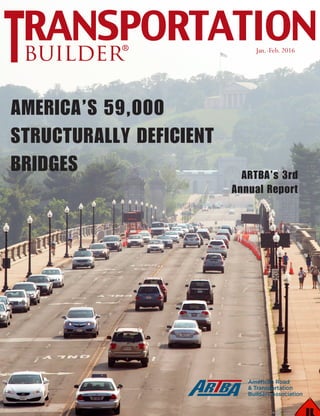
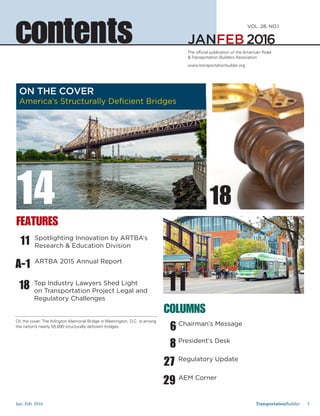
On the cover: The Arlington Memorial Bridge in Washington, D.C. is among
the nation’s nearly 59,000 structurally deficient bridges.
ON THE COVER
America’s Structurally Deficient Bridges
14 18
11
Jan.-Feb. 20164 TransportationBuilder
Staff
PUBLISHER
T. Peter Ruane
transportationbuilder@artba.org
DEPUTY PUBLISHER
Matt Jeanneret
mjeanneret@artba.org
EDITORIAL DIRECTOR
Mark Holan
mholan@artba.org
PUBLICATIONS EDITOR &
GRAPHIC DESIGNER
Jenny Ragone
jragone@artba.org
DIRECTOR OF SALES
Peter Embrey
pembrey@artba.org
CONTRIBUTING WRITERS
Allison Klein
ARTBA vice president of member services
Nick Goldstein
ARTBA vice president of environmental &
regulatory affairs
Mark Holan
ARTBA editorial director
Transportation Builder®
(TB) is the official publication of the American Road &Transportation Builders Association,
a federation whose primary goal is to aggressively grow and protect transportation infrastructure investment to
meet the public and business demand for safe and efficient travel. In support of this mission, ARTBA also
provides programs and services designed to give its members a global competitive edge. As the only national
publication specifically geared toward transportation development professionals,TB represents the primary
source of business, legislative and regulatory news critical to the success and future of the transportation
construction industry.
Transportation Builder® (ISSN 1043-4054) is published
bi-monthly by the American Road &Transportation Builders
Association (ARTBA). Postmaster: Send change of address to
Transportation Builder®, c/o ARTBA,The ARTBA Building,
1219 28th
Street, N.W., Washington, D.C. 20007.
Phone: 202-289-4434, Fax: 202-289-4435, www.artba.org;
artbadc@aol.com. Periodicals postage paid at Washington,
D.C., and additional mailing offices. Subscriptions are $105/year
for ARTBA members, which is included in the dues; $120/year
for non-members; and $200/year non-U.S. mailing addresses.
Copyright ©2016 ARTBA. All rights reserved. Material may not
be reproduced in any form without written permission from the
publisher. Reg. U.S. Patent &Trademark Office.
Visit us: www.transportationbuilder.org
builder®
Executive Committee
Chairman: David S. Zachry
Zachry Construction Corporation, San Antonio,Texas
Senior Vice Chairman: Robert E. Alger
Lane Industries, Inc., Cheshire, Conn.
First Vice Chairman: Matt Cummings
AECOM, Philadelphia, Pa.
Northeastern Region Vice Chairman: Dave Gehr
WSP | Parsons Brinckerhoff, Herndon, Va.
Southern Region Vice Chairman:Tom Elmore
Eutaw Construction Company, Aberdeen, Miss.
Central Region Vice Chairman: Steve McGough
HCSS, Sugar Land,Texas
Western Region Vice Chairman: Jeff Clyde
W.W. Clyde & Co., Springville, Utah
Vice Chairman At-Large:Ward Nye
Martin Marietta Materials, Inc., Raleigh, N.C.
Vice Chairman At-Large: Scott L. Cassels
Kiewit Infrastructure Group, Inc., Kiewit Corporation, Omaha, Neb.
Vice Chairman At-Large: MelissaTooley
Southwest Region UniversityTransportation Center,Texas A&M
Transportation Institute, College Station,Texas
Vice Chairman At-Large: Rob Charter
Caterpillar Inc., Peoria, Ill.
Vice Chairman At-Large: Mike Donnino
Granite Construction Inc., Lewisville,Texas
Vice Chairman At-Large: John Riccardi
3MTraffic Safety and Security Division, St. Paul, Minn.
Treasurer:Tom Hill
Summit Materials, LLC, Denver, Colo.
Secretary: Pete Ruane
ARTBA, Washington, D.C.
ARTBA-TDF Board ofTrustees Chairman: Leo Vecellio, Jr.
Vecellio Group, Inc., West Palm Beach, Fla.
ARTBA-TDF Board ofTrustees Vice Chairman: PaulYarossi
HNTB, NewYork, N.Y.
Contractors Division President:Tim Duit
TTK Construction, Edmond, Okla.
Contractors Division First Vice President: Don Graul
Parsons Construction Group, Westminster, Colo.
Research & Education Division President: Martin Pietrucha
Penn State University, University Park, Pa.
AEM Representative: Ron DeFeo
Materials & Services Division President: Randy Lake
Oldcastle Materials, Inc., Atlanta, Ga.
Planning & Design Division President: David Harwood
Terracon Consultants, Inc., Olathe, Kan.
Public-Private Partnerships Division President: Dusty Holcombe
Virginia Office of Public Private Partnerships, Richmond, Va.
Traffic Safety Industry Division President: Kevin Groeneweg
Mobile Barriers LLC, Golden, Colo.
Transportation Officials Division President: Paul Gruner
Montgomery County Engineers’s Office, Dayton, Ohio
Council of State Executives: LenToenjes, CAE
AGC of St. Louis, St. Louis, Mo.
Immediate Past ARTBA Chairman: Nick Ivanoff
Ammann & Whitney, NewYork, N.Y.
Past Chairman’s Council Chairman: Jim Madara
Gannett Fleming, Allentown, Pa.
Industry Leader Development Council Chairman: Ponch Frank
Ranger Construction Industries, West Palm Beach, Fla.
Joint Committee Co-Chair: Charles Gallagher
Gallagher Asphalt Corp.,Thornton, Ill.
2012 AWARD 2012 AWARD 2009 AWARD
mobilebarriers.com
MOBILE BARRIERS MBT1®
IMPROVING
SAFETY,
EFFICIENCY
AND TRAFFIC
FLOWS.
Jan.-Feb. 2016 TransportationBuilder 5
This issue of Transportation Builder is a little late arriving because we wanted to include ARTBA’s third annual
analysis of our nation’s nearly 59,000 structurally deficient bridges, which was released in late February.
A summary can be found starting on Page 14. More detailed information is available at
www.artbabridgereport.org.
While these bridges may not be imminently unsafe, ARTBA wants to educate the public and policymak-
ers about these needed repairs, which will cost tens of billions of dollars. The five-year FAST Act provides
a modest increase in funding for bridge repairs, but “won’t come close to making an accelerated national
bridge repair program possible,” ARTBA Chief Economist Dr. Alison Premo Black says.
On Page 6, 2016 ARTBA Chairman David Zachy outlines the association’s strategic game plan to fully
engage the next generation of transportation design & construction industry leaders. You’ll want to note
that the Young Executive Development Program (YEDP), which celebrated its 20th
anniversary in 2015,
is now rebranded as the Industry Leader Development Program (ILDP). Likewise, the Young Executive
Leadership Council (YELC), the home for YEDP graduates, is accordingly renamed the Industry Leader
Development Council (ILDC).
Also in this issue, beginning on Page 18, we offer important business intelligence from last year’s annual
Transportation Construction Law and Regulatory Forum. Our hope is that reading about these issues will
prompt ideas and suggestions for topics that you would like to see explored in this year’s forum, June 1-2 at
the ARTBA Building.
CONNECT WITH ARTBA
Mark Holan,
Editorial Director
Editor’s Note
Still Using Paper
Time Cards in 2015?
Cut foremen entry time in half with
HeavyJob Mobile Apps and...
§ Reduce payroll processing by as
much as 90%
§ Know if jobs are profitable with
same-day feedback against budget
§ Work offline for remote jobs with no
internet
§ Train foremen quickly with
easy-to-use time card
§ Integrate with over 35 accounting
systems
§ Low risk—Software comes with a
12-month money back guarantee!
Call us at
800-683-3196
at www.HCSS.comLearn More
in 2015?
CORRECTION: John Rignani is an ARTBA Life Member. His name was left out of the printed version of the
2016 ARTBA Leadership Directory & Buyers’ Guide. We apologize for the oversight.
Jan.-Feb. 20166 TransportationBuilder
The Strategic Game Plan for
Fully Engaging the Next
Generation of Industry Leaders
ARTBA’s Looking for a Few Good Men & Women
Before you are a leader, success is all
about growing yourself. When you
become a leader, success is all about
growing others.”
Former General Electric CEO Jack
Welch’s observation is one ARTBA
embraces. The industry’s ability to grow
and protect the U.S. transportation
construction market in the years ahead
will be determined in good measure by
the association’s ability to develop the
next generation of volunteer leaders.
Industry firms are facing a similar
situation with their business operations.
In 2015, millennials became the nation’s
largest generational workforce,
surpassing the 51- to 70-year-old baby
boomers, and the 34- to 50-year-old
Generation Xers. As baby boomers
continue to retire, companies are being
strategic in their development and
implementation of succession plans to
ensure they have the right people in
place for the future. That’s just smart.
ARTBA Task Force
A little more than a year ago, ARTBA
gathered in person at its headquarters and
over the phone a group of 20 executives
for a day-long meeting of the “Young
Executive Leadership Task Force.”
Their stated mission: “To develop
specific recommendations for the
consideration of the ARTBA Board
of Directors on how to expand the
association’s base of younger industry
executives and better engage them in
its activities, leadership structure and
advocacy core mission.”
The discussion was focused, lively and
chock-full of good ideas. Subsequent
conference calls by the Task Force helped
put more “meat on the bones,” and
resulted in a final 8-page report that was
endorsed by the ARTBA Board of
Directors during its meeting last October
in Philadelphia.
I encourage you to read the full report in
the “Foundation” section of www.artba.org.
To highlight just a few of its findings, a
consensus emerged that ARTBA should
drop the adjective “young” from the
names of some of its programs because it
is not how rising executives wished to be
identified or categorized in the
business world. The group also agreed
that ARTBA should focus its attention on
creating more value and opportunities
for industry executives between the age
of 30 and 50—the “target demographic.”
Rebranding the Young Executive
Development Program
To that end, the Young Executive
Development Program (YEDP), which
celebrated its 20th
anniversary in 2015
and now boasts of more than 600 gradu-
ates, has been renamed the “Industry
Leader Development Program” (ILDP).
It will continue to be held in
Washington, D.C., each spring in
conjunction with the ARTBA Federal
Issues Program and Transportation
Construction Coalition Fly-In. The class,
which has been 50-55 people in recent
years, will be split in two to provide
better opportunities for networking and
relationship development. The ILDP
David Zachry
President & CEO
Zachry Corporation
2016 ARTBA Chairman
From the
Chairman
will help participants understand federal
highway and transit financing work,
demystify the policymaking process, and
explain why coming to Washington and
building relationships with elected
leaders and agency officials should be
viewed like any other critical business
development opportunity.
In the same vein, the Young
Executive Leadership Council (YELC),
which was formed 12 years ago and
became the home for YEDP graduates to
remain involved, is now the “Industry
Leader Development Council” (ILDC).
ILDC Program of Work
The ILDC also has a clear program for
the year ahead that is the result of its late
February meeting in Jacksonville, Fla. It
will:
•	 Develop the agendas and help with
industry outreach for the ARTBA
regional meetings.
•	 Be ready to activate grassroots
advocates in the individual regions
when policy developments in the
Nation’s Capital require action.
•	 Identify and help recruit prospects
for membership.
•	 Look for opportunities for the ILDC
to engage with the ARTBA Board of
Directors or with the various
councils and committees.
“
Jan.-Feb. 2016 TransportationBuilder 7
•	 Recruit resumes for leadership post
considerations by the ARTBA Nomi-
nating Committee and divisions.
•	 Provide input and help with industry
outreach for the ARTBA
Foundation’s Dr. J. Don Brock
TransOvation™ Workshop
We’re Recruiting!
We believe this strategic approach has
unlimited potential. Please identify
executives at your firm for participation
in the 2016 ILDP (held May 9-11 in
the Nation’s Capital) or to serve as an
active member in executing the ILDC’s
program of work, and share their names
with ARTBA’s Vice President of Member
Services Allison Klein: aklein@artba.org.
Our industry’s future success, as Jack
Welch reminds us, is all about growing
others.
B2W-ARTBA-Maintain-HalfPage-2015.indd 1 7/22/15 9:40 AM
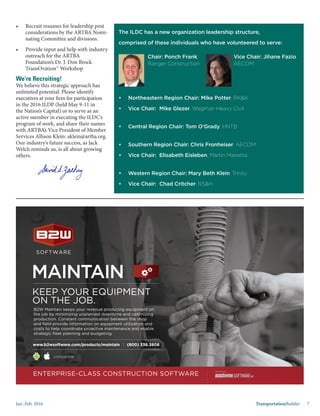
The ILDC has a new organization leadership structure,
comprised of these individuals who have volunteered to serve:
•	 Northeastern Region Chair: Mike Potter, RK&K
•	 Vice Chair: Mike Glezer, Wagman Heavy Civil
•	 Central Region Chair: Tom O’Grady, HNTB
•	 Southern Region Chair: Chris Fronheiser, AECOM
•	 Vice Chair: Elisabeth Eisleben, Martin Marietta
•	 Western Region Chair: Mary Beth Klein, Trinity
•	 Vice Chair: Chad Critcher, RS&H
Vice Chair: Jihane Fazio,
AECOM
Chair: Ponch Frank,
Ranger Construction
Jan.-Feb. 20168 TransportationBuilder
the political pressure on Congress until
they do the right thing.
ARTBA is not a “one trick pony,”
however. Among the other key industry
priorities in 2016:
•	 Ensuring full funding of the FAST
Act’s capital programs. Transporta-
tion funding has become a perennial
battle in Congress. Before the ink
was even dry on President Obama’s
signature, members of Congress
last December slashed about $125
million from the transit capital
program—contrary to the provisions
in the law. For fiscal year 2017, the
FAST Act authorizes an extra $905
million for highways and $187
million for transit. We’ll work
aggressively with the authorizers and
appropriators to help ensure these
increases are realized.
•	 Obtaining long-term, increased
federal investment for airport capital
improvements in the FAA program
reauthorization. ARTBA will push
for a multi-year reauthorization
law that grows revenue through the
Airport Improvement Program and
by raising the cap on the federal
Passenger Facility Charge.
•	 Preventing unwarranted and
excessive regulatory actions. The
Obama Administration has made it
clear that it intends to use Executive
Orders and regulatory action—
particularly in the environmental
and health arenas—during its final
year in office. ARTBA is monitoring
these developments and assessing
potential threats to the transportation
infrastructure market. We will take
immediate action if proposals harm
our interests.
Among the early 2016 headlines
reported in ARTBA’s Washington
Newsline, we hope this one grabbed
your attention: Highway Trust Fund
Crisis Right Around Corner, New Study
Shows.
The nonpartisan Congressional Budget
Office (CBO) released new projections
showing a widening gap between
incoming Highway Trust Fund (HTF)
revenues and the amount needed to
preserve existing federal surface
transportation investment.
The December 2015 Fixing America’s
Surface Transportation (FAST) Act relies
on a one-time $70 billion transfer of
General Fund revenue over the next five
years to bridge the HTF revenue
shortfall. Once those funds are exhausted
in September 2020, the surface
transportation programs face an average
$18 billion annual shortfall over the
following six years, according to CBO.
While some think the highway
program is on auto pilot for the next few
years because of the FAST Act’s passage,
this is certainly not ARTBA’s view. The
next fiscal crisis for the HTF is on the
radar screen, and ARTBA believes now
is the time to be working on a legislative
solution.
ARTBA continues to advocate that a
permanent HTF solution be included in
any tax reform or other budget-related
measures considered by Congress. We
are also working to advance initiatives
that provide additional transportation
capital investment outside of the HTF
through public-private partnerships,
innovative financing mechanisms and
other targets of opportunity.
A HTF fix is no doubt a heavy lift. But,
it is our collective responsibility to keep
•	 Continuing to help state chapters
and their allies to achieve
transportation investment increases
at the state and local levels through
the dynamic Transportation
Investment Advocacy CenterTM
.
Now in its third year,
www.transportationinvestment.org
has been established as a national
hub for information and research
reports. This repository of “lessons
learned” has already helped our
partners frame better strategies to
meet their goals.
Finally, as I write this column, the
first votes have already been cast in the
Republican and Democratic
presidential races. ARTBA will again
elbow its way into the political fray to
present the industry’s agenda by:
providing policy information to the
campaigns; working to ensure that sound
transportation investment strategies are
included in the Republican and
Democratic National Party Platforms;
and keeping our members informed of
presidential candidate transportation-
related statements and positions.
The FAST Act was just the beginning.
The looming presidential and
congressional elections will not distract
us from advancing a full plate of
advocacy priorities. With your leadership
and grassroots activism, I’m optimistic
our industry can make important
progress on multiple fronts during 2016!
From the President’s Desk
T. Peter Ruane
President & CEO
ARTBA
The FAST Act Was Just
the Beginning
Jan.-Feb. 2016 TransportationBuilder 9
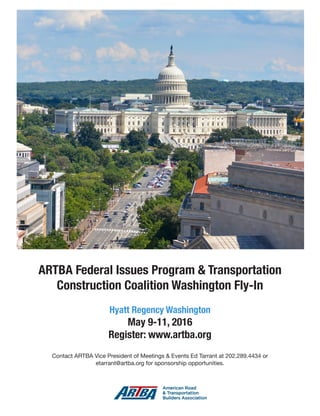
ARTBA Federal Issues Program & Transportation
Construction Coalition Washington Fly-In
Hyatt Regency Washington
May 9-11, 2016
Register: www.artba.org
Contact ARTBA Vice President of Meetings & Events Ed Tarrant at 202.289.4434 or
etarrant@artba.org for sponsorship opportunities.
Jan.-Feb. 201610 TransportationBuilder
R
facebook.com/CATPaving
youtube.com/CATPaving
QEXC1879-01
© 2016 Caterpillar. All Rights Reserved. CAT, CATERPILLAR, BUILT FOR IT, their respective logos, “Caterpillar Yellow,” the “Power Edge”
trade dress as well as corporate and product identity used herein, are trademarks of Caterpillar and may not be used without permission.
70 kW integrated generator saves time and fuel.
•	 15	minute	screed	plate	heating
•	 15,000	hour	service	life
•	 System	monitoring	keeps	operator	informed
Learn	more	at	www.cat.com/F-SeriesPavers
THE NEW
STANDARD
CAT®
F-SERiES PAvERS
Jan.-Feb. 2016 TransportationBuilder 11
Spotlighting Innovation by ARTBA’s
Research & Education Division
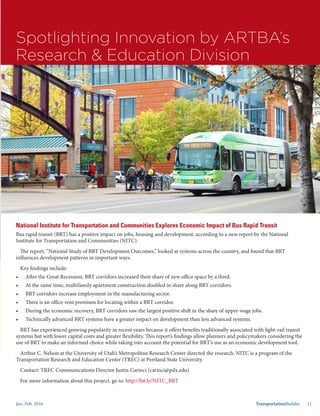
National Institute for Transportation and Communities Explores Economic Impact of Bus Rapid Transit
Bus rapid transit (BRT) has a positive impact on jobs, housing and development, according to a new report by the National
Institute for Transportation and Communities (NITC).
The report, “National Study of BRT Development Outcomes,” looked at systems across the country, and found that BRT
influences development patterns in important ways.
Key findings include:
•	 After the Great Recession, BRT corridors increased their share of new office space by a third.
•	 At the same time, multifamily apartment construction doubled in share along BRT corridors.
•	 BRT corridors increase employment in the manufacturing sector.
•	 There is an office-rent premium for locating within a BRT corridor.
•	 During the economic recovery, BRT corridors saw the largest positive shift in the share of upper-wage jobs.
•	 Technically advanced BRT systems have a greater impact on development than less advanced systems.
BRT has experienced growing popularity in recent years because it offers benefits traditionally associated with light-rail transit
systems but with lower capital costs and greater flexibility. This report’s findings allow planners and policymakers considering the
use of BRT to make an informed choice while taking into account the potential for BRT’s use as an economic development tool.
Arthur C. Nelson at the University of Utah’s Metropolitan Research Center directed the research. NITC is a program of the
Transportation Research and Education Center (TREC) at Portland State University.
Contact: TREC Communications Director Justin Carinci (carinci@pdx.edu)
For more information about this project, go to: http://bit.ly/NITC_BRT
Jan.-Feb. 201612 TransportationBuilder
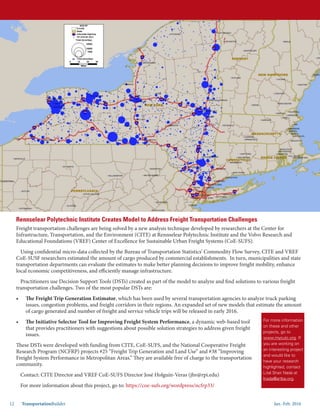
Rennselear Polytechnic Institute Creates Model to Address Freight Transportation Challenges
Freight transportation challenges are being solved by a new analysis technique developed by researchers at the Center for
Infrastructure, Transportation, and the Environment (CITE) at Rennselear Polytechnic Institute and the Volvo Research and
Educational Foundations (VREF) Center of Excellence for Sustainable Urban Freight Systems (CoE-SUFS).
Using confidential micro-data collected by the Bureau of Transportation Statistics’ Commodity Flow Survey, CITE and VREF
CoE-SUSF researchers estimated the amount of cargo produced by commercial establishments. In turn, municipalities and state
transportation departments can evaluate the estimates to make better planning decisions to improve freight mobility, enhance
local economic competitiveness, and efficiently manage infrastructure.
Practitioners use Decision Support Tools (DSTs) created as part of the model to analyze and find solutions to various freight
transportation challenges. Two of the most popular DSTs are:
•	 The Freight Trip Generation Estimator, which has been used by several transportation agencies to analyze truck parking
issues, congestion problems, and freight corridors in their regions. An expanded set of new models that estimate the amount
of cargo generated and number of freight and service vehicle trips will be released in early 2016.
•	 The Initiative Selector Tool for Improving Freight System Performance, a dynamic web-based tool
that provides practitioners with suggestions about possible solution strategies to address given freight
issues.
These DSTs were developed with funding from CITE, CoE-SUFS, and the National Cooperative Freight
Research Program (NCFRP) projects #25 “Freight Trip Generation and Land Use” and #38 “Improving
Freight System Performance in Metropolitan Areas.” They are available free of charge to the transportation
community.
Contact: CITE Director and VREF CoE-SUFS Director José Holguín-Veras (jhv@rpi.edu)
For more information about this project, go to: https://coe-sufs.org/wordpress/ncfrp33/
For more information
on these and other
projects, go to
www.mycutc.org. If
you are working on
an interesting project
and would like to
have your research
highlighted, contact
Lital Shair Nada at
lnada@artba.org.
Jan.-Feb. 2016 TransportationBuilder 13
If you would like to become
a preferred vendor, please
contact Peter Embrey at
pembrey@artba.org or
202.289.4434.
ARTBA’S PREFERRED VENDORS
Visit www.artba.org to learn more about saving money through these companies.
Monster Worldwide, Inc. uses
the world’s most advanced
technology to match the right
people with the right job.
ConvergeOne offers a
comprehensive portfolio of
services, including video, data
and messaging from global
leaders such as Cisco, Microsoft,
Avaya, Unify, Oracle and others.
UniFirst rents, leases, and sells
uniforms, protective clothing,
custom corporate workwear,
floorcare, and other facility
services products to all kinds of
businesses.
USI Insurance Services Inc.
offers Aflac insurance plans and
no-cost FSA administration for
companies with 50+ employees.
Marsh offers heavy highway
contractors new insurance
options with less price volatility,
greater transparency and
control, and mitigating gaps in
their overall coverage.
The ARTBA EmCap program af-
fords employers the opportunity
to reduce the volatility and cost
associated with providing health
benefits to the employees.
Meridian One creates, markets
and manages member benefit
programs for trade and
professional associations
throughout the U.S. and Canada.
APPI Energy navigates the
maze in energy deregulation
by negotiating favorable “real-
time” pricing and contract terms
and conditions with competi-
tive energy suppliers across the
country.
Office Depot is a leading global
provider of office products,
services, and solutions.
Richie Bros. EquipmentOne is
a secure online marketplace for
equipment, trucks and
materials from the energy sector
and other industries.
in partnership with
ARTBACapSM
an employee benefit group captive solution.
in partnership with
ARTBACapSM
an employee benefit group captive solution.
in partnership with
ARTBACapSM
an employee benefit group captive solution.
Jan.-Feb. 201614 TransportationBuilder
Nearly 59,000 U.S. Bridges
by Mark Holan
I
magine slogging through five more presidential campaigns,
or waiting for the final score of the next 21 Super Bowls.
That’s at least how many years it will take to replace or
upgrade the nation’s current inventory of 58,500
structurally deficient bridges, according to ARTBA’s
analysis of the U.S. Department of Transportation’s 2015
“National Bridge Inventory” database.
The association’s third annual review of state bridge data col-
lected by the federal agency notes that if placed end-to-end, the
deck surface of the nation’s structurally deficient bridges would
stretch from New York City to Miami, or about 1,340 miles.
About 9.5 percent of the nation’s approximately 610,000
bridges are classified as structurally deficient, ARTBA found,
but cars, trucks, school buses and emergency vehicles cross
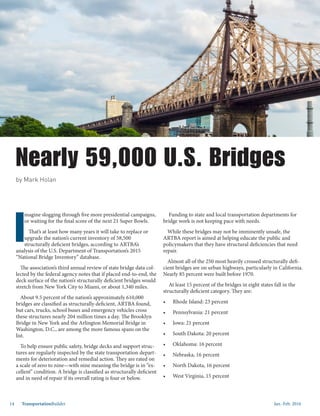
these structures nearly 204 million times a day. The Brooklyn
Bridge in New York and the Arlington Memorial Bridge in
Washington, D.C., are among the more famous spans on the
list.
To help ensure public safety, bridge decks and support struc-
tures are regularly inspected by the state transportation depart-
ments for deterioration and remedial action. They are rated on
a scale of zero to nine—with nine meaning the bridge is in “ex-
cellent” condition. A bridge is classified as structurally deficient
and in need of repair if its overall rating is four or below.
Funding to state and local transportation departments for
bridge work is not keeping pace with needs.
While these bridges may not be imminently unsafe, the
ARTBA report is aimed at helping educate the public and
policymakers that they have structural deficiencies that need
repair.
Almost all of the 250 most heavily crossed structurally defi-
cient bridges are on urban highways, particularly in California.
Nearly 85 percent were built before 1970.
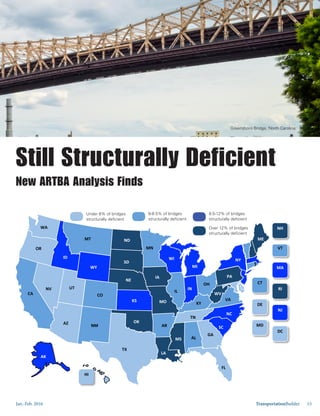
At least 15 percent of the bridges in eight states fall in the
structurally deficient category. They are:
•	 Rhode Island: 23 percent
•	 Pennsylvania: 21 percent
•	 Iowa: 21 percent
•	 South Dakota: 20 percent
•	 Oklahoma: 16 percent
•	 Nebraska, 16 percent
•	 North Dakota, 16 percent
•	 West Virginia, 15 percent
Jan.-Feb. 2016 TransportationBuilder 15


  AK	


WA	
  
OR	


  CA	


ID	
  
MT	
  
WY	
  
NV	
  
AZ	
  
CO	
  
NM	
  
ND	
  
SD	
  
NE	
  
KS	


  OK	
  
TX	


  MN	
  
IA	
  
MO	
  
WI	
  
IL	


MI	


  IN	


  KY	


  TN	
  
MS	
   AL	
  
OH	


  NY	
  
PA	


  VA	


  NC	
  
GA	


FL	
  
ME	


  WV	
  
AR	
  
UT	
  
HI	


SC	
  
VT	


CT	


   RI	


DE	
  
	
   NJ	


MD	
  
	
   DC	


NH	


MA	


  LA	
  
Still Structurally Deficient
New ARTBA Analysis Finds
Greensboro Bridge, North Carolina.
Under 6% of bridges
structurally deficient
6-8.5% of bridges
structurally deficient
8.5-12% of bridges
structurally deficient
Over 12% of bridges
structurally deficient
Jan.-Feb. 201616 TransportationBuilder
Iowa
Pennsylvania
Oklahoma
Missouri
Nebraska
Kansas
Illinois
Mississippi
North Carolina
California
5,025
4,783
3,776
3,222
2,474
2,303
2,244
2,184
2,085
2,009
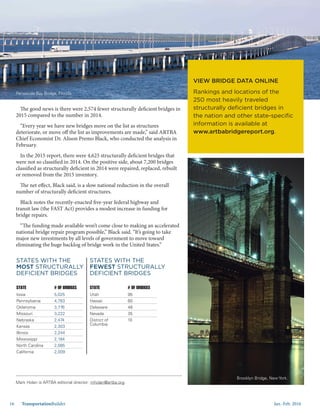
STATE # OF BRIDGES
STATES WITH THE
MOST STRUCTURALLY
DEFICIENT BRIDGES
Utah
Hawaii
Delaware
Nevada
District of
Columbia
95
60
48
35
10
STATE # OF BRIDGES
STATES WITH THE
FEWEST STRUCTURALLY
DEFICIENT BRIDGES
The good news is there were 2,574 fewer structurally deficient bridges in
2015 compared to the number in 2014.
“Every year we have new bridges move on the list as structures
deteriorate, or move off the list as improvements are made,” said ARTBA
Chief Economist Dr. Alison Premo Black, who conducted the analysis in
February.
In the 2015 report, there were 4,625 structurally deficient bridges that
were not so classified in 2014. On the positive side, about 7,200 bridges
classified as structurally deficient in 2014 were repaired, replaced, rebuilt
or removed from the 2015 inventory.
The net effect, Black said, is a slow national reduction in the overall
number of structurally deficient structures.
Black notes the recently-enacted five-year federal highway and
transit law (the FAST Act) provides a modest increase in funding for
bridge repairs.
“The funding made available won’t come close to making an accelerated
national bridge repair program possible,” Black said. “It’s going to take
major new investments by all levels of government to move toward
eliminating the huge backlog of bridge work in the United States.”
VIEW BRIDGE DATA ONLINE
Rankings and locations of the
250 most heavily traveled
structurally deficient bridges in
the nation and other state-specific
information is available at
www.artbabridgereport.org.
Mark Holan is ARTBA editorial director: mholan@artba.org.
Pensacola Bay Bridge, Florida.
Brooklyn Bridge, New York.
Jan.-Feb. 2016 TransportationBuilder 17
Americans drove a record 3.148 trillion
miles in 2015, roaring past the previous
annual high of 3.049 trillion miles set in
2007, according to the U.S. Department
of Transportation’s (U.S. DOT) Federal
Highway Administration (FHWA). The
estimate includes passenger vehicle, bus,
and truck travel. It includes more than
264 billion miles driven in December
2015 as Congress passed and President
Obama signed the “Fixing America’s
Surface Transportation (FAST) Act,”
which includes $226 billion for roads and
bridges over the next five years.
The seasonally-adjusted vehicle miles
traveled (VMT) for December was 268.5
billion miles, a new monthly record for
seasonally-adjusted data. December 2015
VMT increased by 4 percent compared
to December 2014, and by 1.4 percent
compared with the seasonally-adjusted
total for November 2015.


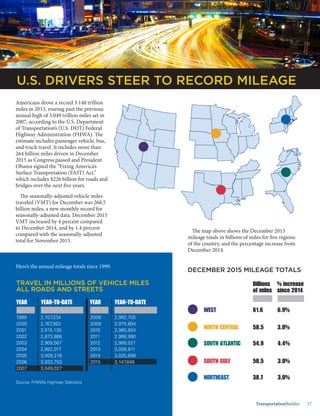
Here’s the annual mileage totals since 1999.
Source: FHWA’s Highway Statistics
YEAR YEAR
TRAVEL IN MILLIONS OF VEHICLE MILES
ALL ROADS AND STREETS
YEAR-TO-DATE YEAR-TO-DATE
U.S. DRIVERS STEER TO RECORD MILEAGE
WEST	 61.6	
58.5	
50.5	
38.7	
54.9	
3.0%	
3.0%	
4.4%	
3.0%	
6.9%	
NORTH CENTRAL	
SOUTH GULF
NORTHEAST
SOUTH ATLANTIC
Billions
of miles
% increase
since 2014
DECEMBER 2015 MILEAGE TOTALS
The map above shows the December 2015
mileage totals in billions of miles for five regions
of the country, and the percentage increase from
December 2014.
2008
2009
2010
2011
2012
2013
2014
2015
2,992,705 	
2,975,804
2,985,854
2,968,990
2,988,021
3,006,911
3,025,656
3,147,848
1999
2000
2001
2002
2003
2004
2005
2006
2007
2,707,234
2,767,363 	
2,815,135 	
2,873,866
2,909,567 	
2,982,017	
3,009,218	
3,033,753	
3,049,027
Jan.-Feb. 201618 TransportationBuilder
Top Industry Lawyers Shed Light
on Transportation Project Legal
and Regulatory Challenges
F
or the past seven years, ARTBA’s annual Transportation
Construction Law and Regulatory Forum has educated contractors,
designers and suppliers about major issues that they could face on a
project. Presenters include top construction attorneys and transportation
professionals from around the country. In recent years, ARTBA has also
put out a “Call for Presentations” so that members have the opportunity to
help shape the topics on the forum’s agenda.
Unlike other law related events, the presenters meet in a discussion-
oriented forum and break down the legal language into real world talk.
Attendees ask questions and engage in an interactive discussion
throughout the program.
To broaden the reach of last year’s program, and get ready for this year’s
event in June, Transportation Builder’s editorial staff asked the forum’s
speakers to write columns summarizing the key points in their
presentations.*
On the following pages, you will find pieces from: Chad Theriot and
Neal Sweeney of Jones Walker LLP on “Managing Projects with Funding
Concerns”; Mark Berry and Jesse Keene of Peckar & Abramson, and Pat
McGeehin of FTI Consulting, on “Contractor Certifications: What Am
I Signing and Why Can It Get Me in Trouble”; Steve Henderson of Stites
& Harbison on “OSHA Issued Your Company A Citation: Now What?”;
Lorraine D’Angelo of LDA Compliance Consulting on “DBE Compliance”;
and Joe McGowan of Rogers, Joseph & O’Donnell on “Brand Name or
Equal Contract Clauses: A Contractor’s Risks and Rights.”
As you digest these articles, we encourage you to consider attending the
2016 forum, scheduled for June 1-2 at the ARTBA Building in our Nation’s
Capital. Please contact me if you have questions, at aklein@artba.org, or
202.289.4434.
by Allison Klein
*ARTBA is not liable for any information provided in these articles, which are intended
for general informational purposes only, and not as a substitute for particular advice
from a qualified professional. No warranty is made regarding these articles.
Alison Klein is ARTBA vice president of member services and manages all aspects of
ARTBA’s annual law and regulatory forum: aklein@artba.org.
Jan.-Feb. 201618 TransportationBuilder
Jan.-Feb. 2016 TransportationBuilder 19
Neal J. Sweeney, nsweeney@joneswalker.com, and Chad V. Theriot,
ctheriot@joneswalker.com, are each partners at Jones Walker LLP.
MANAGING PROJECTS WITH FUNDING CONCERNS
by Neal J. Sweeney and Chad V. Theriot
Projects with funding constraints—like those created by the
ongoing Highway Trust Fund crisis—carry additional risk for
general contractors. One way general contractors account for
that risk is to manage their subcontractors’ performance in the
field. Another is to mitigate risks before work begins.
Subcontractors often perform a significant part of work
on infrastructure projects, and other project participants are
dependent on their work. A poor performing subcontractor, or
one who defaults because of insufficient working capital, can
bring a myriad of problems both before and after the actual
default. For example, slow deliveries of materials as suppliers
grow concerned about the subcontractor’s ability to pay can
have a “ripple” effect.
Therefore, it is even more critical that a general contractor in
an environment of limited—or even disruptive—funding do its
due diligence before engaging a subcontractor. Here are three
preventative measures a general contractor can take before
starting its work.
First, a general contractor can avoid numerous headaches
simply by investigating the subcontractor’s past performance
record, rather than looking solely at its bid price. Unreliable
subcontractors may initially be weeded out by dealing with
reputable individuals who have a proven ability to perform, by
running credit checks, and by inquiring about the experiences
of other general contractors.
Even a cursory investigation can yield important clues.
For example, engaging a subcontractor with a reputation for
shoddy or defective work may result in the general
contractor having to cash-flow and remedy unsatisfactory
work. A litigious subcontractor may refuse to negotiate if a
dispute arises, forcing the general contractor into costly
arbitration or litigation.
Second, a general contractor must consider the
subcontractor’s occupational licensing. State and local law
generally prevent incompetent and inexperienced
subcontractors from engaging in work that effect public health
and safety. This is particularly true with the skilled trades—
electrical, mechanical, etc. A general contractor may, however,
benefit from additional investigation of a subcontractor’s
experience on a particular type of project. For example, an
interstate project likely requires different experience than that
for an airport runway.
A general contractor must satisfy itself that the subcontractor
fully understands the licensing laws and can do the required
work.
Third, general contractors can insist that their subcontractors
furnish payment and performance bonds. A general contractor,
like an owner, needs reassurance that a subcontractor’s portion
of the project will be timely and properly completed.
A performance bond is a financial guarantee that the
subcontractor will perform the subcontract. It usually means
that if the subcontractor defaults and fails to complete the
project, the surety will complete performance or pay damages
up to the limit of the penal sum of the bond.
A payment bond is a financial guarantee that the
subcontractor will pay its sub-subcontractors and suppliers.
This is particularly important where funding is a concern. If
the subcontractor cannot adequately pay its suppliers, there is
a risk the project could come to a grinding halt if materials are
no longer delivered. A payment bond provides added
assurance that sub-subcontractors and suppliers will continue
to perform even if the subcontractor fails to pay since the
surety will step in and pay for materials and sub-subcontractors
up to the limit of the penal sum of the bond.
General contractors should consider separate payment and
performance bonds from subcontractors. The premium for two
separate bonds is generally no more than the premium for a
single “payment and performance” bond. Also, the penal sum
of the bonds—which provides the maximum liability of the
surety—may be lower if the payment and performance bonds
are not separate.
The choice of selecting a particular subcontractor may
ultimately determine the project’s success or failure.
Fortunately, a general contractor can avoid pitfalls with some
up-front due diligence. By dealing with reputable individuals,
by running credit checks, by inquiring about prior experiences,
and by requiring separate bonds, unreliable subcontractors
may be avoided at the outset, thereby minimizing owner-
funding impacts to your project.
Jan.-Feb. 201620 TransportationBuilder
Pat McGeehin, FTI Consulting, Inc.; and Mark R. Berry and Jesse S.
Keene, Peckar & Abramson, PC: MBerry@pecklaw.com
CONTRACT CERTIFICATIONS: WHAT AM I SIGNING AND
HOW CAN IT GET ME INTO TROUBLE?
by Pat McGeehin, Mark R. Berry and Jesse S. Keene
The U.S. Department of Justice is investigating and prosecuting
more cases of alleged fraud against the federal government. At-
torney General Loretta Lynch has a history of focusing on fraud
in the construction industry. In 2014, the government’s fraud col-
lections reached $5.69 billion, including hundreds of millions of
dollars in federal procurement and construction fraud penalties.
So it’s important for ARTBA members to pay attention to
government regulations in order to avoid allegations of false
claims. This article focuses on a few key certifications made daily
on government construction projects. These include:
False Claims Act Summary
The False Claims Act (FCA) prohibits government contractors
from, among other things, “knowingly presenting a false or
fraudulent claim for payment or approval” to the federal govern-
ment. More than 30 states also have their own version of the Act.
Under the FCA, the government may assess fines of up to
$11,000 per false claim and recover three times the government’s
actual damage. The FCA can also result in administrative
penalties such as suspension, debarment, or contract
termination. And, perhaps most seriously, the FCA allows for
criminal prosecution and imprisonment for up to five years for
submission of a false claim.
The FCA and courts interpreting it have broadly defined a
“claim” as any demand for money or property made directly or
indirectly to the federal government.
Progress Payment Applications
Progress payment applications are one of the more commonly
submitted “claims” which can trigger the FCA. The certifications
contained in a payment application contain fertile ground for
potential FCA violations. In particular, the government has
recently prosecuted contractors who falsely certified that they
made all payments due to subcontractors from previous payments
received from the government.
In The Liquidating Trustee Ester Duval of KI Liquidation, Inc.
v. United States, 116 Fed. Cl. 338 (2014), the contractor had a
firm-fixed price contract with the government. The contractor
paid money it received from progress payments to subcontractors
and suppliers, but not all were paid in full. After contract
termination, the government brought and prevailed on claims
that the contractor falsely certified that subcontractors and
suppliers were fully paid.
The rule is clear: the contractor has a duty to examine its
records to determine what the government already has paid
and whether payments are owed to subcontractors or suppliers.
Failure to make a minimal examination of records constitutes
deliberate ignorance or reckless disregard.
Takeaway: Review your payments to subcontractors and
suppliers as part of your payment application process and
ensure their accuracy.
Certified Payrolls
Public projects generally require prevailing wages and submission
of certified payrolls showing who worked on the project and how
much they were paid. Accordingly, the contractor must certify
that the payroll is correct and complete, the wage rates are not less
than required, and the classification for each laborer is correct.
In United States ex rel. Wall v. Circle K Construction, LLC, 697
F.3d 345 (6th
Cir. 2012), a contractor did not collect certified
payrolls from a subcontractor for two years, despite certifying
that all the subcontractor’s laborers were paid correctly.
When it finally collected the subcontractor’s payrolls, the con-
tractor simply submitted them to the government without prior
review. The payrolls were inaccurate, incomplete, and showed the
subcontractor underpaid its workers. The contractor was held
liable for not submitting payrolls from its subcontractor, and not
reviewing them before submission.
Key takeaways include:
•	 filling out certified payrolls accurately;
•	 reviewing certified payrolls for errors before submission;
•	 correcting any errors;
•	 noting in your certified payrolls any information that you do
not have which, if not disclosed, would make your payroll
inaccurate; and
•	 spot checking your subcontractors’ payrolls to ensure accu-
racy and completeness.
Subcontractor Pass-Through Claims
Because subcontractors cannot bring claims directly against the
government, most subcontracts contain a provision under which
the contractor agrees to “pass-through” subcontractor claims. A
contractor cannot, however, be a mere rubber stamp. Rather, the
Federal Acquisition Requirements (FAR) require the contractor
to certify “in good faith” that the subcontractor’s claim is “accu-
rate and complete” and that the contractor “believes the govern-
ment is liable.” Contractors must make a minimal examination of
the underlying records, reasonable under the circumstances.
Importantly, this does not mean that the contractor “believe
the subcontractor’s claim to be certain.” It does, however, require
belief that there are “good grounds” for the claim—i.e., made in
good faith and not frivolously.
Jan.-Feb. 2016 TransportationBuilder 21
determined the scope of the inspection, lead the inspector
directly to those areas that he or she wants to see.
Listen carefully to the inspector’s comments and take detailed
notes of any specific remarks. Your company’s safety director or
a manager should accompany the OSHA inspector, and
duplicate every measurement, photo and/or video taken during
the inspection.
Consult Your Lawyer
As soon as you learn that OSHA will conduct an inspection
and you believe they may want to interview your employees
as part of that inspection, ask your lawyer about any notes or
reports that you will need to gather and prepare.
Notes or reports that your attorney directs you to prepare
may be covered by the work product and attorney-client
privileges. Any notes or reports that are created outside of
the direction of your lawyer may be subject to production to
OSHA.
Employee Interviews
OSHA inspectors will almost always ask to interview your
employees. If so, you should advise your employees to tell the
truth, provide only basic facts and avoid speculation and
guessing.
Keep in mind these rights and tips for talking with the OSHA
inspector:
•	 Employees have the right to refuse the interview, though
OSHA may proceed to get a subpoena to compel the
interview.
•	 Employee interviews are generally conducted in private;
however, employees can request a manager or their own
personal lawyer to attend the interview. The interview
should be rescheduled to accommodate this request.
•	 A company representative has a right to be present for
interviews of managers and can end the interview at any
time.
•	 The company can request signed or written statements that
are given to the inspector.
•	 If time permits before the interview, ask your employees
(without influencing their answers) about what they know,
heard, and saw prior, during and after the accident.
•	 After your employees speak with an OSHA inspector, you
should also interview them to learn what questions were
asked, their responses to those questions, and whether
they signed any written statements. This information will
be very valuable to your attorney in contesting a citation if
one is issued.
PRACTICAL TIPS FOR MANAGING OSHA INSPECTIONS &
CONGESTING CITATIONS
by Steven M. Henderson, P.E., Esq.
Sooner or later, all construction companies will be faced with a
visit from an Occupational Safety and Health Administration
(OSHA) inspector.
Whether this visit is expected or a surprise, it is imperative
for your company to have a plan in place for OSHA
inspections and possible citations. It also is critical to
communicate the plan protocols to appropriate personnel so
that everyone understands their responsibilities.
Here is an overview of what you should expect during an
OSHA inspection and practical steps you should take if your
company receives a citation.
The Inspector Arrives
When an inspector arrives on your project, he or she should
present his or her credentials and request to meet with the
supervisor who is responsible for the jobsite.
The inspector should advise you of the purpose of the
inspection such as whether it is a scheduled inspection or the
result of a complaint. You have the right to refuse the
inspection; however, it is usually not in your best interest to do
so because this will prompt the inspector to obtain an
inspection warrant or a subpoena for your records.
You should take a reasonable time to gather your safety
director, managers and other appropriate personnel to attend
the opening conference with the inspector.
The Opening Conference
During the opening conference, your appointed representatives
should take good notes and ask about the purpose and scope
of the visit. If there has been a complaint regarding imminent
danger, a fatality, or a catastrophe, the opening conference will
probably be cut short, and the inspector will want to proceed
directly to the scene of the accident. If the inspection is the
result of a complaint, you are entitled to see it and should ask
for a copy prior to going forward with the inspection.
Inspections are not always triggered by a complaint. They
could be the result of referrals from other government
agencies, programmed inspections, follow-up or abatement
inspections, or monitoring inspections. Knowing the purpose
and scope of the visit will help you determine the scope of the
walk-around inspection. Since OSHA inspectors maintain the
right to interview employees and review relevant safety
documents, it is important during the opening conference to
ask whether they plan to do so.
The Walk Around Inspection
After the opening conference has concluded and you have
Jan.-Feb. 201622 TransportationBuilder
Records Review and Accident Reports
While on the project, the inspector may ask to see certain
records such as the OSHA 300 logs, safety manuals, first aid
and medical records, training records, safety meeting minutes,
inspection records, and accident reports. Keep a log of the
documents requested by the inspector, and how and when they
are provided to OSHA.
Accident reports should be reviewed by your attorney prior
to providing them to the inspector. Accident reports should
be limited to the facts and should not contain any speculative
theories or guesses as to why an accident occurred or who was
at fault. If your attorney has directed the preparation of the
accident report, that report may be privileged and should not
be produced to the inspector without consulting your attorney.
Closing Conference
After the walk-around and employee interviews have
concluded, the OSHA inspector will hold a closing conference.
Depending on the nature of the investigation, the closing
conference may not take place for several weeks until OSHA
has concluded its investigation. Your safety director and
appropriate management personnel should attend this meeting
and take notes on what was conveyed. During this meeting,
the inspector may provide a preliminary indication of potential
citations that may be issued to your company.
Immediate Steps After Receipt of a Citation
If you receive a citation with penalties from OSHA, you need
to quickly decide to accept the citation and penalties or contest
the citation, the penalty amounts, or both. There are many
reasons you may want to contest the citation, including:
•	 your company did not violate the regulation cited;
•	 the multi-citation employer policy was improperly
applied to your company (i.e., you are cited as an exposing
Steven M. Henderson is a member of the Construction Law Service Group
at Stites & Harbison, PLLC: shenderson@stites.com or 502.779.5826.
employer when your own employers were not exposed to
a hazard or you are cited as a creating employer when your
company did not create the hazardous condition);
•	 the penalties are unreasonably high;
•	 the risk of a repeat citation is high given the regulation
cited; or
•	 your company has a valid affirmative defense (i.e.,
employee misconduct defense, the citation is covered by
the jurisdiction of another federal agency, you did not have
fair notice that OSHA would interpret the regulation in the
manner contained in the citation, or you are cited under
the general duty clause and a specific standard applies).
If you want to contest the citation, a Notice of Contest must
be filed within 15 business days after receipt of a citation or you
will be deemed to have accepted the citations and penalties.
The Notice should identify whether you are contesting specific
citations, all citations, specific penalties, and/or all penalties. It
is very important that you follow the regulations applicable in
the jurisdiction that issues the citation.
When you receive a citation you will be given the option of
scheduling an Informal Conference, which gives you an
opportunity to ask questions about the citation and explain
facts that the inspector misunderstood or did not previously
have in an attempt to either eliminate or reduce the citations
and penalties. But scheduling an Informal Conference does not
extend the time you have to file a Notice of Contest. So
schedule the Informal Conference early enough to file the
Notice of Contest within 15 business days from the receipt of
the citation if necessary.
Jan.-Feb. 2016 TransportationBuilder 23
Lorraine D’Angelo is the principal of LDA Compliance Consulting, Inc.
Lorraine@ldacomplianceconsulting.com.
addition, as part of a settlement, many corporations are
required to implement compliance programs subject to third
party scrutiny, hire additional compliance staff, or retain an
independent monitor to review future corporate activities. All
this adds to the company’s overhead.
It’s rare that a contractor uses a firm that is not on the
government’s certified DBE list. Most trouble is related to
monitoring a certified firm’s performance to make sure that
amounts claimed to participation/attainment are in
conformance with the regulation. Given the high level of
scrutiny by law enforcement agencies on DBE programs, it is
worth remembering Benjamin Franklin’s adage, “An ounce of
prevention is worth a pound of cure.”
Here are some “best practice” measures to avoid problems:
•	 Review internal procedures and controls. Have a written
DBE Compliance Program that specifies the company
process in areas such as outreach, good faith efforts,
verification, assurance reviews, commercially useful
function and modifications to utilization plans.
•	 Understand the rules for what can or cannot be claimed
for participation. Engage in training and education.
•	 Assign accountability and responsibility within your
organization.
•	 Determine the capacity/capability of DBE firms in
advance.
•	 Recruit aggressively for the DBE goal and avoid a “check
the box” exercise.
•	 Engage agency representatives in the process. Be
transparent.
•	 Monitor project performance and address any concerns or
issues as they are noticed.
•	 Document your efforts. Remember, if you cannot show
what you did, it didn’t happen.
•	 Consider retaining a neutral third party to provide an
objective analysis of your current process and procedures.
It could help to avoid big problems.
ARE YOU COMPLYING WITH THE DBE REGULATIONS?
by Lorraine D’Angelo
One of the biggest challenges facing the construction industry
is complying with requirements of the U. S. Department of
Transportation’s Disadvantaged Business Enterprise (DBE)
program.
Agencies such as the Federal Highway Administration,
Federal Transit Administration and Federal Aviation
Administration require a fixed percentage of the total contract
value of a federally assisted project to be awarded to certified
DBE firms. Such businesses are generally at least 51 percent
owned and controlled by one or more minority persons, either
African American, Hispanic American, Asian American,
Native American, a woman or a disabled person.
The government expects contractors working on projects
financed in whole or in part with taxpayer dollars to take all
necessary and reasonable steps to ensure that DBE firms have
an opportunity to compete and participate and that they meet
the goal or prove their “good faith efforts.” The government
knows that contractors may pay more money to use DBE firms,
but has made the social policy goal of eliminating
discrimination and leveling the playing field a top priority.
But it isn’t enough just to hire a DBE firm to reach the
percentage of participation established by the federal agency
for the contract. The DBE firm must provide a “commercially
useful function,” an additional requirement of the regulations.
DBE firms must perform, manage, and supervise a distinct
element of the project using their own resources. A DBE firm
does not provide a commercially useful function if their role is
limited to that of an extra participant in a transaction, contract,
or project through which funds are passed to obtain the
appearance of participation.
In recent years, the government has stepped up its efforts to
detect and punish contractors who commit fraud in this area,
often filing a civil or criminal action under the False Claims
Act. Transportation Department Inspector General Calvin
Scovel III has said that 29 percent of his staff attorneys’ time is
spent investigating DBE fraud cases. Major contractors have
paid millions of dollars to resolve DBE fraud complaints. A
corporation accused of DBE fraud or who has paid a fine,
with or without admitting liability, must continually prove it
is acting responsibly to avoid suspension or debarment from
government contracting work.
Suspension and debarment proceedings against companies
have increased since 2009 under legislative pressure for the
government to work only with those firms that exhibit integrity
in their business practices. The U.S. Department of Justice is
using civil and criminal prosecutions of individual corporate
officers to “deliver the message” to private industry that they
will be held accountable for illegal corporate activity. In
Jan.-Feb. 201624 TransportationBuilder
sourcing to a particular entity or brand name is often allowed,
depending upon the jurisdiction, where a designated matching
product is necessary for technical reasons, testing purposes, or
in the case of an emergency.
Even where brand name or equal clauses are expressly
written into the contract, however, many owners arbitrarily
deny requests for substitution. Contractors should bear in
mind that such clauses are intended to allow contractors the
legal right to supply a product other than the brand name
specified. Contractors must fight to enforce this right to
substitute a lower cost or better substitute product in the same
way that contractors enforce their rights to additional
compensation or additional time for additional work.
Perhaps the most common misperception by contractors
bidding contracts is the belief that the term “equal” (in brand
name or equal) means identical. If this were the case, owners
would have the right to reject almost any substitute
subcontractors or suppliers; particularly where the item or
service specified is covered by a patent or other proprietary
right. Substitute products do not need to be identical: they
merely must provide the so-called “salient characteristics” of
the brand name product.
In plain language, “meeting the salient characteristics” means
that the substitute product or service must be the functional
equivalent of the name brand specified in the project. What
Freedom of choice may not always be a
good thing.
Contractors bidding transportation
contracts these days are more frequently en-
countering “brand name or equal” clauses,
giving bidders the choice of providing either
the specified name brand product or ser-
vice, or an “equal” product or
service in place of the name brand.
Owners are inserting such brand name or
equal clauses in specifications for prod-
ucts, materials and proprietary services,
including work generally performed by
subcontractors such as ground stabilization
techniques and dewatering methods. Under
federal and state laws, contracts specifying
a particular brand name product or service,
generally, must permit bidders to substitute
the brand name with an “equal” product or
service, subject to approval of this product
or method by the project owner and engineer.
While these clauses are essential to maintain fair competition
on government funded projects, the clauses also pose risks to
both prime contractors and the suppliers and subcontractors
that offer substitute products or services. To successfully
perform a contract with one or more brand name or equal
clause, parties must understand the risks, challenges and,
perhaps most importantly, the rights of a contractor to
substitute for a brand name, despite reluctance by owners
representatives.
The public policy of brand name or equal clauses is to
increase competition for government contracts. Federal laws
such as the Competition in Contracting Act (“CICA,” 10
USC 2304(a); 41 USC 235(a)), federal regulations applying
to transportation projects, and many state laws are intended
to decrease government costs by allowing more competition
between suppliers and subcontractors.
As one court wrote, “(t)he framers of the clause obviously
thought that it was in the national interest to widen the area
of competition, and to bar local procurement officials from
choosing a particular source either out of favoritism or because
of an honest preference.” Wismer & Becker Contracting
Engineers DOTCAB No. 76-24, 1978 WL 1870.
There are exceptions to the brand name or equal rule. Sole
by Joseph C. McGowan, Jr.
BRAND NAME OR EQUAL CONTRACT CLAUSES:
A CONTRACTOR’S RISKS AND RIGHTS
Jan.-Feb. 2016 TransportationBuilder 25
Joseph C. McGowan, Jr. is a shareholder with Rogers, Joseph &
O’Donnell, PC.: jmcgowan@rjo.com.
is the functional equivalent, however, depends in large part
upon the intended use of the brand name product or service.
For instance, the mere appearance of a name brand product
is generally not considered a “salient characteristic” where the
product is underground or otherwise not visible. On the other
hand, the appearance of an item installed for aesthetic reasons
would be critical to the item’s purpose, and the government
would, therefore, have the right to demand a product with an
appearance matching the brand name or equal.	
In federal contracts, the government is required to explicitly
identify the “salient characteristics” in the specifications so that
bidders will know exactly which characteristics of the name
brand product or service must be met, and which
characteristics are insignificant details. Even where required,
however, the government often does a poor job of identifying
said “salient characteristics.” In requesting a substitution, be
prepared to make an argument as to which elements the name
brand are salient characteristics (that must be met), and which
elements are mere inconsequential details. This task should not
be treated lightly.
When you consider requesting a substitution, you should
look for timing restrictions and other formal requirements set
forth in the specifications. In California, for instance, Public
Contract Code section 3400(b) allows the owner to specify in
the instructions to bidder a time frame to request substitution
either before or after the project bid and award. If no date is
specified, the request can be submitted within 35 days of the
award of the contract. A contractor who misses such a deadline
for submitting a request for substitution would be left to the
mercy of the owner in requesting relief from such a
requirement. 	
It is also important to provide documentary evidence that
your desired substitute meets the salient requirements. FAR
section 52 211-6 requires that the request for substitution
identify the brand name, make and model of the substitute
item, as well as descriptive literature such as drawings and
prior use of the requested substitute. One of my clients went
so far as to provide a scientific paper comparing a specified
proprietary method with a more generic substitute procedure.
At the very least, a qualified expert should attest to the
capabilities of the substitute product. The type of
documentation to be included in your submittal depends in
large part upon the type of item.	
The contractor requesting the substitution is better off
putting its maximum effort into the initial submittal requesting
the substitution, as owners tend to harden their positions after
rejecting the submittal. You may be prevented from submitting
such evidence in a later claim or court proceeding if you do not
submit documentation in your original request.
Do not give up if your initial request for substitution is
rejected. Many times the owner’s representatives do not
understand the contractor’s rights to substitute where its
substitute meets the salient characteristics of the specified
brand name. Such contracting officers may need to consult
with their attorney to understand their discretion is limited.
The contractor should be prepared to file a notice of
intent to claim within the time frame specified for such claims.
A contractor’s success in obtaining the owner’s approval for
a substitution of a brand name is particularly critical where
approval for substitution is sought post-award. In a recent
example, a prime contractor submitted a bid for a fixed price
contract based upon the assumption that it could perform the
soil stabilization for the project with traditional stone columns,
as opposed to a proprietary method specified by name in
the specifications. The difference in price between the brand
name method specified and the substitute was to the tune of
several million dollars. Had the owner denied the request, the
prime contractor and the subcontractor who bid the substitute
method potentially would have had to absorb a several
million dollar loss—something that would have led to litigation
between the subcontractor and the prime contractor.
For this reason, subcontractor/suppliers submitting bids
with the expectation of substituting for a brand name need to
clarify in their proposals which party (prime or sub) is
responsible should the substitution be rejected by the owner.
Prime contractors relying upon substitute subcontractor/
suppliers should make sure that the bid submitted locks the
subcontractor/supplier into meeting the requirements of a
particular bid item—even if the intended substitute is
ultimately rejected by the owner.
Perhaps more importantly, it is essential that the prime and
subcontractor seek out as much clarification as possible about
the proposed substitution prior to submitting their bid. This
clarification generally takes place during the pre-bid question
and answer process. Ideally, the owner will issue a pre-bid
addendum on the suitability of alternatives to the brand name.
Once the project is awarded, the prime contractor and
supplier/subcontractor need to work together to make sure that
the owner respects their right to substitute. 	
In sum, the freedom to substitute for a brand name—besides
saving the government money—potentially gives a bidder an
edge in competing for a contract. Contractors who avail of
such right to substitute, however, need to be extremely diligent
in reviewing the requirements for requesting a substitution or
an equal product or service, and in building a strong case to
persuade the government to accept the substitute. Owners also
need to be made aware that the right to substitute for a brand
name, where stated in the contract, is a contractual right, and
cannot be denied arbitrarily.
Jan.-Feb. 201626 TransportationBuilder
Safety
Training at
your site at
no cost
Safety Training for the
Roadway Construction Industry
Roadway
Safety+
Safety Training for the
Roadway Construction Industry
ARTBA’s
OSHA
10-Hour
Guideline
Books
All materials can be found at www.workzonesafety.org
This material is based upon work supported by the Federal Highway Administration under agreement DTFH61-II-H-00029. Any opinions, findings,
and conclusions or recommendations expressed in this publication are those of the author(s) and do not necessarily reflect the views or policies of the
U.S. Department of Transportation or the Federal Highway Administration.
Jan.-Feb. 2016 TransportationBuilder 27
While the race for the presidency
dominates the news in 2016, a host
of other issues on the regulatory and
legal front are sure to impact the
transportation construction industry.
After filing over 40 sets of regulatory
comments in 2015, ARTBA is working
just as aggressively to protect the
industry’s market interests in 2016.
On the regulatory front, the U.S.
Department of Transportation
(U.S. DOT) is in the unusual position of
having to implement two separate
surface transportation reauthorization
laws. The agency is continuing its
effort to apply policy changes in 2012’s
“Moving Ahead for Progress in the 21st
Century” (MAP-21), as well as the
“Fixing America’s Surface Transportation
(FAST) Act,” which President Obama
signed in December. ARTBA has been
active in tracking and commenting on
U.S. DOT’s progress in fulfilling MAP-
21, and we are accelerating the pace re-
garding implementation of the FAST Act.
None of MAP-21’s project delivery
reforms were undone in the FAST Act.
Some anti-growth groups wanted to
see the FAST Act repeal portions of the
earlier law that had not yet been
implemented. Fortunately, the FAST Act
builds on MAP-21’s goal of reducing
project delivery delays.
Other regulatory agencies, such as the
U.S. Environmental Protection Agency
(EPA) and the Occupational Safety and
Health Administration (OSHA), are also
expected to be active this year. As the
Obama Administration’s time in office
draws to a close, agency officials are
trying to complete as many regulatory
goals as possible before the next
president comes to power.
Silica Rule
For example, the ongoing review of
OSHA’s proposed rule tightening the
standards for worker exposure to
crystalline silica is being reviewed by
What’s Happening in 2016 Other Than
the Presidential Election? By Nick Goldstein
the Office of Management and Budget
(OMB). A final release could come as
early as March.
In a Feb. 2 meeting, ARTBA explained
to OMB that OSHA used both outdated
data and a faulty economic analysis in
reaching the new standard. Specifically,
OSHA relied on studies from 1930 to
1960 that don’t consider the success
of modern technology to reduce silica
exposure in work zones.
ARTBA also noted the agency may be
doing more harm than good by
requiring workers to wear respirators
in hot environments, potentially
exposing them to heat stroke and stress.
By diverting significant resources to
address a hazard that is minimally
harmful in transportation construction
operations, OSHA is reducing the
resources needed to protect workers
from more significant hazards, such as
struck-by incidents, ARTBA said.
Finally, association staff reminded
agency officials that funds for
transportation come primarily from tax
dollars, and that money spent complying
with this standard reduces other public
safety investments such as guardrail
replacement and pothole repair.
Legal Advocacy
On the litigation front, ARTBA is
currently involved in two major federal
cases. First, ARTBA and a coalition
national trade associations are seeking to
overturn EPA and the U.S. Army Corps
of Engineers’ (Corps) recently-released
rule that expands federal jurisdiction to
all wetland areas through a new
definition of “waters of the United States”
(WOTUS). The new rule expands EPA
and Corps jurisdiction to the point
where virtually any ditch with standing
water could be covered. In an encouraging
sign, a federal appeals court last October
temporarily blocked the rule nationwide,
indicating at least some degree of judicial
skepticism as to its legality.
ARTBA is also petitioning the Supreme
Court to hear Dunnet Bay v. Borggren.
In August, a federal appeals court ruled
that Illinois highway contractor Dunnet
Bay Construction Co., did not have the
right to challenge the state transportation
agency’s interpretation of the federal
Disadvantaged Business Enterprise
(DBE) rule. This dangerous precedent
could deny construction firms nationwide
the chance to challenge misapplications of
the DBE rule or other federal regulatory
requirements. A decision on whether or
not the high court will hear the case is
expected in June.
For questions on these and other legal
or regulatory issues, please contact me at
ngoldstein@artba.org.
Nick Goldstein is ARTBA vice president of
environmental & regulatory affairs:
ngoldstein@artba.org.
Jan.-Feb. 201628 TransportationBuilder
More than 3 million miles of roads and over 300,000
bridges in the United States are owned and maintained
by local governments.
In 1982, the Federal Highway Administration established
the Local Technical Assistance Program (LTAP). In 1991,
the Tribal Technical Assistance Program (TTAP) was also
created. LTAP and TTAP help local governments improve
management of their transportation networks.
There are 58 LTAP/TTAP Centers: one in each state, one
in Puerto Rico, and seven regional Centers that serve
tribal governments. Most Centers are housed at colleg-
es, universities and state departments of transportation.
The mission of LTAP/TTAP is to foster a safe, efficient,
and environmentally sound surface transportation
system by improving skills and increasing knowledge of
the transportation workforce and decision makers.
LTAP/TTAP strives to improve safety for users on local
roads, help local governments build and maintain their
The FHWA LTAP/TTAP Clearinghouse, managed by the American Road & Transportation Builders Association-
Transportation Development Foundation (ARTBA-TDF), provides program support for LTAP and TTAP Centers.
infrastructure, utilize the workforce efficiently, and teach
road workers how to do their jobs safely.
The national program focus areas are safety, workforce
development, infrastructure management and organiza-
tional excellence. LTAP/TTAP Centers help communities
improve the quality and condition of their transportation
network.
For more information about the LTAP and TTAP, or to get
contact information for your local LTAP/TTAP Center,
please visit:
www.LTAP.org
Local & Tribal Technical
Assistance Program
Essential Tools to Improve the Local &
Tribal Transportation Network
Training, Knowledge Exchange & Direct Assistance
Jan.-Feb. 2016 TransportationBuilder 29
Solutions Wanted!
AEM Infrastructure
Challenge Offers
$150,000 in Prizes
A new crowd-sourced competition will
award a total of $150,000 in prizes for
innovative ideas to overhaul the
aging infrastructure that Americans rely
upon to move people, materials, prod-
ucts, services and information.
The Association of Equipment
Manufacturers (AEM) is sponsoring the
three-phased Infrastructure Vision 2050
Challenge to address the $3.6 trillion
infrastructure problem in America. The
Challenge is part of an overall thought
leadership initiative AEM is undertaking
to elevate the conversation, and possible
solutions, to a national scale.
Competition Open to All
AEM encourages all transportation
construction professionals to participate
in the challenge and to spread the word
to others.
Open to everyone everywhere, the
Infrastructure Vision 2050 Challenge
leverages the HeroX crowdsourcing
model designed to bring about
radical business, technological and social
innovation benefiting local and global
communities, inspiring new industries
and catalyzing markets.
“We need to engage innovators who
we haven’t heard from before and who
have the ability to imagine how people,
freight, energy and information will
move in the country of tomorrow—even
as far out as the year 2050,” said Dennis
Slater, AEM president.
The American Society of Civil
Engineers’ 2013 Report Card for
America’s Infrastructure gave the U.S. a
combined grade of D+ for the
condition of its infrastructure. The report
also cites the $101 billion wasted in fuel
and productivity costs due to
congestion, and an estimated 240,000
annual water main breaks as examples
for why rebuilding the country’s
infrastructure is such a critical issue. The
report further estimates that it would
take a $3.6 trillion investment by 2020 to
bring U.S. infrastructure up to
exceptional standards.
Check out Competition Details
Finalists and winners of the three-phased
Infrastructure Vision 2050 Challenge
will be determined by a judging panel
and crowd voting. The first two phases
launched in mid-January. The third
phase is scheduled to launch in mid-
summer.
First phase: The “Complain Phase” will
engage the public to describe the
biggest infrastructure challenge facing
their community.
AEM provides trade and business development
services for companies that manufacture equip-
ment, products and services used world-wide
in the agricultural, construction, forestry, mining
and utility sectors. AEM is headquartered in Mil-
waukee, Wisconsin, with offices in the capitals
of Washington, D.C., Ottawa, and Beijing.
AEM Corner
Total Prize: $5,000 (10 finalists receive
$250; overall winner receives $2,500)
Deadline to enter: March 15, 2016
Second phase: The “Dream Phase” will
seek to solicit new thinking and
solutions, especially from non-experts.
Total Prize: $45,000 (5 winners receive
$9,000 each)
Deadline to enter: May 31, 2016
Third phase: The “Build Phase” takes the
second phase a step further and solicits
plans to implement those solutions on a
larger scale.
Total Prize: $100,000 (Winner receives
$100,000)
Deadline to enter: TBD
Judging criteria and other information
can be found at the Infrastructure Vision
2050 Challenge website—https://herox.
com/Infrastructure2050.
Jan.-Feb. 201630 TransportationBuilder
ADVERTISER INDEX
Promote your company’s products and services in
“Transportation Builder!”
Contact ARTBA’s Peter Embrey at 202.289.4434 or
pembrey@artba.org
Check out our rates in the 2016 media kit available
at www.artba.org.
Advertise with “Transportation Builder”
“ARTBA reserves the right, at its discretion and without liability of any
nature whatsoever, to reject, cancel or suspend any advertising in whole
or in part, in which case any fees paid in advance shall be refunded to
the advertiser on a pro-rata basis.”
HIGHWAY SAFETY PRODUCTS &
RESOURCES
Trinity
www.highwayguardrail.com..................................IFC
Mobile Barriers
www.mobilebarriers.com............................................4
Roadway Safety + Training Program
www.workzonesafety.org..........................................26
LTAP
www.ltap.org...............................................................28
Lindsay Transportation Solutions
www.theroadzipper.com...........................................30
GOMACO Corporation
www.gomaco.com....................................................BC
CONSTRUCTION EQUIPMENT,
PRODUCTS & SERVICES
Heritage Construction & Materials
www.theginfo.com.......................................................5
Caterpillar Inc.
www.cat.com/paving.................................................10
John Deere
www.johndeere.com/fueladvantage.....................IBC
SOFTWARE
B2W Software
www.b2wsoftware.com/artba.....................................7
HCSS
www.hcss.com..............................................................5
Jan.-Feb. 2016
LEARN MORE +1-707-374-6800 • www.theroadzipper.com
Moving People. Safer.
Faster. Smarter . . . Better
THE SOLUTION FOR
MANAGED
LANES
© 2016 Lindsay. All rights reserved. The Road Zipper System is a registered product
of Barrier Systems, Inc. Lindsay Transportation Solutions and the Road Zipper are
trademarks or registered trademarks of the Lindsay Corporation.
I-30 » DALLAS, TX
In operation since 1991
• Average peak hour speeds
increased by 86%
• Bus passenger volumes
increased by 38%
• Carpools increased by 300%
THE ROAD ZIPPER SYSTEM®
Lindsay Transportation Solutions’™
innovative
moveable barrier:
Reduces travel time and congestion
Increases motorist safety
Helps meet air quality standards
LI-TS-0128_AD_ARTBA_ManagedLanes_HalfPg.indd 1 1/14/2016 9:25:57 AM
Jan.-Feb. 2016 TransportationBuilder 31
SUDDENLY, OTHER FUEL GUARANTEES FEEL A BIT LIKE THIS.
JohnDeere.com/FuelAdvantage
Introducing the John Deere WorkSight™ Fuel Advantage. Like other
manufacturers, we pay you back if your machine doesn’t meet a fuel
consumption target. But this is where other fuel programs hit empty.
• Our fuel consumption targets are 10% lower than Cat®’s.*
• We give you quarterly reports with suggestions for improvement.
• Receive a $100 fuel card for use at participating fuel retailers when you
discuss your frst quarterly report with your Construction & Forestry dealer.
Talk about getting more from a fuel guarantee. For details, see your
John Deere dealer or visit our web site.
* Compared to the Cat® Fuel Guarantee Program fuel consumption guarantee levels as of
November 2, 2015. Cat® is a registered trademark of Caterpillar. The John Deere WorkSight
Fuel Advantage program is available now through April 30, 2016.
Jan.-Feb. 201632 TransportationBuilder
TheWorldwide Leader in Bridge Deck FinishingTechnology
BRIDGE DECKS ❘ BRIDGE PARAPET ❘ SAFETY BARRIER ❘ IRRIGATION CANALS
CONCRETE STREETS AND HIGHWAYS ❘ AIRPORT RUNWAYS ❘ CURB AND GUTTER ❘ SIDEWALKS ❘ RECREATIONAL TRAILS
GOMACO CORPORATION IN IDA GROVE,IOWA,USA ❘ 712-364-3347
info@gomaco.com ❘ www.gomaco.com
GOMACO Corporation pioneered the development of the first cylinder finisher over 50 years ago when the company developed
and manufactured a bridge deck finisher to meet the growing needs for bridge markets. Today, GOMACO cylinder finishers are
designed for versatility with the C-450 and C-750. The C-450 frame widths range from 12 feet to 104 feet, with transitional framework
attached. The C-750 frame widths range from 16 feet to 160 feet. They are easy to operate and save time and labor costs on all of
your concrete finishing projects. Pin-connected sections provide fast setup time and the versatility to fit exact job requirements.
GOMACO’s patented three-point finishing system provides the smoothest deck possible with an auger to level the concrete, a
cylinder consolidates and finishes the concrete, and a float pan seals and textures the surface. GOMACO finishers are available with
several different options to customize them to your exact bridge deck specifications. Give us a call for the latest in concrete paving
technology. Our worldwide distributor network and our corporate team always stand ready to serve and assist you.

January/February 2016 TB

  • 1.
    Jan.-Feb. 2016 TransportationBuilder1 AMERICA’S 59,000 STRUCTURALLY DEFICIENT BRIDGES ARTBA’s 3rd Annual Report builder® Jan.-Feb. 2016
  • 2.
  • 3.
    Jan.-Feb. 2016 TransportationBuilder3 JANFEB 2016 VOL. 28, NO.1 contents The official publication of the American Road & Transportation Builders Association www.transportationbuilder.org FEATURES COLUMNS Chairman’s Message President’s Desk Top Industry Lawyers Shed Light on Transportation Project Legal and Regulatory Challenges ARTBA 2015 Annual Report Spotlighting Innovation by ARTBA’s Research & Education Division Regulatory Update AEM Corner 6 18 A-1 11 27 29 8 On the cover: The Arlington Memorial Bridge in Washington, D.C. is among the nation’s nearly 59,000 structurally deficient bridges. ON THE COVER America’s Structurally Deficient Bridges 14 18 11
  • 4.
    Jan.-Feb. 20164 TransportationBuilder Staff PUBLISHER T.Peter Ruane transportationbuilder@artba.org DEPUTY PUBLISHER Matt Jeanneret mjeanneret@artba.org EDITORIAL DIRECTOR Mark Holan mholan@artba.org PUBLICATIONS EDITOR & GRAPHIC DESIGNER Jenny Ragone jragone@artba.org DIRECTOR OF SALES Peter Embrey pembrey@artba.org CONTRIBUTING WRITERS Allison Klein ARTBA vice president of member services Nick Goldstein ARTBA vice president of environmental & regulatory affairs Mark Holan ARTBA editorial director Transportation Builder® (TB) is the official publication of the American Road &Transportation Builders Association, a federation whose primary goal is to aggressively grow and protect transportation infrastructure investment to meet the public and business demand for safe and efficient travel. In support of this mission, ARTBA also provides programs and services designed to give its members a global competitive edge. As the only national publication specifically geared toward transportation development professionals,TB represents the primary source of business, legislative and regulatory news critical to the success and future of the transportation construction industry. Transportation Builder® (ISSN 1043-4054) is published bi-monthly by the American Road &Transportation Builders Association (ARTBA). Postmaster: Send change of address to Transportation Builder®, c/o ARTBA,The ARTBA Building, 1219 28th Street, N.W., Washington, D.C. 20007. Phone: 202-289-4434, Fax: 202-289-4435, www.artba.org; artbadc@aol.com. Periodicals postage paid at Washington, D.C., and additional mailing offices. Subscriptions are $105/year for ARTBA members, which is included in the dues; $120/year for non-members; and $200/year non-U.S. mailing addresses. Copyright ©2016 ARTBA. All rights reserved. Material may not be reproduced in any form without written permission from the publisher. Reg. U.S. Patent &Trademark Office. Visit us: www.transportationbuilder.org builder® Executive Committee Chairman: David S. Zachry Zachry Construction Corporation, San Antonio,Texas Senior Vice Chairman: Robert E. Alger Lane Industries, Inc., Cheshire, Conn. First Vice Chairman: Matt Cummings AECOM, Philadelphia, Pa. Northeastern Region Vice Chairman: Dave Gehr WSP | Parsons Brinckerhoff, Herndon, Va. Southern Region Vice Chairman:Tom Elmore Eutaw Construction Company, Aberdeen, Miss. Central Region Vice Chairman: Steve McGough HCSS, Sugar Land,Texas Western Region Vice Chairman: Jeff Clyde W.W. Clyde & Co., Springville, Utah Vice Chairman At-Large:Ward Nye Martin Marietta Materials, Inc., Raleigh, N.C. Vice Chairman At-Large: Scott L. Cassels Kiewit Infrastructure Group, Inc., Kiewit Corporation, Omaha, Neb. Vice Chairman At-Large: MelissaTooley Southwest Region UniversityTransportation Center,Texas A&M Transportation Institute, College Station,Texas Vice Chairman At-Large: Rob Charter Caterpillar Inc., Peoria, Ill. Vice Chairman At-Large: Mike Donnino Granite Construction Inc., Lewisville,Texas Vice Chairman At-Large: John Riccardi 3MTraffic Safety and Security Division, St. Paul, Minn. Treasurer:Tom Hill Summit Materials, LLC, Denver, Colo. Secretary: Pete Ruane ARTBA, Washington, D.C. ARTBA-TDF Board ofTrustees Chairman: Leo Vecellio, Jr. Vecellio Group, Inc., West Palm Beach, Fla. ARTBA-TDF Board ofTrustees Vice Chairman: PaulYarossi HNTB, NewYork, N.Y. Contractors Division President:Tim Duit TTK Construction, Edmond, Okla. Contractors Division First Vice President: Don Graul Parsons Construction Group, Westminster, Colo. Research & Education Division President: Martin Pietrucha Penn State University, University Park, Pa. AEM Representative: Ron DeFeo Materials & Services Division President: Randy Lake Oldcastle Materials, Inc., Atlanta, Ga. Planning & Design Division President: David Harwood Terracon Consultants, Inc., Olathe, Kan. Public-Private Partnerships Division President: Dusty Holcombe Virginia Office of Public Private Partnerships, Richmond, Va. Traffic Safety Industry Division President: Kevin Groeneweg Mobile Barriers LLC, Golden, Colo. Transportation Officials Division President: Paul Gruner Montgomery County Engineers’s Office, Dayton, Ohio Council of State Executives: LenToenjes, CAE AGC of St. Louis, St. Louis, Mo. Immediate Past ARTBA Chairman: Nick Ivanoff Ammann & Whitney, NewYork, N.Y. Past Chairman’s Council Chairman: Jim Madara Gannett Fleming, Allentown, Pa. Industry Leader Development Council Chairman: Ponch Frank Ranger Construction Industries, West Palm Beach, Fla. Joint Committee Co-Chair: Charles Gallagher Gallagher Asphalt Corp.,Thornton, Ill. 2012 AWARD 2012 AWARD 2009 AWARD mobilebarriers.com MOBILE BARRIERS MBT1® IMPROVING SAFETY, EFFICIENCY AND TRAFFIC FLOWS.
  • 5.
    Jan.-Feb. 2016 TransportationBuilder5 This issue of Transportation Builder is a little late arriving because we wanted to include ARTBA’s third annual analysis of our nation’s nearly 59,000 structurally deficient bridges, which was released in late February. A summary can be found starting on Page 14. More detailed information is available at www.artbabridgereport.org. While these bridges may not be imminently unsafe, ARTBA wants to educate the public and policymak- ers about these needed repairs, which will cost tens of billions of dollars. The five-year FAST Act provides a modest increase in funding for bridge repairs, but “won’t come close to making an accelerated national bridge repair program possible,” ARTBA Chief Economist Dr. Alison Premo Black says. On Page 6, 2016 ARTBA Chairman David Zachy outlines the association’s strategic game plan to fully engage the next generation of transportation design & construction industry leaders. You’ll want to note that the Young Executive Development Program (YEDP), which celebrated its 20th anniversary in 2015, is now rebranded as the Industry Leader Development Program (ILDP). Likewise, the Young Executive Leadership Council (YELC), the home for YEDP graduates, is accordingly renamed the Industry Leader Development Council (ILDC). Also in this issue, beginning on Page 18, we offer important business intelligence from last year’s annual Transportation Construction Law and Regulatory Forum. Our hope is that reading about these issues will prompt ideas and suggestions for topics that you would like to see explored in this year’s forum, June 1-2 at the ARTBA Building. CONNECT WITH ARTBA Mark Holan, Editorial Director Editor’s Note Still Using Paper Time Cards in 2015? Cut foremen entry time in half with HeavyJob Mobile Apps and... § Reduce payroll processing by as much as 90% § Know if jobs are profitable with same-day feedback against budget § Work offline for remote jobs with no internet § Train foremen quickly with easy-to-use time card § Integrate with over 35 accounting systems § Low risk—Software comes with a 12-month money back guarantee! Call us at 800-683-3196 at www.HCSS.comLearn More in 2015? CORRECTION: John Rignani is an ARTBA Life Member. His name was left out of the printed version of the 2016 ARTBA Leadership Directory & Buyers’ Guide. We apologize for the oversight.
  • 6.
    Jan.-Feb. 20166 TransportationBuilder TheStrategic Game Plan for Fully Engaging the Next Generation of Industry Leaders ARTBA’s Looking for a Few Good Men & Women Before you are a leader, success is all about growing yourself. When you become a leader, success is all about growing others.” Former General Electric CEO Jack Welch’s observation is one ARTBA embraces. The industry’s ability to grow and protect the U.S. transportation construction market in the years ahead will be determined in good measure by the association’s ability to develop the next generation of volunteer leaders. Industry firms are facing a similar situation with their business operations. In 2015, millennials became the nation’s largest generational workforce, surpassing the 51- to 70-year-old baby boomers, and the 34- to 50-year-old Generation Xers. As baby boomers continue to retire, companies are being strategic in their development and implementation of succession plans to ensure they have the right people in place for the future. That’s just smart. ARTBA Task Force A little more than a year ago, ARTBA gathered in person at its headquarters and over the phone a group of 20 executives for a day-long meeting of the “Young Executive Leadership Task Force.” Their stated mission: “To develop specific recommendations for the consideration of the ARTBA Board of Directors on how to expand the association’s base of younger industry executives and better engage them in its activities, leadership structure and advocacy core mission.” The discussion was focused, lively and chock-full of good ideas. Subsequent conference calls by the Task Force helped put more “meat on the bones,” and resulted in a final 8-page report that was endorsed by the ARTBA Board of Directors during its meeting last October in Philadelphia. I encourage you to read the full report in the “Foundation” section of www.artba.org. To highlight just a few of its findings, a consensus emerged that ARTBA should drop the adjective “young” from the names of some of its programs because it is not how rising executives wished to be identified or categorized in the business world. The group also agreed that ARTBA should focus its attention on creating more value and opportunities for industry executives between the age of 30 and 50—the “target demographic.” Rebranding the Young Executive Development Program To that end, the Young Executive Development Program (YEDP), which celebrated its 20th anniversary in 2015 and now boasts of more than 600 gradu- ates, has been renamed the “Industry Leader Development Program” (ILDP). It will continue to be held in Washington, D.C., each spring in conjunction with the ARTBA Federal Issues Program and Transportation Construction Coalition Fly-In. The class, which has been 50-55 people in recent years, will be split in two to provide better opportunities for networking and relationship development. The ILDP David Zachry President & CEO Zachry Corporation 2016 ARTBA Chairman From the Chairman will help participants understand federal highway and transit financing work, demystify the policymaking process, and explain why coming to Washington and building relationships with elected leaders and agency officials should be viewed like any other critical business development opportunity. In the same vein, the Young Executive Leadership Council (YELC), which was formed 12 years ago and became the home for YEDP graduates to remain involved, is now the “Industry Leader Development Council” (ILDC). ILDC Program of Work The ILDC also has a clear program for the year ahead that is the result of its late February meeting in Jacksonville, Fla. It will: • Develop the agendas and help with industry outreach for the ARTBA regional meetings. • Be ready to activate grassroots advocates in the individual regions when policy developments in the Nation’s Capital require action. • Identify and help recruit prospects for membership. • Look for opportunities for the ILDC to engage with the ARTBA Board of Directors or with the various councils and committees. “
  • 7.
    Jan.-Feb. 2016 TransportationBuilder7 • Recruit resumes for leadership post considerations by the ARTBA Nomi- nating Committee and divisions. • Provide input and help with industry outreach for the ARTBA Foundation’s Dr. J. Don Brock TransOvation™ Workshop We’re Recruiting! We believe this strategic approach has unlimited potential. Please identify executives at your firm for participation in the 2016 ILDP (held May 9-11 in the Nation’s Capital) or to serve as an active member in executing the ILDC’s program of work, and share their names with ARTBA’s Vice President of Member Services Allison Klein: aklein@artba.org. Our industry’s future success, as Jack Welch reminds us, is all about growing others. B2W-ARTBA-Maintain-HalfPage-2015.indd 1 7/22/15 9:40 AM The ILDC has a new organization leadership structure, comprised of these individuals who have volunteered to serve: • Northeastern Region Chair: Mike Potter, RK&K • Vice Chair: Mike Glezer, Wagman Heavy Civil • Central Region Chair: Tom O’Grady, HNTB • Southern Region Chair: Chris Fronheiser, AECOM • Vice Chair: Elisabeth Eisleben, Martin Marietta • Western Region Chair: Mary Beth Klein, Trinity • Vice Chair: Chad Critcher, RS&H Vice Chair: Jihane Fazio, AECOM Chair: Ponch Frank, Ranger Construction
  • 8.
    Jan.-Feb. 20168 TransportationBuilder thepolitical pressure on Congress until they do the right thing. ARTBA is not a “one trick pony,” however. Among the other key industry priorities in 2016: • Ensuring full funding of the FAST Act’s capital programs. Transporta- tion funding has become a perennial battle in Congress. Before the ink was even dry on President Obama’s signature, members of Congress last December slashed about $125 million from the transit capital program—contrary to the provisions in the law. For fiscal year 2017, the FAST Act authorizes an extra $905 million for highways and $187 million for transit. We’ll work aggressively with the authorizers and appropriators to help ensure these increases are realized. • Obtaining long-term, increased federal investment for airport capital improvements in the FAA program reauthorization. ARTBA will push for a multi-year reauthorization law that grows revenue through the Airport Improvement Program and by raising the cap on the federal Passenger Facility Charge. • Preventing unwarranted and excessive regulatory actions. The Obama Administration has made it clear that it intends to use Executive Orders and regulatory action— particularly in the environmental and health arenas—during its final year in office. ARTBA is monitoring these developments and assessing potential threats to the transportation infrastructure market. We will take immediate action if proposals harm our interests. Among the early 2016 headlines reported in ARTBA’s Washington Newsline, we hope this one grabbed your attention: Highway Trust Fund Crisis Right Around Corner, New Study Shows. The nonpartisan Congressional Budget Office (CBO) released new projections showing a widening gap between incoming Highway Trust Fund (HTF) revenues and the amount needed to preserve existing federal surface transportation investment. The December 2015 Fixing America’s Surface Transportation (FAST) Act relies on a one-time $70 billion transfer of General Fund revenue over the next five years to bridge the HTF revenue shortfall. Once those funds are exhausted in September 2020, the surface transportation programs face an average $18 billion annual shortfall over the following six years, according to CBO. While some think the highway program is on auto pilot for the next few years because of the FAST Act’s passage, this is certainly not ARTBA’s view. The next fiscal crisis for the HTF is on the radar screen, and ARTBA believes now is the time to be working on a legislative solution. ARTBA continues to advocate that a permanent HTF solution be included in any tax reform or other budget-related measures considered by Congress. We are also working to advance initiatives that provide additional transportation capital investment outside of the HTF through public-private partnerships, innovative financing mechanisms and other targets of opportunity. A HTF fix is no doubt a heavy lift. But, it is our collective responsibility to keep • Continuing to help state chapters and their allies to achieve transportation investment increases at the state and local levels through the dynamic Transportation Investment Advocacy CenterTM . Now in its third year, www.transportationinvestment.org has been established as a national hub for information and research reports. This repository of “lessons learned” has already helped our partners frame better strategies to meet their goals. Finally, as I write this column, the first votes have already been cast in the Republican and Democratic presidential races. ARTBA will again elbow its way into the political fray to present the industry’s agenda by: providing policy information to the campaigns; working to ensure that sound transportation investment strategies are included in the Republican and Democratic National Party Platforms; and keeping our members informed of presidential candidate transportation- related statements and positions. The FAST Act was just the beginning. The looming presidential and congressional elections will not distract us from advancing a full plate of advocacy priorities. With your leadership and grassroots activism, I’m optimistic our industry can make important progress on multiple fronts during 2016! From the President’s Desk T. Peter Ruane President & CEO ARTBA The FAST Act Was Just the Beginning
  • 9.
    Jan.-Feb. 2016 TransportationBuilder9 ARTBA Federal Issues Program & Transportation Construction Coalition Washington Fly-In Hyatt Regency Washington May 9-11, 2016 Register: www.artba.org Contact ARTBA Vice President of Meetings & Events Ed Tarrant at 202.289.4434 or etarrant@artba.org for sponsorship opportunities.
  • 10.
    Jan.-Feb. 201610 TransportationBuilder R facebook.com/CATPaving youtube.com/CATPaving QEXC1879-01 ©2016 Caterpillar. All Rights Reserved. CAT, CATERPILLAR, BUILT FOR IT, their respective logos, “Caterpillar Yellow,” the “Power Edge” trade dress as well as corporate and product identity used herein, are trademarks of Caterpillar and may not be used without permission. 70 kW integrated generator saves time and fuel. • 15 minute screed plate heating • 15,000 hour service life • System monitoring keeps operator informed Learn more at www.cat.com/F-SeriesPavers THE NEW STANDARD CAT® F-SERiES PAvERS
  • 11.
    Jan.-Feb. 2016 TransportationBuilder11 Spotlighting Innovation by ARTBA’s Research & Education Division National Institute for Transportation and Communities Explores Economic Impact of Bus Rapid Transit Bus rapid transit (BRT) has a positive impact on jobs, housing and development, according to a new report by the National Institute for Transportation and Communities (NITC). The report, “National Study of BRT Development Outcomes,” looked at systems across the country, and found that BRT influences development patterns in important ways. Key findings include: • After the Great Recession, BRT corridors increased their share of new office space by a third. • At the same time, multifamily apartment construction doubled in share along BRT corridors. • BRT corridors increase employment in the manufacturing sector. • There is an office-rent premium for locating within a BRT corridor. • During the economic recovery, BRT corridors saw the largest positive shift in the share of upper-wage jobs. • Technically advanced BRT systems have a greater impact on development than less advanced systems. BRT has experienced growing popularity in recent years because it offers benefits traditionally associated with light-rail transit systems but with lower capital costs and greater flexibility. This report’s findings allow planners and policymakers considering the use of BRT to make an informed choice while taking into account the potential for BRT’s use as an economic development tool. Arthur C. Nelson at the University of Utah’s Metropolitan Research Center directed the research. NITC is a program of the Transportation Research and Education Center (TREC) at Portland State University. Contact: TREC Communications Director Justin Carinci (carinci@pdx.edu) For more information about this project, go to: http://bit.ly/NITC_BRT
  • 12.
    Jan.-Feb. 201612 TransportationBuilder RennselearPolytechnic Institute Creates Model to Address Freight Transportation Challenges Freight transportation challenges are being solved by a new analysis technique developed by researchers at the Center for Infrastructure, Transportation, and the Environment (CITE) at Rennselear Polytechnic Institute and the Volvo Research and Educational Foundations (VREF) Center of Excellence for Sustainable Urban Freight Systems (CoE-SUFS). Using confidential micro-data collected by the Bureau of Transportation Statistics’ Commodity Flow Survey, CITE and VREF CoE-SUSF researchers estimated the amount of cargo produced by commercial establishments. In turn, municipalities and state transportation departments can evaluate the estimates to make better planning decisions to improve freight mobility, enhance local economic competitiveness, and efficiently manage infrastructure. Practitioners use Decision Support Tools (DSTs) created as part of the model to analyze and find solutions to various freight transportation challenges. Two of the most popular DSTs are: • The Freight Trip Generation Estimator, which has been used by several transportation agencies to analyze truck parking issues, congestion problems, and freight corridors in their regions. An expanded set of new models that estimate the amount of cargo generated and number of freight and service vehicle trips will be released in early 2016. • The Initiative Selector Tool for Improving Freight System Performance, a dynamic web-based tool that provides practitioners with suggestions about possible solution strategies to address given freight issues. These DSTs were developed with funding from CITE, CoE-SUFS, and the National Cooperative Freight Research Program (NCFRP) projects #25 “Freight Trip Generation and Land Use” and #38 “Improving Freight System Performance in Metropolitan Areas.” They are available free of charge to the transportation community. Contact: CITE Director and VREF CoE-SUFS Director José Holguín-Veras (jhv@rpi.edu) For more information about this project, go to: https://coe-sufs.org/wordpress/ncfrp33/ For more information on these and other projects, go to www.mycutc.org. If you are working on an interesting project and would like to have your research highlighted, contact Lital Shair Nada at lnada@artba.org.
  • 13.
    Jan.-Feb. 2016 TransportationBuilder13 If you would like to become a preferred vendor, please contact Peter Embrey at pembrey@artba.org or 202.289.4434. ARTBA’S PREFERRED VENDORS Visit www.artba.org to learn more about saving money through these companies. Monster Worldwide, Inc. uses the world’s most advanced technology to match the right people with the right job. ConvergeOne offers a comprehensive portfolio of services, including video, data and messaging from global leaders such as Cisco, Microsoft, Avaya, Unify, Oracle and others. UniFirst rents, leases, and sells uniforms, protective clothing, custom corporate workwear, floorcare, and other facility services products to all kinds of businesses. USI Insurance Services Inc. offers Aflac insurance plans and no-cost FSA administration for companies with 50+ employees. Marsh offers heavy highway contractors new insurance options with less price volatility, greater transparency and control, and mitigating gaps in their overall coverage. The ARTBA EmCap program af- fords employers the opportunity to reduce the volatility and cost associated with providing health benefits to the employees. Meridian One creates, markets and manages member benefit programs for trade and professional associations throughout the U.S. and Canada. APPI Energy navigates the maze in energy deregulation by negotiating favorable “real- time” pricing and contract terms and conditions with competi- tive energy suppliers across the country. Office Depot is a leading global provider of office products, services, and solutions. Richie Bros. EquipmentOne is a secure online marketplace for equipment, trucks and materials from the energy sector and other industries. in partnership with ARTBACapSM an employee benefit group captive solution. in partnership with ARTBACapSM an employee benefit group captive solution. in partnership with ARTBACapSM an employee benefit group captive solution.
  • 14.
    Jan.-Feb. 201614 TransportationBuilder Nearly59,000 U.S. Bridges by Mark Holan I magine slogging through five more presidential campaigns, or waiting for the final score of the next 21 Super Bowls. That’s at least how many years it will take to replace or upgrade the nation’s current inventory of 58,500 structurally deficient bridges, according to ARTBA’s analysis of the U.S. Department of Transportation’s 2015 “National Bridge Inventory” database. The association’s third annual review of state bridge data col- lected by the federal agency notes that if placed end-to-end, the deck surface of the nation’s structurally deficient bridges would stretch from New York City to Miami, or about 1,340 miles. About 9.5 percent of the nation’s approximately 610,000 bridges are classified as structurally deficient, ARTBA found, but cars, trucks, school buses and emergency vehicles cross these structures nearly 204 million times a day. The Brooklyn Bridge in New York and the Arlington Memorial Bridge in Washington, D.C., are among the more famous spans on the list. To help ensure public safety, bridge decks and support struc- tures are regularly inspected by the state transportation depart- ments for deterioration and remedial action. They are rated on a scale of zero to nine—with nine meaning the bridge is in “ex- cellent” condition. A bridge is classified as structurally deficient and in need of repair if its overall rating is four or below. Funding to state and local transportation departments for bridge work is not keeping pace with needs. While these bridges may not be imminently unsafe, the ARTBA report is aimed at helping educate the public and policymakers that they have structural deficiencies that need repair. Almost all of the 250 most heavily crossed structurally defi- cient bridges are on urban highways, particularly in California. Nearly 85 percent were built before 1970. At least 15 percent of the bridges in eight states fall in the structurally deficient category. They are: • Rhode Island: 23 percent • Pennsylvania: 21 percent • Iowa: 21 percent • South Dakota: 20 percent • Oklahoma: 16 percent • Nebraska, 16 percent • North Dakota, 16 percent • West Virginia, 15 percent
  • 15.
    Jan.-Feb. 2016 TransportationBuilder15        AK     WA   OR                  CA         ID   MT   WY   NV   AZ   CO   NM   ND   SD   NE   KS                  OK   TX      MN   IA   MO   WI   IL     MI          IN                  KY                                  TN   MS   AL   OH          NY   PA                                VA                  NC   GA                                                       FL   ME          WV   AR   UT   HI     SC   VT     CT           RI     DE     NJ     MD     DC     NH     MA        LA   Still Structurally Deficient New ARTBA Analysis Finds Greensboro Bridge, North Carolina. Under 6% of bridges structurally deficient 6-8.5% of bridges structurally deficient 8.5-12% of bridges structurally deficient Over 12% of bridges structurally deficient
  • 16.
    Jan.-Feb. 201616 TransportationBuilder Iowa Pennsylvania Oklahoma Missouri Nebraska Kansas Illinois Mississippi NorthCarolina California 5,025 4,783 3,776 3,222 2,474 2,303 2,244 2,184 2,085 2,009 STATE # OF BRIDGES STATES WITH THE MOST STRUCTURALLY DEFICIENT BRIDGES Utah Hawaii Delaware Nevada District of Columbia 95 60 48 35 10 STATE # OF BRIDGES STATES WITH THE FEWEST STRUCTURALLY DEFICIENT BRIDGES The good news is there were 2,574 fewer structurally deficient bridges in 2015 compared to the number in 2014. “Every year we have new bridges move on the list as structures deteriorate, or move off the list as improvements are made,” said ARTBA Chief Economist Dr. Alison Premo Black, who conducted the analysis in February. In the 2015 report, there were 4,625 structurally deficient bridges that were not so classified in 2014. On the positive side, about 7,200 bridges classified as structurally deficient in 2014 were repaired, replaced, rebuilt or removed from the 2015 inventory. The net effect, Black said, is a slow national reduction in the overall number of structurally deficient structures. Black notes the recently-enacted five-year federal highway and transit law (the FAST Act) provides a modest increase in funding for bridge repairs. “The funding made available won’t come close to making an accelerated national bridge repair program possible,” Black said. “It’s going to take major new investments by all levels of government to move toward eliminating the huge backlog of bridge work in the United States.” VIEW BRIDGE DATA ONLINE Rankings and locations of the 250 most heavily traveled structurally deficient bridges in the nation and other state-specific information is available at www.artbabridgereport.org. Mark Holan is ARTBA editorial director: mholan@artba.org. Pensacola Bay Bridge, Florida. Brooklyn Bridge, New York.
  • 17.
    Jan.-Feb. 2016 TransportationBuilder17 Americans drove a record 3.148 trillion miles in 2015, roaring past the previous annual high of 3.049 trillion miles set in 2007, according to the U.S. Department of Transportation’s (U.S. DOT) Federal Highway Administration (FHWA). The estimate includes passenger vehicle, bus, and truck travel. It includes more than 264 billion miles driven in December 2015 as Congress passed and President Obama signed the “Fixing America’s Surface Transportation (FAST) Act,” which includes $226 billion for roads and bridges over the next five years. The seasonally-adjusted vehicle miles traveled (VMT) for December was 268.5 billion miles, a new monthly record for seasonally-adjusted data. December 2015 VMT increased by 4 percent compared to December 2014, and by 1.4 percent compared with the seasonally-adjusted total for November 2015.                                           Here’s the annual mileage totals since 1999. Source: FHWA’s Highway Statistics YEAR YEAR TRAVEL IN MILLIONS OF VEHICLE MILES ALL ROADS AND STREETS YEAR-TO-DATE YEAR-TO-DATE U.S. DRIVERS STEER TO RECORD MILEAGE WEST 61.6 58.5 50.5 38.7 54.9 3.0% 3.0% 4.4% 3.0% 6.9% NORTH CENTRAL SOUTH GULF NORTHEAST SOUTH ATLANTIC Billions of miles % increase since 2014 DECEMBER 2015 MILEAGE TOTALS The map above shows the December 2015 mileage totals in billions of miles for five regions of the country, and the percentage increase from December 2014. 2008 2009 2010 2011 2012 2013 2014 2015 2,992,705 2,975,804 2,985,854 2,968,990 2,988,021 3,006,911 3,025,656 3,147,848 1999 2000 2001 2002 2003 2004 2005 2006 2007 2,707,234 2,767,363 2,815,135 2,873,866 2,909,567 2,982,017 3,009,218 3,033,753 3,049,027
  • 18.
    Jan.-Feb. 201618 TransportationBuilder TopIndustry Lawyers Shed Light on Transportation Project Legal and Regulatory Challenges F or the past seven years, ARTBA’s annual Transportation Construction Law and Regulatory Forum has educated contractors, designers and suppliers about major issues that they could face on a project. Presenters include top construction attorneys and transportation professionals from around the country. In recent years, ARTBA has also put out a “Call for Presentations” so that members have the opportunity to help shape the topics on the forum’s agenda. Unlike other law related events, the presenters meet in a discussion- oriented forum and break down the legal language into real world talk. Attendees ask questions and engage in an interactive discussion throughout the program. To broaden the reach of last year’s program, and get ready for this year’s event in June, Transportation Builder’s editorial staff asked the forum’s speakers to write columns summarizing the key points in their presentations.* On the following pages, you will find pieces from: Chad Theriot and Neal Sweeney of Jones Walker LLP on “Managing Projects with Funding Concerns”; Mark Berry and Jesse Keene of Peckar & Abramson, and Pat McGeehin of FTI Consulting, on “Contractor Certifications: What Am I Signing and Why Can It Get Me in Trouble”; Steve Henderson of Stites & Harbison on “OSHA Issued Your Company A Citation: Now What?”; Lorraine D’Angelo of LDA Compliance Consulting on “DBE Compliance”; and Joe McGowan of Rogers, Joseph & O’Donnell on “Brand Name or Equal Contract Clauses: A Contractor’s Risks and Rights.” As you digest these articles, we encourage you to consider attending the 2016 forum, scheduled for June 1-2 at the ARTBA Building in our Nation’s Capital. Please contact me if you have questions, at aklein@artba.org, or 202.289.4434. by Allison Klein *ARTBA is not liable for any information provided in these articles, which are intended for general informational purposes only, and not as a substitute for particular advice from a qualified professional. No warranty is made regarding these articles. Alison Klein is ARTBA vice president of member services and manages all aspects of ARTBA’s annual law and regulatory forum: aklein@artba.org. Jan.-Feb. 201618 TransportationBuilder
  • 19.
    Jan.-Feb. 2016 TransportationBuilder19 Neal J. Sweeney, nsweeney@joneswalker.com, and Chad V. Theriot, ctheriot@joneswalker.com, are each partners at Jones Walker LLP. MANAGING PROJECTS WITH FUNDING CONCERNS by Neal J. Sweeney and Chad V. Theriot Projects with funding constraints—like those created by the ongoing Highway Trust Fund crisis—carry additional risk for general contractors. One way general contractors account for that risk is to manage their subcontractors’ performance in the field. Another is to mitigate risks before work begins. Subcontractors often perform a significant part of work on infrastructure projects, and other project participants are dependent on their work. A poor performing subcontractor, or one who defaults because of insufficient working capital, can bring a myriad of problems both before and after the actual default. For example, slow deliveries of materials as suppliers grow concerned about the subcontractor’s ability to pay can have a “ripple” effect. Therefore, it is even more critical that a general contractor in an environment of limited—or even disruptive—funding do its due diligence before engaging a subcontractor. Here are three preventative measures a general contractor can take before starting its work. First, a general contractor can avoid numerous headaches simply by investigating the subcontractor’s past performance record, rather than looking solely at its bid price. Unreliable subcontractors may initially be weeded out by dealing with reputable individuals who have a proven ability to perform, by running credit checks, and by inquiring about the experiences of other general contractors. Even a cursory investigation can yield important clues. For example, engaging a subcontractor with a reputation for shoddy or defective work may result in the general contractor having to cash-flow and remedy unsatisfactory work. A litigious subcontractor may refuse to negotiate if a dispute arises, forcing the general contractor into costly arbitration or litigation. Second, a general contractor must consider the subcontractor’s occupational licensing. State and local law generally prevent incompetent and inexperienced subcontractors from engaging in work that effect public health and safety. This is particularly true with the skilled trades— electrical, mechanical, etc. A general contractor may, however, benefit from additional investigation of a subcontractor’s experience on a particular type of project. For example, an interstate project likely requires different experience than that for an airport runway. A general contractor must satisfy itself that the subcontractor fully understands the licensing laws and can do the required work. Third, general contractors can insist that their subcontractors furnish payment and performance bonds. A general contractor, like an owner, needs reassurance that a subcontractor’s portion of the project will be timely and properly completed. A performance bond is a financial guarantee that the subcontractor will perform the subcontract. It usually means that if the subcontractor defaults and fails to complete the project, the surety will complete performance or pay damages up to the limit of the penal sum of the bond. A payment bond is a financial guarantee that the subcontractor will pay its sub-subcontractors and suppliers. This is particularly important where funding is a concern. If the subcontractor cannot adequately pay its suppliers, there is a risk the project could come to a grinding halt if materials are no longer delivered. A payment bond provides added assurance that sub-subcontractors and suppliers will continue to perform even if the subcontractor fails to pay since the surety will step in and pay for materials and sub-subcontractors up to the limit of the penal sum of the bond. General contractors should consider separate payment and performance bonds from subcontractors. The premium for two separate bonds is generally no more than the premium for a single “payment and performance” bond. Also, the penal sum of the bonds—which provides the maximum liability of the surety—may be lower if the payment and performance bonds are not separate. The choice of selecting a particular subcontractor may ultimately determine the project’s success or failure. Fortunately, a general contractor can avoid pitfalls with some up-front due diligence. By dealing with reputable individuals, by running credit checks, by inquiring about prior experiences, and by requiring separate bonds, unreliable subcontractors may be avoided at the outset, thereby minimizing owner- funding impacts to your project.
  • 20.
    Jan.-Feb. 201620 TransportationBuilder PatMcGeehin, FTI Consulting, Inc.; and Mark R. Berry and Jesse S. Keene, Peckar & Abramson, PC: MBerry@pecklaw.com CONTRACT CERTIFICATIONS: WHAT AM I SIGNING AND HOW CAN IT GET ME INTO TROUBLE? by Pat McGeehin, Mark R. Berry and Jesse S. Keene The U.S. Department of Justice is investigating and prosecuting more cases of alleged fraud against the federal government. At- torney General Loretta Lynch has a history of focusing on fraud in the construction industry. In 2014, the government’s fraud col- lections reached $5.69 billion, including hundreds of millions of dollars in federal procurement and construction fraud penalties. So it’s important for ARTBA members to pay attention to government regulations in order to avoid allegations of false claims. This article focuses on a few key certifications made daily on government construction projects. These include: False Claims Act Summary The False Claims Act (FCA) prohibits government contractors from, among other things, “knowingly presenting a false or fraudulent claim for payment or approval” to the federal govern- ment. More than 30 states also have their own version of the Act. Under the FCA, the government may assess fines of up to $11,000 per false claim and recover three times the government’s actual damage. The FCA can also result in administrative penalties such as suspension, debarment, or contract termination. And, perhaps most seriously, the FCA allows for criminal prosecution and imprisonment for up to five years for submission of a false claim. The FCA and courts interpreting it have broadly defined a “claim” as any demand for money or property made directly or indirectly to the federal government. Progress Payment Applications Progress payment applications are one of the more commonly submitted “claims” which can trigger the FCA. The certifications contained in a payment application contain fertile ground for potential FCA violations. In particular, the government has recently prosecuted contractors who falsely certified that they made all payments due to subcontractors from previous payments received from the government. In The Liquidating Trustee Ester Duval of KI Liquidation, Inc. v. United States, 116 Fed. Cl. 338 (2014), the contractor had a firm-fixed price contract with the government. The contractor paid money it received from progress payments to subcontractors and suppliers, but not all were paid in full. After contract termination, the government brought and prevailed on claims that the contractor falsely certified that subcontractors and suppliers were fully paid. The rule is clear: the contractor has a duty to examine its records to determine what the government already has paid and whether payments are owed to subcontractors or suppliers. Failure to make a minimal examination of records constitutes deliberate ignorance or reckless disregard. Takeaway: Review your payments to subcontractors and suppliers as part of your payment application process and ensure their accuracy. Certified Payrolls Public projects generally require prevailing wages and submission of certified payrolls showing who worked on the project and how much they were paid. Accordingly, the contractor must certify that the payroll is correct and complete, the wage rates are not less than required, and the classification for each laborer is correct. In United States ex rel. Wall v. Circle K Construction, LLC, 697 F.3d 345 (6th Cir. 2012), a contractor did not collect certified payrolls from a subcontractor for two years, despite certifying that all the subcontractor’s laborers were paid correctly. When it finally collected the subcontractor’s payrolls, the con- tractor simply submitted them to the government without prior review. The payrolls were inaccurate, incomplete, and showed the subcontractor underpaid its workers. The contractor was held liable for not submitting payrolls from its subcontractor, and not reviewing them before submission. Key takeaways include: • filling out certified payrolls accurately; • reviewing certified payrolls for errors before submission; • correcting any errors; • noting in your certified payrolls any information that you do not have which, if not disclosed, would make your payroll inaccurate; and • spot checking your subcontractors’ payrolls to ensure accu- racy and completeness. Subcontractor Pass-Through Claims Because subcontractors cannot bring claims directly against the government, most subcontracts contain a provision under which the contractor agrees to “pass-through” subcontractor claims. A contractor cannot, however, be a mere rubber stamp. Rather, the Federal Acquisition Requirements (FAR) require the contractor to certify “in good faith” that the subcontractor’s claim is “accu- rate and complete” and that the contractor “believes the govern- ment is liable.” Contractors must make a minimal examination of the underlying records, reasonable under the circumstances. Importantly, this does not mean that the contractor “believe the subcontractor’s claim to be certain.” It does, however, require belief that there are “good grounds” for the claim—i.e., made in good faith and not frivolously.
  • 21.
    Jan.-Feb. 2016 TransportationBuilder21 determined the scope of the inspection, lead the inspector directly to those areas that he or she wants to see. Listen carefully to the inspector’s comments and take detailed notes of any specific remarks. Your company’s safety director or a manager should accompany the OSHA inspector, and duplicate every measurement, photo and/or video taken during the inspection. Consult Your Lawyer As soon as you learn that OSHA will conduct an inspection and you believe they may want to interview your employees as part of that inspection, ask your lawyer about any notes or reports that you will need to gather and prepare. Notes or reports that your attorney directs you to prepare may be covered by the work product and attorney-client privileges. Any notes or reports that are created outside of the direction of your lawyer may be subject to production to OSHA. Employee Interviews OSHA inspectors will almost always ask to interview your employees. If so, you should advise your employees to tell the truth, provide only basic facts and avoid speculation and guessing. Keep in mind these rights and tips for talking with the OSHA inspector: • Employees have the right to refuse the interview, though OSHA may proceed to get a subpoena to compel the interview. • Employee interviews are generally conducted in private; however, employees can request a manager or their own personal lawyer to attend the interview. The interview should be rescheduled to accommodate this request. • A company representative has a right to be present for interviews of managers and can end the interview at any time. • The company can request signed or written statements that are given to the inspector. • If time permits before the interview, ask your employees (without influencing their answers) about what they know, heard, and saw prior, during and after the accident. • After your employees speak with an OSHA inspector, you should also interview them to learn what questions were asked, their responses to those questions, and whether they signed any written statements. This information will be very valuable to your attorney in contesting a citation if one is issued. PRACTICAL TIPS FOR MANAGING OSHA INSPECTIONS & CONGESTING CITATIONS by Steven M. Henderson, P.E., Esq. Sooner or later, all construction companies will be faced with a visit from an Occupational Safety and Health Administration (OSHA) inspector. Whether this visit is expected or a surprise, it is imperative for your company to have a plan in place for OSHA inspections and possible citations. It also is critical to communicate the plan protocols to appropriate personnel so that everyone understands their responsibilities. Here is an overview of what you should expect during an OSHA inspection and practical steps you should take if your company receives a citation. The Inspector Arrives When an inspector arrives on your project, he or she should present his or her credentials and request to meet with the supervisor who is responsible for the jobsite. The inspector should advise you of the purpose of the inspection such as whether it is a scheduled inspection or the result of a complaint. You have the right to refuse the inspection; however, it is usually not in your best interest to do so because this will prompt the inspector to obtain an inspection warrant or a subpoena for your records. You should take a reasonable time to gather your safety director, managers and other appropriate personnel to attend the opening conference with the inspector. The Opening Conference During the opening conference, your appointed representatives should take good notes and ask about the purpose and scope of the visit. If there has been a complaint regarding imminent danger, a fatality, or a catastrophe, the opening conference will probably be cut short, and the inspector will want to proceed directly to the scene of the accident. If the inspection is the result of a complaint, you are entitled to see it and should ask for a copy prior to going forward with the inspection. Inspections are not always triggered by a complaint. They could be the result of referrals from other government agencies, programmed inspections, follow-up or abatement inspections, or monitoring inspections. Knowing the purpose and scope of the visit will help you determine the scope of the walk-around inspection. Since OSHA inspectors maintain the right to interview employees and review relevant safety documents, it is important during the opening conference to ask whether they plan to do so. The Walk Around Inspection After the opening conference has concluded and you have
  • 22.
    Jan.-Feb. 201622 TransportationBuilder RecordsReview and Accident Reports While on the project, the inspector may ask to see certain records such as the OSHA 300 logs, safety manuals, first aid and medical records, training records, safety meeting minutes, inspection records, and accident reports. Keep a log of the documents requested by the inspector, and how and when they are provided to OSHA. Accident reports should be reviewed by your attorney prior to providing them to the inspector. Accident reports should be limited to the facts and should not contain any speculative theories or guesses as to why an accident occurred or who was at fault. If your attorney has directed the preparation of the accident report, that report may be privileged and should not be produced to the inspector without consulting your attorney. Closing Conference After the walk-around and employee interviews have concluded, the OSHA inspector will hold a closing conference. Depending on the nature of the investigation, the closing conference may not take place for several weeks until OSHA has concluded its investigation. Your safety director and appropriate management personnel should attend this meeting and take notes on what was conveyed. During this meeting, the inspector may provide a preliminary indication of potential citations that may be issued to your company. Immediate Steps After Receipt of a Citation If you receive a citation with penalties from OSHA, you need to quickly decide to accept the citation and penalties or contest the citation, the penalty amounts, or both. There are many reasons you may want to contest the citation, including: • your company did not violate the regulation cited; • the multi-citation employer policy was improperly applied to your company (i.e., you are cited as an exposing Steven M. Henderson is a member of the Construction Law Service Group at Stites & Harbison, PLLC: shenderson@stites.com or 502.779.5826. employer when your own employers were not exposed to a hazard or you are cited as a creating employer when your company did not create the hazardous condition); • the penalties are unreasonably high; • the risk of a repeat citation is high given the regulation cited; or • your company has a valid affirmative defense (i.e., employee misconduct defense, the citation is covered by the jurisdiction of another federal agency, you did not have fair notice that OSHA would interpret the regulation in the manner contained in the citation, or you are cited under the general duty clause and a specific standard applies). If you want to contest the citation, a Notice of Contest must be filed within 15 business days after receipt of a citation or you will be deemed to have accepted the citations and penalties. The Notice should identify whether you are contesting specific citations, all citations, specific penalties, and/or all penalties. It is very important that you follow the regulations applicable in the jurisdiction that issues the citation. When you receive a citation you will be given the option of scheduling an Informal Conference, which gives you an opportunity to ask questions about the citation and explain facts that the inspector misunderstood or did not previously have in an attempt to either eliminate or reduce the citations and penalties. But scheduling an Informal Conference does not extend the time you have to file a Notice of Contest. So schedule the Informal Conference early enough to file the Notice of Contest within 15 business days from the receipt of the citation if necessary.
  • 23.
    Jan.-Feb. 2016 TransportationBuilder23 Lorraine D’Angelo is the principal of LDA Compliance Consulting, Inc. Lorraine@ldacomplianceconsulting.com. addition, as part of a settlement, many corporations are required to implement compliance programs subject to third party scrutiny, hire additional compliance staff, or retain an independent monitor to review future corporate activities. All this adds to the company’s overhead. It’s rare that a contractor uses a firm that is not on the government’s certified DBE list. Most trouble is related to monitoring a certified firm’s performance to make sure that amounts claimed to participation/attainment are in conformance with the regulation. Given the high level of scrutiny by law enforcement agencies on DBE programs, it is worth remembering Benjamin Franklin’s adage, “An ounce of prevention is worth a pound of cure.” Here are some “best practice” measures to avoid problems: • Review internal procedures and controls. Have a written DBE Compliance Program that specifies the company process in areas such as outreach, good faith efforts, verification, assurance reviews, commercially useful function and modifications to utilization plans. • Understand the rules for what can or cannot be claimed for participation. Engage in training and education. • Assign accountability and responsibility within your organization. • Determine the capacity/capability of DBE firms in advance. • Recruit aggressively for the DBE goal and avoid a “check the box” exercise. • Engage agency representatives in the process. Be transparent. • Monitor project performance and address any concerns or issues as they are noticed. • Document your efforts. Remember, if you cannot show what you did, it didn’t happen. • Consider retaining a neutral third party to provide an objective analysis of your current process and procedures. It could help to avoid big problems. ARE YOU COMPLYING WITH THE DBE REGULATIONS? by Lorraine D’Angelo One of the biggest challenges facing the construction industry is complying with requirements of the U. S. Department of Transportation’s Disadvantaged Business Enterprise (DBE) program. Agencies such as the Federal Highway Administration, Federal Transit Administration and Federal Aviation Administration require a fixed percentage of the total contract value of a federally assisted project to be awarded to certified DBE firms. Such businesses are generally at least 51 percent owned and controlled by one or more minority persons, either African American, Hispanic American, Asian American, Native American, a woman or a disabled person. The government expects contractors working on projects financed in whole or in part with taxpayer dollars to take all necessary and reasonable steps to ensure that DBE firms have an opportunity to compete and participate and that they meet the goal or prove their “good faith efforts.” The government knows that contractors may pay more money to use DBE firms, but has made the social policy goal of eliminating discrimination and leveling the playing field a top priority. But it isn’t enough just to hire a DBE firm to reach the percentage of participation established by the federal agency for the contract. The DBE firm must provide a “commercially useful function,” an additional requirement of the regulations. DBE firms must perform, manage, and supervise a distinct element of the project using their own resources. A DBE firm does not provide a commercially useful function if their role is limited to that of an extra participant in a transaction, contract, or project through which funds are passed to obtain the appearance of participation. In recent years, the government has stepped up its efforts to detect and punish contractors who commit fraud in this area, often filing a civil or criminal action under the False Claims Act. Transportation Department Inspector General Calvin Scovel III has said that 29 percent of his staff attorneys’ time is spent investigating DBE fraud cases. Major contractors have paid millions of dollars to resolve DBE fraud complaints. A corporation accused of DBE fraud or who has paid a fine, with or without admitting liability, must continually prove it is acting responsibly to avoid suspension or debarment from government contracting work. Suspension and debarment proceedings against companies have increased since 2009 under legislative pressure for the government to work only with those firms that exhibit integrity in their business practices. The U.S. Department of Justice is using civil and criminal prosecutions of individual corporate officers to “deliver the message” to private industry that they will be held accountable for illegal corporate activity. In
  • 24.
    Jan.-Feb. 201624 TransportationBuilder sourcingto a particular entity or brand name is often allowed, depending upon the jurisdiction, where a designated matching product is necessary for technical reasons, testing purposes, or in the case of an emergency. Even where brand name or equal clauses are expressly written into the contract, however, many owners arbitrarily deny requests for substitution. Contractors should bear in mind that such clauses are intended to allow contractors the legal right to supply a product other than the brand name specified. Contractors must fight to enforce this right to substitute a lower cost or better substitute product in the same way that contractors enforce their rights to additional compensation or additional time for additional work. Perhaps the most common misperception by contractors bidding contracts is the belief that the term “equal” (in brand name or equal) means identical. If this were the case, owners would have the right to reject almost any substitute subcontractors or suppliers; particularly where the item or service specified is covered by a patent or other proprietary right. Substitute products do not need to be identical: they merely must provide the so-called “salient characteristics” of the brand name product. In plain language, “meeting the salient characteristics” means that the substitute product or service must be the functional equivalent of the name brand specified in the project. What Freedom of choice may not always be a good thing. Contractors bidding transportation contracts these days are more frequently en- countering “brand name or equal” clauses, giving bidders the choice of providing either the specified name brand product or ser- vice, or an “equal” product or service in place of the name brand. Owners are inserting such brand name or equal clauses in specifications for prod- ucts, materials and proprietary services, including work generally performed by subcontractors such as ground stabilization techniques and dewatering methods. Under federal and state laws, contracts specifying a particular brand name product or service, generally, must permit bidders to substitute the brand name with an “equal” product or service, subject to approval of this product or method by the project owner and engineer. While these clauses are essential to maintain fair competition on government funded projects, the clauses also pose risks to both prime contractors and the suppliers and subcontractors that offer substitute products or services. To successfully perform a contract with one or more brand name or equal clause, parties must understand the risks, challenges and, perhaps most importantly, the rights of a contractor to substitute for a brand name, despite reluctance by owners representatives. The public policy of brand name or equal clauses is to increase competition for government contracts. Federal laws such as the Competition in Contracting Act (“CICA,” 10 USC 2304(a); 41 USC 235(a)), federal regulations applying to transportation projects, and many state laws are intended to decrease government costs by allowing more competition between suppliers and subcontractors. As one court wrote, “(t)he framers of the clause obviously thought that it was in the national interest to widen the area of competition, and to bar local procurement officials from choosing a particular source either out of favoritism or because of an honest preference.” Wismer & Becker Contracting Engineers DOTCAB No. 76-24, 1978 WL 1870. There are exceptions to the brand name or equal rule. Sole by Joseph C. McGowan, Jr. BRAND NAME OR EQUAL CONTRACT CLAUSES: A CONTRACTOR’S RISKS AND RIGHTS
  • 25.
    Jan.-Feb. 2016 TransportationBuilder25 Joseph C. McGowan, Jr. is a shareholder with Rogers, Joseph & O’Donnell, PC.: jmcgowan@rjo.com. is the functional equivalent, however, depends in large part upon the intended use of the brand name product or service. For instance, the mere appearance of a name brand product is generally not considered a “salient characteristic” where the product is underground or otherwise not visible. On the other hand, the appearance of an item installed for aesthetic reasons would be critical to the item’s purpose, and the government would, therefore, have the right to demand a product with an appearance matching the brand name or equal. In federal contracts, the government is required to explicitly identify the “salient characteristics” in the specifications so that bidders will know exactly which characteristics of the name brand product or service must be met, and which characteristics are insignificant details. Even where required, however, the government often does a poor job of identifying said “salient characteristics.” In requesting a substitution, be prepared to make an argument as to which elements the name brand are salient characteristics (that must be met), and which elements are mere inconsequential details. This task should not be treated lightly. When you consider requesting a substitution, you should look for timing restrictions and other formal requirements set forth in the specifications. In California, for instance, Public Contract Code section 3400(b) allows the owner to specify in the instructions to bidder a time frame to request substitution either before or after the project bid and award. If no date is specified, the request can be submitted within 35 days of the award of the contract. A contractor who misses such a deadline for submitting a request for substitution would be left to the mercy of the owner in requesting relief from such a requirement. It is also important to provide documentary evidence that your desired substitute meets the salient requirements. FAR section 52 211-6 requires that the request for substitution identify the brand name, make and model of the substitute item, as well as descriptive literature such as drawings and prior use of the requested substitute. One of my clients went so far as to provide a scientific paper comparing a specified proprietary method with a more generic substitute procedure. At the very least, a qualified expert should attest to the capabilities of the substitute product. The type of documentation to be included in your submittal depends in large part upon the type of item. The contractor requesting the substitution is better off putting its maximum effort into the initial submittal requesting the substitution, as owners tend to harden their positions after rejecting the submittal. You may be prevented from submitting such evidence in a later claim or court proceeding if you do not submit documentation in your original request. Do not give up if your initial request for substitution is rejected. Many times the owner’s representatives do not understand the contractor’s rights to substitute where its substitute meets the salient characteristics of the specified brand name. Such contracting officers may need to consult with their attorney to understand their discretion is limited. The contractor should be prepared to file a notice of intent to claim within the time frame specified for such claims. A contractor’s success in obtaining the owner’s approval for a substitution of a brand name is particularly critical where approval for substitution is sought post-award. In a recent example, a prime contractor submitted a bid for a fixed price contract based upon the assumption that it could perform the soil stabilization for the project with traditional stone columns, as opposed to a proprietary method specified by name in the specifications. The difference in price between the brand name method specified and the substitute was to the tune of several million dollars. Had the owner denied the request, the prime contractor and the subcontractor who bid the substitute method potentially would have had to absorb a several million dollar loss—something that would have led to litigation between the subcontractor and the prime contractor. For this reason, subcontractor/suppliers submitting bids with the expectation of substituting for a brand name need to clarify in their proposals which party (prime or sub) is responsible should the substitution be rejected by the owner. Prime contractors relying upon substitute subcontractor/ suppliers should make sure that the bid submitted locks the subcontractor/supplier into meeting the requirements of a particular bid item—even if the intended substitute is ultimately rejected by the owner. Perhaps more importantly, it is essential that the prime and subcontractor seek out as much clarification as possible about the proposed substitution prior to submitting their bid. This clarification generally takes place during the pre-bid question and answer process. Ideally, the owner will issue a pre-bid addendum on the suitability of alternatives to the brand name. Once the project is awarded, the prime contractor and supplier/subcontractor need to work together to make sure that the owner respects their right to substitute. In sum, the freedom to substitute for a brand name—besides saving the government money—potentially gives a bidder an edge in competing for a contract. Contractors who avail of such right to substitute, however, need to be extremely diligent in reviewing the requirements for requesting a substitution or an equal product or service, and in building a strong case to persuade the government to accept the substitute. Owners also need to be made aware that the right to substitute for a brand name, where stated in the contract, is a contractual right, and cannot be denied arbitrarily.
  • 26.
    Jan.-Feb. 201626 TransportationBuilder Safety Trainingat your site at no cost Safety Training for the Roadway Construction Industry Roadway Safety+ Safety Training for the Roadway Construction Industry ARTBA’s OSHA 10-Hour Guideline Books All materials can be found at www.workzonesafety.org This material is based upon work supported by the Federal Highway Administration under agreement DTFH61-II-H-00029. Any opinions, findings, and conclusions or recommendations expressed in this publication are those of the author(s) and do not necessarily reflect the views or policies of the U.S. Department of Transportation or the Federal Highway Administration.
  • 27.
    Jan.-Feb. 2016 TransportationBuilder27 While the race for the presidency dominates the news in 2016, a host of other issues on the regulatory and legal front are sure to impact the transportation construction industry. After filing over 40 sets of regulatory comments in 2015, ARTBA is working just as aggressively to protect the industry’s market interests in 2016. On the regulatory front, the U.S. Department of Transportation (U.S. DOT) is in the unusual position of having to implement two separate surface transportation reauthorization laws. The agency is continuing its effort to apply policy changes in 2012’s “Moving Ahead for Progress in the 21st Century” (MAP-21), as well as the “Fixing America’s Surface Transportation (FAST) Act,” which President Obama signed in December. ARTBA has been active in tracking and commenting on U.S. DOT’s progress in fulfilling MAP- 21, and we are accelerating the pace re- garding implementation of the FAST Act. None of MAP-21’s project delivery reforms were undone in the FAST Act. Some anti-growth groups wanted to see the FAST Act repeal portions of the earlier law that had not yet been implemented. Fortunately, the FAST Act builds on MAP-21’s goal of reducing project delivery delays. Other regulatory agencies, such as the U.S. Environmental Protection Agency (EPA) and the Occupational Safety and Health Administration (OSHA), are also expected to be active this year. As the Obama Administration’s time in office draws to a close, agency officials are trying to complete as many regulatory goals as possible before the next president comes to power. Silica Rule For example, the ongoing review of OSHA’s proposed rule tightening the standards for worker exposure to crystalline silica is being reviewed by What’s Happening in 2016 Other Than the Presidential Election? By Nick Goldstein the Office of Management and Budget (OMB). A final release could come as early as March. In a Feb. 2 meeting, ARTBA explained to OMB that OSHA used both outdated data and a faulty economic analysis in reaching the new standard. Specifically, OSHA relied on studies from 1930 to 1960 that don’t consider the success of modern technology to reduce silica exposure in work zones. ARTBA also noted the agency may be doing more harm than good by requiring workers to wear respirators in hot environments, potentially exposing them to heat stroke and stress. By diverting significant resources to address a hazard that is minimally harmful in transportation construction operations, OSHA is reducing the resources needed to protect workers from more significant hazards, such as struck-by incidents, ARTBA said. Finally, association staff reminded agency officials that funds for transportation come primarily from tax dollars, and that money spent complying with this standard reduces other public safety investments such as guardrail replacement and pothole repair. Legal Advocacy On the litigation front, ARTBA is currently involved in two major federal cases. First, ARTBA and a coalition national trade associations are seeking to overturn EPA and the U.S. Army Corps of Engineers’ (Corps) recently-released rule that expands federal jurisdiction to all wetland areas through a new definition of “waters of the United States” (WOTUS). The new rule expands EPA and Corps jurisdiction to the point where virtually any ditch with standing water could be covered. In an encouraging sign, a federal appeals court last October temporarily blocked the rule nationwide, indicating at least some degree of judicial skepticism as to its legality. ARTBA is also petitioning the Supreme Court to hear Dunnet Bay v. Borggren. In August, a federal appeals court ruled that Illinois highway contractor Dunnet Bay Construction Co., did not have the right to challenge the state transportation agency’s interpretation of the federal Disadvantaged Business Enterprise (DBE) rule. This dangerous precedent could deny construction firms nationwide the chance to challenge misapplications of the DBE rule or other federal regulatory requirements. A decision on whether or not the high court will hear the case is expected in June. For questions on these and other legal or regulatory issues, please contact me at ngoldstein@artba.org. Nick Goldstein is ARTBA vice president of environmental & regulatory affairs: ngoldstein@artba.org.
  • 28.
    Jan.-Feb. 201628 TransportationBuilder Morethan 3 million miles of roads and over 300,000 bridges in the United States are owned and maintained by local governments. In 1982, the Federal Highway Administration established the Local Technical Assistance Program (LTAP). In 1991, the Tribal Technical Assistance Program (TTAP) was also created. LTAP and TTAP help local governments improve management of their transportation networks. There are 58 LTAP/TTAP Centers: one in each state, one in Puerto Rico, and seven regional Centers that serve tribal governments. Most Centers are housed at colleg- es, universities and state departments of transportation. The mission of LTAP/TTAP is to foster a safe, efficient, and environmentally sound surface transportation system by improving skills and increasing knowledge of the transportation workforce and decision makers. LTAP/TTAP strives to improve safety for users on local roads, help local governments build and maintain their The FHWA LTAP/TTAP Clearinghouse, managed by the American Road & Transportation Builders Association- Transportation Development Foundation (ARTBA-TDF), provides program support for LTAP and TTAP Centers. infrastructure, utilize the workforce efficiently, and teach road workers how to do their jobs safely. The national program focus areas are safety, workforce development, infrastructure management and organiza- tional excellence. LTAP/TTAP Centers help communities improve the quality and condition of their transportation network. For more information about the LTAP and TTAP, or to get contact information for your local LTAP/TTAP Center, please visit: www.LTAP.org Local & Tribal Technical Assistance Program Essential Tools to Improve the Local & Tribal Transportation Network Training, Knowledge Exchange & Direct Assistance
  • 29.
    Jan.-Feb. 2016 TransportationBuilder29 Solutions Wanted! AEM Infrastructure Challenge Offers $150,000 in Prizes A new crowd-sourced competition will award a total of $150,000 in prizes for innovative ideas to overhaul the aging infrastructure that Americans rely upon to move people, materials, prod- ucts, services and information. The Association of Equipment Manufacturers (AEM) is sponsoring the three-phased Infrastructure Vision 2050 Challenge to address the $3.6 trillion infrastructure problem in America. The Challenge is part of an overall thought leadership initiative AEM is undertaking to elevate the conversation, and possible solutions, to a national scale. Competition Open to All AEM encourages all transportation construction professionals to participate in the challenge and to spread the word to others. Open to everyone everywhere, the Infrastructure Vision 2050 Challenge leverages the HeroX crowdsourcing model designed to bring about radical business, technological and social innovation benefiting local and global communities, inspiring new industries and catalyzing markets. “We need to engage innovators who we haven’t heard from before and who have the ability to imagine how people, freight, energy and information will move in the country of tomorrow—even as far out as the year 2050,” said Dennis Slater, AEM president. The American Society of Civil Engineers’ 2013 Report Card for America’s Infrastructure gave the U.S. a combined grade of D+ for the condition of its infrastructure. The report also cites the $101 billion wasted in fuel and productivity costs due to congestion, and an estimated 240,000 annual water main breaks as examples for why rebuilding the country’s infrastructure is such a critical issue. The report further estimates that it would take a $3.6 trillion investment by 2020 to bring U.S. infrastructure up to exceptional standards. Check out Competition Details Finalists and winners of the three-phased Infrastructure Vision 2050 Challenge will be determined by a judging panel and crowd voting. The first two phases launched in mid-January. The third phase is scheduled to launch in mid- summer. First phase: The “Complain Phase” will engage the public to describe the biggest infrastructure challenge facing their community. AEM provides trade and business development services for companies that manufacture equip- ment, products and services used world-wide in the agricultural, construction, forestry, mining and utility sectors. AEM is headquartered in Mil- waukee, Wisconsin, with offices in the capitals of Washington, D.C., Ottawa, and Beijing. AEM Corner Total Prize: $5,000 (10 finalists receive $250; overall winner receives $2,500) Deadline to enter: March 15, 2016 Second phase: The “Dream Phase” will seek to solicit new thinking and solutions, especially from non-experts. Total Prize: $45,000 (5 winners receive $9,000 each) Deadline to enter: May 31, 2016 Third phase: The “Build Phase” takes the second phase a step further and solicits plans to implement those solutions on a larger scale. Total Prize: $100,000 (Winner receives $100,000) Deadline to enter: TBD Judging criteria and other information can be found at the Infrastructure Vision 2050 Challenge website—https://herox. com/Infrastructure2050.
  • 30.
    Jan.-Feb. 201630 TransportationBuilder ADVERTISERINDEX Promote your company’s products and services in “Transportation Builder!” Contact ARTBA’s Peter Embrey at 202.289.4434 or pembrey@artba.org Check out our rates in the 2016 media kit available at www.artba.org. Advertise with “Transportation Builder” “ARTBA reserves the right, at its discretion and without liability of any nature whatsoever, to reject, cancel or suspend any advertising in whole or in part, in which case any fees paid in advance shall be refunded to the advertiser on a pro-rata basis.” HIGHWAY SAFETY PRODUCTS & RESOURCES Trinity www.highwayguardrail.com..................................IFC Mobile Barriers www.mobilebarriers.com............................................4 Roadway Safety + Training Program www.workzonesafety.org..........................................26 LTAP www.ltap.org...............................................................28 Lindsay Transportation Solutions www.theroadzipper.com...........................................30 GOMACO Corporation www.gomaco.com....................................................BC CONSTRUCTION EQUIPMENT, PRODUCTS & SERVICES Heritage Construction & Materials www.theginfo.com.......................................................5 Caterpillar Inc. www.cat.com/paving.................................................10 John Deere www.johndeere.com/fueladvantage.....................IBC SOFTWARE B2W Software www.b2wsoftware.com/artba.....................................7 HCSS www.hcss.com..............................................................5 Jan.-Feb. 2016 LEARN MORE +1-707-374-6800 • www.theroadzipper.com Moving People. Safer. Faster. Smarter . . . Better THE SOLUTION FOR MANAGED LANES © 2016 Lindsay. All rights reserved. The Road Zipper System is a registered product of Barrier Systems, Inc. Lindsay Transportation Solutions and the Road Zipper are trademarks or registered trademarks of the Lindsay Corporation. I-30 » DALLAS, TX In operation since 1991 • Average peak hour speeds increased by 86% • Bus passenger volumes increased by 38% • Carpools increased by 300% THE ROAD ZIPPER SYSTEM® Lindsay Transportation Solutions’™ innovative moveable barrier: Reduces travel time and congestion Increases motorist safety Helps meet air quality standards LI-TS-0128_AD_ARTBA_ManagedLanes_HalfPg.indd 1 1/14/2016 9:25:57 AM
  • 31.
    Jan.-Feb. 2016 TransportationBuilder31 SUDDENLY, OTHER FUEL GUARANTEES FEEL A BIT LIKE THIS. JohnDeere.com/FuelAdvantage Introducing the John Deere WorkSight™ Fuel Advantage. Like other manufacturers, we pay you back if your machine doesn’t meet a fuel consumption target. But this is where other fuel programs hit empty. • Our fuel consumption targets are 10% lower than Cat®’s.* • We give you quarterly reports with suggestions for improvement. • Receive a $100 fuel card for use at participating fuel retailers when you discuss your frst quarterly report with your Construction & Forestry dealer. Talk about getting more from a fuel guarantee. For details, see your John Deere dealer or visit our web site. * Compared to the Cat® Fuel Guarantee Program fuel consumption guarantee levels as of November 2, 2015. Cat® is a registered trademark of Caterpillar. The John Deere WorkSight Fuel Advantage program is available now through April 30, 2016.
  • 32.
    Jan.-Feb. 201632 TransportationBuilder TheWorldwideLeader in Bridge Deck FinishingTechnology BRIDGE DECKS ❘ BRIDGE PARAPET ❘ SAFETY BARRIER ❘ IRRIGATION CANALS CONCRETE STREETS AND HIGHWAYS ❘ AIRPORT RUNWAYS ❘ CURB AND GUTTER ❘ SIDEWALKS ❘ RECREATIONAL TRAILS GOMACO CORPORATION IN IDA GROVE,IOWA,USA ❘ 712-364-3347 info@gomaco.com ❘ www.gomaco.com GOMACO Corporation pioneered the development of the first cylinder finisher over 50 years ago when the company developed and manufactured a bridge deck finisher to meet the growing needs for bridge markets. Today, GOMACO cylinder finishers are designed for versatility with the C-450 and C-750. The C-450 frame widths range from 12 feet to 104 feet, with transitional framework attached. The C-750 frame widths range from 16 feet to 160 feet. They are easy to operate and save time and labor costs on all of your concrete finishing projects. Pin-connected sections provide fast setup time and the versatility to fit exact job requirements. GOMACO’s patented three-point finishing system provides the smoothest deck possible with an auger to level the concrete, a cylinder consolidates and finishes the concrete, and a float pan seals and textures the surface. GOMACO finishers are available with several different options to customize them to your exact bridge deck specifications. Give us a call for the latest in concrete paving technology. Our worldwide distributor network and our corporate team always stand ready to serve and assist you.